

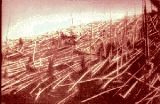
Tunguska event

Encyclopedia
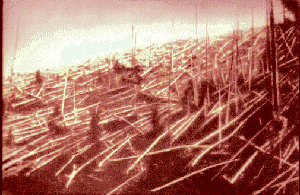
Explosion
An explosion is a rapid increase in volume and release of energy in an extreme manner, usually with the generation of high temperatures and the release of gases. An explosion creates a shock wave. If the shock wave is a supersonic detonation, then the source of the blast is called a "high explosive"...
that occurred near the Podkamennaya Tunguska River
Podkamennaya Tunguska River
The Podkamennaya Tunguska is a river in Krasnoyarsk Krai, Russia; it is an eastern tributary of the Yenisei and has a length of . The name of the river comes from the fact that it flows under pebble fields without open water...
in what is now Krasnoyarsk Krai
Krasnoyarsk Krai
Krasnoyarsk Krai is a federal subject of Russia . It is the second largest federal subject after the Sakha Republic, and Russia's largest krai, occupying an area of , which is 13% of the country's total territory. The administrative center of the krai is the city of Krasnoyarsk...
, Russia, at about 7:14 a.m. KRAT
Krasnoyarsk Time
Krasnoyarsk Time is the time zone eight hours ahead of UTC and 4 hours ahead of Moscow Time . KRAT is the official time zone for central and east Siberian regions of Krasnoyarsk Krai, Khakassia and Tuva....
(0:14 UT
Universal Time
Universal Time is a time scale based on the rotation of the Earth. It is a modern continuation of Greenwich Mean Time , i.e., the mean solar time on the Prime Meridian at Greenwich, and GMT is sometimes used loosely as a synonym for UTC...
) on , 1908.
The explosion is believed to have been caused by the air burst
Air burst
An air burst is the detonation of an explosive device such as an anti-personnel artillery shell or a nuclear weapon in the air instead of on contact with the ground or target or a delayed armor piercing explosion....
of a large meteoroid
Meteoroid
A meteoroid is a sand- to boulder-sized particle of debris in the Solar System. The visible path of a meteoroid that enters Earth's atmosphere is called a meteor, or colloquially a shooting star or falling star. If a meteoroid reaches the ground and survives impact, then it is called a meteorite...
or comet
Comet
A comet is an icy small Solar System body that, when close enough to the Sun, displays a visible coma and sometimes also a tail. These phenomena are both due to the effects of solar radiation and the solar wind upon the nucleus of the comet...
fragment at an altitude of 5 – above the Earth
Earth
Earth is the third planet from the Sun, and the densest and fifth-largest of the eight planets in the Solar System. It is also the largest of the Solar System's four terrestrial planets...
's surface. Different studies have yielded varying estimates of the object's size, with general agreement that it was a few tens of metres across.
The number of scholarly publications on the problem of the Tunguska explosion since 1908 may be estimated at about 1,000 (mainly in Russian). Many scientists have participated in Tunguska studies, the best-known of them being Leonid Kulik
Leonid Kulik
Leonid Alekseyevich Kulik was a Russian mineralogist who is noted for his research into meteorites....
, Yevgeny Krinov
Yevgeny Krinov
Yevgeny Leonidovich Krinov , D.G.S., was a Soviet Russian astronomer and geologist, born in Otyassakh in the Tambov region of the Russian Empire...
, Kirill Florensky, Nikolai Vladimirovich Vasiliev and Wilhelm Fast.
Although the meteoroid or comet burst in the air rather than hitting the surface, this event is still referred to as an impact
Impact event
An impact event is the collision of a large meteorite, asteroid, comet, or other celestial object with the Earth or another planet. Throughout recorded history, hundreds of minor impact events have been reported, with some occurrences causing deaths, injuries, property damage or other significant...
. Estimates of the energy of the blast range from 5 to as high as 30 megatons of TNT
TNT equivalent
TNT equivalent is a method of quantifying the energy released in explosions. The ton of TNT is a unit of energy equal to 4.184 gigajoules, which is approximately the amount of energy released in the detonation of one ton of TNT...
(21–130 PJ), with 10 – the most likely—roughly equal to the United States' Castle Bravo
Castle Bravo
Castle Bravo was the code name given to the first U.S. test of a dry fuel thermonuclear hydrogen bomb device, detonated on March 1, 1954 at Bikini Atoll, Marshall Islands, as the first test of Operation Castle. Castle Bravo was the most powerful nuclear device ever detonated by the United States ,...
thermonuclear bomb tested on March 1, 1954, about 1,000 times more powerful than the atomic bomb
Little Boy
"Little Boy" was the codename of the atomic bomb dropped on Hiroshima on August 6, 1945 by the Boeing B-29 Superfortress Enola Gay, piloted by Colonel Paul Tibbets of the 393rd Bombardment Squadron, Heavy, of the United States Army Air Forces. It was the first atomic bomb to be used as a weapon...
dropped on Hiroshima
Atomic bombings of Hiroshima and Nagasaki
During the final stages of World War II in 1945, the United States conducted two atomic bombings against the cities of Hiroshima and Nagasaki in Japan, the first on August 6, 1945, and the second on August 9, 1945. These two events are the only use of nuclear weapons in war to date.For six months...
, Japan, and about one-third the power of the Tsar Bomba
Tsar Bomba
Tsar Bomba is the nickname for the AN602 hydrogen bomb, the most powerful nuclear weapon ever detonated. It was also referred to as Kuz'kina Mat , in this usage meaning "something that has not been seen before"....
, the largest nuclear weapon ever detonated. The explosion knocked over an estimated 80 million trees covering 2150 square kilometres (830.1 sq mi). It is estimated that the shock wave from the blast would have measured 5.0 on the Richter scale
Richter magnitude scale
The expression Richter magnitude scale refers to a number of ways to assign a single number to quantify the energy contained in an earthquake....
. An explosion of this magnitude is capable of destroying a large metropolitan area
Metropolitan area
The term metropolitan area refers to a region consisting of a densely populated urban core and its less-populated surrounding territories, sharing industry, infrastructure, and housing. A metropolitan area usually encompasses multiple jurisdictions and municipalities: neighborhoods, townships,...
. This possibility has helped to spark discussion of asteroid deflection strategies
Asteroid deflection strategies
Asteroid mitigation strategies are "planetary defense" methods by which near-Earth objects could be diverted, preventing potentially catastrophic impact events. A sufficiently large impact would cause massive tsunamis or an impact winter, or both...
.
The Tunguska event is the largest impact event over land in Earth
Earth
Earth is the third planet from the Sun, and the densest and fifth-largest of the eight planets in the Solar System. It is also the largest of the Solar System's four terrestrial planets...
's recent history. Impacts of similar size over remote ocean areas would most likely have gone unnoticed before the advent of global satellite
Satellite
In the context of spaceflight, a satellite is an object which has been placed into orbit by human endeavour. Such objects are sometimes called artificial satellites to distinguish them from natural satellites such as the Moon....
monitoring in the 1960s and 1970s.
Description

Evenks
The Evenks are a Tungusic people of Northern Asia. In Russia, the Evenks are recognized as one of the Indigenous peoples of the Russian North, with a population of 35,527...
natives and Russian settlers in the hills northwest of Lake Baikal
Lake Baikal
Lake Baikal is the world's oldest at 30 million years old and deepest lake with an average depth of 744.4 metres.Located in the south of the Russian region of Siberia, between Irkutsk Oblast to the northwest and the Buryat Republic to the southeast, it is the most voluminous freshwater lake in the...
observed a column of bluish light, nearly as bright as the Sun
Sun
The Sun is the star at the center of the Solar System. It is almost perfectly spherical and consists of hot plasma interwoven with magnetic fields...
, moving across the sky. About 10 minutes later, there was a flash and a sound similar to artillery fire. Eyewitnesses closer to the explosion reported the sound source moving east to north. The sounds were accompanied by a shock wave
Shock wave
A shock wave is a type of propagating disturbance. Like an ordinary wave, it carries energy and can propagate through a medium or in some cases in the absence of a material medium, through a field such as the electromagnetic field...
that knocked people off their feet and broke windows hundreds of kilometres away. The majority of witnesses reported only the sounds and the tremors, and not the sighting of the explosion. Eyewitness accounts differ as to the sequence of events and their overall duration.
The explosion registered on seismic stations
Seismology
Seismology is the scientific study of earthquakes and the propagation of elastic waves through the Earth or through other planet-like bodies. The field also includes studies of earthquake effects, such as tsunamis as well as diverse seismic sources such as volcanic, tectonic, oceanic,...
across Eurasia
Eurasia
Eurasia is a continent or supercontinent comprising the traditional continents of Europe and Asia ; covering about 52,990,000 km2 or about 10.6% of the Earth's surface located primarily in the eastern and northern hemispheres...
. In some places the shock wave would have been equivalent to an earthquake of 5.0 on the Richter scale. It also produced fluctuations in atmospheric pressure
Atmospheric pressure
Atmospheric pressure is the force per unit area exerted into a surface by the weight of air above that surface in the atmosphere of Earth . In most circumstances atmospheric pressure is closely approximated by the hydrostatic pressure caused by the weight of air above the measurement point...
strong enough to be detected in Great Britain. Over the next few days, night skies in Asia and Europe were aglow; it has been theorized that this was due to light passing through high-altitude ice
Ice
Ice is water frozen into the solid state. Usually ice is the phase known as ice Ih, which is the most abundant of the varying solid phases on the Earth's surface. It can appear transparent or opaque bluish-white color, depending on the presence of impurities or air inclusions...
particles formed at extremely cold temperatures, a phenomenon that occurred again when the Space Shuttle
Space Shuttle
The Space Shuttle was a manned orbital rocket and spacecraft system operated by NASA on 135 missions from 1981 to 2011. The system combined rocket launch, orbital spacecraft, and re-entry spaceplane with modular add-ons...
re-entered the Earth's atmosphere. In the United States, the Smithsonian Astrophysical Observatory
Smithsonian Astrophysical Observatory
The Smithsonian Astrophysical Observatory is a research institute of the Smithsonian Institution headquartered in Cambridge, Massachusetts, where it is joined with the Harvard College Observatory to form the Harvard-Smithsonian Center for Astrophysics .-History:The SAO was founded in 1890 by...
and the Mount Wilson Observatory
Mount Wilson Observatory
The Mount Wilson Observatory is an astronomical observatory in Los Angeles County, California, United States. The MWO is located on Mount Wilson, a 5,715 foot peak in the San Gabriel Mountains near Pasadena, northeast of Los Angeles...
observed a decrease in atmospheric transparency
Atmosphere
An atmosphere is a layer of gases that may surround a material body of sufficient mass, and that is held in place by the gravity of the body. An atmosphere may be retained for a longer duration, if the gravity is high and the atmosphere's temperature is low...
that lasted for several months, from suspended dust.
Selected eyewitness reports
- Testimony of S. Semenov, as recorded by Leonid KulikLeonid KulikLeonid Alekseyevich Kulik was a Russian mineralogist who is noted for his research into meteorites....
's expedition in 1930.
- Testimony of Chuchan of Shanyagir tribe, as recorded by I.M. Suslov in 1926.
- Sibir newspaper, July 2, 1908
- Siberian Life newspaper, July 27, 1908
- Krasnoyaretz newspaper, July 13, 1908
History
There was little scientific curiosity about the impact at the time, possibly due to the isolation of the Tunguska region. If there were any early expeditions to the site, the records were likely to have been lost during the subsequent chaotic years—World War IWorld War I
World War I , which was predominantly called the World War or the Great War from its occurrence until 1939, and the First World War or World War I thereafter, was a major war centred in Europe that began on 28 July 1914 and lasted until 11 November 1918...
, the Russian Revolution of 1917 and the Russian Civil War
Russian Civil War
The Russian Civil War was a multi-party war that occurred within the former Russian Empire after the Russian provisional government collapsed to the Soviets, under the domination of the Bolshevik party. Soviet forces first assumed power in Petrograd The Russian Civil War (1917–1923) was a...
.
The first recorded expedition arrived at the scene more than a decade after the event. In 1921, the Russian mineralogist
Mineralogy
Mineralogy is the study of chemistry, crystal structure, and physical properties of minerals. Specific studies within mineralogy include the processes of mineral origin and formation, classification of minerals, their geographical distribution, as well as their utilization.-History:Early writing...
Leonid Kulik
Leonid Kulik
Leonid Alekseyevich Kulik was a Russian mineralogist who is noted for his research into meteorites....
, visiting the Podkamennaya Tunguska River basin as part of a survey for the Soviet Academy of Sciences
Russian Academy of Sciences
The Russian Academy of Sciences consists of the national academy of Russia and a network of scientific research institutes from across the Russian Federation as well as auxiliary scientific and social units like libraries, publishers and hospitals....
, deduced from local accounts that the explosion had been caused by a giant meteorite impact
Impact event
An impact event is the collision of a large meteorite, asteroid, comet, or other celestial object with the Earth or another planet. Throughout recorded history, hundreds of minor impact events have been reported, with some occurrences causing deaths, injuries, property damage or other significant...
. He persuaded the Soviet
Soviet Union
The Soviet Union , officially the Union of Soviet Socialist Republics , was a constitutionally socialist state that existed in Eurasia between 1922 and 1991....
government to fund an expedition to the Tunguska region, based on the prospect of meteoric iron that could be salvaged to aid Soviet industry. Kulik's party eventually undertook an expedition in 1927.
Evenks
The Evenks are a Tungusic people of Northern Asia. In Russia, the Evenks are recognized as one of the Indigenous peoples of the Russian North, with a population of 35,527...
hunters to guide his party to the impact site. Reaching the explosion site was an extremely arduous task. Upon reaching an area just south of the site, the superstitious Evenki hunters would go no further, fearing what they called the Valleymen. Kulik had to return to the nearby village, and his party was delayed for several days while they sought new guides.
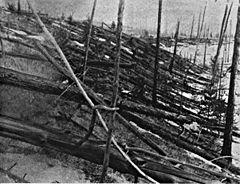
The spectacle that confronted Kulik as he stood on a ridge overlooking the devastated area was overwhelming. To the explorers' surprise, no crater
Impact crater
In the broadest sense, the term impact crater can be applied to any depression, natural or manmade, resulting from the high velocity impact of a projectile with a larger body...
was to be found. There was instead around ground zero
Ground zero
The term ground zero describes the point on the Earth's surface closest to a detonation...
a vast zone (8 kilometers [5 mi] across) of trees scorched and devoid of branches, but standing upright. Those farther away had been partly scorched and knocked down in a direction away from the centre. Much later, in the 1960s, it was established that the zone of leveled forest occupied an area of some 2150 square kilometres (830.1 sq mi), its shape resembling a gigantic spread-eagled butterfly with a “wingspan” of 70 kilometres (43.5 mi) and a “body length” of 55 kilometres (34.2 mi).
Upon closer examination, Kulik located holes which he erroneously concluded were meteorite holes; however, he did not have the means at this time to excavate the holes.
During the next ten years there were three more expeditions to the area. Kulik found several dozens of little “pothole” bogs, each some 10 to 50 m (32.8 to 164 ) in diameter, that he thought might be meteoric craters. After a laborious exercise in draining one of these bog
Bog
A bog, quagmire or mire is a wetland that accumulates acidic peat, a deposit of dead plant material—often mosses or, in Arctic climates, lichens....
s (the so-called “Suslov’s crater”, 32 metres (105 ft) in diameter), he found there was an old stump
Tree stump
After a tree has been cut and felled, the stump or tree stump is usually a small remaining portion of the trunk with the roots still in the ground. Stumps may show the age-defining rings of a tree. The study of these rings is known as dendrochronology....
on the bottom, ruling out the possibility that it was a meteoric crater. In 1938, Kulik arranged for an aerial photographic survey of the area covering the central part of the leveled forest (some 250 square kilometres (96.5 sq mi)). The negatives of these aerial photographs (1,500 negatives, each 18 × 18 cm or 7.1 x 7.1 in) were burned in 1975 by order of Yevgeny Krinov
Yevgeny Krinov
Yevgeny Leonidovich Krinov , D.G.S., was a Soviet Russian astronomer and geologist, born in Otyassakh in the Tambov region of the Russian Empire...
, then Chairman of the Committee on Meteorites of the USSR Academy of Sciences. It was done under the pretext that they were a fire hazard, but the truth may have been the active dislike by official meteorite specialists of anything associated with an unyielding enigma. However, positive imprints could be preserved for further studies in the Russian city of Tomsk
Tomsk
Tomsk is a city and the administrative center of Tomsk Oblast, Russia, located on the Tom River. One of the oldest towns in Siberia, Tomsk celebrated its 400th anniversary in 2004...
.
Despite the large amount of devastation, there was no crater to be seen.
Expeditions sent to the area in the 1950s and 1960s found microscopic silicate
Silicate
A silicate is a compound containing a silicon bearing anion. The great majority of silicates are oxides, but hexafluorosilicate and other anions are also included. This article focuses mainly on the Si-O anions. Silicates comprise the majority of the earth's crust, as well as the other...
and magnetite
Magnetite
Magnetite is a ferrimagnetic mineral with chemical formula Fe3O4, one of several iron oxides and a member of the spinel group. The chemical IUPAC name is iron oxide and the common chemical name is ferrous-ferric oxide. The formula for magnetite may also be written as FeO·Fe2O3, which is one part...
spheres in siftings of the soil. Similar spheres were predicted to exist in the felled trees, although they could not be detected by contemporary means. Later expeditions did identify such spheres in the resin of the trees. Chemical analysis showed that the spheres contained high proportions of nickel
Nickel
Nickel is a chemical element with the chemical symbol Ni and atomic number 28. It is a silvery-white lustrous metal with a slight golden tinge. Nickel belongs to the transition metals and is hard and ductile...
relative to iron
Iron
Iron is a chemical element with the symbol Fe and atomic number 26. It is a metal in the first transition series. It is the most common element forming the planet Earth as a whole, forming much of Earth's outer and inner core. It is the fourth most common element in the Earth's crust...
, which is also found in meteorite
Meteorite
A meteorite is a natural object originating in outer space that survives impact with the Earth's surface. Meteorites can be big or small. Most meteorites derive from small astronomical objects called meteoroids, but they are also sometimes produced by impacts of asteroids...
s, leading to the conclusion they were of extraterrestrial origin. The concentration of the spheres in different regions of the soil was also found to be consistent with the expected distribution of debris from a meteorite airburst. Later studies of the spheres found unusual ratios of numerous other metals relative to the surrounding environment, which was taken as further evidence of their extraterrestrial origin.
Chemical analysis of peat bogs from the area also revealed numerous anomalies considered consistent with an impact event. The isotopic signature
Isotopic signature
An isotopic signature is a ratio of stable or unstable isotopes of particular elements found in an investigated material...
s of stable carbon, hydrogen, and nitrogen isotopes at the layer of the bogs corresponding to 1908 were found to be inconsistent with the isotopic ratios measured in the adjacent layers, and this abnormality was not found in bogs located outside the area. The region of the bogs showing these anomalous signatures also contains an unusually high proportion of iridium
Iridium
Iridium is the chemical element with atomic number 77, and is represented by the symbol Ir. A very hard, brittle, silvery-white transition metal of the platinum family, iridium is the second-densest element and is the most corrosion-resistant metal, even at temperatures as high as 2000 °C...
, similar to the iridium layer found in the K–T boundary
K–T boundary
The K–T boundary is a geological signature, usually a thin band, dated to 65.5 ± 0.3 Ma ago. K is the traditional abbreviation for the Cretaceous period, and T is the abbreviation for the Tertiary period...
. These unusual proportions are believed to result from debris from the falling body that deposited in the bogs. The nitrogen is believed to have been deposited as acid rain
Acid rain
Acid rain is a rain or any other form of precipitation that is unusually acidic, meaning that it possesses elevated levels of hydrogen ions . It can have harmful effects on plants, aquatic animals, and infrastructure. Acid rain is caused by emissions of carbon dioxide, sulfur dioxide and nitrogen...
, a suspected fallout from the explosion.
Meteoroid airburst
The leading scientific explanation for the explosion is the airburstAir burst
An air burst is the detonation of an explosive device such as an anti-personnel artillery shell or a nuclear weapon in the air instead of on contact with the ground or target or a delayed armor piercing explosion....
of a meteoroid
Meteoroid
A meteoroid is a sand- to boulder-sized particle of debris in the Solar System. The visible path of a meteoroid that enters Earth's atmosphere is called a meteor, or colloquially a shooting star or falling star. If a meteoroid reaches the ground and survives impact, then it is called a meteorite...
6–10 kilometres (4–6 miles) above Earth's surface.
Meteoroids enter Earth's atmosphere
Earth's atmosphere
The atmosphere of Earth is a layer of gases surrounding the planet Earth that is retained by Earth's gravity. The atmosphere protects life on Earth by absorbing ultraviolet solar radiation, warming the surface through heat retention , and reducing temperature extremes between day and night...
from outer space
Outer space
Outer space is the void that exists between celestial bodies, including the Earth. It is not completely empty, but consists of a hard vacuum containing a low density of particles: predominantly a plasma of hydrogen and helium, as well as electromagnetic radiation, magnetic fields, and neutrinos....
every day, usually travelling at a speed of more than 10 kilometres per second (6 miles/sec or 21,600 mph). The heat
Heat
In physics and thermodynamics, heat is energy transferred from one body, region, or thermodynamic system to another due to thermal contact or thermal radiation when the systems are at different temperatures. It is often described as one of the fundamental processes of energy transfer between...
generated by compression of air in front of the body (ram pressure
Ram pressure
In physics, ram pressure is a pressure exerted on a body which is moving through a fluid medium. It causes a strong drag force to be exerted on the body. It is given by:P= \rho v^2...
) as it travels through the atmosphere is immense and most meteoroids burn up or explode before they reach the ground. Since the second half of the 20th century, close monitoring of Earth's atmosphere has led to the discovery that such meteoroid airbursts occur rather frequently. A stony meteoroid of about 10 metres (30 ft) in diameter can produce an explosion of around 20 kilotons
TNT equivalent
TNT equivalent is a method of quantifying the energy released in explosions. The ton of TNT is a unit of energy equal to 4.184 gigajoules, which is approximately the amount of energy released in the detonation of one ton of TNT...
, similar to that of the Fat Man
Fat Man
"Fat Man" is the codename for the atomic bomb that was detonated over Nagasaki, Japan, by the United States on August 9, 1945. It was the second of the only two nuclear weapons to be used in warfare to date , and its detonation caused the third man-made nuclear explosion. The name also refers more...
bomb dropped on Nagasaki
Atomic bombings of Hiroshima and Nagasaki
During the final stages of World War II in 1945, the United States conducted two atomic bombings against the cities of Hiroshima and Nagasaki in Japan, the first on August 6, 1945, and the second on August 9, 1945. These two events are the only use of nuclear weapons in war to date.For six months...
, and data released by the U.S. Air Force's Defense Support Program
Defense Support Program
The Defense Support Program is a program of the U.S. Air Force that operates the reconnaissance satellites which form the principal component of the Satellite Early Warning System currently used by the United States....
indicate that such explosions occur high in the upper atmosphere more than once a year. Tunguska-like megaton-range
TNT equivalent
TNT equivalent is a method of quantifying the energy released in explosions. The ton of TNT is a unit of energy equal to 4.184 gigajoules, which is approximately the amount of energy released in the detonation of one ton of TNT...
events are much rarer. Eugene Shoemaker
Eugene Merle Shoemaker
Eugene Merle Shoemaker , American geologist, was one of the founders of the fields of planetary science....
estimated that such events occur about once every 300 years.
Blast patterns
The explosion's effect on the trees near ground zeroGround zero
The term ground zero describes the point on the Earth's surface closest to a detonation...
was replicated during atmospheric nuclear tests
Nuclear testing
Nuclear weapons tests are experiments carried out to determine the effectiveness, yield and explosive capability of nuclear weapons. Throughout the twentieth century, most nations that have developed nuclear weapons have tested them...
in the 1950s and 1960s. These effects are caused by the shock wave
Shock wave
A shock wave is a type of propagating disturbance. Like an ordinary wave, it carries energy and can propagate through a medium or in some cases in the absence of a material medium, through a field such as the electromagnetic field...
produced by large explosion
Explosion
An explosion is a rapid increase in volume and release of energy in an extreme manner, usually with the generation of high temperatures and the release of gases. An explosion creates a shock wave. If the shock wave is a supersonic detonation, then the source of the blast is called a "high explosive"...
s. The trees directly below the explosion are stripped as the blast wave moves vertically downward, while trees farther away are knocked over because the blast wave is travelling closer to the horizontal when it reaches them.
Soviet experiments performed in the mid-1960s, with model forests (made of match
Match
A match is a tool for starting a fire under controlled conditions. A typical modern match is made of a small wooden stick or stiff paper. One end is coated with a material that can be ignited by frictional heat generated by striking the match against a suitable surface...
es on wire stakes) and small explosive charges slid downward on wires, produced butterfly shaped blast patterns strikingly similar to the pattern found at the Tunguska site. The experiments suggested that the object had approached at an angle of roughly 30 degrees from the ground and 115 degrees from north and had exploded in mid-air.
Asteroid or comet?
The composition of the Tunguska body may no longer be a matter of dispute. In 1930, the British astronomer F.J.W. WhippleFrancis John Welsh Whipple
Francis John Welsh Whipple was a British mathematician and meteorologist. From 1925 to 1939 he was superintendent of the Kew Observatory.-Biography:...
suggested that the Tunguska body was a small comet
Comet
A comet is an icy small Solar System body that, when close enough to the Sun, displays a visible coma and sometimes also a tail. These phenomena are both due to the effects of solar radiation and the solar wind upon the nucleus of the comet...
. A cometary meteorite, being composed primarily of ice
Ice
Ice is water frozen into the solid state. Usually ice is the phase known as ice Ih, which is the most abundant of the varying solid phases on the Earth's surface. It can appear transparent or opaque bluish-white color, depending on the presence of impurities or air inclusions...
and dust
Dust
Dust consists of particles in the atmosphere that arise from various sources such as soil dust lifted up by wind , volcanic eruptions, and pollution...
, could have been completely vaporized by the impact with the Earth's atmosphere, leaving no obvious traces. The comet hypothesis was further supported by the glowing skies (or "skyglows" or "bright nights") observed across Europe for several evenings after the impact, possibly explained by dust and ice that had been dispersed from the comet's tail across the upper atmosphere. The cometary hypothesis gained a general acceptance amongst Soviet Tunguska investigators by the 1960s.
In 1978, astronomer Ľubor Kresák
Lubor Kresák
Ľubor Kresák was a Slovak astronomer.He discovered two comets: the periodic comet 41P/Tuttle-Giacobini-Kresak and the non-periodic C/1954 M2 ....
suggested that the body was a fragment of the short-period Comet Encke
Comet Encke
Comet Encke or Encke's Comet is a periodic comet that completes an orbit of the Sun once every three years — the shortest period of any known comet...
, which is responsible for the Beta Taurid meteor shower
Meteor shower
A meteor shower is a celestial event in which a number of meteors are observed to radiate from one point in the night sky. These meteors are caused by streams of cosmic debris called meteoroids entering Earth's atmosphere at extremely high speeds on parallel trajectories. Most meteors are smaller...
: the Tunguska event coincided with a peak in that shower, and the approximate trajectory of the Tunguska impactor is consistent with what would be expected from such a fragment. It is now known that bodies of this kind explode at frequent intervals tens to hundreds of kilometres above the ground. Military satellites have been observing these explosions for decades.
In 1983, astronomer Zdeněk Sekanina published a paper criticizing the comet hypothesis. He pointed out that a body composed of cometary material, travelling through the atmosphere along such a shallow trajectory, ought to have disintegrated, whereas the Tunguska body apparently remained intact into the lower atmosphere. Sekanina argued that the evidence pointed to a dense, rocky object, probably of asteroid
Asteroid
Asteroids are a class of small Solar System bodies in orbit around the Sun. They have also been called planetoids, especially the larger ones...
al origin. This hypothesis was further boosted in 2001, when Farinella, Foschini, et al. released a study suggesting that the object had arrived from the direction of the asteroid belt
Asteroid belt
The asteroid belt is the region of the Solar System located roughly between the orbits of the planets Mars and Jupiter. It is occupied by numerous irregularly shaped bodies called asteroids or minor planets...
.
Proponents of the comet hypothesis have suggested that the object was an extinct comet
Extinct comet
Extinct comets are comets that have expelled most of their volatile ice and have little left to form a tail or coma. The volatile material contained in the comet nucleus evaporates away, and all that remains is inert rock or rubble that can resemble an asteroid. Comets may go through a transition...
with a stony mantle that allowed it to penetrate the atmosphere.
The chief difficulty in the asteroid hypothesis is that a stony object should have produced a large crater
Impact crater
In the broadest sense, the term impact crater can be applied to any depression, natural or manmade, resulting from the high velocity impact of a projectile with a larger body...
where it struck the ground, but no such crater has been found. It has been hypothesized that the passage of the asteroid through the atmosphere caused pressures and temperatures to build up to a point where the asteroid abruptly disintegrated in a huge explosion. The destruction would have to have been so complete that no remnants of substantial size survived, and the material scattered into the upper atmosphere during the explosion would have caused the skyglows. Models published in 1993 suggested that the stony body would have been about 60 metres (196.9 ft) across, with physical properties somewhere between an ordinary chondrite
Chondrite
Chondrites are stony meteorites that have not been modified due to melting or differentiation of the parent body. They formed when various types of dust and small grains that were present in the early solar system accreted to form primitive asteroids...
and a carbonaceous chondrite
Carbonaceous chondrite
Carbonaceous chondrites or C chondrites are a class of chondritic meteorites comprising at least 7 known groups and many ungrouped meteorites. They include some of the most primitive known meteorites...
.
Christopher Chyba and others have proposed a process whereby a stony meteorite could have exhibited the behavior of the Tunguska impactor. Their models show that when the forces opposing a body's descent become greater than the cohesive force holding it together, it blows apart, releasing nearly all its energy at once. The result is no crater, and damage distributed over a fairly wide radius, all of the damage being blast and thermal.
Three-dimensional numerical modelling of the Tunguska impact done by Utyuzhnikov and Rudenko in 2008 supports the comet hypothesis. According to their results, the comet matter dispersed in the atmosphere, while the destruction of the forest was caused by the shock wave.
During the 1990s, Italian researchers extracted resin
Resin
Resin in the most specific use of the term is a hydrocarbon secretion of many plants, particularly coniferous trees. Resins are valued for their chemical properties and associated uses, such as the production of varnishes, adhesives, and food glazing agents; as an important source of raw materials...
from the core of the trees in the area of impact to examine trapped particles that were present during the 1908 event. They found high levels of material commonly found in rocky asteroids and rarely found in comets.
Kelly et al. (2009) contend that the impact was caused by a comet because of the sightings of noctilucent clouds following the impact, a phenomenon caused by massive amounts of water vapor in the upper atmosphere. They compared the noctilucent cloud phenomenon to the exhaust plume from NASA's Endeavour space shuttle
Space Shuttle Endeavour
Space Shuttle Endeavour is one of the retired orbiters of the Space Shuttle program of NASA, the space agency of the United States. Endeavour was the fifth and final spaceworthy NASA space shuttle to be built, constructed as a replacement for Challenger...
.
In 2010, an expedition of Vladimir Alexeev, with scientists from the Troitsk Innovation and Nuclear Research Institute (TRINITY), used ground penetrating radar to examine the Suslov crater at the Tunguska site. What they found was that the crater was created by the violent impact of a celestial body. The layers of the crater consisted of modern permafrost on top, older damaged layers underneath and finally, deep below, fragments of the celestial body were discovered. Preliminary analysis showed that it was a huge piece of ice that shattered on impact, which seem to support the theory that a comet caused the cataclysm.
Lake Cheko
In June 2007, scientists from the University of BolognaUniversity of Bologna
The Alma Mater Studiorum - University of Bologna is the oldest continually operating university in the world, the word 'universitas' being first used by this institution at its foundation. The true date of its founding is uncertain, but believed by most accounts to have been 1088...
identified a lake in the Tunguska region as a possible impact crater from the event. They do not dispute that the Tunguska body exploded in midair but believe that a one-meter fragment survived the explosion and struck the ground. Lake Cheko
Lake Cheko
Lake Cheko is a small freshwater lake in Siberia, near the Podkamennaya Tunguska River, in what is now the Evenkiysky District of the Krasnoyarsk Krai...
is a small, bowl-shaped lake approximately 8 kilometres north-northwest of the hypocenter. The hypothesis has been disputed by other impact crater specialists. A 1961 investigation had dismissed a modern origin of Lake Cheko, saying that the presence of metres-thick silt
Silt
Silt is granular material of a size somewhere between sand and clay whose mineral origin is quartz and feldspar. Silt may occur as a soil or as suspended sediment in a surface water body...
deposits at the lake's bed suggests an age of at least 5,000 years; but more recent research suggests that only a meter or so of the sediment layer on the lake bed is "normal lacustrine sedimentation," a depth indicating a much younger lake of about 100 years. Acoustic-echo soundings of the lake floor provide support for the hypothesis that the lake was formed by the Tunguska event. The soundings revealed a conical shape for the lake bed, which is consistent with an impact crater.
Magnetic readings indicate a possible meter-sized chunk of rock below the lake's deepest point that may be a fragment of the colliding body. Finally, the lake's long axis points to the hypocenter of the Tunguska explosion, about 7 kilometres (4.3 mi) away. Work is still being done at Lake Cheko to determine its origins.
The conclusions of the Italian scientist were published on the website of the University of Bologna. The main points are that "Cheko, a small lake located in Siberia close to the epicentre of the 1908 Tunguska explosion, might fill a crater left by the impact of a fragment of a Cosmic Body. Sediment cores from the lake's bottom were studied to support or reject this hypothesis. A 175 centimetres (68.9 in)-long core, collected near the center of the lake, consists of an upper c. one-metre (39 in)-thick sequence of lacustrine deposits overlaying coarser chaotic material. 210Pb and 137Cs indicate that the transition from lower to upper sequence occurred close to the time of the Tunguska Event. Pollen analysis reveals that remains of aquatic plants are abundant in the top post-1908 sequence but are absent in the lower pre-1908 portion of the core. These results, including organic C, N and δ13C data, suggest that Lake Cheko formed at the time of the Tunguska Event."
Speculative hypotheses
The behaviour of meteorites in the Earth's atmosphere was less well understood during the early decades of the 20th century. Due to this, as well as the paucity of relevant data resulting from Soviet secrecy during the Cold WarCold War
The Cold War was the continuing state from roughly 1946 to 1991 of political conflict, military tension, proxy wars, and economic competition between the Communist World—primarily the Soviet Union and its satellite states and allies—and the powers of the Western world, primarily the United States...
, a great many other hypotheses for the Tunguska event have sprung up, none of which are accepted by the scientific community.
Comet 2005 NB56
One study "suggests that a chunk of Comet 2005 NB562005 NB56
', also written as 2005 NB56, is a near-Earth object. This small body has been suggested as a possible source of the Tunguska event on June 30, 1908.-Controversial study:...
caused the 5–10 megaton fireball, bouncing off the atmosphere and back into orbit around the sun." The scientists involved in the study claim that the object that caused the event will pass close to Earth
Earth
Earth is the third planet from the Sun, and the densest and fifth-largest of the eight planets in the Solar System. It is also the largest of the Solar System's four terrestrial planets...
again in 2045.
Natural H-bomb
In 1989, Serge J.D. D'Alessio and Archie A. Harms suggested that some of the deuteriumDeuterium
Deuterium, also called heavy hydrogen, is one of two stable isotopes of hydrogen. It has a natural abundance in Earth's oceans of about one atom in of hydrogen . Deuterium accounts for approximately 0.0156% of all naturally occurring hydrogen in Earth's oceans, while the most common isotope ...
in a comet entering the Earth's atmosphere may have undergone a nuclear fusion
Nuclear fusion
Nuclear fusion is the process by which two or more atomic nuclei join together, or "fuse", to form a single heavier nucleus. This is usually accompanied by the release or absorption of large quantities of energy...
reaction, leaving a distinctive signature in the form of carbon-14. They concluded that any release of nuclear energy would have been almost negligible. Independently, in 1990, César Sirvent proposed that a deuterium comet, i.e., a comet with an anomalous high concentration of deuterium in its composition, could have exploded as a natural hydrogen bomb, generating most of the energy released. The sequence would be first a mechanical or kinetic explosion, triggering a thermonuclear reaction. These proposals are inconsistent with our knowledge of the composition of comets and of the temperature and pressure conditions necessary for initiating a nuclear fusion reaction. Studies have found the concentration of radioactive isotopes in the blast region to be inconsistent with those expected following a nuclear explosion, fusion or otherwise.
Edward Drobyshevski, has suggested that the event was caused by the explosion of the hydrogen-saturated part of the nucleus of a comet that struck the Earth's atmosphere, with most of the remaining comet nucleus surviving, and possibly continuing to orbit the sun.
Black hole
In 1973, Albert A. Jackson and Michael P. Ryan, physicists at the University of Texas, proposed that the Tunguska event was caused by a small (around 1017 kg to 1019 kg) black holeBlack hole
A black hole is a region of spacetime from which nothing, not even light, can escape. The theory of general relativity predicts that a sufficiently compact mass will deform spacetime to form a black hole. Around a black hole there is a mathematically defined surface called an event horizon that...
passing through the Earth. This hypothesis is considered flawed, as there was no so-called exit event—a second explosion occurring as the black hole, having tunnelled through the Earth, shot out the other side on its way back into space. Based on the direction of impact, the exit event would have occurred in the North Atlantic, closer than the impact event to the seismic recording stations that collected much of the evidence of the event. The hypothesis also fails to account for evidence that cosmic material was deposited by the extraterrestrial body, including dust trails in the atmosphere and the distribution of high-nickel magnetic spherules around the impact area.
Antimatter
In 1941, Lincoln LaPazLincoln LaPaz
Lincoln LaPaz was an American astronomer from the University of New Mexico and a pioneer in the study of meteors.He was born in Wichita, Kansas on February 12, 1897 to Charles Melchior LaPaz and Emma Josephine . He earned his Bachelor of Arts in 1920 in mathematics at Fairmont College and also...
, and later in 1965, Clyde Cowan, Chandra R. Atluri, and Willard F. Libby suggested that the Tunguska event was caused by the annihilation of a chunk of antimatter
Antimatter
In particle physics, antimatter is the extension of the concept of the antiparticle to matter, where antimatter is composed of antiparticles in the same way that normal matter is composed of particles...
falling from space. As with the other hypotheses described in this section, this does not account for the mineral debris left in the area of the explosion.
The Wardenclyffe Tower
Oliver Nichelson suggested that the Tunguska explosion may have been the result of an experiment by Nikola TeslaNikola Tesla
Nikola Tesla was a Serbian-American inventor, mechanical engineer, and electrical engineer...
using the Wardenclyffe Tower
Wardenclyffe Tower
Wardenclyffe Tower also known as the Tesla Tower, was an early wireless telecommunications tower designed by Nikola Tesla and intended for commercial trans-Atlantic wireless telephony, broadcasting, and to demonstrate the transmission of power without interconnecting wires...
, performed during one of Admiral Robert Peary
Robert Peary
Robert Edwin Peary, Sr. was an American explorer who claimed to have been the first person, on April 6, 1909, to reach the geographic North Pole...
's North Pole
North Pole
The North Pole, also known as the Geographic North Pole or Terrestrial North Pole, is, subject to the caveats explained below, defined as the point in the northern hemisphere where the Earth's axis of rotation meets its surface...
expeditions.
This theory failed to gain many adherents owing to the lack of positive evidence, the presence of meteoroid fragments in soils and trees from the time, and the fact that the Wardenclyffe Tower was largely or entirely inactive at that time.
Alien spaceship crash
A number of theories based on UFOs have claimed that the Tunguska event was the result of the activities of extraterrestrial beings, including an exploding alien spaceshipSpacecraft
A spacecraft or spaceship is a craft or machine designed for spaceflight. Spacecraft are used for a variety of purposes, including communications, earth observation, meteorology, navigation, planetary exploration and transportation of humans and cargo....
or even an alien weapon going off to "save the Earth from an imminent threat". These claims appear to originate from a science fiction
Science fiction
Science fiction is a genre of fiction dealing with imaginary but more or less plausible content such as future settings, futuristic science and technology, space travel, aliens, and paranormal abilities...
story "The Explosion" by the Soviet writer Alexander Kazantsev
Alexander Kazantsev
Alexander Petrovitch Kazantsev was a popular Soviet science fiction writer and ufologist.-Biography:Born in Akmolinsk, Imperial Russia . He graduated from Tomsk Polytechnic University, and worked in Soviet Research institute of Electromechanics. Kazantsev was a member of Soviet delegation at the...
in 1946, in which a nuclear-powered Martian
Martian
As an adjective, the term martian is used to describe anything pertaining to the planet Mars.However, a Martian is more usually a hypothetical or fictional native inhabitant of the planet Mars. Historically, life on Mars has often been hypothesized, although there is currently no solid evidence of...
spaceship, trying to land on the Earth, meets with a disaster and blows up in mid-air. Kazantsev never visited Hiroshima
Hiroshima
is the capital of Hiroshima Prefecture, and the largest city in the Chūgoku region of western Honshu, the largest island of Japan. It became best known as the first city in history to be destroyed by a nuclear weapon when the United States Army Air Forces dropped an atomic bomb on it at 8:15 A.M...
, but his idea of the above-ground explosion of the Tunguska space body was inspired by the news about the nuclear explosion over that Japanese city, as well as by his talks with some leading Soviet nuclear physicists.
Many events in Kazantsev's tale, which was intended as pure fantasy, were subsequently confused with the actual occurrences at Tunguska. The nuclear-powered UFO hypothesis was adopted by the TV critics Thomas Atkins and John Baxter in their book The Fire Came By (1976). The television series The Secret KGB UFO Files (Phenomenon: The Lost Archives) in 1998, broadcast on Turner Network Television
Turner Network Television
Turner Network Television is an American cable television channel created by media mogul Ted Turner and currently owned by the Turner Broadcasting System division of Time Warner...
, referred to the Tunguska event as "the Russian Roswell
Roswell UFO incident
The Roswell UFO Incident was the recovery of an object that crashed in the general vicinity of Roswell, New Mexico, in June or July 1947, allegedly an extra-terrestrial spacecraft and its alien occupants. Since the late 1970s the incident has been the subject of intense controversy and of...
" and claimed that crashed UFO debris had been recovered from the site. In 2004, a group from the Tunguska Spatial Phenomenon Foundation claimed to have found the wreckage of an alien spacecraft at the site. In 2009, Dr. Yuri Labvin, the president of the Tunguska Spatial Phenomenon Foundation repeated these claims, based upon findings of quartz
Quartz
Quartz is the second-most-abundant mineral in the Earth's continental crust, after feldspar. It is made up of a continuous framework of SiO4 silicon–oxygen tetrahedra, with each oxygen being shared between two tetrahedra, giving an overall formula SiO2. There are many different varieties of quartz,...
slabs with strange markings on them found at the site, which, he claims, represent the remnants of an alien spaceship's control panel.
Geophysical hypothesis
Astrophysicist Wolfgang Kundt has suggested the Tunguska event was caused by the sudden release and subsequent explosion of 10 million tons of natural gasNatural gas
Natural gas is a naturally occurring gas mixture consisting primarily of methane, typically with 0–20% higher hydrocarbons . It is found associated with other hydrocarbon fuel, in coal beds, as methane clathrates, and is an important fuel source and a major feedstock for fertilizers.Most natural...
from within the Earth's crust. The similar verneshot
Verneshot
A verneshot is a hypothetical volcanic eruption event caused by the buildup of gas deep underneath a craton...
hypothesis has also been suggested as a possible cause of the Tunguska event.
Similar events
The Tunguska event is the strongest, but not the only, example of unexplained explosion events or meteorite air-bursts in recent history. There have been a number of similar events, even as the developments in satellite and radar tracking have reduced the likelihood of undetected meteors.See also
- Asteroid 2009 DD452009 DD452009 DD45 is a small Apollo asteroid that passed near Earth at an altitude of on 2 March 2009 at 13:44 UTC. It was discovered by Australian astronomers at the Siding Spring Observatory on 27 February 2009, only three days before its closest approach to the Earth. Its estimated diameter is between...
- Asteroid deflection strategiesAsteroid deflection strategiesAsteroid mitigation strategies are "planetary defense" methods by which near-Earth objects could be diverted, preventing potentially catastrophic impact events. A sufficiently large impact would cause massive tsunamis or an impact winter, or both...
- Cretaceous–Tertiary extinction event, 65.5 million years ago
- Doomsday eventDoomsday eventA doomsday event is a specific, plausibly verifiable or hypothetical occurrence which has an exceptionally destructive effect on the human race...
- Lonar crater, impact either ca. 52,000 or ca. 656,000 years ago
- Sikhote-Alin meteoriteSikhote-Alin MeteoriteSikhote-Alin is an iron meteorite that fell in 1947 on the Sikhote-Alin Mountains in eastern Siberia. This fall is unique in the history of meteorites. Though large iron meteorite falls had been witnessed previously and fragments recovered, never before in recorded history had a fall of this...
, 1947 impact
External links
- Article about the events, special attention to Leonid Kulik on MysteryDatabase.com
- Quasi Three-Dimensional Modeling of Tunguska Comet Impact (1908) Dr. Andrei E. Zlobin, Paper of 2007 Planetary Defense Conference.
- Tunguska Comet Impact 1908
- The Tunguska Event in 1908: Evidence from Tree-Ring Anatomy – Evgenii A. Vaganov, Malkolm K. Hughes, Pavel P. Silkin and Valery D. Nesvetailo, Astrobiology, Volume 4, Number 3, 2004, pp. 391–399
- Tunguska.ru Russian site with a tiny English section. Includes some gorgeous Tunguska photos.
- Tunguska A research group at University of BolognaUniversity of BolognaThe Alma Mater Studiorum - University of Bologna is the oldest continually operating university in the world, the word 'universitas' being first used by this institution at its foundation. The true date of its founding is uncertain, but believed by most accounts to have been 1088...
that has conducted several recent expeditions to the site. - Tunguska pictures Many Tunguska-related pictures with comments in English.
- Preliminary results from the 1961 combined Tunguska meteorite expedition
- Probable asteroidal origin of the Tunguska Cosmic Body A 2001 paper arguing for the asteroidal hypothesis.
- "Russian Alien Spaceship Claims Raise Eyebrows, Skepticism" article, arguing the event was caused by meteor explosion
- "The Vurdalak Conjecture" website explores the science behind the black-hole impact hypothesis.
- 1908 Siberia Explosion. Reconstruction by William K. Hartmann.
- Simulation of such an event & origin of King Tut's glass
- Team makes Tunguska crater claim (BBC News)
- Astronomy Picture of the Day on Tunguska
- Mystery space blast 'solved' (BBC News)
- Sound of the Tunguska event (reconstruction)
- The Tunguska Event 100 Years later NASANASAThe National Aeronautics and Space Administration is the agency of the United States government that is responsible for the nation's civilian space program and for aeronautics and aerospace research...
- There Was a Hot Time in Tunguska That Night
- http://canopycanopycanopy.com/1/tunguska_internationalA discussion of the Tunguska Event's as a test-site for theory in Triple Canopy (online magazine)Triple Canopy (online magazine)Triple Canopy is an online magazine, which was first published in 2008. In an effort to "slow down the Internet," the magazine curates and facilitates new media projects, which engage with the formal possibilities of the web. Its content ranges from art and literature to essays and critical theory...
]