

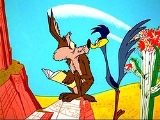
Wile E. Coyote and Road Runner

Encyclopedia
Wile E. Coyote and The Road Runner are a duo of cartoon characters from a series of Looney Tunes
and Merrie Melodies
cartoons. The characters (a coyote
and Greater Roadrunner
) were created by animation director
Chuck Jones
in 1948 for Warner Bros.
, while the template for their adventures was the work of writer Michael Maltese
. The characters star in a long-running series of theatrical cartoon shorts (the first 16 of which were written by Maltese) and occasional made-for-television cartoons.
In each episode, instead of animal senses and cunning, Wile E. Coyote uses absurdly complex contraptions (sometimes in the manner of Rube Goldberg
) and elaborate plans to pursue his quarry.
The Coyote appears separately as an occasional antagonist
of Bugs Bunny
in five shorts from 1952 to 1963: Operation: Rabbit
, To Hare Is Human
, Rabbit's Feat
, Compressed Hare
, and Hare-Breadth Hurry
. While he is generally silent in the Coyote-Road Runner shorts, he speaks with a refined accent in these solo outings (except for Hare-Breadth Hurry), introducing himself as "Wile E. Coyote—super genius", voiced with an upper-class, cultured English accent by Mel Blanc
. The Road Runner vocalizes only with a signature sound, "Beep, Beep", and an occasional tongue noise. The "Meep, Meep" was recorded by Paul Julian
.
To date, 48 cartoons have been made featuring these characters (including the three CGI
shorts), the majority by Chuck Jones.
's book Roughing It
, in which Twain described the coyote as "a long, slim, sick and sorry-looking skeleton" that is "a living, breathing allegory of Want. He is always hungry." Jones said he created the Coyote-Road Runner cartoons as a parody
of traditional "cat and mouse" cartoons such as Tom and Jerry
, which series Jones would work on as a director later in his career.
The Coyote's name of Wile E. is obviously a play on the word "wily." The "E" was said to stand for Ethelbert in one issue of a Looney Tunes comic book, but its writer hadn't intended it to be canon. The Coyote's surname is routinely pronounced with a long "e" (kaɪˈoʊtiː ), but in one cartoon short, To Hare Is Human
, Wile is heard pronouncing it with a diphthong
(kaɪˈoʊteɪ ). Early model sheets for the character prior to his initial appearance (in Fast and Furry-ous
) identified him as "Don Coyote", a play on Don Quixote.
1Part of the animated film Adventures of the Road-Runner
2These cartoons were shown with a feature-length film. Chariots of Fur was shown with Richie Rich, Coyote Falls was shown with Cats & Dogs: The Revenge of Kitty Galore
, Fur of Flying was shown with Legend of the Guardians: The Owls of Ga'Hoole, Rabid Rider was shown with Yogi Bear
.
3Actual Latin name of the Greater Roadrunner
and Coyote
respectively
In Stop! Look! and Hasten!, Wile E. follows the instructions in a manual titled How to Build a Burmese Tiger Trap. Hearing the trap activated, he leaps in and immediately withdraws, panicked, because instead of the Road Runner he has caught an actual Burmese tiger
, who is identified as such and given the pseudo-Latin name "surprisibus! surprisibus!".
In Soup or Sonic, the "beep, beep" of the Road Runner is also given the pseudo-Latin name "beepus-beepus". It might also be noted that in this episode, Wile E. finally "catches" the Road Runner; however, he has been shrunk down to minute size and is dwarfed by the Road Runner. Recovering from the shock, he then turns to the viewer and holds up a sign reading "Okay wise guys, you always wanted me to catch him. Now what do I do?"
 The desert scenery in the first two Road Runner cartoons, Fast and Furry-ous (1949) and Beep, Beep (mid 1952), was designed by Robert Gribbroek
and was quite realistic. In most later cartoons the scenery was designed by Maurice Noble
and was far more abstract
. Several different styles were used. In The Wild Chase (1965), featuring a race between the Road Runner and Speedy Gonzales
, it is stated that the Road Runner is from Texas
, insofar as the race announcer calls him the "Texas Road Burner." This suggests that most of the Wile E. and Road Runner cartoons could take place in Texas. However, in episode 23, "To Beep or Not to Beep
", the catapult is constructed by the Road-Runner Manufacturing Company, which has locations in Taos, Phoenix, Santa Fe, and Flagstaff, suggesting that it takes place in Arizona and New Mexico.
In Going! Going! Gosh!
(late 1952) through Guided Muscle (late 1955) the scenery was 'semi-realistic' with an offwhite sky (possibly suggesting overcast/cloudy weather condition). Gravity-defying rock formations appeared in Ready, Set, Zoom!
(early 1955). A bright yellow sky made its debut in Gee Whiz-z-z-z-z-z-z
(early 1956) but was not used consistently until There They Go-Go-Go!
, later in the same year.
Zoom and Bored
(late 1957) introduced a major change in background style. Sharp, top-heavy rock formations became more prominent, and warm colors (yellow, orange, and red) were favored. Bushes were crescent-shaped. Except for Whoa, Be-Gone!
(early 1958), whose scenery design harked back to Guided Muscle
in certain aspects (such as off-white sky), this style of scenery was retained as far as Fastest with the Mostest
(early 1960). Hopalong Casualty
(mid 1960) changed the colour scheme, with the sky reverting to blue, and some rocks becoming off-white, while the bright yellow desert sand colour is retained, along with the 'sharp' style of rock formations pioneered by Zoom and Bored
. The crescent shapes used for bushes starting with Zoom and Bored
were retained, and also applied to clouds. In the last scene of War and Pieces
(1964), Wile E. Coyote's rocket blasts him through the center of the Earth to China, which is portrayed with abstract Oriental backgrounds.
The Format Films cartoons used a style of scenery similar to Hopalong Casualty
and its successors, albeit less detailed and with small puffy clouds rather than crescent-shaped ones.
Freeze Frame, a made-for-television short originally shown as part of the 1979 CBS special Bugs Bunny's Looney Christmas Tales, depicts the Road Runner taking a turn that leads the chase into mountains and across a wintry landscape of ice and snow.
, which he hopes will help him catch the Road Runner. The devices invariably fail in improbable and spectacular ways. Whether this is result of operator error or faulty merchandise is debatable. The coyote usually ends up burnt to a crisp, squashed flat, or at the bottom of a canyon
(some shorts show him suffering a combination of these fates). Occasionally Acme products do work quite well (e.g. the Dehydrated Boulders, Bat-Man Outfit, Rocket Sled, Jet Powered Roller Skates, or Earthquake Pills). In this case their success often works against the coyote. For example, the Dehydrated Boulder, upon hydration, becomes so large that it crushes him, or the Coyote finding out that the Earthquake Pills bottle label's fine print states that the pills aren’t effective on road runners, right after he swallows the whole bottle, thinking they're ineffective. Other times he uses items that are implausible, such as a superhero outfit, thinking he could fly wearing it (he cannot).
How the coyote acquires these products without money is not explained until the 2003 movie Looney Tunes: Back in Action
, in which he is shown to be an employee of Acme. In a Tiny Toon Adventures
episode, Wile E. makes mention of his protege Calamity Coyote
possessing an unlimited Acme credit card
account, which might serve as another possible explanation. Wile E. being a "beta tester" for Acme has been another suggested explanation. Wile E. also uses war equipment such as cannons, rocket launchers, grenades, and bayonets which are "generic", not Acme products. In a Cartoon Network
commercial promoting Looney Tunes, they ask the Coyote why does he insist on purchasing products from the Acme Corporation when all previous contraptions have backfired on him, to which the Coyote responds with a wooden sign (right after another item blows up in his face): "Good line of Credit."
The company name was likely chosen for its irony
(acme means the highest point, as of achievement or development). Also, a company named ACME would have shown up in the first part of a telephone directory. Some people have said ACME comes from the common expansion A (or American) Company that Makes (or Making) Everything, a backronym
of the word. The origin of the name might also be related to the Acme company that built a fine line of animation stands and optical printers; however, the most likely explanation is the Sears house brand called Acme that appeared in their ubiquitous early 1900s mail-order catalogues.
In one Road Runner & Wile e. Coyote short, 'Ajax' was used instead of Acme.
In another short, the names 'A-1' and 'Ace' are used.
. For example, the Road Runner has the ability to enter the painted image of a cave, while the coyote cannot (unless there is an opening through which he can fall). Sometimes, however, this is reversed, and the Road Runner can bust through a painting while the coyote will not. Sometimes the coyote is allowed to hang in midair until he realizes that he is about to plummet into a chasm (a process occasionally referred to elsewhere as Road-Runnering or Wile E. Coyote moment). The coyote can overtake rocks (or cannons) which fall before he does, and end up being squashed by them.
In Chuck Amuck: The Life and Times Of An Animated Cartoonist, it is claimed that Chuck Jones and the artists behind the Road Runner and Wile E. cartoons adhered to some simple but strict rules:
Various minor exceptions proved these rules. In an interview years after the series was made, writer Michael Maltese said he had never heard of the "Rules." The rules were most likely a gag invented for Jones' book.
closed the Warner Bros. animation studio. War and Pieces, the last Road Runner short directed by Jones, was released in mid-1964. By that time, David DePatie
and veteran director Friz Freleng
had formed DePatie-Freleng Enterprises
, moved into the facility just emptied by Warner, and signed a license with Warners to produce cartoons for the big studio to distribute.
Their first to feature the Road Runner was The Wild Chase
. This was directed by Friz Freleng
himself in 1965. The premise was a race between the bird and "the fastest mouse in all of Mexico," Speedy Gonzales
, with the coyote and Sylvester the Cat
each trying to make a meal out of his usual target. Much of the material was animation rotoscoped from earlier Runner and Gonzales shorts, with the other characters added in.
In total, DePatie-Freleng produced 14 Road Runner cartoons, two of which were directed by Robert McKimson
(Rushing Roulette, 1965, and Sugar and Spies, 1966). Due to cuts in the number of frames used per second in animated features, many of these final Road Runner features were cheap looking and jerky. Also, the music was very different and of poorer quality than the older features. This was disappointing to fans of the original shorts, and many felt it was the final death knell for animation.
The remaining 11 were subcontracted to Format Films
and directed under ex-Warner Bros. animator Rudy Larriva
. The "Larriva Eleven", as the series was later called, lacked the fast-paced action of the Chuck Jones originals and was poorly received by critics. In Of Mice and Magic, Leonard Maltin
calls the series "witless in every sense of the word." In addition, except for the planet Earth scene at the tail end of "Highway Runnery", there was only one clip of the Coyote's fall to the ground, used over and over again. These cartoons can easily be distinguished from Chuck Jones' cartoons because they feature the modern "Abstract WB" Looney Tunes opening and closing sequences, and they use the same music cues over and over again in the cartoons, composed by William Lava
. Only one of those 11 cartoons—"Run, Run, Sweet Road Runner"—had music that was actually scored instead of the same music cues. Another clear clue is that Jones' previously described "Laws" for the characters were not followed with any significant fidelity, nor were there Latin phrases used when introducing the characters.
provided by Mel Blanc
. While he is incredibly intelligent, he is limited by technology and his own short-sighted arrogance, and is thus often easily outsmarted, a somewhat physical symbolism of "street smarts" besting "book smarts".
In one short (Hare-Breadth Hurry
, 1963), Bugs Bunny
—with the help of "speed pills"—even stands in for Road Runner, who has "sprained a giblet", and carries out the duties of outsmarting the hungry scavenger. This is the only Bugs Bunny/Wile E. Coyote short in which the coyote does not speak. As usual Wile E. Coyote ends up falling down a canyon. In a later, made-for-TV short, which had a young Elmer Fudd
chasing a young Bugs Bunny, Elmer also falls down a canyon. On the way down he is overtaken by Wile E. Coyote who shows a sign telling Elmer to get out of the way for someone who is more experienced in falling.
Chuck Jones' 1979
movie The Bugs Bunny/Road Runner Movie
features Jones' characters, including Wile E. Coyote and Road Runner. However, whereas most of the featured cartoons are single cartoons or sometimes isolated clips, the footage of Wile E. Coyote and Road Runner is taken from several different cartoons and compiled to run as one extended sequence.
Wile E. Coyote and the Road Runner have cameo roles in Robert Zemeckis
' Who Framed Roger Rabbit
during the final scene in Marvin Acme's factory with several other Looney Tunes characters. This is one of several anachronism
s in the movie, which is set two years before Wile E. Coyote and the Road Runner debuted.
Wile E. Coyote and the Road Runner appear as members of the Tune Squad team in Space Jam
. There, Wile E. rigs one of the basketball hoops with dynamite to prevent one of the Monstars from scoring a slam dunk. And during practice before Lola Bunny
shows up, Wile E. Coyote gets his hands on a basketball, but the Road Runner steals the ball from him, and heads into a painted image. But Wile E. doesn't know it's a painted image, and he runs right into it.
Wile E. Coyote appears as an employee of the Acme Corporation in Looney Tunes: Back in Action
. There, his role is similar to that of Mustafa from the Austin Powers movies.
Wile E. Coyote also makes a brief cameo in Tweety's High-Flying Adventure, being held by the neck by the Tasmanian Devil
holding up a sign that says "Mother".
Wil.E is an employee at Daffy Duck's store, in the film Bah, Humduck! A Looney Tunes Christmas
.
 In another series of Warner Bros. Looney Tunes cartoons, Chuck Jones used the character design (model sheets and personality) of Wile E. Coyote as "Ralph Wolf
". In this series, Ralph continually attempts to steal sheep from a flock being guarded by the eternally vigilant Sam Sheepdog. As with the Road Runner series, Ralph Wolf uses all sorts of wild inventions and schemes to steal the sheep, but he is continually foiled by the sheepdog
. In a move seen by many as a self-referential gag, Ralph Wolf continually tries to steal the sheep not because he is a fanatic (as Wile E. Coyote was), but because it is his job. In every cartoon, he and the sheepdog punch a timeclock, exchange pleasantries, go to work, take a lunch break, and clock out to go home for the day, all according to a factory-like blowing whistle. The most prominent difference between the coyote and the wolf, aside from their locales, is that Wile E. has a black nose and Ralph has a red nose.
story in Looney Tunes and Merrie Melodies #91 (May 1949). He only made a couple of other appearances at this time. The first appearance of the Road Runner in a comic book was in Bugs Bunny Vacation Funnies #8 (August 1958) published by Dell Comics
. The feature is titled "Beep Beep the Road Runner" and the story "Desert Dessert". It presents itself as the first meeting between Beep Beep and Wile E. (whose mailbox reads "Wile E. Coyote, Inventor and Genius"), and introduces the Road Runner's wife, Matilda, and their three newly hatched sons. This story established the convention that the Road Runner family talked in rhyme in the comics.
Dell initially published a dedicated "Beep Beep the Road Runner" comic as part of Four Color Comics #918, 1008, and 1046 before launching a separate series for the character numbered #4–14 (1960–62), with the three try-out issues counted as the first three numbers. After a hiatus, Gold Key Comics
took over the character with issues #1–88 (1966–84). During the 1960s, the artwork was done by Pete Alvarado
and Phil DeLara
; from 1966–1969, the Gold Key issues consisted of Dell reprints. Afterward, new stories began to appear, initially drawn by Alvarado and De Lara before Jack Manning became the main artist for the title. New and reprinted Beep Beep stories also appeared in Golden Comics Digest
and Gold Key's revival of Looney Tunes
in the 1970s. During this period, Wile E.'s middle name was revealed to be "Ethelbert" in the story "The Greatest of E's" in issue #53 (cover-date September 1975) of Gold Key Comics
' licensed comic book, Beep Beep the Road Runner.
The Road Runner and Wile E. also make appearances in the DC Comics
Looney Tunes title.
, from September 1966 to September 1968, on CBS
. At this time it was merged with The Bugs Bunny Show
to become The Bugs Bunny and Road Runner Show, running from 1968 to 1985. The show was later seen on ABC
until 2000, and on Global
until 2001.
In the 1970s, Chuck Jones directed some Road Runner short films for the educational children's TV series The Electric Company
. These short cartoons used the Coyote and the Road Runner to display words for children to read, but the cartoons themselves were a refreshing return to Jones' glory days.
In 1979, Freeze Frame
, in which Jones moved the chase from the desert to snow covered mountains, was seen as part of Bugs Bunny's Looney Christmas Tales
.
At the end of Bugs Bunny's Portrait of the Artist as a Young Bunny
(the initial sequence of Chuck Jones' TV special, Bugs Bunny's Bustin' Out All Over
), Bugs mentions to the audience that he and Elmer may have been the first pair of characters to have chase scenes in these cartoons, but then a pint-sized baby Wile E. Coyote (wearing a diaper and holding a small knife and fork) runs right in front of Bugs, chasing a gold-colored, mostly unhatched (except for the tail, which is sticking out) Road Runner egg, which is running rapidly while some high-pitched "beep, beep" noises can be heard. This was followed by the full-fledged Runner/Coyote short, Soup or Sonic
. Earlier in that story, while kid Elmer was falling from a cliff, Wile E. Coyote's adult self tells him to move over and let falling to people who know how to do it and then he falls, followed by Elmer.
In the 1980s, ABC began showing many Warner Bros. shorts, but in highly edited form, because the unedited versions were supposedly too violent. Many scenes integral to the stories were taken out, including scenes in which Wile E. Coyote landed at the bottom of the canyon after having fallen from a cliff, or had a boulder or anvil actually make contact with him. In almost all WB animated features, scenes where a character's face was burnt and black, resembling blackface
, were removed, as were animated characters smoking cigarette
s, or even simulated cigarettes. Some cigar smoking scenes were left in. The unedited versions of these shorts (with the exception of ones with blackface) were not seen again until Cartoon Network
, and later Boomerang
, began showing them again in the 1990s and early 2000s. Since the release of the WB library of cartoons on DVD
, Boomerang has stopped showing the cartoons, presumably to increase sales of the DVDs.
Though Wile E. Coyote isn't seen in Cartoon All-Stars to the Rescue
he is mentioned by Bugs Bunny saying that he borrowed his time machine.
Wile E. and the Road Runner later appeared in several episodes of Tiny Toon Adventures
. In this series, Wile E. (voiced in the Jim Reardon
episode "Piece of Mind" by Joe Alaskey
) was the dean
of Acme Looniversity and the mentor of Calamity Coyote
. The Road Runner's protege in this series was Little Beeper. In the episode "Piece of Mind", Wile E. narrates the life story of Calamity while Calamity is falling from the top of a tall skyscraper
. In the direct-to-video movie Tiny Toon Adventures: How I Spent My Vacation
, the Road Runner finally gets a taste of humiliation by getting run over by a mail truck that "brakes for coyotes."
The two were also seen in cameos in Animaniacs
. They were together in two "Slappy Squirrel" cartoons: "Bumbie's Mom" and "Little Old Slappy from Pasadena
". In the latter the Road Runner gets another taste of humiliation when he is outrun by Slappy's car, and holds up a sign saying "I quit"—immediately afterward, Buttons, who was launched into the air during a previous gag, lands squarely on top of him. Wile E. appears without the bird in a The Wizard of Oz
parody
, dressed in his bat
suit from one short, in a twister
(tornado) funnel in "Buttons in Ows".
In a Cartoon Network
TV ad about The Acme Hour
, Wile E. Coyote utilized a pair of jet roller skates to catch the Road Runner and (quite surprisingly) didn't fail. While he was cooking his prey, it was revealed that the roller skates came from a generic brand. The ad said that other brand isn't the same thing.
Wile E. and Road Runner appeared in their toddler versions in Baby Looney Tunes
, only in songs. However, they both had made a cameo in the episode, "Are We There Yet?", where Road Runner was seen out the window of Floyd's car with Wile E. chasing him.
Wile E. Coyote had a cameo as the true identity of an alien hunter (a parody of Predator
) in the Duck Dodgers
episode "K-9 Quarry," voiced by Dee Bradley Baker
. In that episode, he was hunting Martian Commander X-2 and K-9.
In Loonatics Unleashed
, Wile E. Coyote and Roadrunner's 28th century descendants are Tech E. Coyote and Rev Runner. Tech E. Coyote was the tech expert of the Loonatics (influenced by the past cartoons with many of the machines ordered by Wile E. from Acme
), and has magnetic hands and the ability to molecularly regenerate himself (influenced by the many times in which Wile E. painfully failed to capture Roadrunner). Tech E. Coyote speaks, but does not have a British accent as Wile E. Coyote did. Rev Runner is also able to talk, though extremely rapidly, and can fly without the use of jet pack
s, which are used by other members of the Loonatics. He also has super speed, also a take off of Roadrunner. Ironically, the pair get on rather well, despite the number of gadgets Tech designs in order to stop Rev talking. Also they have their moments where they don't get along. When friendship is shown it is often only from Rev to Tech, not the other way around; this could however be attributed to the fact that Tech has only the bare minimum of social skills. They are both portrayed as smart, but Tech is the better inventor and at times Rev was shown doing stupid things. References to ancestor's past are seen in the episode "Family Business" where the other Runners are wary of Tech and Tech relives the famous falling gags done in Coyote/Runner shorts.
In the Cartoon Network
TV series Class of 3000
, Wile E. Coyote is seen constantly in one episode, using rocket shoes and howling like a real life coyote. His Latin name is "Jokis Callbackus".
In 2009, a group of EMRTC engineers attempt to recreate Wile E. Coyote's failed contraptions on a TruTV series Man vs. Cartoon
.
In the What's New Scooby-Doo? episode "New Mexico, Old Monster" Scooby-Doo sees both Road Runner and Wile E. within their usual desert speed chase out the window of the Mystery Machine. After the usual failure by Wile E., it left Scooby to be saying "beep-beep".
In the Total Drama Island
episode "Wawkanakwa Gone Wild" the duck Gwen meets parodies Roadrunner, such as the running and the tongue sticking.
Road Runner appears in an episode of the 1990 series Taz-Mania
in which Taz grabs him by the leg & gets ready to eat him until the 2 gators are ready to capture Taz so he lets Road Runner go.
Road Runner and Wile E. feature in 3D computer animated cartoons or cartoon animation in Cartoon Network
's new TV series The Looney Tunes Show
.
.
The arcade game was originally to have been a laserdisc
-based title incorporating footage from the actual Road Runner cartoons. Atari eventually decided that the format was too unreliable (laserdisc-based games required a great deal of maintenance) and switched it to more conventional raster
-based hardware.
) is a parody of these animated shorts as well as being a spoof of westerns. Kirk Douglas
plays a Coyote-style villain pursuing Arnold Schwarzenegger
and Ann-Margret
. The includes several references to the characters, including cartoon gravity
and painted tunnel entrances.
In The Drawn Together Movie: The Movie!
, Road Runner gets run down and dies. After Road Runner's death, Coyote says that his life has no meaning without Road Runner and then commits suicide by shooting himself in the head with a prop gun.
In a sketch on In Living Color
(Season 5, Episode 10), Wile E. Coyote (played by Jamie Foxx
) is put on trial by Congress
for displaying excessive violence in his cartoons; Elmer Fudd
(played by Jay Leggett) is his lawyer.
In the film UHF
, "Weird Al" Yankovic
's character introduces a Road Runner cartoon as a sad, depressing story of a "pathetic coyote" futilely chasing a "sadistic roadrunner".
The opening to The Road Runner Show
is playing on the television during a conversation Danny is having with his mother in the Stanley Kubrick
film The Shining
.
In Follow That Bird a Wile E. Coyote plushie can be seen as a carnival prize.
The characters were referenced in The Simpsons
, The Cleveland Show
, Bounty Hamster
, Kick Buttowski, What's New, Scooby-Doo?
, Robot Chicken
, and South Park
.
In an episode of Cheers
, some bar patrons calmly discuss the Road Runner cartoons and why the Coyote does not simply use the money to buy food instead of buying contraptions to catch the roadrunner. The discussion continues and builds in intensity as a minor subplot
throughout the entire episode until at the end of the show some of the bar patrons are boisterously declaring that the Coyote character is meant to be symbolic of the Antichrist
.
Wile E. Coyote appeared briefly in an episode of the live-action show Night Court
, where he was admonished by Judge Harry Stone for chasing a bird.
Wile E. Coyote has appeared two times in Family Guy
: his first episode, I Never Met the Dead Man
, depicts him riding in a car with Peter Griffin
; when Peter runs over the Road Runner and asks if he hit "that ostritch", Wile E. tells him to keep going. In PTV
, Wile E. appears in a flashback when Peter offers a store credit when Wile E. claims a refund for a giant sling shot that "slammed me into a mountain". Ms. Coyote then comes in telling her husband to hurry.
In the 1992 Steven Seagal action movie Under Siege
, Tommy Lee Jones' character of William Strannix uses the call sign "Coyote" for the submarine he wants to transfer stolen Tomahawk rockets onto. He uses the call sign Roadrunner for himself. When asked by the ship's Executive Officer, Commander Krill (Gary Busey), he explains: [I'm the roadrunner] "- never been caught, meep-meep".
101 Dalmatians: The Series
included a parody of the cartoons in the episode The Making Of..., where Cruella De Vil
takes the coyote's role, and Spot the Roadrunner's. The sequence included numerous gags from the cartoons, including the Pseudo-Latin names, before Lucky claimed that it "had some funny stuff in it, but it all seemed a little familiar somehow".
In The Bob Hope Christmas Special (1977), when Bob Hope
asks Big Bird
who his favorite movie stars are, one of the stars he mentions is the Road Runner.
In the Phineas and Ferb
episode "The Fast and the Phineas" when Candace runs over to see what her bros. are doing she makes a pull over just like Road Runner.
The characters appeared in the MAD
episode "Not-a-Fan-a-Montana", where Miley Cyrus
was Wile E. and Justin Bieber
was Road Runner. Then in the segment "Meep! My Dad Says" (a parody of $h*! My Dad Says), where the Road Runner appears as the main character to be a father. In the episode "Rio-A", Road Runner gets a ring in his lunch and acquires the ability to fly, while Wile E. gets hit by an anvil.
Guitarist Mark Knopfler
created a song called "Coyote" in homage to the cartoon shows of Wile E. Coyote and the Road Runner, on the 2002 album The Ragpicker's Dream
. Humorist Ian Frazier
created the mock-legal prose piece "Coyote v. Acme", which is included in a book of the same name. Karen Salmansohn wrote an article on The Huffington Post
centering on the characters.
Road Runner appeared in the CollegeHumor
video "Angry Birds PSA" & was actually shown to speak in an American accent.
In the Seth MacFarlane's Cavalcade of Cartoon Comedy
short "Die, Sweet Roadrunner, Die", Wile E. Coyote kills the Road Runner and later realizes that he does not know what to do with his life. He serves as a waiter but after contemplating suicide, he eventually becomes a Christian
. Wile E. Coyote and Road Runner have also appeared in numerous segments of the comic strip Off the Mark
.
Looney Tunes
Looney Tunes is a Warner Bros. animated cartoon series. It preceded the Merrie Melodies series and was Warner Bros.'s first animated theatrical series. Since its first official release, 1930's Sinkin' in the Bathtub, the series has become a worldwide media franchise, spawning several television...
and Merrie Melodies
Merrie Melodies
Merrie Melodies is the name of a series of animated cartoons distributed by Warner Bros. Pictures between 1931 and 1969.Originally produced by Harman-Ising Pictures, Merrie Melodies were produced by Leon Schlesinger Productions from 1933 to 1944. Schlesinger sold his studio to Warner Bros. in 1944,...
cartoons. The characters (a coyote
Coyote
The coyote , also known as the American jackal or the prairie wolf, is a species of canine found throughout North and Central America, ranging from Panama in the south, north through Mexico, the United States and Canada...
and Greater Roadrunner
Greater Roadrunner
The Greater Roadrunner, taxonomically classified as Geococcyx californianus, meaning "Californian Earth-cuckoo," is a long-legged bird in the cuckoo family, Cuculidae. Along with the Lesser Roadrunner, it is one of two species in the roadrunner genus Geococcyx...
) were created by animation director
Animation director
An animation director is the director in charge of all aspects of the animation process during the production of an animated film or animated segment for a live-action film...
Chuck Jones
Chuck Jones
Charles Martin "Chuck" Jones was an American animator, cartoon artist, screenwriter, producer, and director of animated films, most memorably of Looney Tunes and Merrie Melodies shorts for the Warner Bros. Cartoons studio...
in 1948 for Warner Bros.
Warner Bros.
Warner Bros. Entertainment, Inc., also known as Warner Bros. Pictures or simply Warner Bros. , is an American producer of film and television entertainment.One of the major film studios, it is a subsidiary of Time Warner, with its headquarters in Burbank,...
, while the template for their adventures was the work of writer Michael Maltese
Michael Maltese
Michael "Mike" Maltese was a long-time storyboard artist and screenwriter for classic animated cartoon shorts.-Career:...
. The characters star in a long-running series of theatrical cartoon shorts (the first 16 of which were written by Maltese) and occasional made-for-television cartoons.
In each episode, instead of animal senses and cunning, Wile E. Coyote uses absurdly complex contraptions (sometimes in the manner of Rube Goldberg
Rube Goldberg
Reuben Garrett Lucius Goldberg was an American cartoonist, sculptor, author, engineer and inventor.He is best known for a series of popular cartoons depicting complex gadgets that perform simple tasks in indirect, convoluted ways. These devices, now known as Rube Goldberg machines, are similar to...
) and elaborate plans to pursue his quarry.
The Coyote appears separately as an occasional antagonist
Antagonist
An antagonist is a character, group of characters, or institution, that represents the opposition against which the protagonist must contend...
of Bugs Bunny
Bugs Bunny
Bugs Bunny is a animated character created in 1938 at Leon Schlesinger Productions, later Warner Bros. Cartoons. Bugs is an anthropomorphic gray rabbit and is famous for his flippant, insouciant personality and his portrayal as a trickster. He has primarily appeared in animated cartoons, most...
in five shorts from 1952 to 1963: Operation: Rabbit
Operation: Rabbit
Operation: Rabbit is a 1951 Looney Tunes animated cartoon first released theatrically in 1952. Directed by Chuck Jones, the cartoon features Bugs Bunny and Wile E. Coyote in the latter character's first attempt to capture and eat the former.....
, To Hare Is Human
To Hare Is Human
"To Hare is Human" is a 1956 Merrie Melodies cartoon directed by Chuck Jones. It stars Bugs Bunny and Wile E. Coyote. The title is a play on the expression, "To err is human; to forgive, divine."-Plot:...
, Rabbit's Feat
Rabbit's Feat
Rabbit's Feat is an animated 1960 Warner Bros. cartoon featuring Bugs Bunny and Wile E. Coyote, directed by Chuck Jones and written by Michael Maltese. As Maltese had left for Hanna-Barbera, his name was removed from the credits .-Synopsis:Bugs is pursued by Wile E...
, Compressed Hare
Compressed Hare
"Compressed Hare" is a Bugs Bunny cartoon. It stars Wile E. Coyote and Bugs Bunny , and was released on July 29, 1961. That was the final time in a first-run Golden Age short in which Wile E. Coyote speaks.- Plot :...
, and Hare-Breadth Hurry
Hare-Breadth Hurry
Hare-Breadth Hurry is a 1963 Looney Tunes cartoon starring Bugs Bunny in his fifth and final pairing with Wile E. Coyote. Unlike the previous four pairings, this cartoon follows the Wile E. Coyote and Road Runner formula . As such, Wile E. Coyote is silent, although Bugs does speak...
. While he is generally silent in the Coyote-Road Runner shorts, he speaks with a refined accent in these solo outings (except for Hare-Breadth Hurry), introducing himself as "Wile E. Coyote—super genius", voiced with an upper-class, cultured English accent by Mel Blanc
Mel Blanc
Melvin Jerome "Mel" Blanc was an American voice actor and comedian. Although he began his nearly six-decade-long career performing in radio commercials, Blanc is best remembered for his work with Warner Bros...
. The Road Runner vocalizes only with a signature sound, "Beep, Beep", and an occasional tongue noise. The "Meep, Meep" was recorded by Paul Julian
Paul Julian
Paul Julian was an American artist and designer most noted for his work as a background artist for Warner Brothers' Looney Tunes cartoon shorts. He worked primarily for director Friz Freleng's Sylvester and Tweety Bird shorts...
.
To date, 48 cartoons have been made featuring these characters (including the three CGI
Computer-generated imagery
Computer-generated imagery is the application of the field of computer graphics or, more specifically, 3D computer graphics to special effects in art, video games, films, television programs, commercials, simulators and simulation generally, and printed media...
shorts), the majority by Chuck Jones.
Creation
Jones based the Coyote on Mark TwainMark Twain
Samuel Langhorne Clemens , better known by his pen name Mark Twain, was an American author and humorist...
's book Roughing It
Roughing It
Roughing It is a book of semi-autobiographical travel literature written by American humorist Mark Twain. It was written during 1870–71 and published in 1872 as a prequel to his first book Innocents Abroad...
, in which Twain described the coyote as "a long, slim, sick and sorry-looking skeleton" that is "a living, breathing allegory of Want. He is always hungry." Jones said he created the Coyote-Road Runner cartoons as a parody
Parody
A parody , in current usage, is an imitative work created to mock, comment on, or trivialise an original work, its subject, author, style, or some other target, by means of humorous, satiric or ironic imitation...
of traditional "cat and mouse" cartoons such as Tom and Jerry
Tom and Jerry
Tom and Jerry are the cat and mouse cartoon characters that were evolved starting in 1939.Tom and Jerry also may refer to:Cartoon works featuring the cat and mouse so named:* The Tom and Jerry Show...
, which series Jones would work on as a director later in his career.
The Coyote's name of Wile E. is obviously a play on the word "wily." The "E" was said to stand for Ethelbert in one issue of a Looney Tunes comic book, but its writer hadn't intended it to be canon. The Coyote's surname is routinely pronounced with a long "e" (kaɪˈoʊtiː ), but in one cartoon short, To Hare Is Human
To Hare Is Human
"To Hare is Human" is a 1956 Merrie Melodies cartoon directed by Chuck Jones. It stars Bugs Bunny and Wile E. Coyote. The title is a play on the expression, "To err is human; to forgive, divine."-Plot:...
, Wile is heard pronouncing it with a diphthong
Diphthong
A diphthong , also known as a gliding vowel, refers to two adjacent vowel sounds occurring within the same syllable. Technically, a diphthong is a vowel with two different targets: That is, the tongue moves during the pronunciation of the vowel...
(kaɪˈoʊteɪ ). Early model sheets for the character prior to his initial appearance (in Fast and Furry-ous
Fast and Furry-ous
Fast and Furry-ous is a 1949 Warner Bros. Looney Tunes cartoon, released on September 17, 1949, directed by Chuck Jones and written by Michael Maltese...
) identified him as "Don Coyote", a play on Don Quixote.
List of cartoons
The series consists of:- 48 shorts, mostly about 6–7 minutes but includes three webtoons which are "three-minute, three-dimensional cartoons in widescreen (scope)".
- One half-hour special (26 minutes).
- One feature-length film that combines live actionLive actionIn filmmaking, video production, and other media, the term live action refers to cinematography, videography not produced using animation...
and animation (91 minutes).# Release date Title Duration Credits Pseudo-Latin Dog LatinDog Latin, Cod Latin, macaronic Latin, or mock Latin refers to the creation of a phrase or jargon in imitation of Latin, often by directly translating English words into Latin without conjugation or declension...
names givenStory/writing Direction For the Road Runner For the Coyote 1 1949·Sep·17 Fast and Furry-ous Fast and Furry-ousFast and Furry-ous is a 1949 Warner Bros. Looney Tunes cartoon, released on September 17, 1949, directed by Chuck Jones and written by Michael Maltese...6:55 Michael Maltese Chuck Jones Accelleratii incredibus Carnivorous vulgaris 2 1952·May·24 Beep, Beep 6:45 Michael Maltese Chuck Jones Accelerati incredibilus Carnivorous vulgaris 3 1952·Aug·23 Going! Going! Gosh! Going! Going! Gosh!Going! Going! Gosh! is a Warner Bros. cartoon in the Merrie Melodies series featuring Wile E. Coyote and Road Runner. It was produced in 1951 and released on August 23 1952. The cartoon was directed by Chuck Jones, and animated by Lloyd Vaughan, Ben Washam and Ken Harris.- Plot :Introduction: The...6:25 Michael Maltese Chuck Jones Acceleratti incredibilis Carnivorous vulgaris 4 1953·Sep·19 Zipping Along Zipping AlongZipping Along is a 1953 Warner Bros. cartoon in the Merrie Melodies series featuring Wile E. Coyote and Road Runner.- Plot :Introduction: The Road Runner is "zipping along" by a train, and the camera zooms in and then freezes for his "Latin" name: Velocitus Tremenjus...6:55 Michael Maltese Chuck Jones Velocitus tremenjus Road-Runnerus digestus 5 1954·Aug·14 Stop! Look! And Hasten! Stop! Look! And Hasten!Stop! Look! And Hasten! is a 1954 Warner Bros. cartoon in the Merrie Melodies series featuring Wile E. Coyote and Road Runner, released on August 14, 1954. The title is a pun on "Stop, Look, and Listen".-Plot:Introduction: A famished Wile E...7:00 Michael Maltese Chuck Jones Hot-roddicus supersonicus Eatibus anythingus 6 1955·Apr·30 Ready, Set, Zoom! Ready, Set, Zoom!Ready, Set, Zoom! is a 1955 Warner Bros. cartoon in the Looney Tunes series featuring Wile E. Coyote and Road Runner .The title is a pun on "Ready, Set, Go!"-Plot:...6:55 Michael Maltese Chuck Jones Speedipus Rex Famishus-Famishus 7 1955·Dec·10 Guided Muscle Guided MuscleGuided Muscle is a 1955 Warner Bros. cartoon in the Looney Tunes series featuring Wile E. Coyote and Road Runner.- Plot :Introduction: Wile E. Coyote is cooking some food in a tin bucket over a fire. He adds pepper and a drop of a brown liquid, and Wile stirs the bucket and fishes out what is...6:40 Michael Maltese Chuck Jones Velocitus delectiblus Eatibus almost anythingus 8 1956·May·5 Gee Whiz-z-z-z-z-z-z Gee Whiz-z-z-z-z-z-zGee Whiz-z-z-z-z-z-z is a 1956 Warner Bros. cartoon in the Looney Tunes series featuring Wile E. Coyote and Road Runner .-Plot:...6:35 Michael Maltese Chuck Jones Delicius-delicius Eatius birdius 9 1956·Nov·10 There They Go-Go-Go! There They Go-Go-Go!There They Go-Go-Go! is a 1956 Warner Bros. cartoon in the Looney Tunes series featuring Wile E. Coyote and Road Runner .-Plot:...6:35 Michael Maltese Chuck Jones Dig-outius tid-bittius Famishius fantasticus 10 1957·Jan·26 Scrambled Aches Scrambled AchesScrambled Aches is a 1957 Warner Bros. cartoon in the Looney Tunes series featuring Wile E. Coyote and Road Runner . The title is a pun on the food scrambled eggs.-Plot:...6:50 Michael Maltese Chuck Jones Tastyus supersonicus Eternalii famishiis 11 1957·Sep·14 Zoom and Bored Zoom and BoredZoom and Bored is a 1957 Warner Bros. cartoon in the Merrie Melodies series featuring Wile E. Coyote and Road Runner.-Plot:Introduction: The pair zooms into view and begin to chase, freezing momentarily for the credits and Latin names to be shown: COYOTE: Famishus Vulgaris and ROAD RUNNER: Birdibus...6:15 Michael Maltese Chuck Jones Birdibus zippibus Famishus vulgarus 12 1958·Apr·12 Whoa, Be-Gone! Whoa, Be-Gone!Whoa, Be-Gone! is a 1958 Warner Bros. cartoon in the Merrie Melodies series featuring Wile E. Coyote and Road Runner.-Plot:Introduction: The Road Runner is chased down a roadway by Wile E. Coyote on a rocket, and the rocket's exhaust repeatedly runs into the camera during the chase, allowing the...6:10 Michael Maltese Chuck Jones Birdius high-ballius Famishius vulgaris ingeniusi 13 1958·Oct·11 Hook, Line and Stinker Hook, Line and StinkerHook, Line and Stinker is a 1958 Warner Bros. cartoon in the Looney Tunes series featuring Wile E. Coyote and Road Runner. Production number 1487.-Plot:...5:55 Michael Maltese Chuck Jones Burnius-roadibus Famishius-famishius 14 1958·Dec·6 Hip Hip-Hurry! Hip Hip-Hurry!Hip- Hip- Hurry! is a 1958 Warner Bros. cartoon in the Merrie Melodies series featuring Wile E. Coyote and Road Runner .-Plot:...6:00 Michael Maltese Chuck Jones digoutius-unbelieveablii eatius-slobbius 15 1959·May·9 Hot-Rod and Reel! 6:25 Michael Maltese Chuck Jones Super-sonicus-tastius Famishius-famishius 16 1959·Oct·10 Wild About Hurry Wild About HurryWild About Hurry is a 1959 Warner Bros. cartoon in the Merrie Melodies series featuring Wile E. Coyote and Road Runner .-Plot:...6:45 Michael Maltese Chuck Jones Batoutahelius Hardheadipus oedipus 17 1960·Jan·9 Fastest with the Mostest Fastest with the MostestFastest with the Mostest is a 1960 Warner Bros. cartoon in the Looney Tunes series featuring Wile E. Coyote and Road Runner. It was released on January 9, 1960, making it the first Warner Bros. cartoon of the 1960s.-Plot:Introduction: Wile E...7:20 None Chuck Jones Velocitus incalcublii Carnivorous slobbius 18 1960·Oct·8 Hopalong Casualty Hopalong CasualtyHopalong Casualty is a 1960 Warner Brothers Looney Tunes theatrical animated short, featuring the Road Runner and Wile E. Coyote. Chuck Jones directed.-Summary:...6:05 Chuck Jones Chuck Jones speedipus-rex Hard-headipus ravenus 19 1961·Jan·21 Zip 'N Snort Zip 'N SnortZip 'n' Snort is a 1961 Warner Bros. cartoon in the Merrie Melodies series featuring Wile E. Coyote and Road Runner .-Plot:...5:50 Chuck Jones Chuck Jones digoutius-hot-rodis evereadii eatibus 20 1961·Jun·3 Lickety-Splat Lickety-SplatLickety-Splat! is a 1961 Warner Bros.Looney Tunes theatrical animated short. It features Wile E. Coyote and Road Runner and was made under the supervision of Chuck Jones.-Plot:...6:20 Chuck Jones Chuck Jones,
Abe LevitowFastius tasty-us Apetitius giganticus 21 1961·Nov·11 Beep Prepared Beep PreparedBeep Prepared is a Warner Brothers Merrie Melodies theatrical cartoon short released in 1961. It features Wile E. Coyote and Road Runner. Chuck Jones directed from a story by John Dunn.- Plot :...6:00 John Dunn,
Chuck JonesChuck Jones,
Maurice NobleTid-bittius velocitus Hungrii flea-bagius Film 1962·Jun·2 Adventures of the Road Runner 26:00 John Dunn,
Chuck Jones,
Michael MalteseChuck Jones Super-Sonnicus Idioticus Desertous-operativus Idioticus 22 1962·Jun·30 Zoom at the Top Zoom at the TopZoom at the Top is a Merrie Melodies Wile E. Coyote and Road Runner cartoon.- Plot :Introduction: The Road Runner zooms to the end of a cliff and watches as Wile E. Coyote takes steps back on a different cliff, attempting to jump to the other side, and the end falls off when he steps on it, and...6:30 Chuck Jones Chuck Jones,
Maurice Nobledisappearialis quickius overconfidentii vulgaris 23 1963·Dec·28 To Beep or Not to Beep To Beep or Not to BeepTo Beep or Not to Beep is a Merrie Melodies animated short starring Wile E. Coyote and Road Runner. Released December 28, 1963, the cartoon was written by Chuck Jones and John Dunn, and directed by Jones ....
16:35 John Dunn,
Chuck JonesChuck Jones,
Maurice NobleNone None 24 1964·Jun·6 War and Pieces War and PiecesWar and Pieces is a Warner Bros. Looney Tunes theatrical animated short which was made in 1963 and released in 1964. It was directed by Chuck Jones, and features Wile E. Coyote and Road Runner.-Summary:...6:40 John Dunn Chuck Jones,
Maurice NobleMaurice NobleMaurice Noble was an American animation background artist and layout designer whose contributions to the industry spanned more than 60 years. He was a long-time associate of animation director Chuck Jones, most notably at Warner Bros. in the 1950s...Burn-em upus asphaltus Caninus nervous rex 25 1965·Jan·1 Zip Zip Hooray!1 6:15 John Dunn Chuck Jones Super-Sonnicus Idioticus None 26 1965·Feb·1 Road Runner a Go-Go Road Runner a Go-GoRoad Runner a Go-Go is one of 3 cartoons reused from the unsold pilot Adventures of the Road-Runner ....
16:05 John Dunn Chuck Jones None None 27 1965·Feb·27 The Wild Chase The Wild ChaseThe Wild Chase is a Warner Bros. Merrie Melodies short produced by DePatie-Freleng Enterprises featuring Speedy Gonzales and Sylvester, with Wile E. Coyote and Road Runner along for the race. It was directed by Friz Freleng and Hawley Pratt, and was released February 27, 1965. This cartoon was the...6:30 None Friz Freleng Friz FrelengIsadore "Friz" Freleng was an animator, cartoonist, director, and producer best known for his work on the Looney Tunes and Merrie Melodies series of cartoons from Warner Bros....
,
Hawley PrattHawley PrattHawley Pratt was an American film director, animator, and illustrator. He is best known for his work during the heyday of Warner Bros. Cartoons and as the right-hand man of director Friz Freleng as a layout artist and later as a director...None None 28 1965·Jul·31 Rushing Roulette Rushing RouletteRushing Roulette is a 1965 Merrie Melodies cartoon starring Wile E. Coyote and Road Runner. It was directed by Robert McKimson, and was the second Road Runner cartoon directed by someone other than Chuck Jones, who had exclusively used the characters since their debut in 1949...6:20 David Detiege Robert McKimson None None 29 1965·Aug·21 Run, Run, Sweet Road Runner Run, Run, Sweet Road RunnerRun, Run Sweet Roadrunner is an animated cartoon in the Merrie Melodies series released by Warner Bros.. It features Wile E. Coyote and Road Runner and was directed and written by Rudy Larriva for release in 1965....6:00 Rudy Larriva Rudy LarrivaRudolph "Rudy" Larriva was an American animator and director from the 1940s to the 1980s.Born in El Paso, Texas, Larriva worked at a number of animation studios, including Format Films, Filmation, Walt Disney Productions, but is best known for his work at Warner Bros...Rudy Larriva Rudy LarrivaRudolph "Rudy" Larriva was an American animator and director from the 1940s to the 1980s.Born in El Paso, Texas, Larriva worked at a number of animation studios, including Format Films, Filmation, Walt Disney Productions, but is best known for his work at Warner Bros...None None 30 1965·Sep·18 Tired and Feathered 6:20 Rudy Larriva Rudy Larriva None None 31 1965·Oct·9 Boulder Wham! 6:30 Len Janson Len JansonLen Janson is an American animator, writer and director whose career in animated cartoons and live-action motion pictures spanned several decades beginning in the 1960s. He began work as an in-betweener at the Walt Disney cartoon studio. By 1965 he had become a story man with his first screen...Rudy Larriva None None 32 1965·Oct·30 Just Plane Beep 6:45 Don Jurwich Rudy Larriva None None 33 1965·Nov·13 Hairied and Hurried 6:45 Nick Bennion Rudy Larriva None None 34 1965·Dec·11 Highway Runnery 6:45 Al Bertino Al BertinoAl Bertino , was an American animator best remembered for his work with the Walt Disney CompanyBorn in California in 1912, Bertino began work for Walt Disney in 1935...Rudy Larriva None None 35 1965·Dec·25 Chaser on the Rocks 6:45 Tom Dagenais Rudy Larriva None None 36 1966·Jan·8 Shot and Bothered 6:30 Nick Bennion Rudy Larriva None None 37 1966·Jan·29 Out and Out Rout 6:00 Dale Hale Rudy Larriva None None 38 1966·Feb·19 The Solid Tin Coyote The Solid Tin CoyoteThe Solid Tin Coyote is an animated cartoon in the Looney Tunes series released by Warner Bros.. It features Wile E. Coyote and Road Runner and was directed by Rudy Larriva for release in 1966.-Plot:...6:15 Don Jurwich Rudy Larriva None None 39 1966·Mar·12 Clippety Clobbered 6:15 Tom Dagenais Rudy Larriva None None 40 1966·Nov·5 Sugar and Spies Sugar and SpiesSugar and Spies is a 1966 Road Runner cartoon. It is the second of two Road Runner shorts directed by Robert McKimson and the only one to feature music by Walter Greene. It is also the final appearance of the Road Runner and Wile E. Coyote in the original theatrical Looney Tunes...6:20 Tom Dagenais Robert McKimson Robert McKimsonRobert "Bob" Porter McKimson, Sr. was an American animator, illustrator, and director best known for his work on the Looney Tunes and Merrie Melodies series of cartoons from Warner Bros., and later DePatie-Freleng Enterprises...None None 41 1979·Nov·27 Freeze Frame Freeze Frame (cartoon)Freeze Frame is a 1979 animated cartoon which features Wile E. Coyote and Road Runner. It was directed by Chuck Jones, who used a freeze frame to introduce the two visible characters along with their bogus Latin names . There also are 12 sled dogs who are never seen; however, Wile E...6:05 Chuck Jones
(no on-screen credits)Chuck Jones
(no on-screen credits)Semper food-ellus Grotesques appetitus 42 1980·May·21 Soup or Sonic Soup or SonicSoup or Sonic is an animated cartoon distributed in the Merrie Melodies series, starring Wile E. Coyote and the Road Runner. It was first aired on May 21, 1980 as a part of the television special Bugs Bunny's Bustin' Out All Over and was one of four new cartoons released...9:10 Chuck Jones Chuck Jones,
Phil MonroeUltra-sonicus ad infinitum Nemesis ridiculii 43 1994·Dec·21 Chariots of Fur Chariots of FurChariots of Fur is a seven-minute Looney Tunes short released in 1994 by Warner Bros. It features Wile E. Coyote and Road Runner and was directed by Chuck Jones, who created the pair in 1948. As in other shorts of the Road Runner series, Wile E. tries to catch his potential prey through use of...
27:00 Chuck Jones Chuck Jones Boulevardius-burnupius Dogius ignoramii 44 2000·Dec·30 Little Go Beep Little Go BeepLittle Go Beep is a 2000 Looney Tunes cartoon starring Road Runner and Wile E. Coyote as babies.The cartoon starts with baby Wile E. Coyote being told by his father Cage E. Coyote that he is not allowed to talk until he catches the roadrunner. Wile E...7:55 Kathleen Helppie-Shipley,
Earl KressSpike Brandt Morselus babyfatius tastius Poor schnookius 45 2003·Nov·1 The Whizzard of Ow The Whizzard Of OwThe Whizzard of Ow is a short film that was released on November 1, 2003. It stars Wile E. Coyote and Road Runner, being the first short that's not directed by Chuck Jones.-Plot:...7:00 Chris Kelly Bret Haaland Bret HaalandBret Haaland is an American animation director. He worked on The Simpsons during the first season as a layout artist. He has directed episodes of The Critic, Futurama and Father of the Pride...Geococcyx californianus3 Canis latrans3 Film 2003·Nov·14 Looney Tunes: Back in Action Looney Tunes: Back in ActionLooney Tunes: Back in Action is a 2003 American live action/animated adventure comedy film directed by Joe Dante and starring Brendan Fraser, Jenna Elfman, Timothy Dalton, and Steve Martin. The film is essentially a feature-length Looney Tunes cartoon, with all the wackiness and surrealism typical...91:00 Larry Doyle Joe Dante Joe DanteJoseph "Joe" Dante, Jr. is an American film director and producer of films generally with humorous and science fiction content....None Desertus operatus idioticus 46 2010·Jul·30 Coyote Falls Coyote FallsCoyote Falls is a 2010 Looney Tunes film starring characters Wile E. Coyote and Road Runner. It is directed by Matthew O'Callaghan, written by , produced by Reel FX Creative Studios and released by Warner Bros. Animation. It is the first Wile E...
22:59 Tom Sheppard Matthew O'Callaghan None None 47 2010·Sep·24 Fur of Flying Fur of FlyingFur of Flying is a 2010 Looney Tunes film starring characters Wile E. Coyote and Road Runner. It is directed by Matthew O'Callaghan, written by Tom Sheppard, produced by Reel FX Creative Studios and released by Warner Bros. It is the second Wile E...
23:03 Tom Sheppard Matthew O'Callaghan None None 48 2010·Dec·17 Rabid Rider Rabid RiderRabid Rider is a 2010 Looney Tunes film starring characters Wile E. Coyote and Road Runner. It is directed by Matthew O'Callaghan, written by Tom Sheppard, produced by Reel FX Creative Studios and released by Warner Bros. It is the third Wile E. Coyote and Road Runner movie to be made into CGI in...
23:07 Tom Sheppard Matthew O'Callaghan None None 49 Unknown Untitled Wile E. Coyote and Road Runner Short Film2 5:38 Tom Sheppard Matthew O'Callaghan None
1Part of the animated film Adventures of the Road-Runner
Adventures of the Road-Runner
Adventures of the Road-Runner is an animated film, directed by Chuck Jones and co-directed by Maurice Noble and Tom Ray. It was the intended pilot for a TV series starring Wile E. Coyote and the Road Runner, but was never picked up until four years later when Warner Bros. Television produced The...
2These cartoons were shown with a feature-length film. Chariots of Fur was shown with Richie Rich, Coyote Falls was shown with Cats & Dogs: The Revenge of Kitty Galore
Cats & Dogs: The Revenge of Kitty Galore
Cats & Dogs: The Revenge of Kitty Galore is a 2010 family action comedy film directed by Brad Peyton. The film stars Chris O'Donnell and Jack McBrayer. The film also stars the voices of James Marsden, Nick Nolte, Christina Applegate, Katt Williams, Bette Midler, and Neil Patrick Harris...
, Fur of Flying was shown with Legend of the Guardians: The Owls of Ga'Hoole, Rabid Rider was shown with Yogi Bear
Yogi Bear (film)
Yogi Bear is a 2010 American live-action film adaptation of the Hanna-Barbera cartoon series The Yogi Bear Show directed by Eric Brevig. The film stars Dan Aykroyd, Justin Timberlake, Tom Cavanagh, Anna Faris, T. J. Miller, Nate Corddry, and Andrew Daly....
.
3Actual Latin name of the Greater Roadrunner
Greater Roadrunner
The Greater Roadrunner, taxonomically classified as Geococcyx californianus, meaning "Californian Earth-cuckoo," is a long-legged bird in the cuckoo family, Cuculidae. Along with the Lesser Roadrunner, it is one of two species in the roadrunner genus Geococcyx...
and Coyote
Coyote
The coyote , also known as the American jackal or the prairie wolf, is a species of canine found throughout North and Central America, ranging from Panama in the south, north through Mexico, the United States and Canada...
respectively
In Stop! Look! and Hasten!, Wile E. follows the instructions in a manual titled How to Build a Burmese Tiger Trap. Hearing the trap activated, he leaps in and immediately withdraws, panicked, because instead of the Road Runner he has caught an actual Burmese tiger
Tiger
The tiger is the largest cat species, reaching a total body length of up to and weighing up to . Their most recognizable feature is a pattern of dark vertical stripes on reddish-orange fur with lighter underparts...
, who is identified as such and given the pseudo-Latin name "surprisibus! surprisibus!".
In Soup or Sonic, the "beep, beep" of the Road Runner is also given the pseudo-Latin name "beepus-beepus". It might also be noted that in this episode, Wile E. finally "catches" the Road Runner; however, he has been shrunk down to minute size and is dwarfed by the Road Runner. Recovering from the shock, he then turns to the viewer and holds up a sign reading "Okay wise guys, you always wanted me to catch him. Now what do I do?"
Scenery
Robert Gribbroek
Robert Gribbroek was a layout artist and background painter at the Warner Brothers Cartoon studio from 1945 until 1964. He was first credited in Chuck Jones' Lost and Foundling , and he worked mainly for Jones until 1952 when he joined Robert McKimson's unit...
and was quite realistic. In most later cartoons the scenery was designed by Maurice Noble
Maurice Noble
Maurice Noble was an American animation background artist and layout designer whose contributions to the industry spanned more than 60 years. He was a long-time associate of animation director Chuck Jones, most notably at Warner Bros. in the 1950s...
and was far more abstract
Abstract art
Abstract art uses a visual language of form, color and line to create a composition which may exist with a degree of independence from visual references in the world. Western art had been, from the Renaissance up to the middle of the 19th century, underpinned by the logic of perspective and an...
. Several different styles were used. In The Wild Chase (1965), featuring a race between the Road Runner and Speedy Gonzales
Speedy Gonzales
Speedy Gonzales is an animated caricature of a mouse in the Warner Brothers Looney Tunes and Merrie Melodies series of cartoons. He is portrayed as "The Fastest Mouse in all Mexico" with his major traits being the ability to run extremely fast and speaking with an exaggerated Mexican accent...
, it is stated that the Road Runner is from Texas
Texas
Texas is the second largest U.S. state by both area and population, and the largest state by area in the contiguous United States.The name, based on the Caddo word "Tejas" meaning "friends" or "allies", was applied by the Spanish to the Caddo themselves and to the region of their settlement in...
, insofar as the race announcer calls him the "Texas Road Burner." This suggests that most of the Wile E. and Road Runner cartoons could take place in Texas. However, in episode 23, "To Beep or Not to Beep
To Beep or Not to Beep
To Beep or Not to Beep is a Merrie Melodies animated short starring Wile E. Coyote and Road Runner. Released December 28, 1963, the cartoon was written by Chuck Jones and John Dunn, and directed by Jones ....
", the catapult is constructed by the Road-Runner Manufacturing Company, which has locations in Taos, Phoenix, Santa Fe, and Flagstaff, suggesting that it takes place in Arizona and New Mexico.
In Going! Going! Gosh!
Going! Going! Gosh!
Going! Going! Gosh! is a Warner Bros. cartoon in the Merrie Melodies series featuring Wile E. Coyote and Road Runner. It was produced in 1951 and released on August 23 1952. The cartoon was directed by Chuck Jones, and animated by Lloyd Vaughan, Ben Washam and Ken Harris.- Plot :Introduction: The...
(late 1952) through Guided Muscle (late 1955) the scenery was 'semi-realistic' with an offwhite sky (possibly suggesting overcast/cloudy weather condition). Gravity-defying rock formations appeared in Ready, Set, Zoom!
Ready, Set, Zoom!
Ready, Set, Zoom! is a 1955 Warner Bros. cartoon in the Looney Tunes series featuring Wile E. Coyote and Road Runner .The title is a pun on "Ready, Set, Go!"-Plot:...
(early 1955). A bright yellow sky made its debut in Gee Whiz-z-z-z-z-z-z
Gee Whiz-z-z-z-z-z-z
Gee Whiz-z-z-z-z-z-z is a 1956 Warner Bros. cartoon in the Looney Tunes series featuring Wile E. Coyote and Road Runner .-Plot:...
(early 1956) but was not used consistently until There They Go-Go-Go!
There They Go-Go-Go!
There They Go-Go-Go! is a 1956 Warner Bros. cartoon in the Looney Tunes series featuring Wile E. Coyote and Road Runner .-Plot:...
, later in the same year.
Zoom and Bored
Zoom and Bored
Zoom and Bored is a 1957 Warner Bros. cartoon in the Merrie Melodies series featuring Wile E. Coyote and Road Runner.-Plot:Introduction: The pair zooms into view and begin to chase, freezing momentarily for the credits and Latin names to be shown: COYOTE: Famishus Vulgaris and ROAD RUNNER: Birdibus...
(late 1957) introduced a major change in background style. Sharp, top-heavy rock formations became more prominent, and warm colors (yellow, orange, and red) were favored. Bushes were crescent-shaped. Except for Whoa, Be-Gone!
Whoa, Be-Gone!
Whoa, Be-Gone! is a 1958 Warner Bros. cartoon in the Merrie Melodies series featuring Wile E. Coyote and Road Runner.-Plot:Introduction: The Road Runner is chased down a roadway by Wile E. Coyote on a rocket, and the rocket's exhaust repeatedly runs into the camera during the chase, allowing the...
(early 1958), whose scenery design harked back to Guided Muscle
Guided Muscle
Guided Muscle is a 1955 Warner Bros. cartoon in the Looney Tunes series featuring Wile E. Coyote and Road Runner.- Plot :Introduction: Wile E. Coyote is cooking some food in a tin bucket over a fire. He adds pepper and a drop of a brown liquid, and Wile stirs the bucket and fishes out what is...
in certain aspects (such as off-white sky), this style of scenery was retained as far as Fastest with the Mostest
Fastest with the Mostest
Fastest with the Mostest is a 1960 Warner Bros. cartoon in the Looney Tunes series featuring Wile E. Coyote and Road Runner. It was released on January 9, 1960, making it the first Warner Bros. cartoon of the 1960s.-Plot:Introduction: Wile E...
(early 1960). Hopalong Casualty
Hopalong Casualty
Hopalong Casualty is a 1960 Warner Brothers Looney Tunes theatrical animated short, featuring the Road Runner and Wile E. Coyote. Chuck Jones directed.-Summary:...
(mid 1960) changed the colour scheme, with the sky reverting to blue, and some rocks becoming off-white, while the bright yellow desert sand colour is retained, along with the 'sharp' style of rock formations pioneered by Zoom and Bored
Zoom and Bored
Zoom and Bored is a 1957 Warner Bros. cartoon in the Merrie Melodies series featuring Wile E. Coyote and Road Runner.-Plot:Introduction: The pair zooms into view and begin to chase, freezing momentarily for the credits and Latin names to be shown: COYOTE: Famishus Vulgaris and ROAD RUNNER: Birdibus...
. The crescent shapes used for bushes starting with Zoom and Bored
Zoom and Bored
Zoom and Bored is a 1957 Warner Bros. cartoon in the Merrie Melodies series featuring Wile E. Coyote and Road Runner.-Plot:Introduction: The pair zooms into view and begin to chase, freezing momentarily for the credits and Latin names to be shown: COYOTE: Famishus Vulgaris and ROAD RUNNER: Birdibus...
were retained, and also applied to clouds. In the last scene of War and Pieces
War and Pieces
War and Pieces is a Warner Bros. Looney Tunes theatrical animated short which was made in 1963 and released in 1964. It was directed by Chuck Jones, and features Wile E. Coyote and Road Runner.-Summary:...
(1964), Wile E. Coyote's rocket blasts him through the center of the Earth to China, which is portrayed with abstract Oriental backgrounds.
The Format Films cartoons used a style of scenery similar to Hopalong Casualty
Hopalong Casualty
Hopalong Casualty is a 1960 Warner Brothers Looney Tunes theatrical animated short, featuring the Road Runner and Wile E. Coyote. Chuck Jones directed.-Summary:...
and its successors, albeit less detailed and with small puffy clouds rather than crescent-shaped ones.
Freeze Frame, a made-for-television short originally shown as part of the 1979 CBS special Bugs Bunny's Looney Christmas Tales, depicts the Road Runner taking a turn that leads the chase into mountains and across a wintry landscape of ice and snow.
Acme Corporation
Wile E. Coyote often obtains complex and ludicrous devices from a mail-order company, the fictitious Acme CorporationAcme Corporation
The Acme Corporation is a fictional corporation that features prominently in the Road Runner/Wile E. Coyote cartoons as a running gag featuring outlandish products that fail catastrophically at the worst possible times...
, which he hopes will help him catch the Road Runner. The devices invariably fail in improbable and spectacular ways. Whether this is result of operator error or faulty merchandise is debatable. The coyote usually ends up burnt to a crisp, squashed flat, or at the bottom of a canyon
Canyon
A canyon or gorge is a deep ravine between cliffs often carved from the landscape by a river. Rivers have a natural tendency to reach a baseline elevation, which is the same elevation as the body of water it will eventually drain into. This forms a canyon. Most canyons were formed by a process of...
(some shorts show him suffering a combination of these fates). Occasionally Acme products do work quite well (e.g. the Dehydrated Boulders, Bat-Man Outfit, Rocket Sled, Jet Powered Roller Skates, or Earthquake Pills). In this case their success often works against the coyote. For example, the Dehydrated Boulder, upon hydration, becomes so large that it crushes him, or the Coyote finding out that the Earthquake Pills bottle label's fine print states that the pills aren’t effective on road runners, right after he swallows the whole bottle, thinking they're ineffective. Other times he uses items that are implausible, such as a superhero outfit, thinking he could fly wearing it (he cannot).
How the coyote acquires these products without money is not explained until the 2003 movie Looney Tunes: Back in Action
Looney Tunes: Back in Action
Looney Tunes: Back in Action is a 2003 American live action/animated adventure comedy film directed by Joe Dante and starring Brendan Fraser, Jenna Elfman, Timothy Dalton, and Steve Martin. The film is essentially a feature-length Looney Tunes cartoon, with all the wackiness and surrealism typical...
, in which he is shown to be an employee of Acme. In a Tiny Toon Adventures
Tiny Toon Adventures
Steven Spielberg Presents Tiny Toon Adventures, usually referred to as Tiny Toon Adventures or simply Tiny Toons, is an American animated television series created by Tom Ruegger and produced by Amblin Entertainment and Warner Bros. Animation. It began production as a result of Warner Bros....
episode, Wile E. makes mention of his protege Calamity Coyote
Calamity Coyote
Calamity Coyote is a cartoon character from the Warner Bros. animated television series Tiny Toon Adventures. He is one of the recurring characters from the show.-Description:...
possessing an unlimited Acme credit card
Credit card
A credit card is a small plastic card issued to users as a system of payment. It allows its holder to buy goods and services based on the holder's promise to pay for these goods and services...
account, which might serve as another possible explanation. Wile E. being a "beta tester" for Acme has been another suggested explanation. Wile E. also uses war equipment such as cannons, rocket launchers, grenades, and bayonets which are "generic", not Acme products. In a Cartoon Network
Cartoon Network (United States)
Cartoon Network is an American cable television network owned by Turner Broadcasting which primarily airs animated programming. The channel was launched on October 1, 1992 after Turner purchased the animation studio Hanna-Barbera Productions in 1991...
commercial promoting Looney Tunes, they ask the Coyote why does he insist on purchasing products from the Acme Corporation when all previous contraptions have backfired on him, to which the Coyote responds with a wooden sign (right after another item blows up in his face): "Good line of Credit."
The company name was likely chosen for its irony
Irony
Irony is a rhetorical device, literary technique, or situation in which there is a sharp incongruity or discordance that goes beyond the simple and evident intention of words or actions...
(acme means the highest point, as of achievement or development). Also, a company named ACME would have shown up in the first part of a telephone directory. Some people have said ACME comes from the common expansion A (or American) Company that Makes (or Making) Everything, a backronym
Backronym
A backronym or bacronym is a phrase constructed purposely, such that an acronym can be formed to a specific desired word. Backronyms may be invented with serious or humorous intent, or may be a type of false or folk etymology....
of the word. The origin of the name might also be related to the Acme company that built a fine line of animation stands and optical printers; however, the most likely explanation is the Sears house brand called Acme that appeared in their ubiquitous early 1900s mail-order catalogues.
In one Road Runner & Wile e. Coyote short, 'Ajax' was used instead of Acme.
In another short, the names 'A-1' and 'Ace' are used.
Laws and rules
As in other cartoons, the Road Runner and the coyote follow the laws of cartoon physicsCartoon physics
Cartoon physics is a jocular system of laws of physics that supersedes the normal laws, used in animation for humorous effect. Normal physical laws are referential , but cartoon physics are preferential ....
. For example, the Road Runner has the ability to enter the painted image of a cave, while the coyote cannot (unless there is an opening through which he can fall). Sometimes, however, this is reversed, and the Road Runner can bust through a painting while the coyote will not. Sometimes the coyote is allowed to hang in midair until he realizes that he is about to plummet into a chasm (a process occasionally referred to elsewhere as Road-Runnering or Wile E. Coyote moment). The coyote can overtake rocks (or cannons) which fall before he does, and end up being squashed by them.
In Chuck Amuck: The Life and Times Of An Animated Cartoonist, it is claimed that Chuck Jones and the artists behind the Road Runner and Wile E. cartoons adhered to some simple but strict rules:
- The Road Runner cannot harm the Coyote except by going "meep, meep."
- No outside force can harm the Coyote—only his own ineptitude or the failure of Acme products. Trains and trucks were the exception from time to time.
- The Coyote could stop anytime—IF he were not a fanatic. (Repeat: "A fanatic is one who redoubles his effort when he has forgotten his aim." —George SantayanaGeorge SantayanaGeorge Santayana was a philosopher, essayist, poet, and novelist. A lifelong Spanish citizen, Santayana was raised and educated in the United States and identified himself as an American. He wrote in English and is generally considered an American man of letters...
). - No dialogue ever, except "meep, meep" and yowling in pain.
- The Road Runner must stay on the road—for no other reason than that he's a roadrunner.
- All action must be confined to the natural environment of the two characters—the southwest American desert.
- All tools, weapons, or mechanical conveniences must be obtained from the Acme Corporation.
- Whenever possible, make gravity the Coyote's greatest enemy.
- The Coyote is always more humiliated than harmed by his failures.
- The audience's sympathy must remain with the Coyote.
- The Coyote is not allowed to catch or eat the Road Runner (The robot that the Coyote created in The Solid Tin CoyoteThe Solid Tin CoyoteThe Solid Tin Coyote is an animated cartoon in the Looney Tunes series released by Warner Bros.. It features Wile E. Coyote and Road Runner and was directed by Rudy Larriva for release in 1966.-Plot:...
caught the Road Runner so this does not break this rule. The Coyote does catch the Road Runner in Soup or SonicSoup or SonicSoup or Sonic is an animated cartoon distributed in the Merrie Melodies series, starring Wile E. Coyote and the Road Runner. It was first aired on May 21, 1980 as a part of the television special Bugs Bunny's Bustin' Out All Over and was one of four new cartoons released...
but is too small to eat him.)
Various minor exceptions proved these rules. In an interview years after the series was made, writer Michael Maltese said he had never heard of the "Rules." The rules were most likely a gag invented for Jones' book.
Later cartoons
The original Chuck Jones productions ended in 1963 after Jack WarnerJack Warner
Jack Leonard "J. L." Warner , born Jacob Warner in London, Ontario, was a Canadian American film executive who was the president and driving force behind the Warner Bros. Studios in Hollywood, Los Angeles, California...
closed the Warner Bros. animation studio. War and Pieces, the last Road Runner short directed by Jones, was released in mid-1964. By that time, David DePatie
David DePatie
David Hudson DePatie was the last executive in charge of the original Warner Bros. Cartoons cartoon studio and was charged with closing it in 1963. Afterward, DePatie and longtime Warners animator Friz Freleng formed DePatie-Freleng Enterprises, with many former Warners animators joining them...
and veteran director Friz Freleng
Friz Freleng
Isadore "Friz" Freleng was an animator, cartoonist, director, and producer best known for his work on the Looney Tunes and Merrie Melodies series of cartoons from Warner Bros....
had formed DePatie-Freleng Enterprises
DePatie-Freleng Enterprises
DePatie-Freleng Enterprises was a Hollywood-based animation production company, active from 1963 to 1981. They produced theatrical cartoons, animated series, commercials, title sequences and television specials. Notable among these is The Pink Panther film titles and cartoon shorts and the Dr....
, moved into the facility just emptied by Warner, and signed a license with Warners to produce cartoons for the big studio to distribute.
Their first to feature the Road Runner was The Wild Chase
The Wild Chase
The Wild Chase is a Warner Bros. Merrie Melodies short produced by DePatie-Freleng Enterprises featuring Speedy Gonzales and Sylvester, with Wile E. Coyote and Road Runner along for the race. It was directed by Friz Freleng and Hawley Pratt, and was released February 27, 1965. This cartoon was the...
. This was directed by Friz Freleng
Friz Freleng
Isadore "Friz" Freleng was an animator, cartoonist, director, and producer best known for his work on the Looney Tunes and Merrie Melodies series of cartoons from Warner Bros....
himself in 1965. The premise was a race between the bird and "the fastest mouse in all of Mexico," Speedy Gonzales
Speedy Gonzales
Speedy Gonzales is an animated caricature of a mouse in the Warner Brothers Looney Tunes and Merrie Melodies series of cartoons. He is portrayed as "The Fastest Mouse in all Mexico" with his major traits being the ability to run extremely fast and speaking with an exaggerated Mexican accent...
, with the coyote and Sylvester the Cat
Sylvester (Looney Tunes)
Sylvester J. Pussycat, Sr., Sylvester the Cat or simply Sylvester, is a fictional character, a three-time Academy Award-winning anthropomorphic Tuxedo cat in the Looney Tunes and Merrie Melodies repertory, often chasing Tweety Bird, Speedy Gonzales, or Hippety Hopper...
each trying to make a meal out of his usual target. Much of the material was animation rotoscoped from earlier Runner and Gonzales shorts, with the other characters added in.
In total, DePatie-Freleng produced 14 Road Runner cartoons, two of which were directed by Robert McKimson
Robert McKimson
Robert "Bob" Porter McKimson, Sr. was an American animator, illustrator, and director best known for his work on the Looney Tunes and Merrie Melodies series of cartoons from Warner Bros., and later DePatie-Freleng Enterprises...
(Rushing Roulette, 1965, and Sugar and Spies, 1966). Due to cuts in the number of frames used per second in animated features, many of these final Road Runner features were cheap looking and jerky. Also, the music was very different and of poorer quality than the older features. This was disappointing to fans of the original shorts, and many felt it was the final death knell for animation.
The remaining 11 were subcontracted to Format Films
Format Films
Format Films was a television animation studio which was founded by Herbert Klynn in 1959 with Jules Engel as vice president, Herb McIntosh and Joseph Mugnaini. It was most active during the 1960s, producing episodes of The Alvin Show, Popeye, and The Lone Ranger...
and directed under ex-Warner Bros. animator Rudy Larriva
Rudy Larriva
Rudolph "Rudy" Larriva was an American animator and director from the 1940s to the 1980s.Born in El Paso, Texas, Larriva worked at a number of animation studios, including Format Films, Filmation, Walt Disney Productions, but is best known for his work at Warner Bros...
. The "Larriva Eleven", as the series was later called, lacked the fast-paced action of the Chuck Jones originals and was poorly received by critics. In Of Mice and Magic, Leonard Maltin
Leonard Maltin
Leonard Maltin is an American film and animated film critic and historian, author of several mainstream books on cinema, focusing on nostalgic, celebratory narratives.-Personal life:...
calls the series "witless in every sense of the word." In addition, except for the planet Earth scene at the tail end of "Highway Runnery", there was only one clip of the Coyote's fall to the ground, used over and over again. These cartoons can easily be distinguished from Chuck Jones' cartoons because they feature the modern "Abstract WB" Looney Tunes opening and closing sequences, and they use the same music cues over and over again in the cartoons, composed by William Lava
William Lava
William "Bill" B. Lava was a musical composer and arranger who worked on the Warner Bros.' Looney Tunes and Merrie Melodies animated cartoons from 1962 onwards, replacing the deceased Milt Franklyn. Lava's music was very different from that of Franklyn and previous composer Carl Stalling...
. Only one of those 11 cartoons—"Run, Run, Sweet Road Runner"—had music that was actually scored instead of the same music cues. Another clear clue is that Jones' previously described "Laws" for the characters were not followed with any significant fidelity, nor were there Latin phrases used when introducing the characters.
Wile E. Coyote and Bugs Bunny
Wile E. Coyote has also unsuccessfully attempted to catch and eat Bugs Bunny in another series of cartoons. In these cartoons, the coyote takes on the guise of a self-described "super genius" and speaks with a smooth, generic upper-class accentMid-Atlantic English
Mid-Atlantic English is a cultivated or acquired version of the English language that is not a typical idiom of any location. It blends American and British without being predominantly either. It is also used to describe various forms of North American speech that have assimilated some British...
provided by Mel Blanc
Mel Blanc
Melvin Jerome "Mel" Blanc was an American voice actor and comedian. Although he began his nearly six-decade-long career performing in radio commercials, Blanc is best remembered for his work with Warner Bros...
. While he is incredibly intelligent, he is limited by technology and his own short-sighted arrogance, and is thus often easily outsmarted, a somewhat physical symbolism of "street smarts" besting "book smarts".
In one short (Hare-Breadth Hurry
Hare-Breadth Hurry
Hare-Breadth Hurry is a 1963 Looney Tunes cartoon starring Bugs Bunny in his fifth and final pairing with Wile E. Coyote. Unlike the previous four pairings, this cartoon follows the Wile E. Coyote and Road Runner formula . As such, Wile E. Coyote is silent, although Bugs does speak...
, 1963), Bugs Bunny
Bugs Bunny
Bugs Bunny is a animated character created in 1938 at Leon Schlesinger Productions, later Warner Bros. Cartoons. Bugs is an anthropomorphic gray rabbit and is famous for his flippant, insouciant personality and his portrayal as a trickster. He has primarily appeared in animated cartoons, most...
—with the help of "speed pills"—even stands in for Road Runner, who has "sprained a giblet", and carries out the duties of outsmarting the hungry scavenger. This is the only Bugs Bunny/Wile E. Coyote short in which the coyote does not speak. As usual Wile E. Coyote ends up falling down a canyon. In a later, made-for-TV short, which had a young Elmer Fudd
Elmer Fudd
Elmer J. Fudd/Egghead is a fictional cartoon character and one of the most famous Looney Tunes characters, and the de facto archenemy of Bugs Bunny. He has one of the more disputed origins in the Warner Bros. cartoon pantheon . His aim is to hunt Bugs, but he usually ends up seriously injuring...
chasing a young Bugs Bunny, Elmer also falls down a canyon. On the way down he is overtaken by Wile E. Coyote who shows a sign telling Elmer to get out of the way for someone who is more experienced in falling.
Other appearances
In the 1962 pilot for a proposed television series (but instead released as a theatrical short titled The Adventures of the Road-Runner—later edited and split into three short subjects called To Beep or Not to Beep, Zip Zip Hooray! and Road Runner A-Go-Go), Wile E. lectures two young TV-watching children about the edible parts of a Road Runner, attempting to explain his somewhat irrational obsession with catching it.Chuck Jones' 1979
1979 in film
The year 1979 in film involved some significant events.- Major events :* March 5 - Production begins on Star Wars Episode V: The Empire Strikes Back.* May 25 - Alien, a landmark of the science fiction genre, is released....
movie The Bugs Bunny/Road Runner Movie
The Bugs Bunny/Road Runner Movie
The Bugs Bunny/Road Runner Movie is a 1979 Looney Tunes film with a compilation of classic Warner Bros. cartoon shorts and animated bridging sequences, hosted by Bugs Bunny...
features Jones' characters, including Wile E. Coyote and Road Runner. However, whereas most of the featured cartoons are single cartoons or sometimes isolated clips, the footage of Wile E. Coyote and Road Runner is taken from several different cartoons and compiled to run as one extended sequence.
Wile E. Coyote and the Road Runner have cameo roles in Robert Zemeckis
Robert Zemeckis
Robert Lee Zemeckis is an American film director, producer and screenwriter. Zemeckis first came to public attention in the 1980s as the director of the comedic time-travel Back to the Future film series, as well as the Academy Award-winning live-action/animation epic Who Framed Roger Rabbit ,...
' Who Framed Roger Rabbit
Who Framed Roger Rabbit
Who Framed Roger Rabbit is a 1988 American fantasy-comedy-noir film directed by Robert Zemeckis and released by Touchstone Pictures. The film combines live action and animation, and is based on Gary K. Wolf's novel Who Censored Roger Rabbit?, which depicts a world in which cartoon characters...
during the final scene in Marvin Acme's factory with several other Looney Tunes characters. This is one of several anachronism
Anachronism
An anachronism—from the Greek ανά and χρόνος — is an inconsistency in some chronological arrangement, especially a chronological misplacing of persons, events, objects, or customs in regard to each other...
s in the movie, which is set two years before Wile E. Coyote and the Road Runner debuted.
Wile E. Coyote and the Road Runner appear as members of the Tune Squad team in Space Jam
Space Jam
Aside from Jordan, a number of NBA players and coaches appeared in the film. Larry Bird portrays a friend of Jordan who joins him for a game of golf. When the Monstars steal the NBA players' talent, they invade a game between the Phoenix Suns and the New York Knicks, causing the Knicks' Patrick...
. There, Wile E. rigs one of the basketball hoops with dynamite to prevent one of the Monstars from scoring a slam dunk. And during practice before Lola Bunny
Lola Bunny
Lola Bunny is a cartoon character from Warner Bros. Studios. She is an anthropomorphic rabbit and has been established as having a romantic involvement with Bugs Bunny, as well as being his main love interest and girlfriend.-Space Jam:...
shows up, Wile E. Coyote gets his hands on a basketball, but the Road Runner steals the ball from him, and heads into a painted image. But Wile E. doesn't know it's a painted image, and he runs right into it.
Wile E. Coyote appears as an employee of the Acme Corporation in Looney Tunes: Back in Action
Looney Tunes: Back in Action
Looney Tunes: Back in Action is a 2003 American live action/animated adventure comedy film directed by Joe Dante and starring Brendan Fraser, Jenna Elfman, Timothy Dalton, and Steve Martin. The film is essentially a feature-length Looney Tunes cartoon, with all the wackiness and surrealism typical...
. There, his role is similar to that of Mustafa from the Austin Powers movies.
Wile E. Coyote also makes a brief cameo in Tweety's High-Flying Adventure, being held by the neck by the Tasmanian Devil
Tasmanian Devil (Looney Tunes)
The Tasmanian Devil, often referred to as Taz, is an animated cartoon character featured in the Warner Bros. Looney Tunes series of cartoons. The character appeared in only five shorts before Warner Bros...
holding up a sign that says "Mother".
Wil.E is an employee at Daffy Duck's store, in the film Bah, Humduck! A Looney Tunes Christmas
Bah, Humduck! A Looney Tunes Christmas
Bah, Humduck! A Looney Tunes Christmas is a 2006 animated direct-to-video film starring the Looney Tunes and directed by Charles Visser and produced by Warner Bros. Animation...
.
Spin-offs
Wolf and Sheepdog
Ralph E. Wolf and Sam Sheepdog are characters in a series of animated cartoons in the Warner Bros. Looney Tunes and Merrie Melodies line of cartoons. They were created by Chuck Jones....
". In this series, Ralph continually attempts to steal sheep from a flock being guarded by the eternally vigilant Sam Sheepdog. As with the Road Runner series, Ralph Wolf uses all sorts of wild inventions and schemes to steal the sheep, but he is continually foiled by the sheepdog
Livestock guardian dog
A livestock guardian dog is a domesticated canine used to defend livestock against predators. LGDs are commonly referred to as "sheep dogs" since they most often have guarded flocks of sheep, but most are capable of guarding other species of livestock. They are classified as pastoral dogs...
. In a move seen by many as a self-referential gag, Ralph Wolf continually tries to steal the sheep not because he is a fanatic (as Wile E. Coyote was), but because it is his job. In every cartoon, he and the sheepdog punch a timeclock, exchange pleasantries, go to work, take a lunch break, and clock out to go home for the day, all according to a factory-like blowing whistle. The most prominent difference between the coyote and the wolf, aside from their locales, is that Wile E. has a black nose and Ralph has a red nose.
Comic books
Wile E. was called Kelsey Coyote in his comic book debut, a Henery HawkHenery Hawk
Henery Hawk is a cartoon character from the American Looney Tunes series, who appeared in twelve cartoons. His first appearance was The Squawkin' Hawk, directed by Chuck Jones and produced by Leon Schlesinger. Henery's next appearance was Walky Talky Hawky which also featured Foghorn Leghorn and...
story in Looney Tunes and Merrie Melodies #91 (May 1949). He only made a couple of other appearances at this time. The first appearance of the Road Runner in a comic book was in Bugs Bunny Vacation Funnies #8 (August 1958) published by Dell Comics
Dell Comics
Dell Comics was the comic book publishing arm of Dell Publishing, which got its start in pulp magazines. It published comics from 1929 to 1973. At its peak, it was the most prominent and successful American company in the medium...
. The feature is titled "Beep Beep the Road Runner" and the story "Desert Dessert". It presents itself as the first meeting between Beep Beep and Wile E. (whose mailbox reads "Wile E. Coyote, Inventor and Genius"), and introduces the Road Runner's wife, Matilda, and their three newly hatched sons. This story established the convention that the Road Runner family talked in rhyme in the comics.
Dell initially published a dedicated "Beep Beep the Road Runner" comic as part of Four Color Comics #918, 1008, and 1046 before launching a separate series for the character numbered #4–14 (1960–62), with the three try-out issues counted as the first three numbers. After a hiatus, Gold Key Comics
Gold Key Comics
Gold Key Comics was an imprint of Western Publishing created for comic books distributed to newsstands. Also known as Whitman Comics, Gold Key operated from 1962 to 1984.-History:...
took over the character with issues #1–88 (1966–84). During the 1960s, the artwork was done by Pete Alvarado
Pete Alvarado
Peter J. Alvarado, Jr. was an American animation and comic book artist. Alvarado's animation career spanned almost 60 years. He was also a prolific contributor to Western Publishing's line of comic books.-Animation:...
and Phil DeLara
Phil DeLara
Phil DeLara was a Warner Bros. animator and Disney comics, MGM and Hanna-Barbera artist.As an animator, he worked on Bugs Bunny, Porky Pig and Daffy Duck and later on Speedy Gonzales, The Tasmanian Devil, among others....
; from 1966–1969, the Gold Key issues consisted of Dell reprints. Afterward, new stories began to appear, initially drawn by Alvarado and De Lara before Jack Manning became the main artist for the title. New and reprinted Beep Beep stories also appeared in Golden Comics Digest
Golden Comics Digest
Golden Comics Digest was one of three digest size comics published by Gold Key Comics in the early 1970s. The other two were the Mystery Comics Digest and Walt Disney Comics Digest....
and Gold Key's revival of Looney Tunes
Looney Tunes
Looney Tunes is a Warner Bros. animated cartoon series. It preceded the Merrie Melodies series and was Warner Bros.'s first animated theatrical series. Since its first official release, 1930's Sinkin' in the Bathtub, the series has become a worldwide media franchise, spawning several television...
in the 1970s. During this period, Wile E.'s middle name was revealed to be "Ethelbert" in the story "The Greatest of E's" in issue #53 (cover-date September 1975) of Gold Key Comics
Gold Key Comics
Gold Key Comics was an imprint of Western Publishing created for comic books distributed to newsstands. Also known as Whitman Comics, Gold Key operated from 1962 to 1984.-History:...
' licensed comic book, Beep Beep the Road Runner.
The Road Runner and Wile E. also make appearances in the DC Comics
DC Comics
DC Comics, Inc. is one of the largest and most successful companies operating in the market for American comic books and related media. It is the publishing unit of DC Entertainment a company of Warner Bros. Entertainment, which itself is owned by Time Warner...
Looney Tunes title.
Television
The Road Runner and the Coyote appeared on Saturday mornings as the stars of their own TV series, The Road Runner ShowThe Road Runner Show
The Road Runner Show was an animated anthology series which compiled theatrical Wile E. Coyote and Road Runner cartoons from the Looney Tunes and Merrie Melodies, which were produced by Warner Bros. Cartoons between 1948 and 1966. The Road Runner Show ran for two seasons on CBS , and then on ABC...
, from September 1966 to September 1968, on CBS
CBS
CBS Broadcasting Inc. is a major US commercial broadcasting television network, which started as a radio network. The name is derived from the initials of the network's former name, Columbia Broadcasting System. The network is sometimes referred to as the "Eye Network" in reference to the shape of...
. At this time it was merged with The Bugs Bunny Show
The Bugs Bunny Show
The Bugs Bunny Show is a long-running American television anthology series hosted by Bugs Bunny, that was mainly composed of Looney Tunes and Merrie Melodies cartoons released by Warner Bros. between August 1, 1948 and the end of 1969. The show originally debuted as a primetime half-hour program on...
to become The Bugs Bunny and Road Runner Show, running from 1968 to 1985. The show was later seen on ABC
American Broadcasting Company
The American Broadcasting Company is an American commercial broadcasting television network. Created in 1943 from the former NBC Blue radio network, ABC is owned by The Walt Disney Company and is part of Disney-ABC Television Group. Its first broadcast on television was in 1948...
until 2000, and on Global
Global Television Network
Global Television Network is an English language privately owned television network in Canada, owned by Calgary-based Shaw Communications, as part of its Shaw Media division...
until 2001.
In the 1970s, Chuck Jones directed some Road Runner short films for the educational children's TV series The Electric Company
The Electric Company
The Electric Company is an educational American children's television series that was produced by the Children's Television Workshop for PBS in the United States. PBS broadcast 780 episodes over the course of its six seasons from October 25, 1971 to April 15, 1977...
. These short cartoons used the Coyote and the Road Runner to display words for children to read, but the cartoons themselves were a refreshing return to Jones' glory days.
In 1979, Freeze Frame
Freeze Frame (cartoon)
Freeze Frame is a 1979 animated cartoon which features Wile E. Coyote and Road Runner. It was directed by Chuck Jones, who used a freeze frame to introduce the two visible characters along with their bogus Latin names . There also are 12 sled dogs who are never seen; however, Wile E...
, in which Jones moved the chase from the desert to snow covered mountains, was seen as part of Bugs Bunny's Looney Christmas Tales
Bugs Bunny's Looney Christmas Tales
Bugs Bunny's Looney Christmas Tales is an animated Christmas television special featuring Bugs Bunny and other Looney Tunes characters, in three newly-created cartoon shorts with seasonal themes.The special originally aired on CBS on November 27, 1979....
.
At the end of Bugs Bunny's Portrait of the Artist as a Young Bunny
Portrait of the Artist as a Young Bunny
Portrait of the Artist as a Young Bunny is a Warner Bros. cartoon starring Bugs Bunny and Elmer Fudd, with cameo appearances by Wile E. Coyote and the Road Runner...
(the initial sequence of Chuck Jones' TV special, Bugs Bunny's Bustin' Out All Over
Bugs Bunny's Bustin' Out All Over
Bugs Bunny's Bustin' Out All Over is a Looney Tunes television special which aired on May 21, 1980. It features three new cartoons at the time, which featured Bugs Bunny and other Looney Tunes characters. The theme of this special is Springtime...
), Bugs mentions to the audience that he and Elmer may have been the first pair of characters to have chase scenes in these cartoons, but then a pint-sized baby Wile E. Coyote (wearing a diaper and holding a small knife and fork) runs right in front of Bugs, chasing a gold-colored, mostly unhatched (except for the tail, which is sticking out) Road Runner egg, which is running rapidly while some high-pitched "beep, beep" noises can be heard. This was followed by the full-fledged Runner/Coyote short, Soup or Sonic
Soup or Sonic
Soup or Sonic is an animated cartoon distributed in the Merrie Melodies series, starring Wile E. Coyote and the Road Runner. It was first aired on May 21, 1980 as a part of the television special Bugs Bunny's Bustin' Out All Over and was one of four new cartoons released...
. Earlier in that story, while kid Elmer was falling from a cliff, Wile E. Coyote's adult self tells him to move over and let falling to people who know how to do it and then he falls, followed by Elmer.
In the 1980s, ABC began showing many Warner Bros. shorts, but in highly edited form, because the unedited versions were supposedly too violent. Many scenes integral to the stories were taken out, including scenes in which Wile E. Coyote landed at the bottom of the canyon after having fallen from a cliff, or had a boulder or anvil actually make contact with him. In almost all WB animated features, scenes where a character's face was burnt and black, resembling blackface
Blackface
Blackface is a form of theatrical makeup used in minstrel shows, and later vaudeville, in which performers create a stereotyped caricature of a black person. The practice gained popularity during the 19th century and contributed to the proliferation of stereotypes such as the "happy-go-lucky darky...
, were removed, as were animated characters smoking cigarette
Cigarette
A cigarette is a small roll of finely cut tobacco leaves wrapped in a cylinder of thin paper for smoking. The cigarette is ignited at one end and allowed to smoulder; its smoke is inhaled from the other end, which is held in or to the mouth and in some cases a cigarette holder may be used as well...
s, or even simulated cigarettes. Some cigar smoking scenes were left in. The unedited versions of these shorts (with the exception of ones with blackface) were not seen again until Cartoon Network
Cartoon Network
Cartoon Network is a name of television channels worldwide created by Turner Broadcasting which used to primarily show animated programming. The channel began broadcasting on October 1, 1992 in the United States....
, and later Boomerang
Boomerang (TV channel)
Boomerang is a 24-hour American cable television channel owned by Turner Broadcasting System, a division of Time Warner. Boomerang specializes in reruns of animated programming from Time Warner's extensive archives, including pre-1986 MGM, Hanna-Barbera, Cartoon Network, DePatie-Freleng Enterprises...
, began showing them again in the 1990s and early 2000s. Since the release of the WB library of cartoons on DVD
DVD
A DVD is an optical disc storage media format, invented and developed by Philips, Sony, Toshiba, and Panasonic in 1995. DVDs offer higher storage capacity than Compact Discs while having the same dimensions....
, Boomerang has stopped showing the cartoons, presumably to increase sales of the DVDs.
Though Wile E. Coyote isn't seen in Cartoon All-Stars to the Rescue
Cartoon All-Stars to the Rescue
Cartoon All-Stars to the Rescue is an animated drug prevention television special starring many of the popular cartoon characters from American weekday, Sunday morning and Saturday morning television at the time of this film's release...
he is mentioned by Bugs Bunny saying that he borrowed his time machine.
Wile E. and the Road Runner later appeared in several episodes of Tiny Toon Adventures
Tiny Toon Adventures
Steven Spielberg Presents Tiny Toon Adventures, usually referred to as Tiny Toon Adventures or simply Tiny Toons, is an American animated television series created by Tom Ruegger and produced by Amblin Entertainment and Warner Bros. Animation. It began production as a result of Warner Bros....
. In this series, Wile E. (voiced in the Jim Reardon
Jim Reardon
Jim Reardon is an animation director and storyboard consultant, best known for his work on the animated TV series The Simpsons. He has directed over 30 episodes of the series, and was credited as a supervising director for seasons 9 through 15...
episode "Piece of Mind" by Joe Alaskey
Joe Alaskey
Joseph "Joe" Alaskey is an American actor, comedian, and voice artist, credited as one of the successors of Mel Blanc in impersonating the voices of Bugs Bunny, Daffy Duck and other characters from Warner Bros. cartoons. He was born in Watervliet, New York.-Other work:Alaskey has also done voices...
) was the dean
Dean (education)
In academic administration, a dean is a person with significant authority over a specific academic unit, or over a specific area of concern, or both...
of Acme Looniversity and the mentor of Calamity Coyote
Calamity Coyote
Calamity Coyote is a cartoon character from the Warner Bros. animated television series Tiny Toon Adventures. He is one of the recurring characters from the show.-Description:...
. The Road Runner's protege in this series was Little Beeper. In the episode "Piece of Mind", Wile E. narrates the life story of Calamity while Calamity is falling from the top of a tall skyscraper
Skyscraper
A skyscraper is a tall, continuously habitable building of many stories, often designed for office and commercial use. There is no official definition or height above which a building may be classified as a skyscraper...
. In the direct-to-video movie Tiny Toon Adventures: How I Spent My Vacation
Tiny Toon Adventures: How I Spent My Vacation
Tiny Toon Adventures: How I Spent My Vacation, also referred to as Steven Spielberg Presents Tiny Toon Adventures: How I Spent My Vacation or How I Spent My Vacation, is a 1992 American direct-to-video animated film from Warner Bros. Animation and Amblin Entertainment. The film was produced in...
, the Road Runner finally gets a taste of humiliation by getting run over by a mail truck that "brakes for coyotes."
The two were also seen in cameos in Animaniacs
Animaniacs
Steven Spielberg Presents Animaniacs, usually referred to as simply Animaniacs, is an American animated series, distributed by Warner Bros. Television and produced by Amblin Entertainment and Warner Bros. Animation. The cartoon was the second animated series produced by the collaboration of Steven...
. They were together in two "Slappy Squirrel" cartoons: "Bumbie's Mom" and "Little Old Slappy from Pasadena
Pasadena, California
Pasadena is a city in Los Angeles County, California, United States. Although famous for hosting the annual Rose Bowl football game and Tournament of Roses Parade, Pasadena is the home to many scientific and cultural institutions, including the California Institute of Technology , the Jet...
". In the latter the Road Runner gets another taste of humiliation when he is outrun by Slappy's car, and holds up a sign saying "I quit"—immediately afterward, Buttons, who was launched into the air during a previous gag, lands squarely on top of him. Wile E. appears without the bird in a The Wizard of Oz
The Wizard of Oz (1939 film)
The Wizard of Oz is a 1939 American musical fantasy film produced by Metro-Goldwyn-Mayer. It was directed primarily by Victor Fleming. Noel Langley, Florence Ryerson and Edgar Allan Woolf received credit for the screenplay, but there were uncredited contributions by others. The lyrics for the songs...
parody
Parody
A parody , in current usage, is an imitative work created to mock, comment on, or trivialise an original work, its subject, author, style, or some other target, by means of humorous, satiric or ironic imitation...
, dressed in his bat
Bat
Bats are mammals of the order Chiroptera "hand" and pteron "wing") whose forelimbs form webbed wings, making them the only mammals naturally capable of true and sustained flight. By contrast, other mammals said to fly, such as flying squirrels, gliding possums, and colugos, glide rather than fly,...
suit from one short, in a twister
Tornado
A tornado is a violent, dangerous, rotating column of air that is in contact with both the surface of the earth and a cumulonimbus cloud or, in rare cases, the base of a cumulus cloud. They are often referred to as a twister or a cyclone, although the word cyclone is used in meteorology in a wider...
(tornado) funnel in "Buttons in Ows".
In a Cartoon Network
Cartoon Network (United States)
Cartoon Network is an American cable television network owned by Turner Broadcasting which primarily airs animated programming. The channel was launched on October 1, 1992 after Turner purchased the animation studio Hanna-Barbera Productions in 1991...
TV ad about The Acme Hour
Acme Hour
Acme Hour was an hour-long program that aired on Cartoon Network. It was an hour-long compilation of various Warner Bros., MGM, Jay Ward, Walter Lantz, Popeye, Felix the Cat, and public domain Betty Boop cartoon shorts...
, Wile E. Coyote utilized a pair of jet roller skates to catch the Road Runner and (quite surprisingly) didn't fail. While he was cooking his prey, it was revealed that the roller skates came from a generic brand. The ad said that other brand isn't the same thing.
Wile E. and Road Runner appeared in their toddler versions in Baby Looney Tunes
Baby Looney Tunes
Baby Looney Tunes is a Canadian-American animated television series that shows Looney Tunes characters as toddlers. It was produced by Warner Bros. Animation....
, only in songs. However, they both had made a cameo in the episode, "Are We There Yet?", where Road Runner was seen out the window of Floyd's car with Wile E. chasing him.
Wile E. Coyote had a cameo as the true identity of an alien hunter (a parody of Predator
Predator (alien)
The Predator is a fictional extraterrestrial species featured in the Predator science-fiction franchise, characterised by its trophy hunting of other dangerous species for sport, including humans and its fictional counterparts, Aliens....
) in the Duck Dodgers
Duck Dodgers (TV series)
Duck Dodgers is an American animated television series, based on the classic cartoon short Duck Dodgers in the 24½th Century, produced by Warner Bros. Animation from 2003 to 2005. The series aired on Cartoon Network and starred Daffy Duck as the titular character...
episode "K-9 Quarry," voiced by Dee Bradley Baker
Dee Bradley Baker
Dee Bradley Baker is an American voice actor. He is noted as his long-running-role as Klaus Heissler in American Dad! and other various characters including Squilliam Fancyson in the hit TV series SpongeBob SquarePants, Nightcrawler in X-Men: Legends and Marvel: Ultimate Alliance...
. In that episode, he was hunting Martian Commander X-2 and K-9.
In Loonatics Unleashed
Loonatics Unleashed
Loonatics Unleashed is an American animated television series produced by Warner Bros. Animation that ran on the Kids' WB for two seasons from 2005 to 2007 in the United States, Teletoon in Canada, Kids Central in Singapore, Cartoon Network's Boomerang in Australia, Cartoon Network in the UK,...
, Wile E. Coyote and Roadrunner's 28th century descendants are Tech E. Coyote and Rev Runner. Tech E. Coyote was the tech expert of the Loonatics (influenced by the past cartoons with many of the machines ordered by Wile E. from Acme
Acme Corporation
The Acme Corporation is a fictional corporation that features prominently in the Road Runner/Wile E. Coyote cartoons as a running gag featuring outlandish products that fail catastrophically at the worst possible times...
), and has magnetic hands and the ability to molecularly regenerate himself (influenced by the many times in which Wile E. painfully failed to capture Roadrunner). Tech E. Coyote speaks, but does not have a British accent as Wile E. Coyote did. Rev Runner is also able to talk, though extremely rapidly, and can fly without the use of jet pack
Jet pack
Jet pack, rocket belt, rocket pack, and similar names are various types of devices, usually worn on the back, that are propelled by jets of escaping gases so as to allow a single user to fly....
s, which are used by other members of the Loonatics. He also has super speed, also a take off of Roadrunner. Ironically, the pair get on rather well, despite the number of gadgets Tech designs in order to stop Rev talking. Also they have their moments where they don't get along. When friendship is shown it is often only from Rev to Tech, not the other way around; this could however be attributed to the fact that Tech has only the bare minimum of social skills. They are both portrayed as smart, but Tech is the better inventor and at times Rev was shown doing stupid things. References to ancestor's past are seen in the episode "Family Business" where the other Runners are wary of Tech and Tech relives the famous falling gags done in Coyote/Runner shorts.
In the Cartoon Network
Cartoon Network (United States)
Cartoon Network is an American cable television network owned by Turner Broadcasting which primarily airs animated programming. The channel was launched on October 1, 1992 after Turner purchased the animation studio Hanna-Barbera Productions in 1991...
TV series Class of 3000
Class of 3000
Class of 3000 is an American animated television series on Cartoon Network that was created by, was executively produced by, and starred André 3000 of the Hip Hop group OutKast as superstar and music teacher Sunny Bridges, set at Atlanta, Georgia's Westley School of Performing Arts. Mr...
, Wile E. Coyote is seen constantly in one episode, using rocket shoes and howling like a real life coyote. His Latin name is "Jokis Callbackus".
In 2009, a group of EMRTC engineers attempt to recreate Wile E. Coyote's failed contraptions on a TruTV series Man vs. Cartoon
Man vs. Cartoon
Man vs. Cartoon is an American popular science television program airing on truTV. The premise of the show is that students and researchers at New Mexico Tech's Energetic Materials Research and Testing Center attempt to re-create contraptions and situations found in Wile E. Coyote and Road Runner...
.
In the What's New Scooby-Doo? episode "New Mexico, Old Monster" Scooby-Doo sees both Road Runner and Wile E. within their usual desert speed chase out the window of the Mystery Machine. After the usual failure by Wile E., it left Scooby to be saying "beep-beep".
In the Total Drama Island
Total Drama Island
Total Drama Island is a Canadian animated television series which lampoons the conventions commonly found in reality shows. The show and its sequel seasons are collectively referred to as the Total Drama series. It premiered on the Canadian cable television specialty channel Teletoon on July 8, 2007...
episode "Wawkanakwa Gone Wild" the duck Gwen meets parodies Roadrunner, such as the running and the tongue sticking.
Road Runner appears in an episode of the 1990 series Taz-Mania
Taz-Mania
Taz-Mania is a American cartoon sitcom produced by Warner Bros. Animation from 1991–1993, broadcast in the United States on Fox from 1991-1995...
in which Taz grabs him by the leg & gets ready to eat him until the 2 gators are ready to capture Taz so he lets Road Runner go.
Road Runner and Wile E. feature in 3D computer animated cartoons or cartoon animation in Cartoon Network
Cartoon Network
Cartoon Network is a name of television channels worldwide created by Turner Broadcasting which used to primarily show animated programming. The channel began broadcasting on October 1, 1992 in the United States....
's new TV series The Looney Tunes Show
The Looney Tunes Show
The Looney Tunes Show is a packaged show, created for Cartoon Network, and broadcast from 2002 to 2005. It was produced by Warner Bros. Animation. The show featured cartoon shorts from the original Looney Tunes and Merrie Melodies theatrical cartoon series produced from 1930 to 1969.-External links:...
.
3-D shorts
The characters are scheduled to appear in seven 3-D short attached to Warner Bros. features. Three have been screened with features, while the rest serve as segments of 2011's The Looney Tunes ShowThe Looney Tunes Show
The Looney Tunes Show is a packaged show, created for Cartoon Network, and broadcast from 2002 to 2005. It was produced by Warner Bros. Animation. The show featured cartoon shorts from the original Looney Tunes and Merrie Melodies theatrical cartoon series produced from 1930 to 1969.-External links:...
.
Video games
Several Wile E. Coyote and Road Runner-themed video games have been produced:- Road RunnerRoad Runner (game)Road Runner is a variant of the platformer genre, based on the Wile E. Coyote and Road Runner shorts. It was developed and released by Atari Games in 1985.-Gameplay:...
(arcade game by AtariAtariAtari is a corporate and brand name owned by several entities since its inception in 1972. It is currently owned by Atari Interactive, a wholly owned subsidiary of the French publisher Atari, SA . The original Atari, Inc. was founded in 1972 by Nolan Bushnell and Ted Dabney. It was a pioneer in...
, later ported to the Commodore 64Commodore 64The Commodore 64 is an 8-bit home computer introduced by Commodore International in January 1982.Volume production started in the spring of 1982, with machines being released on to the market in August at a price of US$595...
, NESNintendo Entertainment SystemThe Nintendo Entertainment System is an 8-bit video game console that was released by Nintendo in North America during 1985, in Europe during 1986 and Australia in 1987...
, Atari 2600Atari 2600The Atari 2600 is a video game console released in October 1977 by Atari, Inc. It is credited with popularizing the use of microprocessor-based hardware and cartridges containing game code, instead of having non-microprocessor dedicated hardware with all games built in...
, and several PCPersonal computerA personal computer is any general-purpose computer whose size, capabilities, and original sales price make it useful for individuals, and which is intended to be operated directly by an end-user with no intervening computer operator...
platforms) - Electronic Road Runner (self-contained LCD game from Tiger Electronics released in 1990)
- Looney TunesLooney TunesLooney Tunes is a Warner Bros. animated cartoon series. It preceded the Merrie Melodies series and was Warner Bros.'s first animated theatrical series. Since its first official release, 1930's Sinkin' in the Bathtub, the series has become a worldwide media franchise, spawning several television...
(Game BoyGame BoyThe , is an 8-bit handheld video game device developed and manufactured by Nintendo. It was released in Japan on , in North America in , and in Europe on...
game by Sunsoft). - Road Runner's Death Valley RallyRoad Runner's Death Valley RallyRoad Runner's Death Valley Rally is a video game released for the Super NES. It is based on the Looney Tunes characters Wile E. Coyote and Road Runner.-Gameplay:...
(Super NESSuper Nintendo Entertainment SystemThe Super Nintendo Entertainment System is a 16-bit video game console that was released by Nintendo in North America, Europe, Australasia , and South America between 1990 and 1993. In Japan and Southeast Asia, the system is called the , or SFC for short...
game by Sunsoft) - Desert SpeedtrapDesert SpeedtrapDesert Speedtrap Starring Road Runner & Wile E. Coyote was released in 1994 for the Sega Master System console and Sega Game Gear color handheld system.- Gameplay :The Road Runner must outwit the Coyote, while maintaining his strength by eating birdseed...
(Sega Game GearSega Game GearThe was Sega's first handheld game console. It was the third commercially available color handheld console, after the Atari Lynx and the TurboExpress....
and Sega Master SystemSega Master SystemThe is a third-generation video game console that was manufactured and released by Sega in 1985 in Japan , 1986 in North America and 1987 in Europe....
game by SegaSega, usually styled as SEGA, is a multinational video game software developer and an arcade software and hardware development company headquartered in Ōta, Tokyo, Japan, with various offices around the world...
/Probe Software) - Desert DemolitionDesert DemolitionDesert Demolition Starring Road Runner and Wile E. Coyote is a video game for the Sega Mega Drive/Genesis. Wile E. Coyote and Road Runner are having a competition to see who will win the Acme prize for best customers of the year.- Characters :...
(Sega Mega Drive/Genesis game by SegaSega, usually styled as SEGA, is a multinational video game software developer and an arcade software and hardware development company headquartered in Ōta, Tokyo, Japan, with various offices around the world...
/BlueSky SoftwareBlueSky SoftwareBlueSky Software was an American software company situated in California formed in 1988 and had a successful run for 12 years before closing down in March 2001, when parent company Interplay was in financial trouble.- Atari 7800 :* Basketbrawl...
) - Sheep, Dog, 'n' WolfSheep, Dog, 'n' WolfSheep, Dog, 'n' Wolf is a puzzle-platform style game/stealth style game for PlayStation and Microsoft Windows, developed by Infogrames in France. Unlike a standard platformer, the game incorporates stealth and strategy.The game is based on the popular Warner Bros. series of cartoons Sam Sheepdog...
(for the original PlayStationPlayStationThe is a 32-bit fifth-generation video game console first released by Sony Computer Entertainment in Japan on December 3, .The PlayStation was the first of the PlayStation series of consoles and handheld game devices. The PlayStation 2 was the console's successor in 2000...
and published by Infogrames, actually based on the Wolf and SheepdogWolf and SheepdogRalph E. Wolf and Sam Sheepdog are characters in a series of animated cartoons in the Warner Bros. Looney Tunes and Merrie Melodies line of cartoons. They were created by Chuck Jones....
cartoons, but Road Runner does make a cameo appearanceCameo appearanceA cameo role or cameo appearance is a brief appearance of a known person in a work of the performing arts, such as plays, films, video games and television...
) - Looney Tunes Double Pack (published by Majesco EntertainmentMajesco EntertainmentMajesco Entertainment is a video game publisher founded in 1986.-History:Majesco first made a name as a reissuer of old titles that had been abandoned by their original publisher. By cutting the prices dramatically and, eventually, arranging the rights to self-manufacture games for both Nintendo...
, developed by WayForward TechnologiesWayForward TechnologiesWayForward Technologies is a game development company based in Valencia, California. Founded in 1990 by technology entrepreneur Voldi Way, WayForward started by developing games for consoles such as the Super Nintendo Entertainment System and Sega Genesis, as well as TV games and PC educational...
, where "Acme Antics" is the Wile E. Coyote and Road Runner half of the duble pack) - Looney Tunes: Space RaceLooney Tunes: Space RaceLooney Tunes: Space Race is a 2000 video game developed by Infogrames, Inc. It was originally announced as a Nintendo 64 game in 1998, but was later moved to the Dreamcast.. It was ported to PlayStation 2 in 2002 with a new tournament mode. It is a kart racing game, where you can throw weapons...
- Looney Tunes Acme Arsenal
The arcade game was originally to have been a laserdisc
Laserdisc
LaserDisc was a home video format and the first commercial optical disc storage medium. Initially licensed, sold, and marketed as MCA DiscoVision in North America in 1978, the technology was previously referred to interally as Optical Videodisc System, Reflective Optical Videodisc, Laser Optical...
-based title incorporating footage from the actual Road Runner cartoons. Atari eventually decided that the format was too unreliable (laserdisc-based games required a great deal of maintenance) and switched it to more conventional raster
Raster graphics
In computer graphics, a raster graphics image, or bitmap, is a data structure representing a generally rectangular grid of pixels, or points of color, viewable via a monitor, paper, or other display medium...
-based hardware.
In popular culture
Wile E. Coyote and Road Runner have been frequently referenced in popular culture. In The Villain (directed by Hal NeedhamHal Needham
Hal Needham is an American stuntman and film director.-Early years:Needham was born in Memphis, Tennessee, the son of Edith May and Howard Needham. He was raised in Arkansas and Missouri...
) is a parody of these animated shorts as well as being a spoof of westerns. Kirk Douglas
Kirk Douglas
Kirk Douglas is an American stage and film actor, film producer and author. His popular films include Out of the Past , Champion , Ace in the Hole , The Bad and the Beautiful , Lust for Life , Paths of Glory , Gunfight at the O.K...
plays a Coyote-style villain pursuing Arnold Schwarzenegger
Arnold Schwarzenegger
Arnold Alois Schwarzenegger is an Austrian-American former professional bodybuilder, actor, businessman, investor, and politician. Schwarzenegger served as the 38th Governor of California from 2003 until 2011....
and Ann-Margret
Ann-Margret
Ann-Margret Olsson is a Swedish-American actress, singer and dancer whose professional name is Ann-Margret. She became famous for her starring roles in Bye Bye Birdie, Viva Las Vegas, The Cincinnati Kid, Carnal Knowledge, and Tommy...
. The includes several references to the characters, including cartoon gravity
Cartoon physics
Cartoon physics is a jocular system of laws of physics that supersedes the normal laws, used in animation for humorous effect. Normal physical laws are referential , but cartoon physics are preferential ....
and painted tunnel entrances.
In The Drawn Together Movie: The Movie!
The Drawn Together Movie: The Movie!
The Drawn Together Movie: The Movie! is an animated direct-to-DVD American comedy film written and produced by original writers and executive producers Dave Jeser and Matt Silverstein and directed by Greg Franklin...
, Road Runner gets run down and dies. After Road Runner's death, Coyote says that his life has no meaning without Road Runner and then commits suicide by shooting himself in the head with a prop gun.
In a sketch on In Living Color
In Living Color
In Living Color is an American sketch comedy television series, which originally ran on the Fox Network from April 15, 1990 to May 19, 1994. Brothers Keenen and Damon Wayans created, wrote, and starred in the program. The show was produced by Ivory Way Productions in association with 20th Century...
(Season 5, Episode 10), Wile E. Coyote (played by Jamie Foxx
Jamie Foxx
Eric Marlon Bishop , professionally known as Jamie Foxx, is an American actor, singer-songwriter, stand-up comedian, and talk radio host. As an actor, his work in the film Ray earned him the Academy Award and BAFTA Award for Best Actor as well as the Golden Globe Award for Best Actor in a...
) is put on trial by Congress
United States Congress
The United States Congress is the bicameral legislature of the federal government of the United States, consisting of the Senate and the House of Representatives. The Congress meets in the United States Capitol in Washington, D.C....
for displaying excessive violence in his cartoons; Elmer Fudd
Elmer Fudd
Elmer J. Fudd/Egghead is a fictional cartoon character and one of the most famous Looney Tunes characters, and the de facto archenemy of Bugs Bunny. He has one of the more disputed origins in the Warner Bros. cartoon pantheon . His aim is to hunt Bugs, but he usually ends up seriously injuring...
(played by Jay Leggett) is his lawyer.
In the film UHF
UHF (film)
UHF is a 1989 American comedy film starring "Weird Al" Yankovic, David Bowe, Fran Drescher, Victoria Jackson, Kevin McCarthy, Michael Richards, Gedde Watanabe, Billy Barty, Anthony Geary, Emo Philips and Trinidad Silva, in whose memory the film is dedicated.The title refers to Ultra High Frequency...
, "Weird Al" Yankovic
"Weird Al" Yankovic
Alfred Matthew "Weird Al" Yankovic is an American singer-songwriter, music producer, accordionist, actor, comedian, writer, satirist, and parodist. Yankovic is known for his humorous songs that make light of popular culture and that often parody specific songs by contemporary musical acts...
's character introduces a Road Runner cartoon as a sad, depressing story of a "pathetic coyote" futilely chasing a "sadistic roadrunner".
The opening to The Road Runner Show
The Road Runner Show
The Road Runner Show was an animated anthology series which compiled theatrical Wile E. Coyote and Road Runner cartoons from the Looney Tunes and Merrie Melodies, which were produced by Warner Bros. Cartoons between 1948 and 1966. The Road Runner Show ran for two seasons on CBS , and then on ABC...
is playing on the television during a conversation Danny is having with his mother in the Stanley Kubrick
Stanley Kubrick
Stanley Kubrick was an American film director, writer, producer, and photographer who lived in England during most of the last four decades of his career...
film The Shining
The Shining (film)
The Shining is a 1980 psychological horror film produced and directed by Stanley Kubrick, co-written with novelist Diane Johnson, and starring Jack Nicholson, Shelley Duvall, and Danny Lloyd. The film is based on the novel of the same name by Stephen King. A writer, Jack Torrance, takes a job as an...
.
In Follow That Bird a Wile E. Coyote plushie can be seen as a carnival prize.
The characters were referenced in The Simpsons
The Simpsons
The Simpsons is an American animated sitcom created by Matt Groening for the Fox Broadcasting Company. The series is a satirical parody of a middle class American lifestyle epitomized by its family of the same name, which consists of Homer, Marge, Bart, Lisa and Maggie...
, The Cleveland Show
The Cleveland Show
The Cleveland Show is an American animated television series that premiered on September 27, 2009, as a part of the "Animation Domination" lineup on Fox in the United States...
, Bounty Hamster
Bounty Hamster
Bounty Hamster is an animated children's cartoon made in 2002 created by David Max Freedman and Alan Gilbey.- Story :It follows the adventures of Cassie, a 13-year-old girl, who is searching the universe for her father after he was kidnapped by space pirates...
, Kick Buttowski, What's New, Scooby-Doo?
What's New, Scooby-Doo?
What's New, Scooby-Doo? is the ninth incarnation of the Hanna-Barbera Saturday morning cartoon Scooby-Doo, and a revival of the original show Scooby-Doo, Where Are You!. It was the first time the franchise was revived in over a decade. The animated series was developed and produced by Warner Bros....
, Robot Chicken
Robot Chicken
Robot Chicken is an American stop motion animated television series created and executive produced by Seth Green and Matthew Senreich along with co-head writers Douglas Goldstein and Tom Root. Green provides many voices for the show...
, and South Park
South Park
South Park is an American animated television series created by Trey Parker and Matt Stone for the Comedy Central television network. Intended for mature audiences, the show has become famous for its crude language, surreal, satirical, and dark humor that lampoons a wide range of topics...
.
In an episode of Cheers
Cheers
Cheers is an American situation comedy television series that ran for 11 seasons from 1982 to 1993. It was produced by Charles/Burrows/Charles Productions, in association with Paramount Network Television for NBC, and was created by the team of James Burrows, Glen Charles, and Les Charles...
, some bar patrons calmly discuss the Road Runner cartoons and why the Coyote does not simply use the money to buy food instead of buying contraptions to catch the roadrunner. The discussion continues and builds in intensity as a minor subplot
Subplot
A subplot is a secondary plot strand that is a supporting side story for any story or the main plot. Subplots may connect to main plots, in either time and place or in thematic significance...
throughout the entire episode until at the end of the show some of the bar patrons are boisterously declaring that the Coyote character is meant to be symbolic of the Antichrist
Antichrist
The term or title antichrist, in Christian theology, refers to a leader who fulfills Biblical prophecies concerning an adversary of Christ, while resembling him in a deceptive manner...
.
Wile E. Coyote appeared briefly in an episode of the live-action show Night Court
Night Court
Night Court is an American television situation comedy that aired on NBC from January 4, 1984, to May 20, 1992. The setting was the night shift of a Manhattan court, presided over by the young, unorthodox Judge Harold T. "Harry" Stone...
, where he was admonished by Judge Harry Stone for chasing a bird.
Wile E. Coyote has appeared two times in Family Guy
Family Guy
Family Guy is an American animated television series created by Seth MacFarlane for the Fox Broadcasting Company. The series centers on the Griffins, a dysfunctional family consisting of parents Peter and Lois; their children Meg, Chris, and Stewie; and their anthropomorphic pet dog Brian...
: his first episode, I Never Met the Dead Man
I Never Met the Dead Man
"I Never Met the Dead Man" is the second episode of the first season of the animated comedy series Family Guy, originally aired on Fox in the United States on April 11, 1999. The episode follows Peter Griffin as he teaches his daughter Meg how to drive. Due to his horrible advice they crash into a...
, depicts him riding in a car with Peter Griffin
Peter Griffin
Peter Griffin is a fictional character and the protagonist of the animated comedy series Family Guy and the patriarch of the Griffin family. He is voiced by cartoonist Seth MacFarlane and first appeared on television, along with the rest of the family in the 15-minute short on December 20, 1998....
; when Peter runs over the Road Runner and asks if he hit "that ostritch", Wile E. tells him to keep going. In PTV
PTV (Family Guy)
"PTV" is the fourteenth episode of season four of the FOX animated series Family Guy. The episode sees the FCC censor the shows on television after a controversial wardrobe malfunction at the Emmy Awards. Peter starts to create his own TV network which he calls PTV, broadcasting classic shows...
, Wile E. appears in a flashback when Peter offers a store credit when Wile E. claims a refund for a giant sling shot that "slammed me into a mountain". Ms. Coyote then comes in telling her husband to hurry.
In the 1992 Steven Seagal action movie Under Siege
Under Siege
Under Siege is a 1992 American action film directed by Andrew Davis and starring Steven Seagal as a former Navy SEAL who must stop a group of mercenaries, led by Tommy Lee Jones and Gary Busey, on a U.S. Navy battleship...
, Tommy Lee Jones' character of William Strannix uses the call sign "Coyote" for the submarine he wants to transfer stolen Tomahawk rockets onto. He uses the call sign Roadrunner for himself. When asked by the ship's Executive Officer, Commander Krill (Gary Busey), he explains: [I'm the roadrunner] "- never been caught, meep-meep".
101 Dalmatians: The Series
101 Dalmatians: The Series
101 Dalmatians: The Series is a animated television series produced by the Walt Disney Company based on the classic 1961 Disney animated feature of the same name and its 1996 live-action remake.-Premise:...
included a parody of the cartoons in the episode The Making Of..., where Cruella De Vil
Cruella de Vil
Cruella de Vil is a fictional character and the iconic villain in Dodie Smith's 1956 novel The Hundred and One Dalmatians, Disney's 1961 animated film adaptation One Hundred and One Dalmatians, and Disney's live-action film adaptations 101 Dalmatians and 102 Dalmatians. In all her incarnations,...
takes the coyote's role, and Spot the Roadrunner's. The sequence included numerous gags from the cartoons, including the Pseudo-Latin names, before Lucky claimed that it "had some funny stuff in it, but it all seemed a little familiar somehow".
In The Bob Hope Christmas Special (1977), when Bob Hope
Bob Hope
Bob Hope, KBE, KCSG, KSS was a British-born American comedian and actor who appeared in vaudeville, on Broadway, and in radio, television and movies. He was also noted for his work with the US Armed Forces and his numerous USO shows entertaining American military personnel...
asks Big Bird
Big Bird
Big Bird is a protagonist of the children's television show Sesame Street. Big Bird, like many of the other Sesame Street characters, is a Muppet character. He is sometimes referred to simply as "Bird" by his friends....
who his favorite movie stars are, one of the stars he mentions is the Road Runner.
In the Phineas and Ferb
Phineas and Ferb
Phineas and Ferb is an American animated television comedy series. Originally broadcast as a preview on August 17, 2007, on Disney Channel, the series follows Phineas Flynn and his English stepbrother Ferb Fletcher on summer vacation. Every day the boys embark on some grand new project, which...
episode "The Fast and the Phineas" when Candace runs over to see what her bros. are doing she makes a pull over just like Road Runner.
The characters appeared in the MAD
Mad (TV series)
MAD is an American animated sketch comedy series created by Kevin Shinick and produced by Warner Bros. Animation. Based upon the magazine of the same name, each episode is a collection of short animated parodies of television shows, movies, games, celebrities and other media using various types of...
episode "Not-a-Fan-a-Montana", where Miley Cyrus
Miley Cyrus
Miley Ray Cyrus is an American actress and pop singer-songwriter. She achieved wide fame for her role as Miley Stewart/Hannah Montana on the Disney Channel sitcom Hannah Montana....
was Wile E. and Justin Bieber
Justin Bieber
Justin Drew Bieber is a Canadian pop/R&B singer, songwriter and actor. Bieber was discovered in 2008 by Scooter Braun, who came across Bieber's videos on YouTube and later became his manager...
was Road Runner. Then in the segment "Meep! My Dad Says" (a parody of $h*! My Dad Says), where the Road Runner appears as the main character to be a father. In the episode "Rio-A", Road Runner gets a ring in his lunch and acquires the ability to fly, while Wile E. gets hit by an anvil.
Guitarist Mark Knopfler
Mark Knopfler
Mark Freuder Knopfler, OBE is a Scottish-born British guitarist, singer, songwriter, record producer and film score composer. He is best known as the lead guitarist, vocalist, and songwriter for the British rock band Dire Straits, which he co-founded in 1977...
created a song called "Coyote" in homage to the cartoon shows of Wile E. Coyote and the Road Runner, on the 2002 album The Ragpicker's Dream
The Ragpicker's Dream
The Ragpicker's Dream is the third solo album by Mark Knopfler. Released on 30 September 2002, the album is a collection of songs written from the point of view of poor but dignified itinerant men, struggling to get by in life, often enjoying small triumphs. Knopfler gives a folk imprint to the...
. Humorist Ian Frazier
Ian Frazier
Ian Frazier is an American writer and humorist. He is best known for his 1989 non-fiction history Great Plains, his acclaimed 2010 best-selling opus Travels in Siberia, and as a writer and humorist for The New Yorker....
created the mock-legal prose piece "Coyote v. Acme", which is included in a book of the same name. Karen Salmansohn wrote an article on The Huffington Post
The Huffington Post
The Huffington Post is an American news website and content-aggregating blog founded by Arianna Huffington, Kenneth Lerer, and Jonah Peretti, featuring liberal minded columnists and various news sources. The site offers coverage of politics, theology, media, business, entertainment, living, style,...
centering on the characters.
Road Runner appeared in the CollegeHumor
CollegeHumor
CollegeHumor is a comedy website owned by InterActiveCorp and based in New York City. The site features daily original comedy videos and articles created by its in-house writing and production team, in addition to user-submitted videos, pictures, articles and links. In early 2009, CollegeHumor's...
video "Angry Birds PSA" & was actually shown to speak in an American accent.
In the Seth MacFarlane's Cavalcade of Cartoon Comedy
Seth MacFarlane's Cavalcade of Cartoon Comedy
Seth MacFarlane's Cavalcade of Cartoon Comedy is an American cartoon web series created by Seth MacFarlane.-Background:The series, which consists of comic cartoon shorts unrelated to each other, is released on YouTube. The series, which aired several episodes a month, was originally sponsored by...
short "Die, Sweet Roadrunner, Die", Wile E. Coyote kills the Road Runner and later realizes that he does not know what to do with his life. He serves as a waiter but after contemplating suicide, he eventually becomes a Christian
Christian
A Christian is a person who adheres to Christianity, an Abrahamic, monotheistic religion based on the life and teachings of Jesus of Nazareth as recorded in the Canonical gospels and the letters of the New Testament...
. Wile E. Coyote and Road Runner have also appeared in numerous segments of the comic strip Off the Mark
Off The Mark
Off The Mark is a comic panel created by Mark Parisi which began in 1987 and now appears in 100 newspapers. It also appears on greeting cards, in magazines, on T-shirts and more. Off The Mark is distributed daily by United Media....
.
See also
- The Bugs Bunny ShowThe Bugs Bunny ShowThe Bugs Bunny Show is a long-running American television anthology series hosted by Bugs Bunny, that was mainly composed of Looney Tunes and Merrie Melodies cartoons released by Warner Bros. between August 1, 1948 and the end of 1969. The show originally debuted as a primetime half-hour program on...
- Coyotes in popular cultureCoyotes in popular cultureThe coyote is a popular figure in folklore and popular culture. References may invoke either the animal coyote , or the mythological figure Coyote, common to many myths of the indigenous peoples of the Americas...
- Coyote (mythology)Coyote (mythology)Coyote is a mythological character common to many Native American cultures, based on the coyote animal. This character is usually male and is generally anthropomorphic although he may have some coyote-like physical features such as fur, pointed ears, yellow eyes, a tail and claws...
- Road Runner High Speed Online
- Tom and JerryTom and JerryTom and Jerry are the cat and mouse cartoon characters that were evolved starting in 1939.Tom and Jerry also may refer to:Cartoon works featuring the cat and mouse so named:* The Tom and Jerry Show...
- Plymouth Roadrunner
- The Road Runner ShowThe Road Runner ShowThe Road Runner Show was an animated anthology series which compiled theatrical Wile E. Coyote and Road Runner cartoons from the Looney Tunes and Merrie Melodies, which were produced by Warner Bros. Cartoons between 1948 and 1966. The Road Runner Show ran for two seasons on CBS , and then on ABC...
- Calamity CoyoteCalamity CoyoteCalamity Coyote is a cartoon character from the Warner Bros. animated television series Tiny Toon Adventures. He is one of the recurring characters from the show.-Description:...
- Little Beeper
Sources
- Looney Tunes—Stars Of The Show: Wile E. Coyote and Road Runner (official studio site)
- "That WASN'T All, Folks!: Warner Bros. Cartoons 1964–1969", by Jon Cooke
External links
- Wile E. Coyote at the Internet Movie DatabaseInternet Movie DatabaseInternet Movie Database is an online database of information related to movies, television shows, actors, production crew personnel, video games and fictional characters featured in visual entertainment media. It is one of the most popular online entertainment destinations, with over 100 million...
- Road Runner at the Internet Movie DatabaseInternet Movie DatabaseInternet Movie Database is an online database of information related to movies, television shows, actors, production crew personnel, video games and fictional characters featured in visual entertainment media. It is one of the most popular online entertainment destinations, with over 100 million...
- "The ORIGINAL Illustrated Catalog Of ACME Products"
- JamesBrief.com (includes list of characters' faux-scientific names)