All Topics  
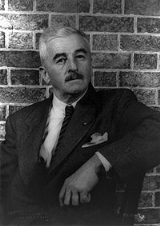
William Faulkner

 
William Faulkner

   Email Print
   Bookmark   Link


William Faulkner


William Faulkner (September 25, 1897 – July 6, 1962) was a Nobel Prize
Nobel Prize in Literature

The Nobel Prize in Literature is awarded annually, since 1901, to an author from any country who has, in the words from the will of Alfred Nobel, produced "in the field of literature the most outstanding work in an ideal direction" ....
-winning American
United States

The United States of America is a Federal government constitutional republic comprising U.S. state and a federal district. The country is situated mostly in central North America, where its Contiguous United States and Washington, D.C., the Capital districts and territories, lie between the Pacific Ocean and Atlantic Oceans, Borders of the U...
 author
Author

An author is defined both as "the person who originates or gives existence to anything" and that authorship determines responsibility for what is created....
. One of the most influential writers of the 20th century
20th century

The twentieth century of the Common Era began on January 1, 1901 and ended on December 31, 2000, according to the Gregorian calendar. The century saw a remarkable shift in the way that vast numbers of people lived, as a result of technological, medical, social, ideological, and political innovation....
, his reputation is based on his novel
Novel

File:2009 stapelweise Neuerscheinungen im Buchladen.JPGA novel is today a long narrative in literary prose. The genre has historical roots both in the fields of the medieval and early modern Romance and in the tradition of the novella....
s, novella
Novella

A novella is a writing, fictional, prose narrative longer than a novelette but shorter than a novel. While there is disagreement as to what length defines a novella, the Science Fiction and Fantasy Writers of America Nebula Awards for science fiction define the novella as having a word count between 17,500 and 40,000....
s and short stories
Short story

The short story refers to a work of fiction that is usually written in prose, usually in narrative format. This format or medium tends to be more pointed than longer works of fiction, such as novellas and novels or books....
. However, he was also a published poet
Poet

A poet is a person who writes poetry....
 and an occasional screenwriter
Screenwriter

Screenwriters or scenarists are scriptwriters who write the screenplays from which films and television programs are made.Most screenwriters start their careers writing on speculation....
.

Most of Faulkner's works are set in his native state of Mississippi
Mississippi

Mississippi is a U.S. state located in the Deep South of the United States. Jackson, Mississippi is the state capital and largest city. The state's name comes from the Mississippi River, which flows along its western boundary, and takes its name from the Anishinaabe language word misi-ziibi ....
, and he is considered one of the most important Southern writers
Southern literature

Southern literature is defined as American literature about the Southern United States or by writers from this region. Characteristics of Southern literature include a focus on a common American history, the significance of family, a sense of community and one?s role within it, the region's dominant religion and the burdens/rewards religion...
, along with Mark Twain
Mark Twain

Samuel Langhorne Clemens , better known by the pen name Mark Twain, was an United Statesmerican author and humorist. Twain is most noted for his novels Adventures of Huckleberry Finn, which has since been called the Great American Novel, and The Adventures of Tom Sawyer....
, Robert Penn Warren
Robert Penn Warren

Robert Penn Warren was an American poet, novelist, and literary critic, and one of the founders of New Criticism. He was also a charter member of the Fellowship of Southern Writers....
, Flannery O'Connor
Flannery O'Connor

Mary Flannery O'Connor was an United States novelist, short-story writer and essayist....
, Truman Capote
Truman Capote

Truman Capote was an United States writer whose short stories, novels, plays, and non-fiction are recognized literary classics, including the novella Breakfast at Tiffany's and In Cold Blood , which he labeled a "non-fiction novel"....
, Eudora Welty
Eudora Welty

Eudora Alice Welty was an award-winning American author and photographer who wrote about the Southern United States....
, and Tennessee Williams
Tennessee Williams

Tennessee Williams was an American playwright who received many of the top theatrical awards. He moved to New Orleans in 1939 and changed his name to "Tennessee", the state of his father's birth....
.

While his work was published regularly starting in the mid 1920s
1920s

The 1920s is sometimes referred to as the "Jazz Age" or the "Roaring Twenties", when speaking about the United States and Canada. In Europe the decade is sometimes referred to as the "Golden Twenties"....
, Faulkner was relatively unknown before receiving the 1949 Nobel Prize in Literature
Nobel Prize in Literature

The Nobel Prize in Literature is awarded annually, since 1901, to an author from any country who has, in the words from the will of Alfred Nobel, produced "in the field of literature the most outstanding work in an ideal direction" ....
.


Discussion
Ask a question about 'William Faulkner'
Start a new discussion about 'William Faulkner'
Answer questions from other users
Full Discussion Forum


Recent Posts


Quotations


A gentleman can live through anything.

The Reivers (1962)

A man is the sum of his misfortunes. One day you'd think misfortune would get tired, but then time is your misfortune.

A mans moral conscience is the curse he had to accept from the gods in order to gain from them the right to dream.

All of us failed to match our dreams of perfection. So I rate us on the basis of our splendid failure to do the impossible.

Between grief and nothing I will take grief.

The Wild Palms (1939)

Clocks slay time. Time is dead as long as it is being clicked off by little wheels; only when the clock stops does time come to life.


Encyclopedia


William Faulkner (September 25, 1897 – July 6, 1962) was a Nobel Prize
Nobel Prize in Literature

The Nobel Prize in Literature is awarded annually, since 1901, to an author from any country who has, in the words from the will of Alfred Nobel, produced "in the field of literature the most outstanding work in an ideal direction" ....
-winning American
United States

The United States of America is a Federal government constitutional republic comprising U.S. state and a federal district. The country is situated mostly in central North America, where its Contiguous United States and Washington, D.C., the Capital districts and territories, lie between the Pacific Ocean and Atlantic Oceans, Borders of the U...
 author
Author

An author is defined both as "the person who originates or gives existence to anything" and that authorship determines responsibility for what is created....
. One of the most influential writers of the 20th century
20th century

The twentieth century of the Common Era began on January 1, 1901 and ended on December 31, 2000, according to the Gregorian calendar. The century saw a remarkable shift in the way that vast numbers of people lived, as a result of technological, medical, social, ideological, and political innovation....
, his reputation is based on his novel
Novel

File:2009 stapelweise Neuerscheinungen im Buchladen.JPGA novel is today a long narrative in literary prose. The genre has historical roots both in the fields of the medieval and early modern Romance and in the tradition of the novella....
s, novella
Novella

A novella is a writing, fictional, prose narrative longer than a novelette but shorter than a novel. While there is disagreement as to what length defines a novella, the Science Fiction and Fantasy Writers of America Nebula Awards for science fiction define the novella as having a word count between 17,500 and 40,000....
s and short stories
Short story

The short story refers to a work of fiction that is usually written in prose, usually in narrative format. This format or medium tends to be more pointed than longer works of fiction, such as novellas and novels or books....
. However, he was also a published poet
Poet

A poet is a person who writes poetry....
 and an occasional screenwriter
Screenwriter

Screenwriters or scenarists are scriptwriters who write the screenplays from which films and television programs are made.Most screenwriters start their careers writing on speculation....
.

Most of Faulkner's works are set in his native state of Mississippi
Mississippi

Mississippi is a U.S. state located in the Deep South of the United States. Jackson, Mississippi is the state capital and largest city. The state's name comes from the Mississippi River, which flows along its western boundary, and takes its name from the Anishinaabe language word misi-ziibi ....
, and he is considered one of the most important Southern writers
Southern literature

Southern literature is defined as American literature about the Southern United States or by writers from this region. Characteristics of Southern literature include a focus on a common American history, the significance of family, a sense of community and one?s role within it, the region's dominant religion and the burdens/rewards religion...
, along with Mark Twain
Mark Twain

Samuel Langhorne Clemens , better known by the pen name Mark Twain, was an United Statesmerican author and humorist. Twain is most noted for his novels Adventures of Huckleberry Finn, which has since been called the Great American Novel, and The Adventures of Tom Sawyer....
, Robert Penn Warren
Robert Penn Warren

Robert Penn Warren was an American poet, novelist, and literary critic, and one of the founders of New Criticism. He was also a charter member of the Fellowship of Southern Writers....
, Flannery O'Connor
Flannery O'Connor

Mary Flannery O'Connor was an United States novelist, short-story writer and essayist....
, Truman Capote
Truman Capote

Truman Capote was an United States writer whose short stories, novels, plays, and non-fiction are recognized literary classics, including the novella Breakfast at Tiffany's and In Cold Blood , which he labeled a "non-fiction novel"....
, Eudora Welty
Eudora Welty

Eudora Alice Welty was an award-winning American author and photographer who wrote about the Southern United States....
, and Tennessee Williams
Tennessee Williams

Tennessee Williams was an American playwright who received many of the top theatrical awards. He moved to New Orleans in 1939 and changed his name to "Tennessee", the state of his father's birth....
.

While his work was published regularly starting in the mid 1920s
1920s

The 1920s is sometimes referred to as the "Jazz Age" or the "Roaring Twenties", when speaking about the United States and Canada. In Europe the decade is sometimes referred to as the "Golden Twenties"....
, Faulkner was relatively unknown before receiving the 1949 Nobel Prize in Literature
Nobel Prize in Literature

The Nobel Prize in Literature is awarded annually, since 1901, to an author from any country who has, in the words from the will of Alfred Nobel, produced "in the field of literature the most outstanding work in an ideal direction" ....
. He is now deemed among the greatest American writers of all time.

Biography

He was born William Cuthbert Falkner in New Albany, Mississippi
New Albany, Mississippi

New Albany is a city in Union County, Mississippi, Mississippi, United States. New Albany is northwest of the much larger city of Tupelo, MS. The population was 7,607 at the 2000 census....
, the eldest son of Murry Cuthbert Falkner (August 17, 1870–August 7, 1932) and Maud Butler (November 27, 1871–October 16, 1960). He later changed the spelling of his name to Faulkner. His brothers were Murry Charles "Jack" Falkner (June 26, 1899–December 24, 1975); author John Falkner(later Faulkner) (September 24, 1901–March 28, 1963); and Dean Swift Falkner (August 15, 1907–November 10, 1935).

Faulkner was raised in and heavily influenced by the state of Mississippi
Mississippi

Mississippi is a U.S. state located in the Deep South of the United States. Jackson, Mississippi is the state capital and largest city. The state's name comes from the Mississippi River, which flows along its western boundary, and takes its name from the Anishinaabe language word misi-ziibi ....
, as well as by the history and culture of the South
Southern United States

The Southern United States—commonly referred to as the American South, Dixie, or simply the South—constitutes a large distinctive region in the southeastern and south-central United States....
 as a whole. When he was four years old, his entire family moved to the nearby town of Oxford
Oxford, Mississippi

Oxford is a city and the county seat of Lafayette County, Mississippi, Mississippi, United States. Founded in 1835, it was named after the British university city of Oxford in hopes of having the state university located there, which it did successfully attract....
, where he lived on and off for the rest of his life. Oxford is the model for the town of "Jefferson" in his fiction, and Lafayette County, Mississippi
Lafayette County, Mississippi

Lafayette County is a county located in the U.S. state of Mississippi. As of 2000, the population was 38,744. Its county seat is Oxford, Mississippi....
, which contains the town of Oxford, is the model for his fictional Yoknapatawpha County
Yoknapatawpha County

Yoknapatawpha County is a List of fictional counties created by American author William Faulkner as a setting for many of his novels. It is widely believed by scholars that Lafayette County, Mississippi is the basis for Yoknapatawpha County....
. Faulkner's great-grandfather, William Clark Falkner
William Clark Falkner

William Clark Falkner was a soldier, lawyer, politician, businessman, and author in northern Mississippi. He is most notable for the influence he had on the work of his great-grandson, author William Faulkner....
, was an important figure in northern Mississippi who served as a colonel in the Confederate Army, founded a railroad, and gave his name to the town of Falkner
Falkner, Mississippi

Falkner is a town in Tippah County, Mississippi, Mississippi, United States. The population was 212 at the 2000 census. The town was named for William Clark Falkner, the great-grandfather of author William Faulkner....
 in nearby Tippah County
Tippah County, Mississippi

Tippah County is a county located in the U.S. state of Mississippi. As of 2000, the population was 20,826. Its county seat is Ripley, Mississippi....
. He also wrote several novels and other works, establishing a literary tradition in the family. Colonel Falkner served as the model for Colonel John Sartoris
Sartoris

Sartoris is a novel, first published in 1929, by the American author William Faulkner. It portrays the decay of the Mississippi aristocracy following the social upheaval of the American Civil War....
 in his great-grandson's writing.

The older Falkner was greatly influenced by the history of his family and the region in which they lived. Mississippi marked his sense of humor, his sense of the tragic position of blacks and whites, his characterization of Southern characters and timeless themes, including fiercely intelligent people dwelling behind the façades of good old boys and simpletons. Unable to join the United States Army
United States Army

The United States Army is the branch of the United States Armed Forces responsible for Army operations. It is the largest and oldest established branch of the U.S....
 because of his height, (he was 5' 5½"), Faulkner first joined the Canadian and then the British
United Kingdom

The United Kingdom of Great Britain and Northern Ireland, commonly known as the United Kingdom , the UK or Britain,is a sovereign state located off the northwestern coast of continental Europe....
 Royal Air Force
Royal Air Force

The Royal Air Force is the United Kingdom's air force, the oldest independent air force in the world. Formed on 1 April 1918, the RAF has taken a significant role in British military history ever since, playing a large part in World War II and in more recent conflicts....
, yet did not see any World War I
World War I

World War I, or the First World War , was a global military conflict which involved the Great powers, organized into two opposing military alliances: the Allies of World War I and the Central Powers....
 wartime action.

Faulkner himself made the change to his last name in 1918 upon joining the Air Force. But according to one story, a careless typesetter simply made an error. When the misprint appeared on the title page of Faulkner's first book and the author was asked about it, he supposedly replied, "Either way suits me."

Although Faulkner is heavily identified with Mississippi, he was living in New Orleans
New Orleans, Louisiana

New Orleans is a major United States port city and the largest city in Louisiana. New Orleans is the center of the New Orleans metropolitan area metropolitan area, the largest metro area in the state....
 in 1925 when he wrote his first novel, Soldiers' Pay
Soldiers' Pay (novel)

Soldiers' Pay is the first novel written by the American author William Faulkner. It was originally published in 1926.Plot overview...
, after being influenced by Sherwood Anderson
Sherwood Anderson

Sherwood Anderson was an United States writer, mainly of short story, most notably the collection Winesburg, Ohio . That work's influence on American fiction was profound, and its literary voice can be heard in Ernest Hemingway, William Faulkner, Thomas Wolfe, John Steinbeck, Erskine Caldwell and others....
 to try fiction. The small house at 624 Pirate's Alley, just around the corner from St. Louis Cathedral
St. Louis Cathedral, New Orleans

Saint Louis Cathedral , also known as the Basilica of St. Louis, King of France, has the distinction of being the oldest continuously operating cathedral in the United States....
, is now the premises of Faulkner House Books, and also serves as the headquarters of the Pirate's Alley Faulkner Society.

Faulkner served as Writer-in-Residence at the University of Virginia
University of Virginia

The University of Virginia is a public university research university located in Charlottesville, Virginia, founded by Thomas Jefferson. Conceived by 1800 and established in 1819, it is the only university in the United States to be designated a World Heritage Site by UNESCO, an honor it shares with nearby Monticello....
 from 1957 until his death at Wright's Sanitorium in Byhalia, Mississippi
Byhalia, Mississippi

Byhalia is a town in Marshall County, Mississippi, Mississippi, United States. The population was 706 as of the 2000 census. The original field recording of "She Began to Lie" was recorded by Herbert Halpert on May 13, 1939 in Byhalia, as sung by Katherine and Christine Shipp....
 of a heart attack at the age of 64.

In Hollywood

In the early 1940s, Howard Hawks
Howard Hawks

Howard Winchester Hawks was an American film director, Film producer and writer of the Classical Hollywood cinema. He died in Palm Springs, California, California, after a fall....
 invited Faulkner to come to Hollywood to become a screenwriter
Screenwriter

Screenwriters or scenarists are scriptwriters who write the screenplays from which films and television programs are made.Most screenwriters start their careers writing on speculation....
 for the films Hawks was directing. Faulkner happily accepted because he badly needed the money, and Hollywood paid well. Thus Faulkner contributed to the scripts for the films Hawks made from Raymond Chandler
Raymond Chandler

Raymond Thornton Chandler was an United States crime fiction, who had an immense stylistic influence upon the modern private eye story, especially in the style of the writing and the attitudes now characteristic of the genre....
's The Big Sleep
The Big Sleep (1946 film)

The Big Sleep is a film noir directed by Howard Hawks, the first film version of Raymond Chandler's The Big Sleep. It stars Humphrey Bogart as detective Philip Marlowe and Lauren Bacall as the femme fatale....
 and Ernest Hemingway
Ernest Hemingway

Ernest Miller Hemingway was an American novelist, short story author, and journalist. He was part of the 1920s expatriate community in Paris, France, and one of the veterans of World War I later known as "the Lost Generation"....
's To Have and Have Not
To Have and Have Not (film)

To Have and Have Not is a thriller film romance film war film adventure film directed by Howard Hawks and starring Humphrey Bogart and Lauren Bacall that is nominally based on the novel To Have and Have Not by Ernest Hemingway....
. Faulkner became good friends with director Howard Hawks
Howard Hawks

Howard Winchester Hawks was an American film director, Film producer and writer of the Classical Hollywood cinema. He died in Palm Springs, California, California, after a fall....
, the screenwriter A.I. Bezzerides, and the actors Humphrey Bogart
Humphrey Bogart

Humphrey DeForest Bogart was an United_States_of_America actor and cultural icon. In 1997, Entertainment Weekly magazine named him the number one movie legend of all time....
 and Lauren Bacall
Lauren Bacall

Lauren Bacall is an American film and theater actress and Model . Known for her husky voice and sultry looks, she has continued acting to the present day....
.

An apocryphal story regarding Faulkner during his Hollywood years found him with a case of writer's block at the studio. He told Hawks he was having a hard time concentrating and would like to write at home. Hawks was agreeable, and Faulkner left. Several days passed, with no word from the writer. Hawks telephoned Faulkner's hotel and found that Faulkner had checked out several days earlier. It seems Faulkner had spoken quite literally, and had returned home to Mississippi to finish the screenplay.

Personal

Faulkner married Estelle Oldham in June 1929 at College Hill Presbyterian Church
College Hill Presbyterian Church

College Hill Presbyterian Church is a member of the Presbyterian Church in America . It is located just outside of Oxford, Mississippi.This fellowship of Christians was organized as a local church on January 11, 1835, in the home of Alexander Shaw, one of the early Scot-Irish settlers in North Mississippi....
 just outside of Oxford, Mississippi
Oxford, Mississippi

Oxford is a city and the county seat of Lafayette County, Mississippi, Mississippi, United States. Founded in 1835, it was named after the British university city of Oxford in hopes of having the state university located there, which it did successfully attract....
. They honeymoon
Honeymoon

A honeymoon is the traditional holiday taken by newlyweds to celebrate their marriage in intimacy and seclusion. Today, honeymoons by Westerners are sometimes celebrated somewhere exotic or otherwise considered special and romance ....
ed on the Mississippi Gulf Coast at Pascagoula
Pascagoula, Mississippi

Pascagoula is a city in Jackson County, Mississippi, Mississippi, United States. It is the principal city of the Pascagoula, Mississippi Pascagoula metropolitan area, as a part of the Gulfport, Mississippi–Biloxi, Mississippi–Pascagoula, Mississippi Gulfport-Biloxi-Pascagoula combined statistical area....
, then returned to Oxford, first living with relatives while they searched for a home of their own to purchase. In 1930 Faulkner purchased the antebellum
Antebellum

"Antebellum" is an expression derived from Latin that means "before war" .In United States history and historiography, "antebellum" is commonly used, in lieu of "pre-Civil War," in reference to the period of increasing sectionalism that led up to the American Civil War....
 home Rowan Oak
Rowan Oak

Rowan Oak, also known as William Faulkner House, is William Faulkner's former home in Oxford, Mississippi. The curator since 1999 is William Griffith....
, known at that time as "The Bailey Place." He and his family lived there until his daughter Jill, after her mother's death, sold the property to the University of Mississippi
University of Mississippi

The University of Mississippi, also known as Ole Miss, is a state university , co-education research university located in Oxford, Mississippi, Mississippi....
 in 1972. The house and furnishings are maintained much as they were in Faulkner's day. Faulkner's scribblings are still preserved on the wall there, including the day-by-day outline covering an entire week that he wrote out on the walls of his small study to help him keep track of the plot twists in the novel A Fable.

Faulkner accomplished what he did despite a lifelong serious drinking problem
Alcoholism

Alcoholism is a term with multiple and sometimes conflicting definitions to describe the detrimental effects of alcohol intake.In common and historic usage, alcoholism refers to any condition that results in the continued consumption of alcoholic beverages despite health problems and negative social consequences....
. As he stated on several occasions, and as was witnessed by members of his family, the press
News media

The news media refers to the section of the mass media that focuses on presenting current news to the public.These include print media ; broadcast media , and increasingly Internet-based mass media ....
, and friends at various periods over the course of his career, he did not drink while writing, nor did he believe that alcohol helped to fuel the creative process. It is now widely believed that Faulkner used alcohol as an "escape valve" from the day-to-day pressures of his regular life, including his financial straits, rather than the more romantic vision of a brilliant writer who needed alcohol to pursue his craft.

Faulkner is known to have had two extramarital affairs. One was with Howard Hawks
Howard Hawks

Howard Winchester Hawks was an American film director, Film producer and writer of the Classical Hollywood cinema. He died in Palm Springs, California, California, after a fall....
's secretary and script-girl, Meta Carpenter. The other, lasting from 1949 to 1953, was with a young writer, Joan Williams, who considered him her mentor. She made her relationship with Faulkner the subject of her 1971 novel The Wintering.

Faulkner also had a romance with Jean Stein
Jean Stein

Jean Babette Stein is an American best-selling author and editor....
, an editor, author, and daughter of movie mogul Jules Stein.

Writing

From the early 1920s to the outbreak of WWII, when Faulkner left for Hollywood, he published 13 novels and numerous short stories, the body of work that grounds his reputation and for which he was awarded Nobel Prize at the age of 52. This prodigious output, mainly driven by an obscure writer's need for money, includes his most celebrated novels such as The Sound and the Fury
The Sound and the Fury

The Sound and the Fury is one of the most celebrated novels of the twentieth century, written by American author William Faulkner, which makes use of the Stream of consciousness writing narrative technique pioneered by European authors such as James Joyce and Virginia Woolf....
 (1929), As I Lay Dying (1930), Light in August (1932), and Absalom, Absalom!
Absalom, Absalom!

Absalom, Absalom! is a Southern Gothic novel by the United States author William Faulkner, published in 1937. It is a story about three families of the Southern United States, taking place before, during, and after the American Civil War, with the focus of the story on the life of Thomas Sutpen....
 (1937). Faulkner was also a prolific writer of short stories
Short story

The short story refers to a work of fiction that is usually written in prose, usually in narrative format. This format or medium tends to be more pointed than longer works of fiction, such as novellas and novels or books....
. His first short story collection, These 13
These 13

These 13 is a collection of Short story written by William Faulkner, and dedicated to his first daughter Alabama, who died nine days after her birth on January 11, 1931, and to his wife Estelle....
 (1933), includes many of his most acclaimed (and most frequently anthologized
Anthology

An anthology, literally a "garland" or "collection of flowers", is a collection of literary works, originally of poems. In genre fiction and especially science fiction, anthology is used to categorize collections of shorter works such as short story and short novels, usually collected into a single volume for publication....
) stories, including "A Rose for Emily
A Rose for Emily

"A Rose for Emily" is a short story by United States author William Faulkner first published in the April 30, 1930 issue of Forum. This story takes place in Faulkner's fictional city, Jefferson, in his fictional county of Yoknapatawpha County, Mississippi....
," "Red Leaves
Red Leaves

"Red Leaves" is a short story by United States author William Faulkner. First published in the Saturday Evening Post on October 25, 1930, it was one of Faulkner's first stories to appear in a national magazine....
", "That Evening Sun
That Evening Sun

"That Evening Sun" is a short story by the American author William Faulkner, published in 1931 on the collection These 13, which included Faulkner's most anthologized story, "A Rose for Emily." "That Evening Sun" is a dark portrait of white Southerners' indifference to the crippling fears of one of their African-American employees, Nancy....
," and "Dry September."

Faulkner set many of his short stories and novels in Yoknapatawpha County
Yoknapatawpha County

Yoknapatawpha County is a List of fictional counties created by American author William Faulkner as a setting for many of his novels. It is widely believed by scholars that Lafayette County, Mississippi is the basis for Yoknapatawpha County....
—based on, and nearly geographically identical to, Lafayette County, of which his hometown of Oxford, Mississippi
Oxford, Mississippi

Oxford is a city and the county seat of Lafayette County, Mississippi, Mississippi, United States. Founded in 1835, it was named after the British university city of Oxford in hopes of having the state university located there, which it did successfully attract....
 is the county seat. Yoknapatawpha was Faulkner's "postage stamp," and the bulk of work that it represents is widely considered by critics to amount to one of the most monumental fictional creations in the history of literature. Three novels, The Hamlet
The Hamlet

The Hamlet is a novel by the United States author William Faulkner, published in 1940, about the fictional Snopes family of Mississippi....
,
The Town
The Town

The Town is a novel written by Conrad Richter in 1950 in literature. It is the third installment of his Awakening Land trilogy, and was awarded the Pulitzer Prize for Fiction in 1951....
,
and The Mansion
The Mansion

'The Mansion' is a mansion owned by famed music producer Rick Rubin in Los Angeles, built in 1918. After recording the Red Hot Chili Peppers' Blood Sugar Sex Magik with considerable ease and comfort, Rubin decided to record many of the albums he has produced here, including; the Red Hot Chili Peppers' Stadium Arcadium, Audioslave's Ou...
,
known collectively as the Snopes Trilogy document the town of Jefferson and its environs as an extended family headed by Flem Snopes insinuates itself into the lives and psyches of the general populace. It is a stage wherein rapaciousness and decay come to the fore in a world where such realities were always present, but never so compartmentalized and well defined; their sources never so easily identifiable.

Additional works include Sanctuary
Sanctuary (novel)

Sanctuary is a novel by the American author William Faulkner. It is considered one of his more controversial, given its theme of rape. First published in 1931, it was Faulkner's commercial and critical breakthrough, establishing his literary reputation....
 (1931), a sensationalist "pulp fiction
Pulp magazine

Pulp magazines were inexpensive fiction magazines. They were widely published from the 1920s through the 1950s. The term pulp fiction can also refer to mass market paperbacks since the 1950s....
"-styled novel, characterized by André Malraux
André Malraux

Andr? Malraux was a France author, adventurer and statesman, and a dominant figure in French politics and culture....
 as "the intrusion of Greek tragedy into the detective story." Its themes of evil and corruption, bearing Southern Gothic
Southern Gothic

Southern Gothic is a Subgenre of the Gothic novel writing style, unique to American literature. Like its parent genre, it relies on supernatural, ironic, or unusual events to guide the plot....
 tones, resonate to this day. Requiem for a Nun
Requiem for a Nun

Requiem for a Nun is a book written by William Faulkner in 1951. Like many of Faulkner's works, Requiem experiments with narrative technique - the book is part novel, part play....
 (1951), a play/novel sequel to Sanctuary, is the only play that Faulkner published, except for his The Marionettes, which he essentially self-published -- in a few hand-written copies -- as a young man.

Faulkner is known for an experimental style with meticulous attention to diction
Diction

Diction, in its original, primary meaning, refers to the writer's or the speaker's distinctive vocabulary choices and style of expression. A secondary, more common meaning of "diction" is more precisely expressed with the word enunciation ? the art of speaking clearly so that each word is clearly heard and understood to its fullest complexity...
 and cadence
Cadence

Cadence may refer to:In music:*Cadence , a melodic configuration or series of chords marking the end of a phrase, section, or piece of music...
. In contrast to the minimalist
Minimalism

Minimalism describes movements in various forms of art and design, especially visual art and Minimalist music, where the work is stripped down to its most fundamental features....
 understatement of his peer Ernest Hemingway
Ernest Hemingway

Ernest Miller Hemingway was an American novelist, short story author, and journalist. He was part of the 1920s expatriate community in Paris, France, and one of the veterans of World War I later known as "the Lost Generation"....
, Faulkner made frequent use of "stream of consciousness" in his writing, and wrote often highly emotional, subtle, cerebral, complex, and sometimes Gothic
Southern Gothic

Southern Gothic is a Subgenre of the Gothic novel writing style, unique to American literature. Like its parent genre, it relies on supernatural, ironic, or unusual events to guide the plot....
 or grotesque
Grotesque

When in conversation, grotesque commonly means strange, fantastic, ugly or bizarre, and thus is often used to describe weird shapes and distorted forms such as Halloween masks or gargoyles on churches....
 stories of a wide variety of characters—ranging from former slaves or descendents of slaves, to poor white, agrarian, or working-class Southerners, to Southern aristocrats.

In an interview with The Paris Review in 1956, Faulkner remarked, "Let the writer take up surgery or bricklaying if he is interested in technique. There is no mechanical way to get the writing done, no shortcut. The young writer would be a fool to follow a theory. Teach yourself by your own mistakes; people learn only by error. The good artist believes that nobody is good enough to give him advice. He has supreme vanity. No matter how much he admires the old writer, he wants to beat him." Another esteemed Southern writer, Flannery O'Connor
Flannery O'Connor

Mary Flannery O'Connor was an United States novelist, short-story writer and essayist....
, stated that, "The presence alone of Faulkner in our midst makes a great difference in what the writer can and cannot permit himself to do. Nobody wants his mule and wagon stalled on the same track the Dixie Limited is roaring down."

Faulkner also wrote two volumes of poetry which were published in small printings, The Marble Faun (1924) and A Green Bough (1933), and a collection of crime-fiction short stories, Knight's Gambit.

Awards

Faulkner received the 1949 Nobel Prize for Literature
Nobel Prize in Literature

The Nobel Prize in Literature is awarded annually, since 1901, to an author from any country who has, in the words from the will of Alfred Nobel, produced "in the field of literature the most outstanding work in an ideal direction" ....
  for "his powerful and artistically unique contribution to the modern American novel." He donated a portion of his Nobel
Nobel Prize in Literature

The Nobel Prize in Literature is awarded annually, since 1901, to an author from any country who has, in the words from the will of Alfred Nobel, produced "in the field of literature the most outstanding work in an ideal direction" ....
 winnings "to establish a fund to support and encourage new fiction writers," eventually resulting in the PEN/Faulkner Award for Fiction
PEN/Faulkner Award for Fiction

The PEN/Faulkner Award for Fiction is awarded annually by the PEN/Faulkner Foundation to the author of the best American work of fiction that year....
. He donated another portion to a local Oxford bank to establish an account to provide scholarship funds to help educate African-American education majors at nearby Rust College
Rust College

Rust College is a Historically black colleges and universities liberal arts college located in Holly Springs, Mississippi, Mississippi. Located approximately 35 miles southeast of Memphis, Tennessee, Tennessee, it is the second-oldest private college in the state and is affiliated with the United Methodist Church and one of only ten historica...
 in Holly Springs, Mississippi
Holly Springs, Mississippi

Holly Springs is a city in Marshall County, Mississippi, Mississippi, United States. The population was 7,957 at the 2000 census. It is the county seat of Marshall County, Mississippi....
.

Faulkner won two Pulitzer Prize
Pulitzer Prize

The Pulitzer Prize is an United States award regarded as the highest national honor in newspaper journalism, literary achievements and musical composition....
s for what are considered as his "minor" novels: his 1954 novel A Fable, which took the Pulitzer in 1955, and the 1962 novel, The Reivers
The Reivers

The Reivers, published in 1962, is the last novel by the United States author William Faulkner. The bestselling novel was awarded the Pulitzer Prize for Fiction in 1963....
,
which was posthumously awarded the Pulitzer in 1963. He also won two National Book Awards, first for his Collected Stories in 1951 and once again for his novel A Fable in 1955.

In 1946, Faulkner was one of three finalists for the first Ellery Queen
Ellery Queen

File:Ellery Queen NYWTS.jpgEllery Queen is both a fictional character and a pseudonym used by two American cousins from Brooklyn, New York: Daniel Nathan, alias Frederic Dannay and Manford Lepofsky, alias Manfred Bennington Lee , to write detective fiction....
 Mystery Magazine
Award. He came in second to Manly Wade Wellman
Manly Wade Wellman

Manly Wade Wellman was an American writer. He is best known for his fantasy and horror stories set in the Appalachian Mountains and for drawing on the native folklore of that region, but he wrote in a wide variety of genres including science fiction, fantasy, historical fiction, detective fiction, western fiction, children's literature and n...
.

On August 3, 1987, the United States Postal Service
United States Postal Service

The United States Postal Service is an Independent agencies of the United States government responsible for providing postal service in the United States....
 issued a 22 cent postage stamp
Postage stamp

A postage stamp is adhesive paper evidence of a fee paid for Mail services. Usually a small rectangle attached to an envelope, the stamp signifies the person sending it has fully or partly paid for delivery....
 in his honor.

Selected writings


Novels

  • Soldiers' Pay
    Soldiers' Pay (novel)

    Soldiers' Pay is the first novel written by the American author William Faulkner. It was originally published in 1926.Plot overview...
     (1926)
  • Father Abraham (written: 1926/1927 pub: 1983)
  • Mosquitoes
    Mosquitoes (Novel)

    Mosquitoes is a comic novel by the American author William Faulkner, published in 1927 in literature. It is the author's second novel. The story tells of the misadventures of passengers on a cruise ship, summarized hour by hour and day by day....
     (1927)
  • Sartoris
    Sartoris

    Sartoris is a novel, first published in 1929, by the American author William Faulkner. It portrays the decay of the Mississippi aristocracy following the social upheaval of the American Civil War....
    /Flags in the Dust
    Flags in the Dust

    Flags in the Dust is a novel by the United States author William Faulkner, completed in 1927. It is the first novel set in his fictional Yoknapatawpha County....
     (1929/1973)
  • The Sound and the Fury
    The Sound and the Fury

    The Sound and the Fury is one of the most celebrated novels of the twentieth century, written by American author William Faulkner, which makes use of the Stream of consciousness writing narrative technique pioneered by European authors such as James Joyce and Virginia Woolf....
     (1929)
  • As I Lay Dying (1930)
  • Sanctuary
    Sanctuary (novel)

    Sanctuary is a novel by the American author William Faulkner. It is considered one of his more controversial, given its theme of rape. First published in 1931, it was Faulkner's commercial and critical breakthrough, establishing his literary reputation....
     (1931)
  • Light in August (1932)
  • Pylon
    Pylon (novel)

    Pylon is a novel by the USA author William Faulkner. Published in 1935, Pylon is set in New Valois, a fictionalized version of New Orleans....
     (1935)
  • Absalom, Absalom!
    Absalom, Absalom!

    Absalom, Absalom! is a Southern Gothic novel by the United States author William Faulkner, published in 1937. It is a story about three families of the Southern United States, taking place before, during, and after the American Civil War, with the focus of the story on the life of Thomas Sutpen....
     (1937)
  • The Unvanquished
    The Unvanquished

    The Unvanquished is a novel by the United States author William Faulkner, set in Yoknapatawpha County. It tells the story of the Sartoris family, who first appeared in the novel Sartoris ....
     (1938)
  • If I Forget Thee Jerusalem (The Wild Palms/Old Man)
    If I Forget Thee Jerusalem (The Wild Palms/Old Man)

    If I Forget Thee, Jerusalem is a novel by the United States author William Faulkner published in 1939. The novel was originally published under the title The Wild Palms, which is the title of one of the two interwoven stories....
     (1939)
  • The Hamlet
    The Hamlet

    The Hamlet is a novel by the United States author William Faulkner, published in 1940, about the fictional Snopes family of Mississippi....
     (1940)
  • Go Down, Moses
    Go Down, Moses

    Go Down, Moses is a collection of seven related pieces of short fiction by United States author William Faulkner, sometimes considered a novel....
     (1942). Episodic novel made up of rewritten previous published short stories.
  • Intruder in the Dust
    Intruder in the Dust

    Intruder in the Dust is a novel by the Nobel Prize-winning United States author William Faulkner.The novel focuses on Lucas Beauchamp, a black farmer accused of murdering a white man....
     (1948)
  • Requiem for a Nun
    Requiem for a Nun

    Requiem for a Nun is a book written by William Faulkner in 1951. Like many of Faulkner's works, Requiem experiments with narrative technique - the book is part novel, part play....
     (1951)
  • A Fable
    A Fable (novel)

    A Fable is a novel written in 1954 by the United States author William Faulkner, which won him both the Pulitzer Prize for Fiction and the National Book Award in 1955....
     (1954)
  • The Town
    The Town (Faulkner)

    The Town is a novel by the United States author William Faulkner, published in 1957, about the fictional Snopes family of Mississippi. It is the second of the "Snopes" trilogy, completed by The Hamlet and The Mansion ....
     (1957)
  • The Mansion
    The Mansion (book)

    The Mansion is a novel by the American author William Faulkner, written in 1959. It is the last in a trilogy of books about the fictional Snopes family of Mississippi, following The Hamlet and The Town....
     (1959)
  • The Reivers
    The Reivers

    The Reivers, published in 1962, is the last novel by the United States author William Faulkner. The bestselling novel was awarded the Pulitzer Prize for Fiction in 1963....
     (1962)


Short stories

  • "Landing in Luck
    Landing in Luck

    "Landing in Luck" was William Faulkner's first published short story,. Appearing in the November 26th, 1919 issue of The Mississippian, a literary magazine at the University of Mississippi, "Landing in Luck" tells the story of Cadet Thompson, who is sent on a solo flight without adequate instruction....
    " (1919)
  • "The Hill" (1922)
  • "New Orleans"
  • "Mirrors of Chartres Street" (1925)
  • "Damon and Pythias Unlimited" (1925)
  • "Jealousy" (1925)
  • "Cheest" (1925)
  • "Out of Nazareth" (1925)
  • "The Kingdom of God" (1925)
  • "The Rosary" (1925)
  • "The Cobbler" (1925)
  • "Chance" (1925)
  • "Sunset" (1925)
  • "The Kid Learns" (1925)
  • "The Liar" (1925)
  • "Home" (1925)
  • "Episode" (1925)
  • "Country Mice" (1925)
  • "Yo Ho and Two Bottles of Rum" (1925)
  • "Music - Sweeter than the Angels Sing"
  • "A Rose for Emily
    A Rose for Emily

    "A Rose for Emily" is a short story by United States author William Faulkner first published in the April 30, 1930 issue of Forum. This story takes place in Faulkner's fictional city, Jefferson, in his fictional county of Yoknapatawpha County, Mississippi....
    " (1930)
  • "Honor" (1930)
  • "Thrift" (1930)
  • "Red Leaves
    Red Leaves

    "Red Leaves" is a short story by United States author William Faulkner. First published in the Saturday Evening Post on October 25, 1930, it was one of Faulkner's first stories to appear in a national magazine....
    " (1930)
  • "Ad Astra" (1931)
  • "Dry September" (1931)
  • "That Evening Sun
    That Evening Sun

    "That Evening Sun" is a short story by the American author William Faulkner, published in 1931 on the collection These 13, which included Faulkner's most anthologized story, "A Rose for Emily." "That Evening Sun" is a dark portrait of white Southerners' indifference to the crippling fears of one of their African-American employees, Nancy....
    " (1931)
  • "Hair" (1931)
  • "Spotted Horses
    Spotted Horses

    "Spotted Horses" is a novella by William Faulkner. It was originally published in Scribner's Magazine magazine. It includes the character Flem Snopes, who appears in much of Faulkner's work, and tells in ambiguous terms of his backhand profiteering with an honest Texan selling untamed ponies....
    " (1931)
  • "The Hound" (1931)
  • "Fox Hunt" (1931)
  • "Carcassonne" (1931)
  • "Divorce in Naples" (1931)
  • "Victory" (1931)
  • "All the Dead Pilots" (1931)
  • "Crevasse" (1931)
  • "Mistral" (1931)
  • "A Justice" (1931)
  • "Dr. Martino" (1931)
  • "Idyll in the Desert" (1931)


  • "Miss Zilphia Grant" (1932)
  • "Death Drag" (1932)
  • "Centaur in Brass" (1932)
  • "Once Aboard the Lugger (I)" (1932)
  • "Lizards in Jamshyd's Courtyard" (1932)
  • "Turnabout" (1932)
  • "Smoke" (1932)
  • "Mountain Victory" (1932)
  • "There Was a Queen" (1933)
  • "Artist at Home" (1933)
  • "Beyond" (1933)
  • "Elly" (1934)
  • "Pennsylvania Station" (1934)
  • "Wash" (1934)
  • "A Bear Hunt" (1934)
  • "The Leg" (1934)
  • "Black Music" (1934)
  • "Mule in the Yard" (1934)
  • "Ambuscade" (1934)
  • "Retreat" (1934)
  • "Lo!" (1934)
  • "Raid" (1934)
  • "Skirmish at Sartoris" (1935)
  • "Golden Land" (1935)
  • "That Will Be Fine" (1935)
  • "Uncle Willy
    Uncle Willy

    Uncle Willy is a short story by William_Faulkner. It features an appearance by Darl Bundren from Faulkner's novel As_I_Lay_Dying_%28novel%29....
    " (1935)
  • "Lion" (1935)
  • "The Brooch" (1936)
  • "Two Dollar Wife" (1936)
  • "Fool About a Horse" (1936)
  • "Vendee" (1936)
  • "Monk" (1937)
  • "Barn Burning
    Barn Burning

    "Barn Burning" is a short story by the American author William Faulkner, which appeared in Harper's in 1938. The story deals with class conflicts, the influence of fathers, and vengeance as viewed through the Point of view of a young, impressionable child....
    " (1939)
  • "Hand Upon the Waters" (1939)
  • "A Point of Law" (1940)
  • "The Old People" (1940)
  • "Pantaloon in Black" (1940)
  • "Gold Is Not Always" (1940)
  • "Tomorrow" (1940). Filmed in 1972, starring Robert Duvall
    Robert Duvall

    Robert Selden Duvall is an United States film actor and Film director who has won an Academy Award, two Emmys, and four Golden Globes. He has appeared in films such as To Kill a Mockingbird , The Godfather, The Godfather Part II, Apocalypse Now, The Natural , Network , THX 1138, MASH , The Great Santini,...
    .
  • "The Tall Men
    The Tall Men (short story)

    "The Tall Men" is a short story written by William Faulkner in 1941. It begins with two men, government officials, visiting a house to serve a warrant for two brothers who have not registered for selective service....
    " (1941)
  • "Two Soldiers
    Two Soldiers

    Two Soldiers is a 2003 in film short subject drama film directed by Aaron Schneider with a score by Alan Silvestri. It won an Academy Award in 76th Academy Awards for Academy Award for Live Action Short Film....
    " (1942)
  • "Delta Autumn" (1942)
  • "The Bear" (1942)


  • "Afternoon of a Cow" (1943)
  • "Shingles for the Lord
    Shingles for the Lord

    "Shingles for the Lord" is a short story written by the American author William Faulkner, first published in the Saturday Evening Post in 1943....
    " (1943)
  • "My Grandmother Millard and General Bedford Forrest and the Battle of Harrykin Creek" (1943)
  • "Shall Not Perish" (1943)
  • "Appendix, Compson, 1699-1945" (1946)
  • "An Error in Chemistry" (1946)
  • "A Courtship" (1948)
  • "Knight's Gambit" (1949)
  • "Nobel Prize Award Speech" (1949)
  • "A Name for the City" (1950)
  • "Notes on a Horsethief" (1951)
  • "Mississippi" (1954)
  • "Sepulture South: Gaslight" (1954)
  • "Race at Morning" (1955)
  • "By the People" (1955)
  • "Hell Creek Crossing" (1962)
  • "Mr. Acarius" (1965)
  • "The Wishing Tree
    The Wishing Tree

    The Wishing Tree is an acoustic music project by Marillion's guitarist Steve Rothery and British vocalist Hannah Stobart . The Wishing Tree have released one album, Carnival of Souls , in 1996....
    " (1967)
  • "Al Jackson" (1971)
  • "And Now What's To Do" (1973)
  • "Nympholepsy" (1973)
  • "The Priest" (1976)
  • "Mayday" (1977)
  • "Frankie and Johnny" (1978)
  • "Don Giovanni" (1979)
  • "Peter" (1979)
  • "A Portrait of Elmer" (1979)
  • "Adolescence" (1979)
  • "Snow" (1979)
  • "Moonlight" (1979)
  • "With Caution and Dispatch" (1979)
  • "Hog Pawn" (1979)
  • "A Dangerous Man" (1979)
  • "A Return" (1979)
  • "The Big Shot" (1979)
  • "Once Aboard the Lugger (II)" (1979)
  • "Dull Tale" (1979)
  • "Evangeline" (1979)
  • "Love" (1988)
  • "Christmas Tree" (1995)
  • "Rose of Lebanon" (1995)
  • "Lucas Beauchamp" (1999)


Poetry

  • Vision in Spring (1921)
  • The Marble Faun (1924)
  • A Green Bough (1933)
  • This Earth, a Poem (1932)
  • Mississippi Poems (1979)
  • Helen, a Courtship and Mississippi Poems (1981).


Discography

  • The William Faulkner Audio Collection. Caedmon, 2003. Five hours on five discs includes Faulkner reading his 1949 Nobel Prize acceptance speech and excerpts from As I Lay Dying, The Old Man and A Fable, plus readings by Debra Winger ("A Rose for Emily", "Barn Burning"), Keith Carradine ("Spotted Horses") and Arliss Howard ("That Evening Sun", "Wash"). Winner of AudioFile Earphones Award.
  • William Faulkner Reads: The Nobel Prize Acceptance Speech, Selections from As I Lay Dying, A Fable, The Old Man. Caedmon/Harper Audio, 1992. Cassette. ISBN 1-55994-572-9
  • William Faulkner Reads from His Work. Arcady Series, MGM E3617 ARC, 1957. Faulkner reads from The Sound and The Fury (side one) and Light in August (side two). Produced by Jean Stein, who also did the liner notes with Edward Cole. Cover photograph by Robert Capa (Magnum).


Listen to


External links

  • owned by the University of Mississippi, Archives and Special Collections.
  • at the University of Mississippi.
  • at the Harry Ransom Center at the University of Texas at Austin
    University of Texas at Austin

    The University of Texas at Austin is a public university research university located in Austin, Texas, Texas, United States, and is the flagship#University campuses institution of University of Texas System....