
All Topics  
Luminiferous aether


   Email Print
   Bookmark   Link


Luminiferous aether


In the late 19th century, "luminiferous aether" (or "ether"), meaning light-bearing aether
Aether (classical element)

According to ancient and History of science in the Middle Ages, aether , also spelled ?ther or ether, is the material that fills the region of the Universe above the Sublunary sphere....
, was the term used to describe a medium for the propagation of light
Light

Light, or visible light, is electromagnetic radiation of a wavelength that is Visible spectrum to the human eye , or up to 380?750 nm. In the broader field of physics, light is sometimes used to refer to electromagnetic radiation of all wavelengths, whether visible or not....
. The word aether stems via Latin
Latin

Latin is an Italic language, historically spoken in Latium and Ancient Rome. Through the Military history of the Roman Empire, Latin spread throughout the Mediterranean and a large part of Europe....
 from the Greek
Greek language

Greek is an Indo-European languages native to the southern Balkan peninsula, the language of the Greek people. It forms an independent branch within Indo-European....
 a????, from a root meaning to kindle, burn, or shine. It signifies the substance which was thought in ancient times to fill the upper regions of space, beyond the clouds.

Later theories including special relativity
Special relativity

Special relativity is the physical theory of measurement in inertial frames of reference proposed in 1905 by Albert Einstein in the paper "Annus Mirabilis Papers#Special relativity"....
 were formulated without the concept of aether.


Discussion
Ask a question about 'Luminiferous aether'
Start a new discussion about 'Luminiferous aether'
Answer questions from other users
Full Discussion Forum


Recent Posts


Encyclopedia


In the late 19th century, "luminiferous aether" (or "ether"), meaning light-bearing aether
Aether (classical element)

According to ancient and History of science in the Middle Ages, aether , also spelled ?ther or ether, is the material that fills the region of the Universe above the Sublunary sphere....
, was the term used to describe a medium for the propagation of light
Light

Light, or visible light, is electromagnetic radiation of a wavelength that is Visible spectrum to the human eye , or up to 380?750 nm. In the broader field of physics, light is sometimes used to refer to electromagnetic radiation of all wavelengths, whether visible or not....
. The word aether stems via Latin
Latin

Latin is an Italic language, historically spoken in Latium and Ancient Rome. Through the Military history of the Roman Empire, Latin spread throughout the Mediterranean and a large part of Europe....
 from the Greek
Greek language

Greek is an Indo-European languages native to the southern Balkan peninsula, the language of the Greek people. It forms an independent branch within Indo-European....
 a????, from a root meaning to kindle, burn, or shine. It signifies the substance which was thought in ancient times to fill the upper regions of space, beyond the clouds.

Later theories including special relativity
Special relativity

Special relativity is the physical theory of measurement in inertial frames of reference proposed in 1905 by Albert Einstein in the paper "Annus Mirabilis Papers#Special relativity"....
 were formulated without the concept of aether. Today the aether is regarded as a superseded scientific theory
Superseded scientific theory

A superseded, or obsolete, scientific theory is a scientific theory that was once commonly accepted, but that is no longer considered the most complete description of reality by a mainstream scientific consensus; or a falsifiable theory which has been shown to be false....
.

The history of light and aether


Isaac Newton
Isaac Newton

Sir Isaac Newton, Fellow of the Royal Society was an English people physicist, mathematician, Astronomy, Natural philosophy, Alchemy, and Theology and one of the the 100 in human history....
 contended that light was made up of numerous small particles. This could explain such features as light's ability to travel in straight lines and reflect off surfaces. This theory was known to have its problems: although it explained reflection well, its explanation of refraction
Refraction

Refraction is the change in direction of a wave due to a change in its speed. This is most commonly observed when a wave passes from one optical medium to another....
 and diffraction
Diffraction

Diffraction is normally taken to refer to various phenomena which occur when a wave encounters an obstacle. It is described as the apparent bending of waves around small obstacles and the spreading out of waves past small openings....
 was less satisfactory. In order to explain refraction, Newton's Opticks
Opticks

Opticks is a book written by England physicist Isaac Newton that was released to the public in 1704. It is about optics and the refraction of light, and is considered one of the great works of science in history....
 (1704) postulated an "Aethereal Medium" transmitting vibrations faster than light, by which light, when overtaken, is put into "Fits of easy Reflexion and easy Transmission", which caused refraction and diffraction. Newton believed that these vibrations were related to heat radiation:

Is not the Heat of the warm Room convey'd through the vacuum by the Vibrations of a much subtiler Medium than Air, which after the Air was drawn out remained in the Vacuum? And is not this Medium the same with that Medium by which Light is refracted and reflected, and by whose Vibrations Light communicates Heat to Bodies, and is put into Fits of easy Reflexion and easy Transmission?


The modern understanding is that heat radiation is, like light, electromagnetic radiation. However, Newton considered them to be two different phenomena. He believed heat vibrations to be excited "when a Ray of Light falls upon the Surface of any pellucid Body". He wrote, "I do not know what this Aether is", but that if it consists of particles then they must be "exceedingly smaller than those of Air, or even than those of Light: The exceeding smallness of its Particles may contribute to the greatness of the force by which those Particles may recede from one another, and thereby make that Medium exceedingly more rare and elastick than Air, and by consequence exceedingly less able to resist the motions of Projectiles, and exceedingly more able to press upon gross Bodies, by endeavoring to expand itself."

Christiaan Huygens
Christiaan Huygens

Christiaan Huygens was a prominent Netherlands mathematics, astronomer, physics, and horology. His work included early telescopic studies, investigations and inventions related to time keeping, and studies of both optics and centrifugal force....
, prior to Newton, had hypothesized that light was a wave propagating through an aether, but Newton rejected this idea. The main reason for his rejection stemmed from the fact that both men could apparently only envision light to be a longitudinal wave, like sound and other mechanical wave
Mechanical wave

A mechanical wave requires a Transmission medium. Sound waves, waves in a Slinky, and pressure waves are all examples of this term. Sound waves need air molecules in order to exist; the Slinky waves need the Slinky, and the waves in the ocean need the water....
s in fluid
Fluid

A fluid is defined as a substance that continually deforms under an applied shear stress. All liquids and all gases are fluids. Fluids are a subset of the Phase and include liquids, gas, Plasma physics and, to some extent, plasticity ....
s. However, longitudinal waves by necessity have only one form for a given propagation direction, rather than two polarization
Polarization

Polarization is a property of waves that describes the orientation of their oscillations. For transverse waves such as many electromagnetic waves, it describes the orientation of the oscillations in the plane perpendicular to the wave's direction of travel....
s as in a transverse wave, and thus they were unable to explain the phenomenon of birefringence
Birefringence

Birefringence, or double refraction, is the decomposition of a Ray of light into two rays when it passes through certain types of material, such as calcite crystals or boron nitride, depending on the polarization of the light....
, where two polarizations of light are refracted differently by a crystal. Instead, Newton preferred to imagine non-spherical particles, or "corpuscles", of light with different "sides" that give rise to birefringence. A further reason why Newton rejected light as waves in a medium was because such a medium would have to extend everywhere in space, and would thereby "disturb and retard the Motions of those great Bodies" (the planets and comets) and thus "as it [light's medium] is of no use, and hinders the Operation of Nature, and makes her languish, so there is no evidence for its Existence, and therefore it ought to be rejected."

In 1720 James Bradley
James Bradley

James Bradley was an English astronomer, Astronomer Royal from 1742. He is best known for discovering the aberration of light while attempting to detect stellar parallax....
 carried out a series of experiments attempting to measure stellar parallax. Although he failed to detect any parallax, thereby placing a lower limit on the distance to stars, he discovered another effect, stellar aberration, an effect which depends not on position (as in parallax), but on speed. He noticed that the apparent position of the star changed as the Earth moved around its orbit. Bradley explained this effect in the context of Newton's corpuscular theory of light, by showing that the aberration angle was given by simple vector addition of the Earth's orbital velocity and the velocity of the corpuscles of light, just as vertically falling raindrops strike a moving object at an angle. Knowing the Earth's velocity and the aberration angle, this enabled him to estimate the speed of light. To explain stellar aberration in the context of an aether-based theory of light was regarded as more problematic, because it requires that the aether be stationary even as the Earth moves through it—precisely the problem that led Newton to reject a wave model in the first place.

However, a century later, Young
Thomas Young (scientist)

Thomas Young was an England polymath who made notable contributions to the fields of Visual perception, light, solid mechanics, energy, physiology, language, harmony and Egyptology....
 and Fresnel revived the wave theory of light when they pointed out that light could be a transverse wave
Transverse wave

A transverse wave is a moving wave that consists of oscillations occurring perpendicular to the direction of energy transfer. If a transverse wave is moving in the positive x-direction, its oscillations are in up and down directions that lie in the y-z plane....
 rather than a longitudinal wave—the polarization of a transverse wave (like Newton's "sides" of light) could explain birefringence, and in the wake of a series of experiments on diffraction the particle model of Newton was finally abandoned. Physicists
Physics

Physics is the natural science which examines basic concepts such as energy, force, and spacetime and all that derives from these, such as mass, charge, matter and its Motion ....
 still assumed, however, that like mechanical waves, light waves required a medium for propagation
Wave propagation

Wave propagation is any of the ways in which wave s travel.With respect to the direction of the oscillation relative to the propagation direction, we can distinguish between longitudinal wave and transverse waves....
, and thus required Huygens's idea of an aether "gas" permeating all space.

However, a transverse wave apparently required the propagating medium to behave as a solid, as opposed to a gas or fluid. The idea of a solid that did not interact with other matter seemed a bit odd, and Augustin-Louis Cauchy suggested that perhaps there was some sort of "dragging", or "entrainment", but this made the aberration measurements difficult to understand. He also suggested that the absence of longitudinal waves suggested that the aether had negative compressibility. George Green
George Green

George Green was a United Kingdom mathematician and physicist, who wrote An Essay on the Application of Mathematical Analysis to the Theories of Electricity and Magnetism ....
 pointed out that such a fluid would be unstable. George Gabriel Stokes
George Gabriel Stokes

Sir George Gabriel Stokes, 1st Baronet Fellow of the Royal Society , was a mathematics and physics, who at University of Cambridge made important contributions to fluid dynamics , optics, and mathematical physics ....
 became a champion of the entrainment interpretation, developing a model in which the aether might be (by analogy with pine pitch) rigid at very high frequencies and fluid at lower speeds. Thus the Earth could move through it fairly freely, but it would be rigid enough to support light.

Later, Maxwell's equations
Maxwell's equations

In electromagnetism, James Clerk Maxwell equations are a set of four partial differential equations that describe the properties of the electric field and magnetic field fields and relate them to their sources, charge density and current density....
 showed that light is an electromagnetic wave
Electromagnetic radiation

Electromagnetic radiation takes the form of wave propagation waves in a vacuum or in matter. EM radiation has an electric field and magnetic field component which oscillate in phase perpendicular to each other and to the direction of energy Wave propagation....
. The apparent need for a propagation medium for such Hertzian waves
Heinrich Rudolf Hertz

Heinrich Rudolf Hertz was a German physicist who clarified and expanded the electromagnetic theory of light that had been put forth by James Clerk Maxwell....
 can be seen by the fact that they consist of perpendicular electric (E) and magnetic (B or H) waves. The E waves consist of undulating dipolar electric fields, and all such dipoles appeared to require separated and opposite electric charges. Electric charge is an inextricable property of matter
Matter

In common usage, matter is anything that has both mass and volume . A more rigorous definition is used in science: matter is what atoms and molecules are made of....
, so it appeared that some form of matter was required to provide the alternating current that would seem to have to exist at any point along the propagation path of the wave. Propagation of waves in a true vacuum would imply the existence of electric field
Electric field

In physics, the space surrounding an electric charge or in the presence of a time-varying magnetic field has a property called an electric field ....
s without associated electric charge
Electric charge

Electric charge is a fundamental conserved property of some subatomic particles, which determines their electromagnetic interaction. Electrically charged matter is influenced by, and produces, electromagnetic fields....
, or of electric charge without associated matter. Albeit compatible with Maxwell's equations, electromagnetic induction of electric fields could not be demonstrated in vacuum, because all methods of detecting electric fields required electrically charged matter.

In addition, Maxwell's equations required that all electromagnetic waves in vacuum
Vacuum

A vacuum is a volume of space that is essentially empty of matter, such that its gaseous pressure is much less than atmospheric pressure. The word comes from the Latin term for "empty," but in reality, no volume of space can ever be perfectly empty....
 propagate at a fixed speed, c
Speed of light

The speed of light in an free space is an important physical constant usually written as c, with a value of 299,792,458 metres per second....
. As this can only occur in one reference frame
Reference frame

Reference frame may refer to:*Frame of reference, in physics*Reference frame , frames of a compressed video that are used to define future frames...
 in Newtonian physics (see Galilean-Newtonian relativity), the aether was hypothesized as the absolute and unique frame of reference in which Maxwell's equations hold. That is, the aether must be "still" universally, otherwise c would vary along with any variations that might occur in its supportive medium. Maxwell himself proposed several mechanical models of aether based on wheels and gears, and George FitzGerald
George FitzGerald

George Francis FitzGerald was an Irish people professor of "natural and experimental philosophy" at Trinity College, Dublin, Dublin, in the late 19th century....
 even constructed a working model of one of them. These models had to agree with the fact that the electromagnetic waves are transverse
Transverse

Transverse may refer to:*Transversality, a concept related to the intersection of manifolds in topology*Transverse City, an album by Warren Zevon...
 but never longitudinal
Longitudinal

The term, longitudinal means "along the major axis" as opposed to latitudinal which means "along the width", transverse, or across.*In automotive engineering, a longitudinal engine is an engine in which the crankshaft is oriented along the long axis of the vehicle, front to back....
.

Nevertheless, by this point the mechanical qualities of the aether had become more and more magical: it had to be a fluid
Fluid

A fluid is defined as a substance that continually deforms under an applied shear stress. All liquids and all gases are fluids. Fluids are a subset of the Phase and include liquids, gas, Plasma physics and, to some extent, plasticity ....
 in order to fill space, but one that was millions of times more rigid than steel in order to support the high frequencies of light waves. It also had to be massless and without viscosity
Viscosity

Viscosity is a measure of the Drag of a fluid which is being deformed by either shear stress or extensional stress. In everyday terms , viscosity is "thickness"....
, otherwise it would visibly affect the orbits of planets. Additionally it appeared it had to be completely transparent, non-dispersive, incompressible, and continuous at a very small scale.

Maxwell wrote in Encyclopedia Britannica:

Aethers were invented for the planets to swim in, to constitute electric atmospheres and magnetic affluvia, to convey sensations from one part of our bodies to another, and so on, until all space had been filled three or four times over with aethers.... The only aether which has survived is that which was invented by Huygens to explain the propagation of light.


Contemporary scientists were aware of the problems, but aether theory was so entrenched in physical law by this point that it was simply assumed to exist. In 1908 Oliver Lodge gave a speech in behalf of Lord Rayleigh
John Strutt, 3rd Baron Rayleigh

John William Strutt, 3rd Baron Rayleigh Order of Merit was an England physicist who, with William Ramsay, discovered the element argon, an achievement for which he earned the Nobel Prize for Physics in 1904....
 to the Royal Institution
Royal Institution

The Royal Institution of Great Britain is an organization devoted to scientific education and research, based in London. It was founded in 1799 by the leading British scientists of the age, including Henry Cavendish and its first president, George Finch, 9th Earl of Winchilsea, for "diffusing the knowledge, and facilitating the general int...
 on this topic, in which he outlined its physical properties, and then attempted to offer reasons why they were not impossible. Nevertheless he was also aware of the criticisms, and quoted Lord Salisbury
Robert Gascoyne-Cecil, 3rd Marquess of Salisbury

Robert Arthur Talbot Gascoyne-Cecil, 3rd Marquess of Salisbury, Order of the Garter, Royal Victorian Order, Privy Council of the United Kingdom , known as Lord Robert Cecil before 1865 and as Viscount Cranborne from 1865 until 1868, was a United Kingdom statesman and thrice Prime Minister of the United Kingdom, serving for a total...
 as saying that "aether is little more than a nominative case of the verb to undulate". Others criticized it as an "English invention", although Rayleigh jokingly corrected them to state it was actually an invention of the Royal Institution.

By the early 20th Century, aether theory was in trouble. A series of increasingly complex experiments had been carried out in the late 1800s to try to detect the motion of earth through the aether, and had failed to do so. A range of proposed aether-dragging theories could explain the null result but these were more complex, and tended to use arbitrary-looking coefficients and physical assumptions. Lorentz and Fitzgerald offered within the framework of Lorentz ether theory
Lorentz ether theory

What is now called Lorentz Ether theory has its roots in Hendrik Lorentz's "Theory of electrons", which was the final point in the development of the classical aether theories at the end of the 19th and at the beginning of the 20th century....
 a more elegant solution to how the motion of an absolute aether could be undetectable (length contraction), but if their equations were correct, the new special theory of relativity (1905) could generate the same mathematics without referring to an aether at all. Aether fell to Occam's Razor
Occam's razor

Occam's razor, also Ockham's razor, is a principle attributed to the 14th-century English logician and Franciscan friar, William of Ockham....
.

Aether and classical mechanics

The key difficulty with the aether hypothesis arose from the juxtaposition of the two well-established theories of Newtonian dynamics and Maxwell's electromagnetism. Under a Galilean transformation
Galilean transformation

The Galilean transformation is used to transform between the coordinates of two reference frames which differ only by constant relative motion within the constructs of Newtonian physics....
 the equations of Newtonian dynamics are invariant
Invariant

Invariant and invariance may have several meanings, among which are:* Invariant , an expression whose value doesn't change during execution ...
, whereas those of electromagnetism are not. Basically this means that while physics should remain the same in non-accelerated experiments, light would not follow the same rules because it is traveling in the universal "aether frame". Some effect caused by this difference should be detectable.

A simple example concerns the model on which aether was originally built: sound. The speed of propagation for mechanical waves, the speed of sound
Speed of sound

Sound is a vibration that travels through an elasticity medium as a wave. The speed of sound describes how much distance such a wave travels in a certain amount of time....
, is defined by the mechanical properties of the medium. For instance, if one is in an airliner
Airliner

An airliner is a large fixed-wing aircraft with the primary function of transporting paying passengers and carrying cargo. Such planes are owned by airlines....
, you can still carry on a conversation with the person beside you because the sound of your words are traveling along with the air inside the aircraft. This effect is basic to all Newtonian dynamics, which says that everything from sound to the trajectory of a thrown baseball should all remain the same in the aircraft as sitting still on the Earth. This is the basis of the Galilean transformation, and the concept of frame of reference.

But the same was not true for light, since Maxwell's mathematics demanded a single universal speed for the propagation of light, based, not on local conditions, but on two measured properties, the permittivity and permeability of free space, that were assumed to be the same throughout the universe. If these numbers did change, there should be noticeable effects in the sky; stars in different directions would have different colors, for instance. Certainly they would remain constant within a small volume, inside the aircraft in our example for instance, which implies that light would not follow along with the aircraft (or the Earth) in a fashion similar to sound. Nor could light change media, for instance, using the atmosphere while near the Earth. It had already been demonstrated that if this were so, the sky would be colored in different directions as the light moved from the still medium of the aether to the moving medium of the Earth's atmosphere, causing diffraction.

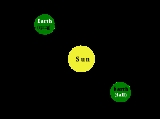
Thus at any point there should be one special coordinate system, "at rest relative to the aether". Maxwell noted in the late 1870s that detecting motion relative to this aether should be easy enough—light traveling along with the motion of the Earth would have a different speed than light traveling backward, as they would both be moving against the unmoving aether. Even if the aether had an overall universal flow, changes in position during the day/night cycle, or over the span of seasons, should allow the drift to be detected.

Experiments

Numerous experiments were carried out in the late 1800s to test for this "aether wind" effect, but most were open to dispute due to low accuracy. Measurements on the speed of propagation were so inaccurate that comparing two speeds to look for a difference was essentially impossible.

The famous Michelson-Morley experiment
Michelson-Morley experiment

The Michelson?Morley experiment, one of the most important and famous experiments in the history of physics, was performed in 1887 by Albert Michelson and Edward Morley at what is now Case Western Reserve University....
 instead compared the source light with itself after being sent in different directions, looking for changes in phase in a manner that could be measured with extremely high accuracy. The publication of their result in 1887, the null result
Null result

Generally, a null result is a result which is null : that is, the proposed result is absent. In science, it is an experimental outcome which does not show an otherwise expected effect....
, was the first clear demonstration that something was seriously wrong with the aether concept of that time. A series of experiments using similar but increasingly sophisticated apparatus all returned the null result as well. A conceptually different experiment that also attempted to detect the motion of the aether was the 1903 Trouton-Noble experiment
Trouton-Noble experiment

The Trouton?Noble experiment attempted to detect motion of the Earth through the luminiferous aether, and was conducted in 1901–1903 by Frederick Thomas Trouton and Henry R....
, which like Michelson-Morley obtained a null result.

In this case the MM experiment yielded a shift of the fringing pattern of about 0.01 of a fringe, corresponding to a small velocity. However, it was incompatible with the expected aether wind effect due to the earth's (seasonally varying) velocity which would have required a shift of 0.4 of a fringe, and the error was small enough that the value may have indeed been zero. Therefore, the null hypothesis
Null hypothesis

In statistics, a null hypothesis is a concept which arises in the context of statistical hypothesis testing. A common convention is to use the symbol H0 to denote the null hypothesis....
, the hypothesis that there was no aether wind, could not be rejected. More modern experiments have since reduced the possible value to a number very close to zero, about 10-15.

These "aether-wind" experiments led to the abandonment of the aether concept by some scientists like Emil Cohn
Emil Cohn

Emil Georg Cohn , was a Germany physicist....
 or Alfred Bucherer
Alfred Bucherer

Alfred Heinrich Bucherer was a German physicist, who is known for his experiments on relativistic mass. He also coined the phrase "theory of relativity"....
, and to a flurry of efforts to "save" aether by assigning it ever more complex properties by others. Of particular interest was the possibility of "aether entrainment" or "aether drag", which would lower the magnitude of the measurement, perhaps enough to explain MMX results. However, as noted earlier, aether dragging already had problems of its own, notably aberration. A more direct measurement was made in the Hammar experiment, which ran a complete MM experiment with one of the "legs" placed between two massive lead blocks. If the aether was dragged by mass then this experiment would have been able to detect the drag caused by the lead, but again the null result was found. Similar experiments by Hoek placed one leg in a heavy vat of water. The theory was again modified, this time to suggest that the entrainment only worked for very large masses or those masses with large magnetic fields. This too was shown to be incorrect when Oliver Joseph Lodge
Oliver Joseph Lodge

Sir Oliver Joseph Lodge, Fellow of the Royal Society , born at Penkhull in Stoke-on-Trent and educated at Adams' Grammar School, was a physicist and writer involved in the development of the wireless telegraph....
 noted no such effect around other planets.

Another, completely different, attempt to save "absolute" aether was made in the Lorentz-Fitzgerald contraction hypothesis, which posited that everything was affected by travel through the aether. In this theory the reason the Michelson-Morley experiment "failed" was that the apparatus contracted in length in the direction of travel. That is, the light was being affected in the "natural" manner by its travel though the aether as predicted, but so was the apparatus itself, canceling out any difference when measured. Fitzgerald had inferred this hypothesis from a paper by Oliver Heaviside
Oliver Heaviside

Oliver Heaviside was a autodidact English electrical engineering, mathematician, and physicist who adapted complex numbers to the study of electrical circuits, invented mathematical techniques to the solution of differential equations , reformulated Maxwell's equations in terms of electric and magnetic forces and flux, and independently co-f...
. Without referral to an aether, this physical interpretation of relativistic effects was shared by Kennedy and Thorndike
Kennedy-Thorndike experiment

The Kennedy?Thorndike experiment , first conducted in 1932, is a modified form of the Michelson?Morley experimental procedure. The modification is to make one arm of the classical Michelson?Morley apparatus very short....
 in 1932 as they concluded that the interferometer's arm contracts and also the frequency of its light source "very nearly" varies in the way required by relativity.

Another experiment purporting to show effects of an aether was Fizeau
Hippolyte Fizeau

Armand Hippolyte Louis Fizeau , France physics, was born in Paris. His earliest work was concerned with improvements in photographic processes. Later, in association with Dillon Beaulieu, he engaged in a series of investigations on the interference of light and heat....
's 1851 experimental confirmation of Fresnel's 1818 prediction that a medium with refractive index
Refractive index

The refractive index of a medium is a measure for how much the speed of light is reduced inside the medium. For example, typical soda-lime glass has a refractive index of 1.5, which means that in glass, light travels at times the speed of light in a vacuum....
 n moving with a velocity v would increase the speed of light traveling through the medium in the same direction as v from c/n to:

That is, movement adds only a fraction of the medium's velocity to the light (predicted by Fresnel in order to make Snell's law
Snell's law

In optics and physics, Snell's law , is a mathematical formula used to describe the relationship between the angles of incidence and refraction, when referring to light or other waves, passing through a boundary between two different isotropic medium , such as water and glass....
 work in all frames of reference, consistent with stellar aberration). This was initially interpreted to mean that the medium drags the aether along, with a portion of the medium's velocity, but that understanding was rejected after Wilhelm Veltmann demonstrated that the index n in Fresnel's formula depended upon the wavelength
Wavelength

In physics, wavelength is the distance between repeating units of a propagating wave of a given frequency. It is commonly designated by the Greek language letter lambda ....
 of light, so that the aether could not be moving at a wavelength-independent speed. This implied that there must be a separate aether for each of the infinitely many frequencies. This realization tended to undermine belief in the aether as a viable physical concept. Moreover, with the advent of special relativity, Fresnel's equation was shown by Laue
Max von Laue

Max Theodor Felix von Laue was a German physicist who won the Nobel Prize in Physics in 1914 for his discovery of the diffraction of X-rays by crystals....
 in 1907 to be just an approximation, valid for v much smaller than c, for the correct relativistic formula to add the velocities v (medium) and c/n (rest frame):

Similarly the Sagnac effect
Sagnac effect

The Sagnac effect , named after French physicist Georges Sagnac, is a phenomenon encountered in interferometry that is elicited by rotation. The Sagnac effect manifests itself in a setup called ring interferometry....
, observed by G. Sagnac in 1913 was immediately seen to be fully consistent with special relativity. In fact, the Michelson-Gale-Pearson experiment
Michelson-Gale-Pearson experiment

The Michelson-Gale-Pearson experiment is a modified version of the Michelson-Morley experiment and the Sagnac effect which tests the theories of special relativity and luminiferous ether along the rotating frame of Earth....
 in 1925 was proposed specifically as a test to confirm the relativity theory, although it was also recognized that such tests, which merely measure absolute rotation, are also consistent with non-relativistic theories.

During the 1920s, the experiments pioneered by Michelson were repeated by Dayton Miller
Dayton Miller

Dayton Clarence Miller was an United States physicist, astronomer, acoustician, and accomplished amateur flautist. An early experimenter of X-rays, Miller was an advocate of aether theory and absolute space and an opponent of Albert Einstein's theory of relativity....
, who publicly proclaimed positive results on several occasions, although not large enough to be consistent with any known aether theory. In any case, other researchers were unable to duplicate Miller's claimed results, and in subsequent years the experimental accuracy of such measurements has been raised by many orders of magnitude, and no trace of any violations of Lorentz invariance has been seen. (A later re-analysis of Miller's results concluded that he had underestimated the variations due to temperature.)

Since the Miller experiment and it's unclear results there have been many more experiments to detect the ether. Many of the experimenters have claimed positive results. These results have not gained much attention from mainstream science. For a list and criticisms of those experiments (Kantor, Marinov, Silvertooth, Torr and Kolen, Munera, Cahill) see .

End of aether?

Aether theory was dealt another blow when the Galilean transformation and Newtonian dynamics were both modified by Albert Einstein
Albert Einstein

Albert Einstein was a Germany-born theoretical physics. He is best known for his theory of relativity and specifically mass?energy equivalence, expressed by the equation E = mc2....
's Special Theory of Relativity, giving the mathematics of Lorentzian electrodynamics
Lorentz ether theory

What is now called Lorentz Ether theory has its roots in Hendrik Lorentz's "Theory of electrons", which was the final point in the development of the classical aether theories at the end of the 19th and at the beginning of the 20th century....
 a new, "non-aether" context. Unlike most major shifts in scientific thought, the Special Theory of Relativity was adopted by the scientific community remarkably quickly, consistent with Einstein's later comment that the laws of physics described by the Special Theory were "ripe for discovery" in 1905. Max Planck's early advocacy of the Special Theory, along with the natural and elegant formulation given to it by Minkowski, contributed much to the rapid acceptance of the Special Theory among working scientists.

Einstein based his Special Theory on Lorentz's earlier work. Instead of suggesting that the mechanical properties of objects changed with their constant-velocity motion through an undetectable aether, Einstein proposed to deduce the characteristics that any successful theory must possess in order to be consistent with the most basic and firmly established principles, independent of the existence of a hypothetical ether. He found that the Lorentz transformation must transcend its connection with Maxwell's equations, and must represent the fundamental relations between the space and time coordinates of inertial frames of reference. In this way he demonstrated that the laws of physics remained invariant as they had with the Galilean transformation, but that light was now invariant as well. Max Born
Max Born

Max Born was a Germany physicist and mathematician who was instrumental in the development of quantum mechanics. He also made contributions to solid-state physics and optics and supervised the work of a number of notable physicists in the 1920s and 30s....
 in his Einstein's Theory of Relativity observed:

Einstein in later years proposed calling empty space equipped with gravitational and electromagnetic fields the "ether", whereby, however, this word is not to denote a substance with its traditional attributes. Thus, in the "ether" there are to be no determinable points, and it is meaningless to speak of motion relative to the "ether." Such a use of the word "ether" is of course admissible, and when once it has been sanctioned by usage in this way, probably quite convenient. From now on ether as a substance vanishes from theory.


With the development of the Theory of Special Relativity, the need to account for a single universal frame of reference had disappeared — and acceptance of the 19th century theory of a luminiferous aether disappeared with it. For Einstein, the Lorentz transformation implied a radical conceptual change: that the concept of position in space or time was not absolute, but could differ depending on the observer's location and velocity.

Moreover, in another paper published the same month in 1905, Einstein made several observations on a then-thorny problem, the photoelectric effect
Photoelectric effect

The photoelectric effect is a phenomenon in which electrons are emitted from matter after the absorption of energy from electromagnetic wave such as x-rays or visible light....
. In this work he demonstrated that light can be considered as particles that have a "wave-like nature". Particles obviously do not need a medium to travel, and thus, neither did light. This was the first step that would lead to the full development of quantum mechanics
Quantum mechanics

Quantum mechanics is a set of principles underlying the most fundamental known description of all physical systems at the microscopic scale . Notable amongst these principles are both a dual wave-like and particle-like behavior of matter and radiation, and prediction of probabilities in situations where classical physics predicts certaintie...
, in which the wave-like nature and the particle-like nature of light are both considered to be simplifications of what is "really happening". A summary of Einstein's thinking about the aether hypothesis, relativity and light quanta may be found in his 1909 (originally German) lecture "The Development of Our Views on the Composition and Essence of Radiation"

Lorentz on his side continued to use the aether concept. In his lectures of around 1911 he pointed out that what "the theory of relativity has to say", "can be carried out independently of what one thinks of the aether and the time". He commented that "whether there is an aether or not, electromagnetic fields certainly exist, and so also does the energy of the electrical oscillations" so that, "if we do not like the name of "aether", we must use another word as a peg to hang all these things upon." He concluded that "one cannot deny the bearer of these concepts a certain substantiality".

In the early 1920s, in a lecture which he was invited to give at Lorentz's university in Leiden, Einstein sought to reconcile the theory of relativity with his mentor's cherished concept of the aether. In this lecture Einstein stressed that, in general relativity, space is "endowed with physical quantities" He pointed out that the aether had been relativized, and thereby lost the last mechanical property that Lorentz had left it, namely, its state of motion. Thus he held that general relativity attributed physical properties to space, including some kind of medium for light, although not a material one. Shortly before his lecture in Leiden in 1920 he admitted in the paper: "Grundgedanken und Methoden der Relativitätstheorie in ihrer Entwicklung dargestellt":

Therefore I thought in 1905 that in physics one should not speak of the ether at all. This judgement was too radical though as we shall see with the next considerations about the general theory of relativity. It moreover remains, as before, allowed to assume a space-filling medium if one can refer to electromagnetic fields (and thus also for sure matter) as the condition thereof.


In later years there have been a few individuals who advocated a neo-Lorentzian approach to physics, but it is Lorentzian only in the sense of positing an absolute true state of rest, which is undetectable and which plays no role in the predictions of the theory. (No violations of Lorentz covariance have ever been detected, despite strenuous efforts.) Hence these theories resemble the 19th century ether theories in name only. For example, the founder of quantum field theory, Paul Dirac, stated in 1951 in an article in Nature, titled "Is there an ether?" that "we are rather forced to have an ether". However, within a year, Dirac had abandoned the idea.

Continuing adherents

A very small number of physicists (like Dayton Miller
Dayton Miller

Dayton Clarence Miller was an United States physicist, astronomer, acoustician, and accomplished amateur flautist. An early experimenter of X-rays, Miller was an advocate of aether theory and absolute space and an opponent of Albert Einstein's theory of relativity....
 and Edward Morley
Edward Morley

Edward Williams Morley was an United States scientist famous for the Michelson-Morley experiment....
) continued research on the aether into the first decades of the 20th century. However, no evidence of the sort sought by these individuals has ever passed the tests of modern scientific standards. Today the majority of physicists hold that there is no need to imagine that an aether (as a medium for light propagation) exists. They believe that neither Einstein's general theory of relativity nor quantum mechanics have need for positing its existence, that there is no evidence for its existence, and that the assumption of its existence is an unnecessary theory violating the principle of Occam's razor
Occam's razor

Occam's razor, also Ockham's razor, is a principle attributed to the 14th-century English logician and Franciscan friar, William of Ockham....
. It is difficult to develop an aether theory consistent with the results of all experiments of modern physics. Any new theory of aether would have to be consistent with all the experiment
Experiment

In scientific inquiry, an experiment is a method of investigating causal relationships among variables. An experiment is a cornerstone of the empiricism approach to acquiring data about the world and is used in both natural sciences and social sciences....
s testing phenomena
Phenomenon

A phenomenon is any observation occurrence. In popular usage, a phenomenon often refers to an extraordinary event. In physics, a phenomenon may be a feature of matter, energy, or spacetime....
 of special relativity, general relativity
General relativity

General relativity or the general theory of relativity is the Geometry Theoretical physics of gravitation published by Albert Einstein in 1916....
, and relativistic quantum mechanics
Quantum mechanics

Quantum mechanics is a set of principles underlying the most fundamental known description of all physical systems at the microscopic scale . Notable amongst these principles are both a dual wave-like and particle-like behavior of matter and radiation, and prediction of probabilities in situations where classical physics predicts certaintie...
. Some new "aether" concepts have been proposed in recent years, but the descriptions of these concepts differ in fundamental ways from the description of the classical luminiferous aether.

Aether concepts

  • Aether theories
    Aether theories

    Alchemy, natural philosophy, and early modern physics proposed the existence of a medium of the ?ther , a space-filling substance or field, thought to be necessary as a transmission medium....
  • Aether (classical element)
    Aether (classical element)

    According to ancient and History of science in the Middle Ages, aether , also spelled ?ther or ether, is the material that fills the region of the Universe above the Sublunary sphere....
  • Aether drag hypothesis
    Aether drag hypothesis

    The aether drag hypothesis was an early attempt to explain the way experiments such as Arago's experiment showed that the speed of light is constant....


See also

  • History of special relativity
    History of special relativity

    The history of special relativity consists of many theoretical and empirical results of physicists like Hendrik Lorentz and Henri Poincar?, which culminated in the theory of special relativity proposed by Albert Einstein, and subsequent work of physicists like Hermann Minkowski....
  • Superseded scientific theory
    Superseded scientific theory

    A superseded, or obsolete, scientific theory is a scientific theory that was once commonly accepted, but that is no longer considered the most complete description of reality by a mainstream scientific consensus; or a falsifiable theory which has been shown to be false....
  • Preferred frame
    Preferred frame

    In theoretical physics, a preferred or privileged frame is usually a special hypothetical frame of reference in which the laws of physics might appear to be identifiably different from those in other frames....
  • Galactic year
    Galactic year

    The galactic year, also known as a cosmic year, is the duration of time required for the solar system to orbit once around the center of the Milky Way galaxy....
  • Virtual particle
    Virtual particle

    In physics, a virtual particle is a particle that exists for a limited time and space, introducing uncertainty in their energy and momentum due to the Heisenberg Uncertainty Principle....
  • Sean Sinjin
    Sean Sinjin

    Sean Sinjin is the author of the book, "Meme", and operates the atheism-education website, BetterHuman.org. He advocates removing religion as an influence from society, and seeks to improve humanity's understanding of its evolutionary past, and responsibility for its future....


External links

  • - A more complete table of results that have claimed to detect an ether.
  • - includes a lengthy list of aether experiments, among others
  • - Lord Rayleigh's address
  • - a categorised compendium of articles relating to the emergence of scientific theories that reference the aether, or quantum foam
    Quantum foam

    Quantum foam, also referred to as spacetime foam, is a concept in quantum mechanics, devised by John Archibald Wheeler in 1955. The foam is supposedly the foundations of the fabric of the universe, but it can also be used as a qualitative description of subatomic spacetime turbulence at extremely small distances of the order of the...
     of space.
  • - Albert Einstein's 1920 inauguration address at the University of Leiden (actually delivered on 27 October 1920).
  • The New Student's Reference Work/Ether