


Ashikaga Yoshimitsu

Encyclopedia
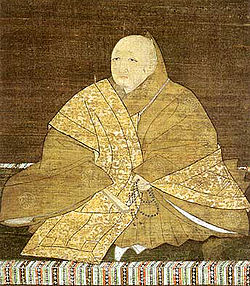
was the 3rd shogun
Shogun
A was one of the hereditary military dictators of Japan from 1192 to 1867. In this period, the shoguns, or their shikken regents , were the de facto rulers of Japan though they were nominally appointed by the emperor...
of the Ashikaga shogunate
Ashikaga shogunate
The , also known as the , was a Japanese feudal military regime, ruled by the shoguns of the Ashikaga clan.This period is also known as the Muromachi period and gets its name from Muromachi Street of Kyoto where the third shogun Ashikaga Yoshimitsu established his residence...
who ruled from 1368 to 1394 during the Muromachi period
Muromachi period
The is a division of Japanese history running from approximately 1336 to 1573. The period marks the governance of the Muromachi or Ashikaga shogunate, which was officially established in 1338 by the first Muromachi shogun, Ashikaga Takauji, two years after the brief Kemmu restoration of imperial...
of Japan
Japan
Japan is an island nation in East Asia. Located in the Pacific Ocean, it lies to the east of the Sea of Japan, China, North Korea, South Korea and Russia, stretching from the Sea of Okhotsk in the north to the East China Sea and Taiwan in the south...
. Yoshimitsu was the son of the second shogun
Shogun
A was one of the hereditary military dictators of Japan from 1192 to 1867. In this period, the shoguns, or their shikken regents , were the de facto rulers of Japan though they were nominally appointed by the emperor...
Ashikaga Yoshiakira
Ashikaga Yoshiakira
was the 2nd shogun of the Ashikaga shogunate who reigned from 1358 to 1367 during the Muromachi period of Japan. Yoshiakira was the son of the founder and first shogun of the Muromachi shogunate, Ashikaga Takauji....
.
In the year after the death of his father Yoshiakira in 1367, Yoshimitsu became Seii Taishogun
Shogun
A was one of the hereditary military dictators of Japan from 1192 to 1867. In this period, the shoguns, or their shikken regents , were the de facto rulers of Japan though they were nominally appointed by the emperor...
at age 11.
Significant events shape the period during which Yoshimitsu was shogun:
- 1368 – Yoshimitsu appointed shogun; ChōkeiEmperor ChokeiEmperor Chōkei was the 98th emperor of Japan, according to the traditional order of succession. He reigned from 1368 through 1383...
ascends southern throne. - 1369 – Kusunoki MasanoriKusunoki Masanoriwas a samurai who fought for the Southern Court in Japan's Nanboku-chō Wars, and is famed for his skills as a leader and military strategist, though he later sought a diplomatic solution and was regarded a traitor by many of his comrades...
defects to Ashikaga. - 1370 – Imagawa SadayoImagawa Sadayo, also known as ', was a renowned Japanese poet and military commander who served as tandai of Kyūshū under the Ashikaga Bakufu from 1371 to 1395. His father, Imagawa Norikuni, had been a supporter of the first Ashikaga Shogun, Ashikaga Takauji, and for his services had been granted the position...
sent to subdue Kyushu. - 1371 – Attempts to arrange truce.
- 1373–1406 – Embassies between China and Japan.
- 1374 – En'yūEmperor Go-En'yuwas the 5th of the Ashikaga Pretenders during the period of two courts. According to pre-Meiji scholars, his reign spanned the years from 1371 through 1382....
ascends northern throne. - 1378 – Yoshimitsu builds the Muromachi palace in Kyoto's elite district of Kamigyo, on the site of the former residence of the nobleman Saionji Sanekane.
- 1379 – Shiba Yoshimasa becomes KanreiKanreior, more rarely, kanryō, was a high political post in feudal Japan; it is usually translated as Shogun's Deputy. After 1349, there were actually two Kanrei, the Kyoto Kanrei and the Kantō Kanrei....
. - 1380 – Kusunoki MasanoriKusunoki Masanoriwas a samurai who fought for the Southern Court in Japan's Nanboku-chō Wars, and is famed for his skills as a leader and military strategist, though he later sought a diplomatic solution and was regarded a traitor by many of his comrades...
rejoins KameyamaEmperor Go-Kameyamawas the 99th emperor of Japan, according to the traditional order of succession. He ruled from 1383 to October 21, 1392, becoming the last Emperor of the Southern Court...
; southern army suffers reverses. - 1382 – Go-Komatsu ascends northern throne; resurgence of southern army.
- 1383 – Yoshimitsu's honors; Go-Kameyama ascends southern throne.
- 1385 – Southern army defeated at KogaKoga-People:* Koga is a Japanese kuge family name* Harue Koga was a Japanese painter active in the Taishō period* Hiroyasu Koga, Yukio Mishima's kaishakunin* Masao Koga, was a Japanese composer, guitarist and pop musician...
. - 1387–1389 – Dissension in Toki family in MinoMino Province, one of the old provinces of Japan, encompassed part of modern-day Gifu Prefecture. It was sometimes called . Mino Province bordered Echizen, Hida, Ise, Mikawa, Ōmi, Owari, and Shinano Provinces....
. - 1389 – Yoshimitsu pacifies Kyūshū and distributes lands; Yoshimitsu opposed by Kamakura kanrei Ashikaga UjimitsuAshikaga Ujimitsuwas a Nanboku-chō period warrior and the Kamakura-fu's second Kantō Kubō, or Shogun Deputy. Son of first Kantō Kubō Ashikaga Motouji, he succeeded his father in 1367 at the age of nine when this last suddenly died during an epidemic. It was during his reign that the Kanto Kubō title became common...
. - 1390 – Kusunoki defeated; Yamana Ujikiyo chastises Tokinaga.
- 1391 – Yamana Ujikyo attacks Kyoto – Meitoku War.
- 1392 – Northern and Southern courts reconciled under Go-Komatsu.
- 1394 – Yoshimitsu officially cedes his position to his son; Ashikaga YoshimochiAshikaga Yoshimochiwas the 4th shogun of the Ashikaga shogunate who reigned from 1394 to 1423 during the Muromachi period of Japan. Yoshimochi was the son of the third shogun Ashikaga Yoshimitsu....
appointed shogun. - 1396 – Imagawa Sadayo dismissed.
- 1397 – Uprising in Kyūshū suppressed.
- 1398 – Muromachi administration organized.
- 1399 – Ōuchi YoshihiroOuchi Yoshihiro, also known as Ouchi Sakyo-no-Tayu, was a Muromachi period samurai clan head and military leader.Yoshirio was the second son of Ōuchi Hiroyo, and a member of the Ōuchi family which served under Ashikaga Takauji. The Ōuchi became known as the shugo of Suō and Nagato in 1363 for assisting the...
and Ashikaga MitsukaneAshikaga Mitsukanewas a Nanboku-chō period warrior, and the Kamakura-fu's third Kantō Kubō, . Being the eldest son, he succeeded his father Ujimitsu in 1398 at the age of 21 when he died during an epidemic.. Like him, Mitsukane aspired more or less openly to the shogunate and, like him and his successors, failed to...
rebel – Ōei War. - 1402 – Uprising in Mutsu suppressed.
- 1404 – Yoshimitsu is crowned Nippon Koku-Ō (King of Japan) by Emperor Yongle of ChinaYongle EmperorThe Yongle Emperor , born Zhu Di , was the third emperor of the Ming Dynasty of China from 1402 to 1424. His Chinese era name Yongle means "Perpetual Happiness".He was the Prince of Yan , possessing a heavy military base in Beiping...
. - 1408 – Yoshimitsu dies.
Muromachi
Yoshimitsu constructed his residence in the Muromachi section in the capital of KyotoKyoto
is a city in the central part of the island of Honshū, Japan. It has a population close to 1.5 million. Formerly the imperial capital of Japan, it is now the capital of Kyoto Prefecture, as well as a major part of the Osaka-Kobe-Kyoto metropolitan area.-History:...
in 1378. As a result, in Japanese, the Ashikaga shogunate
Ashikaga shogunate
The , also known as the , was a Japanese feudal military regime, ruled by the shoguns of the Ashikaga clan.This period is also known as the Muromachi period and gets its name from Muromachi Street of Kyoto where the third shogun Ashikaga Yoshimitsu established his residence...
and the corresponding time period are often referred to as the Muromachi shogunate and Muromachi period.
Yoshimitsu resolved the rift between the Northern and Southern Court
Southern Court
The were a set of four emperors whose legitimate claims were usurped during the Nanboku-chō period spanning from 1336 through 1392. In spite of the legitimacy of its claims to the throne, the Southern Court was permanently replaced in 1392 by the illegitimate Northern Court.-Nanboku-chō overview:...
s in 1392, when he persuaded Go-Kameyama
Emperor Go-Kameyama
was the 99th emperor of Japan, according to the traditional order of succession. He ruled from 1383 to October 21, 1392, becoming the last Emperor of the Southern Court...
of the Southern Court to hand over the Imperial Regalia
Imperial Regalia of Japan
The , also known as the Three Sacred Treasures of Japan, consist of the sword Kusanagi , the mirror Yata no Kagami , and the jewel Yasakani no Magatama...
to Emperor Go-Komatsu
Emperor Go-Komatsu
Emperor Go-Komatsu was the 100th emperor of Japan, according to the traditional order of succession. He is officially considered a pretender from May 24, 1382 to October 21, 1392, when Emperor Go-Kameyama abdicated...
of the Northern Court. Yoshimitsu's greatest political achievement was that he managed to bring about the end to Nanboku-cho
Nanboku-cho
The , spanning from 1336 to 1392, was a period that occurred during the formative years of the Muromachi bakufu of Japan's history.During this period, there existed a Northern Imperial Court, established by Ashikaga Takauji in Kyoto, and a Southern Imperial Court, established by Emperor Go-Daigo in...
fighting. This event had the effect of firmly establishing the authority of the Muromachi shogunate and suppressing the power of the regional daimyo
Daimyo
is a generic term referring to the powerful territorial lords in pre-modern Japan who ruled most of the country from their vast, hereditary land holdings...
who might challenge that central authority.
Although Yoshimitsu retired in 1394 and his son was confirmed as the fourth shogun Ashikaga Yoshimochi
Ashikaga Yoshimochi
was the 4th shogun of the Ashikaga shogunate who reigned from 1394 to 1423 during the Muromachi period of Japan. Yoshimochi was the son of the third shogun Ashikaga Yoshimitsu....
, the old shogun didn't abandon any of his powers. Yoshimitsu continued to maintain authority over the shogunate until his death.
Yoshimitsu also played a major role in the genesis of Noh theatre, as the patron of of Zeami, the actor considered to be Noh's founder. His close relationship with Zeami was not only based on his appreciation of Zeami's aesthetic sensibilities but also on the fact that Yoshimitu, known as an enthusiastic practitioner of Shudo, or Samurai pederasty, was infatuated with the young Zeami and took the young man as his pederastic lover.
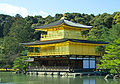
Yoshimitsu died suddenly in 1408 at age 50. After his death, his retirement villa (near Kyoto) became Rokuon-ji, which today is famous for its three-storied, gold-leaf covered reliquary known as "Kinkaku." So famous is this single structure, in fact, that the entire temple itself is often identified as the Kinkaku-ji
Kinkaku-ji
, also known as , is a Zen Buddhist temple in Kyoto, Japan. The garden complex is an excellent example of Muromachi period garden design. It is designated as a National Special Historic Site and a National Special Landscape, and it is one of 17 locations comprising the Historic Monuments of Ancient...
, the Temple of the Golden Pavilion. A statue of Yoshimitsu is found there today.
Eras of Yoshimitsu's bakufu
The years in which Yoshimitsu was shogun are more specifically identified by more than one era name or nengō.Nanboku-chō southern court
- Eras as reckoned by legitimate Court (as determined by Meiji rescript):
- ShōheiShoheiwas a Japanese era name of the Southern Court during the Era of Northern and Southern Courts after Kōkoku and before Kentoku. This period spanned the years from December 1346 to July 1370. The Southern Court emperors in Yoshino were and...
(1346–1370) - KentokuKentokuKentoku was a Japanese era of the Southern Court during the Era of Northern and Southern Courts after Shōhei and before Bunchū, lasting from July 1370 to April 1372...
(1370–1372) - BunchūBunchuBunchū was a Japanese era name of the Southern Court during the Era of Northern and Southern Courts after Kentoku and before Tenju. This period spanned the years from October 1372 to May 1375. The Southern Court emperor in Yoshino during this time-frame was...
(1372–1375) - TenjuTenjuTenju was a Japanese era name of the Southern Court during the Era of Northern and Southern Courts after Bunchū and before Kōwa. This period spanned the years from May 1375 to February 1381. The Southern Court emperor in Yoshino during this time-frame was...
(1375–1381) - Kōwa (1381–1384)
- GenchūGenchuGenchū was a Japanese era of the Southern Court during the Era of Northern and Southern Courts lasting from April 1384 to October 1392. Reigning Emperors were Go-Kameyama in the south and Go-Komatsu in the north.-Nanboku-chō overview:...
(1384–1393)
- Shōhei
Nanboku-chō northern court
- Eras as reckoned by pretender Court (as determined by Meiji rescript):
- ŌanOan, also romanized as Ō-an, was a Japanese era name of the Northern Court during the Era of Northern and Southern Courts after Jōji and before Eiwa. This period spanned the years from February 1368 through February 1375...
(1368–1375) - EiwaEiwawas a Japanese era name of the Northern Court during the Era of Northern and Southern Courts after Ōan and before Kōryaku. This period spanned the years from February 1375 through March 1379...
(1375–1379) - KōryakuKoryakuwas a Japanese era name of the Northern Court during the Era of Northern and Southern Courts after Eiwa and before Eitoku. This period spanned the years from March 1379 through February 1381...
(1379–1381) - EitokuEitokuwas a Japanese era name of the Northern Court during the Era of Northern and Southern Courts after Kōryaku and before Shitoku. This period spanned the years from February 1381 to February 1384...
(1381–1384) - ShitokuShitokuShitoku was a Japanese era name of the Northern Court during the Era of Northern and Southern Courts after Eitoku and before Kakei. This period spanned the years from February 1384 to August 1387...
(1384–1387) - KakeiKakeiKakei was a Japanese era name of the Northern Court during the Era of Northern and Southern Courts after Shitoku and before Kōō. This period spanned the years from August 1387 to February 1389...
(1387–1389) - Kōō (1389–1390)
- MeitokuMeitokuMeitoku was a Japanese era name of the Northern Court during the Era of Northern and Southern Courts after Kōō and before Ōei. This period spanned the years from March 1390 to July 1394...
(1390–1393)‡
- Ōan
Post-Nanboku-chō reunified court
- Eras merged as Meitoku 3 replaced Genchū 9 as Go-Kameyama abdicated.
- MeitokuMeitokuMeitoku was a Japanese era name of the Northern Court during the Era of Northern and Southern Courts after Kōō and before Ōei. This period spanned the years from March 1390 to July 1394...
(1393–1384)‡ - ŌeiOeiwas a after Meitoku and before Shōchō. This period spanned the years from July 1394 through April 1428. Reigning emperors were and .-Change of era:* 1394 : The new era name was created because of plague...
(1394–1428)
- Meitoku