


Nagato Province

Encyclopedia
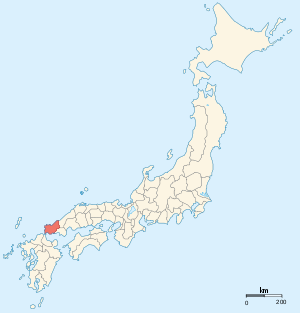
Provinces of Japan
Before the modern prefecture system was established, the land of Japan was divided into tens of kuni , usually known in English as provinces. Each province was divided into gun ....
of Japan
Japan
Japan is an island nation in East Asia. Located in the Pacific Ocean, it lies to the east of the Sea of Japan, China, North Korea, South Korea and Russia, stretching from the Sea of Okhotsk in the north to the East China Sea and Taiwan in the south...
. It was at the extreme western end of Honshū
Honshu
is the largest island of Japan. The nation's main island, it is south of Hokkaido across the Tsugaru Strait, north of Shikoku across the Inland Sea, and northeast of Kyushu across the Kanmon Strait...
, in the area that is today Yamaguchi Prefecture
Yamaguchi Prefecture
is a prefecture of Japan in the Chūgoku region on Honshū island. The capital is the city of Yamaguchi, in the center of the prefecture. The largest city, however, is Shimonoseki.- History :...
. Nagato bordered on Iwami
Iwami Province
was an old province of Japan in the area that is today the western part of Shimane Prefecture. It was sometimes called . Iwami bordered Aki, Bingo, Izumo, Nagato, and Suō provinces.In the Heian era the capital was at modern-day Hamada....
and Suō
Suo Province
was a province of Japan in the area that is today the eastern part of Yamaguchi Prefecture. It was sometimes called . Suō bordered on Aki, Iwami, and Nagato Provinces....
Provinces.
Although the ancient capital of the province was Shimonoseki
Shimonoseki, Yamaguchi
is a city located in Yamaguchi Prefecture, Japan. It is at the southwestern tip of Honshū, facing the Tsushima Strait and also Kitakyushu across the Kanmon Straits....
, Hagi
Hagi, Yamaguchi
is a city located in Yamaguchi, Japan and was incorporated as a city on July 1, 1932. Formerly part of Abu District.On March 6, 2005, the former city of Hagi merged with the towns of Susa and Tamagawa, and the villages of Asahi, Fukue, Kawakami and Mutsumi to form the new city of Hagi.Iwami Airport...
was the seat of the Chōshū han
Han (Japan)
The or domain was the name of the estate belonging to a warrior in Japan after the 17th century. The fiefs of the daimyos of the samurai class of Japan during the Edo period were called han.-Edo period:...
(fief or domain) during the Edo period
Edo period
The , or , is a division of Japanese history which was ruled by the shoguns of the Tokugawa family, running from 1603 to 1868. The political entity of this period was the Tokugawa shogunate....
. Nagato was ruled by the Mōri clan
Mori clan
The Mōri clan was a family of daimyō, descended from Ōe no Hiromoto and established themselves in Aki Province. Their name was derived from a shōen in Mōri, Aikō District, Sagami Province. The generation of Hiromoto began to name themselves Mōri.After the Jōkyū War, Mōri was appointed to the jitō...
before and after the Battle of Sekigahara
Battle of Sekigahara
The , popularly known as the , was a decisive battle on October 21, 1600 which cleared the path to the Shogunate for Tokugawa Ieyasu...
.
In 1871 with the abolition of feudal domains
Abolition of the han system
The was an act, in 1871, of the new Meiji government of the Empire of Japan to replace the traditional feudal domain system and to introduce centralized government authority . This process marked the culmination of the Meiji Restoration in that all daimyo were required to return their authority...
and the establishment of prefecture
Prefecture
A prefecture is an administrative jurisdiction or subdivision in any of various countries and within some international church structures, and in antiquity a Roman district governed by an appointed prefect.-Antiquity:...
s (Haihan Chiken) after the Meiji Restoration
Meiji Restoration
The , also known as the Meiji Ishin, Revolution, Reform or Renewal, was a chain of events that restored imperial rule to Japan in 1868...
, the provinces of Nagato and Suō
Suo Province
was a province of Japan in the area that is today the eastern part of Yamaguchi Prefecture. It was sometimes called . Suō bordered on Aki, Iwami, and Nagato Provinces....
were combined to eventually establish Yamaguchi Prefecture.
Historically
History of Japan
The history of Japan encompasses the history of the islands of Japan and the Japanese people, spanning the ancient history of the region to the modern history of Japan as a nation state. Following the last ice age, around 12,000 BC, the rich ecosystem of the Japanese Archipelago fostered human...
, the oligarchy
Oligarchy
Oligarchy is a form of power structure in which power effectively rests with an elite class distinguished by royalty, wealth, family ties, commercial, and/or military legitimacy...
that came into power after the Meiji Restoration of 1868 had a strong representation from the Chōshū province, as Itō Hirobumi
Ito Hirobumi
Prince was a samurai of Chōshū domain, Japanese statesman, four time Prime Minister of Japan , genrō and Resident-General of Korea. Itō was assassinated by An Jung-geun, a Korean nationalist who was against the annexation of Korea by the Japanese Empire...
, Yamagata Aritomo
Yamagata Aritomo
Field Marshal Prince , also known as Yamagata Kyōsuke, was a field marshal in the Imperial Japanese Army and twice Prime Minister of Japan. He is considered one of the architects of the military and political foundations of early modern Japan. Yamagata Aritomo can be seen as the father of Japanese...
, and Kido Kōin were from there. Other natives famous for their role in the restoration include Yoshida Shōin
Yoshida Shoin
Yoshida Shōin was one of the most distinguished intellectuals in the closing days of the Tokugawa shogunate...
, Takasugi Shinsaku
Takasugi Shinsaku
was a samurai from the Chōshū Domain of Japan who contributed significantly to the Meiji Restoration.He used the alias to hide his activities from the shogunate.-Early life:...
, and Kusaka Genzui among others.
The Japanese battleship Nagato
Japanese battleship Nagato
Nagato was a battleship of the Imperial Japanese Navy; the lead ship of her class. She was the first battleship in the world to mount 16 inch guns, her armour protection and speed made her one of the most powerful capital ships at the time of her commissioning.She was the flagship of Admiral...
was named after this province.