

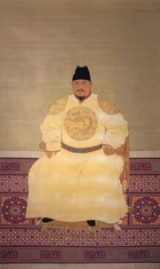
Hongwu Emperor

Encyclopedia
The Hongwu Emperor known variably by his given name Zhu Yuanzhang and by his temple name
Taizu of Ming , was the founder and first emperor of the Ming Dynasty
of China. His era name
, Hongwu, means "vastly martial".
In the middle of the 14th century, with famine, plagues and peasant revolts sweeping across China, Zhu became a leader of an army that conquered China, ending the Yuan Dynasty
and forcing the Mongols
to retreat to the Mongolian steppes. With his seizure of the Yuan capital
(present-day Beijing), he claimed the Mandate of Heaven
and established the Ming Dynasty
in 1368.
family in a village in Zhongli (鍾離, present day Fengyang, Anhui). His father was Zhu Shizhen (朱世珍, original name Zhu Wusi 朱五四) and his mother was Chen Erniang. He had seven older siblings, several of whom were "given away" by his parents, as they did not have enough food to support the family. When he was 16, the Yellow River
broke its banks and flooded the lands where his family lived. Subsequently, a plague killed his family, except one brother.
Destitute, Zhu Yuanzhang accepted a suggestion to take up a pledge made by his late father, and became a novice monk at the Huangjue Temple, a local Buddhist
monastery
. He did not remain there for long as the monastery ran short of funds and he was forced to leave.
For the next few years, Zhu Yuanzhang led the life of a wandering beggar and personally experienced and saw the hardships of the common people. After about three years, he returned to the monastery and stayed there until he was around 24 years old. He learned to read and write during the time he spent with the Buddhist monks. Although he did not become a Buddhist in later years, he still remained sympathetic towards Buddhism.
-ruled Yuan Dynasty
. Zhu rose rapidly through the ranks and became a commander. His rebel force later joined the Red Turbans
, a millenarian
sect related to the White Lotus
Society, and one that followed cultural and religious traditions of Buddhism
, Zoroastrianism
and other religions. Widely seen as a defender of Confucianism
and neo-Confucianism
among the predominant Han Chinese
population in China, Zhu emerged as a leader of the rebels that were struggling to overthrow the Yuan Dynasty.
, which became his base of operations and the official capital of the Ming Dynasty
during his reign. Zhu's government in Nanjing became famous for good governance and the city attracted vast numbers of people fleeing from other more lawless regions. It is estimated that Nanjing's population increased by 10 times over the next 10 years. In the meantime, the Yuan government had been weakened by internal factions fighting for control and it made little effort to retake the Yangtze River
valley. By 1358, central and southern China had fallen into the hands of different rebel groups. During that time, the Red Turbans
also split up. Zhu became the leader of a smaller faction (called "Ming" around 1360) while the larger faction, under Chen Youliang
, controlled the center of the Yangtze River valley.
Zhu was able to attract many talents into his service. One of them was Li Shanchang, who advised Zhu: "Build high walls, stock up rations, and don't be too quick to call yourself a king." Another, Jiao Yu
, was an artillery
officer who later compiled a military treatise outlining the various types of gunpowder
weapons. Another one, Liu Ji, became one of Zhu's key advisors, and edited the military-technology treatise titled Huolongjing
in later years.
Starting from 1360, Zhu and Chen Youliang fought a protracted war for supremacy over the former Red Turban territory. The pivotal moment in the war was the Battle of Lake Poyang
in 1363, one of the largest naval battles in history
. The battle lasted three days and ended with the defeat and retreat of Chen's larger sized navy. Chen died a month later in battle. Zhu did not participate personally in any battles after that and remained in Nanjing, where he directed his generals to go on campaigns.
In 1367, Zhu's forces defeated Zhang Shicheng
's Kingdom of Dazhou
, which was centered in Suzhou
and had previously included most of the Yangtze River Delta
and the Song Dynasty
's capital city of Hangzhou
. This victory granted Zhu's Ming government authority over the lands north and south of the Yangtze River. The other major warlords surrendered to Zhu and on 20 January 1368, Zhu proclaimed himself Emperor
of the Ming Dynasty
in Nanjing
and adopted "Hongwu" as his regnal title
. His dynasty's mission was to drive away the Mongols
and restore Han Chinese
rule in China.
In 1368, Ming armies headed north to attack territories that were still under the Yuan Dynasty's rule. The Mongols gave up their capital city of Khanbaliq
(Dadu, present-day Beijing) and the rest of northern China in September 1368 and retreated to Mongolia
. The Ming army captured the last Yuan-controlled province of Yunnan
in 1381 and China was unified under the Ming Dynasty's rule.
in 1368. His capital city remained in Nanjing
and "Hongwu" was adopted as his regnal title
.
Under Hongwu's rule, the Mongol
bureaucrats who dominated the government in the Yuan Dynasty
's time were replaced by Han Chinese
officials. Hongwu revamped the traditional Confucian
examination
system, from which potential state officials were selected from, based on merit and their knowledge of literature
and philosophy
. Candidates for positions in the civil service and the officers corps of the military were required to pass the imperial examination, as required by the Classics. The Confucian scholar-bureaucrats
, previously marginalized during the Yuan Dynasty, were reinstated to their predominant roles in the government.
Mongol related things, including garments and names, were discontinued from use and boycotted. There were also attacks on palaces and administrative buildings previously used by the Yuan rulers.
However, the reforms did not eliminate the threat of the bureaucrats to peasants. Instead, the expansion of the bureaucrats and their growing prestige translated into more wealth and tax exemption for those in the government service. The bureaucrats gained new privileges and some became illegal money-lenders and managers of gambling rings. Using their power, the bureaucrats expanded their estates at the expense of peasants' lands through outright purchase of those lands and foreclosure on their mortgages whenever they wanted the lands. The peasants often became either tenants or workers, or sought employment elsewhere.
Since the beginning of the Ming government in 1357, great care was taken by Hongwu to distribute land to peasants. One way was through forced migration to less dense areas. Some of those people were tied to a pagoda tree
in Hongdong (洪洞大槐樹) and moved. Public works projects, such as the construction of irrigation systems and dikes, were undertaken in an attempt to help farmers. In addition, Hongwu also reduced the demands for forced labour on the peasantry. In 1370, Hongwu ordered that some lands in Hunan
and Anhui
should be given to young farmers who had reached adulthood. The order was intended to prevent landlords from seizing the land, as it also decreed that the titles to the lands were not transferable. During the middle part of his reign, Hongwu passed an edict, stating that those who brought fallow land under cultivation could keep it as their property without being taxed. The policy was well received by the people and in 1393, cultivated land rose to 8,804,623 ching and 68 mou, something not achieved during any other Chinese dynasty.
Hongwu instigated the implanting of 50,000,000 trees in the vicinity of Nanjing, reconstructing canals, irrigation, and transporting southern people to the north for repopulation. He successfully managed to increase the population from 60 to 100 million.
still posed a threat to China, even though they had been driven away after the collapse of the Yuan Dynasty
. He decided to reassess the orthodox Confucian
view that the military was an inferior class to the scholar bureaucracy. Hongwu kept a powerful army which in 1384 he re-organized using a model known as the Wèisuǒ system . Each military unit consisted of 5,600 men divided into five battalions and ten companies. By 1393 the total number of Wèisuǒ troops had reached 1,200,000. Soldiers were also assigned land on which to grow crops whilst their positions were made hereditary.This type of system can be traced back to the Fǔbīng System of the Sui
and Tang
Dynasties. While the Ming army was initially very effective, it lost its capacity for offensive operations after the death of the Yongle Emperor
, and was defeated by the Mongols in 1449 during the Tumu Crisis
.
Training was conducted within local military districts. In times of war, troops were mobilized from all over the empire on the orders of the War Ministry, and commanders were appointed to lead them to battle. After the war, the army was disbanded into smaller groups and sent back to their respective districts, and the commanders had to return their authority to the state. This system helped to prevent military leaders from having too much power. However, one disadvantage was that the military was under the control of a civilian official for large campaigns, instead of a military general.
s. He used many tortures, especially flaying
and slow slicing. He expected everyone to obey his rule. One of his generals, Chang Yuchun
, carried out massacres in some places in Shandong
and Hunan
provinces to avenge resistance against his army. As time went on, Hongwu became increasingly fearful of rebellions and coups, even going so far as to order the execution of those of his advisers who dared criticize him. A story goes that a Confucian scholar who was fed up with Hongwu's policies decided to go to the capital and berate the emperor. When he gained an audience with the emperor, he brought his own coffin along with him. After delivering his speech he climbed into the coffin, expecting the emperor to execute him. The emperor however, impressed by this show of bravery, chose to spare the scholar's life. He was also said to have ordered the massacre of several thousand people living in Nanjing
after having heard one talked about him without respect. In 1380 after much killing, a thunderbolt hit his palace and he stopped the massacres for some time as he was afraid divine forces would punish him.
Hongwu also noted the destructive role of court eunuch
s under the previous dynasties. He drastically reduced their numbers, forbidding them to handle documents, insisting that they remained illiterate, and executing those who commented on state affairs. Hongwu had a strong aversion to the eunuchs, epitomized by a tablet in his palace stipulating: "Eunuchs must have nothing to do with the administration." However, this aversion to eunuchs being in the employ of an emperor was not popular with Hongwu's successors, and eunuchs soon returned to the emperors' courts after Hongwu. In addition to Hongwu's aversion to eunuchs, he never consented to any of his imperial relatives becoming court officials. This policy was fairly well-maintained by later emperors, and no serious trouble was caused by the empresses or their relatives.
Hongwu attempted, and largely succeeded in, the consolidation of control over all aspects of government, so that no other group could gain enough power to overthrow him. He also buttressed the country's defenses against the Mongols. As emperor, Hongwu increasingly concentrated power in his own hands. He abolished the chancellor's post, which had been head of the main central administrative body under past dynasties, by suppressing a plot for which he had blamed his chief minister. Many argue that the Hongwu Emperor, because of his wish to concentrate absolute authority in his own hands, removed the only insurance against incompetent emperors. However Hongwu's actions were not entirely one-sided since he did create a new post, called "Grand Secretary
", to take the place of the abolished prime minister. Ray Huang
argued that Grand-Secretaries, outwardly powerless, could exercise considerable positive influence from behind the throne. Because of their prestige and the public trust which they enjoyed, they could act as intermediaries between the emperor and the ministerial officials, and thus provide a stabilising force in the court. He executed tens of thousand officials and their relatives over sedition, treason, corruption and other charges.
One of the reasons why Hongwu eliminated the offices of grand councilor, particularly the chancellor, was due to Hu Weiyong
's attempt to usurp the throne. Hu was the Senior Grand Councilor and a close friend of the emperor. He was later executed. His actions greatly shocked the emperor and led the emperor to greatly distrust his high officials. To that end, he completely eliminated all the chancellors and established four advisors or the Grand-Secretaries to work closely with, who were intellectually able, though low ranking. Eliminating the office of the chancellor was the very step that increased the emperor's autocracy in the government.
He was extremely authoritarian, a virtual dictator, and governed directly over all affairs. Hongwu personally wrote essays posted in every village throughout China warning the people to behave, and of the horrifying consequences if they disobeyed.
mentioned that as early as 1364, the monarchy had started to draft a code of laws. This code was known as Code of the Great Ming or Laws of the Great Ming (大明律). The emperor devoted much time to the project and instructed his ministers that the code should be comprehensive and intelligible, so as not to allow any official to exploit loopholes in the code by deliberately misinterpreting it. The Ming code laid much emphasis on family relations. The code was a great improvement on the code of the earlier Tang Dynasty
in regards to the treatment of slaves
. Under the Tang code, slaves were treated as a species of domestic animal; if they were killed by a free citizen the law imposed no sanction on the killer. Under the Ming Dynasty, the law protected both slaves and free citizens.
, Hongwu accepted the Confucian
viewpoint that merchants were solely parasitic. Hongwu felt that agriculture should be the country's source of wealth and that trade was ignoble. As a result, the Ming economic system emphasized agriculture, unlike the economic system of the Song Dynasty
, which had preceded the Mongols
and had relied on traders and merchant for revenues. Hongwu also supported the creation of self-supporting agricultural communities.
However, Hongwu's prejudice against merchants did not diminish the numbers of traders. On the contrary, commerce increased significantly under Hongwu due to the growth of industry throughout the empire. This growth in trade was due in part to poor soil conditions and the overpopulation of certain areas, which forced many people to leave their homes and seek their fortunes in trade. A book titled Tu Pien Hsin Shu, written during the Ming Dynasty, gave a detailed description about the activities of merchants at that time.
 Hongwu ordered the construction of several mosques in Nanjing
, Yunnan, Guangdong
and Fujian
, and had inscriptions praising Muhammed placed in mosques. He rebuilt the Jinjue Mosque in Nanjing and large numbers of Hui people
moved to the city during his rule.
He also wrote a 100 word praise
on Islam, Allah
and the prophet Muhammad
. He had around 10 Muslim generals in his military, including Chang Yuchun
, Lan Yu
, Ding Dexing, Mu Ying
, Feng Sheng
and Hu Dahai
. In addition, Hongwu's spouse, Empress Ma, descended from a Muslim family while he was originally a member of a Muslim rebel group led by Guo Zhixin.
Hui scholars like Yusuf Haji Chang have claimed the Hongwu Emperor was Muslim, due to his intimate relations with Muslims, but the majority of academics reject this theory.
"Barbarians", rather than attacking.
However, Hongwu had harsh words for those who tried to threaten China. He send a message to the Japanese that his army would "capture and exterminate your bandits, head straight for your country, and put your king in bonds", due to consistent raiding by Japanese Wokou pirates.
. Hongwu's 17th son, Zhu Quan
, also wrote the Tea Manual
(茶谱).
 Although Hongwu's rule saw the introduction of paper currency, its development was stifled from the beginning. Not understanding inflation, Hongwu gave out so much paper money as rewards that by 1425, the state was forced to reintroduce copper coin
s because the paper currency had sunk to only 1/70 of its original value.
During Hongwu's reign, the early Ming Dynasty was characterized by rapid and dramatic population growth, largely due to the increased food supply from Hongwu's agricultural reforms. By the end of the dynasty, the population had risen by as much as 50%. This was stimulated by major improvements in agricultural technology, promoted by the pro-agrarian state which came to power in the midst of a pro-Confucian peasant's rebellion. During Hongwu's reign, living standards also greatly improved.
and Jiajing Emperor
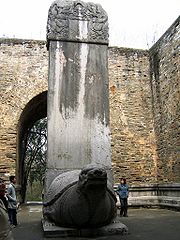
's physicians were executed. He was buried at Ming Xiaoling Mausoleum
on the Purple Mountain, east of Nanjing
.
The folk song Fengyang Flower Drum (凤阳花鼓) was credited to him. His portraits were controversial.
Hongwu's parents, grand-parents. great-grandparents and great-great-grandparents were given posthumous Imperial titles.
Hongwu treated his ladies-in-waiting badly, forcing them to live in the palaces for life without freedom and behind cemented walls. He massacred thousands of them. He restricted the freedom of many concubine
s and killed several. He also forced many of them to commit suicide and ordered that they will be buried with him after his death. Hongwu had several Korean concubines, including Lady Han, who bore him a son, and Lady Kung.
Temple name
Temple names are commonly used when naming most Chinese, Korean , and Vietnamese royalty. They should not be confused with era names. Compared to posthumous names, the use of temple names is more exclusive...
Taizu of Ming , was the founder and first emperor of the Ming Dynasty
Ming Dynasty
The Ming Dynasty, also Empire of the Great Ming, was the ruling dynasty of China from 1368 to 1644, following the collapse of the Mongol-led Yuan Dynasty. The Ming, "one of the greatest eras of orderly government and social stability in human history", was the last dynasty in China ruled by ethnic...
of China. His era name
Chinese era name
A Chinese era name is the regnal year, reign period, or regnal title used when traditionally numbering years in an emperor's reign and naming certain Chinese rulers . Some emperors have several era names, one after another, where each beginning of a new era resets the numbering of the year back...
, Hongwu, means "vastly martial".
In the middle of the 14th century, with famine, plagues and peasant revolts sweeping across China, Zhu became a leader of an army that conquered China, ending the Yuan Dynasty
Yuan Dynasty
The Yuan Dynasty , or Great Yuan Empire was a ruling dynasty founded by the Mongol leader Kublai Khan, who ruled most of present-day China, all of modern Mongolia and its surrounding areas, lasting officially from 1271 to 1368. It is considered both as a division of the Mongol Empire and as an...
and forcing the Mongols
Mongols
Mongols ) are a Central-East Asian ethnic group that lives mainly in the countries of Mongolia, China, and Russia. In China, ethnic Mongols can be found mainly in the central north region of China such as Inner Mongolia...
to retreat to the Mongolian steppes. With his seizure of the Yuan capital
Khanbaliq
Khanbaliq or Dadu refers to a city which is now Beijing, the current capital of the People's Republic of China...
(present-day Beijing), he claimed the Mandate of Heaven
Mandate of Heaven
The Mandate of Heaven is a traditional Chinese philosophical concept concerning the legitimacy of rulers. It is similar to the European concept of the divine right of kings, in that both sought to legitimaze rule from divine approval; however, unlike the divine right of kings, the Mandate of...
and established the Ming Dynasty
Ming Dynasty
The Ming Dynasty, also Empire of the Great Ming, was the ruling dynasty of China from 1368 to 1644, following the collapse of the Mongol-led Yuan Dynasty. The Ming, "one of the greatest eras of orderly government and social stability in human history", was the last dynasty in China ruled by ethnic...
in 1368.
Early life
Zhu Yuanzhang was born in a poor peasantPeasant
A peasant is an agricultural worker who generally tend to be poor and homeless-Etymology:The word is derived from 15th century French païsant meaning one from the pays, or countryside, ultimately from the Latin pagus, or outlying administrative district.- Position in society :Peasants typically...
family in a village in Zhongli (鍾離, present day Fengyang, Anhui). His father was Zhu Shizhen (朱世珍, original name Zhu Wusi 朱五四) and his mother was Chen Erniang. He had seven older siblings, several of whom were "given away" by his parents, as they did not have enough food to support the family. When he was 16, the Yellow River
Yellow River
The Yellow River or Huang He, formerly known as the Hwang Ho, is the second-longest river in China and the sixth-longest in the world at the estimated length of . Originating in the Bayan Har Mountains in Qinghai Province in western China, it flows through nine provinces of China and empties into...
broke its banks and flooded the lands where his family lived. Subsequently, a plague killed his family, except one brother.
Destitute, Zhu Yuanzhang accepted a suggestion to take up a pledge made by his late father, and became a novice monk at the Huangjue Temple, a local Buddhist
Buddhism
Buddhism is a religion and philosophy encompassing a variety of traditions, beliefs and practices, largely based on teachings attributed to Siddhartha Gautama, commonly known as the Buddha . The Buddha lived and taught in the northeastern Indian subcontinent some time between the 6th and 4th...
monastery
Monastery
Monastery denotes the building, or complex of buildings, that houses a room reserved for prayer as well as the domestic quarters and workplace of monastics, whether monks or nuns, and whether living in community or alone .Monasteries may vary greatly in size – a small dwelling accommodating only...
. He did not remain there for long as the monastery ran short of funds and he was forced to leave.
For the next few years, Zhu Yuanzhang led the life of a wandering beggar and personally experienced and saw the hardships of the common people. After about three years, he returned to the monastery and stayed there until he was around 24 years old. He learned to read and write during the time he spent with the Buddhist monks. Although he did not become a Buddhist in later years, he still remained sympathetic towards Buddhism.
Rising in rebellion
The monastery where Zhu Yuanzhang lived was eventually destroyed by an army that was suppressing a local rebellion. In 1352, Zhu joined one of the many insurgent forces that had risen in rebellion against the MongolMongols
Mongols ) are a Central-East Asian ethnic group that lives mainly in the countries of Mongolia, China, and Russia. In China, ethnic Mongols can be found mainly in the central north region of China such as Inner Mongolia...
-ruled Yuan Dynasty
Yuan Dynasty
The Yuan Dynasty , or Great Yuan Empire was a ruling dynasty founded by the Mongol leader Kublai Khan, who ruled most of present-day China, all of modern Mongolia and its surrounding areas, lasting officially from 1271 to 1368. It is considered both as a division of the Mongol Empire and as an...
. Zhu rose rapidly through the ranks and became a commander. His rebel force later joined the Red Turbans
Red Turban Rebellion
The Red Turban Rebellion was an uprising much influenced by the White Lotus Society members that targeted the ruling Yuan Dynasty.- Causes :...
, a millenarian
Millenarianism
Millenarianism is the belief by a religious, social, or political group or movement in a coming major transformation of society, after which all things will be changed, based on a one-thousand-year cycle. The term is more generically used to refer to any belief centered around 1000 year intervals...
sect related to the White Lotus
White Lotus
White Lotus was a type of Buddhist sectarianism that appealed to many Han Chinese, who found solace in worship of the "Unborn or Eternal Venerable Mother" , who was to gather all her children at the millennium into one family....
Society, and one that followed cultural and religious traditions of Buddhism
Buddhism
Buddhism is a religion and philosophy encompassing a variety of traditions, beliefs and practices, largely based on teachings attributed to Siddhartha Gautama, commonly known as the Buddha . The Buddha lived and taught in the northeastern Indian subcontinent some time between the 6th and 4th...
, Zoroastrianism
Zoroastrianism
Zoroastrianism is a religion and philosophy based on the teachings of prophet Zoroaster and was formerly among the world's largest religions. It was probably founded some time before the 6th century BCE in Greater Iran.In Zoroastrianism, the Creator Ahura Mazda is all good, and no evil...
and other religions. Widely seen as a defender of Confucianism
Confucianism
Confucianism is a Chinese ethical and philosophical system developed from the teachings of the Chinese philosopher Confucius . Confucianism originated as an "ethical-sociopolitical teaching" during the Spring and Autumn Period, but later developed metaphysical and cosmological elements in the Han...
and neo-Confucianism
Neo-Confucianism
Neo-Confucianism is an ethical and metaphysical Chinese philosophy influenced by Confucianism, that was primarily developed during the Song Dynasty and Ming Dynasty, but which can be traced back to Han Yu and Li Ao in the Tang Dynasty....
among the predominant Han Chinese
Han Chinese
Han Chinese are an ethnic group native to China and are the largest single ethnic group in the world.Han Chinese constitute about 92% of the population of the People's Republic of China , 98% of the population of the Republic of China , 78% of the population of Singapore, and about 20% of the...
population in China, Zhu emerged as a leader of the rebels that were struggling to overthrow the Yuan Dynasty.
Establishment of the Ming Dynasty
In 1356, Zhu Yuanzhang's army conquered NanjingNanjing
' is the capital of Jiangsu province in China and has a prominent place in Chinese history and culture, having been the capital of China on several occasions...
, which became his base of operations and the official capital of the Ming Dynasty
Ming Dynasty
The Ming Dynasty, also Empire of the Great Ming, was the ruling dynasty of China from 1368 to 1644, following the collapse of the Mongol-led Yuan Dynasty. The Ming, "one of the greatest eras of orderly government and social stability in human history", was the last dynasty in China ruled by ethnic...
during his reign. Zhu's government in Nanjing became famous for good governance and the city attracted vast numbers of people fleeing from other more lawless regions. It is estimated that Nanjing's population increased by 10 times over the next 10 years. In the meantime, the Yuan government had been weakened by internal factions fighting for control and it made little effort to retake the Yangtze River
Yangtze River
The Yangtze, Yangzi or Cháng Jiāng is the longest river in Asia, and the third-longest in the world. It flows for from the glaciers on the Tibetan Plateau in Qinghai eastward across southwest, central and eastern China before emptying into the East China Sea at Shanghai. It is also one of the...
valley. By 1358, central and southern China had fallen into the hands of different rebel groups. During that time, the Red Turbans
Red Turban Rebellion
The Red Turban Rebellion was an uprising much influenced by the White Lotus Society members that targeted the ruling Yuan Dynasty.- Causes :...
also split up. Zhu became the leader of a smaller faction (called "Ming" around 1360) while the larger faction, under Chen Youliang
Chen Youliang
Chen Youliang was the founder of the insurgent state of Dahan in the late Yuan Dynasty period of Chinese history.-Biography:...
, controlled the center of the Yangtze River valley.
Zhu was able to attract many talents into his service. One of them was Li Shanchang, who advised Zhu: "Build high walls, stock up rations, and don't be too quick to call yourself a king." Another, Jiao Yu
Jiao Yu
Jiao Yu was a Chinese military officer loyal to Zhu Yuanzhang , the founder of the Ming Dynasty . He was entrusted by Emperor Hongwu as a leading artillery officer for the rebel army that overthrew the Mongol Yuan Dynasty, and established the Ming Dynasty...
, was an artillery
Artillery
Originally applied to any group of infantry primarily armed with projectile weapons, artillery has over time become limited in meaning to refer only to those engines of war that operate by projection of munitions far beyond the range of effect of personal weapons...
officer who later compiled a military treatise outlining the various types of gunpowder
Gunpowder
Gunpowder, also known since in the late 19th century as black powder, was the first chemical explosive and the only one known until the mid 1800s. It is a mixture of sulfur, charcoal, and potassium nitrate - with the sulfur and charcoal acting as fuels, while the saltpeter works as an oxidizer...
weapons. Another one, Liu Ji, became one of Zhu's key advisors, and edited the military-technology treatise titled Huolongjing
Huolongjing
The Huolongjing is a 14th century military treatise that was compiled and edited by Jiao Yu and Liu Ji of the early Ming Dynasty in China...
in later years.
Starting from 1360, Zhu and Chen Youliang fought a protracted war for supremacy over the former Red Turban territory. The pivotal moment in the war was the Battle of Lake Poyang
Battle of Lake Poyang
The naval battle of Lake Poyang took place 30 August – 4 October AD 1363 and was one of the final battles fought in the fall of China's Mongol-led Yuan Dynasty...
in 1363, one of the largest naval battles in history
Largest naval battle in history
The title of "largest naval battle in history" is disputed between adherents of criteria which include the numbers of personnel and/or vessels involved in the battle, and the total tonnage of the vessels involved...
. The battle lasted three days and ended with the defeat and retreat of Chen's larger sized navy. Chen died a month later in battle. Zhu did not participate personally in any battles after that and remained in Nanjing, where he directed his generals to go on campaigns.
In 1367, Zhu's forces defeated Zhang Shicheng
Zhang Shicheng
Zhang Shicheng (1321-1367)was one of the leaders of the Red Turban Rebellion in the late Yuan Dynasty China. Later he established the Kingdom of Dazhou with reigning name Tianyou .-Life:...
's Kingdom of Dazhou
Kingdom of Dazhou
Kingdom of Great or Greater Zhou , was a state established in 1354 by Zhang Shicheng, one of the leaders of the Red Turban Rebellion. Kingdom of Dazhou lasted for only 13 years and had only one King....
, which was centered in Suzhou
Suzhou
Suzhou , previously transliterated as Su-chou, Suchow, and Soochow, is a major city located in the southeast of Jiangsu Province in Eastern China, located adjacent to Shanghai Municipality. The city is situated on the lower reaches of the Yangtze River and on the shores of Taihu Lake and is a part...
and had previously included most of the Yangtze River Delta
Yangtze River Delta
The Yangtze River Delta, Yangtze Delta or YRD, also called Yangzi, or Chang Jiang Delta, Rive Chang Delta Tai Lake Region or the Golden Triangle of the Yangtze, generally comprises the triangular-shaped territory of Wu-speaking Shanghai, southern Jiangsu province and northern Zhejiang province of...
and the Song Dynasty
Song Dynasty
The Song Dynasty was a ruling dynasty in China between 960 and 1279; it succeeded the Five Dynasties and Ten Kingdoms Period, and was followed by the Yuan Dynasty. It was the first government in world history to issue banknotes or paper money, and the first Chinese government to establish a...
's capital city of Hangzhou
Hangzhou
Hangzhou , formerly transliterated as Hangchow, is the capital and largest city of Zhejiang Province in Eastern China. Governed as a sub-provincial city, and as of 2010, its entire administrative division or prefecture had a registered population of 8.7 million people...
. This victory granted Zhu's Ming government authority over the lands north and south of the Yangtze River. The other major warlords surrendered to Zhu and on 20 January 1368, Zhu proclaimed himself Emperor
Emperor of China
The Emperor of China refers to any sovereign of Imperial China reigning between the founding of Qin Dynasty of China, united by the King of Qin in 221 BCE, and the fall of Yuan Shikai's Empire of China in 1916. When referred to as the Son of Heaven , a title that predates the Qin unification, the...
of the Ming Dynasty
Ming Dynasty
The Ming Dynasty, also Empire of the Great Ming, was the ruling dynasty of China from 1368 to 1644, following the collapse of the Mongol-led Yuan Dynasty. The Ming, "one of the greatest eras of orderly government and social stability in human history", was the last dynasty in China ruled by ethnic...
in Nanjing
Nanjing
' is the capital of Jiangsu province in China and has a prominent place in Chinese history and culture, having been the capital of China on several occasions...
and adopted "Hongwu" as his regnal title
Regnal title
A regnal title is the title held by a monarch while in office. Monarchs can have various titles, including king or queen, prince or princess , emperor or empress , or even duke or grand duke or duchess...
. His dynasty's mission was to drive away the Mongols
Mongols
Mongols ) are a Central-East Asian ethnic group that lives mainly in the countries of Mongolia, China, and Russia. In China, ethnic Mongols can be found mainly in the central north region of China such as Inner Mongolia...
and restore Han Chinese
Han Chinese
Han Chinese are an ethnic group native to China and are the largest single ethnic group in the world.Han Chinese constitute about 92% of the population of the People's Republic of China , 98% of the population of the Republic of China , 78% of the population of Singapore, and about 20% of the...
rule in China.
In 1368, Ming armies headed north to attack territories that were still under the Yuan Dynasty's rule. The Mongols gave up their capital city of Khanbaliq
Khanbaliq
Khanbaliq or Dadu refers to a city which is now Beijing, the current capital of the People's Republic of China...
(Dadu, present-day Beijing) and the rest of northern China in September 1368 and retreated to Mongolia
Mongolia
Mongolia is a landlocked country in East and Central Asia. It is bordered by Russia to the north and China to the south, east and west. Although Mongolia does not share a border with Kazakhstan, its western-most point is only from Kazakhstan's eastern tip. Ulan Bator, the capital and largest...
. The Ming army captured the last Yuan-controlled province of Yunnan
Yunnan
Yunnan is a province of the People's Republic of China, located in the far southwest of the country spanning approximately and with a population of 45.7 million . The capital of the province is Kunming. The province borders Burma, Laos, and Vietnam.Yunnan is situated in a mountainous area, with...
in 1381 and China was unified under the Ming Dynasty's rule.
Reign
Zhu proclaimed himself Emperor of ChinaEmperor of China
The Emperor of China refers to any sovereign of Imperial China reigning between the founding of Qin Dynasty of China, united by the King of Qin in 221 BCE, and the fall of Yuan Shikai's Empire of China in 1916. When referred to as the Son of Heaven , a title that predates the Qin unification, the...
in 1368. His capital city remained in Nanjing
Nanjing
' is the capital of Jiangsu province in China and has a prominent place in Chinese history and culture, having been the capital of China on several occasions...
and "Hongwu" was adopted as his regnal title
Regnal title
A regnal title is the title held by a monarch while in office. Monarchs can have various titles, including king or queen, prince or princess , emperor or empress , or even duke or grand duke or duchess...
.
Under Hongwu's rule, the Mongol
Mongols
Mongols ) are a Central-East Asian ethnic group that lives mainly in the countries of Mongolia, China, and Russia. In China, ethnic Mongols can be found mainly in the central north region of China such as Inner Mongolia...
bureaucrats who dominated the government in the Yuan Dynasty
Yuan Dynasty
The Yuan Dynasty , or Great Yuan Empire was a ruling dynasty founded by the Mongol leader Kublai Khan, who ruled most of present-day China, all of modern Mongolia and its surrounding areas, lasting officially from 1271 to 1368. It is considered both as a division of the Mongol Empire and as an...
's time were replaced by Han Chinese
Han Chinese
Han Chinese are an ethnic group native to China and are the largest single ethnic group in the world.Han Chinese constitute about 92% of the population of the People's Republic of China , 98% of the population of the Republic of China , 78% of the population of Singapore, and about 20% of the...
officials. Hongwu revamped the traditional Confucian
Confucianism
Confucianism is a Chinese ethical and philosophical system developed from the teachings of the Chinese philosopher Confucius . Confucianism originated as an "ethical-sociopolitical teaching" during the Spring and Autumn Period, but later developed metaphysical and cosmological elements in the Han...
examination
Imperial examination
The Imperial examination was an examination system in Imperial China designed to select the best administrative officials for the state's bureaucracy. This system had a huge influence on both society and culture in Imperial China and was directly responsible for the creation of a class of...
system, from which potential state officials were selected from, based on merit and their knowledge of literature
Chinese literature
Chinese literature extends thousands of years, from the earliest recorded dynastic court archives to the mature fictional novels that arose during the Ming Dynasty to entertain the masses of literate Chinese...
and philosophy
Chinese philosophy
Chinese philosophy is philosophy written in the Chinese tradition of thought. The majority of traditional Chinese philosophy originates in the Spring and Autumn and Warring States era, during a period known as the "Hundred Schools of Thought", which was characterized by significant intellectual and...
. Candidates for positions in the civil service and the officers corps of the military were required to pass the imperial examination, as required by the Classics. The Confucian scholar-bureaucrats
Scholar-bureaucrats
Scholar-officials or Scholar-bureaucrats were civil servants appointed by the emperor of China to perform day-to-day governance from the Sui Dynasty to the end of the Qing Dynasty in 1912, China's last imperial dynasty. These officials mostly came from the well-educated men known as the...
, previously marginalized during the Yuan Dynasty, were reinstated to their predominant roles in the government.
Mongol related things, including garments and names, were discontinued from use and boycotted. There were also attacks on palaces and administrative buildings previously used by the Yuan rulers.
Land reform and peasantry
As Hongwu came from a peasant family, he was aware of how peasants used to suffer under the oppression of the scholar-bureaucrats and the wealthy. Many of the latter, relying on their connections with government officials, encroached unscrupulously on peasants' lands and bribed the officials to transfer the burden of taxation to the poor. To prevent such abuse, Hongwu instituted two systems: Yellow Records and Fish Scale Records. These systems served to secure both the government's income from land taxes and affirm that peasants would not lose their lands.However, the reforms did not eliminate the threat of the bureaucrats to peasants. Instead, the expansion of the bureaucrats and their growing prestige translated into more wealth and tax exemption for those in the government service. The bureaucrats gained new privileges and some became illegal money-lenders and managers of gambling rings. Using their power, the bureaucrats expanded their estates at the expense of peasants' lands through outright purchase of those lands and foreclosure on their mortgages whenever they wanted the lands. The peasants often became either tenants or workers, or sought employment elsewhere.
Since the beginning of the Ming government in 1357, great care was taken by Hongwu to distribute land to peasants. One way was through forced migration to less dense areas. Some of those people were tied to a pagoda tree
Styphnolobium japonicum
Styphnolobium japonicum Schott , the Pagoda Tree is a species of small tree or shrub in the subfamily Faboideae of the pea family Fabaceae....
in Hongdong (洪洞大槐樹) and moved. Public works projects, such as the construction of irrigation systems and dikes, were undertaken in an attempt to help farmers. In addition, Hongwu also reduced the demands for forced labour on the peasantry. In 1370, Hongwu ordered that some lands in Hunan
Hunan
' is a province of South-Central China, located to the south of the middle reaches of the Yangtze River and south of Lake Dongting...
and Anhui
Anhui
Anhui is a province in the People's Republic of China. Located in eastern China across the basins of the Yangtze River and the Huai River, it borders Jiangsu to the east, Zhejiang to the southeast, Jiangxi to the south, Hubei to the southwest, Henan to the northwest, and Shandong for a tiny...
should be given to young farmers who had reached adulthood. The order was intended to prevent landlords from seizing the land, as it also decreed that the titles to the lands were not transferable. During the middle part of his reign, Hongwu passed an edict, stating that those who brought fallow land under cultivation could keep it as their property without being taxed. The policy was well received by the people and in 1393, cultivated land rose to 8,804,623 ching and 68 mou, something not achieved during any other Chinese dynasty.
Hongwu instigated the implanting of 50,000,000 trees in the vicinity of Nanjing, reconstructing canals, irrigation, and transporting southern people to the north for repopulation. He successfully managed to increase the population from 60 to 100 million.
Military
Hongwu realized that the MongolsMongols
Mongols ) are a Central-East Asian ethnic group that lives mainly in the countries of Mongolia, China, and Russia. In China, ethnic Mongols can be found mainly in the central north region of China such as Inner Mongolia...
still posed a threat to China, even though they had been driven away after the collapse of the Yuan Dynasty
Yuan Dynasty
The Yuan Dynasty , or Great Yuan Empire was a ruling dynasty founded by the Mongol leader Kublai Khan, who ruled most of present-day China, all of modern Mongolia and its surrounding areas, lasting officially from 1271 to 1368. It is considered both as a division of the Mongol Empire and as an...
. He decided to reassess the orthodox Confucian
Confucianism
Confucianism is a Chinese ethical and philosophical system developed from the teachings of the Chinese philosopher Confucius . Confucianism originated as an "ethical-sociopolitical teaching" during the Spring and Autumn Period, but later developed metaphysical and cosmological elements in the Han...
view that the military was an inferior class to the scholar bureaucracy. Hongwu kept a powerful army which in 1384 he re-organized using a model known as the Wèisuǒ system . Each military unit consisted of 5,600 men divided into five battalions and ten companies. By 1393 the total number of Wèisuǒ troops had reached 1,200,000. Soldiers were also assigned land on which to grow crops whilst their positions were made hereditary.This type of system can be traced back to the Fǔbīng System of the Sui
Sui Dynasty
The Sui Dynasty was a powerful, but short-lived Imperial Chinese dynasty. Preceded by the Southern and Northern Dynasties, it ended nearly four centuries of division between rival regimes. It was followed by the Tang Dynasty....
and Tang
Tang Dynasty
The Tang Dynasty was an imperial dynasty of China preceded by the Sui Dynasty and followed by the Five Dynasties and Ten Kingdoms Period. It was founded by the Li family, who seized power during the decline and collapse of the Sui Empire...
Dynasties. While the Ming army was initially very effective, it lost its capacity for offensive operations after the death of the Yongle Emperor
Yongle Emperor
The Yongle Emperor , born Zhu Di , was the third emperor of the Ming Dynasty of China from 1402 to 1424. His Chinese era name Yongle means "Perpetual Happiness".He was the Prince of Yan , possessing a heavy military base in Beiping...
, and was defeated by the Mongols in 1449 during the Tumu Crisis
Tumu Crisis
The Tumu Crisis ; also called the Crisis of Tumubao or Battle of Tumu Fortress , was a frontier conflict between the Oirat Mongols and the Chinese Ming Dynasty which led to the capture of the Zhengtong Emperor on September 1, 1449 and the loss of an army of 500,000 men to a much smaller force....
.
Training was conducted within local military districts. In times of war, troops were mobilized from all over the empire on the orders of the War Ministry, and commanders were appointed to lead them to battle. After the war, the army was disbanded into smaller groups and sent back to their respective districts, and the commanders had to return their authority to the state. This system helped to prevent military leaders from having too much power. However, one disadvantage was that the military was under the control of a civilian official for large campaigns, instead of a military general.
Consolidating control
Hongwu was infamous for killing many people and his purgePurge
In history, religion, and political science, a purge is the removal of people who are considered undesirable by those in power from a government, from another organization, or from society as a whole. Purges can be peaceful or violent; many will end with the imprisonment or exile of those purged,...
s. He used many tortures, especially flaying
Flaying
Flaying is the removal of skin from the body. Generally, an attempt is made to keep the removed portion of skin intact.-Scope:An animal may be flayed in preparation for human consumption, or for its hide or fur; this is more commonly called skinning....
and slow slicing. He expected everyone to obey his rule. One of his generals, Chang Yuchun
Chang Yuchun
Chang Yuchun , style name Boren and pseudonym Yanheng , was a Chinese Muslim military general. He was a follower of the Ming Dynasty's founder, Zhu Yuanzhang, and contributed greatly to the founding of the dynasty...
, carried out massacres in some places in Shandong
Shandong
' is a Province located on the eastern coast of the People's Republic of China. Shandong has played a major role in Chinese history from the beginning of Chinese civilization along the lower reaches of the Yellow River and served as a pivotal cultural and religious site for Taoism, Chinese...
and Hunan
Hunan
' is a province of South-Central China, located to the south of the middle reaches of the Yangtze River and south of Lake Dongting...
provinces to avenge resistance against his army. As time went on, Hongwu became increasingly fearful of rebellions and coups, even going so far as to order the execution of those of his advisers who dared criticize him. A story goes that a Confucian scholar who was fed up with Hongwu's policies decided to go to the capital and berate the emperor. When he gained an audience with the emperor, he brought his own coffin along with him. After delivering his speech he climbed into the coffin, expecting the emperor to execute him. The emperor however, impressed by this show of bravery, chose to spare the scholar's life. He was also said to have ordered the massacre of several thousand people living in Nanjing
Nanjing
' is the capital of Jiangsu province in China and has a prominent place in Chinese history and culture, having been the capital of China on several occasions...
after having heard one talked about him without respect. In 1380 after much killing, a thunderbolt hit his palace and he stopped the massacres for some time as he was afraid divine forces would punish him.
Hongwu also noted the destructive role of court eunuch
Eunuch
A eunuch is a person born male most commonly castrated, typically early enough in his life for this change to have major hormonal consequences...
s under the previous dynasties. He drastically reduced their numbers, forbidding them to handle documents, insisting that they remained illiterate, and executing those who commented on state affairs. Hongwu had a strong aversion to the eunuchs, epitomized by a tablet in his palace stipulating: "Eunuchs must have nothing to do with the administration." However, this aversion to eunuchs being in the employ of an emperor was not popular with Hongwu's successors, and eunuchs soon returned to the emperors' courts after Hongwu. In addition to Hongwu's aversion to eunuchs, he never consented to any of his imperial relatives becoming court officials. This policy was fairly well-maintained by later emperors, and no serious trouble was caused by the empresses or their relatives.
Hongwu attempted, and largely succeeded in, the consolidation of control over all aspects of government, so that no other group could gain enough power to overthrow him. He also buttressed the country's defenses against the Mongols. As emperor, Hongwu increasingly concentrated power in his own hands. He abolished the chancellor's post, which had been head of the main central administrative body under past dynasties, by suppressing a plot for which he had blamed his chief minister. Many argue that the Hongwu Emperor, because of his wish to concentrate absolute authority in his own hands, removed the only insurance against incompetent emperors. However Hongwu's actions were not entirely one-sided since he did create a new post, called "Grand Secretary
Grand Secretariat
The Grand Secretariat was nominally a coordinating agency but de facto the highest institution in the Ming imperial government. It first took shape after Emperor Hongwu abolished the office of Chancellor in 1380 and gradually evolved into an effective coordinating organ superimposed on the Six...
", to take the place of the abolished prime minister. Ray Huang
Ray Huang
Ray Huang was a Chinese historian and philosopher. He was an officer in the Nationalist army and fought in the Burma campaigns. He earned a Ph.D in history from the University of Michigan, worked with Joseph Needham and is a contributor of Needham's Science and Civilisation in China...
argued that Grand-Secretaries, outwardly powerless, could exercise considerable positive influence from behind the throne. Because of their prestige and the public trust which they enjoyed, they could act as intermediaries between the emperor and the ministerial officials, and thus provide a stabilising force in the court. He executed tens of thousand officials and their relatives over sedition, treason, corruption and other charges.
One of the reasons why Hongwu eliminated the offices of grand councilor, particularly the chancellor, was due to Hu Weiyong
Hu Weiyong
Hu Weiyong was the last Chancellor of China Ming Dynasty from 1373 to 1380.-Biography:Hu Weiyong was born in HaoZhou, Anhui Province . In 1363 Hu contributed a large number of warship to Zhu Yuanzhang to use for battle with Chen Youliang...
's attempt to usurp the throne. Hu was the Senior Grand Councilor and a close friend of the emperor. He was later executed. His actions greatly shocked the emperor and led the emperor to greatly distrust his high officials. To that end, he completely eliminated all the chancellors and established four advisors or the Grand-Secretaries to work closely with, who were intellectually able, though low ranking. Eliminating the office of the chancellor was the very step that increased the emperor's autocracy in the government.
He was extremely authoritarian, a virtual dictator, and governed directly over all affairs. Hongwu personally wrote essays posted in every village throughout China warning the people to behave, and of the horrifying consequences if they disobeyed.
Legal code
The legal code drawn up in the time of the Hongwu Emperor was considered one of the great achievements of the era. The History of MingHistory of Ming
The History of Ming is one of the official Chinese historical works known as the Twenty-Four Histories of China. It consists of 332 volumes and covers the history of Ming Dynasty from 1368 to 1644, which was written by a number of officials commissioned by the court of Qing Dynasty, with the lead...
mentioned that as early as 1364, the monarchy had started to draft a code of laws. This code was known as Code of the Great Ming or Laws of the Great Ming (大明律). The emperor devoted much time to the project and instructed his ministers that the code should be comprehensive and intelligible, so as not to allow any official to exploit loopholes in the code by deliberately misinterpreting it. The Ming code laid much emphasis on family relations. The code was a great improvement on the code of the earlier Tang Dynasty
Tang Dynasty
The Tang Dynasty was an imperial dynasty of China preceded by the Sui Dynasty and followed by the Five Dynasties and Ten Kingdoms Period. It was founded by the Li family, who seized power during the decline and collapse of the Sui Empire...
in regards to the treatment of slaves
Slavery
Slavery is a system under which people are treated as property to be bought and sold, and are forced to work. Slaves can be held against their will from the time of their capture, purchase or birth, and deprived of the right to leave, to refuse to work, or to demand compensation...
. Under the Tang code, slaves were treated as a species of domestic animal; if they were killed by a free citizen the law imposed no sanction on the killer. Under the Ming Dynasty, the law protected both slaves and free citizens.
Confucianism
Supported by the scholar-bureaucratsScholar-bureaucrats
Scholar-officials or Scholar-bureaucrats were civil servants appointed by the emperor of China to perform day-to-day governance from the Sui Dynasty to the end of the Qing Dynasty in 1912, China's last imperial dynasty. These officials mostly came from the well-educated men known as the...
, Hongwu accepted the Confucian
Confucianism
Confucianism is a Chinese ethical and philosophical system developed from the teachings of the Chinese philosopher Confucius . Confucianism originated as an "ethical-sociopolitical teaching" during the Spring and Autumn Period, but later developed metaphysical and cosmological elements in the Han...
viewpoint that merchants were solely parasitic. Hongwu felt that agriculture should be the country's source of wealth and that trade was ignoble. As a result, the Ming economic system emphasized agriculture, unlike the economic system of the Song Dynasty
Song Dynasty
The Song Dynasty was a ruling dynasty in China between 960 and 1279; it succeeded the Five Dynasties and Ten Kingdoms Period, and was followed by the Yuan Dynasty. It was the first government in world history to issue banknotes or paper money, and the first Chinese government to establish a...
, which had preceded the Mongols
Mongols
Mongols ) are a Central-East Asian ethnic group that lives mainly in the countries of Mongolia, China, and Russia. In China, ethnic Mongols can be found mainly in the central north region of China such as Inner Mongolia...
and had relied on traders and merchant for revenues. Hongwu also supported the creation of self-supporting agricultural communities.
However, Hongwu's prejudice against merchants did not diminish the numbers of traders. On the contrary, commerce increased significantly under Hongwu due to the growth of industry throughout the empire. This growth in trade was due in part to poor soil conditions and the overpopulation of certain areas, which forced many people to leave their homes and seek their fortunes in trade. A book titled Tu Pien Hsin Shu, written during the Ming Dynasty, gave a detailed description about the activities of merchants at that time.
Islam
Nanjing
' is the capital of Jiangsu province in China and has a prominent place in Chinese history and culture, having been the capital of China on several occasions...
, Yunnan, Guangdong
Guangdong
Guangdong is a province on the South China Sea coast of the People's Republic of China. The province was previously often written with the alternative English name Kwangtung Province...
and Fujian
Fujian
' , formerly romanised as Fukien or Huguing or Foukien, is a province on the southeast coast of mainland China. Fujian is bordered by Zhejiang to the north, Jiangxi to the west, and Guangdong to the south. Taiwan lies to the east, across the Taiwan Strait...
, and had inscriptions praising Muhammed placed in mosques. He rebuilt the Jinjue Mosque in Nanjing and large numbers of Hui people
Hui people
The Hui people are an ethnic group in China, defined as Chinese speaking people descended from foreign Muslims. They are typically distinguished by their practice of Islam, however some also practice other religions, and many are direct descendants of Silk Road travelers.In modern People's...
moved to the city during his rule.
He also wrote a 100 word praise
The Hundred-word Eulogy
The Hundred-word Eulogy is a 100 character praise of Islam, Allah, and the prophet Muhammad written by the Hongwu Emperor of China. Copies of it are on display in several mosques in Nanjing, China.-Chinese:至聖百字讃乾坤?始天?注名傳教大聖降生西域授受天經三十部册普化衆生...
on Islam, Allah
Allah
Allah is a word for God used in the context of Islam. In Arabic, the word means simply "God". It is used primarily by Muslims and Bahá'ís, and often, albeit not exclusively, used by Arabic-speaking Eastern Catholic Christians, Maltese Roman Catholics, Eastern Orthodox Christians, Mizrahi Jews and...
and the prophet Muhammad
Muhammad
Muhammad |ligature]] at U+FDF4 ;Arabic pronunciation varies regionally; the first vowel ranges from ~~; the second and the last vowel: ~~~. There are dialects which have no stress. In Egypt, it is pronounced not in religious contexts...
. He had around 10 Muslim generals in his military, including Chang Yuchun
Chang Yuchun
Chang Yuchun , style name Boren and pseudonym Yanheng , was a Chinese Muslim military general. He was a follower of the Ming Dynasty's founder, Zhu Yuanzhang, and contributed greatly to the founding of the dynasty...
, Lan Yu
Lan Yu (general)
Lan Yu was a Chinese general who contributed to the founding of the Ming Dynasty. His ancestral home was in present-day Dingyuan County, Anhui. In 1393 Lan was suspected and accused of plotting a rebellion and eventually put to death by the Hongwu Emperor...
, Ding Dexing, Mu Ying
Mu Ying
Mu Ying was a general during the Ming Dynasty, and an adopted son of its founder, the Hongwu Emperor . Mu Ying was a Chinese Muslim. Mu Ying was one of the few capable generals who survived the massacre of the Hongwu Emperor....
, Feng Sheng
Feng Sheng
Feng Sheng can refer to:Art*Feng Sheng, a character in The Female Prince*Feng Sheng Music, a Chinese record label used by Wang Feng...
and Hu Dahai
Hu Dahai
Hu Dahai 胡大海 , styled Tongfu 通甫, was a noted Chinese general of the 14th century who helped Zhu Yuanzhang establish the Ming Dynasty...
. In addition, Hongwu's spouse, Empress Ma, descended from a Muslim family while he was originally a member of a Muslim rebel group led by Guo Zhixin.
Hui scholars like Yusuf Haji Chang have claimed the Hongwu Emperor was Muslim, due to his intimate relations with Muslims, but the majority of academics reject this theory.
Foreign policy
Hongwu was a non interventionist, refusing to intervene in a Vietnamese invasion of Champa to help the Chams, only rebuking the Vietnamese for their invasion, being opposed to military action abroad. He specifically warned future Emperors only to defend against foreign barbarians, and not engage in military campaigns for glory and conquest. Hongwu was advised to concentrate on defending against the Rong and DiBeidi
Beidi or Northern Di were groups of people who lived to the north of what was then China during the Zhou Dynasty. By the end of the dynasty they were mostly conquered or absorbed by the Chinese....
"Barbarians", rather than attacking.
However, Hongwu had harsh words for those who tried to threaten China. He send a message to the Japanese that his army would "capture and exterminate your bandits, head straight for your country, and put your king in bonds", due to consistent raiding by Japanese Wokou pirates.
Loose tea
To combat corruption in the tea trade, Hongwu ordered the ceasing of compressed tea production. He decreed that tea take a simpler and less currency-ready form. The change was a vital development for further innovation in tea cultureTea culture
Tea culture is defined by the way tea is made and consumed, by the way the people interact with tea, and by the aesthetics surrounding tea drinking, it includes aspects of: tea production, tea brewing, tea arts and ceremony, society, history, health, ethics, education, and communication and media...
. Hongwu's 17th son, Zhu Quan
Zhu Quan
Zhu Quan , The Prince of Ning , was the 17th son of Ming Emperor Hongwu Zhu Yuanzhang; a military commander, historian and playwright, great tea connoisseur and a qin player....
, also wrote the Tea Manual
Tea Manual
Cha Pu is a short work written in 1440 by Zhu Quan , the 17th son of Ming dynasty founder Emperor Hongwu, and relates the methods of tea preparation and degustation...
(茶谱).
Development of the Ming Dynasty
Coin
A coin is a piece of hard material that is standardized in weight, is produced in large quantities in order to facilitate trade, and primarily can be used as a legal tender token for commerce in the designated country, region, or territory....
s because the paper currency had sunk to only 1/70 of its original value.
During Hongwu's reign, the early Ming Dynasty was characterized by rapid and dramatic population growth, largely due to the increased food supply from Hongwu's agricultural reforms. By the end of the dynasty, the population had risen by as much as 50%. This was stimulated by major improvements in agricultural technology, promoted by the pro-agrarian state which came to power in the midst of a pro-Confucian peasant's rebellion. During Hongwu's reign, living standards also greatly improved.
Death
Hongwu died on 24 June 1398 after reigning for 30 years at the age of 69. After his death, his physicians were penalized. The Hongzhi EmperorHongzhi Emperor
The Hongzhi Emperor was emperor of the Ming dynasty in China between 1487 and 1505. Born Zhu Youcheng , he was the son of the Chenghua Emperor and his reign as emperor of China is called the Hongzhi...
and Jiajing Emperor
Jiajing Emperor
The Jiajing Emperor was the 11th Ming Dynasty Emperor of China who ruled from 1521 to 1567. Born Zhu Houcong, he was the former Zhengde Emperor's cousin...
's physicians were executed. He was buried at Ming Xiaoling Mausoleum
Ming Xiaoling Mausoleum
The Ming Xiaoling Mausoleum is the tomb of the Hongwu Emperor, the founder of the Ming Dynasty. It lies at the southern foot of Purple Mountain , located east of the historical center of Nanjing, China...
on the Purple Mountain, east of Nanjing
Nanjing
' is the capital of Jiangsu province in China and has a prominent place in Chinese history and culture, having been the capital of China on several occasions...
.
Assessment
Historians consider Hongwu to be one of the most significant emperors of China. As historian Ebrey puts it "Seldom has the course of Chinese history been influenced by a single personality as much as it was by the founder of the Ming Dynasty, Zhu Yuanzhang." His rise to power was fast despite him having from a poor and humble origin. In 11 years he went from being a penniless monk to the most powerful warlord in China. Five years later, he became emperor of China. Simon Leys described him as:-'an adventurer from peasant stock, poorly educated, a man of action, a bold and shrewd tactician, a visionary mind, in many respects a creative genius; naturally coarse, cynical, and ruthless, he eventually showed symptoms of paranoia, bordering on psychopathyPsychopathyPsychopathy is a mental disorder characterized primarily by a lack of empathy and remorse, shallow emotions, egocentricity, and deceptiveness. Psychopaths are highly prone to antisocial behavior and abusive treatment of others, and are very disproportionately responsible for violent crime...
.'
The folk song Fengyang Flower Drum (凤阳花鼓) was credited to him. His portraits were controversial.
Parents and ancestors
- Great-Great-Great-Grandfather
- Zhu Zhongba (朱仲八)
- Great-Great-Grandfather
- Zhu Bailiu (朱百六), posthumously honored as Emperor Xuan (玄皇帝) with the temple name of Dezu (德祖)
- Great-Great-Grandmother
- Lady Hu (胡氏), posthumously honored as Empress Xuan (玄皇后)
- Great-Grandfather
- Zhu Sijiu (朱四九), posthumously honored as Emperor Heng (恆皇帝) with the temple name of Yizu (懿祖)
- Great-Grandmother
- Lady Hou (侯氏), posthumously honored as Empress Heng (恆皇后)
- Grandfather
- Zhu Chuyi (朱初一), posthumously honored as Emperor Yu (裕皇帝) with the temple name of Xizu (熙祖)
- Grandmother
- Lady Wang (王氏), posthumously honored as Empress Yu (裕皇后)
- Father
- Zhu Shizhen (朱世珍, original name Zhu Wusi 朱五四) (1283–1344), posthumously honored as Emperor Chun (淳皇帝) with the temple name of Renzu (仁祖)
- Mother
- Chen Erniang, posthumously honored as Empress Chun (淳皇后)
Hongwu's parents, grand-parents. great-grandparents and great-great-grandparents were given posthumous Imperial titles.
The great-great-grandfather of the Emperor was given the posthumous name of Emperor Xuan and the temple name of Dezu, and the great-great-grandmother was given the title of Empress Xuan. The great-grandfather was given the posthumous name of Emperor Heng and the temple name of Yizu, and the great-grandmother was given the title of Empress Heng. The grandfather of the Emperor was given the posthumous name of Emperor Yu and the temple name of Xizu, and the grandmother was given the title of Empress Yu. The father of the Emperor was given the posthumous name of Emperor Chun and the temple name of Renzu, and the mother of the Emperor, whose maiden name was Chen, was given the title of Empress Chun.
Consorts
| Formal Title | Maiden Name | Birth | Death | Father | Mother | Issue | Notes |
|---|---|---|---|---|---|---|---|
| Empress Xiao Ci Gao 孝慈高皇后 |
Family name Chinese surname Chinese family names have been historically used by Han Chinese and Sinicized Chinese ethnic groups in mainland China, Taiwan, Hong Kong, and among overseas Chinese communities. In ancient times two types of surnames, family names and clan names , existed.The colloquial expressions laobaixing... : Ma (馬) |
1332 Suzhou, Anhui Suzhou, Anhui -Administration:Suzhou administers five county-level divisions, including one district and four counties.*Yongqiao District *Dangshan County *Xiao County *Lingbi County *Si County... |
1382 | Ma Gong 馬公 |
Lady Zheng 鄭媼 |
Zhu Biao, Crown Prince Yiwen Zhu Biao Zhu Biao was Emperor Hongwu's first son and Crown Prince of the founder of the Ming Dynasty. He was supposed to be soft hearted. He once questioned his father why many of the ministers and generals who were pioneers of the Empire were being killed or banished... Zhu Shuang, Prince Min of Qin Zhu Gang, Prince Gong of Jin Zhu Di, Yongle Emperor Yongle Emperor The Yongle Emperor , born Zhu Di , was the third emperor of the Ming Dynasty of China from 1402 to 1424. His Chinese era name Yongle means "Perpetual Happiness".He was the Prince of Yan , possessing a heavy military base in Beiping... Zhu Su, Prince Ding of Zhou Princess Ning Princess Anqing |
|
| Noble Consort Cheng Mu 成穆貴妃 |
Family name Chinese surname Chinese family names have been historically used by Han Chinese and Sinicized Chinese ethnic groups in mainland China, Taiwan, Hong Kong, and among overseas Chinese communities. In ancient times two types of surnames, family names and clan names , existed.The colloquial expressions laobaixing... : Sun (孫) |
1343 Chenzhou Huaiyang County Huaiyang County is a county in the prefecture-level city of Zhoukou in Henan province, People's Republic of China. During the Spring and Autumn Period the capital of the state of Chen was located there.... |
1374 | – | – | Princess Huaiqing | |
| Consort Li 李淑妃 |
Family name Chinese surname Chinese family names have been historically used by Han Chinese and Sinicized Chinese ethnic groups in mainland China, Taiwan, Hong Kong, and among overseas Chinese communities. In ancient times two types of surnames, family names and clan names , existed.The colloquial expressions laobaixing... : Li (李) |
Shouzhou Fengtai County Fengtai County is a county of Anhui Province , China. It is under the administration of Huainan city .... |
– | Li Jie 李傑 |
– | – | |
| Consort Ning 寧妃 |
Family name Chinese surname Chinese family names have been historically used by Han Chinese and Sinicized Chinese ethnic groups in mainland China, Taiwan, Hong Kong, and among overseas Chinese communities. In ancient times two types of surnames, family names and clan names , existed.The colloquial expressions laobaixing... : Guo (郭) |
Haozhou | – | Guo Shanfu 郭山甫 |
– | ||
| Consort Hui 惠妃 |
Family name Chinese surname Chinese family names have been historically used by Han Chinese and Sinicized Chinese ethnic groups in mainland China, Taiwan, Hong Kong, and among overseas Chinese communities. In ancient times two types of surnames, family names and clan names , existed.The colloquial expressions laobaixing... : Guo (郭) |
– | – | Guo Zixing 郭子興 |
– | Zhu Tan, Prince Huang of Lu Zhu Chun, Prince Xian of Shu Zhu Gui, Prince Jian of Dai Zhu Hui, Prince of Gu Princess Zhenyi of Yongjia Princess Ruyang |
|
| Consort Zhuang Jing An Rong Hui 莊靖安榮惠妃 |
Family name Chinese surname Chinese family names have been historically used by Han Chinese and Sinicized Chinese ethnic groups in mainland China, Taiwan, Hong Kong, and among overseas Chinese communities. In ancient times two types of surnames, family names and clan names , existed.The colloquial expressions laobaixing... : Cui (崔) |
– | – | – | – | ||
| Consort Jiang 江貴妃 |
Family name Chinese surname Chinese family names have been historically used by Han Chinese and Sinicized Chinese ethnic groups in mainland China, Taiwan, Hong Kong, and among overseas Chinese communities. In ancient times two types of surnames, family names and clan names , existed.The colloquial expressions laobaixing... : Jiang (江) |
– | – | – | – | – | |
| Consort Zhao 趙貴妃 |
Family name Chinese surname Chinese family names have been historically used by Han Chinese and Sinicized Chinese ethnic groups in mainland China, Taiwan, Hong Kong, and among overseas Chinese communities. In ancient times two types of surnames, family names and clan names , existed.The colloquial expressions laobaixing... : Zhao (趙) |
– | – | – | – | Zhu Mo, Prince Jian of Shen | |
| Consort Zhao Jing Chong 昭敬充妃 |
Family name Chinese surname Chinese family names have been historically used by Han Chinese and Sinicized Chinese ethnic groups in mainland China, Taiwan, Hong Kong, and among overseas Chinese communities. In ancient times two types of surnames, family names and clan names , existed.The colloquial expressions laobaixing... : Hu (胡) |
– | – | – | – | – | |
| Consort An 安妃 |
Family name Chinese surname Chinese family names have been historically used by Han Chinese and Sinicized Chinese ethnic groups in mainland China, Taiwan, Hong Kong, and among overseas Chinese communities. In ancient times two types of surnames, family names and clan names , existed.The colloquial expressions laobaixing... : Zheng (鄭) |
– | – | – | – | Princess Fuqing | |
| Consort Ding 定妃 |
Family name Chinese surname Chinese family names have been historically used by Han Chinese and Sinicized Chinese ethnic groups in mainland China, Taiwan, Hong Kong, and among overseas Chinese communities. In ancient times two types of surnames, family names and clan names , existed.The colloquial expressions laobaixing... : Da (達) |
– | – | – | – | Zhu Fu, Prince of Qi Zhu Zi, Prince of Dan |
|
| Consort Shun 順妃 |
Family name Chinese surname Chinese family names have been historically used by Han Chinese and Sinicized Chinese ethnic groups in mainland China, Taiwan, Hong Kong, and among overseas Chinese communities. In ancient times two types of surnames, family names and clan names , existed.The colloquial expressions laobaixing... : Hu (胡) |
– | – | – | – | Zhu Bai, Prince Xian of Xiang | |
| Consort Shun 順妃 |
Family name: Im (任) |
Goryeo Goryeo The Goryeo Dynasty or Koryŏ was a Korean dynasty established in 918 by Emperor Taejo. Korea gets its name from this kingdom which came to be pronounced Korea. It united the Later Three Kingdoms in 936 and ruled most of the Korean peninsula until it was removed by the Joseon dynasty in 1392... |
– | – | – | – | Was Korean |
| Consort Xian 賢妃 |
Family name Chinese surname Chinese family names have been historically used by Han Chinese and Sinicized Chinese ethnic groups in mainland China, Taiwan, Hong Kong, and among overseas Chinese communities. In ancient times two types of surnames, family names and clan names , existed.The colloquial expressions laobaixing... : Li (李) |
– | – | – | – | Zhu Jing, Prince Ding of Tang | |
| Consort Hui 惠妃 |
Family name Chinese surname Chinese family names have been historically used by Han Chinese and Sinicized Chinese ethnic groups in mainland China, Taiwan, Hong Kong, and among overseas Chinese communities. In ancient times two types of surnames, family names and clan names , existed.The colloquial expressions laobaixing... : Liu (劉) |
– | – | – | – | Zhu Dong, Prince Jing of Ying | |
| Consort Li 麗妃 |
Family name Chinese surname Chinese family names have been historically used by Han Chinese and Sinicized Chinese ethnic groups in mainland China, Taiwan, Hong Kong, and among overseas Chinese communities. In ancient times two types of surnames, family names and clan names , existed.The colloquial expressions laobaixing... : Ge (葛) |
||||||
| Consort Kung 碽妃 |
Family name: Kung (碽) |
Goryeo Goryeo The Goryeo Dynasty or Koryŏ was a Korean dynasty established in 918 by Emperor Taejo. Korea gets its name from this kingdom which came to be pronounced Korea. It united the Later Three Kingdoms in 936 and ruled most of the Korean peninsula until it was removed by the Joseon dynasty in 1392... |
|||||
| Was given to the Hongwu Emperor as tribute from Goryeo Goryeo The Goryeo Dynasty or Koryŏ was a Korean dynasty established in 918 by Emperor Taejo. Korea gets its name from this kingdom which came to be pronounced Korea. It united the Later Three Kingdoms in 936 and ruled most of the Korean peninsula until it was removed by the Joseon dynasty in 1392... ; speculated by some to be the biological mother of the Yongle Emperor Yongle Emperor The Yongle Emperor , born Zhu Di , was the third emperor of the Ming Dynasty of China from 1402 to 1424. His Chinese era name Yongle means "Perpetual Happiness".He was the Prince of Yan , possessing a heavy military base in Beiping... |
|||||||
| Consort Han 韓妃 |
Family name: Han (韓) |
Goryeo Goryeo The Goryeo Dynasty or Koryŏ was a Korean dynasty established in 918 by Emperor Taejo. Korea gets its name from this kingdom which came to be pronounced Korea. It united the Later Three Kingdoms in 936 and ruled most of the Korean peninsula until it was removed by the Joseon dynasty in 1392... |
|||||
| Zhu Zhi, Prince Jian of Liao Princess Hanshan |
Was Korean | ||||||
| Consort Yu 余妃 |
Family name Chinese surname Chinese family names have been historically used by Han Chinese and Sinicized Chinese ethnic groups in mainland China, Taiwan, Hong Kong, and among overseas Chinese communities. In ancient times two types of surnames, family names and clan names , existed.The colloquial expressions laobaixing... : Yu (余) |
||||||
| Consort Yang 楊妃 |
Family name Chinese surname Chinese family names have been historically used by Han Chinese and Sinicized Chinese ethnic groups in mainland China, Taiwan, Hong Kong, and among overseas Chinese communities. In ancient times two types of surnames, family names and clan names , existed.The colloquial expressions laobaixing... : Yang (楊) |
||||||
| Zhu Quan, Prince Xian of Ning Zhu Quan Zhu Quan , The Prince of Ning , was the 17th son of Ming Emperor Hongwu Zhu Yuanzhang; a military commander, historian and playwright, great tea connoisseur and a qin player.... |
|||||||
| Consort Zhou 周妃 |
Family name Chinese surname Chinese family names have been historically used by Han Chinese and Sinicized Chinese ethnic groups in mainland China, Taiwan, Hong Kong, and among overseas Chinese communities. In ancient times two types of surnames, family names and clan names , existed.The colloquial expressions laobaixing... : Zhou (周) |
||||||
| Zhu Pian, Prince Zhuang of Min Zhu Song, Prince Xian of Han |
|||||||
| Lee Jieyu 李婕妤 |
Family name: Lee (李) |
Goryeo Goryeo The Goryeo Dynasty or Koryŏ was a Korean dynasty established in 918 by Emperor Taejo. Korea gets its name from this kingdom which came to be pronounced Korea. It united the Later Three Kingdoms in 936 and ruled most of the Korean peninsula until it was removed by the Joseon dynasty in 1392... |
|||||
| Was Korean | |||||||
| Beauty Lady Cui 崔美人 |
Family name: Choi (崔) |
Goryeo Goryeo The Goryeo Dynasty or Koryŏ was a Korean dynasty established in 918 by Emperor Taejo. Korea gets its name from this kingdom which came to be pronounced Korea. It united the Later Three Kingdoms in 936 and ruled most of the Korean peninsula until it was removed by the Joseon dynasty in 1392... |
|||||
| Was Korean | |||||||
| Beauty Lady Zhang 張美人 |
Family name Chinese surname Chinese family names have been historically used by Han Chinese and Sinicized Chinese ethnic groups in mainland China, Taiwan, Hong Kong, and among overseas Chinese communities. In ancient times two types of surnames, family names and clan names , existed.The colloquial expressions laobaixing... : Zhang (張) |
||||||
| Princess Baoqing | |||||||
| Lady Gao 郜氏 |
Family name Chinese surname Chinese family names have been historically used by Han Chinese and Sinicized Chinese ethnic groups in mainland China, Taiwan, Hong Kong, and among overseas Chinese communities. In ancient times two types of surnames, family names and clan names , existed.The colloquial expressions laobaixing... : Gao (郜) |
||||||
| Zhu Ying, Prince Zhuang of Su | Was not given a formal consort name |
Hongwu treated his ladies-in-waiting badly, forcing them to live in the palaces for life without freedom and behind cemented walls. He massacred thousands of them. He restricted the freedom of many concubine
Concubinage
Concubinage is the state of a woman or man in an ongoing, usually matrimonially oriented, relationship with somebody to whom they cannot be married, often because of a difference in social status or economic condition.-Concubinage:...
s and killed several. He also forced many of them to commit suicide and ordered that they will be buried with him after his death. Hongwu had several Korean concubines, including Lady Han, who bore him a son, and Lady Kung.
Sons
| Number | Name | Formal Title | Born | Died | Mother | Spouse | Issue | Notes |
|---|---|---|---|---|---|---|---|---|
| 1 | Zhu Biao Zhu Biao Zhu Biao was Emperor Hongwu's first son and Crown Prince of the founder of the Ming Dynasty. He was supposed to be soft hearted. He once questioned his father why many of the ministers and generals who were pioneers of the Empire were being killed or banished... 朱標 |
Crown Prince Yiwen 懿文太子 |
10 October 1355 | 17 May 1392 | Empress Xiao Ci Gao | Lady Chang Lady Lü |
Zhu Xiongying, Prince Huai of Yu Zhu Yunwen, Jianwen Emperor Jianwen Emperor The Jianwen Emperor , with the personal name Zhu Yunwen , reigned as the second Emperor of the Ming dynasty... Zhu Yuntong, Prince of Wu Zhu Yunjian, Prince of Heng Zhu Yunhuo, Prince Jian of Xu Princess Jiangdou Princess Yilun unnamed daughter Princess Nanping |
|
| 2 | Zhu Shuang 朱樉 |
Prince Min of Qin 秦愍王 |
3 December 1356 | 9 April 1395 | Empress Xiao Ci Gao | Lady Wang Lady Deng |
Zhu Shangbing, Prince Huai of Qin Zhu Shanglie, Prince Yijian of Yongxing Zhu Shangyu, Prince Daoxi of Bao'an Zhu Shangzhou, Prince Gongjing of Xingping Zhu Shanghong, Prince Huaijian of Yongshou Zhu Shangkai, Prince of Anding Princess Pucheng Princess Chang'an |
|
| 3 | Zhu Gang 朱棡 |
Prince Gong of Jin 晉恭王 |
18 December 1358 | 22 April 1398 | Empress Xiao Ci Gao | Lady Xie | Zhu Jixi, Prince Ding of Jin Zhu Jiye, Prince of Gaoping Zhu Jihuang, Prince of Jin Zhu Jixuan, Prince of Qingcheng Zhu Jihuan, Prince of Ninghua Zhu Jilang, Prince of Yonghe Zhu Jihe, Prince of Guangchang two unnamed daughters Princess Rongcheng |
|
| 4 | Zhu Di 朱棣 |
The Yongle Emperor Yongle Emperor The Yongle Emperor , born Zhu Di , was the third emperor of the Ming Dynasty of China from 1402 to 1424. His Chinese era name Yongle means "Perpetual Happiness".He was the Prince of Yan , possessing a heavy military base in Beiping... |
2 May 1360 | 12 August 1424 | Empress Xiao Ci Gao | Xu Yihua, Empress Ren Xiao Wen 20 concubines |
Zhu Gaochi, Hongzhi Emperor Hongxi Emperor The Hongxi Emperor was the fourth emperor of the Ming Dynasty in China. He succeeded his father, the Yongle Emperor, in 1424. His era name means "Vastly bright".-Biography:... Zhu Gaoxu, Prince of Han Zhu Gaoxu Zhu Gaoxu , Prince of Gaoyang , later the Prince of Han was the second son of the Yongle Emperor and Empress Ren Xiao Wen. Gaoxu fought with his elder brother Zhu Gaozhi for the throne.-Early life:Young Gaoxu was very interested in the military and was known as a great general... Zhu Gaosui, Prince Jian of Zhao Zhu Gaoxi Princess Yong'an Princess Yongping Princess Ancheng Princess Xianning Princess Changning |
|
| 5 | Zhu Su 朱橚 |
Prince Ding of Zhou 周定王 |
8 October 1361 | 2 September 1425 | Empress Xiao Ci Gao | – | – | |
| 6 | Zhu Zhen 朱楨 |
Prince Zhao of Chu 楚昭王 |
5 April 1364 | 22 March 1424 | Consort Chong | – | Zhu Mengwan, Prince Zhuang of Chu | |
| 7 | Zhu Fu 朱榑 |
Prince of Qi 齊王 |
1364 | 1428 | Consort Ding | – | Zhu Xianting Zhu Xianhuo, Prince Daoyin of Le'an Zhu Xian𤊥, Prince of Changshan Zhu Xian'an, Prince of Pingyuan Zhu Xianhe |
|
| 8 | Zhu Zi 朱梓 |
Prince of Dan 潭王 |
– | 1390 | Consort Ding | Lady Yu (daughter of Yu Xian (于顯)) |
none | |
| 9 | Zhu Qi 朱杞 |
Prince of Zhao 趙王 |
October 1369 | 16 January 1371 | unknown | none | none | |
| 10 | Zhu Tan 朱檀 |
Prince Huang of Lu 魯荒王 |
15 March 1370 | 1389 | Consort Hui | Lady Tang (daughter of Tang He (湯和)) |
Zhu Zhaohui, Prince Jing of Lu | |
| 11 | Zhu Chun 朱椿 |
Prince Xian of Shu 蜀獻王 |
1371 | 1423 | Consort Hui | Lady Lan (daughter of Lan Yu Lan Yu (general) Lan Yu was a Chinese general who contributed to the founding of the Ming Dynasty. His ancestral home was in present-day Dingyuan County, Anhui. In 1393 Lan was suspected and accused of plotting a rebellion and eventually put to death by the Hongwu Emperor... ) |
Zhu Yuelian, Prince Zhuang of Shu | |
| 12 | Zhu Bai 朱柏 |
Prince Xian of Xiang 湘獻王 |
1371 | 1399 | Consort Shun | Lady Wu (niece of Wu Gao (吳高) |
no sons | |
| 13 | Zhu Gui 朱桂 |
Prince Jian of Dai 代簡王 |
25 August 1374 | 29 December 1446 | Consort Hui | Lady Xu (second daughter of Xu Da Xu Da Xu Da was a Chinese military general who lived in the early Ming Dynasty and contributed to the founding of the dynasty. Apart from being a friend of the Hongwu Emperor, founding emperor of the dynasty, Xu was also the father of Empress Xu, who would marry the third ruler of the Ming, the Yongle... ) |
Zhu Xuntuan, Prince Li of Dai | |
| 14 | Zhu Ying 朱楧 |
Prince Zhuang of Su 肅莊王 |
1376 | 1419 | Lady Gao | – | Zhu Shanyan, Prince Kang of Su | |
| 15 | Zhu Zhi 朱植 |
Prince Jian of Liao 遼簡王 |
– | 1424 | Consort Han | – | Zhu Guiying Zhu Guixia, Prince of Liao |
|
| 16 | Zhu㮵 朱㮵 |
Prince Jing of Qing 慶靖王 |
6 February 1378 | 23 August 1438 | Consort Yu | Lady Sun (daughter of Sun Da (孫達)) |
three sons Zhu Zhikui, Prince Kang of Qing |
|
| 17 | Zhu Quan Zhu Quan Zhu Quan , The Prince of Ning , was the 17th son of Ming Emperor Hongwu Zhu Yuanzhang; a military commander, historian and playwright, great tea connoisseur and a qin player.... 朱權 |
Prince Xian of Ning 寧獻王 |
1378 | 1448 | Consort Yang | – | Zhu Panshi, Prince Hui of Ning | |
| 18 | Zhu Pian 朱楩 |
Prince Zhuang of Min 岷莊王 |
10 April 1379 | 10 May 1450 | Consort Zhou | – | Zhu Huiyi Zhu Huirou, Prince Gong of Min Zhu Huimei, Prince Gonghui of Jiangchuan Zhu Huiye, Prince of Guangtong Zhu Huixi, Prince of Yangzong |
|
| 19 | Zhu Hui 朱橞 |
Prince of Gu 谷王 |
30 April 1379 | 1428 | Consort Hui | Lady Zhou (daughter of Zhou Duo (週鐸)) |
Zhu Fuzhuo Zhu Fuyue Zhu Fuxin |
|
| 20 | Zhu Song 朱松 |
Prince Xian of Han 韓憲王 |
26 June 1380 | 19 November 1407 | Consort Zhou | Lady Feng | Zhu Chong𤊨 | |
| 21 | Zhu Mo 朱模 |
Prince Jian of Shen 瀋簡王 |
1 September 1380 | 1431 | Consort Zhao | Lady Guo (daughter of Guo Ying (郭英)) Lady Zhang |
Zhu Jitun, Prince Kang of Shen | |
| 22 | Zhu Ying 朱楹 |
Prince Hui of An 安惠王 |
18 October 1383 | 9 October 1417 | – | Lady Xu (youngest daughter of Xu Da Xu Da Xu Da was a Chinese military general who lived in the early Ming Dynasty and contributed to the founding of the dynasty. Apart from being a friend of the Hongwu Emperor, founding emperor of the dynasty, Xu was also the father of Empress Xu, who would marry the third ruler of the Ming, the Yongle... ) |
no sons | |
| 23 | Zhu Jing 朱桱 |
Prince Ding of Tang 唐定王 |
11 October 1386 | 8 September 1415 | Consort Xian | – | Zhu Qiongjing, Prince Jing of Tang Zhu Qiongda, Prince Xian of Tang Zhu Qiongwei, Prince Daohuai of Xinye |
|
| 24 | Zhu Dong 朱棟 |
Prince Jing of Ying 郢靖王 |
21 June 1388 | 14 November 1414 | Consort Hui | Lady Guo (daughter of Guo Ying, Marquess of Wuding) |
no sons | |
| 25 | Zhu Yi 朱㰘 |
Prince Li of Yi 伊厲王 |
9 July 1388 | 8 October 1414 | Consort Li | Lady Liu | Zhu Yonggui, Prince Jian of Yi | |
| 26 | Zhu Nan 朱楠 |
none | 4 January 1394 | 1394 | – | none | none | Died about one month after his birth. |
Daughters
| Number | Title | Born | Died | Date Married | Spouse | Issue | Mother | Notes |
|---|---|---|---|---|---|---|---|---|
| 1 | Princess Lin'an 臨安公主 |
1360 | 17 August 1421 | 1376 | Li Qi 李祺 (son of Li Shanzhang, Duke of Han) |
– | – | |
| 2 | Princess Ning 寧國公主 |
1364 | 7 September 1434 | 1378 | Mei Yin 梅殷 (second son of Mei Sizu, Marquess of Runan) |
– | Empress Xiao Ci Gao | |
| 3 | Princess Chongning 崇寧公主 |
– | – | 21 December 1384 | Niu Cheng 牛城 |
– | – | |
| 4 | Princess Anqing 安慶公主 |
– | – | 23 December 1381 | Ouyang Lun 歐陽倫 |
– | Empress Xiao Ci Gao | |
| 5 | Princess Runing 汝寧公主 |
– | – | 11 June 1382 | Lu Xian 陸賢 (son of Lu Zhongheng, Marquess of Ji'an) |
– | – | |
| 6 | Princess Huaiqing 懷慶公主 |
– | 15 July 1425 | 11 September 1382 | Wang Ning, Marquess of Yongchun 永春侯 |
Wang Zhenliang 王貞亮 Wang Zhenqing 王貞慶 |
Noble Consort Cheng Mu | |
| 7 | Princess Daming 大名公主 |
1368 | 30 March 1426 | 2 September 1382 | Li Jian, Marquess of Luancheng 灤城侯李堅 (son of Li Ying (李英)) |
Li Zhuang 李莊 |
– | |
| 8 | Princess Fuqing 福清公主 |
– | 28 February 1417 | 26 April 1385 | Zhang Lin 張麟 (son of Zhang Long, Marquess of Fengxiang) |
– | Consort An | |
| 9 | Princess Shouchun 壽春公主 |
1370 | 1 August 1388 | 9 April 1386 | Fu Zhong 傅忠 (son of Fu Youde, Duke of Ying) |
– | – | |
| 10 | none | – | – | none | none | none | – | Died young |
| 11 | Princess Nankang 南康公主 |
1373 | 15 November 1438 | 1387 | Hu Guan 胡觀 (third son of Hu Hai, Marquess of Dongchuan) |
– | – | |
| 12 | Princess Zhenyi of Yongjia 永嘉貞懿公主 |
1376 | 12 October 1455 | 23 November 1389 | Guo Zhen 郭鎮 (son of Guo Ying, Marquess of Wuding) |
Guo Zhensi 郭珍嗣 |
Consort Hui | |
| 13 | none | – | – | none | none | none | – | Died young |
| 14 | Princess Hanshan 含山公主 |
1381 | 18 October 1462 | 11 September 1394 | Yin Qing 尹清 |
– | Consort Han | |
| 15 | Princess Ruyang 汝陽公主 |
– | – | 23 August 1394 | Xie Da 謝達 |
– | Consort Hui | |
| 16 | Princess Baoqing 寶慶公主 |
1394 | 1433 | 1413 | Zhao Hui 趙輝 |
– | Beauty Lady Zhang |
Television series
- Chuanqi Huangdi Zhu YuanzhangChuanqi Huangdi Zhu YuanzhangChuanqi Huangdi Zhu Yuanzhang is a 2006 Chinese television series based on the life story of Zhu Yuanzhang, founding emperor of the Chinese Ming Dynasty.-Cast:*Chen Baoguo as Zhu Yuanzhang*Xu Fan as Empress Ma*Hou Tianlai as Hu Weiyong...
(传奇皇帝朱元璋) – starring Chen BaoguoChen BaoguoChen Baoguo is an award winning Chinese actor. He graduated from the Central Academy of Drama in 1977 and has since acted in many films and television series, including Han Wu Dadi, Da Zhai Men and Rob-B-Hood. He is married to actress Zhao Kui'e .-Filmography:-Awards and nominations:-References:...
- Founding Emperor of Ming DynastyFounding Emperor of Ming DynastyFounding Emperor of Ming Dynasty is a 2006 Chinese television series based on the biography of Zhu Yuanzhang, founding emperor of the Chinese Ming Dynasty.-Plot:...
(朱元璋) – starring Hu JunHu JunHu Jun is a Chinese actor of Manchu ethnicity. He is known for his dramatic roles in various films and television series.-Filmography:-External links:***** - Official recognition fan site...
See also
- Ming Xiaoling MausoleumMing Xiaoling MausoleumThe Ming Xiaoling Mausoleum is the tomb of the Hongwu Emperor, the founder of the Ming Dynasty. It lies at the southern foot of Purple Mountain , located east of the historical center of Nanjing, China...
- Tibet during the Ming DynastyTibet during the Ming DynastyThe exact nature of Sino-Tibetan relations during the Ming Dynasty of China is unclear. Analysis of the relationship is further complicated by modern political conflicts, and the application of Westphalian sovereignty to a time when the concept did not exist...