


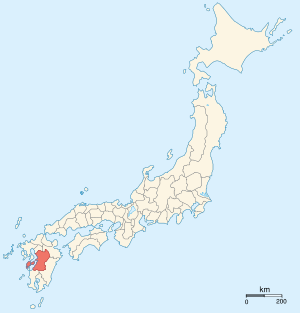
Higo Province

Encyclopedia
Japan
Japan is an island nation in East Asia. Located in the Pacific Ocean, it lies to the east of the Sea of Japan, China, North Korea, South Korea and Russia, stretching from the Sea of Okhotsk in the north to the East China Sea and Taiwan in the south...
in the area that is today Kumamoto Prefecture
Kumamoto Prefecture
is a prefecture of Japan located on Kyushu Island. The capital is the city of Kumamoto.- History :Historically the area was called Higo Province; and the province was renamed Kumamoto during the Meiji Restoration. The creation of prefectures was part of the abolition of the feudal system...
on the island of Kyūshū
Kyushu
is the third largest island of Japan and most southwesterly of its four main islands. Its alternate ancient names include , , and . The historical regional name is referred to Kyushu and its surrounding islands....
. It was sometimes called , with Hizen Province
Hizen Province
was an old province of Japan in the area of Saga and Nagasaki prefectures. It was sometimes called , with Higo Province. Hizen bordered on the provinces of Chikuzen and Chikugo. The province was included in Saikaidō...
. Higo bordered on Chikugo
Chikugo Province
is the name of a former province of Japan in the area that is today the southern part of Fukuoka Prefecture on Kyūshū. It was sometimes called , with Chikuzen Province...
, Bungo
Bungo Province
was a province of Japan in eastern Kyūshū in the area of Ōita Prefecture. It was sometimes called , with Buzen Province. Bungo bordered Buzen, Hyūga, Higo, Chikugo, and Chikuzen Provinces.-History:...
, Hyūga
Hyuga Province
was an old province of Japan on the east coast of Kyūshū, corresponding to the modern Miyazaki Prefecture. It was sometimes called or . Hyūga bordered on Bungo, Higo, Ōsumi, and Satsuma Province.The ancient capital was near Saito.-Historical record:...
, Ōsumi
Osumi Province
was an old province of Japan in the area that is today the eastern part of Kagoshima Prefecture. It was sometimes called . Ōsumi bordered on Hyūga and Satsuma Provinces.Osumi's ancient capital was near modern Kokubu...
, and Satsuma
Satsuma Province
was an old province of Japan that is now the western half of Kagoshima Prefecture on the island of Kyūshū. Its abbreviation is Sasshū .During the Sengoku Period, Satsuma was a fief of the Shimazu daimyo, who ruled much of southern Kyūshū from their castle at Kagoshima city.In 1871, with the...
Provinces.
The castle
Japanese castle
' were fortresses composed primarily of wood and stone. They evolved from the wooden stockades of earlier centuries, and came into their best-known form in the 16th century...
town of Higo was usually at Kumamoto City
Kumamoto, Kumamoto
is the capital city of Kumamoto Prefecture on the island of Kyushu, Japan. Greater Kumamoto has a population of 1,460,000, as of the 2000 census...
. During the Muromachi Period
Muromachi period
The is a division of Japanese history running from approximately 1336 to 1573. The period marks the governance of the Muromachi or Ashikaga shogunate, which was officially established in 1338 by the first Muromachi shogun, Ashikaga Takauji, two years after the brief Kemmu restoration of imperial...
, Higo was held by the Kikuchi clan
Kikuchi clan
The of Higo Province was a powerful daimyo family of Higo, Kyūshū. The Kikuchi lineage was renowned for its valiant service in defense of the emperor and against foreign invaders. The clan first distinguished itself during the Jürchen invasion of northern Kyūshū in 1019...
, but they were dispossessed during the Sengoku Period
Sengoku period
The or Warring States period in Japanese history was a time of social upheaval, political intrigue, and nearly constant military conflict that lasted roughly from the middle of the 15th century to the beginning of the 17th century. The name "Sengoku" was adopted by Japanese historians in reference...
, and the province was occupied by neighboring lords, including the Shimazu clan
Shimazu clan
The were the daimyō of the Satsuma han, which spread over Satsuma, Ōsumi and Hyūga provinces in Japan.The Shimazu were identified as one of the tozama or outsider daimyō clans in contrast with the fudai or insider clans which were hereditary vassals or allies of the Tokugawa clan,The Shimazu were...
of Satsuma
Satsuma Province
was an old province of Japan that is now the western half of Kagoshima Prefecture on the island of Kyūshū. Its abbreviation is Sasshū .During the Sengoku Period, Satsuma was a fief of the Shimazu daimyo, who ruled much of southern Kyūshū from their castle at Kagoshima city.In 1871, with the...
, until Toyotomi Hideyoshi
Toyotomi Hideyoshi
was a daimyo warrior, general and politician of the Sengoku period. He unified the political factions of Japan. He succeeded his former liege lord, Oda Nobunaga, and brought an end to the Sengoku period. The period of his rule is often called the Momoyama period, named after Hideyoshi's castle...
invaded Kyūshū
Kyushu
is the third largest island of Japan and most southwesterly of its four main islands. Its alternate ancient names include , , and . The historical regional name is referred to Kyushu and its surrounding islands....
and gave Higo to his retainers, first Sasa Narimasa and later Kato Kiyomasa
Kato Kiyomasa
was a Japanese daimyō of the Azuchi-Momoyama and Edo period.-Origins and early career:Kiyomasa was born in Owari Province to Katō Kiyotada. Kiyotada's wife, Ito, was a cousin of Toyotomi Hideyoshi's mother. Kiyotada died while his son was still young...
. The Kato were soon stripped of their lands, and the region was given to the Hosokawa clan
Hosokawa clan
The ' was a Japanese samurai clan, descended from Emperor Seiwa and a branch of the Minamoto clan, by the Ashikaga clan. It produced many prominent officials in the Ashikaga shogunate's administration. In the Edo period, the Hosokawa clan was one of the largest landholding daimyo families in Japan...
.
During the Sengoku Period, Higo was a major center for Christianity
Christianity
Christianity is a monotheistic religion based on the life and teachings of Jesus as presented in canonical gospels and other New Testament writings...
in Japan
Japan
Japan is an island nation in East Asia. Located in the Pacific Ocean, it lies to the east of the Sea of Japan, China, North Korea, South Korea and Russia, stretching from the Sea of Okhotsk in the north to the East China Sea and Taiwan in the south...
, and it is also the location where Miyamoto Musashi
Miyamoto Musashi
, also known as Shinmen Takezō, Miyamoto Bennosuke or, by his Buddhist name, Niten Dōraku, was a Japanese swordsman and rōnin. Musashi, as he was often simply known, became renowned through stories of his excellent swordsmanship in numerous duels, even from a very young age...
stayed at the Hosokawa daimyo
Daimyo
is a generic term referring to the powerful territorial lords in pre-modern Japan who ruled most of the country from their vast, hereditary land holdings...
's invitation while completing his The Book of Five Rings
The Book of Five Rings
is a text on kenjutsu and the martial arts in general, written by the samurai warrior Miyamoto Musashi circa 1645. There have been various translations made over the years, and it enjoys an audience considerably broader than only that of martial artists: for instance, some business leaders find its...
.