


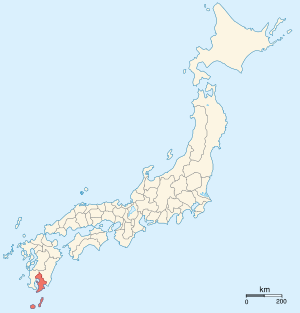
Osumi Province

Encyclopedia
Japan
Japan is an island nation in East Asia. Located in the Pacific Ocean, it lies to the east of the Sea of Japan, China, North Korea, South Korea and Russia, stretching from the Sea of Okhotsk in the north to the East China Sea and Taiwan in the south...
in the area that is today the eastern part of Kagoshima Prefecture
Kagoshima Prefecture
is a prefecture of Japan located on the island of Kyushu. The capital is the city of Kagoshima.- Geography :Kagoshima Prefecture is located at the southwest tip of Kyushu and includes a chain of islands stretching further to the southwest for a few hundred kilometers...
. It was sometimes called . Ōsumi bordered on Hyūga
Hyuga Province
was an old province of Japan on the east coast of Kyūshū, corresponding to the modern Miyazaki Prefecture. It was sometimes called or . Hyūga bordered on Bungo, Higo, Ōsumi, and Satsuma Province.The ancient capital was near Saito.-Historical record:...
and Satsuma
Satsuma Province
was an old province of Japan that is now the western half of Kagoshima Prefecture on the island of Kyūshū. Its abbreviation is Sasshū .During the Sengoku Period, Satsuma was a fief of the Shimazu daimyo, who ruled much of southern Kyūshū from their castle at Kagoshima city.In 1871, with the...
Provinces.
Osumi's ancient capital was near modern Kokubu
Kokubu, Kagoshima
Kokubu was a city located in Kagoshima, Japan.On November 7, 2005 Kobuku was merged with the towns of Kirishima , Fukuyama, Hayato, Makizono, Mizobe and Yokogawa, all from Aira District, to form the new city of Kirishima and no longer exists as an independent municipality.As of 2003, the city had...
. During the Sengoku
Sengoku period
The or Warring States period in Japanese history was a time of social upheaval, political intrigue, and nearly constant military conflict that lasted roughly from the middle of the 15th century to the beginning of the 17th century. The name "Sengoku" was adopted by Japanese historians in reference...
and Edo
Edo period
The , or , is a division of Japanese history which was ruled by the shoguns of the Tokugawa family, running from 1603 to 1868. The political entity of this period was the Tokugawa shogunate....
Periods, Ōsumi was controlled by the Shimazu clan
Shimazu clan
The were the daimyō of the Satsuma han, which spread over Satsuma, Ōsumi and Hyūga provinces in Japan.The Shimazu were identified as one of the tozama or outsider daimyō clans in contrast with the fudai or insider clans which were hereditary vassals or allies of the Tokugawa clan,The Shimazu were...
of neighboring Satsuma and did not develop a major administrative center.
The Ōsumi region has developed its own distinct local dialect
Dialect
The term dialect is used in two distinct ways, even by linguists. One usage refers to a variety of a language that is a characteristic of a particular group of the language's speakers. The term is applied most often to regional speech patterns, but a dialect may also be defined by other factors,...
. Although Ōsumi is part of Kagoshima Prefecture today, this dialect is different from that spoken in the city of Kagoshima
Kagoshima, Kagoshima
is the capital city of Kagoshima Prefecture at the southwestern tip of the Kyūshū island of Japan, and the largest city in the prefecture by some margin...
. There is a notable cultural pride in traditional poetry
Poetry
Poetry is a form of literary art in which language is used for its aesthetic and evocative qualities in addition to, or in lieu of, its apparent meaning...
written in Ōsumi and Kagoshima dialects.
Japan's first satellite, Ōsumi
Osumi (satellite)
Ōsumi is the name of the first Japanese artificial satellite put into orbit, named after the Ōsumi Province in the southern islands of Japan. It was launched on February 11, 1970 at 04:25 UTC with a Lambda 4S-5 rocket from Uchinoura Space Center by Institute of Space and Aeronautical Science,...
, was named after the province.
Historical record
In the 3rd month of the 6th year of the WadōWado (era)
was a after Keiun and before Reiki. This period spanned the years from January 708 through September 715. The reigning empress was .-Change of era:...
era (713), the land of Ōsumi Province was administratively separated from Hyūga Province
Hyuga Province
was an old province of Japan on the east coast of Kyūshū, corresponding to the modern Miyazaki Prefecture. It was sometimes called or . Hyūga bordered on Bungo, Higo, Ōsumi, and Satsuma Province.The ancient capital was near Saito.-Historical record:...
. In that same year, Empress Gemmei
Empress Gemmei
, also known as Empress Genmyō, was the 43rd emperor of Japan, according to the traditional order of succession.Gemmei's reign spanned the years 707 through 715....
's Daijō-kan continued to organize other cadastral changes in the provincial map of the Nara Period
Nara period
The of the history of Japan covers the years from AD 710 to 794. Empress Gemmei established the capital of Heijō-kyō . Except for 5 years , when the capital was briefly moved again, it remained the capital of Japanese civilization until Emperor Kammu established a new capital, Nagaoka-kyō, in 784...
.