

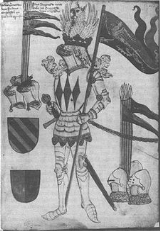
William Montacute, 1st Earl of Salisbury

Encyclopedia
William I Montagu, alias de Montacute, 1st Earl of Salisbury, 3rd Baron Montacute, King of Mann (1301 - 30 January 1344) was an English
nobleman and loyal servant of King Edward III
.
The son of William de Montacute, the second Baron Montacute, he entered the royal household at an early age, and became a close companion of the young Prince Edward. The relationship continued after Edward was crowned king following the deposition of Edward II
in 1327. In 1330, Montagu was one of Edward's main accomplices in the coup against Roger Mortimer, who up until then had been acting as the king's protector.
In the following years Montagu served the king in various capacities, primarily in the Scottish Wars
. He was richly rewarded, and among other things received the lordship of the Isle of Man
. In 1337, he was created Earl of Salisbury, and given an annual income of 1000 marks
to go with the title. He served on the Continent
in the early years of the Hundred Years' War, but in 1340 he was captured by the French, and in return for his freedom had to promise never to fight in France again. Salisbury died of wounds suffered at a tournament
early in 1344.
Legend has it that Montagu's wife Catherine
was raped by Edward III, but this story is almost certainly French propaganda. William and Catherine had six children, most of whom married into the nobility. Modern historians have called William Montague Edward's "most intimate personal friend" and "the chief influence behind the throne from Mortimer's downfall in 1330 until his own death in 1344."
in Oxfordshire
in 1301. His was the eldest son of William de Montagu
, the second Baron Montagu
, and Elizabeth Montfort, daughter of Peter de Montfort of Beaudesert
, Warwickshire
. The Montagu family, a West Country
family with roots going back to the Conquest
, held extensive lands in Somerset
, Dorset
and Devon
. The father, William Montagu, distinguished himself in the Scottish Wars
during the reign of Edward I
, and served as steward of Edward II's
household. Some members of the nobility, including Thomas of Lancaster, viewed Montagu with suspicion, as a member of a court party with undue influence on the king. For this reason he was sent to Aquitaine
, to serve as seneschal
. Here he died in October 1319. Even though he sat in parliament as a baron, the second lord Montagu never rose above a level of purely regional importance.
of the king in 1320. On 21 February 1323 he was granted his father's lands and title. His service to Edward II
took him abroad to the Continent in both 1320 and 1325. In 1326 he was knighted. After the deposition of Edward II in 1327, Montagu continued in the service of Edward's son Edward III
. He helped the new king in repelling the Scottish
invasion of 1327, and was created knight banneret
in 1328.
Montagu enjoyed a close relationship with Edward III, and accompanied him abroad on a diplomatic mission in 1329. That same year he was sent on an embassy to negotiate a marriage alliance with King Philip VI of France
. His most important task, however, came in connection with a mission to the Papacy in Avignon
. The young king—along with his government—was under the dominance of his mother Isabella
and her lover Roger Mortimer, who had been responsible for the deposition of the king's father. Montagu explained the king's situation, and Pope John XXII
asked for a special signal that assure him that he was dealing with the king in person. After Montagu's return, Richard Bury
, Keeper of the Privy Seal
, wrote to inform the pope that only letters containing the words pater sancte (holy father), in Edward's own handwriting, were indeed from the king. Only Edward, Bury and Montagu were party to the scheme.
, the constable of the castle showed Montagu a secret entrance through an underground tunnel. Along with Edward de Bohun, Robert Ufford
, and John Neville and others, he entered the castle, where he met up with the king. A short brawl followed before Mortimer was captured. The queen stormed into the chamber shouting "Good son, have pity on noble Mortimer". Edward did not obey his mother's wishes, and a few weeks later Mortimer was executed for treason in London. As a reward for his part in the coup, Montagu was given lands worth £1000, including the Welsh lordship of Denbigh
that had belonged to Mortimer. His family also benefited; his brother Simon
became Bishop of Worcester
and later of Ely
. Another brother, Edward de Montacute, 1st Baron Montacute, was married to Alice
, a co-heir of Thomas of Brotherton, Earl of Norfolk
.
at Cheapside
, where he and the king were costumed as Tartars. From 1333 onwards, Montagu was deeply engaged in the Scottish Wars
, and distinguished himself at the Siege of Berwick and the Battle of Halidon Hill
. It was after this event that his lordship over the Isle of Man
was recognised, a right he held from his grandfather. The lordship was at the moment of a purely theoretical nature, however, since the island was still under Scottish control.
In February 1334 Montagu was sent on a commission to Edinburgh, to demand Edward Balliol's homage to Edward. In the great summer campaign of 1335, it was Montagu who provided the largest English contingent, with 180 men-at-arms
and 136 archers. He was well rewarded for his contributions: after the Scots had been forced to cede the Lowlands
, Montagu was granted the county of Peeblesshire
. He was also allowed to buy the wardship
of Roger Mortimer's son Roger for 1000 marks
, a deal that turned out to be very lucrative for Montagu. At this point, however, the fortunes were turning for the English in Scotland. Montagu campaigned in the north again in 1337, but the siege of Dunbar
met with failure. Following the abortive attempt in Scotland, Edward III turned his attention to the continent.
on 16 March 1337. This was one of six comital promotions Edward III made that day, in preparation for what was to become the Hundred Years' War. To allow Montagu to support his new status, the king granted him land and rent of a value of 1000 marks a year. The money was provided from the royal stannaries
of Cornwall. A contemporary poem tells of a vow made by the earl on the eve of the wars he would not open one of his eyes while fighting in France. The story is probably a satire; the truth was that Montagu had already lost the use of one of his eyes in a tournament
.
In April 1337, Montagu was appointed to a diplomatic commission to Valenciennes
, to establish alliances with Flanders
and the German
princes. In July 1338, he accompanied the king on another mission to the continent, again providing the greatest number of soldiers, with 123 men-at-arms and 50 archers. In September of that year he was made Marshal of England
. After the death of Thomas of Brotherton, Earl of Norfolk
, this office had come into the hands of Norfolk's daughter Margaret. The king did not trust the office with her husband, so he decided instead to bestow it on his trusted companion, Montagu. Edward's policy of building alliances put him in great debt, and when he left the Low Countries to return to England late in 1338, Salisbury had to stay behind as surety to the king's debtors, along with the king's family and the Earl of Derby
. The earl had earlier voiced concerns about the costly alliances, but he nevertheless remained loyal to the king's strategy.
While Edward was away, Salisbury was captured by the French at Lille
in April 1340, and imprisoned in Paris
. Reportedly, King Philip VI of France
wanted to execute Salisbury and Robert Ufford, Earl of Suffolk
, who was captured with him. Philip was, however, dissuaded by John of Bohemia, who argued that the earls could come in handy in an exchange, should any French noblemen be captured. Though released on parole in September, it was not until May 1342 that he reached a final settlement with the French. Salisbury was freed in a prisoner exchange, but only on the condition that he never fight in France again.
 Salisbury had long been frustrated by the failure of the government in England to provide sufficient funds for the war effort. On his return, however, he played little part in the conflict of 1341 between King Edward and Chancellor
John Stratford
. In May that year he was appointed to a committee to hear the king's charges against Stratford, but little came from this. In 1342–43 he fought with Robert of Artois
in the Breton War of Succession
, and in 1343 helped negotiate the Truce of Malestroit. It was probably sometime after this he made good his claim on the Isle of Man, by conquering the island which was until then held by the Scots.
His final international commission took place late in 1343, when he accompanied Henry of Grosmont, Earl of Derby
, on a diplomatic mission to Castile
. Early in 1344 he was back in England, where he took part in a great tournament at Windsor
. It was during this tournament, according to the chronicler Adam Murimuth
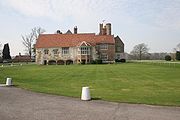
, that he received wounds that would prove fatal. Salisbury died on 30 January 1344. He was buried at Bisham Priory
in Berkshire
, adjoining his home, Bisham Manor. He had founded the priory himself in 1337, on his elevation to the earldom. King Edward's financial obligations were never paid in full during the earl's lifetime, and at Salisbury' death the king owed him £11,720. Of this, some £6374 were written off by his executor
s in 1346.
, daughter of William de Grandison, 1st Baron Grandison. Two anecdotal stories revolve around Catherine Montagu; in one she is identified as the "Countess of Salisbury" from whose dropped garter Edward III named the Order of the Garter
. In the other, Edward III falls in love with the countess, and arranges to be alone with her so he can rape her. Neither story is supported by contemporary evidence, and the latter almost certainly is a product of French propaganda.
William and Catherine had six children, most of whom made highly fortunate matches with other members of the nobility. The first Earl of Salisbury made enormous additions to the family fortune; at the time of his father's death, the lands had been valued at just over £300. In 1344, only the annual income of the lands has been estimated to more than £2,300, equivalent to about £ in present day terms. Edward was also free with granting franchises
to Salisbury, including the return of writs
, which gave the earl authority in his lands normally held by the royally appointed sheriff
. Salisbury's oldest son William succeeded his father in July 1349, while still a minor, as William Montagu, 2nd Earl of Salisbury
. The younger William was one of the founding members of the Order of the Garter
, but he never enjoyed the same favour with the king as his father had.
The children of William and Catherine were as follows:
English people
The English are a nation and ethnic group native to England, who speak English. The English identity is of early mediaeval origin, when they were known in Old English as the Anglecynn. England is now a country of the United Kingdom, and the majority of English people in England are British Citizens...
nobleman and loyal servant of King Edward III
Edward III of England
Edward III was King of England from 1327 until his death and is noted for his military success. Restoring royal authority after the disastrous reign of his father, Edward II, Edward III went on to transform the Kingdom of England into one of the most formidable military powers in Europe...
.
The son of William de Montacute, the second Baron Montacute, he entered the royal household at an early age, and became a close companion of the young Prince Edward. The relationship continued after Edward was crowned king following the deposition of Edward II
Edward II of England
Edward II , called Edward of Caernarfon, was King of England from 1307 until he was deposed by his wife Isabella in January 1327. He was the sixth Plantagenet king, in a line that began with the reign of Henry II...
in 1327. In 1330, Montagu was one of Edward's main accomplices in the coup against Roger Mortimer, who up until then had been acting as the king's protector.
In the following years Montagu served the king in various capacities, primarily in the Scottish Wars
Second War of Scottish Independence
The Second War of Scottish Independence was the second cluster of a series of military campaigns fought between the independent Kingdom of Scotland and the Kingdom of England in the late thirteenth and early fourteenth centuries....
. He was richly rewarded, and among other things received the lordship of the Isle of Man
Isle of Man
The Isle of Man , otherwise known simply as Mann , is a self-governing British Crown Dependency, located in the Irish Sea between the islands of Great Britain and Ireland, within the British Isles. The head of state is Queen Elizabeth II, who holds the title of Lord of Mann. The Lord of Mann is...
. In 1337, he was created Earl of Salisbury, and given an annual income of 1000 marks
Mark (money)
Mark was a measure of weight mainly for gold and silver, commonly used throughout western Europe and often equivalent to 8 ounces. Considerable variations, however, occurred throughout the Middle Ages Mark (from a merging of three Teutonic/Germanic languages words, Latinized in 9th century...
to go with the title. He served on the Continent
Continental Europe
Continental Europe, also referred to as mainland Europe or simply the Continent, is the continent of Europe, explicitly excluding European islands....
in the early years of the Hundred Years' War, but in 1340 he was captured by the French, and in return for his freedom had to promise never to fight in France again. Salisbury died of wounds suffered at a tournament
Tournament (medieval)
A tournament, or tourney is the name popularly given to chivalrous competitions or mock fights of the Middle Ages and Renaissance . It is one of various types of hastiludes....
early in 1344.
Legend has it that Montagu's wife Catherine
Catherine Montacute, Countess of Salisbury
Catherine Montacute , Countess of Salisbury was an English noblewoman, remembered for her relationship with King Edward III of England and possibly the woman in whose honour the Order of the Garter was originated. She was born Catherine Grandison, daughter of William de Grandison, 1st Baron...
was raped by Edward III, but this story is almost certainly French propaganda. William and Catherine had six children, most of whom married into the nobility. Modern historians have called William Montague Edward's "most intimate personal friend" and "the chief influence behind the throne from Mortimer's downfall in 1330 until his own death in 1344."
Family background
William was born in CassingtonCassington
Cassington is a village and civil parish in Oxfordshire about northwest of Oxford. The village lies on gravel strata about from the confluence of the River Evenlode with the River Thames. The parish includes the hamlet of Worton northeast of the village and the site of the former hamlet of...
in Oxfordshire
Oxfordshire
Oxfordshire is a county in the South East region of England, bordering on Warwickshire and Northamptonshire , Buckinghamshire , Berkshire , Wiltshire and Gloucestershire ....
in 1301. His was the eldest son of William de Montagu
William de Montagu, 2nd Baron Montagu
Sir William Montagu , 2nd Baron Montacute was an English nobleman and courtier of King Edward II....
, the second Baron Montagu
Baron Montagu
The titles Baron Montacute or Baron Montagu were created three and two times respectively in the Peerage of England.-Montacute:The first creation was for John de Montacute who was summoned to parliament on 29 December 1299. The third baron was created Earl of Salisbury in 1337. On the death of the...
, and Elizabeth Montfort, daughter of Peter de Montfort of Beaudesert
Beaudesert, Warwickshire
Beaudesert is a village and civil parish in the Stratford-on-Avon district of Warwickshire, England, half a mile east across the River Alne to the north and west of Henley-in-Arden, to which it is closely associated and shares a joint parish council with...
, Warwickshire
Warwickshire
Warwickshire is a landlocked non-metropolitan county in the West Midlands region of England. The county town is Warwick, although the largest town is Nuneaton. The county is famous for being the birthplace of William Shakespeare...
. The Montagu family, a West Country
West Country
The West Country is an informal term for the area of south western England roughly corresponding to the modern South West England government region. It is often defined to encompass the historic counties of Cornwall, Devon, Dorset and Somerset and the City of Bristol, while the counties of...
family with roots going back to the Conquest
Norman conquest of England
The Norman conquest of England began on 28 September 1066 with the invasion of England by William, Duke of Normandy. William became known as William the Conqueror after his victory at the Battle of Hastings on 14 October 1066, defeating King Harold II of England...
, held extensive lands in Somerset
Somerset
The ceremonial and non-metropolitan county of Somerset in South West England borders Bristol and Gloucestershire to the north, Wiltshire to the east, Dorset to the south-east, and Devon to the south-west. It is partly bounded to the north and west by the Bristol Channel and the estuary of the...
, Dorset
Dorset
Dorset , is a county in South West England on the English Channel coast. The county town is Dorchester which is situated in the south. The Hampshire towns of Bournemouth and Christchurch joined the county with the reorganisation of local government in 1974...
and Devon
Devon
Devon is a large county in southwestern England. The county is sometimes referred to as Devonshire, although the term is rarely used inside the county itself as the county has never been officially "shired", it often indicates a traditional or historical context.The county shares borders with...
. The father, William Montagu, distinguished himself in the Scottish Wars
First War of Scottish Independence
The First War of Scottish Independence lasted from the invasion by England in 1296 until the de jure restoration of Scottish independence with the Treaty of Edinburgh-Northampton in 1328...
during the reign of Edward I
Edward I of England
Edward I , also known as Edward Longshanks and the Hammer of the Scots, was King of England from 1272 to 1307. The first son of Henry III, Edward was involved early in the political intrigues of his father's reign, which included an outright rebellion by the English barons...
, and served as steward of Edward II's
Edward II of England
Edward II , called Edward of Caernarfon, was King of England from 1307 until he was deposed by his wife Isabella in January 1327. He was the sixth Plantagenet king, in a line that began with the reign of Henry II...
household. Some members of the nobility, including Thomas of Lancaster, viewed Montagu with suspicion, as a member of a court party with undue influence on the king. For this reason he was sent to Aquitaine
Aquitaine
Aquitaine , archaic Guyenne/Guienne , is one of the 27 regions of France, in the south-western part of metropolitan France, along the Atlantic Ocean and the Pyrenees mountain range on the border with Spain. It comprises the 5 departments of Dordogne, :Lot et Garonne, :Pyrénées-Atlantiques, Landes...
, to serve as seneschal
Seneschal
A seneschal was an officer in the houses of important nobles in the Middle Ages. In the French administrative system of the Middle Ages, the sénéchal was also a royal officer in charge of justice and control of the administration in southern provinces, equivalent to the northern French bailli...
. Here he died in October 1319. Even though he sat in parliament as a baron, the second lord Montagu never rose above a level of purely regional importance.
Early service
The younger William was still a minor at the time of his father's death, and entered the royal household as a wardWard (law)
In law, a ward is someone placed under the protection of a legal guardian. A court may take responsibility for the legal protection of an individual, usually either a child or incapacitated person, in which case the ward is known as a ward of the court, or a ward of the state, in the United States,...
of the king in 1320. On 21 February 1323 he was granted his father's lands and title. His service to Edward II
Edward II of England
Edward II , called Edward of Caernarfon, was King of England from 1307 until he was deposed by his wife Isabella in January 1327. He was the sixth Plantagenet king, in a line that began with the reign of Henry II...
took him abroad to the Continent in both 1320 and 1325. In 1326 he was knighted. After the deposition of Edward II in 1327, Montagu continued in the service of Edward's son Edward III
Edward III of England
Edward III was King of England from 1327 until his death and is noted for his military success. Restoring royal authority after the disastrous reign of his father, Edward II, Edward III went on to transform the Kingdom of England into one of the most formidable military powers in Europe...
. He helped the new king in repelling the Scottish
Scottish people
The Scottish people , or Scots, are a nation and ethnic group native to Scotland. Historically they emerged from an amalgamation of the Picts and Gaels, incorporating neighbouring Britons to the south as well as invading Germanic peoples such as the Anglo-Saxons and the Norse.In modern use,...
invasion of 1327, and was created knight banneret
Knight banneret
A knight banneret, sometimes known simply as banneret, was a Medieval knight who led a company of troops during time of war under his own banner and were eligible to bear supporters in English heraldry.The military rank of a knight banneret was...
in 1328.
Montagu enjoyed a close relationship with Edward III, and accompanied him abroad on a diplomatic mission in 1329. That same year he was sent on an embassy to negotiate a marriage alliance with King Philip VI of France
Philip VI of France
Philip VI , known as the Fortunate and of Valois, was the King of France from 1328 to his death. He was also Count of Anjou, Maine, and Valois from 1325 to 1328...
. His most important task, however, came in connection with a mission to the Papacy in Avignon
Avignon
Avignon is a French commune in southeastern France in the départment of the Vaucluse bordered by the left bank of the Rhône river. Of the 94,787 inhabitants of the city on 1 January 2010, 12 000 live in the ancient town centre surrounded by its medieval ramparts.Often referred to as the...
. The young king—along with his government—was under the dominance of his mother Isabella
Isabella of France
Isabella of France , sometimes described as the She-wolf of France, was Queen consort of England as the wife of Edward II of England. She was the youngest surviving child and only surviving daughter of Philip IV of France and Joan I of Navarre...
and her lover Roger Mortimer, who had been responsible for the deposition of the king's father. Montagu explained the king's situation, and Pope John XXII
Pope John XXII
Pope John XXII , born Jacques Duèze , was pope from 1316 to 1334. He was the second Pope of the Avignon Papacy , elected by a conclave in Lyon assembled by Philip V of France...
asked for a special signal that assure him that he was dealing with the king in person. After Montagu's return, Richard Bury
Richard Aungerville
Richard de Bury , also known as Richard Aungerville , was an English writer, bibliophile, Benedictine monk and bishop. He was a patron of learning, and one of the first English collectors of books. He is chiefly remembered for his Philobiblon, written to inculcate in the clergy the pursuit of...
, Keeper of the Privy Seal
Lord Privy Seal
The Lord Privy Seal is the fifth of the Great Officers of State in the United Kingdom, ranking beneath the Lord President of the Council and above the Lord Great Chamberlain. The office is one of the traditional sinecure offices of state...
, wrote to inform the pope that only letters containing the words pater sancte (holy father), in Edward's own handwriting, were indeed from the king. Only Edward, Bury and Montagu were party to the scheme.
Coup against Mortimer
When Mortimer discovered the conspiracy against him, Montagu was brought in for interrogation along with the king but gave nothing away. Afterward he supposedly advised Edward to move against his protector, because "It was better that they should eat the dog than that the dog should eat them". On 19 October 1330, while Mortimer and Isabella were entrenched in Nottingham CastleNottingham Castle
Nottingham Castle is a castle in Nottingham, England. It is located in a commanding position on a natural promontory known as "'Castle Rock'", with cliffs high to the south and west. In the Middle Ages it was a major royal fortress and occasional royal residence...
, the constable of the castle showed Montagu a secret entrance through an underground tunnel. Along with Edward de Bohun, Robert Ufford
Robert d'Ufford, 1st Earl of Suffolk
Robert d'Ufford, 1st Earl of Suffolk, KG was born in Thurston, Suffolk, England to Robert d'Ufford and Cecily de Valoines. On 13 November 1334 he married Margaret de Norwich, daughter of Sir Walter Norwich and Catherine de Hedersete. They had four children. He was made Earl of Suffolk in...
, and John Neville and others, he entered the castle, where he met up with the king. A short brawl followed before Mortimer was captured. The queen stormed into the chamber shouting "Good son, have pity on noble Mortimer". Edward did not obey his mother's wishes, and a few weeks later Mortimer was executed for treason in London. As a reward for his part in the coup, Montagu was given lands worth £1000, including the Welsh lordship of Denbigh
Denbigh
Denbigh is a market town and community in Denbighshire, Wales. Before 1888, it was the county town of Denbighshire. Denbigh lies 8 miles to the north west of Ruthin and to the south of St Asaph. It is about 13 miles from the seaside resort of Rhyl. The town grew around the glove-making industry...
that had belonged to Mortimer. His family also benefited; his brother Simon
Simon Montacute
Simon Montacute was a medieval Bishop of Worcester and Bishop of Ely.Montacute was nominated to the see of Worcester on 11 December 1333 and consecrated on 8 May 1334. and was then translated to the see of Ely on 14 March 1337. As bishop of Ely, he was involved in the foundation of Peterhouse,...
became Bishop of Worcester
Bishop of Worcester
The Bishop of Worcester is the Ordinary of the Church of England Diocese of Worcester in the Province of Canterbury, England. He is the head of the Diocese of Worcester in the Province of Canterbury...
and later of Ely
Bishop of Ely
The Bishop of Ely is the Ordinary of the Church of England Diocese of Ely in the Province of Canterbury. The diocese roughly covers the county of Cambridgeshire , together with a section of north-west Norfolk and has its see in the City of Ely, Cambridgeshire, where the seat is located at the...
. Another brother, Edward de Montacute, 1st Baron Montacute, was married to Alice
Alice of Norfolk
Alice of Norfolk was the daughter of Thomas of Brotherton, 1st Earl of Norfolk , , by Alice Hayles...
, a co-heir of Thomas of Brotherton, Earl of Norfolk
Thomas of Brotherton, 1st Earl of Norfolk
Thomas of Brotherton, 1st Earl of Norfolk, Lord Marshal of England was the son of Edward I of England and Margaret of France.-Early life:...
.
Service under Edward III
In the years to come, Montagu acted as Edward's closest companion. In April 1331, the two went on a secret expedition to France, disguised as merchants so they would not be recognised. In September of the same year, Montagu held a tournamentTournament (medieval)
A tournament, or tourney is the name popularly given to chivalrous competitions or mock fights of the Middle Ages and Renaissance . It is one of various types of hastiludes....
at Cheapside
Cheapside
Cheapside is a street in the City of London that links Newgate Street with the junction of Queen Victoria Street and Mansion House Street. To the east is Mansion House, the Bank of England, and the major road junction above Bank tube station. To the west is St. Paul's Cathedral, St...
, where he and the king were costumed as Tartars. From 1333 onwards, Montagu was deeply engaged in the Scottish Wars
Second War of Scottish Independence
The Second War of Scottish Independence was the second cluster of a series of military campaigns fought between the independent Kingdom of Scotland and the Kingdom of England in the late thirteenth and early fourteenth centuries....
, and distinguished himself at the Siege of Berwick and the Battle of Halidon Hill
Battle of Halidon Hill
The Battle of Halidon Hill was fought during the Second War of Scottish Independence. Scottish forces under Sir Archibald Douglas were heavily defeated on unfavourable terrain while trying to relieve Berwick-upon-Tweed.-The Disinherited:...
. It was after this event that his lordship over the Isle of Man
Isle of Man
The Isle of Man , otherwise known simply as Mann , is a self-governing British Crown Dependency, located in the Irish Sea between the islands of Great Britain and Ireland, within the British Isles. The head of state is Queen Elizabeth II, who holds the title of Lord of Mann. The Lord of Mann is...
was recognised, a right he held from his grandfather. The lordship was at the moment of a purely theoretical nature, however, since the island was still under Scottish control.
In February 1334 Montagu was sent on a commission to Edinburgh, to demand Edward Balliol's homage to Edward. In the great summer campaign of 1335, it was Montagu who provided the largest English contingent, with 180 men-at-arms
Man-at-arms
Man-at-arms was a term used from the High Medieval to Renaissance periods to describe a soldier, almost always a professional warrior in the sense of being well-trained in the use of arms, who served as a fully armoured heavy cavalryman...
and 136 archers. He was well rewarded for his contributions: after the Scots had been forced to cede the Lowlands
Scottish Lowlands
The Scottish Lowlands is a name given to the Southern half of Scotland.The area is called a' Ghalldachd in Scottish Gaelic, and the Lawlands ....
, Montagu was granted the county of Peeblesshire
Peeblesshire
Peeblesshire , the County of Peebles or Tweeddale was a county of Scotland. Its main town was Peebles, and it bordered Midlothian to the north, Selkirkshire to the east, Dumfriesshire to the south, and Lanarkshire to the west.After the local government reorganisation of 1975 the use of the name...
. He was also allowed to buy the wardship
Ward (law)
In law, a ward is someone placed under the protection of a legal guardian. A court may take responsibility for the legal protection of an individual, usually either a child or incapacitated person, in which case the ward is known as a ward of the court, or a ward of the state, in the United States,...
of Roger Mortimer's son Roger for 1000 marks
Mark (money)
Mark was a measure of weight mainly for gold and silver, commonly used throughout western Europe and often equivalent to 8 ounces. Considerable variations, however, occurred throughout the Middle Ages Mark (from a merging of three Teutonic/Germanic languages words, Latinized in 9th century...
, a deal that turned out to be very lucrative for Montagu. At this point, however, the fortunes were turning for the English in Scotland. Montagu campaigned in the north again in 1337, but the siege of Dunbar
Dunbar
Dunbar is a town in East Lothian on the southeast coast of Scotland, approximately 28 miles east of Edinburgh and 28 miles from the English Border at Berwick-upon-Tweed....
met with failure. Following the abortive attempt in Scotland, Edward III turned his attention to the continent.
The Hundred Years' War
Montagu was created Earl of SalisburyEarl of Salisbury
Earl of Salisbury is a title that has been created several times in British history. It has a complex history, being first created for Patrick de Salisbury in the middle twelfth century. It was eventually inherited by Alice, wife of Thomas, Earl of Lancaster...
on 16 March 1337. This was one of six comital promotions Edward III made that day, in preparation for what was to become the Hundred Years' War. To allow Montagu to support his new status, the king granted him land and rent of a value of 1000 marks a year. The money was provided from the royal stannaries
Stannary
The word stannary is historically applied to:*A tin mine, especially in Cornwall or Devon, South West England*A region containing tin works *A chartered entity comprising such a region, its works, and its workers...
of Cornwall. A contemporary poem tells of a vow made by the earl on the eve of the wars he would not open one of his eyes while fighting in France. The story is probably a satire; the truth was that Montagu had already lost the use of one of his eyes in a tournament
Tournament (medieval)
A tournament, or tourney is the name popularly given to chivalrous competitions or mock fights of the Middle Ages and Renaissance . It is one of various types of hastiludes....
.
In April 1337, Montagu was appointed to a diplomatic commission to Valenciennes
Valenciennes
Valenciennes is a commune in the Nord department in northern France.It lies on the Scheldt river. Although the city and region had seen a steady decline between 1975 and 1990, it has since rebounded...
, to establish alliances with Flanders
County of Flanders
The County of Flanders was one of the territories constituting the Low Countries. The county existed from 862 to 1795. It was one of the original secular fiefs of France and for centuries was one of the most affluent regions in Europe....
and the German
Germany
Germany , officially the Federal Republic of Germany , is a federal parliamentary republic in Europe. The country consists of 16 states while the capital and largest city is Berlin. Germany covers an area of 357,021 km2 and has a largely temperate seasonal climate...
princes. In July 1338, he accompanied the king on another mission to the continent, again providing the greatest number of soldiers, with 123 men-at-arms and 50 archers. In September of that year he was made Marshal of England
Earl Marshal
Earl Marshal is a hereditary royal officeholder and chivalric title under the sovereign of the United Kingdom used in England...
. After the death of Thomas of Brotherton, Earl of Norfolk
Thomas of Brotherton, 1st Earl of Norfolk
Thomas of Brotherton, 1st Earl of Norfolk, Lord Marshal of England was the son of Edward I of England and Margaret of France.-Early life:...
, this office had come into the hands of Norfolk's daughter Margaret. The king did not trust the office with her husband, so he decided instead to bestow it on his trusted companion, Montagu. Edward's policy of building alliances put him in great debt, and when he left the Low Countries to return to England late in 1338, Salisbury had to stay behind as surety to the king's debtors, along with the king's family and the Earl of Derby
Henry of Grosmont, 1st Duke of Lancaster
Henry of Grosmont, 1st Duke of Lancaster, 4th Earl of Leicester and Lancaster, KG , also Earl of Derby, was a member of the English nobility in the 14th century, and a prominent English diplomat, politician, and soldier...
. The earl had earlier voiced concerns about the costly alliances, but he nevertheless remained loyal to the king's strategy.
While Edward was away, Salisbury was captured by the French at Lille
Lille
Lille is a city in northern France . It is the principal city of the Lille Métropole, the fourth-largest metropolitan area in the country behind those of Paris, Lyon and Marseille. Lille is situated on the Deûle River, near France's border with Belgium...
in April 1340, and imprisoned in Paris
Paris
Paris is the capital and largest city in France, situated on the river Seine, in northern France, at the heart of the Île-de-France region...
. Reportedly, King Philip VI of France
Philip VI of France
Philip VI , known as the Fortunate and of Valois, was the King of France from 1328 to his death. He was also Count of Anjou, Maine, and Valois from 1325 to 1328...
wanted to execute Salisbury and Robert Ufford, Earl of Suffolk
Robert d'Ufford, 1st Earl of Suffolk
Robert d'Ufford, 1st Earl of Suffolk, KG was born in Thurston, Suffolk, England to Robert d'Ufford and Cecily de Valoines. On 13 November 1334 he married Margaret de Norwich, daughter of Sir Walter Norwich and Catherine de Hedersete. They had four children. He was made Earl of Suffolk in...
, who was captured with him. Philip was, however, dissuaded by John of Bohemia, who argued that the earls could come in handy in an exchange, should any French noblemen be captured. Though released on parole in September, it was not until May 1342 that he reached a final settlement with the French. Salisbury was freed in a prisoner exchange, but only on the condition that he never fight in France again.
Final years
Lord Chancellor
The Lord High Chancellor of Great Britain, or Lord Chancellor, is a senior and important functionary in the government of the United Kingdom. He is the second highest ranking of the Great Officers of State, ranking only after the Lord High Steward. The Lord Chancellor is appointed by the Sovereign...
John Stratford
John de Stratford
John de Stratford was Archbishop of Canterbury and Treasurer and Chancellor of England.-Life:John was born at Stratford-on-Avon and educated at Merton College, Oxford, afterwards entering the service of Edward II....
. In May that year he was appointed to a committee to hear the king's charges against Stratford, but little came from this. In 1342–43 he fought with Robert of Artois
Robert III of Artois
Robert III of Artois was the son of Philip of Artois and Blanche of Brittany.In 1318 he married Joan of Valois , daughter of Charles of Valois, and had issue:* Louis...
in the Breton War of Succession
Breton War of Succession
The Breton War of Succession was a conflict between the Houses of Blois and Montfort for control of the Duchy of Brittany. It was fought between 1341 and 1364. It formed an integral part of the early Hundred Years War due to the involvement of the French and English governments in the conflict; the...
, and in 1343 helped negotiate the Truce of Malestroit. It was probably sometime after this he made good his claim on the Isle of Man, by conquering the island which was until then held by the Scots.
His final international commission took place late in 1343, when he accompanied Henry of Grosmont, Earl of Derby
Henry of Grosmont, 1st Duke of Lancaster
Henry of Grosmont, 1st Duke of Lancaster, 4th Earl of Leicester and Lancaster, KG , also Earl of Derby, was a member of the English nobility in the 14th century, and a prominent English diplomat, politician, and soldier...
, on a diplomatic mission to Castile
Kingdom of Castile
Kingdom of Castile was one of the medieval kingdoms of the Iberian Peninsula. It emerged as a political autonomous entity in the 9th century. It was called County of Castile and was held in vassalage from the Kingdom of León. Its name comes from the host of castles constructed in the region...
. Early in 1344 he was back in England, where he took part in a great tournament at Windsor
Windsor Castle
Windsor Castle is a medieval castle and royal residence in Windsor in the English county of Berkshire, notable for its long association with the British royal family and its architecture. The original castle was built after the Norman invasion by William the Conqueror. Since the time of Henry I it...
. It was during this tournament, according to the chronicler Adam Murimuth
Adam Murimuth
Adam Murimuth was an English ecclesiastic and chronicler.-Life:He was born in 1274 or 1275 and studied civil law at the University of Oxford. Between 1312 and 1318 he practised in the papal curia at Avignon...
, that he received wounds that would prove fatal. Salisbury died on 30 January 1344. He was buried at Bisham Priory
Bisham Abbey
Bisham Abbey is a Grade I listed manor house at Bisham in the English county of Berkshire. The name is taken from the now lost monastery which once stood alongside. Bisham Abbey was previously named Bisham Priory, and was the traditional resting place of many Earls of Salisbury...
in Berkshire
Berkshire
Berkshire is a historic county in the South of England. It is also often referred to as the Royal County of Berkshire because of the presence of the royal residence of Windsor Castle in the county; this usage, which dates to the 19th century at least, was recognised by the Queen in 1957, and...
, adjoining his home, Bisham Manor. He had founded the priory himself in 1337, on his elevation to the earldom. King Edward's financial obligations were never paid in full during the earl's lifetime, and at Salisbury' death the king owed him £11,720. Of this, some £6374 were written off by his executor
Executor
An executor, in the broadest sense, is one who carries something out .-Overview:...
s in 1346.
Family
In or before 1327 Salisbury married CatherineCatherine Montacute, Countess of Salisbury
Catherine Montacute , Countess of Salisbury was an English noblewoman, remembered for her relationship with King Edward III of England and possibly the woman in whose honour the Order of the Garter was originated. She was born Catherine Grandison, daughter of William de Grandison, 1st Baron...
, daughter of William de Grandison, 1st Baron Grandison. Two anecdotal stories revolve around Catherine Montagu; in one she is identified as the "Countess of Salisbury" from whose dropped garter Edward III named the Order of the Garter
Order of the Garter
The Most Noble Order of the Garter, founded in 1348, is the highest order of chivalry, or knighthood, existing in England. The order is dedicated to the image and arms of St...
. In the other, Edward III falls in love with the countess, and arranges to be alone with her so he can rape her. Neither story is supported by contemporary evidence, and the latter almost certainly is a product of French propaganda.
William and Catherine had six children, most of whom made highly fortunate matches with other members of the nobility. The first Earl of Salisbury made enormous additions to the family fortune; at the time of his father's death, the lands had been valued at just over £300. In 1344, only the annual income of the lands has been estimated to more than £2,300, equivalent to about £ in present day terms. Edward was also free with granting franchises
Exclusive right
In Anglo-Saxon law, an exclusive right is a de facto, non-tangible prerogative existing in law to perform an action or acquire a benefit and to permit or deny others the right to perform the same action or to acquire the same benefit. A "prerogative" is in effect an exclusive right...
to Salisbury, including the return of writs
Return of writs
The privilege of return of writs, in medieval England, was a right given to certain liberties or franchises to execute royal writs within the land in question. This in effect meant overpassing the authority normally held by the sheriff as the king's representative in the localities...
, which gave the earl authority in his lands normally held by the royally appointed sheriff
Sheriff
A sheriff is in principle a legal official with responsibility for a county. In practice, the specific combination of legal, political, and ceremonial duties of a sheriff varies greatly from country to country....
. Salisbury's oldest son William succeeded his father in July 1349, while still a minor, as William Montagu, 2nd Earl of Salisbury
William Montacute, 2nd Earl of Salisbury
Sir William II Montague, alias de Montacute, 2nd Earl of Salisbury, 4th Baron Montacute, King of Mann, KG was an English nobleman and commander in the English army during King Edward III's French campaigns in the Hundred Years War.He was born in Donyatt in Somerset, the eldest son of William...
. The younger William was one of the founding members of the Order of the Garter
Order of the Garter
The Most Noble Order of the Garter, founded in 1348, is the highest order of chivalry, or knighthood, existing in England. The order is dedicated to the image and arms of St...
, but he never enjoyed the same favour with the king as his father had.
The children of William and Catherine were as follows:
| Name | Birth | Death | Notes |
|---|---|---|---|
| Elizabeth Montagu | — | 1359 | Married Hugh le Despencer, 2nd Baron le Despencer Hugh le Despencer, 2nd Baron le Despencer Hugh le Despencer was the eldest son and heir of Hugh the younger Despenser, son of Hugh the elder Despenser. His father and grandfather both were executed in 1326. His mother was Eleanor de Clare, daughter of Gilbert de Clare, 6th Earl of Hertford and Joan of Acre... before 27 April 1341 Married Guy de Brian, 4th Baron Brian, after 1349 |
| William Montacute, 2nd Earl of Salisbury William Montacute, 2nd Earl of Salisbury Sir William II Montague, alias de Montacute, 2nd Earl of Salisbury, 4th Baron Montacute, King of Mann, KG was an English nobleman and commander in the English army during King Edward III's French campaigns in the Hundred Years War.He was born in Donyatt in Somerset, the eldest son of William... |
1328 | 1397 | Succeeded his father 11 June 1349 |
| John Montagu | 1330 | 1390 | Father of John Montacute, 3rd Earl of Salisbury John Montacute, 3rd Earl of Salisbury `John Montacute, 3rd Earl of Salisbury and 5th and 2nd Baron Montacute, KG was an English nobleman, one of the few who remained loyal to Richard II after Henry IV became king.-Early life:... |
| Philippa Montagu | 1332 | 1381 | Married Roger Mortimer, 2nd Earl of March |
| Sibyl Montagu | — | — | Married Edmund FitzAlan, the disinherited son of Richard FitzAlan, 10th Earl of Arundel Richard FitzAlan, 10th Earl of Arundel Richard FitzAlan, 10th Earl of Arundel and 8th Earl of Surrey was an English nobleman and medieval military leader.- Lineage :... |
| Agnes Montagu | — | — | Was contracted to marry John, eldest son of Roger Grey, 1st Baron Grey de Ruthyn Roger Grey, 1st Baron Grey de Ruthyn Roger Grey, 1st Baron Grey de Ruthyn was summoned to parliament in 1324. He saw much service as a soldier.He was the son of John Grey, 2nd Baron Grey de Wilton, by his second marriage, to Maud Bassett, a daughter of Ralph Bassett, 1st Baron Bassett... |
| Alice Montagu | — | — | Married Ralph Daubeney, son of Helias Daubeney, 1st Baron Daubeney |