


Man-at-arms

Encyclopedia

Soldier
A soldier is a member of the land component of national armed forces; whereas a soldier hired for service in a foreign army would be termed a mercenary...
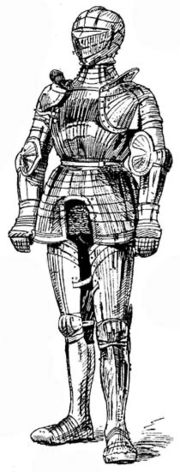
, almost always a professional warrior in the sense of being well-trained in the use of arms, who served as a fully armoured heavy cavalryman. It could refer to knight
Knight
A knight was a member of a class of lower nobility in the High Middle Ages.By the Late Middle Ages, the rank had become associated with the ideals of chivalry, a code of conduct for the perfect courtly Christian warrior....
s or noblemen, and to members of their retinues or to mercenaries in companies under captains. Such men could serve for pay or through a feudal obligation. The terms knight
Knight
A knight was a member of a class of lower nobility in the High Middle Ages.By the Late Middle Ages, the rank had become associated with the ideals of chivalry, a code of conduct for the perfect courtly Christian warrior....
and man-at-arms are often used interchangeably, but while all knights certainly were men-at-arms, not all men-at-arms were knights.
In England
Serjeant-at-Arms
A Sergeant-at-Arms is an officer appointed by a deliberative body, usually a legislature, to keep order during its meetings. The word sergeant is derived from the Latin serviens, which means "servant"....
, an esquire
Esquire
Esquire is a term of West European origin . Depending on the country, the term has different meanings...
(a man wealthy enough to be a knight but who was not because he did not want the costs and responsibilities of that rank), a knight bachelor, a knight banneret and all grades of nobility usually served as men-at-arms when called to war. Throughout the Medieval period and into the Tudor Age the armour of the man-at-arms became progressively more effective and expensive; indeed, Edward I decreed that all his men-at-arms should be mounted on equus coopertus, that is armoured, or barded, horses. The greater the number well-equipped men a nobleman or knight had in his retinue, the better his social standing.
The social stratification of men who served as men-at-arms is illustrated by their rates of pay on campaign, in the mid 1340s a knight was paid 2 shillings a day, an ordinary man-at-arms was paid half this amount; for comparison a foot archer received 2 or 3 pence (12 pennies to the shilling). A man-at-arms was also remunerated differentially according to the quality of his principal war-horse, if the horse was to die or was killed in battle. An ordinary esquire might own a war-horse worth only 5 pounds whilst a great nobleman might own a horse worth up to 100 pounds.
Social status also affected the types of military service performed by men-at-arms. Garrison duty was considered unattractive and was often carried out by soldiers of lesser status. For example the English garrison in the Scottish town of Roxburgh in 1301 consisted of just three knights compared to twenty seven men-at-arms of lesser status.
Although the social structure of the Anglo-Norman
Normans
The Normans were the people who gave their name to Normandy, a region in northern France. They were descended from Norse Viking conquerors of the territory and the native population of Frankish and Gallo-Roman stock...
society of England was relatively rigid, one of the easiest ways for a man to improve his social rank was through military service; another method was through the church. In the Norman states, unlike in many other contemporary societies, the knighting of men of common birth who had demonstrated ability and courage on the field was possible. Although rare, some non-knightly men-at-arms did advance socially to the status of knights. The knighting of squire
Squire
The English word squire is a shortened version of the word Esquire, from the Old French , itself derived from the Late Latin , in medieval or Old English a scutifer. The Classical Latin equivalent was , "arms bearer"...
s and men-at-arms was sometimes done in an ignoble manner, simply to increase the number of knights within an army (such practice was common during the Hundred Year's War). In chivalric theory any knight could bestow knighthood on another, however, in practice this was usually done by sovereigns and the higher nobility. It is recorded that the great mercenary captain Sir John Hawkwood
John Hawkwood
Sir John Hawkwood was an English mercenary or condottiero who was active in 14th century Italy. The French chronicler Jean Froissart knew him as Jean Haccoude and Italians as Giovanni Acuto...
knighted a number of his followers, as many as twenty on one occasion, though he could reasonably be expected to provide the income his created knights required to maintain their new status.
The fully armoured man-at-arms was gradually replaced in the course of the 16th century by later cavalry types, the demi-lancer
Demi-lancer
The "Demi-lancer" or demilancer was a type of heavy cavalryman found in Western Europe in the 16th and early 17th centuries.-Characteristics:...
and the cuirassier
Cuirassier
Cuirassiers were mounted cavalry soldiers equipped with armour and firearms, first appearing in late 15th-century Europe. They were the successors of the medieval armoured knights...
.
The last major battle in which English men-at-arms were prominent was fought against a Scottish army in 1547 at Pinkie Cleugh
Battle of Pinkie Cleugh
The Battle of Pinkie Cleugh, on the banks of the River Esk near Musselburgh, Scotland on 10 September 1547, was part of the War of the Rough Wooing. It was the last pitched battle between Scottish and English armies, and is seen as the first modern battle in the British Isles...
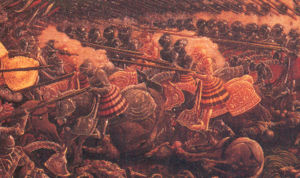
. The outnumbered Scots cavalry were easily driven off by the English horse (the Scots cavalry having lost heavily in an engagement the day before), the Scots then made a sudden advance with their massed pikemen. To slow their onset and give time for the English infantry to receive them the English heavy horse (men-at-arms and demi-lancers) were thrown against the pikes. The English cavalry crashed into the pikemen with great elan but sustained considerable losses. However, they halted the Scots attack, buying time for the English infantry and artillery to deploy effectively; the battle resulted in a heavy defeat for the Scots.
In France
In some countries, such as France, the men-at-arms (gens d'armes) became a paramilitary
Paramilitary
A paramilitary is a force whose function and organization are similar to those of a professional military, but which is not considered part of a state's formal armed forces....
with police duties.
There, a military corps having such duties was first created in 1337 and was placed under the orders of the Constable of France
Constable of France
The Constable of France , as the First Officer of the Crown, was one of the original five Great Officers of the Crown of France and Commander in Chief of the army. He, theoretically, as Lieutenant-general of the King, outranked all the nobles and was second-in-command only to the King...
(connétable), and therefore named connétablie. In 1626 after the abolition of the title of connétable, it was put under the command of the Maréchal of France, and renamed Maréchaussée. Its main mission was protecting the roads from highwaymen
Highwayman
A highwayman was a thief and brigand who preyed on travellers. This type of outlaw, usually, travelled and robbed by horse, as compared to a footpad who traveled and robbed on foot. Mounted robbers were widely considered to be socially superior to footpads...
.
The gens d'armes were originally heavy cavalry in the king's household, the equivalent of the "Honourable Corps of Gentlemen at Arms
Honourable Corps of Gentlemen at Arms
Her Majesty's Bodyguard of the Honourable Corps of Gentlemen at Arms is a bodyguard to the British Monarch. Until 17 March 1834 they were known as The Honourable Band of Gentlemen Pensioners.-Formation:...
". In 1720 the maréchaussée was subordinated to the gendarmerie
Gendarmerie
A gendarmerie or gendarmery is a military force charged with police duties among civilian populations. Members of such a force are typically called "gendarmes". The Shorter Oxford English Dictionary describes a gendarme as "a soldier who is employed on police duties" and a "gendarmery, -erie" as...
; after the French Revolution
French Revolution
The French Revolution , sometimes distinguished as the 'Great French Revolution' , was a period of radical social and political upheaval in France and Europe. The absolute monarchy that had ruled France for centuries collapsed in three years...
the maréchaussée was abolished and the gendarmerie took over its duties in 1791.