

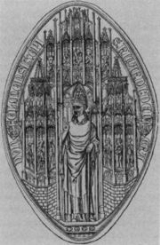
Richard Aungerville

Encyclopedia
Richard de Bury also known as Richard Aungerville (or Aungervyle), was an English
writer
, bibliophile, Benedictine
monk
and bishop
. He was a patron of learning, and one of the first English collectors of books. He is chiefly remembered for his Philobiblon, written to inculcate in the clergy the pursuit of learning and the love of books. The "Philobiblon" is considered the earliest books to discuss librarianship in-depth.
, the son of Sir Richard Aungervyle, who was descended from one of William the Conqueror
's men. Aungervyle settled in Leicestershire
, and the family came into possession of the manor of Willoughby. The year of Richard de Bury's birth is debated, there are conflicting sources; the earliest date from the Catholic Encyclopedia is 1281, other historians determined his birth year to be either 1286 or 1287. Recent research has shown that 1287 is the most widely accepted birth date.
Sir Richard Aungervyle died when de Bury was a young boy. He was educated by his maternal uncle John de Willoughby, and after leaving the grammar school
was sent to the University of Oxford
, where he studied philosophy
and theology
. He became a Benedictine
monk at Durham Cathedral
. He was made tutor to the future King Edward III
whilst Prince of Wales
(whom he would later serve as high chancellor
and treasurer
of England
) and, according to Thomas Frognall Dibdin
, inspired the prince with his own love of books.
Somehow he became involved in the intrigues preceding the deposition of King Edward II
, and supplied Queen Isabella
and her lover, Roger Mortimer, in Paris
with money in 1325 from the revenues of Brienne, of which province he was treasurer. For some time he had to hide in Paris from the officers sent by Edward II to apprehend him. On the accession of Edward III his services were rewarded by rapid promotion. He was cofferer to the king, treasurer of the wardrobe and afterwards Lord Privy Seal
in 1329. The king repeatedly recommended him to the pope
, and twice sent him, in 1330 and 1333, as ambassador to the papal court in exile at Avignon
. On the first of these visits he met a fellow bibliophile, Petrarch
, who records his impression of Aungerville as "not ignorant of literature and from his youth up curious beyond belief of hidden things." Petrarch asked him for information about Thule, but de Bury, who promised to reply when he was back at home among his books, never responded to repeated enquiries. Pope John XXII
, made him his principal chaplain
, and presented him with a rochet in earnest of the next vacant bishopric in England.
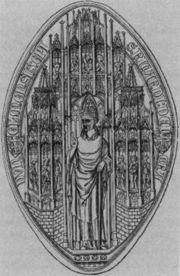 During his absence from England he was made dean of rolls in 1333. In September of the same year, he was made Bishop of Durham by the king, overruling the choice of the monks, who had elected and actually installed their sub-prior, Robert de Graynes. In February 1334 de Bury was made Lord Treasurer, an appointment he exchanged later in the year for that of Lord Chancellor
. He resigned the following year, and, after making arrangements for the protection of his northern diocese from an expected attack by the Scots
, he proceeded in July 1336 to France to attempt a settlement of the claims in dispute between Edward and the French king. In the next year he served on three commissions for the defence of the northern counties. In June 1338 he was once again sent abroad on a peace mission, but within a month was waylaid by the approaching campaign.
de Bury traveled to Coblenz and met Louis IV, Holy Roman Emperor
, and in the next year was sent to England to raise money. This seems to have been his last visit to the continent. In 1340 and 1342 he again tried to negotiate peace with the Scots, but afterward left public politics to care for his diocese and accumulate a library. He sent far and wide in search of manuscripts, rescuing many volumes from the charge of ignorant and neglectful monks. He may sometimes have brought undue pressure to bear on the owners, for it is recorded that an abbot of St Albans bribed him with four valuable books, and that de Bury, who procured certain coveted privileges for the monastery, bought from him thirty-two other books for fifty pieces of silver, far less than their normal price. The record of his passion for books
, his Philobiblon (Greek for 'The Love of Books') it is Latin treatise in praise of books . The Philobiblon was completed in 1344 and first printed in 1473. The most accurate and reliable English translation is by Ernest C. Thomas in 1888. Alfred Hessel describes the Philobiblon as “[t]he particular charm of the apology consist in fact that it contains sound library theory—though clothed in medieval garb”. This remarkable piece of literature is one of the earliest books to discuss librarianship in-depth.
Richard de Bury gives an account of the wearied efforts made by himself and his agents to collect books. He records his intention of founding a hall at Oxford, and in connection with it a library in which his books were to form the nucleus. He even details the dates to be observed for the lending and care of the books, and had already taken the preliminary steps for the foundation. The bishop died, however, in great poverty on 14 April 1345 at Bishop Auckland
, and it seems likely that his collection was dispersed immediately after his death. Of it, the traditional account is that the books were sent to the Durham Benedictines at his foundation of Durham College, Oxford, and that on the dissolution of the foundation by Henry VIII
they were divided between Duke Humphrey of Gloucester's library, Balliol College, Oxford
, and George Owen. Only two of the volumes are known to be in existence; one is a copy of John of Salisbury
's works in the British Museum
, and the other some theological treatises by Anselm and others in the Bodleian
.
The chief authority for the bishop's life is William de Chambre, printed in Wharton's Anglia Sacra, 1691, and in Historiae conelmensis scriptores tres, Surtees Soc., 1839, who describes him as an amiable and excellent man, charitable in his diocese, and the liberal patron of many learned men, among these being Thomas Bradwardine
, afterwards Archbishop of Canterbury
, Richard Fitzralph
, afterwards Archbishop of Armagh, the enemy of the mendicant orders, Walter Burley
, who translated Aristotle
, John Mauduit the astronomer
, Robert Holkot and Richard de Kilvington. John Bale
and Pits I mention other works of his, Epistolae Familiares and Orationes ad Principes. The opening words of the Philobiblon and the Epistolae as given by Bale represent those of the Philobiblon and its prologue, of that he apparently made two books out of one treatise. It is possible that the Orationes may represent a letter book of Richard de Bury's, entitled Liber Epistolaris quondam dominiis cardi de Bury, Episcopi Dunelmensis, now in the possession of Lord Harlech.
This manuscript, the contents of which are fully catalogued in the Fourth Report (1874) of the Historical Manuscripts Commission (Appendix, pp. 379–397), contains numerous letters from various popes, from the king, a correspondence dealing with the affairs of the university of Oxford, another with the province of Gascony
, beside some harangues and letters evidently meant as models to be used on various occasions. It has often been asserted that the Philobiblon itself was not written by Richard de Bury at all, but by Robert Holkot. This assertion is supported by the fact that in seven of the extant manuscripts of Philobiblon it is ascribed to Holkote in an introductory page, in these or slightly varying terms: Incipit prologus in re philobiblon ricardi dunelmensis episcopi que libri composuit ag. The Paris manuscript has simply Philobiblon olchoti anglici, and does not contain the usual concluding note of the date when the book was completed by Richard. As a great part of the charm of book lies in the unconscious record of the collector's own character, the establishment of Holkot's authorship would materially alter its value. A notice of Richard de Bury by his contemporary Adam Murimuth
(Continuatio Chronicarum, Rolls series
, 1889, p. 171) gives a less favourable account of him than does William de Chambre, asserting that he was only moderately learned, but desired to be regarded as a great scholar.
England
England is a country that is part of the United Kingdom. It shares land borders with Scotland to the north and Wales to the west; the Irish Sea is to the north west, the Celtic Sea to the south west, with the North Sea to the east and the English Channel to the south separating it from continental...
writer
Writer
A writer is a person who produces literature, such as novels, short stories, plays, screenplays, poetry, or other literary art. Skilled writers are able to use language to portray ideas and images....
, bibliophile, Benedictine
Benedictine
Benedictine refers to the spirituality and consecrated life in accordance with the Rule of St Benedict, written by Benedict of Nursia in the sixth century for the cenobitic communities he founded in central Italy. The most notable of these is Monte Cassino, the first monastery founded by Benedict...
monk
Monk
A monk is a person who practices religious asceticism, living either alone or with any number of monks, while always maintaining some degree of physical separation from those not sharing the same purpose...
and bishop
Bishop
A bishop is an ordained or consecrated member of the Christian clergy who is generally entrusted with a position of authority and oversight. Within the Catholic Church, Eastern Orthodox, Oriental Orthodox Churches, in the Assyrian Church of the East, in the Independent Catholic Churches, and in the...
. He was a patron of learning, and one of the first English collectors of books. He is chiefly remembered for his Philobiblon, written to inculcate in the clergy the pursuit of learning and the love of books. The "Philobiblon" is considered the earliest books to discuss librarianship in-depth.
Life
Richard de Bury was born near Bury St Edmunds, SuffolkSuffolk
Suffolk is a non-metropolitan county of historic origin in East Anglia, England. It has borders with Norfolk to the north, Cambridgeshire to the west and Essex to the south. The North Sea lies to the east...
, the son of Sir Richard Aungervyle, who was descended from one of William the Conqueror
William I of England
William I , also known as William the Conqueror , was the first Norman King of England from Christmas 1066 until his death. He was also Duke of Normandy from 3 July 1035 until his death, under the name William II...
's men. Aungervyle settled in Leicestershire
Leicestershire
Leicestershire is a landlocked county in the English Midlands. It takes its name from the heavily populated City of Leicester, traditionally its administrative centre, although the City of Leicester unitary authority is today administered separately from the rest of Leicestershire...
, and the family came into possession of the manor of Willoughby. The year of Richard de Bury's birth is debated, there are conflicting sources; the earliest date from the Catholic Encyclopedia is 1281, other historians determined his birth year to be either 1286 or 1287. Recent research has shown that 1287 is the most widely accepted birth date.
Sir Richard Aungervyle died when de Bury was a young boy. He was educated by his maternal uncle John de Willoughby, and after leaving the grammar school
Grammar school
A grammar school is one of several different types of school in the history of education in the United Kingdom and some other English-speaking countries, originally a school teaching classical languages but more recently an academically-oriented secondary school.The original purpose of mediaeval...
was sent to the University of Oxford
University of Oxford
The University of Oxford is a university located in Oxford, United Kingdom. It is the second-oldest surviving university in the world and the oldest in the English-speaking world. Although its exact date of foundation is unclear, there is evidence of teaching as far back as 1096...
, where he studied philosophy
Philosophy
Philosophy is the study of general and fundamental problems, such as those connected with existence, knowledge, values, reason, mind, and language. Philosophy is distinguished from other ways of addressing such problems by its critical, generally systematic approach and its reliance on rational...
and theology
Theology
Theology is the systematic and rational study of religion and its influences and of the nature of religious truths, or the learned profession acquired by completing specialized training in religious studies, usually at a university or school of divinity or seminary.-Definition:Augustine of Hippo...
. He became a Benedictine
Benedictine
Benedictine refers to the spirituality and consecrated life in accordance with the Rule of St Benedict, written by Benedict of Nursia in the sixth century for the cenobitic communities he founded in central Italy. The most notable of these is Monte Cassino, the first monastery founded by Benedict...
monk at Durham Cathedral
Durham Cathedral
The Cathedral Church of Christ, Blessed Mary the Virgin and St Cuthbert of Durham is a cathedral in the city of Durham, England, the seat of the Anglican Bishop of Durham. The Bishopric dates from 995, with the present cathedral being founded in AD 1093...
. He was made tutor to the future King Edward III
Edward III of England
Edward III was King of England from 1327 until his death and is noted for his military success. Restoring royal authority after the disastrous reign of his father, Edward II, Edward III went on to transform the Kingdom of England into one of the most formidable military powers in Europe...
whilst Prince of Wales
Prince of Wales
Prince of Wales is a title traditionally granted to the heir apparent to the reigning monarch of the United Kingdom of Great Britain and Northern Ireland and the 15 other independent Commonwealth realms...
(whom he would later serve as high chancellor
Chancellor
Chancellor is the title of various official positions in the governments of many nations. The original chancellors were the Cancellarii of Roman courts of justice—ushers who sat at the cancelli or lattice work screens of a basilica or law court, which separated the judge and counsel from the...
and treasurer
Treasurer
A treasurer is the person responsible for running the treasury of an organization. The adjective for a treasurer is normally "tresorial". The adjective "treasurial" normally means pertaining to a treasury, rather than the treasurer.-Government:...
of England
England
England is a country that is part of the United Kingdom. It shares land borders with Scotland to the north and Wales to the west; the Irish Sea is to the north west, the Celtic Sea to the south west, with the North Sea to the east and the English Channel to the south separating it from continental...
) and, according to Thomas Frognall Dibdin
Thomas Frognall Dibdin
Thomas Frognall Dibdin , English bibliographer, born at Calcutta, was the son of Thomas Dibdin, the sailor brother of Charles Dibdin....
, inspired the prince with his own love of books.
Somehow he became involved in the intrigues preceding the deposition of King Edward II
Edward II of England
Edward II , called Edward of Caernarfon, was King of England from 1307 until he was deposed by his wife Isabella in January 1327. He was the sixth Plantagenet king, in a line that began with the reign of Henry II...
, and supplied Queen Isabella
Isabella of France
Isabella of France , sometimes described as the She-wolf of France, was Queen consort of England as the wife of Edward II of England. She was the youngest surviving child and only surviving daughter of Philip IV of France and Joan I of Navarre...
and her lover, Roger Mortimer, in Paris
Paris
Paris is the capital and largest city in France, situated on the river Seine, in northern France, at the heart of the Île-de-France region...
with money in 1325 from the revenues of Brienne, of which province he was treasurer. For some time he had to hide in Paris from the officers sent by Edward II to apprehend him. On the accession of Edward III his services were rewarded by rapid promotion. He was cofferer to the king, treasurer of the wardrobe and afterwards Lord Privy Seal
Lord Privy Seal
The Lord Privy Seal is the fifth of the Great Officers of State in the United Kingdom, ranking beneath the Lord President of the Council and above the Lord Great Chamberlain. The office is one of the traditional sinecure offices of state...
in 1329. The king repeatedly recommended him to the pope
Pope
The Pope is the Bishop of Rome, a position that makes him the leader of the worldwide Catholic Church . In the Catholic Church, the Pope is regarded as the successor of Saint Peter, the Apostle...
, and twice sent him, in 1330 and 1333, as ambassador to the papal court in exile at Avignon
Avignon
Avignon is a French commune in southeastern France in the départment of the Vaucluse bordered by the left bank of the Rhône river. Of the 94,787 inhabitants of the city on 1 January 2010, 12 000 live in the ancient town centre surrounded by its medieval ramparts.Often referred to as the...
. On the first of these visits he met a fellow bibliophile, Petrarch
Petrarch
Francesco Petrarca , known in English as Petrarch, was an Italian scholar, poet and one of the earliest humanists. Petrarch is often called the "Father of Humanism"...
, who records his impression of Aungerville as "not ignorant of literature and from his youth up curious beyond belief of hidden things." Petrarch asked him for information about Thule, but de Bury, who promised to reply when he was back at home among his books, never responded to repeated enquiries. Pope John XXII
Pope John XXII
Pope John XXII , born Jacques Duèze , was pope from 1316 to 1334. He was the second Pope of the Avignon Papacy , elected by a conclave in Lyon assembled by Philip V of France...
, made him his principal chaplain
Chaplain
Traditionally, a chaplain is a minister in a specialized setting such as a priest, pastor, rabbi, or imam or lay representative of a religion attached to a secular institution such as a hospital, prison, military unit, police department, university, or private chapel...
, and presented him with a rochet in earnest of the next vacant bishopric in England.
Lord Chancellor
The Lord High Chancellor of Great Britain, or Lord Chancellor, is a senior and important functionary in the government of the United Kingdom. He is the second highest ranking of the Great Officers of State, ranking only after the Lord High Steward. The Lord Chancellor is appointed by the Sovereign...
. He resigned the following year, and, after making arrangements for the protection of his northern diocese from an expected attack by the Scots
Scotland
Scotland is a country that is part of the United Kingdom. Occupying the northern third of the island of Great Britain, it shares a border with England to the south and is bounded by the North Sea to the east, the Atlantic Ocean to the north and west, and the North Channel and Irish Sea to the...
, he proceeded in July 1336 to France to attempt a settlement of the claims in dispute between Edward and the French king. In the next year he served on three commissions for the defence of the northern counties. In June 1338 he was once again sent abroad on a peace mission, but within a month was waylaid by the approaching campaign.
de Bury traveled to Coblenz and met Louis IV, Holy Roman Emperor
Louis IV, Holy Roman Emperor
Louis IV , called the Bavarian, of the house of Wittelsbach, was the King of Germany from 1314, the King of Italy from 1327 and the Holy Roman Emperor from 1328....
, and in the next year was sent to England to raise money. This seems to have been his last visit to the continent. In 1340 and 1342 he again tried to negotiate peace with the Scots, but afterward left public politics to care for his diocese and accumulate a library. He sent far and wide in search of manuscripts, rescuing many volumes from the charge of ignorant and neglectful monks. He may sometimes have brought undue pressure to bear on the owners, for it is recorded that an abbot of St Albans bribed him with four valuable books, and that de Bury, who procured certain coveted privileges for the monastery, bought from him thirty-two other books for fifty pieces of silver, far less than their normal price. The record of his passion for books
Bibliophilia
Bibliophilia or bibliophilism is the love of books. Accordingly a bibliophile is an individual who loves books. A bookworm is someone who loves books for their content, or who otherwise loves reading. The -ia-suffixed form "bibliophilia" is sometimes considered to be an incorrect usage; the older...
, his Philobiblon (Greek for 'The Love of Books') it is Latin treatise in praise of books . The Philobiblon was completed in 1344 and first printed in 1473. The most accurate and reliable English translation is by Ernest C. Thomas in 1888. Alfred Hessel describes the Philobiblon as “[t]he particular charm of the apology consist in fact that it contains sound library theory—though clothed in medieval garb”. This remarkable piece of literature is one of the earliest books to discuss librarianship in-depth.
Richard de Bury gives an account of the wearied efforts made by himself and his agents to collect books. He records his intention of founding a hall at Oxford, and in connection with it a library in which his books were to form the nucleus. He even details the dates to be observed for the lending and care of the books, and had already taken the preliminary steps for the foundation. The bishop died, however, in great poverty on 14 April 1345 at Bishop Auckland
Bishop Auckland
Bishop Auckland is a market town and civil parish in County Durham in north east England. It is located about northwest of Darlington and southwest of Durham at the confluence of the River Wear with its tributary the River Gaunless...
, and it seems likely that his collection was dispersed immediately after his death. Of it, the traditional account is that the books were sent to the Durham Benedictines at his foundation of Durham College, Oxford, and that on the dissolution of the foundation by Henry VIII
Henry VIII of England
Henry VIII was King of England from 21 April 1509 until his death. He was Lord, and later King, of Ireland, as well as continuing the nominal claim by the English monarchs to the Kingdom of France...
they were divided between Duke Humphrey of Gloucester's library, Balliol College, Oxford
Balliol College, Oxford
Balliol College , founded in 1263, is one of the constituent colleges of the University of Oxford in England but founded by a family with strong Scottish connections....
, and George Owen. Only two of the volumes are known to be in existence; one is a copy of John of Salisbury
John of Salisbury
John of Salisbury , who described himself as Johannes Parvus , was an English author, educationalist, diplomat and bishop of Chartres, and was born at Salisbury.-Early life and education:...
's works in the British Museum
British Museum
The British Museum is a museum of human history and culture in London. Its collections, which number more than seven million objects, are amongst the largest and most comprehensive in the world and originate from all continents, illustrating and documenting the story of human culture from its...
, and the other some theological treatises by Anselm and others in the Bodleian
Bodleian Library
The Bodleian Library , the main research library of the University of Oxford, is one of the oldest libraries in Europe, and in Britain is second in size only to the British Library...
.
The chief authority for the bishop's life is William de Chambre, printed in Wharton's Anglia Sacra, 1691, and in Historiae conelmensis scriptores tres, Surtees Soc., 1839, who describes him as an amiable and excellent man, charitable in his diocese, and the liberal patron of many learned men, among these being Thomas Bradwardine
Thomas Bradwardine
Thomas Bradwardine was an English scholar, scientist, courtier and, very briefly, Archbishop of Canterbury. As a celebrated scholastic philosopher and doctor of theology, he is often called Doctor Profundus, .-Life:He was born either at Hartfield in Sussex or at Chichester, where his family were...
, afterwards Archbishop of Canterbury
Archbishop of Canterbury
The Archbishop of Canterbury is the senior bishop and principal leader of the Church of England, the symbolic head of the worldwide Anglican Communion, and the diocesan bishop of the Diocese of Canterbury. In his role as head of the Anglican Communion, the archbishop leads the third largest group...
, Richard Fitzralph
Richard FitzRalph
Richard FitzRalph was an Archbishop of Armagh during the 14th century. He was born into a well-off burgess family of Anglo-Norman/Hiberno-Norman descent in Dundalk, Ireland. He is noted as an ex-fellow and teacher of Balliol College, at the University of Oxford in 1325...
, afterwards Archbishop of Armagh, the enemy of the mendicant orders, Walter Burley
Walter Burley
Walter Burley was a medieval English Scholastic philosopher and logician. He was a Master of Arts at Oxford in 1301, and a fellow of Merton College, Oxford until about 1310. He spent sixteen years at Paris until 1326, becoming a fellow of the Sorbonne by 1324. After that, he spent seventeen...
, who translated Aristotle
Aristotle
Aristotle was a Greek philosopher and polymath, a student of Plato and teacher of Alexander the Great. His writings cover many subjects, including physics, metaphysics, poetry, theater, music, logic, rhetoric, linguistics, politics, government, ethics, biology, and zoology...
, John Mauduit the astronomer
Astronomer
An astronomer is a scientist who studies celestial bodies such as planets, stars and galaxies.Historically, astronomy was more concerned with the classification and description of phenomena in the sky, while astrophysics attempted to explain these phenomena and the differences between them using...
, Robert Holkot and Richard de Kilvington. John Bale
John Bale
John Bale was an English churchman, historian and controversialist, and Bishop of Ossory. He wrote the oldest known historical verse drama in English , and developed and published a very extensive list of the works of British authors down to his own time, just as the monastic libraries were being...
and Pits I mention other works of his, Epistolae Familiares and Orationes ad Principes. The opening words of the Philobiblon and the Epistolae as given by Bale represent those of the Philobiblon and its prologue, of that he apparently made two books out of one treatise. It is possible that the Orationes may represent a letter book of Richard de Bury's, entitled Liber Epistolaris quondam dominiis cardi de Bury, Episcopi Dunelmensis, now in the possession of Lord Harlech.
This manuscript, the contents of which are fully catalogued in the Fourth Report (1874) of the Historical Manuscripts Commission (Appendix, pp. 379–397), contains numerous letters from various popes, from the king, a correspondence dealing with the affairs of the university of Oxford, another with the province of Gascony
Gascony
Gascony is an area of southwest France that was part of the "Province of Guyenne and Gascony" prior to the French Revolution. The region is vaguely defined and the distinction between Guyenne and Gascony is unclear; sometimes they are considered to overlap, and sometimes Gascony is considered a...
, beside some harangues and letters evidently meant as models to be used on various occasions. It has often been asserted that the Philobiblon itself was not written by Richard de Bury at all, but by Robert Holkot. This assertion is supported by the fact that in seven of the extant manuscripts of Philobiblon it is ascribed to Holkote in an introductory page, in these or slightly varying terms: Incipit prologus in re philobiblon ricardi dunelmensis episcopi que libri composuit ag. The Paris manuscript has simply Philobiblon olchoti anglici, and does not contain the usual concluding note of the date when the book was completed by Richard. As a great part of the charm of book lies in the unconscious record of the collector's own character, the establishment of Holkot's authorship would materially alter its value. A notice of Richard de Bury by his contemporary Adam Murimuth
Adam Murimuth
Adam Murimuth was an English ecclesiastic and chronicler.-Life:He was born in 1274 or 1275 and studied civil law at the University of Oxford. Between 1312 and 1318 he practised in the papal curia at Avignon...
(Continuatio Chronicarum, Rolls series
Rolls Series
The Rolls Series, official title The Chronicles and Memorials of Great Britain and Ireland during the Middle Ages, is a major collection of British and Irish historical materials and primary sources, published in the second half of the 19th century. Some 255 volumes, representing 99 separate...
, 1889, p. 171) gives a less favourable account of him than does William de Chambre, asserting that he was only moderately learned, but desired to be regarded as a great scholar.