

War and Peace

Encyclopedia
War and Peace is a novel
by the Russia
n author Leo Tolstoy
, first published in 1869. The work is epic
in scale and is regarded as one of the most important works of world literature. It is regarded as Tolstoy's finest literary achievement, along with his other major prose work Anna Karenina
(1873–1877).
War and Peace delineates in graphic detail events leading up to the French invasion of Russia
, and the impact of the Napoleonic era
on Tsarist society, as seen through the eyes of five Russia
n aristocratic
families. Portions of an earlier version of the novel, then known as The Year 1805,
were serialized in the magazine The Russian Messenger
between 1865 and 1867. The novel was first published in its entirety in 1869. Newsweek
in 2009 ranked it top of its list of Top 100 Books.
Tolstoy himself, somewhat enigmatically, said of War and Peace that it was "not a novel, even less is it a poem, and still less an historical chronicle." He went on to elaborate the best of Russian literature usually do not conform to standard norms. Tolstoy regarded Anna Karenina as the first of his novels.
 War and Peace is well known as being one of the longest novels ever written, though not the longest. It is actually the seventeenth longest novel ever written in a Latin or Cyrillic based alphabet and is subdivided into four books or volumes, each with subparts containing many chapters.
Tolstoy came up with the title, and some of his themes, from an 1861 work of Proudhon: La Guerre et la Paix ('War and Peace' in French
). Tolstoy had served in the Crimean War
and written a series of short stories and novellas featuring scenes of war.
He began writing War and Peace in the year that he finally married and settled down at his country estate. The first half of the book was written under the name "1805".
During the writing of the second half, he read widely and acknowledged Schopenhauer as one of his main inspirations. However, Tolstoy developed his own views of history and the role of the individual within it.
The novel can be generally classified as historical fiction
. It contains elements present in many types of popular 18th and 19th century literature, especially the romance novel
. War and Peace attains its literary status by transcending genres.
Tolstoy was instrumental in bringing a new kind of consciousness to the novel. His narrative structure is noted for its "god-like" ability to hover over and within events, but also in the way it swiftly and seamlessly portrayed a particular character's point of view. His use of visual detail is often cinematic in its scope, using the literary equivalents of panning, wide shots and close-ups, to give dramatic interest to battles and ballrooms alike. These devices, while not exclusive to Tolstoy, are part of the new style of the novel that arose in the mid-19th century and of which Tolstoy proved himself a master.
of the Crimean War
, Tolstoy was quite critical of standard history, especially the standards of military history
, in War and Peace. Tolstoy read all the standard histories available in Russian and French about the Napoleonic Wars
and combined more traditional historical writing with the novel form. He explains at the start of the novel's third volume his own views on how history ought to be written. His aim was to blur the line between fiction and history, in order to get closer to the truth, as he states in Volume II.
The novel is set 60 years earlier than the time at which Tolstoy wrote it, "in the days of our grandfathers", as he puts it. He had spoken with people who had lived through war during the French invasion of Russia
in 1812, so the book is also, in part, accurate ethnography
fictionalized. He read letters, journals, autobiographical and biographical materials pertaining to Napoleon and the dozens of other historical characters in the novel. There are approximately 160 real persons named or referred to in War and Peace.
The completed novel was then called Voyna i mir (new style orthography; in English War and Peace).
The 1805 manuscript (sometimes referred to as "the original War and Peace") was re-edited and annotated in Russia
in 1983 and since has been translated separately from the "known" version, to English
, German
, French
, Spanish
, Dutch
, Swedish
, Finnish
, Albanian
, and Korean
. The fact that so many extant versions of War and Peace survive make it one of the best insights into the mental processes of a great novelist.
Russians who had read the serialized version were anxious to acquire the complete first edition, which included epilogues, and it sold out almost immediately. The novel was translated almost immediately after publication into many other languages.
Isaac Babel
said, after reading War and Peace, "If the world could write by itself, it would write like Tolstoy." Tolstoy "gives us a unique combination of the 'naive objectivity' of the oral narrator with the interest in detail characteristic of realism. This is the reason for our trust in his presentation."
with characters often switching between the two languages. This reflected 19th century Russian aristocracy, where French, a foreign tongue, was widely spoken and considered a language of prestige and more refined than Russian. This came about from the historical influence throughout Europe of the powerful court of the Sun King, Louis XIV of France
, leading to members of the Russian aristocracy being less competent in speaking their mother tongue. In War and Peace, for example, Julie Karagina, Princess Marya's friend, has to take Russian lessons in order to master her native language.
It has been suggested that it is a deliberate literary device employed by Tolstoy, to use French to portray artifice and insincerity as the language of the theater and deceit while Russian emerges as a language of sincerity, honesty and seriousness. It displays slight irony that as Pierre and others socialize and use French phrases, they will be attacked by legions of Bonapartists in a very short time. It is sometimes used in satire against Napoleon. In the novel, when Pierre proposes to Hélène, he speaks to her in French — Je vous aime ('I love you'). When the marriage later emerges to be a sham, Pierre blames those French words.
The use of French diminishes as the book progresses and the wars with the French intensify, culminating in the capture and eventual burning of Moscow
. The progressive elimination of French from the text is a means of demonstrating that Russia has freed itself from foreign cultural domination. It is also, at the level of plot development, a way of showing that a once-admired and friendly nation, France, has turned into an enemy. By midway through the book, several of the Russian aristocracy, whose command of French is far better than their command of Russian, are anxious to find Russian tutors for themselves.
and Louise and Aylmer Maude knew Tolstoy personally. Translations have to deal with Tolstoy’s often peculiar syntax and his fondness of repetitions. About 2% of War and Peace is in French; Tolstoy removed the French in a revised 1873 edition, only to restore it later. Most translators follow Garnett retaining some French, Briggs uses no French, while Pevear-Volokhonsky and Amy Mandelker's revision of the Maude translation both retain the French fully. (For a list of translations see below)
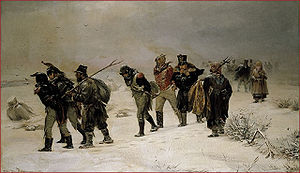 The novel begins in the year 1805 during the reign of Tsar Alexander I
and leads up to the 1812 French invasion of Russia
by Napoleon
. The era of Catherine the Great
(from 1762–1796), when the royal court in Paris
was the centre of western European civilization, is still fresh in the minds of older people. Catherine, fluent in French and wishing to reshape Russia into a great European nation, made French the language of her royal court. For the next one hundred years, it became a social requirement for members of the Russian nobility to speak French and understand French culture. This historical and cultural context in the aristocracy is reflected in War and Peace. Catherine's grandson, Alexander I, came to the throne in 1801 at the age of 24. In the novel, his mother, Marya Feodorovna, is the most powerful woman in the Russian court.
War and Peace tells the story of five aristocratic
families — the Bezukhovs, the Bolkonskys, the Rostovs, the Kuragins and the Drubetskoys—and the entanglements of their personal lives with the history of 1805–1813, principally Napoleon's invasion of Russia in 1812. The Bezukhovs, while very rich, are a fragmented family as the old Count, Kirill Vladimirovich, has fathered dozens of illegitimate sons. The Bolkonskys are an old established and wealthy family based at Bald Hills. Old Prince Bolkonsky, Nikolai Andreevich, served as a general under Catherine the Great, in earlier wars. The Moscow
Rostovs have many estates, but never enough cash. They are a closely knit, loving family who live for the moment regardless of their financial situation. The Kuragin family has three children, who are all of questionable character. The Drubetskoy family is of impoverished nobility, and consists of an elderly mother and her only son, Boris, whom she wishes to push up the career ladder.
Tolstoy spent years researching and rewriting the book. He worked from primary source materials (interviews and other documents), as well as from history books, philosophy texts and other historical novels. Tolstoy also used a great deal of his own experience in the Crimean War
to bring vivid detail and first-hand accounts of how the Russian army was structured.
The standard Russian text of War and Peace is divided into four books (fifteen parts) and an epilogue
in two parts – one mainly narrative, the other thematic. While roughly the first half of the novel is concerned strictly with the fictional characters, the later parts, as well as one of the work's two epilogues, increasingly consist of essay
s about the nature of war, power, history
, and historiography
. Tolstoy interspersed these essays into the story in a way that defies previous fictional convention. Certain abridged versions remove these essays entirely, while others, published even during Tolstoy's life, simply moved these essays into an appendix
.
during the Napoleonic wars
.
, at a soirée given by Anna Pavlovna Scherer — the maid of honour and confidante to the queen mother
Maria Feodorovna. Many of the main characters and aristocratic families in the novel are introduced as they enter Anna Pavlovna's salon. Pierre (Pyotr Kirilovich) Bezukhov
is the illegitimate son of a wealthy count
, an elderly man who is dying after a series of strokes. Pierre is about to become embroiled in a struggle for his inheritance. Educated abroad at his father's expense following his mother's death, Pierre is essentially kindhearted, but socially awkward, and owing in part to his open, benevolent nature, finds it difficult to integrate into Petersburg society. It is known to everyone at the soirée that Pierre is his father's favorite of all the old count’s illegitimate children.
Also attending the soireé is Pierre's friend, the intelligent and sardonic Prince Andrei Nikolayevich Bolkonsky, husband of Lise, the charming society favourite. Finding Petersburg society unctuous and disillusioned with married life after discovering his wife is empty and superficial, Prince Andrei makes the fateful choice to be an aide-de-camp
to Prince Mikhail Ilarionovich Kutuzov in the coming war against Napoleon
.
The plot moves to Moscow
, Russia's ancient city and former capital, contrasting its provincial, more Russian ways to the highly mannered society of Petersburg. The Rostov family are introduced. Count Ilya Andreyevich Rostov has four adolescent children. Thirteen-year-old Natasha (Natalia Ilyinichna) believes herself in love with Boris Drubetskoy, a disciplined young man who is about to join the army as an officer. Twenty-year-old Nikolai Ilyich pledges his teenage love to Sonya (Sofia Alexandrovna), his fifteen-year-old cousin, an orphan who has been brought up by the Rostovs. The eldest child of the Rostov family, Vera Ilyinichna, is cold and somewhat haughty but has a good prospective marriage in a Russian-German officer, Adolf Karlovich Berg. Petya (Pyotr Ilyich) is nine and the youngest of the Rostov family; like his brother, he is impetuous and eager to join the army when of age. The heads of the family, Count Ilya Rostov and Countess Natalya Rostova, are an affectionate couple but forever worried about their disordered finances.
At Bald Hills, the Bolkonskys' country estate, Prince Andrei departs for war and leaves his terrified, pregnant wife Lise with his eccentric father Prince Nikolai Andreyevich Bolkonsky and his devoutly religious sister Maria Nikolayevna Bolkonskaya.
The second part opens with descriptions of the impending Russian-French war preparations. At the Schöngrabern engagement
, Nikolai Rostov, who is now conscripted as ensign
in a squadron of hussar
s, has his first taste of battle. He meets Prince Andrei, whom he insults in a fit of impetuousness. Even more than most young soldiers, he is deeply attracted by Tsar Alexander's charisma. Nikolai gambles and socializes with his officer, Vasily Dmitrich Denisov, and befriends the ruthless and perhaps psychopathic Fyodor Ivanovich Dolokhov.
Pierre Bezukhov, upon finally receiving his massive inheritance, is suddenly transformed from a bumbling young man into the richest and most eligible bachelor in the Russian Empire. Despite rationally knowing that it is wrong, he proposes marriage with Prince Kuragin's beautiful and immoral daughter Hélène (Elena Vasilyevna Kuragina), to whom he is sexually attracted. Hélène, who is rumoured to be involved in an incestuous affair with her brother, the equally charming and immoral Anatol, tells Pierre that she will never have children with him. Hélène has an affair with Dolokhov, who mocks Pierre in public. Pierre loses his temper and challenges Dolokhov, a seasoned dueller and a ruthless killer, to a duel. Unexpectedly, Pierre wounds Dolokhov. Hélène denies her affair, but Pierre is convinced of her guilt and, after almost being violent to her, leaves her. In his moral and spiritual confusion, Pierre joins the Freemasons, and becomes embroiled in Masonic internal politics. Much of Book Two concerns his struggles with his passions and his spiritual conflicts to be a better man. Now a rich aristocrat, he abandons his former carefree behavior and enters upon a philosophical quest particular to Tolstoy: how should one live a moral life in an ethically imperfect world? The question continually baffles and confuses Pierre. He attempts to liberate his serfs, but ultimately achieves nothing of note.
Pierre is vividly contrasted with the intelligent and ambitious Prince Andrei Bolkonsky. At the Battle of Austerlitz
, Andrei is inspired by a vision of glory to lead a charge of a straggling army. He suffers a near fatal artillery
wound. In the face of death, Andrei realizes all his former ambitions are pointless and his former hero Napoleon (who rescues him in a horseback excursion to the battlefield) is apparently as vain as himself.
Prince Andrei recovers from his injuries in a military hospital and returns home, only to find his wife Lise dying in childbirth. He is stricken by his guilty conscience for not treating Lise better when she was alive and is haunted by the pitiful expression on his dead wife's face. His child, Nikolenka, survives.
Burdened with nihilistic
disillusionment, Prince Andrei does not return to the army but chooses to remain on his estate, working on a project that would codify military behavior and help solve some of the problems of Russian disorganization that he believes were responsible for the loss of life in battle on the Russian side. Pierre comes to visit him and brings new questions: where is God in this amoral
world? Pierre is interested in panentheism
and the possibility of an afterlife
.
Pierre's estranged wife, Hélène, begs him to take her back, and against his better judgment he does. Despite her vapid shallowness, Hélène establishes herself as an influential hostess in Petersburg society.
Prince Andrei feels impelled to take his newly written military notions to Petersburg, naively expecting to influence either the Emperor himself or those close to him. Young Natasha, also in Petersburg, is caught up in the excitement of dressing for her first grand ball, where she meets Prince Andrei and briefly reinvigorates him with her vivacious charm. Andrei believes he has found purpose in life again and, after paying the Rostovs several visits, proposes marriage to Natasha. However, old Prince Bolkonsky, Andrei's father, dislikes the Rostovs, opposes the marriage, and insists on a year's delay. Prince Andrei leaves to recuperate from his wounds abroad, leaving Natasha initially distraught. She soon recovers her spirits, however, and Count Rostov takes her and Sonya to spend some time with a friend in Moscow.
Natasha visits the Moscow opera
, where she meets Hélène and her brother Anatol. Anatol has since married a Polish woman whom he has abandoned in Poland. He is very attracted to Natasha and is determined to seduce her. Hélène and Anatol conspire together to accomplish this plan. Anatol kisses Natasha and writes her passionate letters, eventually establishing plans to elope. Natasha is convinced that she loves Anatol and writes to Princess Maria, Andrei's sister, breaking off her engagement. At the last moment, Sonya discovers her plans to elope and foils them. Pierre is initially shocked and horrified at Natasha's behavior, but comes to realize he has fallen in love with her himself. During the time when the Great Comet of 1811–2
streaks the sky, life appears to begin anew for Pierre.
Prince Andrei accepts coldly Natasha's breaking of the engagement. He tells Pierre that his pride will not allow him to renew his proposal of marriage. Shamed by her near-seduction and at the realisation that Andrei will not forgive her, Natasha makes a suicide attempt and is left seriously ill.
 With the help of her family, especially Sonya, and the stirrings of religious faith, Natasha manages to persevere in Moscow through this dark period. Meanwhile, the whole of Russia is affected by the coming confrontation between Napoleon's troops and the Russian army. Pierre convinces himself through gematria
that Napoleon is the Antichrist
of the Book of Revelation
. Old prince Bolkonsky dies of a stroke while trying to protect his estate from French marauders. No organized help from any Russian army seems available to the Bolkonskys, but Nikolai Rostov turns up at their estate in time to help put down an incipient peasant revolt. He finds himself attracted to Princess Maria, but remembers his promise to Sonya.
Back in Moscow, the war-obsessed Petya manages to snatch a loose piece of the Tsar's biscuit outside the Cathedral of the Assumption; he finally convinces his parents to allow him to enlist.
Napoleon himself is a main character in this section of the novel and is presented in vivid detail, as both a thinker and would-be strategist. His toilette and his customary attitudes and traits of mind are depicted in detail. Also described are the well-organized force of over 400,000 French Army (only 140,000 of them actually French-speaking) which marches quickly through the Russian countryside in the late summer and reaches the outskirts of the city of Smolensk
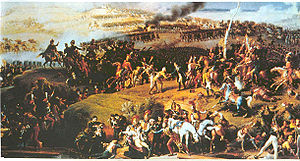
. Pierre decides to leave Moscow and go to watch the Battle of Borodino
from a vantage point next to a Russian artillery crew. After watching for a time, he begins to join in carrying ammunition. In the midst of the turmoil he experiences firsthand the death and destruction of war. The battle becomes a hideous slaughter for both armies and ends in a standoff. The Russians, however, have won a moral victory by standing up to Napoleon's reputedly invincible army. For strategic reasons and having suffered grievous losses, the Russian army withdraws the next day, allowing Napoleon to march on to Moscow. Among the casualties are Anatol Kuragin and Prince Andrei. Anatol loses a leg, and Andrei suffers a grenade wound in the abdomen. Both are reported dead, but their families are in such disarray that no one can be notified.
 The Rostovs have waited until the last minute to abandon Moscow, even after it is clear that Kutuzov has retreated past Moscow and Muscovites are being given contradictory, often propagandistic, instructions on how to either flee or fight. Count Rostopchin is publishing posters, rousing the citizens to put their faith in religious icons, while at the same time urging them to fight with pitchforks if necessary. Before fleeing himself, he gives orders to burn the city. The Rostovs have a difficult time deciding what to take with them, but in the end, Natasha convinces them to load their carts with the wounded and dying from the Battle of Borodino. Unknown to Natasha, Prince Andrei is amongst the wounded.
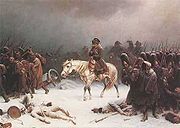
When Napoleon's Grand Army finally occupies an abandoned and burning Moscow
, Pierre takes off on a quixotic mission to assassinate Napoleon
. He becomes an anonymous man in all the chaos, shedding his responsibilities by wearing peasant clothes and shunning his duties and lifestyle. The only people he sees while in this garb are Natasha and some of her family, as they depart Moscow. Natasha recognizes and smiles at him, and he in turn realizes the full scope of his love for her.
Pierre saves the life of a French officer who fought at Borodino, yet is taken prisoner by the retreating French during his attempted assassination of Napoleon
, after saving a woman from being raped by soldiers in the French Army. He becomes friends with a fellow prisoner, Platon Karataev, a peasant with a saintly demeanor, who is incapable of malice. In Karataev, Pierre finally finds what he has been seeking: an honest person of integrity (unlike the aristocrats of Petersburg society) who is utterly without pretense. Pierre discovers meaning in life simply by living and interacting with him. After witnessing French soldiers sacking Moscow and shooting Russian civilians arbitrarily, Pierre is forced to march with the Grand Army during its disastrous retreat from Moscow in the harsh Russian winter. After months of trial and tribulation—during which the fever-plagued Karataev is shot by the French—Pierre is finally freed by a Russian raiding party, after a small skirmish with the French that sees the young Petya Rostov killed in action.
Meanwhile, Andrei, wounded during Napoleon's invasion, has been taken in as a casualty and cared for by the Rostovs, fleeing from Moscow to Yaroslavl
. He is reunited with Natasha and his sister Maria before the end of the war. Having lost all will to live, he forgives Natasha in a last act before dying.
As the novel draws to a close, Pierre's wife Hélène dies ambiguously (some have speculated it was under some ignominious circumstances, as in an abortion
attempt; translator Anthony Briggs speculates it was a heart attack). Pierre is reunited with Natasha, while the victorious Russians rebuild Moscow. Natasha speaks of Prince Andrei's death and Pierre of Karataev's. Both are aware of a growing bond between them in their bereavement. With the help of Princess Maria, Pierre finds love at last and, revealing his love after being released by his former wife's death, marries Natasha.
Nikolai finds himself with the task of maintaining the family on the verge of bankruptcy. His abhorrence at the idea of marrying for wealth almost gets in his way, but finally in spite of rather than according to his mother's wishes, he marries the now-rich Maria Bolkonskaya and in so doing also saves his family from financial ruin.
Nikolai and Maria then move to Bald Hills with his mother and Sonya, whom he supports for the rest of their life. Buoyed by his wife's fortune, Nikolai pays off all his family's debts. They also raise Prince Andrei's orphaned son, Nikolai Andreyevich (Nikolenka) Bolkonsky.
As in all good marriages, there are misunderstandings, but the couples–Pierre and Natasha, Nikolai and Maria–remain devoted to their spouses. Pierre and Natasha visit Bald Hills in 1820, much to the jubilation of everyone concerned. There is a hint in the closing chapters that the idealistic, boyish Nikolenka and Pierre would both become part of the Decembrist Uprising. The first epilogue concludes with Nikolenka promising he would do something with which even his late father "would be satisfied..." (presumably as a revolutionary
in the Decembrist revolt).
The second part of the epilogue contains Tolstoy's critique of all existing forms of mainstream history. He attempts to show that there is a great force behind history, which he first terms divine. He offers the entire book as evidence of this force, and critiques his own work. God, therefore, becomes the word Tolstoy uses to refer to all the forces that produce history, taken together and operating behind the scenes.
Many of Tolstoy's characters in War and Peace were based on real-life people known to Tolstoy himself. His grandparents and their friends were the models for many of the main characters, his great-grandparents would have been of the generation of Prince Vasilly or Count Ilya Rostov. Some of the characters, obviously, are actual historic figures.
and starred Gardin and the Russian ballerina Vera Karalli
. F. Kamei produced a version in Japan in 1947.
The 208-minute long American 1956 version
was directed by King Vidor
and starred Audrey Hepburn
(Natasha), Henry Fonda
(Pierre) and Mel Ferrer
(Andrei). Audrey Hepburn was nominated for a BAFTA Award for best British actress and for a Golden Globe Award
for best actress in a drama production.
The critically acclaimed four-part 1965 Russian version by the Soviet
director Sergei Bondarchuk
was released in stages from 1965-1967 and as a re-edited whole in 1968. It starred Lyudmila Savelyeva (as Natasha Rostova) and Vyacheslav Tikhonov
(as Andrei Bolkonsky). Bondarchuk himself played the character of Pierre Bezukhov. The film was almost seven hours long; it involved thousands of actors, 120 000 extras, and it took seven years to finish the shooting, as a result of which the actors age changed dramatically from scene to scene. It won an Oscar for Best Foreign Language Film
for its authenticity and massive scale. The film is considered the best screen version of the novel.
(1972): The BBC
(British Broadcasting Corporation) made a television serial based on the novel, broadcast in 1972-73. Anthony Hopkins
played the lead role of Pierre. Other lead characters were played by Rupert Davies
, Faith Brook
, Morag Hood
, Alan Dobie
, Angela Down and Sylvester Morand
. This version faithfully included many of Tolstoy's minor characters, including Platon Karataev (Harry Locke
).,
La guerre et la paix (2000): French TV production of Prokofiev's
opera War and Peace
, directed by François Roussillon. Robert Brubaker
played the lead role of Pierre.
War and Peace
(2007): produced by the Italian Lux Vide, a TV mini-series in Russian & English co-produced in Russia, France, Germany, Poland and Italy. Directed by Robert Dornhelm
, with screenplay written by Lorenzo Favella, Enrico Medioli and Gavin Scott. It features an international cast with Alexander Beyer
playing the lead role of Pierre assisted by Malcolm McDowell
, Clémence Poésy
, Alessio Boni
, Pilar Abella, J. Kimo Arbas, Ken Duken
, Juozapas Bagdonas and Toni Bertorelli.
in 1938, the Russian composer Sergei Prokofiev
composed his opera War and Peace
(Op. 91, libretto by Mira Mendelson) based on this epic novel during the 1940s. The complete musical work premiered in Leningrad
in 1955. It was the first opera to be given a public performance at the Sydney Opera House
(1973).
and Erwin Piscator
(1942, revised 1955, published by Macgibbon & Kee in London 1963, and staged in 16 countries since) and R. Lucas (1943).
A stage adaptation by Helen Edmundson
, first produced in 1996 at the Royal National Theatre
, was published that year by Nick Hern Books, London. Edmundson added to and amended the play for a 2008 production as two 3-hour parts by Shared Experience
, directed by Nancy Meckler
and Polly Teale
. This was first put on at the Nottingham Playhouse
, then toured in the UK to Liverpool, Darlington, Bath, Warwick, Oxford, Truro, London (the Hampstead Theatre
) and Cheltenham.
broadcast an eight-part adaptation by Walter Peacock from 17 January to 7 February 1943 with two episodes on each Sunday. All but the last instalment, which ran for one and a half hours, were one hour long. Leslie Banks
played Pierre while Celia Johnson
was Natasha.
In December 1970, Pacifica Radio
station WBAI
broadcast a reading of the entire novel (the 1968 Dunnigan
translation) read by over 140 celebrities and ordinary people.
A dramatised full-cast adaptation in 20 parts, edited by Michael Bakewell, was broadcast by the BBC.
Transmission Times: 30.12.1969 to 12.5.1970
Cast included: David Buck, Kate Binchy, Martin Jarvis
A dramatised full-cast adaptation in ten parts was written by Marcy Kahan and Mike Walker in 1997 for BBC Radio 4
. The production won the 1998 Talkie award for Best Drama and was around 9.5 hours in length. It was directed by Janet Whitaker and featured Simon Russell Beale, Gerard Murphy, Richard Johnson, and others.
Referring to album notes, the first track "The Gates of Delirium
", from the album Relayer
, by the progressive rock group Yes
, is said to be based loosely on the novel.
Novel
A novel is a book of long narrative in literary prose. The genre has historical roots both in the fields of the medieval and early modern romance and in the tradition of the novella. The latter supplied the present generic term in the late 18th century....
by the Russia
Russia
Russia or , officially known as both Russia and the Russian Federation , is a country in northern Eurasia. It is a federal semi-presidential republic, comprising 83 federal subjects...
n author Leo Tolstoy
Leo Tolstoy
Lev Nikolayevich Tolstoy was a Russian writer who primarily wrote novels and short stories. Later in life, he also wrote plays and essays. His two most famous works, the novels War and Peace and Anna Karenina, are acknowledged as two of the greatest novels of all time and a pinnacle of realist...
, first published in 1869. The work is epic
Epic poetry
An epic is a lengthy narrative poem, ordinarily concerning a serious subject containing details of heroic deeds and events significant to a culture or nation. Oral poetry may qualify as an epic, and Albert Lord and Milman Parry have argued that classical epics were fundamentally an oral poetic form...
in scale and is regarded as one of the most important works of world literature. It is regarded as Tolstoy's finest literary achievement, along with his other major prose work Anna Karenina
Anna Karenina
Anna Karenina is a novel by the Russian writer Leo Tolstoy, published in serial installments from 1873 to 1877 in the periodical The Russian Messenger...
(1873–1877).
War and Peace delineates in graphic detail events leading up to the French invasion of Russia
French invasion of Russia
The French invasion of Russia of 1812 was a turning point in the Napoleonic Wars. It reduced the French and allied invasion forces to a tiny fraction of their initial strength and triggered a major shift in European politics as it dramatically weakened French hegemony in Europe...
, and the impact of the Napoleonic era
Napoleonic Era
The Napoleonic Era is a period in the history of France and Europe. It is generally classified as including the fourth and final stage of the French Revolution, the first being the National Assembly, the second being the Legislative Assembly, and the third being the Directory...
on Tsarist society, as seen through the eyes of five Russia
Russia
Russia or , officially known as both Russia and the Russian Federation , is a country in northern Eurasia. It is a federal semi-presidential republic, comprising 83 federal subjects...
n aristocratic
Aristocracy
Aristocracy , is a form of government in which a few elite citizens rule. The term derives from the Greek aristokratia, meaning "rule of the best". In origin in Ancient Greece, it was conceived of as rule by the best qualified citizens, and contrasted with monarchy...
families. Portions of an earlier version of the novel, then known as The Year 1805,
were serialized in the magazine The Russian Messenger
The Russian Messenger
The Russian Messenger has been the title of three notable magazines published in Russia in the 19th century.-The Russian Messenger of Sergey Glinka:...
between 1865 and 1867. The novel was first published in its entirety in 1869. Newsweek
Newsweek
Newsweek is an American weekly news magazine published in New York City. It is distributed throughout the United States and internationally. It is the second-largest news weekly magazine in the U.S., having trailed Time in circulation and advertising revenue for most of its existence...
in 2009 ranked it top of its list of Top 100 Books.
Tolstoy himself, somewhat enigmatically, said of War and Peace that it was "not a novel, even less is it a poem, and still less an historical chronicle." He went on to elaborate the best of Russian literature usually do not conform to standard norms. Tolstoy regarded Anna Karenina as the first of his novels.
Crafting the novel
Tolstoy came up with the title, and some of his themes, from an 1861 work of Proudhon: La Guerre et la Paix ('War and Peace' in French
French language
French is a Romance language spoken as a first language in France, the Romandy region in Switzerland, Wallonia and Brussels in Belgium, Monaco, the regions of Quebec and Acadia in Canada, and by various communities elsewhere. Second-language speakers of French are distributed throughout many parts...
). Tolstoy had served in the Crimean War
Crimean War
The Crimean War was a conflict fought between the Russian Empire and an alliance of the French Empire, the British Empire, the Ottoman Empire, and the Kingdom of Sardinia. The war was part of a long-running contest between the major European powers for influence over territories of the declining...
and written a series of short stories and novellas featuring scenes of war.
He began writing War and Peace in the year that he finally married and settled down at his country estate. The first half of the book was written under the name "1805".
During the writing of the second half, he read widely and acknowledged Schopenhauer as one of his main inspirations. However, Tolstoy developed his own views of history and the role of the individual within it.
The novel can be generally classified as historical fiction
Historical fiction
Historical fiction tells a story that is set in the past. That setting is usually real and drawn from history, and often contains actual historical persons, but the principal characters tend to be fictional...
. It contains elements present in many types of popular 18th and 19th century literature, especially the romance novel
Romance novel
The romance novel is a literary genre developed in Western culture, mainly in English-speaking countries. Novels in this genre place their primary focus on the relationship and romantic love between two people, and must have an "emotionally satisfying and optimistic ending." Through the late...
. War and Peace attains its literary status by transcending genres.
Tolstoy was instrumental in bringing a new kind of consciousness to the novel. His narrative structure is noted for its "god-like" ability to hover over and within events, but also in the way it swiftly and seamlessly portrayed a particular character's point of view. His use of visual detail is often cinematic in its scope, using the literary equivalents of panning, wide shots and close-ups, to give dramatic interest to battles and ballrooms alike. These devices, while not exclusive to Tolstoy, are part of the new style of the novel that arose in the mid-19th century and of which Tolstoy proved himself a master.
Realism
Tolstoy incorporated extensive historical research. He was also influenced by many other novels. A veteranVeteran
A veteran is a person who has had long service or experience in a particular occupation or field; " A veteran of ..."...
of the Crimean War
Crimean War
The Crimean War was a conflict fought between the Russian Empire and an alliance of the French Empire, the British Empire, the Ottoman Empire, and the Kingdom of Sardinia. The war was part of a long-running contest between the major European powers for influence over territories of the declining...
, Tolstoy was quite critical of standard history, especially the standards of military history
Military history
Military history is a humanities discipline within the scope of general historical recording of armed conflict in the history of humanity, and its impact on the societies, their cultures, economies and changing intra and international relationships....
, in War and Peace. Tolstoy read all the standard histories available in Russian and French about the Napoleonic Wars
Napoleonic Wars
The Napoleonic Wars were a series of wars declared against Napoleon's French Empire by opposing coalitions that ran from 1803 to 1815. As a continuation of the wars sparked by the French Revolution of 1789, they revolutionised European armies and played out on an unprecedented scale, mainly due to...
and combined more traditional historical writing with the novel form. He explains at the start of the novel's third volume his own views on how history ought to be written. His aim was to blur the line between fiction and history, in order to get closer to the truth, as he states in Volume II.
The novel is set 60 years earlier than the time at which Tolstoy wrote it, "in the days of our grandfathers", as he puts it. He had spoken with people who had lived through war during the French invasion of Russia
French invasion of Russia
The French invasion of Russia of 1812 was a turning point in the Napoleonic Wars. It reduced the French and allied invasion forces to a tiny fraction of their initial strength and triggered a major shift in European politics as it dramatically weakened French hegemony in Europe...
in 1812, so the book is also, in part, accurate ethnography
Ethnography
Ethnography is a qualitative method aimed to learn and understand cultural phenomena which reflect the knowledge and system of meanings guiding the life of a cultural group...
fictionalized. He read letters, journals, autobiographical and biographical materials pertaining to Napoleon and the dozens of other historical characters in the novel. There are approximately 160 real persons named or referred to in War and Peace.
Reception
The first draft of War and Peace was completed in 1863. In 1865, the periodical Russkiy Vestnik published the first part of this early version under the title 1805. In the following year, it published more of the same early version. Tolstoy was dissatisfied with this version, although he allowed several parts of it to be published (with a different ending) in 1867, still under the same title "1805". He heavily rewrote the entire novel between 1866 and 1869. Tolstoy's wife, Sophia Tolstoya, wrote as many as seven separate complete manuscripts by hand before Tolstoy considered it again ready for publication. The version that was published in Russkiy Vestnik had a very different ending from the version eventually published under the title War and Peace in 1869.The completed novel was then called Voyna i mir (new style orthography; in English War and Peace).
The 1805 manuscript (sometimes referred to as "the original War and Peace") was re-edited and annotated in Russia
Russia
Russia or , officially known as both Russia and the Russian Federation , is a country in northern Eurasia. It is a federal semi-presidential republic, comprising 83 federal subjects...
in 1983 and since has been translated separately from the "known" version, to English
English language
English is a West Germanic language that arose in the Anglo-Saxon kingdoms of England and spread into what was to become south-east Scotland under the influence of the Anglian medieval kingdom of Northumbria...
, German
German language
German is a West Germanic language, related to and classified alongside English and Dutch. With an estimated 90 – 98 million native speakers, German is one of the world's major languages and is the most widely-spoken first language in the European Union....
, French
French language
French is a Romance language spoken as a first language in France, the Romandy region in Switzerland, Wallonia and Brussels in Belgium, Monaco, the regions of Quebec and Acadia in Canada, and by various communities elsewhere. Second-language speakers of French are distributed throughout many parts...
, Spanish
Spanish language
Spanish , also known as Castilian , is a Romance language in the Ibero-Romance group that evolved from several languages and dialects in central-northern Iberia around the 9th century and gradually spread with the expansion of the Kingdom of Castile into central and southern Iberia during the...
, Dutch
Dutch language
Dutch is a West Germanic language and the native language of the majority of the population of the Netherlands, Belgium, and Suriname, the three member states of the Dutch Language Union. Most speakers live in the European Union, where it is a first language for about 23 million and a second...
, Swedish
Swedish language
Swedish is a North Germanic language, spoken by approximately 10 million people, predominantly in Sweden and parts of Finland, especially along its coast and on the Åland islands. It is largely mutually intelligible with Norwegian and Danish...
, Finnish
Finnish language
Finnish is the language spoken by the majority of the population in Finland Primarily for use by restaurant menus and by ethnic Finns outside Finland. It is one of the two official languages of Finland and an official minority language in Sweden. In Sweden, both standard Finnish and Meänkieli, a...
, Albanian
Albanian language
Albanian is an Indo-European language spoken by approximately 7.6 million people, primarily in Albania and Kosovo but also in other areas of the Balkans in which there is an Albanian population, including western Macedonia, southern Montenegro, southern Serbia and northwestern Greece...
, and Korean
Korean language
Korean is the official language of the country Korea, in both South and North. It is also one of the two official languages in the Yanbian Korean Autonomous Prefecture in People's Republic of China. There are about 78 million Korean speakers worldwide. In the 15th century, a national writing...
. The fact that so many extant versions of War and Peace survive make it one of the best insights into the mental processes of a great novelist.
Russians who had read the serialized version were anxious to acquire the complete first edition, which included epilogues, and it sold out almost immediately. The novel was translated almost immediately after publication into many other languages.
Isaac Babel
Isaac Babel
Isaak Emmanuilovich Babel was a Russian language journalist, playwright, literary translator, and short story writer. He is best known as the author of Red Cavalry, Story of My Dovecote, and Tales of Odessa, all of which are considered masterpieces of Russian literature...
said, after reading War and Peace, "If the world could write by itself, it would write like Tolstoy." Tolstoy "gives us a unique combination of the 'naive objectivity' of the oral narrator with the interest in detail characteristic of realism. This is the reason for our trust in his presentation."
Language
Although Tolstoy wrote most of the book, including all the narration, in Russian, significant portions of dialogue (including its opening paragraph) are written in FrenchFrench language
French is a Romance language spoken as a first language in France, the Romandy region in Switzerland, Wallonia and Brussels in Belgium, Monaco, the regions of Quebec and Acadia in Canada, and by various communities elsewhere. Second-language speakers of French are distributed throughout many parts...
with characters often switching between the two languages. This reflected 19th century Russian aristocracy, where French, a foreign tongue, was widely spoken and considered a language of prestige and more refined than Russian. This came about from the historical influence throughout Europe of the powerful court of the Sun King, Louis XIV of France
Louis XIV of France
Louis XIV , known as Louis the Great or the Sun King , was a Bourbon monarch who ruled as King of France and Navarre. His reign, from 1643 to his death in 1715, began at the age of four and lasted seventy-two years, three months, and eighteen days...
, leading to members of the Russian aristocracy being less competent in speaking their mother tongue. In War and Peace, for example, Julie Karagina, Princess Marya's friend, has to take Russian lessons in order to master her native language.
It has been suggested that it is a deliberate literary device employed by Tolstoy, to use French to portray artifice and insincerity as the language of the theater and deceit while Russian emerges as a language of sincerity, honesty and seriousness. It displays slight irony that as Pierre and others socialize and use French phrases, they will be attacked by legions of Bonapartists in a very short time. It is sometimes used in satire against Napoleon. In the novel, when Pierre proposes to Hélène, he speaks to her in French — Je vous aime ('I love you'). When the marriage later emerges to be a sham, Pierre blames those French words.
The use of French diminishes as the book progresses and the wars with the French intensify, culminating in the capture and eventual burning of Moscow
Moscow
Moscow is the capital, the most populous city, and the most populous federal subject of Russia. The city is a major political, economic, cultural, scientific, religious, financial, educational, and transportation centre of Russia and the continent...
. The progressive elimination of French from the text is a means of demonstrating that Russia has freed itself from foreign cultural domination. It is also, at the level of plot development, a way of showing that a once-admired and friendly nation, France, has turned into an enemy. By midway through the book, several of the Russian aristocracy, whose command of French is far better than their command of Russian, are anxious to find Russian tutors for themselves.
English translations
War and Peace has been translated into English on several occasions, starting with Clara Bell working from a French translation. The translators Constance GarnettConstance Garnett
Constance Clara Garnett was an English translator of nineteenth-century Russian literature...
and Louise and Aylmer Maude knew Tolstoy personally. Translations have to deal with Tolstoy’s often peculiar syntax and his fondness of repetitions. About 2% of War and Peace is in French; Tolstoy removed the French in a revised 1873 edition, only to restore it later. Most translators follow Garnett retaining some French, Briggs uses no French, while Pevear-Volokhonsky and Amy Mandelker's revision of the Maude translation both retain the French fully. (For a list of translations see below)
Background and historical context
Alexander I of Russia
Alexander I of Russia , served as Emperor of Russia from 23 March 1801 to 1 December 1825 and the first Russian King of Poland from 1815 to 1825. He was also the first Russian Grand Duke of Finland and Lithuania....
and leads up to the 1812 French invasion of Russia
French invasion of Russia
The French invasion of Russia of 1812 was a turning point in the Napoleonic Wars. It reduced the French and allied invasion forces to a tiny fraction of their initial strength and triggered a major shift in European politics as it dramatically weakened French hegemony in Europe...
by Napoleon
Napoleon I
Napoleon Bonaparte was a French military and political leader during the latter stages of the French Revolution.As Napoleon I, he was Emperor of the French from 1804 to 1815...
. The era of Catherine the Great
Catherine II of Russia
Catherine II, also known as Catherine the Great , Empress of Russia, was born in Stettin, Pomerania, Prussia on as Sophie Friederike Auguste von Anhalt-Zerbst-Dornburg...
(from 1762–1796), when the royal court in Paris
Paris
Paris is the capital and largest city in France, situated on the river Seine, in northern France, at the heart of the Île-de-France region...
was the centre of western European civilization, is still fresh in the minds of older people. Catherine, fluent in French and wishing to reshape Russia into a great European nation, made French the language of her royal court. For the next one hundred years, it became a social requirement for members of the Russian nobility to speak French and understand French culture. This historical and cultural context in the aristocracy is reflected in War and Peace. Catherine's grandson, Alexander I, came to the throne in 1801 at the age of 24. In the novel, his mother, Marya Feodorovna, is the most powerful woman in the Russian court.
War and Peace tells the story of five aristocratic
Aristocracy
Aristocracy , is a form of government in which a few elite citizens rule. The term derives from the Greek aristokratia, meaning "rule of the best". In origin in Ancient Greece, it was conceived of as rule by the best qualified citizens, and contrasted with monarchy...
families — the Bezukhovs, the Bolkonskys, the Rostovs, the Kuragins and the Drubetskoys—and the entanglements of their personal lives with the history of 1805–1813, principally Napoleon's invasion of Russia in 1812. The Bezukhovs, while very rich, are a fragmented family as the old Count, Kirill Vladimirovich, has fathered dozens of illegitimate sons. The Bolkonskys are an old established and wealthy family based at Bald Hills. Old Prince Bolkonsky, Nikolai Andreevich, served as a general under Catherine the Great, in earlier wars. The Moscow
Moscow
Moscow is the capital, the most populous city, and the most populous federal subject of Russia. The city is a major political, economic, cultural, scientific, religious, financial, educational, and transportation centre of Russia and the continent...
Rostovs have many estates, but never enough cash. They are a closely knit, loving family who live for the moment regardless of their financial situation. The Kuragin family has three children, who are all of questionable character. The Drubetskoy family is of impoverished nobility, and consists of an elderly mother and her only son, Boris, whom she wishes to push up the career ladder.
Tolstoy spent years researching and rewriting the book. He worked from primary source materials (interviews and other documents), as well as from history books, philosophy texts and other historical novels. Tolstoy also used a great deal of his own experience in the Crimean War
Crimean War
The Crimean War was a conflict fought between the Russian Empire and an alliance of the French Empire, the British Empire, the Ottoman Empire, and the Kingdom of Sardinia. The war was part of a long-running contest between the major European powers for influence over territories of the declining...
to bring vivid detail and first-hand accounts of how the Russian army was structured.
The standard Russian text of War and Peace is divided into four books (fifteen parts) and an epilogue
Epilogue
An epilogue, epilog or afterword is a piece of writing at the end of a work of literature or drama, usually used to bring closure to the work...
in two parts – one mainly narrative, the other thematic. While roughly the first half of the novel is concerned strictly with the fictional characters, the later parts, as well as one of the work's two epilogues, increasingly consist of essay
Essay
An essay is a piece of writing which is often written from an author's personal point of view. Essays can consist of a number of elements, including: literary criticism, political manifestos, learned arguments, observations of daily life, recollections, and reflections of the author. The definition...
s about the nature of war, power, history
History
History is the discovery, collection, organization, and presentation of information about past events. History can also mean the period of time after writing was invented. Scholars who write about history are called historians...
, and historiography
Historiography
Historiography refers either to the study of the history and methodology of history as a discipline, or to a body of historical work on a specialized topic...
. Tolstoy interspersed these essays into the story in a way that defies previous fictional convention. Certain abridged versions remove these essays entirely, while others, published even during Tolstoy's life, simply moved these essays into an appendix
Addendum
An addendum, in general, is an addition required to be made to a document by its reader subsequent to its printing or publication. It comes from the Latin verbal phrase addendum est, being the gerundive form of the verb addo, addere, addidi, additum, "to give to, add to", meaning " must be added"...
.
Plot summary
War and Peace has a large cast of characters, the majority of whom are introduced in the first book. Some are actual historical figures, such as Napoleon and Alexander I. While the scope of the novel is vast, it is centered around five aristocratic families. The plot and the interactions of the characters take place in the era surrounding the 1812 French invasion of RussiaFrench invasion of Russia
The French invasion of Russia of 1812 was a turning point in the Napoleonic Wars. It reduced the French and allied invasion forces to a tiny fraction of their initial strength and triggered a major shift in European politics as it dramatically weakened French hegemony in Europe...
during the Napoleonic wars
Napoleonic Wars
The Napoleonic Wars were a series of wars declared against Napoleon's French Empire by opposing coalitions that ran from 1803 to 1815. As a continuation of the wars sparked by the French Revolution of 1789, they revolutionised European armies and played out on an unprecedented scale, mainly due to...
.
Book/Volume One
The novel begins in July 1805 in Saint PetersburgSaint Petersburg
Saint Petersburg is a city and a federal subject of Russia located on the Neva River at the head of the Gulf of Finland on the Baltic Sea...
, at a soirée given by Anna Pavlovna Scherer — the maid of honour and confidante to the queen mother
Queen mother
Queen Mother is a title or position reserved for a widowed queen consort whose son or daughter from that marriage is the reigning monarch. The term has been used in English since at least 1577...
Maria Feodorovna. Many of the main characters and aristocratic families in the novel are introduced as they enter Anna Pavlovna's salon. Pierre (Pyotr Kirilovich) Bezukhov
Pierre Bezukhov
Count Pyotr "Pierre" Kirillovich Bezukhov is a central fictional character in Leo Tolstoy's novel War and Peace. He is the favourite of several illegitimate sons of the wealthy nobleman Count Kirill Vladimirovich Bezukhov.-Description:...
is the illegitimate son of a wealthy count
Count
A count or countess is an aristocratic nobleman in European countries. The word count came into English from the French comte, itself from Latin comes—in its accusative comitem—meaning "companion", and later "companion of the emperor, delegate of the emperor". The adjective form of the word is...
, an elderly man who is dying after a series of strokes. Pierre is about to become embroiled in a struggle for his inheritance. Educated abroad at his father's expense following his mother's death, Pierre is essentially kindhearted, but socially awkward, and owing in part to his open, benevolent nature, finds it difficult to integrate into Petersburg society. It is known to everyone at the soirée that Pierre is his father's favorite of all the old count’s illegitimate children.
Also attending the soireé is Pierre's friend, the intelligent and sardonic Prince Andrei Nikolayevich Bolkonsky, husband of Lise, the charming society favourite. Finding Petersburg society unctuous and disillusioned with married life after discovering his wife is empty and superficial, Prince Andrei makes the fateful choice to be an aide-de-camp
Aide-de-camp
An aide-de-camp is a personal assistant, secretary, or adjutant to a person of high rank, usually a senior military officer or a head of state...
to Prince Mikhail Ilarionovich Kutuzov in the coming war against Napoleon
Napoleon I
Napoleon Bonaparte was a French military and political leader during the latter stages of the French Revolution.As Napoleon I, he was Emperor of the French from 1804 to 1815...
.
The plot moves to Moscow
Moscow
Moscow is the capital, the most populous city, and the most populous federal subject of Russia. The city is a major political, economic, cultural, scientific, religious, financial, educational, and transportation centre of Russia and the continent...
, Russia's ancient city and former capital, contrasting its provincial, more Russian ways to the highly mannered society of Petersburg. The Rostov family are introduced. Count Ilya Andreyevich Rostov has four adolescent children. Thirteen-year-old Natasha (Natalia Ilyinichna) believes herself in love with Boris Drubetskoy, a disciplined young man who is about to join the army as an officer. Twenty-year-old Nikolai Ilyich pledges his teenage love to Sonya (Sofia Alexandrovna), his fifteen-year-old cousin, an orphan who has been brought up by the Rostovs. The eldest child of the Rostov family, Vera Ilyinichna, is cold and somewhat haughty but has a good prospective marriage in a Russian-German officer, Adolf Karlovich Berg. Petya (Pyotr Ilyich) is nine and the youngest of the Rostov family; like his brother, he is impetuous and eager to join the army when of age. The heads of the family, Count Ilya Rostov and Countess Natalya Rostova, are an affectionate couple but forever worried about their disordered finances.
At Bald Hills, the Bolkonskys' country estate, Prince Andrei departs for war and leaves his terrified, pregnant wife Lise with his eccentric father Prince Nikolai Andreyevich Bolkonsky and his devoutly religious sister Maria Nikolayevna Bolkonskaya.
The second part opens with descriptions of the impending Russian-French war preparations. At the Schöngrabern engagement
Battle of Schöngrabern
The Battle of Schöngrabern was an engagement in the Napoleonic Wars during the War of the Third Coalition, fought on 16 November 1805 near Hollabrunn in Lower Austria, four weeks after the Battle of Ulm and two weeks before the Battle of Austerlitz.The Russian army of Kutuzov was retiring north of...
, Nikolai Rostov, who is now conscripted as ensign
Ensign
An ensign is a national flag when used at sea, in vexillology, or a distinguishing token, emblem, or badge, such as a symbol of office in heraldry...
in a squadron of hussar
Hussar
Hussar refers to a number of types of light cavalry which originated in Hungary in the 14th century, tracing its roots from Serbian medieval cavalry tradition, brought to Hungary in the course of the Serb migrations, which began in the late 14th century....
s, has his first taste of battle. He meets Prince Andrei, whom he insults in a fit of impetuousness. Even more than most young soldiers, he is deeply attracted by Tsar Alexander's charisma. Nikolai gambles and socializes with his officer, Vasily Dmitrich Denisov, and befriends the ruthless and perhaps psychopathic Fyodor Ivanovich Dolokhov.
Book/Volume Two
Book Two begins in late 1805 with Nikolai Rostov briefly returning on home leave to Moscow. Nikolai finds the Rostov family facing financial ruin due to poor estate management. He spends an eventful winter at home, accompanied by his friend Denisov, his officer from the Pavlograd Regiment in which he serves. Natasha has blossomed into a beautiful young girl. Denisov falls in love with her, proposes marriage but is rejected. Although his mother pleads with Nikolai to find himself a good financial prospect in marriage, Nikolai refuses to accede to his mother's request. He promises to marry his childhood sweetheart, the dowry-less Sonya.Pierre Bezukhov, upon finally receiving his massive inheritance, is suddenly transformed from a bumbling young man into the richest and most eligible bachelor in the Russian Empire. Despite rationally knowing that it is wrong, he proposes marriage with Prince Kuragin's beautiful and immoral daughter Hélène (Elena Vasilyevna Kuragina), to whom he is sexually attracted. Hélène, who is rumoured to be involved in an incestuous affair with her brother, the equally charming and immoral Anatol, tells Pierre that she will never have children with him. Hélène has an affair with Dolokhov, who mocks Pierre in public. Pierre loses his temper and challenges Dolokhov, a seasoned dueller and a ruthless killer, to a duel. Unexpectedly, Pierre wounds Dolokhov. Hélène denies her affair, but Pierre is convinced of her guilt and, after almost being violent to her, leaves her. In his moral and spiritual confusion, Pierre joins the Freemasons, and becomes embroiled in Masonic internal politics. Much of Book Two concerns his struggles with his passions and his spiritual conflicts to be a better man. Now a rich aristocrat, he abandons his former carefree behavior and enters upon a philosophical quest particular to Tolstoy: how should one live a moral life in an ethically imperfect world? The question continually baffles and confuses Pierre. He attempts to liberate his serfs, but ultimately achieves nothing of note.
Pierre is vividly contrasted with the intelligent and ambitious Prince Andrei Bolkonsky. At the Battle of Austerlitz
Battle of Austerlitz
The Battle of Austerlitz, also known as the Battle of the Three Emperors, was one of Napoleon's greatest victories, where the French Empire effectively crushed the Third Coalition...
, Andrei is inspired by a vision of glory to lead a charge of a straggling army. He suffers a near fatal artillery
Artillery
Originally applied to any group of infantry primarily armed with projectile weapons, artillery has over time become limited in meaning to refer only to those engines of war that operate by projection of munitions far beyond the range of effect of personal weapons...
wound. In the face of death, Andrei realizes all his former ambitions are pointless and his former hero Napoleon (who rescues him in a horseback excursion to the battlefield) is apparently as vain as himself.
Prince Andrei recovers from his injuries in a military hospital and returns home, only to find his wife Lise dying in childbirth. He is stricken by his guilty conscience for not treating Lise better when she was alive and is haunted by the pitiful expression on his dead wife's face. His child, Nikolenka, survives.
Burdened with nihilistic
Nihilism
Nihilism is the philosophical doctrine suggesting the negation of one or more putatively meaningful aspects of life. Most commonly, nihilism is presented in the form of existential nihilism which argues that life is without objective meaning, purpose, or intrinsic value...
disillusionment, Prince Andrei does not return to the army but chooses to remain on his estate, working on a project that would codify military behavior and help solve some of the problems of Russian disorganization that he believes were responsible for the loss of life in battle on the Russian side. Pierre comes to visit him and brings new questions: where is God in this amoral
Amorality
Amorality is an absence of, indifference towards, or disregard for moral beliefs. Any entity that is not sentient may be considered amoral. In addition, it can be argued that sentient but non-human creatures, like dogs, have no concept of morality and are therefore amoral...
world? Pierre is interested in panentheism
Panentheism
Panentheism is a belief system which posits that God exists, interpenetrates every part of nature and timelessly extends beyond it...
and the possibility of an afterlife
Afterlife
The afterlife is the belief that a part of, or essence of, or soul of an individual, which carries with it and confers personal identity, survives the death of the body of this world and this lifetime, by natural or supernatural means, in contrast to the belief in eternal...
.
Pierre's estranged wife, Hélène, begs him to take her back, and against his better judgment he does. Despite her vapid shallowness, Hélène establishes herself as an influential hostess in Petersburg society.
Prince Andrei feels impelled to take his newly written military notions to Petersburg, naively expecting to influence either the Emperor himself or those close to him. Young Natasha, also in Petersburg, is caught up in the excitement of dressing for her first grand ball, where she meets Prince Andrei and briefly reinvigorates him with her vivacious charm. Andrei believes he has found purpose in life again and, after paying the Rostovs several visits, proposes marriage to Natasha. However, old Prince Bolkonsky, Andrei's father, dislikes the Rostovs, opposes the marriage, and insists on a year's delay. Prince Andrei leaves to recuperate from his wounds abroad, leaving Natasha initially distraught. She soon recovers her spirits, however, and Count Rostov takes her and Sonya to spend some time with a friend in Moscow.
Natasha visits the Moscow opera
Opera
Opera is an art form in which singers and musicians perform a dramatic work combining text and musical score, usually in a theatrical setting. Opera incorporates many of the elements of spoken theatre, such as acting, scenery, and costumes and sometimes includes dance...
, where she meets Hélène and her brother Anatol. Anatol has since married a Polish woman whom he has abandoned in Poland. He is very attracted to Natasha and is determined to seduce her. Hélène and Anatol conspire together to accomplish this plan. Anatol kisses Natasha and writes her passionate letters, eventually establishing plans to elope. Natasha is convinced that she loves Anatol and writes to Princess Maria, Andrei's sister, breaking off her engagement. At the last moment, Sonya discovers her plans to elope and foils them. Pierre is initially shocked and horrified at Natasha's behavior, but comes to realize he has fallen in love with her himself. During the time when the Great Comet of 1811–2
C/1811 F1
The Great Comet of 1811, formally designated C/1811 F1, is a comet that was visible to the naked eye for around 260 days, a record it held until the appearance of Comet Hale-Bopp in 1997...
streaks the sky, life appears to begin anew for Pierre.
Prince Andrei accepts coldly Natasha's breaking of the engagement. He tells Pierre that his pride will not allow him to renew his proposal of marriage. Shamed by her near-seduction and at the realisation that Andrei will not forgive her, Natasha makes a suicide attempt and is left seriously ill.
Book/Volume Three
Gematria
Gematria or gimatria is a system of assigning numerical value to a word or phrase, in the belief that words or phrases with identical numerical values bear some relation to each other, or bear some relation to the number itself as it may apply to a person's age, the calendar year, or the like...
that Napoleon is the Antichrist
Antichrist
The term or title antichrist, in Christian theology, refers to a leader who fulfills Biblical prophecies concerning an adversary of Christ, while resembling him in a deceptive manner...
of the Book of Revelation
Book of Revelation
The Book of Revelation is the final book of the New Testament. The title came into usage from the first word of the book in Koine Greek: apokalupsis, meaning "unveiling" or "revelation"...
. Old prince Bolkonsky dies of a stroke while trying to protect his estate from French marauders. No organized help from any Russian army seems available to the Bolkonskys, but Nikolai Rostov turns up at their estate in time to help put down an incipient peasant revolt. He finds himself attracted to Princess Maria, but remembers his promise to Sonya.
Back in Moscow, the war-obsessed Petya manages to snatch a loose piece of the Tsar's biscuit outside the Cathedral of the Assumption; he finally convinces his parents to allow him to enlist.
Napoleon himself is a main character in this section of the novel and is presented in vivid detail, as both a thinker and would-be strategist. His toilette and his customary attitudes and traits of mind are depicted in detail. Also described are the well-organized force of over 400,000 French Army (only 140,000 of them actually French-speaking) which marches quickly through the Russian countryside in the late summer and reaches the outskirts of the city of Smolensk
Smolensk
Smolensk is a city and the administrative center of Smolensk Oblast, Russia, located on the Dnieper River. Situated west-southwest of Moscow, this walled city was destroyed several times throughout its long history since it was on the invasion routes of both Napoleon and Hitler. Today, Smolensk...
. Pierre decides to leave Moscow and go to watch the Battle of Borodino
Battle of Borodino
The Battle of Borodino , fought on September 7, 1812, was the largest and bloodiest single-day action of the French invasion of Russia and all Napoleonic Wars, involving more than 250,000 troops and resulting in at least 70,000 casualties...
from a vantage point next to a Russian artillery crew. After watching for a time, he begins to join in carrying ammunition. In the midst of the turmoil he experiences firsthand the death and destruction of war. The battle becomes a hideous slaughter for both armies and ends in a standoff. The Russians, however, have won a moral victory by standing up to Napoleon's reputedly invincible army. For strategic reasons and having suffered grievous losses, the Russian army withdraws the next day, allowing Napoleon to march on to Moscow. Among the casualties are Anatol Kuragin and Prince Andrei. Anatol loses a leg, and Andrei suffers a grenade wound in the abdomen. Both are reported dead, but their families are in such disarray that no one can be notified.
Book/Volume Four
When Napoleon's Grand Army finally occupies an abandoned and burning Moscow
Moscow
Moscow is the capital, the most populous city, and the most populous federal subject of Russia. The city is a major political, economic, cultural, scientific, religious, financial, educational, and transportation centre of Russia and the continent...
, Pierre takes off on a quixotic mission to assassinate Napoleon
Napoleon I of France
Napoleon Bonaparte was a French military and political leader during the latter stages of the French Revolution.As Napoleon I, he was Emperor of the French from 1804 to 1815...
. He becomes an anonymous man in all the chaos, shedding his responsibilities by wearing peasant clothes and shunning his duties and lifestyle. The only people he sees while in this garb are Natasha and some of her family, as they depart Moscow. Natasha recognizes and smiles at him, and he in turn realizes the full scope of his love for her.
Pierre saves the life of a French officer who fought at Borodino, yet is taken prisoner by the retreating French during his attempted assassination of Napoleon
Napoleon I of France
Napoleon Bonaparte was a French military and political leader during the latter stages of the French Revolution.As Napoleon I, he was Emperor of the French from 1804 to 1815...
, after saving a woman from being raped by soldiers in the French Army. He becomes friends with a fellow prisoner, Platon Karataev, a peasant with a saintly demeanor, who is incapable of malice. In Karataev, Pierre finally finds what he has been seeking: an honest person of integrity (unlike the aristocrats of Petersburg society) who is utterly without pretense. Pierre discovers meaning in life simply by living and interacting with him. After witnessing French soldiers sacking Moscow and shooting Russian civilians arbitrarily, Pierre is forced to march with the Grand Army during its disastrous retreat from Moscow in the harsh Russian winter. After months of trial and tribulation—during which the fever-plagued Karataev is shot by the French—Pierre is finally freed by a Russian raiding party, after a small skirmish with the French that sees the young Petya Rostov killed in action.
Meanwhile, Andrei, wounded during Napoleon's invasion, has been taken in as a casualty and cared for by the Rostovs, fleeing from Moscow to Yaroslavl
Yaroslavl
Yaroslavl is a city and the administrative center of Yaroslavl Oblast, Russia, located northeast of Moscow. The historical part of the city, a World Heritage Site, is located at the confluence of the Volga and the Kotorosl Rivers. It is one of the Golden Ring cities, a group of historic cities...
. He is reunited with Natasha and his sister Maria before the end of the war. Having lost all will to live, he forgives Natasha in a last act before dying.
As the novel draws to a close, Pierre's wife Hélène dies ambiguously (some have speculated it was under some ignominious circumstances, as in an abortion
Abortion
Abortion is defined as the termination of pregnancy by the removal or expulsion from the uterus of a fetus or embryo prior to viability. An abortion can occur spontaneously, in which case it is usually called a miscarriage, or it can be purposely induced...
attempt; translator Anthony Briggs speculates it was a heart attack). Pierre is reunited with Natasha, while the victorious Russians rebuild Moscow. Natasha speaks of Prince Andrei's death and Pierre of Karataev's. Both are aware of a growing bond between them in their bereavement. With the help of Princess Maria, Pierre finds love at last and, revealing his love after being released by his former wife's death, marries Natasha.
Epilogue in two parts
The first part of the epilogue begins with the wedding of Pierre and Natasha in 1813. It is the last happy event for the Rostov family, which is undergoing a transition. Count Rostov dies soon after, leaving his eldest son Nikolai to take charge of the debt-ridden estate.Nikolai finds himself with the task of maintaining the family on the verge of bankruptcy. His abhorrence at the idea of marrying for wealth almost gets in his way, but finally in spite of rather than according to his mother's wishes, he marries the now-rich Maria Bolkonskaya and in so doing also saves his family from financial ruin.
Nikolai and Maria then move to Bald Hills with his mother and Sonya, whom he supports for the rest of their life. Buoyed by his wife's fortune, Nikolai pays off all his family's debts. They also raise Prince Andrei's orphaned son, Nikolai Andreyevich (Nikolenka) Bolkonsky.
As in all good marriages, there are misunderstandings, but the couples–Pierre and Natasha, Nikolai and Maria–remain devoted to their spouses. Pierre and Natasha visit Bald Hills in 1820, much to the jubilation of everyone concerned. There is a hint in the closing chapters that the idealistic, boyish Nikolenka and Pierre would both become part of the Decembrist Uprising. The first epilogue concludes with Nikolenka promising he would do something with which even his late father "would be satisfied..." (presumably as a revolutionary
Revolutionary
A revolutionary is a person who either actively participates in, or advocates revolution. Also, when used as an adjective, the term revolutionary refers to something that has a major, sudden impact on society or on some aspect of human endeavor.-Definition:...
in the Decembrist revolt).
The second part of the epilogue contains Tolstoy's critique of all existing forms of mainstream history. He attempts to show that there is a great force behind history, which he first terms divine. He offers the entire book as evidence of this force, and critiques his own work. God, therefore, becomes the word Tolstoy uses to refer to all the forces that produce history, taken together and operating behind the scenes.
Principal characters in War and Peace
- Count Pyotr Kirillovich (Pierre) BezukhovPierre BezukhovCount Pyotr "Pierre" Kirillovich Bezukhov is a central fictional character in Leo Tolstoy's novel War and Peace. He is the favourite of several illegitimate sons of the wealthy nobleman Count Kirill Vladimirovich Bezukhov.-Description:...
— The large-bodied, ungainly, and socially awkward illegitimate son of an old Russian grandee. Pierre, educated abroad, returns to Russia as a misfit. His unexpected inheritance of a large fortune makes him socially desirable. Pierre is the central character and often a voice for Tolstoy's own beliefs or struggles. - Prince Andrei Nikolayevich BolkonskyAndrey Nikolayevich BolkonskyPrince Andrei Nikolaevich Bolkonsky is a fictional character in Leo Tolstoy's novel War and Peace....
— A strong but cynical, thoughtful and philosophical aide-de-camp in the Napoleonic WarsNapoleonic WarsThe Napoleonic Wars were a series of wars declared against Napoleon's French Empire by opposing coalitions that ran from 1803 to 1815. As a continuation of the wars sparked by the French Revolution of 1789, they revolutionised European armies and played out on an unprecedented scale, mainly due to...
. - Princess Maria Nikolayevna BolkonskayaMaria BolkonskayaPrincess Marya Nikolaevna Bolkonsky is a fictional character in Leo Tolstoy's novel War and Peace....
— A pious woman whose eccentric father attempted to give her a good education. The caring, nurturing nature of her large eyes in her otherwise thin and plain face are frequently mentioned. - Count Ilya Andreyevich Rostov — The pater-familias of the Rostov family; terrible with finances, generous to a fault.
- Countess Natalya Rostova — Wife of Count Ilya Rostov, mother of the four Rostov children.
- Countess Natalia Ilyinichna (Natasha) RostovaNatasha RostovaCountess Natalya "Natasha" Ilyinichna Rostova is a central fictional character in Leo Tolstoy's novel War and Peace.-Biography:...
— A central character, introduced as "not pretty but full of life" and a romantic young girl, she evolves through trials and suffering and eventually finds happiness. She is an accomplished singer and dancer. - Count Nikolai Ilyich RostovNikolai RostovCount Nikolai Ilyitch Rostov is a character in Leo Tolstoy's novel War and Peace.-Brief background:...
— A hussarHussarHussar refers to a number of types of light cavalry which originated in Hungary in the 14th century, tracing its roots from Serbian medieval cavalry tradition, brought to Hungary in the course of the Serb migrations, which began in the late 14th century....
, the beloved eldest son of the Rostov family. - Sofia Alexandrovna (Sonya) RostovaSonya RostovaSonya Rostova is a character in Leo Tolstoy's 1869 novel War and Peace, and in Sergey Prokofiev's 1955 opera War and Peace based on it. She is the orphaned niece of Count and Countess Rostov....
— Orphaned cousin of Vera, Nikolai, Natasha, and Petya Rostov. - Countess Vera Ilyinichna Rostova — Eldest of the Rostov children, she marries the German career soldier, Berg.
- Pyotr Ilyich (Petya) RostovPetya RostovCount Pyotr "Petya" Ilyich Rostov is a character in Leo Tolstoy's novel War and Peace. The youngest member of the Rostov family, Petya is initially a minor character, however towards the end of the novel Petya's importance to the plot increases as he joins the Russian army in their defence...
— Youngest of the Rostov children. - Prince Vasily Sergeyevich Kuragin — A ruthless man who is determined to marry his children well, despite having doubts about the character of some of them.
- Princess Elena Vasilyevna (Hélène) KuraginHelene KuraginElena "Hélène" Vasilyevna Kuragina is a fictional character in Leo Tolstoy's novel War and Peace and its various cinematic adaptations.-Biography:...
— A beautiful and sexually alluring woman who has many affairs, including (it is rumoured) with her brother Anatole. - Prince Anatol Vasilyevich Kuragin — Hélène's brother and a very handsome and amoral pleasure seeker who is secretly married yet tries to elope with Natasha Rostova.
- Prince Ipolit Vasilyevich — The eldest and perhaps most dim-witted of the Kuragin children.
- Prince Boris Drubetskoy — A poor but aristocratic young man driven by ambition, even at the expense of his friends and benefactors, who marries for money, rather than love, an heiress, Julie Karagina.
- Princess Anna Mikhailovna Drubetskaya — The mother of Boris.
- Fyodor Ivanovich Dolokhov — A cold, almost psychopathic officer, he ruins Nikolai Rostov by luring him into an outrageous gambling debt (by which he, Dolokhov, profits), he only shows love to his doting mother.
- Adolf Karlovich Berg — A young Russian officer, who desires to be just like everyone else.
- Anna Pavlovna Sherer — Also known as Annette, she is the hostess of the salon that is the site of much of the novel's action in Petersburg.
- Maria Dmitryevna Akhrosimova — An older Moscow society lady, she is an elegant dancer and trend-setter, despite her age and size.
- Amalia Evgenyevna Bourienne — A French woman who lives with the Bolkonskys, primarily as Princess Marya's companion.
- Vasily Dmitrich Denisov — Nikolai Rostov's friend and brother officer, who proposes to Natasha.
- Platon Krataev - The archetypal good Russian peasant, whom Pierre meets in the prisoner of war camp.
- Napoleon I of France — the Great Man, whose fate is detailed in the book.
- General Mikhail Ilarionovich KutuzovMikhail Illarionovich KutuzovMikhail Illarionovich Golenishchev-Kutuzov was a Field Marshal of the Russian Empire. He served as one of the finest military officers and diplomats of Russia under the reign of three Romanov Tsars: Catherine II, Paul I and Alexander I...
— Russian commander-in-chief throughout the book. His diligence and modesty eventually save Russia from Napoleon. - Osip Bazdeyev — the Freemason who interests Pierre in his mysterious group, starting a lengthy subplot.
- TsarTsarTsar is a title used to designate certain European Slavic monarchs or supreme rulers. As a system of government in the Tsardom of Russia and Russian Empire, it is known as Tsarist autocracy, or Tsarism...
Alexander I of RussiaAlexander I of RussiaAlexander I of Russia , served as Emperor of Russia from 23 March 1801 to 1 December 1825 and the first Russian King of Poland from 1815 to 1825. He was also the first Russian Grand Duke of Finland and Lithuania....
— He signed a peace treatyTreaties of TilsitThe Treaties of Tilsit were two agreements signed by Napoleon I of France in the town of Tilsit in July, 1807 in the aftermath of his victory at Friedland. The first was signed on 7 July, between Tsar Alexander I of Russia and Napoleon I of France, when they met on a raft in the middle of the Neman...
with Napoleon in 1807 and then went to war with him.
Many of Tolstoy's characters in War and Peace were based on real-life people known to Tolstoy himself. His grandparents and their friends were the models for many of the main characters, his great-grandparents would have been of the generation of Prince Vasilly or Count Ilya Rostov. Some of the characters, obviously, are actual historic figures.
Film
The first Russian adaptation was Война и мир (Voyna i mir) in 1915, which was directed by Vladimir GardinVladimir Gardin
Vladimir Rostislavovich Gardin was a pioneering Russian film director and actor who strove to raise the artistic level of Russian cinema....
and starred Gardin and the Russian ballerina Vera Karalli
Vera Karalli
Vera Alexeyevna Karalli was a notable Russian ballet dancer, choreographer and silent film actress during the early years of the twentieth century.-Early life and career:...
. F. Kamei produced a version in Japan in 1947.
The 208-minute long American 1956 version
War and Peace (1956 film)
War and Peace is the first English-language film version of the novel War and Peace by Leo Tolstoy. It is an American/Italian version, directed by King Vidor and produced by Dino De Laurentiis and Carlo Ponti. The music score was by Nino Rota and the cinematography by Jack Cardiff...
was directed by King Vidor
King Vidor
King Wallis Vidor was an American film director, film producer, and screenwriter whose career spanned nearly seven decades...
and starred Audrey Hepburn
Audrey Hepburn
Audrey Hepburn was a British actress and humanitarian. Although modest about her acting ability, Hepburn remains one of the world's most famous actresses of all time, remembered as a film and fashion icon of the twentieth century...
(Natasha), Henry Fonda
Henry Fonda
Henry Jaynes Fonda was an American film and stage actor.Fonda made his mark early as a Broadway actor. He also appeared in 1938 in plays performed in White Plains, New York, with Joan Tompkins...
(Pierre) and Mel Ferrer
Mel Ferrer
Mel Ferrer was an American actor, film director and film producer.-Early life:Ferrer was born Melchor Gastón Ferrer in Elberon, New Jersey, of Catalan and Irish descent. His father, Dr. José María Ferrer , was born in Cuba, was an authority on pneumonia and served as chief of staff of St....
(Andrei). Audrey Hepburn was nominated for a BAFTA Award for best British actress and for a Golden Globe Award
Golden Globe Award
The Golden Globe Award is an accolade bestowed by the 93 members of the Hollywood Foreign Press Association recognizing excellence in film and television, both domestic and foreign...
for best actress in a drama production.
The critically acclaimed four-part 1965 Russian version by the Soviet
Soviet Union
The Soviet Union , officially the Union of Soviet Socialist Republics , was a constitutionally socialist state that existed in Eurasia between 1922 and 1991....
director Sergei Bondarchuk
Sergei Bondarchuk
Sergei Fedorovich Bondarchuk was a Soviet film director, screenwriter, and actor.- Biography :Born in Belozerka, in the Kherson Governorate, Sergei Bondarchuk spent his childhood in the cities of Yeysk and Taganrog, graduating from the Taganrog School Number 4 in 1938. His first performance as an...
was released in stages from 1965-1967 and as a re-edited whole in 1968. It starred Lyudmila Savelyeva (as Natasha Rostova) and Vyacheslav Tikhonov
Vyacheslav Tikhonov
Vyacheslav Vasilyevich Tikhonov was a Soviet and Russian actor whose best known role was as Soviet spy Stirlitz in the television series Seventeen Moments of Spring. He was a recipient of numerous state awards, including the titles of People's Artist of the USSR and Hero of Socialist Labour .-...
(as Andrei Bolkonsky). Bondarchuk himself played the character of Pierre Bezukhov. The film was almost seven hours long; it involved thousands of actors, 120 000 extras, and it took seven years to finish the shooting, as a result of which the actors age changed dramatically from scene to scene. It won an Oscar for Best Foreign Language Film
Academy Awards
An Academy Award, also known as an Oscar, is an accolade bestowed by the American Academy of Motion Picture Arts and Sciences to recognize excellence of professionals in the film industry, including directors, actors, and writers...
for its authenticity and massive scale. The film is considered the best screen version of the novel.
Television
War and PeaceWar and Peace (TV series)
War and Peace is a television dramatization of the Leo Tolstoy novel of War and Peace. This 20 episode series began on September 28, 1972.The BBC dramatisation of Tolstoy's epic story of love and loss set against the backdrop of the Napoleonic Wars...
(1972): The BBC
BBC
The British Broadcasting Corporation is a British public service broadcaster. Its headquarters is at Broadcasting House in the City of Westminster, London. It is the largest broadcaster in the world, with about 23,000 staff...
(British Broadcasting Corporation) made a television serial based on the novel, broadcast in 1972-73. Anthony Hopkins
Anthony Hopkins
Sir Philip Anthony Hopkins, KBE , best known as Anthony Hopkins, is a Welsh actor of film, stage and television...
played the lead role of Pierre. Other lead characters were played by Rupert Davies
Rupert Davies
Rupert Davies was a British actor. He remains best known for playing the title role in the BBC's 1960s television adaptation of Maigret, based on the Maigret novels written by Georges Simenon....
, Faith Brook
Faith Brook
Faith Brook is an English actress who has appeared on stage, in films and on television.Her father was the actor Clive Brook, and her brother Lyndon Brook was also an actor. Her first credited film appearance was The Jungle Book in 1942...
, Morag Hood
Morag Hood
Morag Hood was a Scottish actress described by many commentators as "a celebrated beauty," who featured in numerous British programmes, stage productions, and audio presentations from the 1960s up to the late 1990s....
, Alan Dobie
Alan Dobie
Alan Russell Dobie , is a British actor.Dobie was born in Wombwell, Yorkshire, England, to George Russell and Sarah Kate Dobie. His father was a mining engineer and his mother's family were farmers. He was married to actress Rachel Roberts from 1955-61 then married Maureen Scott in 1963...
, Angela Down and Sylvester Morand
Sylvester Morand
Sylvester Morand is a British actor, best known for his role as Nikolai Rostov in the BBC's 1973 dramatisation of War and Peace. He lives in West Hampstead, London, his brother, Timothy Morand lives nearby and is also an actor. He is also a stage actor....
. This version faithfully included many of Tolstoy's minor characters, including Platon Karataev (Harry Locke
Harry Locke
Harry Locke was a British character actor.He was born and died in London. He was a familiar face in three decades of British cinema, with appearances including Passport to Pimlico , Reach for the Sky , Carry On Nurse , The Devil-Ship Pirates and The Family Way .In 1969 he appeared in Randall...
).,
La guerre et la paix (2000): French TV production of Prokofiev's
Sergei Prokofiev
Sergei Sergeyevich Prokofiev was a Russian composer, pianist and conductor who mastered numerous musical genres and is regarded as one of the major composers of the 20th century...
opera War and Peace
War and Peace (Prokofiev)
War and Peace is an opera in two parts , sometimes arranged as five acts, by Sergei Prokofiev to a Russian libretto by the composer and Mira Mendelson, based on the novel War and Peace by Leo Tolstoy...
, directed by François Roussillon. Robert Brubaker
Robert Brubaker
Robert Brubaker was an American character actor best known for his roles in television and movie westerns, including as Gunsmoke and 40 Guns to Apache Pass. Brubaker was the only actor to have two recurring roles on the television series, Gunsmoke, portraying both a bartender named Floyd and a...
played the lead role of Pierre.
War and Peace
War and Peace (miniseries)
War and Peace is a 2007 Russian-French-Italian-German miniseries directed by Robert Dornhelm. It was broadcast in Belgium and in France in four parts during October and November 2007. It was inspired by Leo Tolstoy's novel War and Peace, which also is divided into four parts...
(2007): produced by the Italian Lux Vide, a TV mini-series in Russian & English co-produced in Russia, France, Germany, Poland and Italy. Directed by Robert Dornhelm
Robert Dornhelm
Robert Dornhelm is an Austrian film and television director of Romanian ancestry. He has worked on numerous television programmes and has also released such movies as Echo Park, The Venice Project, Der Unfisch, and A Further Gesture...
, with screenplay written by Lorenzo Favella, Enrico Medioli and Gavin Scott. It features an international cast with Alexander Beyer
Alexander Beyer
Alexander Beyer is a German actor.He was born in Erfurt, East Germany. He has appeared in such films as: Volker Schloendorff's The Legend of Rita , Leander Haussmann's Sun Alley , Johannes Kiefer's Gregor's Greatest Invention , which was nominated for an...
playing the lead role of Pierre assisted by Malcolm McDowell
Malcolm McDowell
Malcolm McDowell is an English actor with a career spanning over forty years.McDowell is principally known for his roles in the controversial films If...., O Lucky Man!, A Clockwork Orange and Caligula...
, Clémence Poésy
Clémence Poésy
Clémence Poésy is a French actress and fashion model. Since starting on the stage as a child, Poésy had dramatic education, and has been active on both film and television since 1999, including some English-language productions...
, Alessio Boni
Alessio Boni
Alessio Boni is an Italian actor.Boni was born in Sarnico. In 1992, Boni finished his theatre studies at the Accademia Nazionale d'Arte Drammatica. The second of three, Marco is the eldest and Andrea is the youngest brother...
, Pilar Abella, J. Kimo Arbas, Ken Duken
Ken Duken
Ken Duken is a German actor.Ken Duken is the third child of film and stage actress Christina Loeb; his father is a doctor. Duken never attended a drama school but took courses in drama, including under James Reynold...
, Juozapas Bagdonas and Toni Bertorelli.
Opera
Initiated by a proposal of the German director Erwin PiscatorErwin Piscator
Erwin Friedrich Maximilian Piscator was a German theatre director and producer and, with Bertolt Brecht, the foremost exponent of epic theatre, a form that emphasizes the socio-political content of drama, rather than its emotional manipulation of the audience or on the production's formal...
in 1938, the Russian composer Sergei Prokofiev
Sergei Prokofiev
Sergei Sergeyevich Prokofiev was a Russian composer, pianist and conductor who mastered numerous musical genres and is regarded as one of the major composers of the 20th century...
composed his opera War and Peace
War and Peace (Prokofiev)
War and Peace is an opera in two parts , sometimes arranged as five acts, by Sergei Prokofiev to a Russian libretto by the composer and Mira Mendelson, based on the novel War and Peace by Leo Tolstoy...
(Op. 91, libretto by Mira Mendelson) based on this epic novel during the 1940s. The complete musical work premiered in Leningrad
Saint Petersburg
Saint Petersburg is a city and a federal subject of Russia located on the Neva River at the head of the Gulf of Finland on the Baltic Sea...
in 1955. It was the first opera to be given a public performance at the Sydney Opera House
Sydney Opera House
The Sydney Opera House is a multi-venue performing arts centre in the Australian city of Sydney. It was conceived and largely built by Danish architect Jørn Utzon, finally opening in 1973 after a long gestation starting with his competition-winning design in 1957...
(1973).
Theatre
The first successful stage adaptations of War and Peace were produced by Alfred NeumannAlfred Neumann (writer)
Alfred Neumann was a German writer of novels, stories, poems, plays, and films, as well as a translator into German. He was a recipient of the Kleist Prize in 1926 and his writings were banned during the Third Reich. He became a US citizen after moving to Los Angeles in 1941 where he stayed until...
and Erwin Piscator
Erwin Piscator
Erwin Friedrich Maximilian Piscator was a German theatre director and producer and, with Bertolt Brecht, the foremost exponent of epic theatre, a form that emphasizes the socio-political content of drama, rather than its emotional manipulation of the audience or on the production's formal...
(1942, revised 1955, published by Macgibbon & Kee in London 1963, and staged in 16 countries since) and R. Lucas (1943).
A stage adaptation by Helen Edmundson
Helen Edmundson
Helen Edmundson is a British playwright particularly well-known for her adaptations of various literary classics for the stage.Edmundson's first play Flying was produced at the National Theatre Studio in 1990...
, first produced in 1996 at the Royal National Theatre
Royal National Theatre
The Royal National Theatre in London is one of the United Kingdom's two most prominent publicly funded theatre companies, alongside the Royal Shakespeare Company...
, was published that year by Nick Hern Books, London. Edmundson added to and amended the play for a 2008 production as two 3-hour parts by Shared Experience
Shared Experience
Shared Experience is a British theatre company. Its current joint artistic directors are Nancy Meckler and Polly Teale. Kate Saxon is an Associate Director.-Productions:*A Passage to India *Madame Bovary...
, directed by Nancy Meckler
Nancy Meckler
Nancy Meckler is an American theatre director and film director, best known for her work in the United Kingdom, especially with Shared Experience, where she is joint artistic director alongside Polly Teale....
and Polly Teale
Polly Teale
Polly Teale is a British writer and theatre director best known for her work with the Shared Experience theatre company, where she is joint artistic director alongside Nancy Meckler. Teale won the prize for best director at the 2003 Evening Standard Theatre Awards for her staging of After Mrs...
. This was first put on at the Nottingham Playhouse
Nottingham Playhouse
The Nottingham Playhouse is a theatre in Nottingham, England. It was first established as a repertory theatre in the 1950s when it operated from a former cinema. Directors during this period included Val May and Frank Dunlop.-The building:...
, then toured in the UK to Liverpool, Darlington, Bath, Warwick, Oxford, Truro, London (the Hampstead Theatre
Hampstead Theatre
Hampstead Theatre is a theatre in the vicinity of Swiss Cottage and Belsize Park, in the London Borough of Camden. It specialises in commissioning and producing new writing, supporting and developing the work of new writers. In 2009 it celebrates its 50 year anniversary.The original theatre was...
) and Cheltenham.
Radio
The BBC Home ServiceBBC Home Service
The BBC Home Service was a British national radio station which broadcast from 1939 until 1967.-Development:Between the 1920s and the outbreak of The Second World War, the BBC had developed two nationwide radio services, the BBC National Programme and the BBC Regional Programme...
broadcast an eight-part adaptation by Walter Peacock from 17 January to 7 February 1943 with two episodes on each Sunday. All but the last instalment, which ran for one and a half hours, were one hour long. Leslie Banks
Leslie Banks
Leslie Banks, CBE was an English theatre and cinema actor, director and producer, now best remembered playing gruff, menacing characters in black and white movies of the 1930s and 1940s.-Early life:...
played Pierre while Celia Johnson
Celia Johnson
Dame Celia Elizabeth Johnson DBE was an English actress.She began her stage acting career in 1928, and subsequently achieved success in West End and Broadway productions. She also appeared in several films, including the romantic drama Brief Encounter , for which she received a nomination for the...
was Natasha.
In December 1970, Pacifica Radio
Pacifica Radio
Pacifica Radio is the oldest public radio network in the United States. It is a group of five independently operated, non-commercial, listener-supported radio stations that is known for its progressive/liberal political orientation. It is also a program service supplying over 100 affiliated...
station WBAI
WBAI
WBAI, a part of the Pacifica Radio Network, is a non-commercial, listener-supported radio station, broadcasting at 99.5 FM in New York City.Its programming is leftist/progressive, and a mixture of political news and opinion from a leftist perspective, tinged with aspects of its complex and varied...
broadcast a reading of the entire novel (the 1968 Dunnigan
Ann Dunnigan
Ann Dunnigan was an American translator of 19th-century Russian literature, as well as a teacher and an actor.During the 1960s and 1970s, Dunnigan translated into English several major works of Anton Chekhov, Fyodor Dostoyevsky, Leo Tolstoy, and Ilya Tolstoy...
translation) read by over 140 celebrities and ordinary people.
A dramatised full-cast adaptation in 20 parts, edited by Michael Bakewell, was broadcast by the BBC.
Transmission Times: 30.12.1969 to 12.5.1970
Cast included: David Buck, Kate Binchy, Martin Jarvis
A dramatised full-cast adaptation in ten parts was written by Marcy Kahan and Mike Walker in 1997 for BBC Radio 4
BBC Radio 4
BBC Radio 4 is a British domestic radio station, operated and owned by the BBC, that broadcasts a wide variety of spoken-word programmes, including news, drama, comedy, science and history. It replaced the BBC Home Service in 1967. The station controller is currently Gwyneth Williams, and the...
. The production won the 1998 Talkie award for Best Drama and was around 9.5 hours in length. It was directed by Janet Whitaker and featured Simon Russell Beale, Gerard Murphy, Richard Johnson, and others.
Music
Composition by Nino RotaNino Rota
Nino Rota was an Italian composer and academic who is best known for his film scores, notably for the films of Federico Fellini and Luchino Visconti...
Referring to album notes, the first track "The Gates of Delirium
The Gates of Delirium
"The Gates of Delirium" is the first track on Yes’s 1974 album, Relayer. Based on Leo Tolstoy's War and Peace, the song begins with a prelude, which leads into a lengthy instrumental section representing the battle...
", from the album Relayer
Relayer
-Personnel:*Jon Anderson – lead vocals*Steve Howe – acoustic and electric guitars, vocals*Patrick Moraz – keyboards*Chris Squire – bass guitar and vocals*Alan White – drums, percussion-Production:*Produced By Yes & Eddie Offord...
, by the progressive rock group Yes
Yes (band)
Yes are an English rock band who achieved worldwide success with their progressive, art, and symphonic style of rock music. Regarded as one of the pioneers of the progressive genre, Yes are known for their lengthy songs, mystical lyrics, elaborate album art, and live stage sets...
, is said to be based loosely on the novel.
Full translations into English
- Clara Bell (from a French version) (1885–86)
- Nathan Haskell DoleNathan Haskell DoleNathan Haskell Dole was an American editor, translator, and author. He attended Phillips Academy, Andover, and graduated from Harvard University in 1874. He was a writer and journalist in Philadelphia, New York, and Boston...
(1898) - Leo WienerLeo WienerLeo Wiener was an Americanhistorian, linguist, author and translator of Polish-Jewish origin. Wiener was born in Russia and spent the early part of his childhood there, before coming to the United States alone, with the purpose of creating a vegetarian commune in Belize...
(1904) - Constance GarnettConstance GarnettConstance Clara Garnett was an English translator of nineteenth-century Russian literature...
(1904) - Aylmer and Louise MaudeAylmer and Louise MaudeAylmer Maude and Louise Maude were English translators of Tolstoy's works, and Aylmer Maude also wrote his friend Tolstoy's biography. After living many years in Russia the Maudes spent the rest of their life in England translating Tolstoy's writing and promoting public interest in his work...
(1922–3) - Rosemary EdmondsRosemary EdmondsRosemary Edmonds , born Rosemary Lilian Dickie, was a British translator of Russian literature whose editions of Leo Tolstoy have been in print for 50 years.-Biography:...
(1957, revised 1978) - Ann DunniganAnn DunniganAnn Dunnigan was an American translator of 19th-century Russian literature, as well as a teacher and an actor.During the 1960s and 1970s, Dunnigan translated into English several major works of Anton Chekhov, Fyodor Dostoyevsky, Leo Tolstoy, and Ilya Tolstoy...
(1968) - Anthony Briggs (2005)
- Andrew BromfieldAndrew BromfieldAndrew Bromfield is a British editor and translator of Russian works. He is a founding editor of the Russian literature journal Glas, and has translated into English works by Boris Akunin, Vladimir Voinovich, Irina Denezhkina, Victor Pelevin, and Sergei Lukyanenko, among other writers.-Bibliography...
(2007), translation of the first completed draft, approx. 400 pages shorter than other English translations - Richard PevearRichard PevearRichard Pevear and Larissa Volokhonsky are a couple that are best known for their collaborative translations. Most of their translations are of works in Russian, but also French, Italian, and Greek. Their translations have been nominated three times and twice won the PEN/Book-of-the-Month Club...
and Larissa Volokhonsky (2007) - Maude translation revised by Amy Mandelker, Oxford University Press (2010) ISBN 978-0199232765
See also
- List of characters in War and Peace
- List of historical novels
- Natasha's Dance by Orlando FigesOrlando FigesOrlando Figes is a British historian of Russia, and Professor of History at Birkbeck, University of London.-Overview:Figes is the son of the feminist writer Eva Figes. His sister is the author and editor Kate Figes. He attended William Ellis School in north London from 1971-78...
, a cultural history of Russia using the name of the main female character
External links
- English audiorecording at LibriVox.org
- English translation at gutenberg
- Searchable version of the gutenberg text in multiple formats SiSUSiSUSiSU , is a Unix command line-oriented framework for document structuring, publishing and search.-Usage:...
- War and Peace, complete text with accompanying audio.
- Full text of War and Peace in modern Russian orthography
- An audio version of Book 1 of War and Peace (other books are available through links).
- A searchable online version of Aylmer Maude's English translation of War and Peace
- SparkNotes Study Guide for "War and Peace"
- Birth, death, balls and battles by Orlando FigesOrlando FigesOrlando Figes is a British historian of Russia, and Professor of History at Birkbeck, University of London.-Overview:Figes is the son of the feminist writer Eva Figes. His sister is the author and editor Kate Figes. He attended William Ellis School in north London from 1971-78...
. This is an edited version of an essay found in the Penguin Classics new translation of War and Peace (2005). - Homage to War and Peace Searchable map, compiled by Nicholas Jenkins, of places named in Tolstoy's novel (2008).
- Russian Army during the Napoleonic Wars
- The War and Peace Broadcast: 35th Anniversary, from Pacifica Radio Archives site
- Radio documentary about 1970 marathon reading of War and Peace on WBAI, from Democracy Now! program, December 6, 2005
- Discussion-Forum at Reading Group Guides