

Tisha B'Av

Encyclopedia
is an annual fast day
in Judaism
, named for the ninth day (Tisha) of the month of Av
in the Hebrew calendar
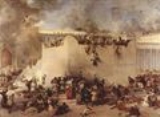
. The fast commemorates the destruction of both the First Temple
and Second Temple
in Jerusalem, which occurred about 655 years apart, but on the same Hebrew calendar
date. Although primarily meant to commemorate the destruction of the Temples, it is also considered appropriate to commemorate other Jewish tragedies that occurred on this day, most notably the expulsion of the Jews from Spain
in 1492. Accordingly, the day has been called the "saddest day in Jewish history".
Tisha B'Av falls in July or August in the western calendar. When the ninth of Av falls on Sabbath
(Saturday), the observance is deferred to Sunday the tenth of Av. While the day recalls general tragedies which have befallen the Jewish people over the ages, the day focuses on commemoration of five events: the destruction of the two ancient Temples in Jerusalem, the sin of ten of the twelve scouts
sent by Moses
, who spoke disparagingly about the Promised Land
, the razing of Jerusalem following the siege of Jerusalem
in 70 CE
, and the failure of the Bar Kokhba revolt against the Roman Empire
.
The fast lasts about 25 hours, beginning at sunset on the eve of Tisha B'Av and ending at nightfall the next day. In addition to the prohibitions against eating or drinking, observant Jews also observe prohibitions against washing or bathing, applying creams or oils, wearing leather shoes, and engaging in sexual activity. In addition, mourning customs similar to those applicable to the shiva period immediately following the death of a close relative are traditionally followed for at least part of the day, including sitting on low stools, refraining from work and not greeting others.
The Book of Lamentations
is traditionally read, followed by the kinnot
, a series of liturgical lamentations. In many Sephardic
and Yemenite
communities, and formerly also among Ashkenazim, it is also customary to read the Book of Job
.
and Second Temple
s.
In connection with the fall of Jerusalem, three other fast-days were established at the same time as the Ninth Day of Av: these were the Tenth of Tevet
, when the siege began; the Seventeenth of Tammuz
, when the first breach was made in the wall; and the Third of Tishrei, known as the Fast of Gedalia
h, the day when Gedaliah
was assassinated.
The three weeks leading up to Tisha B'Av are known as The Three Weeks
, while the days leading up to Tisha B'Av are known as The Nine Days
.
(Taanit 4:6), five specific events occurred on the ninth of Av that warrant fasting:
Note: Due to a two-year difference within the Hebrew calendar, the years in which the First and Second Temple were destroyed have been disputed. Though it has been accepted by most historians to refer to the most modern interpretation of the Calendar (which corresponds to the Roman siege of Jerusalem
in 70 CE.)
Other calamities associated with Tisha B'Av:
. In addition to the length of the fast which lasts about 25 hours, beginning at sunset on the eve of Tisha B'Av and ends at nightfall the following day, Tisha B'Av also shares the following five prohibitions:
These restrictions are waived in the case of health issues. For example, those who are seriously ill may eat and drink. According to the Orthodox-Mizrachi establishment, combat soldiers are absolved of fasting on Tisha B'Av on the basis that it can endanger their lives. The latest of such decrees were issued during the Second Lebanon War by leading Rabbinical authorities Israel's Chief Rabbis Shlomo Amar
and Yona Metzger
in tandem with the IDF's chief rabbi, Brigadier General Yisrael Weiss. On other fast days almost any medical condition may justify breaking the fast; in practice, since many cases differ, consultation with a rabbi
is often necessary. Ritual washing up to the knuckles is permitted. Washing to cleanse dirt or mud from one's body is also permitted.
study is forbidden on Tisha B'av (as it is considered a spiritually enjoyable activity), except for the study of distressing texts such as the Book of Lamentations
, the Book of Job
, portions of Jeremiah
and chapters of the Talmud
that discuss the laws of mourning.
According to the Rema it is customary to sit on low stools or on the floor, as is done during shiva from the meal immediately before the fast (seudah hamafseket) until noon. The Beit Yosef
rules that the custom extends until one prays Mincha
(the afternoon prayer).
If possible, work is avoided during this period. Electric lighting may be turned off or dimmed, and kinot recited by candlelight. Some sleep on the floor or modify their normal sleeping routine, by sleeping without a pillow, for instance. People refrain from greeting each other or sending gifts on this day. Old prayerbooks and Torahs are often buried on this day.
When Tisha B'Av begins on Saturday night, the Havdalah
ritual at the end of Shabbat
is truncated (using a candle but no spices), without a blessing over wine. After Tisha B'Av ends on Sunday evening, another Havdalah ceremony is performed with wine (without candle or spices).
The laws of Tisha B'Av are recorded in the Shulchan Aruch
(Literally "The Set Table", a code of Jewish Law") Orach Chayim
552-557.
of Eicha (Lamentations
) is read in synagogue
during the evening services
. In addition, most of the morning is spent chanting or reading Kinnot
, most bewailing the loss of the Temples and the subsequent persecutions, but many others referring to post-exile disasters. These later kinnot were composed by various poets (often prominent rabbis) who had either suffered in the events mentioned or relate received reports. Important kinnot were composed by Elazar ha-Kalir
and Rabbi Judah ha-Levi. After the Holocaust
, kinnot were composed by the German-born Rabbi Shimon Schwab
(in 1959, at the request of Rabbi Joseph Breuer
) and by Rabbi Solomon Halberstam, leader of the Bobov Hasidim (in 1984). Since Israel's unilateral disengagement
from Gaza
, some right wing segments of the Religious Zionist community have begun to recite kinnot to commemorate the expulsion of Jewish settlers from Gush Katif
and northern West Bank
on the day after Tisha B'Av, in 2005.
In many Sephardic congregations the Book of Job
is read on the morning of Tisha B'Av.
At the Mincha
service, Ashkenazim add a paragraph that begins Nachem ("Console...") to the conclusion of the blessing Boneh Yerushalayim ("Who builds Jerusalem") recited during the Amidah
. The prayer elaborates the mournful state of the Temple in Jerusalem
. The concluding signature of the blessing is also extended to say "Blessed are You, O Lord, Who consoles Zion and builds Jerusalem."
The growing strictness in the observance of mourning customs in connection with the Ninth Day of Av became pronounced in post-Talmudic times, and particularly in the darkest period of Jewish history, from the fifteenth century to the eighteenth.
Maimonides
(twelfth century), in his Mishneh Torah
, says that the restrictions as to the eating of meat and the drinking of wine refer only to the last meal before fasting on the Eighth Day of Av, if taken after noon, but before noon anything may be eaten (Hilchoth Ta'anith 5:8). Rabbi Moses of Coucy (thirteenth century) wrote that it is the universal custom to refrain from meat and wine during the whole day preceding the Ninth of Av (Sefer Mitzvoth ha-Gadol, Venice ed., Laws of Tishah B'Av, 249b). Rabbi Joseph Caro (sixteenth century) says some are accustomed to abstain from meat and wine from the beginning of the week in which the Ninth Day of Av falls; and still others abstain throughout the three weeks from the Seventeenth of Tammuz (Shulkhan Arukh, Orach Chayim 551).
A gradual extension of prohibitions can be traced in the abstention from marrying at this season and in other signs of mourning. So Rabbi Moses of Coucy says that some do not use the tefillin
("phylacteries") on the Ninth Day of Av, a custom which later was universally observed (it is now postponed until the afternoon). In this manner all customs originally designated as marks of unusual piety finally became the rule for all.
, restaurants and places of entertainment are closed on the eve of Tisha B'Av and the following day by law. Establishments that break the law are subject to fines. Outside of Israel, the day is not observed by most secular Jews, as opposed to Yom Kippur
, on which many secular Jews fast and go to synagogue
.
When Menachem Begin
became Prime Minister, he wanted to unite all the memorial days and days of mourning on Tisha B'Av, so that Holocaust Remembrance Day and Memorial Day would also fall on this day.
, former chancellor of the Conservative Jewish Theological Seminary of America
, downplayed its significance as having no appeal to the modern Jew who "no longer prays for the restoration of the sacrificial cult in Jerusalem." He viewed the day as having meaning since it had absorbed the “memory of other national disasters." In Reform Judaism
too, mourning the destruction of the Temple in such an elaborate fashion is not regarded as meaningful as Reform has never assigned a central religious role to the ancient Temple.
Berl Katznelson
, a leader of the Labor Zionist movement, criticized his party's youth movement for holding campfires on Tisha B'Av in 1936. He believed that even secular Jews could find some meaning in traditional observances.
A 2010 poll in Israel revealed the some 22% of Israelis fast on Tisha B'Av; another 52% honor the day by avoiding entertainment and not going out with friends.
s and the subsequent scattering the Jewish nation into exile
, the modern day re-establishment of a Jewish state in the Holy Land has raised various attitudes within Judaism as to whether Tisha B'Av still has significance or not.
Some in the Conservative movement
view the establishment of the State of Israel and the restoration of Jewish sovereign independence as “a great salvation” and conclude that it would be correct to commemorate this historic fact by concluding the fast after the midday service; others opine that the fast should be completed and cite the fact that even during the Second Temple period the fast was observed.
Following the Six Day War, the national religious community viewed Israel’s territorial gains with almost messianic overtones. The liberation of geographical areas with immense religious significance, including Jerusalem, the Western Wall and Temple Mount was seen as portentious; however only the full rebuilding of the Temple will engender enough reason to cease observing the day as one of mourning. Some have always believed that until the arrival of the Messianic Era, Tisha B'Av will continue to be observed as a fast day.
will be born on Tisha B'Av, though many explain this idea metaphorically, as the hope for the Jewish Messiah was born on Tisha B'Av with the destruction of the Temple.
Ta'anit
A ta'anit or taanis or taʿanith in Classical Hebrew is a fast in Judaism in which one abstains from all food and drink, including water...
in Judaism
Judaism
Judaism ) is the "religion, philosophy, and way of life" of the Jewish people...
, named for the ninth day (Tisha) of the month of Av
Av
Av is the eleventh month of the civil year and the fifth month of the ecclesiastical year on the Hebrew calendar. The name is Babylonian in origin and appeared in the Talmud around the 3rd century. This is the only month which is not named in the Bible. It is a summer month of 30 days...
in the Hebrew calendar
Hebrew calendar
The Hebrew calendar , or Jewish calendar, is a lunisolar calendar used today predominantly for Jewish religious observances. It determines the dates for Jewish holidays and the appropriate public reading of Torah portions, yahrzeits , and daily Psalm reading, among many ceremonial uses...
. The fast commemorates the destruction of both the First Temple
Solomon's Temple
Solomon's Temple, also known as the First Temple, was the main temple in ancient Jerusalem, on the Temple Mount , before its destruction by Nebuchadnezzar II after the Siege of Jerusalem of 587 BCE....
and Second Temple
Second Temple
The Jewish Second Temple was an important shrine which stood on the Temple Mount in Jerusalem between 516 BCE and 70 CE. It replaced the First Temple which was destroyed in 586 BCE, when the Jewish nation was exiled to Babylon...
in Jerusalem, which occurred about 655 years apart, but on the same Hebrew calendar
Hebrew calendar
The Hebrew calendar , or Jewish calendar, is a lunisolar calendar used today predominantly for Jewish religious observances. It determines the dates for Jewish holidays and the appropriate public reading of Torah portions, yahrzeits , and daily Psalm reading, among many ceremonial uses...
date. Although primarily meant to commemorate the destruction of the Temples, it is also considered appropriate to commemorate other Jewish tragedies that occurred on this day, most notably the expulsion of the Jews from Spain
Alhambra decree
The Alhambra Decree was an edict issued on 31 March 1492 by the joint Catholic Monarchs of Spain ordering the expulsion of Jews from the Kingdom of Spain and its territories and possessions by 31 July of that year.The edict was formally revoked on 16 December 1968, following the Second...
in 1492. Accordingly, the day has been called the "saddest day in Jewish history".
Tisha B'Av falls in July or August in the western calendar. When the ninth of Av falls on Sabbath
Shabbat
Shabbat is the seventh day of the Jewish week and a day of rest in Judaism. Shabbat is observed from a few minutes before sunset on Friday evening until a few minutes after when one would expect to be able to see three stars in the sky on Saturday night. The exact times, therefore, differ from...
(Saturday), the observance is deferred to Sunday the tenth of Av. While the day recalls general tragedies which have befallen the Jewish people over the ages, the day focuses on commemoration of five events: the destruction of the two ancient Temples in Jerusalem, the sin of ten of the twelve scouts
The Twelve Spies
In the Book of Numbers, The Twelve Spies were a group of Israelite chieftains, one from each of the Twelve Tribes, who were dispatched by Moses to scout out the Land of Canaan for 40 days during the time the Israelites were in the desert...
sent by Moses
Moses
Moses was, according to the Hebrew Bible and Qur'an, a religious leader, lawgiver and prophet, to whom the authorship of the Torah is traditionally attributed...
, who spoke disparagingly about the Promised Land
Promised land
The Promised Land is a term used to describe the land promised or given by God, according to the Hebrew Bible, to the Israelites, the descendants of Jacob. The promise is firstly made to Abraham and then renewed to his son Isaac, and to Isaac's son Jacob , Abraham's grandson...
, the razing of Jerusalem following the siege of Jerusalem
Siege of Jerusalem (70)
The Siege of Jerusalem in the year 70 AD was the decisive event of the First Jewish-Roman War. The Roman army, led by the future Emperor Titus, with Tiberius Julius Alexander as his second-in-command, besieged and conquered the city of Jerusalem, which had been occupied by its Jewish defenders in...
in 70 CE
70
Year 70 was a common year starting on Monday of the Julian calendar. At the time, it was known as the Year of the Consulship of Augustus and Vespasianus...
, and the failure of the Bar Kokhba revolt against the Roman Empire
Roman Empire
The Roman Empire was the post-Republican period of the ancient Roman civilization, characterised by an autocratic form of government and large territorial holdings in Europe and around the Mediterranean....
.
The fast lasts about 25 hours, beginning at sunset on the eve of Tisha B'Av and ending at nightfall the next day. In addition to the prohibitions against eating or drinking, observant Jews also observe prohibitions against washing or bathing, applying creams or oils, wearing leather shoes, and engaging in sexual activity. In addition, mourning customs similar to those applicable to the shiva period immediately following the death of a close relative are traditionally followed for at least part of the day, including sitting on low stools, refraining from work and not greeting others.
The Book of Lamentations
Book of Lamentations
The Book of Lamentations ) is a poetic book of the Hebrew Bible composed by the Jewish prophet Jeremiah. It mourns the destruction of Jerusalem and the Holy Temple in the 6th Century BCE....
is traditionally read, followed by the kinnot
Kinnot
Kinnot are dirges or elegies traditionally recited by Jews on Tisha B'Av to mourn the destruction of the Second Temple in Jerusalem and other tragedies in Jewish history, including the Crusades and the Holocaust...
, a series of liturgical lamentations. In many Sephardic
Sephardic Judaism
Sephardic law and customs means the practice of Judaism as observed by the Sephardi and Mizrahi Jews, so far as it is peculiar to themselves and not shared with other Jewish groups such as the Ashkenazim...
and Yemenite
Yemenite Jews
Yemenite Jews are those Jews who live, or whose recent ancestors lived, in Yemen . Between June 1949 and September 1950, the overwhelming majority of Yemen's Jewish population was transported to Israel in Operation Magic Carpet...
communities, and formerly also among Ashkenazim, it is also customary to read the Book of Job
Book of Job
The Book of Job , commonly referred to simply as Job, is one of the books of the Hebrew Bible. It relates the story of Job, his trials at the hands of Satan, his discussions with friends on the origins and nature of his suffering, his challenge to God, and finally a response from God. The book is a...
.
Destruction of the Temple
The fast commemorates the destruction of the FirstSolomon's Temple
Solomon's Temple, also known as the First Temple, was the main temple in ancient Jerusalem, on the Temple Mount , before its destruction by Nebuchadnezzar II after the Siege of Jerusalem of 587 BCE....
and Second Temple
Second Temple
The Jewish Second Temple was an important shrine which stood on the Temple Mount in Jerusalem between 516 BCE and 70 CE. It replaced the First Temple which was destroyed in 586 BCE, when the Jewish nation was exiled to Babylon...
s.
In connection with the fall of Jerusalem, three other fast-days were established at the same time as the Ninth Day of Av: these were the Tenth of Tevet
Tenth of Tevet
Tenth of Tevet , the tenth day of the Hebrew month of Tevet, is a minor fast day in Judaism. It is a "low fast" observed from sunrise to sunset. The day has no relationship to Hanukkah, but it happens to follow that festival by a week...
, when the siege began; the Seventeenth of Tammuz
Seventeenth of Tammuz
The Seventeenth of Tammuz is a minor Jewish fast day commemorating the breach of the walls of Jerusalem before the destruction of the Second Temple. It falls on the 17th day of the Hebrew month of Tammuz and marks the beginning of the three-week mourning period leading up to Tisha B'Av.The day...
, when the first breach was made in the wall; and the Third of Tishrei, known as the Fast of Gedalia
Fast of Gedalia
The Fast of Gedalia , also spelled Gedaliah, is a Jewish fast day from dawn until dusk to lament the assassination of the righteous governor of Judah of that name, which ended Jewish rule following the destruction of the First Temple.-Origins:...
h, the day when Gedaliah
Gedaliah
According to the Hebrew Bible, Gedaliah was appointed by Nebuchadnezzar II of Babylon as governor of Yehud province, which was formed after the defeat of the Kingdom of Judah and the destruction of Jerusalem, in a part of the territory that previously formed the kingdom. He was supported by a...
was assassinated.
The three weeks leading up to Tisha B'Av are known as The Three Weeks
The Three Weeks
The Three Weeks or Bein ha-Metzarim is a period of mourning commemorating the destruction of the first and second Jewish Temples...
, while the days leading up to Tisha B'Av are known as The Nine Days
The Nine Days
The Nine Days is a religious observance in Judaism that takes place during the first nine days of the Jewish month of Av...
.
Five calamities
According to the MishnahMishnah
The Mishnah or Mishna is the first major written redaction of the Jewish oral traditions called the "Oral Torah". It is also the first major work of Rabbinic Judaism. It was redacted c...
(Taanit 4:6), five specific events occurred on the ninth of Av that warrant fasting:
- The twelve spiesThe Twelve SpiesIn the Book of Numbers, The Twelve Spies were a group of Israelite chieftains, one from each of the Twelve Tribes, who were dispatched by Moses to scout out the Land of Canaan for 40 days during the time the Israelites were in the desert...
sent by MosesMosesMoses was, according to the Hebrew Bible and Qur'an, a religious leader, lawgiver and prophet, to whom the authorship of the Torah is traditionally attributed...
to observe the land of CanaanCanaanCanaan is a historical region roughly corresponding to modern-day Israel, Palestine, Lebanon, and the western parts of Jordan...
returned from their mission. Only two of the spies, JoshuaJoshuaJoshua , is a minor figure in the Torah, being one of the spies for Israel and in few passages as Moses's assistant. He turns to be the central character in the Hebrew Bible's Book of Joshua...
and CalebCalebCaleb is a male given name. A character called Caleb is named in both the Bible and Quran.-Caleb:When the Hebrews came to the outskirts of Canaan, the land that had been promised to them by God, after having fled slavery in Egypt, Moses sent twelve spies into Canaan to report on what was...
, brought a positive report, while the others spoke disparagingly about the land. The majority report caused the Children of Israel to cry, panic and despair of ever entering the "Promised LandPromised landThe Promised Land is a term used to describe the land promised or given by God, according to the Hebrew Bible, to the Israelites, the descendants of Jacob. The promise is firstly made to Abraham and then renewed to his son Isaac, and to Isaac's son Jacob , Abraham's grandson...
". For this, they were punished by God that their generation would not enter the land. Because of the Israelites' lack of faith, God decreed that for all generations this date would become one of crying and misfortune for their descendants. (See NumbersBook of NumbersThe Book of Numbers is the fourth book of the Hebrew Bible, and the fourth of five books of the Jewish Torah/Pentateuch....
Ch. 13–14) - The First Temple built by King SolomonSolomonSolomon , according to the Book of Kings and the Book of Chronicles, a King of Israel and according to the Talmud one of the 48 prophets, is identified as the son of David, also called Jedidiah in 2 Samuel 12:25, and is described as the third king of the United Monarchy, and the final king before...
and the Kingdom of JudahKingdom of JudahThe Kingdom of Judah was a Jewish state established in the Southern Levant during the Iron Age. It is often referred to as the "Southern Kingdom" to distinguish it from the northern Kingdom of Israel....
was destroyed by the BabyloniaBabyloniaBabylonia was an ancient cultural region in central-southern Mesopotamia , with Babylon as its capital. Babylonia emerged as a major power when Hammurabi Babylonia was an ancient cultural region in central-southern Mesopotamia (present-day Iraq), with Babylon as its capital. Babylonia emerged as...
ns led by NebuchadnezzarNebuchadrezzar IINebuchadnezzar II was king of the Neo-Babylonian Empire, who reigned c. 605 BC – 562 BC. According to the Bible, he conquered Judah and Jerusalem, and sent the Jews into exile. He is credited with the construction of the Hanging Gardens of Babylon and also known for the destruction...
in 586 BCE (3175 AMAnno Mundi' , abbreviated as AM or A.M., refers to a Calendar era based on the Biblical creation of the world. Numerous efforts have been made to determine the Biblical date of Creation, yielding varying results. Besides differences in interpretation, which version of the Bible is being referenced also...
) after the siege in 587Siege of Jerusalem (587 BC)In 589 BC, Nebuchadnezzar II laid siege to Jerusalem, culminating in the destruction of the city and its temple in 587 BC.-Siege:Following the siege of 597 BC, Nebuchadnezzar installed Zedekiah as tributary king of Judah at the age of twenty-one. However, Zedekiah revolted against Babylon, and...
and the Judaeans were sent into the Babylonian exileBabylonian captivityThe Babylonian captivity was the period in Jewish history during which the Jews of the ancient Kingdom of Judah were captives in Babylon—conventionally 587–538 BCE....
. - The Second TempleSecond TempleThe Jewish Second Temple was an important shrine which stood on the Temple Mount in Jerusalem between 516 BCE and 70 CE. It replaced the First Temple which was destroyed in 586 BCE, when the Jewish nation was exiled to Babylon...
built by EzraEzraEzra , also called Ezra the Scribe and Ezra the Priest in the Book of Ezra. According to the Hebrew Bible he returned from the Babylonian exile and reintroduced the Torah in Jerusalem...
and NehemiahNehemiahNehemiah ]]," Standard Hebrew Nəḥemya, Tiberian Hebrew Nəḥemyāh) is the central figure of the Book of Nehemiah, which describes his work rebuilding Jerusalem and purifying the Jewish community. He was the son of Hachaliah, Nehemiah ]]," Standard Hebrew Nəḥemya, Tiberian Hebrew Nəḥemyāh) is the...
was destroyed by the Romans in August of 70 CE (3830 AM), scattering the people of JudeaJudeaJudea or Judæa was the name of the mountainous southern part of the historic Land of Israel from the 8th century BCE to the 2nd century CE, when Roman Judea was renamed Syria Palaestina following the Jewish Bar Kokhba revolt.-Etymology:The...
and commencing the Jewish exileJewish diasporaThe Jewish diaspora is the English term used to describe the Galut גלות , or 'exile', of the Jews from the region of the Kingdom of Judah and Roman Iudaea and later emigration from wider Eretz Israel....
from the Holy Land. According to the TalmudTalmudThe Talmud is a central text of mainstream Judaism. It takes the form of a record of rabbinic discussions pertaining to Jewish law, ethics, philosophy, customs and history....
in tractate Ta'anitTa'anit (Talmud)Ta'anit or Taanis is a volume of the Mishnah, Tosefta, and both Talmuds. In Judaism these are the basic works of rabbinic literature.The tractate of Ta'anit is devoted chiefly to the fast-days, their practices and prayers...
, the destruction of the Second Temple began on the Ninth of Av and the Temple continued to burn throughout the Tenth of Av. - The Romans crushed Bar Kokhba's revolt and destroyed the city of BetarBetar (fortress)The Betar Fortress was the last standing Jewish fortress in the Bar Kochba revolt of the 2nd century CE, destroyed by the Roman army of Emperor Hadrian in the year 135...
, killing over 100,000 Jews, on July 8, 132 CE (Av 9, 3892 AM). - Following the Roman siege of JerusalemSiege of Jerusalem (70)The Siege of Jerusalem in the year 70 AD was the decisive event of the First Jewish-Roman War. The Roman army, led by the future Emperor Titus, with Tiberius Julius Alexander as his second-in-command, besieged and conquered the city of Jerusalem, which had been occupied by its Jewish defenders in...
, Roman commander Turnus Rufus plowed the site of the Temple and the surrounding area, in 133 CE.
Note: Due to a two-year difference within the Hebrew calendar, the years in which the First and Second Temple were destroyed have been disputed. Though it has been accepted by most historians to refer to the most modern interpretation of the Calendar (which corresponds to the Roman siege of Jerusalem
Siege of Jerusalem (70)
The Siege of Jerusalem in the year 70 AD was the decisive event of the First Jewish-Roman War. The Roman army, led by the future Emperor Titus, with Tiberius Julius Alexander as his second-in-command, besieged and conquered the city of Jerusalem, which had been occupied by its Jewish defenders in...
in 70 CE.)
Other calamities
Over time, Tisha B'Av has come to be a Jewish day of mourning, not only for these events, but also for later tragedies. Regardless of the exact dates of these events, for many Jews, Tisha B'Av is the designated day of mourning for them, and these themes are reflected in liturgy composed for this day (see below).Other calamities associated with Tisha B'Av:
- The First CrusadeCrusadesThe Crusades were a series of religious wars, blessed by the Pope and the Catholic Church with the main goal of restoring Christian access to the holy places in and near Jerusalem...
was declared by Pope Urban IIPope Urban IIPope Urban II , born Otho de Lagery , was Pope from 12 March 1088 until his death on July 29 1099...
on July 20, 1095 (Av 9, 4855 AM), killing 10,000 Jews in its first month and destroying Jewish communities in FranceFranceThe French Republic , The French Republic , The French Republic , (commonly known as France , is a unitary semi-presidential republic in Western Europe with several overseas territories and islands located on other continents and in the Indian, Pacific, and Atlantic oceans. Metropolitan France...
and the RhinelandRhinelandHistorically, the Rhinelands refers to a loosely-defined region embracing the land on either bank of the River Rhine in central Europe....
. - Jews were expelled from England on July 25, 1290 (Av 9, 5050 AM).
- Jews were expelledAlhambra decreeThe Alhambra Decree was an edict issued on 31 March 1492 by the joint Catholic Monarchs of Spain ordering the expulsion of Jews from the Kingdom of Spain and its territories and possessions by 31 July of that year.The edict was formally revoked on 16 December 1968, following the Second...
from SpainSpainSpain , officially the Kingdom of Spain languages]] under the European Charter for Regional or Minority Languages. In each of these, Spain's official name is as follows:;;;;;;), is a country and member state of the European Union located in southwestern Europe on the Iberian Peninsula...
on August 11, 1492 (Av 9, 5252 AM). - On August 1, 1914 (Av 9, 5674 AM), World War I broke out, causing unprecedented devastation across Europe and set the stage for World War II and the HolocaustThe HolocaustThe Holocaust , also known as the Shoah , was the genocide of approximately six million European Jews and millions of others during World War II, a programme of systematic state-sponsored murder by Nazi...
. - On the eve of Tisha B'Av 5702 (July 23, 1942), the mass deportation began of Jews from the Warsaw GhettoWarsaw GhettoThe Warsaw Ghetto was the largest of all Jewish Ghettos in Nazi-occupied Europe during World War II. It was established in the Polish capital between October and November 15, 1940, in the territory of General Government of the German-occupied Poland, with over 400,000 Jews from the vicinity...
, en route to Treblinka. - The Jewish community center in Buenos AiresBuenos AiresBuenos Aires is the capital and largest city of Argentina, and the second-largest metropolitan area in South America, after São Paulo. It is located on the western shore of the estuary of the Río de la Plata, on the southeastern coast of the South American continent...
was bombed, killing 86 and wounding 300 others, on Monday July 18, 1994, in Jewish Calendar, the 10th of Av, 5754. Jewish Cal 1994
Main prohibitions
Tisha B'Av bears similar stringencies to those of Yom KippurYom Kippur
Yom Kippur , also known as Day of Atonement, is the holiest and most solemn day of the year for the Jews. Its central themes are atonement and repentance. Jews traditionally observe this holy day with a 25-hour period of fasting and intensive prayer, often spending most of the day in synagogue...
. In addition to the length of the fast which lasts about 25 hours, beginning at sunset on the eve of Tisha B'Av and ends at nightfall the following day, Tisha B'Av also shares the following five prohibitions:
- No eating or drinking
- No washing or bathing
- No application of creams or oils
- No wearing of leather shoes
- No marital relations
These restrictions are waived in the case of health issues. For example, those who are seriously ill may eat and drink. According to the Orthodox-Mizrachi establishment, combat soldiers are absolved of fasting on Tisha B'Av on the basis that it can endanger their lives. The latest of such decrees were issued during the Second Lebanon War by leading Rabbinical authorities Israel's Chief Rabbis Shlomo Amar
Shlomo Amar
Rabbi Shlomo Moshe Amar has been the Sephardi Chief Rabbi of Israel and the Rishon LeZion since his appointment in 2003. His colleague is Rabbi Yona Metzger, the Ashkenazi Chief Rabbi of Israel....
and Yona Metzger
Yona Metzger
Yona Metzger is the Ashkenazi Chief Rabbi of Israel. His counterpart is Rabbi Shlomo Amar, the Sephardic Chief Rabbi of Israel since their appointments in 2003.-Background:...
in tandem with the IDF's chief rabbi, Brigadier General Yisrael Weiss. On other fast days almost any medical condition may justify breaking the fast; in practice, since many cases differ, consultation with a rabbi
Rabbi
In Judaism, a rabbi is a teacher of Torah. This title derives from the Hebrew word רבי , meaning "My Master" , which is the way a student would address a master of Torah...
is often necessary. Ritual washing up to the knuckles is permitted. Washing to cleanse dirt or mud from one's body is also permitted.
Additional customs
TorahTorah
Torah- A scroll containing the first five books of the BibleThe Torah , is name given by Jews to the first five books of the bible—Genesis , Exodus , Leviticus , Numbers and Deuteronomy Torah- A scroll containing the first five books of the BibleThe Torah , is name given by Jews to the first five...
study is forbidden on Tisha B'av (as it is considered a spiritually enjoyable activity), except for the study of distressing texts such as the Book of Lamentations
Book of Lamentations
The Book of Lamentations ) is a poetic book of the Hebrew Bible composed by the Jewish prophet Jeremiah. It mourns the destruction of Jerusalem and the Holy Temple in the 6th Century BCE....
, the Book of Job
Book of Job
The Book of Job , commonly referred to simply as Job, is one of the books of the Hebrew Bible. It relates the story of Job, his trials at the hands of Satan, his discussions with friends on the origins and nature of his suffering, his challenge to God, and finally a response from God. The book is a...
, portions of Jeremiah
Book of Jeremiah
The Book of Jeremiah is the second of the Latter Prophets in the Hebrew Bible, following the book of Isaiah and preceding Ezekiel and the Book of the Twelve....
and chapters of the Talmud
Talmud
The Talmud is a central text of mainstream Judaism. It takes the form of a record of rabbinic discussions pertaining to Jewish law, ethics, philosophy, customs and history....
that discuss the laws of mourning.
According to the Rema it is customary to sit on low stools or on the floor, as is done during shiva from the meal immediately before the fast (seudah hamafseket) until noon. The Beit Yosef
Beit Yosef
Beit Yosef may refer to:* Beit Yosef, Israel, a moshav in the Beit She'an Valley* Beit Yosef , a book by Rabbi Joseph Caro...
rules that the custom extends until one prays Mincha
Mincha
Mincha, מנחה is the afternoon prayer service in Judaism.-Etymology:The name "Mincha" is derived from the meal offering that accompanied each sacrifice.-Origin:...
(the afternoon prayer).
If possible, work is avoided during this period. Electric lighting may be turned off or dimmed, and kinot recited by candlelight. Some sleep on the floor or modify their normal sleeping routine, by sleeping without a pillow, for instance. People refrain from greeting each other or sending gifts on this day. Old prayerbooks and Torahs are often buried on this day.
End of fast
Although the fast ends at nightfall, according to tradition, the Temple continued burning throughout the night and for most of the following day, the tenth of Av. It is therefore customary to refrain from eating meat, drinking wine, bathing, cutting hair, doing laundry, listening to music, making a shehechiyanu blessing until midday (chatzos) of the following day.When Tisha B'Av begins on Saturday night, the Havdalah
Havdalah
Havdalah is a Jewish religious ceremony that marks the symbolic end of Shabbat and holidays, and ushers in the new week. Shabbat ends on Saturday night after the appearance of three stars in the sky...
ritual at the end of Shabbat
Shabbat
Shabbat is the seventh day of the Jewish week and a day of rest in Judaism. Shabbat is observed from a few minutes before sunset on Friday evening until a few minutes after when one would expect to be able to see three stars in the sky on Saturday night. The exact times, therefore, differ from...
is truncated (using a candle but no spices), without a blessing over wine. After Tisha B'Av ends on Sunday evening, another Havdalah ceremony is performed with wine (without candle or spices).
The laws of Tisha B'Av are recorded in the Shulchan Aruch
Shulchan Aruch
The Shulchan Aruch also known as the Code of Jewish Law, is the most authoritative legal code of Judaism. It was authored in Safed, Israel, by Yosef Karo in 1563 and published in Venice two years later...
(Literally "The Set Table", a code of Jewish Law") Orach Chayim
Orach Chayim
Orach Chayim "manner of life" is a section of Rabbi Jacob ben Asher's compilation of Halakha , Arba'ah Turim. This section treats all aspects of Jewish law primarily pertinent to the Hebrew calendar...
552-557.
Services
The scrollThe Five Scrolls
The Five Scrolls or The Five Megillot are parts of the Ketuvim , the third major section of the Tanakh . The Five Scrolls are the Song of Songs, the Book of Ruth, the Book of Lamentations, Ecclesiastes and the Book of Esther...
of Eicha (Lamentations
Book of Lamentations
The Book of Lamentations ) is a poetic book of the Hebrew Bible composed by the Jewish prophet Jeremiah. It mourns the destruction of Jerusalem and the Holy Temple in the 6th Century BCE....
) is read in synagogue
Synagogue
A synagogue is a Jewish house of prayer. This use of the Greek term synagogue originates in the Septuagint where it sometimes translates the Hebrew word for assembly, kahal...
during the evening services
Jewish services
Jewish prayer are the prayer recitations that form part of the observance of Judaism. These prayers, often with instructions and commentary, are found in the siddur, the traditional Jewish prayer book....
. In addition, most of the morning is spent chanting or reading Kinnot
Kinnot
Kinnot are dirges or elegies traditionally recited by Jews on Tisha B'Av to mourn the destruction of the Second Temple in Jerusalem and other tragedies in Jewish history, including the Crusades and the Holocaust...
, most bewailing the loss of the Temples and the subsequent persecutions, but many others referring to post-exile disasters. These later kinnot were composed by various poets (often prominent rabbis) who had either suffered in the events mentioned or relate received reports. Important kinnot were composed by Elazar ha-Kalir
Eleazar Kalir
Eleazar ben Kalir was one of Judaism's earliest and most prolific of the paytanim, liturgical poets. Many of his hymns have found their way into festive prayers of the Ashkenazi Jews synagogal rite....
and Rabbi Judah ha-Levi. After the Holocaust
The Holocaust
The Holocaust , also known as the Shoah , was the genocide of approximately six million European Jews and millions of others during World War II, a programme of systematic state-sponsored murder by Nazi...
, kinnot were composed by the German-born Rabbi Shimon Schwab
Shimon Schwab
Shimon Schwab was an Orthodox rabbi and communal leader in Germany and the United States. Educated in Frankfurt am Main and in the yeshivot of Lithuania, he was rabbi in Ichenhausen, Bavaria, after immigration to the United States in Baltimore, and from 1958 until his death at Khal Adath Jeshurun...
(in 1959, at the request of Rabbi Joseph Breuer
Joseph Breuer
Joseph Breuer was a rabbi and community leader in Germany and the United States. He was a Rabbi of one of the large Jewish synagogues founded by German-Jewish refugees fleeing Nazi oppression that had settled in Washington Heights, New York....
) and by Rabbi Solomon Halberstam, leader of the Bobov Hasidim (in 1984). Since Israel's unilateral disengagement
Israel's unilateral disengagement plan
Israel's unilateral disengagement plan , also known as the "Disengagement plan", "Gaza expulsion plan", and "Hitnatkut", was a proposal by Israeli Prime Minister Ariel Sharon, adopted by the government on June 6, 2004 and enacted in August 2005, to evict all Israelis from the Gaza Strip and from...
from Gaza
Gaza
Gaza , also referred to as Gaza City, is a Palestinian city in the Gaza Strip, with a population of about 450,000, making it the largest city in the Palestinian territories.Inhabited since at least the 15th century BC,...
, some right wing segments of the Religious Zionist community have begun to recite kinnot to commemorate the expulsion of Jewish settlers from Gush Katif
Gush Katif
Gush Katif was a bloc of 17 Israeli settlements in the southern Gaza strip. Gush Katif was specifically mentioned by Yitzhak Rabin, the Israeli prime minister who fell victim to an assassin in 1995, as essential to Israel's security border. In August 2005, the Israeli army moved the 8,600...
and northern West Bank
West Bank
The West Bank ) of the Jordan River is the landlocked geographical eastern part of the Palestinian territories located in Western Asia. To the west, north, and south, the West Bank shares borders with the state of Israel. To the east, across the Jordan River, lies the Hashemite Kingdom of Jordan...
on the day after Tisha B'Av, in 2005.
In many Sephardic congregations the Book of Job
Book of Job
The Book of Job , commonly referred to simply as Job, is one of the books of the Hebrew Bible. It relates the story of Job, his trials at the hands of Satan, his discussions with friends on the origins and nature of his suffering, his challenge to God, and finally a response from God. The book is a...
is read on the morning of Tisha B'Av.
At the Mincha
Mincha
Mincha, מנחה is the afternoon prayer service in Judaism.-Etymology:The name "Mincha" is derived from the meal offering that accompanied each sacrifice.-Origin:...
service, Ashkenazim add a paragraph that begins Nachem ("Console...") to the conclusion of the blessing Boneh Yerushalayim ("Who builds Jerusalem") recited during the Amidah
Amidah
The Amidah , also called the Shmoneh Esreh , is the central prayer of the Jewish liturgy. This prayer, among others, is found in the siddur, the traditional Jewish prayer book...
. The prayer elaborates the mournful state of the Temple in Jerusalem
Temple in Jerusalem
The Temple in Jerusalem or Holy Temple , refers to one of a series of structures which were historically located on the Temple Mount in the Old City of Jerusalem, the current site of the Dome of the Rock. Historically, these successive temples stood at this location and functioned as the centre of...
. The concluding signature of the blessing is also extended to say "Blessed are You, O Lord, Who consoles Zion and builds Jerusalem."
History of the observance
In the long period which is reflected in Talmudic literature the observance of the Ninth Day of Av assumed a character of constantly growing sadness and asceticism. By the end of the second century or at the beginning of the third, the celebration of the day had lost much of its gloom. Rabbi Judah ha-Nasi was in favor of abolishing it altogether or, according to another version, of lessening its severity when the fast has been postponed from Saturday to Sunday (Talmud, Tractate Megillah 5b).The growing strictness in the observance of mourning customs in connection with the Ninth Day of Av became pronounced in post-Talmudic times, and particularly in the darkest period of Jewish history, from the fifteenth century to the eighteenth.
Maimonides
Maimonides
Moses ben-Maimon, called Maimonides and also known as Mūsā ibn Maymūn in Arabic, or Rambam , was a preeminent medieval Jewish philosopher and one of the greatest Torah scholars and physicians of the Middle Ages...
(twelfth century), in his Mishneh Torah
Mishneh Torah
The Mishneh Torah subtitled Sefer Yad ha-Hazaka is a code of Jewish religious law authored by Maimonides , one of history's foremost rabbis...
, says that the restrictions as to the eating of meat and the drinking of wine refer only to the last meal before fasting on the Eighth Day of Av, if taken after noon, but before noon anything may be eaten (Hilchoth Ta'anith 5:8). Rabbi Moses of Coucy (thirteenth century) wrote that it is the universal custom to refrain from meat and wine during the whole day preceding the Ninth of Av (Sefer Mitzvoth ha-Gadol, Venice ed., Laws of Tishah B'Av, 249b). Rabbi Joseph Caro (sixteenth century) says some are accustomed to abstain from meat and wine from the beginning of the week in which the Ninth Day of Av falls; and still others abstain throughout the three weeks from the Seventeenth of Tammuz (Shulkhan Arukh, Orach Chayim 551).
A gradual extension of prohibitions can be traced in the abstention from marrying at this season and in other signs of mourning. So Rabbi Moses of Coucy says that some do not use the tefillin
Tefillin
Tefillin also called phylacteries are a set of small black leather boxes containing scrolls of parchment inscribed with verses from the Torah, which are worn by observant Jews during weekday morning prayers. Although "tefillin" is technically the plural form , it is loosely used as a singular as...
("phylacteries") on the Ninth Day of Av, a custom which later was universally observed (it is now postponed until the afternoon). In this manner all customs originally designated as marks of unusual piety finally became the rule for all.
In Israel
In IsraelIsrael
The State of Israel is a parliamentary republic located in the Middle East, along the eastern shore of the Mediterranean Sea...
, restaurants and places of entertainment are closed on the eve of Tisha B'Av and the following day by law. Establishments that break the law are subject to fines. Outside of Israel, the day is not observed by most secular Jews, as opposed to Yom Kippur
Yom Kippur
Yom Kippur , also known as Day of Atonement, is the holiest and most solemn day of the year for the Jews. Its central themes are atonement and repentance. Jews traditionally observe this holy day with a 25-hour period of fasting and intensive prayer, often spending most of the day in synagogue...
, on which many secular Jews fast and go to synagogue
Synagogue
A synagogue is a Jewish house of prayer. This use of the Greek term synagogue originates in the Septuagint where it sometimes translates the Hebrew word for assembly, kahal...
.
When Menachem Begin
Menachem Begin
' was a politician, founder of Likud and the sixth Prime Minister of the State of Israel. Before independence, he was the leader of the Zionist militant group Irgun, the Revisionist breakaway from the larger Jewish paramilitary organization Haganah. He proclaimed a revolt, on 1 February 1944,...
became Prime Minister, he wanted to unite all the memorial days and days of mourning on Tisha B'Av, so that Holocaust Remembrance Day and Memorial Day would also fall on this day.
Contemporary opinions
Although agreeing that the destruction of the two Temples in Jerusalem had threatened the very survival of the Jewish people, Ismar SchorschIsmar Schorsch
Ismar Schorsch had been the son of hanoveranian Rabbi Emil Schorsch. They both experienced the so called "Reichskristallnacht" in a different manner. Dr. Ismar Schorsch became the sixth Chancellor of The Jewish Theological Seminary and is the Rabbi Herman Abramovitz Professor of Jewish history...
, former chancellor of the Conservative Jewish Theological Seminary of America
Jewish Theological Seminary of America
The Jewish Theological Seminary of America is one of the academic and spiritual centers of Conservative Judaism, and a major center for academic scholarship in Jewish studies.JTS operates five schools: Albert A...
, downplayed its significance as having no appeal to the modern Jew who "no longer prays for the restoration of the sacrificial cult in Jerusalem." He viewed the day as having meaning since it had absorbed the “memory of other national disasters." In Reform Judaism
Reform Judaism
Reform Judaism refers to various beliefs, practices and organizations associated with the Reform Jewish movement in North America, the United Kingdom and elsewhere. In general, it maintains that Judaism and Jewish traditions should be modernized and should be compatible with participation in the...
too, mourning the destruction of the Temple in such an elaborate fashion is not regarded as meaningful as Reform has never assigned a central religious role to the ancient Temple.
Berl Katznelson
Berl Katznelson
Berl Katznelson was one the intellectual founders of Labor Zionism, instrumental to the establishment of the modern State of Israel, and the editor of Davar, the first daily newspaper of the workers' movement.-Biography:...
, a leader of the Labor Zionist movement, criticized his party's youth movement for holding campfires on Tisha B'Av in 1936. He believed that even secular Jews could find some meaning in traditional observances.
A 2010 poll in Israel revealed the some 22% of Israelis fast on Tisha B'Av; another 52% honor the day by avoiding entertainment and not going out with friends.
In light of renewed Jewish sovereignty in the Land of Israel
As the main focus of the day recalls the destruction of the First and Second TempleSecond Temple
The Jewish Second Temple was an important shrine which stood on the Temple Mount in Jerusalem between 516 BCE and 70 CE. It replaced the First Temple which was destroyed in 586 BCE, when the Jewish nation was exiled to Babylon...
s and the subsequent scattering the Jewish nation into exile
Jewish diaspora
The Jewish diaspora is the English term used to describe the Galut גלות , or 'exile', of the Jews from the region of the Kingdom of Judah and Roman Iudaea and later emigration from wider Eretz Israel....
, the modern day re-establishment of a Jewish state in the Holy Land has raised various attitudes within Judaism as to whether Tisha B'Av still has significance or not.
Some in the Conservative movement
Conservative Judaism
Conservative Judaism is a modern stream of Judaism that arose out of intellectual currents in Germany in the mid-19th century and took institutional form in the United States in the early 1900s.Conservative Judaism has its roots in the school of thought known as Positive-Historical Judaism,...
view the establishment of the State of Israel and the restoration of Jewish sovereign independence as “a great salvation” and conclude that it would be correct to commemorate this historic fact by concluding the fast after the midday service; others opine that the fast should be completed and cite the fact that even during the Second Temple period the fast was observed.
Following the Six Day War, the national religious community viewed Israel’s territorial gains with almost messianic overtones. The liberation of geographical areas with immense religious significance, including Jerusalem, the Western Wall and Temple Mount was seen as portentious; however only the full rebuilding of the Temple will engender enough reason to cease observing the day as one of mourning. Some have always believed that until the arrival of the Messianic Era, Tisha B'Av will continue to be observed as a fast day.
Other traditions
Classical Jewish sources maintain that the Jewish MessiahJewish Messiah
Messiah, ; mashiah, moshiah, mashiach, or moshiach, is a term used in the Hebrew Bible to describe priests and kings, who were traditionally anointed with holy anointing oil as described in Exodus 30:22-25...
will be born on Tisha B'Av, though many explain this idea metaphorically, as the hope for the Jewish Messiah was born on Tisha B'Av with the destruction of the Temple.
External links
- Hundreds of Shiurim on Tisha B'Av
- Tishah B'Av - A Guide to the Service
- This year's secular date for Tisha B'Av
- Study Sheet For Tisha B’Av - The Meaning of Breaking the Glass at Jewish Weddings
- Educational Resources about Tisha B'Av