


Second Seminole War

Encyclopedia
The Second Seminole War, also known as the Florida War, was a conflict from 1835 to 1842 in Florida
between various groups of Native American
s collectively known as Seminole
s and the United States
, part of a series of conflicts called the Seminole Wars
. The Second Seminole War, often referred to as the Seminole War, was the most expensive Indian War fought by the United States.
had moved into the unoccupied lands in Florida in the 18th century. These included Alabamas
, Choctaw
s, Yamasee
s, Yuchi
s and Creek people
. The Creeks were the largest group, and included Lower Creeks and Upper Creeks, and both Hitchiti
- and Muscogee
-speakers. One group of Hitchiti-speakers, the Mikasuki, settled around what is now Lake Miccosukee
near Tallahassee
. Another group of Hitchiti-speakers settled around the Alachua Prairie
in what is now Alachua County
. The Spanish in St. Augustine
began calling the Alachua Creeks Cimarrones, which roughly meant "wild ones" or "runaways", and which is the probable origin of "Seminole". This name was eventually also applied to the other groups in Florida, although the Native Americans still regarded themselves as members of different tribes. Other groups in Florida at the time of the Seminole Wars included "Spanish Indians", so called because it was believed that they were descended from Calusa
s, and "rancho Indians", persons of Native American ancestry, possibly both Calusa and Creek, and mixed Native American/Spanish ancestry, living at Spanish/Cuban fishing camps on the Florida coast.
 The United States and Spain were at odds over Florida after the Treaty of Paris
ended the American Revolutionary War
and returned East
and West Florida
to Spanish control. The United States disputed the boundaries of West Florida (which had been established while the territory was under British
control) and accused the Spanish authorities of failing to restrain the Native Americans living in Florida from raiding into the United States, and harboring runaway slaves. Starting in 1810 the United States occupied and annexed parts of West Florida. In 1817 Andrew Jackson
led an invasion of the Floridas, an incident known as the First Seminole War. The United States subsequently acquired Florida from Spain
via the Adams-Onís Treaty
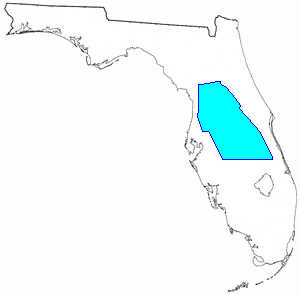
and took possession in 1821. Now that Florida belonged to the United States, the Seminoles were again a problem for the government. In 1823 the government negotiated the Treaty of Moultrie Creek
with the Seminoles, establishing a reservation for them in the middle of the state. Six chiefs, however, were allowed to keep their villages along the Apalachicola River.
The Seminoles slowly settled into the reservation, although there were isolated clashes with whites. Col. (later Gen.) Duncan Lamont Clinch
was placed in charge of the Army units in Florida, Fort King
was built near the reservation agency, at the site of present-day Ocala, and by early 1827 the Army could report that the Seminoles were on the reservation and Florida was peaceful. This peace lasted for five years, during which time there were repeated calls for the Seminoles to be sent west of the Mississippi. The Seminoles were opposed to any such move, and especially to the suggestion that they join their Creek relations. Most whites regarded the Seminoles as simply Creeks who had recently moved to Florida, while the Seminoles claimed Florida as their home and denied that they had any connection with the Creeks.
The status of runaway slaves was a continuing irritation between Seminoles and whites. Seminoles and slave catchers argued over the ownership of slaves. New plantations in Florida increased the pool of slaves who could run away to the Seminoles. Worried about the possibility of an Indian uprising and/or a slave rebellion, Governor DuVal requested additional Federal troops for Florida. Instead, Fort King was closed in 1828. The Seminoles, short of food and finding the hunting becoming poorer on the reservation, were wandering off of it more often. Also in 1828, Andrew Jackson, the old enemy of the Seminoles, was elected President of the United States
. In 1830 Congress passed the Indian Removal Act
. All problems with the Seminoles were to be solved by moving them to west of the Mississippi.
 The United States Senate
finally ratified the Treaty of Payne's Landing
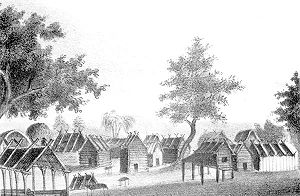
in April 1834. The treaty had given the Seminoles three years to move west of the Mississippi. The government interpreted the three years as starting 1832, and expected the Seminoles to move in 1835. Fort King was reopened in 1834. A new Seminole agent, Wiley Thompson, had been appointed in 1834, and the task of persuading the Seminoles to move fell to him. He called the chiefs together at Fort King in October 1834 to talk to them about the removal to the west. The Seminoles informed Thompson that they had no intention of moving, and that they did not feel bound by the Treaty of Payne's Landing. Thompson then requested reinforcements for Fort King and Fort Brooke, reporting that, "the Indians after they had received the Annuity, purchased an unusually large quantity of Powder & Lead." General Clinch also warned Washington that the Seminoles did not intend to move, and that more troops would be needed to force them to move. In March 1835 Thompson called the chiefs together to read a letter from Andrew Jackson to them. In his letter, Jackson said, "Should you ... refuse to move, I have then directed the Commanding officer to remove you by force." The chiefs asked for thirty days to respond. A month later the Seminole chiefs told Thompson that they would not move west. Thompson and the chiefs began arguing, and General Clinch had to intervene to prevent bloodshed. Eventually, eight of the chiefs agreed to move west, but asked to delay the move until the end of the year, and Thompson and Clinch agreed.
Five of the most important Seminole chiefs, including Micanopy
of the Alachua Seminoles, had not agreed to the move. In retaliation, Thompson declared that those chiefs were removed from their positions. As relations with the Seminoles deteriorated, Thompson forbade the sale of guns and ammunition to them. Osceola
, a young warrior beginning to be noticed by the whites, was particularly upset by the ban, feeling that it equated Seminoles with slaves and said, "The white man shall not make me black. I will make the white man red with blood; and then blacken him in the sun and rain ... and the buzzard live upon his flesh." In spite of this, Thompson considered Osceola to be a friend, and gave him a rifle. Later, though, when Osceola was causing trouble, Thompson had him locked up at Fort King for a night. The next day, in order to secure his release, Osceola agreed to abide by the Treaty of Payne's Landing and to bring his followers in.
The situation grew worse. A group of whites assaulted some Indians sitting around a campfire. Two more Indians came up during the assault and opened fire on the whites. Three whites were wounded, and one Indian was killed and one wounded. In August 1835, Private Kinsley Dalton (for whom Dalton, Georgia
is named) was killed by Seminoles as he was carrying the mail from Fort Brooke to Fort King. In November, Chief Charley Emathla, wanting no part of a war, led his people towards Fort Brooke where they were to board ships to go west. This was considered a betrayal by other Seminoles. Osceola met Charlie Emathla on the trail and killed him.
 As the realization that the Seminoles would resist relocation sank in, Florida began preparing for war. The St. Augustine Militia asked the War Department
for the loan of 500 muskets. Five hundred volunteers were mobilized under Brig. Gen. Richard K. Call
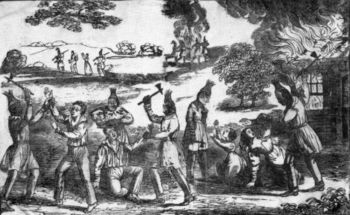
. Indian war parties raided farms and settlements, and families fled to forts, large towns, or out of the territory altogether. A war party led by Osceola captured a Florida militia supply train, killing eight of its guards and wounding six others. Most of the goods taken were recovered by the militia in another fight a few days later. Sugar plantations along the Atlantic coast south of St. Augustine were destroyed, with many of the slaves on the plantations joining the Seminoles.
The U.S. Army had 11 companies, about 550 soldiers, stationed in Florida. Fort King had only one company of soldiers, and it was feared that they might be overrun by the Seminoles. There were three companies at Fort Brooke, with another two expected momentarily, so it was decided to send two companies to Fort King. On December 23, 1835 the two companies, totaling 110 men, left Fort Brooke under the command of Maj. Francis L. Dade
. Seminoles shadowed the marching soldiers for five days. On December 28 the Seminoles ambushed the soldiers, and wiped out the command. Only three men survived the massacre, and one, Edwin De Courcey, was hunted down and killed by a Seminole the next day. Two survivors, Ransome Clarke and Joseph Sprague, returned to Fort Brooke. Only Clarke, who died of his wounds a few years later, left any account of the battle from the Army's perspective. Joseph Sprague was unharmed and lived quite a while longer, but was not able to give an account of the battle because he had sought immediate refuge in a nearby pond. The Seminoles lost just three men, with five wounded. On the same day as the Dade Massacre
, Osceola and his followers shot and killed from ambush Wiley Thompson
and six others outside of Fort King.
Subsequently Major Ethan Allen Hitchcock
was among those who found the remains of the Dade party in February. In his journal he wrote a haunting account of the discovery, then vented his bitter discontent with the conflict: "The government is in the wrong, and this is the chief cause of the persevering opposition of the Indians, who have nobly defended their country against our attempt to enforce a fraudulent treaty. The natives used every means to avoid a war, but were forced into it by the tyranny of our government."
On December 29 General Clinch left Fort Drane (recently established on Clinch's plantation, about twenty miles (32 km) northwest of Fort King) with 750 soldiers, including 500 volunteers on an enlistment due to end January 1, 1836. They were going to a Seminole stronghold called the Cove of the Withlacoochee, what is now known as Lake Tsala Apopka, an area of many lakes on the southwest side of the Withlacoochee River
. When they reached the river, they could not find the ford, and Clinch had his regular troops ferried across the river in a single canoe they had found. Once they were across and had relaxed, the Seminoles attacked. The troops only saved themselves by fixing bayonets and charging the Seminoles, at the cost of four dead and 59 wounded. The militia provided cover as the Army troops then withdrew across the river.
On January 6, 1836 a band of Seminoles attacked the coontie plantation of William Cooley
on the New River
(in present-day Fort Lauderdale, Florida
), killing his wife and children and the children's tutor. The other residents of the New River area and of the Biscayne Bay
country to the south fled to Key West. On January 17, volunteers and Seminoles met south of St. Augustine at the Battle of Dunlawton
. The volunteers lost four men, with thirteen wounded. On January 19, 1836 the Navy sloop-of-war
Vandalia
was dispatched to Tampa Bay from Pensacola. On the same day 57 marines
were dispatched from Key West to help man Fort Brooke.
was placed in charge of the war. Congress appropriated US$620,000 for the war. Volunteer companies began forming in Alabama, Georgia and South Carolina
. General Gaines put together a force of 1,100 regulars and volunteers in New Orleans
and sailed with them to Fort Brooke.
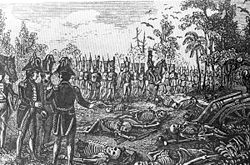 When Gaines reached Fort Brooke, he found it low on supplies. Believing that General Scott had sent supplies to Fort King, Gaines led his men on to Fort King. Along the road they found the site of the Dade Massacre, and buried the bodies in three mass graves. The force reached Fort King after nine days, only to find it was very short on supplies. After receiving seven days worth of rations from General Clinch at Fort Drane, Gaines headed back for Fort Brooke. Hoping to accomplish something for his efforts, Gaines took his men on a different route back to Fort Brooke, intending to engage the Seminoles in their stronghold in the Cove of the Withlacoochee River. Due to a lack of knowledge of the country, the Gaines party reached the same point on the Withlacoochee where Clinch had met the Seminoles one-and-a-half months earlier, and it took another day to find the ford while the two sides exchanged gunfire across the river.
When a crossing was attempted at the ford of the Withlacoochee, Lt. James Izard was wounded (and later died). General Gaines was stuck. He could not cross the river, and if he returned to Fort King his men would be out of rations. Gaines had his men construct a fortification, called Camp Izard, and sent word to General Clinch. Gaines hoped that the Seminoles would concentrate around Camp Izard, and that Clinch's forces could then hit the Seminoles in their flank, crushing them between the two forces. Unfortunately, General Scott, who was in charge of the war, ordered Clinch to stay at Fort Drane. Gaines's men were soon reduced to eating their horses and mules, and an occasional dog, while a battle went on for eight days. Still at Fort Drane, Clinch requested that General Scott change his orders and allow him to go to Gaines' aid. Clinch finally decided to disobey Scott and left to join Gaines just one day before Scott's permission to do so arrived at Fort Drane. Clinch and his men reached Camp Izard on March 6, chasing away the Seminoles.
 General Scott had begun assembling men and supplies for a grand campaign against the Seminoles. Three columns, totaling 5,000 men, were to converge on the Cove of the Withlacoochee, trapping the Seminoles with a force large enough to defeat them. Scott would accompany one column, under the command of General Clinch, moving south from Fort Drane. A second column, under Brig. Gen. Abraham Eustis
, would travel southwest from Volusia, a town on the St. Johns River
. The third wing, under the command of Col. William Lindsay, would move north from Fort Brooke. The plan was for the three columns to arrive at the Cove simultaneously so as to prevent the Seminoles from escaping. Eustis and Lindsay were supposed to be in place on March 25, so that Clinch's column could drive the Seminoles into them.
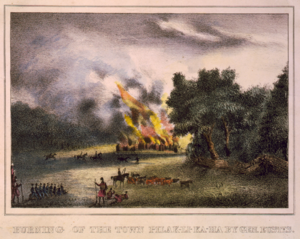
On the way from St. Augustine to Volusia to take up his starting position, Gen. Eustis found Pilaklikaha, or Palatlakaha, also known as Abraham's Town. Abraham was a Black Seminole leader, and interpreter for the Seminoles. Eustis burned the town before moving on to Volusia.
All three columns were delayed. Eustis was two days late departing Volusia because of an attack by the Seminoles. Clinch's and Lindsay's columns only reached their positions on March 28. Because of problems crossing through uncharted territory, Eustis's column did not arrive until March 30. Clinch crossed the Withlacoochee on March 29 to attack the Seminoles in the Cove, but found the villages deserted. Eustis's column did fight a skirmish with some Seminoles before reaching its assigned position, but the whole action had killed or captured only a few Seminoles. On March 31 all three commanders, running low on supplies, headed for Fort Brooke. The failure of the expedition to effectively engage the Seminoles was seen as a defeat, and was blamed on insufficient time for planning and an inhospitable climate.
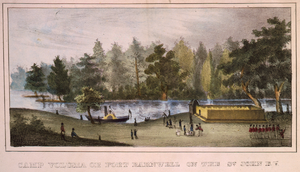
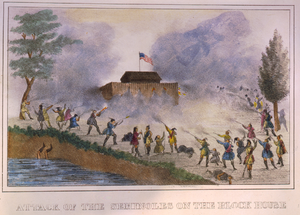 April 1836 did not go well for the Army. Seminoles attacked a number of forts, including Camp Cooper in the Cove, Fort Alabama on the Hillsborough River
north of Fort Brooke, Fort Barnwell near Volusia, and Fort Drane itself. The Seminoles also burned the sugar works on Clinch's plantation. After that, Clinch resigned his commission and left the territory. Fort Alabama was abandoned in late April. In late May, Fort King was also abandoned. In June the soldiers in a blockhouse on the Withlacoochee were rescued after being besieged by the Seminoles for 48 days. On July 23, 1836, Seminoles attacked the Cape Florida lighthouse, severely wounding the assistant keeper in charge and killing his assistant, and burning the lighthouse. The lighthouse was not repaired until 1846. Fort Drane was abandoned in July because of illness, with five out of seven officers and 140 men on the sick list. The Army was suffering terribly from illness; at the time summer in Florida was called the sickly season. By the end of August, Fort Defiance, on the edge of the Alachua Prairie, was also abandoned. Seeing that the war promised to be long and expensive, Congress appropriated another US$1.5 million, and allowed volunteers to enlist for up to a year.
Richard Keith Call, who had led the Florida volunteers as a Brig. Gen. when Clinch marched on the Cove of the Withlacoochee in December, had been appointed Governor of the Territory of Florida on March 16, 1836. Governor Call proposed a summer campaign using militias and volunteers instead of regular Army troops. The War Department agreed to this proposal, but delays in preparations meant the campaign did not start until the end of September. Call also intended to attack the Cove of the Withlacoochee. He sent most of his supplies down the west coast of the peninsula and up the Withlacoochee to set up a supply base. With the main body of his men he marched to the now abandoned Fort Drane, and then on to the Withlacoochee, which they reached on October 13. The Withlacoochee was flooding and could not be forded. The army could not make rafts for a crossing because they had not brought any axes with them. In addition, Seminoles on the other side of the river were shooting at any soldier who showed himself along the river. Call then turned west along the north bank of the river to reach the supply depot. However, the steamer bringing the supplies had sunk in the lower part of the river, and the supply depot was far downstream from where Call was expecting it. Out of food, Call led his men back to Fort Drane, another failed expedition against the Cove.
 In mid-November Call tried again. His forces made it across the Withlacoochee this time, but found the Cove abandoned. Call divided his forces, and proceeded up the river (south) on both sides. On November 17 Seminoles were routed from a large camp. There was another battle the next day, and the Seminoles were assumed to be headed for the Wahoo Swamp. Call waited to bring the other column across the river, then entered the Wahoo Swamp on November 21. The Seminoles resisted the advance in the Battle of Wahoo Swamp
, as their families were close by, but had to retreat across a stream. Major David Moniac, a mix-blooded Creek who was the first Native American to graduate from West Point
, tried to determine how deep the stream was, but was shot and killed by the Seminoles.
Faced with trying to cross a stream of unknown depth under hostile fire, and with supplies again running short, Call withdrew and led his men to Volusia. On December 9 Call was relieved of command and replaced by Maj. Gen. Thomas Jesup
, who took the troops back to Fort Brooke. The enlistments of the volunteers were up at the end of December and they went home.
was the commanding general of the Army. Edmund Gaines and Winfield Scott had each taken to the field and failed to defeat the Seminoles. Thomas Jesup
was the last Major General available. Jesup had just suppressed an uprising of the Creeks of western Georgia and eastern Alabama (the Creek War of 1836
), upstaging Winfield Scott in the process. Jesup brought a new approach to the war. Instead of sending large columns out to try to force the Seminoles into a set-piece battle, he concentrated on wearing the Seminoles down. This required a large military presence in Florida, and Jesup eventually had a force of more than 9,000 men under his command. About half of the force were volunteers and militia. It also included a brigade of Marines, and Navy and Revenue-Marine
personnel patrolling the coast and inland rivers and streams.
The Navy and the Revenue-Marine both worked with the Army from the beginning of the war. Navy ships and revenue cutters ferried men and supplies to Army posts. They patrolled the Florida coast to gather information on and intercept Seminoles, and to block smuggling of arms and supplies to the Seminoles. Sailors and Marines helped man Army forts that were short of manpower. Sailors, Marines and revenue-Marines participated in expeditions into the interior of Florida, both by boat and on land. Against those numbers the Seminoles had started the war with between 900 and 1,400 warriors, and with no means of replacing their losses.
Even as Seminoles began to come into the Army camps to await transportation west, slave catchers were claiming blacks living with the Seminoles. As the Seminoles had no written records of ownership, they generally lost in disputes over ownership. Other whites were trying to have Seminoles arrested for alleged crimes or debts. All of this made the Seminoles suspicious of promises made by Jesup. On the other hand, it was noted that many of the warriors coming into the transportation camps had not brought their families, and seemed mainly to be interested in collecting supplies. By the end of May, many chiefs, including Micanopy, had surrendered. Two important leaders, Osceola and Sam Jones
, had not surrendered, however, and were known to be vehemently opposed to relocation. On June 2 these two leaders with about 200 followers entered the poorly guarded holding camp at Fort Brooke and led away the 700 Seminoles there who had surrendered. The war was on again, and Jesup would never again trust the word of an Indian.
The war did not immediately resume on a large scale. General Jesup had thought that the surrender of so many Seminoles meant the war was ending, and had not planned a long campaign. Many of the soldiers had been assigned elsewhere, or, in the case of militias and volunteers, released from duty. It was also getting into summer, the 'sickly season', and the Army did not fight aggressively in Florida during the summer. The Panic of 1837
was reducing government revenues, but Congress appropriated another US$1.6 million for the war. In August the Army stopped supplying rations to civilians who had taken refuge at its forts.
.
 General Jesup had King Phillip send a message to his son Coacoochee
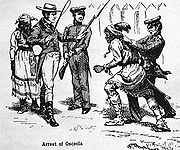
(Wild Cat) to arrange a meeting with Jesup. When Coacoochee arrived under a flag of truce, Jesup arrested him. In October Osceola and Coa Hadjo, another chief, requested a parley with Jesup. A meeting was arranged south of St. Augustine. When Osceola and Coa Hadjo arrived for the meeting, also under a white flag, they were arrested. Osceola was dead within three months of his capture, in prison at Fort Moultrie
in Charleston, South Carolina
. Not all of the Seminoles captured by the Army stayed captured. While Osceola was still held at Fort Marion (Castillo de San Marcos) in St. Augustine, twenty Seminoles held in the same cell with him and King Phillip escaped through a narrow window. The escapees included Coacoochee and John Horse, a Black Seminole leader.
A delegation of Cherokee
s was sent to Florida to try to talk the Seminoles into moving west. When Micanopy and others came in to meet the Cherokees, General Jesup had the Seminoles held. John Ross
, the head of the Cherokee delegation, protested, but to no avail. Jesup replied that he had told the Cherokees that no Seminole who came in would be allowed to return home.
and Pennsylvania
. So many men, in fact, that he had trouble feeding all of them. Jesup's plan was to sweep down the peninsula with multiple columns, pushing the Seminoles further south. General Joseph Marion Hernández
led a column down the east coast. General Eustis took his column up the St. Johns River (southward). Colonel Zachary Taylor
led a column from Fort Brooke into the middle of the state, and then southward between the Kissimmee River
and the Peace River
. Other commands cleared out the areas between the St. Johns and the Oklawaha River, between the Oklawaha and the Withlacoochee River, and along the Caloosahatchee River
. A joint Army-Navy unit patrolled the lower east coast of Florida. Other troops patrolled the northern part of the territory to protect against Seminole raids.
Colonel Taylor saw the first major action of the campaign. Leaving Fort Gardiner on the upper Kissimmee with 1,000 men on December 19, Taylor headed towards Lake Okeechobee
. In the first two days out ninety Seminoles surrendered. On the third day Taylor stopped to build Fort Basinger, where he left his sick and enough men to guard the Seminoles that had surrendered. Three days later, on Christmas Day, 1837, Taylor's column caught up with the main body of the Seminoles on the north shore of Lake Okeechobee.
The Seminoles led by Alligator, Sam Jones, and the recently escaped Coacoochee, were well positioned in a hammock
surrounded by sawgrass
. The ground was thick mud, and sawgrass easily cuts and burns the skin. Taylor had about 800 men, while the Seminoles numbered less than 400. Taylor sent the Missouri volunteers in first. Colonel Richard Gentry, three other officers and more than twenty enlisted men were killed before the volunteers retreated. Next in were 200 soldiers of the 6th Infantry
, who lost four officers and suffered nearly 40% casualties before they withdrew. Then it was the turn of the 4th Infantry, 160 men augmented by remnants of the 6th Infantry and the Missouri volunteers. This time the troops were able to drive the Seminoles from the hammock and towards the lake. Taylor then attacked their flank with his reserves, but the Seminoles were able to escape across the lake. Only about a dozen Seminoles had been killed in the battle. Nevertheless, the Battle of Lake Okeechobee
was hailed as a great victory for Taylor and the Army.
.) At the end of January Jesup's troops caught up with a large body of Seminoles to the east of Lake Okeechobee. The Seminoles were originally positioned in a hammock, but cannon and rocket fire drove them back across a wide stream (the Loxahatchee River
), where they made another stand. The Seminoles eventually just faded away, having caused more casualties than they received, and the Battle of Loxahatchee was over.
The fighting now died down. In February 1838 Seminole chiefs Tuskegee and Halleck Hadjo approached Jesup with the proposition that they would stop fighting if they were allowed to stay south of Lake Okeechobee. Jesup favored the idea, foreseeing a long struggle to capture the remaining Seminoles in the Everglades
, and calculating that the Seminoles would be easier to round up later when the land was actually needed by white settlers. However, Jesup had to write to Washington for approval. The chiefs and their followers camped near the Army while awaiting the reply, and there was considerable fraternizing between the two camps. Secretary of War Joel Roberts Poinsett
rejected the arrangement, however, and instructed Jesup to continue his campaign. Upon receiving Poinsett's response, Jesup summoned the chiefs to his camp, but they refused his invitation. Unwilling to let 500 Seminoles return to the swamps, Jesup sent a force to detain them. The Seminoles offered very little resistance, perhaps seeing little reason to continue fighting.
Taylor's plan was to build small posts at frequent intervals across northern Florida, connected by wagon roads, and to use larger units to search designated areas. This was expensive, but Congress continued to appropriate the necessary funds. In October 1838 Taylor had the last of the Indians living along the Apalachicola River relocated west. Killings in the Tallahassee area caused Taylor to pull troops out of southern Florida to provide more protection in the north. The winter season was fairly quiet. Only a few Seminoles were killed, and fewer than 200 sent west, while only nine U.S. troops were killed by the Seminoles. Taylor was able to report in the Spring of 1839 that his men had constructed 53 new posts and cut 848 miles (1,365 km) of wagon roads.
sent the Commanding General of the Army, Alexander Macomb, to negotiate a new treaty with the Seminoles. The Seminoles were slow to respond to the offer of a new treaty, remembering the broken treaties and promises of the past. Finally, Sam Jones sent his chosen successor, Chitto Tustenuggee, to meet with Macomb. On May 19, 1839 Macomb announced that an agreement had been reached with the Seminoles. The Seminoles would stop fighting in exchange for a reservation in southern Florida.
As the summer passed the agreement seemed to be holding. The few killings that occurred could be blamed on undisciplined young warriors, or even on outlaw whites. A trading post was established on the north shore of the Caloosahatchee River, and the Seminoles who came to the trading post seemed to be friendly. A detachment of 23 soldiers was stationed at the trading post to guard it, under the command of Colonel William S. Harney
. On July 23, some 150 Indians attacked the Calooshatchee trading post and guard. Some of the soldiers, including Colonel Harney, were able to reach the river and find boats to escape in, but most of the soldiers, as well as a number of civilians in the trading post, were killed. The war was on again.
It was not clear which band of Indians had attacked the trading post. Many blamed the 'Spanish' Indians, led by Chakaika. Some, though, suspected Sam Jones, whose band of Mikasukis had been the ones to actually reach agreement with Macomb. Sam Jones promised to turn the men responsible for the attack over to Harney in 33 days. In the meantime the Mikasukis in Sam Jones' camp near Fort Lauderdale
remained on friendly terms with the soldiers stationed there. On July 27 the officers at the fort were invited to a dance at the Mikasuki camp. The officers declined but sent two soldiers and a black interpreter with a keg of whiskey. The soldiers were killed, but the interpreter escaped and reported at the fort that Sam Jones and Chitto Tustenuggee were involved in the attack. In August Seminoles operated as far north as Fort White
.
 As the Army's efforts in Florida were proving so unsuccessful, it turned to a novel method, using bloodhound
s to track the Seminoles. Although General Taylor had requested and received permission to procure bloodhounds in 1838, he had not done so. The Florida territorial government purchased a pack of bloodhounds from Cuba in early 1840 and hired Cuban handlers. While initial trials of the hounds had mixed results, an outcry arose from a significant portion of the general public in the United States over fears that the dogs might try to kill or maim the Seminoles, including women and children. The Secretary of War had to issue an order that the dogs be kept muzzled and on leashes while being used for tracking. As it developed, since bloodhounds cannot track through water, the Seminoles easily evaded them.
In the north of Florida, Taylor's blockhouse and patrol system kept the Seminoles on the move, but could not clear them from the area. Ambushes of travelers were common. On February 13, 1840 the mail stage between St. Augustine and Jacksonville was ambushed. In May Seminoles attacked a theatrical troupe near St. Augustine, killing a total of six people. In the same month a group of four soldiers traveling between forts in Alachua County were attacked, with one killed and two others never seen again. A party of eighteen men pursued the Indians, but six of them were killed.
In May 1840 Zachary Taylor, having served longer than any preceding commander in the Florida war, was granted his request for a transfer. He was replaced by Brig. Gen. Walker Keith Armistead
, who had earlier served in Florida as second in command to Gen. Jesup. Armistead immediately went on the offensive, sending out 100 soldiers at a time to search for Seminoles and their camps. For the first time, the Army actively campaigned in Florida during the summer, taking captives and destroying crops and buildings. The Seminoles also remained active. A total of fourteen soldiers were killed in action during July. The Army was now seeking the hidden camps of the Seminoles, burning fields and driving off horses, cattle and pigs.
Armistead planned to turn over the defense of Florida north of Fort King to the militia and volunteers, while Army regulars worked to confine the Seminoles to south of Fort King, and to pursue them vigorously. Hidden camps and fields were discovered and destroyed across central Florida, and by the middle of the summer the Army had destroyed 500 acres (2 km²) of Seminole crops. General Armistead became estranged from the territorial government, although he needed 1,500 militiamen from the Territory to defend the area north of Fort King. To bolster the effort south of Fort King, the Eighth Infantry Regiment was sent to Florida. The Army in Florida now included ten companies of the Second Dragoon, nine companies of the Third Artillery, and the First, Second, Third, Sixth, Seventh and Eighth Infantry Regiments.
Changes were also being made in southern Florida. At Fort Bankhead on Key Biscayne
Col. Harney instituted an intensive training program in swamp and jungle warfare for his men. The Navy was taking a larger role in the war, with sailors and marines pushing up rivers and streams, and into the Everglades.
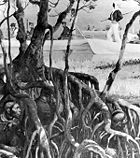
s off shore and barge
s close to the mainland to intercept Cuban and Bahamian traders bringing arms and other supplies to the Seminoles, and smaller boats, down to canoes, for patrolling up rivers and into the Everglades. McLaughlin established his base at Tea Table Key
in the upper Florida Keys
.
An attempt to cross the Everglades from west to east was launched in April 1840, but the sailors and marines were engaged by Seminoles at the rendezvous point on Cape Sable
. Although there were no known fatalities (the Seminoles carried off their dead and wounded), many of the naval personnel became ill, and the expedition was called off and the sick were taken to Pensacola. For the next few months the men of Lt. McLaughlin's force explored the inlets and rivers of southern Florida. McLaughlin did lead a force across the Everglades later. Traveling from December 1840 to the middle of January 1841, McLaughlin's force crossed the Everglades from east to west in dugout canoes, the first groups of whites to complete a crossing.
is a small island in the upper Florida Keys
which had developed into a base for wreckers
. In 1836 it became the county seat
of the newly created Dade County
and a port of entry
. Despite fears of attack and sightings of Indians in the area, the inhabitants of Indian Key stayed to protect their property, and to be close to any wrecks in the upper Keys. The islanders had six cannons and their own small militia company for their defense, and the Navy had established a base on nearby Tea Table Key
.
Early in the morning of August 7, 1840, a large party of 'Spanish' Indians sneaked onto Indian Key. By chance, one man was up and raised the alarm after spotting the Indians. Of about fifty people living on the island, forty were able to escape. The dead included Dr. Henry Perrine
, former United States
Consul
in Campeche
, Mexico
, who was waiting at Indian Key until it was safe to take up a 36 sq mi (93 km²) grant on the mainland that Congress had awarded to him.
The naval base on Tea Table Key had been stripped of personnel for an operation on the southwest coast of the mainland, leaving only a physician, his patients, and five sailors under a midshipman to look after them. This small contingent mounted a couple of cannons on barges and tried to attack the Indians on Indian Key. The Indians fired back at the sailors with musket balls loaded in one of the cannons on shore. The recoil of the cannons on the barges broke them loose, sending them into the water, and the sailors had to retreat. The Indians burned the buildings on Indian Key after thoroughly looting it.
Armistead had US$55,000 to use for bribing chiefs to surrender. In November 1840 Gen. Armistead had met at Fort King with Tiger Tail (Thlocklo Tustenuggee), a Muskogee speaker, and Halleck Tustenuggee, a Mikasuki speaker. Armistead was authorized by Washington to offer each leader $5,000 to bring their followers in for transportation west, and to concede land in the south of Florida to those remaining. However, Colonel Ethan A. Hitchcock
recorded in his diary, with considerable frustration, that the General instead pocketed these proposals and insisted the chiefs agree to the terms of the Payne's Landing treaty. Moreover, while talking peace, he secretly sent a force threatening Halleck's people at his home. After several days as guests of the Army both chiefs fled in the middle of the night on November 14, 1840. Echo Emathla, a Tallahassee chief, surrendered, but most of the Tallahassee, under Tiger Tail, did not. The Mikasukis, led by Coosa Tustenuggee and Halleck Tustenuggee, continued to operate in the northern part of the Florida peninsula. Coosa Tustenuggee finally accepted US$5,000 for bringing in his sixty people. Lesser chiefs received US$200, and every warrior got US$30 and a rifle. Coacoochee took advantage of Armistead's willingness to negotiate. In March 1841 he agreed to bring in his followers in two or three months. During that time he appeared at several forts, presenting the pass given to him by Armistead, and demanding food and liquor. On one visit to Fort Pierce, Coacoochee demanded a horse to ride to Fort Brooke. The fort commander gave him one, along with five and one-half gallons of whiskey.
By the Spring of 1841 Armistead had sent 450 Seminoles west. Another 236 were at Fort Brooke awaiting transportation. Armistead estimated that 120 warriors had been shipped west during his tenure, and that there were no more than 300 warriors left in Florida. In May 1841 Halleck Tustenuggee sent word that he would be bringing his band in to surrender.
On May 1, 1841 Lieutenant William Tecumseh Sherman
was assigned to escort Coacoochee to a meeting at Fort Pierce. After washing and dressing in his best (which included a vest with a bullet hole and blood on it), Coacoochee asked Sherman to give him silver in exchange for a one-dollar bill from the Bank of Tallahassee. At the meeting Major Thomas Childs
agreed to give Coacoochee thirty days to bring in his people for transportation west. Coacoochee's people came and went freely at the fort for the rest of the month, while Childs became convinced that Coachoochee would renege on his agreement. Childs asked for and received permission to seize Coacoochee. On June 4 he arrested Coachoochee and fifteen of his followers. Lieutenant Colonel William Gates ordered that Coacoochee and his men be shipped immediately to New Orleans. When Colonel Worth learned of this, he ordered the ship to return to Tampa Bay, as he intended to use Coacoochee to persuade the rest of the Seminoles to surrender.
Colonel Worth offered bribes worth about US$8,000 to Coacoochee. As Coacoochee has no real hope of escaping, he agreed to send out messengers urging the Seminoles to move west. The chiefs still active in the northern part of the Florida peninsula, Halleck Tustenuggee, Tiger Tail, Nethlockemathla, and Octiarche, met in council and agreed to kill any messengers from the whites. The southern chiefs seemed to have learned of this decision, and supported it. However, when one messenger appeared at a council of Holata Mico, Sam Jones, Otulkethlocko, Hospetarke, Fuse Hadjo and Passacka, he was made prisoner, but not killed.
A total of 211 Seminoles surrendered as a result of Coacoochee's messages, including most of his own band. Hospetarke was drawn into a meeting at Camp Ogden (near the mouth of the Peace River) in August and he and 127 of his band were captured. As the number of Seminoles in Florida decreased, it became easier for those left to stay hidden. In November the Third Artillery moved into the Big Cypress Swamp
and burned a few villages. Some of the Seminoles in southern Florida gave up after that, and turned themselves in for transportation west.
Seminoles were still scattered throughout most of Florida. One band that had been reduced to starvation surrendered in northern Florida near the Apalachicola River in 1842. Further east, however, bands led by Halpatter Tustenuggee, Halleck Tustenuggee and Chitto Harjo raided Mandarin
and other settlements along the lower (i.e., northern) St. Johns River. On April 19, 1842, a column of 200 soldiers led by First Lieutenant George A. McCall
found a group of Seminole warriors in the Pelchikaha Swamp, about thirty miles south of Fort King. There was a brief fire-fight and then the Seminoles disappeared into a hammock. Halleck Tustenuggee was held prisoner when he showed up at Fort King for a talk. Part of his band was caught when they visited the fort, and Lieutenant McCall captured the rest of Halleck's band in their camp.
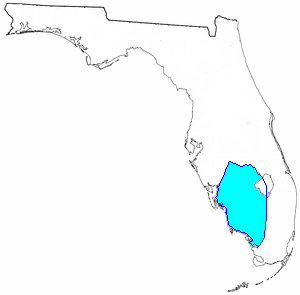 Colonel Worth recommended early in 1842 that the remaining Seminoles be left in peace if they would stay in southern Florida. Worth eventually received authorization to leave the remaining Seminoles on an informal reservation in southwestern Florida, and to declare an end to the war on a date of his choosing. At this time there were still several diverse bands of Indians in Florida. Billy Bowlegs
was the head of a large band of Seminoles living near Charlotte Harbor. Sam Jones led a band of Mikasukis that lived in the Everglades near Fort Lauderdale. North of Lake Okeechobee was a band of Muskogees led by Chipco. Another Muskogee band, led by Tiger Tail, lived near Tallahassee. Finally, in northern Florida there was a band of Creeks led by Octiarche which had fled from Georgia in 1836.
In August 1842 Congress passed the Armed Occupation Act
, which provided free land to settlers who improved the land and were prepared to defend themselves from Indians. In many ways this act prefigured the Homestead Act
of 1862. Heads of households could claim 160 acre (0.6474976 km²) of land south of a line running across the northern part of the peninsula. They had to 'prove' their claim by living on the land for five years and clearing 5 acres (20,234.3 m²). However, they could not claim land within two miles (3 km) of a military post. A total of 1,317 grants totaling 210720 acres (853 km²) were registered in 1842 and 1843.
Also in August 1842 Worth met with the chiefs still in Florida. Each warrior was offered a rifle, money and one year's worth of rations if they moved west. Some accepted the offer, but most hoped to eventually move to the reservation in southwest Florida. Believing that the remaining Indians in Florida would either go west or move to the reservation, Worth declared the war to be at an end on August 14, 1842. Worth then went on ninety-days leave, leaving command to Colonel Josiah Vose. The Army in Florida consisted at this point of parts of three regiments, totaling 1,890 men. Attacks on white settlers continued even as far north as the area around Tallahassee. Otiarche and Tiger Tail had not indicated what they would do. Complaints from Florida caused the War Department to order Vose to take action against the bands still off the reservation, but Vose argued that breaking the pledges made to the Indians would have bad results, and the War Department accepted his arguments. In early October a major hurricane struck Cedar Key
, where the Army headquarters had been located, and the Indians would no longer visit it.
Worth returned to Florida at the beginning of November 1842. He soon decided that Tiger Tail and Otiarche had taken too long to make up their minds on what to do, and ordered that they be brought in. Tiger Tail was so ill that he had to be carried on a litter, and he died in New Orleans waiting for transportation to the Indian territory. The other Indians in northern Florida were also captured and sent west. By April 1843 only one regiment, the Eighth Infantry, was still in Florida. In November 1843 Worth reported that the only Indians left in Florida were 42 Seminole warriors, 33 Mikasukis, 10 Creeks and 10 Tallahassees, with women and children bringing the total to about 300. Worth also stated that these Indians were all living on the reservation and were no longer a threat to the white population of Florida.
Sources agree that the U.S. Army officially recorded 1,466 deaths in the Second Seminole War, mostly from disease. The number killed in action is less clear. Mahon reports 328 regular Army killed in action, while Missall reports that Seminoles killed 269 officers and men. Almost half of those deaths occurred in the Dade Massacre
, Battle of Lake Okeechobee
and Harney Massacre. Similarly, Mahon reports 69 deaths for the Navy while Missal reports 41 for the U.S. Navy and Marine Corps, but adds others may have died after being sent out of Florida as incurable. Mahon and the Florida Board of State Institutions agree that 55 volunteer officers and men were killed by the Seminoles, while Missall says the number is unknown. There is no figure for how many militiamen and volunteers died of disease or accident, however. The number of white civilians and Seminoles killed is also uncertain. A northern newspaper carried a report that more than eighty civilians were killed by Indians in Florida in 1839. Nobody was keeping a cumulative account of the number of Indians killed, or who died of starvation or other privations caused by the war. The Indians shipped west did not fare well, either. By the end of 1843 3,824 Indians had been shipped from Florida to what became the Indian Territory, but in 1844 there were only 3,136 left. As of 1962 there were only 2,343 Seminoles in Oklahoma.
Florida
Florida is a state in the southeastern United States, located on the nation's Atlantic and Gulf coasts. It is bordered to the west by the Gulf of Mexico, to the north by Alabama and Georgia and to the east by the Atlantic Ocean. With a population of 18,801,310 as measured by the 2010 census, it...
between various groups of Native American
Native Americans in the United States
Native Americans in the United States are the indigenous peoples in North America within the boundaries of the present-day continental United States, parts of Alaska, and the island state of Hawaii. They are composed of numerous, distinct tribes, states, and ethnic groups, many of which survive as...
s collectively known as Seminole
Seminole
The Seminole are a Native American people originally of Florida, who now reside primarily in that state and Oklahoma. The Seminole nation emerged in a process of ethnogenesis out of groups of Native Americans, most significantly Creeks from what is now Georgia and Alabama, who settled in Florida in...
s and the United States
United States
The United States of America is a federal constitutional republic comprising fifty states and a federal district...
, part of a series of conflicts called the Seminole Wars
Seminole Wars
The Seminole Wars, also known as the Florida Wars, were three conflicts in Florida between the Seminole — the collective name given to the amalgamation of various groups of native Americans and Black people who settled in Florida in the early 18th century — and the United States Army...
. The Second Seminole War, often referred to as the Seminole War, was the most expensive Indian War fought by the United States.
Background
Bands from various tribes in the southeastern United StatesSoutheastern United States
The Southeastern United States, colloquially referred to as the Southeast, is the eastern portion of the Southern United States. It is one of the most populous regions in the United States of America....
had moved into the unoccupied lands in Florida in the 18th century. These included Alabamas
Alabama (people)
The Alabama or Alibamu are a Southeastern culture people of Native Americans, originally from Mississippi...
, Choctaw
Choctaw
The Choctaw are a Native American people originally from the Southeastern United States...
s, Yamasee
Yamasee
The Yamasee were a multiethnic confederation of Native Americans that lived in the coastal region of present-day northern coastal Georgia near the Savannah River and later in northeastern Florida.-History:...
s, Yuchi
Yuchi
For the Chinese surname 尉迟, see Yuchi.The Yuchi, also spelled Euchee and Uchee, are a Native American Indian tribe who traditionally lived in the eastern Tennessee River valley in Tennessee in the 16th century. During the 17th century, they moved south to Alabama, Georgia and South Carolina...
s and Creek people
Creek people
The Muscogee , also known as the Creek or Creeks, are a Native American people traditionally from the southeastern United States. Mvskoke is their name in traditional spelling. The modern Muscogee live primarily in Oklahoma, Alabama, Georgia, and Florida...
. The Creeks were the largest group, and included Lower Creeks and Upper Creeks, and both Hitchiti
Hitchiti
The Hitchiti were a Muskogean-speaking tribe formerly residing chiefly in a town of the same name on the east bank of the Chattahoochee River, 4 miles below Chiaha, in west Georgia. They spoke the Hitchiti language, which was mutually intelligible with Mikasuki; both tribes were part of the loose...
- and Muscogee
Creek language
The Creek language, also known as Muskogee or Muscogee , is a Muskogean language spoken by Muscogee and Seminole people primarily in the U.S. states of Oklahoma and Florida....
-speakers. One group of Hitchiti-speakers, the Mikasuki, settled around what is now Lake Miccosukee
Lake Miccosukee
Lake Miccosukee is a large swampy prairie lake in northern Jefferson County, Florida, USA, located east of the settlement of Miccosukee. A small portion of the lake, its northwest corner, is located in Leon County.-Characteristics:...
near Tallahassee
Tallahassee, Florida
Tallahassee is the capital of the U.S. state of Florida. It is the county seat and only incorporated municipality in Leon County, and is the 128th largest city in the United States. Tallahassee became the capital of Florida, then the Florida Territory, in 1824. In 2010, the population recorded by...
. Another group of Hitchiti-speakers settled around the Alachua Prairie
Paynes Prairie
Paynes Prairie is a Florida State Park, encompassing a savanna south of Gainesville, Florida, in Micanopy. It is also a U.S. National Natural Landmark. It is crossed by both I-75 and U.S. 441 .- History :...
in what is now Alachua County
Alachua County, Florida
Alachua County is a county located in the U.S. state of Florida. The U.S. Census Bureau 2006 estimate for the county is 227,120. Its county seat is Gainesville, Florida. Alachua County is the home of the University of Florida and is also known for its diverse culture, local music, and artisans...
. The Spanish in St. Augustine
St. Augustine, Florida
St. Augustine is a city in the northeast section of Florida and the county seat of St. Johns County, Florida, United States. Founded in 1565 by Spanish explorer and admiral Pedro Menéndez de Avilés, it is the oldest continuously occupied European-established city and port in the continental United...
began calling the Alachua Creeks Cimarrones, which roughly meant "wild ones" or "runaways", and which is the probable origin of "Seminole". This name was eventually also applied to the other groups in Florida, although the Native Americans still regarded themselves as members of different tribes. Other groups in Florida at the time of the Seminole Wars included "Spanish Indians", so called because it was believed that they were descended from Calusa
Calusa
The Calusa were a Native American people who lived on the coast and along the inner waterways of Florida's southwest coast. Calusa society developed from that of archaic peoples of the Everglades region; at the time of European contact, the Calusa were the people of the Caloosahatchee culture...
s, and "rancho Indians", persons of Native American ancestry, possibly both Calusa and Creek, and mixed Native American/Spanish ancestry, living at Spanish/Cuban fishing camps on the Florida coast.
Treaty of Paris (1783)
The Treaty of Paris, signed on September 3, 1783, ended the American Revolutionary War between Great Britain on the one hand and the United States of America and its allies on the other. The other combatant nations, France, Spain and the Dutch Republic had separate agreements; for details of...
ended the American Revolutionary War
American Revolutionary War
The American Revolutionary War , the American War of Independence, or simply the Revolutionary War, began as a war between the Kingdom of Great Britain and thirteen British colonies in North America, and ended in a global war between several European great powers.The war was the result of the...
and returned East
East Florida
East Florida was a colony of Great Britain from 1763–1783 and of Spain from 1783–1822. East Florida was established by the British colonial government in 1763; as its name implies it consisted of the eastern part of the region of Florida, with West Florida comprising the western parts. Its capital...
and West Florida
West Florida
West Florida was a region on the north shore of the Gulf of Mexico, which underwent several boundary and sovereignty changes during its history. West Florida was first established in 1763 by the British government; as its name suggests it largely consisted of the western portion of the region...
to Spanish control. The United States disputed the boundaries of West Florida (which had been established while the territory was under British
United Kingdom
The United Kingdom of Great Britain and Northern IrelandIn the United Kingdom and Dependencies, other languages have been officially recognised as legitimate autochthonous languages under the European Charter for Regional or Minority Languages...
control) and accused the Spanish authorities of failing to restrain the Native Americans living in Florida from raiding into the United States, and harboring runaway slaves. Starting in 1810 the United States occupied and annexed parts of West Florida. In 1817 Andrew Jackson
Andrew Jackson
Andrew Jackson was the seventh President of the United States . Based in frontier Tennessee, Jackson was a politician and army general who defeated the Creek Indians at the Battle of Horseshoe Bend , and the British at the Battle of New Orleans...
led an invasion of the Floridas, an incident known as the First Seminole War. The United States subsequently acquired Florida from Spain
Spain
Spain , officially the Kingdom of Spain languages]] under the European Charter for Regional or Minority Languages. In each of these, Spain's official name is as follows:;;;;;;), is a country and member state of the European Union located in southwestern Europe on the Iberian Peninsula...
via the Adams-Onís Treaty
Adams-Onís Treaty
The Adams–Onís Treaty of 1819, also known as the Transcontinental Treaty or the Purchase of Florida, was a treaty between the United States and Spain in 1819 that gave Florida to the U.S. and set out a boundary between the U.S. and New Spain . It settled a standing border dispute between the two...
and took possession in 1821. Now that Florida belonged to the United States, the Seminoles were again a problem for the government. In 1823 the government negotiated the Treaty of Moultrie Creek
Treaty of Moultrie Creek
The Treaty of Moultrie Creek was an agreement signed in 1823 between the government of the United States and several chiefs of the Seminole Indians in the present-day state of Florida. The United States had acquired Florida from Spain in 1821 by means of the Adams-Onís Treaty. In 1823 the...
with the Seminoles, establishing a reservation for them in the middle of the state. Six chiefs, however, were allowed to keep their villages along the Apalachicola River.
The Seminoles slowly settled into the reservation, although there were isolated clashes with whites. Col. (later Gen.) Duncan Lamont Clinch
Duncan Lamont Clinch
Duncan Lamont Clinch was an American army officer and served as a commander during the First and Second Seminole Wars. He also served in the United States House of Representatives, representing Georgia....
was placed in charge of the Army units in Florida, Fort King
Fort King
Fort King was a United States military fort in north central Florida. It was named after Colonel William King, commander of Florida's Fourth Infantry and the first governor of the provisional West Florida region. The fort was built in 1827, and became the genesis of the city of Ocala...
was built near the reservation agency, at the site of present-day Ocala, and by early 1827 the Army could report that the Seminoles were on the reservation and Florida was peaceful. This peace lasted for five years, during which time there were repeated calls for the Seminoles to be sent west of the Mississippi. The Seminoles were opposed to any such move, and especially to the suggestion that they join their Creek relations. Most whites regarded the Seminoles as simply Creeks who had recently moved to Florida, while the Seminoles claimed Florida as their home and denied that they had any connection with the Creeks.
The status of runaway slaves was a continuing irritation between Seminoles and whites. Seminoles and slave catchers argued over the ownership of slaves. New plantations in Florida increased the pool of slaves who could run away to the Seminoles. Worried about the possibility of an Indian uprising and/or a slave rebellion, Governor DuVal requested additional Federal troops for Florida. Instead, Fort King was closed in 1828. The Seminoles, short of food and finding the hunting becoming poorer on the reservation, were wandering off of it more often. Also in 1828, Andrew Jackson, the old enemy of the Seminoles, was elected President of the United States
President of the United States
The President of the United States of America is the head of state and head of government of the United States. The president leads the executive branch of the federal government and is the commander-in-chief of the United States Armed Forces....
. In 1830 Congress passed the Indian Removal Act
Indian Removal Act
The Indian Removal Act was signed into law by President Andrew Jackson on May 28, 1830.The Removal Act was strongly supported in the South, where states were eager to gain access to lands inhabited by the Five Civilized Tribes. In particular, Georgia, the largest state at that time, was involved in...
. All problems with the Seminoles were to be solved by moving them to west of the Mississippi.
Treaty of Payne's Landing
In the spring of 1832 the Seminoles on the reservation were called to a meeting at Payne's Landing on the Oklawaha River. The treaty negotiated there called for the Seminoles to move west, if the land was found to be suitable. They were to be settled on the Creek reservation and become part of the Creek tribe. The delegation of seven chiefs who were to inspect the new reservation did not leave Florida until October 1832. After touring the area for several months and conferring with the Creeks who had already been settled there, on March 28, 1833 the seven chiefs signed a statement that the new land was acceptable. Upon their return to Florida, however, most of the chiefs renounced the statement, claiming that they had not signed it, or that they had been forced to sign it, and in any case, that they did not have the power to decide for all the tribes and bands that resided on the reservation. Even some U.S. Army officers claimed that the chiefs had been "wheedled and bullied into signing." Furthermore, "there is evidence of trickery by the whites in the way the treaty is phrased." The villages in the area of the Apalachicola River were more easily persuaded, however, and went west in 1834.United States Senate
The United States Senate is the upper house of the bicameral legislature of the United States, and together with the United States House of Representatives comprises the United States Congress. The composition and powers of the Senate are established in Article One of the U.S. Constitution. Each...
finally ratified the Treaty of Payne's Landing
Treaty of Payne's Landing
The Treaty of Payne's Landing was an agreement signed on 9 May 1832 between the government of the United States and several chiefs of the Seminole Indians in the present-day state of Florida.- Background :...
in April 1834. The treaty had given the Seminoles three years to move west of the Mississippi. The government interpreted the three years as starting 1832, and expected the Seminoles to move in 1835. Fort King was reopened in 1834. A new Seminole agent, Wiley Thompson, had been appointed in 1834, and the task of persuading the Seminoles to move fell to him. He called the chiefs together at Fort King in October 1834 to talk to them about the removal to the west. The Seminoles informed Thompson that they had no intention of moving, and that they did not feel bound by the Treaty of Payne's Landing. Thompson then requested reinforcements for Fort King and Fort Brooke, reporting that, "the Indians after they had received the Annuity, purchased an unusually large quantity of Powder & Lead." General Clinch also warned Washington that the Seminoles did not intend to move, and that more troops would be needed to force them to move. In March 1835 Thompson called the chiefs together to read a letter from Andrew Jackson to them. In his letter, Jackson said, "Should you ... refuse to move, I have then directed the Commanding officer to remove you by force." The chiefs asked for thirty days to respond. A month later the Seminole chiefs told Thompson that they would not move west. Thompson and the chiefs began arguing, and General Clinch had to intervene to prevent bloodshed. Eventually, eight of the chiefs agreed to move west, but asked to delay the move until the end of the year, and Thompson and Clinch agreed.
Five of the most important Seminole chiefs, including Micanopy
Micanopy
Micanopy , also known as Micco-Nuppe, Michenopah, Miccanopa, Mico-an-opa and Sint-chakkee , was the leading chief of the Seminoles who led the tribe during the Second Seminole War...
of the Alachua Seminoles, had not agreed to the move. In retaliation, Thompson declared that those chiefs were removed from their positions. As relations with the Seminoles deteriorated, Thompson forbade the sale of guns and ammunition to them. Osceola
Osceola
Osceola, also known as Billy Powell , became an influential leader with the Seminole in Florida. He was of Creek, Scots-Irish and English parentage, and had migrated to Florida with his mother after the defeat of the Creek in 1814.Osceola led a small band of warriors in the Seminole resistance...
, a young warrior beginning to be noticed by the whites, was particularly upset by the ban, feeling that it equated Seminoles with slaves and said, "The white man shall not make me black. I will make the white man red with blood; and then blacken him in the sun and rain ... and the buzzard live upon his flesh." In spite of this, Thompson considered Osceola to be a friend, and gave him a rifle. Later, though, when Osceola was causing trouble, Thompson had him locked up at Fort King for a night. The next day, in order to secure his release, Osceola agreed to abide by the Treaty of Payne's Landing and to bring his followers in.
The situation grew worse. A group of whites assaulted some Indians sitting around a campfire. Two more Indians came up during the assault and opened fire on the whites. Three whites were wounded, and one Indian was killed and one wounded. In August 1835, Private Kinsley Dalton (for whom Dalton, Georgia
Dalton, Georgia
Dalton is a city in Whitfield County, Georgia, United States. It is the county seat of Whitfield County and the principal city of the Dalton, Georgia Metropolitan Statistical Area, which encompasses all of both Murray and Whitfield counties. As of the 2010 census, the city had a population of 33,128...
is named) was killed by Seminoles as he was carrying the mail from Fort Brooke to Fort King. In November, Chief Charley Emathla, wanting no part of a war, led his people towards Fort Brooke where they were to board ships to go west. This was considered a betrayal by other Seminoles. Osceola met Charlie Emathla on the trail and killed him.
The Dade Massacre
United States Department of War
The United States Department of War, also called the War Department , was the United States Cabinet department originally responsible for the operation and maintenance of the United States Army...
for the loan of 500 muskets. Five hundred volunteers were mobilized under Brig. Gen. Richard K. Call
Richard K. Call
Richard Keith Call was the third and fifth territorial governor of Florida.Named after his uncle, a Revolutionary War hero, he was born in Pittsfield, Prince George County, Virginia. In 1813 he left school to take part in the Creek War. He came favorably to the attention of General Andrew Jackson,...
. Indian war parties raided farms and settlements, and families fled to forts, large towns, or out of the territory altogether. A war party led by Osceola captured a Florida militia supply train, killing eight of its guards and wounding six others. Most of the goods taken were recovered by the militia in another fight a few days later. Sugar plantations along the Atlantic coast south of St. Augustine were destroyed, with many of the slaves on the plantations joining the Seminoles.
The U.S. Army had 11 companies, about 550 soldiers, stationed in Florida. Fort King had only one company of soldiers, and it was feared that they might be overrun by the Seminoles. There were three companies at Fort Brooke, with another two expected momentarily, so it was decided to send two companies to Fort King. On December 23, 1835 the two companies, totaling 110 men, left Fort Brooke under the command of Maj. Francis L. Dade
Francis L. Dade
Francis Langhorne Dade was a Major in the U.S. 4th Infantry Regiment, United States Army, during the Second Seminole War. Dade was killed in a battle with Seminole Indians that came to be known as the "Dade Massacre"...
. Seminoles shadowed the marching soldiers for five days. On December 28 the Seminoles ambushed the soldiers, and wiped out the command. Only three men survived the massacre, and one, Edwin De Courcey, was hunted down and killed by a Seminole the next day. Two survivors, Ransome Clarke and Joseph Sprague, returned to Fort Brooke. Only Clarke, who died of his wounds a few years later, left any account of the battle from the Army's perspective. Joseph Sprague was unharmed and lived quite a while longer, but was not able to give an account of the battle because he had sought immediate refuge in a nearby pond. The Seminoles lost just three men, with five wounded. On the same day as the Dade Massacre
Dade Massacre
The "Dade Massacre" was an 1835 defeat for the United States Army that started the Second Seminole War, which lasted until 1842.On December 23, 1835, two U.S. companies of 110 troops under Major Francis L. Dade departed from Fort Brooke , heading up the King Highway on a resupply and reinforce...
, Osceola and his followers shot and killed from ambush Wiley Thompson
Wiley Thompson
Wiley Thompson was a United States Representative from Georgia.Born in Amelia County, Virginia, Thompson moved to Elberton, Georgia, and served as a commissioner of the Elbert County Academy in 1808...
and six others outside of Fort King.
Subsequently Major Ethan Allen Hitchcock
Ethan A. Hitchcock (general)
Ethan Allen Hitchcock was a career United States Army officer and author who had War Department assignments in Washington, D.C., during the American Civil War, in which he served as a major general.-Early life:...
was among those who found the remains of the Dade party in February. In his journal he wrote a haunting account of the discovery, then vented his bitter discontent with the conflict: "The government is in the wrong, and this is the chief cause of the persevering opposition of the Indians, who have nobly defended their country against our attempt to enforce a fraudulent treaty. The natives used every means to avoid a war, but were forced into it by the tyranny of our government."
On December 29 General Clinch left Fort Drane (recently established on Clinch's plantation, about twenty miles (32 km) northwest of Fort King) with 750 soldiers, including 500 volunteers on an enlistment due to end January 1, 1836. They were going to a Seminole stronghold called the Cove of the Withlacoochee, what is now known as Lake Tsala Apopka, an area of many lakes on the southwest side of the Withlacoochee River
Withlacoochee River (South)
The Withlacoochee River originates in central Florida's Green Swamp, east of Polk City. It flows west, then north, and then turns northwest and finally west again before it empties into the Gulf of Mexico near Yankeetown. The river is long and has a drainage basin of...
. When they reached the river, they could not find the ford, and Clinch had his regular troops ferried across the river in a single canoe they had found. Once they were across and had relaxed, the Seminoles attacked. The troops only saved themselves by fixing bayonets and charging the Seminoles, at the cost of four dead and 59 wounded. The militia provided cover as the Army troops then withdrew across the river.
On January 6, 1836 a band of Seminoles attacked the coontie plantation of William Cooley
William Cooley
William Cooley was one of the first American settlers, and a regional leader, in what is now known as Broward County, in the U.S. state of Florida. His family was killed by Seminoles in 1836, during the Second Seminole War...
on the New River
New River (Broward County, Florida)
The New River is a river in South Florida, USA. The river originates in the Everglades and flows east. After passing through Fort Lauderdale, the river enters the Atlantic Ocean at Port Everglades cut. The river is entirely within Broward County and is composed from the junction of three main...
(in present-day Fort Lauderdale, Florida
Fort Lauderdale, Florida
Fort Lauderdale is a city in the U.S. state of Florida, on the Atlantic coast. It is the county seat of Broward County. As of the 2010 census, the city had a population of 165,521. It is a principal city of the South Florida metropolitan area, which was home to 5,564,635 people at the 2010...
), killing his wife and children and the children's tutor. The other residents of the New River area and of the Biscayne Bay
Biscayne Bay
Biscayne Bay is a lagoon that is approximately 35 miles long and up to 8 miles wide located on the Atlantic coast of South Florida, United States. It is usually divided for purposes of discussion and analysis into three parts: North Bay, Central Bay, and South Bay. Its area is...
country to the south fled to Key West. On January 17, volunteers and Seminoles met south of St. Augustine at the Battle of Dunlawton
Dunlawton Plantation and Sugar Mill
The Dunlawton Plantation and Sugar Mill was a plantation that was destroyed by the Seminoles at the beginning of the Second Seminole War. The ruins are located west of Port Orange, Florida off Nova Road.On August 28, 1973, it was added to the U.S...
. The volunteers lost four men, with thirteen wounded. On January 19, 1836 the Navy sloop-of-war
Sloop-of-war
In the 18th and most of the 19th centuries, a sloop-of-war was a warship with a single gun deck that carried up to eighteen guns. As the rating system covered all vessels with 20 guns and above, this meant that the term sloop-of-war actually encompassed all the unrated combat vessels including the...
Vandalia
USS Vandalia (1828)
The first Vandalia was an 18-gun sloop-of-war in the United States Navy during the Second Seminole War and the American Civil War. She was named for the city of Vandalia, Illinois.-Service history:...
was dispatched to Tampa Bay from Pensacola. On the same day 57 marines
United States Marine Corps
The United States Marine Corps is a branch of the United States Armed Forces responsible for providing power projection from the sea, using the mobility of the United States Navy to deliver combined-arms task forces rapidly. It is one of seven uniformed services of the United States...
were dispatched from Key West to help man Fort Brooke.
General Gaines' expedition
The regular American army was very small at the time, with less than 7,500 men manning a total of 53 posts. It was spread thin, with the Canadian border to guard, coastal fortifications to man, and especially, Indians to move west and then watch and keep separated from white settlers. Temporary needs for additional troops were filled by state and territory militias, and by self-organized volunteer units. As news and rumors of the fighting spread, action was taken on many levels. Maj. Gen. Winfield ScottWinfield Scott
Winfield Scott was a United States Army general, and unsuccessful presidential candidate of the Whig Party in 1852....
was placed in charge of the war. Congress appropriated US$620,000 for the war. Volunteer companies began forming in Alabama, Georgia and South Carolina
South Carolina
South Carolina is a state in the Deep South of the United States that borders Georgia to the south, North Carolina to the north, and the Atlantic Ocean to the east. Originally part of the Province of Carolina, the Province of South Carolina was one of the 13 colonies that declared independence...
. General Gaines put together a force of 1,100 regulars and volunteers in New Orleans
New Orleans, Louisiana
New Orleans is a major United States port and the largest city and metropolitan area in the state of Louisiana. The New Orleans metropolitan area has a population of 1,235,650 as of 2009, the 46th largest in the USA. The New Orleans – Metairie – Bogalusa combined statistical area has a population...
and sailed with them to Fort Brooke.
When a crossing was attempted at the ford of the Withlacoochee, Lt. James Izard was wounded (and later died). General Gaines was stuck. He could not cross the river, and if he returned to Fort King his men would be out of rations. Gaines had his men construct a fortification, called Camp Izard, and sent word to General Clinch. Gaines hoped that the Seminoles would concentrate around Camp Izard, and that Clinch's forces could then hit the Seminoles in their flank, crushing them between the two forces. Unfortunately, General Scott, who was in charge of the war, ordered Clinch to stay at Fort Drane. Gaines's men were soon reduced to eating their horses and mules, and an occasional dog, while a battle went on for eight days. Still at Fort Drane, Clinch requested that General Scott change his orders and allow him to go to Gaines' aid. Clinch finally decided to disobey Scott and left to join Gaines just one day before Scott's permission to do so arrived at Fort Drane. Clinch and his men reached Camp Izard on March 6, chasing away the Seminoles.
General Scott's campaign
Abraham Eustis
Abraham Eustis was a lawyer and notable U.S. Army officer, eventually rising to become a Brevet Brigadier General...
, would travel southwest from Volusia, a town on the St. Johns River
St. Johns River
The St. Johns River is the longest river in the U.S. state of Florida and its most significant for commercial and recreational use. At long, it winds through or borders twelve counties, three of which are the state's largest. The drop in elevation from the headwaters to the mouth is less than ;...
. The third wing, under the command of Col. William Lindsay, would move north from Fort Brooke. The plan was for the three columns to arrive at the Cove simultaneously so as to prevent the Seminoles from escaping. Eustis and Lindsay were supposed to be in place on March 25, so that Clinch's column could drive the Seminoles into them.
On the way from St. Augustine to Volusia to take up his starting position, Gen. Eustis found Pilaklikaha, or Palatlakaha, also known as Abraham's Town. Abraham was a Black Seminole leader, and interpreter for the Seminoles. Eustis burned the town before moving on to Volusia.
All three columns were delayed. Eustis was two days late departing Volusia because of an attack by the Seminoles. Clinch's and Lindsay's columns only reached their positions on March 28. Because of problems crossing through uncharted territory, Eustis's column did not arrive until March 30. Clinch crossed the Withlacoochee on March 29 to attack the Seminoles in the Cove, but found the villages deserted. Eustis's column did fight a skirmish with some Seminoles before reaching its assigned position, but the whole action had killed or captured only a few Seminoles. On March 31 all three commanders, running low on supplies, headed for Fort Brooke. The failure of the expedition to effectively engage the Seminoles was seen as a defeat, and was blamed on insufficient time for planning and an inhospitable climate.
The Army retreats, Governor Call tries his hand
Hillsborough River (Florida)
The Hillsborough River is a river located in the state of Florida in the USA. It arises in the Green Swamp near the juncture of Hillsborough, Pasco and Polk counties, and flows through Pasco and Hillsborough Counties to an outlet in the city of Tampa on Tampa Bay. The name Hillsborough River first...
north of Fort Brooke, Fort Barnwell near Volusia, and Fort Drane itself. The Seminoles also burned the sugar works on Clinch's plantation. After that, Clinch resigned his commission and left the territory. Fort Alabama was abandoned in late April. In late May, Fort King was also abandoned. In June the soldiers in a blockhouse on the Withlacoochee were rescued after being besieged by the Seminoles for 48 days. On July 23, 1836, Seminoles attacked the Cape Florida lighthouse, severely wounding the assistant keeper in charge and killing his assistant, and burning the lighthouse. The lighthouse was not repaired until 1846. Fort Drane was abandoned in July because of illness, with five out of seven officers and 140 men on the sick list. The Army was suffering terribly from illness; at the time summer in Florida was called the sickly season. By the end of August, Fort Defiance, on the edge of the Alachua Prairie, was also abandoned. Seeing that the war promised to be long and expensive, Congress appropriated another US$1.5 million, and allowed volunteers to enlist for up to a year.
Richard Keith Call, who had led the Florida volunteers as a Brig. Gen. when Clinch marched on the Cove of the Withlacoochee in December, had been appointed Governor of the Territory of Florida on March 16, 1836. Governor Call proposed a summer campaign using militias and volunteers instead of regular Army troops. The War Department agreed to this proposal, but delays in preparations meant the campaign did not start until the end of September. Call also intended to attack the Cove of the Withlacoochee. He sent most of his supplies down the west coast of the peninsula and up the Withlacoochee to set up a supply base. With the main body of his men he marched to the now abandoned Fort Drane, and then on to the Withlacoochee, which they reached on October 13. The Withlacoochee was flooding and could not be forded. The army could not make rafts for a crossing because they had not brought any axes with them. In addition, Seminoles on the other side of the river were shooting at any soldier who showed himself along the river. Call then turned west along the north bank of the river to reach the supply depot. However, the steamer bringing the supplies had sunk in the lower part of the river, and the supply depot was far downstream from where Call was expecting it. Out of food, Call led his men back to Fort Drane, another failed expedition against the Cove.
Battle of Wahoo Swamp
The Battle of Wahoo Swamp was fought during the Second Seminole War. An army of militia, Tennessee volunteers, Creek mercenaries and United States marines and soldiers led by Florida Governor, General Richard K...
, as their families were close by, but had to retreat across a stream. Major David Moniac, a mix-blooded Creek who was the first Native American to graduate from West Point
United States Military Academy
The United States Military Academy at West Point is a four-year coeducational federal service academy located at West Point, New York. The academy sits on scenic high ground overlooking the Hudson River, north of New York City...
, tried to determine how deep the stream was, but was shot and killed by the Seminoles.
Faced with trying to cross a stream of unknown depth under hostile fire, and with supplies again running short, Call withdrew and led his men to Volusia. On December 9 Call was relieved of command and replaced by Maj. Gen. Thomas Jesup
Thomas Jesup
Brigadier General Thomas Sidney Jesup, USA was an American military officer known as the "Father of the Modern Quartermaster Corps". He was born in Berkeley County, West Virginia. He began his military career in 1808, and served in the War of 1812, seeing action in the battles of Chippewa and...
, who took the troops back to Fort Brooke. The enlistments of the volunteers were up at the end of December and they went home.
Jesup takes command
In 1836 the United States Army had just four Major Generals. Alexander Macomb, Jr.Alexander Macomb, Jr.
Alexander Macomb was the commanding general of the United States Army from May 29, 1828 to June 25, 1841. Macomb was the field commander at the Battle of Plattsburg, and after the stunning victory was lauded with praise and styled "The Hero of Plattsburgh" by some of the American press...
was the commanding general of the Army. Edmund Gaines and Winfield Scott had each taken to the field and failed to defeat the Seminoles. Thomas Jesup
Thomas Jesup
Brigadier General Thomas Sidney Jesup, USA was an American military officer known as the "Father of the Modern Quartermaster Corps". He was born in Berkeley County, West Virginia. He began his military career in 1808, and served in the War of 1812, seeing action in the battles of Chippewa and...
was the last Major General available. Jesup had just suppressed an uprising of the Creeks of western Georgia and eastern Alabama (the Creek War of 1836
Creek War of 1836
The Creek War of 1836 was a conflict fought between the Muscogee Creek people and non-Native land speculators and squatters in Alabama in 1836....
), upstaging Winfield Scott in the process. Jesup brought a new approach to the war. Instead of sending large columns out to try to force the Seminoles into a set-piece battle, he concentrated on wearing the Seminoles down. This required a large military presence in Florida, and Jesup eventually had a force of more than 9,000 men under his command. About half of the force were volunteers and militia. It also included a brigade of Marines, and Navy and Revenue-Marine
United States Revenue Cutter Service
The United States Revenue Cutter Service was established by Secretary of the Treasury Alexander Hamilton in 1790 as an armed maritime law enforcement service. Throughout its entire existence the Revenue Cutter Service operated under the authority of the United States Department of the Treasury...
personnel patrolling the coast and inland rivers and streams.
The Navy and the Revenue-Marine both worked with the Army from the beginning of the war. Navy ships and revenue cutters ferried men and supplies to Army posts. They patrolled the Florida coast to gather information on and intercept Seminoles, and to block smuggling of arms and supplies to the Seminoles. Sailors and Marines helped man Army forts that were short of manpower. Sailors, Marines and revenue-Marines participated in expeditions into the interior of Florida, both by boat and on land. Against those numbers the Seminoles had started the war with between 900 and 1,400 warriors, and with no means of replacing their losses.
Truce and reversal
January 1837 saw a change in the war. In various actions a number of Seminoles and Black Seminoles were killed or captured. At the Battle of Hatchee-Lustee, the Marine brigade captured between thirty and forty Seminoles and blacks, mainly women and children, along with 100 pack ponies and 1,400 head of cattle. At the end of January some Seminole chiefs sent messengers to Jesup, and a truce was arranged. Fighting did not stop right away, and a meeting between Jesup and the chiefs did not occur until near the end of February. In March a 'Capitulation' was signed by a number of chiefs, including Micanopy, stipulating that the Seminoles could be accompanied by their allies and "their negroes, their 'bona fide' property" in their relocation to the West.Even as Seminoles began to come into the Army camps to await transportation west, slave catchers were claiming blacks living with the Seminoles. As the Seminoles had no written records of ownership, they generally lost in disputes over ownership. Other whites were trying to have Seminoles arrested for alleged crimes or debts. All of this made the Seminoles suspicious of promises made by Jesup. On the other hand, it was noted that many of the warriors coming into the transportation camps had not brought their families, and seemed mainly to be interested in collecting supplies. By the end of May, many chiefs, including Micanopy, had surrendered. Two important leaders, Osceola and Sam Jones
Ar-pi-uck-i (Sam Jones)
Ar-pi-uck-i, also known as Sam Jones, was a powerful spiritual alektca and war chief of the Miccosukee, a Seminole-Muscogee Creek tribe of the Southeast United States. Ar-pi-uck-i successfully defied the U.S...
, had not surrendered, however, and were known to be vehemently opposed to relocation. On June 2 these two leaders with about 200 followers entered the poorly guarded holding camp at Fort Brooke and led away the 700 Seminoles there who had surrendered. The war was on again, and Jesup would never again trust the word of an Indian.
The war did not immediately resume on a large scale. General Jesup had thought that the surrender of so many Seminoles meant the war was ending, and had not planned a long campaign. Many of the soldiers had been assigned elsewhere, or, in the case of militias and volunteers, released from duty. It was also getting into summer, the 'sickly season', and the Army did not fight aggressively in Florida during the summer. The Panic of 1837
Panic of 1837
The Panic of 1837 was a financial crisis or market correction in the United States built on a speculative fever. The end of the Second Bank of the United States had produced a period of runaway inflation, but on May 10, 1837 in New York City, every bank began to accept payment only in specie ,...
was reducing government revenues, but Congress appropriated another US$1.6 million for the war. In August the Army stopped supplying rations to civilians who had taken refuge at its forts.
Captures and false flags
Jesup did keep pressure on the Seminoles by sending small units into the field. Many of the blacks with the Seminoles began turning themselves in. After a couple of swings in policy on dealing with fugitive slaves, Jesup ended up sending most of them west to join the Seminoles that were already in Indian territory. On September 10, 1837 the Army and militias captured a band of Mikasukis including King Phillip, one of the most important chiefs in Florida. The next night the same command captured a band of Yuchis, including their leader, Uchee BillyUchee Billy
Uchee Billy or Yuchi Billy was a chief of the Yuchi tribe who along with his band escaped forced relocation from Georgia to Indian Territory by moving to the area of what is now Volusia County, Florida in 1822...
.
Wild Cat (Seminole)
Wild Cat, born Coacoochee or Cowacoochee , was a leading Seminole chieftain during the later stages of the Second Seminole War as well as the nephew of Micanopy....
(Wild Cat) to arrange a meeting with Jesup. When Coacoochee arrived under a flag of truce, Jesup arrested him. In October Osceola and Coa Hadjo, another chief, requested a parley with Jesup. A meeting was arranged south of St. Augustine. When Osceola and Coa Hadjo arrived for the meeting, also under a white flag, they were arrested. Osceola was dead within three months of his capture, in prison at Fort Moultrie
Fort Moultrie National Monument
Fort Moultrie is the name of a series of citadels on Sullivan's Island, South Carolina, built to protect the city of Charleston, South Carolina. The first fort, built of palmetto logs, inspired the flag and nickname of South Carolina...
in Charleston, South Carolina
Charleston, South Carolina
Charleston is the second largest city in the U.S. state of South Carolina. It was made the county seat of Charleston County in 1901 when Charleston County was founded. The city's original name was Charles Towne in 1670, and it moved to its present location from a location on the west bank of the...
. Not all of the Seminoles captured by the Army stayed captured. While Osceola was still held at Fort Marion (Castillo de San Marcos) in St. Augustine, twenty Seminoles held in the same cell with him and King Phillip escaped through a narrow window. The escapees included Coacoochee and John Horse, a Black Seminole leader.
A delegation of Cherokee
Cherokee
The Cherokee are a Native American people historically settled in the Southeastern United States . Linguistically, they are part of the Iroquoian language family...
s was sent to Florida to try to talk the Seminoles into moving west. When Micanopy and others came in to meet the Cherokees, General Jesup had the Seminoles held. John Ross
John Ross (Cherokee chief)
John Ross , also known as Guwisguwi , was Principal Chief of the Cherokee Native American Nation from 1828–1866...
, the head of the Cherokee delegation, protested, but to no avail. Jesup replied that he had told the Cherokees that no Seminole who came in would be allowed to return home.
Zachary Taylor and the Battle of Lake Okeechobee
Jesup now had a large army assembled, including volunteers from as far away as MissouriMissouri
Missouri is a US state located in the Midwestern United States, bordered by Iowa, Illinois, Kentucky, Tennessee, Arkansas, Oklahoma, Kansas and Nebraska. With a 2010 population of 5,988,927, Missouri is the 18th most populous state in the nation and the fifth most populous in the Midwest. It...
and Pennsylvania
Pennsylvania
The Commonwealth of Pennsylvania is a U.S. state that is located in the Northeastern and Mid-Atlantic regions of the United States. The state borders Delaware and Maryland to the south, West Virginia to the southwest, Ohio to the west, New York and Ontario, Canada, to the north, and New Jersey to...
. So many men, in fact, that he had trouble feeding all of them. Jesup's plan was to sweep down the peninsula with multiple columns, pushing the Seminoles further south. General Joseph Marion Hernández
Joseph Marion Hernández
José Mariano Hernández or Joseph Marion Hernández was an American politician, plantation owner, and soldier. He was the first from the Florida Territory and the first Hispanic American to serve in the United States Congress. He served from September 1822 to March 1823. He was a member of the Whig...
led a column down the east coast. General Eustis took his column up the St. Johns River (southward). Colonel Zachary Taylor
Zachary Taylor
Zachary Taylor was the 12th President of the United States and an American military leader. Initially uninterested in politics, Taylor nonetheless ran as a Whig in the 1848 presidential election, defeating Lewis Cass...
led a column from Fort Brooke into the middle of the state, and then southward between the Kissimmee River
Kissimmee River
The Kissimmee River is a river in south-central Florida, United States.-Course:The Kissimmee River arises in Osceola County as the outflow from East Lake Tohopekaliga, passing through Lake Tohopekaliga, Lake Cypress, Lake Hatchineha and Lake Kissimmee...
and the Peace River
Peace River (Florida)
The Peace River is a river in the southwestern part of the Florida peninsula, in the U.S.A.. It originates at the juncture of Saddle Creek and Peace Creek northeast of Bartow in Polk County and flows south through Hardee County to Arcadia in DeSoto County and then southwest into the Charlotte...
. Other commands cleared out the areas between the St. Johns and the Oklawaha River, between the Oklawaha and the Withlacoochee River, and along the Caloosahatchee River
Caloosahatchee River
The Caloosahatchee River is a river on the southwest Gulf Coast of Florida in the United States, approximately long. It drains rural areas on the northern edge of the Everglades northwest of Miami...
. A joint Army-Navy unit patrolled the lower east coast of Florida. Other troops patrolled the northern part of the territory to protect against Seminole raids.
Colonel Taylor saw the first major action of the campaign. Leaving Fort Gardiner on the upper Kissimmee with 1,000 men on December 19, Taylor headed towards Lake Okeechobee
Lake Okeechobee
Lake Okeechobee , locally referred to as The Lake or The Big O, is the largest freshwater lake in the state of Florida. It is the seventh largest freshwater lake in the United States and the second largest freshwater lake contained entirely within the lower 48 states...
. In the first two days out ninety Seminoles surrendered. On the third day Taylor stopped to build Fort Basinger, where he left his sick and enough men to guard the Seminoles that had surrendered. Three days later, on Christmas Day, 1837, Taylor's column caught up with the main body of the Seminoles on the north shore of Lake Okeechobee.
The Seminoles led by Alligator, Sam Jones, and the recently escaped Coacoochee, were well positioned in a hammock
Hammock (ecology)
Hammocks are dense stands of hardwood trees that grow on natural rises of only a few inches higher than surrounding marshland that is otherwise too wet to support them. Hammocks are distinctive in that they are formed gradually over thousands of years rising in a wet area through the deposits of...
surrounded by sawgrass
Cladium
Cladium is a genus of large sedges, with a worldwide distribution in tropical and temperate regions...
. The ground was thick mud, and sawgrass easily cuts and burns the skin. Taylor had about 800 men, while the Seminoles numbered less than 400. Taylor sent the Missouri volunteers in first. Colonel Richard Gentry, three other officers and more than twenty enlisted men were killed before the volunteers retreated. Next in were 200 soldiers of the 6th Infantry
U.S. 6th Infantry Regiment
The 6th Infantry Regiment was formed in 1812. Its most famous commander was Zachary Taylor, later the twelfth President of the United States. The Motto, "Regulars, By God!" derives from the Battle of Chippawa, in which British general Riall noticed that the approaching regiment had on the uniforms...
, who lost four officers and suffered nearly 40% casualties before they withdrew. Then it was the turn of the 4th Infantry, 160 men augmented by remnants of the 6th Infantry and the Missouri volunteers. This time the troops were able to drive the Seminoles from the hammock and towards the lake. Taylor then attacked their flank with his reserves, but the Seminoles were able to escape across the lake. Only about a dozen Seminoles had been killed in the battle. Nevertheless, the Battle of Lake Okeechobee
Battle of Lake Okeechobee
The Battle of Lake Okeechobee was one of the major battles of the Second Seminole War. It was fought between 800 troops of the 1st, 4th, and 6th Infantry Regiments and 132 Missouri Volunteers and between 380 and 480 Seminoles led by Billy Bowlegs, Abiaca and Alligator on December 25, 1837...
was hailed as a great victory for Taylor and the Army.
The Battle of Loxahatchee
Taylor now joined the other columns sweeping down the peninsula to pass on the east side of Lake Okeechobee, under the overall command of General Jesup. The troops along the Caloosahatche River blocked any passage north on the west side of the lake. Still patrolling the east coast of Florida was the combined Army-Navy force under Navy Lt. Levin Powell. On January 15 Powell was leading eighty men towards a Seminole camp when they found themselves almost completely surrounded by a larger number of Seminoles. A charge against the Seminoles was unsuccessful, but the troops made it back to their boats after losing four dead and twenty-two wounded. (The party's retreat was covered by Army Lt. Joseph E. JohnstonJoseph E. Johnston
Joseph Eggleston Johnston was a career U.S. Army officer, serving with distinction in the Mexican-American War and Seminole Wars, and was also one of the most senior general officers in the Confederate States Army during the American Civil War...
.) At the end of January Jesup's troops caught up with a large body of Seminoles to the east of Lake Okeechobee. The Seminoles were originally positioned in a hammock, but cannon and rocket fire drove them back across a wide stream (the Loxahatchee River
Loxahatchee River
The Loxahatchee River The Loxahatchee River The Loxahatchee River (Seminole for river of turtles is a 7.6 mile river near the southeast coast of Florida. It is a National Wild and Scenic River, one of only two in the state, and received its federal designation on May 17, 1985. The 1930s pioneer...
), where they made another stand. The Seminoles eventually just faded away, having caused more casualties than they received, and the Battle of Loxahatchee was over.
The fighting now died down. In February 1838 Seminole chiefs Tuskegee and Halleck Hadjo approached Jesup with the proposition that they would stop fighting if they were allowed to stay south of Lake Okeechobee. Jesup favored the idea, foreseeing a long struggle to capture the remaining Seminoles in the Everglades
Everglades
The Everglades are subtropical wetlands in the southern portion of the U.S. state of Florida, comprising the southern half of a large watershed. The system begins near Orlando with the Kissimmee River, which discharges into the vast but shallow Lake Okeechobee...
, and calculating that the Seminoles would be easier to round up later when the land was actually needed by white settlers. However, Jesup had to write to Washington for approval. The chiefs and their followers camped near the Army while awaiting the reply, and there was considerable fraternizing between the two camps. Secretary of War Joel Roberts Poinsett
Joel Roberts Poinsett
Joel Roberts Poinsett was a physician, botanist and American statesman. He was a member of the United States House of Representatives, the first United States Minister to Mexico , a U.S...
rejected the arrangement, however, and instructed Jesup to continue his campaign. Upon receiving Poinsett's response, Jesup summoned the chiefs to his camp, but they refused his invitation. Unwilling to let 500 Seminoles return to the swamps, Jesup sent a force to detain them. The Seminoles offered very little resistance, perhaps seeing little reason to continue fighting.
Jesup steps down; Zachary Taylor takes command
Jesup now asked to be relieved of his command. As summer approached in 1838 the number of troops in Florida dwindled to about 2,300. In April Jesup was informed that he should return to his position as Quartermaster General of the Army. In May Zachary Taylor, now a General, assumed command of the Army forces in Florida. With reduced forces in Florida, Taylor concentrated on keeping the Seminoles out of northern Florida, so that settlers could return to their homes. The Seminoles were still capable of reaching far north, however. In July a family was killed on the Santa Fe River, another near Tallahassee, as well as two families in Georgia. The fighting died down during the summer, as the soldiers were pulled back to the coasts, and the Seminoles concentrated on growing their crops and gathering supplies for fall and winter.Taylor's plan was to build small posts at frequent intervals across northern Florida, connected by wagon roads, and to use larger units to search designated areas. This was expensive, but Congress continued to appropriate the necessary funds. In October 1838 Taylor had the last of the Indians living along the Apalachicola River relocated west. Killings in the Tallahassee area caused Taylor to pull troops out of southern Florida to provide more protection in the north. The winter season was fairly quiet. Only a few Seminoles were killed, and fewer than 200 sent west, while only nine U.S. troops were killed by the Seminoles. Taylor was able to report in the Spring of 1839 that his men had constructed 53 new posts and cut 848 miles (1,365 km) of wagon roads.
Macomb's peace and the Harney Massacre
In Washington and around the country support for the war was eroding. The size of the Army had been increased because of the demands for manpower in the Florida war. Many people were beginning to think that the Seminoles had earned a right to stay in Florida. It was also obvious that it would take a long time to root all of the Seminoles out of Florida, at a great cost. Congress appropriated US$5,000 to negotiate a settlement with the Seminoles. President Martin Van BurenMartin Van Buren
Martin Van Buren was the eighth President of the United States . Before his presidency, he was the eighth Vice President and the tenth Secretary of State, under Andrew Jackson ....
sent the Commanding General of the Army, Alexander Macomb, to negotiate a new treaty with the Seminoles. The Seminoles were slow to respond to the offer of a new treaty, remembering the broken treaties and promises of the past. Finally, Sam Jones sent his chosen successor, Chitto Tustenuggee, to meet with Macomb. On May 19, 1839 Macomb announced that an agreement had been reached with the Seminoles. The Seminoles would stop fighting in exchange for a reservation in southern Florida.
As the summer passed the agreement seemed to be holding. The few killings that occurred could be blamed on undisciplined young warriors, or even on outlaw whites. A trading post was established on the north shore of the Caloosahatchee River, and the Seminoles who came to the trading post seemed to be friendly. A detachment of 23 soldiers was stationed at the trading post to guard it, under the command of Colonel William S. Harney
William S. Harney
William Selby Harney was a cavalry officer in the U.S. Army during the Mexican-American War and the Indian Wars. He was born in what is today part of Nashville, Tennessee but at the time was known as Haysborough....
. On July 23, some 150 Indians attacked the Calooshatchee trading post and guard. Some of the soldiers, including Colonel Harney, were able to reach the river and find boats to escape in, but most of the soldiers, as well as a number of civilians in the trading post, were killed. The war was on again.
It was not clear which band of Indians had attacked the trading post. Many blamed the 'Spanish' Indians, led by Chakaika. Some, though, suspected Sam Jones, whose band of Mikasukis had been the ones to actually reach agreement with Macomb. Sam Jones promised to turn the men responsible for the attack over to Harney in 33 days. In the meantime the Mikasukis in Sam Jones' camp near Fort Lauderdale
Fort Lauderdale, Florida
Fort Lauderdale is a city in the U.S. state of Florida, on the Atlantic coast. It is the county seat of Broward County. As of the 2010 census, the city had a population of 165,521. It is a principal city of the South Florida metropolitan area, which was home to 5,564,635 people at the 2010...
remained on friendly terms with the soldiers stationed there. On July 27 the officers at the fort were invited to a dance at the Mikasuki camp. The officers declined but sent two soldiers and a black interpreter with a keg of whiskey. The soldiers were killed, but the interpreter escaped and reported at the fort that Sam Jones and Chitto Tustenuggee were involved in the attack. In August Seminoles operated as far north as Fort White
Fort White, Florida
Fort White is a town in Columbia County, Florida, United States named after a military fort built in the 1830s. It is the closest town to the Ichetucknee Springs State Park. The Fort White Public School Historic District is located within the town's borders. As of 2010, the population recorded by...
.
New tactics
Bloodhound
The Bloodhound is a large breed of dog which, while originally bred to hunt deer and wild boar, was later bred specifically to track human beings. It is a scenthound, tracking by smell, as opposed to a sighthound, which tracks using vision. It is famed for its ability to discern human odors even...
s to track the Seminoles. Although General Taylor had requested and received permission to procure bloodhounds in 1838, he had not done so. The Florida territorial government purchased a pack of bloodhounds from Cuba in early 1840 and hired Cuban handlers. While initial trials of the hounds had mixed results, an outcry arose from a significant portion of the general public in the United States over fears that the dogs might try to kill or maim the Seminoles, including women and children. The Secretary of War had to issue an order that the dogs be kept muzzled and on leashes while being used for tracking. As it developed, since bloodhounds cannot track through water, the Seminoles easily evaded them.
In the north of Florida, Taylor's blockhouse and patrol system kept the Seminoles on the move, but could not clear them from the area. Ambushes of travelers were common. On February 13, 1840 the mail stage between St. Augustine and Jacksonville was ambushed. In May Seminoles attacked a theatrical troupe near St. Augustine, killing a total of six people. In the same month a group of four soldiers traveling between forts in Alachua County were attacked, with one killed and two others never seen again. A party of eighteen men pursued the Indians, but six of them were killed.
In May 1840 Zachary Taylor, having served longer than any preceding commander in the Florida war, was granted his request for a transfer. He was replaced by Brig. Gen. Walker Keith Armistead
Walker Keith Armistead
Walker Keith Armistead was a military officer who served as Chief of Engineers of the United States Army Corps of Engineers....
, who had earlier served in Florida as second in command to Gen. Jesup. Armistead immediately went on the offensive, sending out 100 soldiers at a time to search for Seminoles and their camps. For the first time, the Army actively campaigned in Florida during the summer, taking captives and destroying crops and buildings. The Seminoles also remained active. A total of fourteen soldiers were killed in action during July. The Army was now seeking the hidden camps of the Seminoles, burning fields and driving off horses, cattle and pigs.
Armistead planned to turn over the defense of Florida north of Fort King to the militia and volunteers, while Army regulars worked to confine the Seminoles to south of Fort King, and to pursue them vigorously. Hidden camps and fields were discovered and destroyed across central Florida, and by the middle of the summer the Army had destroyed 500 acres (2 km²) of Seminole crops. General Armistead became estranged from the territorial government, although he needed 1,500 militiamen from the Territory to defend the area north of Fort King. To bolster the effort south of Fort King, the Eighth Infantry Regiment was sent to Florida. The Army in Florida now included ten companies of the Second Dragoon, nine companies of the Third Artillery, and the First, Second, Third, Sixth, Seventh and Eighth Infantry Regiments.
Changes were also being made in southern Florida. At Fort Bankhead on Key Biscayne
Key Biscayne
Key Biscayne is an island located in Miami-Dade County, Florida, United States, between the Atlantic Ocean and Biscayne Bay. It is the southernmost of the barrier islands along the Atlantic coast of Florida, and lies south of Miami Beach and southeast of Miami...
Col. Harney instituted an intensive training program in swamp and jungle warfare for his men. The Navy was taking a larger role in the war, with sailors and marines pushing up rivers and streams, and into the Everglades.
The "Mosquito Fleet"
In the early years of the war Navy Lt. Levin Powell had commanded a joint Army-Navy force of some 200 men that operated along the coast. In late 1839 Navy Lt. John T. McLaughlin was given command of a joint Army-Navy amphibious force to operate in Florida. This included schoonerSchooner
A schooner is a type of sailing vessel characterized by the use of fore-and-aft sails on two or more masts with the forward mast being no taller than the rear masts....
s off shore and barge
Barge
A barge is a flat-bottomed boat, built mainly for river and canal transport of heavy goods. Some barges are not self-propelled and need to be towed by tugboats or pushed by towboats...
s close to the mainland to intercept Cuban and Bahamian traders bringing arms and other supplies to the Seminoles, and smaller boats, down to canoes, for patrolling up rivers and into the Everglades. McLaughlin established his base at Tea Table Key
Tea Table Key
Teatable Key is an island in the upper Florida Keys.It is located on U.S. 1 at mile marker 75.All of the key is within the Village of Islamorada as of November 4, 1997, when it was incorporated....
in the upper Florida Keys
Florida Keys
The Florida Keys are a coral archipelago in southeast United States. They begin at the southeastern tip of the Florida peninsula, about south of Miami, and extend in a gentle arc south-southwest and then westward to Key West, the westernmost of the inhabited islands, and on to the uninhabited Dry...
.
An attempt to cross the Everglades from west to east was launched in April 1840, but the sailors and marines were engaged by Seminoles at the rendezvous point on Cape Sable
Cape Sable
Cape Sable, Florida is the southernmost point of the US mainland and mainland Florida. It is located in southwestern Florida, in Monroe County, and is part of the Everglades National Park. The cape is a peninsula issuing from the southeastern part of the Florida mainland, running west and curving...
. Although there were no known fatalities (the Seminoles carried off their dead and wounded), many of the naval personnel became ill, and the expedition was called off and the sick were taken to Pensacola. For the next few months the men of Lt. McLaughlin's force explored the inlets and rivers of southern Florida. McLaughlin did lead a force across the Everglades later. Traveling from December 1840 to the middle of January 1841, McLaughlin's force crossed the Everglades from east to west in dugout canoes, the first groups of whites to complete a crossing.
Indian Key
Indian KeyIndian Key State Historic Site
Indian Key State Historic Site is an island within the Florida State Park system located just a few hundred yards southeast of U.S. 1 within the Florida Keys. The island was briefly inhabited in the middle of the 19th century, but is now an uninhabited ghost town...
is a small island in the upper Florida Keys
Florida Keys
The Florida Keys are a coral archipelago in southeast United States. They begin at the southeastern tip of the Florida peninsula, about south of Miami, and extend in a gentle arc south-southwest and then westward to Key West, the westernmost of the inhabited islands, and on to the uninhabited Dry...
which had developed into a base for wreckers
Wrecking (shipwreck)
Wrecking is the practice of taking valuables from a shipwreck which has foundered near or close to shore. Often an unregulated activity of opportunity in coastal communities, wrecking has been subjected to increasing regulation and evolved into what is now known as marine salvage...
. In 1836 it became the county seat
County seat
A county seat is an administrative center, or seat of government, for a county or civil parish. The term is primarily used in the United States....
of the newly created Dade County
Miami-Dade County, Florida
Miami-Dade County is a county located in the southeastern part of the state of Florida. As of 2010 U.S. Census, the county had a population of 2,496,435, making it the most populous county in Florida and the eighth-most populous county in the United States...
and a port of entry
Port of entry
In general, a port of entry is a place where one may lawfully enter a country. It typically has a staff of people who check passports and visas and inspect luggage to assure that contraband is not imported. International airports are usually ports of entry, as are road and rail crossings on a...
. Despite fears of attack and sightings of Indians in the area, the inhabitants of Indian Key stayed to protect their property, and to be close to any wrecks in the upper Keys. The islanders had six cannons and their own small militia company for their defense, and the Navy had established a base on nearby Tea Table Key
Tea Table Key
Teatable Key is an island in the upper Florida Keys.It is located on U.S. 1 at mile marker 75.All of the key is within the Village of Islamorada as of November 4, 1997, when it was incorporated....
.
Early in the morning of August 7, 1840, a large party of 'Spanish' Indians sneaked onto Indian Key. By chance, one man was up and raised the alarm after spotting the Indians. Of about fifty people living on the island, forty were able to escape. The dead included Dr. Henry Perrine
Henry Perrine
Henry Perrine was a physician, horticulturist, United States Consul in Campeche, Campeche, Mexico, and an enthusiast for introducing tropical plants into cultivation in the United States....
, former United States
United States
The United States of America is a federal constitutional republic comprising fifty states and a federal district...
Consul
Consul (representative)
The political title Consul is used for the official representatives of the government of one state in the territory of another, normally acting to assist and protect the citizens of the consul's own country, and to facilitate trade and friendship between the peoples of the two countries...
in Campeche
Campeche, Campeche
San Francisco de Campeche is the capital city of the Mexican state of Campeche, located at,...
, Mexico
Mexico
The United Mexican States , commonly known as Mexico , is a federal constitutional republic in North America. It is bordered on the north by the United States; on the south and west by the Pacific Ocean; on the southeast by Guatemala, Belize, and the Caribbean Sea; and on the east by the Gulf of...
, who was waiting at Indian Key until it was safe to take up a 36 sq mi (93 km²) grant on the mainland that Congress had awarded to him.
The naval base on Tea Table Key had been stripped of personnel for an operation on the southwest coast of the mainland, leaving only a physician, his patients, and five sailors under a midshipman to look after them. This small contingent mounted a couple of cannons on barges and tried to attack the Indians on Indian Key. The Indians fired back at the sailors with musket balls loaded in one of the cannons on shore. The recoil of the cannons on the barges broke them loose, sending them into the water, and the sailors had to retreat. The Indians burned the buildings on Indian Key after thoroughly looting it.
Revenge and negotiations
In December, 1840 Col. Harney finally got revenge for his humiliation on the Caloosahatchee River. He led ninety men into the Everglades from Fort Dallas on the Miami River, traveling in canoes borrowed from the Marines. They were guided by a black man named John who had been in Seminole captivity for a while. The column encountered some Indians in canoes and gave chase, catching some of them and promptly hanging the men. When John was having trouble finding the way, Harney tried to force the captured Seminole women to lead the way to the camp, reportedly by threatening to hang their children. However, John got his bearings again and the Harney party found the camp of Chakaika and the 'Spanish Indians'. Dressed as Indians, the soldiers approached the camp early in the morning, achieving surprise. Chakaika was outside the camp when the attack started. He started to run and then stopped and turned to face the soldiers, offering his hand, but one of the soldiers shot and killed him. There was a brief fight during which some of the Indians escaped. Harney had two of the captured warriors hanged, and had Chakaika's body hung beside them. Harney and his men returned to Fort Dallas after twelve days in the Everglades. Harney had lost one soldier killed. His command had killed four Indians in action and hanged five more. The Legislative Council of Florida presented Harney with a commendation and a sword, and Harney was soon given command of the Second Dragoons.Armistead had US$55,000 to use for bribing chiefs to surrender. In November 1840 Gen. Armistead had met at Fort King with Tiger Tail (Thlocklo Tustenuggee), a Muskogee speaker, and Halleck Tustenuggee, a Mikasuki speaker. Armistead was authorized by Washington to offer each leader $5,000 to bring their followers in for transportation west, and to concede land in the south of Florida to those remaining. However, Colonel Ethan A. Hitchcock
Ethan A. Hitchcock (general)
Ethan Allen Hitchcock was a career United States Army officer and author who had War Department assignments in Washington, D.C., during the American Civil War, in which he served as a major general.-Early life:...
recorded in his diary, with considerable frustration, that the General instead pocketed these proposals and insisted the chiefs agree to the terms of the Payne's Landing treaty. Moreover, while talking peace, he secretly sent a force threatening Halleck's people at his home. After several days as guests of the Army both chiefs fled in the middle of the night on November 14, 1840. Echo Emathla, a Tallahassee chief, surrendered, but most of the Tallahassee, under Tiger Tail, did not. The Mikasukis, led by Coosa Tustenuggee and Halleck Tustenuggee, continued to operate in the northern part of the Florida peninsula. Coosa Tustenuggee finally accepted US$5,000 for bringing in his sixty people. Lesser chiefs received US$200, and every warrior got US$30 and a rifle. Coacoochee took advantage of Armistead's willingness to negotiate. In March 1841 he agreed to bring in his followers in two or three months. During that time he appeared at several forts, presenting the pass given to him by Armistead, and demanding food and liquor. On one visit to Fort Pierce, Coacoochee demanded a horse to ride to Fort Brooke. The fort commander gave him one, along with five and one-half gallons of whiskey.
By the Spring of 1841 Armistead had sent 450 Seminoles west. Another 236 were at Fort Brooke awaiting transportation. Armistead estimated that 120 warriors had been shipped west during his tenure, and that there were no more than 300 warriors left in Florida. In May 1841 Halleck Tustenuggee sent word that he would be bringing his band in to surrender.
Colonel Worth takes charge
In May 1841 Armistead was replaced by Col. William Jenkins Worth as commander of Army forces in Florida. Due to the unpopularity of the war in the nation and in Congress, Worth had to cut back. The war was costing US$93,300 per month in addition to the pay of the regular soldiers. John T. Sprague, Worth's aide, believed that some civilians were trying to deliberately prolong the war in order to stay on the government payroll. Nearly 1,000 civilian employees of the Army were released, and smaller commands were consolidated. Worth then ordered his men out on what would now be called 'search and destroy' missions during the summer. These efforts effectively drove the Seminoles out of their old stronghold in the Cove of the Withlacoochee. Much of the rest of northern Florida was also cleared by these methods.On May 1, 1841 Lieutenant William Tecumseh Sherman
William Tecumseh Sherman
William Tecumseh Sherman was an American soldier, businessman, educator and author. He served as a General in the Union Army during the American Civil War , for which he received recognition for his outstanding command of military strategy as well as criticism for the harshness of the "scorched...
was assigned to escort Coacoochee to a meeting at Fort Pierce. After washing and dressing in his best (which included a vest with a bullet hole and blood on it), Coacoochee asked Sherman to give him silver in exchange for a one-dollar bill from the Bank of Tallahassee. At the meeting Major Thomas Childs
Thomas Childs
Thomas Childs was a U.S. soldier who served with distinction during the Mexican-American War.Childs was born on March 16, 1796, in Pittsfield, Massachusetts, the son and grandson of Revolutionary War veterans...
agreed to give Coacoochee thirty days to bring in his people for transportation west. Coacoochee's people came and went freely at the fort for the rest of the month, while Childs became convinced that Coachoochee would renege on his agreement. Childs asked for and received permission to seize Coacoochee. On June 4 he arrested Coachoochee and fifteen of his followers. Lieutenant Colonel William Gates ordered that Coacoochee and his men be shipped immediately to New Orleans. When Colonel Worth learned of this, he ordered the ship to return to Tampa Bay, as he intended to use Coacoochee to persuade the rest of the Seminoles to surrender.
Colonel Worth offered bribes worth about US$8,000 to Coacoochee. As Coacoochee has no real hope of escaping, he agreed to send out messengers urging the Seminoles to move west. The chiefs still active in the northern part of the Florida peninsula, Halleck Tustenuggee, Tiger Tail, Nethlockemathla, and Octiarche, met in council and agreed to kill any messengers from the whites. The southern chiefs seemed to have learned of this decision, and supported it. However, when one messenger appeared at a council of Holata Mico, Sam Jones, Otulkethlocko, Hospetarke, Fuse Hadjo and Passacka, he was made prisoner, but not killed.
A total of 211 Seminoles surrendered as a result of Coacoochee's messages, including most of his own band. Hospetarke was drawn into a meeting at Camp Ogden (near the mouth of the Peace River) in August and he and 127 of his band were captured. As the number of Seminoles in Florida decreased, it became easier for those left to stay hidden. In November the Third Artillery moved into the Big Cypress Swamp
Big Cypress National Preserve
Big Cypress National Preserve is a United States National Preserve located in southern Florida, about 45 miles west of Miami. The Big Cypress, along with Big Thicket National Preserve in Texas, became the first national preserves in the United States National Park System when they were...
and burned a few villages. Some of the Seminoles in southern Florida gave up after that, and turned themselves in for transportation west.
Seminoles were still scattered throughout most of Florida. One band that had been reduced to starvation surrendered in northern Florida near the Apalachicola River in 1842. Further east, however, bands led by Halpatter Tustenuggee, Halleck Tustenuggee and Chitto Harjo raided Mandarin
Mandarin, Florida
Mandarin is a neighborhood located in the southern most portion of Jacksonville, in Duval County, Florida, United States. It is located on the eastern banks of the St. Johns River, across from Orange Park...
and other settlements along the lower (i.e., northern) St. Johns River. On April 19, 1842, a column of 200 soldiers led by First Lieutenant George A. McCall
George A. McCall
George Archibald McCall was a United States Army officer who became a brigadier general and prisoner of war during the American Civil War. He was also a naturalist.-Biography:...
found a group of Seminole warriors in the Pelchikaha Swamp, about thirty miles south of Fort King. There was a brief fire-fight and then the Seminoles disappeared into a hammock. Halleck Tustenuggee was held prisoner when he showed up at Fort King for a talk. Part of his band was caught when they visited the fort, and Lieutenant McCall captured the rest of Halleck's band in their camp.
The war winds down
Billy Bowlegs
thumbChief Billy Bowlegs or Billy Bolek was a leader of the Seminoles in Florida during the Second and Third Seminole Wars against the United States...
was the head of a large band of Seminoles living near Charlotte Harbor. Sam Jones led a band of Mikasukis that lived in the Everglades near Fort Lauderdale. North of Lake Okeechobee was a band of Muskogees led by Chipco. Another Muskogee band, led by Tiger Tail, lived near Tallahassee. Finally, in northern Florida there was a band of Creeks led by Octiarche which had fled from Georgia in 1836.
In August 1842 Congress passed the Armed Occupation Act
Armed Occupation Act
The Florida Armed Occupation Act of 1842 was passed as an incentive to populate Florida. The Act granted 160 acres of unsettled land south of the line separating townships 9 and 10 South....
, which provided free land to settlers who improved the land and were prepared to defend themselves from Indians. In many ways this act prefigured the Homestead Act
Homestead Act
A homestead act is one of three United States federal laws that gave an applicant freehold title to an area called a "homestead" – typically 160 acres of undeveloped federal land west of the Mississippi River....
of 1862. Heads of households could claim 160 acre (0.6474976 km²) of land south of a line running across the northern part of the peninsula. They had to 'prove' their claim by living on the land for five years and clearing 5 acres (20,234.3 m²). However, they could not claim land within two miles (3 km) of a military post. A total of 1,317 grants totaling 210720 acres (853 km²) were registered in 1842 and 1843.
Also in August 1842 Worth met with the chiefs still in Florida. Each warrior was offered a rifle, money and one year's worth of rations if they moved west. Some accepted the offer, but most hoped to eventually move to the reservation in southwest Florida. Believing that the remaining Indians in Florida would either go west or move to the reservation, Worth declared the war to be at an end on August 14, 1842. Worth then went on ninety-days leave, leaving command to Colonel Josiah Vose. The Army in Florida consisted at this point of parts of three regiments, totaling 1,890 men. Attacks on white settlers continued even as far north as the area around Tallahassee. Otiarche and Tiger Tail had not indicated what they would do. Complaints from Florida caused the War Department to order Vose to take action against the bands still off the reservation, but Vose argued that breaking the pledges made to the Indians would have bad results, and the War Department accepted his arguments. In early October a major hurricane struck Cedar Key
Cedar Key, Florida
Cedar Key is a city in Levy County, Florida, United States. The population was 790 at the 2000 census. According to the U.S Census estimates of 2005, the city had a population of 958. The Cedar Keys are a cluster of islands close to the mainland. Most of the developed area of the city has been on...
, where the Army headquarters had been located, and the Indians would no longer visit it.
Worth returned to Florida at the beginning of November 1842. He soon decided that Tiger Tail and Otiarche had taken too long to make up their minds on what to do, and ordered that they be brought in. Tiger Tail was so ill that he had to be carried on a litter, and he died in New Orleans waiting for transportation to the Indian territory. The other Indians in northern Florida were also captured and sent west. By April 1843 only one regiment, the Eighth Infantry, was still in Florida. In November 1843 Worth reported that the only Indians left in Florida were 42 Seminole warriors, 33 Mikasukis, 10 Creeks and 10 Tallahassees, with women and children bringing the total to about 300. Worth also stated that these Indians were all living on the reservation and were no longer a threat to the white population of Florida.
Costs
Mahon cites estimates of US$30,000,000 to $40,000,000 as the cost of the Second Seminole War, but knew of no analysis of the actual cost. Congress appropriated funds for the 'suppression of Indian hostilities', but the costs of the Creek War of 1836 are included in that. An inquiry in extravagance in naval operations found that the Navy had spent about US$511,000 on the war. The investigation did find questionable expenditures. Among other things, while the Army had bought dugout canoes for $10 to $15 apiece, the Navy spent an average of $226 per canoe. The number of Army, Navy and Marine regulars who served in Florida is given as 10,169. About 30,000 militiamen and volunteers also served in the war.Sources agree that the U.S. Army officially recorded 1,466 deaths in the Second Seminole War, mostly from disease. The number killed in action is less clear. Mahon reports 328 regular Army killed in action, while Missall reports that Seminoles killed 269 officers and men. Almost half of those deaths occurred in the Dade Massacre
Dade Massacre
The "Dade Massacre" was an 1835 defeat for the United States Army that started the Second Seminole War, which lasted until 1842.On December 23, 1835, two U.S. companies of 110 troops under Major Francis L. Dade departed from Fort Brooke , heading up the King Highway on a resupply and reinforce...
, Battle of Lake Okeechobee
Battle of Lake Okeechobee
The Battle of Lake Okeechobee was one of the major battles of the Second Seminole War. It was fought between 800 troops of the 1st, 4th, and 6th Infantry Regiments and 132 Missouri Volunteers and between 380 and 480 Seminoles led by Billy Bowlegs, Abiaca and Alligator on December 25, 1837...
and Harney Massacre. Similarly, Mahon reports 69 deaths for the Navy while Missal reports 41 for the U.S. Navy and Marine Corps, but adds others may have died after being sent out of Florida as incurable. Mahon and the Florida Board of State Institutions agree that 55 volunteer officers and men were killed by the Seminoles, while Missall says the number is unknown. There is no figure for how many militiamen and volunteers died of disease or accident, however. The number of white civilians and Seminoles killed is also uncertain. A northern newspaper carried a report that more than eighty civilians were killed by Indians in Florida in 1839. Nobody was keeping a cumulative account of the number of Indians killed, or who died of starvation or other privations caused by the war. The Indians shipped west did not fare well, either. By the end of 1843 3,824 Indians had been shipped from Florida to what became the Indian Territory, but in 1844 there were only 3,136 left. As of 1962 there were only 2,343 Seminoles in Oklahoma.
After the war
Peace had come to Florida for a while. The Indians were mostly staying on the reservation, but there were minor clashes. The Florida authorities continued to press for removal of all Indians from Florida. The Indians for their part tried to limit their contacts with whites as much as possible. As time went on there were more serious incidents. The government resolved once more to remove all Indians from Florida, and applied increasing pressure on the Seminoles until they struck back, starting the Third Seminole War of 1855-1858.See also
- Black SeminolesBlack SeminolesThe Black Seminoles is a term used by modern historians for the descendants of free blacks and some runaway slaves , mostly Gullahs who escaped from coastal South Carolina and Georgia rice plantations into the Spanish Florida wilderness beginning as early as the late 17th century...
- History of FloridaHistory of FloridaThe history of Florida can be traced back to when the first Native Americans began to inhabit the peninsula as early as 14,000 years ago. Recorded history begins with the arrival of Europeans to Florida, beginning with the Spanish explorer Juan Ponce de León, who explored the area in 1513...
- Indian Campaign MedalIndian Campaign MedalThe Indian Campaign Medal is a decoration established by War Department General Orders 12, 1907. The medal was retroactively awarded to any soldier of the U.S...
- Population transferPopulation transferPopulation transfer is the movement of a large group of people from one region to another by state policy or international authority, most frequently on the basis of ethnicity or religion...
- Seminole (tribe)