Home      Discussion      Topics      Dictionary      Almanac
Signup       Login
Bloodhound

Bloodhound

Overview
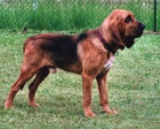
A bloodhound (also known as the St. Hubert hound and Sleuth Hound) is a large breed
Dog breed
Dog breeds are groups of closely related and visibly similar domestic dogs, which are all of the subspecies Canis lupus familiaris, having characteristic traits that are selected and maintained by humans, bred from a known foundation stock....

 of dog
Dog
The dog is a domesticated form of the Gray Wolf, a member of the Canidae family of the order Carnivora. The term is used for both feral and pet varieties. The domestic dog has been one of the most widely kept working and companion animals in human history...

 that was bred originally to hunt deer and wild boar, later specifically to track human beings by scent. It is famed for its ability to follow scents hours or even days old over great distances. Its extraordinarily keen nose is combined with a strong and tenacious tracking instinct, producing the ideal scenthound, and it is used by police and law enforcement the world over to track escaped prisoners, missing persons, and even missing animals.

Bloodhounds weigh from 33 to 50 kg (80 to 110 lb), although some individuals can weigh as much as 72 kg (160 lb).
Discussion
Ask a question about 'Bloodhound'
Start a new discussion about 'Bloodhound'
Answer questions from other users
Full Discussion Forum
 
Encyclopedia
A bloodhound (also known as the St. Hubert hound and Sleuth Hound) is a large breed
Dog breed
Dog breeds are groups of closely related and visibly similar domestic dogs, which are all of the subspecies Canis lupus familiaris, having characteristic traits that are selected and maintained by humans, bred from a known foundation stock....

 of dog
Dog
The dog is a domesticated form of the Gray Wolf, a member of the Canidae family of the order Carnivora. The term is used for both feral and pet varieties. The domestic dog has been one of the most widely kept working and companion animals in human history...

 that was bred originally to hunt deer and wild boar, later specifically to track human beings by scent. It is famed for its ability to follow scents hours or even days old over great distances. Its extraordinarily keen nose is combined with a strong and tenacious tracking instinct, producing the ideal scenthound, and it is used by police and law enforcement the world over to track escaped prisoners, missing persons, and even missing animals.

Appearance


Bloodhounds weigh from 33 to 50 kg (80 to 110 lb), although some individuals can weigh as much as 72 kg (160 lb). They stand 58 to 69 cm (23 to 27 inches) high at the withers. According to the AKC
American Kennel Club
The American Kennel Club is a registry of purebred dog pedigrees in the United States. Beyond maintaining its pedigree registry, this kennel club also promotes and sanctions events for purebred dogs, including the Westminster Kennel Club Dog Show, an annual event which predates the official...

 standard of the breed, larger dogs are to be preferred by conformation judges. The acceptable colors for bloodhounds are black and tan, liver and tan, or red. Bloodhounds possess an unusually large skeletal structure with most of their weight concentrated in their bones, which are very thick for their length. The coat is typical for a scenthound: hard and composed of fur alone, with no admixture of hair.

Temperament


This breed is a gentle dog which is nonetheless tireless in following a scent. Because of its strong tracking instinct, it can be willful and somewhat difficult to obedience train.
Bloodhounds have an affectionate, gentle, and even-tempered nature, so they make excellent family pets. However, like any large breed, they require supervision when around small children because they can knock them over with their bulk. Bloodhounds are also characterized by a stubborn "what's-in-it-for-me?" attitude, a likely cause (in conjunction with their size and propensity for excessive drooling) for the high rate, in comparison with other breeds, of bloodhounds given up for adoption once full-grown.

Illnesses


Compared to other purebred dogs, bloodhounds have an unusually high rate of gastrointestinal ailments, with bloat
Bloat
Bloat is a medical condition in which the stomach becomes overstretched by excessive gas content. It is also commonly referred to as torsion, gastric torsion, and gastric dilatation-volvulus when the stomach is also twisted. The word bloat is often used as a general term to cover gas distension...

 being the most common type of gastrointestinal problem. The breed also suffers an unusually high incidence of eye, skin, and ear ailments; thus these areas should be inspected frequently for signs of developing problems. Owners should be especially aware of the signs of bloat, which is both the most common illness and the leading cause of death of bloodhounds. The thick coat gives the breed the tendency to overheat quickly.

Lifespan and mortality


Bloodhounds in a 2004 UK Kennel Club survey had a median longevity of 6.75 years, which makes them one of the shortest-lived of dog breeds. The oldest of the 82 deceased dogs in the survey died at the age of 12.1 years. Bloat took 34% of the animals, making it the most common cause of death and the bloodhound the breed to lose the most to the condition. The second leading cause of death in the study was cancer, at 27%; this percentage is similar to other breeds, but the median age of death was unusually young (median of about 8 years).

History


The bloodhound was, according to legend, first bred ca. 1000 AD by monks at the St. Hubert Monastery in Belgium; its origins are likely in France, home of many of modern hounds. Its excellent tracking skills were drawn on in breeding other scenthounds, such as the English Foxhound
English Foxhound
The English Foxhound is one of the four foxhound breeds of dog. They are scent hounds, bred to hunt foxes by scent.-Appearance:The English Foxhound is about 21-25 inches tall to the withers, and weighs anywhere between 65-75 pounds, although some English Foxhounds bred for the show ring can be...

, American Foxhound
American Foxhound
The American Foxhound is a breed of dog that is cousin to the English Foxhound. They are scent hounds, bred to hunt foxes by scent.-Appearance:...

, Coonhound
Coonhound
A Coonhound is a type of scent hound and a member of the hound group.Coonhounds are an American style of hunting dog developed for the unique quarry and working conditions found in the United States. Coondogs are highly valued, and the locus of competition , although there is no recognized breed...

, Swiss Jura Hound, Bavarian Mountain Hound
Bavarian Mountain Hound
The Bavarian Mountain Hound is a breed of dog from Germany. It is a scent hound and has been used in Germany since the Middle Ages to trail wounded game. It is a cross between the Bavarian Hound, and the Hanover Hound.-Appearance:...

 and many others.

From ca. 1200 the monks of the Abbey of St Hubert annually sent several couple of their black hounds as a gift to the King of France. Writing in 1561 Jaques de Fouilloux describes them as strong of body, but with low, short legs. He says they have become mixed in breeding, so that they are now of all colours and widely distributed. Charles IX
Charles IX
Charles IX may refer to:* Charles IX of France * Charles IX of Sweden...

 of France 1550-74, recipient of the gift from the Abbey, describes them as pack-hounds of medium stature, and long in the body. He himself preferred the larger chiens-gris (dun-hounds), although they did not have such good noses. By the time of Louis XIV, they were already rare.. In 1788, D’Yauville who was master of the Royal hounds says those sent by the St Hubert monks, once much prized, had degenerated, and scarcely one of the annual gift of six or eight was now kept.

Upon the French Revolution
French Revolution
The French Revolution was a period of political and social upheaval and radical change in the history of France, during which the French governmental structure, previously an absolute monarchy with feudal privileges for the aristocracy and Catholic clergy, underwent radical change to forms based...

 of 1789 the gifts ceased, and hunting in France went into a decline till the end of the Napoleonic wars
Napoleonic Wars
The Napoleonic Wars were a series of conflicts declared against Napoleon's French Empire and changing sets of European allies by opposing coalitions that ran from 1803 to 1815. As a continuation of the wars sparked by the French Revolution of 1789, they revolutionized European armies and played...

. When it recovered during the 19th Century, huntsmen, with many breeds to choose from, seem to have had little interest in the St Hubert. An exception was Baron Le Couteulx de Canteleu, who tried to find them. He reported that there were hardly any to be found in France and those to be met with in the Ardennes had been so much crossed that they had not preserved the characteristics of the breed.

It was generally agreed among writers on the bloodhound in the last two centuries that the original St Hubert strain effectively died out in the nineteenth century, and that the European St Hubert owes its present existence to the development of the bloodhound in Britain.

References to the bloodhound begin to appear in English writing in the 14th century, in contexts which suggest it was well established by then. It is often claimed that its ancestors were brought over from Normandy by William the Conqueror, but there is no actual evidence for this. That the Normans brought hounds from Europe during the post-Conquest period is a virtual certainty, but whether they included the bloodhound itself, rather than the ancestors from which the bloodhound was subsequently developed, is a matter of dispute which is probably not resolvable on the basis of surviving evidence.

The typical use of the bloodhound, in hunting deer and boar, was as a ‘limer’, or ‘lyam-hound’. That is, it was handled on a leash or ‘lyam’, and hunted the cold scent of the animal. When it had ‘harboured’ the hart or boar (that is discovered where it was browsing or resting) the handler reported back to his lord, who then brought the smaller pack hounds (‘rache
Rache
Rache [] is an obsolete name for a kind of hunting-dog used in Britain in the Middle Ages. It was a scent hound used in a pack to run down and kill game, or bring it to bay...

s’) to pursue the quarry on its hot scent, when the animal was ‘unharboured’, or ‘upreared’. So the bloodhound was much valued for its ability to hunt the cold scent of an individual animal, and, though it did not usually take part in the kill, it was given a special reward from the carcase.

It also seems that from the earliest times the bloodhound was used to track people. There are stories written in the Medieval period of Robert the Bruce (in 1307), and William Wallace
William Wallace
Sir William Wallace was a Scottish knight and landowner who is known for leading a resistance during the Wars of Scottish Independence and is today remembered in Scotland as a patriot and national hero....

 (1270-1305) being followed by 'sleuth hounds’. Whether true or not, these stories show that the sleuth hound
Sleuth hound
The sleuth hound was a breed of dog. Broadly, it was a Scottish term for what in England was called the bloodhound, although it seems that there were slight differences between them....

 was already known as an animal which could follow a human scent almost infallibly, and it later becomes clear that the (Scottish) sleuth hound and the bloodhound were the same animal. Around the 16th century the bloodhound, sleuth hound, or ‘slough-dog’ was much used on the Scottish borders to track cross-border raiders, known as Border Reivers
Border Reivers
Border Reivers were raiders along the Anglo–Scottish border from the late 13th century to the end of the 16th century. Their ranks consisted of both Scottish and English families, and they raided the entire border country without regard to their victims' nationality...

. It was also used to track game poachers in deer-parks.

With the rise of fox-hunting, the decline of deer-hunting, and the extinction of the wild boar, as well as a more settled state of society, the use of the bloodhound diminished. It was kept on a few deer-parks and by a few enthusiasts, with some variation in type, until its popularity began to increase again with the rise of dog-showing in the 19th Century. Numbers, however, have remained low in Britain. Very few survived the Second World War, but the gene-pool has gradually been replenished with imports from America.

During the later 19th century numbers of bloodhounds were exported to Europe by French enthusiasts, who regretted the extinction of the ancient St Hubert. They wished to re-establish it, using the English bloodhound. Many of the finest specimens were bought, especially by Le Couteulx de Canteleu, and exhibited and bred in France as Chiens de St Hubert. Whatever few original St Huberts remained either died out or were absorbed into the new population. As a result, the bloodhound became known on parts of the Continent as the Chien de Saint Hubert, and is recognised under that name by the Federation Cynologique Internationale. Its country of origin is given by the FCI as Belgium, while the UK Kennel Club regards it as a native British breed, though accepting the European St Huberts as bloodhounds.

When the first bloodhounds were exported to the USA is not known. Bloodhounds were used to track runaway slaves before the American Civil War
American Civil War
The American Civil War , also known as the War Between the States and several other names, was a civil war in the United States of America. Eleven Southern slave states declared their secession from the United States and formed the Confederate States of America...

, but it has been questioned whether the dogs used were genuine bloodhounds. However, in the later part of the 19th century, and in the next, more pure bloodhounds were introduced from Britain, and bred in America, and they were much more widely used in tracking lost people and criminals - often with brilliant success - than in Britain.
In Britain there have been instances from time to time of the successful use of the bloodhound, to track criminals or missing people. However man-trailing is enjoyed as a sport by British bloodhound owners, through national working trials, and this enthusiasm has also spread to Europe. In addition while the pure bloodhound is used to hunt singly there are also several bloodhound packs which use bloodhounds with some degree of foxhound outcrossing to hunt the human scent.

Meanwhile the bloodhound has become a truly international breed, though numbers are small in most countries, with more in the USA than anywhere else. Following the spread of the bloodhound from Britain in the nineteenth and twentieth centuries, imports and exports and, increasingly, artificial insemination, are maintaining the world population as a common breeding stock, without a great deal of divergence in type in different countries.

The earliest known report of a trial of the bloodhound's trailing abilities comes from the great scientist Robert Boyle
Robert Boyle
Robert Boyle was a natural philosopher, chemist, physicist, inventor, and gentleman scientist, also noted for his writings in theology. He is best known for the formulation of Boyle's law...

, who describes how a bloodhound tracked a man seven miles along a route frequented by people, and found him in an upstairs room of a house.

The image on the right is the earliest known picture specifically published to show what a bloodhound was like. It was published in Zurich in 1563, in Conrad Gesner's Thierbuch (a compendium of animals).
It had the captions: 'Englischen Blüthund' and 'Canis Sagax Sanguinarius apud Anglos' (English scent hound with associations of blood). It was drawn from life by, or under the supervision of, John Caius
John Caius
John Caius , also known as Johannes Caius, was an English physician, and second founder of the present Gonville and Caius College, Cambridge.-Early years:...

, and sent to his friend Gesner in Switzerland. It suggests both how the bloodhound has changed, and how much of its conformation has survived. Caius (translated Fleming) describes it as a large hound, 'having lippes of great size and eares of no small lenghth.' (Note the collar, and long leash, or 'lyam', for tracking.)

Bloodhounds are now coloured red,black and tan or liver and tan; however, until Elizabethen times they also occurred in other solid colors, including white, and all other hound colours. It is possible that the Talbot Hound, now extinct, was a white bloodhound, but this is uncertain.

During the late 19th century, bloodhounds were frequent subjects for artists such as Edwin Landseer and Briton Riviere
Briton Rivière
Briton Rivière , Irish artist, was born in London.His father, William Rivière, was for some years drawing-master at Cheltenham College, and afterwards an art teacher at Oxford. He was educated at Cheltenham College and at Oxford, where he took his degree in 1867...

; the dogs depicted are close in appearance to modern bloodhounds, indicating that the essential character of the bloodhound predates modern dog breeding. However, the dogs depicted by Landseer show less wrinkle and haw
Nictitating membrane
The nictitating membrane is a transparent or translucent third eyelid present in some animals that can be drawn across the eye for protection and to moisten the eye while also keeping visibility...

 than modern dogs.

The Derivation of ‘Bloodhound’


Most recent accounts will say that the etymological meaning is ‘hound of pure or noble blood’. This derives from an original suggestion of Le Couteulx de Canteleu in the nineteenth century, which has been enthusiastically and uncritically espoused by later writers, perhaps because it absolved this undoubtedly good-natured dog from suggestions of bloodthirstiness. Neither Le Couteulx nor anyone since has offered any historical evidence to support this view. Before that the word had been taken to mean, roughly, ‘blood seeking hound’. This was the explanation put forward by John Caius, who was one of the most learned men of his time, and had an interest in etymology, in the sixteenth century. It is supported by considerable historical linguistic evidence, which can be gleaned from such sources as the Oxford English Dictionary (OED): the fact that first uses of the word ‘blood’ to refer to good breeding in an animal post date the first use of ‘bloodhound’; that other comparable uses, as in ‘blood-horse’ and ‘blood-stock’ appear many centuries later; and that derogatory uses of the word ‘bloodhound’, which any suggestion of noble breeding would sadly weaken, appear from as early as c1400. Other early sources tell us that hounds were supposed to have an interest in blood, and that the bloodhound was used to follow the trail of a wounded animal. In the absence of anything in early usage, or any historical evidence whatsoever, to support the modern explanation, the older must be regarded as correct.

Scenting ability


The bloodhound's physical characteristics account for its ability to follow a scent trail left several days in the past. Under optimal conditions, a bloodhound can detect as few as one or two cells. The bloodhound's nasal chambers(where scents are identified) are larger than those of most other breeds. The large, long pendent ears serve to prevent wind from scattering nearby skin cells while the dog's nose is on the ground; the folds of wrinkled flesh under the lips and neck—called the shawl—serve to catch stray scent particles in the air or on a nearby branch as the bloodhound is scenting, reinforcing the scent in the dog's memory and nose.

A common misconception is that bloodhounds are employed in packs; while this is sometimes the case in England, in North America bloodhounds are used as solitary trackers. When they are on a trail, bloodhounds are usually silent and do not give voice as other scenthounds.

Noteworthy Bloodhounds


Grafton was the bloodhound in Landseer's famous painting Dignity and Impudence (1839). Both dogs in the picture belonged to Jacob Bell.http://www.rpsgb.org.uk/informationresources/museum/exhibitions/jacobbell/patron/paintings/dignity_impudence.html

Mr T A Jennings' Ch Druid, known as 'Old Druid' was the first bloodhound champion. Born in 1857 he was later bought by Emperor Napoleon III for his son, Prince Eugene Louis Jean Joseph, and taken to France.

A bloodhound named Nick Carter is frequently cited as the archetype of the trailing bloodhound and the extensive publicity this dog received may be the source of much bloodhound-related folklore. Born in 1900, Nick Carter was owned and handled by Captain G.V. Mullikin of Lexington, Kentucky
Lexington, Kentucky
Lexington is the second-largest city in Kentucky and the 65th largest in the United States. Known as the "Thoroughbred City" and the "Horse Capital of the World", it is located in the heart of Kentucky's Bluegrass region...

; he is credited with more than 650 finds, including one that required him to follow a trail 105 hours old.

Ch. Heathers Knock on Wood, known as "Knotty", is one of the most awarded bloodhounds of all time; he has received more Best-in-Shows than any other bloodhound and is the first liver-and-tan bloodhound ever to win a Best-in-Show. Knotty was awarded the Best-in-Show at the Eukanuba Tournament in 2005 and won the Hound Group in the Westminster Kennel Club Show in that same year. Knotty's offspring have also proven to be able showdogs and as a result of a very high amount of his puppies being awarded the title of "Champion" by the AKC, Knotty was inducted into the AKC's Stud Dog Hall of Fame shortly before his death in Spring of 2008.

On the popular 1960's sitcom Beverly Hillbillies, veteran canine actor Stretch portrayed Jed's bloodhound Duke.

Fictional Bloodhounds

  • Pluto
    Pluto (Disney)
    Pluto is an animated cartoon character made famous in a series of Disney short cartoons. He has most frequently appeared as Mickey Mouse's pet dog. He also had an independent starring role in 48 Disney shorts in the 1930s, 1940s and 1950s...

    , pet of Mickey Mouse
    Mickey Mouse
    Mickey Mouse is a comic animal cartoon character who has become an icon for The Walt Disney Company. Mickey Mouse was created in 1928 by Walt Disney and Ub Iwerks and voiced by Walt Disney. The Walt Disney Company celebrates his birth as November 18, 1928 upon the release of Steamboat Willie...

    , from The Chain Gang
    The Chain Gang
    The Chain Gang is a Mickey Mouse animated film produced in 1930 by Walt Disney for Columbia Pictures. In this film Mickey is shown in a prison as an inmate performing jobs like smashing rocks. During a prison riot, Mickey manages to break out. Pluto makes his debut in this film as one of the...

  • Ol' Red
    Ol' Red
    "Ol' Red" is a song written by James "Bo" Bohan, Don Goodman and Mark Sherrill. The song was originally recorded by George Jones on his 1990 album You Oughta Be Here with Me and covered by Kenny Rogers on his 1993 album If Only My Heart Had a Voice, although neither artist released it as a single...

    , from the George Jones (later remade by Blake Shelton) song of the same name.
  • Ladybird from King of the Hill
    King of the Hill
    King of the Hill is an American animated series created by Mike Judge and Greg Daniels, that ran from January 12, 1997 to September 13, 2009 on Fox. It centers on the Hills, a small-town Methodist family in Arlen, Texas...

  • Huckleberry Hound
    Huckleberry Hound
    Hanna-Barbera's second series, made specifically for television, The Huckleberry Hound Show was a 1958 syndicated animated series, sponsored by Kellogg's. Three segments were included in the program: one featuring Huckleberry Hound; Yogi Bear and his sidekick Boo Boo; and Pixie and Dixie, two mice...

  • Copper
    Copper
    Copper is a chemical element with the symbol Cu and atomic number 29.It is a ductile metal with very high thermal and electrical conductivity. Pure copper is rather soft and malleable and a freshly-exposed surface has a pinkish or peachy color...

     from the film
    The Fox and the Hound (film)
    The Fox and the Hound is a 1981 animated feature produced by Walt Disney Productions which premiered in the United States on July 10, 1981. The twenty-fourth animated feature in the Walt Disney Animated Classics series, the film is loosely based on the Daniel P...

     and novel
    The Fox and the Hound (novel)
    The Fox and the Hound is a 1967 novel written by Daniel P. Mannix and illustrated by John Schoenherr. It follows the lives of Tod, a red fox raised by a human for the first year of his life, and Copper, a half-bloodhound dog owned by an area hunter...

     The Fox and the Hound
  • Beaureguard in Pogo
    Pogo
    Pogo was the title and central character of a long-running daily comic strip created by Walt Kelly. Set in the Okefenokee Swamp of the southeastern United States, the strip often engaged in social and political satire through the adventures of its anthropomorphic funny animal characters.Pogo...

  • Pedro, the bloodhound owned and used by the English detective, Sexton Blake
    Sexton Blake
    Sexton Blake is a fictional detective who appeared in many British comic strips and novels throughout the 20th century, described by Professor Jeffrey Richards on the BBC in 'The Radio Detectives' in 2003 as "the poor man's Sherlock Holmes"...

    .
  • Henry, a bloodhound used in a popular series of British TV dog food commercials, with Clement Freud
    Clement Freud
    Sir Clement Raphael Freud was an English broadcaster, writer, politician and chef.-Early life:Freud was born in Berlin, the son of Jewish parents Ernst Ludwig Freud, an architect, and Lucie née Brasch. He was the grandson of psychoanalyst Sigmund Freud and the brother of artist Lucian Freud...

    .
  • Trusty in "Lady and the Tramp
    Lady and the Tramp
    Lady and the Tramp is a American animated feature film produced by Walt Disney and released to theaters on June 22, 1955, by Buena Vista Distribution. The fifteenth animated feature in the Walt Disney Animated Classics series, it was the first animated feature filmed in the CinemaScope widescreen...

    " and "Lady and the Tramp 2"
  • Snuffles in Quick Draw McGraw
    Quick Draw McGraw
    Quick Draw McGraw is an anthropomorphic cartoon horse starring in The Quick Draw McGraw Show, the third cartoon television production created by Hanna-Barbera following their success with The Ruff & Reddy Show and The Huckleberry Hound Show. The show debuted in syndication in the fall of 1959,...

  • Napoleon from The Aristocats
    The Aristocats
    The Aristocats is an animated feature produced and released by Walt Disney Productions in 1970. The twentieth animated feature in the Walt Disney Animated Classics series, the film is based on a story by Tom McGowan and Tom Rowe, and revolves around a family of aristocratic cats, and how an alley...

  • Duke, Jed's bloodhound from the Beverly Hillbillies
  • Hubert from Best in Show
    Best in Show (film)
    Best in Show is a 2000 mockumentary that follows five entrants in a prestigious dog show. The film focuses on the slightly surreal interactions among the various owners and handlers as they travel to the show and compete. Much of the dialogue was improvised.Christopher Guest directed; he also...

  • Bobby Lee and others from Virginia Lanier's bloodhound series
  • Buddy, in Cats and Dogs
  • Bruno in Cinderella (1950 film)
    Cinderella (1950 film)
    Cinderella is a American animated feature produced by Walt Disney and based on the fairy tale "Cendrillon" by Charles Perrault. Twelfth in the Walt Disney Animated Classics series, the film had a limited release on February 15, 1950 by RKO Radio Pictures. Directing credits go to Clyde Geronimi,...

  • The Bumpuses' hounds in A Christmas Story
    A Christmas Story
    A Christmas Story is a 1983 American/Canadian comedy film based on the short stories and semi-fictional anecdotes of author and raconteur Jean Shepherd, including material from his books In God We Trust, All Others Pay Cash and Wanda Hickey's Night of Golden Memories. It was directed by Bob Clark...

  • McGruff the Crime Dog
    McGruff the Crime Dog
    McGruff the Crime Dog is an anthropomorphic cartoon bloodhound created for the National Crime Prevention Council for use by American police in building crime awareness among children. He debuted in July 1980. The character was created by John Young. The motto "Take a Bite out of Crime" was...

  • Jasper T. Jowls at Chuck E. Cheese's
    Chuck E. Cheese's
    Chuck E. Cheese's is a chain of family entertainment centers. Chuck E...

  • 2nd book in the Provost's Dog
    Provost's Dog
    The Provost's Dog trilogy is an ongoing series of young adult fantasy novels by best-selling author Tamora Pierce. The series is a prequel to Pierce's first quartet, The Song of the Lioness, and is set in the fictional kingdom of Tortall two hundred years earlier...

     trilogy or Beka Cooper series by Tamora Pierce
    Tamora Pierce
    Tamora Pierce is an author of fantasy literature for young adults. She is an alumna of the University of Pennsylvania...

  • General Pepper from Star Fox (series)
  • Bear & Bryant in Sweet Home Alabama
  • Pommes Frites, faithful and remarkable companion of Michael Bond
    Michael Bond
    Michael Bond, OBE, is an English author, most celebrated for his Paddington Bear series of books.Bond was educated at Presentation College, a Catholic school in Reading...

    's culinary detective, Monsieur Pamplemousse
  • Old Towser in "One Hundred and One Dalmatians
    One Hundred and One Dalmatians
    One Hundred and One Dalmatians is a American animated feature produced by Walt Disney and based on the novel The Hundred and One Dalmatians by Dodie Smith...

    "
  • Waylon and Floyd in The Fox and the Hound 2
    The Fox and the Hound 2
    The Fox and the Hound 2 is a 2006 direct-to-video midquel to the 1981 Disney animated film The Fox and the Hound. It was produced by DisneyToon Studios, directed by Jim Kammerud, and features the voice talents of Patrick Swayze and Reba McEntire. The story of the film takes place during the youth...

    "

Additional Reading


Boitard, Jean-Pierre, Le Chien de Saint-Hubert, éditions Artémis 2002. ISBN 2-84416-155-3

External links
