
|
|
|
|
Lake Okeechobee
|
| |
|
| |
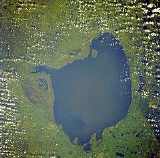
Lake Okeechobee, (IPA: ) locally referred to as Lake O or The Big Lake is a freshwater lake in the U.S. state of Florida. It is the second-largest freshwater lake wholly within the continental United States, second only to Lake Michigan and the largest in the southern United States. Okeechobee covers 730 square miles (1,890 kmē) and is relatively shallow, with an average depth of only 9 feet (3 m). The lake covers land in Glades, Okeechobee, Martin, Palm Beach, and Hendry counties. Maps of Florida show that all five of these counties meet at a point near the center of the lake.
The name Okeechobee comes from the Hitchiti words "oki" (water) and "chubi" (big), and literally means "big water". It was also previously called Macaco and Mayaimi, the latter being the origin of the name of the city Miami, Florida by way of the Miami River.
The floor of the lake is a limestone basin, and the lake varies in depth from 1 to 12 feet (0.3 to 4 m), its water being somewhat murky from nutrient-enriched runoff from surrounding farmlands. The surface is above sea level, and the lake is enclosed by a 20-foot (6 m) high dike built by the U.S. Army Corps of Engineers after a hurricane in 1928 breached the old dike, flooding surrounding communities and claiming thousands of lives. There are several inflows, including Taylor Creek and the Kissimmee River, and several small outlets, such as the Miami River, the New River on the east, and the Caloosahatchee River (via the Caloosahatchee Canal and Lake Hicpochee) on the southwest.
HistoryOkeechobee is thought to have been formed out of the ocean about 6,000 years ago when the waters receded.
Hurricanes In 1926, the Great Miami Hurricane hit the Lake Okeechobee area killing approximately 300 people. Two years later in 1928, the Okeechobee Hurricane crossed over the lake killing thousands. The Red Cross reported a figure of 1,836 deaths which the National Weather Service initially accepted; but in 2003, the number was revised to "at least 2,500" . In both cases the catastrophe was caused by flooding from a storm surge when strong winds drove water over the 6-foot (2 m) mud dike that circled the lake at the time.
After the two hurricanes, the Florida State Legislature formed the "Okeechobee Flood Control District". The organization was authorized to cooperate with the U.S. Army Corps of Engineers in actions to prevent similar disasters. U.S. President Herbert Hoover visited the area personally, and afterward the Corps designed a new plan incorporating construction of channels, gates, and levees. The Okeechobee Waterway was officially opened on March 23 1937, when a series of boats left Fort Myers, Florida on March 22 and on the next day arrived at Stuart, Florida.
The 1947 Fort Lauderdale Hurricane sent an even larger storm surge nearly over the new dike, causing it to be expanded again in the 1960s.
Three recent hurricanes, Hurricane Frances, Hurricane Jeanne and Hurricane Wilma, had no major adverse effects on communities surrounding Lake Okeechobee.
National Scenic TrailThe 20 foot (6 m) wide dike surrounding Lake Okeechobee is a part of the Florida Trail, a 1,400 mile long trail that is a National Scenic Trail. There is a well-maintained paved pathway along the entire perimeter used by hikers and bicyclists and wide enough to accommodate authorized vehicles.
FishingLake Okeechobee is a popular fishing location, supporting both recreational and some commercial fishing. Among the fish that are commonly caught in the lake are Bluegill, Largemouth Bass and Crappie.
WildlifeIn addition to the fish population, the American Alligator is very common in the lake. A lot of birds live around the lake as well including the Great Blue Heron, Bald Eagle, Osprey and Turkey Vulture, as well as many seasonal birds that migrate through the area.
Rim CanalDuring construction of the dike, earth was excavated along its perimter, resulting in a deep channel which runs along the perimeter of the lake. In places this is on the permiter of the lake, in others it is separated from the open lake by low grassy islands. During the drought of 2007-2008 this canal remained navigable while much of surrounding areas were too shallow or even above the water line. Even when the waters are higher, navigating the open lake can be tricky, whereas the rim canal is simple, so to reach a specific location in the lake it is often easiest to go around the rim canal to get close then take one of the many channels into the lake.
Environmental concernsIn 2007, during a drought, state water and wildlife managers removed thousands of truckloads of toxic mud from the lake's floor, in an effort to return to the lake's natural sandy base and create clearer water and better habitat for wildlife. The mud contained elevated levels of arsenic and other pesticides. According to tests from the South Florida Water Management District, arsenic levels on the northern part of the lake bed were as much as four times the limit for residential land. Independent tests found the mud to be too polluted for use on agricultural or commercial lands, and therefore difficult to even dispose on land.
Through 2008, the lake remained well below normal levels with large portions of the lake bed exposed above the water line. During this time large portions of the lake bed, which was covered in organic matter dried out and caught fire.
The lake in popular cultureLake Okeechobee and the Everglades feature as a backdrop for the 1951 Gary Cooper film, Distant Drums.
Lake Okeechobee is the setting of a climactic scene in Carl Hiaasen's 2002 novel Basket Case (Ch. 28).
Lake Okeechobee is the setting of a significant part of Zora Neale Hurston's novel Their Eyes Were Watching God, and the movie of the same name. Janie and Tea Cake go there to work "on the muck".
|
| |
|
|