
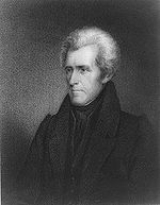
The
Indian Removal Act, part of a United States government policy known as
Indian removalIndian Removal was a nineteenth century policy of the government of the United States to relocate Native American tribes living east of the Mississippi River to lands west of the river...
, was signed into law by
PresidentThe President of the United States is the head of state and head of government of the United States and is the highest political official in the United States by influence and recognition...
Andrew JacksonAndrew Jackson was the seventh President of the United States . He was military governor of Florida , commander of the American forces at the Battle of New Orleans , and eponym of the era of Jacksonian democracy...
(D) on May 26, 1830.-19), the U.S. House passed it on 26 May 1830 (102-97); Francis Paul Prucha,
The Great Father: The United States Government and the American Indians, Volume I (Lincoln: University of Nebraska Press, 1984), p. 206.
The Removal Act was strongly supported in the South, where states were eager to gain access to lands inhabited by the "
Five Civilized TribesThe Five Civilized Tribes is the term applied to five Native American nations, the Cherokee, Chickasaw, Choctaw, Creek, and Seminole, considered civilized by white settlers during that time period because they adopted many of the colonists' customs and had generally good relations with their...
".
The
Indian Removal Act, part of a United States government policy known as
Indian removalIndian Removal was a nineteenth century policy of the government of the United States to relocate Native American tribes living east of the Mississippi River to lands west of the river...
, was signed into law by
PresidentThe President of the United States is the head of state and head of government of the United States and is the highest political official in the United States by influence and recognition...
Andrew JacksonAndrew Jackson was the seventh President of the United States . He was military governor of Florida , commander of the American forces at the Battle of New Orleans , and eponym of the era of Jacksonian democracy...
(D) on May 26, 1830.-19), the U.S. House passed it on 26 May 1830 (102-97); Francis Paul Prucha,
The Great Father: The United States Government and the American Indians, Volume I (Lincoln: University of Nebraska Press, 1984), p. 206.
The Removal Act was strongly supported in the South, where states were eager to gain access to lands inhabited by the "
Five Civilized TribesThe Five Civilized Tribes is the term applied to five Native American nations, the Cherokee, Chickasaw, Choctaw, Creek, and Seminole, considered civilized by white settlers during that time period because they adopted many of the colonists' customs and had generally good relations with their...
". In particular,
GeorgiaGeorgia is a state in the United States. One of the original Thirteen Colonies that revolted against British rule in the American Revolution, it had been the last of the Thirteen Colonies to be established, in 1733. Georgia was the fourth state to ratify the United States Constitution, on January...
, the largest state at that time, was involved in a contentious jurisdictional dispute with the
CherokeeThe Cherokee are a Native American people from the Southeastern United States...
nation. President Jackson hoped removal would resolve the Georgia crisis. The Indian Removal Act was also very controversial. While Indian removal was, in theory, supposed to be voluntary, in practice great pressure was put on American Indian leaders to sign removal treaties. Most observers, whether they were in favor of the Indian removal policy or not, realized that the passage of the act meant the inevitable removal of most Indians from the states. Some Native American leaders who had previously resisted removal now began to reconsider their positions, especially after Jackson's landslide re-election in 1832.
Most European Americans favored the passage of the Indian Removal Act, though there was significant opposition. Many
ChristianA Christian is a person who adheres to Christianity, an Abrahamic, monotheistic, religion based on the life and teachings of Jesus of Nazareth, who Christians believe was the Messiah prophesied in the Old Testament/Hebrew Bible, and the Son of God.The term "Christian" is also used adjectivally to...
missionariesA missionary is a member of a religion who works to convert those who do not share the missionary's faith; someone who proselytizes. The word "mission" is derived from the Latin missioninimus A missionary is a member of a religion who works to convert those who do not share the missionary's faith;...
, most notably missionary organizer
Jeremiah EvartsJeremiah F. Evarts was a Christian missionary, reformer, and activist for the rights of American Indians in the United States, and a leading opponent of the Indian removal policy of the United States government.-Early years:...
, protested against passage of the Act. In Congress,
New Jersey SenatorThe United States Senate is the upper house of the bicameral United States Congress, the lower house being the House of Representatives. The composition and powers of the Senate and the House are established in Article One of the U.S. Constitution . Each U.S state is represented by two senators,...
Theodore FrelinghuysenTheodore Frelinghuysen was an American politician, serving as New Jersey Attorney General, United States Senator, and Mayor of Newark, New Jersey before running as a candidate for Vice President with Henry Clay on the Whig ticket in the election of 1844...
and Congressman David Crockett of
TennesseeTennessee is a state located in the Southeastern United States. According to the 2008 census, it has a population of 6,214,888, an increase of nearly 9.5% since 2000. Tennessee is the 14th fastest growing state in the US and is ranked 17th by population. It is ranked 36th by total land area. In...
spoke out against the legislation. The Removal Act was passed after bitter debate in Congress.
The Removal Act paved the way for the reluctant—and often forcible—emigration of tens of thousands of American Indians to the West. The first removal treaty signed after the Removal Act was the
Treaty of Dancing Rabbit CreekThe Treaty of Dancing Rabbit Creek was a treaty signed on September 27, 1830 between the Choctaw and the United States Government. This was the first removal treaty carried into effect under the Indian Removal Act...
on September 27, 1830, in which
ChoctawThe Choctaw are a Native American people originally from the Southeastern United States . They are of the Muskogean linguistic group...
s in
MississippiMississippi is a state located in the Southern United States. Jackson is the state capital and largest city. The state's name comes from the Mississippi River, which flows along its western boundary, and takes its name from the Ojibwe word misi-ziibi . The state is heavily forested outside of the...
ceded land east of the river in exchange for payment and land in the West. Choctaw chief (thought to be Thomas Harkins or Nitikechi) quoted to the Arkansas Gazette that the 1831 Choctaw removal was a "
trail of tears and death." The
Treaty of New EchotaThe Treaty of New Echota was a treaty signed on December 29, 1835 in New Echota, Georgia by officials of the United States government and representatives of a minority Cherokee political faction. The treaty was amended and ratified in March 1836. The treaty established terms under which the entire...
(signed in 1835) resulted in the removal of the Cherokee on the
Trail of TearsThe Trail of Tears was the relocation and movement of Native Americans in the United States from their homelands to Indian Territory in the Western United States. The phrase originated from a description of the removal of the Choctaw Nation in 1831...
. The Seminoles did not leave peacefully as did other tribes; along with fugitive slaves they resisted the removal. The Second Seminole War lasted from 1835 to 1842 and resulted in the forced removal of Seminoles, only a small number to remain, and around 3,000 were killed amongst American soldiers and Seminoles.
In 1823 the Supreme Court handed down a decision (
Johnson v. M'IntoshJohnson v. M'Intosh, 21 U.S. 543 , was a case in which the Supreme Court of the United States held that private citizens could not purchase lands directly from Native Americans...
) which stated that Indians could occupy lands within the United States, but could not hold title to those lands.
See also
- Cherokee Nation v. Georgia
Cherokee Nation v. Georgia, , was a United States Supreme Court case.- Background :On December 20, 1828, the state of Georgia, fearful that the United States would not effect the removal of the Cherokee Nation tribal band from their historic lands in Georgia; enacted a series of laws which...
- Worcester v. Georgia
Worcester v. Georgia, 31 U.S. 515 , was a case in which the United States Supreme Court held that Cherokee Native Americans were entitled to federal protection from the actions of state governments which would infringe on the tribe's sovereignty.-The Case:Georgia law required all whites living in...
- Treaty of New Echota
The Treaty of New Echota was a treaty signed on December 29, 1835 in New Echota, Georgia by officials of the United States government and representatives of a minority Cherokee political faction. The treaty was amended and ratified in March 1836. The treaty established terms under which the entire...
- Five Civilized Tribes
The Five Civilized Tribes is the term applied to five Native American nations, the Cherokee, Chickasaw, Choctaw, Creek, and Seminole, considered civilized by white settlers during that time period because they adopted many of the colonists' customs and had generally good relations with their...
- Cherokee Indians
- Creek Indians
- Indian removal
Indian Removal was a nineteenth century policy of the government of the United States to relocate Native American tribes living east of the Mississippi River to lands west of the river...
- List of Choctaw Treaties
External links