
Encyclopedia
The
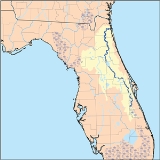
St. Johns River is the longest
river in the
U.S. state of
Florida, stretching 310 miles from
Indian River County to the
Atlantic Ocean in
Duval County. The St. Johns river is the longest river in the United States that flows north. It was designated as one of the
American Heritage Rivers in 1997.
The elevation change from headwaters to mouth is only about 30 feet, making the St. Johns one of the world's "laziest" rivers. This slow flow makes it difficult for pollutants to be flushed from the waters, which has become a serious problem for the river ecosystem. Still, the river is home to numerous species of plants and animals. It is not uncommon to see
dolphins in the river north of
Jacksonville,
manatees in the springtime when the water warms up,
alligators,
bald eagles,
ospreys,
stingrays, and many species of fish, both salt and fresh water.
History and names
More than 100,000 years ago, the area of land that now comprises the river was connected to the Atlantic Ocean for most, if not all, of its length, making the river nothing more than an extended system of lagoons and tributaries. As the ocean levels dropped, barrier islands and reef formations effectively walled off the system of lagoons from the ocean, forming the river. This unusual geologic past explains why a river of this size arose with such little drop in elevation from source to mouth .
The river basin was the home to the native
Timucua tribes, who called it
Welaka, or "river of lakes".
In the early 1500s, Spanish explorers called the river
Río de Corrientes, or "river of currents".
An expedition of French
Huguenots landed at the mouth of the river on May 1, 1562, and thus called it
Rivière du Mai, or "river of May". In 1564, a bluff overlooking this site became the location of
Fort Caroline, the first
French colony in North America. This fort was captured by the Spanish from St. Augustine a little over a year after it was founded.
The conquering Spanish renamed the river
San Mateo, after Saint Matthew, whose feast day fell the day after their victory over the French.
A
Catholic mission named San Juan del Puerto was founded on Fort St. George Island near the river's mouth around 1578, and in time the river came to be known as
Río de San Juan. This was translated St. Johns River in English, and this name has remained intact through colonization, war, and the creation of the United States.
The three basins
The upper basin of the river has indistinct banks, with numerous
sloughs and
lagoons, often pooling into ponds and lakes. Some of the larger lakes are known today as Lake Hell 'n' Blazes, Sawgrass Lake,
Lake Washington, Lake Winder, Lake Poinsett, Ruth Lake, Puzzle Lake, Lake Harney, Lake Jesup and Lake Monroe.
Below Lake Harney, the river is joined by the Econlockhatchee River, and runs between higher bluffs on either side, forming the middle basin. This part of the river runs through what is now the Ocala National Forest. After the English acquisition of Florida from Spain in 1762, English explorer
William Bartram was sent by
King George III to explore the territory. In his subsequent book
Travels, Bartram called the middle basin a "...blessed land where the gods have amassed into one heap all the flowering plants, birds, fish and other wildlife of two continents in order to turn the rushing streams, the silent lake shores and the awe-abiding woodlands of this mysterious land into a true garden of Eden." Here the river forms the broad and shallow Lake George, where marine sharks have been seen in drought years where the normally rain-fed freshwaters of the river cannot fight back the inflowing Atlantic salt water.
The lower basin begins where the largest tributary of the St. Johns, the Ocklawaha River, joins the flow. It passes through the historic city of Palatka, Florida, then through unspoiled riverine bottomland hardwoods, pine flatwoods and sandhill communities, on its way to Jacksonville.
Past Green Cove Springs, the river becomes an
estuary, where fresh and salt water meet, and a wide diversity of living species inhabit the islands, inlets, sounds, streams and marshes of the area.
Fishing
The St. Johns is known for excellent fishing, especially
largemouth bass. Its estuarial nature provides both freshwater and saltwater or brackish-water species. Saltwater species include redfish, red drum, flouder, tarpon, and the brackish water
sea trout ,known locally as the "gator trout". A recent report states that saltwater species have been venturing farther up the river in recent years.
Some of the best known fishing occurs in January–March, when the
American shad run up the river, and it becomes full of trolling boats. The shad, like the salmon, are anadromous and live most of their life at sea. They are caught primarily for the eggs, shad roe, for the flesh is below average and full of small bones.
Port city of Jacksonville
As the St. Johns River flows through the city of
Jacksonville, Florida it is spanned by seven bridges . The Jacksonville Port Authority facilities at the mouth of the St. Johns river make up Florida's second largest
port. In fiscal year
2003, JAXPORT handled over 1,500 ships, delivering almost 700,000 containers and over 500,000 cars. Some of the major local commodities include
gypsum and
oil.
The
U.S. Navy maintains the Naval Air Station Jacksonville and Naval Station Mayport near the river's mouth.
See also
External links
-
- William Bartram explores the St. John's River, just south of St. Augustine, Florida, in April of 1774.
- Account of redfish increasing in the St. Johns while black bass decrease.