

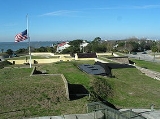
Fort Moultrie National Monument

Encyclopedia
Citadel
A citadel is a fortress for protecting a town, sometimes incorporating a castle. The term derives from the same Latin root as the word "city", civis, meaning citizen....
s on Sullivan's Island, South Carolina
Sullivan's Island, South Carolina
Sullivan's Island is a town in Charleston County, South Carolina, United States, on a similarly named island at the entrance to Charleston Harbor. The population was 1,911 at the 2000 census. It is also the site of a major battle of the American Revolution at Fort Sullivan on June 28, 1776. As...
, built to protect the city of Charleston, South Carolina
Charleston, South Carolina
Charleston is the second largest city in the U.S. state of South Carolina. It was made the county seat of Charleston County in 1901 when Charleston County was founded. The city's original name was Charles Towne in 1670, and it moved to its present location from a location on the west bank of the...
. The first fort, built of palmetto logs, inspired the flag
Flag of South Carolina
The flag of the state of South Carolina dates back to 1765 when opponents of the Stamp Act marched in protest behind a blue flag bearing three white crescents. In 1775 Colonel William Moultrie was asked by the Revolutionary Council of Safety to design a flag for the South Carolina troops to use...
and nickname (Palmetto State) of South Carolina
South Carolina
South Carolina is a state in the Deep South of the United States that borders Georgia to the south, North Carolina to the north, and the Atlantic Ocean to the east. Originally part of the Province of Carolina, the Province of South Carolina was one of the 13 colonies that declared independence...
. It is named in honour of the commander in the Battle of Sullivan's Island
Battle of Sullivan's Island
The Battle of Sullivan's Island or the Battle of Fort Sullivan was fought on June 28, 1776, during the American Revolutionary War, also known as the American War of Independence. It took place near Charleston, South Carolina, during the first British attempt to capture the city from American rebels...
, General William Moultrie
William Moultrie
William Moultrie was a general from South Carolina in the American Revolutionary War.He was born in Charleston, South Carolina. He fought in the Anglo-Cherokee War and served in the colonial assembly before the advent of the American Revolution....
.
Fort Moultrie is the only area of the National Park System where the entire 171-year history of American seacoast defense (1776–1947) can be traced.
American Revolution
South Carolina patriots began to build a fort to guard Charleston, South CarolinaCharleston, South Carolina
Charleston is the second largest city in the U.S. state of South Carolina. It was made the county seat of Charleston County in 1901 when Charleston County was founded. The city's original name was Charles Towne in 1670, and it moved to its present location from a location on the west bank of the...
, harbor in 1776. British Admiral Sir Peter Parker with nine British warships attacked the fort—still unnamed and incomplete—on June 28, 1776, near the beginning of the American Revolutionary War
American Revolutionary War
The American Revolutionary War , the American War of Independence, or simply the Revolutionary War, began as a war between the Kingdom of Great Britain and thirteen British colonies in North America, and ended in a global war between several European great powers.The war was the result of the...
. The soft palmetto logs did not crack under bombardment but rather absorbed the shot; cannon balls reportedly even bounced off the walls of the structure. William Moultrie
William Moultrie
William Moultrie was a general from South Carolina in the American Revolutionary War.He was born in Charleston, South Carolina. He fought in the Anglo-Cherokee War and served in the colonial assembly before the advent of the American Revolution....
commanded the 2nd South Carolina Regiment for the revolutionary patriots in this battle. The fort took its name Fort Moultrie in his honor. Charleston locals celebrate 'Carolina Day' to commemorate the bravery of the defenders of the fort.
The British eventually captured Fort Moultrie in the Siege of Charleston
Siege of Charleston
The Siege of Charleston was one of the major battles which took place towards the end of the American Revolutionary War, after the British began to shift their strategic focus towards the American Southern Colonies. After about six weeks of siege, Continental Army Major General Benjamin Lincoln...
in spring 1780. Nevertheless, the colonists won the war, and British troops departed in 1782.
Early federal period
Great BritainGreat Britain
Great Britain or Britain is an island situated to the northwest of Continental Europe. It is the ninth largest island in the world, and the largest European island, as well as the largest of the British Isles...
and France
France
The French Republic , The French Republic , The French Republic , (commonly known as France , is a unitary semi-presidential republic in Western Europe with several overseas territories and islands located on other continents and in the Indian, Pacific, and Atlantic oceans. Metropolitan France...
began another war in 1793, heightening tensions. The United States of America thence embarked on a systematic fortification of important harbors. Atop the decayed original Fort Moultrie, the Army completed a new fort in 1798; the Army also built nineteen other new forts along the Atlantic coast. A hurricane destroyed Fort Moultrie in 1804, and a brick fort replaced it in 1809.
Fort Moultrie changed little over the next five decades. The Army altered the parapet and modernized the armament, but defense of Charleston centered increasingly around newly created Fort Sumter
Fort Sumter
Fort Sumter is a Third System masonry coastal fortification located in Charleston Harbor, South Carolina. The fort is best known as the site upon which the shots initiating the American Civil War were fired, at the Battle of Fort Sumter.- Construction :...
. By the time of the American Civil War
American Civil War
The American Civil War was a civil war fought in the United States of America. In response to the election of Abraham Lincoln as President of the United States, 11 southern slave states declared their secession from the United States and formed the Confederate States of America ; the other 25...
, Fort Moultrie, Fort Sumter, Fort Johnson, and Castle Pinckney
Castle Pinckney
Castle Pinckney was a small masonry fortification constructed by the United States government by 1810 in the harbor of Charleston, South Carolina...
surrounded and defended Charleston.
Fort Moultrie nevertheless began to record meteorological observations in the early 1820s.
The Army detained Seminole Indian fighter Osceola
Osceola
Osceola, also known as Billy Powell , became an influential leader with the Seminole in Florida. He was of Creek, Scots-Irish and English parentage, and had migrated to Florida with his mother after the defeat of the Creek in 1814.Osceola led a small band of warriors in the Seminole resistance...
and some fellow Seminole prisoners at Fort Moultrie late 1837. Osceola died of malaria in January 1838; the Army buried his corpse at Fort Moultrie and thereafter maintained his grave.
Civil War
South Carolina seceded from the Union on December 20, 1860. Unlike their counterparts at the other forts, defenders of Fort Moultrie chose not to surrender to the South Carolina forces. On December 26, 1860, Union Major Robert Anderson moved his garrison at Fort Moultrie to the stronger Fort SumterFort Sumter
Fort Sumter is a Third System masonry coastal fortification located in Charleston Harbor, South Carolina. The fort is best known as the site upon which the shots initiating the American Civil War were fired, at the Battle of Fort Sumter.- Construction :...
. On February 8, 1861, South Carolina joined other seceded Deep Southern states to form the Confederate States of America
Confederate States of America
The Confederate States of America was a government set up from 1861 to 1865 by 11 Southern slave states of the United States of America that had declared their secession from the U.S...
. In April 1861, Confederate troops shelled Fort Sumter into submission and the American Civil War
American Civil War
The American Civil War was a civil war fought in the United States of America. In response to the election of Abraham Lincoln as President of the United States, 11 southern slave states declared their secession from the United States and formed the Confederate States of America ; the other 25...
began.
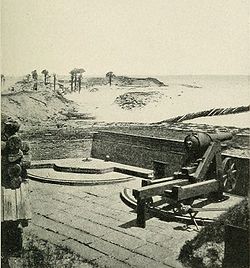
In April 1863, Federal ironclads and shore batteries began a bombardment of Fort Moultrie and the other forts around Charleston harbor. Over the ensuing twenty months, Union bombardment reduced Fort Sumter to a rubble pile and pounded Fort Moultrie below a sand hill, which protected it against further Union bombardment. The Rifled cannon proved its superiority to brickwork fortifications but not to the endurance of the Confederate artillerymen who continued to man Fort Moultrie. In February 1865, the Confederate Army finally abandoned the rubble of Fort Moultrie and evacuated the city of Charleston, South Carolina.
Postbellum period
The Army modernized Fort Moultrie in the 1870s with huge rifled cannon and deep concrete bunkers. Further modernization in the 1880s turned all of Sullivan's Island surrounding the old fort into a military complex.The fort evolved with the times through and beyond World War II
World War II
World War II, or the Second World War , was a global conflict lasting from 1939 to 1945, involving most of the world's nations—including all of the great powers—eventually forming two opposing military alliances: the Allies and the Axis...
. Seacoast defense of the United States ceased as a viable strategy by 1947.
Decommissioning
The Department of Defense in 1960 turned Fort Moultrie to National Park ServiceNational Park Service
The National Park Service is the U.S. federal agency that manages all national parks, many national monuments, and other conservation and historical properties with various title designations...
. The National Park Service manages the historic fort as a unit of Fort Sumter National Monument. The National Park Service constructed the fort as a tour backward in time through its defenses from World War II back to the palmetto log fort of William Moultrie.
The National Register of Historic Places listed Fort Moultrie Quartermaster and Support Facilities Historic District on September 6, 2007. In 2016, the "America the Beautiful" quarter for South Carolina will feature "Fort Moultrie (Fort Sumter National Monument)."