

.gif)
Samson and Delilah (opera)

Encyclopedia
Samson and Delilah Op. 47, is a grand opera
in three acts and four scenes by Camille Saint-Saëns
to a French
libretto
by Ferdinand Lemaire
. It was first performed in Weimar
at the Grossherzogliches (Grand Ducal) Theater (now the Staatskapelle Weimar
) on 2 December 1877 in a German
translation.
The opera is based on the Biblical
tale of Samson
and Delilah
found in Chapter 16 of the Book of Judges
in the Old Testament
. It is the only opera by Saint-Saëns that is regularly performed. The second act love scene in Delilah's tent is one of the set pieces that define French opera
. Two of Delilah's aria
s are particularly well known: "Printemps qui commence" and "Mon cœur s'ouvre à ta voix" ("My heart opens itself to your voice", also known as "Softly awakes my heart"), the latter of which is one of the most popular recital pieces in the mezzo-soprano
/contralto
repertoire.
swept France, and Saint-Saëns, an admirer of the oratorio
s of Handel
and Mendelssohn
, made plans to compose an oratorio on the subject of Samson and Delilah as suggested by Voltaire
's libretto Samson for Rameau
. The composer began work on the theme in 1867, just two years after completing his first (and as then yet unperformed) opera, Le timbre d'argent. Saint-Saëns had approached Ferdinand Lemaire
, the husband of one of his wife's cousins, about writing a libretto for the oratorio but Lemaire convinced the composer that the story was better suited to an opera.
Saint-Saëns later wrote:
 After Lemaire finished the libretto, Saint-Saëns began actively composing act 2 of the opera, producing an aria
for Dalila, a duet for Samson and Dalila, and some musical pieces for the chorus (some of which were later assigned to act 1) during 1867–1869. From the very beginning, the work was conceived as a grand duet between Samson and Dalila set off against the approaching tempest. Although the orchestration was not yet complete, act 2 was presented in a private performance in 1870 just prior to the outbreak of the Franco-Prussian War
with Saint-Saëns playing the orchestral parts, which were largely improvised, on the piano. Composer Augusta Holmès
(Dalila), painter Henri Regnault
(Samson), and Romain Bussine
(High Priest) rendered their roles from part books.
In spite of many precedents, the French public reacted negatively to Saint-Saëns's intention of putting a Biblical subject on the stage. The alarm on the part of the public caused him to abandon working further on the opera for the next two years.
 In the summer of 1872, not too long after the premiere of Saint-Saëns's second opera La princesse jaune
, the composer went to Weimar
to see the first revival of Wagner's Das Rheingold
under the baton of Franz Liszt
, the former musical director of the Weimar court orchestra and opera. Liszt was highly interested in producing new works by talented composers and persuaded Saint-Saëns to finish Samson and Delilah, even offering to produce the completed work at the grand-ducal opera house in Weimar. Encouraged, Saint-Saëns began composing act 1 in late 1872 and worked on it sporadically for the next few years. He wrote a large amount of act 1 and completed it during a trip to Algiers
in 1874. Upon returning to France in 1875, Saint-Saëns presented act 1 in Paris at the Théâtre du Châtelet
in a similar format as the 1870 performance of act 2. The work was harshly received by music critics and failed to gain the public's interest. That same year acclaimed mezzo-soprano
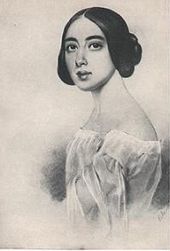
Pauline Viardot, for whom Saint-Saëns wrote the role of Dalila, organized and performed in a private performance of act 2 at a friend's home in Croissy
, with the composer at the piano. Viardot was a great admirer of the work and she hoped that this private performance would encourage Halanzier, the director of the Paris Opéra
who was in attendance, to mount a full production. Although Saint-Saëns completed the score in 1876, no opera houses in France displayed any desire to stage Samson et Dalila. Liszt's sustained support however led to the work being mounted in Weimar in 1877.
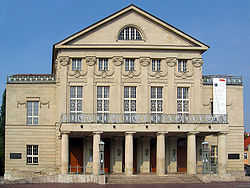 Although Liszt was no longer the musical director in Weimar, he still exerted a powerful influence at the Weimar court. Eduard Lassen
, the director who followed Liszt at Weimar, owed much of his success to his celebrated predecessor, and Liszt used his influence to arrange the premiere of Samson et Dalila with Lassen on the podium during the 1877–1878 season. The libretto was duly translated into German for the production and the opera's first performance was given on 2 December 1877 at the Grossherzogliches Theatre (Grand Ducal Theater). Viardot was too old to sing Delilah so the role was entrusted to Auguste von Müller
, a resident performer at the Weimar opera house. Although a resounding success with the Weimar critics and audience, the opera was not immediately revived in other opera houses.
in 1882, the opera was not seen again until it was performed for the first time in France at the Théâtre des Arts in Rouen
on 3 March 1890 with Carlotta Bossi as Dalila and Jean-Alexandre Talazac
as Samson. The opera received its Paris premiere at the Éden-Théâtre on 31 October 1890 with Rosine Bloch
as Dalila and Talazac singing Samson once again, this time with a much warmer reception by Paris audiences. Over the next two years, performances were given in Bordeaux
, Geneva
, Toulouse
, Nantes
, Dijon
, and Montpellier
. The Paris Opéra finally staged the opera on 23 November 1892 in a performance under the supervision of Saint-Saëns conducted by Édouard Colonne
with Blanche Deschamps-Jéhin
as Dalila and Edmond Vergnet
as Samson, a performance which was lauded by critics and the audience.
 Samson et Dalila also earned a great deal of popularity outside of France during the 1890s. The opera debuted successfully in Monaco
at the Opéra de Monte-Carlo
on 15 March 1892. This was followed by the opera's United States premiere at Carnegie Hall
in a concert version on 25 March 1892. The first staged performance of the opera in the U.S. was held at the French Opera House, New Orleans on 4 January 1893. The first of many productions at the Metropolitan Opera
in New York City was held on 2 February 1895, with Eugenia Mantelli
as Dalila, Francesco Tamagno
as Samson, and Pol Plançon
portraying both Abimélech and the Old Hebrew. There is some evidence that the sets for the Met's production had been taken from some of their other operas, and at the second performance that season the work was given in concert, with the ballet sequences omitted; in this form the work traveled to Boston
, where it was performed on 3 March 1895.
The opera made its premiere in Italy at the Teatro Pagliano in Florence
on 26 March 1892. The opera was mounted in Venice
at the Teatro La Fenice
on 8 March 1893 with Elisa Persini as Dalila and Augusto Brogi as Samson. The work was first mounted at La Scala
on 17 January 1895 with Renée Vidal as Dalila and Emanuele Lafarge as Samson. This was followed by its first performance at the Teatro Regio di Torino on 6 January 1897 with Alice Cucini
and Irma De Spagni alternating as Dalila and Hector Dupeyron
as Samson. The work was first performed at the Teatro Regio di Parma that same year and was mounted at the Teatro Comunale di Bologna
in 1899.
In England, the opera was first performed on 25 September 1893 at the Royal Opera House
, Covent Garden. Although the company planned on performing the work in a fully staged production, the Lord Chamberlain
objected to a Biblical work being mounted and the company was forced to present the opera in a concert version. It was not staged in London until 1909 when the ban was finally lifted. Louise Kirkby Lunn
portrayed Dalila and Charles Fontaine portrayed Samson in the 1909 production. Subsequently, Paul Franz replaced Fontaine in the protagonist's role, earning the composer's praise for both the quality of his voice and his interpretation.
In North America, French contralto Jeanne Gerville-Réache
is largely credited for popularizing the work in the United States and Canada during the early twentieth century. Réache first performed the role of Delilah with the Manhattan Opera Company
in New York City in 1908 and went on to sing the role several more times over the next seven years, including performances in Philadelphia, Boston, Chicago
, and Montreal
(for the Canadian premiere in 1915).
The Metropolitan Opera
revived the opera in its 1915–1916 season with Margarete Matzenauer
as Delilah, Enrico Caruso as Samson, and Pasquale Amato
as the High Priest. Since then the company has staged productions of the opera at least once every decade giving more than 200 performances of the work. Their most recent production of the opera was in 2006 with Olga Borodina
as Delilah and Jon Fredric West as Samson. The Lyric Opera of Chicago
gave their first performance of the opera in November 1962 with Rita Gorr
as Delilah and Hans Kaart as Samson. The company has revived the work numerous times since then, most recently in their 2003–2004 season with Olga Borodina as Dalila and José Cura
as Samson. Likewise, the San Francisco Opera
has staged the opera 10 times during its history giving its first performance in 1925, with Marguerite d'Alvarez
and Fernand Ansseau in the principal roles, and its most recent performance in 2008, with Borodina and Clifton Forbis.
Samson et Dalila is a consistent presence in the opera houses of Europe. By 1920, the Paris Opéra alone had given more than five hundred performances of the opera. Recent productions include performances at La Scala
in 2002 (Plácido Domingo
and Borodina), the Royal Opera House
in 2004 (Denyce Graves
and José Cura), Teatro Comunale di Bologna
in 2008 (Julia Gertseva and Andrew Richards), the National Theatre (Prague)
in 2008, the Royal Swedish Opera
in 2008 (Anna Larsson
and Lars Cleveman
) and the Vlaamse Opera
in 2009 (Marianna Tarasova and Torsten Kerl).
Throughout its history, Samson et Dalila has served as a star vehicle for many singers. In particular, the role of Delilah is considered to be one of the great opera roles for the mezzo-soprano
. Singers who have become associated with the role include Ebe Stignani
, Grace Bumbry
, Julia Claussen
, Giulietta Simionato
, Fiorenza Cossotto
, Rita Gorr
, Denyce Graves
, Louise Homer
, Marilyn Horne
, Elena Obraztsova
, Risë Stevens
and Shirley Verrett
. Notable Samsons have included Francesco Tamagno
, Enrico Caruso, Charles Dalmorès
, Paul Franz, Fernand Ansseau, Georges Thill
, Guy Chauvet, Giovanni Martinelli
, José Luccioni
, Richard Tucker
, Jon Vickers
, and Ramón Vinay
. Apart from the previously mentioned Pasquale Amato
, Met baritones Giuseppe De Luca
, Leonard Warren
and Gabriel Bacquier
were also well known for their portrayals of the High Priest.
, the opera does not include the accounts of Samson's heroic deeds which earned him both fame and leadership among the Hebrews. The accounts of Samson's slaying of a lion and his triumph over 1000 Philistines while wielding only the jawbone of an ass are omitted. Saint-Saëns and his librettist most likely made this choice so the story would concentrate on Dalila. Samson, therefore, is presented as an inspiring leader rather than the almost supernatural hero of the Bible. It is his vulnerable, tender heart and his susceptibility to the protestations of love from a dissembling woman that is the focus of the plot. Delilah is portrayed as a manipulative, conniving, ruthless woman bent on revenge. Samson's numerous attempts to conceal the secret of his strength in the Biblical account are never mentioned in the opera and the revelation that his strength resides in his hair occurs offstage. The opera includes some material not found in the Bible such as the death of Abimélech in act 1.
In a square outside the temple of Dagon, a group of Hebrews
beg Jehovah
for relief from their bondage to the Philistines
in a melancholy chorus
("Dieu, d'Israël"), which leads into a fugue
("Nous avons vu nos cités renversées"). Samson tries to revive the Israelites' morale and faith in God ("Arrêtez, ô mes frères") in a rousing aria
set against the chorus's continuous prayer. Abimelech, the Philistine governor, appears and taunts the Israelites, saying that they are helpless because their god has abandoned them. He further states that his god, Dagon, is far superior ("Ce Dieu que votre voix implore"). The Hebrews cower in fear before Abimelech until Samson incites them into defiant action. Enraged, Abimelech attacks an unarmed Samson with his sword. Samson manages to wrest the sword from Abimelech and kills him.
Afraid of what might now happen, the Hebrews flee, abandoning Samson. The High Priest of Dagon comes from the Philistine temple and curses the Hebrews and Samson's prodigious strength. A messenger arrives and informs the High Priest that the Hebrews are destroying the harvest. He responds with a further curse that alludes to his plot to utilize Delilah's beauty to outwit Samson's strength ("Qu'enfin une compagne infâme trahisse son amour!").
As dawn breaks the Hebrews lift up a humble prayer to God in a style reminiscent of plainchant. Out of the temple emerges Dalila along with several priestesses of Dagon. As they walk down the temple steps, they sing of the pleasures of spring. Dalila engages seductively with Samson proclaiming that he has won her heart and bids him to come with her to her home in the valley of Sorek. As she tries to charm him, a trio forms as an old Hebrew warns of the danger this woman presents and Samson prays for God's protection from Dalila's charms. In an attempt to seduce Samson away from his leadership of the Israelite uprising, Dalila and the priestesses begin a sexually charged dance for him accompanied by a tambourine
. After the dance, Dalila sings how spring is blossoming all around her yet, in her heart, she feels like it is still winter ("Printemps qui commence"). As Samson struggles with his desire for Dalila, the old Hebrew repeats his cautionary plea. His warning, however, is made in vain and the curtain closes as Samson meets Delilah's gaze with every intention of going to her nearby dwelling.
Dalila knows that Samson is entranced with her and will come to her instead of leading the revolution against the Philistines. Sitting on a rock outside the entrance to her retreat, she sings triumphantly about her power to ensnare Samson. She says that all of his strength is hopeless to withstand love's onslaught ("Amour! viens aider ma faiblesse").
Distant lightning is seen as the High Priest arrives to report that Samson and the Hebrews have conquered the Philistines. He attempts to achieve Samson's capture by offering Dalila gold, but she refuses saying she cares not for money but only for revenge. Her desire to hurt Samson is motivated solely by her loyalty to her gods and her hatred for the Hebrews. Dalila and the High Priest sing a duet expressing their mutual abhorrence for Samson and the Hebrews. Dalila vows to discover the secret of Samson's strength.
Now alone, Dalila contemplates her chances of success. Samson, intent on taking his place as the leader of the Hebrew revolt, emerges to say his last farewell as distant lightning is once again seen. In an attempt to close the trap which she has set for Samson, Dalila tells Samson seductively that she is completely his if he wants her. She begs him to respond to her caresses, hoping that he will finally let go of all other things and concentrate completely on her. His admission Je t'aime! introduces her main aria "Mon cœur s'ouvre à ta voix", which becomes a duet on the second verse when Samson joins her in song. Now that Dalila has him in her power, she feigns disbelief in his constancy and demands that he show his love by confiding in her the secret of his strength. Samson hears rolling thunder again which now seems like a warning from God and refuses. Dalila weeps and scorns Samson and runs into her dwelling. Samson is momentarily torn but then follows Dalila inside. Not long afterward, having finally learned that the secret of Samson's strength is his long hair, she calls to hidden Philistine soldiers, who rush in to capture and blind Samson.
Scene 1: In a dungeon at Gaza
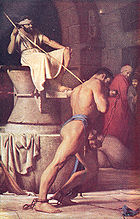
His hair shorn and now blind and shackled, Samson is turning a mill-wheel and praying for his people, who will suffer for his sin. He hears their voices, echoing the Hebrews' lament from act 1. Overcome with remorse, Samson offers his life in sacrifice, while the Hebrews are heard in the distance lamenting his fate.
Scene 2: In the Temple of Dagon
A musical interlude is played as the scene changes to the temple of Dagon, where the Philistines are preparing a sacrifice to commemorate their victory. The priests and priestesses of Dagon sing softly, reprising the song to spring from act 1. The music turns savage as the priests dance a wild Bacchanale
. Following the dance, Samson enters led by a boy. He is ridiculed by the High Priest and the crowd. Dalila taunts Samson further by recounting to him the details of her devious plot in a variant of her love song. When the priests try to force him to kneel before Dagon, he asks the boy to lead him to the two main pillars of the temple. Samson prays to God to restore his strength, and pulls down the pillars and the temple with them, crushing himself and his enemies. The curtain falls.
Grand Opera
Grand opera is a genre of 19th-century opera generally in four or five acts, characterised by large-scale casts and orchestras, and lavish and spectacular design and stage effects, normally with plots based on or around dramatic historic events...
in three acts and four scenes by Camille Saint-Saëns
Camille Saint-Saëns
Charles-Camille Saint-Saëns was a French Late-Romantic composer, organist, conductor, and pianist. He is known especially for The Carnival of the Animals, Danse macabre, Samson and Delilah, Piano Concerto No. 2, Cello Concerto No. 1, Havanaise, Introduction and Rondo Capriccioso, and his Symphony...
to a French
French language
French is a Romance language spoken as a first language in France, the Romandy region in Switzerland, Wallonia and Brussels in Belgium, Monaco, the regions of Quebec and Acadia in Canada, and by various communities elsewhere. Second-language speakers of French are distributed throughout many parts...
libretto
Libretto
A libretto is the text used in an extended musical work such as an opera, operetta, masque, oratorio, cantata, or musical. The term "libretto" is also sometimes used to refer to the text of major liturgical works, such as mass, requiem, and sacred cantata, or even the story line of a...
by Ferdinand Lemaire
Ferdinand Lemaire
Ferdinand Lemaire was a French librettist and poet, best known for writing the libretto of Camille Saint-Saëns's opera Samson et Dalila....
. It was first performed in Weimar
Weimar
Weimar is a city in Germany famous for its cultural heritage. It is located in the federal state of Thuringia , north of the Thüringer Wald, east of Erfurt, and southwest of Halle and Leipzig. Its current population is approximately 65,000. The oldest record of the city dates from the year 899...
at the Grossherzogliches (Grand Ducal) Theater (now the Staatskapelle Weimar
Staatskapelle Weimar
The Deutsche Nationaltheater and Staatskapelle Weimar is the most important musical and theatrical venue in Weimar in Germany. It is a twin institution, consisting of the theatrical Deutsches Nationaltheater and the symphony orchestra known as the Staatskapelle Weimar...
) on 2 December 1877 in a German
German language
German is a West Germanic language, related to and classified alongside English and Dutch. With an estimated 90 – 98 million native speakers, German is one of the world's major languages and is the most widely-spoken first language in the European Union....
translation.
The opera is based on the Biblical
Bible
The Bible refers to any one of the collections of the primary religious texts of Judaism and Christianity. There is no common version of the Bible, as the individual books , their contents and their order vary among denominations...
tale of Samson
Samson
Samson, Shimshon ; Shamshoun or Sampson is the third to last of the Judges of the ancient Israelites mentioned in the Tanakh ....
and Delilah
Delilah
Delilah appears only in the Hebrew bible Book of Judges 16, where she is the "woman in the valley of Sorek" whom Samson loved, and who was his downfall...
found in Chapter 16 of the Book of Judges
Book of Judges
The Book of Judges is the seventh book of the Hebrew bible and the Christian Old Testament. Its title describes its contents: it contains the history of Biblical judges, divinely inspired prophets whose direct knowledge of Yahweh allows them to act as decision-makers for the Israelites, as...
in the Old Testament
Old Testament
The Old Testament, of which Christians hold different views, is a Christian term for the religious writings of ancient Israel held sacred and inspired by Christians which overlaps with the 24-book canon of the Masoretic Text of Judaism...
. It is the only opera by Saint-Saëns that is regularly performed. The second act love scene in Delilah's tent is one of the set pieces that define French opera
French Opera
French opera is one of Europe's most important operatic traditions, containing works by composers of the stature of Rameau, Berlioz, Bizet, Debussy, Poulenc and Olivier Messiaen...
. Two of Delilah's aria
Aria
An aria in music was originally any expressive melody, usually, but not always, performed by a singer. The term is now used almost exclusively to describe a self-contained piece for one voice usually with orchestral accompaniment...
s are particularly well known: "Printemps qui commence" and "Mon cœur s'ouvre à ta voix" ("My heart opens itself to your voice", also known as "Softly awakes my heart"), the latter of which is one of the most popular recital pieces in the mezzo-soprano
Mezzo-soprano
A mezzo-soprano is a type of classical female singing voice whose range lies between the soprano and the contralto singing voices, usually extending from the A below middle C to the A two octaves above...
/contralto
Contralto
Contralto is the deepest female classical singing voice, with the lowest tessitura, falling between tenor and mezzo-soprano. It typically ranges between the F below middle C to the second G above middle C , although at the extremes some voices can reach the E below middle C or the second B above...
repertoire.
Composition history
In the middle of the 19th century, a revival of interest in choral musicChoir
A choir, chorale or chorus is a musical ensemble of singers. Choral music, in turn, is the music written specifically for such an ensemble to perform.A body of singers who perform together as a group is called a choir or chorus...
swept France, and Saint-Saëns, an admirer of the oratorio
Oratorio
An oratorio is a large musical composition including an orchestra, a choir, and soloists. Like an opera, an oratorio includes the use of a choir, soloists, an ensemble, various distinguishable characters, and arias...
s of Handel
George Frideric Handel
George Frideric Handel was a German-British Baroque composer, famous for his operas, oratorios, anthems and organ concertos. Handel was born in 1685, in a family indifferent to music...
and Mendelssohn
Felix Mendelssohn
Jakob Ludwig Felix Mendelssohn Barthóldy , use the form 'Mendelssohn' and not 'Mendelssohn Bartholdy'. The Grove Dictionary of Music and Musicians gives ' Felix Mendelssohn' as the entry, with 'Mendelssohn' used in the body text...
, made plans to compose an oratorio on the subject of Samson and Delilah as suggested by Voltaire
Voltaire
François-Marie Arouet , better known by the pen name Voltaire , was a French Enlightenment writer, historian and philosopher famous for his wit and for his advocacy of civil liberties, including freedom of religion, free trade and separation of church and state...
's libretto Samson for Rameau
Jean-Philippe Rameau
Jean-Philippe Rameau was one of the most important French composers and music theorists of the Baroque era. He replaced Jean-Baptiste Lully as the dominant composer of French opera and is also considered the leading French composer for the harpsichord of his time, alongside François...
. The composer began work on the theme in 1867, just two years after completing his first (and as then yet unperformed) opera, Le timbre d'argent. Saint-Saëns had approached Ferdinand Lemaire
Ferdinand Lemaire
Ferdinand Lemaire was a French librettist and poet, best known for writing the libretto of Camille Saint-Saëns's opera Samson et Dalila....
, the husband of one of his wife's cousins, about writing a libretto for the oratorio but Lemaire convinced the composer that the story was better suited to an opera.
Saint-Saëns later wrote:
"A young relative of mine had married a charming young man who wrote verse on the side. I realized that he was gifted and had in fact real talent. I asked him to work with me on an oratorio on a biblical subject. 'An oratorio!', he said, 'no, let's make it an opera!', and he began to dig through the Bible while I outlined the plan of the work, even sketching scenes, and leaving him only the versification to do. For some reason I began the music with Act 2, and I played it at home to a select audience who could make nothing of it at all."
Aria
An aria in music was originally any expressive melody, usually, but not always, performed by a singer. The term is now used almost exclusively to describe a self-contained piece for one voice usually with orchestral accompaniment...
for Dalila, a duet for Samson and Dalila, and some musical pieces for the chorus (some of which were later assigned to act 1) during 1867–1869. From the very beginning, the work was conceived as a grand duet between Samson and Dalila set off against the approaching tempest. Although the orchestration was not yet complete, act 2 was presented in a private performance in 1870 just prior to the outbreak of the Franco-Prussian War
Franco-Prussian War
The Franco-Prussian War or Franco-German War, often referred to in France as the 1870 War was a conflict between the Second French Empire and the Kingdom of Prussia. Prussia was aided by the North German Confederation, of which it was a member, and the South German states of Baden, Württemberg and...
with Saint-Saëns playing the orchestral parts, which were largely improvised, on the piano. Composer Augusta Holmès
Augusta Holmès
Augusta Mary Anne Holmès was a French composer of Irish descent. At first she published under the pseudonym Hermann Zenta. In 1871, Holmès became a French citizen and added the accent to her last name...
(Dalila), painter Henri Regnault
Henri Regnault
Alexandre-Georges-Henri Regnault was a French painter.-Biography:Regnault was born in Paris, the son of Henri Victor Regnault...
(Samson), and Romain Bussine
Romain Bussine
Romain Bussine was a French poet, baritone, and voice teacher who lived during the 19th century.In 1871, together with Camille Saint-Saëns and Henri Duparc, he founded the Société Nationale de Musique as a forum for promoting contemporary French chamber and orchestral music...
(High Priest) rendered their roles from part books.
In spite of many precedents, the French public reacted negatively to Saint-Saëns's intention of putting a Biblical subject on the stage. The alarm on the part of the public caused him to abandon working further on the opera for the next two years.
La princesse jaune
La princesse jaune is an opéra comique in one act and five scenes by composer Camille Saint-Saëns to a French libretto by Louis Gallet. The opera premiered at the Opéra-Comique in Paris on 12 June 1872....
, the composer went to Weimar
Weimar
Weimar is a city in Germany famous for its cultural heritage. It is located in the federal state of Thuringia , north of the Thüringer Wald, east of Erfurt, and southwest of Halle and Leipzig. Its current population is approximately 65,000. The oldest record of the city dates from the year 899...
to see the first revival of Wagner's Das Rheingold
Das Rheingold
is the first of the four operas that constitute Richard Wagner's Der Ring des Nibelungen . It was originally written as an introduction to the tripartite Ring, but the cycle is now generally regarded as consisting of four individual operas.Das Rheingold received its premiere at the National Theatre...
under the baton of Franz Liszt
Franz Liszt
Franz Liszt ; ), was a 19th-century Hungarian composer, pianist, conductor, and teacher.Liszt became renowned in Europe during the nineteenth century for his virtuosic skill as a pianist. He was said by his contemporaries to have been the most technically advanced pianist of his age...
, the former musical director of the Weimar court orchestra and opera. Liszt was highly interested in producing new works by talented composers and persuaded Saint-Saëns to finish Samson and Delilah, even offering to produce the completed work at the grand-ducal opera house in Weimar. Encouraged, Saint-Saëns began composing act 1 in late 1872 and worked on it sporadically for the next few years. He wrote a large amount of act 1 and completed it during a trip to Algiers
Algiers
' is the capital and largest city of Algeria. According to the 1998 census, the population of the city proper was 1,519,570 and that of the urban agglomeration was 2,135,630. In 2009, the population was about 3,500,000...
in 1874. Upon returning to France in 1875, Saint-Saëns presented act 1 in Paris at the Théâtre du Châtelet
Théâtre du Châtelet
The Théâtre du Châtelet is a theatre and opera house, located in the place du Châtelet in the 1st arrondissement of Paris, France.One of two theatres built on the site of a châtelet, a small castle or fortress, it was designed by Gabriel Davioud at the request of Baron Haussmann between 1860 and...
in a similar format as the 1870 performance of act 2. The work was harshly received by music critics and failed to gain the public's interest. That same year acclaimed mezzo-soprano
Mezzo-soprano
A mezzo-soprano is a type of classical female singing voice whose range lies between the soprano and the contralto singing voices, usually extending from the A below middle C to the A two octaves above...
Pauline Viardot, for whom Saint-Saëns wrote the role of Dalila, organized and performed in a private performance of act 2 at a friend's home in Croissy
Croissy-sur-Seine
Croissy-sur-Seine is a commune in the Yvelines department in the Île-de-France region in north-central France. It is a small but affluent suburban town on the western outskirts of Paris.-Geography:...
, with the composer at the piano. Viardot was a great admirer of the work and she hoped that this private performance would encourage Halanzier, the director of the Paris Opéra
Palais Garnier
The Palais Garnier, , is an elegant 1,979-seat opera house, which was built from 1861 to 1875 for the Paris Opera. It was originally called the Salle des Capucines because of its location on the Boulevard des Capucines in the 9th arrondissement of Paris, but soon became known as the Palais Garnier...
who was in attendance, to mount a full production. Although Saint-Saëns completed the score in 1876, no opera houses in France displayed any desire to stage Samson et Dalila. Liszt's sustained support however led to the work being mounted in Weimar in 1877.
Premiere in Weimar
Eduard Lassen
Eduard Lassen was a Belgian composer and conductor of Danish birth who spent most of his career working as the music director at the court in Weimar. A moderately prolific composer, Lassen produced music in a variety of genres including operas, symphonic works, piano works, lieder, and choral...
, the director who followed Liszt at Weimar, owed much of his success to his celebrated predecessor, and Liszt used his influence to arrange the premiere of Samson et Dalila with Lassen on the podium during the 1877–1878 season. The libretto was duly translated into German for the production and the opera's first performance was given on 2 December 1877 at the Grossherzogliches Theatre (Grand Ducal Theater). Viardot was too old to sing Delilah so the role was entrusted to Auguste von Müller
Auguste von Müller
Auguste von Müller was a nineteenth century German operatic mezzo-soprano and actress. She is best remembered today for originating the role of Dalila in the world premiere of Camille Saint-Saëns's Samson et Dalila in 1877.-Biography:...
, a resident performer at the Weimar opera house. Although a resounding success with the Weimar critics and audience, the opera was not immediately revived in other opera houses.
Beginning of international popularity in the 1890s
After the numerous setbacks it suffered in its early years, Samson et Dalila finally began to attract the attention of the world's great opera houses during the 1890s. Although the first revival of Samson et Dalila was in Germany at the Hamburg State OperaHamburg State Opera
The Hamburg State Opera is one of the leading opera companies in Germany.Opera in Hamburg dates back to 2 January 1678 when the "Opern-Theatrum" was inaugurated with a performance of a biblical Singspiel by Johann Theile...
in 1882, the opera was not seen again until it was performed for the first time in France at the Théâtre des Arts in Rouen
Rouen
Rouen , in northern France on the River Seine, is the capital of the Haute-Normandie region and the historic capital city of Normandy. Once one of the largest and most prosperous cities of medieval Europe , it was the seat of the Exchequer of Normandy in the Middle Ages...
on 3 March 1890 with Carlotta Bossi as Dalila and Jean-Alexandre Talazac
Jean-Alexandre Talazac
Jean-Alexandre Talazac , was a French operatic tenor, particularly associated with the French repertory.Talazac was born in Bordeaux. He studied at the National Conservatory of Music in Paris, and made his debut in 1877 at the Théâtre Lyrique...
as Samson. The opera received its Paris premiere at the Éden-Théâtre on 31 October 1890 with Rosine Bloch
Rosine Bloch
Rosine Bloch was a French operatic mezzo-soprano of Jewish descent who had a successful stage career in Europe between 1865 and 1891. She not only possessed a beautiful, warm, and lyrical voice but was also a remarkably beautiful woman physically...
as Dalila and Talazac singing Samson once again, this time with a much warmer reception by Paris audiences. Over the next two years, performances were given in Bordeaux
Bordeaux
Bordeaux is a port city on the Garonne River in the Gironde department in southwestern France.The Bordeaux-Arcachon-Libourne metropolitan area, has a population of 1,010,000 and constitutes the sixth-largest urban area in France. It is the capital of the Aquitaine region, as well as the prefecture...
, Geneva
Geneva
Geneva In the national languages of Switzerland the city is known as Genf , Ginevra and Genevra is the second-most-populous city in Switzerland and is the most populous city of Romandie, the French-speaking part of Switzerland...
, Toulouse
Toulouse
Toulouse is a city in the Haute-Garonne department in southwestern FranceIt lies on the banks of the River Garonne, 590 km away from Paris and half-way between the Atlantic Ocean and the Mediterranean Sea...
, Nantes
Nantes
Nantes is a city in western France, located on the Loire River, from the Atlantic coast. The city is the 6th largest in France, while its metropolitan area ranks 8th with over 800,000 inhabitants....
, Dijon
Dijon
Dijon is a city in eastern France, the capital of the Côte-d'Or département and of the Burgundy region.Dijon is the historical capital of the region of Burgundy. Population : 151,576 within the city limits; 250,516 for the greater Dijon area....
, and Montpellier
Montpellier
-Neighbourhoods:Since 2001, Montpellier has been divided into seven official neighbourhoods, themselves divided into sub-neighbourhoods. Each of them possesses a neighbourhood council....
. The Paris Opéra finally staged the opera on 23 November 1892 in a performance under the supervision of Saint-Saëns conducted by Édouard Colonne
Édouard Colonne
Édouard Juda Colonne was a French conductor and violinist, who was a champion of the music of Berlioz and other eminent 19th-century composers.-Life and career:...
with Blanche Deschamps-Jéhin
Blanche Deschamps-Jéhin
Blanche Deschamps-Jéhin was a French operatic contralto who had a prolific career in France from 1879-1905. She possessed a rich-toned and flexible voice that had a wide vocal range...
as Dalila and Edmond Vergnet
Edmond Vergnet
Edmond-Alphonse Vergnet was a French operatic tenor.-Biography:Vergnet studied singing in Paris before making his professional opera début at the Paris Opéra in 1874 as Raimbaut in Gaetano Donizetti's Robert le diable...
as Samson, a performance which was lauded by critics and the audience.
Monaco
Monaco , officially the Principality of Monaco , is a sovereign city state on the French Riviera. It is bordered on three sides by its neighbour, France, and its centre is about from Italy. Its area is with a population of 35,986 as of 2011 and is the most densely populated country in the...
at the Opéra de Monte-Carlo
Opéra de Monte-Carlo
The Opéra de Monte-Carlo is an opera house located in the principality of Monaco.With the lack of cultural diversions available in Monaco in the 1870s, Prince Charles III, along with the Société des Bains de Mer, decided on the construction of an opera house. Initially, it was Charles III's...
on 15 March 1892. This was followed by the opera's United States premiere at Carnegie Hall
Carnegie Hall
Carnegie Hall is a concert venue in Midtown Manhattan in New York City, United States, located at 881 Seventh Avenue, occupying the east stretch of Seventh Avenue between West 56th Street and West 57th Street, two blocks south of Central Park....
in a concert version on 25 March 1892. The first staged performance of the opera in the U.S. was held at the French Opera House, New Orleans on 4 January 1893. The first of many productions at the Metropolitan Opera
Metropolitan Opera
The Metropolitan Opera is an opera company, located in New York City. Originally founded in 1880, the company gave its first performance on October 22, 1883. The company is operated by the non-profit Metropolitan Opera Association, with Peter Gelb as general manager...
in New York City was held on 2 February 1895, with Eugenia Mantelli
Eugenia Mantelli
Eugenia Mantelli was an Italian opera singer who had a prolific career in Europe, the United States, and South America from the 1880s through the early part of the twentieth century...
as Dalila, Francesco Tamagno
Francesco Tamagno
Francesco Tamagno was an operatic tenor from Italy who sang with enormous success throughout Europe and America. On 5 February 1887, he cemented his place in musical history by creating the role of Otello in Giuseppe Verdi's masterpiece of the same name...
as Samson, and Pol Plançon
Pol Plançon
Pol-Henri Plançon was a distinguished French operatic bass . He was one of the most acclaimed singers active during the 1880s, 1890s and early 20th century—a period often referred to as the "Golden Age of Opera".In addition to being among the earliest international opera stars to have made...
portraying both Abimélech and the Old Hebrew. There is some evidence that the sets for the Met's production had been taken from some of their other operas, and at the second performance that season the work was given in concert, with the ballet sequences omitted; in this form the work traveled to Boston
Boston
Boston is the capital of and largest city in Massachusetts, and is one of the oldest cities in the United States. The largest city in New England, Boston is regarded as the unofficial "Capital of New England" for its economic and cultural impact on the entire New England region. The city proper had...
, where it was performed on 3 March 1895.
The opera made its premiere in Italy at the Teatro Pagliano in Florence
Florence
Florence is the capital city of the Italian region of Tuscany and of the province of Florence. It is the most populous city in Tuscany, with approximately 370,000 inhabitants, expanding to over 1.5 million in the metropolitan area....
on 26 March 1892. The opera was mounted in Venice
Venice
Venice is a city in northern Italy which is renowned for the beauty of its setting, its architecture and its artworks. It is the capital of the Veneto region...
at the Teatro La Fenice
La Fenice
Teatro La Fenice is an opera house in Venice, Italy. It is one of the most famous theatres in Europe, the site of many famous operatic premieres. Its name reflects its role in permitting an opera company to "rise from the ashes" despite losing the use of two theatres...
on 8 March 1893 with Elisa Persini as Dalila and Augusto Brogi as Samson. The work was first mounted at La Scala
La Scala
La Scala , is a world renowned opera house in Milan, Italy. The theatre was inaugurated on 3 August 1778 and was originally known as the New Royal-Ducal Theatre at La Scala...
on 17 January 1895 with Renée Vidal as Dalila and Emanuele Lafarge as Samson. This was followed by its first performance at the Teatro Regio di Torino on 6 January 1897 with Alice Cucini
Alice Cucini
Alice Cucini was an Italian contralto who had a prolific opera career in Europe and South America between 1891 and 1915. She was particularly associated with the role of Dalila in Camille Saint-Saëns's Samson et Dalila, which she sang in numerous houses internationally...
and Irma De Spagni alternating as Dalila and Hector Dupeyron
Hector Dupeyron
Hector Dupeyron was a French operatic tenor who had a prolific opera career in Europe from 1887 through 1906. Possessing a powerful and dramatic voice, he particularly excelled in the works of Richard Wagner and Giacomo Meyerbeer.-Biography:...
as Samson. The work was first performed at the Teatro Regio di Parma that same year and was mounted at the Teatro Comunale di Bologna
Teatro Comunale di Bologna
The Teatro Comunale di Bologna is an opera house in Bologna, Italy, and is one of the most important opera venues in Italy. Typically, it presents eight operas with six performances during its November to April season....
in 1899.
In England, the opera was first performed on 25 September 1893 at the Royal Opera House
Royal Opera House
The Royal Opera House is an opera house and major performing arts venue in Covent Garden, central London. The large building is often referred to as simply "Covent Garden", after a previous use of the site of the opera house's original construction in 1732. It is the home of The Royal Opera, The...
, Covent Garden. Although the company planned on performing the work in a fully staged production, the Lord Chamberlain
Lord Chamberlain
The Lord Chamberlain or Lord Chamberlain of the Household is one of the chief officers of the Royal Household in the United Kingdom and is to be distinguished from the Lord Great Chamberlain, one of the Great Officers of State....
objected to a Biblical work being mounted and the company was forced to present the opera in a concert version. It was not staged in London until 1909 when the ban was finally lifted. Louise Kirkby Lunn
Louise Kirkby Lunn
Louise Kirkby Lunn was an English contralto. Sometimes classified as a mezzo-soprano, she was a leading English-born singer of the first two decades of the 20th century, earning praise for her performances in concert, oratorio and opera.-Training:Kirkby Lunn had her early vocal training in her...
portrayed Dalila and Charles Fontaine portrayed Samson in the 1909 production. Subsequently, Paul Franz replaced Fontaine in the protagonist's role, earning the composer's praise for both the quality of his voice and his interpretation.
20th and 21st century performance history
By 1906, Samson et Dalila had received more than 200 performances internationally. The opera has continued to remain moderately popular since and, while not being among the most frequently performed operas, the work has become a part of the standard opera performance repertory at most major opera houses. The opera has been revived numerous times not only in Europe and North America, but also in South America, Australia, and Asia. While none of Saint-Saëns's later operas suffered the tribulations endured by Samson et Dalila during its early years, none of his other works have achieved the same enduring success either.In North America, French contralto Jeanne Gerville-Réache
Jeanne Gerville-Réache
Jeanne Gerville-Réache was a French operatic contralto from the Belle Époque. She possessed a remarkably beautiful voice, an excellent singing technique, and wide vocal range which enabled her to perform several roles traditionally associated with mezzo-sopranos in addition to contralto parts...
is largely credited for popularizing the work in the United States and Canada during the early twentieth century. Réache first performed the role of Delilah with the Manhattan Opera Company
Manhattan Opera Company
The Manhattan Opera Company was an opera company based in New York City. Active from 1906 until 1910, it was founded by Oscar Hammerstein I.The company began operations in 1906 at the Manhattan Opera House on 34th Street in New York City...
in New York City in 1908 and went on to sing the role several more times over the next seven years, including performances in Philadelphia, Boston, Chicago
Chicago
Chicago is the largest city in the US state of Illinois. With nearly 2.7 million residents, it is the most populous city in the Midwestern United States and the third most populous in the US, after New York City and Los Angeles...
, and Montreal
Montreal
Montreal is a city in Canada. It is the largest city in the province of Quebec, the second-largest city in Canada and the seventh largest in North America...
(for the Canadian premiere in 1915).
The Metropolitan Opera
Metropolitan Opera
The Metropolitan Opera is an opera company, located in New York City. Originally founded in 1880, the company gave its first performance on October 22, 1883. The company is operated by the non-profit Metropolitan Opera Association, with Peter Gelb as general manager...
revived the opera in its 1915–1916 season with Margarete Matzenauer
Margarete Matzenauer
Margaret Matzenauer was a mezzo-soprano singer with an opulent timbre and a wide range to her voice...
as Delilah, Enrico Caruso as Samson, and Pasquale Amato
Pasquale Amato
Pasquale Amato was an outstanding Italian operatic baritone. Amato enjoyed an international reputation but attained the peak of his fame in New York City, where he sang with the Metropolitan Opera from 1908 until 1921....
as the High Priest. Since then the company has staged productions of the opera at least once every decade giving more than 200 performances of the work. Their most recent production of the opera was in 2006 with Olga Borodina
Olga Borodina
Olga Vladimirovna Borodina is a leading dramatic mezzo-soprano, known for her roles in Russian operas at her home company, the Mariinsky Theatre, and for her international performing and recording career in a varied repertoire.Borodina made her debut in Samson and Delilah at the Royal Opera House...
as Delilah and Jon Fredric West as Samson. The Lyric Opera of Chicago
Lyric Opera of Chicago
Lyric Opera of Chicago is one of the leading opera companies in the United States. It was founded in Chicago in 1952, under the name 'Lyric Theatre of Chicago' by Carol Fox, Nicolà Rescigno and Lawrence Kelly, with a season that included Maria Callas's American debut in Norma...
gave their first performance of the opera in November 1962 with Rita Gorr
Rita Gorr
Rita Gorr , is a Belgian operatic mezzo-soprano. She possessed a large, rich-toned voice and was an intense singing-actress, especially in dramatic roles such as Ortrud and Amneris , two of her greatest roles....
as Delilah and Hans Kaart as Samson. The company has revived the work numerous times since then, most recently in their 2003–2004 season with Olga Borodina as Dalila and José Cura
José Cura
José Cura is a prominent operatic tenor known for his intense and original interpretations of his characters, notably Verdi’s Otello and Saint-Saëns’ Samson, as well as for his unconventional and innovative concert performances. He is also able to perform high baritone roles with the extended...
as Samson. Likewise, the San Francisco Opera
San Francisco Opera
San Francisco Opera is an American opera company, based in San Francisco, California.It was founded in 1923 by Gaetano Merola and is the second largest opera company in North America...
has staged the opera 10 times during its history giving its first performance in 1925, with Marguerite d'Alvarez
Marguerite d'Alvarez
Marguerite d'Alvarez was an English contralto.Born in Liverpool, d'Alvarez studied in Brussels, and made her debut in Rouen, singing Delilah. She made her first American appearances with the Manhattan Opera in 1909 as Fidès in Giacomo Meyerbeer's Le prophète...
and Fernand Ansseau in the principal roles, and its most recent performance in 2008, with Borodina and Clifton Forbis.
Samson et Dalila is a consistent presence in the opera houses of Europe. By 1920, the Paris Opéra alone had given more than five hundred performances of the opera. Recent productions include performances at La Scala
La Scala
La Scala , is a world renowned opera house in Milan, Italy. The theatre was inaugurated on 3 August 1778 and was originally known as the New Royal-Ducal Theatre at La Scala...
in 2002 (Plácido Domingo
Plácido Domingo
Plácido Domingo KBE , born José Plácido Domingo Embil, is a Spanish tenor and conductor known for his versatile and strong voice, possessing a ringing and dramatic tone throughout its range...
and Borodina), the Royal Opera House
Royal Opera House
The Royal Opera House is an opera house and major performing arts venue in Covent Garden, central London. The large building is often referred to as simply "Covent Garden", after a previous use of the site of the opera house's original construction in 1732. It is the home of The Royal Opera, The...
in 2004 (Denyce Graves
Denyce Graves
Denyce Graves is an American mezzo-soprano opera singer.-Early life:Graves was born on March 7, 1964, to Charles Graves and Dorothy Graves-Kenner. She is the middle of three children and was raised by her mother on Galveston Street, S.W., in the Bellevue section of Washington...
and José Cura), Teatro Comunale di Bologna
Teatro Comunale di Bologna
The Teatro Comunale di Bologna is an opera house in Bologna, Italy, and is one of the most important opera venues in Italy. Typically, it presents eight operas with six performances during its November to April season....
in 2008 (Julia Gertseva and Andrew Richards), the National Theatre (Prague)
National Theatre (Prague)
The National Theatre in Prague is known as the Alma Mater of Czech opera, and as the national monument of Czech history and art.The National Theatre belongs to the most important Czech cultural institutions, with a rich artistic tradition which was created and maintained by the most distinguished...
in 2008, the Royal Swedish Opera
Royal Swedish Opera
Kungliga Operan is Sweden's national stage for opera and ballet.-Location and Environment:...
in 2008 (Anna Larsson
Anna Larsson
Anna Larsson is a Swedish contralto. Her international debut was made with the Berlin Philharmonic and the conductor Claudio Abbado in a performance of Gustav Mahler's Symphony No. 2 in 1997...
and Lars Cleveman
Lars Cleveman
Lars Cleveman is a Swedish musician and opera singer. Together with Martin Rössel, he founded Sweden's first electronic underground group, Dom Dummaste. Additionally, Cleveman is a renowned tenor opera singer, performing at the Royal Swedish Opera in Stockholm. He replaced Ben Heppner at Covent...
) and the Vlaamse Opera
Vlaamse Opera
The Vlaamse Opera ' is an opera company in Belgium directed by Aviel Cahn which operates in two different opera houses in two Flemish cities, the Vlaamse Opera Antwerpen at Van Ertbornstraat 8 and the Vlaamse Opera Ghent at Schouwburgstraat 3...
in 2009 (Marianna Tarasova and Torsten Kerl).
Throughout its history, Samson et Dalila has served as a star vehicle for many singers. In particular, the role of Delilah is considered to be one of the great opera roles for the mezzo-soprano
Mezzo-soprano
A mezzo-soprano is a type of classical female singing voice whose range lies between the soprano and the contralto singing voices, usually extending from the A below middle C to the A two octaves above...
. Singers who have become associated with the role include Ebe Stignani
Ebe Stignani
Ebe Stignani was an Italian opera singer, who was pre-eminent in the dramatic mezzo-soprano roles of the Italian repertoire during a stage career of more than thirty years.-Career:...
, Grace Bumbry
Grace Bumbry
Grace Bumbry , an American opera singer, is considered one of the leading mezzo-sopranos of her generation, as well as a major soprano for many years...
, Julia Claussen
Julia Claussen
Julia Claussen was a Swedish mezzo-soprano.A native of Stockholm, Claussen was educated at the Royal Academy of Music in that city; she also studied at the Royal Academy in Berlin. She made her debut in La favorita in Stockholm on January 19, 1903, and remained with the Royal Swedish Opera for...
, Giulietta Simionato
Giulietta Simionato
Giulietta Simionato was an Italian mezzo-soprano. Her career spanned from the 1930s until her retirement in 1966.-Life:Born at Forlì, Romagna, she studied in Rovigo and Padua, and made her operatic debut at Montagnana in 1928...
, Fiorenza Cossotto
Fiorenza Cossotto
Fiorenza Cossotto is an Italian mezzo soprano. She is considered by many to be one of the great mezzo-sopranos of the 20th century.-Life and career:...
, Rita Gorr
Rita Gorr
Rita Gorr , is a Belgian operatic mezzo-soprano. She possessed a large, rich-toned voice and was an intense singing-actress, especially in dramatic roles such as Ortrud and Amneris , two of her greatest roles....
, Denyce Graves
Denyce Graves
Denyce Graves is an American mezzo-soprano opera singer.-Early life:Graves was born on March 7, 1964, to Charles Graves and Dorothy Graves-Kenner. She is the middle of three children and was raised by her mother on Galveston Street, S.W., in the Bellevue section of Washington...
, Louise Homer
Louise Homer
Louise Homer was an American operatic contralto who had an active international career in concert halls and opera houses from 1895 until her retirement in 1932. After a brief stint as a vaudeville entertainer in New England, she made her professional opera debut in France in 1898...
, Marilyn Horne
Marilyn Horne
Marilyn Horne is an American mezzo-soprano opera singer. She specialized in roles requiring a large sound, beauty of tone, excellent breath support, and the ability to execute difficult coloratura passages....
, Elena Obraztsova
Elena Obraztsova
Elena Vasiliyevna Obraztsova is a Russian mezzo-soprano, widely recognised as one of the greatest opera singers of all time, thanks to her outstanding stage presence and the vocal abilities....
, Risë Stevens
Risë Stevens
Risë Stevens is a retired American operatic mezzo-soprano.-Professional life:Stevens studied at New York's Juilliard School for three years. She went to Vienna, where she was trained by Marie Gutheil-Schoder and Herbert Graf. She made her début as Mignon in Prague in 1936 and stayed there until...
and Shirley Verrett
Shirley Verrett
Shirley Verrett was an African-American operatic mezzo-soprano who successfully transitioned into soprano roles i.e. soprano sfogato...
. Notable Samsons have included Francesco Tamagno
Francesco Tamagno
Francesco Tamagno was an operatic tenor from Italy who sang with enormous success throughout Europe and America. On 5 February 1887, he cemented his place in musical history by creating the role of Otello in Giuseppe Verdi's masterpiece of the same name...
, Enrico Caruso, Charles Dalmorès
Charles Dalmorès
Charles Dalmorès was a French tenor. He enjoyed an international operatic career, singing to public and critical acclaim on both sides of the Atlantic during the first two decades of the 20th century.-Biography:...
, Paul Franz, Fernand Ansseau, Georges Thill
Georges Thill
Georges Thill was a French opera singer, often considered to be his country's greatest lyric-dramatic tenor...
, Guy Chauvet, Giovanni Martinelli
Giovanni Martinelli
Giovanni Martinelli was a celebrated Italian operatic tenor. He was particularly associated with the Italian lyric-dramatic repertory, although he performed French operatic roles to great acclaim as well...
, José Luccioni
José Luccioni
José Luccioni was a French operatic tenor of Corsican origin. He possessed one of the best dramatic voices of the 1930s and 1940s....
, Richard Tucker
Richard Tucker
Richard Tucker was an American operatic tenor.-Early life:Tucker was born Rivn Ticker in Brooklyn, New York, into a family of Romanian immigrants from Bessarabia. His father, Shmul Ticker, and mother Fanya-Tsipa Ticker had already adopted the surname "Tucker" by the time their son entered first...
, Jon Vickers
Jon Vickers
Jonathan Stewart Vickers, CC , known professionally as Jon Vickers, is a retired Canadian heldentenor.Born in Prince Albert, Saskatchewan, he was the sixth in a family of eight children. In 1950, he was awarded a scholarship to study opera at The Royal Conservatory of Music in Toronto...
, and Ramón Vinay
Ramón Vinay
Ramón Vinay was a famous Chilean operatic tenor with a powerful, dramatic voice. He is probably best remembered for his appearances in the title role of Giuseppe Verdi's tragic opera Otello....
. Apart from the previously mentioned Pasquale Amato
Pasquale Amato
Pasquale Amato was an outstanding Italian operatic baritone. Amato enjoyed an international reputation but attained the peak of his fame in New York City, where he sang with the Metropolitan Opera from 1908 until 1921....
, Met baritones Giuseppe De Luca
Giuseppe de Luca
Giuseppe De Luca , was a famous Italian baritone who achieved his greatest triumphs at the New York Metropolitan Opera...
, Leonard Warren
Leonard Warren
Leonard Warren was a famous American opera singer. A baritone, he was a leading artist for many years with the Metropolitan Opera in New York.-Biography:...
and Gabriel Bacquier
Gabriel Bacquier
Gabriel Bacquier is a French operatic baritone. One of the leading baritones of the 20th century and particularly associated with the French and Italian repertories, he is considered a fine singing-actor equally at home in dramatic or comic roles.-Life and career:Gabriel Bacquier was born in...
were also well known for their portrayals of the High Priest.
Libretto
Although the libretto of Samson et Dalila is taken from Chapter 16 of the Book of JudgesBook of Judges
The Book of Judges is the seventh book of the Hebrew bible and the Christian Old Testament. Its title describes its contents: it contains the history of Biblical judges, divinely inspired prophets whose direct knowledge of Yahweh allows them to act as decision-makers for the Israelites, as...
, the opera does not include the accounts of Samson's heroic deeds which earned him both fame and leadership among the Hebrews. The accounts of Samson's slaying of a lion and his triumph over 1000 Philistines while wielding only the jawbone of an ass are omitted. Saint-Saëns and his librettist most likely made this choice so the story would concentrate on Dalila. Samson, therefore, is presented as an inspiring leader rather than the almost supernatural hero of the Bible. It is his vulnerable, tender heart and his susceptibility to the protestations of love from a dissembling woman that is the focus of the plot. Delilah is portrayed as a manipulative, conniving, ruthless woman bent on revenge. Samson's numerous attempts to conceal the secret of his strength in the Biblical account are never mentioned in the opera and the revelation that his strength resides in his hair occurs offstage. The opera includes some material not found in the Bible such as the death of Abimélech in act 1.
Roles
| Role | Voice type Voice type A voice type is a particular kind of human singing voice perceived as having certain identifying qualities or characteristics. Voice classification is the process by which human voices are evaluated and are thereby designated into voice types... |
Premiere cast, 2 December 1877 (Conductor: Eduard Lassen Eduard Lassen Eduard Lassen was a Belgian composer and conductor of Danish birth who spent most of his career working as the music director at the court in Weimar. A moderately prolific composer, Lassen produced music in a variety of genres including operas, symphonic works, piano works, lieder, and choral... ) |
|---|---|---|
| Samson Samson Samson, Shimshon ; Shamshoun or Sampson is the third to last of the Judges of the ancient Israelites mentioned in the Tanakh .... |
tenor Tenor The tenor is a type of male singing voice and is the highest male voice within the modal register. The typical tenor voice lies between C3, the C one octave below middle C, to the A above middle C in choral music, and up to high C in solo work. The low extreme for tenors is roughly B2... |
Franz Ferenczy Franz Ferenczy Franz Ferenczy was a nineteenth century German tenor who had a prolific opera career in Europe between 1859-1880. Possessing a powerful voice with a wide vocal range, Ferenczy particularly excelled in the operas of Giacomo Meyerbeer and Richard Wagner... |
| Dalila Delilah Delilah appears only in the Hebrew bible Book of Judges 16, where she is the "woman in the valley of Sorek" whom Samson loved, and who was his downfall... |
mezzo-soprano Mezzo-soprano A mezzo-soprano is a type of classical female singing voice whose range lies between the soprano and the contralto singing voices, usually extending from the A below middle C to the A two octaves above... |
Auguste von Müller Auguste von Müller Auguste von Müller was a nineteenth century German operatic mezzo-soprano and actress. She is best remembered today for originating the role of Dalila in the world premiere of Camille Saint-Saëns's Samson et Dalila in 1877.-Biography:... |
| High Priest of Dagon Dagon Dagon was originally an Assyro-Babylonian fertility god who evolved into a major northwest Semitic god, reportedly of grain and fish and/or fishing... |
baritone Baritone Baritone is a type of male singing voice that lies between the bass and tenor voices. It is the most common male voice. Originally from the Greek , meaning deep sounding, music for this voice is typically written in the range from the second F below middle C to the F above middle C Baritone (or... |
Hans von Milde Hans von Milde Hans Feodor von Milde was an Austrian operatic baritone and the husband of soprano Rosa von Milde-Agthe. He sang for almost four decades at the opera house in Weimar where he particularly excelled in the works of Richard Wagner... |
| Abimélech, satrap Satrap Satrap was the name given to the governors of the provinces of the ancient Median and Achaemenid Empires and in several of their successors, such as the Sassanid Empire and the Hellenistic empires.... of Gaza Gaza Gaza , also referred to as Gaza City, is a Palestinian city in the Gaza Strip, with a population of about 450,000, making it the largest city in the Palestinian territories.Inhabited since at least the 15th century BC,... |
bass Bass (voice type) A bass is a type of male singing voice and possesses the lowest vocal range of all voice types. According to The New Grove Dictionary of Opera, a bass is typically classified as having a range extending from around the second E below middle C to the E above middle C... |
Dengler |
| First Philistine Philistines Philistines , Pleshet or Peleset, were a people who occupied the southern coast of Canaan at the beginning of the Iron Age . According to the Bible, they ruled the five city-states of Gaza, Askelon, Ashdod, Ekron and Gath, from the Wadi Gaza in the south to the Yarqon River in the north, but with... |
tenor | Karl Knopp |
| Second Philistine | bass | Felix Schmidt |
| Philistine Messenger | tenor | Winiker |
| Old Hebrew | bass | Adolf Hennig |
| Hebrews and Philistines | ||
Act 1
A square in Gaza at nightIn a square outside the temple of Dagon, a group of Hebrews
Hebrews
Hebrews is an ethnonym used in the Hebrew Bible...
beg Jehovah
Jehovah
Jehovah is an anglicized representation of Hebrew , a vocalization of the Tetragrammaton , the proper name of the God of Israel in the Hebrew Bible....
for relief from their bondage to the Philistines
Philistines
Philistines , Pleshet or Peleset, were a people who occupied the southern coast of Canaan at the beginning of the Iron Age . According to the Bible, they ruled the five city-states of Gaza, Askelon, Ashdod, Ekron and Gath, from the Wadi Gaza in the south to the Yarqon River in the north, but with...
in a melancholy chorus
Refrain
A refrain is the line or lines that are repeated in music or in verse; the "chorus" of a song...
("Dieu, d'Israël"), which leads into a fugue
Fugue
In music, a fugue is a compositional technique in two or more voices, built on a subject that is introduced at the beginning in imitation and recurs frequently in the course of the composition....
("Nous avons vu nos cités renversées"). Samson tries to revive the Israelites' morale and faith in God ("Arrêtez, ô mes frères") in a rousing aria
Aria
An aria in music was originally any expressive melody, usually, but not always, performed by a singer. The term is now used almost exclusively to describe a self-contained piece for one voice usually with orchestral accompaniment...
set against the chorus's continuous prayer. Abimelech, the Philistine governor, appears and taunts the Israelites, saying that they are helpless because their god has abandoned them. He further states that his god, Dagon, is far superior ("Ce Dieu que votre voix implore"). The Hebrews cower in fear before Abimelech until Samson incites them into defiant action. Enraged, Abimelech attacks an unarmed Samson with his sword. Samson manages to wrest the sword from Abimelech and kills him.
Afraid of what might now happen, the Hebrews flee, abandoning Samson. The High Priest of Dagon comes from the Philistine temple and curses the Hebrews and Samson's prodigious strength. A messenger arrives and informs the High Priest that the Hebrews are destroying the harvest. He responds with a further curse that alludes to his plot to utilize Delilah's beauty to outwit Samson's strength ("Qu'enfin une compagne infâme trahisse son amour!").
As dawn breaks the Hebrews lift up a humble prayer to God in a style reminiscent of plainchant. Out of the temple emerges Dalila along with several priestesses of Dagon. As they walk down the temple steps, they sing of the pleasures of spring. Dalila engages seductively with Samson proclaiming that he has won her heart and bids him to come with her to her home in the valley of Sorek. As she tries to charm him, a trio forms as an old Hebrew warns of the danger this woman presents and Samson prays for God's protection from Dalila's charms. In an attempt to seduce Samson away from his leadership of the Israelite uprising, Dalila and the priestesses begin a sexually charged dance for him accompanied by a tambourine
Tambourine
The tambourine or marine is a musical instrument of the percussion family consisting of a frame, often of wood or plastic, with pairs of small metal jingles, called "zils". Classically the term tambourine denotes an instrument with a drumhead, though some variants may not have a head at all....
. After the dance, Dalila sings how spring is blossoming all around her yet, in her heart, she feels like it is still winter ("Printemps qui commence"). As Samson struggles with his desire for Dalila, the old Hebrew repeats his cautionary plea. His warning, however, is made in vain and the curtain closes as Samson meets Delilah's gaze with every intention of going to her nearby dwelling.
Act 2
Delilah's retreat in the Valley of SorekDalila knows that Samson is entranced with her and will come to her instead of leading the revolution against the Philistines. Sitting on a rock outside the entrance to her retreat, she sings triumphantly about her power to ensnare Samson. She says that all of his strength is hopeless to withstand love's onslaught ("Amour! viens aider ma faiblesse").
Distant lightning is seen as the High Priest arrives to report that Samson and the Hebrews have conquered the Philistines. He attempts to achieve Samson's capture by offering Dalila gold, but she refuses saying she cares not for money but only for revenge. Her desire to hurt Samson is motivated solely by her loyalty to her gods and her hatred for the Hebrews. Dalila and the High Priest sing a duet expressing their mutual abhorrence for Samson and the Hebrews. Dalila vows to discover the secret of Samson's strength.
Now alone, Dalila contemplates her chances of success. Samson, intent on taking his place as the leader of the Hebrew revolt, emerges to say his last farewell as distant lightning is once again seen. In an attempt to close the trap which she has set for Samson, Dalila tells Samson seductively that she is completely his if he wants her. She begs him to respond to her caresses, hoping that he will finally let go of all other things and concentrate completely on her. His admission Je t'aime! introduces her main aria "Mon cœur s'ouvre à ta voix", which becomes a duet on the second verse when Samson joins her in song. Now that Dalila has him in her power, she feigns disbelief in his constancy and demands that he show his love by confiding in her the secret of his strength. Samson hears rolling thunder again which now seems like a warning from God and refuses. Dalila weeps and scorns Samson and runs into her dwelling. Samson is momentarily torn but then follows Dalila inside. Not long afterward, having finally learned that the secret of Samson's strength is his long hair, she calls to hidden Philistine soldiers, who rush in to capture and blind Samson.
Act 3
The city of GazaScene 1: In a dungeon at Gaza
His hair shorn and now blind and shackled, Samson is turning a mill-wheel and praying for his people, who will suffer for his sin. He hears their voices, echoing the Hebrews' lament from act 1. Overcome with remorse, Samson offers his life in sacrifice, while the Hebrews are heard in the distance lamenting his fate.
Scene 2: In the Temple of Dagon
A musical interlude is played as the scene changes to the temple of Dagon, where the Philistines are preparing a sacrifice to commemorate their victory. The priests and priestesses of Dagon sing softly, reprising the song to spring from act 1. The music turns savage as the priests dance a wild Bacchanale
Bacchanale
A bacchanale is a dramatic musical composition, often depicting a drunken revel or bacchanal.Well-known examples are the bacchanales in Camille Saint-Saëns's Samson et Dalila and the Overture and Bacchanale of Richard Wagner's Tannhäuser. John Cage wrote a Bacchanale for prepared piano...
. Following the dance, Samson enters led by a boy. He is ridiculed by the High Priest and the crowd. Dalila taunts Samson further by recounting to him the details of her devious plot in a variant of her love song. When the priests try to force him to kneel before Dagon, he asks the boy to lead him to the two main pillars of the temple. Samson prays to God to restore his strength, and pulls down the pillars and the temple with them, crushing himself and his enemies. The curtain falls.
Recordings
| Year | Cast: Samson, Dalila, Grand-prétre de Dagon, Abimélech) |
Conductor, opera house and orchestra |
Label |
|---|---|---|---|
| 1936 | René Maison René Maison René Maison was a prominent Belgian operatic tenor, particularly associated with heroic roles of the French, Italian and German repertories.-Career:... , Gertrud Pålson-Wettergren, Ezio Pinza Ezio Pinza Ezio Pinza was an Italian basso opera singer with a rich, smooth and sonorous voice. He spent 22 seasons at New York's Metropolitan Opera, appearing in more than 750 performances of 50 operas... , John Gurney |
Maurice Abravanel Maurice Abravanel Maurice Abravanel was aSwiss-American Jewish conductor of classical music. He is remembered as the conductor of the Utah Symphony Orchestra for over 30 years.-Life:... , Metropolitan Opera Orchestra and Chorus Metropolitan Opera The Metropolitan Opera is an opera company, located in New York City. Originally founded in 1880, the company gave its first performance on October 22, 1883. The company is operated by the non-profit Metropolitan Opera Association, with Peter Gelb as general manager... (Live recording for radio on 26 December 1936 which has subsequently been released on CD.) |
CD: Guild Cat: 2273 |
| 1941 | René Maison, Risë Stevens Risë Stevens Risë Stevens is a retired American operatic mezzo-soprano.-Professional life:Stevens studied at New York's Juilliard School for three years. She went to Vienna, where she was trained by Marie Gutheil-Schoder and Herbert Graf. She made her début as Mignon in Prague in 1936 and stayed there until... , Leonard Warren Leonard Warren Leonard Warren was a famous American opera singer. A baritone, he was a leading artist for many years with the Metropolitan Opera in New York.-Biography:... , Norman Cordon |
Wilfrid Pelletier Wilfrid Pelletier Joseph Louis Wilfrid Pelletier , CC was a Canadian conductor, pianist, composer, and arts administrator. He was instrumental in establishing the Montreal Symphony Orchestra, serving as the orchestra's first artistic director and conductor from 1935-1941... , Metropolitan Opera Orchestra and Chorus (Live recording for radio on 13 December 1941 which has subsequently been released on CD.) |
CD: Omega Opera Archive |
| 1946 | José Luccioni, Hélène Bouvier Hélène Bouvier Hélène Bouvier was a French operatic mezzo-soprano, particularly associated with the French repertoire.... , Paul Cabanel, Charles Cambon |
Louis Fourestier, Paris Opéra Orchestra and Chorus (The first studio made recording and the first recording of the opera to be released commercially.) |
CD: Naxos Cat: 8.110063-64 |
| 1948 | José Luccioni, Susanne Lefort, Pierre Nougaro, Ernest Mestrallet |
Eugène Bigot, Grand Théâtre de Genève Grand Théâtre de Genève Grand Théâtre de Genève is an opera house in Geneva, Switzerland.As with many other opera houses, the Grand Théâtre de Genève is both a venue and an institution. The venue is a majestic building, towering over Place Neuve, officially opened in 1876, partly destroyed by fire in 1951 and reopened in... Orchestra and Chorus |
CD: Malibran Music Cat: MR502 |
| 1948 | Lorenz Fehenberger Lorenz Fehenberger Lorenz Fehenberger , was a German operatic tenor, particularly associated with the German and Italian repertories.... , Res Fischer Res Fischer Res Fischer was one of the few true German contraltos of the 1930s and 1940s, and was one of the most powerful singing-actresses of her day.... , Fred Destal, Max Eibel |
Hans Altman, Orchester und Chor des Bayerischen Rundfunks |
CD: Walhall Cat: WLCD 0040 |
| 1949 | Ramón Vinay Ramón Vinay Ramón Vinay was a famous Chilean operatic tenor with a powerful, dramatic voice. He is probably best remembered for his appearances in the title role of Giuseppe Verdi's tragic opera Otello.... , Risë Stevens, Robert Merrill Robert Merrill Robert Merrill was an American operatic baritone.-Early life:Merrill was born Moishe Miller, later known as Morris Miller, in the Williamsburg section of Brooklyn, New York, to tailor Abraham Miller, originally Milstein, and his wife Lillian, née Balaban, immigrants from Warsaw, Poland.His mother... , Osie Hawkins |
Emil Cooper Emil Cooper Emil Albertovich Cooper, also known as Emil Kuper was a Russian conductor and violinist, of English ancestry.... , Metropolitan Opera Orchestra and Chorus (Live recording for radio on 26 November 1949 which has subsequently been released on CD.) |
CD: Omega Opera Archive |
| 1953 | Ramón Vinay, Risë Stevens, Sigurd Björling Sigurd Björling Sigurd Björling was a Swedish operatic baritone.He made his debut as Alfio in Cavalleria Rusticana in 1935 at Royal Swedish Opera... , Norman Scott Norman Scott (bass) Norman Scott was an American operatic bass. He had a long and fruitful association with the Metropolitan Opera in New York City from 1951 up until his death seventeen years later. His repertoire at the Met included well over 50 roles, and he gave a total of 927 performances at the house during his... |
Fausto Cleva Fausto Cleva Fausto Cleva was an Italian-born American operatic conductor.After studies at the Conservatorio in his native city and Milan, Cleva made his debut conducting La traviata in Carcano, near Milan, before emigrating to the United States in 1920, becoming an American citizen in 1931... , Metropolitan Opera Orchestra and Chorus (Live recording for radio on 14 March 1953 which has subsequently been released on CD.) |
CD: Omega Opera Archive |
| 1954 | Jan Peerce Jan Peerce Jan Peerce was an American operatic tenor. Peerce was an accomplished performer on the operatic and Broadway concert stages, in solo recitals, and as a recording artist. He is the father of film director Larry Peerce.... , Risë Stevens, Robert Merrill |
Robert Shaw Robert Shaw (conductor) Robert Shaw was an American conductor most famous for his work with his namesake Chorale, with the Cleveland Orchestra and Chorus, and the Atlanta Symphony Orchestra and Chorus. Shaw received 14 Grammy awards, four ASCAP awards for service to contemporary music, the first Guggenheim Fellowship... , NBC Symphony Orchestra NBC Symphony Orchestra The NBC Symphony Orchestra was a radio orchestra established by David Sarnoff of the National Broadcasting Company especially for conductor Arturo Toscanini... and the Robert Shaw Chorale Robert Shaw Chorale The Robert Shaw Chorale was a professional chorus founded in New York City in 1948 by Robert Shaw, a Californian who had been drafted out of college a decade earlier by Fred Waring to conduct his Glee Club in radio broadcasts... |
CD: RCA Victor Cat: LM 1848 |
| 1955 | Ramón Vinay, Ebe Stignani Ebe Stignani Ebe Stignani was an Italian opera singer, who was pre-eminent in the dramatic mezzo-soprano roles of the Italian repertoire during a stage career of more than thirty years.-Career:... , Antonio Manca-Serra, Giovanni Amodeo |
Fritz Rieger Fritz Rieger Friedrich Edmund "Fritz" Rieger, was a German conductor.Rieger was born in Oberaltstadt, Karkonosze, Bohemia, Austria-Hungary. From 1931 to 1938 he worked in Prague. In August 1941 he became director of the Bremen opera, and in August 1944 he took up the position of director of the Bremen... , Teatro di San Carlo Orchestra and Chorus Teatro di San Carlo The Real Teatro di San Carlo is an opera house in Naples, Italy. It is the oldest continuously active such venue in Europe.Founded by the Bourbon Charles VII of Naples of the Spanish branch of the dynasty, the theatre was inaugurated on 4 November 1737 — the king's name day — with a performance... |
CD: Bongiovanni CAT: HOCO 31 |
| 1956 | Set Svanholm Set Svanholm Set Svanholm was a Swedish operatic tenor, considered the leading Tristan and Siegfried of the first decade following World War II.... , Blanche Thebom Blanche Thebom Blanche Thebom was an American operatic mezzo-soprano, voice teacher, and opera director. She was part of the first wave of American opera singers that had highly successful international careers. In her own country she had a long association with the Metropolitan Opera in New York City which... , Sigurd Björling Sigurd Björling Sigurd Björling was a Swedish operatic baritone.He made his debut as Alfio in Cavalleria Rusticana in 1935 at Royal Swedish Opera... |
Herbert Sandberg, Royal Swedish Opera Orchestra and Chorus Royal Swedish Opera Kungliga Operan is Sweden's national stage for opera and ballet.-Location and Environment:... |
CD: Caprice CAT: CAP 22054 |
| 1963 | Jon Vickers Jon Vickers Jonathan Stewart Vickers, CC , known professionally as Jon Vickers, is a retired Canadian heldentenor.Born in Prince Albert, Saskatchewan, he was the sixth in a family of eight children. In 1950, he was awarded a scholarship to study opera at The Royal Conservatory of Music in Toronto... , Rita Gorr Rita Gorr Rita Gorr , is a Belgian operatic mezzo-soprano. She possessed a large, rich-toned voice and was an intense singing-actress, especially in dramatic roles such as Ortrud and Amneris , two of her greatest roles.... , Ernest Blanc Ernest Blanc Ernest Blanc was a French opera singer, one of the leading baritones of his era in France.Born in Sanary-sur-Mer, Ernest Blanc studied at the Music Conservatory of Toulon with Sabran, from 1946 to 1949. He made his debut in Marseille, as Tonio, in 1950... , Anton Diakov |
Georges Prêtre Georges Prêtre - Biography :He was born in Waziers , and attended the Douai Conservatory and then studied harmony under Maurice Duruflé and conducting under André Cluytens among others at the Conservatoire de Paris. Amongst his early musical interests were jazz and trumpet. After graduating, he conducted in a... , Orchestre du Théâtre National de l'Opéra de Paris |
CD: EMI classics |
| 1964 | Jon Vickers, Oralia Domínguez Oralia Dominguez Oralia Dominguez is a Mexican operatic mezzo-soprano who has performed at many of the world's leading opera houses.She was born in the city of San Luis Potosí in northern Mexico and studied at the National Conservatory of Music where she made the acquaintance of the composer Carlos Chavez who... , Ernest Blanc, Henk Driessen |
Jean Fournet Jean Fournet Jean Fournet was a French conductor.Fournet’s father was a flutist who gave him some instruction on the flute and music theory. Fournet was then trained at the Conservatoire de Paris in flute by Gaston Blanquart and Marcel Moyse, and conducting by Philippe Gaubert... , Netherlands Radio Symphony Orchestra |
CD: Opera D'oro |
| 1970 | Richard Cassily, Shirley Verrett, Robert Massard Robert Massard Robert Massard is a French baritone, primarily associated with the French repertory, one of the few outstanding French opera singers of the postwar era.- Career :Massard was born in Pau, France, and was mainly self-taught... , Giovanni Foiani |
Georges Prêtre Georges Prêtre - Biography :He was born in Waziers , and attended the Douai Conservatory and then studied harmony under Maurice Duruflé and conducting under André Cluytens among others at the Conservatoire de Paris. Amongst his early musical interests were jazz and trumpet. After graduating, he conducted in a... , Orquestra do Teatro alla Scala La Scala La Scala , is a world renowned opera house in Milan, Italy. The theatre was inaugurated on 3 August 1778 and was originally known as the New Royal-Ducal Theatre at La Scala... |
CD: Opera D'oro |
| 1978 | Plácido Domingo Plácido Domingo Plácido Domingo KBE , born José Plácido Domingo Embil, is a Spanish tenor and conductor known for his versatile and strong voice, possessing a ringing and dramatic tone throughout its range... , Elena Obraztsova Elena Obraztsova Elena Vasiliyevna Obraztsova is a Russian mezzo-soprano, widely recognised as one of the greatest opera singers of all time, thanks to her outstanding stage presence and the vocal abilities.... , Renato Bruson Renato Bruson Renato Bruson is an Italian operatic baritone. Bruson is widely considered one of the most important Verdi baritones of the late 20th and early 21st century. He was born in Granze near Padua, Italy.-Biography and career:... , Pierre Thau |
Daniel Barenboim Daniel Barenboim Daniel Barenboim, KBE is an Argentinian-Israeli pianist and conductor. He has served as music director of several major symphonic and operatic orchestras and made numerous recordings.... , Orchestre et Choeur de Paris |
CD: Deutsche Grammophon Cat: 413 297-2 |
| 1981 | Plácido Domingo, Shirley Verrett Shirley Verrett Shirley Verrett was an African-American operatic mezzo-soprano who successfully transitioned into soprano roles i.e. soprano sfogato... , Wolfgang Brendel, Arnold Voketaitis Arnold Voketaitis Arnold Voketaitis is an American bass-baritone of Lithuanian descent who had an active singing career performing in operas, concerts, and recitals from the late 1950s through the 1990s. He enjoyed a particularly successful partnership with the New York City Opera and has performed with most of the... |
Julius Rudel Julius Rudel Julius Rudel is an American opera and orchestra conductor who emigrated to the United States from Austria at the age of 17 and studied conducting at the Mannes College of Music in New York City. He then forged a 35-year career with the New York City Opera, from 1944 to 1979, and was the Music... , San Francisco Opera San Francisco Opera San Francisco Opera is an American opera company, based in San Francisco, California.It was founded in 1923 by Gaetano Merola and is the second largest opera company in North America... orchestra and chorus |
DVD: Kultur Video Cat: 032031 00109 1 |
| 1982 | Jon Vickers, Shirley Verrett, Jonathan Summers, John Tomlinson |
Sir Colin Davis Colin Davis Sir Colin Rex Davis, CH, CBE is an English conductor. His repertoire is broad, but among the composers with whom he is particularly associated are Mozart, Berlioz, Elgar, Sibelius, Stravinsky and Tippett.... , Royal Opera House Royal Opera House The Royal Opera House is an opera house and major performing arts venue in Covent Garden, central London. The large building is often referred to as simply "Covent Garden", after a previous use of the site of the opera house's original construction in 1732. It is the home of The Royal Opera, The... orchestra and chorus |
DVD: Kultur Video Cat: 032031 00109 1 |
| 1989 | José Carreras José Carreras Josep Maria Carreras i Coll , better known as José Carreras , is a Spanish Catalan tenor particularly known for his performances in the operas of Verdi and Puccini... , Agnes Baltsa Agnes Baltsa Agnes Baltsa is a leading Greek mezzo-soprano.Baltsa was born in Lefkada. She began playing piano at the age of six, before moving to Athens in 1958 to concentrate on singing... , Jonathan Summers, Simon Estes Simon Estes Simon Estes is an operatic bass-baritone of African-American descent who had a major international opera career since the 1960s... |
Sir Colin Davis, Bavarian Radio Symphony orchestra and chorus |
CD: Philips |
| 1991 | Plácido Domingo, Waltraud Meier Waltraud Meier Waltraud Meier is a Grammy Award–winning German dramatic soprano and mezzo-soprano singer. She is particularly known for her Wagnerian roles as Kundry, Isolde, Ortrud, Venus and Sieglinde, but has also had success in the French and Italian repertoire appearing as Eboli, Amneris, Carmen and Santuzza... , Alain Fondary, Jean-Philippe Courtis |
Myung-whun Chung Myung-Whun Chung Myung-whun Chung is a South Korean pianist and conductor.His sisters, violinist Kyung-wha Chung, and cellist Myung-wha Chung, and he at one time performed together as the Chung Trio. He was a joined second-prize winner in the 1974 International Tchaikovsky Competition. Chung studied conducting at... , Bastille Opera Opéra Bastille L'Opéra Bastille ' is a modern opera house in Paris, France. It is the home base of the Opéra national de Paris and was designed to replace the Palais Garnier, which is nowadays mainly used for ballet performances.... orchestra and chorus |
CD: EMI Classics Cat: 54470-2 |
| 1998 | Plácido Domingo, Olga Borodina Olga Borodina Olga Vladimirovna Borodina is a leading dramatic mezzo-soprano, known for her roles in Russian operas at her home company, the Mariinsky Theatre, and for her international performing and recording career in a varied repertoire.Borodina made her debut in Samson and Delilah at the Royal Opera House... , Sergei Leiferkus Sergei Leiferkus Sergei Leiferkus is an operatic baritone from Russia, known for his dramatic technique and powerful voice particularly in Russian and Italian language repertoire. He is most notable for his roles as Scarpia in Tosca, Iago in Otello, Grand-prétre de Dagon in Samson et Dalila and Simon Boccanegra... , Richard Paul Fink |
James Levine James Levine James Lawrence Levine is an American conductor and pianist. He is currently the music director of the Metropolitan Opera and former music director of the Boston Symphony Orchestra. Levine's first performance conducting the Metropolitan Opera was on June 5, 1971, and as of May 2011 he has... , Metropolitan Opera Metropolitan Opera The Metropolitan Opera is an opera company, located in New York City. Originally founded in 1880, the company gave its first performance on October 22, 1883. The company is operated by the non-profit Metropolitan Opera Association, with Peter Gelb as general manager... orchestra and chorus |
DVD: Deutsche Grammophon Deutsche Grammophon Deutsche Grammophon is a German classical record label which was the foundation of the future corporation to be known as PolyGram. It is now part of Universal Music Group since its acquisition and absorption of PolyGram in 1999, and it is also UMG's oldest active label... Cat: 00440 073 0599 |
| 1998 | José Cura José Cura José Cura is a prominent operatic tenor known for his intense and original interpretations of his characters, notably Verdi’s Otello and Saint-Saëns’ Samson, as well as for his unconventional and innovative concert performances. He is also able to perform high baritone roles with the extended... , Olga Borodina, Jean-Philippe Lafont, Egils Siliņš |
Sir Colin Davis, London Symphony Orchestra London Symphony Orchestra The London Symphony Orchestra is a major orchestra of the United Kingdom, as well as one of the best-known orchestras in the world. Since 1982, the LSO has been based in London's Barbican Centre.-History:... & Chorus |
CD: Elektra Records Elektra Records Elektra Records is an American record label owned by Warner Music Group. In 2004, it was consolidated into WMG's Atlantic Records Group. After five years of dormancy, the label was revived by Atlantic in 2009.... |
| 2007 | Clifton Forbis, Denyce Graves Denyce Graves Denyce Graves is an American mezzo-soprano opera singer.-Early life:Graves was born on March 7, 1964, to Charles Graves and Dorothy Graves-Kenner. She is the middle of three children and was raised by her mother on Galveston Street, S.W., in the Bellevue section of Washington... , Greer Grimsley Greer Grimsley Greer Grimsley is an American bass-baritone who has had an active international opera career for the last three decades. He has sung leading roles with all of America's leading opera companies, including the Metropolitan Opera, the Lyric Opera of Chicago, the San Francisco Opera, and the Houston... , Philip Skinner Philip Skinner Philip Skinner is an American bass-baritone who has sung leading roles in both North American and European opera houses. A veteran performer at San Francisco Opera, he made his debut there in 1985 and has gone on to sing over 35 roles with the company... |
Karen Keltner, San Diego Symphony Orchestra & San Diego Opera Chorus San Diego Opera The San Diego Opera Association is a professional opera company located in the city of San Diego, California and is a member of OPERA America. It was founded in 1950 to present productions by San Francisco Opera in the San Diego area... |
CD: Premiere Opera Ltd CAT: CDNO 2793-2 |
- Note: "Cat:" is short for the label's catalogue number where available.