


La Scala

Encyclopedia
La Scala is a world renowned opera house
in Milan
, Italy. The theatre was inaugurated on 3 August 1778 and was originally known as the New Royal-Ducal Theatre at La Scala . The premiere performance was Antonio Salieri
's Europa riconosciuta
.
Most of Italy's greatest operatic artists, and many of the finest singers from around the world, have appeared at La Scala during the past 200 years. Today, the theatre is still recognised as one of the leading opera and ballet theatres in the world and is home to the La Scala Theatre Chorus, La Scala Theatre Ballet and La Scala Theatre Orchestra. The theatre also has an associate school, known as the La Scala Theatre Academy , which offers professional training in music, dance, stage craft and stage management.
. All performances must end before midnight, and long operas start earlier in the evening when necessary.
The Museo Teatrale alla Scala
(La Scala Theatre Museum), accessible from the theatre's foyer and a part of the house, contains a collection of paintings, drafts, statues, costumes, and other documents regarding La Scala's and opera history in general. La Scala also hosts the Accademia d'Arti e Mestieri dello Spettacolo (Academy for the Performing Arts). Its goal is to train a new generation of young musicians, technical staff, and dancers (at the Scuola di Ballo del Teatro alla Scala
, one of the Academy's divisions).
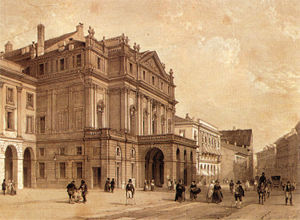 A fire destroyed the previous theatre, the Teatro Regio Ducale, on 25 February 1776, after a carnival
gala. A group of ninety wealthy Milanese, who owned palchi (private boxes) in the theatre, wrote to Archduke Ferdinand of Austria-Este
asking for a new theatre and a provisional one to be used while completing the new one. The neoclassical
architect Giuseppe Piermarini
produced an initial design but it was rejected by Count Firmian (the governor of the then Austrian Lombardy
).
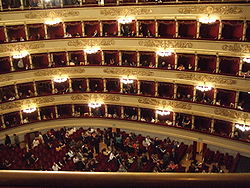 A second plan was accepted in 1776 by Empress Maria Theresa
. The new theatre was built on the former location of the church of Santa Maria della Scala
, from which the theatre gets its name. The church was deconsecrated and demolished, and over a period of two years the theatre was completed by Pietro Marliani, Pietro Nosetti and Antonio and Giuseppe Fe.
The theatre had a total over 3,000 seats organized into 678 pit-stalls, arranged in six tiers of boxes above which is the 'loggione' or two galleries. Its stage is one of the largest in Italy (16.15m d x 20.4m w x 26m h).
Building expenses were covered by the sale of palchi, which were lavishly decorated by their owners, impressing observers such as Stendhal
. La Scala (as it came to be known) soon became the preeminent meeting place for noble and wealthy Milanese people. In the tradition of the times, the platea (the main floor) had no chairs and spectators watched the shows standing up. The orchestra was in full sight, as the golfo mistico (orchestra pit) had not yet been built.
Above the boxes, La Scala has a gallery where the less wealthy can watch the performances, called the loggione. The loggione is typically crowded with the most critical opera aficionados, who can be ecstatic or merciless towards singers' perceived successes or failures. La Scala's loggione is considered a baptism of fire in the opera world, and fiascos are long remembered. (One recent incident occurred in 2006 when tenor Roberto Alagna
was booed off the stage during a performance of Aïda
, forcing his understudy
, Antonello Palombi
, quickly to replace him mid-scene without time to change into a costume.)
As with most of the theatres at that time, La Scala was also a casino
, with gamblers sitting in the foyer. Conditions in the auditorium, too, could be frustrating for the opera lover, as Mary Shelley
discovered in September 1840:
La Scala was originally illuminated with 84 oil lamps mounted on the palcoscenico and another thousand in the rest of theatre. To prevent the risks of fire, several rooms were filled with hundreds of water buckets. In time, oil lamps were replaced by gas lamps, these in turn were replaced by electric lights in 1883.
The original structure was renovated in 1907, when it was given its current layout with 2,800 seats. In 1943, during WWII
, La Scala was severely damaged by bombing. It was rebuilt and reopened on 11 May 1946, with a memorable concert conducted by Arturo Toscanini
—twice La Scala's principal conductor and an associate of the composers Giuseppe Verdi
and Giacomo Puccini
—with a soprano solo by Renata Tebaldi
, which created a sensation.
La Scala hosted the prima (first production) of many famous operas, and had a special relationship with Verdi. For several years, however, Verdi did not allow his work to be played here, as some of his music had been modified (he said "corrupted") by the orchestra. This dispute originated in a disagreement over the production of his Giovanna d'Arco
in 1845; however the composer later conducted his Requiem
there on 25 May 1874, and in 1886 announced that La Scala would host the premiere of his penultimate opera Otello
. The premiere of his last opera, Falstaff
was also given in the theatre.
In 1982, the Filarmonica della Scala was established, drawing its members from the larger pool of musicians that comprise the Orchestra della Scala.
 The theatre underwent a major renovation from early 2002 to late 2004. The theatre was closed following the traditional 7 December 2001 season opening performances of Otello, which ran through December. From 19 January 2002 to November 2004, the opera company was transferred to the new Teatro degli Arcimboldi
, built in the Pirelli-Bicocca industrial area 4.5 miles from the city centre.
The renovation by renowned architect
Mario Botta
proved controversial, as preservationists feared that historic details would be lost. However, the opera company was said to be impressed with improvements to the structure and the sound quality, which was enhanced when the heavy red carpets in the hall were removed. The stage was entirely re-constructed, and an enlarged backstage allows more sets to be stored, permitting more productions. Seats now include monitors for the electronic libretto system
, allowing audiences to follow opera libretti in English and Italian in addition to the original language.
The opera house re-opened on 7 December 2004 with a production, conducted by Riccardo Muti
, of Salieri's
Europa riconosciuta
, the opera that was performed at La Scala's inauguration in 1778. Tickets for the re-opening fetched up to €2,000.
The renovations cost a reported €61 million, and left a budget shortfall that the opera house overcame in 2006.
. The resulting staff backlash caused serious disruptions and staff strikes. In a statement, the theater's board said it was "urgent to unify the theatre's management." On 16 March 2005, the La Scala orchestra and other staff voted overwhelmingly in no confidence motion against Muti, and demanded the resignation of Fontana's replacement, Mauro Meli. Muti had already been forced to cancel a concert a few days earlier because of the disagreements. Italy's culture minister, Giuliano Urbani, supported the conductor but called for urgent action by management to safeguard the smooth operation and prestige of La Scala. On 2 April 2005, Muti resigned from La Scala, citing "hostility" from staff members.
In May 2005, Stéphane Lissner, formerly with the Aix-en-Provence Festival
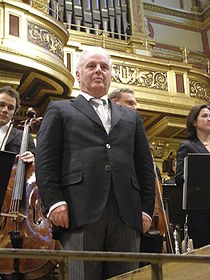
, was appointed as General Manager and Artistic Director of La Scala. On 15 May 2006, Daniel Barenboim
was named Maestro Scaligero, or de facto principal guest conductor, of the company. In October 2011, Barenboim was appointed the next music director of La Scala, effective December 2011, with an initial contract of 5 years.
Opera house
An opera house is a theatre building used for opera performances that consists of a stage, an orchestra pit, audience seating, and backstage facilities for costumes and set building...
in Milan
Milan
Milan is the second-largest city in Italy and the capital city of the region of Lombardy and of the province of Milan. The city proper has a population of about 1.3 million, while its urban area, roughly coinciding with its administrative province and the bordering Province of Monza and Brianza ,...
, Italy. The theatre was inaugurated on 3 August 1778 and was originally known as the New Royal-Ducal Theatre at La Scala . The premiere performance was Antonio Salieri
Antonio Salieri
Antonio Salieri was a Venetian classical composer, conductor and teacher born in Legnago, south of Verona, in the Republic of Venice, but who spent his adult life and career as a faithful subject of the Habsburg monarchy....
's Europa riconosciuta
Europa riconosciuta
Europa riconosciuta is an opera in two acts by Antonio Salieri, designated as a dramma per musica, set to an Italian libretto by Mattia Verazi.The opera takes place in Tyre and tells a story of love, violence and political discord in ancient times...
.
Most of Italy's greatest operatic artists, and many of the finest singers from around the world, have appeared at La Scala during the past 200 years. Today, the theatre is still recognised as one of the leading opera and ballet theatres in the world and is home to the La Scala Theatre Chorus, La Scala Theatre Ballet and La Scala Theatre Orchestra. The theatre also has an associate school, known as the La Scala Theatre Academy , which offers professional training in music, dance, stage craft and stage management.
Overview
La Scala's season traditionally opens on 7 December, Saint Ambrose's Day, the feast day of Milan's patron saintPatron saint
A patron saint is a saint who is regarded as the intercessor and advocate in heaven of a nation, place, craft, activity, class, clan, family, or person...
. All performances must end before midnight, and long operas start earlier in the evening when necessary.
The Museo Teatrale alla Scala
Museo Teatrale alla Scala
The Museo Teatrale alla Scala is a theatrical museum and library attached to the Teatro alla Scala in Milan, Italy. Although it has a particular focus on the history of opera and of that opera house, its scope extends to Italian theatrical history in general, and includes displays relating, for...
(La Scala Theatre Museum), accessible from the theatre's foyer and a part of the house, contains a collection of paintings, drafts, statues, costumes, and other documents regarding La Scala's and opera history in general. La Scala also hosts the Accademia d'Arti e Mestieri dello Spettacolo (Academy for the Performing Arts). Its goal is to train a new generation of young musicians, technical staff, and dancers (at the Scuola di Ballo del Teatro alla Scala
Scuola di Ballo del Teatro alla Scala
La Scala Theatre Ballet School is one of the leading classical ballet schools in the world and is the associate school of La Scala Theatre Ballet, an international ballet company based at La Scala in Milan, Italy...
, one of the Academy's divisions).
History
Carnival
Carnaval is a festive season which occurs immediately before Lent; the main events are usually during February. Carnaval typically involves a public celebration or parade combining some elements of a circus, mask and public street party...
gala. A group of ninety wealthy Milanese, who owned palchi (private boxes) in the theatre, wrote to Archduke Ferdinand of Austria-Este
Archduke Ferdinand of Austria-Este
Archduke Ferdinand Karl Anton Joseph Johann Stanislaus of Austria-Este was a son of Holy Roman Emperor Franz I and Maria Theresa of Austria. He was the founder of the House of Austria-Este and Governor of the Duchy of Milan between 1765 and 1796...
asking for a new theatre and a provisional one to be used while completing the new one. The neoclassical
Neoclassicism
Neoclassicism is the name given to Western movements in the decorative and visual arts, literature, theatre, music, and architecture that draw inspiration from the "classical" art and culture of Ancient Greece or Ancient Rome...
architect Giuseppe Piermarini
Giuseppe Piermarini
Giuseppe Piermarini was an Italian architect who trained with Luigi Vanvitelli at Rome and designed the Teatro alla Scala, Milan , which remains the work by which he is remembered. Indeed, "il Piermarini" serves as an occasional euphemism for the celebrated opera house...
produced an initial design but it was rejected by Count Firmian (the governor of the then Austrian Lombardy
Lombardy
Lombardy is one of the 20 regions of Italy. The capital is Milan. One-sixth of Italy's population lives in Lombardy and about one fifth of Italy's GDP is produced in this region, making it the most populous and richest region in the country and one of the richest in the whole of Europe...
).
Maria Theresa of Austria
Maria Theresa Walburga Amalia Christina was the only female ruler of the Habsburg dominions and the last of the House of Habsburg. She was the sovereign of Austria, Hungary, Croatia, Bohemia, Mantua, Milan, Lodomeria and Galicia, the Austrian Netherlands and Parma...
. The new theatre was built on the former location of the church of Santa Maria della Scala
Chiesa di Santa Maria alla Scala (Milan)
Santa Maria alla Scala was a church built in the gothic style in Milan in 1381 and named in honour of Beatrice Regina della Scala, the wife of Bernabò Visconti who commissioned the building. The church was demolished in 1778 to make way for the ducal theatre which became the Teatro alla Scala....
, from which the theatre gets its name. The church was deconsecrated and demolished, and over a period of two years the theatre was completed by Pietro Marliani, Pietro Nosetti and Antonio and Giuseppe Fe.
The theatre had a total over 3,000 seats organized into 678 pit-stalls, arranged in six tiers of boxes above which is the 'loggione' or two galleries. Its stage is one of the largest in Italy (16.15m d x 20.4m w x 26m h).
Building expenses were covered by the sale of palchi, which were lavishly decorated by their owners, impressing observers such as Stendhal
Stendhal
Marie-Henri Beyle , better known by his pen name Stendhal, was a 19th-century French writer. Known for his acute analysis of his characters' psychology, he is considered one of the earliest and foremost practitioners of realism in his two novels Le Rouge et le Noir and La Chartreuse de Parme...
. La Scala (as it came to be known) soon became the preeminent meeting place for noble and wealthy Milanese people. In the tradition of the times, the platea (the main floor) had no chairs and spectators watched the shows standing up. The orchestra was in full sight, as the golfo mistico (orchestra pit) had not yet been built.
Above the boxes, La Scala has a gallery where the less wealthy can watch the performances, called the loggione. The loggione is typically crowded with the most critical opera aficionados, who can be ecstatic or merciless towards singers' perceived successes or failures. La Scala's loggione is considered a baptism of fire in the opera world, and fiascos are long remembered. (One recent incident occurred in 2006 when tenor Roberto Alagna
Roberto Alagna
Roberto Alagna is a French-Italian tenor. He was born in Clichy-sous-Bois, Seine-Saint-Denis, France.-Early years:Alagna was born outside of the city of Paris in 1963 to a family of Sicilian immigrants . As a teenager, the young Alagna began busking and singing pop in Parisian cabarets for tips...
was booed off the stage during a performance of Aïda
Aida
Aida sometimes spelled Aïda, is an opera in four acts by Giuseppe Verdi to an Italian libretto by Antonio Ghislanzoni, based on a scenario written by French Egyptologist Auguste Mariette...
, forcing his understudy
Understudy
In theater, an understudy is a performer who learns the lines and blocking/choreography of a regular actor or actress in a play. Should the regular actor or actress be unable to appear on stage because of illness or emergencies, the understudy takes over the part...
, Antonello Palombi
Antonello Palombi
Antonello Palombi is an Italian operatic tenor.Palombi joined the Carabinieri, Italy’s paramilitary police force, when he was 20. . While stationed in Perugia and Florence, he also sang in the cathedral choir of Todi. At the suggestion of the choirmaster there, he decided to study singing seriously...
, quickly to replace him mid-scene without time to change into a costume.)
As with most of the theatres at that time, La Scala was also a casino
Casino
In modern English, a casino is a facility which houses and accommodates certain types of gambling activities. Casinos are most commonly built near or combined with hotels, restaurants, retail shopping, cruise ships or other tourist attractions...
, with gamblers sitting in the foyer. Conditions in the auditorium, too, could be frustrating for the opera lover, as Mary Shelley
Mary Shelley
Mary Shelley was a British novelist, short story writer, dramatist, essayist, biographer, and travel writer, best known for her Gothic novel Frankenstein: or, The Modern Prometheus . She also edited and promoted the works of her husband, the Romantic poet and philosopher Percy Bysshe Shelley...
discovered in September 1840:
At the Opera they were giving the Templario. Unfortunately, as is well known, the theatre of La Scala serves, not only as the universal drawing-room for all the society of Milan, but every sort of trading transaction, from horse-dealing to stock-jobbing, is carried on in the pit; so that brief and far between are the snatches of melody one can catch.
La Scala was originally illuminated with 84 oil lamps mounted on the palcoscenico and another thousand in the rest of theatre. To prevent the risks of fire, several rooms were filled with hundreds of water buckets. In time, oil lamps were replaced by gas lamps, these in turn were replaced by electric lights in 1883.
The original structure was renovated in 1907, when it was given its current layout with 2,800 seats. In 1943, during WWII
World War II
World War II, or the Second World War , was a global conflict lasting from 1939 to 1945, involving most of the world's nations—including all of the great powers—eventually forming two opposing military alliances: the Allies and the Axis...
, La Scala was severely damaged by bombing. It was rebuilt and reopened on 11 May 1946, with a memorable concert conducted by Arturo Toscanini
Arturo Toscanini
Arturo Toscanini was an Italian conductor. One of the most acclaimed musicians of the late 19th and 20th century, he was renowned for his intensity, his perfectionism, his ear for orchestral detail and sonority, and his photographic memory...
—twice La Scala's principal conductor and an associate of the composers Giuseppe Verdi
Giuseppe Verdi
Giuseppe Fortunino Francesco Verdi was an Italian Romantic composer, mainly of opera. He was one of the most influential composers of the 19th century...
and Giacomo Puccini
Giacomo Puccini
Giacomo Antonio Domenico Michele Secondo Maria Puccini was an Italian composer whose operas, including La bohème, Tosca, Madama Butterfly, and Turandot, are among the most frequently performed in the standard repertoire...
—with a soprano solo by Renata Tebaldi
Renata Tebaldi
Renata Tebaldi was an Italian lirico-spinto soprano popular in the post-war period...
, which created a sensation.
La Scala hosted the prima (first production) of many famous operas, and had a special relationship with Verdi. For several years, however, Verdi did not allow his work to be played here, as some of his music had been modified (he said "corrupted") by the orchestra. This dispute originated in a disagreement over the production of his Giovanna d'Arco
Giovanna d'Arco
Giovanna d'Arco is an operatic dramma lirico with a prologue and three acts by Giuseppe Verdi to an Italian libretto by Temistocle Solera....
in 1845; however the composer later conducted his Requiem
Requiem (Verdi)
The Messa da Requiem by Giuseppe Verdi is a musical setting of the Roman Catholic funeral mass for four soloists, double choir and orchestra. It was composed in memory of Alessandro Manzoni, an Italian poet and novelist much admired by Verdi. The first performance in San Marco in Milan on 22 May...
there on 25 May 1874, and in 1886 announced that La Scala would host the premiere of his penultimate opera Otello
Otello
Otello is an opera in four acts by Giuseppe Verdi to an Italian libretto by Arrigo Boito, based on Shakespeare's play Othello. It was Verdi's penultimate opera, and was first performed at the Teatro alla Scala, Milan, on February 5, 1887....
. The premiere of his last opera, Falstaff
Falstaff (opera)
Falstaff is an operatic commedia lirica in three acts by Giuseppe Verdi, adapted by Arrigo Boito from Shakespeare's plays The Merry Wives of Windsor and scenes from Henry IV. It was Verdi's last opera, written in the composer's ninth decade, and only the second of his 26 operas to be a comedy...
was also given in the theatre.
In 1982, the Filarmonica della Scala was established, drawing its members from the larger pool of musicians that comprise the Orchestra della Scala.
Major renovation, 2002 to 2004
Teatro degli Arcimboldi
The Teatro degli Arcimboldi is a theatre and opera house in Milan which was built over a twenty-seven month period in anticipation of the closure and subsequent nearly three-year long renovation of Milan's La Scala opera house in December 2001...
, built in the Pirelli-Bicocca industrial area 4.5 miles from the city centre.
The renovation by renowned architect
Architect
An architect is a person trained in the planning, design and oversight of the construction of buildings. To practice architecture means to offer or render services in connection with the design and construction of a building, or group of buildings and the space within the site surrounding the...
Mario Botta
Mario Botta
Mario Botta is a Swiss architect. He studied at the Liceo Artistico in Milan and the IUAV in Venice. His ideas were influenced by Le Corbusier, Carlo Scarpa, Louis Kahn. He opened his own practice in 1970 in Lugano.-Career:...
proved controversial, as preservationists feared that historic details would be lost. However, the opera company was said to be impressed with improvements to the structure and the sound quality, which was enhanced when the heavy red carpets in the hall were removed. The stage was entirely re-constructed, and an enlarged backstage allows more sets to be stored, permitting more productions. Seats now include monitors for the electronic libretto system
Electronic libretto
The Electronic libretto system is used primarily in opera houses and is a device which presents translations of lyrics into an audience's language or transcribes lyrics that may be difficult to understand in the sung form....
, allowing audiences to follow opera libretti in English and Italian in addition to the original language.
The opera house re-opened on 7 December 2004 with a production, conducted by Riccardo Muti
Riccardo Muti
Riccardo Muti, Cavaliere di Gran Croce OMRI is an Italian conductor and music director of the Chicago Symphony Orchestra.-Childhood and education:...
, of Salieri's
Antonio Salieri
Antonio Salieri was a Venetian classical composer, conductor and teacher born in Legnago, south of Verona, in the Republic of Venice, but who spent his adult life and career as a faithful subject of the Habsburg monarchy....
Europa riconosciuta
Europa riconosciuta
Europa riconosciuta is an opera in two acts by Antonio Salieri, designated as a dramma per musica, set to an Italian libretto by Mattia Verazi.The opera takes place in Tyre and tells a story of love, violence and political discord in ancient times...
, the opera that was performed at La Scala's inauguration in 1778. Tickets for the re-opening fetched up to €2,000.
The renovations cost a reported €61 million, and left a budget shortfall that the opera house overcame in 2006.
Management controversies and changes, 2005 onward
Carlo Fontana, the general manager of La Scala since 1990, was dismissed in February 2005 by the board of governors over differences with the music director, Riccardo MutiRiccardo Muti
Riccardo Muti, Cavaliere di Gran Croce OMRI is an Italian conductor and music director of the Chicago Symphony Orchestra.-Childhood and education:...
. The resulting staff backlash caused serious disruptions and staff strikes. In a statement, the theater's board said it was "urgent to unify the theatre's management." On 16 March 2005, the La Scala orchestra and other staff voted overwhelmingly in no confidence motion against Muti, and demanded the resignation of Fontana's replacement, Mauro Meli. Muti had already been forced to cancel a concert a few days earlier because of the disagreements. Italy's culture minister, Giuliano Urbani, supported the conductor but called for urgent action by management to safeguard the smooth operation and prestige of La Scala. On 2 April 2005, Muti resigned from La Scala, citing "hostility" from staff members.
In May 2005, Stéphane Lissner, formerly with the Aix-en-Provence Festival
Aix-en-Provence Festival
The festival international d'art lyrique is an annual international music festival which takes place each summer in Aix-en-Provence, principally in the month of July. Devoted mainly to opera, it also includes concerts of orchestral, chamber, vocal and solo instrumental music.-Establishment:The...
, was appointed as General Manager and Artistic Director of La Scala. On 15 May 2006, Daniel Barenboim
Daniel Barenboim
Daniel Barenboim, KBE is an Argentinian-Israeli pianist and conductor. He has served as music director of several major symphonic and operatic orchestras and made numerous recordings....
was named Maestro Scaligero, or de facto principal guest conductor, of the company. In October 2011, Barenboim was appointed the next music director of La Scala, effective December 2011, with an initial contract of 5 years.
Principal conductors/Music directors of La Scala
- Franco FaccioFranco FaccioFranco Faccio was an Italian composer and conductor.-Biography:Born in Verona, Faccio became known as a conductor of Verdi's music. He studied music at the Milan Conservatory where he was a pupil of Stefano Ronchetti-Monteviti...
, (1871–1889) - Arturo ToscaniniArturo ToscaniniArturo Toscanini was an Italian conductor. One of the most acclaimed musicians of the late 19th and 20th century, he was renowned for his intensity, his perfectionism, his ear for orchestral detail and sonority, and his photographic memory...
, (1898–1908) - Tullio SerafinTullio Serafin-Biography:Tullio Serafin was a leading Italian opera conductor with a long career and a very broad repertoire who revived many 19th century bel canto operas by Bellini, Rossini and Donizetti to become staples of 20th century repertoire...
, (1909–1914, 1917–1918) - La Scala closed from 1918 to 1920
- Arturo ToscaniniArturo ToscaniniArturo Toscanini was an Italian conductor. One of the most acclaimed musicians of the late 19th and 20th century, he was renowned for his intensity, his perfectionism, his ear for orchestral detail and sonority, and his photographic memory...
, (1921–1929) - Victor de SabataVictor de SabataVictor de Sabata was an Italian conductor and composer. He is widely recognized as one of the most distinguished operatic conductors of the twentieth century, especially for his Verdi, Puccini and Wagner. He is also acclaimed for his interpretations of orchestral music...
, (1930–1953) - Carlo Maria GiuliniCarlo Maria GiuliniCarlo Maria Giulini was an Italian conductor.-Biography:Giulini was born in Barletta, Italy, to a father born in Lombardy and a mother born in Naples; but he was raised in Bolzano, which at the time of his birth was part of Austria...
, (1953–1956) - Guido CantelliGuido CantelliGuido Cantelli was an Italian orchestral conductor.-Biography:Born in Novara, Italy, Cantelli was named Musical Director of La Scala, Milan on 16 November 1956 but his promising career was cut short only one week later by his death at the age of 36 in an aircraft crash in Paris, France.Cantelli...
, (1956) - Gianandrea GavazzeniGianandrea GavazzeniGianandrea Gavazzeni was an Italian pianist, conductor , composer and musicologist.Gavazzeni was born in Bergamo. For almost 50 years, starting from 1948, he was principal conductor at La Scala, Milan, in 1966-68 being its music and artistic director.He had his Metropolitan Opera debut on 11...
, (1966–1968) - Claudio AbbadoClaudio AbbadoClaudio Abbado, Cavaliere di Gran Croce OMRI , is an Italian conductor. He has served as music director of the La Scala opera house in Milan, principal conductor of the London Symphony Orchestra, principal guest conductor of the Chicago Symphony Orchestra, music director of the Vienna State Opera,...
, (1968–1986) - Riccardo MutiRiccardo MutiRiccardo Muti, Cavaliere di Gran Croce OMRI is an Italian conductor and music director of the Chicago Symphony Orchestra.-Childhood and education:...
, (1986–2005) - Daniel BarenboimDaniel BarenboimDaniel Barenboim, KBE is an Argentinian-Israeli pianist and conductor. He has served as music director of several major symphonic and operatic orchestras and made numerous recordings....
, (2006–2011, Maestro Scaligero; music director effective December 2011)
Premieres
- See: :Category:La Scala world premieres
- 2007: TenekeTenekeTeneke is an opera in three acts by Italian composer Fabio Vacchi.Franco Marcoaldi adapted the Italian libretto from the eponymous novel by the Turkish author Yaşar Kemal published in 1955. The opera was premiered on September 22, 2007 at the Teatro alla Scala of Milan, conducted by Roberto Abbado...
by Fabio VacchiFabio VacchiFabio Vacchi is an Italian composer born in 1949 in Bologna.-Training and debut:Fabio Vacchi studied at the G.B. Martini Conservatory of Bologna with Giacomo Manzoni and Tito Gotti. In 1974 he participated in the courses of the Tanglewood Festival in the USA, where he was awarded the Koussevitzky... - 1988: Montag aus LichtMontag aus LichtMontag aus Licht is an opera by Karlheinz Stockhausen in a greeting, three acts, and a farewell, and was the third of seven to be composed for the opera cycle Licht: die sieben Tage der Woche...
by Karlheinz StockhausenKarlheinz StockhausenKarlheinz Stockhausen was a German composer, widely acknowledged by critics as one of the most important but also controversial composers of the 20th and early 21st centuries. Another critic calls him "one of the great visionaries of 20th-century music"... - 1984: Samstag aus LichtSamstag aus LichtSamstag aus Licht is an opera by Karlheinz Stockhausen in a greeting and four scenes, and was the second of seven to be composed for the opera cycle Licht: die sieben Tage der Woche...
by Karlheinz Stockhausen - 1981: Donnerstag aus LichtDonnerstag aus LichtDonnerstag aus Licht is an opera by Karlheinz Stockhausen in a greeting, three acts, and a farewell, and was the first of seven to be composed for the opera cycle Licht: die sieben Tage der Woche...
by Karlheinz Stockhausen - 1957: Dialogues of the CarmelitesDialogues of the CarmelitesDialogues of the Carmelites , is an opera in three acts by Francis Poulenc. In 1953, M. Valcarenghi approached Poulenc to commission a ballet for La Scala in Milan; when Poulenc found the proposed subject uninspiring, Valcarenghi suggested instead a screenplay by Georges Bernanos, based on the...
by Francis PoulencFrancis PoulencFrancis Jean Marcel Poulenc was a French composer and a member of the French group Les six. He composed solo piano music, chamber music, oratorio, choral music, opera, ballet music, and orchestral music... - 1926: TurandotTurandotTurandot is an opera in three acts by Giacomo Puccini, set to a libretto in Italian by Giuseppe Adami and Renato Simoni.Though Puccini's first interest in the subject was based on his reading of Friedrich Schiller's adaptation of the play, his work is most nearly based on the earlier text Turandot...
by Giacomo PucciniGiacomo PucciniGiacomo Antonio Domenico Michele Secondo Maria Puccini was an Italian composer whose operas, including La bohème, Tosca, Madama Butterfly, and Turandot, are among the most frequently performed in the standard repertoire... - 1924: NeroneNerone (Boito)Nerone is an opera in four acts composed by Arrigo Boito, to a libretto in Italian written by the composer. The work is a series of scenes from Imperial Rome at the time of Emperor Nero depicting tensions between the Imperial religion and Christianity, and ends with the Great Fire of Rome...
by Arrigo BoitoArrigo BoitoArrigo Boito , aka Enrico Giuseppe Giovanni Boito, pseudonym Tobia Gorrio, was an Italian poet, journalist, novelist and composer, best known today for his libretti, especially those for Giuseppe Verdi's operas Otello and Falstaff, and his own opera Mefistofele... - 1904: Madama ButterflyMadama ButterflyMadama Butterfly is an opera in three acts by Giacomo Puccini, with an Italian libretto by Luigi Illica and Giuseppe Giacosa. Puccini based his opera in part on the short story "Madame Butterfly" by John Luther Long, which was dramatized by David Belasco...
by Giacomo Puccini - 1893: FalstaffFalstaff (opera)Falstaff is an operatic commedia lirica in three acts by Giuseppe Verdi, adapted by Arrigo Boito from Shakespeare's plays The Merry Wives of Windsor and scenes from Henry IV. It was Verdi's last opera, written in the composer's ninth decade, and only the second of his 26 operas to be a comedy...
by Giuseppe VerdiGiuseppe VerdiGiuseppe Fortunino Francesco Verdi was an Italian Romantic composer, mainly of opera. He was one of the most influential composers of the 19th century... - 1892: La WallyLa WallyLa Wally is a four-act opera by Alfredo Catalani, composed on a libretto by Luigi Illica, and first performed at La Scala, Milan on 20 January 1892....
by Alfredo CatalaniAlfredo CatalaniAlfredo Catalani was an Italian operatic composer. He is best remembered for his operas Loreley and La Wally... - 1889: EdgarEdgar (opera)Edgar is an operatic dramma lirico in three acts by Giacomo Puccini to an Italian libretto by Ferdinando Fontana, freely based on the play in verse La Coupe et les lèvres by Alfred de Musset...
by Giacomo Puccini - 1887: OtelloOtelloOtello is an opera in four acts by Giuseppe Verdi to an Italian libretto by Arrigo Boito, based on Shakespeare's play Othello. It was Verdi's penultimate opera, and was first performed at the Teatro alla Scala, Milan, on February 5, 1887....
by Giuseppe Verdi - 1885: Marion DelormeMarion DelormeMarion Delorme was a French courtesan known for her relationships with the important men of her time.- Early life, life as a courtesan, early death :...
by Amilcare PonchielliAmilcare PonchielliAmilcare Ponchielli was an Italian composer, largely of operas.-Biography:Born in Paderno Fasolaro, now Paderno Ponchielli, near Cremona, Ponchielli won a scholarship at the age of nine to study music at the Milan Conservatory, writing his first symphony by the time he was ten years old.Two years... - 1876: La GiocondaLa Gioconda (opera)La Gioconda is an opera in four acts by Amilcare Ponchielli set to an Italian libretto by Arrigo Boito, based on Angelo, tyran de Padoue, a play in prose by Victor Hugo, dating from 1835...
by Amilcare Ponchielli - 1870: Il GuaranyIl GuaranyIl Guarany is an opera ballo composed by Antônio Carlos Gomes, based on the novel O Guarani, written by José de Alencar. The libretto was written by Antonio Scalvini and Carlo D'Ormeville.-Performance history:...
by Antônio Carlos GomesAntônio Carlos GomesAntônio Carlos Gomes was the first New World composer whose work was accepted by Europe.-Life:He was born in Campinas, Brazil, son of Maestro Manuel José Gomes and Fabiana Maria Jaguari Cardoso.... - 1868: MefistofeleMefistofeleMefistofele is an opera in a prologue, four acts and an epilogue, the only completed opera by the Italian composer-librettist Arrigo Boito.-Composition history:...
by Arrigo BoitoArrigo BoitoArrigo Boito , aka Enrico Giuseppe Giovanni Boito, pseudonym Tobia Gorrio, was an Italian poet, journalist, novelist and composer, best known today for his libretti, especially those for Giuseppe Verdi's operas Otello and Falstaff, and his own opera Mefistofele... - 1845: Giovanna d'ArcoGiovanna d'ArcoGiovanna d'Arco is an operatic dramma lirico with a prologue and three acts by Giuseppe Verdi to an Italian libretto by Temistocle Solera....
by Giuseppe Verdi
- 1843: I Lombardi alla prima crociataI Lombardi alla prima crociataI Lombardi alla prima crociata is an operatic dramma lirico in four acts by Giuseppe Verdi to an Italian libretto by Temistocle Solera, based on an epic poem by Tommaso Grossi. Its first performance was given at the Teatro alla Scala in Milan on 11 February 1843...
by Giuseppe Verdi - 1842: NabuccoNabuccoNabucco is an opera in four acts by Giuseppe Verdi to an Italian libretto by Temistocle Solera, based on the Biblical story and the 1836 play by Auguste Anicet-Bourgeois and Francis Cornue...
by Giuseppe Verdi - 1840: Un giorno di regnoUn giorno di regnoUn giorno di regno, ossia il finto Stanislao is an operatic melodramma giocoso in two acts by Giuseppe Verdi to an Italian libretto by Felice Romani, based on the play Le faux Stanislas by Alexandre Vincent Pineu-Duval...
by Giuseppe Verdi - 1839: Oberto, Conte di San BonifacioOberto (opera)Oberto, Conte di San Bonifacio is an opera in two acts by Giuseppe Verdi to an Italian libretto by Temistocle Solera, based on an existing libretto by Antonio Piazza probably called Rocester....
by Giuseppe Verdi - 1835: Maria StuardaMaria StuardaMaria Stuarda is a tragic opera, , in two acts, by Gaetano Donizetti, to a libretto by Giuseppe Bardari, based on Friedrich Schiller's 1800 play Maria Stuart....
by Gaetano DonizettiGaetano DonizettiDomenico Gaetano Maria Donizetti was an Italian composer from Bergamo, Lombardy. His best-known works are the operas L'elisir d'amore , Lucia di Lammermoor , and Don Pasquale , all in Italian, and the French operas La favorite and La fille du régiment... - 1833: Lucrezia BorgiaLucrezia Borgia (opera)Lucrezia Borgia is a melodramma, or opera, in a prologue and two acts by Gaetano Donizetti. Felice Romani wrote the Italian libretto after the play by Victor Hugo, in its turn after the legend of Lucrezia Borgia. Lucrezia Borgia was first performed on 26 December 1833 at La Scala, Milan with...
by Gaetano Donizetti - 1831: NormaNorma (opera)Norma is a tragedia lirica or opera in two acts by Vincenzo Bellini with libretto by Felice Romani after Norma, ossia L'infanticidio by Alexandre Soumet. First produced at La Scala on December 26, 1831, it is generally regarded as an example of the supreme height of the bel canto tradition...
by Vincenzo BelliniVincenzo BelliniVincenzo Salvatore Carmelo Francesco Bellini was an Italian opera composer. His greatest works are I Capuleti ed i Montecchi , La sonnambula , Norma , Beatrice di Tenda , and I puritani... - 1829: La stranieraLa stranieraLa straniera is an opera in two acts by Vincenzo Bellini, from a libretto by Felice Romani, based on L'étrangère by Charles-Victor Prévot, vicomte d'Arlincourt...
by Vincenzo Bellini - 1827: Il pirataIl pirataIl pirata is an opera in two acts by Vincenzo Bellini to an Italian libretto by Felice Romani from a French translation of the tragic play Bertram, or The Castle of St Aldobrando by Charles Maturin...
by Vincenzo Bellini - 1820: Margherita d'AnjouMargherita d'AnjouMargherita d’Anjou is an operatic melodramma semiseria in two acts by Giacomo Meyerbeer. The Italian libretto was by Felice Romani after a text by René Charles Guilbert de Pixérécourt. It is the fourth of Meyerbeer's Italian operas and his first real success.-Performance history:Margherita d’Anjou...
by Giacomo MeyerbeerGiacomo MeyerbeerGiacomo Meyerbeer was a noted German opera composer, and the first great exponent of "grand opera." At his peak in the 1830s and 1840s, he was the most famous and successful composer of opera in Europe, yet he is rarely performed today.-Early years:He was born to a Jewish family in Tasdorf , near... - 1814: Il turco in ItaliaIl turco in ItaliaIl turco in Italia is an opera in two acts by Gioachino Rossini. The Italian-language libretto was written by Felice Romani...
by Gioachino Rossini - 1813: Aureliano in PalmiraAureliano in PalmiraAureliano in Palmira is an operatic dramma serio in two acts written by Gioachino Rossini to an Italian libretto in which the librettist was credited only by the initials "G. F. R." The libretto has generally been attributed to Giuseppe Felice Romani, but sometimes to the otherwise...
by Gioachino Rossini - 1812: La pietra del paragoneLa pietra del paragoneLa pietra del paragone is an opera, or melodramma giocoso, in two acts by Gioachino Rossini, to an original Italian libretto by Luigi Romanelli.-Performance history:...
by Gioachino Rossini - 1800: Idante, ovvero I sacrifici d'Ecate by Marcos PortugalMarcos PortugalMarcos António da Fonseca Portugal was a Portuguese classical composer, who achieved great international fame for his operas in Italian....
- 1794: Demofoonte by Marcos Portugal
- 1778: Europa riconosciutaEuropa riconosciutaEuropa riconosciuta is an opera in two acts by Antonio Salieri, designated as a dramma per musica, set to an Italian libretto by Mattia Verazi.The opera takes place in Tyre and tells a story of love, violence and political discord in ancient times...
by Antonio SalieriAntonio SalieriAntonio Salieri was a Venetian classical composer, conductor and teacher born in Legnago, south of Verona, in the Republic of Venice, but who spent his adult life and career as a faithful subject of the Habsburg monarchy....