

Palais Garnier

Encyclopedia
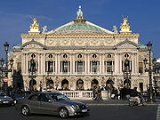
The Palais Garnier, palɛ gaʁnje, is an elegant 1,979-seat opera house
, which was built from 1861 to 1875 for the Paris Opera
. It was originally called the Salle des Capucines because of its location on the Boulevard des Capucines
in the 9th arrondissement of Paris, but soon became known as the Palais Garnier in recognition of its opulence and its architect, Charles Garnier
. The theatre was also often referred to as the Opéra Garnier, the Opéra de Paris or simply the Opéra. It was the primary home of the Paris Opera and its associated Paris Opera Ballet
until 1989, when a new 2,700-seat house, the Opéra Bastille
, with elaborate facilities for set and production changes, opened at the Place de la Bastille
. The Paris Opera now mainly uses the Palais Garnier for ballet.
The Palais Garnier is "probably the most famous opera house in the world, a symbol of Paris like Notre Dame cathedral, the Louvre, or the Sacré Coeur basilica." This is at least partly due to its use as the setting for Gaston Leroux
's 1911 novel The Phantom of the Opera
and the novel's subsequent adaptations in films and Andrew Lloyd Weber's popular 1986 musical
. Another contributing factor is that among the buildings constructed in Paris during the Second Empire
, besides being the most expensive, it has been described as the only one that is "unquestionably a masterpiece of the first rank."
The Palais Garnier also houses the Bibliothèque-Musée de l'Opéra de Paris (Paris Opera Library-Museum). Although the Library-Museum is no longer managed by the Opera and is part of the Bibliothèque nationale de France
, the museum is included in unaccompanied tours of the Palais Garnier.
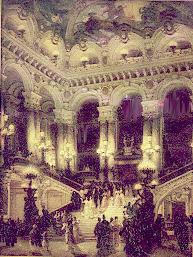 The Palais Garnier was designed as part of the great reconstruction of Paris during the Second Empire
initiated by Emperor Napoleon III
, who chose Baron Haussmann
to supervise the reconstruction. In 1858 the Emperor authorized Haussmann to clear the required 12000 square metres (1.2 ha) of land on which to build a second theatre for the world-renowned Parisian Opera and Ballet companies.
The selection of the architect was the subject of an architectural design competition
in 1861, a competition which was won by the architect Charles Garnier
(1825–1898). Legend has it that the Emperor's wife, the Empress Eugénie
, who was likely irritated that her own favored candidate, Viollet-le-Duc, had not been selected, asked the relatively unknown Garnier: "What is this? It's not a style; it's neither Louis Quatorze, nor Louis Quinze, nor Louis Seize!" "Why Ma'am, it's Napoléon Trois" replied Garnier "and you're complaining!" Andrew Ayers has written that Garnier's definition "remains undisputed, so much does the Palais Garnier seem emblematic of its time and of the Second Empire that created it. A giddy mixture of up-to-the-minute technology, rather prescriptive rationalism, exuberant eclecticism and astonishing opulence, Garnier's opera encapsulated the divergent tendencies and political and social ambitions of its era." Ayers goes on to say that the judges of the competition in particular admired Garnier's design for "the clarity of his plan, which was a brilliant example of the beaux-arts design methods in which both he and they were thoroughly versed."
e over the end bays.
With the incorporated changes, the model was transported over specially installed rails to the Palais de l'Industrie for public display at the 1863 exhibition. Théophile Gautier
wrote of the model (Le Moniteur Universel, 13 May 1863) that "the general arrangement becomes intelligible to all eyes and already acquires a sort of reality that better permits one to prejudge the final effect ... it attracts the crowd's curiosity; it is, in effect, the new Opéra seen through reversed opera glasses." The model is now lost, but it was photographed by J. B. Donas in 1863.
The emperor's quadrigae were never added, although they can be seen in the model. Instead Charles-Alphonse Guméry's
gilded bronze sculptural groups Harmony and Poetry were installed in 1869. The linear frieze seen in the model was also redesigned with alternating low- and high-relief decorative medallions bearing the gilded letters from the imperial monogram ("N" for Napoléon, "E" for Empereur). The custom-designed letters were not ready in time for the unveiling and were replaced with commercially available substitutes. After the fall of the empire in 1870, Garnier was relieved to be able to remove them from the medallions. Letters in Garnier's original design were finally installed during the restoration of the building in 2000.
. The official title of the Paris Opera was prominently displayed on the entablature
of the giant Corinthian order
of coupled columns fronting the main-floor loggia
: "ACADEMIE IMPERIALE DE MUSIQUE". When the emperor was deposed on 4 September 1870 as a result of the disastrous Franco-Prussian War
, the government was replaced by the Third Republic
, and almost immediately, on 17 September 1870, the Opera was renamed Théâtre National de l'Opéra, a name it kept until 1939. In spite of this, when it came time to change the name on the new opera house, only the first six letters of the word IMPERIALE were replaced, giving the now famous "ACADEMIE NATIONALE DE MUSIQUE", an official title which had actually only been used during the approximately two-year period of the Second Republic
which had preceded the Second Empire.
during the Franco-Prussian War (September 1870 – January 1871). Construction was far enough along that portions of the building could be used as a food warehouse and a hospital. After France's defeat Garnier became seriously ill from the deprivations of the siege and left Paris from March to June to recover on the Liguria
n coast of Italy, while his assistant Louis Louvet remained behind during the turmoil of the Paris Commune
which followed. Louvet wrote several letters to Garnier, which document events relating to the building. Because of the theatre's proximity to the fighting at the Place Vendôme
, troops of the National Guard
bivouacked there and were in charge of its defense and distributing food to soldiers and civilians. The Commune authorities planned to replace Garnier with another architect, but this unnamed man had not yet appeared when Republican troops ousted the National Guard and gained control over the building on 23 May. By the end of the month the Commune had been severely defeated. The Third Republic had become sufficiently well established by the fall, that on 30 September construction work recommenced, and by late October a small amount of funds were voted by the new legislature for further construction.
who remained in office until May 1873, but also persisted under his successor Marshal MacMahon. Economies were demanded, and Garnier was forced to suppress the completion of sections of the building, in particular the Pavillon de l'Empereur (which later became the home of the Opera Library Museum). However, on 28–29 October an overwhelming incentive to complete the new theatre came when the Salle Le Peletier, which had been the chief venue of the Paris Opera and Ballet since 1821, was destroyed by a fire which raged the entire night.
and Rossini's Guillaume Tell, the first two acts of Halévy's 1835 opera La Juive
, along with "The Consecration of the Swords" from Meyerbeer's 1836 opera Les Huguenots
and the 1866 ballet La source with music by Delibes and Minkus.
On 20 May 1896, the falling of one of the counterweight
s for the grand chandelier resulted in the death of one member of the audience. This incident inspired one of the more famous scenes in Gaston Leroux
's classic 1910 gothic novel The Phantom of the Opera
.
Originally the chandelier was raised up through the ceiling into the cupola over the auditorium for cleaning, but now it is lowered. The space in the cupola was used in the 1960s for opera rehearsals, and in the 1980s was remodeled into two floors of dance rehearsal space. The lower floor consists of the Salle Nureïev (Nureyev) and the Salle Balanchine, and the upper floor, the Salle Petipa
.
During 1994, restoration work began on the theatre. This consisted of modernizing the stage machinery and electrical facilities, while restoring and preserving the opulent décor, as well as strengthening the structure and foundation of the building. This restoration was completed in 2007.
After three attempts since 1875, a restaurant opened its doors on the eastern facade of the building in 2011. It was designed by French architect Odile Decq. The chef is Christophe Aribert
.
.
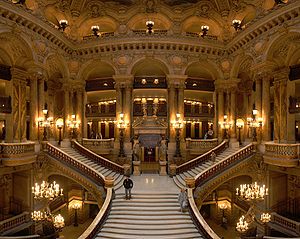
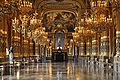 The Palais Garnier is a building of exceptional opulence. The style is monumental and considered typically Beaux-Arts, with use of axial symmetry in plan, and its exterior ornamentation. Its audience sits under a central chandelier which weighs more than six tons, and it has a huge stage with room to accommodate as many as 450 artists.
It is decorated with very elaborate multicolored marble friezes, columns, and lavish statuary, many of which portray deities of Greek mythology
. Gilded galvanoplastic bronze busts of many of the great composers are located between the columns of the theatre's front façade and depict from left to right: Rossini, Auber
, Beethoven, Mozart, Spontini, Meyerbeer, and Halévy
. On the left and right lateral returns of the front facade are busts of the librettists Eugène Scribe
and Philippe Quinault
, respectively.
The sculptural group Apollo, Poetry, and Music, located at the apex of the south gable of the stage flytower, is the work of Aimé Millet
, and the two smaller bronze Pegasus
figures at either end of the south gable are by Eugène-Louis Lequesne
. The two gilded figural groups Harmony and Poetry, which respectively crown the apexes of the principal facade's left and right avant-corps, were both designed by Charles Gumery
. The bases of the two avant-corps are decorated (from left to right) with four major multifigure groups sculpted by: François Jouffroy
(Harmony), Jean-Baptiste Claude Eugène Guillaume
(Instrumental Music), Jean-Baptiste Carpeaux
(The Dance, criticized for indecency), and Jean-Joseph Perraud
(Lyrical Drama). The facade also incorporates other work by Gumery, Alexandre Falguière
, and others.
The interior consists of interweaving corridors, stairwells, alcoves and landings allowing the movement of large numbers of people and space for socializing during intermission. Rich with velvet, gold leaf, and cherubim and nymphs, the interior is characteristic of Baroque sumptuousness.
The ceiling area, which surrounds the chandelier, contains a new 1964 painting by Marc Chagall
which was installed on a removable frame over the original and depicts scenes from operas by 14 composers – Moussorgsky, Mozart, Wagner, Berlioz, Rameau, Debussy, Ravel, Stravinsky, Tchaikovsky, Adam
, Bizet, Verdi, Beethoven, and Gluck. Although praised by some, others feel Chagall's work creates "a false note in Garnier's carefully orchestrated interior."
Several buildings in Poland
were based on the design of the Palais Garnier. these include the Juliusz Słowacki Theatre in Kraków
, built during 1893, The Lviv Theatre of Opera and Ballet in Lviv
, built between 1897 and 1900, and also the Warsaw Philharmony edifice in Warsaw
, built between 1900 and 1901.
In the Ukraine, the influence of the Palais Garnier can be seen at the National Opera House of Ukraine in Kiev
, built in 1901.
The Thomas Jefferson Building
of the Library of Congress
in Washington, D.C.
is modelled after the Palais Garnier, most notably the facade and Great Hall.
The Theatro Municipal do Rio de Janeiro (1909) was also modeled after Palais Garnier, particularly and Great Hall and stairs.
The Amazon Theatre
in Manaus (Brazil) built from 1884 to 1896. The overview is very similar, though the decoration is more simple.
The Hanoi Opera House
in Vietnam is considered to be a typical French colonial architectural monument in Vietnam, and it is also a small-scale replica of the Palais Garnier. The Saigon Opera House
is a smaller counterpart.
Opera house
An opera house is a theatre building used for opera performances that consists of a stage, an orchestra pit, audience seating, and backstage facilities for costumes and set building...
, which was built from 1861 to 1875 for the Paris Opera
Paris Opera
The Paris Opera is the primary opera company of Paris, France. It was founded in 1669 by Louis XIV as the Académie d'Opéra and shortly thereafter was placed under the leadership of Jean-Baptiste Lully and renamed the Académie Royale de Musique...
. It was originally called the Salle des Capucines because of its location on the Boulevard des Capucines
Boulevard des Capucines
The Boulevard des Capucines is one of the four 'grands boulevards' in Paris, a chain of boulevards running east-west that also includes Boulevard de la Madeleine, Boulevard des Italiens, and Boulevard Montmartre....
in the 9th arrondissement of Paris, but soon became known as the Palais Garnier in recognition of its opulence and its architect, Charles Garnier
Charles Garnier (architect)
Charles Garnier was a French architect, perhaps best known as the architect of the Palais Garnier and the Opéra de Monte-Carlo.-Early life:...
. The theatre was also often referred to as the Opéra Garnier, the Opéra de Paris or simply the Opéra. It was the primary home of the Paris Opera and its associated Paris Opera Ballet
Paris Opera Ballet
The Paris Opera Ballet is the oldest national ballet company in the world, and many European and international ballet companies can trace their origins to it...
until 1989, when a new 2,700-seat house, the Opéra Bastille
Opéra Bastille
L'Opéra Bastille ' is a modern opera house in Paris, France. It is the home base of the Opéra national de Paris and was designed to replace the Palais Garnier, which is nowadays mainly used for ballet performances....
, with elaborate facilities for set and production changes, opened at the Place de la Bastille
Place de la Bastille
The Place de la Bastille is a square in Paris, where the Bastille prison stood until the 'Storming of the Bastille' and its subsequent physical destruction between 14 July 1789 and 14 July 1790 during the French Revolution; no vestige of it remains....
. The Paris Opera now mainly uses the Palais Garnier for ballet.
The Palais Garnier is "probably the most famous opera house in the world, a symbol of Paris like Notre Dame cathedral, the Louvre, or the Sacré Coeur basilica." This is at least partly due to its use as the setting for Gaston Leroux
Gaston Leroux
Gaston Louis Alfred Leroux was a French journalist and author of detective fiction.In the English-speaking world, he is best known for writing the novel The Phantom of the Opera , which has been made into several film and stage productions of the same name, notably the 1925 film starring Lon...
's 1911 novel The Phantom of the Opera
The Phantom of the Opera
Le Fantôme de l'Opéra is a novel by French writer Gaston Leroux. It was first published as a serialisation in "Le Gaulois" from September 23, 1909 to January 8, 1910...
and the novel's subsequent adaptations in films and Andrew Lloyd Weber's popular 1986 musical
The Phantom of the Opera (1986 musical)
The Phantom of the Opera is a musical by Andrew Lloyd Webber, based on the French novel Le Fantôme de l'Opéra by Gaston Leroux.The music was composed by Lloyd Webber, and most lyrics were written by Charles Hart, with additional lyrics by Richard Stilgoe. Alan Jay Lerner was an early collaborator,...
. Another contributing factor is that among the buildings constructed in Paris during the Second Empire
Second French Empire
The Second French Empire or French Empire was the Imperial Bonapartist regime of Napoleon III from 1852 to 1870, between the Second Republic and the Third Republic, in France.-Rule of Napoleon III:...
, besides being the most expensive, it has been described as the only one that is "unquestionably a masterpiece of the first rank."
The Palais Garnier also houses the Bibliothèque-Musée de l'Opéra de Paris (Paris Opera Library-Museum). Although the Library-Museum is no longer managed by the Opera and is part of the Bibliothèque nationale de France
Bibliothèque nationale de France
The is the National Library of France, located in Paris. It is intended to be the repository of all that is published in France. The current president of the library is Bruno Racine.-History:...
, the museum is included in unaccompanied tours of the Palais Garnier.
Construction history
Second French Empire
The Second French Empire or French Empire was the Imperial Bonapartist regime of Napoleon III from 1852 to 1870, between the Second Republic and the Third Republic, in France.-Rule of Napoleon III:...
initiated by Emperor Napoleon III
Napoleon III of France
Louis-Napoléon Bonaparte was the President of the French Second Republic and as Napoleon III, the ruler of the Second French Empire. He was the nephew and heir of Napoleon I, christened as Charles Louis Napoléon Bonaparte...
, who chose Baron Haussmann
Baron Haussmann
Georges-Eugène Haussmann, commonly known as Baron Haussmann , was a French civic planner whose name is associated with the rebuilding of Paris...
to supervise the reconstruction. In 1858 the Emperor authorized Haussmann to clear the required 12000 square metres (1.2 ha) of land on which to build a second theatre for the world-renowned Parisian Opera and Ballet companies.
The selection of the architect was the subject of an architectural design competition
Architectural design competition
An architectural design competition is a special type of competition in which an organization or government body that plans to build a new building asks for architects to submit a proposed design for a building. The winning design is usually chosen by an independent panel of design professionals...
in 1861, a competition which was won by the architect Charles Garnier
Charles Garnier (architect)
Charles Garnier was a French architect, perhaps best known as the architect of the Palais Garnier and the Opéra de Monte-Carlo.-Early life:...
(1825–1898). Legend has it that the Emperor's wife, the Empress Eugénie
Eugénie de Montijo
Doña María Eugenia Ignacia Augustina de Palafox-Portocarrero de Guzmán y Kirkpatrick, 16th Countess of Teba and 15th Marquise of Ardales; 5 May 1826 – 11 July 1920), known as Eugénie de Montijo , was the last Empress consort of the French from 1853 to 1871 as the wife of Napoleon III, Emperor of...
, who was likely irritated that her own favored candidate, Viollet-le-Duc, had not been selected, asked the relatively unknown Garnier: "What is this? It's not a style; it's neither Louis Quatorze, nor Louis Quinze, nor Louis Seize!" "Why Ma'am, it's Napoléon Trois" replied Garnier "and you're complaining!" Andrew Ayers has written that Garnier's definition "remains undisputed, so much does the Palais Garnier seem emblematic of its time and of the Second Empire that created it. A giddy mixture of up-to-the-minute technology, rather prescriptive rationalism, exuberant eclecticism and astonishing opulence, Garnier's opera encapsulated the divergent tendencies and political and social ambitions of its era." Ayers goes on to say that the judges of the competition in particular admired Garnier's design for "the clarity of his plan, which was a brilliant example of the beaux-arts design methods in which both he and they were thoroughly versed."
Laying of the foundation
Initial funds to begin construction were voted on 2 July 1861, and the site was excavated between 27 August and 31 December. On 13 January 1862 the first concrete foundations were poured, starting at the front and progressing sequentially toward the back, with the laying of the substructure masonry beginning as soon as each section of concrete was cast. The opera house needed a much deeper basement in the substage area than other building types, but the level of the groundwater was unexpectedly high. Wells were sunk in February 1862 and eight steam pumps installed in March, but the site would not dry up. To deal with this problem Garnier designed a double foundation to protect the superstructure from moisture. It incorporated a water course and an enormous concrete cistern (cuve) which would both relieve the pressure of the external groundwater on the basement walls and serve as a reservoir in case of fire. A contract for its construction was signed on 20 June. Soon a persistent legend arose that the opera house was built over a subterranean lake, inspiring Gaston Leroux to incorporate the idea into his novel The Phantom of the Opera. By 21 July the cornerstone was laid at the southeast angle of the building's facade. The brick vault of the cuve was finished by 8 November, and the substructure was essentially complete by the end of the year.Model
The emperor expressed an interest in seeing a model of the building, and a plaster scale model (2 cm per meter) was constructed by Louis Villeminot between April 1862 and April 1863 at a cost of more than 8,000 francs. After previewing it, the emperor requested several changes to the design of the building, the most important of which was the suppression of a balustraded terrace with corner groups at the top of the facade and its replacement with a massive attic story fronted by a continuous frieze surmounted by imperial quadrigaQuadriga
A quadriga is a car or chariot drawn by four horses abreast . It was raced in the Ancient Olympic Games and other contests. It is represented in profile as the chariot of gods and heroes on Greek vases and in bas-relief. The quadriga was adopted in ancient Roman chariot racing...
e over the end bays.
With the incorporated changes, the model was transported over specially installed rails to the Palais de l'Industrie for public display at the 1863 exhibition. Théophile Gautier
Théophile Gautier
Pierre Jules Théophile Gautier was a French poet, dramatist, novelist, journalist, art critic and literary critic....
wrote of the model (Le Moniteur Universel, 13 May 1863) that "the general arrangement becomes intelligible to all eyes and already acquires a sort of reality that better permits one to prejudge the final effect ... it attracts the crowd's curiosity; it is, in effect, the new Opéra seen through reversed opera glasses." The model is now lost, but it was photographed by J. B. Donas in 1863.
The emperor's quadrigae were never added, although they can be seen in the model. Instead Charles-Alphonse Guméry's
Charles Gumery
Charles-Alphonse-Achille Guméry was a French sculptor working in an academic realist manner in Paris. Several of his figures ornament the Opéra Garnier most notoriously the group La Danse, which was commissioned from him after the group by Jean-Baptiste Carpeaux was found unacceptable.Though he...
gilded bronze sculptural groups Harmony and Poetry were installed in 1869. The linear frieze seen in the model was also redesigned with alternating low- and high-relief decorative medallions bearing the gilded letters from the imperial monogram ("N" for Napoléon, "E" for Empereur). The custom-designed letters were not ready in time for the unveiling and were replaced with commercially available substitutes. After the fall of the empire in 1870, Garnier was relieved to be able to remove them from the medallions. Letters in Garnier's original design were finally installed during the restoration of the building in 2000.
Change in name
The scaffolding concealing the facade was removed on 15 August 1867 in time for the Paris Exposition of 1867Exposition Universelle (1867)
The Exposition Universelle of 1867 was a World Exposition held in Paris, France, in 1867.-Conception:In 1864, Emperor Napoleon III decreed that an international exposition should be held in Paris in 1867. A commission was appointed with Prince Jerome Napoleon as president, under whose direction...
. The official title of the Paris Opera was prominently displayed on the entablature
Entablature
An entablature refers to the superstructure of moldings and bands which lie horizontally above columns, resting on their capitals. Entablatures are major elements of classical architecture, and are commonly divided into the architrave , the frieze ,...
of the giant Corinthian order
Corinthian order
The Corinthian order is one of the three principal classical orders of ancient Greek and Roman architecture. The other two are the Doric and Ionic. When classical architecture was revived during the Renaissance, two more orders were added to the canon, the Tuscan order and the Composite order...
of coupled columns fronting the main-floor loggia
Loggia
Loggia is the name given to an architectural feature, originally of Minoan design. They are often a gallery or corridor at ground level, sometimes higher, on the facade of a building and open to the air on one side, where it is supported by columns or pierced openings in the wall...
: "ACADEMIE IMPERIALE DE MUSIQUE". When the emperor was deposed on 4 September 1870 as a result of the disastrous Franco-Prussian War
Franco-Prussian War
The Franco-Prussian War or Franco-German War, often referred to in France as the 1870 War was a conflict between the Second French Empire and the Kingdom of Prussia. Prussia was aided by the North German Confederation, of which it was a member, and the South German states of Baden, Württemberg and...
, the government was replaced by the Third Republic
French Third Republic
The French Third Republic was the republican government of France from 1870, when the Second French Empire collapsed due to the French defeat in the Franco-Prussian War, to 1940, when France was overrun by Nazi Germany during World War II, resulting in the German and Italian occupations of France...
, and almost immediately, on 17 September 1870, the Opera was renamed Théâtre National de l'Opéra, a name it kept until 1939. In spite of this, when it came time to change the name on the new opera house, only the first six letters of the word IMPERIALE were replaced, giving the now famous "ACADEMIE NATIONALE DE MUSIQUE", an official title which had actually only been used during the approximately two-year period of the Second Republic
French Second Republic
The French Second Republic was the republican government of France between the 1848 Revolution and the coup by Louis-Napoléon Bonaparte which initiated the Second Empire. It officially adopted the motto Liberté, Égalité, Fraternité...
which had preceded the Second Empire.
1870–1871
All work on the building came to a halt due to the siege of ParisSiege of Paris
The Siege of Paris, lasting from September 19, 1870 – January 28, 1871, and the consequent capture of the city by Prussian forces led to French defeat in the Franco-Prussian War and the establishment of the German Empire as well as the Paris Commune....
during the Franco-Prussian War (September 1870 – January 1871). Construction was far enough along that portions of the building could be used as a food warehouse and a hospital. After France's defeat Garnier became seriously ill from the deprivations of the siege and left Paris from March to June to recover on the Liguria
Liguria
Liguria is a coastal region of north-western Italy, the third smallest of the Italian regions. Its capital is Genoa. It is a popular region with tourists for its beautiful beaches, picturesque little towns, and good food.-Geography:...
n coast of Italy, while his assistant Louis Louvet remained behind during the turmoil of the Paris Commune
Paris Commune
The Paris Commune was a government that briefly ruled Paris from March 18 to May 28, 1871. It existed before the split between anarchists and Marxists had taken place, and it is hailed by both groups as the first assumption of power by the working class during the Industrial Revolution...
which followed. Louvet wrote several letters to Garnier, which document events relating to the building. Because of the theatre's proximity to the fighting at the Place Vendôme
Place Vendôme
Place Vendôme is a square in the 1st arrondissement of Paris, France, located to the north of the Tuileries Gardens and east of the Église de la Madeleine. It is the starting point of the Rue de la Paix. Its regular architecture by Jules Hardouin-Mansart and pedimented screens canted across the...
, troops of the National Guard
National Guard (France)
The National Guard was the name given at the time of the French Revolution to the militias formed in each city, in imitation of the National Guard created in Paris. It was a military force separate from the regular army...
bivouacked there and were in charge of its defense and distributing food to soldiers and civilians. The Commune authorities planned to replace Garnier with another architect, but this unnamed man had not yet appeared when Republican troops ousted the National Guard and gained control over the building on 23 May. By the end of the month the Commune had been severely defeated. The Third Republic had become sufficiently well established by the fall, that on 30 September construction work recommenced, and by late October a small amount of funds were voted by the new legislature for further construction.
1872–1873
The political leaders of the new government maintained an intense dislike of all things associated with the Second Empire, and many of them regarded the essentially apolitical Garnier as a holdover from that regime. This was especially true during the presidency of Adolphe ThiersAdolphe Thiers
Marie Joseph Louis Adolphe Thiers was a French politician and historian. was a prime minister under King Louis-Philippe of France. Following the overthrow of the Second Empire he again came to prominence as the French leader who suppressed the revolutionary Paris Commune of 1871...
who remained in office until May 1873, but also persisted under his successor Marshal MacMahon. Economies were demanded, and Garnier was forced to suppress the completion of sections of the building, in particular the Pavillon de l'Empereur (which later became the home of the Opera Library Museum). However, on 28–29 October an overwhelming incentive to complete the new theatre came when the Salle Le Peletier, which had been the chief venue of the Paris Opera and Ballet since 1821, was destroyed by a fire which raged the entire night.
Completion
During 1874 Garnier and his workforce worked feverishly to complete the new house, and by 17 October the orchestra was able to conduct an acoustical test of the new auditorium, followed by another on 2 December which was attended by officials, guests, and members of the press. The Paris Opera Ballet danced on the stage on 12 December, and six days later the famous chandelier was lit for the first time. The theatre was formally inaugurated on 5 January 1875 with a lavish gala performance. The program included the overtures to Auber's La muette de PorticiLa muette de Portici
La muette de Portici originally called Masaniello, ou La muette de Portici, is an opera in five acts by Daniel Auber, with a libretto by Germain Delavigne, revised by Eugène Scribe...
and Rossini's Guillaume Tell, the first two acts of Halévy's 1835 opera La Juive
La Juive
La Juive is a grand opera in five acts by Fromental Halévy to an original French libretto by Eugène Scribe; it was first performed at the Opéra, Paris, on February 23, 1835.-Composition history:...
, along with "The Consecration of the Swords" from Meyerbeer's 1836 opera Les Huguenots
Les Huguenots
Les Huguenots is a French opera by Giacomo Meyerbeer, one of the most popular and spectacular examples of the style of grand opera. The opera is in five acts and premiered in Paris in 1836. The libretto was written by Eugène Scribe and Émile Deschamps....
and the 1866 ballet La source with music by Delibes and Minkus.
The chandelier
The 7-ton bronze and crystal chandelier was designed by Garnier. Jules Corboz prepared the model, and it was cast and chased by Lacarière, Delatour & Cie. The total cost came to 30,000 gold francs. The use of a central chandelier aroused controversy, and it was criticized for obstructing views of the stage by patrons in the fourth level boxes and views of the ceiling painted by Eugène Lenepveu. Garnier had anticipated these disadvantages but provided a lively defense in his 1871 book Le Théâtre: "What else could fill the theatre with such joyous life? Who else could offer the variety of forms that we have in the pattern of the flames, in these groups and tiers of points of light, these wild hues of gold flecked with bright spots, and these crystalline highlights?"On 20 May 1896, the falling of one of the counterweight
Counterweight
A counterweight is an equivalent counterbalancing weight that balances a load.-Uses:A counterweight is often used in traction lifts , cranes and funfair rides...
s for the grand chandelier resulted in the death of one member of the audience. This incident inspired one of the more famous scenes in Gaston Leroux
Gaston Leroux
Gaston Louis Alfred Leroux was a French journalist and author of detective fiction.In the English-speaking world, he is best known for writing the novel The Phantom of the Opera , which has been made into several film and stage productions of the same name, notably the 1925 film starring Lon...
's classic 1910 gothic novel The Phantom of the Opera
The Phantom of the Opera
Le Fantôme de l'Opéra is a novel by French writer Gaston Leroux. It was first published as a serialisation in "Le Gaulois" from September 23, 1909 to January 8, 1910...
.
Originally the chandelier was raised up through the ceiling into the cupola over the auditorium for cleaning, but now it is lowered. The space in the cupola was used in the 1960s for opera rehearsals, and in the 1980s was remodeled into two floors of dance rehearsal space. The lower floor consists of the Salle Nureïev (Nureyev) and the Salle Balanchine, and the upper floor, the Salle Petipa
Marius Petipa
Victor Marius Alphonse Petipa was a French ballet dancer, teacher and choreographer. Petipa is considered to be the most influential ballet master and choreographer of ballet that has ever lived....
.
Recent history of the house
In 1969, the theatre was given new electrical facilities and, during 1978, part of the original Foyer de la Danse was converted into new rehearsal space for the Ballet company by the architect Jean-Loup Roubert.During 1994, restoration work began on the theatre. This consisted of modernizing the stage machinery and electrical facilities, while restoring and preserving the opulent décor, as well as strengthening the structure and foundation of the building. This restoration was completed in 2007.
After three attempts since 1875, a restaurant opened its doors on the eastern facade of the building in 2011. It was designed by French architect Odile Decq. The chef is Christophe Aribert
Christophe Aribert
Christophe Aribert is a French chef with two Michelin stars and 4 toques Gault Millau. He runs the kitchen of the restaurant at the Grand Hotel Les Terrasses at Uriage-les-Bains.-Early life and career:...
.
.
Architecture and style
It is decorated with very elaborate multicolored marble friezes, columns, and lavish statuary, many of which portray deities of Greek mythology
Greek mythology
Greek mythology is the body of myths and legends belonging to the ancient Greeks, concerning their gods and heroes, the nature of the world, and the origins and significance of their own cult and ritual practices. They were a part of religion in ancient Greece...
. Gilded galvanoplastic bronze busts of many of the great composers are located between the columns of the theatre's front façade and depict from left to right: Rossini, Auber
Daniel Auber
Daniel François Esprit Auber was a French composer.-Biography:The son of a Paris print-seller, Auber was born in Caen in Normandy. Though his father expected him to continue in the print-selling business, he also allowed his son to learn how to play several musical instruments...
, Beethoven, Mozart, Spontini, Meyerbeer, and Halévy
Fromental Halévy
Jacques-François-Fromental-Élie Halévy, usually known as Fromental Halévy , was a French composer. He is known today largely for his opera La Juive.-Early career:...
. On the left and right lateral returns of the front facade are busts of the librettists Eugène Scribe
Eugène Scribe
Augustin Eugène Scribe , was a French dramatist and librettist. He is best known for the perfection of the so-called "well-made play" . This dramatic formula was a mainstay of popular theater for over 100 years.-Biography:...
and Philippe Quinault
Philippe Quinault
Philippe Quinault , French dramatist and librettist, was born in Paris.- Biography :Quinault was educated by the liberality of François Tristan l'Hermite, the author of Marianne. Quinault's first play was produced at the Hôtel de Bourgogne in 1653, when he was only eighteen...
, respectively.
The sculptural group Apollo, Poetry, and Music, located at the apex of the south gable of the stage flytower, is the work of Aimé Millet
Aimé Millet
Aimé Millet was a noted French sculptor, who was born and died in Paris.Millet was the son of miniaturist Frederick Millet and uncle to Chicago architectural decorator Julian Louis Millet...
, and the two smaller bronze Pegasus
Pegasus
Pegasus is one of the best known fantastical as well as mythological creatures in Greek mythology. He is a winged divine horse, usually white in color. He was sired by Poseidon, in his role as horse-god, and foaled by the Gorgon Medusa. He was the brother of Chrysaor, born at a single birthing...
figures at either end of the south gable are by Eugène-Louis Lequesne
Eugène-Louis Lequesne
Eugène-Louis Lequesne was a French sculptor.In 1841, he entered the École nationale des beaux-arts, in James Pradier's workshop. In 1843, he won the second Prix de Rome, and in 1844 the first prize, with a plaster bas-relief entitled Pyrrhus tuant Priam...
. The two gilded figural groups Harmony and Poetry, which respectively crown the apexes of the principal facade's left and right avant-corps, were both designed by Charles Gumery
Charles Gumery
Charles-Alphonse-Achille Guméry was a French sculptor working in an academic realist manner in Paris. Several of his figures ornament the Opéra Garnier most notoriously the group La Danse, which was commissioned from him after the group by Jean-Baptiste Carpeaux was found unacceptable.Though he...
. The bases of the two avant-corps are decorated (from left to right) with four major multifigure groups sculpted by: François Jouffroy
François Jouffroy
François Jouffroy was a French sculptor.Jouffroy was born in Dijon, the son of a baker, and attended the local drawing school before being admitted to the École des Beaux-Arts in Paris in 1824. In 1832 he won the Prix de Rome...
(Harmony), Jean-Baptiste Claude Eugène Guillaume
Jean-Baptiste Claude Eugène Guillaume
Jean-Baptiste Claude Eugène Guillaume was a French sculptor.-Biography:He was born at Montbard, Côte-d'Or. He studied under Cavelier, Millet, and Barrias, at the École des Beaux-Arts, which he entered in 1841, and where he gained the prix de Rome in 1845 with "Theseus finding on a rock his...
(Instrumental Music), Jean-Baptiste Carpeaux
Jean-Baptiste Carpeaux
Jean-Baptiste Carpeaux was a French sculptor and painter.Born in Valenciennes, Nord, son of a mason, his early studies were under François Rude. Carpeaux entered the Ecole des Beaux-Arts in 1844 and won the Prix de Rome in 1854, and moving to Rome to find inspiration, he there studied the works of...
(The Dance, criticized for indecency), and Jean-Joseph Perraud
Jean-Joseph Perraud
Jean-Joseph Perraud was a French academic sculptor. According to Eaton, "During the Second Empire no sculptor enjoyed a greater reputation," although his style fell out of fashion soon after his death....
(Lyrical Drama). The facade also incorporates other work by Gumery, Alexandre Falguière
Alexandre Falguière
Jean Alexandre Joseph Falguière was a French sculptor and painter.He was born in Toulouse...
, and others.
The interior consists of interweaving corridors, stairwells, alcoves and landings allowing the movement of large numbers of people and space for socializing during intermission. Rich with velvet, gold leaf, and cherubim and nymphs, the interior is characteristic of Baroque sumptuousness.
The ceiling area, which surrounds the chandelier, contains a new 1964 painting by Marc Chagall
Marc Chagall
Marc Chagall Art critic Robert Hughes referred to Chagall as "the quintessential Jewish artist of the twentieth century."According to art historian Michael J...
which was installed on a removable frame over the original and depicts scenes from operas by 14 composers – Moussorgsky, Mozart, Wagner, Berlioz, Rameau, Debussy, Ravel, Stravinsky, Tchaikovsky, Adam
Adolphe Adam
Adolphe Charles Adam was a French composer and music critic. A prolific composer of operas and ballets, he is best known today for his ballets Giselle and Le corsaire , his operas Le postillon de Lonjumeau , Le toréador and Si j'étais roi , and his Christmas...
, Bizet, Verdi, Beethoven, and Gluck. Although praised by some, others feel Chagall's work creates "a false note in Garnier's carefully orchestrated interior."
Influence abroad
The building became one of the most inspirational architectural prototypes for the following thirty years.Several buildings in Poland
Poland
Poland , officially the Republic of Poland , is a country in Central Europe bordered by Germany to the west; the Czech Republic and Slovakia to the south; Ukraine, Belarus and Lithuania to the east; and the Baltic Sea and Kaliningrad Oblast, a Russian exclave, to the north...
were based on the design of the Palais Garnier. these include the Juliusz Słowacki Theatre in Kraków
Kraków
Kraków also Krakow, or Cracow , is the second largest and one of the oldest cities in Poland. Situated on the Vistula River in the Lesser Poland region, the city dates back to the 7th century. Kraków has traditionally been one of the leading centres of Polish academic, cultural, and artistic life...
, built during 1893, The Lviv Theatre of Opera and Ballet in Lviv
Lviv
Lviv is a city in western Ukraine. The city is regarded as one of the main cultural centres of today's Ukraine and historically has also been a major Polish and Jewish cultural center, as Poles and Jews were the two main ethnicities of the city until the outbreak of World War II and the following...
, built between 1897 and 1900, and also the Warsaw Philharmony edifice in Warsaw
Warsaw
Warsaw is the capital and largest city of Poland. It is located on the Vistula River, roughly from the Baltic Sea and from the Carpathian Mountains. Its population in 2010 was estimated at 1,716,855 residents with a greater metropolitan area of 2,631,902 residents, making Warsaw the 10th most...
, built between 1900 and 1901.
In the Ukraine, the influence of the Palais Garnier can be seen at the National Opera House of Ukraine in Kiev
Kiev
Kiev or Kyiv is the capital and the largest city of Ukraine, located in the north central part of the country on the Dnieper River. The population as of the 2001 census was 2,611,300. However, higher numbers have been cited in the press....
, built in 1901.
The Thomas Jefferson Building
Thomas Jefferson Building
The oldest of the three United States Library of Congress buildings, the Thomas Jefferson Building was built between 1890 and 1897. It is known for its classicizing facade and elaborately decorated interior. John L. Smithmeyer and Paul J...
of the Library of Congress
Library of Congress
The Library of Congress is the research library of the United States Congress, de facto national library of the United States, and the oldest federal cultural institution in the United States. Located in three buildings in Washington, D.C., it is the largest library in the world by shelf space and...
in Washington, D.C.
Washington, D.C.
Washington, D.C., formally the District of Columbia and commonly referred to as Washington, "the District", or simply D.C., is the capital of the United States. On July 16, 1790, the United States Congress approved the creation of a permanent national capital as permitted by the U.S. Constitution....
is modelled after the Palais Garnier, most notably the facade and Great Hall.
The Theatro Municipal do Rio de Janeiro (1909) was also modeled after Palais Garnier, particularly and Great Hall and stairs.
The Amazon Theatre
Amazon Theatre
300px|thumb|Teatro Amazonas in [[Manaus]]The Amazon Theatre is an opera house located in the heart of Manaus, inside the Amazon Rainforest in Brazil. It is the location of the annual Festival Amazonas de Ópera held in April.It was built during the Belle Époque at a time when fortunes were made in...
in Manaus (Brazil) built from 1884 to 1896. The overview is very similar, though the decoration is more simple.
The Hanoi Opera House
Hanoi Opera House
The Hanoi Opera House is an opera house in central Hanoi, Vietnam. It was erected by the French colonial administration between 1901 and 1911. It was modeled on the Palais Garnier, the older of Paris's two opera houses, and is considered to be one of the architectural landmarks of Hanoi.The Hanoi...
in Vietnam is considered to be a typical French colonial architectural monument in Vietnam, and it is also a small-scale replica of the Palais Garnier. The Saigon Opera House
Municipal Theatre, Ho Chi Minh City
The Saigon Opera House , an opera house in Ho Chi Minh City, Vietnam, is an example of French Colonial architecture in Vietnam.Built in 1897 by French architect Ferret Eugene, the 800 seat building was used as the home of the Lower House assembly of South Vietnam after 1956...
is a smaller counterpart.
See also
- Bibliothèque-Musée de l'Opéra National de ParisBibliothèque-Musée de l'Opéra National de ParisThe Bibliothèque-Musée de l'Opéra National de Paris is a library and museum of the Paris Opera and is located in the 9th arrondissement at 8 rue Scribe, Paris, France. It is no longer managed by the Opera, but instead is part of the Music Department of the National Library of France...
- Opéra National de Paris
- Paris Opera BalletParis Opera BalletThe Paris Opera Ballet is the oldest national ballet company in the world, and many European and international ballet companies can trace their origins to it...
- Théâtre de l'Académie Royale de MusiqueThéâtre de l'Académie Royale de MusiqueThéâtre de l'Académie Royale de Musique may refer to the opera company commonly known as the Paris Opera or to one of several different theatres used during periods when the company was officially named the Académie Royale de Musique:...
- The Phantom of the OperaThe Phantom of the OperaLe Fantôme de l'Opéra is a novel by French writer Gaston Leroux. It was first published as a serialisation in "Le Gaulois" from September 23, 1909 to January 8, 1910...
External links
- Official website (in English)
- L'Opéra Restaurant (in English)
- History of architecture (in Spanish)
- Unused architectural drawings for the Opéra de Paris by Charles Rohault de Fleury