


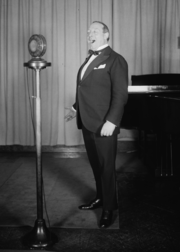
Giuseppe de Luca

Encyclopedia
Italy
Italy , officially the Italian Republic languages]] under the European Charter for Regional or Minority Languages. In each of these, Italy's official name is as follows:;;;;;;;;), is a unitary parliamentary republic in South-Central Europe. To the north it borders France, Switzerland, Austria and...
baritone
Baritone
Baritone is a type of male singing voice that lies between the bass and tenor voices. It is the most common male voice. Originally from the Greek , meaning deep sounding, music for this voice is typically written in the range from the second F below middle C to the F above middle C Baritone (or...
who achieved his greatest triumphs at the New York
New York
New York is a state in the Northeastern region of the United States. It is the nation's third most populous state. New York is bordered by New Jersey and Pennsylvania to the south, and by Connecticut, Massachusetts and Vermont to the east...
Metropolitan Opera
Metropolitan Opera
The Metropolitan Opera is an opera company, located in New York City. Originally founded in 1880, the company gave its first performance on October 22, 1883. The company is operated by the non-profit Metropolitan Opera Association, with Peter Gelb as general manager...
. He notably created roles in the world premieres of two opera
Opera
Opera is an art form in which singers and musicians perform a dramatic work combining text and musical score, usually in a theatrical setting. Opera incorporates many of the elements of spoken theatre, such as acting, scenery, and costumes and sometimes includes dance...
s by Giacomo Puccini
Giacomo Puccini
Giacomo Antonio Domenico Michele Secondo Maria Puccini was an Italian composer whose operas, including La bohème, Tosca, Madama Butterfly, and Turandot, are among the most frequently performed in the standard repertoire...
: Sharpless in Madama Butterfly
Madama Butterfly
Madama Butterfly is an opera in three acts by Giacomo Puccini, with an Italian libretto by Luigi Illica and Giuseppe Giacosa. Puccini based his opera in part on the short story "Madame Butterfly" by John Luther Long, which was dramatized by David Belasco...
(at La Scala
La Scala
La Scala , is a world renowned opera house in Milan, Italy. The theatre was inaugurated on 3 August 1778 and was originally known as the New Royal-Ducal Theatre at La Scala...
, Milan, 1904) and the title role in Gianni Schicchi
Gianni Schicchi
Gianni Schicchi is a comic opera in one act by Giacomo Puccini to an Italian libretto by Giovacchino Forzano, composed in 1917–18. The libretto is based on an incident mentioned in Dante's Divine Comedy. The work is the third and final part of Puccini's Il trittico —three one-act operas with...
(Metropolitan Opera, 1918).
Career & recordings
De Luca was born in RomeRome
Rome is the capital of Italy and the country's largest and most populated city and comune, with over 2.7 million residents in . The city is located in the central-western portion of the Italian Peninsula, on the Tiber River within the Lazio region of Italy.Rome's history spans two and a half...
, the son of a blacksmith, and sang in church choirs as a boy. After his voice broke, a wealthy patron paid for him to have singing lessons at the Rome Conservatory, where he studied with two top-class pedagogues, Venceslao Persichini (who also taught De Luca's fellow baritone stars Mattia Battistini
Mattia Battistini
Mattia Battistini was an Italian operatic baritone. He became internationally famous due to the beauty of his voice and the virtuosity of his singing technique, and he earned the sobriquet "King of Baritones".-Early life:...
and Titta Ruffo
Titta Ruffo
Titta Ruffo , born as Ruffo Titta Cafiero, was an Italian opera star who had a major international singing career. Known as the "Voce del leone" , he was greatly admired, even by rival baritones, such as Giuseppe De Luca, who said of Ruffo: "His was not a voice, it was a miracle" Titta Ruffo (9...
) and Antonio Cotogni
Antonio Cotogni
Antonio Cotogni was an Italian baritone of the first magnitude. Regarded internationally as being one of the greatest male opera singers of the 19th century, he was particularly admired by the composer Giuseppe Verdi...
. He made his opera
Opera
Opera is an art form in which singers and musicians perform a dramatic work combining text and musical score, usually in a theatrical setting. Opera incorporates many of the elements of spoken theatre, such as acting, scenery, and costumes and sometimes includes dance...
tic debut at Piacenza
Piacenza
Piacenza is a city and comune in the Emilia-Romagna region of northern Italy. It is the capital of the province of Piacenza...
in 1897, singing Valentin in Gounod's Faust
Faust (opera)
Faust is a drame lyrique in five acts by Charles Gounod to a French libretto by Jules Barbier and Michel Carré from Carré's play Faust et Marguerite, in turn loosely based on Johann Wolfgang von Goethe's Faust, Part 1...
. His debut proved a success and he was invited to sing at a string of more important venues.
He appeared at Italy's foremost opera house, La Scala
La Scala
La Scala , is a world renowned opera house in Milan, Italy. The theatre was inaugurated on 3 August 1778 and was originally known as the New Royal-Ducal Theatre at La Scala...
, Milan
Milan
Milan is the second-largest city in Italy and the capital city of the region of Lombardy and of the province of Milan. The city proper has a population of about 1.3 million, while its urban area, roughly coinciding with its administrative province and the bordering Province of Monza and Brianza ,...
, from 1902 to 1910, and made his London
London
London is the capital city of :England and the :United Kingdom, the largest metropolitan area in the United Kingdom, and the largest urban zone in the European Union by most measures. Located on the River Thames, London has been a major settlement for two millennia, its history going back to its...
debut at the Royal Opera House
Royal Opera House
The Royal Opera House is an opera house and major performing arts venue in Covent Garden, central London. The large building is often referred to as simply "Covent Garden", after a previous use of the site of the opera house's original construction in 1732. It is the home of The Royal Opera, The...
, Covent Garden
Covent Garden
Covent Garden is a district in London on the eastern fringes of the West End, between St. Martin's Lane and Drury Lane. It is associated with the former fruit and vegetable market in the central square, now a popular shopping and tourist site, and the Royal Opera House, which is also known as...
, in 1907.
Subsequently, De Luca moved to America where he became a leading baritone at the Metropolitan Opera for 20 years, from 1915 to 1935. (He returned briefly to the Met in 1939-1940.) His first appearance at that house was on November 25, 1915, as Figaro in The Barber of Seville
The Barber of Seville
The Barber of Seville, or The Futile Precaution is an opera buffa in two acts by Gioachino Rossini with a libretto by Cesare Sterbini. The libretto was based on Pierre Beaumarchais's comedy Le Barbier de Séville , which was originally an opéra comique, or a mixture of spoken play with music...
with Frieda Hempel
Frieda Hempel
Frieda Hempel was a German soprano singer in operatic and concert work who had an international career in Europe and the United States.-Biography:...
as Rosina and Giacomo Damacco as Count Almaviva, with Gaetano Bavagnoli
Gaetano Bavagnoli
Gaetano Bavagnoli was an Italian conductor who was particularly known for his work within the field of opera. He was mainly active within Italy's major opera houses during the first third of the 20th century; although he did conduct at important international stages like the Metropolitan Opera in...
conducting.
After his retirement, he taught voice at the Juilliard School
Juilliard School
The Juilliard School, located at the Lincoln Center for the Performing Arts in New York City, United States, is a performing arts conservatory which was established in 1905...
. He died in New York
New York City
New York is the most populous city in the United States and the center of the New York Metropolitan Area, one of the most populous metropolitan areas in the world. New York exerts a significant impact upon global commerce, finance, media, art, fashion, research, technology, education, and...
City at the age of 73.
De Luca is notable for creating two important Puccini roles: Sharpless in Madama Butterfly
Madama Butterfly
Madama Butterfly is an opera in three acts by Giacomo Puccini, with an Italian libretto by Luigi Illica and Giuseppe Giacosa. Puccini based his opera in part on the short story "Madame Butterfly" by John Luther Long, which was dramatized by David Belasco...
(La Scala, 1904) and the title role in Gianni Schicchi
Gianni Schicchi
Gianni Schicchi is a comic opera in one act by Giacomo Puccini to an Italian libretto by Giovacchino Forzano, composed in 1917–18. The libretto is based on an incident mentioned in Dante's Divine Comedy. The work is the third and final part of Puccini's Il trittico —three one-act operas with...
(Metropolitan Opera, 1918). He also created the Marquess in Massenet's Grisélidis
Grisélidis
Grisélidis is an opera in three acts and a prologue by Jules Massenet to a French libretto by Armand Silvestre and Eugène Morand. It is based on the play by the same authors first performed at the Comédie-Française on 15 May 1891, which is drawn from the medieval tale of 'patient Grissil'...
, Michonnet in Cilea’s Adriana Lecouvreur
Adriana Lecouvreur
Adriana Lecouvreur is an opera in four acts by Francesco Cilea to an Italian libretto by Arturo Colautti, based on the play by Eugène Scribe and Ernest Legouvé...
, Gleby in Giordano
Umberto Giordano
Umberto Menotti Maria Giordano was an Italian composer, mainly of operas.He was born in Foggia in Puglia, southern Italy, and studied under Paolo Serrao at the Conservatoire of Naples...
’s Siberia
Siberia (opera)
Siberia is an opera in three acts by Umberto Giordano from a libretto by Luigi Illica. There is no direct source for the plot of Siberia and it is quite possible that this is an original work by Illica...
(1903), and Sancho Panza
Sancho Panza
Sancho Panza is a fictional character in the novel Don Quixote written by Spanish author Don Miguel de Cervantes Saavedra in 1605. Sancho acts as squire to Don Quixote, and provides comments throughout the novel, known as sanchismos, that are a combination of broad humour, ironic Spanish proverbs,...
in Massenet’s Don Quichotte
Don Quichotte
Don Quichotte is an opera in five acts by Jules Massenet to a French libretto by Henri Caïn.Massenet's comédie-héroïque, like so many other dramatized versions of the story of Don Quixote, relates only indirectly to the great novel by Miguel de Cervantes...
opposite Feodor Chaliapin
Feodor Chaliapin
Feodor Ivanovich Chaliapin was a Russian opera singer. The possessor of a large and expressive bass voice, he enjoyed an important international career at major opera houses and is often credited with establishing the tradition of naturalistic acting in his chosen art form.During the first phase...
.
The illustrious but dictatorial conductor Arturo Toscanini
Arturo Toscanini
Arturo Toscanini was an Italian conductor. One of the most acclaimed musicians of the late 19th and 20th century, he was renowned for his intensity, his perfectionism, his ear for orchestral detail and sonority, and his photographic memory...
is reputed to have once called De Luca, "absolutely the best baritone I ever heard"http://www.opera-gems.com/reflections/giuseppe%20de%20luca.htm. Certainly, he was praised by critics and audiences alike in a wide range of operatic roles, ranging from buffo and bel canto
Bel canto
Bel canto , along with a number of similar constructions , is an Italian opera term...
parts through to the core Verdi and Puccini characters. He even made some early forays into Wagner
Richard Wagner
Wilhelm Richard Wagner was a German composer, conductor, theatre director, philosopher, music theorist, poet, essayist and writer primarily known for his operas...
during his days at La Scala. (He eschewed the German language, however, singing only in Italian
Italian language
Italian is a Romance language spoken mainly in Europe: Italy, Switzerland, San Marino, Vatican City, by minorities in Malta, Monaco, Croatia, Slovenia, France, Libya, Eritrea, and Somalia, and by immigrant communities in the Americas and Australia...
and French
French language
French is a Romance language spoken as a first language in France, the Romandy region in Switzerland, Wallonia and Brussels in Belgium, Monaco, the regions of Quebec and Acadia in Canada, and by various communities elsewhere. Second-language speakers of French are distributed throughout many parts...
.)
De Luca's elegant vocalism is preserved on numerous recordings which he made for the Fonotipia and Victor companies in Italy and America from the early 1900s through to the 1920s and '30s. On some of them, he is partnered by other great singers of the Metropolitan Opera's golden age, including Enrico Caruso, Giovanni Martinelli
Giovanni Martinelli
Giovanni Martinelli was a celebrated Italian operatic tenor. He was particularly associated with the Italian lyric-dramatic repertory, although he performed French operatic roles to great acclaim as well...
, Beniamino Gigli
Beniamino Gigli
Beniamino Gigli was an Italian opera singer. The most famous tenor of his generation, he was renowned internationally for the great beauty of his voice and the soundness of his vocal technique. Music critics sometimes took him to task, however, for what was perceived to be the over-emotionalism...
, Amelita Galli-Curci
Amelita Galli-Curci
Amelita Galli-Curci was an Italian operatic soprano. She was one of the best-known coloratura singers of the early 20th century with her gramophone records selling in large numbers.-Early life:...
, Elisabeth Rethberg
Elisabeth Rethberg
The German soprano Elisabeth Rethberg was an opera singer of international repute active from the period of the First World War through to the early 1940s. Some hailed her as the greatest soprano of her day...
, Rosa Ponselle
Rosa Ponselle
Rosa Ponselle , was an American operatic soprano with a large, opulent voice. She sang mainly at the New York Metropolitan Opera and is generally considered by music critics to have been one of the greatest sopranos of the past 100 years.-Early life:She was born Rosa Ponzillo on January 22, 1897,...
and Ezio Pinza
Ezio Pinza
Ezio Pinza was an Italian basso opera singer with a rich, smooth and sonorous voice. He spent 22 seasons at New York's Metropolitan Opera, appearing in more than 750 performances of 50 operas...
. CD reissues of his recordings are widely available today. Film clips of him performing also exist.
De Luca was renowned as a master of lyric, smooth-toned legato
Legato
In musical notation the Italian word legato indicates that musical notes are played or sung smoothly and connected. That is, in transitioning from note to note, there should be no intervening silence...
singing and his recordings confirm his excellence in this regard. Being a small man, his voice was not of huge dimensions; but it was immaculately used and had ample carrying power in even the largest theatres. During De Luca's best years, his voice also possessed exceptional beauty of tone in the middle register. He was a clever and versatile actor, too, and was considered to be especially memorable in ebullient comic roles.