


Teatro di San Carlo

Encyclopedia
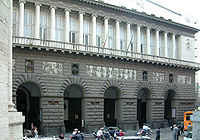
The Real Teatro di San Carlo is an opera house
Opera house
An opera house is a theatre building used for opera performances that consists of a stage, an orchestra pit, audience seating, and backstage facilities for costumes and set building...
in Naples
Naples
Naples is a city in Southern Italy, situated on the country's west coast by the Gulf of Naples. Lying between two notable volcanic regions, Mount Vesuvius and the Phlegraean Fields, it is the capital of the region of Campania and of the province of Naples...
, Italy
Italy
Italy , officially the Italian Republic languages]] under the European Charter for Regional or Minority Languages. In each of these, Italy's official name is as follows:;;;;;;;;), is a unitary parliamentary republic in South-Central Europe. To the north it borders France, Switzerland, Austria and...
. It is the oldest continuously active such venue in Europe
Europe
Europe is, by convention, one of the world's seven continents. Comprising the westernmost peninsula of Eurasia, Europe is generally 'divided' from Asia to its east by the watershed divides of the Ural and Caucasus Mountains, the Ural River, the Caspian and Black Seas, and the waterways connecting...
.
Founded by the Bourbon
House of Bourbon
The House of Bourbon is a European royal house, a branch of the Capetian dynasty . Bourbon kings first ruled Navarre and France in the 16th century. By the 18th century, members of the Bourbon dynasty also held thrones in Spain, Naples, Sicily, and Parma...
Charles VII of Naples
Charles III of Spain
Charles III was the King of Spain and the Spanish Indies from 1759 to 1788. He was the eldest son of Philip V of Spain and his second wife, the Princess Elisabeth Farnese...
(Carlo VII in Italian) of the Spanish branch of the dynasty, the theatre was inaugurated on 4 November 1737 — the king's name day
Name day
A name day is a tradition in many countries in Europe and Latin America that consists of celebrating the day of the year associated with one's given name....
— with a performance of Domenico Sarro
Domenico Sarro
Domenico Natale Sarro, also Sarri was an Italian composer.He studied at the Neapolitan conservatory of S. Onofrio. He composed extensively in the early 18th century. His opera Didone abbandonata, premiered on 1 February 1724 at the Teatro San Bartolomeo in Naples, was the first setting of a major...
's Achille in Sciro, an opera based on the play by the famous poet and dramatist who went by the name of Metastasio
Metastasio
Pietro Antonio Domenico Trapassi, better known by his pseudonym of Metastasio, was an Italian poet and librettist, considered the most important writer of opera seria libretti.-Early life:...
. Sarro also conducted the orchestra in two ballets as intermezzi, created by Grossatesta. At the time, it was the largest opera house in the world, seating 3,300.
History
_-_n._0278_-_napoli_-_teatro_san_carlo_2.jpg)
Construction
The theatre was designed by the architects Giovanni Antonio MedranoGiovanni Antonio Medrano
Giovanni Antonio Medrano was an Italian architect.Born in Sciacca, Sicily, he became a brigadier in the army of Charles of Bourbon, while he was king of the Two Sicilies. Following the Battle of Bitonto in 1734, Charles had Medrano construct a commemorative obelisk in Bitonto.In 1737, Charles...
and Angelo Carasale
Angelo Carasale
Angelo Carasale was an Italian architect and the one primarily responsible for the elaborate furnishings of the new San Carlo opera house in Naples in 1737...
for the monarch since Charles wanted to endow Naples with a new and larger theatre to replace the old and dilapidated Teatro San Bartolomeo
Early theatres in Naples
Theatres for diverse musical and dramatic presentations began to open in Naples, Italy, in the mid-16th century as part of the general Spanish cultural and political expansion into the kingdom of Naples, which had just become a vicerealm of Spain...
of 1621.
The new theatre was much admired for its architecture, its gold decorations, and the sumptuous blue upholstery (blue and gold being the official colours of the Bourbons).
Reconstruction
On 12 February 1816 the San Carlo was destroyed by fire. However, it was re-designed by the architect Antonio Niccolini and rebuilt within ten months on order of King Ferdinand IV, another Bourbon monarch and son of Charles III.On 12 January 1817, the rebuilt theatre was inaugurated with Johann Simon Mayr's Il sogno di Partenope. Stendhal
Stendhal
Marie-Henri Beyle , better known by his pen name Stendhal, was a 19th-century French writer. Known for his acute analysis of his characters' psychology, he is considered one of the earliest and foremost practitioners of realism in his two novels Le Rouge et le Noir and La Chartreuse de Parme...
attended the second night of the inauguration and wrote: "There is nothing in all Europe, I won’t say comparable to this theatre, but which gives the slightest idea of what it is like..., it dazzles the eyes, it enraptures the soul...". It was designed as a traditional horseshoe-shaped auditorium with 1,444 seats, and the proscenium is 33.5m wide and 30m high. The stage is 34.5m deep.
In 1844 there was a new redecoration under Niccolini his son Fausto and Francesco Maria dei Giudice. The main aspect of the new intervention has been the change of the theatre's interior appearance to the now-traditional red and gold. Apart from the creation of the orchestra pit suggested by Verdi
Giuseppe Verdi
Giuseppe Fortunino Francesco Verdi was an Italian Romantic composer, mainly of opera. He was one of the most influential composers of the 19th century...
in 1872, the installation of electricity in 1890, the subsequent abolition of the central chandelier and the construction of the new foyer and a new wing for dressing rooms, the theatre underwent no substantial changes until the bombing of the Second World War in 1943. However, the theatre was quickly repaired by the occupying Allied forces, and it re-opened within six months on 16 December 1943.
The great age of Neapolitan opera
At the time, Neapolitan opera enjoyed great success all over Europe, not only in the field of opera buffaOpera buffa
Opera buffa is a genre of opera. It was first used as an informal description of Italian comic operas variously classified by their authors as ‘commedia in musica’, ‘commedia per musica’, ‘dramma bernesco’, ‘dramma comico’, ‘divertimento giocoso' etc...
but also in that of opera seria
Opera seria
Opera seria is an Italian musical term which refers to the noble and "serious" style of Italian opera that predominated in Europe from the 1710s to c. 1770...
. The Neapolitan school of opera composers included Feo
Francesco Feo
Francesco Feo was an Italian composer, known chiefly for his operas. He was born and died in Naples, where most of his operas were premièred.-Life:...
, Porpora, Traetta
Tommaso Traetta
Tommaso Michele Francesco Saverio Traetta was an Italian composer.-Biography:Traetta was born in Bitonto, a town near Bari, near the top of the heel of the boot of Italy. He eventually became a pupil of the composer, singer and teacher Nicola Porpora in Naples, and scored a first success with his...
, Piccinni, Vinci
Leonardo Vinci
Leonardo Vinci was an Italian composer, best known for his operas.He was born at Strongoli and educated at Naples under Gaetano Greco in the Conservatorio dei Poveri di Gesù Cristo. He first became known for his opere buffe in Neapolitan dialect in 1719; he also composed many opere serie...
, Anfossi
Pasquale Anfossi
Bonifacio Domenico Pasquale Anfossi was an Italian opera composer. Born in Taggia, Liguria, he studied with Niccolò Piccinni and Antonio Sacchini, and worked mainly in London, Venice and Rome....
, Durante
Francesco Durante
Francesco Durante was an Italian composer.He was born at Frattamaggiore, in the Kingdom of Two Sicilies, and at an early age he entered the Conservatorio dei poveri di Gesù Cristo, in Naples, where he received lessons from Gaetano Greco. Later he became a pupil of Alessandro Scarlatti at the...
, Jommelli
Niccolò Jommelli
Niccolò Jommelli was an Italian composer. He was born in Aversa and died in Naples. Along with other composers mainly in the Holy Roman Empire and France, he made important changes to opera and reduced the importance of star singers.-Early life:Jommelli was born to Francesco Antonio Jommelli and...
, Cimarosa
Domenico Cimarosa
Domenico Cimarosa was an Italian opera composer of the Neapolitan school...
, Paisiello
Giovanni Paisiello
Giovanni Paisiello was an Italian composer of the Classical era.-Life:Paisiello was born at Taranto and educated by the Jesuits there. He became known for his beautiful singing voice and in 1754 was sent to the Conservatorio di S. Onofrio at Naples, where he studied under Francesco Durante, and...
, Zingarelli
Niccolò Antonio Zingarelli
Niccolò Antonio Zingarelli was an Italian composer, chiefly of opera.-Early career:Zingarelli was born in Naples, where he studied at the Santa Maria di Loreto Conservatory under Fenaroli and Speranza....
, and Gazzaniga
Giuseppe Gazzaniga
Giuseppe Gazzaniga was a member of the Neapolitan school of opera composers. He composed fifty-one operas and is considered to be one of the last Italian opera buffa composers.-Biography:...
. Naples became the capital of European music and even foreign composers considered the performance of their compositions at the San Carlo theatre as the goal of their career. These composers included Hasse
Johann Adolph Hasse
Johann Adolph Hasse was an 18th-century German composer, singer and teacher of music. Immensely popular in his time, Hasse was best known for his prolific operatic output, though he also composed a considerable quantity of sacred music...
(who later settled in Naples) Haydn, Johann Christian Bach
Johann Christian Bach
Johann Christian Bach was a composer of the Classical era, the eleventh and youngest son of Johann Sebastian Bach. He is sometimes referred to as 'the London Bach' or 'the English Bach', due to his time spent living in the British capital...
and Gluck.
Similarly the most prominent singers performed and consolidated their fame at the San Carlo, such as Lucrezia Anguiari, called "La Cocchetta." Other prominent singers who performed at San Carlo included the renowned castrati
Castrato
A castrato is a man with a singing voice equivalent to that of a soprano, mezzo-soprano, or contralto voice produced either by castration of the singer before puberty or one who, because of an endocrinological condition, never reaches sexual maturity.Castration before puberty prevents a boy's...
Giovanni Manzuoli
Giovanni Manzuoli
Giovanni Manzuoli was an Italian castrato who sang as a soprano at the beginning of his career, and later as a contralto.-History:...
, Caffarelli (Gaetano Majorano), Farinelli
Farinelli
Farinelli , was the stage name of Carlo Maria Broschi, celebrated Italian castrato singer of the 18th century and one of the greatest singers in the history of opera.- Early years :...
(Carlo Broschi), Gizziello (Gioacchino Conti) and Gian Battista Velluti, the last castrato. Caffarelli, Farinelli, and Gizziello were products of the local conservatories of Naples
Music Conservatories of Naples
The Music Conservatory of Naples is a music institution in Naples, southern Italy. It is currently located in the complex of San Pietro a Majella.-San Pietro a Majella:...
Composers in residence
From 1815 to 1822, Gioacchino RossiniGioacchino Rossini
Gioachino Antonio Rossini was an Italian composer who wrote 39 operas as well as sacred music, chamber music, songs, and some instrumental and piano pieces...
was house composer and artistic director of the royal opera houses, including the San Carlo, and he wrote ten operas during this time. These were Elisabetta, regina d'Inghilterra
Elisabetta, regina d'Inghilterra
Elisabetta, regina d'Inghilterra, is a dramma per musica or opera in two acts by Gioachino Rossini to a libretto by Giovanni Schmidt, from the play The Page of Leicester by Carlo Federici...
(1815), La Gazzetta
La Gazzetta
La gazzetta, ossia Il matrimonio per concorso is an opera buffa by Gioachino Rossini. The libretto was by Giuseppe Palomba after Carlo Goldoni's play Il matrimonio per concorso of 1763....
, Otello, ossia il Moro di Venezia
Otello (Rossini)
Otello is an opera in three acts by Gioachino Rossini to an Italian libretto by Francesco Maria Berio di Salsi, based on Shakespeare's play Othello....
(1816), Armida
Armida (Rossini)
Armida is an opera in three acts by Gioachino Rossini to an Italian libretto by Giovanni Schmidt, based on scenes from Gerusalemme liberata by Torquato Tasso.-Performance history:...
(1817), Mosè in Egitto
Mosè in Egitto
Mosè in Egitto is a three-act opera written by Gioachino Rossini to a libretto by Andrea Leone Tottola, which was based on a play by Francesco Ringhieri, L'Osiride, of 1760....
, Ricciardo e Zoraide
Ricciardo e Zoraide
Ricciardo e Zoraide is an opera in two acts by Gioachino Rossini to an Italian libretto by Francesco Berio de Salsa...
(1818), Ermione
Ermione
Ermione is a tragic opera in two acts by Gioachino Rossini to an Italian libretto by Andrea Leone Tottola, based on the play Andromaque by Jean Racine.- Performance history :...
, Bianca e Falliero
Bianca e Falliero
Bianca e Falliero, ossia Il consiglio dei tre is a two-act operatic melodramma by Gioachino Rossini to an Italian libretto by Felice Romani. The libretto was based on Antoine-Vincent Arnault's play Les Vénitiens, ou Blanche et Montcassin.-Performance history:The opera premiered on December 26,...
, Eduardo e Cristina
Eduardo e Cristina
Eduardo e Cristina is an operatic 'dramma' in two acts by Gioachino Rossini to an Italian libretto originally written by Giovanni Schmidt for Odoardo e Cristina , an opera by Stefano Pavesi, and adapted for Rossini by Andrea Leone Tottola and Gherardo Bevilacqua-Aldobrandini.This pastiche work was...
, La donna del lago
La donna del lago
La donna del lago is an opera by Gioachino Rossini with a libretto by Andrea Leone Tottola, based on The Lady of the Lake, a poem by Sir Walter Scott.This opera was the first to be based on Scott's romantic works...
(1819), Maometto secondo (1820), and Zelmira
Zelmira
Zelmira is an opera in two acts by Gioachino Rossini to a libretto by Andrea Leone Tottola. Based on the French play, Zelmire by de Belloy, it was the last of the composer's Neapolitan operas...
(1822).
Regular singers of the period included Manuel Garcia
Manuel Garcia
Manuel Garcia may refer to:*Manuel García , singer & voice pedagogue; son of Manuel García *Manuel García , Spanish singer and composer, father of Manuel Patricio Rodríguez García...
and his daughter Maria Malibran
Maria Malibran
The mezzo-soprano Maria Malibran , was one of the most famous opera singers of the 19th century. Malibran was known for her stormy personality and dramatic intensity, becoming a legendary figure after her death at age 28...
, Clorinda Corradi
Clorinda Corradi
Clorinda Corradi was an Italian opera singer and one of the most famous contraltos in history.-Life:...
, Giuditta Pasta
Giuditta Pasta
Giuditta Angiola Maria Costanza Pasta , born in Saronno, Italy, was a soprano considered among the greatest of opera singers, to whom the 20th-century soprano Maria Callas was compared.-Studies and career:...
, Isabella Colbran
Isabella Colbran
Isabella Colbran was a Spanish opera singer, who was known in her native country as Isabel Colbrandt. Many sources note her as a dramatic coloratura soprano but, some believe that she was a mezzo-soprano with a high extension, a soprano sfogato...
, Giovanni Battista Rubini
Giovanni Battista Rubini
Giovanni Battista Rubini was an Italian tenor, as famous in his time as Enrico Caruso in a later day. His ringing and expressive coloratura dexterity in the highest register of his voice, the tenorino, inspired the writing of operatic roles which today are almost impossible to cast...
, Domenico Donzelli and the two great French rivals Adolphe Nourrit
Adolphe Nourrit
Adolphe Nourrit was a French operatic tenor, librettist, and composer. One of the most esteemed opera singers of the 1820s and 1830s, he was particularly associated with the works of Gioachino Rossini....
and Gilbert Duprez
Gilbert Duprez
Gilbert Duprez was a French tenor, singing teacher and minor composer who famously pioneered the delivery of the operatic high C from the chest. He also created the role of Edgardo in the popular bel canto-era opera Lucia di Lammermoor in 1835.-Biography:Gilbert-Louis Duprez, to give his full...
—the inventor of the C from the chest.
After the composition of Zelmira, Rossini left Naples with Colbran who had previously been the lover of the theatre's impresario, Domenico Barbaja. The couple were married shortly thereafter.
To replace Rossini, Barbaja first signed up Giovanni Pacini
Giovanni Pacini
Giovanni Pacini was an Italian composer, best known for his operas. Pacini was born in Catania, Sicily, the son of the buffo Luigi Pacini, who was to appear in the premieres of many of Giovanni's operas...
and then another rising star of Italian opera: Gaetano Donizetti
Gaetano Donizetti
Domenico Gaetano Maria Donizetti was an Italian composer from Bergamo, Lombardy. His best-known works are the operas L'elisir d'amore , Lucia di Lammermoor , and Don Pasquale , all in Italian, and the French operas La favorite and La fille du régiment...
. As artistic director of the royal opera houses, Donizetti remained in Naples from 1822 until 1838, composing sixteen operas for the theatre, among which Maria Stuarda
Maria Stuarda
Maria Stuarda is a tragic opera, , in two acts, by Gaetano Donizetti, to a libretto by Giuseppe Bardari, based on Friedrich Schiller's 1800 play Maria Stuart....
(1834), Roberto Devereux
Roberto Devereux
Roberto Devereux is a tragedia lirica, or tragic opera, by Gaetano Donizetti...
(1837), Poliuto
Poliuto
Poliuto is a tragedia lirica, or tragic opera, by Gaetano Donizetti. Salvadore Cammarano wrote the Italian libretto after Pierre Corneille's play Polyeucte . It was composed in 1838 and first performed on 30 November 1848 at the Teatro San Carlo, Naples...
(1838) and the famous Lucia di Lammermoor
Lucia di Lammermoor
Lucia di Lammermoor is a dramma tragico in three acts by Gaetano Donizetti. Salvadore Cammarano wrote the Italian language libretto loosely based upon Sir Walter Scott's historical novel The Bride of Lammermoor....
(1835), written for soprano Tacchinardi-Persiani and for tenor Duprez.
Vincenzo Bellini
Vincenzo Bellini
Vincenzo Salvatore Carmelo Francesco Bellini was an Italian opera composer. His greatest works are I Capuleti ed i Montecchi , La sonnambula , Norma , Beatrice di Tenda , and I puritani...
, Sicilian by birth, also staged his first work, Bianca e Gernando, at the San Carlo.
Giuseppe Verdi
Giuseppe Verdi
Giuseppe Fortunino Francesco Verdi was an Italian Romantic composer, mainly of opera. He was one of the most influential composers of the 19th century...
was also associated with the theatre. In 1841, his Oberto Conte di San Bonifacio
Oberto (opera)
Oberto, Conte di San Bonifacio is an opera in two acts by Giuseppe Verdi to an Italian libretto by Temistocle Solera, based on an existing libretto by Antonio Piazza probably called Rocester....
was performed there and in 1845 he wrote his first opera for the theatre, Alzira
Alzira (opera)
Alzira is an opera in a prologue and two acts by Giuseppe Verdi to an Italian libretto by Salvadore Cammarano, based on the play Alzire, ou les Américains by Voltaire.The first performance was at the Teatro San Carlo, Naples, on August 12, 1845...
; a second, Luisa Miller
Luisa Miller
Luisa Miller is an opera in three acts by Giuseppe Verdi to an Italian libretto by Salvadore Cammarano, based on the play Kabale und Liebe by Friedrich von Schiller. The first performance was given at the Teatro San Carlo in Naples on December 8, 1849...
, followed in 1849. His third should have been Gustavo III
Gustavo III (Verdi)
Gustavo III is an opera by Giuseppe Verdi to a libretto begun in early 1857 by the Italian playwright Antonio Somma. Never performed during Verdi's lifetime, the opera was later revised and renamed Un ballo in maschera...
, but the censor made such siginifcant changes that it was never performed in that version nor under that title (until a re-created version was given in 2004). It was later performed in Rome with significant revisions to the plot and its location, while the title became Un ballo in maschera
Un ballo in maschera
Un ballo in maschera , is an opera in three acts by Giuseppe Verdi with text by Antonio Somma. The libretto is loosely based on an 1833 play, Gustave III, by French playwright Eugène Scribe who wrote about the historical assassination of King Gustav III of Sweden...
.
Among the conductors and composers appointed by the Teatro San Carlo is the famous and eccentric French harpist and composer Nicolas Bochsa (1789-1856) who was accompanied by his "friend" the prima donna
Prima donna
Originally used in opera or Commedia dell'arte companies, "prima donna" is Italian for "first lady." The term was used to designate the leading female singer in the opera company, the person to whom the prime roles would be given. The prima donna was normally, but not necessarily, a soprano...
Anna Bishop with whom he was touring the world. He conducted several operas (1844-1845) in the San Carlo with Anna Bishop as prima donna.
By the end of the nineteenth century and into the twentieth century, Giacomo Puccini
Giacomo Puccini
Giacomo Antonio Domenico Michele Secondo Maria Puccini was an Italian composer whose operas, including La bohème, Tosca, Madama Butterfly, and Turandot, are among the most frequently performed in the standard repertoire...
and other composers of verismo
Verismo
Verismo was an Italian literary movement which peaked between approximately 1875 and the early 1900s....
operas, such as the great Pietro Mascagni
Pietro Mascagni
Pietro Antonio Stefano Mascagni was an Italian composer most noted for his operas. His 1890 masterpiece Cavalleria rusticana caused one of the greatest sensations in opera history and single-handedly ushered in the Verismo movement in Italian dramatic music...
, Leoncavallo
Ruggero Leoncavallo
Ruggero Leoncavallo was an Italian opera composer. His two-act work Pagliacci remains one of the most popular works in the repertory, appearing as number 20 on the Operabase list of the most-performed operas worldwide.-Biography:...
, Giordano
Umberto Giordano
Umberto Menotti Maria Giordano was an Italian composer, mainly of operas.He was born in Foggia in Puglia, southern Italy, and studied under Paolo Serrao at the Conservatoire of Naples...
, and Cilea
Francesco Cilea
Francesco Cilea was an Italian composer. Today he is particularly known for his operas L'arlesiana and Adriana Lecouvreur.-Biography:...
, staged their works there.
Conductors
Principal conductors- Salvatore AccardoSalvatore AccardoSalvatore Accardo is an Italian violin virtuoso and conductor.He is highly regarded for his interpretations of Paganini, J. S. Bach, Antonio Vivaldi, contemporary works, chamber music, and opera conducting....
(1993-1995) - Gabriele Ferro (1999-2004)
- Gary BertiniGary BertiniGary Bertini was an Israeli conductor.-Biography:Gary Bertini was born Shloyme Golergant in Bricheva, Bessarabia, then in Romania, now in Donduşeni District, Moldova. His father, K. A. Bertini , was a poet and translator of the Russian and Yiddish Gary Bertini (Hebrew: גארי ברתיני) (born 1 May...
(2004-2005) - Jeffrey TateJeffrey TateDr Jeffrey Tate CBE is an English conductor.Tate was born with spina bifida, and also has kyphosis. His family moved to Farnham, Surrey when he was young and he attended Farnham Grammar School between 1954 and 1961 gaining a State Scholarship to Cambridge University, where he directed theatre...
(2005-2010)
Principal guest conductor
- Maurizio Benini (from 2010)