
All Topics  
Fugue


   Email Print
   Bookmark   Link


Fugue


In music
Music

Music is an art form whose media is sound organized in time. Common elements of music are pitch , rhythm , dynamics , and the sonic qualities of timbre and texture ....
, a fugue is a type of contrapuntal
Counterpoint

In music, counterpoint is the relationship between two or more Register that are independent in contour and rhythm, and interdependent in harmony....
 composition or technique of composition for a fixed number of parts
Melody

In music, a melody , also tune, voice, or line, is a linear succession of musical tones which is perceived as a single entity....
, normally referred to as "voices". In the Middle Ages
Middle Ages

File:Karl 1 mit papst gelasius gregor1 sacramentar v karl d kahlen.jpgThe Middle Ages of European history are a period in history which lasted for roughly a millennium, commonly dated from the fall of the Roman Empire in the 5th century to the beginning of the Early Modern Period in the 16th century, marked by the division of Western Christi...
, the term was widely used to denote any works in canonic
Canon (music)

In music, a canon is a counterpoint composition that employs a melody with one or more imitations of the melody played after a given duration . The initial melody is called the leader , while the imitative melody is called the follower which is played in a different voice....
 style; by the Renaissance
Renaissance

The Renaissance was a cultural movement that spanned roughly the 14th to the 17th century, beginning in Italy in the late Middle Ages and later spreading to the rest of Europe....
, it had come to denote specifically imitative works. Since the 17th century, the term fugue has described what is commonly regarded as the most fully developed procedure of imitative counterpoint.


Discussion
Ask a question about 'Fugue'
Start a new discussion about 'Fugue'
Answer questions from other users
Full Discussion Forum


Recent Posts


Encyclopedia


Kdf2
In music
Music

Music is an art form whose media is sound organized in time. Common elements of music are pitch , rhythm , dynamics , and the sonic qualities of timbre and texture ....
, a fugue is a type of contrapuntal
Counterpoint

In music, counterpoint is the relationship between two or more Register that are independent in contour and rhythm, and interdependent in harmony....
 composition or technique of composition for a fixed number of parts
Melody

In music, a melody , also tune, voice, or line, is a linear succession of musical tones which is perceived as a single entity....
, normally referred to as "voices". In the Middle Ages
Middle Ages

File:Karl 1 mit papst gelasius gregor1 sacramentar v karl d kahlen.jpgThe Middle Ages of European history are a period in history which lasted for roughly a millennium, commonly dated from the fall of the Roman Empire in the 5th century to the beginning of the Early Modern Period in the 16th century, marked by the division of Western Christi...
, the term was widely used to denote any works in canonic
Canon (music)

In music, a canon is a counterpoint composition that employs a melody with one or more imitations of the melody played after a given duration . The initial melody is called the leader , while the imitative melody is called the follower which is played in a different voice....
 style; by the Renaissance
Renaissance

The Renaissance was a cultural movement that spanned roughly the 14th to the 17th century, beginning in Italy in the late Middle Ages and later spreading to the rest of Europe....
, it had come to denote specifically imitative works. Since the 17th century, the term fugue has described what is commonly regarded as the most fully developed procedure of imitative counterpoint. A fugue opens with one main theme, the subject, which then sounds successively in each voice in imitation; when each voice has entered, the exposition is complete; this is occasionally followed by a connecting passage, or episode, developed from previously heard material; further "entries" of the subject then are heard in related keys. Episodes (if applicable) and entries are usually alternated until the "final entry" of the subject, by which point the music has returned to the opening key, or tonic
Tonic

Tonic may refer to:*Tonic , a concept of musical theory*Tonic , an American post-grunge rock band*The Tonic, a Christian rapper and member of The Cross Movement...
, which is often followed by closing material, the coda
Coda (music)

Coda is a term used in music in a number of different senses, primarily to designate a passage which brings a piece to a conclusion....
. In this sense, fugue is a style of composition, rather than fixed structure. Though there are certain established practices, in writing the exposition for example, composers approach the style with varying degrees of freedom and individuality.

The form evolved during the 18th century from several earlier types of contrapuntal compositions, such as imitative ricercar
Ricercar

A ricercar is a type of late Renaissance music and mostly early Baroque music instrumental composition. The term means to search out, and many ricercars serve a Prelude function to "search out" the key or mode of a following piece....
s, capriccios
Capriccio (music)

A capriccio or caprice , is a piece of music, usually fairly free in form and of a lively character. The typical capriccio is one that is fast, intense, and often virtuoso in nature....
, canzona
Canzona

In music, a canzona was a 16th-century multipart vocal setting of a literary canzone and a 1500s- and 1600s instrumental composition. At first based on Franco-Flemish polyphonic songs , later independently composed, the instrumental canzonas, such as the brass canzonas of Giovanni Gabrieli, influenced the fugue and were the direct ancest...
s, and fantasias
Fantasia (music)

The fantasia is a musical composition with its roots in the art of improvisation. Because of this, it seldom approximates the textbook rules of any strict musical form ....
. Middle and late Baroque
Baroque

In the the arts, the Baroque was a Western cultural Epoch , starting roughly at the beginning of the 17th century in Rome, Italy. It was exemplified by drama and grandeur in Baroque sculpture, Baroque painting, literature, Baroque dance, and Baroque music....
 composers such as Dietrich Buxtehude (1637–1707) and Johann Pachelbel
Johann Pachelbel

Johann Pachelbel was a German Baroque music composer, organist and teacher, who brought the German organ schools to its peak. He composed a large body of sacred and secular music, and his contributions to the development of the chorale prelude and fugue have earned him a place among the most important composers of the middle Baroque era....
 (1653–1706) contributed greatly to the development of the fugue, and the form reached ultimate maturity in the works of Johann Sebastian Bach
Johann Sebastian Bach

Johann Sebastian Bach was a German composer and organ whose sacred and secular works for choir, orchestra, and solo instruments drew together the strands of the Baroque music period and brought it to its ultimate maturity....
 (1685–1750). With the decline of sophisticated contrapuntal styles at the end of the baroque period, the fugue's popularity as a compositional style waned, eventually giving way to sonata form
Sonata

Sonata , in music, literally means a piece played as opposed to a cantata , a piece sung. The term, being vague, naturally evolved through the Music history, designating a variety of forms prior to the Classical music era era....
. Nevertheless, composers from the 1750s to the present day continue to write and study fugue for various purposes; they appear in the works of Mozart (e.g. Kyrie Eleison of the Requiem in D minor
Requiem (Mozart)

The Requiem Mass in D minor by Wolfgang Amadeus Mozart was composed in 1791. The requiem was Mozart's last composition, and is one of his most popular and most respected works....
) and Beethoven (e.g. end of the Credo of the Missa Solemnis
Missa Solemnis (Beethoven)

The Missa solemnis in D Major, opus number 123 was composed by Ludwig van Beethoven from 1819-1823. It was first performed on April 7, 1824 in St....
), and many composers such as Felix Mendelssohn
Felix Mendelssohn

Jakob Ludwig Felix Mendelssohn Bartholdy, born, and generally known in English-speaking countries, as Felix Mendelssohn was a Germany composer, pianist, organist and conducting of the early Romantic music period....
 (1809-1847), Anton Reicha
Anton Reicha

Anton Reicha was a Czech Republic-born Naturalization France composer. A contemporary and lifelong friend of Ludwig van Beethoven, Reicha is now best remembered for his substantial early contribution to the wind quintet literature and his role as a teacher - his pupils included Franz Liszt and Hector Berlioz....
 (1770–1836) and Dmitri Shostakovich
Dmitri Shostakovich

Dmitri Dmitriyevich Shostakovich was a List of Russian composers of the Soviet Union period.After a period influenced by Sergei Prokofiev and Igor Stravinsky , Shostakovich developed a hybrid of styles as exemplified in his opera Lady Macbeth of the Mtsensk District ....
 (1906–1975) wrote cycles of fugues.

The English term fugue originates in the 16th century and is derived from either the French or Italian fuga, which in turn comes from Latin, also fuga, which is itself related to both fugere (‘to flee’) and fugare, (‘to chase’). The adjectival form is fugal. Variants include fughetta (literally, 'a small fugue') and fugato (a passage in fugal style within another work that is not a fugue).

Musical outline


A fugue begins with what is known as the exposition and is characteristically written according to certain predefined rules; in later portions the composer has somewhat more freedom, though a logical key structure is usually followed, and further "entries" of the subject will occur throughout the fugue, repeating the accompanying material at the same time. The various entries may or may not be separated by episodes.

What follows is a chart displaying a fairly typical fugal outline, and a detailed explanation of the processes involved in creating this structure, with examples.

Example of Key/Entry Structure, in a Three-Voice Baroque Fugue
Exposition 1st Middle-Entry 2nd Middle-Entry Final Entries in Tonic
Tonic Dom. T (D-redundant entry) Relative Maj/Min Dom. of Rel. Subdom. T T
Sop. Subj. CS1 C
O
D
E
T
T
A
CS˛ A E
P
I
S
O
D
E
>
CS1 CS˛ E
P
I
S
O
D
E
S E
P
I
S
O
D
E
CS1 Free Counterpoint C
O
D
A
Alto Ans. CS1 CS˛ S CS1 CS˛ S CS1
Bass S CS1 CS˛ A CS1 CS˛ S


The exposition


A fugue begins with the exposition of its subject sounding in one of the voices alone in the tonic
Tonic (music)

The tonic is the first note of a scale in the tonality method of musical composition. The chord #The Triad formed on the tonic note, the tonic chord, is thus the most significant chord ....
 key. After the statement of the subject, a second voice enters with the subject transposed to another (often closely related) key, usually the dominant
Dominant (music)

In music, the dominant is the fifth degree of the Scale . For example, in the C major scale , the dominant is the note G; and the dominant chord uses the notes G, B, and D....
, which is known as the answer. Sometimes the answer is the tonic or subdominant
Subdominant

In music, the subdominant is the technical name for the fourth tonal degree of the diatonic scale. It is so called because it is the same distance "below" the Tonic as the dominant is above the tonic - in other words, the tonic is the dominant of the subdominant....
 (see J.S.Bach's Toccata and Fugue in D minor, BWV 565, and the opening fugato of the Partita No 2 in C minor, BWV 826
Partitas for keyboard (825–830)

The Partitas, BWV 825?830, are a set of six harpsichord suites written by Johann Sebastian Bach, published from 1726 in music to 1730 in music as Clavier-?bung I, and the first of his works to be published....
); to avoid disturbing the sense of key, it may also have to be altered slightly. When the answer is an exact transposition of the subject to the dominant, it is classified as a real answer; if it has to be altered in any way it is a tonal answer.

A tonal answer is usually called for when the subject begins with a prominent dominant note, or where there is a prominent dominant note very close to the beginning of the subject. To prevent an undermining of the music's sense of key
Key (music)

In music theory, the term key is used in many different and sometimes contradictory ways. A common use is to speak of music as being "in" a certain key, such as in the key of C or in the key of F-sharp....
, this note is transposed up a fourth to the tonic rather than up a fifth to the supertonic. Answers in the subdominant are also employed for the same reason and tend to occur in specific circumstances: a) when the subject begins with the following scale tones: 5-4-5 or 5-4-3; and b) when subjects themselves modulate to the dominant, in which case, the answer begins in the subdominant, and subsequently modulates to the tonic.

While the answer is being stated, the voice in which the subject was previously heard continues with new material. If this new material is reused in later statements of the subject, it is called a countersubject; if this accompanying material is only heard once, it is simply referred to as free counterpoint. Each voice then responds with its own subject or answer in turn, and further countersubjects or free counterpoint may be heard.

When a tonal answer is used, it is customary for the exposition to alternate subjects (S) with answers (A), however, in some fugues this order is occasionally varied: e.g. see the SAAS arrangement of Fugue no.1 in C major, BWV 846, from the Well-Tempered Clavier Book 1
Well-Tempered Clavier

The Well-Tempered Clavier , BWV 846?893, is a collection of solo keyboard music composed by Johann Sebastian Bach. He first gave the title to a book of prelude and fugues in all 24 major and minor key , dated 1722, composed "for the profit and use of musical youth desirous of learning, and especially for the pastime of those already...
 by J.S. Bach. A brief codetta is often heard connecting the various statements of the subject and answer. This allows the music to either a) return to the tonic, following an answer in the dominant, or b) to modulate to the dominant to enable a statement of the answer.

The first answer must occur as soon after the initial statement of the subject as possible, therefore the first codetta is often extremely short, and in many cases is not even needed. In the above example this is the case: the subject finishes on the quarter note
Quarter note

A quarter note or crotchet is a note played for one quarter of the duration of a whole note . Quarter notes are notated with a filled-in oval note head and a straight, flagless stem ....
 or crotchet b-flat of the third beat of the second bar which harmonizes the opening G of the answer. The second and later codettas may be considerably longer, and often serve to a) develop the material heard so far in the subject/answer and countersubject and possibly introduce ideas heard in the second countersubject or free counterpoint that follows b) delay, and therefore heighten the impact of the reentry of the subject in another voice as well as modulating back to the tonic.

The exposition usually concludes when all voices have given a statement of the subject or answer. In many fugues, however, there is one more entry of the subject, called a redundant entry, in which all of the voices sound simultaneously. Furthermore, in some fugues the entry of one of the voices may be reserved until later, for example in the pedals of an Organ Fugue (see J.S. Bach's Fugue in C major for Organ, BWV 547). Whilst the voices of a fugue may enter in any order desired, Bach frequently reserves the bass entry until last, for dramatic effect. Opening with the subject stated in the bass, whilst unusual, is to be preferred when other actions would present illegal inversions in the exposition.

The countersubject(s)

The distinction is made between the use of free counterpoint and regular countersubjects accompanying the fugue subject/answer, because in order for a countersubject to be heard accompanying the subject in more than one instance, it must be capable of sounding correctly above or below the subject, and must be conceived, therefore, in invertible or double counterpoint. In tonal
Tonal

Tonal may refer to:* Tonal , a concept appearing in the belief systems and traditions of Mesoamerican cultures, involving a spiritual link between a person and an animal...
 music invertible contrapuntal lines must be written according to certain rules because several intervallic combinations, whilst acceptable in one particular orientation, are no longer permissible when inverted. For example, when the note "G" sounds in one voice above the note "C" in lower voice, the interval of a fifth is formed, which is considered consonant and entirely acceptable. When this interval is inverted ("C" in the upper voice above "G" in the lower), it forms a fourth, considered a dissonance in tonal contrapuntal practice, and requires special treatment, or preparation and resolution, if is to be used. Likewise, the use of a 4-3 suspension is somewhat ineffectual in invertible counterpoint; in inversion it becomes 5-6, and since both the fifth and sixth are considered consonant intervals, is not a suspension at all, whereas the 7-6 suspension may be used successfully as it inverts to 2-3.

When writing invertible countersubjects in a fugue, composers therefore usually restrict themselves to the intervals of the third
Third

Third may refer to:*3 , such as the 3rd of something*Fraction , such as 1/3*The Third *Third World, economically underdeveloped nations*Third-class degree, type of British undergraduate degree classification...
, which inverts to a sixth
Sixth

Sixth can refer to:* Sixth_Amendment_to_the_United_States_Constitution to the U.S. Constitution...
, and octaves, which invert to the unison
UNISON

UNISON ? the Public Service Union is the second largest trade union in the United Kingdom, with over 1.3 million members.It was formed in 1993 when three previous public sector trade unions, the National Association of Local Government Officers , the National Union of Public Employees and the Confederation of Health Service Employees merg...
, in addition the careful use of the 7-6 suspension.

The episode


Further entries of the subject follow this initial exposition, either immediately (as for example in Fugue no.1 in C major, BWV 846, WTC Bk 1
Well-Tempered Clavier

The Well-Tempered Clavier , BWV 846?893, is a collection of solo keyboard music composed by Johann Sebastian Bach. He first gave the title to a book of prelude and fugues in all 24 major and minor key , dated 1722, composed "for the profit and use of musical youth desirous of learning, and especially for the pastime of those already...
), or separated by episodes. Episodic material is always modulatory and is usually based upon some element heard in the exposition. Each episode has primarily the function of modulating for the next entry of the subject in a new key, and may also provide release from the strictness of form employed in the exposition, and middle-entries. Whilst not all of Bach's fugues contain episodes, most have at least one serving as a modulatory bridge passage between the middle-entries, on which the greater emphasis is usually laid.

The middle entries


Further entries of the subject, or middle entries, occur at various intervals throughout the fugue, must state the subject or answer at least once in its entirety, and may also be heard in combination with the countersubject(s) from the exposition, new countersubjects, free counterpoint or any of these in combination. It is uncommon for the subject to enter alone in a single voice in the middle-entries just as it is in the exposition; rather it is usually heard with at least one of the countersubjects and/or other free contrapuntal accompaniments. Middle-entries tend to occur in keys other than the tonic - as shown in the typical structure above, these are often closely related keys such as the relative dominant and subdominant, but key structure of fugues varies greatly. In the fugues of J.S. Bach (see for example Fugue no. 2 in C Minor, BWV 847, from J.S. Bach's
Johann Sebastian Bach

Johann Sebastian Bach was a German composer and organ whose sacred and secular works for choir, orchestra, and solo instruments drew together the strands of the Baroque music period and brought it to its ultimate maturity....
 Well-Tempered Clavier Book 1
Well-Tempered Clavier

The Well-Tempered Clavier , BWV 846?893, is a collection of solo keyboard music composed by Johann Sebastian Bach. He first gave the title to a book of prelude and fugues in all 24 major and minor key , dated 1722, composed "for the profit and use of musical youth desirous of learning, and especially for the pastime of those already...
, quoted below) the first middle-entry very commonly occurs in the relative major or minor of the work's overall key, and is followed by an entry the dominant of the relative major or minor when the fugue's subject requires a tonal answer.

Some fugues may also have one or more counter-expositions, similar to the opening exposition, but in which the subject is altered in some way, often by inversion, although the term is sometimes used synonymously with middle-entry and may also describe the exposition of completely new subjects, as in a double fugue for example (see below). In any of the entries within a fugue the subject may be altered, by inversion
Inversion (music)

In music theory, the word inversion has several meanings. There are inverted chords, inverted melodies, inverted intervals, and inverted voices....
, retrograde
Permutation (music)

In music, a permutation of a set is a transformation of its prime form by applying zero or more of certain operations, specifically transposition , inversion , and retrograde....
 (a less common form where the entire subject is heard back-to-front) and diminution
Diminution

Diminution, from Italian diminuimento, is a musical term used to mean different things in the context of interval , scales, chord or note values....
 (the reduction of the subject's rhythmic values by a certain factor), augmentation
Augmentation (music)

In music and music theory augmentation is the lengthening or widening of rhythms, melody, interval s or chord s. The opposite is diminution .A melody or series of notes is augmented if the lengths of the notes are prolonged....
 (the increase of the subject's rhythmic values by a certain factor) or any combination of them.

Example and analysis


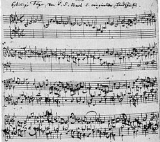
The excerpt below, bars 7–12 of J.S. Bach's
Johann Sebastian Bach

Johann Sebastian Bach was a German composer and organ whose sacred and secular works for choir, orchestra, and solo instruments drew together the strands of the Baroque music period and brought it to its ultimate maturity....
 Fugue no. 2 in C minor, BWV 847, from the Well-Tempered Clavier, Book 1
Well-Tempered Clavier

The Well-Tempered Clavier , BWV 846?893, is a collection of solo keyboard music composed by Johann Sebastian Bach. He first gave the title to a book of prelude and fugues in all 24 major and minor key , dated 1722, composed "for the profit and use of musical youth desirous of learning, and especially for the pastime of those already...
  illustrates the application of most of the characteristics described above. The fugue is for keyboard and in three voices, with regular countersubjects. This excerpt opens at last entry of the exposition: the subject is sounding in the bass, the first countersubject in the treble, while the middle-voice is stating a second version of the second countersubject, which concludes with the characteristic rhythm of the subject, and is always used together with the first version of the second countersubject. Following this an episode modulates from the tonic to the relative major by means of sequence, in the form of an accompanied canon
Canon (music)

In music, a canon is a counterpoint composition that employs a melody with one or more imitations of the melody played after a given duration . The initial melody is called the leader , while the imitative melody is called the follower which is played in a different voice....
 at the 4th. Arrival in E-flat major is marked by a quasi perfect cadence across the barline, from the last quarter note beat of the first bar to the first beat of the second bar in the second system, and the first middle entry. Here Bach has altered countersubject 2 to accommodate the change of mode.

False entries


At any point in the fugue there may be false entries of the subject, which include the start of the subject but are not completed. False entries are often abbreviated to the head of the subject, and anticipate the "true" entry of the subject, heightening the impact of the subject proper.

Stretto


Sometimes counter-expositions or the middle entries take place in stretto, whereby one voice responds with the subject/answer before the first voice has completed its entry of the subject/answer, usually increasing the intensity of the music. Only one entry of the subject must be heard in its completion in a stretto. However, a stretto in which the subject/answer is heard in completion in all voices is known as stretto maestrale or grand stretto. Strettos may also occur by inversion, augmentation and diminution. A fugue in which the opening exposition takes place in stretto form is known as a close fugue or stretto fugue (see for example, the Gratias agimus tibi and Dona nobis pacem choruses from Bach's Mass in B Minor). In general, fugues that are densely strettoed will not contain countersubjects, and vice versa. One notable exception is the E Major fugue from Bach's Well-Tempered Clavier, Book II, which initially exposes the subject accompanied by its countersubject, followed by counterexposition of the two ideas, separated in time, and each in stretto with itself.

Final entries and coda


The closing section of a fugue often includes one or two counter-expositions, and possibly a stretto, in the tonic
Tonic

Tonic may refer to:*Tonic , a concept of musical theory*Tonic , an American post-grunge rock band*The Tonic, a Christian rapper and member of The Cross Movement...
; sometimes over a tonic or dominant pedal note
Pedal point

In tonality, a pedal point is a sustained tone, typically in the bass , during which at least one foreign, i.e., consonance and dissonance harmony is sounded in the other register ....
. Any material that follows the final entry of the subject is considered to be the final coda and is normally cadential
Cadence (music)

In Classical music musical theory, a harmonic cadence is a chord progression of two chord s that Conclusion a phrase , section , or composition of music....
.

Types of fugue


Double (triple, quadruple) fugue


A double fugue has two subjects that are often developed simultaneously; similarly, it follows that a triple fugue has three subjects. It is not widely agreed whether a double fugue can be defined as (a) a fugue in which the second subject is presented simultaneously with the subject in the exposition (e.g. as in Kyrie Eleison
Kyrie

K?rie is from the Greek language word ????e , the vocative case of ?????? , meaning O Lord. It is the common name of an important prayer of Christian liturgy, also called K?rie, el?ison which is Greek language for Lord, have mercy....
 of Mozart’s
Wolfgang Amadeus Mozart

Wolfgang Amadeus Mozart Mozart showed prodigious ability from his earliest childhood in Salzburg. Already competent on keyboard and violin, he composed from the age of five and performed before European royalty; at seventeen he was engaged as a court musician in Salzburg, but grew restless and traveled in search of a better position, always...
 Requiem in D minor
Requiem (Mozart)

The Requiem Mass in D minor by Wolfgang Amadeus Mozart was composed in 1791. The requiem was Mozart's last composition, and is one of his most popular and most respected works....
), or (b) a fugue in which the second subject has its own exposition at some later point, and the two subjects are not combined until later (see for example, fugue no. 14 in f-sharp minor from Bach’s Well-Tempered Clavier Book 2
Well-Tempered Clavier

The Well-Tempered Clavier , BWV 846?893, is a collection of solo keyboard music composed by Johann Sebastian Bach. He first gave the title to a book of prelude and fugues in all 24 major and minor key , dated 1722, composed "for the profit and use of musical youth desirous of learning, and especially for the pastime of those already...
).

Counter-fugue


A counter-fugue is a fugue in which the first answer is presented as the subject in inversion
Inversion (music)

In music theory, the word inversion has several meanings. There are inverted chords, inverted melodies, inverted intervals, and inverted voices....
, and the inverted subject continues to feature prominently throughout the fugue, as for example in Bach's The Art of Fugue
The Art of Fugue

The Art of Fugue or The Art of the Fugue , BWV 1080, is an incomplete work by Johann Sebastian Bach . The work was probably started in the beginning of the 1740s, if not earlier....
, Contrapunctus IV.

Permutation fugue


Permutation fugue describes a type of composition (or technique of composition) in which elements of fugue and strict canon are combined. Each voice enters in succession with the subject, each entry alternating between tonic and dominant, and each voice, having stated the initial subject, continues by stating two or more themes (or countersubjects), which must be conceived in correct invertible counterpoint. Each voice takes this pattern and states all the subjects/themes in the same order (and repeats the material when all the themes have been stated, sometimes after a rest). There is usually very little non-structural/thematic material. During the course of a permutation fugue, it is quite uncommon, actually, for every single possible voice-combination (or 'permutation') of the themes to be heard. This limitation exists in consequence of sheer proportionality: the more voices in a fugue, the more exponential is possible permutations. In consequence, composers exercise editorial judgment as to the most musical of permutations and processes leading thereto. One example of permutation fugue can be seen in the opening chorus of Bach’s cantata, Himmelskönig, sei willkommen BWV182.

Permutation fugues differ from conventional fugue in that there are no connecting episodes, nor statement of the themes in related keys. The fugue of Passacaglia and Fugue in C minor, BWV 582
Passacaglia and Fugue in C minor, BWV 582

Passacaglia and Fugue in C minor is an Pipe organ piece by Johann Sebastian Bach. Presumably composed early in Bach's career, it is one of his most important and well-known works, and an important influence on 19th and 20th century passacaglias: Robert Schumann described the variations of the passacaglia as "intertwined so ingeniously t...
 is unusual in this sense, since it does have episodes between permutation expositions.

History


The term fuga was used as far back as the Middle Ages, but was initially used to refer to any kind of imitative counterpoint, including canons
Canon (music)

In music, a canon is a counterpoint composition that employs a melody with one or more imitations of the melody played after a given duration . The initial melody is called the leader , while the imitative melody is called the follower which is played in a different voice....
, which are now thought of as distinct from fugues. It was not until the 16th century that fugal technique as it is understood today began to be seen in pieces, both instrumental and vocal. Fugal writing is found in works such as fantasias, ricercares and canzonas.

The fugue arose from the technique of "imitation", where the same musical material was repeated starting on a different note. Originally this was to aid improvisation
Improvisation

Improvisation is the practice of acting, singing, talking and reacting, of making and creating, in the moment and in response to the stimulus of one's immediate environment and inner feelings....
, but by the 1550s, it was considered a technique of composition. The Renaissance
Renaissance

The Renaissance was a cultural movement that spanned roughly the 14th to the 17th century, beginning in Italy in the late Middle Ages and later spreading to the rest of Europe....
 composer Giovanni Pierluigi da Palestrina
Giovanni Pierluigi da Palestrina

Giovanni Pierluigi da Palestrina was an Italy composer of the Renaissance music. He was the most famous sixteenth-century representative of the Roman School of musical composition....
 (1525?-1594) wrote masses using modal
Musical mode

Mode is a term from Western music theory having three senses: the rhythmic relationship between long and short values in the late medieval period; in early medieval theory, Interval ; and, most commonly, a concept involving Musical scale and melody type ....
 counterpoint and imitation, and fugal writing became the basis for writing motet
Motet

In Western music, motet is a word that is applied to a number of highly varied choir musical compositions.The name comes either from the Latin movere, or a Latinized version of Old French mot, "word" or "verbal utterance." The Medieval Latin for "motet" is "motectum", and the Italian mottetto was also used....
s as well. Palestrina's imitative motets differed from fugues in that each phrase of the text had a different subject which was introduced and worked out separately, whereas a fugue continued working with the same subject or subjects throughout the entire length of the piece.

Baroque era


It was in the Baroque
Baroque music

Baroque music describes a period or style of European classical music approximately extending from Dates of classical music eras. This era is said to begin in music after the Renaissance music and was followed by the Classical music era....
 period that the writing of fugues became central to composition, in part as a demonstration of compositional expertise. Fugues were incorporated into a variety of musical forms. Jan Pieterszoon Sweelinck
Jan Pieterszoon Sweelinck

Jan Pieterszoon Sweelinck was a Netherlands composer, organist, and pedagogue whose work straddled the end of the Renaissance music and beginning of the Baroque music eras....
, Girolamo Frescobaldi
Girolamo Frescobaldi

Girolamo Frescobaldi was an Italian musician, one of the most important composers of keyboard instrument music in the late Renaissance music and early Baroque music periods....
, Johann Jakob Froberger
Johann Jakob Froberger

Johann Jakob Froberger was a German people Baroque composer, Keyboard instrument virtuoso, and organist. He was among the most famous composers of the era and influenced practically every major composer in Europe by developing the genre of keyboard suite and contributing greatly to the exchange of musical traditions through his many travels....
 and Dieterich Buxtehude
Dieterich Buxtehude

Dieterich Buxtehude was a German-Danish organist, lutenist and a highly regarded composer of the Baroque period. His organ works comprise a central part of the standard organ repertoire and are frequently performed at recitals and church services....
 all wrote fugues, and George Frideric Handel
George Frideric Handel

George Frideric Handel was an England Baroque music composer of Germany birth who is famous for his operas, oratorios, and concerto grosso. His life and music may justly be described as "cosmopolitan": he was born in Germany, trained in Italy, and spent most of his life in England....
 included them in many of his oratorio
Oratorio

An oratorio is a large musical composition including an orchestra, a choir, and solo ists. The oratorio was somewhat modeled after the opera. Their similarities include the use of a choir, soloists, an ensemble, various distinguishable Fictional character, and arias....
s. Keyboard suite
Suite

In music, a suite is an ordered set of instrumental or orchestral pieces normally performed in a concert setting rather than as accompaniment; they may be extracts from an opera, ballet, or incidental music to a play or film , or they may be entirely original movements ....
s from this time often conclude with a fugal gigue
Gigue

The gigue or giga is a lively baroque dance originating from the British jig. It was imported into France in the mid-17th century and usually appears at the end of a suite....
. The French overture
French overture

The French overture is a musical form widely used in the Baroque music period. It is in three parts: the first is slow, often with double-dotted rhythms , the second is quick and fugal, and the first part returns at the end....
 featured a quick fugal section after a slow introduction. The second movement of a sonata da chiesa
Sonata da chiesa

Sonata da chiesa is an instrumental composition dating from the Baroque period, generally consisting of four movements. More than one melody was often used, and the movements were ordered slow–fast–slow–fast with respect to tempo....
, as written by Arcangelo Corelli
Arcangelo Corelli

Arcangelo Corelli was an Italian violinist and composer of Baroque music....
 and others, was usually fugal.

The Baroque period also saw a rise in the importance of music theory
Music theory

Music theory is the field of study that deals with how music works. It examines the language and notation of music. It identifies patterns that govern composer techniques....
. The most influential text was published by Johann Joseph Fux (1660–1741), his Gradus Ad Parnassum ("Steps to Parnassus"), which appeared in 1725. This work laid out the terms of "species" of counterpoint, and offered a series of exercises to learn fugue writing. Fux's work was largely based on the practice of Palestrina's modal fugues. It remained influential into the nineteenth century. Haydn
Joseph Haydn

Joseph Haydn was an Austrians composer. He was one of the most prominent composers of the classical music era, and is called by some the "Father of the Symphony" and "Father of the String Quartet"....
, for example, taught counterpoint from his own summary of Fux, and thought of it as the basis for formal structure.

Johann Sebastian Bach

Johann Sebastian Bach was a German composer and organ whose sacred and secular works for choir, orchestra, and solo instruments drew together the strands of the Baroque music period and brought it to its ultimate maturity....
 often entered into contests where he would be given a subject with which to spontaneously improvise
Improvisation

Improvisation is the practice of acting, singing, talking and reacting, of making and creating, in the moment and in response to the stimulus of one's immediate environment and inner feelings....
 a fugue on the organ
Organ (music)

The organ is a keyboard instrument of one or more divisions, each played with its own keyboard played either Manual or Pedal clavier. The organ is one of the oldest musical instruments in the European classical music....
 or harpsichord
Harpsichord

A harpsichord is a musical instrument played by means of a musical keyboard. It produces sound by plucking a string when each Key is pressed....
. This musical form was also apparent in chamber music he would later compose for Weimar; the famous Concerto for Two Violins in D Minor
Double Violin Concerto (Bach)

The Concerto for 2 Violins, Strings and Continuo in D Minor , also known as the Double Violin Concerto, is perhaps one of the most famous works by Johann Sebastian Bach and considered among the best examples of the work of the late Baroque music period....
 (BWV 1043) (although not contrapuntal in its entirety) has a fugal opening section to its first movement.

Bach's most famous fugues are those for the harpsichord in The Well-Tempered Clavier and the Art of Fugue, and his organ fugues, which are usually preceded by a prelude
Prelude (music)

A prelude is a short Musical piece of music, the form of which may vary from piece to piece. While, during the Baroque Age, for example, it may have served as an introduction to succeeding movements of a work that were usually longer and more complex, it may also have been a stand alone piece of work during the Romantic Era....
 or toccata
Toccata

Toccata is a virtuoso piece of music typically for a keyboard instrument or plucked string instrument featuring fast-moving, lightly fingered or otherwise virtuosic passages or sections, with or without imitative or fugue interludes, generally emphasizing the dexterity of the performer's fingers....
. The Art of Fugue is a collection of fugues (and four canons
Canon (music)

In music, a canon is a counterpoint composition that employs a melody with one or more imitations of the melody played after a given duration . The initial melody is called the leader , while the imitative melody is called the follower which is played in a different voice....
) on a single theme that is gradually transformed as the cycle progresses. The Well-Tempered Clavier comprises two volumes written in different times of Bach's life, each comprising 24 prelude and fugue pairs, one for each major and minor key. Bach also wrote smaller single fugues, and put fugues into many of his works that were not fugues per se.

Although J. S. Bach was not well known as a composer in his lifetime, his influence extended forward through his son C.P.E. Bach
Carl Philipp Emanuel Bach

Carl Philipp Emanuel Bach was a Germany musician and composer, the second of five sons of Johann Sebastian Bach and Maria Barbara Bach. He was one of the founders of the Classical music era style, composing in the Galante music and Classical periods....
 and through the theorist Friedrich Wilhelm Marpurg
Friedrich Wilhelm Marpurg

Friedrich Wilhelm Marpurg was a Germany Music criticism, Music theory and composer. He was friendly and active with many figures of the Age of Enlightenment of the 18th century....
 (1718–1795) whose Abhandlung von der Fuge ("Treatise on the fugue", 1753) was largely based on J. S. Bach's work.

Classical era

During the Classical era, the fugue was no longer a central or even fully natural mode of musical composition. Nevertheless, both Haydn
Joseph Haydn

Joseph Haydn was an Austrians composer. He was one of the most prominent composers of the classical music era, and is called by some the "Father of the Symphony" and "Father of the String Quartet"....
 and Mozart
Wolfgang Amadeus Mozart

Wolfgang Amadeus Mozart Mozart showed prodigious ability from his earliest childhood in Salzburg. Already competent on keyboard and violin, he composed from the age of five and performed before European royalty; at seventeen he was engaged as a court musician in Salzburg, but grew restless and traveled in search of a better position, always...
 had periods of their careers in which they in some sense "rediscovered" fugal writing and used it frequently in their work.

Haydn's most famous fugues can be found in his Sun quartets
String Quartets, Op. 20 (Haydn)

The six string quartets opus 20 by Joseph Haydn are among the works that earned Haydn the sobriquet "the father of the string quartet." The quartets are considered a milestone in the history of composition; in them, Haydn develops compositional techniques that were to define the medium for the next 200 years....
 (op. 20, 1772), of which three have fugal finales. This was a practice that Haydn repeated only once later in his quartet-writing career, with the finale of his quartet Op. 50 no. 4 (1787). Some of the earliest examples of Haydn's use of counterpoint, however, are in three symphonies (No. 3
Symphony No. 3 (Haydn)

Joseph Haydn's Symphony No. 3 in G major, Hoboken I/3, is believed to have been written between 1760 and 1762.It is scored for 2 oboes, bassoon, 2 horn s, strings and continuo....
, No. 13
Symphony No. 13 (Haydn)

Joseph Haydn's Symphony No. 13 in D major was written in 1763 for the orchestra of Haydn's patron, Prince Nikolaus Esterh?zy, in Eisenstadt.The work can be precisely dated thanks to a dated score in Haydn's own hand in the National Library of Budapest....
, and No. 40
Symphony No. 40 (Haydn)

The Symphony No. 40 in F major is a symphony by Joseph Haydn. The symphony was composed by 1763 in music, long before the other works numbered in the 40s in Hoboken's catalog....
) that date from 1762–63. The earliest fugues, in both the symphonies and in the baryton trios, exhibit the influence of Joseph Fux's treatise on counterpoint, Gradus ad Parnassum (1725), which Haydn studied carefully. Haydn's second fugal period occurred after he heard, and was greatly inspired by, the oratorio
Oratorio

An oratorio is a large musical composition including an orchestra, a choir, and solo ists. The oratorio was somewhat modeled after the opera. Their similarities include the use of a choir, soloists, an ensemble, various distinguishable Fictional character, and arias....
s of Handel during his visits to London (1791–1793, 1794–1795). Haydn then studied Handel's techniques and incorporated Handelian fugal writing into the choruses of his mature oratorios The Creation and The Seasons
The Seasons (Haydn)

The Seasons is an oratorio by Joseph Haydn ....
,
as well as several of his later symphonies, including No. 88
Symphony No. 88 (Haydn)

The Symphony No. 88 in G major was written by Joseph Haydn. It is occasionally referred to as The Letter V referring to an older method of cataloguing Haydn's symphonic output....
, No. 95
Symphony No. 95 (Haydn)

The Symphony No. 95 in C minor is the third of the so-called twelve London symphonies written by Joseph Haydn. It is the only one of the twelve London symphonies in a minor key....
, and No. 101
Symphony No. 101 (Haydn)

The Symphony No. 101 in D major is the ninth of the twelve so-called London Symphonies written by Joseph Haydn. It is popularly known as the The Clock because of the "ticking" rhythm throughout the second movement....
.

Mozart studied counterpoint when young with Padre Martini in Rome. However, the major impetus to fugal writing for Mozart was the influence of Baron Gottfried van Swieten
Gottfried van Swieten

Baron Gottfried van Swieten was a diplomat, librarian, and government official who served the Habsburg Monarchy during the eighteenth century....
 in Vienna around 1782. Van Swieten, during diplomatic service in Berlin
Berlin

Berlin is the Capital of Germany city and one of sixteen States of Germany of Germany. With a population of 3.4 million within its city limits, Berlin is the country's largest city....
, had taken the opportunity to collect as many manuscripts by Bach and Handel as he could, and he invited Mozart to study his collection and also encouraged him to transcribe various works for other combinations of instruments. Mozart was evidently fascinated by these works, and wrote a set of transcriptions for string trio of fugues from Bach's Well-Tempered Clavier
Well-Tempered Clavier

The Well-Tempered Clavier , BWV 846?893, is a collection of solo keyboard music composed by Johann Sebastian Bach. He first gave the title to a book of prelude and fugues in all 24 major and minor key , dated 1722, composed "for the profit and use of musical youth desirous of learning, and especially for the pastime of those already...
, introducing them with preludes of his own. Mozart then set to writing fugues on his own, mimicking the Baroque style. These included the fugues for string quartet, K. 405 (1782) and a fugue in C Minor K. 426 for two pianos (1783). Later, Mozart incorporated fugal writing into the finale of his Symphony No. 41
Symphony No. 41 (Mozart)

Wolfgang Amadeus Mozart completed his Symphony No. 41 in C major on 10 August 1788. It was his last symphony.The work is nicknamed the Jupiter Symphony....
 and his opera Die Zauberflöte. The parts of the Requiem
Requiem

The Requiem or Requiem Mass , also known formally in Latin as the Missa pro defunctis or Missa defunctorum , is a liturgy of the Roman Catholic Church, Anglo-Catholic Anglicans, and certain Lutheran Church Churches in the United States....
 he completed also contain several fugues (most notably the Kyrie, and the three fugues in the Domine Jesu; he also left behind a sketch for an Amen
Amen

The word Amen is a declaration of affirmation found in the Hebrew Bible and New Testament. Its use in Judaism dates back to its earliest texts....
 fugue which, some believe, would have come at the end of the Sequentia).

A common characteristic of the Classical composers is that they usually wrote fugues not as isolated works but as part of a larger work, often as a sonata-form development section or as a finale. It was also characteristic to abandon fugal texture just before the end of a work, providing a purely homophonic resolution. This is found, for instance, in the final fugue of the chorus "The Heavens are Telling" in Haydn's The Creation (1798).

Romantic era


By the beginning of the Romantic
Romantic music

In music, romanticism is a term, often considered misleading, and concept derived from literature traditionally defined by attributes including, "interest in nature, medieval chivalry, mysticism, [and] remoteness [ Social alienation and Solitude]"....
 era, fugue writing had become specifically attached to the norms and styles of the Baroque. Ludwig van Beethoven
Ludwig van Beethoven

Ludwig van Beethoven was a German composer and pianist. He was a crucial figure in the transitional period between the Classical music era and Romantic music eras in classical music, and remains one of the most acclaimed and influential composers of all time....
 was familiar with fugal writing from childhood, as an important part of his training was playing from The Well-Tempered Clavier. During his early career in Vienna
Vienna

Vienna is the Capital of Republic of Austria and also one of the nine states of Austria. Vienna is Austria's primary city, with a population of about 1.7 million...
, Beethoven attracted notice for his performance of these fugues. There are fugal sections in Beethoven's early piano sonatas, and fugal writing is to be found in the second and fourth movements of the Eroica Symphony
Symphony No. 3 (Beethoven)

The Symphony No. 3 in E flat major by Ludwig van Beethoven is a musical work sometimes cited as marking the end of the Classical period and the beginning of musical Romantic music....
 (1805). Nevertheless, fugues did not take on a truly central role in Beethoven's work until his "late period." A fugue forms the development section of the last movement of his piano sonata op. 101 (1816), and massive, dissonant fugues form the finales of his Hammerklavier
Piano Sonata No. 29 (Beethoven)

Ludwig van Beethoven's Piano Sonata No. 29 in B flat major, opus number, known as the Gro?e Sonate f?r das Hammerklavier, or more simply as the Hammerklavier, is widely considered to be one of the most important works of the composer's third period and one of the great piano sonatas....
 piano sonata (1818) and string quartet op. 130
String Quartet No. 13 (Beethoven)

The String Quartet No. 13 in B major, opus number 130, by Ludwig van Beethoven was completed in November 1825 . The number traditionally assigned to it is based on the order of its publication; it is actually the fourteenth quartet in order of composition....
 (1825); the latter was later published separately as op. 133, the Grosse Fuge ("Great Fugue"). Also his piano sonata op. 110 and his cello sonata op. 102,2 have fugue movements. Beethoven's last piano sonata, op. 111 (1822) integrates fugal texture throughout the first movement, written in sonata form
Sonata form

Sonata form is a musical form that has been used widely since the early Classical music era. While it is typically used in the first Movement of multimovement pieces, it is sometimes employed in subsequent movements as well....
. Fugues are also found in the Missa Solemnis
Missa Solemnis (Beethoven)

The Missa solemnis in D Major, opus number 123 was composed by Ludwig van Beethoven from 1819-1823. It was first performed on April 7, 1824 in St....
 and in the finale of the Ninth Symphony
Symphony No. 9 (Beethoven)

The Symphony No. 9 in D minor, Opus number 125 "Choral" is the last complete symphony composed by Ludwig van Beethoven. Completed in 1824, the choral symphony Ninth Symphony is one of the best known works of the Western repertoire, considered both an icon and a forefather of Romantic music, and one of Beethoven's greatest masterpieces....
.

One manual explicitly stated that the hallmark of contrapuntal style was the style of J. S. Bach. The 19th century's taste for academicism - setting of forms and norms by explicit rules - found Marpurg
Friedrich Wilhelm Marpurg

Friedrich Wilhelm Marpurg was a Germany Music criticism, Music theory and composer. He was friendly and active with many figures of the Age of Enlightenment of the 18th century....
, and the fugue, to be a congenial topic. The writing of fugues also remained an important part of musical education throughout the 19th century, particularly with the publication of the complete works of Bach
Johann Sebastian Bach

Johann Sebastian Bach was a German composer and organ whose sacred and secular works for choir, orchestra, and solo instruments drew together the strands of the Baroque music period and brought it to its ultimate maturity....
 and Handel
George Frideric Handel

George Frideric Handel was an England Baroque music composer of Germany birth who is famous for his operas, oratorios, and concerto grosso. His life and music may justly be described as "cosmopolitan": he was born in Germany, trained in Italy, and spent most of his life in England....
, and the revival of interest in Bach's music.

Examples of fugal writing in the Romantic
Romantic music

In music, romanticism is a term, often considered misleading, and concept derived from literature traditionally defined by attributes including, "interest in nature, medieval chivalry, mysticism, [and] remoteness [ Social alienation and Solitude]"....
 era are found in the last movement of Berlioz
Hector Berlioz

Louis Hector Berlioz was a French Romantic music composer and guitarist, best known for his compositions Symphonie fantastique and Requiem . Berlioz made great contributions to the modern orchestra with his Treatise on Instrumentation and by utilizing huge orchestral forces for his works; as a conductor, he performed several c...
's Symphonie Fantastique
Symphonie Fantastique

An Episode in the Life of the Artist Opus 14, usually referred to by its subtitle Symphonie fantastique is a symphony written by French composer Hector Berlioz in 1830....
, and Wagner
Richard Wagner

Wilhelm Richard Wagner was a German composer, Conducting, theatre director and essayist, primarily known for his operas . Unlike most other great opera composers, Wagner wrote both the scenario and libretto for his works....
's Meistersinger
Die Meistersinger von Nürnberg

Die Meistersinger von N?rnberg is an opera in three acts, written and composed by Richard Wagner. It is one of the most popular operas in the repertory, and is among the longest still commonly performed today, usually taking around four and a half hours....
, in particular the triple fugue at the conclusion of the second act. The finale of Giuseppe Verdi
Giuseppe Verdi

Giuseppe Fortunino Francesco Verdi was an Italian Romantic music composer, mainly of opera. He was one of the most influential composers in the 19th century....
's opera Falstaff
Falstaff (opera)

Falstaff is an operatic commedia lirica in three acts by Giuseppe Verdi, adapted by Arrigo Boito from William Shakespeare's plays The Merry Wives of Windsor and scenes from Henry IV, Part 1....
 is a ten-voice fugue. Felix Mendelssohn
Felix Mendelssohn

Jakob Ludwig Felix Mendelssohn Bartholdy, born, and generally known in English-speaking countries, as Felix Mendelssohn was a Germany composer, pianist, organist and conducting of the early Romantic music period....
 was obsessed with fugal writing, as it can be found prominently in the Scottish Symphony, Italian Symphony, and the Hebrides Overture
Hebrides Overture

The Hebrides Overture , Opus number 26, also known as Fingal's Cave , is a concert overture composed by Felix Mendelssohn. Written in 1830, the piece was inspired by a cavern known as Fingal's Cave on Staffa, an island in the Hebrides archipelago located off the coast of Scotland....
. In the last movement of his Fifth Symphony
Symphony No. 5 (Bruckner)

The Symphony No. 5 in B flat major of Anton Bruckner was written in 1875–1876, with a few minor changes over the next few years. It was first performed in public on two pianos by Joseph Schalk and Franz Zottmann on 20 April 1887 at the B?sendorfersaal in Vienna....
 Anton Bruckner
Anton Bruckner

Anton Bruckner was an Austrian composer known primarily for his symphony, mass , and motets. His symphonies are often considered emblematic of the final stage of Austro-German Romantic music because of their rich harmonic language, complex polyphony, and considerable length....
 wrote the development section in form of a big double fugue. The unfinished Finale of his Ninth Symphony
Symphony No. 9 (Bruckner)

Anton Bruckner's Symphony No. 9 in D minor is the last Symphony upon which he worked, leaving the last movement incomplete at the time of his death in 1896....
 has a fugue section, too. Another composer of this time, whose work is strongly influenced by fugal textures, was Felix Draeseke
Felix Draeseke

Felix August Bernhard Draeseke was a composer of the "New German School" admiring Franz Liszt and Richard Wagner. He wrote compositions in most forms including eight operas and stage works, four symphonies, and much vocal and chamber music....
. Especially in his church music highly artificial fugues could be found.

Robert Schumann
Robert Schumann

Robert Schumann, sometimes given as Robert Alexander Schumann, was a German composer, aesthete and influential music critic. He is one of the most famous Romantic music composers of the 19th century....
, and Johannes Brahms
Johannes Brahms

Johannes Brahms , composer and pianist, was one of the leading musicians of the Romantic music. Born in Hamburg, Brahms spent much of his professional life in Vienna, Austria, where he was a leader of the musical scene....
 also included fugues in many of their works. The final part of Schumann's Piano Quintet
Piano Quintet (Schumann)

The Piano Quintet in E flat major, opus number 44, by Robert Schumann was written in 1842. Like most piano quintets, it is written for piano and string quartet ....
 is a double fugue, and his opus numbers 126, 72 and 60 are all sets of fugues for the piano (opus 60 based on the BACH motif
BACH motif

In music, the BACH motif is the sequence of note B flat, A, C, B natural. Bach's use of this Cruciform#Cruciform melody in reference to himself extended to its Inversion #Inverted melodies, retrograde, retrograde-inversion, and all transpositions thereof....
). The recapitulation of Liszt's B minor sonata is cast in the form of a 3-part fugato. The Quasi-Faust movement of Charles-Valentin Alkan
Charles-Valentin Alkan

Charles-Valentin Alkan was a France composer and one of the greatest virtuoso pianists of his day. His attachment to his Jewish origins is displayed both in his life and his work....
's Grande Sonate
Grande sonate 'Les quatre âges'

Grande sonate: 'Les quatre ?ges is a four movement sonata for piano by Charles-Valentin Alkan. The sonata's title refers to the subtitles given to each movement, portraying a man at the ages of 20, 30, 40, and 50....
 contains a bizarre but musically convincing fugue in 8 parts. Brahms' Variations and Fugue on a Theme by Handel
Variations and Fugue on a Theme by Handel

The Variations and Fugue on a Theme by Handel, Op. 24, is a work for solo piano written by Johannes Brahms in 1861. It consists of a set of twenty-five variations and a concluding fugue based on a theme from George Frideric Handel's Harpsichord Suite No....
 ends with a fugue, as does his Cello Sonata No. 1
Cello Sonata No. 1 (Brahms)

The Cello Sonata No. 1 in E minor, opus number 38 written by Johannes Brahms in 1862–1865 has three movements:* Allegro non troppo, in E minor, in common time signature....
. Towards the end of the Romantic era, Richard Strauss
Richard Strauss

Richard Georg Strauss was a German composer of the late Romantic music and early modern eras, particularly of operas, Lieder and tone poems. Strauss was also a prominent Conducting....
 included a fugue in his tone poem, Also sprach Zarathustra, to represent the high intelligence of science. Sergei Rachmaninoff
Sergei Rachmaninoff

Sergei Vasilievich Rachmaninoff was a Russian composer, pianist, and conducting. He was one of the finest pianists of his day and, as a composer, the last great representative of Russian late Romantic music in classical music....
, despite writing in a lush post-romantic idiom, was highly skilled in counterpoint (as is highly evident in his Vespers); a well known fugue occurs in his Symphony No. 2
Symphony No. 2 (Rachmaninoff)

Sergei Rachmaninoff composed his Symphony No. 2 in E minor, Op. 27 in 1906?07. The premiere was conducted by the composer himself in St. Petersburg on 8 February 1908....
. Alexander Glazunov
Alexander Glazunov

Aleksandr Konstantinovich Glazunov was a Russian composer, music teacher and Conducting. He served as director of the Saint Petersburg Conservatory between 1905 and 1928 and was also instrumental in the reorganization of the institute into the Petrograd Conservatory, then the Leningrad Conservatory, following the October Revolution....
 wrote a very difficult Prelude and Fugue in D minor, his Op. 62, for the piano.

20th century


The late Romantic composer Max Reger
Max Reger

Johann Baptist Joseph Maximilian Reger was a German composer, Conducting, pianist, organist, and teacher....
 had the closest association with the fugue among his contemporaries. Many of his organ works contain, or are themselves fugues. Two of Reger's most-played orchestral works, the Hiller variations and the Mozart variations, end with a large-scale orchestral fugue.

A number of other twentieth century composers made extensive use of the fugue. Béla Bartók
Béla Bartók

B?la Viktor J?nos Bart?k was a Hungarian people composer and pianist, considered to be one of the greatest composers of the 20th century. Through his collection and analytical study of folk music, he was one of the founders of ethnomusicology....
 opened his Music for Strings, Percussion and Celesta
Music for Strings, Percussion and Celesta

Music for Strings, Percussion and Celesta Sz. 106, BB 114 is one of the best-known Musical composition by the Hungary composer B?la Bart?k. Commissioned by Paul Sacher to celebrate the tenth anniversary of the Basel Chamber Orchestra, the score is dated September 7, 1936....
 with a fugue based on alternating ascending and descending fifth series. He also included fugal sections in the final movements of his String Quartet No. 1
String Quartet No. 1 (Bartók)

The String Quartet No. 1 in A minor by B?la Bart?k was completed in 1909. The score is dated January 27 of that year.The work is in three movements, played without breaks between each:...
, String Quartet No. 5
String Quartet No. 5 (Bartók)

The String Quartet No. 5 Sz. 102, BB 110 by B?la Bart?k was written between August 6 and September 6, 1934.The work is in five movements:...
, Concerto for Orchestra
Concerto for Orchestra (Bartók)

Concerto for Orchestra is a five-movement musical composition for orchestra composed by B?la Bart?k in 1943. It is one of his best-known, most popular and most accessible works....
, and Piano Concerto No. 3
Piano Concerto No. 3 (Bartók)

B?la Bart?k Piano Concerto No. 3 in E major, Sz. 119, BB 127 is a musical composition for piano with orchestral accompaniment. The piece was composed in 1945 in music by Hungarian composer B?la Bart?k during the final months of his career and life....
. The second movement of his Sonata for Solo Violin
Sonata for Solo Violin (Bartók)

The Sonata for Solo Violin Sz. 117, BB 124, is a sonata for unaccompanied violin composed by Bartok....
 is also a fugue. The Czech composer Jaromir Weinberger
Jaromír Weinberger

Jarom?r Weinberger was a Czech American composer....
 studied fugue with Max Reger, and had an uncommonly facile skill in fugal writing. The fugue of the "Polka and Fugue" from his opera "Schwanda the Bagpiper" is an example.

Igor Stravinsky
Igor Stravinsky

Igor Fyodorovich Stravinsky was a Russian-born composer, considered by many to be the most influential composer of 20th century music. He was a quintessentially Cosmopolitanism Russian who was named by Time as one of the 100 most influential people of the century....
 also incorporated fugues into his works, including the Symphony of Psalms
Symphony of Psalms

The Symphony of Psalms by Igor Stravinsky was written in 1930 and was commissioned by Serge Koussevitzky to celebrate the 50th anniversary of the Boston Symphony Orchestra....
 and the Dumbarton Oaks
Concerto in E-flat (Dumbarton Oaks)

Concerto in E-flat is a chamber concerto by Igor Stravinsky, named for the Dumbarton Oaks estate of Robert Woods Bliss in Washington, DC, who commissioned it for his thirtieth wedding anniversary....
 concerto. The last movement
Movement (music)

A movement is a self-contained part of a musical composition or musical form. While individual or selected movements from a composition are sometimes performed separately, a performance of the complete work requires all the movements to be performed in succession....
 of Samuel Barber
Samuel Barber

Samuel Osborne Barber II was an American composer of orchestral, opera, choral, and piano music. His Adagio for Strings is among his most popular compositions and widely considered a masterpiece of modern classical music....
's famous Sonata for Piano is a sort of "modernized" fugue, which, instead of obeying the constraint of a fixed number of voices, develops the fugue subject and its head-motif in various contrapuntal situations. Elliott Carter
Elliott Carter

Elliott Cook Carter, Jr. is a two-time Pulitzer Prize for Music-winning American composer born and living in New York City. He studied with Nadia Boulanger in Paris in the 1930s, and then returned to the United States....
 uses a fugue for the second movement of his Piano Sonata (1945–1946). In a different direction, the tonal fugue movement of Charles Ives
Charles Ives

Charles Edward Ives was an American musical modernism composer. He is widely regarded as one of the first American composers of international significance....
' fourth symphony evokes a nostalgia for an older, halcyon time. The practice of writing fugue cycles in the manner of Bach's Well-Tempered Clavier was perpetuated by Paul Hindemith
Paul Hindemith

Paul Hindemith was a German composer, violist, violinist, teacher, music theorist and Conducting....
 in his Ludus Tonalis
Ludus Tonalis

Ludus Tonalis , subtitled "Kontrapunktische, tonal, und Klaviertechnische ?bungen : counterpoint, tonal and technical studies for the piano," is a piano work by Paul Hindemith that was composed in 1942 during his exile in the United States....
, Kaikhosru Sorabji
Kaikhosru Shapurji Sorabji

Kaikhosru Shapurji Sorabji was a Parsi people composer who lived in Britain. He was a music journalist and pianist.He occupies a curious place in the repertoire....
 in a number of his works including the Opus clavicembalisticum
Opus Clavicembalisticum

Opus Clavicembalisticum is a solo piano piece composed by Kaikhosru Shapurji Sorabji, completed on June 26, 1930. The piece is notable for its length and difficulty: at the time of its completion it was the Longest non-repetitive piano piece in existence....
, and Dmitri Shostakovich
Dmitri Shostakovich

Dmitri Dmitriyevich Shostakovich was a List of Russian composers of the Soviet Union period.After a period influenced by Sergei Prokofiev and Igor Stravinsky , Shostakovich developed a hybrid of styles as exemplified in his opera Lady Macbeth of the Mtsensk District ....
 in his Preludes and Fugues
24 Preludes and Fugues (Shostakovich)

The 24 Preludes and Fugues, Op. 87 by Dmitri Shostakovich is a set of 24 piano pieces, one in each of the Major scale and Minor scale keys of the chromatic scale....
, opus 87 (which, like the Well-Tempered Clavier, contains a prelude and fugue in each key, although the order of Shostakovich's pieces follows the cycle of fifths, whereas Bach's progressed chromatically). Several Bachianas Brasileiras
Bachianas Brasileiras

The Bachianas brasileiras constitute a series of nine suites by the Brazilian composer Heitor Villa-Lobos, written for various combinations of instruments and voices between 1930 and 1945....
 of Heitor Villa-Lobos
Heitor Villa-Lobos

Heitor Villa-Lobos was a Brazilian composer, described as "the single most significant creative figure in 20th-century Brazilian art music". Villa-Lobos has become the best-known and most significant Latin American composer of all time....
 feature a fugue as one of the movements. Ástor Piazzolla
Ástor Piazzolla

?stor Pantale?n Piazzolla was an Argentina tango music composer and bandone?n player. His oeuvre revolutionized the traditional tango into a new style termed nuevo tango, incorporating elements from jazz and European classical music....
 also wrote a number of fugues in his Nuevo tango
Nuevo tango

Tango nuevo or nuevo tango - describes: form of music in which new elements are incorporated into traditional Argentine tango; evolution of Argentine tango dance....
 style. György Ligeti
György Ligeti

Gy?rgy S?ndor Ligeti was a composer, born in a Hungarian History of the Jews in Romania family in Transylvania, Romania. He briefly lived in Hungary before later becoming an Austrian citizen....
 wrote a fugue for his "Requiem’s" (1966) second movement, the Kyrie/Christe, which consists of a 5-part fugue in which each part (S,M,A,T,B) is subsequently divided in four voices that make a canon
Canon (music)

In music, a canon is a counterpoint composition that employs a melody with one or more imitations of the melody played after a given duration . The initial melody is called the leader , while the imitative melody is called the follower which is played in a different voice....
. The melodic material in this fugue is totally chromatic, with melismatic (running) parts overlaid onto skipping intervals, and use of polyrhythm
Polyrhythm

Polyrhythm is the simultaneous sounding of two or more independent rhythms. Polyrhythms can be distinguished from irrational rhythms, which can occur within the context of a single Part ; polyrhythms require at least two rhythms to be played concurrently, one of which is typically an irrational rhythm....
 (multiple simulataneous subdivisions of the measure), blurs everything both harmonically and rhythmically so as to create an aural aggregate, thus highlighting the theoretical/aesthetic question of the next section as to whether fugue is a form or a texture, Ligeti’s using the form (actually, its counterpoint
Counterpoint

In music, counterpoint is the relationship between two or more Register that are independent in contour and rhythm, and interdependent in harmony....
) to create a texture.

Benjamin Britten
Benjamin Britten

Edward Benjamin Britten, Baron Britten, Order of Merit Order of the Companions of Honour was an England composer, conducting, viola and pianist....
 composed a fugue for orchestra in his The Young Person's Guide to the Orchestra
The Young Person's Guide to the Orchestra

The Young Person's Guide to the Orchestra, opus 34, is a musical composition by Benjamin Britten in 1946 with a subtitle "Variations and Fugue on a Theme of Purcell"....
, consisting of subject entries by each instrument once. Leonard Bernstein
Leonard Bernstein

Leonard Bernstein was a multi-Emmy-winning and Academy Award for Original Music Score nominated American Conductor , composer, author, music lecturer and Piano....
 wrote a "Cool Fugue" as part of his musical West Side Story
West Side Story

West Side Story is a musical with a book by Arthur Laurents, music by Leonard Bernstein, and lyrics by Stephen Sondheim. The musical is based on William Shakespeare's Romeo and Juliet....
. Stephen Schwartz
Stephen Schwartz (composer)

Stephen Lawrence Schwartz is an American musical theater lyricist and composer. In a career already spanning over four decades, Schwartz has written such hit musicals as Godspell , Pippin and Wicked ....
 wrote a song from his 1974 Broadway hit The Magic Show
The Magic Show

The Magic Show is a musical theatre in one act composed and with lyrics by Stephen Schwartz and a book by Bob Randall . It starred magician Doug Henning....
 called "The Goldfarb Variations" which uses fugue-like vocal counterpoint. Jazz musician Alec Templeton
Alec Templeton

'Alec Templeton' was a composer, pianist and satirist. Blind from birth, he studied at London's Royal Academy. In 1936, he moved from Wales to the United States as a member of Jack Hylton's Jazz Band, where he played with a number of orchestras and gave his first radio performances on Rudy Vallee, The Chase and Sanborn Hour, Kraft M...
 even wrote a fugue (recorded subsequently by Benny Goodman
Benny Goodman

Benjamin David Goodman, was an United States jazz musician, clarinetist and bandleader, known as "King of Swing ", "Patriarch of the Clarinet", "The Professor", and "Swing's Senior Statesman"....
): "Bach Goes to Town." Canadian pianist Glenn Gould
Glenn Gould

Glenn Herbert Gould was a Canadian pianist, noted especially for his recordings of the music of Johann Sebastian Bach, his remarkable technical proficiency, his unorthodox musical philosophy, and his eccentric personality and piano technique....
 composed So You Want to Write a Fugue?, a full-scale fugue set to a text that cleverly explicates its own musical form. John Cage
John Cage

John Milton Cage Jr. was an American composer. A pioneer of Aleatoric music, electronic music and Extended technique, Cage was one of the leading figures of the post-war avant-garde and, in the opinion of many, the most influential American composer of the 20th century....
 wrote a fugue for unpitched percussion instruments which substitutes complex rhythmic ratios for key areas.

Alan Hovhaness
Alan Hovhaness

Alan Hovhaness was an United States composer of Armenian-American and Scottish American ancestry, but the inspiration for his mature work was as much Eastern as Western....
 wrote a great many fugues employing ancient mode
Mode

Mode may mean:* Mode * Mode , the value that has the largest number of observations* Musical mode, a classification system of musical tonalities...
s, esoteric rhythms & meters, and (being of Armenian heritage) Oriental harmonic flavor — also with extensive use of most fugal techniques described above.

20th-century fugue writing explored many of the directions implied by Beethoven's Grosse Fuge, and what came to be termed "free counterpoint" as well as "dissonant counterpoint." Fugal technique as described by Marpurg became part of the theoretical basis for Schoenberg
Arnold Schoenberg

Arnold Schoenberg was an Austrian and later American composer, associated with the expressionist movement in German poetry and art, and leader of the Second Viennese School....
's twelve-tone technique
Twelve-tone technique

Twelve-tone technique is a method of musical musical composition devised by Arnold Schoenberg. The technique is a means of ensuring that all 12 notes of the chromatic scale are sounded as often as one another in a piece of music while preventing the emphasis of any through the use of tone rows....
. Indeed, the aforementioned Glenn Gould, wrote a 12-tone Fugue in his Bassoon
Bassoon

The bassoon is a woodwind instrument in the double reed family that typically plays music written in the Bass and tenor registers, and occasionally higher....
 Sonata (later arranged for Flute
Flute

The flute is a musical instrument of the woodwind family. Unlike other woodwind instruments, a flute is a reedless wind instrument that produces its sound from the flow of air against an edge....
 and Piano
Piano

The piano is a musical instrument played by means of a keyboard instrument. Widely used in Western music for solo performance, ensemble use, chamber music, and accompaniment, the piano is also very popular as an aid to musical composition and rehearsal....
) in 1950. In this Fugue, the Subject in the Bassoon later becomes the Answer in the Piano at the Tritone. It is important to note that Gould wrote traditional tonal-style canons with his rows
Tone row

In music, a tone row or note row , also series and set, refers to a non-repetitive ordering of the twelve notes of the chromatic scale....
 as opposed to adopting Webern
Anton Webern

Anton Webern was an Austrian composer and Conducting. He was a member of the Second Viennese School. As a student and significant follower of Arnold Schoenberg, he became one of the best-known proponents of the twelve-tone technique; in addition, his innovations regarding schematic organization of pitch, rhythm and dynamics were formative...
-like canonic principles where the tone row dictates the phrase entry.

Is the fugue a musical form or texture?


A widespread view of the fugue is that it is not a musical form (in the sense that, say, sonata form
Sonata form

Sonata form is a musical form that has been used widely since the early Classical music era. While it is typically used in the first Movement of multimovement pieces, it is sometimes employed in subsequent movements as well....
 is) but rather a technique of composition. For instance, Donald Francis Tovey
Donald Francis Tovey

Sir Donald Francis Tovey was a United Kingdom musical analysis, musicology, writer on music, composer and pianist. He is best known for his Essays in Musical Analysis....
 wrote that "Fugue is not so much a musical form as a musical texture," that can be introduced anywhere as a distinctive and recognizable technique, often to produce intensification in musical development.

On the other hand, composers almost never write music in a purely cumulative fashion, and usually a work will have some kind of overall formal organization—hence the rough outline given above, involving the exposition, the sequence of episodes, and the concluding coda. When scholars say that the fugue is not a musical form, what is usually meant is that there is no single formal outline into which all fugues reliably can be fitted.

The Austrian musicologist Erwin Ratz
Erwin Ratz

Erwin Ratz was an Austrian musicologist and music theory. He studied musicology with Guido Adler and composition with Arnold Schoenberg and was active in the Schoenberg circle....
 argues that the formal organization of a fugue involves not only the arrangement of its theme and episodes, but also its harmonic structure. In particular, the exposition and coda tend to emphasize the tonic key, whereas the episodes usually explore more distant tonalities. However, it is to be noted that while certain related keys
Closely related key

In music, a closely related key is one sharing many common tones with the original key.In elementary harmony, these are the family of key s that shares either all pitch or all but one pitch with the key it is being compared to....
 are more commonly explored in fugal development, the overall structure of a fugue does not limit its harmonic structure as much as Ratz would have us believe. For example, a fugue may not even explore the dominant, one of the most closely related keys to the tonic. Bach's Fugue in B from the Well Tempered Clavier explores the relative minor, the supertonic
Supertonic

In music or music theory, the supertonic is the second degree or note of a diatonic scale . For example, in the C major scale , the supertonic is the note D; and the supertonic chord uses the notes D, F, and A....
 and the subdominant
Subdominant

In music, the subdominant is the technical name for the fourth tonal degree of the diatonic scale. It is so called because it is the same distance "below" the Tonic as the dominant is above the tonic - in other words, the tonic is the dominant of the subdominant....
. This is unlike later forms such as the sonata, which clearly prescribes which keys are explored (typically the tonic and dominant in an ABA form). Then, many modern fugues dispense with traditional tonal harmonic scaffolding altogether, and either use serial (pitch-oriented) rules, or (as the Kyrie/Christe in Ligeti
Ligeti

Ligeti is a surname, and may refer to:...
’s Requiem, Lutoslawski works), use panchromatic or even denser harmonic spectra.

Fugues are also not limited in the way the exposition is structured, the number of expositions in related keys, or the number of episodes (if any). So, the fugue may be considered a compositional practice rather than a compositional form, similar to the invention. The fugue, like the invention and sinfonia, employs a basic melodic subject and spins out additional melodic material from it to develop an entire piece.

Perceptions and aesthetics


Fugue is the most complex of contrapuntal forms. The philosopher Theodor Adorno, a skilled pianist and interpreter of Beethoven's music, expressed a sense of the arduousness and also the inauthenticity of modern fugue composition, or any composing of fugue in a contemporary context, i.e., as an anachronism
Anachronism

An anachronism is an error in chronology, especially a chronological misplacing of persons, events, objects, or customs in regard to each other....
 . Adorno's conservative and historically bound view of Bach is not found among most modern fugue composers, such as David Diamond
David Diamond (composer)

David Leo Diamond was an United States composer of european classical music.He was born in Rochester, New York and studied at the Cleveland Institute of Music and the Eastman School of Music under Bernard Rogers, also receiving lessons from Roger Sessions in New York City and Nadia Boulanger in Paris....
, Paul Hindemith
Paul Hindemith

Paul Hindemith was a German composer, violist, violinist, teacher, music theorist and Conducting....
 or Dmitri Shostakovich
Dmitri Shostakovich

Dmitri Dmitriyevich Shostakovich was a List of Russian composers of the Soviet Union period.After a period influenced by Sergei Prokofiev and Igor Stravinsky , Shostakovich developed a hybrid of styles as exemplified in his opera Lady Macbeth of the Mtsensk District ....
. The most classicist fugues that have appeared after Beethoven are those of Felix Mendelssohn, who as a child impressed Goethe
Johann Wolfgang von Goethe

was a Germans writer and according to George Eliot, "Germany's greatest man of letters? and the last true polymath to walk the earth." Goethe's works span the fields of poetry, drama, literature, theology, philosophy, humanism and science....
 and others with his mastery of counterpoint while improvising at the piano. In the words of Ratz, "fugal technique significantly burdens the shaping of musical ideas, and it was given only to the greatest geniuses, such as Bach and Beethoven, to breathe life into such an unwieldy form and make it the bearer of the highest thoughts."

In presenting Bach's fugues as among the greatest of contrapuntal works, Peter Kivy points out that "counterpoint itself, since time out of mind, has been associated in the thinking of musicians with the profound and the serious" and argues that "there seems to be some rational justification for their doing so." Because of the way fugue is often taught, the form can be seen as dry and filled with laborious technical exercises. The term "school fugue" is used for a very strict form of the fugue that was created to facilitate teaching.

Others, such as Alfred Mann, argued that fugue writing, by focusing the compositional process actually improves or disciplines the composer towards musical ideas. This is related to the idea that restrictions create freedom for the composer, by directing their efforts. He also points out that fugue writing has its roots in improvisation, and was, during the baroque, practiced as an improvisatory art.

External links

  • Downloadable of J.S. Bach's
    Johann Sebastian Bach

    Johann Sebastian Bach was a German composer and organ whose sacred and secular works for choir, orchestra, and solo instruments drew together the strands of the Baroque music period and brought it to its ultimate maturity....
     Well-Tempered Clavier
    Well-Tempered Clavier

    The Well-Tempered Clavier , BWV 846?893, is a collection of solo keyboard music composed by Johann Sebastian Bach. He first gave the title to a book of prelude and fugues in all 24 major and minor key , dated 1722, composed "for the profit and use of musical youth desirous of learning, and especially for the pastime of those already...
     on Mutopia
  • (requires )