
SL Benfica

Encyclopedia
Sport Lisboa e Benfica (spɔɾ liʒˈboɐ i bɐ̃ȷ̃ˈfikɐ; ), commonly known as simply Benfica or occasionally as Benfica Lisbon, is a Portuguese multi-sports club based in Lisbon
. Although they successfully compete in a number of different sports, Benfica is mostly known for its association football team. Founded in Lisbon
in February 28, 1904, it is one of the "Três Grandes" (Big Three
, in English), football clubs in Portugal, with Futebol Clube do Porto and Sporting Clube de Portugal being the other two clubs, Benfica's biggest rivals. Benfica has more than 14 million fans and the Guinness World Record for the football club in the world with most members. Benfica's supporters are often called "Benfiquistas". Benfica was elected by the IFFHS as the 9th most successful European football club of the 20th century
and by FIFA
as the 12th most successful football club of the 20th century.
It is the most successful Portuguese football club in terms of national titles with 66 titles.
Benfica was one of the founding members of the Primeira Liga in 1933, and, together with Porto and Sporting, it has never been relegated from the First Division (Primeira Divisão, in Portuguese
) of Portuguese football.
On February 28, 1904, Sport Lisboa e Benfica (originally known as Grupo Sport Lisboa, Lisbon Sport Group) was founded during a meeting in the southwest part of Lisbon involving 24 young men, led by Cosme Damião
. As a result of this meeting, the most popular and successful Portuguese football club in domestic competitions was created.
Domestically, Benfica won a total of 32 Portuguese Liga
titles, 27 Championship of Portugal/Portuguese Cup titles, 3 Portuguese League Cup
titles and 4 Portuguese SuperCup titles.
Benfica has the distinction of being one of only two teams in the history of the Portuguese Liga
to have won the championship, while completing an entire 30 game season, unbeaten (in the 1972–73 season).
Internationally, Benfica won the 1960–61 and the 1961–62 European Cup. In addition, Benfica were runners-up in the 1961
and 1962 Intercontinental Cup
, in the 1962–63, 1964–65, 1967–68, 1987–88 and 1989–90 European Cup, and in the 1982–83 UEFA Cup
.
As a multiple sport club, Benfica has departments for basketball
, roller hockey
, indoor football (known as futsal
), volleyball
, handball
, beach soccer
, water polo
, rugby
, and cycling
, among others. Due to the success and popularity of the football club, Benfica has built the biggest fan base among the "Três Grandes" (Benfica, Porto and Sporting) in Portugal. Benfica also has one of the biggest fan bases in the world, with many supporters outside of Portugal in countries like Andorra
, Angola
, Australia
, Belgium
, Brazil
, Canada
, Cape Verde
, Croatia
, France
, Germany
, Guinea-Bissau
, United Kingdom
, Japan
, Luxembourg
, Macau
, Mexico
, Switzerland
, Netherlands
and United States
. Currently, Benfica has the largest number of supporters worldwide for a Portuguese club, with a total number of around 14 million.
On November 9, 2006, Benfica was acknowledged by Guinness World Records
as having the largest number of paying club members (known as sócios, in Portuguese) in the world, with 160,398 paid members.
On September 30, 2009, Benfica announced that it had reached the 200,000 mark for paid club members. In May, 2004, Benfica launched an aggressive marketing campaign known as kit sócio (membership kit) to increase its paid club membership from 94,714 to 200,000. As a result, five years later, Benfica was able to add more than 105,000 new paid club members to their existing membership of 94,714, which more than doubled their total paid club membership. Benfica currently remains the leader of international football clubs with the largest number of paying club members worldwide.
neighborhood of Lisbon
and former students from the Real Casa Pia de Lisboa took place at the Farmácia Franco (Franco Pharmacy), located on Rua de Belém in the southwest part of Lisbon, with the goal of forming a new football club that would be called Grupo Sport Lisboa. There were a total of 24 people who attended the meeting, including the co-founder and future soul of the football club, Cosme Damião
. During the meeting, José Rosa Rodrigues was appointed as the club's first president, along with Daniel Brito as secretary and Manuel Gourlade as treasurer.
The first game was played in January, 1905. Despite important football victories in the first few years, the club suffered due to poor operating conditions. As a result, in 1907, several players from the first team joined the then more prosperous Sporting Clube de Portugal, located across the city.
In 1908, Grupo Sport Lisboa acquired, by mutual agreement, the Sport Clube de Benfica, a club founded in 1906 as Grupo Sport Benfica and later changed its name to Sport Clube de Benfica. Despite the merger of the two football clubs, Grupo Sport Lisboa and Sport Clube de Benfica continued their respective club operations. For Grupo Sport Lisboa, they maintained the football team, the red and white shirt colors, the eagle as the symbol, the "E Pluribus Unum" as the motto
, and the logo
. For Sport Clube de Benfica, they maintained the football field, the main directors, and the club's house.
Under the mutual agreement, both Sport Clube de Benfica and Grupo Sport Lisboa determined that the foundation date of the newly formed club should coincide with the foundation date of Grupo Sport Lisboa, February 28, 1904, given that it was the most recognized club (of the two) in the merger and it was already quite popular in Lisbon due to its football merits. (It is interesting to note that Sport Lisboa e Benfica is the only club of the "Big Three
" that has never changed its foundation date.) With regard to the new club's logo, a bicycle
wheel was added to the Grupo Sport Lisboa's original logo, which represented the most important sport of Sport Clube de Benfica. As for the new club's name, Benfica from Sport Clube de Benfica was added to the Sport Lisboa of Grupo Sport Lisboa to form Sport Lisboa e Benfica, which remains the formal full name of Benfica today. As for other notes, the club moved from the Belém
area of Lisbon to the present-day Benfica
area, which is a neighborhood located in the northern part of the city. Furthermore, the two entities of the new club had simultaneous associates, which helped to stabilize operations and later increased the success of the merger.
In October, 1908, a month after the agreement, the club won the first game ever against Sporting Clube de Portugal. Then, in the 1909–10 season, Benfica ended Carcavelos Club's reign (for the last three years) as Lisbon Champions. In addition, that season was considered a "golden one", as the club won all three regional championships in Portuguese competition, thus establishing a record.
Meanwhile, club’s popularity increased outside of Lisbon's city borders. Several affiliate clubs were created, mainly in the Algarve.
The 1913–14 season was very successful, as the club was the first to win the regional Lisbon championships in all the four categories.
The first international matches were played with some relevant results: in 1913, the club won their first international football trophy, named Torneio Três Cidades (Three Cities' Tournament).
The rink hockey department was created in 1917. In 1919, the club organized the first ever football game played at night in Portugal.
It was not until the 1920s that the club became more known as Benfica. A falling out within the club regarding some football players led to several members leaving the club and founding Clube de Futebol Os Belenenses, which is now Lisbon's third largest football club. This is regarded as the second major crisis within the club.
in Lisbon. This exodus of players left Sport Lisboa e Benfica struggling in the following years and the club would only win two regional titles until 1930.
Fortunately for Benfica, cycling picked up the slack and became an important source of victories. Spearheading the team was Alfredo Luís Piedade, considered to be one of the greatest names in Portuguese cycling.
In 1925, the club inaugurated the Amoreiras Stadium. The departments of field hockey
, rugby
, and basketball
were created in this decade; only the first mentioned doesn’t have official activities today.
From the time 1921–22, one begins to realize the Portugal . Championship The representative Madeira only enter in the competition next season. In 1927–28 the club only adds to their participation. Was on the edge of Benfica win the quarter-final, with the 3-1 win until the last minute of the game, but ending up losing 3-4 in the extended discount.
After losing the first national championship, Benfica won the next three championships in a row (1935–36, 1936–37, and 1937–38), and their first Portuguese Cup, in 1939–40.
Cycling continued to be the key sport within the club. The duels between Benfica's José Maria Nicolau and Sporting Clube de Portugal's Alfredo Trinidade on the road throughout the country enthralled many fans and were a critical factor for the ascendance of popularity of not only Benfica but also Sporting. José Maria Nicolau is regarded as one of Benfica's greatest ever cyclist and won two Volta a Portugal
's titles in 1931 and 1934.
by defeating Bordeaux
in the final. The Latin Cup was then seen as one of Europe's most prestigious European Cups in a time when UEFA had yet to launch its unified European Cups.
Another highlight came in 1954 when Benfica moved into the famous Estádio da Luz. It initially had capacity for 40,000 spectators, but this was gradually expanded due to club's growing success and fan base.
Benfica won three championships during the 1950s and were runner-ups three times. They also gathered six Portuguese Cups, and their accomplishments included a series of four consecutive victories between 1948 and 1953. The Portuguese cup was not held in 1950 due to the Latin Cup being organized in Portugal.
In addition to all these successes, Benfica was able to end the decade with the foundations in place enabling the club to enter the 1960s with one of the best teams in Europe.
's dominance in the early European Champions' Cup
. Having won two European Cups in a row against FC Barcelona
(1961) and Real Madrid (1962). This was the last time Benfica won an international competition.
During this decade, Benfica would reach another three European Champions' Cup finals, but the Lisbon club never managed to win a European trophy again, having lost against Milan
(1963), Internazionale (1965), and Manchester United
(1968).
In 1968, Benfica was considered the best European team by France Football
, despite its defeat in the Champions Cup. Many of its successes in the 1960s were achieved with all-time football great Eusébio
playing for the Lisbon side. In fact, the 1960s were the best period of Benfica history, in which the club won an astonishing eight Championships
(1960, '61, '63, '64, '65, '67, '68, and '69), three Portuguese Cups (1961, '64, and '69), and two European Champions Cup (1961 and '62).
led the club to three successive Portuguese championships, and once to the national cup between 1970 and 1973. Benfica also attracted Europe-wide attention when the team reached the semi-finals of the European Cup of Champions, where the team was only narrowly defeated 1–0 on aggregate by the legendary Ajax side of that era.
In 1972–73, Benfica became the first club in Portugal to last a whole season without defeat and won 28 matches — 23 consecutively — out of 30, and drew two. In that year, Eusébio
also became Europe's top scorer with 40 goals, in what was his penultimate season as a Benfica player. The team scored 101 goals, breaking 100 only for the second time in their history.
The club had some problems in the late 1970s, early 1980s, but managed to stand up to its standards again, this time under the guidance of Sven-Göran Eriksson
. In two years (1983 and 1984) the club won two championships, one Portuguese Cup, and reached the final of the UEFA Cup
in 1983 against Anderlecht
.
Following the completion of improvements to the football stadium, the board of Benfica decided to open the third level of the Estádio da Luz, which transformed it into one of the biggest in Europe, with a standing room capacity of 120,000. In 1987, Benfica won another double (championship and Portuguese cup), an achievement done for the ninth time in their history.
During the period from 1988 to 1994, Benfica made a huge financial investment in an effort to win another European cup, but the club failed to meet its expectations. While Benfica reached the European cup final in 1988 and 1990, it lost in the final against PSV and Milan
, respectively. Domestically, Benfica won three more championships (1989, '91, and '94) and one Portuguese Cup (1993).
, winning the first title in eight years (the Portuguese Cup, won against José Mourinho
's FC Porto in the final), and in 2004–05, the first national championship in 11 years, this time with Giovanni Trapattoni
as coach — in an odd season in which the top club had the least amount of points ever and an efficiency (63.7% of points obtainable) that historically would never have been enough to secure even second place. That year was also marked by the death of the Hungarian player Miklos Feher during a match against Vitória de Guimarães at the Estádio da Luz, shocking scenes of paramedics trying to revive the player on the pitch to no avail will live on in the memory of many and certainly of the players that were there that day. The wake was held at the Estádio da Luz and both the President Luís Filipe Vieira and the captain Nuno Gomes went to Hungary for the players burial.
In 2005–06, Benfica won the Portuguese SuperCup for the fourth time. In the 2005–06
Champions League
, Benfica managed to reach the quarter-finals, defeating Manchester United 2–1 in the decisive group stage encounter, and then overcoming the 2005
European champions Liverpool
3–0 on aggregate. However, Benfica lost in the Quarter Finals to the eventual winner Barcelona
by an aggregate of 2–0, both goals coming during the second leg in Camp Nou
. In the 2006–07
season, Benfica found themselves again facing Manchester United
in a decisive Champions League group match in which the winner would advance. However, this time it was Manchester United who prevailed, gaining revenge in a 3–1 win.
On August 20, 2007, José Antonio Camacho returned to Benfica on a two-year contract, following the sacking of Fernando Santos after only one match in the league (a tie against the recently promoted Leixões), at time when Benfica was facing a vital Champions League qualifying game against Copenhagen
. Benfica granted a place in the Champions League
after defeating Copenhagen for 1–0, but eventually exited the competition at the group stage. They then parachuted to the UEFA Cup where they were defeated by Spanish debutants, Getafe
. Camacho resigned a few months later, in March. Benfica failed to gain a top three finish in the 2007–08 season, placing the team in the UEFA Cup for the upcoming season.
On May 22, 2008, former Valencia
manager Quique Sánchez Flores
was appointed as the club's new manager for the new season.
In 2008, Benfica launched its own TV channel called Benfica TV.
In 2009, Benfica won the second edition of the Portuguese League Cup defeating their cross-town rival Sporting CP, under the guidance of Quique Sánchez Flores
resigned as coach after agreeing to a friendly contractual termination; he was replaced by former Sporting de Braga manager Jorge Jesus on June 17.
On July 12, 2009, Benfica tied 2–2 against Sion
in their first of ten friendlies in the 2009–10 pre-season with Óscar Cardozo
and Javier Saviola
each scoring a goal. On July 13, in their second friendly, they beat defending UEFA Cup
-champions Shakhtar Donetsk
2–0, with goals coming from Cardozo and Carlos Martins. On 16 July, in their third friendly, Benfica beat Athletic Bilbao
2–1 with Saviola scoring two second-half goals.
On July 18, in their fourth friendly, they beat Olhanense 2–1 with a 74th minute highlight goal from Cardozo and an injury time goal from Miguel Vítor
. On 21 July, in their fifth friendly, Benfica lost 2–1 against Atlético Madrid with their only goal coming from Cardozo. The game was played in front of 58,000 fans at the Estádio da Luz as this was the presentation game for Benfica and the first game former team-legend Simão
played versus Benfica in an Atlético uniform. On July 24, in their sixth friendly, they beat Sunderland 2–0 with goals coming from Cardozo and Maxi Pereira
. On July 26, in their seventh friendly, Benfica won the prestigious Amsterdam Tournament
against Ajax 3–2, with an own goal from Ismaïl Aissati
and goals from Ángel Di María
and David Luiz
.
On August 1, 2009, in their eighth friendly, they beat Portsmouth
4–0 with Cardozo scoring two first-half goals and Weldon
scoring a second-half goal. An own goal from Wilkinson late in the second half resulted in Benfica's fourth goal of the match. On August 2, in their ninth friendly, Benfica won the Guimarães Tournament against Vitória de Guimarães 2–0, with goals coming from Weldon and Ruben Amorim
. On August 8, in their final friendly of the 2009–10 preseason, Benfica won the Eusébio Cup
on penalty kicks against Milan
. At the end of full-time, the match was tied 1–1 with Benfica's goal coming from Cardozo in the second half. During the penalty kick shoot-out, goalkeeper Quim saved a total of four penalties, which gave the match to Benfica and kept the Eusébio Cup in Lisbon for the first time.
With a string of good results to start the 2009–10 season, breath-taking attacking football, and some high scoring games in the Portuguese Liga, manager Jorge Jesus and his players have brought a sense of excitement to Benfica supporters that has not been seen since the football club won the 2004–05 Portuguese Liga. This sense of excitement and renewed passion amongst Benfica fans has resulted in high hopes for domestic competitions in the 2009–10 Portuguese Liga, Cup of Portugal
, and Portuguese League Cup
, as well as for international competition in the UEFA Europa League.
As the season of the Portuguese Liga progressed, excitement amongst Benfica fans and intrigue amongst rival fans led to high attendance figures in both the Estádio da Luz and opposing team stadiums throughout Portugal. For example, in a Portuguese Liga match between Benfica and União de Leiria in Leiria
on 26 September 2009, the Estádio Dr. Magalhães Pessoa
had their highest attendance figure since the UEFA Euro 2004 tournament. Furthermore, informal estimates by those who attended the football match claim that more than 90% of the stadium was composed of Benfica supporters.
When the first half of the season ended after 15 matches, Benfica had a record of 11 wins, two draws, and one loss, with 39 goals scored and nine conceided. Benfica also has had the highest average home attendance with 46,737; their highest mark was 58,659 against FC Porto.
On March 21, the first solid proof of Jesus' work came with the conquest of the first trophy, a 3–0 win against arch-rivals FC Porto on the 2010 Portuguese League Cup
. A game completely dominated by Benfica, who managed to bestow upon its rivals the 2nd defeat of the season.
On April 1 and 8, Benfica were paired with Liverpool in a two-legged quarterfinal matchup in the 2009–10 UEFA Europa League. In Lisbon at the Estádio da Luz, Benfica defeated the English club 2–1 on 1 April. However, despite the positive result in the first leg of the matchup, Benfica was defeated by a score of 4–1 in Liverpool's Anfield Stadium.
On April 13, 2010 in the Lisbon Derby, Benfica played another important match against "capital rivals" Sporting. The match began with Sporting creating more goal opportunities in the first half. Given Benfica's poor tactics, Jorge Jesus replaced Éder Luis with Pablo Aimar. This substitution helped to dramactically improve Benfica's play-making abilities. During the match, Fábio Coentrão placed the ball in the penalty area for Óscar Cardozo to score. Later on, Pablo Aimar, after a great pass from Ramires, managed to score the 2nd goal for Benfica.
On May 9, 2010, Benfica won their final match against Rio Ave and became the Champion of the 2009–2010 Season
. Óscar Cardozo scored twice in the game, which made him the top scorer of the season with 26 goals (right ahead of Falcao, with 25 goals; Cardozo scored 9 penalty kicks that aided this conquest). At the end of the season, Benfica finished 5 points ahead of runner-up, SC Braga (the best result that Braga has had in the history of their football club), with 76 points out of a possible 90. During the 2009–10 Portuguese Liga, Benfica recorded 24 victories, 4 draws and 2 defeats, with 78 goals scored and only 20 conceded. As the 2009–10 Portuguese Liga Champions, Benfica secured their direct entry into the Group Stage of the 2010-11 UEFA Champions League.
On April 14, 2011, Benfica progressed to their first European semi-final (after being eliminated from UEFA Champions League
and ending his group in 3rd place to qualify for the Europa League) in 18 years, set to face Braga in the Europa League semi-finals on April 28, 2011.
On April 23, 2011, Benfica won the League Cup Final against Paços de Ferreira, clinching their 3rd consecutive league cup trophy.
On May 5, 2011, Benfica was eliminated by Braga in the semi-finals of Europa League by 2–2 in aggregate, with Braga proceeding to the finals through away goals rule. The winning team would eventually be runners-up to the competition.
The second year of Jorge Jesus heading the club was considered a failure, as the club had the worst championship start of all time. Benfica ended up in second place. The team's only success was the Portuguese League Cup. Benfica reached the semi-finals of the Europa League.
presently holds records for number of total appearances for Benfica with 614 games played.
Benfica's all time top goalscorer is Eusébio
, who scored 638 goals for the club in 614 games. José Águas
is in second place with 438 goals in 514 games for the club followed by Nené
, who has scored 359 goals in 575 games.
The club jointly holds the record of having gone a whole season without losing a game, during the 1972–73 season and has a European winning streak record of 29 games between 1971–72 and 1972–73.
Before every home match, an actual eagle named Vitória flies around the Estádio da Luz several times and lands on top of Benfica's club shield, creating a real life version of the club's emblem. When this tradition first started, the eagle would not land on the shield every time, so it was believed by fans that when the eagle landed on top of the crest the team would win their game. As time went on and the eagle consistently landed on the shield, this belief was quickly forgotten.
It is said to be the only club in the world whose official anthem is sung by a tenor, Luís Piçarra, and the classic musician António Vitorino de Almeida has written a symphony to commemorate the club's first 100 years.
stadium in Lisbon
, Portugal
, the home of Benfica.
It is called "a Catedral" (the Cathedral) by the Benfica fans.
The term Luz refers, historically, to the parish of the Igreja de Nossa Senhora da Luz (Church of Our Lady of the Light). The Stadium of Light
in Sunderland, England
may have been inspired by the name of this Lisbon stadium.
In Portuguese, the word Luz means "Light". Although the stadium was named in honor of the parish, the words da Luz in the parish name translates to "of the Light". Hence, the name is not mistranslated and is correctly translated.
The stadium hosted several matches in the 2004 European Football Championship, including the final match. The previous Benfica stadium (also called "Estádio da Luz" and one of the largest stadiums in the world with 120,000 seats) was demolished and the new one was built for the tournament with a capacity of 65,647.
The stadium is a testament to the achievement of Portuguese engineering and construction expertise, says Damon Lavelle, the Project Architect and lead designer from PopulousHOK Group
>
This Stadium was delivered ahead of schedule and under budget; to this day it represents the best value for money of any comparable stadium in the whole of Europe.
, a leading Portuguese bank. It is here that the professional team trains daily and also is the home of all Benfica's youth squads. Benfica's youth squads have become to be known as one of the best academies in the world. The club scouts players from all over the world.
, Angola
, Australia
, Belgium
, Brazil
, Canada
, Cape Verde
, Croatia
, England
, France
, Germany
, Guinea-Bissau
, Luxembourg
, Macau
, South Africa
, Switzerland
, and the United States
). S.L. Benfica has a fan base in all of the regions of Portugal.
Since the 2004–05 championship, club membership figures have seen a significant increase (see reasons above). In April 2006, the number of club members surpassed 140,000. In July 2006, Benfica had 143,000 members, 1,000 more than Manchester United
. Since 2006, Benfica has been the club with the most associates (paid club members), known as Sócios, in the world.
On September 30, 2009, Benfica announced that it had reached the 200,000 mark for paid club members. In May, 2004, Benfica launched an aggressive marketing campaign, known as kit sócio (membership kit), to increase its paid club membership from 94,714 to 200,000. As a result, five years later, Benfica was able to add more than 105,000 new paid club members to their existing membership of 94,714, which more than doubled their total paid club membership. Currently, Benfica remains the leader of international football clubs with the largest number of paying club members worldwide.
Like all major Portuguese football clubs, Benfica has several organized groups of supporters (claque, in Portuguese), including the Diabos Vermelhos (Red Devils), No Name Boys, and Grupo Manks. However, due to recent legislation against "violence in sports", none of them are officially recognized as organized groups.
Benfica supporters commonly call themselves Benfiquistas in order to show their dedication to the Portuguese club.
The next major rival of Benfica is FC Porto, in the so-called "classic". This rivalry has grown in the last 20 years.
Together with Sporting, they form the Big Three
in Portuguese sports. True to say that from the point of view of Porto and Sporting, their biggest rival is Benfica.
Sport Lisboa e Benfica – Futebol, S.A.D., the football department, is the largest by number of athletes, allocated budget, attendance, and sponsor contract receipts. As for the other sports departments in Benfica, they each have their own budget policy, sponsor contracts, and governing bodies. Although traditionally referred to as "the amateur sports departments," many of Benfica’s main competitive teams are composed of full-time professional athletes and coaches. Benfica also develops instructional and youth sport programs at both men’s and women’s sports events. In addition, Benfica hosts a number of youth sports academies throughout the world.
Regarding its business operations, Benfica has a network of merchandising
shops called Loja do Benfica across Portugal and an online shop
through Benfica's official website; a stadium management company; and BenficaTV channel, which started broadcasting in November 2008. Other business projects, such as a radio station and even a motor sports team have been discussed as possibilities for the future.
Benfica’s revenue sources and percentages:
In 2007, Portuguese stock market authority CMVM approved Benfica's prospectus for the initial public offering
(IPO) of up to 15 million shares in the Futebol, S.A.D., a 33% free-float. On May 22, 2007, Sport Lisboa e Benfica – Futebol, S.A.D. (ticker: SLBEN) debuted on Euronext Lisbon
and since then, it has been a publicly traded company.
Business Structure:
In June, 2007, after the share price fell from an initial €5/share to nearly €2.69/share, Portuguese businessman Joe Berardo made a takeover offer of 60% of the stock for €3.5/share. Benfica's president Luís Filipe Vieira
refused the offer saying "Benfica will always have the majority of the stock".
The largest individual shareholders of Sport Lisboa e Benfica – Futebol, SAD (ticker: SLBEN) are former Benfica president Manuel Vilarinho
and current Benfica president Luís Filipe Vieira. Former Benfica president Manuel Vilarinho owns 12.27% of Sport Lisboa e Benfica – Futebol, SAD, as of August 1, 2009.
an countries with a significant Portuguese
diaspora. Some of the most famous and oldest of those clubs or clubs playing in their countries' top tier include: Sport Luanda e Benfica
founded in 1922, in Angola
n's capital, Luanda
; Sport Lubango e Benfica
from Lubango
, Angola
, created in 1950; Sport Benfica e Castelo Branco initiated in 1924, in Castelo Branco, Portugal
; Sport Macúti e Benfica
from Beira
, Mozambique
; Sport Quelimane e Benfica
in Quelimane
, Mozambique
; Casa Estrella del Benfica
from Andorra la Vella
, Andorra
, founded in 2003; FC RM Hamm Benfica
created in 2004, from Luxembourg City
, in the Hamm
quarter, in Luxembourg
; Benfica (Santa Cruz)
based in Santa Cruz
, in the island of Santiago
, Cape Verde
; Sport London e Benfica F.C. from London
, England
, created in 1981; amongst many others. There are also clubs that, despite not having the word Benfica in their official name, inspired themselves in the club by creating a similar logo. Arguably the most famous of those clubs are C.D. Santa Clara
, who has played in the Primeira Liga, and Grupo Desportivo de Maputo
, that plays in the Moçambola
. Finally, some clubs don't share the word Benfica or similar logos who, nevertheless, are among the many affiliations or satellite clubs that S.L. Benfica has, with some of them sharing the same board as their parent club
. For instance, Benfica's current president, Luís Filipe Vieira
, was also president of F.C. Alverca
, a well-known satellite club for Benfica, who also played in the Primeira Liga. Most of all these clubs inspired by Benfica were later affiliated with it as means to show their friendship with one another.
Sport Lisboa e Benfica (spɔɾ liʒˈboɐ i bɐ̃ȷ̃ˈfikɐ; ), commonly known as simply Benfica or occasionally as Benfica Lisbon, is a Portuguese multi-sports club based in Lisbon
. Although they successfully compete in a number of different sports, Benfica is mostly known for its association football team. Founded in Lisbon
in February 28, 1904, it is one of the "Três Grandes" (Big Three
, in English), football clubs in Portugal, with Futebol Clube do Porto and Sporting Clube de Portugal being the other two clubs, Benfica's biggest rivals. Benfica has more than 14 million fans and the Guinness World Record for the football club in the world with most members. Benfica's supporters are often called "Benfiquistas". Benfica was elected by the IFFHS as the 9th most successful European football club of the 20th century
and by FIFA
as the 12th most successful football club of the 20th century.
It is the most successful Portuguese football club in terms of national titles with 66 titles.
Benfica was one of the founding members of the Primeira Liga in 1933, and, together with Porto and Sporting, it has never been relegated from the First Division (Primeira Divisão, in Portuguese
) of Portuguese football.
On February 28, 1904, Sport Lisboa e Benfica (originally known as Grupo Sport Lisboa, Lisbon Sport Group) was founded during a meeting in the southwest part of Lisbon involving 24 young men, led by Cosme Damião
. As a result of this meeting, the most popular and successful Portuguese football club in domestic competitions was created.
Domestically, Benfica won a total of 32 Portuguese Liga
titles, 27 Championship of Portugal/Portuguese Cup titles, 3 Portuguese League Cup
titles and 4 Portuguese SuperCup titles.
Benfica has the distinction of being one of only two teams in the history of the Portuguese Liga
to have won the championship, while completing an entire 30 game season, unbeaten (in the 1972–73 season).
Internationally, Benfica won the 1960–61 and the 1961–62 European Cup. In addition, Benfica were runners-up in the 1961
and 1962 Intercontinental Cup
, in the 1962–63, 1964–65, 1967–68, 1987–88 and 1989–90 European Cup, and in the 1982–83 UEFA Cup
.
As a multiple sport club, Benfica has departments for basketball
, roller hockey
, indoor football (known as futsal
), volleyball
, handball
, beach soccer
, water polo
, rugby
, and cycling
, among others. Due to the success and popularity of the football club, Benfica has built the biggest fan base among the "Três Grandes" (Benfica, Porto and Sporting) in Portugal. Benfica also has one of the biggest fan bases in the world, with many supporters outside of Portugal in countries like Andorra
, Angola
, Australia
, Belgium
, Brazil
, Canada
, Cape Verde
, Croatia
, France
, Germany
, Guinea-Bissau
, United Kingdom
, Japan
, Luxembourg
, Macau
, Mexico
, Switzerland
, Netherlands
and United States
. Currently, Benfica has the largest number of supporters worldwide for a Portuguese club, with a total number of around 14 million.
On November 9, 2006, Benfica was acknowledged by Guinness World Records
as having the largest number of paying club members (known as sócios, in Portuguese) in the world, with 160,398 paid members.
On September 30, 2009, Benfica announced that it had reached the 200,000 mark for paid club members. In May, 2004, Benfica launched an aggressive marketing campaign known as kit sócio (membership kit) to increase its paid club membership from 94,714 to 200,000. As a result, five years later, Benfica was able to add more than 105,000 new paid club members to their existing membership of 94,714, which more than doubled their total paid club membership. Benfica currently remains the leader of international football clubs with the largest number of paying club members worldwide.
neighborhood of Lisbon
and former students from the Real Casa Pia de Lisboa took place at the Farmácia Franco (Franco Pharmacy), located on Rua de Belém in the southwest part of Lisbon, with the goal of forming a new football club that would be called Grupo Sport Lisboa. There were a total of 24 people who attended the meeting, including the co-founder and future soul of the football club, Cosme Damião
. During the meeting, José Rosa Rodrigues was appointed as the club's first president, along with Daniel Brito as secretary and Manuel Gourlade as treasurer.
The first game was played in January, 1905. Despite important football victories in the first few years, the club suffered due to poor operating conditions. As a result, in 1907, several players from the first team joined the then more prosperous Sporting Clube de Portugal, located across the city.
In 1908, Grupo Sport Lisboa acquired, by mutual agreement, the Sport Clube de Benfica, a club founded in 1906 as Grupo Sport Benfica and later changed its name to Sport Clube de Benfica. Despite the merger of the two football clubs, Grupo Sport Lisboa and Sport Clube de Benfica continued their respective club operations. For Grupo Sport Lisboa, they maintained the football team, the red and white shirt colors, the eagle as the symbol, the "E Pluribus Unum" as the motto
, and the logo
. For Sport Clube de Benfica, they maintained the football field, the main directors, and the club's house.
Under the mutual agreement, both Sport Clube de Benfica and Grupo Sport Lisboa determined that the foundation date of the newly formed club should coincide with the foundation date of Grupo Sport Lisboa, February 28, 1904, given that it was the most recognized club (of the two) in the merger and it was already quite popular in Lisbon due to its football merits. (It is interesting to note that Sport Lisboa e Benfica is the only club of the "Big Three
" that has never changed its foundation date.) With regard to the new club's logo, a bicycle
wheel was added to the Grupo Sport Lisboa's original logo, which represented the most important sport of Sport Clube de Benfica. As for the new club's name, Benfica from Sport Clube de Benfica was added to the Sport Lisboa of Grupo Sport Lisboa to form Sport Lisboa e Benfica, which remains the formal full name of Benfica today. As for other notes, the club moved from the Belém
area of Lisbon to the present-day Benfica
area, which is a neighborhood located in the northern part of the city. Furthermore, the two entities of the new club had simultaneous associates, which helped to stabilize operations and later increased the success of the merger.
In October, 1908, a month after the agreement, the club won the first game ever against Sporting Clube de Portugal. Then, in the 1909–10 season, Benfica ended Carcavelos Club's reign (for the last three years) as Lisbon Champions. In addition, that season was considered a "golden one", as the club won all three regional championships in Portuguese competition, thus establishing a record.
Meanwhile, club’s popularity increased outside of Lisbon's city borders. Several affiliate clubs were created, mainly in the Algarve.
The 1913–14 season was very successful, as the club was the first to win the regional Lisbon championships in all the four categories.
The first international matches were played with some relevant results: in 1913, the club won their first international football trophy, named Torneio Três Cidades (Three Cities' Tournament).
The rink hockey department was created in 1917. In 1919, the club organized the first ever football game played at night in Portugal.
It was not until the 1920s that the club became more known as Benfica. A falling out within the club regarding some football players led to several members leaving the club and founding Clube de Futebol Os Belenenses, which is now Lisbon's third largest football club. This is regarded as the second major crisis within the club.
in Lisbon. This exodus of players left Sport Lisboa e Benfica struggling in the following years and the club would only win two regional titles until 1930.
Fortunately for Benfica, cycling picked up the slack and became an important source of victories. Spearheading the team was Alfredo Luís Piedade, considered to be one of the greatest names in Portuguese cycling.
In 1925, the club inaugurated the Amoreiras Stadium. The departments of field hockey
, rugby
, and basketball
were created in this decade; only the first mentioned doesn’t have official activities today.
From the time 1921–22, one begins to realize the Portugal . Championship The representative Madeira only enter in the competition next season. In 1927–28 the club only adds to their participation. Was on the edge of Benfica win the quarter-final, with the 3-1 win until the last minute of the game, but ending up losing 3-4 in the extended discount.
After losing the first national championship, Benfica won the next three championships in a row (1935–36, 1936–37, and 1937–38), and their first Portuguese Cup, in 1939–40.
Cycling continued to be the key sport within the club. The duels between Benfica's José Maria Nicolau and Sporting Clube de Portugal's Alfredo Trinidade on the road throughout the country enthralled many fans and were a critical factor for the ascendance of popularity of not only Benfica but also Sporting. José Maria Nicolau is regarded as one of Benfica's greatest ever cyclist and won two Volta a Portugal
's titles in 1931 and 1934.
by defeating Bordeaux
in the final. The Latin Cup was then seen as one of Europe's most prestigious European Cups in a time when UEFA had yet to launch its unified European Cups.
Another highlight came in 1954 when Benfica moved into the famous Estádio da Luz. It initially had capacity for 40,000 spectators, but this was gradually expanded due to club's growing success and fan base.
Benfica won three championships during the 1950s and were runner-ups three times. They also gathered six Portuguese Cups, and their accomplishments included a series of four consecutive victories between 1948 and 1953. The Portuguese cup was not held in 1950 due to the Latin Cup being organized in Portugal.
In addition to all these successes, Benfica was able to end the decade with the foundations in place enabling the club to enter the 1960s with one of the best teams in Europe.
's dominance in the early European Champions' Cup
. Having won two European Cups in a row against FC Barcelona
(1961) and Real Madrid (1962). This was the last time Benfica won an international competition.
During this decade, Benfica would reach another three European Champions' Cup finals, but the Lisbon club never managed to win a European trophy again, having lost against Milan
(1963), Internazionale (1965), and Manchester United
(1968).
In 1968, Benfica was considered the best European team by France Football
, despite its defeat in the Champions Cup. Many of its successes in the 1960s were achieved with all-time football great Eusébio
playing for the Lisbon side. In fact, the 1960s were the best period of Benfica history, in which the club won an astonishing eight Championships
(1960, '61, '63, '64, '65, '67, '68, and '69), three Portuguese Cups (1961, '64, and '69), and two European Champions Cup (1961 and '62).
led the club to three successive Portuguese championships, and once to the national cup between 1970 and 1973. Benfica also attracted Europe-wide attention when the team reached the semi-finals of the European Cup of Champions, where the team was only narrowly defeated 1–0 on aggregate by the legendary Ajax side of that era.
In 1972–73, Benfica became the first club in Portugal to last a whole season without defeat and won 28 matches — 23 consecutively — out of 30, and drew two. In that year, Eusébio
also became Europe's top scorer with 40 goals, in what was his penultimate season as a Benfica player. The team scored 101 goals, breaking 100 only for the second time in their history.
The club had some problems in the late 1970s, early 1980s, but managed to stand up to its standards again, this time under the guidance of Sven-Göran Eriksson
. In two years (1983 and 1984) the club won two championships, one Portuguese Cup, and reached the final of the UEFA Cup
in 1983 against Anderlecht
.
Following the completion of improvements to the football stadium, the board of Benfica decided to open the third level of the Estádio da Luz, which transformed it into one of the biggest in Europe, with a standing room capacity of 120,000. In 1987, Benfica won another double (championship and Portuguese cup), an achievement done for the ninth time in their history.
During the period from 1988 to 1994, Benfica made a huge financial investment in an effort to win another European cup, but the club failed to meet its expectations. While Benfica reached the European cup final in 1988 and 1990, it lost in the final against PSV and Milan
, respectively. Domestically, Benfica won three more championships (1989, '91, and '94) and one Portuguese Cup (1993).
, winning the first title in eight years (the Portuguese Cup, won against José Mourinho
's FC Porto in the final), and in 2004–05, the first national championship in 11 years, this time with Giovanni Trapattoni
as coach — in an odd season in which the top club had the least amount of points ever and an efficiency (63.7% of points obtainable) that historically would never have been enough to secure even second place. That year was also marked by the death of the Hungarian player Miklos Feher during a match against Vitória de Guimarães at the Estádio da Luz, shocking scenes of paramedics trying to revive the player on the pitch to no avail will live on in the memory of many and certainly of the players that were there that day. The wake was held at the Estádio da Luz and both the President Luís Filipe Vieira and the captain Nuno Gomes went to Hungary for the players burial.
In 2005–06, Benfica won the Portuguese SuperCup for the fourth time. In the 2005–06
Champions League
, Benfica managed to reach the quarter-finals, defeating Manchester United 2–1 in the decisive group stage encounter, and then overcoming the 2005
European champions Liverpool
3–0 on aggregate. However, Benfica lost in the Quarter Finals to the eventual winner Barcelona
by an aggregate of 2–0, both goals coming during the second leg in Camp Nou
. In the 2006–07
season, Benfica found themselves again facing Manchester United
in a decisive Champions League group match in which the winner would advance. However, this time it was Manchester United who prevailed, gaining revenge in a 3–1 win.
On August 20, 2007, José Antonio Camacho returned to Benfica on a two-year contract, following the sacking of Fernando Santos after only one match in the league (a tie against the recently promoted Leixões), at time when Benfica was facing a vital Champions League qualifying game against Copenhagen
. Benfica granted a place in the Champions League
after defeating Copenhagen for 1–0, but eventually exited the competition at the group stage. They then parachuted to the UEFA Cup where they were defeated by Spanish debutants, Getafe
. Camacho resigned a few months later, in March. Benfica failed to gain a top three finish in the 2007–08 season, placing the team in the UEFA Cup for the upcoming season.
On May 22, 2008, former Valencia
manager Quique Sánchez Flores
was appointed as the club's new manager for the new season.
In 2008, Benfica launched its own TV channel called Benfica TV.
In 2009, Benfica won the second edition of the Portuguese League Cup defeating their cross-town rival Sporting CP, under the guidance of Quique Sánchez Flores
resigned as coach after agreeing to a friendly contractual termination; he was replaced by former Sporting de Braga manager Jorge Jesus on June 17.
On July 12, 2009, Benfica tied 2–2 against Sion
in their first of ten friendlies in the 2009–10 pre-season with Óscar Cardozo
and Javier Saviola
each scoring a goal. On July 13, in their second friendly, they beat defending UEFA Cup
-champions Shakhtar Donetsk
2–0, with goals coming from Cardozo and Carlos Martins. On 16 July, in their third friendly, Benfica beat Athletic Bilbao
2–1 with Saviola scoring two second-half goals.
On July 18, in their fourth friendly, they beat Olhanense 2–1 with a 74th minute highlight goal from Cardozo and an injury time goal from Miguel Vítor
. On 21 July, in their fifth friendly, Benfica lost 2–1 against Atlético Madrid with their only goal coming from Cardozo. The game was played in front of 58,000 fans at the Estádio da Luz as this was the presentation game for Benfica and the first game former team-legend Simão
played versus Benfica in an Atlético uniform. On July 24, in their sixth friendly, they beat Sunderland 2–0 with goals coming from Cardozo and Maxi Pereira
. On July 26, in their seventh friendly, Benfica won the prestigious Amsterdam Tournament
against Ajax 3–2, with an own goal from Ismaïl Aissati
and goals from Ángel Di María
and David Luiz
.
On August 1, 2009, in their eighth friendly, they beat Portsmouth
4–0 with Cardozo scoring two first-half goals and Weldon
scoring a second-half goal. An own goal from Wilkinson late in the second half resulted in Benfica's fourth goal of the match. On August 2, in their ninth friendly, Benfica won the Guimarães Tournament against Vitória de Guimarães 2–0, with goals coming from Weldon and Ruben Amorim
. On August 8, in their final friendly of the 2009–10 preseason, Benfica won the Eusébio Cup
on penalty kicks against Milan
. At the end of full-time, the match was tied 1–1 with Benfica's goal coming from Cardozo in the second half. During the penalty kick shoot-out, goalkeeper Quim saved a total of four penalties, which gave the match to Benfica and kept the Eusébio Cup in Lisbon for the first time.
With a string of good results to start the 2009–10 season, breath-taking attacking football, and some high scoring games in the Portuguese Liga, manager Jorge Jesus and his players have brought a sense of excitement to Benfica supporters that has not been seen since the football club won the 2004–05 Portuguese Liga. This sense of excitement and renewed passion amongst Benfica fans has resulted in high hopes for domestic competitions in the 2009–10 Portuguese Liga, Cup of Portugal
, and Portuguese League Cup
, as well as for international competition in the UEFA Europa League.
As the season of the Portuguese Liga progressed, excitement amongst Benfica fans and intrigue amongst rival fans led to high attendance figures in both the Estádio da Luz and opposing team stadiums throughout Portugal. For example, in a Portuguese Liga match between Benfica and União de Leiria in Leiria
on 26 September 2009, the Estádio Dr. Magalhães Pessoa
had their highest attendance figure since the UEFA Euro 2004 tournament. Furthermore, informal estimates by those who attended the football match claim that more than 90% of the stadium was composed of Benfica supporters.
When the first half of the season ended after 15 matches, Benfica had a record of 11 wins, two draws, and one loss, with 39 goals scored and nine conceided. Benfica also has had the highest average home attendance with 46,737; their highest mark was 58,659 against FC Porto.
On March 21, the first solid proof of Jesus' work came with the conquest of the first trophy, a 3–0 win against arch-rivals FC Porto on the 2010 Portuguese League Cup
. A game completely dominated by Benfica, who managed to bestow upon its rivals the 2nd defeat of the season.
On April 1 and 8, Benfica were paired with Liverpool in a two-legged quarterfinal matchup in the 2009–10 UEFA Europa League. In Lisbon at the Estádio da Luz, Benfica defeated the English club 2–1 on 1 April. However, despite the positive result in the first leg of the matchup, Benfica was defeated by a score of 4–1 in Liverpool's Anfield Stadium.
On April 13, 2010 in the Lisbon Derby, Benfica played another important match against "capital rivals" Sporting. The match began with Sporting creating more goal opportunities in the first half. Given Benfica's poor tactics, Jorge Jesus replaced Éder Luis with Pablo Aimar. This substitution helped to dramactically improve Benfica's play-making abilities. During the match, Fábio Coentrão placed the ball in the penalty area for Óscar Cardozo to score. Later on, Pablo Aimar, after a great pass from Ramires, managed to score the 2nd goal for Benfica.
On May 9, 2010, Benfica won their final match against Rio Ave and became the Champion of the 2009–2010 Season
. Óscar Cardozo scored twice in the game, which made him the top scorer of the season with 26 goals (right ahead of Falcao, with 25 goals; Cardozo scored 9 penalty kicks that aided this conquest). At the end of the season, Benfica finished 5 points ahead of runner-up, SC Braga (the best result that Braga has had in the history of their football club), with 76 points out of a possible 90. During the 2009–10 Portuguese Liga, Benfica recorded 24 victories, 4 draws and 2 defeats, with 78 goals scored and only 20 conceded. As the 2009–10 Portuguese Liga Champions, Benfica secured their direct entry into the Group Stage of the 2010-11 UEFA Champions League.
On April 14, 2011, Benfica progressed to their first European semi-final (after being eliminated from UEFA Champions League
and ending his group in 3rd place to qualify for the Europa League) in 18 years, set to face Braga in the Europa League semi-finals on April 28, 2011.
On April 23, 2011, Benfica won the League Cup Final against Paços de Ferreira, clinching their 3rd consecutive league cup trophy.
On May 5, 2011, Benfica was eliminated by Braga in the semi-finals of Europa League by 2–2 in aggregate, with Braga proceeding to the finals through away goals rule. The winning team would eventually be runners-up to the competition.
The second year of Jorge Jesus heading the club was considered a failure, as the club had the worst championship start of all time. Benfica ended up in second place. The team's only success was the Portuguese League Cup. Benfica reached the semi-finals of the Europa League.
presently holds records for number of total appearances for Benfica with 614 games played.
Benfica's all time top goalscorer is Eusébio
, who scored 638 goals for the club in 614 games. José Águas
is in second place with 438 goals in 514 games for the club followed by Nené
, who has scored 359 goals in 575 games.
The club jointly holds the record of having gone a whole season without losing a game, during the 1972–73 season and has a European winning streak record of 29 games between 1971–72 and 1972–73.
Before every home match, an actual eagle named Vitória flies around the Estádio da Luz several times and lands on top of Benfica's club shield, creating a real life version of the club's emblem. When this tradition first started, the eagle would not land on the shield every time, so it was believed by fans that when the eagle landed on top of the crest the team would win their game. As time went on and the eagle consistently landed on the shield, this belief was quickly forgotten.
It is said to be the only club in the world whose official anthem is sung by a tenor, Luís Piçarra, and the classic musician António Vitorino de Almeida has written a symphony to commemorate the club's first 100 years.
stadium in Lisbon
, Portugal
, the home of Benfica.
It is called "a Catedral" (the Cathedral) by the Benfica fans.
The term Luz refers, historically, to the parish of the Igreja de Nossa Senhora da Luz (Church of Our Lady of the Light). The Stadium of Light
in Sunderland, England
may have been inspired by the name of this Lisbon stadium.
In Portuguese, the word Luz means "Light". Although the stadium was named in honor of the parish, the words da Luz in the parish name translates to "of the Light". Hence, the name is not mistranslated and is correctly translated.
The stadium hosted several matches in the 2004 European Football Championship, including the final match. The previous Benfica stadium (also called "Estádio da Luz" and one of the largest stadiums in the world with 120,000 seats) was demolished and the new one was built for the tournament with a capacity of 65,647.
The stadium is a testament to the achievement of Portuguese engineering and construction expertise, says Damon Lavelle, the Project Architect and lead designer from PopulousHOK Group
>
This Stadium was delivered ahead of schedule and under budget; to this day it represents the best value for money of any comparable stadium in the whole of Europe.
, a leading Portuguese bank. It is here that the professional team trains daily and also is the home of all Benfica's youth squads. Benfica's youth squads have become to be known as one of the best academies in the world. The club scouts players from all over the world.
, Angola
, Australia
, Belgium
, Brazil
, Canada
, Cape Verde
, Croatia
, England
, France
, Germany
, Guinea-Bissau
, Luxembourg
, Macau
, South Africa
, Switzerland
, and the United States
). S.L. Benfica has a fan base in all of the regions of Portugal.
Since the 2004–05 championship, club membership figures have seen a significant increase (see reasons above). In April 2006, the number of club members surpassed 140,000. In July 2006, Benfica had 143,000 members, 1,000 more than Manchester United
. Since 2006, Benfica has been the club with the most associates (paid club members), known as Sócios, in the world.
On September 30, 2009, Benfica announced that it had reached the 200,000 mark for paid club members. In May, 2004, Benfica launched an aggressive marketing campaign, known as kit sócio (membership kit), to increase its paid club membership from 94,714 to 200,000. As a result, five years later, Benfica was able to add more than 105,000 new paid club members to their existing membership of 94,714, which more than doubled their total paid club membership. Currently, Benfica remains the leader of international football clubs with the largest number of paying club members worldwide.
Like all major Portuguese football clubs, Benfica has several organized groups of supporters (claque, in Portuguese), including the Diabos Vermelhos (Red Devils), No Name Boys, and Grupo Manks. However, due to recent legislation against "violence in sports", none of them are officially recognized as organized groups.
Benfica supporters commonly call themselves Benfiquistas in order to show their dedication to the Portuguese club.
The next major rival of Benfica is FC Porto, in the so-called "classic". This rivalry has grown in the last 20 years.
Together with Sporting, they form the Big Three
in Portuguese sports. True to say that from the point of view of Porto and Sporting, their biggest rival is Benfica.
Sport Lisboa e Benfica – Futebol, S.A.D., the football department, is the largest by number of athletes, allocated budget, attendance, and sponsor contract receipts. As for the other sports departments in Benfica, they each have their own budget policy, sponsor contracts, and governing bodies. Although traditionally referred to as "the amateur sports departments," many of Benfica’s main competitive teams are composed of full-time professional athletes and coaches. Benfica also develops instructional and youth sport programs at both men’s and women’s sports events. In addition, Benfica hosts a number of youth sports academies throughout the world.
Regarding its business operations, Benfica has a network of merchandising
shops called Loja do Benfica across Portugal and an online shop
through Benfica's official website; a stadium management company; and BenficaTV channel, which started broadcasting in November 2008. Other business projects, such as a radio station and even a motor sports team have been discussed as possibilities for the future.
Benfica’s revenue sources and percentages:
In 2007, Portuguese stock market authority CMVM approved Benfica's prospectus for the initial public offering
(IPO) of up to 15 million shares in the Futebol, S.A.D., a 33% free-float. On May 22, 2007, Sport Lisboa e Benfica – Futebol, S.A.D. (ticker: SLBEN) debuted on Euronext Lisbon
and since then, it has been a publicly traded company.
Business Structure:
In June, 2007, after the share price fell from an initial €5/share to nearly €2.69/share, Portuguese businessman Joe Berardo made a takeover offer of 60% of the stock for €3.5/share. Benfica's president Luís Filipe Vieira
refused the offer saying "Benfica will always have the majority of the stock".
The largest individual shareholders of Sport Lisboa e Benfica – Futebol, SAD (ticker: SLBEN) are former Benfica president Manuel Vilarinho
and current Benfica president Luís Filipe Vieira. Former Benfica president Manuel Vilarinho owns 12.27% of Sport Lisboa e Benfica – Futebol, SAD, as of August 1, 2009.
an countries with a significant Portuguese
diaspora. Some of the most famous and oldest of those clubs or clubs playing in their countries' top tier include: Sport Luanda e Benfica
founded in 1922, in Angola
n's capital, Luanda
; Sport Lubango e Benfica
from Lubango
, Angola
, created in 1950; Sport Benfica e Castelo Branco initiated in 1924, in Castelo Branco, Portugal
; Sport Macúti e Benfica
from Beira
, Mozambique
; Sport Quelimane e Benfica
in Quelimane
, Mozambique
; Casa Estrella del Benfica
from Andorra la Vella
, Andorra
, founded in 2003; FC RM Hamm Benfica
created in 2004, from Luxembourg City
, in the Hamm
quarter, in Luxembourg
; Benfica (Santa Cruz)
based in Santa Cruz
, in the island of Santiago
, Cape Verde
; Sport London e Benfica F.C. from London
, England
, created in 1981; amongst many others. There are also clubs that, despite not having the word Benfica in their official name, inspired themselves in the club by creating a similar logo. Arguably the most famous of those clubs are C.D. Santa Clara
, who has played in the Primeira Liga, and Grupo Desportivo de Maputo
, that plays in the Moçambola
. Finally, some clubs don't share the word Benfica or similar logos who, nevertheless, are among the many affiliations or satellite clubs that S.L. Benfica has, with some of them sharing the same board as their parent club
. For instance, Benfica's current president, Luís Filipe Vieira
, was also president of F.C. Alverca
, a well-known satellite club for Benfica, who also played in the Primeira Liga. Most of all these clubs inspired by Benfica were later affiliated with it as means to show their friendship with one another.
Sport Lisboa e Benfica (spɔɾ liʒˈboɐ i bɐ̃ȷ̃ˈfikɐ; ), commonly known as simply Benfica or occasionally as Benfica Lisbon, is a Portuguese multi-sports club based in Lisbon
. Although they successfully compete in a number of different sports, Benfica is mostly known for its association football team. Founded in Lisbon
in February 28, 1904, it is one of the "Três Grandes" (Big Three
, in English), football clubs in Portugal, with Futebol Clube do Porto and Sporting Clube de Portugal being the other two clubs, Benfica's biggest rivals. Benfica has more than 14 million fans and the Guinness World Record for the football club in the world with most members. Benfica's supporters are often called "Benfiquistas". Benfica was elected by the IFFHS as the 9th most successful European football club of the 20th century
and by FIFA
as the 12th most successful football club of the 20th century.
It is the most successful Portuguese football club in terms of national titles with 66 titles.
Benfica was one of the founding members of the Primeira Liga in 1933, and, together with Porto and Sporting, it has never been relegated from the First Division (Primeira Divisão, in Portuguese
) of Portuguese football.
On February 28, 1904, Sport Lisboa e Benfica (originally known as Grupo Sport Lisboa, Lisbon Sport Group) was founded during a meeting in the southwest part of Lisbon involving 24 young men, led by Cosme Damião
. As a result of this meeting, the most popular and successful Portuguese football club in domestic competitions was created.
Domestically, Benfica won a total of 32 Portuguese Liga
titles, 27 Championship of Portugal/Portuguese Cup titles, 3 Portuguese League Cup
titles and 4 Portuguese SuperCup titles.
Benfica has the distinction of being one of only two teams in the history of the Portuguese Liga
to have won the championship, while completing an entire 30 game season, unbeaten (in the 1972–73 season).
Internationally, Benfica won the 1960–61 and the 1961–62 European Cup. In addition, Benfica were runners-up in the 1961
and 1962 Intercontinental Cup
, in the 1962–63, 1964–65, 1967–68, 1987–88 and 1989–90 European Cup, and in the 1982–83 UEFA Cup
.
As a multiple sport club, Benfica has departments for basketball
, roller hockey
, indoor football (known as futsal
), volleyball
, handball
, beach soccer
, water polo
, rugby
, and cycling
, among others. Due to the success and popularity of the football club, Benfica has built the biggest fan base among the "Três Grandes" (Benfica, Porto and Sporting) in Portugal. Benfica also has one of the biggest fan bases in the world, with many supporters outside of Portugal in countries like Andorra
, Angola
, Australia
, Belgium
, Brazil
, Canada
, Cape Verde
, Croatia
, France
, Germany
, Guinea-Bissau
, United Kingdom
, Japan
, Luxembourg
, Macau
, Mexico
, Switzerland
, Netherlands
and United States
. Currently, Benfica has the largest number of supporters worldwide for a Portuguese club, with a total number of around 14 million.
On November 9, 2006, Benfica was acknowledged by Guinness World Records
as having the largest number of paying club members (known as sócios, in Portuguese) in the world, with 160,398 paid members.
On September 30, 2009, Benfica announced that it had reached the 200,000 mark for paid club members. In May, 2004, Benfica launched an aggressive marketing campaign known as kit sócio (membership kit) to increase its paid club membership from 94,714 to 200,000. As a result, five years later, Benfica was able to add more than 105,000 new paid club members to their existing membership of 94,714, which more than doubled their total paid club membership. Benfica currently remains the leader of international football clubs with the largest number of paying club members worldwide.
neighborhood of Lisbon
and former students from the Real Casa Pia de Lisboa took place at the Farmácia Franco (Franco Pharmacy), located on Rua de Belém in the southwest part of Lisbon, with the goal of forming a new football club that would be called Grupo Sport Lisboa. There were a total of 24 people who attended the meeting, including the co-founder and future soul of the football club, Cosme Damião
. During the meeting, José Rosa Rodrigues was appointed as the club's first president, along with Daniel Brito as secretary and Manuel Gourlade as treasurer.
The first game was played in January, 1905. Despite important football victories in the first few years, the club suffered due to poor operating conditions. As a result, in 1907, several players from the first team joined the then more prosperous Sporting Clube de Portugal, located across the city.
In 1908, Grupo Sport Lisboa acquired, by mutual agreement, the Sport Clube de Benfica, a club founded in 1906 as Grupo Sport Benfica and later changed its name to Sport Clube de Benfica. Despite the merger of the two football clubs, Grupo Sport Lisboa and Sport Clube de Benfica continued their respective club operations. For Grupo Sport Lisboa, they maintained the football team, the red and white shirt colors, the eagle as the symbol, the "E Pluribus Unum" as the motto
, and the logo
. For Sport Clube de Benfica, they maintained the football field, the main directors, and the club's house.
Under the mutual agreement, both Sport Clube de Benfica and Grupo Sport Lisboa determined that the foundation date of the newly formed club should coincide with the foundation date of Grupo Sport Lisboa, February 28, 1904, given that it was the most recognized club (of the two) in the merger and it was already quite popular in Lisbon due to its football merits. (It is interesting to note that Sport Lisboa e Benfica is the only club of the "Big Three
" that has never changed its foundation date.) With regard to the new club's logo, a bicycle
wheel was added to the Grupo Sport Lisboa's original logo, which represented the most important sport of Sport Clube de Benfica. As for the new club's name, Benfica from Sport Clube de Benfica was added to the Sport Lisboa of Grupo Sport Lisboa to form Sport Lisboa e Benfica, which remains the formal full name of Benfica today. As for other notes, the club moved from the Belém
area of Lisbon to the present-day Benfica
area, which is a neighborhood located in the northern part of the city. Furthermore, the two entities of the new club had simultaneous associates, which helped to stabilize operations and later increased the success of the merger.
In October, 1908, a month after the agreement, the club won the first game ever against Sporting Clube de Portugal. Then, in the 1909–10 season, Benfica ended Carcavelos Club's reign (for the last three years) as Lisbon Champions. In addition, that season was considered a "golden one", as the club won all three regional championships in Portuguese competition, thus establishing a record.
Meanwhile, club’s popularity increased outside of Lisbon's city borders. Several affiliate clubs were created, mainly in the Algarve.
The 1913–14 season was very successful, as the club was the first to win the regional Lisbon championships in all the four categories.
The first international matches were played with some relevant results: in 1913, the club won their first international football trophy, named Torneio Três Cidades (Three Cities' Tournament).
The rink hockey department was created in 1917. In 1919, the club organized the first ever football game played at night in Portugal.
It was not until the 1920s that the club became more known as Benfica. A falling out within the club regarding some football players led to several members leaving the club and founding Clube de Futebol Os Belenenses, which is now Lisbon's third largest football club. This is regarded as the second major crisis within the club.
in Lisbon. This exodus of players left Sport Lisboa e Benfica struggling in the following years and the club would only win two regional titles until 1930.
Fortunately for Benfica, cycling picked up the slack and became an important source of victories. Spearheading the team was Alfredo Luís Piedade, considered to be one of the greatest names in Portuguese cycling.
In 1925, the club inaugurated the Amoreiras Stadium. The departments of field hockey
, rugby
, and basketball
were created in this decade; only the first mentioned doesn’t have official activities today.
From the time 1921–22, one begins to realize the Portugal . Championship The representative Madeira only enter in the competition next season. In 1927–28 the club only adds to their participation. Was on the edge of Benfica win the quarter-final, with the 3-1 win until the last minute of the game, but ending up losing 3-4 in the extended discount.
After losing the first national championship, Benfica won the next three championships in a row (1935–36, 1936–37, and 1937–38), and their first Portuguese Cup, in 1939–40.
Cycling continued to be the key sport within the club. The duels between Benfica's José Maria Nicolau and Sporting Clube de Portugal's Alfredo Trinidade on the road throughout the country enthralled many fans and were a critical factor for the ascendance of popularity of not only Benfica but also Sporting. José Maria Nicolau is regarded as one of Benfica's greatest ever cyclist and won two Volta a Portugal
's titles in 1931 and 1934.
by defeating Bordeaux
in the final. The Latin Cup was then seen as one of Europe's most prestigious European Cups in a time when UEFA had yet to launch its unified European Cups.
Another highlight came in 1954 when Benfica moved into the famous Estádio da Luz. It initially had capacity for 40,000 spectators, but this was gradually expanded due to club's growing success and fan base.
Benfica won three championships during the 1950s and were runner-ups three times. They also gathered six Portuguese Cups, and their accomplishments included a series of four consecutive victories between 1948 and 1953. The Portuguese cup was not held in 1950 due to the Latin Cup being organized in Portugal.
In addition to all these successes, Benfica was able to end the decade with the foundations in place enabling the club to enter the 1960s with one of the best teams in Europe.
's dominance in the early European Champions' Cup
. Having won two European Cups in a row against FC Barcelona
(1961) and Real Madrid (1962). This was the last time Benfica won an international competition.
During this decade, Benfica would reach another three European Champions' Cup finals, but the Lisbon club never managed to win a European trophy again, having lost against Milan
(1963), Internazionale (1965), and Manchester United
(1968).
In 1968, Benfica was considered the best European team by France Football
, despite its defeat in the Champions Cup. Many of its successes in the 1960s were achieved with all-time football great Eusébio
playing for the Lisbon side. In fact, the 1960s were the best period of Benfica history, in which the club won an astonishing eight Championships
(1960, '61, '63, '64, '65, '67, '68, and '69), three Portuguese Cups (1961, '64, and '69), and two European Champions Cup (1961 and '62).
led the club to three successive Portuguese championships, and once to the national cup between 1970 and 1973. Benfica also attracted Europe-wide attention when the team reached the semi-finals of the European Cup of Champions, where the team was only narrowly defeated 1–0 on aggregate by the legendary Ajax side of that era.
In 1972–73, Benfica became the first club in Portugal to last a whole season without defeat and won 28 matches — 23 consecutively — out of 30, and drew two. In that year, Eusébio
also became Europe's top scorer with 40 goals, in what was his penultimate season as a Benfica player. The team scored 101 goals, breaking 100 only for the second time in their history.
The club had some problems in the late 1970s, early 1980s, but managed to stand up to its standards again, this time under the guidance of Sven-Göran Eriksson
. In two years (1983 and 1984) the club won two championships, one Portuguese Cup, and reached the final of the UEFA Cup
in 1983 against Anderlecht
.
Following the completion of improvements to the football stadium, the board of Benfica decided to open the third level of the Estádio da Luz, which transformed it into one of the biggest in Europe, with a standing room capacity of 120,000. In 1987, Benfica won another double (championship and Portuguese cup), an achievement done for the ninth time in their history.
During the period from 1988 to 1994, Benfica made a huge financial investment in an effort to win another European cup, but the club failed to meet its expectations. While Benfica reached the European cup final in 1988 and 1990, it lost in the final against PSV and Milan
, respectively. Domestically, Benfica won three more championships (1989, '91, and '94) and one Portuguese Cup (1993).
, winning the first title in eight years (the Portuguese Cup, won against José Mourinho
's FC Porto in the final), and in 2004–05, the first national championship in 11 years, this time with Giovanni Trapattoni
as coach — in an odd season in which the top club had the least amount of points ever and an efficiency (63.7% of points obtainable) that historically would never have been enough to secure even second place. That year was also marked by the death of the Hungarian player Miklos Feher during a match against Vitória de Guimarães at the Estádio da Luz, shocking scenes of paramedics trying to revive the player on the pitch to no avail will live on in the memory of many and certainly of the players that were there that day. The wake was held at the Estádio da Luz and both the President Luís Filipe Vieira and the captain Nuno Gomes went to Hungary for the players burial.
In 2005–06, Benfica won the Portuguese SuperCup for the fourth time. In the 2005–06
Champions League
, Benfica managed to reach the quarter-finals, defeating Manchester United 2–1 in the decisive group stage encounter, and then overcoming the 2005
European champions Liverpool
3–0 on aggregate. However, Benfica lost in the Quarter Finals to the eventual winner Barcelona
by an aggregate of 2–0, both goals coming during the second leg in Camp Nou
. In the 2006–07
season, Benfica found themselves again facing Manchester United
in a decisive Champions League group match in which the winner would advance. However, this time it was Manchester United who prevailed, gaining revenge in a 3–1 win.
On August 20, 2007, José Antonio Camacho returned to Benfica on a two-year contract, following the sacking of Fernando Santos after only one match in the league (a tie against the recently promoted Leixões), at time when Benfica was facing a vital Champions League qualifying game against Copenhagen
. Benfica granted a place in the Champions League
after defeating Copenhagen for 1–0, but eventually exited the competition at the group stage. They then parachuted to the UEFA Cup where they were defeated by Spanish debutants, Getafe
. Camacho resigned a few months later, in March. Benfica failed to gain a top three finish in the 2007–08 season, placing the team in the UEFA Cup for the upcoming season.
On May 22, 2008, former Valencia
manager Quique Sánchez Flores
was appointed as the club's new manager for the new season.
In 2008, Benfica launched its own TV channel called Benfica TV.
In 2009, Benfica won the second edition of the Portuguese League Cup defeating their cross-town rival Sporting CP, under the guidance of Quique Sánchez Flores
resigned as coach after agreeing to a friendly contractual termination; he was replaced by former Sporting de Braga manager Jorge Jesus on June 17.
On July 12, 2009, Benfica tied 2–2 against Sion
in their first of ten friendlies in the 2009–10 pre-season with Óscar Cardozo
and Javier Saviola
each scoring a goal. On July 13, in their second friendly, they beat defending UEFA Cup
-champions Shakhtar Donetsk
2–0, with goals coming from Cardozo and Carlos Martins. On 16 July, in their third friendly, Benfica beat Athletic Bilbao
2–1 with Saviola scoring two second-half goals.
On July 18, in their fourth friendly, they beat Olhanense 2–1 with a 74th minute highlight goal from Cardozo and an injury time goal from Miguel Vítor
. On 21 July, in their fifth friendly, Benfica lost 2–1 against Atlético Madrid with their only goal coming from Cardozo. The game was played in front of 58,000 fans at the Estádio da Luz as this was the presentation game for Benfica and the first game former team-legend Simão
played versus Benfica in an Atlético uniform. On July 24, in their sixth friendly, they beat Sunderland 2–0 with goals coming from Cardozo and Maxi Pereira
. On July 26, in their seventh friendly, Benfica won the prestigious Amsterdam Tournament
against Ajax 3–2, with an own goal from Ismaïl Aissati
and goals from Ángel Di María
and David Luiz
.
On August 1, 2009, in their eighth friendly, they beat Portsmouth
4–0 with Cardozo scoring two first-half goals and Weldon
scoring a second-half goal. An own goal from Wilkinson late in the second half resulted in Benfica's fourth goal of the match. On August 2, in their ninth friendly, Benfica won the Guimarães Tournament against Vitória de Guimarães 2–0, with goals coming from Weldon and Ruben Amorim
. On August 8, in their final friendly of the 2009–10 preseason, Benfica won the Eusébio Cup
on penalty kicks against Milan
. At the end of full-time, the match was tied 1–1 with Benfica's goal coming from Cardozo in the second half. During the penalty kick shoot-out, goalkeeper Quim saved a total of four penalties, which gave the match to Benfica and kept the Eusébio Cup in Lisbon for the first time.
With a string of good results to start the 2009–10 season, breath-taking attacking football, and some high scoring games in the Portuguese Liga, manager Jorge Jesus and his players have brought a sense of excitement to Benfica supporters that has not been seen since the football club won the 2004–05 Portuguese Liga. This sense of excitement and renewed passion amongst Benfica fans has resulted in high hopes for domestic competitions in the 2009–10 Portuguese Liga, Cup of Portugal
, and Portuguese League Cup
, as well as for international competition in the UEFA Europa League.
As the season of the Portuguese Liga progressed, excitement amongst Benfica fans and intrigue amongst rival fans led to high attendance figures in both the Estádio da Luz and opposing team stadiums throughout Portugal. For example, in a Portuguese Liga match between Benfica and União de Leiria in Leiria
on 26 September 2009, the Estádio Dr. Magalhães Pessoa
had their highest attendance figure since the UEFA Euro 2004 tournament. Furthermore, informal estimates by those who attended the football match claim that more than 90% of the stadium was composed of Benfica supporters.
When the first half of the season ended after 15 matches, Benfica had a record of 11 wins, two draws, and one loss, with 39 goals scored and nine conceided. Benfica also has had the highest average home attendance with 46,737; their highest mark was 58,659 against FC Porto.
On March 21, the first solid proof of Jesus' work came with the conquest of the first trophy, a 3–0 win against arch-rivals FC Porto on the 2010 Portuguese League Cup
. A game completely dominated by Benfica, who managed to bestow upon its rivals the 2nd defeat of the season.
On April 1 and 8, Benfica were paired with Liverpool in a two-legged quarterfinal matchup in the 2009–10 UEFA Europa League. In Lisbon at the Estádio da Luz, Benfica defeated the English club 2–1 on 1 April. However, despite the positive result in the first leg of the matchup, Benfica was defeated by a score of 4–1 in Liverpool's Anfield Stadium.
On April 13, 2010 in the Lisbon Derby, Benfica played another important match against "capital rivals" Sporting. The match began with Sporting creating more goal opportunities in the first half. Given Benfica's poor tactics, Jorge Jesus replaced Éder Luis with Pablo Aimar. This substitution helped to dramactically improve Benfica's play-making abilities. During the match, Fábio Coentrão placed the ball in the penalty area for Óscar Cardozo to score. Later on, Pablo Aimar, after a great pass from Ramires, managed to score the 2nd goal for Benfica.
On May 9, 2010, Benfica won their final match against Rio Ave and became the Champion of the 2009–2010 Season
. Óscar Cardozo scored twice in the game, which made him the top scorer of the season with 26 goals (right ahead of Falcao, with 25 goals; Cardozo scored 9 penalty kicks that aided this conquest). At the end of the season, Benfica finished 5 points ahead of runner-up, SC Braga (the best result that Braga has had in the history of their football club), with 76 points out of a possible 90. During the 2009–10 Portuguese Liga, Benfica recorded 24 victories, 4 draws and 2 defeats, with 78 goals scored and only 20 conceded. As the 2009–10 Portuguese Liga Champions, Benfica secured their direct entry into the Group Stage of the 2010-11 UEFA Champions League.
On April 14, 2011, Benfica progressed to their first European semi-final (after being eliminated from UEFA Champions League
and ending his group in 3rd place to qualify for the Europa League) in 18 years, set to face Braga in the Europa League semi-finals on April 28, 2011.
On April 23, 2011, Benfica won the League Cup Final against Paços de Ferreira, clinching their 3rd consecutive league cup trophy.
On May 5, 2011, Benfica was eliminated by Braga in the semi-finals of Europa League by 2–2 in aggregate, with Braga proceeding to the finals through away goals rule. The winning team would eventually be runners-up to the competition.
The second year of Jorge Jesus heading the club was considered a failure, as the club had the worst championship start of all time. Benfica ended up in second place. The team's only success was the Portuguese League Cup. Benfica reached the semi-finals of the Europa League.
presently holds records for number of total appearances for Benfica with 614 games played.
Benfica's all time top goalscorer is Eusébio
, who scored 638 goals for the club in 614 games. José Águas
is in second place with 438 goals in 514 games for the club followed by Nené
, who has scored 359 goals in 575 games.
The club jointly holds the record of having gone a whole season without losing a game, during the 1972–73 season and has a European winning streak record of 29 games between 1971–72 and 1972–73.
Before every home match, an actual eagle named Vitória flies around the Estádio da Luz several times and lands on top of Benfica's club shield, creating a real life version of the club's emblem. When this tradition first started, the eagle would not land on the shield every time, so it was believed by fans that when the eagle landed on top of the crest the team would win their game. As time went on and the eagle consistently landed on the shield, this belief was quickly forgotten.
It is said to be the only club in the world whose official anthem is sung by a tenor, Luís Piçarra, and the classic musician António Vitorino de Almeida has written a symphony to commemorate the club's first 100 years.
stadium in Lisbon
, Portugal
, the home of Benfica.
It is called "a Catedral" (the Cathedral) by the Benfica fans.
The term Luz refers, historically, to the parish of the Igreja de Nossa Senhora da Luz (Church of Our Lady of the Light). The Stadium of Light
in Sunderland, England
may have been inspired by the name of this Lisbon stadium.
In Portuguese, the word Luz means "Light". Although the stadium was named in honor of the parish, the words da Luz in the parish name translates to "of the Light". Hence, the name is not mistranslated and is correctly translated.
The stadium hosted several matches in the 2004 European Football Championship, including the final match. The previous Benfica stadium (also called "Estádio da Luz" and one of the largest stadiums in the world with 120,000 seats) was demolished and the new one was built for the tournament with a capacity of 65,647.
The stadium is a testament to the achievement of Portuguese engineering and construction expertise, says Damon Lavelle, the Project Architect and lead designer from PopulousHOK Group
>
This Stadium was delivered ahead of schedule and under budget; to this day it represents the best value for money of any comparable stadium in the whole of Europe.
, a leading Portuguese bank. It is here that the professional team trains daily and also is the home of all Benfica's youth squads. Benfica's youth squads have become to be known as one of the best academies in the world. The club scouts players from all over the world.
, Angola
, Australia
, Belgium
, Brazil
, Canada
, Cape Verde
, Croatia
, England
, France
, Germany
, Guinea-Bissau
, Luxembourg
, Macau
, South Africa
, Switzerland
, and the United States
). S.L. Benfica has a fan base in all of the regions of Portugal.
Since the 2004–05 championship, club membership figures have seen a significant increase (see reasons above). In April 2006, the number of club members surpassed 140,000. In July 2006, Benfica had 143,000 members, 1,000 more than Manchester United
. Since 2006, Benfica has been the club with the most associates (paid club members), known as Sócios, in the world.
On September 30, 2009, Benfica announced that it had reached the 200,000 mark for paid club members. In May, 2004, Benfica launched an aggressive marketing campaign, known as kit sócio (membership kit), to increase its paid club membership from 94,714 to 200,000. As a result, five years later, Benfica was able to add more than 105,000 new paid club members to their existing membership of 94,714, which more than doubled their total paid club membership. Currently, Benfica remains the leader of international football clubs with the largest number of paying club members worldwide.
Like all major Portuguese football clubs, Benfica has several organized groups of supporters (claque, in Portuguese), including the Diabos Vermelhos (Red Devils), No Name Boys, and Grupo Manks. However, due to recent legislation against "violence in sports", none of them are officially recognized as organized groups.
Benfica supporters commonly call themselves Benfiquistas in order to show their dedication to the Portuguese club.
The next major rival of Benfica is FC Porto, in the so-called "classic". This rivalry has grown in the last 20 years.
Together with Sporting, they form the Big Three
in Portuguese sports. True to say that from the point of view of Porto and Sporting, their biggest rival is Benfica.
Sport Lisboa e Benfica – Futebol, S.A.D., the football department, is the largest by number of athletes, allocated budget, attendance, and sponsor contract receipts. As for the other sports departments in Benfica, they each have their own budget policy, sponsor contracts, and governing bodies. Although traditionally referred to as "the amateur sports departments," many of Benfica’s main competitive teams are composed of full-time professional athletes and coaches. Benfica also develops instructional and youth sport programs at both men’s and women’s sports events. In addition, Benfica hosts a number of youth sports academies throughout the world.
Regarding its business operations, Benfica has a network of merchandising
shops called Loja do Benfica across Portugal and an online shop
through Benfica's official website; a stadium management company; and BenficaTV channel, which started broadcasting in November 2008. Other business projects, such as a radio station and even a motor sports team have been discussed as possibilities for the future.
Benfica’s revenue sources and percentages:
In 2007, Portuguese stock market authority CMVM approved Benfica's prospectus for the initial public offering
(IPO) of up to 15 million shares in the Futebol, S.A.D., a 33% free-float. On May 22, 2007, Sport Lisboa e Benfica – Futebol, S.A.D. (ticker: SLBEN) debuted on Euronext Lisbon
and since then, it has been a publicly traded company.
Business Structure:
In June, 2007, after the share price fell from an initial €5/share to nearly €2.69/share, Portuguese businessman Joe Berardo made a takeover offer of 60% of the stock for €3.5/share. Benfica's president Luís Filipe Vieira
refused the offer saying "Benfica will always have the majority of the stock".
The largest individual shareholders of Sport Lisboa e Benfica – Futebol, SAD (ticker: SLBEN) are former Benfica president Manuel Vilarinho
and current Benfica president Luís Filipe Vieira. Former Benfica president Manuel Vilarinho owns 12.27% of Sport Lisboa e Benfica – Futebol, SAD, as of August 1, 2009.
an countries with a significant Portuguese
diaspora. Some of the most famous and oldest of those clubs or clubs playing in their countries' top tier include: Sport Luanda e Benfica
founded in 1922, in Angola
n's capital, Luanda
; Sport Lubango e Benfica
from Lubango
, Angola
, created in 1950; Sport Benfica e Castelo Branco initiated in 1924, in Castelo Branco, Portugal
; Sport Macúti e Benfica
from Beira
, Mozambique
; Sport Quelimane e Benfica
in Quelimane
, Mozambique
; Casa Estrella del Benfica
from Andorra la Vella
, Andorra
, founded in 2003; FC RM Hamm Benfica
created in 2004, from Luxembourg City
, in the Hamm
quarter, in Luxembourg
; Benfica (Santa Cruz)
based in Santa Cruz
, in the island of Santiago
, Cape Verde
; Sport London e Benfica F.C. from London
, England
, created in 1981; amongst many others. There are also clubs that, despite not having the word Benfica in their official name, inspired themselves in the club by creating a similar logo. Arguably the most famous of those clubs are C.D. Santa Clara
, who has played in the Primeira Liga, and Grupo Desportivo de Maputo
, that plays in the Moçambola
. Finally, some clubs don't share the word Benfica or similar logos who, nevertheless, are among the many affiliations or satellite clubs that S.L. Benfica has, with some of them sharing the same board as their parent club
. For instance, Benfica's current president, Luís Filipe Vieira
, was also president of F.C. Alverca
, a well-known satellite club for Benfica, who also played in the Primeira Liga. Most of all these clubs inspired by Benfica were later affiliated with it as means to show their friendship with one another.
1957 Latin Cup
1960–61 European Cup
1961–62 European Cup
1962–63 European Cup
1964–65 European Cup
1967–68 European Cup
1982–83 UEFA Cup
1987–88 European Cup
1989–90 European Cup
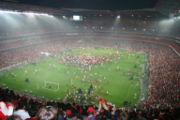
Regional (Lisbon) titles
Note: It shouldn't be translated as Empire Cup as it refers to Império LC, a Lisbon club from the early 20th century.
The following players have won the Ballon d'Or while playing for Benfica: Eusébio
– 1965
European Golden Boot
The following players have won the European Golden Shoe while playing for Benfica: Eusébio
(43 goals) – 1968 (First winner) Eusébio
(40 goals) – 1973
FIFA World Cup Golden Boot
The following players have won the FIFA World Cup Golden Boot while playing for Benfica: Eusébio
(9 goals) – 1966
Best European Goalkeeper
The following players have won the Best European Goalkeeper
while playing for Benfica: Michel Preud'homme
– 1994
UEFA European Football Championship
The following players have won the UEFA European Football Championship
while playing for Benfica: Takis Fyssas
– 2004
Copa América
The following players have won the Copa América
while playing for Benfica: Aldair – 1989 Ricardo Gomes – 1989 Luisão
– 2004 Maxi Pereira – 2011
FIFA Confederations Cup
The following players have won the FIFA Confederations Cup
while playing for Benfica: Luisão
– 2005
, 2009
Léo
– 2005
Summer Olympics Football Tournament
The following players have won the Summer Olympics Football Tournament
while playing for Benfica: Ángel di María
– 2008
, honour of respect due to death on field while playing.
As of the 2004–05 season, president Luis Felipe Veira said no player will wear the number 29 shirt in Benfica, since the club decided to retire the shirt out of respect for Miklos Feher due to his tragic death.
Goalkeepers Michel Preud'homme
(1994–1999) Costa Pereira (1954–1967) Manuel Bento (1972–1992)
Left fullbacks Ângelo Martins (1952–1965) Fernando Cruz
(1959–1969) Gustavo Teixeira
(1932–1939)
Right fullbacks António Veloso
(1980–1995) Manuel Serra
(1956–1962) Mário João
(1957–1962)
Central defenders Carlos Mozer
(1987–1989; 1992–1995) Ricardo Gomes (1988–1991; 1995–1996) Félix Antunes
(1946–1954) Germano (1960–1966) Humberto Coelho (1968–1975; 1977–1984) Raúl Machado
(1962–1969)
Left midfielders António Simões
(1961–1975) Cavém
(1955–1969) Fernando Chalana
(1976–84; 1987–1990) Rogério "Pipi"
(1942–1954)
Right midfielders Francisco Palmeiro
(1953–1961) José Augusto (1959–1969) Nené
(1968–1986)
Central midfielders Valdo (1988–1991; 1995–1997) Francisco Albino
(1932–1945) Francisco Ferreira (1938–1952) João Alves
(1978–1979; 1980–83) Mário Coluna
(1954–1970)
Forwards Espírito Santo
(1936–1950) Eusébio
(1960–1975) João Pinto
(1992–2000) José Águas
(1950–1963) José Torres
(1959–1971) Santana
(1954–1968) Vítor Silva
(1927–1936)
: 1908–1926 Ribeiro dos Reis: 1926–1929 Arthur John: 1929–1931 Ribeiro dos Reis: 1931–1934 Vítor Gonçalves: 1934–1935 Lipót Hertzka: 1935–1939 János Biri: 1939–1947 Lipót Hertzka: 1947–1948 Edward "Ted" Smith: 1948–1952 Alberto Zozaya
: 1952–1953 José Valdivieso: 1954 Otto Glória
: 1954–1959 Béla Guttmann
: 1959–1962 Fernando Riera
: 1962–1963 Lajos Czeizler
: 1963–1964 Elek Schwartz
: 1964–1965 Béla Guttmann
: 1965–1966
Fernando Riera
: 1966–1967 Fernando Cabrita
: 1967–1968 Otto Glória
: 1968–1970 Jimmy Hagan
: 1970–1973 Fernando Cabrita
: 1973–1974 Milorad "Michel" Pavić
: 1974–1975 Mário Wilson
: 1975–1976 John Mortimore
: 1976–1979 Mário Wilson
: 1979–1980 Lajos Baróti
: 1980–1982 Sven-Göran Eriksson
: 1982–1984 Pál Csernai
: 1984–1985 John Mortimore
: 1985–1987 Ebbe Skovdahl
: 1987 Toni: 1987–1989 Sven-Göran Eriksson
: 1989–1992 Tomislav Ivić
: 1992 Toni: 1992–1994
Artur Jorge: 1994–1995 Mário Wilson
: 1995–1996 Paulo Autuori: 1996–1997 Manuel José
: 1997 Mário Wilson
: 1997 Graeme Souness
: 1997–1999 Jupp Heynckes
: 1999–2000 José Mourinho
: 2000 Toni: 2000–2002 Jesualdo Ferreira
: 2002 José Antonio Camacho
: 2002–2004 Giovanni Trapattoni
: 2004–2005 Ronald Koeman
: 2005–2006 Fernando Santos: 2006–2007 José Antonio Camacho
: 2007–2008 Fernando Chalana
: 2008 Quique Sanchez Flores
: 2008–2009 Jorge Jesus: 2009–Present
section has won the Portuguese National Championship 9 times and the Portuguese Cup 1 time. In addition to these national titles, they have won the Tornoi Européen de Nîmes FITA once. It is one of the most successful Portuguese archery clubs.
in triple jump
is among Benfica's athletics biggest names. By the number of regional, national and international titles, it is the most successful sport of the club.
. One of its most memorable moments was when Benfica's basketball team won a European Cup clash against Italian giants Buckler Bologna
, beating the Italians 102–90, in 4 December 1993 at Pavilhão da Luz in Lisbon. However, due to Portugal
's popularity in football
, basketball is not nearly as popular with the population as football
. Just as in football
, Benfica has a major rivalry with F.C. Porto's basketball team and it usually leads to arguments between the fans and players. In his basketball history, Benfica has won 20 Portuguese championships, 18 Portuguese cups, 5 League Cups and 7 Portuguese Supercups and are currently one of the best teams in the league.
The 72,5 kg kickboxing-world champion, Bruno Carvalho
, is one of Benfica's athletes.
was the second modality established within the club, and along with football, is one of only two sports referenced in the club logo. The sport was in activity from 1906 to 1941, 1947 to 1978, 1999 to 2000, and once again from 2007 to 2008. Benfica last won the Volta a Portugal
in 1999, with Spanish cyclist David Plaza
capturing the leader's yellow jersey. Historically, the club has had great national successes in cycling.
Men's Futsal National trophies:
department, with the following activities:
Aerobics
, Acrobatic, Aerominis, Ballet
, Ballroom dance
, Boxing
, Dance
, Gymnastics of maintenance, Hapkido
, Haidong Gumdo
, Hip Hop, Kempo, Kickboxing
, Krav Maga, Muay-Thai, "Os Madrugadores", PlayGym, Rhythmic gymnastics
, Silhouettes, Taekwondo
, Trampoline
, Yoga
, Youth Gymnastics.
Every year, the club organises the sarau Gimnáguia, known as one of the biggest and most important gymnastics event in Portugal
, with the participation of several clubs. The event celebrated in 2007 the twenty-fifth anniversary.
, has joined Benfica. The section is fully established on January 21, 2008, when the club will inaugurate their first ever Tatami
mat
.
won the National Portuguese Gold (Top Portuguese Division) Paintball Championship 3 times in a row; 2008, 2009 and 2010, the Portuguese Cup in 2008.
At international level also won the SPL Millennium European Paintball Series in 2009 and 3 SPL Millennium European Paintball Series
Challenges; the World Cup of Toulouse in 2008, the European Masters Cup of Bitburg in 2008 and the Campaign Cup of London in 2009.
Hugo Domingues of S.L. Benfica Paintball team is one of the best world Paintballers.
In 2010 the S.L. Benfica Paintball team participate in the top Millennium European Paintball Series Competition, the CPL (Champions Profissional Paintball League).
an competitions (1 CERS Cup). The club's rink hockey team is considered one of the best in Portugal
and rivalizes at national level with F.C. Porto and Óquei Clube de Barcelos
rink hockey teams, in Europe they are also a title disputing team although they have only won the second most important cup once, CERS Cup.
, Direito
and Belenenses
being other powerful competitors. Benfica have also won the Iberian Cup. Benfica is the oldest Portuguese club with a rugby section. In the 2008 season, the men's senior team ended in the 4th position in the national championship, while the women's section was the national champion for the second consecutive year.
section has had its best season in 2008, with Benfica being 2nd in the Portuguese championship.
The Casa do Benfica no Porto (House of SL Benfica in Porto) won the FIPS-MER World Championship Shore Angling Clubs in 2006 and
a Silver Medal in 2010.
is considered the best Portuguese swimmer of all-time, achieving remarkable results at international level. In the eighties, Benfica achieved relevant results, both in national and international levels. In 2007, the club won several medals in different competitions, at youth and seniors levels. Benfica has a men's and women's department.
in women's triathlon
is currently the most notable athlete of this department.
Lisbon
Lisbon is the capital city and largest city of Portugal with a population of 545,245 within its administrative limits on a land area of . The urban area of Lisbon extends beyond the administrative city limits with a population of 3 million on an area of , making it the 9th most populous urban...
. Although they successfully compete in a number of different sports, Benfica is mostly known for its association football team. Founded in Lisbon
Lisbon
Lisbon is the capital city and largest city of Portugal with a population of 545,245 within its administrative limits on a land area of . The urban area of Lisbon extends beyond the administrative city limits with a population of 3 million on an area of , making it the 9th most populous urban...
in February 28, 1904, it is one of the "Três Grandes" (Big Three
Big Three (Portugal)
The Big Three is the nickname of the three most successful sports clubs in Portugal. The football teams of Sport Lisboa e Benfica, Futebol Clube do Porto and Sporting Clube de Portugal have a great rivalry, and are usually the main contenders for the title. They share all but two of the Portuguese...
, in English), football clubs in Portugal, with Futebol Clube do Porto and Sporting Clube de Portugal being the other two clubs, Benfica's biggest rivals. Benfica has more than 14 million fans and the Guinness World Record for the football club in the world with most members. Benfica's supporters are often called "Benfiquistas". Benfica was elected by the IFFHS as the 9th most successful European football club of the 20th century
IFFHS continental Clubs of the 20th Century
In 2009 the International Federation of Football History & Statistics , an organization recognized by FIFA, released the results of a statistical study which determined the best continental clubs of the 20th century...
and by FIFA
FIFA
The Fédération Internationale de Football Association , commonly known by the acronym FIFA , is the international governing body of :association football, futsal and beach football. Its headquarters are located in Zurich, Switzerland, and its president is Sepp Blatter, who is in his fourth...
as the 12th most successful football club of the 20th century.
It is the most successful Portuguese football club in terms of national titles with 66 titles.
Benfica was one of the founding members of the Primeira Liga in 1933, and, together with Porto and Sporting, it has never been relegated from the First Division (Primeira Divisão, in Portuguese
Portuguese language
Portuguese is a Romance language that arose in the medieval Kingdom of Galicia, nowadays Galicia and Northern Portugal. The southern part of the Kingdom of Galicia became independent as the County of Portugal in 1095...
) of Portuguese football.
On February 28, 1904, Sport Lisboa e Benfica (originally known as Grupo Sport Lisboa, Lisbon Sport Group) was founded during a meeting in the southwest part of Lisbon involving 24 young men, led by Cosme Damião
Cosme Damião
Cosme Damião was a Portuguese football player, as a midfielder, and a coach for SL Benfica. He will always be remembered as the main force behind the birth of Benfica and one of the first great Portuguese football players.He was educated at the Casa Pia, in Lisbon. Starting at a young age, Damião...
. As a result of this meeting, the most popular and successful Portuguese football club in domestic competitions was created.
Domestically, Benfica won a total of 32 Portuguese Liga
Portuguese Liga
The Primeira Liga , formerly called Primeira Divisão, currently named Liga ZON Sagres after their main sponsors, is the top professional association football division of the Portuguese football league system...
titles, 27 Championship of Portugal/Portuguese Cup titles, 3 Portuguese League Cup
Portuguese League Cup
The Taça da Liga , officially known as bwin Cup, is a competition organized by the Portuguese League for Professional Football started in the 2007–08 football season. For the first three seasons it was known as Carlsberg Cup for sponsorship reasons...
titles and 4 Portuguese SuperCup titles.
Benfica has the distinction of being one of only two teams in the history of the Portuguese Liga
Portuguese Liga
The Primeira Liga , formerly called Primeira Divisão, currently named Liga ZON Sagres after their main sponsors, is the top professional association football division of the Portuguese football league system...
to have won the championship, while completing an entire 30 game season, unbeaten (in the 1972–73 season).
Internationally, Benfica won the 1960–61 and the 1961–62 European Cup. In addition, Benfica were runners-up in the 1961
1961 Intercontinental Cup
A play-off was needed due to the rules at the time that awarded 2 points for each victory and both teams having won one game each....
and 1962 Intercontinental Cup
1962 Intercontinental Cup
The 1962 Intercontinental Cup was a football tie held over two legs between Santos, winners of the 1962 Copa Libertadores, and Benfica, winners of the 1961–62 European Cup...
, in the 1962–63, 1964–65, 1967–68, 1987–88 and 1989–90 European Cup, and in the 1982–83 UEFA Cup
1983 UEFA Cup Final
The 1983 UEFA Cup Final was played on 4 May 1983 and 18 May 1983 between R.S.C. Anderlecht of Belgium and SL Benfica of Portugal. Anderlecht won 2–1 on aggregate.-First leg:-Second leg:-References:* *...
.
As a multiple sport club, Benfica has departments for basketball
Basketball
Basketball is a team sport in which two teams of five players try to score points by throwing or "shooting" a ball through the top of a basketball hoop while following a set of rules...
, roller hockey
Roller hockey
Roller Hockey is a form of hockey played on a dry surface using skates with wheels. The term "Roller Hockey" is often used interchangeably to refer to two variant forms chiefly differentiated by the type of skate used. There is traditional "Roller Hockey," played with quad roller skates, and...
, indoor football (known as futsal
Futsal
Futsal is a variant of association football that is played on a smaller pitch and mainly played indoors. Its name is a portmanteau of the Portuguese futebol de salão and the Spanish fútbol de salón , which can be translated as "hall football" or "indoor football"...
), volleyball
Volleyball
Volleyball is a team sport in which two teams of six players are separated by a net. Each team tries to score points by grounding a ball on the other team's court under organized rules.The complete rules are extensive...
, handball
Team handball
Handball is a team sport in which two teams of seven players each pass a ball to throw it into the goal of the other team...
, beach soccer
Beach soccer
Beach soccer, also known as beach football or beasal, is a variant of association football played on a beach or some form of sand. The game emphasises skill, agility and shooting at goal....
, water polo
Water polo
Water polo is a team water sport. The playing team consists of six field players and one goalkeeper. The winner of the game is the team that scores more goals. Game play involves swimming, treading water , players passing the ball while being defended by opponents, and scoring by throwing into a...
, rugby
Rugby football
Rugby football is a style of football named after Rugby School in the United Kingdom. It is seen most prominently in two current sports, rugby league and rugby union.-History:...
, and cycling
Cycling
Cycling, also called bicycling or biking, is the use of bicycles for transport, recreation, or for sport. Persons engaged in cycling are cyclists or bicyclists...
, among others. Due to the success and popularity of the football club, Benfica has built the biggest fan base among the "Três Grandes" (Benfica, Porto and Sporting) in Portugal. Benfica also has one of the biggest fan bases in the world, with many supporters outside of Portugal in countries like Andorra
Andorra
Andorra , officially the Principality of Andorra , also called the Principality of the Valleys of Andorra, , is a small landlocked country in southwestern Europe, located in the eastern Pyrenees mountains and bordered by Spain and France. It is the sixth smallest nation in Europe having an area of...
, Angola
Angola
Angola, officially the Republic of Angola , is a country in south-central Africa bordered by Namibia on the south, the Democratic Republic of the Congo on the north, and Zambia on the east; its west coast is on the Atlantic Ocean with Luanda as its capital city...
, Australia
Australia
Australia , officially the Commonwealth of Australia, is a country in the Southern Hemisphere comprising the mainland of the Australian continent, the island of Tasmania, and numerous smaller islands in the Indian and Pacific Oceans. It is the world's sixth-largest country by total area...
, Belgium
Belgium
Belgium , officially the Kingdom of Belgium, is a federal state in Western Europe. It is a founding member of the European Union and hosts the EU's headquarters, and those of several other major international organisations such as NATO.Belgium is also a member of, or affiliated to, many...
, Brazil
Brazil
Brazil , officially the Federative Republic of Brazil , is the largest country in South America. It is the world's fifth largest country, both by geographical area and by population with over 192 million people...
, Canada
Canada
Canada is a North American country consisting of ten provinces and three territories. Located in the northern part of the continent, it extends from the Atlantic Ocean in the east to the Pacific Ocean in the west, and northward into the Arctic Ocean...
, Cape Verde
Cape Verde
The Republic of Cape Verde is an island country, spanning an archipelago of 10 islands located in the central Atlantic Ocean, 570 kilometres off the coast of Western Africa...
, Croatia
Croatia
Croatia , officially the Republic of Croatia , is a unitary democratic parliamentary republic in Europe at the crossroads of the Mitteleuropa, the Balkans, and the Mediterranean. Its capital and largest city is Zagreb. The country is divided into 20 counties and the city of Zagreb. Croatia covers ...
, France
France
The French Republic , The French Republic , The French Republic , (commonly known as France , is a unitary semi-presidential republic in Western Europe with several overseas territories and islands located on other continents and in the Indian, Pacific, and Atlantic oceans. Metropolitan France...
, Germany
Germany
Germany , officially the Federal Republic of Germany , is a federal parliamentary republic in Europe. The country consists of 16 states while the capital and largest city is Berlin. Germany covers an area of 357,021 km2 and has a largely temperate seasonal climate...
, Guinea-Bissau
Guinea-Bissau
The Republic of Guinea-Bissau is a country in West Africa. It is bordered by Senegal to the north, and Guinea to the south and east, with the Atlantic Ocean to its west....
, United Kingdom
United Kingdom
The United Kingdom of Great Britain and Northern IrelandIn the United Kingdom and Dependencies, other languages have been officially recognised as legitimate autochthonous languages under the European Charter for Regional or Minority Languages...
, Japan
Japan
Japan is an island nation in East Asia. Located in the Pacific Ocean, it lies to the east of the Sea of Japan, China, North Korea, South Korea and Russia, stretching from the Sea of Okhotsk in the north to the East China Sea and Taiwan in the south...
, Luxembourg
Luxembourg
Luxembourg , officially the Grand Duchy of Luxembourg , is a landlocked country in western Europe, bordered by Belgium, France, and Germany. It has two principal regions: the Oesling in the North as part of the Ardennes massif, and the Gutland in the south...
, Macau
Macau
Macau , also spelled Macao , is, along with Hong Kong, one of the two special administrative regions of the People's Republic of China...
, Mexico
Mexico
The United Mexican States , commonly known as Mexico , is a federal constitutional republic in North America. It is bordered on the north by the United States; on the south and west by the Pacific Ocean; on the southeast by Guatemala, Belize, and the Caribbean Sea; and on the east by the Gulf of...
, Switzerland
Switzerland
Switzerland name of one of the Swiss cantons. ; ; ; or ), in its full name the Swiss Confederation , is a federal republic consisting of 26 cantons, with Bern as the seat of the federal authorities. The country is situated in Western Europe,Or Central Europe depending on the definition....
, Netherlands
Netherlands
The Netherlands is a constituent country of the Kingdom of the Netherlands, located mainly in North-West Europe and with several islands in the Caribbean. Mainland Netherlands borders the North Sea to the north and west, Belgium to the south, and Germany to the east, and shares maritime borders...
and United States
United States
The United States of America is a federal constitutional republic comprising fifty states and a federal district...
. Currently, Benfica has the largest number of supporters worldwide for a Portuguese club, with a total number of around 14 million.
On November 9, 2006, Benfica was acknowledged by Guinness World Records
Guinness World Records
Guinness World Records, known until 2000 as The Guinness Book of Records , is a reference book published annually, containing a collection of world records, both human achievements and the extremes of the natural world...
as having the largest number of paying club members (known as sócios, in Portuguese) in the world, with 160,398 paid members.
On September 30, 2009, Benfica announced that it had reached the 200,000 mark for paid club members. In May, 2004, Benfica launched an aggressive marketing campaign known as kit sócio (membership kit) to increase its paid club membership from 94,714 to 200,000. As a result, five years later, Benfica was able to add more than 105,000 new paid club members to their existing membership of 94,714, which more than doubled their total paid club membership. Benfica currently remains the leader of international football clubs with the largest number of paying club members worldwide.
The foundation and first years (1904–1910)
On February 28, 1904, a meeting of young people from the BelémBelém
Belém is a Brazilian city, the capital and largest city of state of Pará, in the country's north region. It is the entrance gate to the Amazon with a busy port, airport and bus/coach station...
neighborhood of Lisbon
Lisbon
Lisbon is the capital city and largest city of Portugal with a population of 545,245 within its administrative limits on a land area of . The urban area of Lisbon extends beyond the administrative city limits with a population of 3 million on an area of , making it the 9th most populous urban...
and former students from the Real Casa Pia de Lisboa took place at the Farmácia Franco (Franco Pharmacy), located on Rua de Belém in the southwest part of Lisbon, with the goal of forming a new football club that would be called Grupo Sport Lisboa. There were a total of 24 people who attended the meeting, including the co-founder and future soul of the football club, Cosme Damião
Cosme Damião
Cosme Damião was a Portuguese football player, as a midfielder, and a coach for SL Benfica. He will always be remembered as the main force behind the birth of Benfica and one of the first great Portuguese football players.He was educated at the Casa Pia, in Lisbon. Starting at a young age, Damião...
. During the meeting, José Rosa Rodrigues was appointed as the club's first president, along with Daniel Brito as secretary and Manuel Gourlade as treasurer.
The first game was played in January, 1905. Despite important football victories in the first few years, the club suffered due to poor operating conditions. As a result, in 1907, several players from the first team joined the then more prosperous Sporting Clube de Portugal, located across the city.
In 1908, Grupo Sport Lisboa acquired, by mutual agreement, the Sport Clube de Benfica, a club founded in 1906 as Grupo Sport Benfica and later changed its name to Sport Clube de Benfica. Despite the merger of the two football clubs, Grupo Sport Lisboa and Sport Clube de Benfica continued their respective club operations. For Grupo Sport Lisboa, they maintained the football team, the red and white shirt colors, the eagle as the symbol, the "E Pluribus Unum" as the motto
Motto
A motto is a phrase meant to formally summarize the general motivation or intention of a social group or organization. A motto may be in any language, but Latin is the most used. The local language is usual in the mottoes of governments...
, and the logo
Logo
A logo is a graphic mark or emblem commonly used by commercial enterprises, organizations and even individuals to aid and promote instant public recognition...
. For Sport Clube de Benfica, they maintained the football field, the main directors, and the club's house.
Under the mutual agreement, both Sport Clube de Benfica and Grupo Sport Lisboa determined that the foundation date of the newly formed club should coincide with the foundation date of Grupo Sport Lisboa, February 28, 1904, given that it was the most recognized club (of the two) in the merger and it was already quite popular in Lisbon due to its football merits. (It is interesting to note that Sport Lisboa e Benfica is the only club of the "Big Three
Big Three (Portugal)
The Big Three is the nickname of the three most successful sports clubs in Portugal. The football teams of Sport Lisboa e Benfica, Futebol Clube do Porto and Sporting Clube de Portugal have a great rivalry, and are usually the main contenders for the title. They share all but two of the Portuguese...
" that has never changed its foundation date.) With regard to the new club's logo, a bicycle
Bicycle
A bicycle, also known as a bike, pushbike or cycle, is a human-powered, pedal-driven, single-track vehicle, having two wheels attached to a frame, one behind the other. A person who rides a bicycle is called a cyclist, or bicyclist....
wheel was added to the Grupo Sport Lisboa's original logo, which represented the most important sport of Sport Clube de Benfica. As for the new club's name, Benfica from Sport Clube de Benfica was added to the Sport Lisboa of Grupo Sport Lisboa to form Sport Lisboa e Benfica, which remains the formal full name of Benfica today. As for other notes, the club moved from the Belém
Santa Maria de Belém
Santa Maria de Belém, or just Belém , whose name is derived from the Portuguese word for Bethlehem, is a civil parish of the municipality of Lisbon, in central Portugal...
area of Lisbon to the present-day Benfica
Benfica (Lisbon)
Benfica is a Portuguese parish, located in the municipality of Lisbon. It has a population of 38,523 inhabitants and a total area of 7.94 km².The biggest park of Lisbon, Monsanto Forest Park, is located in Benfica.-20th century:...
area, which is a neighborhood located in the northern part of the city. Furthermore, the two entities of the new club had simultaneous associates, which helped to stabilize operations and later increased the success of the merger.
In October, 1908, a month after the agreement, the club won the first game ever against Sporting Clube de Portugal. Then, in the 1909–10 season, Benfica ended Carcavelos Club's reign (for the last three years) as Lisbon Champions. In addition, that season was considered a "golden one", as the club won all three regional championships in Portuguese competition, thus establishing a record.
An early age of achievements (1910–1921)
Between 1905 and 1922, the club won 11 Lisbon regional titles in football.Meanwhile, club’s popularity increased outside of Lisbon's city borders. Several affiliate clubs were created, mainly in the Algarve.
The 1913–14 season was very successful, as the club was the first to win the regional Lisbon championships in all the four categories.
The first international matches were played with some relevant results: in 1913, the club won their first international football trophy, named Torneio Três Cidades (Three Cities' Tournament).
The rink hockey department was created in 1917. In 1919, the club organized the first ever football game played at night in Portugal.
It was not until the 1920s that the club became more known as Benfica. A falling out within the club regarding some football players led to several members leaving the club and founding Clube de Futebol Os Belenenses, which is now Lisbon's third largest football club. This is regarded as the second major crisis within the club.
Football crisis and cycling dominance (1922–1930)
The national football competitions only began in the 1920s. The impact of the defection of players to Clube de Futebol Os Belenenses was made worse by further losses due to the creation of Casa Pia Atlético ClubeCasa Pia A.C.
Casa Pia Atlético Clube is a sports association founded in 1920 and based in Lisbon, Portugal. The club is named after Casa Pia, a Portuguese children's charity, and many of its athletes come from that institution...
in Lisbon. This exodus of players left Sport Lisboa e Benfica struggling in the following years and the club would only win two regional titles until 1930.
Fortunately for Benfica, cycling picked up the slack and became an important source of victories. Spearheading the team was Alfredo Luís Piedade, considered to be one of the greatest names in Portuguese cycling.
In 1925, the club inaugurated the Amoreiras Stadium. The departments of field hockey
Field hockey
Field Hockey, or Hockey, is a team sport in which a team of players attempts to score goals by hitting, pushing or flicking a ball into an opposing team's goal using sticks...
, rugby
Rugby football
Rugby football is a style of football named after Rugby School in the United Kingdom. It is seen most prominently in two current sports, rugby league and rugby union.-History:...
, and basketball
Basketball
Basketball is a team sport in which two teams of five players try to score points by throwing or "shooting" a ball through the top of a basketball hoop while following a set of rules...
were created in this decade; only the first mentioned doesn’t have official activities today.
From the time 1921–22, one begins to realize the Portugal . Championship The representative Madeira only enter in the competition next season. In 1927–28 the club only adds to their participation. Was on the edge of Benfica win the quarter-final, with the 3-1 win until the last minute of the game, but ending up losing 3-4 in the extended discount.
The first national football titles (1930s)
The 1930s were a much kinder decade to Benfica. The club's football team started the decade by winning two national championships (for the first time) in 1930 and 1931 and one regional championship.After losing the first national championship, Benfica won the next three championships in a row (1935–36, 1936–37, and 1937–38), and their first Portuguese Cup, in 1939–40.
Cycling continued to be the key sport within the club. The duels between Benfica's José Maria Nicolau and Sporting Clube de Portugal's Alfredo Trinidade on the road throughout the country enthralled many fans and were a critical factor for the ascendance of popularity of not only Benfica but also Sporting. José Maria Nicolau is regarded as one of Benfica's greatest ever cyclist and won two Volta a Portugal
Volta a Portugal
The Volta a Portugal em bicicleta is a long distance road bicycle race for professionals held in Portugal. The competition takes place annually during a two-week span.- History :...
's titles in 1931 and 1934.
The 1940s
The 1940s saw the domination by Benfica and Sporting in the country's football championship to an extent never seen before. Between 1941 and 1950, the two clubs finished first and second in every championship except for the 1945–46 season when Benfica finished second to Os Belenenses. During this period, Benfica and Sporting each won four titles. By now, football was clearly the club's most important sport.The 1950s
Benfica's first major international football success happened in 1950 when they won the Latin CupLatin Cup
The Latin Cup was an international football tournament for club sides from the Latin European nations of France, Italy, Spain and Portugal. In 1949 the football federations came together and launched their own club competition...
by defeating Bordeaux
FC Girondins de Bordeaux
Football Club des Girondins de Bordeaux is a French association football club based in the city of Bordeaux. The club currently play in Ligue 1, the first division of French football, and won its last Ligue 1 title in the 2008–09 season....
in the final. The Latin Cup was then seen as one of Europe's most prestigious European Cups in a time when UEFA had yet to launch its unified European Cups.
Another highlight came in 1954 when Benfica moved into the famous Estádio da Luz. It initially had capacity for 40,000 spectators, but this was gradually expanded due to club's growing success and fan base.
Benfica won three championships during the 1950s and were runner-ups three times. They also gathered six Portuguese Cups, and their accomplishments included a series of four consecutive victories between 1948 and 1953. The Portuguese cup was not held in 1950 due to the Latin Cup being organized in Portugal.
In addition to all these successes, Benfica was able to end the decade with the foundations in place enabling the club to enter the 1960s with one of the best teams in Europe.
The golden era (1960–1970)
Benfica was the first team to break Real MadridReal Madrid C.F.
Real Madrid Club de Fútbol , commonly known as Real Madrid, is a professional football club based in Madrid, Spain. The club have won a record 31 La Liga titles, the Primera División of the Liga de Fútbol Profesional , 18 Copas del Rey, 8 Spanish Super Cups, 1 Copa Eva Duarte and 1 Copa de la...
's dominance in the early European Champions' Cup
UEFA Champions League
The UEFA Champions League, known simply the Champions League and originally known as the European Champion Clubs' Cup or European Cup, is an annual international club football competition organised by the Union of European Football Associations since 1955 for the top football clubs in Europe. It...
. Having won two European Cups in a row against FC Barcelona
FC Barcelona
Futbol Club Barcelona , also known as Barcelona and familiarly as Barça, is a professional football club, based in Barcelona, Catalonia, Spain....
(1961) and Real Madrid (1962). This was the last time Benfica won an international competition.
During this decade, Benfica would reach another three European Champions' Cup finals, but the Lisbon club never managed to win a European trophy again, having lost against Milan
A.C. Milan
Associazione Calcio Milan, commonly referred to as A.C. Milan or simply Milan , is a professional Italian football club based in Milan, Lombardy, that plays in the Serie A. Milan was founded in 1899 by English lace-maker Herbert Kilpin and businessman Alfred Edwards among others...
(1963), Internazionale (1965), and Manchester United
Manchester United F.C.
Manchester United Football Club is an English professional football club, based in Old Trafford, Greater Manchester, that plays in the Premier League. Founded as Newton Heath LYR Football Club in 1878, the club changed its name to Manchester United in 1902 and moved to Old Trafford in 1910.The 1958...
(1968).
In 1968, Benfica was considered the best European team by France Football
France Football
France Football is a French bi-weekly magazine containing football news from all over the world. It's one of the most reputable sports publications in Europe, mostly because of their photographic reports and accurate statistics of the big European Cup matches, and extensive coverage of the European...
, despite its defeat in the Champions Cup. Many of its successes in the 1960s were achieved with all-time football great Eusébio
Eusébio
Eusébio da Silva Ferreira, GCIH, GCM , commonly known simply as Eusébio, is a retired Mozambican-born Portuguese football forward. He is considered one of the best footballers of all-time by the IFFHS, experts and fans...
playing for the Lisbon side. In fact, the 1960s were the best period of Benfica history, in which the club won an astonishing eight Championships
Portuguese Liga
The Primeira Liga , formerly called Primeira Divisão, currently named Liga ZON Sagres after their main sponsors, is the top professional association football division of the Portuguese football league system...
(1960, '61, '63, '64, '65, '67, '68, and '69), three Portuguese Cups (1961, '64, and '69), and two European Champions Cup (1961 and '62).
The silver era (1970–1994)
During the 1970s, the team faded slightly from the European scene, but remained the main force inside Portuguese football, winning six championships (1971, '72, '73, '75, '76, and '77) and two Portuguese cups (1970 and '72). Jimmy HaganJimmy Hagan
James Hagan was an English football player and manager born in Washington, County Durham, England. He played between 1938 and 1958 for Sheffield United and once for England. As manager he had his greatest successes with S.L...
led the club to three successive Portuguese championships, and once to the national cup between 1970 and 1973. Benfica also attracted Europe-wide attention when the team reached the semi-finals of the European Cup of Champions, where the team was only narrowly defeated 1–0 on aggregate by the legendary Ajax side of that era.
In 1972–73, Benfica became the first club in Portugal to last a whole season without defeat and won 28 matches — 23 consecutively — out of 30, and drew two. In that year, Eusébio
Eusébio
Eusébio da Silva Ferreira, GCIH, GCM , commonly known simply as Eusébio, is a retired Mozambican-born Portuguese football forward. He is considered one of the best footballers of all-time by the IFFHS, experts and fans...
also became Europe's top scorer with 40 goals, in what was his penultimate season as a Benfica player. The team scored 101 goals, breaking 100 only for the second time in their history.
The club had some problems in the late 1970s, early 1980s, but managed to stand up to its standards again, this time under the guidance of Sven-Göran Eriksson
Sven-Göran Eriksson
Sven-Göran Eriksson , in Sweden commonly referred to just by his nickname Svennis, is a Swedish ex-football manager. From October 2010 to October 2011 he managed Football League Championship side Leicester City....
. In two years (1983 and 1984) the club won two championships, one Portuguese Cup, and reached the final of the UEFA Cup
UEFA Cup
The UEFA Europa League is an annual association football cup competition organised by UEFA since 1971 for eligible European football clubs. It is the second most prestigious European club football contest after the UEFA Champions League...
in 1983 against Anderlecht
R.S.C. Anderlecht
Royal Sporting Club Anderlecht, usually known as Anderlecht or RSCA , is a Belgian professional football club based in Anderlecht in the Brussels Capital Region. Anderlecht plays in the Belgian Pro League and is the most successful Belgian football team in European competitions as well as in the...
.
Following the completion of improvements to the football stadium, the board of Benfica decided to open the third level of the Estádio da Luz, which transformed it into one of the biggest in Europe, with a standing room capacity of 120,000. In 1987, Benfica won another double (championship and Portuguese cup), an achievement done for the ninth time in their history.
During the period from 1988 to 1994, Benfica made a huge financial investment in an effort to win another European cup, but the club failed to meet its expectations. While Benfica reached the European cup final in 1988 and 1990, it lost in the final against PSV and Milan
A.C. Milan
Associazione Calcio Milan, commonly referred to as A.C. Milan or simply Milan , is a professional Italian football club based in Milan, Lombardy, that plays in the Serie A. Milan was founded in 1899 by English lace-maker Herbert Kilpin and businessman Alfred Edwards among others...
, respectively. Domestically, Benfica won three more championships (1989, '91, and '94) and one Portuguese Cup (1993).
The dark years (1994–2003)
Financial trouble began to undermine the club due to rampant spending and a questionable signing policy which allowed for squads composed of well over 30 players. Consequently, the period from 1994 through 2003 was arguably the darkest in the history of Benfica. During this time, Benfica only won one Portuguese Cup in 1996 and finished in positions, such as sixth in 2000–01 and fourth in 2001–02. The debts were accumulating, and nearly every year saw the hire of a new Benfica coach and the addition of high-priced but under-performing players.The rebuilding years
In 2004, the club regained some of its sporting prowess, with a new president and the manager José Antonio CamachoJosé Antonio Camacho
José Antonio Camacho Alfaro is a retired Spanish footballer who played as a left defender, and the current coach of the China PR national football team....
, winning the first title in eight years (the Portuguese Cup, won against José Mourinho
José Mourinho
José Mário dos Santos Félix Mourinho is a Portuguese football manager and the current manager of Real Madrid. He is commonly known as "The Special One".Mourinho is regarded by some players, coaches and critics as the best ever coach in football....
's FC Porto in the final), and in 2004–05, the first national championship in 11 years, this time with Giovanni Trapattoni
Giovanni Trapattoni
Giovanni Trapattoni , sometimes known as "Trap" or "Il Trap", is an Italian football coach and former player, considered the most successful club coach in the history of Serie A. As a player he was part of Italy's squad at the 1962 FIFA World Cup....
as coach — in an odd season in which the top club had the least amount of points ever and an efficiency (63.7% of points obtainable) that historically would never have been enough to secure even second place. That year was also marked by the death of the Hungarian player Miklos Feher during a match against Vitória de Guimarães at the Estádio da Luz, shocking scenes of paramedics trying to revive the player on the pitch to no avail will live on in the memory of many and certainly of the players that were there that day. The wake was held at the Estádio da Luz and both the President Luís Filipe Vieira and the captain Nuno Gomes went to Hungary for the players burial.
In 2005–06, Benfica won the Portuguese SuperCup for the fourth time. In the 2005–06
UEFA Champions League 2005-06
The 2005–06 UEFA Champions League was the 51st staging of UEFA's premier European club football tournament, the UEFA Champions League, and the 14th since it was rebranded from the European Cup in 1992. 74 teams from 50 football associations took part, starting with the first qualifying round played...
Champions League
UEFA Champions League
The UEFA Champions League, known simply the Champions League and originally known as the European Champion Clubs' Cup or European Cup, is an annual international club football competition organised by the Union of European Football Associations since 1955 for the top football clubs in Europe. It...
, Benfica managed to reach the quarter-finals, defeating Manchester United 2–1 in the decisive group stage encounter, and then overcoming the 2005
UEFA Champions League 2004-05
The 2004–05 UEFA Champions League was the 50th season of UEFA's premier European club football tournament, and the 13th since it was rebranded as the UEFA Champions League in 1992. The competition was won by Liverpool, who beat Milan on penalties in the final, having come back from 3–0 down...
European champions Liverpool
Liverpool F.C.
Liverpool Football Club is an English Premier League football club based in Liverpool, Merseyside. Liverpool has won eighteen League titles, second most in English football, seven FA Cups and a record seven League Cups...
3–0 on aggregate. However, Benfica lost in the Quarter Finals to the eventual winner Barcelona
FC Barcelona
Futbol Club Barcelona , also known as Barcelona and familiarly as Barça, is a professional football club, based in Barcelona, Catalonia, Spain....
by an aggregate of 2–0, both goals coming during the second leg in Camp Nou
Camp Nou
Camp Nou , sometimes called "the Nou Camp" in English, is a football stadium in Barcelona, Catalonia, Spain. The stadium, located in the west of the city, has been the home of FC Barcelona since its construction in 1957....
. In the 2006–07
UEFA Champions League 2006-07
The 2006–07 UEFA Champions League was the 15th season of UEFA's premier European club football tournament, the UEFA Champions League, since it was rebranded from the European Cup, and the 52nd season overall. The final was contested by Milan and Liverpool on 23 May 2007...
season, Benfica found themselves again facing Manchester United
Manchester United F.C.
Manchester United Football Club is an English professional football club, based in Old Trafford, Greater Manchester, that plays in the Premier League. Founded as Newton Heath LYR Football Club in 1878, the club changed its name to Manchester United in 1902 and moved to Old Trafford in 1910.The 1958...
in a decisive Champions League group match in which the winner would advance. However, this time it was Manchester United who prevailed, gaining revenge in a 3–1 win.
On August 20, 2007, José Antonio Camacho returned to Benfica on a two-year contract, following the sacking of Fernando Santos after only one match in the league (a tie against the recently promoted Leixões), at time when Benfica was facing a vital Champions League qualifying game against Copenhagen
F.C. Copenhagen
F.C. Copenhagen is a professional Danish football club in Copenhagen, Denmark. It is part of the Parken Sport & Entertainment....
. Benfica granted a place in the Champions League
UEFA Champions League
The UEFA Champions League, known simply the Champions League and originally known as the European Champion Clubs' Cup or European Cup, is an annual international club football competition organised by the Union of European Football Associations since 1955 for the top football clubs in Europe. It...
after defeating Copenhagen for 1–0, but eventually exited the competition at the group stage. They then parachuted to the UEFA Cup where they were defeated by Spanish debutants, Getafe
Getafe CF
Getafe Club de Fútbol is a Spanish La Liga football club based in Getafe, a city in the Madrid metropolitan area, founded in 1946 and refounded in 1983.In the top level since 2004-05, it holds home games at the Coliseum Alfonso Pérez....
. Camacho resigned a few months later, in March. Benfica failed to gain a top three finish in the 2007–08 season, placing the team in the UEFA Cup for the upcoming season.
On May 22, 2008, former Valencia
Valencia CF
Valencia Club de Fútbol is a Spanish football club based in Valencia, Spain. They play in La Liga and are one of the most successful and biggest clubs in Spanish Football and European Football. Valencia have won six La Liga titles, seven Copa del Rey trophies, two Fairs Cups which was the...
manager Quique Sánchez Flores
Quique Sanchez Flores
Enrique "Quique" Sánchez Flores is a retired Spanish footballer who played as a right defender, and a current manager....
was appointed as the club's new manager for the new season.
In 2008, Benfica launched its own TV channel called Benfica TV.
In 2009, Benfica won the second edition of the Portuguese League Cup defeating their cross-town rival Sporting CP, under the guidance of Quique Sánchez Flores
From Jorge Jesus Era to the Present (2009–present)
On June 8, 2009, manager Quique Sánchez FloresQuique Sanchez Flores
Enrique "Quique" Sánchez Flores is a retired Spanish footballer who played as a right defender, and a current manager....
resigned as coach after agreeing to a friendly contractual termination; he was replaced by former Sporting de Braga manager Jorge Jesus on June 17.
On July 12, 2009, Benfica tied 2–2 against Sion
FC Sion
FC Sion is a Swiss football team from the city of Sion. The club was founded in 1909, and play their home games at the Stade Tourbillon. They have won the Swiss Super League twice, and the Swiss Cup in each of their twelve appearances in the final, the most recent being in 2011.The first team also...
in their first of ten friendlies in the 2009–10 pre-season with Óscar Cardozo
Óscar Cardozo
Óscar René Cardozo Marín is a Paraguayan footballer who plays for S.L. Benfica in Portugal, as a striker.Known for his powerful left-foot shot and free-kick skills, he first gained notoriety whilst playing for Newell's Old Boys, which led to a move to Benfica, where he scored more than 100...
and Javier Saviola
Javier Saviola
Javier Pedro Saviola Fernández is an Argentine professional footballer who plays for S.L. Benfica in Portugal, as a striker....
each scoring a goal. On July 13, in their second friendly, they beat defending UEFA Cup
UEFA Cup
The UEFA Europa League is an annual association football cup competition organised by UEFA since 1971 for eligible European football clubs. It is the second most prestigious European club football contest after the UEFA Champions League...
-champions Shakhtar Donetsk
FC Shakhtar Donetsk
FC Shakhtar Donetsk is a Ukrainian professional football club from the city of Donetsk. Shakhtar has appeared in several European competitions and currently is often a participant of the UEFA Champions League. The club became the first Ukrainian club to win the UEFA Cup in 2009, the last year...
2–0, with goals coming from Cardozo and Carlos Martins. On 16 July, in their third friendly, Benfica beat Athletic Bilbao
Athletic Bilbao
Athletic Club, also known as Athletic Bilbao, is an association football club from Bilbao in Biscay, Spain. The club has played in the Primera División of La Liga since its start in 1928. They have won La Liga on eight occasions...
2–1 with Saviola scoring two second-half goals.
On July 18, in their fourth friendly, they beat Olhanense 2–1 with a 74th minute highlight goal from Cardozo and an injury time goal from Miguel Vítor
Miguel Vítor
Miguel Ângelo Leonardo Vítor is a Portuguese footballer who plays for S.L. Benfica as a central defender.-Club career:...
. On 21 July, in their fifth friendly, Benfica lost 2–1 against Atlético Madrid with their only goal coming from Cardozo. The game was played in front of 58,000 fans at the Estádio da Luz as this was the presentation game for Benfica and the first game former team-legend Simão
Simão Sabrosa
Simão Pedro Fonseca Sabrosa, OIH , commonly known as Simão , is a Portuguese footballer who plays for Beşiktaş J.K. in Turkey, mainly as a left winger - he can also play as a forward - with dribbling and set piece skills as primary attributes.Having played in his country for two of the three...
played versus Benfica in an Atlético uniform. On July 24, in their sixth friendly, they beat Sunderland 2–0 with goals coming from Cardozo and Maxi Pereira
Maximiliano Pereira
Victorio Maximiliano "Maxi" Pereira Páez is an Uruguayan footballer who plays for S.L. Benfica in the Portuguese first division. Mainly a right defender, he can occasionally appear as a midfielder....
. On July 26, in their seventh friendly, Benfica won the prestigious Amsterdam Tournament
Amsterdam Tournament
The Amsterdam Tournament is a pre-season association football competition, held in Amsterdam, Netherlands. The competition is hosted by Eredivisie club Ajax at the Amsterdam Arena. It was inaugurated in 1975 as the Amsterdam 700 Tournament to celebrate 700 years of history in the city...
against Ajax 3–2, with an own goal from Ismaïl Aissati
Ismaïl Aissati
Ismaïl Aissati is a Dutch-Moroccan footballer. He currently plays for Ajax Amsterdam in the Dutch Eredivisie.-Career:Being born to Moroccan parents in the Netherlands, he is still allowed to play for either national team...
and goals from Ángel Di María
Ángel Di María
Ángel Fabián di María Hernández is an Argentine footballer who currently plays as a winger for Spanish La Liga club Real Madrid and the Argentine national team...
and David Luiz
David Luiz
David Luiz Moreira Marinho , known as David Luiz, is a Brazilian footballer who plays for Chelsea in the Premier League...
.
On August 1, 2009, in their eighth friendly, they beat Portsmouth
Portsmouth F.C.
Portsmouth Football Club is an English football club based in the city of Portsmouth. The club is nicknamed Pompey. Portsmouth's home matches have been played at Fratton Park since the club's formation in 1898. The team currently play in the Football League Championship after being relegated from...
4–0 with Cardozo scoring two first-half goals and Weldon
Weldon Santos de Andrade
Weldon Santos de Andrade , simply Weldon, is a Brazilian footballer who plays for CFR Cluj in Romania, as a striker.-Football career:Weldon was born in Santo André, São Paulo...
scoring a second-half goal. An own goal from Wilkinson late in the second half resulted in Benfica's fourth goal of the match. On August 2, in their ninth friendly, Benfica won the Guimarães Tournament against Vitória de Guimarães 2–0, with goals coming from Weldon and Ruben Amorim
Ruben Amorim
Ruben Filipe Marques Amorim is a Portuguese professional footballer who plays for S.L. Benfica as a midfielder....
. On August 8, in their final friendly of the 2009–10 preseason, Benfica won the Eusébio Cup
Eusébio Cup
The Eusébio Cup is an annual football tournament held at Sport Lisboa e Benfica's Estádio da Luz in Lisbon, Portugal. Benfica host the tournament in early-mid August, one or two weeks before the regular season kicks off. It is usually Benfica's and the participating team's last pre-season match...
on penalty kicks against Milan
A.C. Milan
Associazione Calcio Milan, commonly referred to as A.C. Milan or simply Milan , is a professional Italian football club based in Milan, Lombardy, that plays in the Serie A. Milan was founded in 1899 by English lace-maker Herbert Kilpin and businessman Alfred Edwards among others...
. At the end of full-time, the match was tied 1–1 with Benfica's goal coming from Cardozo in the second half. During the penalty kick shoot-out, goalkeeper Quim saved a total of four penalties, which gave the match to Benfica and kept the Eusébio Cup in Lisbon for the first time.
With a string of good results to start the 2009–10 season, breath-taking attacking football, and some high scoring games in the Portuguese Liga, manager Jorge Jesus and his players have brought a sense of excitement to Benfica supporters that has not been seen since the football club won the 2004–05 Portuguese Liga. This sense of excitement and renewed passion amongst Benfica fans has resulted in high hopes for domestic competitions in the 2009–10 Portuguese Liga, Cup of Portugal
2009–10 Taça de Portugal
The 2009–10 Taça de Portugal was the 70th season of the Taça de Portugal. The competition began on 30 August 2009, with the first round matches, and concluded with the final, held on 16 May at the Estádio Nacional, in Oeiras, between defending champions Porto and then Liga de Honra team Chaves...
, and Portuguese League Cup
2009–10 Portuguese League Cup
The 2009–10 Taça da Liga was the third edition of the Taça da Liga, also known as Carlsberg Cup due to sponsorship reasons. The first matches were played on 1 August 2009. The final was scheduled on 21 March 2009 where Benfica beat F.C. Porto 3-0, and won their second title...
, as well as for international competition in the UEFA Europa League.
As the season of the Portuguese Liga progressed, excitement amongst Benfica fans and intrigue amongst rival fans led to high attendance figures in both the Estádio da Luz and opposing team stadiums throughout Portugal. For example, in a Portuguese Liga match between Benfica and União de Leiria in Leiria
Leiria
Leiria is a city in Leiria Municipality in the Centro Region, Portugal. It is the capital of Leiria District. The city proper has 50,200 inhabitants and the entire municipality has nearly 120,000...
on 26 September 2009, the Estádio Dr. Magalhães Pessoa
Estádio Dr. Magalhães Pessoa
The Estádio Dr. Magalhães Pessoa is a football stadium in Leiria, Portugal, built as a venue for the UEFA Euro 2004 finals held in Portugal. It is the home for Leiria's main football club, União de Leiria. It was designed by Tomás Taveira in 2003. The stadium contains different coloured seats as...
had their highest attendance figure since the UEFA Euro 2004 tournament. Furthermore, informal estimates by those who attended the football match claim that more than 90% of the stadium was composed of Benfica supporters.
When the first half of the season ended after 15 matches, Benfica had a record of 11 wins, two draws, and one loss, with 39 goals scored and nine conceided. Benfica also has had the highest average home attendance with 46,737; their highest mark was 58,659 against FC Porto.
On March 21, the first solid proof of Jesus' work came with the conquest of the first trophy, a 3–0 win against arch-rivals FC Porto on the 2010 Portuguese League Cup
2010 Taça da Liga Final
- External links :** *...
. A game completely dominated by Benfica, who managed to bestow upon its rivals the 2nd defeat of the season.
On April 1 and 8, Benfica were paired with Liverpool in a two-legged quarterfinal matchup in the 2009–10 UEFA Europa League. In Lisbon at the Estádio da Luz, Benfica defeated the English club 2–1 on 1 April. However, despite the positive result in the first leg of the matchup, Benfica was defeated by a score of 4–1 in Liverpool's Anfield Stadium.
On April 13, 2010 in the Lisbon Derby, Benfica played another important match against "capital rivals" Sporting. The match began with Sporting creating more goal opportunities in the first half. Given Benfica's poor tactics, Jorge Jesus replaced Éder Luis with Pablo Aimar. This substitution helped to dramactically improve Benfica's play-making abilities. During the match, Fábio Coentrão placed the ball in the penalty area for Óscar Cardozo to score. Later on, Pablo Aimar, after a great pass from Ramires, managed to score the 2nd goal for Benfica.
On May 9, 2010, Benfica won their final match against Rio Ave and became the Champion of the 2009–2010 Season
2009–10 Portuguese Liga
The 2009–10 Portuguese Liga season, officially known as the Liga Sagres due to sponsorship reasons, was the 76th season of top-tier football in Portugal. It began on 16 August 2009 and ended on 9 May 2010...
. Óscar Cardozo scored twice in the game, which made him the top scorer of the season with 26 goals (right ahead of Falcao, with 25 goals; Cardozo scored 9 penalty kicks that aided this conquest). At the end of the season, Benfica finished 5 points ahead of runner-up, SC Braga (the best result that Braga has had in the history of their football club), with 76 points out of a possible 90. During the 2009–10 Portuguese Liga, Benfica recorded 24 victories, 4 draws and 2 defeats, with 78 goals scored and only 20 conceded. As the 2009–10 Portuguese Liga Champions, Benfica secured their direct entry into the Group Stage of the 2010-11 UEFA Champions League.
On April 14, 2011, Benfica progressed to their first European semi-final (after being eliminated from UEFA Champions League
UEFA Champions League
The UEFA Champions League, known simply the Champions League and originally known as the European Champion Clubs' Cup or European Cup, is an annual international club football competition organised by the Union of European Football Associations since 1955 for the top football clubs in Europe. It...
and ending his group in 3rd place to qualify for the Europa League) in 18 years, set to face Braga in the Europa League semi-finals on April 28, 2011.
On April 23, 2011, Benfica won the League Cup Final against Paços de Ferreira, clinching their 3rd consecutive league cup trophy.
On May 5, 2011, Benfica was eliminated by Braga in the semi-finals of Europa League by 2–2 in aggregate, with Braga proceeding to the finals through away goals rule. The winning team would eventually be runners-up to the competition.
The second year of Jorge Jesus heading the club was considered a failure, as the club had the worst championship start of all time. Benfica ended up in second place. The team's only success was the Portuguese League Cup. Benfica reached the semi-finals of the Europa League.
Club statistics and records
EusébioEusébio
Eusébio da Silva Ferreira, GCIH, GCM , commonly known simply as Eusébio, is a retired Mozambican-born Portuguese football forward. He is considered one of the best footballers of all-time by the IFFHS, experts and fans...
presently holds records for number of total appearances for Benfica with 614 games played.
Benfica's all time top goalscorer is Eusébio
Eusébio
Eusébio da Silva Ferreira, GCIH, GCM , commonly known simply as Eusébio, is a retired Mozambican-born Portuguese football forward. He is considered one of the best footballers of all-time by the IFFHS, experts and fans...
, who scored 638 goals for the club in 614 games. José Águas
José Águas
José Pinto de Carvalho Santos Águas was a Portuguese footballer who played as a striker.He endured a lengthy professional spell with Benfica, never scoring less than 18 goals in his first division seasons.-Football career:...
is in second place with 438 goals in 514 games for the club followed by Nené
Nene
Nene may refer to:*River Nene, a river in England*Rolls-Royce Nene, a jet engine*Nene , also called Nēnē and Hawaiian Goose, Branta sandvicensis, a rare goose*Nene , a Seminole Indian word meaning "street"...
, who has scored 359 goals in 575 games.
The club jointly holds the record of having gone a whole season without losing a game, during the 1972–73 season and has a European winning streak record of 29 games between 1971–72 and 1972–73.
Symbols
The emblem is composed of an eagle, a shield in the club colours of red and white, and the acronym SLB for "Sport Lisboa e Benfica" over a football, all superimposed over a bicycle wheel, which was taken from the Grupo Sport Benfica emblem. The club motto is "E Pluribus Unum," Latin for "Out of many, one".Before every home match, an actual eagle named Vitória flies around the Estádio da Luz several times and lands on top of Benfica's club shield, creating a real life version of the club's emblem. When this tradition first started, the eagle would not land on the shield every time, so it was believed by fans that when the eagle landed on top of the crest the team would win their game. As time went on and the eagle consistently landed on the shield, this belief was quickly forgotten.
It is said to be the only club in the world whose official anthem is sung by a tenor, Luís Piçarra, and the classic musician António Vitorino de Almeida has written a symphony to commemorate the club's first 100 years.
Stadium
The Estádio da Luz ((ɨ)ˈʃtadiu dɐ ˈluʃ), officially named the Estádio do Sport Lisboa e Benfica, which translated means, "Stadium of Light," is a footballFootball (soccer)
Association football, more commonly known as football or soccer, is a sport played between two teams of eleven players with a spherical ball...
stadium in Lisbon
Lisbon
Lisbon is the capital city and largest city of Portugal with a population of 545,245 within its administrative limits on a land area of . The urban area of Lisbon extends beyond the administrative city limits with a population of 3 million on an area of , making it the 9th most populous urban...
, Portugal
Portugal
Portugal , officially the Portuguese Republic is a country situated in southwestern Europe on the Iberian Peninsula. Portugal is the westernmost country of Europe, and is bordered by the Atlantic Ocean to the West and South and by Spain to the North and East. The Atlantic archipelagos of the...
, the home of Benfica.
It is called "a Catedral" (the Cathedral) by the Benfica fans.
The term Luz refers, historically, to the parish of the Igreja de Nossa Senhora da Luz (Church of Our Lady of the Light). The Stadium of Light
Stadium of Light
The Stadium of Light is an all-seater football stadium in Sunderland, England. With space for 49,000 spectators, the Stadium of Light has the fifth-largest capacity of any English football stadium. The stadium primarily hosts Sunderland A.F.C. matches...
in Sunderland, England
England
England is a country that is part of the United Kingdom. It shares land borders with Scotland to the north and Wales to the west; the Irish Sea is to the north west, the Celtic Sea to the south west, with the North Sea to the east and the English Channel to the south separating it from continental...
may have been inspired by the name of this Lisbon stadium.
In Portuguese, the word Luz means "Light". Although the stadium was named in honor of the parish, the words da Luz in the parish name translates to "of the Light". Hence, the name is not mistranslated and is correctly translated.
The stadium hosted several matches in the 2004 European Football Championship, including the final match. The previous Benfica stadium (also called "Estádio da Luz" and one of the largest stadiums in the world with 120,000 seats) was demolished and the new one was built for the tournament with a capacity of 65,647.
The stadium is a testament to the achievement of Portuguese engineering and construction expertise, says Damon Lavelle, the Project Architect and lead designer from PopulousHOK Group
Hellmuth, Obata and Kassabaum
HOK is a global architecture, interiors, engineering, planning and consulting firm. HOK is the largest U.S.-based architecture-engineering firm and the "No. 1 role model for sustainable and high-performance design." HOK also is the second-largest interior design firm...
>
This Stadium was delivered ahead of schedule and under budget; to this day it represents the best value for money of any comparable stadium in the whole of Europe.
Training centre and youth academy
Benfica owns state-of-the-art training facilities in Seixal. The complex is called the Caixa Futebol Campus, named after sponsor Caixa Geral de DepósitosCaixa Geral de Depósitos
Caixa Geral de Depósitos is a Portuguese state-owned banking corporation and the largest bank in Portugal.- History :*1876 — Caixa Geral de Depósitos was founded under the aegis of the Junta de Crédito Público....
, a leading Portuguese bank. It is here that the professional team trains daily and also is the home of all Benfica's youth squads. Benfica's youth squads have become to be known as one of the best academies in the world. The club scouts players from all over the world.
Supporters
In Portugal, a large number of Portuguese are said to be Benfica sympathisers. Almost every municipality of Portugal has its own Casa do Benfica (House of Benfica), which can also be found in many cities and towns of countries worldwide (AndorraAndorra
Andorra , officially the Principality of Andorra , also called the Principality of the Valleys of Andorra, , is a small landlocked country in southwestern Europe, located in the eastern Pyrenees mountains and bordered by Spain and France. It is the sixth smallest nation in Europe having an area of...
, Angola
Angola
Angola, officially the Republic of Angola , is a country in south-central Africa bordered by Namibia on the south, the Democratic Republic of the Congo on the north, and Zambia on the east; its west coast is on the Atlantic Ocean with Luanda as its capital city...
, Australia
Australia
Australia , officially the Commonwealth of Australia, is a country in the Southern Hemisphere comprising the mainland of the Australian continent, the island of Tasmania, and numerous smaller islands in the Indian and Pacific Oceans. It is the world's sixth-largest country by total area...
, Belgium
Belgium
Belgium , officially the Kingdom of Belgium, is a federal state in Western Europe. It is a founding member of the European Union and hosts the EU's headquarters, and those of several other major international organisations such as NATO.Belgium is also a member of, or affiliated to, many...
, Brazil
Brazil
Brazil , officially the Federative Republic of Brazil , is the largest country in South America. It is the world's fifth largest country, both by geographical area and by population with over 192 million people...
, Canada
Canada
Canada is a North American country consisting of ten provinces and three territories. Located in the northern part of the continent, it extends from the Atlantic Ocean in the east to the Pacific Ocean in the west, and northward into the Arctic Ocean...
, Cape Verde
Cape Verde
The Republic of Cape Verde is an island country, spanning an archipelago of 10 islands located in the central Atlantic Ocean, 570 kilometres off the coast of Western Africa...
, Croatia
Croatia
Croatia , officially the Republic of Croatia , is a unitary democratic parliamentary republic in Europe at the crossroads of the Mitteleuropa, the Balkans, and the Mediterranean. Its capital and largest city is Zagreb. The country is divided into 20 counties and the city of Zagreb. Croatia covers ...
, England
England
England is a country that is part of the United Kingdom. It shares land borders with Scotland to the north and Wales to the west; the Irish Sea is to the north west, the Celtic Sea to the south west, with the North Sea to the east and the English Channel to the south separating it from continental...
, France
France
The French Republic , The French Republic , The French Republic , (commonly known as France , is a unitary semi-presidential republic in Western Europe with several overseas territories and islands located on other continents and in the Indian, Pacific, and Atlantic oceans. Metropolitan France...
, Germany
Germany
Germany , officially the Federal Republic of Germany , is a federal parliamentary republic in Europe. The country consists of 16 states while the capital and largest city is Berlin. Germany covers an area of 357,021 km2 and has a largely temperate seasonal climate...
, Guinea-Bissau
Guinea-Bissau
The Republic of Guinea-Bissau is a country in West Africa. It is bordered by Senegal to the north, and Guinea to the south and east, with the Atlantic Ocean to its west....
, Luxembourg
Luxembourg
Luxembourg , officially the Grand Duchy of Luxembourg , is a landlocked country in western Europe, bordered by Belgium, France, and Germany. It has two principal regions: the Oesling in the North as part of the Ardennes massif, and the Gutland in the south...
, Macau
Macau
Macau , also spelled Macao , is, along with Hong Kong, one of the two special administrative regions of the People's Republic of China...
, South Africa
South Africa
The Republic of South Africa is a country in southern Africa. Located at the southern tip of Africa, it is divided into nine provinces, with of coastline on the Atlantic and Indian oceans...
, Switzerland
Switzerland
Switzerland name of one of the Swiss cantons. ; ; ; or ), in its full name the Swiss Confederation , is a federal republic consisting of 26 cantons, with Bern as the seat of the federal authorities. The country is situated in Western Europe,Or Central Europe depending on the definition....
, and the United States
United States
The United States of America is a federal constitutional republic comprising fifty states and a federal district...
). S.L. Benfica has a fan base in all of the regions of Portugal.
Since the 2004–05 championship, club membership figures have seen a significant increase (see reasons above). In April 2006, the number of club members surpassed 140,000. In July 2006, Benfica had 143,000 members, 1,000 more than Manchester United
Manchester United F.C.
Manchester United Football Club is an English professional football club, based in Old Trafford, Greater Manchester, that plays in the Premier League. Founded as Newton Heath LYR Football Club in 1878, the club changed its name to Manchester United in 1902 and moved to Old Trafford in 1910.The 1958...
. Since 2006, Benfica has been the club with the most associates (paid club members), known as Sócios, in the world.
On September 30, 2009, Benfica announced that it had reached the 200,000 mark for paid club members. In May, 2004, Benfica launched an aggressive marketing campaign, known as kit sócio (membership kit), to increase its paid club membership from 94,714 to 200,000. As a result, five years later, Benfica was able to add more than 105,000 new paid club members to their existing membership of 94,714, which more than doubled their total paid club membership. Currently, Benfica remains the leader of international football clubs with the largest number of paying club members worldwide.
Like all major Portuguese football clubs, Benfica has several organized groups of supporters (claque, in Portuguese), including the Diabos Vermelhos (Red Devils), No Name Boys, and Grupo Manks. However, due to recent legislation against "violence in sports", none of them are officially recognized as organized groups.
Benfica supporters commonly call themselves Benfiquistas in order to show their dedication to the Portuguese club.
Rivalries
Due to the club's history, Benfica's main rival is Sporting Clube de Portugal. Their rivalry represents not only the natural rivalry between two clubs from the same city, but it's also based on perceived notions in regards to the personal and socioeconomic status of the fanbases.The next major rival of Benfica is FC Porto, in the so-called "classic". This rivalry has grown in the last 20 years.
Together with Sporting, they form the Big Three
Big Three (Portugal)
The Big Three is the nickname of the three most successful sports clubs in Portugal. The football teams of Sport Lisboa e Benfica, Futebol Clube do Porto and Sporting Clube de Portugal have a great rivalry, and are usually the main contenders for the title. They share all but two of the Portuguese...
in Portuguese sports. True to say that from the point of view of Porto and Sporting, their biggest rival is Benfica.
Organization and finances
Sport Lisboa e Benfica is organized by sports departments and has a number of specific businesses. The holding company for all Sport Lisboa e Benfica's departments and businesses is Sport Lisboa e Benfica SGPS, SA, which participates in all branches and businesses of the club.Sport Lisboa e Benfica – Futebol, S.A.D., the football department, is the largest by number of athletes, allocated budget, attendance, and sponsor contract receipts. As for the other sports departments in Benfica, they each have their own budget policy, sponsor contracts, and governing bodies. Although traditionally referred to as "the amateur sports departments," many of Benfica’s main competitive teams are composed of full-time professional athletes and coaches. Benfica also develops instructional and youth sport programs at both men’s and women’s sports events. In addition, Benfica hosts a number of youth sports academies throughout the world.
Regarding its business operations, Benfica has a network of merchandising
Merchandising
Merchandising is the methods, practices, and operations used to promote and sustain certain categories of commercial activity. In the broadest sense, merchandising is any practice which contributes to the sale of products to a retail consumer...
shops called Loja do Benfica across Portugal and an online shop
Online shop
Online shopping is the process whereby consumers directly buy goods or services from a seller in real-time, without an intermediary service, over the Internet. It is a form of electronic commerce...
through Benfica's official website; a stadium management company; and BenficaTV channel, which started broadcasting in November 2008. Other business projects, such as a radio station and even a motor sports team have been discussed as possibilities for the future.
Benfica’s revenue sources and percentages:
- 2002 – €42 million
- 2003 – €40 million
- 2004 – €55 million
- 2005 – €63 million
- 2006 – €85.1 million
- Matchday – €38.6 million
- BroadcastingBroadcastingBroadcasting is the distribution of audio and video content to a dispersed audience via any audio visual medium. Receiving parties may include the general public or a relatively large subset of thereof...
– €17.2 million - CommercialAdvertisingAdvertising is a form of communication used to persuade an audience to take some action with respect to products, ideas, or services. Most commonly, the desired result is to drive consumer behavior with respect to a commercial offering, although political and ideological advertising is also common...
– €29.3 million
- 2009–2010 Europa League total prize money – €2.3 million
- 2010–2011 Champions League total prize money – €9.35 million (as of August 25, 2010)
- Broadcasting – €2.25 million
- Making it to the group stage – €7.1 million
In 2007, Portuguese stock market authority CMVM approved Benfica's prospectus for the initial public offering
Initial public offering
An initial public offering or stock market launch, is the first sale of stock by a private company to the public. It can be used by either small or large companies to raise expansion capital and become publicly traded enterprises...
(IPO) of up to 15 million shares in the Futebol, S.A.D., a 33% free-float. On May 22, 2007, Sport Lisboa e Benfica – Futebol, S.A.D. (ticker: SLBEN) debuted on Euronext Lisbon
Euronext Lisbon
Euronext Lisbon is a stock exchange in Lisbon, Portugal. It belongs to the NYSE Euronext group, the first global stock exchange.Euronext Lisbon trades equities, public and private bonds, participation bonds, warrants, corporate warrants, investment trust units, and exchange traded funds...
and since then, it has been a publicly traded company.
Business Structure:
- Sport Lisboa e Benfica (the sports club)
- Sport Lisboa e Benfica – Futebol, SAD (company for football) – 40% owned by Sport Lisboa e Benfica; 10.04% owned by Sport Lisboa e Benfica, SGPS, SA
- Sport Lisboa e Benfica, SGPS, SA (holding company)
- Sport Lisboa e Benfica – Multimédia, SA (official website and multimedia products)
- Benfica Estádio – Construção e Gestão de Estádios, SA (stadium management)
- Sport Lisboa e Benfica – Comercial – Gestão e Exploração da Marca Benfica, SA (brand management/merchandising)
In June, 2007, after the share price fell from an initial €5/share to nearly €2.69/share, Portuguese businessman Joe Berardo made a takeover offer of 60% of the stock for €3.5/share. Benfica's president Luís Filipe Vieira
Luís Filipe Vieira
Luís Filipe Vieira Ferreira , also known as "LFV" in Portugal, is a Portuguese businessman who is currently the chairman of Portuguese sports club Benfica...
refused the offer saying "Benfica will always have the majority of the stock".
The largest individual shareholders of Sport Lisboa e Benfica – Futebol, SAD (ticker: SLBEN) are former Benfica president Manuel Vilarinho
Manuel Vilarinho
Manuel Lino Rodrigues Vilarinho, was the 32nd president of S.L. Benfica, elected on 28 October 2000. The election was the most hotly contested in all Benfica's history and Vilarinho won 62% of the vote, ousting João Vale e Azevedo, the incumbent president, in the process.Vilarinho caused former...
and current Benfica president Luís Filipe Vieira. Former Benfica president Manuel Vilarinho owns 12.27% of Sport Lisboa e Benfica – Futebol, SAD, as of August 1, 2009.
Clubs inspired after Benfica
Being one of the most successful Portuguese football clubs, Benfica has many followers around the world who have created clubs in honour of Benfica, specially in Portuguese-speaking countries and EuropeEurope
Europe is, by convention, one of the world's seven continents. Comprising the westernmost peninsula of Eurasia, Europe is generally 'divided' from Asia to its east by the watershed divides of the Ural and Caucasus Mountains, the Ural River, the Caspian and Black Seas, and the waterways connecting...
an countries with a significant Portuguese
Portuguese people
The Portuguese are a nation and ethnic group native to the country of Portugal, in the west of the Iberian peninsula of south-west Europe. Their language is Portuguese, and Roman Catholicism is the predominant religion....
diaspora. Some of the most famous and oldest of those clubs or clubs playing in their countries' top tier include: Sport Luanda e Benfica
Sport Luanda e Benfica
Sport Luanda e Benfica, usually known as Benfica de Luanda or simply as Benfica, is a football club from Luanda, Angola. The club is named after Sport Lisboa e Benfica, of Portugal, and shares the same colours. The logo is also very similar to the Portuguese one...
founded in 1922, in Angola
Angola
Angola, officially the Republic of Angola , is a country in south-central Africa bordered by Namibia on the south, the Democratic Republic of the Congo on the north, and Zambia on the east; its west coast is on the Atlantic Ocean with Luanda as its capital city...
n's capital, Luanda
Luanda
Luanda, formerly named São Paulo da Assunção de Loanda, is the capital and largest city of Angola. Located on Angola's coast with the Atlantic Ocean, Luanda is both Angola's chief seaport and its administrative center. It has a population of at least 5 million...
; Sport Lubango e Benfica
Sport Lubango e Benfica
Sport Lubango e Benfica is an Angolan football club based in Lubango. They play their home games at the Estádio Nossa Senhora do Monte.-Squad:...
from Lubango
Lubango
Lubango is the capital city of the Angolan province of Huíla. Its last known population was 100,757. Until 1975, the city's official name was Sá da Bandeira.-Portuguese rule:...
, Angola
Angola
Angola, officially the Republic of Angola , is a country in south-central Africa bordered by Namibia on the south, the Democratic Republic of the Congo on the north, and Zambia on the east; its west coast is on the Atlantic Ocean with Luanda as its capital city...
, created in 1950; Sport Benfica e Castelo Branco initiated in 1924, in Castelo Branco, Portugal
Castelo Branco, Portugal
The city of Castelo Branco is made up of one parish with a population of 30,649.It is located in Castelo Branco Municipality in Castelo Branco District.-History and landmarks:...
; Sport Macúti e Benfica
Sport Macúti e Benfica
Sport Macúti e Benfica, is a football club from Beira, Mozambique, playing in the top division in Mozambican football, Moçambola.- Current squad :...
from Beira
Beira, Mozambique
Beira is the second largest city in Mozambique. It lies in the central region of the country in Sofala Province, where the Pungue River meets the Indian Ocean. Beira had a population of 412,588 in 1997, which grew to an estimated 546,000 in 2006...
, Mozambique
Mozambique
Mozambique, officially the Republic of Mozambique , is a country in southeastern Africa bordered by the Indian Ocean to the east, Tanzania to the north, Malawi and Zambia to the northwest, Zimbabwe to the west and Swaziland and South Africa to the southwest...
; Sport Quelimane e Benfica
Sport Quelimane e Benfica
Sport Quelimane e Benfica, is a football club from Quelimane, Mozambique, playing in the top division in Mozambican football, Moçambola.The club plays their matches in the stadium of Ferroviário de Quelimane.- Current squad :...
in Quelimane
Quelimane
Quelimane is a seaport in Mozambique. It is the administrative capital of the Zambezia Province and the province's largest city, and stands 25 km from the mouth of the Rio dos Bons Sinais . The river was named when Vasco da Gama, on his way to India, reached it and saw "good signs" that he was on...
, Mozambique
Mozambique
Mozambique, officially the Republic of Mozambique , is a country in southeastern Africa bordered by the Indian Ocean to the east, Tanzania to the north, Malawi and Zambia to the northwest, Zimbabwe to the west and Swaziland and South Africa to the southwest...
; Casa Estrella del Benfica
Casa Estrella del Benfica
Serralleria Estrella from Casa del Benfica is an Andorran football club, currently competing in the 2010-11 Primera Divisió, although upon season's end they will be relegated to the 2011-12 Segona Divisió.- Current squad 2010/11 :...
from Andorra la Vella
Andorra la Vella
Andorra la Vella is the capital of the Co-principality of Andorra, and is located high in the east Pyrenees between France and Spain. It is also the name of the parish that surrounds the capital....
, Andorra
Andorra
Andorra , officially the Principality of Andorra , also called the Principality of the Valleys of Andorra, , is a small landlocked country in southwestern Europe, located in the eastern Pyrenees mountains and bordered by Spain and France. It is the sixth smallest nation in Europe having an area of...
, founded in 2003; FC RM Hamm Benfica
FC RM Hamm Benfica
FC Rapid Mansfeldia Hamm Benfica is a football club, based in Hamm, a quarter of Luxembourg City, in southern Luxembourg.-History:The club was founded on 26 March 2004 after a fusion between FC Hamm 37 and FC RM 86 Luxembourg...
created in 2004, from Luxembourg City
Luxembourg (city)
The city of Luxembourg , also known as Luxembourg City , is a commune with city status, and the capital of the Grand Duchy of Luxembourg. It is located at the confluence of the Alzette and Pétrusse Rivers in southern Luxembourg...
, in the Hamm
Hamm, Luxembourg
Hamm is a quarter in eastern Luxembourg City, in southern Luxembourg. It is the home of the Luxembourg American Cemetery and Memorial, the final resting place of 5,076 American servicemen, including General Patton....
quarter, in Luxembourg
Luxembourg
Luxembourg , officially the Grand Duchy of Luxembourg , is a landlocked country in western Europe, bordered by Belgium, France, and Germany. It has two principal regions: the Oesling in the North as part of the Ardennes massif, and the Gutland in the south...
; Benfica (Santa Cruz)
Benfica (Santa Cruz)
Benfica is a football club that plays in the Santiago Island League North Zone of the Grupo Centro Sul in Cape Verde. The team is based in the town of Santa Cruz in the southeastern part of the island of Santiago...
based in Santa Cruz
Santa Cruz, Cape Verde
Santa Cruz is a municipality located in the eastern part of the island of Santiago in Sotavento in southern Cape Verde and is ranked fourth in Cape Verde. The municipal is around 32,965, the area is 150 km² and the density is about 205/km². The seat of the municipality is Vila de Pedra Badejo...
, in the island of Santiago
Santiago, Cape Verde
Santiago , or Santiagu in Cape Verdean Creole, is the largest island of Cape Verde, its most important agricultural centre and home to half the nation’s population. At the time of Darwin's voyage it was called St. Jago....
, Cape Verde
Cape Verde
The Republic of Cape Verde is an island country, spanning an archipelago of 10 islands located in the central Atlantic Ocean, 570 kilometres off the coast of Western Africa...
; Sport London e Benfica F.C. from London
London
London is the capital city of :England and the :United Kingdom, the largest metropolitan area in the United Kingdom, and the largest urban zone in the European Union by most measures. Located on the River Thames, London has been a major settlement for two millennia, its history going back to its...
, England
England
England is a country that is part of the United Kingdom. It shares land borders with Scotland to the north and Wales to the west; the Irish Sea is to the north west, the Celtic Sea to the south west, with the North Sea to the east and the English Channel to the south separating it from continental...
, created in 1981; amongst many others. There are also clubs that, despite not having the word Benfica in their official name, inspired themselves in the club by creating a similar logo. Arguably the most famous of those clubs are C.D. Santa Clara
C.D. Santa Clara
Clube Desportivo Santa Clara is a Portuguese football club from Ponta Delgada, Azores. They are the most successful football team from the Azores islands. To date, it is the only club from the Azores islands to have competed in the top division of the Portuguese Liga, although they currently...
, who has played in the Primeira Liga, and Grupo Desportivo de Maputo
Grupo Desportivo de Maputo
Grupo Desportivo de Maputo, usually known as Desportivo de Maputo, Desportivo Maputo or by the acronym GDM, is a association football club from Maputo, Mozambique.- History :...
, that plays in the Moçambola
Moçambola
Moçambola is the top division of Mozambican football , and it is organized by the Mozambican Football Federation.-History:...
. Finally, some clubs don't share the word Benfica or similar logos who, nevertheless, are among the many affiliations or satellite clubs that S.L. Benfica has, with some of them sharing the same board as their parent club
Farm team
In sports, a farm team, farm system, feeder team or nursery club, is generally a team or club whose role is to provide experience and training for young players, with an agreement that any successful players can move on to a higher level at a given point...
. For instance, Benfica's current president, Luís Filipe Vieira
Luís Filipe Vieira
Luís Filipe Vieira Ferreira , also known as "LFV" in Portugal, is a Portuguese businessman who is currently the chairman of Portuguese sports club Benfica...
, was also president of F.C. Alverca
F.C. Alverca
Futebol Clube de Alverca is a Portuguese football club based in Alverca do Ribatejo, Vila Franca de Xira, Lisbon. Founded on 1 September 1939, it currently plays in the Lisbon District Championships.-History:...
, a well-known satellite club for Benfica, who also played in the Primeira Liga. Most of all these clubs inspired by Benfica were later affiliated with it as means to show their friendship with one another.
History of team honours
From 1922 to 1938, the Portuguese Championship was carried out as a knock-out competition. In 1934, an experimental and unofficial League Championship (Campeonato da I Liga) was introduced. This tournament was the precursor of the Portuguese League which started with the 1938–39 season. The previous format continued in renamed form as the cup competition.International finals campaigns
1950 Latin Cup| Stage | Opponent | Result | Replay |
|---|---|---|---|
| 1/2 |  Lazio LazioS.S. Lazio Società Sportiva Lazio, commonly referred to as Lazio, is a professional Italian football club based in Rome. The team, founded in 1900, play in the Serie A and have spent most of their history in the top tier of Italian football... |
3–0 | |
| Final |  Girondins Bordeaux Girondins BordeauxFC Girondins de Bordeaux Football Club des Girondins de Bordeaux is a French association football club based in the city of Bordeaux. The club currently play in Ligue 1, the first division of French football, and won its last Ligue 1 title in the 2008–09 season.... |
3–3 (a.e.t.) | 2–1 (a.e.t.) |
Sport Lisboa e Benfica (spɔɾ liʒˈboɐ i bɐ̃ȷ̃ˈfikɐ; ), commonly known as simply Benfica or occasionally as Benfica Lisbon, is a Portuguese multi-sports club based in Lisbon
Lisbon
Lisbon is the capital city and largest city of Portugal with a population of 545,245 within its administrative limits on a land area of . The urban area of Lisbon extends beyond the administrative city limits with a population of 3 million on an area of , making it the 9th most populous urban...
. Although they successfully compete in a number of different sports, Benfica is mostly known for its association football team. Founded in Lisbon
Lisbon
Lisbon is the capital city and largest city of Portugal with a population of 545,245 within its administrative limits on a land area of . The urban area of Lisbon extends beyond the administrative city limits with a population of 3 million on an area of , making it the 9th most populous urban...
in February 28, 1904, it is one of the "Três Grandes" (Big Three
Big Three (Portugal)
The Big Three is the nickname of the three most successful sports clubs in Portugal. The football teams of Sport Lisboa e Benfica, Futebol Clube do Porto and Sporting Clube de Portugal have a great rivalry, and are usually the main contenders for the title. They share all but two of the Portuguese...
, in English), football clubs in Portugal, with Futebol Clube do Porto and Sporting Clube de Portugal being the other two clubs, Benfica's biggest rivals. Benfica has more than 14 million fans and the Guinness World Record for the football club in the world with most members. Benfica's supporters are often called "Benfiquistas". Benfica was elected by the IFFHS as the 9th most successful European football club of the 20th century
IFFHS continental Clubs of the 20th Century
In 2009 the International Federation of Football History & Statistics , an organization recognized by FIFA, released the results of a statistical study which determined the best continental clubs of the 20th century...
and by FIFA
FIFA
The Fédération Internationale de Football Association , commonly known by the acronym FIFA , is the international governing body of :association football, futsal and beach football. Its headquarters are located in Zurich, Switzerland, and its president is Sepp Blatter, who is in his fourth...
as the 12th most successful football club of the 20th century.
It is the most successful Portuguese football club in terms of national titles with 66 titles.
Benfica was one of the founding members of the Primeira Liga in 1933, and, together with Porto and Sporting, it has never been relegated from the First Division (Primeira Divisão, in Portuguese
Portuguese language
Portuguese is a Romance language that arose in the medieval Kingdom of Galicia, nowadays Galicia and Northern Portugal. The southern part of the Kingdom of Galicia became independent as the County of Portugal in 1095...
) of Portuguese football.
On February 28, 1904, Sport Lisboa e Benfica (originally known as Grupo Sport Lisboa, Lisbon Sport Group) was founded during a meeting in the southwest part of Lisbon involving 24 young men, led by Cosme Damião
Cosme Damião
Cosme Damião was a Portuguese football player, as a midfielder, and a coach for SL Benfica. He will always be remembered as the main force behind the birth of Benfica and one of the first great Portuguese football players.He was educated at the Casa Pia, in Lisbon. Starting at a young age, Damião...
. As a result of this meeting, the most popular and successful Portuguese football club in domestic competitions was created.
Domestically, Benfica won a total of 32 Portuguese Liga
Portuguese Liga
The Primeira Liga , formerly called Primeira Divisão, currently named Liga ZON Sagres after their main sponsors, is the top professional association football division of the Portuguese football league system...
titles, 27 Championship of Portugal/Portuguese Cup titles, 3 Portuguese League Cup
Portuguese League Cup
The Taça da Liga , officially known as bwin Cup, is a competition organized by the Portuguese League for Professional Football started in the 2007–08 football season. For the first three seasons it was known as Carlsberg Cup for sponsorship reasons...
titles and 4 Portuguese SuperCup titles.
Benfica has the distinction of being one of only two teams in the history of the Portuguese Liga
Portuguese Liga
The Primeira Liga , formerly called Primeira Divisão, currently named Liga ZON Sagres after their main sponsors, is the top professional association football division of the Portuguese football league system...
to have won the championship, while completing an entire 30 game season, unbeaten (in the 1972–73 season).
Internationally, Benfica won the 1960–61 and the 1961–62 European Cup. In addition, Benfica were runners-up in the 1961
1961 Intercontinental Cup
A play-off was needed due to the rules at the time that awarded 2 points for each victory and both teams having won one game each....
and 1962 Intercontinental Cup
1962 Intercontinental Cup
The 1962 Intercontinental Cup was a football tie held over two legs between Santos, winners of the 1962 Copa Libertadores, and Benfica, winners of the 1961–62 European Cup...
, in the 1962–63, 1964–65, 1967–68, 1987–88 and 1989–90 European Cup, and in the 1982–83 UEFA Cup
1983 UEFA Cup Final
The 1983 UEFA Cup Final was played on 4 May 1983 and 18 May 1983 between R.S.C. Anderlecht of Belgium and SL Benfica of Portugal. Anderlecht won 2–1 on aggregate.-First leg:-Second leg:-References:* *...
.
As a multiple sport club, Benfica has departments for basketball
Basketball
Basketball is a team sport in which two teams of five players try to score points by throwing or "shooting" a ball through the top of a basketball hoop while following a set of rules...
, roller hockey
Roller hockey
Roller Hockey is a form of hockey played on a dry surface using skates with wheels. The term "Roller Hockey" is often used interchangeably to refer to two variant forms chiefly differentiated by the type of skate used. There is traditional "Roller Hockey," played with quad roller skates, and...
, indoor football (known as futsal
Futsal
Futsal is a variant of association football that is played on a smaller pitch and mainly played indoors. Its name is a portmanteau of the Portuguese futebol de salão and the Spanish fútbol de salón , which can be translated as "hall football" or "indoor football"...
), volleyball
Volleyball
Volleyball is a team sport in which two teams of six players are separated by a net. Each team tries to score points by grounding a ball on the other team's court under organized rules.The complete rules are extensive...
, handball
Team handball
Handball is a team sport in which two teams of seven players each pass a ball to throw it into the goal of the other team...
, beach soccer
Beach soccer
Beach soccer, also known as beach football or beasal, is a variant of association football played on a beach or some form of sand. The game emphasises skill, agility and shooting at goal....
, water polo
Water polo
Water polo is a team water sport. The playing team consists of six field players and one goalkeeper. The winner of the game is the team that scores more goals. Game play involves swimming, treading water , players passing the ball while being defended by opponents, and scoring by throwing into a...
, rugby
Rugby football
Rugby football is a style of football named after Rugby School in the United Kingdom. It is seen most prominently in two current sports, rugby league and rugby union.-History:...
, and cycling
Cycling
Cycling, also called bicycling or biking, is the use of bicycles for transport, recreation, or for sport. Persons engaged in cycling are cyclists or bicyclists...
, among others. Due to the success and popularity of the football club, Benfica has built the biggest fan base among the "Três Grandes" (Benfica, Porto and Sporting) in Portugal. Benfica also has one of the biggest fan bases in the world, with many supporters outside of Portugal in countries like Andorra
Andorra
Andorra , officially the Principality of Andorra , also called the Principality of the Valleys of Andorra, , is a small landlocked country in southwestern Europe, located in the eastern Pyrenees mountains and bordered by Spain and France. It is the sixth smallest nation in Europe having an area of...
, Angola
Angola
Angola, officially the Republic of Angola , is a country in south-central Africa bordered by Namibia on the south, the Democratic Republic of the Congo on the north, and Zambia on the east; its west coast is on the Atlantic Ocean with Luanda as its capital city...
, Australia
Australia
Australia , officially the Commonwealth of Australia, is a country in the Southern Hemisphere comprising the mainland of the Australian continent, the island of Tasmania, and numerous smaller islands in the Indian and Pacific Oceans. It is the world's sixth-largest country by total area...
, Belgium
Belgium
Belgium , officially the Kingdom of Belgium, is a federal state in Western Europe. It is a founding member of the European Union and hosts the EU's headquarters, and those of several other major international organisations such as NATO.Belgium is also a member of, or affiliated to, many...
, Brazil
Brazil
Brazil , officially the Federative Republic of Brazil , is the largest country in South America. It is the world's fifth largest country, both by geographical area and by population with over 192 million people...
, Canada
Canada
Canada is a North American country consisting of ten provinces and three territories. Located in the northern part of the continent, it extends from the Atlantic Ocean in the east to the Pacific Ocean in the west, and northward into the Arctic Ocean...
, Cape Verde
Cape Verde
The Republic of Cape Verde is an island country, spanning an archipelago of 10 islands located in the central Atlantic Ocean, 570 kilometres off the coast of Western Africa...
, Croatia
Croatia
Croatia , officially the Republic of Croatia , is a unitary democratic parliamentary republic in Europe at the crossroads of the Mitteleuropa, the Balkans, and the Mediterranean. Its capital and largest city is Zagreb. The country is divided into 20 counties and the city of Zagreb. Croatia covers ...
, France
France
The French Republic , The French Republic , The French Republic , (commonly known as France , is a unitary semi-presidential republic in Western Europe with several overseas territories and islands located on other continents and in the Indian, Pacific, and Atlantic oceans. Metropolitan France...
, Germany
Germany
Germany , officially the Federal Republic of Germany , is a federal parliamentary republic in Europe. The country consists of 16 states while the capital and largest city is Berlin. Germany covers an area of 357,021 km2 and has a largely temperate seasonal climate...
, Guinea-Bissau
Guinea-Bissau
The Republic of Guinea-Bissau is a country in West Africa. It is bordered by Senegal to the north, and Guinea to the south and east, with the Atlantic Ocean to its west....
, United Kingdom
United Kingdom
The United Kingdom of Great Britain and Northern IrelandIn the United Kingdom and Dependencies, other languages have been officially recognised as legitimate autochthonous languages under the European Charter for Regional or Minority Languages...
, Japan
Japan
Japan is an island nation in East Asia. Located in the Pacific Ocean, it lies to the east of the Sea of Japan, China, North Korea, South Korea and Russia, stretching from the Sea of Okhotsk in the north to the East China Sea and Taiwan in the south...
, Luxembourg
Luxembourg
Luxembourg , officially the Grand Duchy of Luxembourg , is a landlocked country in western Europe, bordered by Belgium, France, and Germany. It has two principal regions: the Oesling in the North as part of the Ardennes massif, and the Gutland in the south...
, Macau
Macau
Macau , also spelled Macao , is, along with Hong Kong, one of the two special administrative regions of the People's Republic of China...
, Mexico
Mexico
The United Mexican States , commonly known as Mexico , is a federal constitutional republic in North America. It is bordered on the north by the United States; on the south and west by the Pacific Ocean; on the southeast by Guatemala, Belize, and the Caribbean Sea; and on the east by the Gulf of...
, Switzerland
Switzerland
Switzerland name of one of the Swiss cantons. ; ; ; or ), in its full name the Swiss Confederation , is a federal republic consisting of 26 cantons, with Bern as the seat of the federal authorities. The country is situated in Western Europe,Or Central Europe depending on the definition....
, Netherlands
Netherlands
The Netherlands is a constituent country of the Kingdom of the Netherlands, located mainly in North-West Europe and with several islands in the Caribbean. Mainland Netherlands borders the North Sea to the north and west, Belgium to the south, and Germany to the east, and shares maritime borders...
and United States
United States
The United States of America is a federal constitutional republic comprising fifty states and a federal district...
. Currently, Benfica has the largest number of supporters worldwide for a Portuguese club, with a total number of around 14 million.
On November 9, 2006, Benfica was acknowledged by Guinness World Records
Guinness World Records
Guinness World Records, known until 2000 as The Guinness Book of Records , is a reference book published annually, containing a collection of world records, both human achievements and the extremes of the natural world...
as having the largest number of paying club members (known as sócios, in Portuguese) in the world, with 160,398 paid members.
On September 30, 2009, Benfica announced that it had reached the 200,000 mark for paid club members. In May, 2004, Benfica launched an aggressive marketing campaign known as kit sócio (membership kit) to increase its paid club membership from 94,714 to 200,000. As a result, five years later, Benfica was able to add more than 105,000 new paid club members to their existing membership of 94,714, which more than doubled their total paid club membership. Benfica currently remains the leader of international football clubs with the largest number of paying club members worldwide.
The foundation and first years (1904–1910)
On February 28, 1904, a meeting of young people from the BelémBelém
Belém is a Brazilian city, the capital and largest city of state of Pará, in the country's north region. It is the entrance gate to the Amazon with a busy port, airport and bus/coach station...
neighborhood of Lisbon
Lisbon
Lisbon is the capital city and largest city of Portugal with a population of 545,245 within its administrative limits on a land area of . The urban area of Lisbon extends beyond the administrative city limits with a population of 3 million on an area of , making it the 9th most populous urban...
and former students from the Real Casa Pia de Lisboa took place at the Farmácia Franco (Franco Pharmacy), located on Rua de Belém in the southwest part of Lisbon, with the goal of forming a new football club that would be called Grupo Sport Lisboa. There were a total of 24 people who attended the meeting, including the co-founder and future soul of the football club, Cosme Damião
Cosme Damião
Cosme Damião was a Portuguese football player, as a midfielder, and a coach for SL Benfica. He will always be remembered as the main force behind the birth of Benfica and one of the first great Portuguese football players.He was educated at the Casa Pia, in Lisbon. Starting at a young age, Damião...
. During the meeting, José Rosa Rodrigues was appointed as the club's first president, along with Daniel Brito as secretary and Manuel Gourlade as treasurer.
The first game was played in January, 1905. Despite important football victories in the first few years, the club suffered due to poor operating conditions. As a result, in 1907, several players from the first team joined the then more prosperous Sporting Clube de Portugal, located across the city.
In 1908, Grupo Sport Lisboa acquired, by mutual agreement, the Sport Clube de Benfica, a club founded in 1906 as Grupo Sport Benfica and later changed its name to Sport Clube de Benfica. Despite the merger of the two football clubs, Grupo Sport Lisboa and Sport Clube de Benfica continued their respective club operations. For Grupo Sport Lisboa, they maintained the football team, the red and white shirt colors, the eagle as the symbol, the "E Pluribus Unum" as the motto
Motto
A motto is a phrase meant to formally summarize the general motivation or intention of a social group or organization. A motto may be in any language, but Latin is the most used. The local language is usual in the mottoes of governments...
, and the logo
Logo
A logo is a graphic mark or emblem commonly used by commercial enterprises, organizations and even individuals to aid and promote instant public recognition...
. For Sport Clube de Benfica, they maintained the football field, the main directors, and the club's house.
Under the mutual agreement, both Sport Clube de Benfica and Grupo Sport Lisboa determined that the foundation date of the newly formed club should coincide with the foundation date of Grupo Sport Lisboa, February 28, 1904, given that it was the most recognized club (of the two) in the merger and it was already quite popular in Lisbon due to its football merits. (It is interesting to note that Sport Lisboa e Benfica is the only club of the "Big Three
Big Three (Portugal)
The Big Three is the nickname of the three most successful sports clubs in Portugal. The football teams of Sport Lisboa e Benfica, Futebol Clube do Porto and Sporting Clube de Portugal have a great rivalry, and are usually the main contenders for the title. They share all but two of the Portuguese...
" that has never changed its foundation date.) With regard to the new club's logo, a bicycle
Bicycle
A bicycle, also known as a bike, pushbike or cycle, is a human-powered, pedal-driven, single-track vehicle, having two wheels attached to a frame, one behind the other. A person who rides a bicycle is called a cyclist, or bicyclist....
wheel was added to the Grupo Sport Lisboa's original logo, which represented the most important sport of Sport Clube de Benfica. As for the new club's name, Benfica from Sport Clube de Benfica was added to the Sport Lisboa of Grupo Sport Lisboa to form Sport Lisboa e Benfica, which remains the formal full name of Benfica today. As for other notes, the club moved from the Belém
Santa Maria de Belém
Santa Maria de Belém, or just Belém , whose name is derived from the Portuguese word for Bethlehem, is a civil parish of the municipality of Lisbon, in central Portugal...
area of Lisbon to the present-day Benfica
Benfica (Lisbon)
Benfica is a Portuguese parish, located in the municipality of Lisbon. It has a population of 38,523 inhabitants and a total area of 7.94 km².The biggest park of Lisbon, Monsanto Forest Park, is located in Benfica.-20th century:...
area, which is a neighborhood located in the northern part of the city. Furthermore, the two entities of the new club had simultaneous associates, which helped to stabilize operations and later increased the success of the merger.
In October, 1908, a month after the agreement, the club won the first game ever against Sporting Clube de Portugal. Then, in the 1909–10 season, Benfica ended Carcavelos Club's reign (for the last three years) as Lisbon Champions. In addition, that season was considered a "golden one", as the club won all three regional championships in Portuguese competition, thus establishing a record.
An early age of achievements (1910–1921)
Between 1905 and 1922, the club won 11 Lisbon regional titles in football.Meanwhile, club’s popularity increased outside of Lisbon's city borders. Several affiliate clubs were created, mainly in the Algarve.
The 1913–14 season was very successful, as the club was the first to win the regional Lisbon championships in all the four categories.
The first international matches were played with some relevant results: in 1913, the club won their first international football trophy, named Torneio Três Cidades (Three Cities' Tournament).
The rink hockey department was created in 1917. In 1919, the club organized the first ever football game played at night in Portugal.
It was not until the 1920s that the club became more known as Benfica. A falling out within the club regarding some football players led to several members leaving the club and founding Clube de Futebol Os Belenenses, which is now Lisbon's third largest football club. This is regarded as the second major crisis within the club.
Football crisis and cycling dominance (1922–1930)
The national football competitions only began in the 1920s. The impact of the defection of players to Clube de Futebol Os Belenenses was made worse by further losses due to the creation of Casa Pia Atlético ClubeCasa Pia A.C.
Casa Pia Atlético Clube is a sports association founded in 1920 and based in Lisbon, Portugal. The club is named after Casa Pia, a Portuguese children's charity, and many of its athletes come from that institution...
in Lisbon. This exodus of players left Sport Lisboa e Benfica struggling in the following years and the club would only win two regional titles until 1930.
Fortunately for Benfica, cycling picked up the slack and became an important source of victories. Spearheading the team was Alfredo Luís Piedade, considered to be one of the greatest names in Portuguese cycling.
In 1925, the club inaugurated the Amoreiras Stadium. The departments of field hockey
Field hockey
Field Hockey, or Hockey, is a team sport in which a team of players attempts to score goals by hitting, pushing or flicking a ball into an opposing team's goal using sticks...
, rugby
Rugby football
Rugby football is a style of football named after Rugby School in the United Kingdom. It is seen most prominently in two current sports, rugby league and rugby union.-History:...
, and basketball
Basketball
Basketball is a team sport in which two teams of five players try to score points by throwing or "shooting" a ball through the top of a basketball hoop while following a set of rules...
were created in this decade; only the first mentioned doesn’t have official activities today.
From the time 1921–22, one begins to realize the Portugal . Championship The representative Madeira only enter in the competition next season. In 1927–28 the club only adds to their participation. Was on the edge of Benfica win the quarter-final, with the 3-1 win until the last minute of the game, but ending up losing 3-4 in the extended discount.
The first national football titles (1930s)
The 1930s were a much kinder decade to Benfica. The club's football team started the decade by winning two national championships (for the first time) in 1930 and 1931 and one regional championship.After losing the first national championship, Benfica won the next three championships in a row (1935–36, 1936–37, and 1937–38), and their first Portuguese Cup, in 1939–40.
Cycling continued to be the key sport within the club. The duels between Benfica's José Maria Nicolau and Sporting Clube de Portugal's Alfredo Trinidade on the road throughout the country enthralled many fans and were a critical factor for the ascendance of popularity of not only Benfica but also Sporting. José Maria Nicolau is regarded as one of Benfica's greatest ever cyclist and won two Volta a Portugal
Volta a Portugal
The Volta a Portugal em bicicleta is a long distance road bicycle race for professionals held in Portugal. The competition takes place annually during a two-week span.- History :...
's titles in 1931 and 1934.
The 1940s
The 1940s saw the domination by Benfica and Sporting in the country's football championship to an extent never seen before. Between 1941 and 1950, the two clubs finished first and second in every championship except for the 1945–46 season when Benfica finished second to Os Belenenses. During this period, Benfica and Sporting each won four titles. By now, football was clearly the club's most important sport.The 1950s
Benfica's first major international football success happened in 1950 when they won the Latin CupLatin Cup
The Latin Cup was an international football tournament for club sides from the Latin European nations of France, Italy, Spain and Portugal. In 1949 the football federations came together and launched their own club competition...
by defeating Bordeaux
FC Girondins de Bordeaux
Football Club des Girondins de Bordeaux is a French association football club based in the city of Bordeaux. The club currently play in Ligue 1, the first division of French football, and won its last Ligue 1 title in the 2008–09 season....
in the final. The Latin Cup was then seen as one of Europe's most prestigious European Cups in a time when UEFA had yet to launch its unified European Cups.
Another highlight came in 1954 when Benfica moved into the famous Estádio da Luz. It initially had capacity for 40,000 spectators, but this was gradually expanded due to club's growing success and fan base.
Benfica won three championships during the 1950s and were runner-ups three times. They also gathered six Portuguese Cups, and their accomplishments included a series of four consecutive victories between 1948 and 1953. The Portuguese cup was not held in 1950 due to the Latin Cup being organized in Portugal.
In addition to all these successes, Benfica was able to end the decade with the foundations in place enabling the club to enter the 1960s with one of the best teams in Europe.
The golden era (1960–1970)
Benfica was the first team to break Real MadridReal Madrid C.F.
Real Madrid Club de Fútbol , commonly known as Real Madrid, is a professional football club based in Madrid, Spain. The club have won a record 31 La Liga titles, the Primera División of the Liga de Fútbol Profesional , 18 Copas del Rey, 8 Spanish Super Cups, 1 Copa Eva Duarte and 1 Copa de la...
's dominance in the early European Champions' Cup
UEFA Champions League
The UEFA Champions League, known simply the Champions League and originally known as the European Champion Clubs' Cup or European Cup, is an annual international club football competition organised by the Union of European Football Associations since 1955 for the top football clubs in Europe. It...
. Having won two European Cups in a row against FC Barcelona
FC Barcelona
Futbol Club Barcelona , also known as Barcelona and familiarly as Barça, is a professional football club, based in Barcelona, Catalonia, Spain....
(1961) and Real Madrid (1962). This was the last time Benfica won an international competition.
During this decade, Benfica would reach another three European Champions' Cup finals, but the Lisbon club never managed to win a European trophy again, having lost against Milan
A.C. Milan
Associazione Calcio Milan, commonly referred to as A.C. Milan or simply Milan , is a professional Italian football club based in Milan, Lombardy, that plays in the Serie A. Milan was founded in 1899 by English lace-maker Herbert Kilpin and businessman Alfred Edwards among others...
(1963), Internazionale (1965), and Manchester United
Manchester United F.C.
Manchester United Football Club is an English professional football club, based in Old Trafford, Greater Manchester, that plays in the Premier League. Founded as Newton Heath LYR Football Club in 1878, the club changed its name to Manchester United in 1902 and moved to Old Trafford in 1910.The 1958...
(1968).
In 1968, Benfica was considered the best European team by France Football
France Football
France Football is a French bi-weekly magazine containing football news from all over the world. It's one of the most reputable sports publications in Europe, mostly because of their photographic reports and accurate statistics of the big European Cup matches, and extensive coverage of the European...
, despite its defeat in the Champions Cup. Many of its successes in the 1960s were achieved with all-time football great Eusébio
Eusébio
Eusébio da Silva Ferreira, GCIH, GCM , commonly known simply as Eusébio, is a retired Mozambican-born Portuguese football forward. He is considered one of the best footballers of all-time by the IFFHS, experts and fans...
playing for the Lisbon side. In fact, the 1960s were the best period of Benfica history, in which the club won an astonishing eight Championships
Portuguese Liga
The Primeira Liga , formerly called Primeira Divisão, currently named Liga ZON Sagres after their main sponsors, is the top professional association football division of the Portuguese football league system...
(1960, '61, '63, '64, '65, '67, '68, and '69), three Portuguese Cups (1961, '64, and '69), and two European Champions Cup (1961 and '62).
The silver era (1970–1994)
During the 1970s, the team faded slightly from the European scene, but remained the main force inside Portuguese football, winning six championships (1971, '72, '73, '75, '76, and '77) and two Portuguese cups (1970 and '72). Jimmy HaganJimmy Hagan
James Hagan was an English football player and manager born in Washington, County Durham, England. He played between 1938 and 1958 for Sheffield United and once for England. As manager he had his greatest successes with S.L...
led the club to three successive Portuguese championships, and once to the national cup between 1970 and 1973. Benfica also attracted Europe-wide attention when the team reached the semi-finals of the European Cup of Champions, where the team was only narrowly defeated 1–0 on aggregate by the legendary Ajax side of that era.
In 1972–73, Benfica became the first club in Portugal to last a whole season without defeat and won 28 matches — 23 consecutively — out of 30, and drew two. In that year, Eusébio
Eusébio
Eusébio da Silva Ferreira, GCIH, GCM , commonly known simply as Eusébio, is a retired Mozambican-born Portuguese football forward. He is considered one of the best footballers of all-time by the IFFHS, experts and fans...
also became Europe's top scorer with 40 goals, in what was his penultimate season as a Benfica player. The team scored 101 goals, breaking 100 only for the second time in their history.
The club had some problems in the late 1970s, early 1980s, but managed to stand up to its standards again, this time under the guidance of Sven-Göran Eriksson
Sven-Göran Eriksson
Sven-Göran Eriksson , in Sweden commonly referred to just by his nickname Svennis, is a Swedish ex-football manager. From October 2010 to October 2011 he managed Football League Championship side Leicester City....
. In two years (1983 and 1984) the club won two championships, one Portuguese Cup, and reached the final of the UEFA Cup
UEFA Cup
The UEFA Europa League is an annual association football cup competition organised by UEFA since 1971 for eligible European football clubs. It is the second most prestigious European club football contest after the UEFA Champions League...
in 1983 against Anderlecht
R.S.C. Anderlecht
Royal Sporting Club Anderlecht, usually known as Anderlecht or RSCA , is a Belgian professional football club based in Anderlecht in the Brussels Capital Region. Anderlecht plays in the Belgian Pro League and is the most successful Belgian football team in European competitions as well as in the...
.
Following the completion of improvements to the football stadium, the board of Benfica decided to open the third level of the Estádio da Luz, which transformed it into one of the biggest in Europe, with a standing room capacity of 120,000. In 1987, Benfica won another double (championship and Portuguese cup), an achievement done for the ninth time in their history.
During the period from 1988 to 1994, Benfica made a huge financial investment in an effort to win another European cup, but the club failed to meet its expectations. While Benfica reached the European cup final in 1988 and 1990, it lost in the final against PSV and Milan
A.C. Milan
Associazione Calcio Milan, commonly referred to as A.C. Milan or simply Milan , is a professional Italian football club based in Milan, Lombardy, that plays in the Serie A. Milan was founded in 1899 by English lace-maker Herbert Kilpin and businessman Alfred Edwards among others...
, respectively. Domestically, Benfica won three more championships (1989, '91, and '94) and one Portuguese Cup (1993).
The dark years (1994–2003)
Financial trouble began to undermine the club due to rampant spending and a questionable signing policy which allowed for squads composed of well over 30 players. Consequently, the period from 1994 through 2003 was arguably the darkest in the history of Benfica. During this time, Benfica only won one Portuguese Cup in 1996 and finished in positions, such as sixth in 2000–01 and fourth in 2001–02. The debts were accumulating, and nearly every year saw the hire of a new Benfica coach and the addition of high-priced but under-performing players.The rebuilding years
In 2004, the club regained some of its sporting prowess, with a new president and the manager José Antonio CamachoJosé Antonio Camacho
José Antonio Camacho Alfaro is a retired Spanish footballer who played as a left defender, and the current coach of the China PR national football team....
, winning the first title in eight years (the Portuguese Cup, won against José Mourinho
José Mourinho
José Mário dos Santos Félix Mourinho is a Portuguese football manager and the current manager of Real Madrid. He is commonly known as "The Special One".Mourinho is regarded by some players, coaches and critics as the best ever coach in football....
's FC Porto in the final), and in 2004–05, the first national championship in 11 years, this time with Giovanni Trapattoni
Giovanni Trapattoni
Giovanni Trapattoni , sometimes known as "Trap" or "Il Trap", is an Italian football coach and former player, considered the most successful club coach in the history of Serie A. As a player he was part of Italy's squad at the 1962 FIFA World Cup....
as coach — in an odd season in which the top club had the least amount of points ever and an efficiency (63.7% of points obtainable) that historically would never have been enough to secure even second place. That year was also marked by the death of the Hungarian player Miklos Feher during a match against Vitória de Guimarães at the Estádio da Luz, shocking scenes of paramedics trying to revive the player on the pitch to no avail will live on in the memory of many and certainly of the players that were there that day. The wake was held at the Estádio da Luz and both the President Luís Filipe Vieira and the captain Nuno Gomes went to Hungary for the players burial.
In 2005–06, Benfica won the Portuguese SuperCup for the fourth time. In the 2005–06
UEFA Champions League 2005-06
The 2005–06 UEFA Champions League was the 51st staging of UEFA's premier European club football tournament, the UEFA Champions League, and the 14th since it was rebranded from the European Cup in 1992. 74 teams from 50 football associations took part, starting with the first qualifying round played...
Champions League
UEFA Champions League
The UEFA Champions League, known simply the Champions League and originally known as the European Champion Clubs' Cup or European Cup, is an annual international club football competition organised by the Union of European Football Associations since 1955 for the top football clubs in Europe. It...
, Benfica managed to reach the quarter-finals, defeating Manchester United 2–1 in the decisive group stage encounter, and then overcoming the 2005
UEFA Champions League 2004-05
The 2004–05 UEFA Champions League was the 50th season of UEFA's premier European club football tournament, and the 13th since it was rebranded as the UEFA Champions League in 1992. The competition was won by Liverpool, who beat Milan on penalties in the final, having come back from 3–0 down...
European champions Liverpool
Liverpool F.C.
Liverpool Football Club is an English Premier League football club based in Liverpool, Merseyside. Liverpool has won eighteen League titles, second most in English football, seven FA Cups and a record seven League Cups...
3–0 on aggregate. However, Benfica lost in the Quarter Finals to the eventual winner Barcelona
FC Barcelona
Futbol Club Barcelona , also known as Barcelona and familiarly as Barça, is a professional football club, based in Barcelona, Catalonia, Spain....
by an aggregate of 2–0, both goals coming during the second leg in Camp Nou
Camp Nou
Camp Nou , sometimes called "the Nou Camp" in English, is a football stadium in Barcelona, Catalonia, Spain. The stadium, located in the west of the city, has been the home of FC Barcelona since its construction in 1957....
. In the 2006–07
UEFA Champions League 2006-07
The 2006–07 UEFA Champions League was the 15th season of UEFA's premier European club football tournament, the UEFA Champions League, since it was rebranded from the European Cup, and the 52nd season overall. The final was contested by Milan and Liverpool on 23 May 2007...
season, Benfica found themselves again facing Manchester United
Manchester United F.C.
Manchester United Football Club is an English professional football club, based in Old Trafford, Greater Manchester, that plays in the Premier League. Founded as Newton Heath LYR Football Club in 1878, the club changed its name to Manchester United in 1902 and moved to Old Trafford in 1910.The 1958...
in a decisive Champions League group match in which the winner would advance. However, this time it was Manchester United who prevailed, gaining revenge in a 3–1 win.
On August 20, 2007, José Antonio Camacho returned to Benfica on a two-year contract, following the sacking of Fernando Santos after only one match in the league (a tie against the recently promoted Leixões), at time when Benfica was facing a vital Champions League qualifying game against Copenhagen
F.C. Copenhagen
F.C. Copenhagen is a professional Danish football club in Copenhagen, Denmark. It is part of the Parken Sport & Entertainment....
. Benfica granted a place in the Champions League
UEFA Champions League
The UEFA Champions League, known simply the Champions League and originally known as the European Champion Clubs' Cup or European Cup, is an annual international club football competition organised by the Union of European Football Associations since 1955 for the top football clubs in Europe. It...
after defeating Copenhagen for 1–0, but eventually exited the competition at the group stage. They then parachuted to the UEFA Cup where they were defeated by Spanish debutants, Getafe
Getafe CF
Getafe Club de Fútbol is a Spanish La Liga football club based in Getafe, a city in the Madrid metropolitan area, founded in 1946 and refounded in 1983.In the top level since 2004-05, it holds home games at the Coliseum Alfonso Pérez....
. Camacho resigned a few months later, in March. Benfica failed to gain a top three finish in the 2007–08 season, placing the team in the UEFA Cup for the upcoming season.
On May 22, 2008, former Valencia
Valencia CF
Valencia Club de Fútbol is a Spanish football club based in Valencia, Spain. They play in La Liga and are one of the most successful and biggest clubs in Spanish Football and European Football. Valencia have won six La Liga titles, seven Copa del Rey trophies, two Fairs Cups which was the...
manager Quique Sánchez Flores
Quique Sanchez Flores
Enrique "Quique" Sánchez Flores is a retired Spanish footballer who played as a right defender, and a current manager....
was appointed as the club's new manager for the new season.
In 2008, Benfica launched its own TV channel called Benfica TV.
In 2009, Benfica won the second edition of the Portuguese League Cup defeating their cross-town rival Sporting CP, under the guidance of Quique Sánchez Flores
From Jorge Jesus Era to the Present (2009–present)
On June 8, 2009, manager Quique Sánchez FloresQuique Sanchez Flores
Enrique "Quique" Sánchez Flores is a retired Spanish footballer who played as a right defender, and a current manager....
resigned as coach after agreeing to a friendly contractual termination; he was replaced by former Sporting de Braga manager Jorge Jesus on June 17.
On July 12, 2009, Benfica tied 2–2 against Sion
FC Sion
FC Sion is a Swiss football team from the city of Sion. The club was founded in 1909, and play their home games at the Stade Tourbillon. They have won the Swiss Super League twice, and the Swiss Cup in each of their twelve appearances in the final, the most recent being in 2011.The first team also...
in their first of ten friendlies in the 2009–10 pre-season with Óscar Cardozo
Óscar Cardozo
Óscar René Cardozo Marín is a Paraguayan footballer who plays for S.L. Benfica in Portugal, as a striker.Known for his powerful left-foot shot and free-kick skills, he first gained notoriety whilst playing for Newell's Old Boys, which led to a move to Benfica, where he scored more than 100...
and Javier Saviola
Javier Saviola
Javier Pedro Saviola Fernández is an Argentine professional footballer who plays for S.L. Benfica in Portugal, as a striker....
each scoring a goal. On July 13, in their second friendly, they beat defending UEFA Cup
UEFA Cup
The UEFA Europa League is an annual association football cup competition organised by UEFA since 1971 for eligible European football clubs. It is the second most prestigious European club football contest after the UEFA Champions League...
-champions Shakhtar Donetsk
FC Shakhtar Donetsk
FC Shakhtar Donetsk is a Ukrainian professional football club from the city of Donetsk. Shakhtar has appeared in several European competitions and currently is often a participant of the UEFA Champions League. The club became the first Ukrainian club to win the UEFA Cup in 2009, the last year...
2–0, with goals coming from Cardozo and Carlos Martins. On 16 July, in their third friendly, Benfica beat Athletic Bilbao
Athletic Bilbao
Athletic Club, also known as Athletic Bilbao, is an association football club from Bilbao in Biscay, Spain. The club has played in the Primera División of La Liga since its start in 1928. They have won La Liga on eight occasions...
2–1 with Saviola scoring two second-half goals.
On July 18, in their fourth friendly, they beat Olhanense 2–1 with a 74th minute highlight goal from Cardozo and an injury time goal from Miguel Vítor
Miguel Vítor
Miguel Ângelo Leonardo Vítor is a Portuguese footballer who plays for S.L. Benfica as a central defender.-Club career:...
. On 21 July, in their fifth friendly, Benfica lost 2–1 against Atlético Madrid with their only goal coming from Cardozo. The game was played in front of 58,000 fans at the Estádio da Luz as this was the presentation game for Benfica and the first game former team-legend Simão
Simão Sabrosa
Simão Pedro Fonseca Sabrosa, OIH , commonly known as Simão , is a Portuguese footballer who plays for Beşiktaş J.K. in Turkey, mainly as a left winger - he can also play as a forward - with dribbling and set piece skills as primary attributes.Having played in his country for two of the three...
played versus Benfica in an Atlético uniform. On July 24, in their sixth friendly, they beat Sunderland 2–0 with goals coming from Cardozo and Maxi Pereira
Maximiliano Pereira
Victorio Maximiliano "Maxi" Pereira Páez is an Uruguayan footballer who plays for S.L. Benfica in the Portuguese first division. Mainly a right defender, he can occasionally appear as a midfielder....
. On July 26, in their seventh friendly, Benfica won the prestigious Amsterdam Tournament
Amsterdam Tournament
The Amsterdam Tournament is a pre-season association football competition, held in Amsterdam, Netherlands. The competition is hosted by Eredivisie club Ajax at the Amsterdam Arena. It was inaugurated in 1975 as the Amsterdam 700 Tournament to celebrate 700 years of history in the city...
against Ajax 3–2, with an own goal from Ismaïl Aissati
Ismaïl Aissati
Ismaïl Aissati is a Dutch-Moroccan footballer. He currently plays for Ajax Amsterdam in the Dutch Eredivisie.-Career:Being born to Moroccan parents in the Netherlands, he is still allowed to play for either national team...
and goals from Ángel Di María
Ángel Di María
Ángel Fabián di María Hernández is an Argentine footballer who currently plays as a winger for Spanish La Liga club Real Madrid and the Argentine national team...
and David Luiz
David Luiz
David Luiz Moreira Marinho , known as David Luiz, is a Brazilian footballer who plays for Chelsea in the Premier League...
.
On August 1, 2009, in their eighth friendly, they beat Portsmouth
Portsmouth F.C.
Portsmouth Football Club is an English football club based in the city of Portsmouth. The club is nicknamed Pompey. Portsmouth's home matches have been played at Fratton Park since the club's formation in 1898. The team currently play in the Football League Championship after being relegated from...
4–0 with Cardozo scoring two first-half goals and Weldon
Weldon Santos de Andrade
Weldon Santos de Andrade , simply Weldon, is a Brazilian footballer who plays for CFR Cluj in Romania, as a striker.-Football career:Weldon was born in Santo André, São Paulo...
scoring a second-half goal. An own goal from Wilkinson late in the second half resulted in Benfica's fourth goal of the match. On August 2, in their ninth friendly, Benfica won the Guimarães Tournament against Vitória de Guimarães 2–0, with goals coming from Weldon and Ruben Amorim
Ruben Amorim
Ruben Filipe Marques Amorim is a Portuguese professional footballer who plays for S.L. Benfica as a midfielder....
. On August 8, in their final friendly of the 2009–10 preseason, Benfica won the Eusébio Cup
Eusébio Cup
The Eusébio Cup is an annual football tournament held at Sport Lisboa e Benfica's Estádio da Luz in Lisbon, Portugal. Benfica host the tournament in early-mid August, one or two weeks before the regular season kicks off. It is usually Benfica's and the participating team's last pre-season match...
on penalty kicks against Milan
A.C. Milan
Associazione Calcio Milan, commonly referred to as A.C. Milan or simply Milan , is a professional Italian football club based in Milan, Lombardy, that plays in the Serie A. Milan was founded in 1899 by English lace-maker Herbert Kilpin and businessman Alfred Edwards among others...
. At the end of full-time, the match was tied 1–1 with Benfica's goal coming from Cardozo in the second half. During the penalty kick shoot-out, goalkeeper Quim saved a total of four penalties, which gave the match to Benfica and kept the Eusébio Cup in Lisbon for the first time.
With a string of good results to start the 2009–10 season, breath-taking attacking football, and some high scoring games in the Portuguese Liga, manager Jorge Jesus and his players have brought a sense of excitement to Benfica supporters that has not been seen since the football club won the 2004–05 Portuguese Liga. This sense of excitement and renewed passion amongst Benfica fans has resulted in high hopes for domestic competitions in the 2009–10 Portuguese Liga, Cup of Portugal
2009–10 Taça de Portugal
The 2009–10 Taça de Portugal was the 70th season of the Taça de Portugal. The competition began on 30 August 2009, with the first round matches, and concluded with the final, held on 16 May at the Estádio Nacional, in Oeiras, between defending champions Porto and then Liga de Honra team Chaves...
, and Portuguese League Cup
2009–10 Portuguese League Cup
The 2009–10 Taça da Liga was the third edition of the Taça da Liga, also known as Carlsberg Cup due to sponsorship reasons. The first matches were played on 1 August 2009. The final was scheduled on 21 March 2009 where Benfica beat F.C. Porto 3-0, and won their second title...
, as well as for international competition in the UEFA Europa League.
As the season of the Portuguese Liga progressed, excitement amongst Benfica fans and intrigue amongst rival fans led to high attendance figures in both the Estádio da Luz and opposing team stadiums throughout Portugal. For example, in a Portuguese Liga match between Benfica and União de Leiria in Leiria
Leiria
Leiria is a city in Leiria Municipality in the Centro Region, Portugal. It is the capital of Leiria District. The city proper has 50,200 inhabitants and the entire municipality has nearly 120,000...
on 26 September 2009, the Estádio Dr. Magalhães Pessoa
Estádio Dr. Magalhães Pessoa
The Estádio Dr. Magalhães Pessoa is a football stadium in Leiria, Portugal, built as a venue for the UEFA Euro 2004 finals held in Portugal. It is the home for Leiria's main football club, União de Leiria. It was designed by Tomás Taveira in 2003. The stadium contains different coloured seats as...
had their highest attendance figure since the UEFA Euro 2004 tournament. Furthermore, informal estimates by those who attended the football match claim that more than 90% of the stadium was composed of Benfica supporters.
When the first half of the season ended after 15 matches, Benfica had a record of 11 wins, two draws, and one loss, with 39 goals scored and nine conceided. Benfica also has had the highest average home attendance with 46,737; their highest mark was 58,659 against FC Porto.
On March 21, the first solid proof of Jesus' work came with the conquest of the first trophy, a 3–0 win against arch-rivals FC Porto on the 2010 Portuguese League Cup
2010 Taça da Liga Final
- External links :** *...
. A game completely dominated by Benfica, who managed to bestow upon its rivals the 2nd defeat of the season.
On April 1 and 8, Benfica were paired with Liverpool in a two-legged quarterfinal matchup in the 2009–10 UEFA Europa League. In Lisbon at the Estádio da Luz, Benfica defeated the English club 2–1 on 1 April. However, despite the positive result in the first leg of the matchup, Benfica was defeated by a score of 4–1 in Liverpool's Anfield Stadium.
On April 13, 2010 in the Lisbon Derby, Benfica played another important match against "capital rivals" Sporting. The match began with Sporting creating more goal opportunities in the first half. Given Benfica's poor tactics, Jorge Jesus replaced Éder Luis with Pablo Aimar. This substitution helped to dramactically improve Benfica's play-making abilities. During the match, Fábio Coentrão placed the ball in the penalty area for Óscar Cardozo to score. Later on, Pablo Aimar, after a great pass from Ramires, managed to score the 2nd goal for Benfica.
On May 9, 2010, Benfica won their final match against Rio Ave and became the Champion of the 2009–2010 Season
2009–10 Portuguese Liga
The 2009–10 Portuguese Liga season, officially known as the Liga Sagres due to sponsorship reasons, was the 76th season of top-tier football in Portugal. It began on 16 August 2009 and ended on 9 May 2010...
. Óscar Cardozo scored twice in the game, which made him the top scorer of the season with 26 goals (right ahead of Falcao, with 25 goals; Cardozo scored 9 penalty kicks that aided this conquest). At the end of the season, Benfica finished 5 points ahead of runner-up, SC Braga (the best result that Braga has had in the history of their football club), with 76 points out of a possible 90. During the 2009–10 Portuguese Liga, Benfica recorded 24 victories, 4 draws and 2 defeats, with 78 goals scored and only 20 conceded. As the 2009–10 Portuguese Liga Champions, Benfica secured their direct entry into the Group Stage of the 2010-11 UEFA Champions League.
On April 14, 2011, Benfica progressed to their first European semi-final (after being eliminated from UEFA Champions League
UEFA Champions League
The UEFA Champions League, known simply the Champions League and originally known as the European Champion Clubs' Cup or European Cup, is an annual international club football competition organised by the Union of European Football Associations since 1955 for the top football clubs in Europe. It...
and ending his group in 3rd place to qualify for the Europa League) in 18 years, set to face Braga in the Europa League semi-finals on April 28, 2011.
On April 23, 2011, Benfica won the League Cup Final against Paços de Ferreira, clinching their 3rd consecutive league cup trophy.
On May 5, 2011, Benfica was eliminated by Braga in the semi-finals of Europa League by 2–2 in aggregate, with Braga proceeding to the finals through away goals rule. The winning team would eventually be runners-up to the competition.
The second year of Jorge Jesus heading the club was considered a failure, as the club had the worst championship start of all time. Benfica ended up in second place. The team's only success was the Portuguese League Cup. Benfica reached the semi-finals of the Europa League.
Club statistics and records
EusébioEusébio
Eusébio da Silva Ferreira, GCIH, GCM , commonly known simply as Eusébio, is a retired Mozambican-born Portuguese football forward. He is considered one of the best footballers of all-time by the IFFHS, experts and fans...
presently holds records for number of total appearances for Benfica with 614 games played.
Benfica's all time top goalscorer is Eusébio
Eusébio
Eusébio da Silva Ferreira, GCIH, GCM , commonly known simply as Eusébio, is a retired Mozambican-born Portuguese football forward. He is considered one of the best footballers of all-time by the IFFHS, experts and fans...
, who scored 638 goals for the club in 614 games. José Águas
José Águas
José Pinto de Carvalho Santos Águas was a Portuguese footballer who played as a striker.He endured a lengthy professional spell with Benfica, never scoring less than 18 goals in his first division seasons.-Football career:...
is in second place with 438 goals in 514 games for the club followed by Nené
Nene
Nene may refer to:*River Nene, a river in England*Rolls-Royce Nene, a jet engine*Nene , also called Nēnē and Hawaiian Goose, Branta sandvicensis, a rare goose*Nene , a Seminole Indian word meaning "street"...
, who has scored 359 goals in 575 games.
The club jointly holds the record of having gone a whole season without losing a game, during the 1972–73 season and has a European winning streak record of 29 games between 1971–72 and 1972–73.
Symbols
The emblem is composed of an eagle, a shield in the club colours of red and white, and the acronym SLB for "Sport Lisboa e Benfica" over a football, all superimposed over a bicycle wheel, which was taken from the Grupo Sport Benfica emblem. The club motto is "E Pluribus Unum," Latin for "Out of many, one".Before every home match, an actual eagle named Vitória flies around the Estádio da Luz several times and lands on top of Benfica's club shield, creating a real life version of the club's emblem. When this tradition first started, the eagle would not land on the shield every time, so it was believed by fans that when the eagle landed on top of the crest the team would win their game. As time went on and the eagle consistently landed on the shield, this belief was quickly forgotten.
It is said to be the only club in the world whose official anthem is sung by a tenor, Luís Piçarra, and the classic musician António Vitorino de Almeida has written a symphony to commemorate the club's first 100 years.
Stadium
The Estádio da Luz ((ɨ)ˈʃtadiu dɐ ˈluʃ), officially named the Estádio do Sport Lisboa e Benfica, which translated means, "Stadium of Light," is a footballFootball (soccer)
Association football, more commonly known as football or soccer, is a sport played between two teams of eleven players with a spherical ball...
stadium in Lisbon
Lisbon
Lisbon is the capital city and largest city of Portugal with a population of 545,245 within its administrative limits on a land area of . The urban area of Lisbon extends beyond the administrative city limits with a population of 3 million on an area of , making it the 9th most populous urban...
, Portugal
Portugal
Portugal , officially the Portuguese Republic is a country situated in southwestern Europe on the Iberian Peninsula. Portugal is the westernmost country of Europe, and is bordered by the Atlantic Ocean to the West and South and by Spain to the North and East. The Atlantic archipelagos of the...
, the home of Benfica.
It is called "a Catedral" (the Cathedral) by the Benfica fans.
The term Luz refers, historically, to the parish of the Igreja de Nossa Senhora da Luz (Church of Our Lady of the Light). The Stadium of Light
Stadium of Light
The Stadium of Light is an all-seater football stadium in Sunderland, England. With space for 49,000 spectators, the Stadium of Light has the fifth-largest capacity of any English football stadium. The stadium primarily hosts Sunderland A.F.C. matches...
in Sunderland, England
England
England is a country that is part of the United Kingdom. It shares land borders with Scotland to the north and Wales to the west; the Irish Sea is to the north west, the Celtic Sea to the south west, with the North Sea to the east and the English Channel to the south separating it from continental...
may have been inspired by the name of this Lisbon stadium.
In Portuguese, the word Luz means "Light". Although the stadium was named in honor of the parish, the words da Luz in the parish name translates to "of the Light". Hence, the name is not mistranslated and is correctly translated.
The stadium hosted several matches in the 2004 European Football Championship, including the final match. The previous Benfica stadium (also called "Estádio da Luz" and one of the largest stadiums in the world with 120,000 seats) was demolished and the new one was built for the tournament with a capacity of 65,647.
The stadium is a testament to the achievement of Portuguese engineering and construction expertise, says Damon Lavelle, the Project Architect and lead designer from PopulousHOK Group
Hellmuth, Obata and Kassabaum
HOK is a global architecture, interiors, engineering, planning and consulting firm. HOK is the largest U.S.-based architecture-engineering firm and the "No. 1 role model for sustainable and high-performance design." HOK also is the second-largest interior design firm...
>
This Stadium was delivered ahead of schedule and under budget; to this day it represents the best value for money of any comparable stadium in the whole of Europe.
Training centre and youth academy
Benfica owns state-of-the-art training facilities in Seixal. The complex is called the Caixa Futebol Campus, named after sponsor Caixa Geral de DepósitosCaixa Geral de Depósitos
Caixa Geral de Depósitos is a Portuguese state-owned banking corporation and the largest bank in Portugal.- History :*1876 — Caixa Geral de Depósitos was founded under the aegis of the Junta de Crédito Público....
, a leading Portuguese bank. It is here that the professional team trains daily and also is the home of all Benfica's youth squads. Benfica's youth squads have become to be known as one of the best academies in the world. The club scouts players from all over the world.
Supporters
In Portugal, a large number of Portuguese are said to be Benfica sympathisers. Almost every municipality of Portugal has its own Casa do Benfica (House of Benfica), which can also be found in many cities and towns of countries worldwide (AndorraAndorra
Andorra , officially the Principality of Andorra , also called the Principality of the Valleys of Andorra, , is a small landlocked country in southwestern Europe, located in the eastern Pyrenees mountains and bordered by Spain and France. It is the sixth smallest nation in Europe having an area of...
, Angola
Angola
Angola, officially the Republic of Angola , is a country in south-central Africa bordered by Namibia on the south, the Democratic Republic of the Congo on the north, and Zambia on the east; its west coast is on the Atlantic Ocean with Luanda as its capital city...
, Australia
Australia
Australia , officially the Commonwealth of Australia, is a country in the Southern Hemisphere comprising the mainland of the Australian continent, the island of Tasmania, and numerous smaller islands in the Indian and Pacific Oceans. It is the world's sixth-largest country by total area...
, Belgium
Belgium
Belgium , officially the Kingdom of Belgium, is a federal state in Western Europe. It is a founding member of the European Union and hosts the EU's headquarters, and those of several other major international organisations such as NATO.Belgium is also a member of, or affiliated to, many...
, Brazil
Brazil
Brazil , officially the Federative Republic of Brazil , is the largest country in South America. It is the world's fifth largest country, both by geographical area and by population with over 192 million people...
, Canada
Canada
Canada is a North American country consisting of ten provinces and three territories. Located in the northern part of the continent, it extends from the Atlantic Ocean in the east to the Pacific Ocean in the west, and northward into the Arctic Ocean...
, Cape Verde
Cape Verde
The Republic of Cape Verde is an island country, spanning an archipelago of 10 islands located in the central Atlantic Ocean, 570 kilometres off the coast of Western Africa...
, Croatia
Croatia
Croatia , officially the Republic of Croatia , is a unitary democratic parliamentary republic in Europe at the crossroads of the Mitteleuropa, the Balkans, and the Mediterranean. Its capital and largest city is Zagreb. The country is divided into 20 counties and the city of Zagreb. Croatia covers ...
, England
England
England is a country that is part of the United Kingdom. It shares land borders with Scotland to the north and Wales to the west; the Irish Sea is to the north west, the Celtic Sea to the south west, with the North Sea to the east and the English Channel to the south separating it from continental...
, France
France
The French Republic , The French Republic , The French Republic , (commonly known as France , is a unitary semi-presidential republic in Western Europe with several overseas territories and islands located on other continents and in the Indian, Pacific, and Atlantic oceans. Metropolitan France...
, Germany
Germany
Germany , officially the Federal Republic of Germany , is a federal parliamentary republic in Europe. The country consists of 16 states while the capital and largest city is Berlin. Germany covers an area of 357,021 km2 and has a largely temperate seasonal climate...
, Guinea-Bissau
Guinea-Bissau
The Republic of Guinea-Bissau is a country in West Africa. It is bordered by Senegal to the north, and Guinea to the south and east, with the Atlantic Ocean to its west....
, Luxembourg
Luxembourg
Luxembourg , officially the Grand Duchy of Luxembourg , is a landlocked country in western Europe, bordered by Belgium, France, and Germany. It has two principal regions: the Oesling in the North as part of the Ardennes massif, and the Gutland in the south...
, Macau
Macau
Macau , also spelled Macao , is, along with Hong Kong, one of the two special administrative regions of the People's Republic of China...
, South Africa
South Africa
The Republic of South Africa is a country in southern Africa. Located at the southern tip of Africa, it is divided into nine provinces, with of coastline on the Atlantic and Indian oceans...
, Switzerland
Switzerland
Switzerland name of one of the Swiss cantons. ; ; ; or ), in its full name the Swiss Confederation , is a federal republic consisting of 26 cantons, with Bern as the seat of the federal authorities. The country is situated in Western Europe,Or Central Europe depending on the definition....
, and the United States
United States
The United States of America is a federal constitutional republic comprising fifty states and a federal district...
). S.L. Benfica has a fan base in all of the regions of Portugal.
Since the 2004–05 championship, club membership figures have seen a significant increase (see reasons above). In April 2006, the number of club members surpassed 140,000. In July 2006, Benfica had 143,000 members, 1,000 more than Manchester United
Manchester United F.C.
Manchester United Football Club is an English professional football club, based in Old Trafford, Greater Manchester, that plays in the Premier League. Founded as Newton Heath LYR Football Club in 1878, the club changed its name to Manchester United in 1902 and moved to Old Trafford in 1910.The 1958...
. Since 2006, Benfica has been the club with the most associates (paid club members), known as Sócios, in the world.
On September 30, 2009, Benfica announced that it had reached the 200,000 mark for paid club members. In May, 2004, Benfica launched an aggressive marketing campaign, known as kit sócio (membership kit), to increase its paid club membership from 94,714 to 200,000. As a result, five years later, Benfica was able to add more than 105,000 new paid club members to their existing membership of 94,714, which more than doubled their total paid club membership. Currently, Benfica remains the leader of international football clubs with the largest number of paying club members worldwide.
Like all major Portuguese football clubs, Benfica has several organized groups of supporters (claque, in Portuguese), including the Diabos Vermelhos (Red Devils), No Name Boys, and Grupo Manks. However, due to recent legislation against "violence in sports", none of them are officially recognized as organized groups.
Benfica supporters commonly call themselves Benfiquistas in order to show their dedication to the Portuguese club.
Rivalries
Due to the club's history, Benfica's main rival is Sporting Clube de Portugal. Their rivalry represents not only the natural rivalry between two clubs from the same city, but it's also based on perceived notions in regards to the personal and socioeconomic status of the fanbases.The next major rival of Benfica is FC Porto, in the so-called "classic". This rivalry has grown in the last 20 years.
Together with Sporting, they form the Big Three
Big Three (Portugal)
The Big Three is the nickname of the three most successful sports clubs in Portugal. The football teams of Sport Lisboa e Benfica, Futebol Clube do Porto and Sporting Clube de Portugal have a great rivalry, and are usually the main contenders for the title. They share all but two of the Portuguese...
in Portuguese sports. True to say that from the point of view of Porto and Sporting, their biggest rival is Benfica.
Organization and finances
Sport Lisboa e Benfica is organized by sports departments and has a number of specific businesses. The holding company for all Sport Lisboa e Benfica's departments and businesses is Sport Lisboa e Benfica SGPS, SA, which participates in all branches and businesses of the club.Sport Lisboa e Benfica – Futebol, S.A.D., the football department, is the largest by number of athletes, allocated budget, attendance, and sponsor contract receipts. As for the other sports departments in Benfica, they each have their own budget policy, sponsor contracts, and governing bodies. Although traditionally referred to as "the amateur sports departments," many of Benfica’s main competitive teams are composed of full-time professional athletes and coaches. Benfica also develops instructional and youth sport programs at both men’s and women’s sports events. In addition, Benfica hosts a number of youth sports academies throughout the world.
Regarding its business operations, Benfica has a network of merchandising
Merchandising
Merchandising is the methods, practices, and operations used to promote and sustain certain categories of commercial activity. In the broadest sense, merchandising is any practice which contributes to the sale of products to a retail consumer...
shops called Loja do Benfica across Portugal and an online shop
Online shop
Online shopping is the process whereby consumers directly buy goods or services from a seller in real-time, without an intermediary service, over the Internet. It is a form of electronic commerce...
through Benfica's official website; a stadium management company; and BenficaTV channel, which started broadcasting in November 2008. Other business projects, such as a radio station and even a motor sports team have been discussed as possibilities for the future.
Benfica’s revenue sources and percentages:
- 2002 – €42 million
- 2003 – €40 million
- 2004 – €55 million
- 2005 – €63 million
- 2006 – €85.1 million
- Matchday – €38.6 million
- BroadcastingBroadcastingBroadcasting is the distribution of audio and video content to a dispersed audience via any audio visual medium. Receiving parties may include the general public or a relatively large subset of thereof...
– €17.2 million - CommercialAdvertisingAdvertising is a form of communication used to persuade an audience to take some action with respect to products, ideas, or services. Most commonly, the desired result is to drive consumer behavior with respect to a commercial offering, although political and ideological advertising is also common...
– €29.3 million
- 2009–2010 Europa League total prize money – €2.3 million
- 2010–2011 Champions League total prize money – €9.35 million (as of August 25, 2010)
- Broadcasting – €2.25 million
- Making it to the group stage – €7.1 million
In 2007, Portuguese stock market authority CMVM approved Benfica's prospectus for the initial public offering
Initial public offering
An initial public offering or stock market launch, is the first sale of stock by a private company to the public. It can be used by either small or large companies to raise expansion capital and become publicly traded enterprises...
(IPO) of up to 15 million shares in the Futebol, S.A.D., a 33% free-float. On May 22, 2007, Sport Lisboa e Benfica – Futebol, S.A.D. (ticker: SLBEN) debuted on Euronext Lisbon
Euronext Lisbon
Euronext Lisbon is a stock exchange in Lisbon, Portugal. It belongs to the NYSE Euronext group, the first global stock exchange.Euronext Lisbon trades equities, public and private bonds, participation bonds, warrants, corporate warrants, investment trust units, and exchange traded funds...
and since then, it has been a publicly traded company.
Business Structure:
- Sport Lisboa e Benfica (the sports club)
- Sport Lisboa e Benfica – Futebol, SAD (company for football) – 40% owned by Sport Lisboa e Benfica; 10.04% owned by Sport Lisboa e Benfica, SGPS, SA
- Sport Lisboa e Benfica, SGPS, SA (holding company)
- Sport Lisboa e Benfica – Multimédia, SA (official website and multimedia products)
- Benfica Estádio – Construção e Gestão de Estádios, SA (stadium management)
- Sport Lisboa e Benfica – Comercial – Gestão e Exploração da Marca Benfica, SA (brand management/merchandising)
In June, 2007, after the share price fell from an initial €5/share to nearly €2.69/share, Portuguese businessman Joe Berardo made a takeover offer of 60% of the stock for €3.5/share. Benfica's president Luís Filipe Vieira
Luís Filipe Vieira
Luís Filipe Vieira Ferreira , also known as "LFV" in Portugal, is a Portuguese businessman who is currently the chairman of Portuguese sports club Benfica...
refused the offer saying "Benfica will always have the majority of the stock".
The largest individual shareholders of Sport Lisboa e Benfica – Futebol, SAD (ticker: SLBEN) are former Benfica president Manuel Vilarinho
Manuel Vilarinho
Manuel Lino Rodrigues Vilarinho, was the 32nd president of S.L. Benfica, elected on 28 October 2000. The election was the most hotly contested in all Benfica's history and Vilarinho won 62% of the vote, ousting João Vale e Azevedo, the incumbent president, in the process.Vilarinho caused former...
and current Benfica president Luís Filipe Vieira. Former Benfica president Manuel Vilarinho owns 12.27% of Sport Lisboa e Benfica – Futebol, SAD, as of August 1, 2009.
Clubs inspired after Benfica
Being one of the most successful Portuguese football clubs, Benfica has many followers around the world who have created clubs in honour of Benfica, specially in Portuguese-speaking countries and EuropeEurope
Europe is, by convention, one of the world's seven continents. Comprising the westernmost peninsula of Eurasia, Europe is generally 'divided' from Asia to its east by the watershed divides of the Ural and Caucasus Mountains, the Ural River, the Caspian and Black Seas, and the waterways connecting...
an countries with a significant Portuguese
Portuguese people
The Portuguese are a nation and ethnic group native to the country of Portugal, in the west of the Iberian peninsula of south-west Europe. Their language is Portuguese, and Roman Catholicism is the predominant religion....
diaspora. Some of the most famous and oldest of those clubs or clubs playing in their countries' top tier include: Sport Luanda e Benfica
Sport Luanda e Benfica
Sport Luanda e Benfica, usually known as Benfica de Luanda or simply as Benfica, is a football club from Luanda, Angola. The club is named after Sport Lisboa e Benfica, of Portugal, and shares the same colours. The logo is also very similar to the Portuguese one...
founded in 1922, in Angola
Angola
Angola, officially the Republic of Angola , is a country in south-central Africa bordered by Namibia on the south, the Democratic Republic of the Congo on the north, and Zambia on the east; its west coast is on the Atlantic Ocean with Luanda as its capital city...
n's capital, Luanda
Luanda
Luanda, formerly named São Paulo da Assunção de Loanda, is the capital and largest city of Angola. Located on Angola's coast with the Atlantic Ocean, Luanda is both Angola's chief seaport and its administrative center. It has a population of at least 5 million...
; Sport Lubango e Benfica
Sport Lubango e Benfica
Sport Lubango e Benfica is an Angolan football club based in Lubango. They play their home games at the Estádio Nossa Senhora do Monte.-Squad:...
from Lubango
Lubango
Lubango is the capital city of the Angolan province of Huíla. Its last known population was 100,757. Until 1975, the city's official name was Sá da Bandeira.-Portuguese rule:...
, Angola
Angola
Angola, officially the Republic of Angola , is a country in south-central Africa bordered by Namibia on the south, the Democratic Republic of the Congo on the north, and Zambia on the east; its west coast is on the Atlantic Ocean with Luanda as its capital city...
, created in 1950; Sport Benfica e Castelo Branco initiated in 1924, in Castelo Branco, Portugal
Castelo Branco, Portugal
The city of Castelo Branco is made up of one parish with a population of 30,649.It is located in Castelo Branco Municipality in Castelo Branco District.-History and landmarks:...
; Sport Macúti e Benfica
Sport Macúti e Benfica
Sport Macúti e Benfica, is a football club from Beira, Mozambique, playing in the top division in Mozambican football, Moçambola.- Current squad :...
from Beira
Beira, Mozambique
Beira is the second largest city in Mozambique. It lies in the central region of the country in Sofala Province, where the Pungue River meets the Indian Ocean. Beira had a population of 412,588 in 1997, which grew to an estimated 546,000 in 2006...
, Mozambique
Mozambique
Mozambique, officially the Republic of Mozambique , is a country in southeastern Africa bordered by the Indian Ocean to the east, Tanzania to the north, Malawi and Zambia to the northwest, Zimbabwe to the west and Swaziland and South Africa to the southwest...
; Sport Quelimane e Benfica
Sport Quelimane e Benfica
Sport Quelimane e Benfica, is a football club from Quelimane, Mozambique, playing in the top division in Mozambican football, Moçambola.The club plays their matches in the stadium of Ferroviário de Quelimane.- Current squad :...
in Quelimane
Quelimane
Quelimane is a seaport in Mozambique. It is the administrative capital of the Zambezia Province and the province's largest city, and stands 25 km from the mouth of the Rio dos Bons Sinais . The river was named when Vasco da Gama, on his way to India, reached it and saw "good signs" that he was on...
, Mozambique
Mozambique
Mozambique, officially the Republic of Mozambique , is a country in southeastern Africa bordered by the Indian Ocean to the east, Tanzania to the north, Malawi and Zambia to the northwest, Zimbabwe to the west and Swaziland and South Africa to the southwest...
; Casa Estrella del Benfica
Casa Estrella del Benfica
Serralleria Estrella from Casa del Benfica is an Andorran football club, currently competing in the 2010-11 Primera Divisió, although upon season's end they will be relegated to the 2011-12 Segona Divisió.- Current squad 2010/11 :...
from Andorra la Vella
Andorra la Vella
Andorra la Vella is the capital of the Co-principality of Andorra, and is located high in the east Pyrenees between France and Spain. It is also the name of the parish that surrounds the capital....
, Andorra
Andorra
Andorra , officially the Principality of Andorra , also called the Principality of the Valleys of Andorra, , is a small landlocked country in southwestern Europe, located in the eastern Pyrenees mountains and bordered by Spain and France. It is the sixth smallest nation in Europe having an area of...
, founded in 2003; FC RM Hamm Benfica
FC RM Hamm Benfica
FC Rapid Mansfeldia Hamm Benfica is a football club, based in Hamm, a quarter of Luxembourg City, in southern Luxembourg.-History:The club was founded on 26 March 2004 after a fusion between FC Hamm 37 and FC RM 86 Luxembourg...
created in 2004, from Luxembourg City
Luxembourg (city)
The city of Luxembourg , also known as Luxembourg City , is a commune with city status, and the capital of the Grand Duchy of Luxembourg. It is located at the confluence of the Alzette and Pétrusse Rivers in southern Luxembourg...
, in the Hamm
Hamm, Luxembourg
Hamm is a quarter in eastern Luxembourg City, in southern Luxembourg. It is the home of the Luxembourg American Cemetery and Memorial, the final resting place of 5,076 American servicemen, including General Patton....
quarter, in Luxembourg
Luxembourg
Luxembourg , officially the Grand Duchy of Luxembourg , is a landlocked country in western Europe, bordered by Belgium, France, and Germany. It has two principal regions: the Oesling in the North as part of the Ardennes massif, and the Gutland in the south...
; Benfica (Santa Cruz)
Benfica (Santa Cruz)
Benfica is a football club that plays in the Santiago Island League North Zone of the Grupo Centro Sul in Cape Verde. The team is based in the town of Santa Cruz in the southeastern part of the island of Santiago...
based in Santa Cruz
Santa Cruz, Cape Verde
Santa Cruz is a municipality located in the eastern part of the island of Santiago in Sotavento in southern Cape Verde and is ranked fourth in Cape Verde. The municipal is around 32,965, the area is 150 km² and the density is about 205/km². The seat of the municipality is Vila de Pedra Badejo...
, in the island of Santiago
Santiago, Cape Verde
Santiago , or Santiagu in Cape Verdean Creole, is the largest island of Cape Verde, its most important agricultural centre and home to half the nation’s population. At the time of Darwin's voyage it was called St. Jago....
, Cape Verde
Cape Verde
The Republic of Cape Verde is an island country, spanning an archipelago of 10 islands located in the central Atlantic Ocean, 570 kilometres off the coast of Western Africa...
; Sport London e Benfica F.C. from London
London
London is the capital city of :England and the :United Kingdom, the largest metropolitan area in the United Kingdom, and the largest urban zone in the European Union by most measures. Located on the River Thames, London has been a major settlement for two millennia, its history going back to its...
, England
England
England is a country that is part of the United Kingdom. It shares land borders with Scotland to the north and Wales to the west; the Irish Sea is to the north west, the Celtic Sea to the south west, with the North Sea to the east and the English Channel to the south separating it from continental...
, created in 1981; amongst many others. There are also clubs that, despite not having the word Benfica in their official name, inspired themselves in the club by creating a similar logo. Arguably the most famous of those clubs are C.D. Santa Clara
C.D. Santa Clara
Clube Desportivo Santa Clara is a Portuguese football club from Ponta Delgada, Azores. They are the most successful football team from the Azores islands. To date, it is the only club from the Azores islands to have competed in the top division of the Portuguese Liga, although they currently...
, who has played in the Primeira Liga, and Grupo Desportivo de Maputo
Grupo Desportivo de Maputo
Grupo Desportivo de Maputo, usually known as Desportivo de Maputo, Desportivo Maputo or by the acronym GDM, is a association football club from Maputo, Mozambique.- History :...
, that plays in the Moçambola
Moçambola
Moçambola is the top division of Mozambican football , and it is organized by the Mozambican Football Federation.-History:...
. Finally, some clubs don't share the word Benfica or similar logos who, nevertheless, are among the many affiliations or satellite clubs that S.L. Benfica has, with some of them sharing the same board as their parent club
Farm team
In sports, a farm team, farm system, feeder team or nursery club, is generally a team or club whose role is to provide experience and training for young players, with an agreement that any successful players can move on to a higher level at a given point...
. For instance, Benfica's current president, Luís Filipe Vieira
Luís Filipe Vieira
Luís Filipe Vieira Ferreira , also known as "LFV" in Portugal, is a Portuguese businessman who is currently the chairman of Portuguese sports club Benfica...
, was also president of F.C. Alverca
F.C. Alverca
Futebol Clube de Alverca is a Portuguese football club based in Alverca do Ribatejo, Vila Franca de Xira, Lisbon. Founded on 1 September 1939, it currently plays in the Lisbon District Championships.-History:...
, a well-known satellite club for Benfica, who also played in the Primeira Liga. Most of all these clubs inspired by Benfica were later affiliated with it as means to show their friendship with one another.
History of team honours
From 1922 to 1938, the Portuguese Championship was carried out as a knock-out competition. In 1934, an experimental and unofficial League Championship (Campeonato da I Liga) was introduced. This tournament was the precursor of the Portuguese League which started with the 1938–39 season. The previous format continued in renamed form as the cup competition.International finals campaigns
1950 Latin Cup| Stage | Opponent | Result | Replay |
|---|---|---|---|
| 1/2 | Lazio S.S. Lazio Società Sportiva Lazio, commonly referred to as Lazio, is a professional Italian football club based in Rome. The team, founded in 1900, play in the Serie A and have spent most of their history in the top tier of Italian football... |
3–0 | |
| Final | Girondins Bordeaux FC Girondins de Bordeaux Football Club des Girondins de Bordeaux is a French association football club based in the city of Bordeaux. The club currently play in Ligue 1, the first division of French football, and won its last Ligue 1 title in the 2008–09 season.... |
3–3 (a.e.t.) | 2–1 (a.e.t.) |
Sport Lisboa e Benfica (spɔɾ liʒˈboɐ i bɐ̃ȷ̃ˈfikɐ; ), commonly known as simply Benfica or occasionally as Benfica Lisbon, is a Portuguese multi-sports club based in Lisbon
Lisbon
Lisbon is the capital city and largest city of Portugal with a population of 545,245 within its administrative limits on a land area of . The urban area of Lisbon extends beyond the administrative city limits with a population of 3 million on an area of , making it the 9th most populous urban...
. Although they successfully compete in a number of different sports, Benfica is mostly known for its association football team. Founded in Lisbon
Lisbon
Lisbon is the capital city and largest city of Portugal with a population of 545,245 within its administrative limits on a land area of . The urban area of Lisbon extends beyond the administrative city limits with a population of 3 million on an area of , making it the 9th most populous urban...
in February 28, 1904, it is one of the "Três Grandes" (Big Three
Big Three (Portugal)
The Big Three is the nickname of the three most successful sports clubs in Portugal. The football teams of Sport Lisboa e Benfica, Futebol Clube do Porto and Sporting Clube de Portugal have a great rivalry, and are usually the main contenders for the title. They share all but two of the Portuguese...
, in English), football clubs in Portugal, with Futebol Clube do Porto and Sporting Clube de Portugal being the other two clubs, Benfica's biggest rivals. Benfica has more than 14 million fans and the Guinness World Record for the football club in the world with most members. Benfica's supporters are often called "Benfiquistas". Benfica was elected by the IFFHS as the 9th most successful European football club of the 20th century
IFFHS continental Clubs of the 20th Century
In 2009 the International Federation of Football History & Statistics , an organization recognized by FIFA, released the results of a statistical study which determined the best continental clubs of the 20th century...
and by FIFA
FIFA
The Fédération Internationale de Football Association , commonly known by the acronym FIFA , is the international governing body of :association football, futsal and beach football. Its headquarters are located in Zurich, Switzerland, and its president is Sepp Blatter, who is in his fourth...
as the 12th most successful football club of the 20th century.
It is the most successful Portuguese football club in terms of national titles with 66 titles.
Benfica was one of the founding members of the Primeira Liga in 1933, and, together with Porto and Sporting, it has never been relegated from the First Division (Primeira Divisão, in Portuguese
Portuguese language
Portuguese is a Romance language that arose in the medieval Kingdom of Galicia, nowadays Galicia and Northern Portugal. The southern part of the Kingdom of Galicia became independent as the County of Portugal in 1095...
) of Portuguese football.
On February 28, 1904, Sport Lisboa e Benfica (originally known as Grupo Sport Lisboa, Lisbon Sport Group) was founded during a meeting in the southwest part of Lisbon involving 24 young men, led by Cosme Damião
Cosme Damião
Cosme Damião was a Portuguese football player, as a midfielder, and a coach for SL Benfica. He will always be remembered as the main force behind the birth of Benfica and one of the first great Portuguese football players.He was educated at the Casa Pia, in Lisbon. Starting at a young age, Damião...
. As a result of this meeting, the most popular and successful Portuguese football club in domestic competitions was created.
Domestically, Benfica won a total of 32 Portuguese Liga
Portuguese Liga
The Primeira Liga , formerly called Primeira Divisão, currently named Liga ZON Sagres after their main sponsors, is the top professional association football division of the Portuguese football league system...
titles, 27 Championship of Portugal/Portuguese Cup titles, 3 Portuguese League Cup
Portuguese League Cup
The Taça da Liga , officially known as bwin Cup, is a competition organized by the Portuguese League for Professional Football started in the 2007–08 football season. For the first three seasons it was known as Carlsberg Cup for sponsorship reasons...
titles and 4 Portuguese SuperCup titles.
Benfica has the distinction of being one of only two teams in the history of the Portuguese Liga
Portuguese Liga
The Primeira Liga , formerly called Primeira Divisão, currently named Liga ZON Sagres after their main sponsors, is the top professional association football division of the Portuguese football league system...
to have won the championship, while completing an entire 30 game season, unbeaten (in the 1972–73 season).
Internationally, Benfica won the 1960–61 and the 1961–62 European Cup. In addition, Benfica were runners-up in the 1961
1961 Intercontinental Cup
A play-off was needed due to the rules at the time that awarded 2 points for each victory and both teams having won one game each....
and 1962 Intercontinental Cup
1962 Intercontinental Cup
The 1962 Intercontinental Cup was a football tie held over two legs between Santos, winners of the 1962 Copa Libertadores, and Benfica, winners of the 1961–62 European Cup...
, in the 1962–63, 1964–65, 1967–68, 1987–88 and 1989–90 European Cup, and in the 1982–83 UEFA Cup
1983 UEFA Cup Final
The 1983 UEFA Cup Final was played on 4 May 1983 and 18 May 1983 between R.S.C. Anderlecht of Belgium and SL Benfica of Portugal. Anderlecht won 2–1 on aggregate.-First leg:-Second leg:-References:* *...
.
As a multiple sport club, Benfica has departments for basketball
Basketball
Basketball is a team sport in which two teams of five players try to score points by throwing or "shooting" a ball through the top of a basketball hoop while following a set of rules...
, roller hockey
Roller hockey
Roller Hockey is a form of hockey played on a dry surface using skates with wheels. The term "Roller Hockey" is often used interchangeably to refer to two variant forms chiefly differentiated by the type of skate used. There is traditional "Roller Hockey," played with quad roller skates, and...
, indoor football (known as futsal
Futsal
Futsal is a variant of association football that is played on a smaller pitch and mainly played indoors. Its name is a portmanteau of the Portuguese futebol de salão and the Spanish fútbol de salón , which can be translated as "hall football" or "indoor football"...
), volleyball
Volleyball
Volleyball is a team sport in which two teams of six players are separated by a net. Each team tries to score points by grounding a ball on the other team's court under organized rules.The complete rules are extensive...
, handball
Team handball
Handball is a team sport in which two teams of seven players each pass a ball to throw it into the goal of the other team...
, beach soccer
Beach soccer
Beach soccer, also known as beach football or beasal, is a variant of association football played on a beach or some form of sand. The game emphasises skill, agility and shooting at goal....
, water polo
Water polo
Water polo is a team water sport. The playing team consists of six field players and one goalkeeper. The winner of the game is the team that scores more goals. Game play involves swimming, treading water , players passing the ball while being defended by opponents, and scoring by throwing into a...
, rugby
Rugby football
Rugby football is a style of football named after Rugby School in the United Kingdom. It is seen most prominently in two current sports, rugby league and rugby union.-History:...
, and cycling
Cycling
Cycling, also called bicycling or biking, is the use of bicycles for transport, recreation, or for sport. Persons engaged in cycling are cyclists or bicyclists...
, among others. Due to the success and popularity of the football club, Benfica has built the biggest fan base among the "Três Grandes" (Benfica, Porto and Sporting) in Portugal. Benfica also has one of the biggest fan bases in the world, with many supporters outside of Portugal in countries like Andorra
Andorra
Andorra , officially the Principality of Andorra , also called the Principality of the Valleys of Andorra, , is a small landlocked country in southwestern Europe, located in the eastern Pyrenees mountains and bordered by Spain and France. It is the sixth smallest nation in Europe having an area of...
, Angola
Angola
Angola, officially the Republic of Angola , is a country in south-central Africa bordered by Namibia on the south, the Democratic Republic of the Congo on the north, and Zambia on the east; its west coast is on the Atlantic Ocean with Luanda as its capital city...
, Australia
Australia
Australia , officially the Commonwealth of Australia, is a country in the Southern Hemisphere comprising the mainland of the Australian continent, the island of Tasmania, and numerous smaller islands in the Indian and Pacific Oceans. It is the world's sixth-largest country by total area...
, Belgium
Belgium
Belgium , officially the Kingdom of Belgium, is a federal state in Western Europe. It is a founding member of the European Union and hosts the EU's headquarters, and those of several other major international organisations such as NATO.Belgium is also a member of, or affiliated to, many...
, Brazil
Brazil
Brazil , officially the Federative Republic of Brazil , is the largest country in South America. It is the world's fifth largest country, both by geographical area and by population with over 192 million people...
, Canada
Canada
Canada is a North American country consisting of ten provinces and three territories. Located in the northern part of the continent, it extends from the Atlantic Ocean in the east to the Pacific Ocean in the west, and northward into the Arctic Ocean...
, Cape Verde
Cape Verde
The Republic of Cape Verde is an island country, spanning an archipelago of 10 islands located in the central Atlantic Ocean, 570 kilometres off the coast of Western Africa...
, Croatia
Croatia
Croatia , officially the Republic of Croatia , is a unitary democratic parliamentary republic in Europe at the crossroads of the Mitteleuropa, the Balkans, and the Mediterranean. Its capital and largest city is Zagreb. The country is divided into 20 counties and the city of Zagreb. Croatia covers ...
, France
France
The French Republic , The French Republic , The French Republic , (commonly known as France , is a unitary semi-presidential republic in Western Europe with several overseas territories and islands located on other continents and in the Indian, Pacific, and Atlantic oceans. Metropolitan France...
, Germany
Germany
Germany , officially the Federal Republic of Germany , is a federal parliamentary republic in Europe. The country consists of 16 states while the capital and largest city is Berlin. Germany covers an area of 357,021 km2 and has a largely temperate seasonal climate...
, Guinea-Bissau
Guinea-Bissau
The Republic of Guinea-Bissau is a country in West Africa. It is bordered by Senegal to the north, and Guinea to the south and east, with the Atlantic Ocean to its west....
, United Kingdom
United Kingdom
The United Kingdom of Great Britain and Northern IrelandIn the United Kingdom and Dependencies, other languages have been officially recognised as legitimate autochthonous languages under the European Charter for Regional or Minority Languages...
, Japan
Japan
Japan is an island nation in East Asia. Located in the Pacific Ocean, it lies to the east of the Sea of Japan, China, North Korea, South Korea and Russia, stretching from the Sea of Okhotsk in the north to the East China Sea and Taiwan in the south...
, Luxembourg
Luxembourg
Luxembourg , officially the Grand Duchy of Luxembourg , is a landlocked country in western Europe, bordered by Belgium, France, and Germany. It has two principal regions: the Oesling in the North as part of the Ardennes massif, and the Gutland in the south...
, Macau
Macau
Macau , also spelled Macao , is, along with Hong Kong, one of the two special administrative regions of the People's Republic of China...
, Mexico
Mexico
The United Mexican States , commonly known as Mexico , is a federal constitutional republic in North America. It is bordered on the north by the United States; on the south and west by the Pacific Ocean; on the southeast by Guatemala, Belize, and the Caribbean Sea; and on the east by the Gulf of...
, Switzerland
Switzerland
Switzerland name of one of the Swiss cantons. ; ; ; or ), in its full name the Swiss Confederation , is a federal republic consisting of 26 cantons, with Bern as the seat of the federal authorities. The country is situated in Western Europe,Or Central Europe depending on the definition....
, Netherlands
Netherlands
The Netherlands is a constituent country of the Kingdom of the Netherlands, located mainly in North-West Europe and with several islands in the Caribbean. Mainland Netherlands borders the North Sea to the north and west, Belgium to the south, and Germany to the east, and shares maritime borders...
and United States
United States
The United States of America is a federal constitutional republic comprising fifty states and a federal district...
. Currently, Benfica has the largest number of supporters worldwide for a Portuguese club, with a total number of around 14 million.
On November 9, 2006, Benfica was acknowledged by Guinness World Records
Guinness World Records
Guinness World Records, known until 2000 as The Guinness Book of Records , is a reference book published annually, containing a collection of world records, both human achievements and the extremes of the natural world...
as having the largest number of paying club members (known as sócios, in Portuguese) in the world, with 160,398 paid members.
On September 30, 2009, Benfica announced that it had reached the 200,000 mark for paid club members. In May, 2004, Benfica launched an aggressive marketing campaign known as kit sócio (membership kit) to increase its paid club membership from 94,714 to 200,000. As a result, five years later, Benfica was able to add more than 105,000 new paid club members to their existing membership of 94,714, which more than doubled their total paid club membership. Benfica currently remains the leader of international football clubs with the largest number of paying club members worldwide.
The foundation and first years (1904–1910)
On February 28, 1904, a meeting of young people from the BelémBelém
Belém is a Brazilian city, the capital and largest city of state of Pará, in the country's north region. It is the entrance gate to the Amazon with a busy port, airport and bus/coach station...
neighborhood of Lisbon
Lisbon
Lisbon is the capital city and largest city of Portugal with a population of 545,245 within its administrative limits on a land area of . The urban area of Lisbon extends beyond the administrative city limits with a population of 3 million on an area of , making it the 9th most populous urban...
and former students from the Real Casa Pia de Lisboa took place at the Farmácia Franco (Franco Pharmacy), located on Rua de Belém in the southwest part of Lisbon, with the goal of forming a new football club that would be called Grupo Sport Lisboa. There were a total of 24 people who attended the meeting, including the co-founder and future soul of the football club, Cosme Damião
Cosme Damião
Cosme Damião was a Portuguese football player, as a midfielder, and a coach for SL Benfica. He will always be remembered as the main force behind the birth of Benfica and one of the first great Portuguese football players.He was educated at the Casa Pia, in Lisbon. Starting at a young age, Damião...
. During the meeting, José Rosa Rodrigues was appointed as the club's first president, along with Daniel Brito as secretary and Manuel Gourlade as treasurer.
The first game was played in January, 1905. Despite important football victories in the first few years, the club suffered due to poor operating conditions. As a result, in 1907, several players from the first team joined the then more prosperous Sporting Clube de Portugal, located across the city.
In 1908, Grupo Sport Lisboa acquired, by mutual agreement, the Sport Clube de Benfica, a club founded in 1906 as Grupo Sport Benfica and later changed its name to Sport Clube de Benfica. Despite the merger of the two football clubs, Grupo Sport Lisboa and Sport Clube de Benfica continued their respective club operations. For Grupo Sport Lisboa, they maintained the football team, the red and white shirt colors, the eagle as the symbol, the "E Pluribus Unum" as the motto
Motto
A motto is a phrase meant to formally summarize the general motivation or intention of a social group or organization. A motto may be in any language, but Latin is the most used. The local language is usual in the mottoes of governments...
, and the logo
Logo
A logo is a graphic mark or emblem commonly used by commercial enterprises, organizations and even individuals to aid and promote instant public recognition...
. For Sport Clube de Benfica, they maintained the football field, the main directors, and the club's house.
Under the mutual agreement, both Sport Clube de Benfica and Grupo Sport Lisboa determined that the foundation date of the newly formed club should coincide with the foundation date of Grupo Sport Lisboa, February 28, 1904, given that it was the most recognized club (of the two) in the merger and it was already quite popular in Lisbon due to its football merits. (It is interesting to note that Sport Lisboa e Benfica is the only club of the "Big Three
Big Three (Portugal)
The Big Three is the nickname of the three most successful sports clubs in Portugal. The football teams of Sport Lisboa e Benfica, Futebol Clube do Porto and Sporting Clube de Portugal have a great rivalry, and are usually the main contenders for the title. They share all but two of the Portuguese...
" that has never changed its foundation date.) With regard to the new club's logo, a bicycle
Bicycle
A bicycle, also known as a bike, pushbike or cycle, is a human-powered, pedal-driven, single-track vehicle, having two wheels attached to a frame, one behind the other. A person who rides a bicycle is called a cyclist, or bicyclist....
wheel was added to the Grupo Sport Lisboa's original logo, which represented the most important sport of Sport Clube de Benfica. As for the new club's name, Benfica from Sport Clube de Benfica was added to the Sport Lisboa of Grupo Sport Lisboa to form Sport Lisboa e Benfica, which remains the formal full name of Benfica today. As for other notes, the club moved from the Belém
Santa Maria de Belém
Santa Maria de Belém, or just Belém , whose name is derived from the Portuguese word for Bethlehem, is a civil parish of the municipality of Lisbon, in central Portugal...
area of Lisbon to the present-day Benfica
Benfica (Lisbon)
Benfica is a Portuguese parish, located in the municipality of Lisbon. It has a population of 38,523 inhabitants and a total area of 7.94 km².The biggest park of Lisbon, Monsanto Forest Park, is located in Benfica.-20th century:...
area, which is a neighborhood located in the northern part of the city. Furthermore, the two entities of the new club had simultaneous associates, which helped to stabilize operations and later increased the success of the merger.
In October, 1908, a month after the agreement, the club won the first game ever against Sporting Clube de Portugal. Then, in the 1909–10 season, Benfica ended Carcavelos Club's reign (for the last three years) as Lisbon Champions. In addition, that season was considered a "golden one", as the club won all three regional championships in Portuguese competition, thus establishing a record.
An early age of achievements (1910–1921)
Between 1905 and 1922, the club won 11 Lisbon regional titles in football.Meanwhile, club’s popularity increased outside of Lisbon's city borders. Several affiliate clubs were created, mainly in the Algarve.
The 1913–14 season was very successful, as the club was the first to win the regional Lisbon championships in all the four categories.
The first international matches were played with some relevant results: in 1913, the club won their first international football trophy, named Torneio Três Cidades (Three Cities' Tournament).
The rink hockey department was created in 1917. In 1919, the club organized the first ever football game played at night in Portugal.
It was not until the 1920s that the club became more known as Benfica. A falling out within the club regarding some football players led to several members leaving the club and founding Clube de Futebol Os Belenenses, which is now Lisbon's third largest football club. This is regarded as the second major crisis within the club.
Football crisis and cycling dominance (1922–1930)
The national football competitions only began in the 1920s. The impact of the defection of players to Clube de Futebol Os Belenenses was made worse by further losses due to the creation of Casa Pia Atlético ClubeCasa Pia A.C.
Casa Pia Atlético Clube is a sports association founded in 1920 and based in Lisbon, Portugal. The club is named after Casa Pia, a Portuguese children's charity, and many of its athletes come from that institution...
in Lisbon. This exodus of players left Sport Lisboa e Benfica struggling in the following years and the club would only win two regional titles until 1930.
Fortunately for Benfica, cycling picked up the slack and became an important source of victories. Spearheading the team was Alfredo Luís Piedade, considered to be one of the greatest names in Portuguese cycling.
In 1925, the club inaugurated the Amoreiras Stadium. The departments of field hockey
Field hockey
Field Hockey, or Hockey, is a team sport in which a team of players attempts to score goals by hitting, pushing or flicking a ball into an opposing team's goal using sticks...
, rugby
Rugby football
Rugby football is a style of football named after Rugby School in the United Kingdom. It is seen most prominently in two current sports, rugby league and rugby union.-History:...
, and basketball
Basketball
Basketball is a team sport in which two teams of five players try to score points by throwing or "shooting" a ball through the top of a basketball hoop while following a set of rules...
were created in this decade; only the first mentioned doesn’t have official activities today.
From the time 1921–22, one begins to realize the Portugal . Championship The representative Madeira only enter in the competition next season. In 1927–28 the club only adds to their participation. Was on the edge of Benfica win the quarter-final, with the 3-1 win until the last minute of the game, but ending up losing 3-4 in the extended discount.
The first national football titles (1930s)
The 1930s were a much kinder decade to Benfica. The club's football team started the decade by winning two national championships (for the first time) in 1930 and 1931 and one regional championship.After losing the first national championship, Benfica won the next three championships in a row (1935–36, 1936–37, and 1937–38), and their first Portuguese Cup, in 1939–40.
Cycling continued to be the key sport within the club. The duels between Benfica's José Maria Nicolau and Sporting Clube de Portugal's Alfredo Trinidade on the road throughout the country enthralled many fans and were a critical factor for the ascendance of popularity of not only Benfica but also Sporting. José Maria Nicolau is regarded as one of Benfica's greatest ever cyclist and won two Volta a Portugal
Volta a Portugal
The Volta a Portugal em bicicleta is a long distance road bicycle race for professionals held in Portugal. The competition takes place annually during a two-week span.- History :...
's titles in 1931 and 1934.
The 1940s
The 1940s saw the domination by Benfica and Sporting in the country's football championship to an extent never seen before. Between 1941 and 1950, the two clubs finished first and second in every championship except for the 1945–46 season when Benfica finished second to Os Belenenses. During this period, Benfica and Sporting each won four titles. By now, football was clearly the club's most important sport.The 1950s
Benfica's first major international football success happened in 1950 when they won the Latin CupLatin Cup
The Latin Cup was an international football tournament for club sides from the Latin European nations of France, Italy, Spain and Portugal. In 1949 the football federations came together and launched their own club competition...
by defeating Bordeaux
FC Girondins de Bordeaux
Football Club des Girondins de Bordeaux is a French association football club based in the city of Bordeaux. The club currently play in Ligue 1, the first division of French football, and won its last Ligue 1 title in the 2008–09 season....
in the final. The Latin Cup was then seen as one of Europe's most prestigious European Cups in a time when UEFA had yet to launch its unified European Cups.
Another highlight came in 1954 when Benfica moved into the famous Estádio da Luz. It initially had capacity for 40,000 spectators, but this was gradually expanded due to club's growing success and fan base.
Benfica won three championships during the 1950s and were runner-ups three times. They also gathered six Portuguese Cups, and their accomplishments included a series of four consecutive victories between 1948 and 1953. The Portuguese cup was not held in 1950 due to the Latin Cup being organized in Portugal.
In addition to all these successes, Benfica was able to end the decade with the foundations in place enabling the club to enter the 1960s with one of the best teams in Europe.
The golden era (1960–1970)
Benfica was the first team to break Real MadridReal Madrid C.F.
Real Madrid Club de Fútbol , commonly known as Real Madrid, is a professional football club based in Madrid, Spain. The club have won a record 31 La Liga titles, the Primera División of the Liga de Fútbol Profesional , 18 Copas del Rey, 8 Spanish Super Cups, 1 Copa Eva Duarte and 1 Copa de la...
's dominance in the early European Champions' Cup
UEFA Champions League
The UEFA Champions League, known simply the Champions League and originally known as the European Champion Clubs' Cup or European Cup, is an annual international club football competition organised by the Union of European Football Associations since 1955 for the top football clubs in Europe. It...
. Having won two European Cups in a row against FC Barcelona
FC Barcelona
Futbol Club Barcelona , also known as Barcelona and familiarly as Barça, is a professional football club, based in Barcelona, Catalonia, Spain....
(1961) and Real Madrid (1962). This was the last time Benfica won an international competition.
During this decade, Benfica would reach another three European Champions' Cup finals, but the Lisbon club never managed to win a European trophy again, having lost against Milan
A.C. Milan
Associazione Calcio Milan, commonly referred to as A.C. Milan or simply Milan , is a professional Italian football club based in Milan, Lombardy, that plays in the Serie A. Milan was founded in 1899 by English lace-maker Herbert Kilpin and businessman Alfred Edwards among others...
(1963), Internazionale (1965), and Manchester United
Manchester United F.C.
Manchester United Football Club is an English professional football club, based in Old Trafford, Greater Manchester, that plays in the Premier League. Founded as Newton Heath LYR Football Club in 1878, the club changed its name to Manchester United in 1902 and moved to Old Trafford in 1910.The 1958...
(1968).
In 1968, Benfica was considered the best European team by France Football
France Football
France Football is a French bi-weekly magazine containing football news from all over the world. It's one of the most reputable sports publications in Europe, mostly because of their photographic reports and accurate statistics of the big European Cup matches, and extensive coverage of the European...
, despite its defeat in the Champions Cup. Many of its successes in the 1960s were achieved with all-time football great Eusébio
Eusébio
Eusébio da Silva Ferreira, GCIH, GCM , commonly known simply as Eusébio, is a retired Mozambican-born Portuguese football forward. He is considered one of the best footballers of all-time by the IFFHS, experts and fans...
playing for the Lisbon side. In fact, the 1960s were the best period of Benfica history, in which the club won an astonishing eight Championships
Portuguese Liga
The Primeira Liga , formerly called Primeira Divisão, currently named Liga ZON Sagres after their main sponsors, is the top professional association football division of the Portuguese football league system...
(1960, '61, '63, '64, '65, '67, '68, and '69), three Portuguese Cups (1961, '64, and '69), and two European Champions Cup (1961 and '62).
The silver era (1970–1994)
During the 1970s, the team faded slightly from the European scene, but remained the main force inside Portuguese football, winning six championships (1971, '72, '73, '75, '76, and '77) and two Portuguese cups (1970 and '72). Jimmy HaganJimmy Hagan
James Hagan was an English football player and manager born in Washington, County Durham, England. He played between 1938 and 1958 for Sheffield United and once for England. As manager he had his greatest successes with S.L...
led the club to three successive Portuguese championships, and once to the national cup between 1970 and 1973. Benfica also attracted Europe-wide attention when the team reached the semi-finals of the European Cup of Champions, where the team was only narrowly defeated 1–0 on aggregate by the legendary Ajax side of that era.
In 1972–73, Benfica became the first club in Portugal to last a whole season without defeat and won 28 matches — 23 consecutively — out of 30, and drew two. In that year, Eusébio
Eusébio
Eusébio da Silva Ferreira, GCIH, GCM , commonly known simply as Eusébio, is a retired Mozambican-born Portuguese football forward. He is considered one of the best footballers of all-time by the IFFHS, experts and fans...
also became Europe's top scorer with 40 goals, in what was his penultimate season as a Benfica player. The team scored 101 goals, breaking 100 only for the second time in their history.
The club had some problems in the late 1970s, early 1980s, but managed to stand up to its standards again, this time under the guidance of Sven-Göran Eriksson
Sven-Göran Eriksson
Sven-Göran Eriksson , in Sweden commonly referred to just by his nickname Svennis, is a Swedish ex-football manager. From October 2010 to October 2011 he managed Football League Championship side Leicester City....
. In two years (1983 and 1984) the club won two championships, one Portuguese Cup, and reached the final of the UEFA Cup
UEFA Cup
The UEFA Europa League is an annual association football cup competition organised by UEFA since 1971 for eligible European football clubs. It is the second most prestigious European club football contest after the UEFA Champions League...
in 1983 against Anderlecht
R.S.C. Anderlecht
Royal Sporting Club Anderlecht, usually known as Anderlecht or RSCA , is a Belgian professional football club based in Anderlecht in the Brussels Capital Region. Anderlecht plays in the Belgian Pro League and is the most successful Belgian football team in European competitions as well as in the...
.
Following the completion of improvements to the football stadium, the board of Benfica decided to open the third level of the Estádio da Luz, which transformed it into one of the biggest in Europe, with a standing room capacity of 120,000. In 1987, Benfica won another double (championship and Portuguese cup), an achievement done for the ninth time in their history.
During the period from 1988 to 1994, Benfica made a huge financial investment in an effort to win another European cup, but the club failed to meet its expectations. While Benfica reached the European cup final in 1988 and 1990, it lost in the final against PSV and Milan
A.C. Milan
Associazione Calcio Milan, commonly referred to as A.C. Milan or simply Milan , is a professional Italian football club based in Milan, Lombardy, that plays in the Serie A. Milan was founded in 1899 by English lace-maker Herbert Kilpin and businessman Alfred Edwards among others...
, respectively. Domestically, Benfica won three more championships (1989, '91, and '94) and one Portuguese Cup (1993).
The dark years (1994–2003)
Financial trouble began to undermine the club due to rampant spending and a questionable signing policy which allowed for squads composed of well over 30 players. Consequently, the period from 1994 through 2003 was arguably the darkest in the history of Benfica. During this time, Benfica only won one Portuguese Cup in 1996 and finished in positions, such as sixth in 2000–01 and fourth in 2001–02. The debts were accumulating, and nearly every year saw the hire of a new Benfica coach and the addition of high-priced but under-performing players.The rebuilding years
In 2004, the club regained some of its sporting prowess, with a new president and the manager José Antonio CamachoJosé Antonio Camacho
José Antonio Camacho Alfaro is a retired Spanish footballer who played as a left defender, and the current coach of the China PR national football team....
, winning the first title in eight years (the Portuguese Cup, won against José Mourinho
José Mourinho
José Mário dos Santos Félix Mourinho is a Portuguese football manager and the current manager of Real Madrid. He is commonly known as "The Special One".Mourinho is regarded by some players, coaches and critics as the best ever coach in football....
's FC Porto in the final), and in 2004–05, the first national championship in 11 years, this time with Giovanni Trapattoni
Giovanni Trapattoni
Giovanni Trapattoni , sometimes known as "Trap" or "Il Trap", is an Italian football coach and former player, considered the most successful club coach in the history of Serie A. As a player he was part of Italy's squad at the 1962 FIFA World Cup....
as coach — in an odd season in which the top club had the least amount of points ever and an efficiency (63.7% of points obtainable) that historically would never have been enough to secure even second place. That year was also marked by the death of the Hungarian player Miklos Feher during a match against Vitória de Guimarães at the Estádio da Luz, shocking scenes of paramedics trying to revive the player on the pitch to no avail will live on in the memory of many and certainly of the players that were there that day. The wake was held at the Estádio da Luz and both the President Luís Filipe Vieira and the captain Nuno Gomes went to Hungary for the players burial.
In 2005–06, Benfica won the Portuguese SuperCup for the fourth time. In the 2005–06
UEFA Champions League 2005-06
The 2005–06 UEFA Champions League was the 51st staging of UEFA's premier European club football tournament, the UEFA Champions League, and the 14th since it was rebranded from the European Cup in 1992. 74 teams from 50 football associations took part, starting with the first qualifying round played...
Champions League
UEFA Champions League
The UEFA Champions League, known simply the Champions League and originally known as the European Champion Clubs' Cup or European Cup, is an annual international club football competition organised by the Union of European Football Associations since 1955 for the top football clubs in Europe. It...
, Benfica managed to reach the quarter-finals, defeating Manchester United 2–1 in the decisive group stage encounter, and then overcoming the 2005
UEFA Champions League 2004-05
The 2004–05 UEFA Champions League was the 50th season of UEFA's premier European club football tournament, and the 13th since it was rebranded as the UEFA Champions League in 1992. The competition was won by Liverpool, who beat Milan on penalties in the final, having come back from 3–0 down...
European champions Liverpool
Liverpool F.C.
Liverpool Football Club is an English Premier League football club based in Liverpool, Merseyside. Liverpool has won eighteen League titles, second most in English football, seven FA Cups and a record seven League Cups...
3–0 on aggregate. However, Benfica lost in the Quarter Finals to the eventual winner Barcelona
FC Barcelona
Futbol Club Barcelona , also known as Barcelona and familiarly as Barça, is a professional football club, based in Barcelona, Catalonia, Spain....
by an aggregate of 2–0, both goals coming during the second leg in Camp Nou
Camp Nou
Camp Nou , sometimes called "the Nou Camp" in English, is a football stadium in Barcelona, Catalonia, Spain. The stadium, located in the west of the city, has been the home of FC Barcelona since its construction in 1957....
. In the 2006–07
UEFA Champions League 2006-07
The 2006–07 UEFA Champions League was the 15th season of UEFA's premier European club football tournament, the UEFA Champions League, since it was rebranded from the European Cup, and the 52nd season overall. The final was contested by Milan and Liverpool on 23 May 2007...
season, Benfica found themselves again facing Manchester United
Manchester United F.C.
Manchester United Football Club is an English professional football club, based in Old Trafford, Greater Manchester, that plays in the Premier League. Founded as Newton Heath LYR Football Club in 1878, the club changed its name to Manchester United in 1902 and moved to Old Trafford in 1910.The 1958...
in a decisive Champions League group match in which the winner would advance. However, this time it was Manchester United who prevailed, gaining revenge in a 3–1 win.
On August 20, 2007, José Antonio Camacho returned to Benfica on a two-year contract, following the sacking of Fernando Santos after only one match in the league (a tie against the recently promoted Leixões), at time when Benfica was facing a vital Champions League qualifying game against Copenhagen
F.C. Copenhagen
F.C. Copenhagen is a professional Danish football club in Copenhagen, Denmark. It is part of the Parken Sport & Entertainment....
. Benfica granted a place in the Champions League
UEFA Champions League
The UEFA Champions League, known simply the Champions League and originally known as the European Champion Clubs' Cup or European Cup, is an annual international club football competition organised by the Union of European Football Associations since 1955 for the top football clubs in Europe. It...
after defeating Copenhagen for 1–0, but eventually exited the competition at the group stage. They then parachuted to the UEFA Cup where they were defeated by Spanish debutants, Getafe
Getafe CF
Getafe Club de Fútbol is a Spanish La Liga football club based in Getafe, a city in the Madrid metropolitan area, founded in 1946 and refounded in 1983.In the top level since 2004-05, it holds home games at the Coliseum Alfonso Pérez....
. Camacho resigned a few months later, in March. Benfica failed to gain a top three finish in the 2007–08 season, placing the team in the UEFA Cup for the upcoming season.
On May 22, 2008, former Valencia
Valencia CF
Valencia Club de Fútbol is a Spanish football club based in Valencia, Spain. They play in La Liga and are one of the most successful and biggest clubs in Spanish Football and European Football. Valencia have won six La Liga titles, seven Copa del Rey trophies, two Fairs Cups which was the...
manager Quique Sánchez Flores
Quique Sanchez Flores
Enrique "Quique" Sánchez Flores is a retired Spanish footballer who played as a right defender, and a current manager....
was appointed as the club's new manager for the new season.
In 2008, Benfica launched its own TV channel called Benfica TV.
In 2009, Benfica won the second edition of the Portuguese League Cup defeating their cross-town rival Sporting CP, under the guidance of Quique Sánchez Flores
From Jorge Jesus Era to the Present (2009–present)
On June 8, 2009, manager Quique Sánchez FloresQuique Sanchez Flores
Enrique "Quique" Sánchez Flores is a retired Spanish footballer who played as a right defender, and a current manager....
resigned as coach after agreeing to a friendly contractual termination; he was replaced by former Sporting de Braga manager Jorge Jesus on June 17.
On July 12, 2009, Benfica tied 2–2 against Sion
FC Sion
FC Sion is a Swiss football team from the city of Sion. The club was founded in 1909, and play their home games at the Stade Tourbillon. They have won the Swiss Super League twice, and the Swiss Cup in each of their twelve appearances in the final, the most recent being in 2011.The first team also...
in their first of ten friendlies in the 2009–10 pre-season with Óscar Cardozo
Óscar Cardozo
Óscar René Cardozo Marín is a Paraguayan footballer who plays for S.L. Benfica in Portugal, as a striker.Known for his powerful left-foot shot and free-kick skills, he first gained notoriety whilst playing for Newell's Old Boys, which led to a move to Benfica, where he scored more than 100...
and Javier Saviola
Javier Saviola
Javier Pedro Saviola Fernández is an Argentine professional footballer who plays for S.L. Benfica in Portugal, as a striker....
each scoring a goal. On July 13, in their second friendly, they beat defending UEFA Cup
UEFA Cup
The UEFA Europa League is an annual association football cup competition organised by UEFA since 1971 for eligible European football clubs. It is the second most prestigious European club football contest after the UEFA Champions League...
-champions Shakhtar Donetsk
FC Shakhtar Donetsk
FC Shakhtar Donetsk is a Ukrainian professional football club from the city of Donetsk. Shakhtar has appeared in several European competitions and currently is often a participant of the UEFA Champions League. The club became the first Ukrainian club to win the UEFA Cup in 2009, the last year...
2–0, with goals coming from Cardozo and Carlos Martins. On 16 July, in their third friendly, Benfica beat Athletic Bilbao
Athletic Bilbao
Athletic Club, also known as Athletic Bilbao, is an association football club from Bilbao in Biscay, Spain. The club has played in the Primera División of La Liga since its start in 1928. They have won La Liga on eight occasions...
2–1 with Saviola scoring two second-half goals.
On July 18, in their fourth friendly, they beat Olhanense 2–1 with a 74th minute highlight goal from Cardozo and an injury time goal from Miguel Vítor
Miguel Vítor
Miguel Ângelo Leonardo Vítor is a Portuguese footballer who plays for S.L. Benfica as a central defender.-Club career:...
. On 21 July, in their fifth friendly, Benfica lost 2–1 against Atlético Madrid with their only goal coming from Cardozo. The game was played in front of 58,000 fans at the Estádio da Luz as this was the presentation game for Benfica and the first game former team-legend Simão
Simão Sabrosa
Simão Pedro Fonseca Sabrosa, OIH , commonly known as Simão , is a Portuguese footballer who plays for Beşiktaş J.K. in Turkey, mainly as a left winger - he can also play as a forward - with dribbling and set piece skills as primary attributes.Having played in his country for two of the three...
played versus Benfica in an Atlético uniform. On July 24, in their sixth friendly, they beat Sunderland 2–0 with goals coming from Cardozo and Maxi Pereira
Maximiliano Pereira
Victorio Maximiliano "Maxi" Pereira Páez is an Uruguayan footballer who plays for S.L. Benfica in the Portuguese first division. Mainly a right defender, he can occasionally appear as a midfielder....
. On July 26, in their seventh friendly, Benfica won the prestigious Amsterdam Tournament
Amsterdam Tournament
The Amsterdam Tournament is a pre-season association football competition, held in Amsterdam, Netherlands. The competition is hosted by Eredivisie club Ajax at the Amsterdam Arena. It was inaugurated in 1975 as the Amsterdam 700 Tournament to celebrate 700 years of history in the city...
against Ajax 3–2, with an own goal from Ismaïl Aissati
Ismaïl Aissati
Ismaïl Aissati is a Dutch-Moroccan footballer. He currently plays for Ajax Amsterdam in the Dutch Eredivisie.-Career:Being born to Moroccan parents in the Netherlands, he is still allowed to play for either national team...
and goals from Ángel Di María
Ángel Di María
Ángel Fabián di María Hernández is an Argentine footballer who currently plays as a winger for Spanish La Liga club Real Madrid and the Argentine national team...
and David Luiz
David Luiz
David Luiz Moreira Marinho , known as David Luiz, is a Brazilian footballer who plays for Chelsea in the Premier League...
.
On August 1, 2009, in their eighth friendly, they beat Portsmouth
Portsmouth F.C.
Portsmouth Football Club is an English football club based in the city of Portsmouth. The club is nicknamed Pompey. Portsmouth's home matches have been played at Fratton Park since the club's formation in 1898. The team currently play in the Football League Championship after being relegated from...
4–0 with Cardozo scoring two first-half goals and Weldon
Weldon Santos de Andrade
Weldon Santos de Andrade , simply Weldon, is a Brazilian footballer who plays for CFR Cluj in Romania, as a striker.-Football career:Weldon was born in Santo André, São Paulo...
scoring a second-half goal. An own goal from Wilkinson late in the second half resulted in Benfica's fourth goal of the match. On August 2, in their ninth friendly, Benfica won the Guimarães Tournament against Vitória de Guimarães 2–0, with goals coming from Weldon and Ruben Amorim
Ruben Amorim
Ruben Filipe Marques Amorim is a Portuguese professional footballer who plays for S.L. Benfica as a midfielder....
. On August 8, in their final friendly of the 2009–10 preseason, Benfica won the Eusébio Cup
Eusébio Cup
The Eusébio Cup is an annual football tournament held at Sport Lisboa e Benfica's Estádio da Luz in Lisbon, Portugal. Benfica host the tournament in early-mid August, one or two weeks before the regular season kicks off. It is usually Benfica's and the participating team's last pre-season match...
on penalty kicks against Milan
A.C. Milan
Associazione Calcio Milan, commonly referred to as A.C. Milan or simply Milan , is a professional Italian football club based in Milan, Lombardy, that plays in the Serie A. Milan was founded in 1899 by English lace-maker Herbert Kilpin and businessman Alfred Edwards among others...
. At the end of full-time, the match was tied 1–1 with Benfica's goal coming from Cardozo in the second half. During the penalty kick shoot-out, goalkeeper Quim saved a total of four penalties, which gave the match to Benfica and kept the Eusébio Cup in Lisbon for the first time.
With a string of good results to start the 2009–10 season, breath-taking attacking football, and some high scoring games in the Portuguese Liga, manager Jorge Jesus and his players have brought a sense of excitement to Benfica supporters that has not been seen since the football club won the 2004–05 Portuguese Liga. This sense of excitement and renewed passion amongst Benfica fans has resulted in high hopes for domestic competitions in the 2009–10 Portuguese Liga, Cup of Portugal
2009–10 Taça de Portugal
The 2009–10 Taça de Portugal was the 70th season of the Taça de Portugal. The competition began on 30 August 2009, with the first round matches, and concluded with the final, held on 16 May at the Estádio Nacional, in Oeiras, between defending champions Porto and then Liga de Honra team Chaves...
, and Portuguese League Cup
2009–10 Portuguese League Cup
The 2009–10 Taça da Liga was the third edition of the Taça da Liga, also known as Carlsberg Cup due to sponsorship reasons. The first matches were played on 1 August 2009. The final was scheduled on 21 March 2009 where Benfica beat F.C. Porto 3-0, and won their second title...
, as well as for international competition in the UEFA Europa League.
As the season of the Portuguese Liga progressed, excitement amongst Benfica fans and intrigue amongst rival fans led to high attendance figures in both the Estádio da Luz and opposing team stadiums throughout Portugal. For example, in a Portuguese Liga match between Benfica and União de Leiria in Leiria
Leiria
Leiria is a city in Leiria Municipality in the Centro Region, Portugal. It is the capital of Leiria District. The city proper has 50,200 inhabitants and the entire municipality has nearly 120,000...
on 26 September 2009, the Estádio Dr. Magalhães Pessoa
Estádio Dr. Magalhães Pessoa
The Estádio Dr. Magalhães Pessoa is a football stadium in Leiria, Portugal, built as a venue for the UEFA Euro 2004 finals held in Portugal. It is the home for Leiria's main football club, União de Leiria. It was designed by Tomás Taveira in 2003. The stadium contains different coloured seats as...
had their highest attendance figure since the UEFA Euro 2004 tournament. Furthermore, informal estimates by those who attended the football match claim that more than 90% of the stadium was composed of Benfica supporters.
When the first half of the season ended after 15 matches, Benfica had a record of 11 wins, two draws, and one loss, with 39 goals scored and nine conceided. Benfica also has had the highest average home attendance with 46,737; their highest mark was 58,659 against FC Porto.
On March 21, the first solid proof of Jesus' work came with the conquest of the first trophy, a 3–0 win against arch-rivals FC Porto on the 2010 Portuguese League Cup
2010 Taça da Liga Final
- External links :** *...
. A game completely dominated by Benfica, who managed to bestow upon its rivals the 2nd defeat of the season.
On April 1 and 8, Benfica were paired with Liverpool in a two-legged quarterfinal matchup in the 2009–10 UEFA Europa League. In Lisbon at the Estádio da Luz, Benfica defeated the English club 2–1 on 1 April. However, despite the positive result in the first leg of the matchup, Benfica was defeated by a score of 4–1 in Liverpool's Anfield Stadium.
On April 13, 2010 in the Lisbon Derby, Benfica played another important match against "capital rivals" Sporting. The match began with Sporting creating more goal opportunities in the first half. Given Benfica's poor tactics, Jorge Jesus replaced Éder Luis with Pablo Aimar. This substitution helped to dramactically improve Benfica's play-making abilities. During the match, Fábio Coentrão placed the ball in the penalty area for Óscar Cardozo to score. Later on, Pablo Aimar, after a great pass from Ramires, managed to score the 2nd goal for Benfica.
On May 9, 2010, Benfica won their final match against Rio Ave and became the Champion of the 2009–2010 Season
2009–10 Portuguese Liga
The 2009–10 Portuguese Liga season, officially known as the Liga Sagres due to sponsorship reasons, was the 76th season of top-tier football in Portugal. It began on 16 August 2009 and ended on 9 May 2010...
. Óscar Cardozo scored twice in the game, which made him the top scorer of the season with 26 goals (right ahead of Falcao, with 25 goals; Cardozo scored 9 penalty kicks that aided this conquest). At the end of the season, Benfica finished 5 points ahead of runner-up, SC Braga (the best result that Braga has had in the history of their football club), with 76 points out of a possible 90. During the 2009–10 Portuguese Liga, Benfica recorded 24 victories, 4 draws and 2 defeats, with 78 goals scored and only 20 conceded. As the 2009–10 Portuguese Liga Champions, Benfica secured their direct entry into the Group Stage of the 2010-11 UEFA Champions League.
On April 14, 2011, Benfica progressed to their first European semi-final (after being eliminated from UEFA Champions League
UEFA Champions League
The UEFA Champions League, known simply the Champions League and originally known as the European Champion Clubs' Cup or European Cup, is an annual international club football competition organised by the Union of European Football Associations since 1955 for the top football clubs in Europe. It...
and ending his group in 3rd place to qualify for the Europa League) in 18 years, set to face Braga in the Europa League semi-finals on April 28, 2011.
On April 23, 2011, Benfica won the League Cup Final against Paços de Ferreira, clinching their 3rd consecutive league cup trophy.
On May 5, 2011, Benfica was eliminated by Braga in the semi-finals of Europa League by 2–2 in aggregate, with Braga proceeding to the finals through away goals rule. The winning team would eventually be runners-up to the competition.
The second year of Jorge Jesus heading the club was considered a failure, as the club had the worst championship start of all time. Benfica ended up in second place. The team's only success was the Portuguese League Cup. Benfica reached the semi-finals of the Europa League.
Club statistics and records
EusébioEusébio
Eusébio da Silva Ferreira, GCIH, GCM , commonly known simply as Eusébio, is a retired Mozambican-born Portuguese football forward. He is considered one of the best footballers of all-time by the IFFHS, experts and fans...
presently holds records for number of total appearances for Benfica with 614 games played.
Benfica's all time top goalscorer is Eusébio
Eusébio
Eusébio da Silva Ferreira, GCIH, GCM , commonly known simply as Eusébio, is a retired Mozambican-born Portuguese football forward. He is considered one of the best footballers of all-time by the IFFHS, experts and fans...
, who scored 638 goals for the club in 614 games. José Águas
José Águas
José Pinto de Carvalho Santos Águas was a Portuguese footballer who played as a striker.He endured a lengthy professional spell with Benfica, never scoring less than 18 goals in his first division seasons.-Football career:...
is in second place with 438 goals in 514 games for the club followed by Nené
Nene
Nene may refer to:*River Nene, a river in England*Rolls-Royce Nene, a jet engine*Nene , also called Nēnē and Hawaiian Goose, Branta sandvicensis, a rare goose*Nene , a Seminole Indian word meaning "street"...
, who has scored 359 goals in 575 games.
The club jointly holds the record of having gone a whole season without losing a game, during the 1972–73 season and has a European winning streak record of 29 games between 1971–72 and 1972–73.
Symbols
The emblem is composed of an eagle, a shield in the club colours of red and white, and the acronym SLB for "Sport Lisboa e Benfica" over a football, all superimposed over a bicycle wheel, which was taken from the Grupo Sport Benfica emblem. The club motto is "E Pluribus Unum," Latin for "Out of many, one".Before every home match, an actual eagle named Vitória flies around the Estádio da Luz several times and lands on top of Benfica's club shield, creating a real life version of the club's emblem. When this tradition first started, the eagle would not land on the shield every time, so it was believed by fans that when the eagle landed on top of the crest the team would win their game. As time went on and the eagle consistently landed on the shield, this belief was quickly forgotten.
It is said to be the only club in the world whose official anthem is sung by a tenor, Luís Piçarra, and the classic musician António Vitorino de Almeida has written a symphony to commemorate the club's first 100 years.
Stadium
The Estádio da Luz ((ɨ)ˈʃtadiu dɐ ˈluʃ), officially named the Estádio do Sport Lisboa e Benfica, which translated means, "Stadium of Light," is a footballFootball (soccer)
Association football, more commonly known as football or soccer, is a sport played between two teams of eleven players with a spherical ball...
stadium in Lisbon
Lisbon
Lisbon is the capital city and largest city of Portugal with a population of 545,245 within its administrative limits on a land area of . The urban area of Lisbon extends beyond the administrative city limits with a population of 3 million on an area of , making it the 9th most populous urban...
, Portugal
Portugal
Portugal , officially the Portuguese Republic is a country situated in southwestern Europe on the Iberian Peninsula. Portugal is the westernmost country of Europe, and is bordered by the Atlantic Ocean to the West and South and by Spain to the North and East. The Atlantic archipelagos of the...
, the home of Benfica.
It is called "a Catedral" (the Cathedral) by the Benfica fans.
The term Luz refers, historically, to the parish of the Igreja de Nossa Senhora da Luz (Church of Our Lady of the Light). The Stadium of Light
Stadium of Light
The Stadium of Light is an all-seater football stadium in Sunderland, England. With space for 49,000 spectators, the Stadium of Light has the fifth-largest capacity of any English football stadium. The stadium primarily hosts Sunderland A.F.C. matches...
in Sunderland, England
England
England is a country that is part of the United Kingdom. It shares land borders with Scotland to the north and Wales to the west; the Irish Sea is to the north west, the Celtic Sea to the south west, with the North Sea to the east and the English Channel to the south separating it from continental...
may have been inspired by the name of this Lisbon stadium.
In Portuguese, the word Luz means "Light". Although the stadium was named in honor of the parish, the words da Luz in the parish name translates to "of the Light". Hence, the name is not mistranslated and is correctly translated.
The stadium hosted several matches in the 2004 European Football Championship, including the final match. The previous Benfica stadium (also called "Estádio da Luz" and one of the largest stadiums in the world with 120,000 seats) was demolished and the new one was built for the tournament with a capacity of 65,647.
The stadium is a testament to the achievement of Portuguese engineering and construction expertise, says Damon Lavelle, the Project Architect and lead designer from PopulousHOK Group
Hellmuth, Obata and Kassabaum
HOK is a global architecture, interiors, engineering, planning and consulting firm. HOK is the largest U.S.-based architecture-engineering firm and the "No. 1 role model for sustainable and high-performance design." HOK also is the second-largest interior design firm...
>
This Stadium was delivered ahead of schedule and under budget; to this day it represents the best value for money of any comparable stadium in the whole of Europe.
Training centre and youth academy
Benfica owns state-of-the-art training facilities in Seixal. The complex is called the Caixa Futebol Campus, named after sponsor Caixa Geral de DepósitosCaixa Geral de Depósitos
Caixa Geral de Depósitos is a Portuguese state-owned banking corporation and the largest bank in Portugal.- History :*1876 — Caixa Geral de Depósitos was founded under the aegis of the Junta de Crédito Público....
, a leading Portuguese bank. It is here that the professional team trains daily and also is the home of all Benfica's youth squads. Benfica's youth squads have become to be known as one of the best academies in the world. The club scouts players from all over the world.
Supporters
In Portugal, a large number of Portuguese are said to be Benfica sympathisers. Almost every municipality of Portugal has its own Casa do Benfica (House of Benfica), which can also be found in many cities and towns of countries worldwide (AndorraAndorra
Andorra , officially the Principality of Andorra , also called the Principality of the Valleys of Andorra, , is a small landlocked country in southwestern Europe, located in the eastern Pyrenees mountains and bordered by Spain and France. It is the sixth smallest nation in Europe having an area of...
, Angola
Angola
Angola, officially the Republic of Angola , is a country in south-central Africa bordered by Namibia on the south, the Democratic Republic of the Congo on the north, and Zambia on the east; its west coast is on the Atlantic Ocean with Luanda as its capital city...
, Australia
Australia
Australia , officially the Commonwealth of Australia, is a country in the Southern Hemisphere comprising the mainland of the Australian continent, the island of Tasmania, and numerous smaller islands in the Indian and Pacific Oceans. It is the world's sixth-largest country by total area...
, Belgium
Belgium
Belgium , officially the Kingdom of Belgium, is a federal state in Western Europe. It is a founding member of the European Union and hosts the EU's headquarters, and those of several other major international organisations such as NATO.Belgium is also a member of, or affiliated to, many...
, Brazil
Brazil
Brazil , officially the Federative Republic of Brazil , is the largest country in South America. It is the world's fifth largest country, both by geographical area and by population with over 192 million people...
, Canada
Canada
Canada is a North American country consisting of ten provinces and three territories. Located in the northern part of the continent, it extends from the Atlantic Ocean in the east to the Pacific Ocean in the west, and northward into the Arctic Ocean...
, Cape Verde
Cape Verde
The Republic of Cape Verde is an island country, spanning an archipelago of 10 islands located in the central Atlantic Ocean, 570 kilometres off the coast of Western Africa...
, Croatia
Croatia
Croatia , officially the Republic of Croatia , is a unitary democratic parliamentary republic in Europe at the crossroads of the Mitteleuropa, the Balkans, and the Mediterranean. Its capital and largest city is Zagreb. The country is divided into 20 counties and the city of Zagreb. Croatia covers ...
, England
England
England is a country that is part of the United Kingdom. It shares land borders with Scotland to the north and Wales to the west; the Irish Sea is to the north west, the Celtic Sea to the south west, with the North Sea to the east and the English Channel to the south separating it from continental...
, France
France
The French Republic , The French Republic , The French Republic , (commonly known as France , is a unitary semi-presidential republic in Western Europe with several overseas territories and islands located on other continents and in the Indian, Pacific, and Atlantic oceans. Metropolitan France...
, Germany
Germany
Germany , officially the Federal Republic of Germany , is a federal parliamentary republic in Europe. The country consists of 16 states while the capital and largest city is Berlin. Germany covers an area of 357,021 km2 and has a largely temperate seasonal climate...
, Guinea-Bissau
Guinea-Bissau
The Republic of Guinea-Bissau is a country in West Africa. It is bordered by Senegal to the north, and Guinea to the south and east, with the Atlantic Ocean to its west....
, Luxembourg
Luxembourg
Luxembourg , officially the Grand Duchy of Luxembourg , is a landlocked country in western Europe, bordered by Belgium, France, and Germany. It has two principal regions: the Oesling in the North as part of the Ardennes massif, and the Gutland in the south...
, Macau
Macau
Macau , also spelled Macao , is, along with Hong Kong, one of the two special administrative regions of the People's Republic of China...
, South Africa
South Africa
The Republic of South Africa is a country in southern Africa. Located at the southern tip of Africa, it is divided into nine provinces, with of coastline on the Atlantic and Indian oceans...
, Switzerland
Switzerland
Switzerland name of one of the Swiss cantons. ; ; ; or ), in its full name the Swiss Confederation , is a federal republic consisting of 26 cantons, with Bern as the seat of the federal authorities. The country is situated in Western Europe,Or Central Europe depending on the definition....
, and the United States
United States
The United States of America is a federal constitutional republic comprising fifty states and a federal district...
). S.L. Benfica has a fan base in all of the regions of Portugal.
Since the 2004–05 championship, club membership figures have seen a significant increase (see reasons above). In April 2006, the number of club members surpassed 140,000. In July 2006, Benfica had 143,000 members, 1,000 more than Manchester United
Manchester United F.C.
Manchester United Football Club is an English professional football club, based in Old Trafford, Greater Manchester, that plays in the Premier League. Founded as Newton Heath LYR Football Club in 1878, the club changed its name to Manchester United in 1902 and moved to Old Trafford in 1910.The 1958...
. Since 2006, Benfica has been the club with the most associates (paid club members), known as Sócios, in the world.
On September 30, 2009, Benfica announced that it had reached the 200,000 mark for paid club members. In May, 2004, Benfica launched an aggressive marketing campaign, known as kit sócio (membership kit), to increase its paid club membership from 94,714 to 200,000. As a result, five years later, Benfica was able to add more than 105,000 new paid club members to their existing membership of 94,714, which more than doubled their total paid club membership. Currently, Benfica remains the leader of international football clubs with the largest number of paying club members worldwide.
Like all major Portuguese football clubs, Benfica has several organized groups of supporters (claque, in Portuguese), including the Diabos Vermelhos (Red Devils), No Name Boys, and Grupo Manks. However, due to recent legislation against "violence in sports", none of them are officially recognized as organized groups.
Benfica supporters commonly call themselves Benfiquistas in order to show their dedication to the Portuguese club.
Rivalries
Due to the club's history, Benfica's main rival is Sporting Clube de Portugal. Their rivalry represents not only the natural rivalry between two clubs from the same city, but it's also based on perceived notions in regards to the personal and socioeconomic status of the fanbases.The next major rival of Benfica is FC Porto, in the so-called "classic". This rivalry has grown in the last 20 years.
Together with Sporting, they form the Big Three
Big Three (Portugal)
The Big Three is the nickname of the three most successful sports clubs in Portugal. The football teams of Sport Lisboa e Benfica, Futebol Clube do Porto and Sporting Clube de Portugal have a great rivalry, and are usually the main contenders for the title. They share all but two of the Portuguese...
in Portuguese sports. True to say that from the point of view of Porto and Sporting, their biggest rival is Benfica.
Organization and finances
Sport Lisboa e Benfica is organized by sports departments and has a number of specific businesses. The holding company for all Sport Lisboa e Benfica's departments and businesses is Sport Lisboa e Benfica SGPS, SA, which participates in all branches and businesses of the club.Sport Lisboa e Benfica – Futebol, S.A.D., the football department, is the largest by number of athletes, allocated budget, attendance, and sponsor contract receipts. As for the other sports departments in Benfica, they each have their own budget policy, sponsor contracts, and governing bodies. Although traditionally referred to as "the amateur sports departments," many of Benfica’s main competitive teams are composed of full-time professional athletes and coaches. Benfica also develops instructional and youth sport programs at both men’s and women’s sports events. In addition, Benfica hosts a number of youth sports academies throughout the world.
Regarding its business operations, Benfica has a network of merchandising
Merchandising
Merchandising is the methods, practices, and operations used to promote and sustain certain categories of commercial activity. In the broadest sense, merchandising is any practice which contributes to the sale of products to a retail consumer...
shops called Loja do Benfica across Portugal and an online shop
Online shop
Online shopping is the process whereby consumers directly buy goods or services from a seller in real-time, without an intermediary service, over the Internet. It is a form of electronic commerce...
through Benfica's official website; a stadium management company; and BenficaTV channel, which started broadcasting in November 2008. Other business projects, such as a radio station and even a motor sports team have been discussed as possibilities for the future.
Benfica’s revenue sources and percentages:
- 2002 – €42 million
- 2003 – €40 million
- 2004 – €55 million
- 2005 – €63 million
- 2006 – €85.1 million
- Matchday – €38.6 million
- BroadcastingBroadcastingBroadcasting is the distribution of audio and video content to a dispersed audience via any audio visual medium. Receiving parties may include the general public or a relatively large subset of thereof...
– €17.2 million - CommercialAdvertisingAdvertising is a form of communication used to persuade an audience to take some action with respect to products, ideas, or services. Most commonly, the desired result is to drive consumer behavior with respect to a commercial offering, although political and ideological advertising is also common...
– €29.3 million
- 2009–2010 Europa League total prize money – €2.3 million
- 2010–2011 Champions League total prize money – €9.35 million (as of August 25, 2010)
- Broadcasting – €2.25 million
- Making it to the group stage – €7.1 million
In 2007, Portuguese stock market authority CMVM approved Benfica's prospectus for the initial public offering
Initial public offering
An initial public offering or stock market launch, is the first sale of stock by a private company to the public. It can be used by either small or large companies to raise expansion capital and become publicly traded enterprises...
(IPO) of up to 15 million shares in the Futebol, S.A.D., a 33% free-float. On May 22, 2007, Sport Lisboa e Benfica – Futebol, S.A.D. (ticker: SLBEN) debuted on Euronext Lisbon
Euronext Lisbon
Euronext Lisbon is a stock exchange in Lisbon, Portugal. It belongs to the NYSE Euronext group, the first global stock exchange.Euronext Lisbon trades equities, public and private bonds, participation bonds, warrants, corporate warrants, investment trust units, and exchange traded funds...
and since then, it has been a publicly traded company.
Business Structure:
- Sport Lisboa e Benfica (the sports club)
- Sport Lisboa e Benfica – Futebol, SAD (company for football) – 40% owned by Sport Lisboa e Benfica; 10.04% owned by Sport Lisboa e Benfica, SGPS, SA
- Sport Lisboa e Benfica, SGPS, SA (holding company)
- Sport Lisboa e Benfica – Multimédia, SA (official website and multimedia products)
- Benfica Estádio – Construção e Gestão de Estádios, SA (stadium management)
- Sport Lisboa e Benfica – Comercial – Gestão e Exploração da Marca Benfica, SA (brand management/merchandising)
In June, 2007, after the share price fell from an initial €5/share to nearly €2.69/share, Portuguese businessman Joe Berardo made a takeover offer of 60% of the stock for €3.5/share. Benfica's president Luís Filipe Vieira
Luís Filipe Vieira
Luís Filipe Vieira Ferreira , also known as "LFV" in Portugal, is a Portuguese businessman who is currently the chairman of Portuguese sports club Benfica...
refused the offer saying "Benfica will always have the majority of the stock".
The largest individual shareholders of Sport Lisboa e Benfica – Futebol, SAD (ticker: SLBEN) are former Benfica president Manuel Vilarinho
Manuel Vilarinho
Manuel Lino Rodrigues Vilarinho, was the 32nd president of S.L. Benfica, elected on 28 October 2000. The election was the most hotly contested in all Benfica's history and Vilarinho won 62% of the vote, ousting João Vale e Azevedo, the incumbent president, in the process.Vilarinho caused former...
and current Benfica president Luís Filipe Vieira. Former Benfica president Manuel Vilarinho owns 12.27% of Sport Lisboa e Benfica – Futebol, SAD, as of August 1, 2009.
Clubs inspired after Benfica
Being one of the most successful Portuguese football clubs, Benfica has many followers around the world who have created clubs in honour of Benfica, specially in Portuguese-speaking countries and EuropeEurope
Europe is, by convention, one of the world's seven continents. Comprising the westernmost peninsula of Eurasia, Europe is generally 'divided' from Asia to its east by the watershed divides of the Ural and Caucasus Mountains, the Ural River, the Caspian and Black Seas, and the waterways connecting...
an countries with a significant Portuguese
Portuguese people
The Portuguese are a nation and ethnic group native to the country of Portugal, in the west of the Iberian peninsula of south-west Europe. Their language is Portuguese, and Roman Catholicism is the predominant religion....
diaspora. Some of the most famous and oldest of those clubs or clubs playing in their countries' top tier include: Sport Luanda e Benfica
Sport Luanda e Benfica
Sport Luanda e Benfica, usually known as Benfica de Luanda or simply as Benfica, is a football club from Luanda, Angola. The club is named after Sport Lisboa e Benfica, of Portugal, and shares the same colours. The logo is also very similar to the Portuguese one...
founded in 1922, in Angola
Angola
Angola, officially the Republic of Angola , is a country in south-central Africa bordered by Namibia on the south, the Democratic Republic of the Congo on the north, and Zambia on the east; its west coast is on the Atlantic Ocean with Luanda as its capital city...
n's capital, Luanda
Luanda
Luanda, formerly named São Paulo da Assunção de Loanda, is the capital and largest city of Angola. Located on Angola's coast with the Atlantic Ocean, Luanda is both Angola's chief seaport and its administrative center. It has a population of at least 5 million...
; Sport Lubango e Benfica
Sport Lubango e Benfica
Sport Lubango e Benfica is an Angolan football club based in Lubango. They play their home games at the Estádio Nossa Senhora do Monte.-Squad:...
from Lubango
Lubango
Lubango is the capital city of the Angolan province of Huíla. Its last known population was 100,757. Until 1975, the city's official name was Sá da Bandeira.-Portuguese rule:...
, Angola
Angola
Angola, officially the Republic of Angola , is a country in south-central Africa bordered by Namibia on the south, the Democratic Republic of the Congo on the north, and Zambia on the east; its west coast is on the Atlantic Ocean with Luanda as its capital city...
, created in 1950; Sport Benfica e Castelo Branco initiated in 1924, in Castelo Branco, Portugal
Castelo Branco, Portugal
The city of Castelo Branco is made up of one parish with a population of 30,649.It is located in Castelo Branco Municipality in Castelo Branco District.-History and landmarks:...
; Sport Macúti e Benfica
Sport Macúti e Benfica
Sport Macúti e Benfica, is a football club from Beira, Mozambique, playing in the top division in Mozambican football, Moçambola.- Current squad :...
from Beira
Beira, Mozambique
Beira is the second largest city in Mozambique. It lies in the central region of the country in Sofala Province, where the Pungue River meets the Indian Ocean. Beira had a population of 412,588 in 1997, which grew to an estimated 546,000 in 2006...
, Mozambique
Mozambique
Mozambique, officially the Republic of Mozambique , is a country in southeastern Africa bordered by the Indian Ocean to the east, Tanzania to the north, Malawi and Zambia to the northwest, Zimbabwe to the west and Swaziland and South Africa to the southwest...
; Sport Quelimane e Benfica
Sport Quelimane e Benfica
Sport Quelimane e Benfica, is a football club from Quelimane, Mozambique, playing in the top division in Mozambican football, Moçambola.The club plays their matches in the stadium of Ferroviário de Quelimane.- Current squad :...
in Quelimane
Quelimane
Quelimane is a seaport in Mozambique. It is the administrative capital of the Zambezia Province and the province's largest city, and stands 25 km from the mouth of the Rio dos Bons Sinais . The river was named when Vasco da Gama, on his way to India, reached it and saw "good signs" that he was on...
, Mozambique
Mozambique
Mozambique, officially the Republic of Mozambique , is a country in southeastern Africa bordered by the Indian Ocean to the east, Tanzania to the north, Malawi and Zambia to the northwest, Zimbabwe to the west and Swaziland and South Africa to the southwest...
; Casa Estrella del Benfica
Casa Estrella del Benfica
Serralleria Estrella from Casa del Benfica is an Andorran football club, currently competing in the 2010-11 Primera Divisió, although upon season's end they will be relegated to the 2011-12 Segona Divisió.- Current squad 2010/11 :...
from Andorra la Vella
Andorra la Vella
Andorra la Vella is the capital of the Co-principality of Andorra, and is located high in the east Pyrenees between France and Spain. It is also the name of the parish that surrounds the capital....
, Andorra
Andorra
Andorra , officially the Principality of Andorra , also called the Principality of the Valleys of Andorra, , is a small landlocked country in southwestern Europe, located in the eastern Pyrenees mountains and bordered by Spain and France. It is the sixth smallest nation in Europe having an area of...
, founded in 2003; FC RM Hamm Benfica
FC RM Hamm Benfica
FC Rapid Mansfeldia Hamm Benfica is a football club, based in Hamm, a quarter of Luxembourg City, in southern Luxembourg.-History:The club was founded on 26 March 2004 after a fusion between FC Hamm 37 and FC RM 86 Luxembourg...
created in 2004, from Luxembourg City
Luxembourg (city)
The city of Luxembourg , also known as Luxembourg City , is a commune with city status, and the capital of the Grand Duchy of Luxembourg. It is located at the confluence of the Alzette and Pétrusse Rivers in southern Luxembourg...
, in the Hamm
Hamm, Luxembourg
Hamm is a quarter in eastern Luxembourg City, in southern Luxembourg. It is the home of the Luxembourg American Cemetery and Memorial, the final resting place of 5,076 American servicemen, including General Patton....
quarter, in Luxembourg
Luxembourg
Luxembourg , officially the Grand Duchy of Luxembourg , is a landlocked country in western Europe, bordered by Belgium, France, and Germany. It has two principal regions: the Oesling in the North as part of the Ardennes massif, and the Gutland in the south...
; Benfica (Santa Cruz)
Benfica (Santa Cruz)
Benfica is a football club that plays in the Santiago Island League North Zone of the Grupo Centro Sul in Cape Verde. The team is based in the town of Santa Cruz in the southeastern part of the island of Santiago...
based in Santa Cruz
Santa Cruz, Cape Verde
Santa Cruz is a municipality located in the eastern part of the island of Santiago in Sotavento in southern Cape Verde and is ranked fourth in Cape Verde. The municipal is around 32,965, the area is 150 km² and the density is about 205/km². The seat of the municipality is Vila de Pedra Badejo...
, in the island of Santiago
Santiago, Cape Verde
Santiago , or Santiagu in Cape Verdean Creole, is the largest island of Cape Verde, its most important agricultural centre and home to half the nation’s population. At the time of Darwin's voyage it was called St. Jago....
, Cape Verde
Cape Verde
The Republic of Cape Verde is an island country, spanning an archipelago of 10 islands located in the central Atlantic Ocean, 570 kilometres off the coast of Western Africa...
; Sport London e Benfica F.C. from London
London
London is the capital city of :England and the :United Kingdom, the largest metropolitan area in the United Kingdom, and the largest urban zone in the European Union by most measures. Located on the River Thames, London has been a major settlement for two millennia, its history going back to its...
, England
England
England is a country that is part of the United Kingdom. It shares land borders with Scotland to the north and Wales to the west; the Irish Sea is to the north west, the Celtic Sea to the south west, with the North Sea to the east and the English Channel to the south separating it from continental...
, created in 1981; amongst many others. There are also clubs that, despite not having the word Benfica in their official name, inspired themselves in the club by creating a similar logo. Arguably the most famous of those clubs are C.D. Santa Clara
C.D. Santa Clara
Clube Desportivo Santa Clara is a Portuguese football club from Ponta Delgada, Azores. They are the most successful football team from the Azores islands. To date, it is the only club from the Azores islands to have competed in the top division of the Portuguese Liga, although they currently...
, who has played in the Primeira Liga, and Grupo Desportivo de Maputo
Grupo Desportivo de Maputo
Grupo Desportivo de Maputo, usually known as Desportivo de Maputo, Desportivo Maputo or by the acronym GDM, is a association football club from Maputo, Mozambique.- History :...
, that plays in the Moçambola
Moçambola
Moçambola is the top division of Mozambican football , and it is organized by the Mozambican Football Federation.-History:...
. Finally, some clubs don't share the word Benfica or similar logos who, nevertheless, are among the many affiliations or satellite clubs that S.L. Benfica has, with some of them sharing the same board as their parent club
Farm team
In sports, a farm team, farm system, feeder team or nursery club, is generally a team or club whose role is to provide experience and training for young players, with an agreement that any successful players can move on to a higher level at a given point...
. For instance, Benfica's current president, Luís Filipe Vieira
Luís Filipe Vieira
Luís Filipe Vieira Ferreira , also known as "LFV" in Portugal, is a Portuguese businessman who is currently the chairman of Portuguese sports club Benfica...
, was also president of F.C. Alverca
F.C. Alverca
Futebol Clube de Alverca is a Portuguese football club based in Alverca do Ribatejo, Vila Franca de Xira, Lisbon. Founded on 1 September 1939, it currently plays in the Lisbon District Championships.-History:...
, a well-known satellite club for Benfica, who also played in the Primeira Liga. Most of all these clubs inspired by Benfica were later affiliated with it as means to show their friendship with one another.
History of team honours
From 1922 to 1938, the Portuguese Championship was carried out as a knock-out competition. In 1934, an experimental and unofficial League Championship (Campeonato da I Liga) was introduced. This tournament was the precursor of the Portuguese League which started with the 1938–39 season. The previous format continued in renamed form as the cup competition.International finals campaigns
1950 Latin Cup| Stage | Opponent | Result | Replay |
|---|---|---|---|
| 1/2 | Lazio S.S. Lazio Società Sportiva Lazio, commonly referred to as Lazio, is a professional Italian football club based in Rome. The team, founded in 1900, play in the Serie A and have spent most of their history in the top tier of Italian football... |
3–0 | |
| Final | Girondins Bordeaux FC Girondins de Bordeaux Football Club des Girondins de Bordeaux is a French association football club based in the city of Bordeaux. The club currently play in Ligue 1, the first division of French football, and won its last Ligue 1 title in the 2008–09 season.... |
3–3 (a.e.t.) | 2–1 (a.e.t.) |
1957 Latin Cup
| Stage | Opponent | Result |
|---|---|---|
| 1/2 | Saint-Étienne AS Saint-Étienne Association Sportive de Saint-Étienne Loire is a French association football club based in Saint-Étienne. The club was founded in 1919 and currently play in Ligue 1, the top division of French football. Saint-Étienne plays its home matches at the Stade Geoffroy-Guichard located within the city... |
1–0 |
| Final |  Real Madrid Real MadridReal Madrid C.F. Real Madrid Club de Fútbol , commonly known as Real Madrid, is a professional football club based in Madrid, Spain. The club have won a record 31 La Liga titles, the Primera División of the Liga de Fútbol Profesional , 18 Copas del Rey, 8 Spanish Super Cups, 1 Copa Eva Duarte and 1 Copa de la... |
0–1 |
1960–61 European Cup
| Stage | Opponent | Home | Away |
|---|---|---|---|
| Pre. Round |  Hearts HeartsHeart of Midlothian F.C. Heart of Midlothian Football Club are a Scottish professional football club based in Gorgie, in the west of Edinburgh. They currently play in the Scottish Premier League and are one of the two principal clubs in the city, the other being Hibernian... |
3–0 | 2–1 |
| 1st Round |  Újpesti Dózsa Újpesti DózsaÚjpest FC Újpest Football Club , earlier known as Újpesti TE and Újpesti Dózsa, is a Hungarian football club, based in Újpest, Budapest. The club's colours are purple and white... |
6–2 | 1–2 |
| 1/4 |  AGF AGF |
3–1 | 4–1 |
| 1/2 |  Rapid Vienna Rapid ViennaSK Rapid Wien The Sportklub Rapid Wien is an Austrian football club playing in the country's capital city of Vienna. Rapid is the most popular club in Austria and also record title holder having won the Austrian national football title 32 times... |
3–0 | 1–1 |
| Final | Barcelona FC Barcelona Futbol Club Barcelona , also known as Barcelona and familiarly as Barça, is a professional football club, based in Barcelona, Catalonia, Spain.... |
3–2 | |
1961–62 European Cup
| Stage | Opponent | Home | Away |
|---|---|---|---|
| 1st Round | Austria Wien FK Austria Wien Fußballklub Austria Wien is an Austrian association football club from the capital city of Vienna. They are considered the most successful club in Austria, having won the highest Austrian Bundesliga 23 times, the Austrian Cup 27 times and the Austrian Supercup 6 times. They also reached the UEFA... |
5–1 | 1–1 |
| 1/4 |  Nuremberg Nuremberg |
6–0 | 1–3 |
| 1/2 |  Tottenham Hotspur Tottenham HotspurTottenham Hotspur F.C. Tottenham Hotspur Football Club , commonly referred to as Spurs, is an English Premier League football club based in Tottenham, north London. The club's home stadium is White Hart Lane.... |
3–1 | 1–2 |
| Final | Real Madrid Real Madrid C.F. Real Madrid Club de Fútbol , commonly known as Real Madrid, is a professional football club based in Madrid, Spain. The club have won a record 31 La Liga titles, the Primera División of the Liga de Fútbol Profesional , 18 Copas del Rey, 8 Spanish Super Cups, 1 Copa Eva Duarte and 1 Copa de la... |
5–3 | |
1962–63 European Cup
| Stage | Opponent | Home | Away |
|---|---|---|---|
| 1st Round |  Norrköping NorrköpingIFK Norrköping IFK Norrköping is a Swedish football club based in Norrköping. The club, formed on 29 May 1897, is currently playing in the first division of Swedish football, Allsvenskan... |
5–1 | 1–1 |
| 1/4 |  Dukla Prague Dukla Prague |
2–1 | 0–0 |
| 1/2 |  Feyenoord Feyenoord |
3–1 | 0–0 |
| Final | Milan A.C. Milan Associazione Calcio Milan, commonly referred to as A.C. Milan or simply Milan , is a professional Italian football club based in Milan, Lombardy, that plays in the Serie A. Milan was founded in 1899 by English lace-maker Herbert Kilpin and businessman Alfred Edwards among others... |
1–2 | |
1964–65 European Cup
| Stage | Opponent | Home | Away |
|---|---|---|---|
| Pre. Round |  Aris ArisFC Aris Bonnevoie FC Aris Bonnevoie was a football club, based in Luxembourg City, in southern Luxembourg. It is now a part of Racing FC Union Luxembourg.-History:... |
5–1 | 5–1 |
| 1st Round |  La Chaux-de-Fonds La Chaux-de-FondsFC La Chaux-de-Fonds FC La Chaux-de-Fonds is a Swiss football club based in La Chaux-de-Fonds. It was founded in 1894. They play at the Stade Charrière.-History:F.C... |
5–0 | 1–1 |
| 1/4 | Real Madrid Real Madrid C.F. Real Madrid Club de Fútbol , commonly known as Real Madrid, is a professional football club based in Madrid, Spain. The club have won a record 31 La Liga titles, the Primera División of the Liga de Fútbol Profesional , 18 Copas del Rey, 8 Spanish Super Cups, 1 Copa Eva Duarte and 1 Copa de la... |
5–1 | 1–2 |
| 1/2 | Vasas ETO Györ Gyori ETO FC Győri ETO FC , Győri Egyetértés Torna Osztály Football Club or just Győr, is a Hungarian sports club from Győr, a mid-size town in the north-west of the country. In 1904 the club was founded as Győri Vagongyár ETO and has undergone many name changes since... |
4–0 | 1–0 |
| Final | Internazionale |
0–1 | |
1967–68 European Cup
| Stage | Opponent | Home | Away |
|---|---|---|---|
| 1st Round |  Glentoran GlentoranGlentoran F.C. Glentoran F.C. is a semi-professional, football club in Northern Ireland. The club was founded in 1882 and plays its home games at the Oval in east Belfast. Club colours are green, red, and black.Glentoran's biggest rivals are Linfield... (a Away goals rule The away goals rule is a method of breaking ties in association football and other sports when teams play each other twice, once at each team's home ground. By the away goals rule, the team that has scored more goals "away from home" will win if scores are otherwise equal... ) |
0–0 | 1–1 |
| 2nd Round | Saint-Étienne AS Saint-Étienne Association Sportive de Saint-Étienne Loire is a French association football club based in Saint-Étienne. The club was founded in 1919 and currently play in Ligue 1, the top division of French football. Saint-Étienne plays its home matches at the Stade Geoffroy-Guichard located within the city... |
2–0 | 0–1 |
| 1/4 | Vasas Vasas SC Vasas SC is one of Hungary's major sports clubs. Most of its facilities are situated in Budapest's 13th district in the north of the town. Members of the Hungarian Union of Iron Workers founded the club as Vas-és Fémmunkások Sport Clubja, the "Sport Club of Iron and Steel Workers", on 16 March 1911... |
3–0 | 0–0 |
| 1/2 | Juventus Juventus F.C. Juventus Football Club S.p.A. , commonly referred to as Juventus and colloquially as Juve , are a professional Italian association football club based in Turin, Piedmont... |
2–0 | 1–0 |
| Final | Manchester United Manchester United F.C. Manchester United Football Club is an English professional football club, based in Old Trafford, Greater Manchester, that plays in the Premier League. Founded as Newton Heath LYR Football Club in 1878, the club changed its name to Manchester United in 1902 and moved to Old Trafford in 1910.The 1958... |
1–4 (a.e.t.) | |
1982–83 UEFA Cup
| Stage | Opponent | Home | Away |
|---|---|---|---|
| 1st Round | Real Betis Real Betis Real Betis Balompié S.A.D. is a Spanish football club based in Seville, in the autonomous community of Andalusia. Founded on 12 September 1907, it currently plays in La Liga, holding home games at Estadio Benito Villamarín.... |
2–1 | 2–1 |
| 2nd Round |  Lokeren Lokeren |
2–0 | 2–1 |
| 3rd Round | Zürich |
4–0 | 1–1 |
| 1/4 | Roma A.S. Roma Associazione Sportiva Roma, commonly referred to as simply Roma, is a professional Italian football club based in Rome. Founded by a merger in 1927, Roma have participated in the top-tier of Italian football for all of their existence but one season in the early 50s... |
1–1 | 2–1 |
| 1/2 |  Universitatea Craiova Universitatea CraiovaFC Universitatea Craiova Fotbal Club Universitatea Craiova is a Romanian professional football club from Craiova. They became the first Romanian football team to reach the semi-finals of a European tournament, during the UEFA Cup in 1982–83... (a Away goals rule The away goals rule is a method of breaking ties in association football and other sports when teams play each other twice, once at each team's home ground. By the away goals rule, the team that has scored more goals "away from home" will win if scores are otherwise equal... ) |
0–0 | 1–1 |
| Final | Anderlecht R.S.C. Anderlecht Royal Sporting Club Anderlecht, usually known as Anderlecht or RSCA , is a Belgian professional football club based in Anderlecht in the Brussels Capital Region. Anderlecht plays in the Belgian Pro League and is the most successful Belgian football team in European competitions as well as in the... |
1–1 | 0–1 |
1987–88 European Cup
| Stage | Opponent | Home | Away |
|---|---|---|---|
| 1st Round |  Partizani Tirana Partizani TiranaKF Partizani Tirana Futboll Klub or Klubi Sportiv Partizani is an Albanian football club, playing in the capital, Tirana, and founded in 1946. Their first participation in the Albanian National Championship was in 1947.... |
4–0 | w/o |
| 2nd Round | AGF |
1–0 | 0–0 |
| 1/4 | Anderlecht R.S.C. Anderlecht Royal Sporting Club Anderlecht, usually known as Anderlecht or RSCA , is a Belgian professional football club based in Anderlecht in the Brussels Capital Region. Anderlecht plays in the Belgian Pro League and is the most successful Belgian football team in European competitions as well as in the... |
2–0 | 0–1 |
| 1/2 | Steaua Bucureşti |
2–0 | 0–0 |
| Final | PSV |
0–0 (a.e.t.) 5–6 (p.s.) | |
1989–90 European Cup
| Stage | Opponent | Home | Away |
|---|---|---|---|
| 1st Round |  Derry City Derry City |
4–0 | 2–1 |
| 2nd Round | Budapest Honvéd Budapest Honvéd FC Budapest Honvéd FC |football]] team. "Honved" means the Homeland Defense. Originally formed as Kispest AC, they became Kispest FC in 1926 before reverting to their original name in 1944. The team enjoyed a golden age during the 1950s when it was renamed Budapest Honvéd SE and became the Hungarian... |
7–0 | 2–0 |
| 1/4 |  Dnipro Dnipropetrovsk Dnipro DnipropetrovskFC Dnipro Dnipropetrovsk Football Club Dnipro is a Ukrainian professional football club from the city of Dnipropetrovsk.-BRIT:The club's franchise traces its history all the way back when the first team that was formed in 1918 by the Petrovsky factory and was called as BRIT . The team participated in the regional competition... |
1–0 | 3–0 |
| 1/2 | Marseille Olympique de Marseille Olympique de Marseille is a French association football club based in Marseille. Founded in 1899, the club plays in Ligue 1 and have spent most of its history in the top tier of French football. Marseille have been French champions nine times and have won the Coupe de France a record ten times. In... (a Away goals rule The away goals rule is a method of breaking ties in association football and other sports when teams play each other twice, once at each team's home ground. By the away goals rule, the team that has scored more goals "away from home" will win if scores are otherwise equal... ) |
1–0 | 1–2 |
| Final | Milan A.C. Milan Associazione Calcio Milan, commonly referred to as A.C. Milan or simply Milan , is a professional Italian football club based in Milan, Lombardy, that plays in the Serie A. Milan was founded in 1899 by English lace-maker Herbert Kilpin and businessman Alfred Edwards among others... |
0–1 | |
Official national titles
- Primeira Liga (Primeira Divisão, Primeira Liga, Campeonato Nacional):
- Winners (32) (Record): 1935–36, 1936–37, 1937–38, 1941–42, 1942–43, 1944–45, 1949–50, 1954–55, 1956–57, 1959–60, 1960–61, 1962–63, 1963–64, 1964–65, 1966–67, 1967–68, 1968–69, 1970–71, 1971–72, 1972–73, 1974–75, 1975–76, 1976–77, 1980–81, 1982–83, 1983–84, 1986–87, 1988–89, 1990–91, 1993–94, 2004–05, 2009–10
- Runners-up (25): 1943–44, 1945–46, 1946–47, 1947–48, 1948–49, 1951–52, 1952–53, 1955–56, 1958–59, 1965–66, 1969–70, 1973–74, 1977–78, 1978–79, 1981–82, 1985–86, 1987–88, 1989–90, 1991–92, 1992–93, 1995–96, 1997–98, 2002–03, 2003–04, 2010–11
- Championship of Portugal/Portuguese Cup (Campeonato de Portugal/Taça de Portugal):
- Winners (27) (Record): 1929–30, 1930–31, 1934–35, 1939–40, 1942–43, 1943–44, 1948–49, 1950–51, 1951–52, 1952–53, 1954–55, 1956–57, 1958–59, 1961–62, 1963–64, 1968–69, 1969–70, 1971–72, 1979–80, 1980–81, 1982–83, 1984–85, 1985–86, 1986–87, 1992–93, 1995–96, 2003–04
- Runners-up (10): 1937–38, 1938–39, 1957–58, 1964–65, 1970–71, 1973–74, 1974–75, 1988–89, 1996–97, 2004–05
- League Cup (Taça da Liga):
- Winners (3) (Record): 2008–09, 2009–10, 2010–11
- Portuguese SuperCup (Supertaça de Portugal):
- Winners (4): 1980, 1985, 1989, 2005
- Runners-up (11): 1981, 1983, 1984, 1986, 1987, 1991, 1993, 1994, 1996, 2004, 2010
Regional (Lisbon) titles
- Cup of Honour (Taça de Honra):
- Winners (18): 1919–20, 1921–22, 1962–63, 1964–65, 1966–67, 1967–68, 1968–69, 1971–72, 1972–73, 1973–74, 1974–75, 1977–78, 1978–79, 1979–80, 1981–82, 1983–84, 1985–86, 1987–88
- Campeonato de Lisboa (Lisbon Championship):
- Winners (10): 1909–10, 1911–12, 1912–13, 1913–14, 1915–16, 1916–17, 1917–18, 1919–20, 1932–33, 1939–40
- Runners-up (20): 1906–07, 1908–09, 1910–11, 1914–15, 1918–19, 1921–22, 1922–23, 1927–28, 1928–29, 1929–30, 1934–35, 1935–36, 1936–37, 1937–38, 1940–41, 1941–42, 1942–43, 1943–44, 1944–45, 1946–47
- Lisbon Championship – 2nd Category/Reserves:
- Winners (42): 1909/10, 1910/11, 1912/13, 1913/14, 1914/15, 1915/16, 1917/18, 1918/19, 1919/20, 1920/21, 1921/22, 1926/27, 1928/29, 1930/31, 1935/36, 1938/39, 1940/41, 1942/43, 1944/45, 1948/49, 1949/50, 1952/53, 1953/54, 1956/57, 1957/58, 1962/63, 1963/64, 1964/65, 1965/66, 1969/70, 1970/71, 1971/72, 1974/75, 1975/76, 1976/77, 1977/78, 1978/79, 1979/80, 1980/81, 1981/82, 1986/87, 1992/93
Unofficial national titles
- Império Cup (Taça do Império):
- Winners (3): 1912, 1913, 1918
Note: It shouldn't be translated as Empire Cup as it refers to Império LC, a Lisbon club from the early 20th century.
- Títulos dos Jogos Olímpicos Nacionais (Titles of the National Olympic Games):
- Winners (3): 1910, 1912, 1913
- Taça de Ribeiro dos Reis (Ribeiro dos Reis Cup):
- Winners (3): 1963–64, 1965–66, 1970–71
International titles
- European Cup:
- Winners (2): 1960–61; 1961–62
- Runners-up (5): 1962–63; 1964–65; 1967–68; 1987–88; 1989–90
- Intercontinental CupIntercontinental Cup (football)The European/South American Cup, commonly referred to as the World Club Championship, Intercontinental Cup or Toyota Cup, was a football competition endorsed by UEFA and CONMEBOL, contested between the winners of the European Cup and the South American Copa Libertadores...
:- Runners-up (2): 19611961 Intercontinental CupA play-off was needed due to the rules at the time that awarded 2 points for each victory and both teams having won one game each....
, 19621962 Intercontinental CupThe 1962 Intercontinental Cup was a football tie held over two legs between Santos, winners of the 1962 Copa Libertadores, and Benfica, winners of the 1961–62 European Cup...
- Runners-up (2): 1961
- UEFA CupUEFA CupThe UEFA Europa League is an annual association football cup competition organised by UEFA since 1971 for eligible European football clubs. It is the second most prestigious European club football contest after the UEFA Champions League...
:- Runners-up (1): 1982–83
- Latin CupLatin CupThe Latin Cup was an international football tournament for club sides from the Latin European nations of France, Italy, Spain and Portugal. In 1949 the football federations came together and launched their own club competition...
:- Winners (1): 1950
- Iberian CupIberian CupThe Iberian Cup, also called Iberian Supercup, was an international competition between clubs from Portugal and Spain, disputed by two teams that were champions in a major competition, very much alike a Supercup, to find out which was the best team from Iberian Peninsula...
:- Winners (1): 1983
Friendly Competitions
- Três cidades Trophy:
- Winners (1): 1913
- Quatro cidades Trophy:
- Winners (1): 1916
- Páscoa Trophy:
- Winners (1): 1925
- Ramon de Carranza TrophyRamón de Carranza TrophyThe Ramón de Carranza Trophy is a pre-season football tournament organised by Cádiz CF, in memory of its former president, Ramón de Carranza - after whom their stadium is named as well....
:- Winners (2): 1963, 1971
- Pequeña Copa del Mundo de ClubesPequeña Copa del Mundo de ClubesPequeña Copa del Mundo was an association football tournament held in Venezuela between 1952 and 1957, with a single revival in 1963 and in 1965. It was usually played by eight participants, half from Europe and half from South America. On the European side, the Latin Cup may have initially been...
:- Winners (1): 1965
- Badajoz Trophy:
- Winners (2): 1969, 1973
- Salamanca Trophy:
- Winners (1): 1973
- Vinho do Porto Trophy:
- Winners (1): 1973
- Los Angeles Trophy:
- Winners (1): 1975
- Belo Horizonte Trophy:
- Winners (1): 1975
- Braga Trophy:
- Winners (1): 1977
- Paris Trophy:
- Winners (1): 1979
- FC Schalke 04 Trophy:
- Winners (1): 1980
- Toronto Tournament:
- Winners (4): 1981, 1982, 1983, 1987
- Lisboa Trophy:
- Winners (3): 1984, 1986, 1987
- Lisboa International Trophy:
- Winners (2): 1983, 1985
- Maputo Tournament:
- Winners (1): 1986
- Teresa Herrera TrophyTeresa Herrera TrophyThe Teresa Herrera Trophy is an annual pre-season football tournament hosted by Deportivo La Coruña at the Estadio Riazor.Established in 1946, it is the third oldest professional football tournament in Spain - behind the Trofeo Playa y Sol and the Copa San Pedro - and is considered one of...
:- Winners (1): 1987
- Vigo Trophy:
- Winners (1): 1990
- Dubai CupMohammed bin Rashid International Football ChampionshipMohammed bin Rashid International Football Championship, also known as the Dubai Cup, is a friendly football tournament that takes place in Dubai in the United Arab Emirates...
:- Winners (1): 2007Mohammed bin Rashid International Football Championship 2007The Mohammed bin Rashid International Football Championship, also known as the Dubai Cup, is a friendly football tournament that takes place in Dubai in the United Arab Emirates...
- Winners (1): 2007
- Guadiana TrophyGuadiana Trophy-Tournaments :-2002 Tournament:-2003 Tournament:-2004 Tournament:-2005 Tournament:The 2005 competition has taken place between 28–30 July 2005 and featured Sporting, Vitoria Setubal, Middlesbrough and Betis...
:- Winners (5): 2002, 2007Guadiana Trophy 2007The 2007 Guadiana Trophy competition took place between 3-5 August 2007 and featured Benfica, Sporting Clube de Portugal, and Real Betis. Benfica won in the final against rivals Sporting.-Day 1:-Day 2:-Day 3:...
, 2009Guadiana Trophy 2009The 2009 Guadiana Trophy competition has taken place between 16-18 July 2009 and featured Benfica, Olhanense, Athletic Bilbao and Anderlecht. Benfica won in the final against Olhanense.-Semi-finals:-Third place match:-Final:...
, 2010Guadiana Trophy 2010The 2010 Guadiana Trophy was the 10th edition of the competition and took place between 30 July and 1 August 2010. It featured Benfica, Feyenoord, and Aston Villa.Benfica won its fourth title after beating Aston Villa in the final by a score of 4-1.-Day 1:...
,2011
- Winners (5): 2002, 2007
- Cidade de Guimarães TrophyCidade de Guimarães TrophyThe Cidade de Guimarães Trophy is an annual soccer tournament played in the pre-season, hosted by Vitoria Guimaraes.-Tournaments:-2007 Tournament:-2008 Tournament:...
:- Winners (3): 2008, 2009, 2010
- Amsterdam TournamentAmsterdam TournamentThe Amsterdam Tournament is a pre-season association football competition, held in Amsterdam, Netherlands. The competition is hosted by Eredivisie club Ajax at the Amsterdam Arena. It was inaugurated in 1975 as the Amsterdam 700 Tournament to celebrate 700 years of history in the city...
:- Winners (1): 2009Amsterdam Tournament 2009The Amsterdam Tournament 2009 was the 11th Amsterdam Tournament, a pre-season football tournament which is contested from club teams from all over Western Europe. The 2009 tournament was contested by Ajax, Sunderland, Benfica, and Atlético Madrid...
- Winners (1): 2009
- Eusébio CupEusébio CupThe Eusébio Cup is an annual football tournament held at Sport Lisboa e Benfica's Estádio da Luz in Lisbon, Portugal. Benfica host the tournament in early-mid August, one or two weeks before the regular season kicks off. It is usually Benfica's and the participating team's last pre-season match...
:- Winners (2): 2009Eusébio CupThe Eusébio Cup is an annual football tournament held at Sport Lisboa e Benfica's Estádio da Luz in Lisbon, Portugal. Benfica host the tournament in early-mid August, one or two weeks before the regular season kicks off. It is usually Benfica's and the participating team's last pre-season match...
, 2011
- Winners (2): 2009
- Pedro Pauleta TrophyPedro Pauleta TrophyThe Pedro Pauleta Trophy was a football tournament held in honour to Pedro Pauleta, a former Portuguese striker who is the leading scorer for the Portuguese national team. It was held at Santa Clara's Estádio de São Miguel in Azores, Portugal....
:- Winners (1): 2009Pedro Pauleta TrophyThe Pedro Pauleta Trophy was a football tournament held in honour to Pedro Pauleta, a former Portuguese striker who is the leading scorer for the Portuguese national team. It was held at Santa Clara's Estádio de São Miguel in Azores, Portugal....
- Winners (1): 2009
- CNE Cup:
- Winners (1): 2009
- Albufeira Summer Cup:
- Winners (1): 2010
Award winners
Ballon d'OrThe following players have won the Ballon d'Or while playing for Benfica: Eusébio
Eusébio
Eusébio da Silva Ferreira, GCIH, GCM , commonly known simply as Eusébio, is a retired Mozambican-born Portuguese football forward. He is considered one of the best footballers of all-time by the IFFHS, experts and fans...
– 1965
Ballon d'or 1965
The 1965 Ballon d'Or, given to the best football player in Europe as judged by a panel of sports journalists from UEFA member countries, was awarded to Eusébio on 28 December 1965....
European Golden Boot
The following players have won the European Golden Shoe while playing for Benfica: Eusébio
Eusébio
Eusébio da Silva Ferreira, GCIH, GCM , commonly known simply as Eusébio, is a retired Mozambican-born Portuguese football forward. He is considered one of the best footballers of all-time by the IFFHS, experts and fans...
(43 goals) – 1968 (First winner) Eusébio
Eusébio
Eusébio da Silva Ferreira, GCIH, GCM , commonly known simply as Eusébio, is a retired Mozambican-born Portuguese football forward. He is considered one of the best footballers of all-time by the IFFHS, experts and fans...
(40 goals) – 1973
FIFA World Cup Golden Boot
The following players have won the FIFA World Cup Golden Boot while playing for Benfica: Eusébio
Eusébio
Eusébio da Silva Ferreira, GCIH, GCM , commonly known simply as Eusébio, is a retired Mozambican-born Portuguese football forward. He is considered one of the best footballers of all-time by the IFFHS, experts and fans...
(9 goals) – 1966
1966 FIFA World Cup
The 1966 FIFA World Cup, the eighth staging of the World Cup, was held in England from 11 July to 30 July. England beat West Germany 4–2 in the final, winning the World Cup for the first time, so becoming the first host to win the tournament since Italy in 1934.-Host selection:England was chosen as...
Best European Goalkeeper
The following players have won the Best European Goalkeeper
Best European Goalkeeper
The Best European Goalkeeper award is a football award given annually since 1990 to the most outstanding Goalkeeper in Europe, as voted by the UEFA magazine, in 2009 the ESM become the donor of the award .- List of winners :*1990 – Walter Zenga...
while playing for Benfica: Michel Preud'homme
Michel Preud'homme
Michel Georges Jean Ghislain Preud’Homme'tönten mannen, , commonly known as Michel Preud'homme, is a Belgian football coach and retired goalkeeper. He is currently head coach of Al-Shabab Riyadh, a role he took after guiding outgoing Dutch Eredivisie champions FC Twente in the 2010–11 season...
– 1994
UEFA European Football Championship
The following players have won the UEFA European Football Championship
UEFA European Football Championship
The UEFA European Football Championship is the main football competition of the men's national football teams governed by UEFA . Held every four years since 1960, in the even-numbered year between World Cup tournaments, it was originally called the UEFA European Nations Cup, changing to the current...
while playing for Benfica: Takis Fyssas
Takis Fyssas
Panagiotis "Takis" Fyssas is a former Greek international footballer. He is currently technical director of the Hellenic Football Federation.-Panionios:...
– 2004
Copa América
The following players have won the Copa América
Copa América
The Copa América —previously known as South American Championship—is an international football competition contested between the men's national teams of CONMEBOL, the sport's continental governing body...
while playing for Benfica: Aldair – 1989 Ricardo Gomes – 1989 Luisão
Luisão
Ânderson Luís da Silva , aka Luisão , is a Brazilian footballer who plays for S.L. Benfica in Portugal, as a central defender....
– 2004 Maxi Pereira – 2011
2011 Copa América
The 2011 Campeonato Sudamericano Copa América, better known as the 2011 Copa América or the Copa América Argentina 2011, was the 43rd edition of the Copa América, the main international football tournament for national teams in South America...
FIFA Confederations Cup
The following players have won the FIFA Confederations Cup
FIFA Confederations Cup
The FIFA Confederations Cup is an association football tournament for national teams, currently held every four years by FIFA. It is contested by the winners of each of the six FIFA confederation championships , along with the FIFA World Cup winner and the host nation, to bring the number of teams...
while playing for Benfica: Luisão
Luisão
Ânderson Luís da Silva , aka Luisão , is a Brazilian footballer who plays for S.L. Benfica in Portugal, as a central defender....
– 2005
2005 FIFA Confederations Cup
-Group B:---------------------Knockout stage:-Semi-finals:-----Third place playoff:-Final:-Awards:-Goal scorers:5 goals Adriano4 goals Luciano Figueroa John Aloisi Michael Ballack...
, 2009
2009 FIFA Confederations Cup
The 2009 FIFA Confederations Cup was the eighth Confederations Cup, and was held in South Africa from 14 June to 28 June 2009 as a prelude to the 2010 FIFA World Cup. The draw was held on 22 November 2008 at the Sandton Convention Centre in Johannesburg. The opening match was played at Ellis Park...
Léo
Leonardo Lourenço Bastos
Leonardo Lourenço Bastos , commonly known as Léo, is a Brazilian footballer who currently plays as a defender for Brazilian club Santos FC.-Career:...
– 2005
2005 FIFA Confederations Cup
-Group B:---------------------Knockout stage:-Semi-finals:-----Third place playoff:-Final:-Awards:-Goal scorers:5 goals Adriano4 goals Luciano Figueroa John Aloisi Michael Ballack...
Summer Olympics Football Tournament
The following players have won the Summer Olympics Football Tournament
Football at the Summer Olympics
Association football, usually known simply as football or soccer, has been included in every Olympiad except 1896 and 1932 as a men's competition sport. Women's football was added to the official programme in 1996.-Early history:...
while playing for Benfica: Ángel di María
Ángel Di María
Ángel Fabián di María Hernández is an Argentine footballer who currently plays as a winger for Spanish La Liga club Real Madrid and the Argentine national team...
– 2008
Football at the 2008 Summer Olympics – Men's tournament
The men's association football tournament at the 2008 Summer Olympics was held in Beijing and four other cities in the People's Republic of China from 7 August to 23 August. Associations affiliated with FIFA were invited to enter their men's U-23 teams in regional qualifying competitions, from...
Players
Retired numbers
29 – Miklós FehérMiklós Fehér
Miklós "Miki" Fehér was a Hungarian footballer who played as a striker.On 25 January 2004, Fehér died of a cardiac arrest during a match between Vitória de Guimarães and his team Benfica in Guimarães, Portugal....
, honour of respect due to death on field while playing.
As of the 2004–05 season, president Luis Felipe Veira said no player will wear the number 29 shirt in Benfica, since the club decided to retire the shirt out of respect for Miklos Feher due to his tragic death.
Out on loan
Officially recognized
This is a list of footballers, including the years in which they were part of the squad, who have been recognized as prime and best performers in their positions playing for Benfica, according to their official website:Goalkeepers Michel Preud'homme
Michel Preud'homme
Michel Georges Jean Ghislain Preud’Homme'tönten mannen, , commonly known as Michel Preud'homme, is a Belgian football coach and retired goalkeeper. He is currently head coach of Al-Shabab Riyadh, a role he took after guiding outgoing Dutch Eredivisie champions FC Twente in the 2010–11 season...
(1994–1999) Costa Pereira (1954–1967) Manuel Bento (1972–1992)
Left fullbacks Ângelo Martins (1952–1965) Fernando Cruz
Fernando Cruz
Fernando da Conceição Cruz was a Portuguese footballer. He played for SL Benfica as a left-back, from 1959/60 to 1969/70.-Club career:...
(1959–1969) Gustavo Teixeira
Gustavo Teixeira
Gustavo Antunes Teixeira , former Portuguese footballer who played as defender.- Football career :...
(1932–1939)
Right fullbacks António Veloso
António Veloso
António Augusto da Silva Veloso is a retired Portuguese footballer who played most notably with Benfica. A gritty defender who could appear in the flanks and on occasion in the middle, he played for his main club during almost two professional decades.An international for nearly 15 years, Veloso...
(1980–1995) Manuel Serra
Manuel Francisco Serra
Manuel Francisco Serra is a former Portuguese footballer who played for S.L. Benfica.- External links :* *...
(1956–1962) Mário João
Mário João
Mário João was a Portuguese footballer.He played as a right-defender for SL Benfica, from 1957/58 to 1961/62, and CUF, from Barreiro, from 1962/63 to 1967/68...
(1957–1962)
Central defenders Carlos Mozer
Carlos Mozer
José Carlos Nepomuceno Mozer is a retired Brazilian footballer who played as a central defender, and a current coach.In his career, he was mainly associated with Benfica in Portugal, which he represented in two separate spells...
(1987–1989; 1992–1995) Ricardo Gomes (1988–1991; 1995–1996) Félix Antunes
Félix Assunção Antunes
Félix Assunção Antunes, commonly known as Félix was a former football player that used to play as Midfielder, or as Defender. He is notable for his run with the Portuguese giants S.L...
(1946–1954) Germano (1960–1966) Humberto Coelho (1968–1975; 1977–1984) Raúl Machado
Raúl Machado
Raúl Martins Machado is a retired Portuguese footballer. He played for Leixões and Benfica in the Portuguese Liga, as a central defender.Machado gained 11 caps for the Portugal national team.- External links :* *...
(1962–1969)
Left midfielders António Simões
António Simões
António José Simões da Costa ; born Corroios, 14 December 1943) is a Portuguese footballer and a current coach. He played as a left winger for Benfica, from 1961/62 to 1974/75. With only 1.58 m of height, he is seen as the first "Giant Gnome" of Portuguese football, before Rui Barros...
(1961–1975) Cavém
Domiciano Cavém
Domiciano Barrocal Gomes Cavém was a Portuguese footballer who played for SL Benfica. He played first as an extreme-forward, later as a midfielder and a right-defender...
(1955–1969) Fernando Chalana
Fernando Chalana
Fernando Albino de Sousa Chalana is a retired Portuguese professional footballer and manager.Widely regarded as one of the greatest talents in national football, among the likes of Eusébio, Cristiano Ronaldo, Luís Figo and Rui Costa, the diminutive winger's main asset was his above-average ball...
(1976–84; 1987–1990) Rogério "Pipi"
Rogério Lantres de Carvalho
Rogério Lantres de Carvalho , was a Portuguese footballer who played for SL Benfica, also known as "O Pipi".Born in Lisbon he began his career in the local Lisbon club, Chelas, Rogério Carvalho signed with Benfica in 1942. He played 12 seasons in the club, excepting a period in the 1947, when he...
(1942–1954)
Right midfielders Francisco Palmeiro
Francisco Palmeiro
Francisco Luis Palmeiro Rodrigues , known as Palmeiro, is a retired Portuguese footballer who played as a striker.During eight years of his senior career, Palmeiro played with first division giants S.L...
(1953–1961) José Augusto (1959–1969) Nené
Tamagnini Nené
Tamagnini Manuel Gomes Baptista, Nené , is a retired Portuguese footballer.A striker, he played his entire career with Sport Lisboa e Benfica, appearing in nearly 600 official games for the club....
(1968–1986)
Central midfielders Valdo (1988–1991; 1995–1997) Francisco Albino
Francisco Alves Albino
Francisco Alves Albino, best known as Albino was a former Portuguese footballer. Nicknamed "O Tempero" , he had a notable run for SL Benfica in its early days.-Career:...
(1932–1945) Francisco Ferreira (1938–1952) João Alves
João Resende Alves
João António Ferreira Resende Alves , is a retired Portuguese footballer and a current coach.A skilled attacking midfielder, he was considered one of the best Portuguese players from his generation, and earned the nickname "Luvas Pretas", from the black gloves he used to wear while playing.During...
(1978–1979; 1980–83) Mário Coluna
Mário Coluna
Mário Esteves Coluna is a former Portuguese and Mozambican footballer. He was primarily a left-half and was nicknamed the "O Monstro Sagrado" .-Career:...
(1954–1970)
Forwards Espírito Santo
Guilherme Espírito Santo
Guilherme Santa Graça Espirito Santo, best known as Espírito Santo is a Portuguese former football player and athlete. He played as a forward center or as a right winger. He is notable for his run with Portuguese giants SL Benfica. Espirito Santo is of Angolan descent.-Career:He started his career...
(1936–1950) Eusébio
Eusébio
Eusébio da Silva Ferreira, GCIH, GCM , commonly known simply as Eusébio, is a retired Mozambican-born Portuguese football forward. He is considered one of the best footballers of all-time by the IFFHS, experts and fans...
(1960–1975) João Pinto
João Vieira Pinto
João Manuel Vieira Pinto is a retired Portuguese footballer who played mostly as a forward.Blessed with formidable skills and scoring ability, he made his name mostly at a domestic level and as a key figure in the Portuguese national team's "Golden Generation", collecting 138 caps and scoring 35...
(1992–2000) José Águas
José Águas
José Pinto de Carvalho Santos Águas was a Portuguese footballer who played as a striker.He endured a lengthy professional spell with Benfica, never scoring less than 18 goals in his first division seasons.-Football career:...
(1950–1963) José Torres
José Augusto Torres
José Augusto da Costa Séneca Torres was a Portuguese football centre forward and coach.Nicknamed O Bom Gigante , most of his 21-year senior career was spent at Benfica, with great individual and team success...
(1959–1971) Santana
Joaquim Santana Silva Guimarães
Joaquim Santana Silva Guimarães, known as Santana , was a Portuguese footballer who played as a right winger, with above-average technical skills.-Club career:...
(1954–1968) Vítor Silva
Vítor Silva
Vítor Marcolino da Silva was a Portuguese footballer. He was one of the first great forwards both for Benfica as for Portugal....
(1927–1936)
Current coaching staff
Former coaches
Manuel Goularde: 1904–1908 Cosme DamiãoCosme Damião
Cosme Damião was a Portuguese football player, as a midfielder, and a coach for SL Benfica. He will always be remembered as the main force behind the birth of Benfica and one of the first great Portuguese football players.He was educated at the Casa Pia, in Lisbon. Starting at a young age, Damião...
: 1908–1926 Ribeiro dos Reis: 1926–1929 Arthur John: 1929–1931 Ribeiro dos Reis: 1931–1934 Vítor Gonçalves: 1934–1935 Lipót Hertzka: 1935–1939 János Biri: 1939–1947 Lipót Hertzka: 1947–1948 Edward "Ted" Smith: 1948–1952 Alberto Zozaya
Alberto Zozaya
Alberto Maximo Zozaya is a former Argentine football striker, he played most of his career for Estudiantes de La Plata and represented the Argentina national football team.-Playing career:...
: 1952–1953 José Valdivieso: 1954 Otto Glória
Otto Glória
Otto Martins Glória was a Brazilian football coach. He had his greatest successes with SL Benfica in Lisbon, Portugal, which he guided to nine national trophies...
: 1954–1959 Béla Guttmann
Béla Guttmann
Béla Guttmann was a Jewish Hungarian footballer and coach. He played as a midfielder for MTK Hungária FC, SC Hakoah Wien, Hungary and several clubs in the United States. However he is perhaps best remembered as a coach and manager of some the world’s leading football teams, including AC Milan, São...
: 1959–1962 Fernando Riera
Fernando Riera
Fernando Riera Bauzá was a Chilean professional football player and manager, patriarch of Chilean football.Riera was born in Santiago, Chile...
: 1962–1963 Lajos Czeizler
Lajos Czeizler
Lajos Czeizler was a Hungarian football coach born in Heves.With altogether 11 major titles he remains one of the most successful football coaches of all time....
: 1963–1964 Elek Schwartz
Elek Schwartz
Alexandru "Elek" Schwartz was a Jewish-Romanian footballer and coach of the Dutch national football team. With SL Benfica he won the national Championship and Cup trophies of 1965 and led the club into the final of the European Cup of Champions.-Player in Romania and France:Elek Schwartz initially...
: 1964–1965 Béla Guttmann
Béla Guttmann
Béla Guttmann was a Jewish Hungarian footballer and coach. He played as a midfielder for MTK Hungária FC, SC Hakoah Wien, Hungary and several clubs in the United States. However he is perhaps best remembered as a coach and manager of some the world’s leading football teams, including AC Milan, São...
: 1965–1966
Fernando Riera
Fernando Riera
Fernando Riera Bauzá was a Chilean professional football player and manager, patriarch of Chilean football.Riera was born in Santiago, Chile...
: 1966–1967 Fernando Cabrita
Fernando Cabrita
Fernando da Silva Cabrita was a Portuguese footballer and football manager.He played as a forward for teams like Olhanense and Sporting da Covilhã, but he still had 7 caps for Portugal National Team, 4 for Olhanense and 3 for Sporting da Covilhã...
: 1967–1968 Otto Glória
Otto Glória
Otto Martins Glória was a Brazilian football coach. He had his greatest successes with SL Benfica in Lisbon, Portugal, which he guided to nine national trophies...
: 1968–1970 Jimmy Hagan
Jimmy Hagan
James Hagan was an English football player and manager born in Washington, County Durham, England. He played between 1938 and 1958 for Sheffield United and once for England. As manager he had his greatest successes with S.L...
: 1970–1973 Fernando Cabrita
Fernando Cabrita
Fernando da Silva Cabrita was a Portuguese footballer and football manager.He played as a forward for teams like Olhanense and Sporting da Covilhã, but he still had 7 caps for Portugal National Team, 4 for Olhanense and 3 for Sporting da Covilhã...
: 1973–1974 Milorad "Michel" Pavić
Milorad Pavic (footballer)
Milorad "Miša" Pavić was a Serbian football player and coach.In his home country he coached Red Star Belgrade and FK Vojvodina....
: 1974–1975 Mário Wilson
Mário Wilson
Mário Wilson is a retired football player and a former coach of the Portuguese squad, Académica de Coimbra, Sport Lisboa e Benfica and Vitória de Guimarães, among other football teams. As a player, he played for clubs such as Académica de Coimbra and Sporting Clube de Portugal...
: 1975–1976 John Mortimore
John Mortimore (footballer)
John Mortimore is an English former association football player and manager. He played as a centre half in the Football League for Chelsea, with whom he scored 10 goals from 279 games in all competitions between 1956 and 1965 and won the 1965 Football League Cup, and for Queens Park Rangers...
: 1976–1979 Mário Wilson
Mário Wilson
Mário Wilson is a retired football player and a former coach of the Portuguese squad, Académica de Coimbra, Sport Lisboa e Benfica and Vitória de Guimarães, among other football teams. As a player, he played for clubs such as Académica de Coimbra and Sporting Clube de Portugal...
: 1979–1980 Lajos Baróti
Lajos Baróti
Lajos Baróti was a Hungarian association football player and manager. With eleven major titles he is one of the outstanding coaches of his era.-Career :...
: 1980–1982 Sven-Göran Eriksson
Sven-Göran Eriksson
Sven-Göran Eriksson , in Sweden commonly referred to just by his nickname Svennis, is a Swedish ex-football manager. From October 2010 to October 2011 he managed Football League Championship side Leicester City....
: 1982–1984 Pál Csernai
Pál Csernai
Pál Csernai was a Hungarian football player and coach. As a player he was denied great successes, but as a coach he revived the fortunes of Bayern Munich in the early 1980s after the end of their golden era.-The Player:...
: 1984–1985 John Mortimore
John Mortimore (footballer)
John Mortimore is an English former association football player and manager. He played as a centre half in the Football League for Chelsea, with whom he scored 10 goals from 279 games in all competitions between 1956 and 1965 and won the 1965 Football League Cup, and for Queens Park Rangers...
: 1985–1987 Ebbe Skovdahl
Ebbe Skovdahl
Ebbe Skovdahl Hansen is a retired Danish football manager. He most prominently was a successful manager at Brøndby IF, for whom he had also played in his active years...
: 1987 Toni: 1987–1989 Sven-Göran Eriksson
Sven-Göran Eriksson
Sven-Göran Eriksson , in Sweden commonly referred to just by his nickname Svennis, is a Swedish ex-football manager. From October 2010 to October 2011 he managed Football League Championship side Leicester City....
: 1989–1992 Tomislav Ivić
Tomislav Ivic
Tomislav Ivić was a Croatian football player and manager.Often described as a brilliant strategist, Ivić is credited with helping develop the modern style of the game...
: 1992 Toni: 1992–1994
Artur Jorge: 1994–1995 Mário Wilson
Mário Wilson
Mário Wilson is a retired football player and a former coach of the Portuguese squad, Académica de Coimbra, Sport Lisboa e Benfica and Vitória de Guimarães, among other football teams. As a player, he played for clubs such as Académica de Coimbra and Sporting Clube de Portugal...
: 1995–1996 Paulo Autuori: 1996–1997 Manuel José
Manuel José
Manuel José de Jesus Silva, ComM, known simply as Manuel José , is a Portuguese football manager, who currently manages Al-Ahly. Some of the teams he has coached include Vitória de Guimarães, Sporting CP, Sporting de Braga, Boavista, Benfica, Al-Ahly, Belenenses, Angola, amongst others, being the...
: 1997 Mário Wilson
Mário Wilson
Mário Wilson is a retired football player and a former coach of the Portuguese squad, Académica de Coimbra, Sport Lisboa e Benfica and Vitória de Guimarães, among other football teams. As a player, he played for clubs such as Académica de Coimbra and Sporting Clube de Portugal...
: 1997 Graeme Souness
Graeme Souness
Graeme James Souness is a Scottish former professional football player and manager.Souness was the captain of the successful Liverpool team of the early 1980s and player-manager of Rangers in the late 1980s as well as captain of the Scottish national team. He also played for Tottenham Hotspur,...
: 1997–1999 Jupp Heynckes
Jupp Heynckes
Josef "Jupp" Heynckes is a German football coach and former player. As player he belonged to the core of the team of Borussia Mönchengladbach in its golden era of the 1960s and 1970s where he won many national championships and the Cup as well as the UEFA Cup...
: 1999–2000 José Mourinho
José Mourinho
José Mário dos Santos Félix Mourinho is a Portuguese football manager and the current manager of Real Madrid. He is commonly known as "The Special One".Mourinho is regarded by some players, coaches and critics as the best ever coach in football....
: 2000 Toni: 2000–2002 Jesualdo Ferreira
Jesualdo Ferreira
Manuel Jesualdo Ferreira is a Portuguese football manager who currently manages Greek club Panathinaikos.-Early career:In Ferreira's early career, he managed Rio Maior and Torreense...
: 2002 José Antonio Camacho
José Antonio Camacho
José Antonio Camacho Alfaro is a retired Spanish footballer who played as a left defender, and the current coach of the China PR national football team....
: 2002–2004 Giovanni Trapattoni
Giovanni Trapattoni
Giovanni Trapattoni , sometimes known as "Trap" or "Il Trap", is an Italian football coach and former player, considered the most successful club coach in the history of Serie A. As a player he was part of Italy's squad at the 1962 FIFA World Cup....
: 2004–2005 Ronald Koeman
Ronald Koeman
Ronald Koeman is a former Dutch footballer, and the current manager of Feyenoord. He is the younger brother of former Feyenoord coach Erwin Koeman and the son of former Dutch international Martin Koeman...
: 2005–2006 Fernando Santos: 2006–2007 José Antonio Camacho
José Antonio Camacho
José Antonio Camacho Alfaro is a retired Spanish footballer who played as a left defender, and the current coach of the China PR national football team....
: 2007–2008 Fernando Chalana
Fernando Chalana
Fernando Albino de Sousa Chalana is a retired Portuguese professional footballer and manager.Widely regarded as one of the greatest talents in national football, among the likes of Eusébio, Cristiano Ronaldo, Luís Figo and Rui Costa, the diminutive winger's main asset was his above-average ball...
: 2008 Quique Sanchez Flores
Quique Sanchez Flores
Enrique "Quique" Sánchez Flores is a retired Spanish footballer who played as a right defender, and a current manager....
: 2008–2009 Jorge Jesus: 2009–Present
Archery
The archeryArchery
Archery is the art, practice, or skill of propelling arrows with the use of a bow, from Latin arcus. Archery has historically been used for hunting and combat; in modern times, however, its main use is that of a recreational activity...
section has won the Portuguese National Championship 9 times and the Portuguese Cup 1 time. In addition to these national titles, they have won the Tornoi Européen de Nîmes FITA once. It is one of the most successful Portuguese archery clubs.
Athletics
Athletics is a sport with a great tradition in Benfica's history. Nowadays, Olympic champion and national recordist Nelson ÉvoraNelson Évora
Nelson Évora is a Portuguese athlete, of Cape Verdean descent, who specializes in the triple jump and long jump. He is the current triple jump olympic and former world champion. Évora currently competes for Portuguese sports club S.L. Benfica...
in triple jump
Triple jump
The triple jump is a track and field sport, similar to the long jump, but involving a “hop, bound and jump” routine, whereby the competitor runs down the track and performs a hop, a bound and then a jump into the sand pit.The triple jump has its origins in the Ancient Olympics and has been a...
is among Benfica's athletics biggest names. By the number of regional, national and international titles, it is the most successful sport of the club.
Basketball
Benfica is a top club in PortugalPortugal
Portugal , officially the Portuguese Republic is a country situated in southwestern Europe on the Iberian Peninsula. Portugal is the westernmost country of Europe, and is bordered by the Atlantic Ocean to the West and South and by Spain to the North and East. The Atlantic archipelagos of the...
. One of its most memorable moments was when Benfica's basketball team won a European Cup clash against Italian giants Buckler Bologna
Virtus Bologna
-Notable players: Marco Bonamico 9 seasons: '75-'76, '77-'78, '80-'86, '88-'89 Carlo Caglieris 6 seasons: '75-'81 Pietro Generali 6 seasons: '75-'76, '78-'83 Gianni Bertolotti 5 seasons: '75-'80 Terry Driscoll 3 seasons: '75-'78 Eric Luc Leclerc 1 season: '75-'76 Luigi Serafini 2 seasons: '75-'77...
, beating the Italians 102–90, in 4 December 1993 at Pavilhão da Luz in Lisbon. However, due to Portugal
Portugal
Portugal , officially the Portuguese Republic is a country situated in southwestern Europe on the Iberian Peninsula. Portugal is the westernmost country of Europe, and is bordered by the Atlantic Ocean to the West and South and by Spain to the North and East. The Atlantic archipelagos of the...
's popularity in football
Football (soccer)
Association football, more commonly known as football or soccer, is a sport played between two teams of eleven players with a spherical ball...
, basketball is not nearly as popular with the population as football
Football (soccer)
Association football, more commonly known as football or soccer, is a sport played between two teams of eleven players with a spherical ball...
. Just as in football
Football (soccer)
Association football, more commonly known as football or soccer, is a sport played between two teams of eleven players with a spherical ball...
, Benfica has a major rivalry with F.C. Porto's basketball team and it usually leads to arguments between the fans and players. In his basketball history, Benfica has won 20 Portuguese championships, 18 Portuguese cups, 5 League Cups and 7 Portuguese Supercups and are currently one of the best teams in the league.
Beach soccer
In recent years, the club started to develop a team capable of winning major titles, in part due to the growth the sport has witnessed in Portugal and world-wide.Billiards
Benfica has a long and rich tradition on Billiards. The new board of the section was elected in April 2007.Boxing
The Boxing section was reintroduced in 2008 and won the national championship 40 years after its last championship.The 72,5 kg kickboxing-world champion, Bruno Carvalho
Bruno Carvalho
Bruno Segadas Vianna Carvalho is a former Brazilian football player.He was on trial at Livingston in summer 2003...
, is one of Benfica's athletes.
Cycling
CyclingCycling
Cycling, also called bicycling or biking, is the use of bicycles for transport, recreation, or for sport. Persons engaged in cycling are cyclists or bicyclists...
was the second modality established within the club, and along with football, is one of only two sports referenced in the club logo. The sport was in activity from 1906 to 1941, 1947 to 1978, 1999 to 2000, and once again from 2007 to 2008. Benfica last won the Volta a Portugal
Volta a Portugal
The Volta a Portugal em bicicleta is a long distance road bicycle race for professionals held in Portugal. The competition takes place annually during a two-week span.- History :...
in 1999, with Spanish cyclist David Plaza
David Plaza
David Plaza Romero is a Spanish former professional road bicycle racer.- Palmarès :1991199419992000...
capturing the leader's yellow jersey. Historically, the club has had great national successes in cycling.
Futsal
Benfica has a professional futsal team since 2002. In 5 years, the club won 4 Portuguese championships, 4 Portuguese cups, 4 Portuguese Supercups and 1 UEFA cup. Benfica also reached the final of the UEFA Cup in the 2003/04 season. In 2007 season, Benfica was national champion and also won the Portuguese cup. In the Women's section, Benfica was also national champion.Men's Futsal National trophies:
- Campeão Nacional (National Championship): 2002/03 ; 2004/05 ; 2006/07; 2007/08; 2008/09
- Taça Nacional (National Cup) winner: 2002/03 ; 2004/05 ; 2006/07 ; 2008/2009
- Supertaça (Supercup): 2002/03 ; 2005/06 ; 2006/07; 2008/2009
- UEFA Futsal Cup: 2009/10 (winner), 2004/05 (runner up)
- Taça das Taças (Winner's Cup): 2006/07 (runner up)
Handball
The Men's national Handball honours of Benfica include 7 championships,3 cups, 3 supercups and 1 league cup. The club gave up of the sport between 1997 and 2004. Until the 1992/93 season, the club's variant of seven achieved the 100th trophy mark. 30 of them were conquered by seniors teams. In the 2007 season, Benfica ended a period of sixteen seasons without any national title won on men's seniors, after the conquest of the league cup, on 28 January 2007. Benfica won the national championship in the 2008 season, after 18 years without achieving that status.Golf
Benfica is one of Portugal's biggest Golf clubs. It organizes around 20 tournaments each year.Gymnastics
The club has a gymnasticsGymnastics
Gymnastics is a sport involving performance of exercises requiring physical strength, flexibility, agility, coordination, and balance. Internationally, all of the gymnastic sports are governed by the Fédération Internationale de Gymnastique with each country having its own national governing body...
department, with the following activities:
Aerobics
Aerobics
Aerobics is a form of physical exercise that combines rhythmic aerobic exercise with stretching and strength training routines with the goal of improving all elements of fitness...
, Acrobatic, Aerominis, Ballet
Ballet
Ballet is a type of performance dance, that originated in the Italian Renaissance courts of the 15th century, and which was further developed in France and Russia as a concert dance form. The early portions preceded the invention of the proscenium stage and were presented in large chambers with...
, Ballroom dance
Ballroom dance
Ballroom dance refers to a set of partner dances, which are enjoyed both socially and competitively around the world. Because of its performance and entertainment aspects, ballroom dance is also widely enjoyed on stage, film, and television....
, Boxing
Boxing
Boxing, also called pugilism, is a combat sport in which two people fight each other using their fists. Boxing is supervised by a referee over a series of between one to three minute intervals called rounds...
, Dance
Dance
Dance is an art form that generally refers to movement of the body, usually rhythmic and to music, used as a form of expression, social interaction or presented in a spiritual or performance setting....
, Gymnastics of maintenance, Hapkido
Hapkido
Hapkido is a dynamic and also eclectic Korean martial art. It is a form of self-defense that employs joint locks, techniques of other martial arts, as well as kicks, punches, and other striking attacks...
, Haidong Gumdo
Haidong Gumdo
Haedong Kumdo, also spelled Haidong Gumdo, is a name coined around 1982 and used for several Korean martial arts organizations that use swords. Spelling varies between certain organizations...
, Hip Hop, Kempo, Kickboxing
Kickboxing
Kickboxing refers to a group of martial arts and stand-up combat sports based on kicking and punching, historically developed from karate, Muay Thai and western boxing....
, Krav Maga, Muay-Thai, "Os Madrugadores", PlayGym, Rhythmic gymnastics
Rhythmic gymnastics
Rhythmic gymnastics is a sport in which individuals or teams of competitors manipulate one or two pieces of apparatus: rope, clubs, hoop, ball, ribbon and Free . An individual athlete only manipulates 1 apparatus at a time...
, Silhouettes, Taekwondo
Taekwondo
Taekwondo is a Korean martial art and the national sport of South Korea. In Korean, tae means "to strike or break with foot"; kwon means "to strike or break with fist"; and do means "way", "method", or "path"...
, Trampoline
Trampoline
A trampoline is a device consisting of a piece of taut, strong fabric stretched over a steel frame using many coiled springs. People bounce on trampolines for recreational and competitive purposes....
, Yoga
Yoga
Yoga is a physical, mental, and spiritual discipline, originating in ancient India. The goal of yoga, or of the person practicing yoga, is the attainment of a state of perfect spiritual insight and tranquility while meditating on Supersoul...
, Youth Gymnastics.
Every year, the club organises the sarau Gimnáguia, known as one of the biggest and most important gymnastics event in Portugal
Portugal
Portugal , officially the Portuguese Republic is a country situated in southwestern Europe on the Iberian Peninsula. Portugal is the westernmost country of Europe, and is bordered by the Atlantic Ocean to the West and South and by Spain to the North and East. The Atlantic archipelagos of the...
, with the participation of several clubs. The event celebrated in 2007 the twenty-fifth anniversary.
Judo
European champion in the women's under-52 kg category, Telma MonteiroTelma Monteiro
Telma Monteiro is a Portuguese judoka from the city of Almada. She is currently in the number two spot on the world ranking list. She is also a multi-time medal winner in both World and European Championships and Cups. She won silver medals in the last European and World Championships.Since July...
, has joined Benfica. The section is fully established on January 21, 2008, when the club will inaugurate their first ever Tatami
Tatami
A is a type of mat used as a flooring material in traditional Japanese-style rooms. Traditionally made of rice straw to form the core , with a covering of woven soft rush straw, tatami are made in standard sizes, with the length exactly twice the width...
mat
Mat
A mat is a generic term for a piece of fabric or flat material, generally placed on a floor or other flat surface, and serving a range of purposes including:* providing a regular or flat surface, such as a mousepad....
.
Paintball
Benfica has achieved a big importance in Portuguese Paintball in the last years, the S.L. Benfica Paintball team, created in 2008won the National Portuguese Gold (Top Portuguese Division) Paintball Championship 3 times in a row; 2008, 2009 and 2010, the Portuguese Cup in 2008.
At international level also won the SPL Millennium European Paintball Series in 2009 and 3 SPL Millennium European Paintball Series
Challenges; the World Cup of Toulouse in 2008, the European Masters Cup of Bitburg in 2008 and the Campaign Cup of London in 2009.
Hugo Domingues of S.L. Benfica Paintball team is one of the best world Paintballers.
In 2010 the S.L. Benfica Paintball team participate in the top Millennium European Paintball Series Competition, the CPL (Champions Profissional Paintball League).
Rink hockey
Benfica has practiced this sport without interruption for longer than any other club in the world. The team are currently playing in the Primeira Divisão (First Division). The club has won many domestic competitions (20 Portuguese championships, 12 Portuguese Cups and 6 Portuguese Supercups), and EuropeEurope
Europe is, by convention, one of the world's seven continents. Comprising the westernmost peninsula of Eurasia, Europe is generally 'divided' from Asia to its east by the watershed divides of the Ural and Caucasus Mountains, the Ural River, the Caspian and Black Seas, and the waterways connecting...
an competitions (1 CERS Cup). The club's rink hockey team is considered one of the best in Portugal
Portugal
Portugal , officially the Portuguese Republic is a country situated in southwestern Europe on the Iberian Peninsula. Portugal is the westernmost country of Europe, and is bordered by the Atlantic Ocean to the West and South and by Spain to the North and East. The Atlantic archipelagos of the...
and rivalizes at national level with F.C. Porto and Óquei Clube de Barcelos
Óquei Clube de Barcelos
Óquei Clube de Barcelos is a rink hockey team from Barcelos, Portugal. It is one of the most successful rink hockey teams in Portugal and Europe. It is known and referred to as "Óquei de Barcelos", "OCB", "OC Barcelos", or just "Barcelos".-Foundation:...
rink hockey teams, in Europe they are also a title disputing team although they have only won the second most important cup once, CERS Cup.
Rugby union
Benfica have won many Portuguese championships in rugby, with Académica de Coimbra, C.D.U.P.Centro Desportivo Universitário do Porto
Centro Desportivo Universitário do Porto or CDUP is a Portuguese amateur sports club for students at the University of Porto, in Porto, Portugal.-Sports:...
, Direito
Grupo Desportivo Direito
Grupo Desportivo Direito is a Portuguese rugby union team in Lisbon. It is one of the most successful teams in Portugal, having won the National Championship 8 times, in 1998/99, 1999/00, 2001/02, 2004/05, 2005/06, 2008/09, 2009/10 and 2010/11, the Division II National Champsionhip once, in...
and Belenenses
C.F. Os Belenenses (rugby)
Belenenses is a Portuguese rugby union team. Apart from winning several titles as a team, they have also provided five players to the National Team that played at the 2007 Rugby World Cup finals and which is the National Champion of the 2007/2008 season....
being other powerful competitors. Benfica have also won the Iberian Cup. Benfica is the oldest Portuguese club with a rugby section. In the 2008 season, the men's senior team ended in the 4th position in the national championship, while the women's section was the national champion for the second consecutive year.
Sport fishing
The sport fishingRecreational fishing
Recreational fishing, also called sport fishing, is fishing for pleasure or competition. It can be contrasted with commercial fishing, which is fishing for profit, or subsistence fishing, which is fishing for survival....
section has had its best season in 2008, with Benfica being 2nd in the Portuguese championship.
The Casa do Benfica no Porto (House of SL Benfica in Porto) won the FIPS-MER World Championship Shore Angling Clubs in 2006 and
a Silver Medal in 2010.
Swimming
S.L. Benfica's swimming department is among the best in Portugal. Benfica's swimmer Alexandre YokochiAlexandre Yokochi
Alexandre Felske Tadayuki Yokochi was a Portuguese swimmer and is a professor of chemical engineering at Oregon State University....
is considered the best Portuguese swimmer of all-time, achieving remarkable results at international level. In the eighties, Benfica achieved relevant results, both in national and international levels. In 2007, the club won several medals in different competitions, at youth and seniors levels. Benfica has a men's and women's department.
Triathlon
World champion Vanessa FernandesVanessa Fernandes
Vanessa de Sousa Fernandes is a Portuguese athlete from Perosinho, Vila Nova de Gaia and a former triathlon European and World champion...
in women's triathlon
Triathlon
A triathlon is a multi-sport event involving the completion of three continuous and sequential endurance events. While many variations of the sport exist, triathlon, in its most popular form, involves swimming, cycling, and running in immediate succession over various distances...
is currently the most notable athlete of this department.
Table tennis
The club has a table tennis department, with a men's and women's section. Benfica dominated this sport at national level for a long period of time, with several titles won.Volleyball
Benfica has achieved a certain importance in Portuguese volleyball in the last years after investing in hiring a winning team. The club won 3 Portuguese championships (the last one in 2004/05) and 10 Portuguese cups.External links
