

Valencia CF

Encyclopedia
Valencia Club de Fútbol is a Spanish
football club
based in Valencia, Spain. They play in La Liga
and are one of the most successful and biggest clubs in Spanish Football
and European Football
. Valencia have won six La Liga titles, seven Copa del Rey
trophies, two Fairs Cups which was the predecessor to the UEFA Cup
, one UEFA Cup, one UEFA Cup Winners' Cup
and two UEFA Super Cups. They have also reached two UEFA Champions League
finals in a row, losing to La Liga rivals Real Madrid
in 2000 and then to German club Bayern Munich on penalties after a 1–1 draw in 2001. Valencia were also members of the G-14
group of leading Europe
an football clubs. In total, Valencia have reached seven major European finals, winning four of them.
In the all-time La Liga table
, Valencia is in 3rd position behind Real Madrid
and FC Barcelona
. In terms of continental titles, Valencia is again the 3rd-most successful behind Real Madrid and Barcelona, with these three being the only Spanish
clubs to have won five or more continental trophies.
Valencia were founded in 1919 and have played their home games at the 55,000-seater Estadio Mestalla since 1923. They are due to move into the new 75,000-seater Nou Mestalla
in the north-west of the city in 2013. Valencia have a long-standing rivalry with Levante
, also located in Valencia, and with two others club in the Valencian Community
region, Hercules
and Villarreal
.
Valencia are the third most supported football club in Spain, behind only Real Madrid
and FC Barcelona
. It is also one of the biggest clubs in the world in terms of number of associates (registered paying supporters), with more than 50,000 season ticket holders and another 20,000+ season ticket holders on the waiting list, who can be accommodated in the new 75,000-seater stadium.
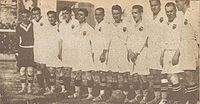 The club was established in March 5, 1919 and officially approved in March 18, 1919, with Octavio Augusto Milego Díaz as its first president; incidentally the presidency was decided by a coin toss. The club played its first competitive match away from home on 21 May 1919 against Valencia Gimnástico, and lost the match 1–0.
Valencia CF moved into the Mestalla stadium in 1923, having played its home matches at the Algirós ground since 7 December 1919. The first match at Mestalla pitted the home side against Castellón Castalia and ended a 0–0 draw. In another match the day after, Valencia won against the same opposition 1–0. Valencia CF won the Regional Championship in 1923, and was eligible to play in the domestic Copa del Rey
cup competition for the first time in its history.
halted the progress of the Valencia team until 1941, when it won the Copa del Rey, beating RCD Espanyol
in the final. In the 1941–42 season, the club won its first Spanish La Liga
championship title, although winning the Copa del Rey
was more reputable than the championship at that time. The club maintained its consistency to capture the league title again in the 1943–44 season, as well as the 1946–47 league edition.
In the 1950s, the club failed to emulate the success of the 1940s, even though it grew as a club. A restructuring of Mestalla resulted in an increase in spectator capacity to 45,000, while the club had a number of Spanish and foreign stars. Players such as Spanish international
Antonio Puchades
and Dutch
forward Faas Wilkes
graced the pitch at Mestalla. In the 1952–53 season, the club finished as runners-up in the La Liga, and in the following season, the club won the Copa del Rey, then known as the Copa del Generalísimo.
(the forerunner to the UEFA Cup
). In the 1961–62 season
, Valencia beat Spanish club FC Barcelona
in the final. The 1962–63 edition
of the Inter-Cities Fairs Cup final, pitted Valencia CF against Croatia
n club Dinamo Zagreb
, which the Valencians also won. Valencia CF was again present in the Inter-Cities Fairs Cup final in the 1963–64 season, but was defeated 2–1 by Real Zaragoza
from Spain.
Former two-time European Footballer of the Year
award winner Alfredo Di Stéfano
was hired as coach in 1970, and immediately inspired his new club to their fourth La Liga championship. This secured Valencia its first qualification for the European Cup, contested by the various European domestic champions. Valencia reached the third round of the 1971–72 competition, before losing to Hungarian
champions Újpest TE
. The most notable players of the 1970s era include Austria
n midfielder Kurt Jara
, forward Johnny Rep of the Netherlands
and Argentinian
forward Mario Kempes
, who became the La Liga topscorer for two consecutive seasons in the 1976–77 and 1977–78 season. Valencia would go on to win the Copa del Rey again in the 1978–79 season, and also capture the European Cup Winners' Cup the next season, after beating English
club Arsenal FC in the final, with Kempes spearheading Valencia's success in Europe.
as coach. After a disappointing season, Valencia was in 17th place and faced relegation with seven games left to play. Koldo Aguirre replaced Miljanic as coach, and Valencia barely avoided relegation that year, relying on favorable results from other teams to ensure their own survival. In the 1983–84 and 1984–85 seasons, the club was heavily in debt under the presidency of Vicente Tormo. The club finally hit rock bottom when it was relegated
at the end of the 1985–86 season, and riven with internal problems such as unpaid player and staff wages, as well as poor morale. The club was relegated for the first time after 55 years in Spanish top-flight football.
Arturo Tuzón was named the new club president, and he helped steer Valencia CF back to La Liga. Alfredo Di Stéfano returned as coach in 1986, and Valencia won promotion
again following the 1986–87 season. Di Stéfano stayed on as coach until the 1987–88 season, when the team finished in 14th position in La Liga. Bulgaria
n forward Luboslav Penev joined the club in 1989, as Valencia aimed to consolidate their place in La Liga. Guus Hiddink
was appointed as head coach in the 1991–92 season, and the club finished fourth in the League and reached the quarter-finals of the Copa del Rey. In 1992, Valencia CF officially became a Sporting Limited Company, and retained Hiddink as their coach until 1993.
Brazilian coach Carlos Alberto Parreira
, fresh from winning the 1994 FIFA World Cup
with the Brazilian national team
, became manager at Mestalla in 1994. Parreira immediately signed the Spanish goalkeeper Andoni Zubizarreta
and the Russia
n forward Oleg Salenko, as well as Predrag Mijatovic
, but failed to produce results expected of him. He was replaced by new coach José Manuel Rielo. The club's earlier successes continued to elude it, although it was not short of top coaching staff like Luis Aragonés
and Jorge Valdano, as well as foreign star forwards like Brazilian Romário
, Claudio López and Ariel Ortega
from Argentina.
. Valencia finished third in the league, four points behind the champions Deportivo La Coruña
and level on points with second placed Barça. But the biggest success was in the UEFA Champions League
; for the first time in its history, Valencia reached the European Cup
final. However, in the final played in Paris
on 24 May 2000, Real Madrid
beat Valencia 3–0.
It was also Claudio López's farewell, as he had agreed to sign for the Italian side Lazio
, also leaving was Farinós for Internazionale
and Gerard for Barcelona. The notable signings of that summer were, the Norwegian John Carew
, Rubén Baraja, the Argentine Roberto Ayala
, Vicente Rodriguez
and the Brazilian left back Fábio Aurélio
. Also bought that season was Pablo Aimar
in January. Baraja, Aimar, Vicente and Ayala would soon become a staple of Valencia's dominance of early 2000s in La Liga.
Valencia started the championship on the right foot and were top after 10 games, after the Christmas break Valencia started to pay for the top demand that such an absorbing competition like the Champions League requires. After passing the two mini-league phases, Cúper's team eliminated Arsenal
in quarter finals and Leeds United in the semi-finals, and got ready to face Bayern Munich
in the big final, Valencia had now reached two European Cup finals in a row. This time the final was to be played in Milan and at the San Siro
, on 23 May. Gaizka Mendieta
gave Valencia the lead by scoring from the penalty spot right at the start of the match, Cañizares then stopped a penalty from Mehmet Scholl
, but Stefan Effenberg
drew level after the break thanks to another penalty. After extra time, it was a penalty shoot-out to decide who would be European champions, Valencia, or Bayern Munich. Mauricio Pellegrino
was the man who missed to give Bayern European glory and give Valencia heartbreak for the second season running in the biggest game in club football. For Valencia, it was difficult to recover from the blow in Milan, it culminated in Valencia finishing 5th in La Liga
and out of the Champions League for the 2001–02 season, the final game of the season meant Valencia only needed a draw at the Nou Camp against Barcelona to seal Champions League qualification, unfortunately for Los Che they lost to Barcelona 3–2 at the Nou Camp, with a last minute goal from Rivaldo
resulting in Barcelona qualifying for the Champions League and Valencia missing out, in a head-to-head tie.
The president, D. Pedro Cortés, resigned due to personal reasons and left the club in July, with the satisfaction of having won the King’s Cup, one Spanish Super Cup and having been runners up in two Champions League finals in a row. D. Jaime Ortí replaced him as president and expressed his intention on maintaining the good form that had made the club so admired on the European circuit. There were also some changes in the team and staff, Rafael Benítez
, after helping Tenerife to promotion, replaced Héctor Cúper
after the latter became the new coach at Internazionale. Among the footballers, Mendieta, Deschamps, Milla and Zahović left, and Marchena, Mista, Curro Torres, Rufete, de los Santos, and Salva arrived.
From 1999 up until the end of the 2004 season, Valencia had one of the their most successful periods in the club's history. With a total of two La Liga
titles, one UEFA Cup
, one Copa del Rey
and one UEFA Super Cup, in those six years, no less than five first class titles and two UEFA Champions League
finals had been achieved.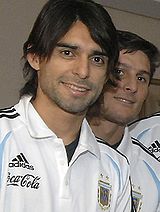 The 2001–02 season brought Valencia a La Liga title, 31 years after the last title crown. There were new incorporations to the team, manager Rafael Benítez
and the new players of Marchena, Mista, Curro Torres, Rufete, de los Santos and Salva.
That first game against fellow title rivals Real Madrid
, produced a significant and important victory. This was followed by a record of eleven games won consecutively, breaking the existing one set in the 1970–71 season, the season they had last won the La Liga title under Alfredo di Stéfano
.
After a defeat in La Coruña against Deportivo on 9 December 2001, the team had to win against Espanyol
in the Estadi Olímpic Lluís Companys
to prevent falling further behind the league leaders. Valencia were 2–0 down at half time, but a comeback in the second half saw Valencia win 3–2.
In the second part of the season, Benítez's team suffered a small setback after losing 1–0 in the Santiago Bernabéu to Real Madrid, but they recovered from this setback and achieved four victories and two draws in the following six games. The games against Las Palmas
, Athletic de Bilbao, Deportivo Alavés
, Real Zaragoza
and Barça
.
In one of those crucial games that they would come up against Espanyol, Valencia were trailing 1–0 half-time and a man down too with the dismissal of Carboni, but after two goals from Rubén Baraja, Valencia achieved a 2–1 victory. Furthermore, Real Madrid's defeat in Anoeta
to Real Sociedad
left Valencia with a three-point lead at the top of the table.
The final game of the season was at La Rosaleda to face Málaga
, on 5 May 2002, a date that has gone down in Valencia’s history. The team shut itself away in Benalmádena, close to the scene of the game, in order to gain focus. An early goal from Ayala and another close to half-time from Fábio Aurélio
, assured them their fifth La Liga title, 31 years after their last title win.
The 2002–03 season was a disappointing one for Valencia, as they failed in their attempt to retain the La Liga title and ended up outside of the Champions League spots in fifth, behind Celta de Vigo
. They were also knocked out in the quarter-finals of the Champions League by Internazionale
on away goals. The 2003–04 season saw Valencia trailing the long time leaders Real Madrid. In February, after 26 games played, Real Madrid were eight points clear. However, their form declined in the late season and they lost their last five games of the campaign, allowing Valencia to overtake them and win the title. The club added the UEFA Cup to this success. Valencia had now been La Liga champions twice in three seasons.
In the summer of 2004, coach Rafa Benítez decided to leave the club stating he had had problems with the club president, he would soon become manager of Liverpool
. He was replaced by former Valencia coach Claudio Ranieri
, who had recently been sacked by Chelsea
. However, his second reign at the club was a disappointment as Valencia harboured realistic hopes of retaining their La Liga crown but, by February, found themselves in 7th place. Valencia had also been knocked out of the Champions League group phase, with Ranieri being sacked promptly in February. The 2004–2005 season ended with Valencia outside of the UEFA Cup spots.
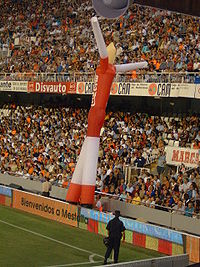 In the summer of 2005, Getafe
coach Quique Sánchez Flores
was appointed as the new manager of Valencia and ended the season in third place, which in turn gained Valencia a place in the Champions League after a season away from the competition. The 2006–07 season was a season with many difficulties, a season which started with realistic hopes of challenging for La Liga was disrupted with a huge list of injuries to key players and internal arguments between Flores and new Sporting Director Amedeo Carboni
. Valencia ended the season in fourth place and were knocked out of the Champions League at the quarter-finals stage by Chelsea
3–2 on aggregate, after knocking out Italian champions Inter in the second round. In the summer of 2007, the internal fight between Flores and Carboni was settled with Carboni being replaced by Ángel Ruiz as the new Sporting Director of Valencia.
On 29 October 2007, the Valencia board of directors fired Flores after a string of disappointing performances and caretaker manager Óscar Rubén Fernández took over on a temporary basis until a full-time manager was found, rumoured to be either Marcello Lippi
or José Mourinho
. A day later, Dutch manager Ronald Koeman
announced he would be leaving PSV to sign for Valencia. But there was still no improvement; in fact, Valencia even went on to drop to the 15th position in the league, just two points above the relegation zone. Although on 16 April 2008, Valencia lifted the Copa del Rey with a 3–1 victory over Getafe at the Vicente Calderón
. This was the club's 7th Copa title. Five days later, one day after a devastating 5–1 league defeat in Bilbao, Valencia fired Ronald Koeman
and replaced him with Voro
, who would guide Valencia as Caretaker Manager for the rest of the season. He went on to win the first game since the sacking of Koeman, beating Osasuna
3–0 in his first game in charge. Voro would eventually drag Valencia from the relegation battle to a safe mid-table finish of 10th place, finally ending a disastrous league campaign for Los Che.
Highly-rated Unai Emery was announced as the new manager of Valencia on 22 May 2008. The start of the young manager's career looked to be promising, with the club winning four out of its first five games, a surge that saw the team rise to the top position of the La Liga table. Despite looking impressive in Europe, Los Che then hit a poor run of form in the league that saw them dip as low as seventh in the standings. Amid the slump emerged reports of a massive internal debt at the club exceeding 400 million Euros, as well as that the players had been unpaid in weeks. The team's problems were compounded when they were knocked out of the UEFA Cup by Dynamo Kyiv
on away goals. After a run where Valencia took only five points from ten games in La Liga, an announcement was made that the club had secured a loan that would cover the players' expenses until the end of the year. This announcement coincided with an upturn in form, and the club won six of its next eight games to surge back into the critical fourth place Champions' League spot. However, Los Che were then defeated by 4th place rivals Atlético Madrid and Villarreal
in two of the last three games of the campaign, and finished sixth in the table, which meant they failed to qualify for a second successive year for the Champions League.
, Juan Mata, and David Silva
could leave the club to help balance the books. In the first season of the new decade, Valencia returned to the UEFA Champions League
for the first time since the 2007-08 season as they finished comfortably in 3rd in the 2009-10 La Liga season. However, in the summer of 2010 due to financial reasons, David Villa and David Silva were sold to Barcelona and Manchester City, respectively, to reduce the club's massive debt. But, despite the loss of two of the club's most important players, the team was able to finish comfortably in 3rd again La Liga for the 2nd season running, although they were eliminated from the UEFA Champions League
by German side Schalke 04
in the Round of 16. In the summer of 2011, then current captain Juan Mata was sold to Chelsea
to further help Valencia's precarious financial situation. It was announced by president Manuel Llorente that the club's debt had been decreased and that the work on the new stadium will re-begin as soon as possible, somewhere in 2012.
 Valencia played its first years at the Algirós stadium but moved to the Mestalla
in 1923. In the 1950s, Mestalla was restructured, which resulted in a capacity increase to 45,000 spectators. Today it holds 55,000 seats. Valencia was scheduled to move to a new stadium
in the north-west of the city in 2010. Construction of the 75,000-seat Nou Mestalla
was halted by financial constraints, however, and the future status of the project remains indefinite.
The current Mestalla is the fifth largest stadium in Spain. It is also renowned for its steep terracing and for being one of the most intimidating atmospheres in all of Europe to play.
On 20 May 1923, the Mestalla pitch was inaugurated with a friendly match that brought Valencia CF and Levante UD
face to face. It was the beginning of a new era that meant farewell to the old place, Algirós, which will always remain in the memories of the Valencian
s as first home of the club. A long history has taken place on the Mestalla field since its very beginning, when the Valencia team was not yet in the Primera División
. Back then, this stadium could hold 17,000 spectators, and in that time the club started to show its potential in regional championships, which led the managers of that time to carry out the first alterations of Mestalla in 1927. The stadium's total capacity increased to 25,000 before it became severely damaged during the Civil War.
Mestalla was used as concentration camp and junk warehouse. It would only keep its structure, since the rest was a lonely plot of land with no terraces and a stand broken during the war. Once the Valencian pitch
was renovated, Mestalla saw how the team managed to bring home their first title, the 1941 Cup. An overwhelming team was playing on the grass of the redesigned Valencian stadium in that decade, team that conquered three League titles and two Cups with the legendary ‘electric forwards’ of Epi, Amadeo, Mundo, Asensi and Guillermo Gorostiza. Those years of sporting success also served as support to recover little by little the Mestalla ground.
During the decade of the fifties, the Valencia ground experienced the deepest change in its whole history. That project resulted in a stadium with a capacity of 45,500 spectators. It was a dream that was destroyed by the flood
that flooded Valencia in October 1957 after the overflowing of the Turia River
. Nevertheless, Mestalla not only returned to normality, but also some more improvements were added, like artificial light, which was inaugurated during the 1959 Fallas festivities. This was the beginning of a new change for the Mestalla.
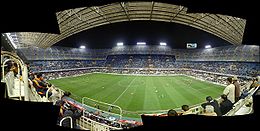 During the sixties, the stadium kept the same appearance, whilst the urban
view around it was quickly being transformed. Moreover, the Valencian domain became from that moment on, the setting of big European feats. Nottingham Forest was the first foreign team that played an official match in Mestalla with the "Che" club. They played on 15 September 1961 and it was the first clash of a golden age full of continental successes, reinforced with the Fairs Cup won in 1962 and 1963. Mestalla had just entered the European competitions as a stadium where the most important events were taking place.
From 1969, the expression "Anem a Mestalla" (Let’s go to Mestalla), so common among the supporters, started to fall into oblivion. The reason was the change of name that meant a big tribute that the club paid to his most symbolic president that lasted for a quarter of a century. Luis Casanova Giner admitted that he was completely overwhelmed by such honour, and the president himself requested in 1994 that his name was again replaced by the name of Mestalla, as it happened. At the beginning of the seventies, the local bench of the back-then-called Luis Casanova stadium was occupied by Alfredo Di Stéfano
, whose results were the winning of one League competition, one second place in the League and two Cup finals lost by the minimum difference. Moreover, Valencia participated for the first time in the European Cup
and made their debut in the UEFA Cup
. It all was a series of events that made that every match in the stadium located in Suecia Avenue turned into a big party.
In 1972, the head office of the club, located in the back of the numbered terraces, was inaugurated. It consisted of an office of avant-garde
style with a worth mentioning trophy hall, which held the foundation flag of the club. In the summer of 1973 there was another new thing, the goal seats, which meant the elimination of fourteen rows of standing terraces
providing more comfort and an adjustment to the new times. Valencia's management started to consider the possibility of moving Mestalla from its present location to some land in the outskirts of the town, but finally the project was turned down and some years later.
At that time, Mario Kempes
, subsequently considered one of the greatest footballers in the world by Pele was playing for Valencia. With the Matador in its team, Valencia won the Copa del Rey
, the Cup Winners Cup and European Super Cup
in consecutive years. The "Che" team became continental superchampion in the last European final played in Mestalla. It was in 1980 against Nottingham Forest, which oddly enough was the first foreign team that had played an official match in the Valencian stadium.
Mestalla, which in 1925 had held the first match of the Spain national football team
in Valencia, was chosen as the setting for the debut of Spain in the 1982 World Cup, although the performance of the combined national team was not finally what was expected. Ten years later, the Olympic team would look for support in the Valencian stadium, this time with a very different result, since the selected young footballers finally got the gold medal in the 1992 Summer Olympics
held in Barcelona
.
Mestalla has been the setting for important international matches, has held several Cup finals, has been seat for Levante UD, home of the Spanish national team and exile for Castellón
and Real Madrid
in the European Cup.
2008–2009 was to have been the last season at the Mestalla, with the club moving to their new 75,000-seater stadium Nou Mestalla
in time for the 2009–2010 season. However, due to the club being in financial crisis, work on the new stadium has stopped.
". The hymn was written by Ramon Gimeno Gil, in Valencian language. The anthem was premiered and had its official presentation at the 75th anniversary of Valencia Club de Futbol on September 21, 1993.
nostre València Club de Futbol
que lluita per a defendre en totes bandes nostres colors
En el Camp de l'Algirós ja començàrem a demostrar
que era una bona manera per a València representar
Amunt València, Visca el València, és el millor
Amunt València, Visca el València del nostre cor
Units com sempre els valencianistes et seguirem
en cada estadi per a què triomfes t'animarem
En la capital del Túria és el València qui vist de blanc
i defén la camiseta ple de coratge per a guanyar
En Mestalla continuarem sempre esforçant-se per a triomfar
i les glòries arribaren i en competència continuaran
Amunt València, Visca el València, és el millor
Amunt València, Visca el València, del nostre cor
Units com sempre els valencianistes et seguirem,
en cada estadi perquè triomfes t'animarem
Amunt València, Visca el València és el millooooooooor
 Valencia and the Balearic Islands were conquered by King James I of Aragon
during the first half of the 13th century. After the conquest the king gave them the status of independent kingdoms of whom he was also the king (but they were independent of Aragonese laws and institutions). The arms of Valencia show those of James I, King of Aragon.
The unique crowned letters L besides the shield were granted by King James. The reason for the letters was that the city had been loyal twice to the King, hence twice a letter L and a crown for the king.
There are several possible explanations for the bat; one is that bats are simply quite common in the area. The second theory is that on October 9, 1238, when James I was about to enter the city, re-conquering it from the Moors, one bat landed on the top of his flag, and he interpreted it as a good sign. As he conquered the city, the bat was added to the arms.
Last updated: 26 Nov 2011
Pos. = Position; Pl = Match played; W = Win; D = Draw; L = Lost; GS = Goal Scored; GA = Goal Against; Pts = Points
Spain
Spain , officially the Kingdom of Spain languages]] under the European Charter for Regional or Minority Languages. In each of these, Spain's official name is as follows:;;;;;;), is a country and member state of the European Union located in southwestern Europe on the Iberian Peninsula...
football club
Football team
A football team is the collective name given to a group of players selected together in the various team sports known as football.Such teams could be selected to play in an against an opposing team, to represent a football club, group, state or nation, an All-star team or even selected as a...
based in Valencia, Spain. They play in La Liga
La Liga
The Primera División of the Liga Nacional de Fútbol Profesional , commonly known as La Liga or, for sponsorship reasons, Liga BBVA since 2008, is the top professional association football division of the Spanish football league system...
and are one of the most successful and biggest clubs in Spanish Football
Football in Spain
Football is the most popular sport in Spain. The Royal Spanish Football Federation is the national governing body and it organizes La Liga, the Copa del Rey and the Spain national football team, current champion of the FIFA World Cup...
and European Football
European football records
-Most competition wins:These lists rank the winners of the four main competitions in European football, specifically the UEFA Champions League, UEFA Cup-Europa League, its predecessor the Fairs Cup, the now defunct Cup Winners' Cup, and the UEFA Super Cup, by the total number of competition...
. Valencia have won six La Liga titles, seven Copa del Rey
Copa del Rey
The Copa del Rey is an annual football cup competition for Spanish football teams. Its full name is Campeonato de España – Copa de Su Majestad el Rey de Fútbol ....
trophies, two Fairs Cups which was the predecessor to the UEFA Cup
UEFA Cup
The UEFA Europa League is an annual association football cup competition organised by UEFA since 1971 for eligible European football clubs. It is the second most prestigious European club football contest after the UEFA Champions League...
, one UEFA Cup, one UEFA Cup Winners' Cup
UEFA Cup Winners' Cup
The UEFA Cup Winners' Cup was a football club competition contested annually by the most recent winners of all European domestic cup competitions. The cup is one of the many inter-European club competitions that have been organised by UEFA. The first competition was held in the 1960–61 season—but...
and two UEFA Super Cups. They have also reached two UEFA Champions League
UEFA Champions League
The UEFA Champions League, known simply the Champions League and originally known as the European Champion Clubs' Cup or European Cup, is an annual international club football competition organised by the Union of European Football Associations since 1955 for the top football clubs in Europe. It...
finals in a row, losing to La Liga rivals Real Madrid
Real Madrid C.F.
Real Madrid Club de Fútbol , commonly known as Real Madrid, is a professional football club based in Madrid, Spain. The club have won a record 31 La Liga titles, the Primera División of the Liga de Fútbol Profesional , 18 Copas del Rey, 8 Spanish Super Cups, 1 Copa Eva Duarte and 1 Copa de la...
in 2000 and then to German club Bayern Munich on penalties after a 1–1 draw in 2001. Valencia were also members of the G-14
G-14
The G-14 was an organisation of European football clubs that existed between 2000 and 2008. It consisted of 14 teams initially, later expanded to 18...
group of leading Europe
Europe
Europe is, by convention, one of the world's seven continents. Comprising the westernmost peninsula of Eurasia, Europe is generally 'divided' from Asia to its east by the watershed divides of the Ural and Caucasus Mountains, the Ural River, the Caspian and Black Seas, and the waterways connecting...
an football clubs. In total, Valencia have reached seven major European finals, winning four of them.
In the all-time La Liga table
All-Time La Liga table
The All-time La Liga table is an overall record of all match results, points, and goals of every team that has played in La Liga since its inception in 1929. The table is accurate as of the end of the 2010–11 season.League or status at 2011–12:...
, Valencia is in 3rd position behind Real Madrid
Real Madrid C.F.
Real Madrid Club de Fútbol , commonly known as Real Madrid, is a professional football club based in Madrid, Spain. The club have won a record 31 La Liga titles, the Primera División of the Liga de Fútbol Profesional , 18 Copas del Rey, 8 Spanish Super Cups, 1 Copa Eva Duarte and 1 Copa de la...
and FC Barcelona
FC Barcelona
Futbol Club Barcelona , also known as Barcelona and familiarly as Barça, is a professional football club, based in Barcelona, Catalonia, Spain....
. In terms of continental titles, Valencia is again the 3rd-most successful behind Real Madrid and Barcelona, with these three being the only Spanish
Spain
Spain , officially the Kingdom of Spain languages]] under the European Charter for Regional or Minority Languages. In each of these, Spain's official name is as follows:;;;;;;), is a country and member state of the European Union located in southwestern Europe on the Iberian Peninsula...
clubs to have won five or more continental trophies.
Valencia were founded in 1919 and have played their home games at the 55,000-seater Estadio Mestalla since 1923. They are due to move into the new 75,000-seater Nou Mestalla
Nou Mestalla
Nou Mestalla is a partly built 75,000-seat football stadium in Valencia, Spain, intended as a replacement for Valencia CF's current stadium, Estadio Mestalla. The basic concrete structure of the stadium was built between August 2007 and February 2009, but work was then halted for financial...
in the north-west of the city in 2013. Valencia have a long-standing rivalry with Levante
Levante UD
Levante Unión Deportiva, S.A.D. is a Spanish football club based in Valencia, in the namesake community.Founded in 1909, it plays in La Liga, holding home games at Estadi Ciutat de València.-Early years:...
, also located in Valencia, and with two others club in the Valencian Community
Valencian Community
The Valencian Community is an autonomous community of Spain located in central and south-eastern Iberian Peninsula. Its capital and largest city is Valencia...
region, Hercules
Hércules CF
Hércules Club de Fútbol, S.A.D. is a Spanish football team based in Alicante, in the autonomous community of Valencia. Founded in 1922, it currently plays in the Spanish second division, and holds home games at the Estadio José Rico Pérez, which seats 30,000 spectators.-History:After first...
and Villarreal
Villarreal CF
Villarreal Club de Fútbol, S.A.D. , usually abbreviated to Villarreal CF or just Villarreal, is a Spanish Primera División football club based in Vila-real, a city in the province of Castellón within the Valencian Community...
.
Valencia are the third most supported football club in Spain, behind only Real Madrid
Real Madrid
Real Madrid Club de Fútbol , commonly known as Real Madrid, is a professional football club based in Madrid, Spain. The club have won a record 31 La Liga titles, the Primera División of the Liga de Fútbol Profesional , 18 Copas del Rey, 8 Spanish Super Cups, 1 Copa Eva Duarte and 1 Copa de la...
and FC Barcelona
FC Barcelona
Futbol Club Barcelona , also known as Barcelona and familiarly as Barça, is a professional football club, based in Barcelona, Catalonia, Spain....
. It is also one of the biggest clubs in the world in terms of number of associates (registered paying supporters), with more than 50,000 season ticket holders and another 20,000+ season ticket holders on the waiting list, who can be accommodated in the new 75,000-seater stadium.
History
Valencia CF moved into the Mestalla stadium in 1923, having played its home matches at the Algirós ground since 7 December 1919. The first match at Mestalla pitted the home side against Castellón Castalia and ended a 0–0 draw. In another match the day after, Valencia won against the same opposition 1–0. Valencia CF won the Regional Championship in 1923, and was eligible to play in the domestic Copa del Rey
Copa del Rey
The Copa del Rey is an annual football cup competition for Spanish football teams. Its full name is Campeonato de España – Copa de Su Majestad el Rey de Fútbol ....
cup competition for the first time in its history.
Emergence as a Giant in Spanish Football
The Spanish Civil WarSpanish Civil War
The Spanish Civil WarAlso known as The Crusade among Nationalists, the Fourth Carlist War among Carlists, and The Rebellion or Uprising among Republicans. was a major conflict fought in Spain from 17 July 1936 to 1 April 1939...
halted the progress of the Valencia team until 1941, when it won the Copa del Rey, beating RCD Espanyol
RCD Espanyol
Reial Club Deportiu Espanyol de Barcelona is a sports club based in Barcelona, Spain. It is best known for its football team. Espanyol currently play in the Estadi Cornellà-El Prat with seats for 40,500 spectators. It was inaugurated on 2 August 2009...
in the final. In the 1941–42 season, the club won its first Spanish La Liga
La Liga
The Primera División of the Liga Nacional de Fútbol Profesional , commonly known as La Liga or, for sponsorship reasons, Liga BBVA since 2008, is the top professional association football division of the Spanish football league system...
championship title, although winning the Copa del Rey
Copa del Rey
The Copa del Rey is an annual football cup competition for Spanish football teams. Its full name is Campeonato de España – Copa de Su Majestad el Rey de Fútbol ....
was more reputable than the championship at that time. The club maintained its consistency to capture the league title again in the 1943–44 season, as well as the 1946–47 league edition.
In the 1950s, the club failed to emulate the success of the 1940s, even though it grew as a club. A restructuring of Mestalla resulted in an increase in spectator capacity to 45,000, while the club had a number of Spanish and foreign stars. Players such as Spanish international
Spain national football team
The Spain national football team represents Spain in international association football and is controlled by the Royal Spanish Football Federation, the governing body for football in Spain. The current head coach is Vicente del Bosque...
Antonio Puchades
Antonio Puchades
Antonio Puchades Casanova is a former Spanish footballer.During his career he played for Valencia CF from 1946 to 1958, winning one La Liga title and two Copa del Reys...
and Dutch
Netherlands
The Netherlands is a constituent country of the Kingdom of the Netherlands, located mainly in North-West Europe and with several islands in the Caribbean. Mainland Netherlands borders the North Sea to the north and west, Belgium to the south, and Germany to the east, and shares maritime borders...
forward Faas Wilkes
Faas Wilkes
Servaas "Faas" Wilkes was a Dutch football forward, who earned a total of 38 caps for the Dutch national team, in which he scored 35 goals...
graced the pitch at Mestalla. In the 1952–53 season, the club finished as runners-up in the La Liga, and in the following season, the club won the Copa del Rey, then known as the Copa del Generalísimo.
European successes
While managing indifferent league form in the early 1960s, the club had its first European success in the form of the Inter-Cities Fairs CupInter-Cities Fairs Cup
The Inter-Cities Fairs Cup was a European football competition played between 1955 and 1971. The competition was the idea of Swiss pools supremo Ernst Thommen, Ottorino Barassi from Italy, and the English Football Association general secretary Stanley Rous, all of whom later became senior officials...
(the forerunner to the UEFA Cup
UEFA Cup
The UEFA Europa League is an annual association football cup competition organised by UEFA since 1971 for eligible European football clubs. It is the second most prestigious European club football contest after the UEFA Champions League...
). In the 1961–62 season
Inter-Cities Fairs Cup 1961-62
The fourth Inter-Cities Fairs Cup was played over the 1961–62 season. There were five representative teams for some major European cities, three of which lost out in the first round. The final was the first European final to be contested between two clubs from the same country, namely Spain...
, Valencia beat Spanish club FC Barcelona
FC Barcelona
Futbol Club Barcelona , also known as Barcelona and familiarly as Barça, is a professional football club, based in Barcelona, Catalonia, Spain....
in the final. The 1962–63 edition
Inter-Cities Fairs Cup 1962-63
The fifth Inter-Cities Fairs Cup was played over the 1962–63 season. There were five representative teams for some major European cities, four of which lost out in the first round...
of the Inter-Cities Fairs Cup final, pitted Valencia CF against Croatia
Croatia
Croatia , officially the Republic of Croatia , is a unitary democratic parliamentary republic in Europe at the crossroads of the Mitteleuropa, the Balkans, and the Mediterranean. Its capital and largest city is Zagreb. The country is divided into 20 counties and the city of Zagreb. Croatia covers ...
n club Dinamo Zagreb
Dinamo Zagreb
GNK Dinamo Zagreb, commonly referred to as Dinamo Zagreb , or by their nickname Modri are a Croatian football club based in Zagreb. They play their home matches at Stadion Maksimir. They are the most successful club in Croatian football, having won thirteen Croatian championship titles, ten...
, which the Valencians also won. Valencia CF was again present in the Inter-Cities Fairs Cup final in the 1963–64 season, but was defeated 2–1 by Real Zaragoza
Real Zaragoza
Real Zaragoza, S.A.D. is a Spanish association football team from Zaragoza in Spain. Founded on 18 March 1932, Real Zaragoza have spent the majority of their 78 year history in the Spanish top-flight. Real Zaragoza are Spain's 9th highest ranked team in overall league points...
from Spain.
Former two-time European Footballer of the Year
European Footballer of the Year
The "", literally translated as "the golden ball" and often referred to as the European Footballer of the Year award, was an annual association football award. It was presented to the player who had been considered to have performed the best over the previous calendar year...
award winner Alfredo Di Stéfano
Alfredo Di Stéfano
Alfredo Stéfano Di Stéfano Laulhé, born into a family of Italian immigrants from Capri, is a former Argentinian footballer and coach, widely regarded as one of the greatest players of all time...
was hired as coach in 1970, and immediately inspired his new club to their fourth La Liga championship. This secured Valencia its first qualification for the European Cup, contested by the various European domestic champions. Valencia reached the third round of the 1971–72 competition, before losing to Hungarian
Hungary
Hungary , officially the Republic of Hungary , is a landlocked country in Central Europe. It is situated in the Carpathian Basin and is bordered by Slovakia to the north, Ukraine and Romania to the east, Serbia and Croatia to the south, Slovenia to the southwest and Austria to the west. The...
champions Újpest TE
Újpest FC
Újpest Football Club , earlier known as Újpesti TE and Újpesti Dózsa, is a Hungarian football club, based in Újpest, Budapest. The club's colours are purple and white...
. The most notable players of the 1970s era include Austria
Austria
Austria , officially the Republic of Austria , is a landlocked country of roughly 8.4 million people in Central Europe. It is bordered by the Czech Republic and Germany to the north, Slovakia and Hungary to the east, Slovenia and Italy to the south, and Switzerland and Liechtenstein to the...
n midfielder Kurt Jara
Kurt Jara
Kurt Jara is a retired Austrian footballer.-Club career:Jara started his professional career with local side FC Wacker Innsbruck before moving to Spanish outfit Valencia CF in 1973. After two seasons in La Liga he joined German Bundesliga team MSV Duisburg where he spent 5 seasons and reached the...
, forward Johnny Rep of the Netherlands
Netherlands
The Netherlands is a constituent country of the Kingdom of the Netherlands, located mainly in North-West Europe and with several islands in the Caribbean. Mainland Netherlands borders the North Sea to the north and west, Belgium to the south, and Germany to the east, and shares maritime borders...
and Argentinian
Argentina
Argentina , officially the Argentine Republic , is the second largest country in South America by land area, after Brazil. It is constituted as a federation of 23 provinces and an autonomous city, Buenos Aires...
forward Mario Kempes
Mario Kempes
Mario Alberto Kempes Chiodi is a retired Argentine footballer. His father, Mario, also a footballer, inspired him to play from a young age. At the age of 7, he began playing with a junior team and at 14, he joined La Cuarta de Talleres...
, who became the La Liga topscorer for two consecutive seasons in the 1976–77 and 1977–78 season. Valencia would go on to win the Copa del Rey again in the 1978–79 season, and also capture the European Cup Winners' Cup the next season, after beating English
England
England is a country that is part of the United Kingdom. It shares land borders with Scotland to the north and Wales to the west; the Irish Sea is to the north west, the Celtic Sea to the south west, with the North Sea to the east and the English Channel to the south separating it from continental...
club Arsenal FC in the final, with Kempes spearheading Valencia's success in Europe.
Stagnation
In 1982, the club appointed Miljan MiljanicMiljan Miljanic
Miljan Miljanić is a retired Yugoslav football player, coach and administrator....
as coach. After a disappointing season, Valencia was in 17th place and faced relegation with seven games left to play. Koldo Aguirre replaced Miljanic as coach, and Valencia barely avoided relegation that year, relying on favorable results from other teams to ensure their own survival. In the 1983–84 and 1984–85 seasons, the club was heavily in debt under the presidency of Vicente Tormo. The club finally hit rock bottom when it was relegated
Promotion and relegation
In many sports leagues around the world, promotion and relegation is a process that takes place at the end of each season. Through it, teams are transferred between divisions based on their performance that season...
at the end of the 1985–86 season, and riven with internal problems such as unpaid player and staff wages, as well as poor morale. The club was relegated for the first time after 55 years in Spanish top-flight football.
Arturo Tuzón was named the new club president, and he helped steer Valencia CF back to La Liga. Alfredo Di Stéfano returned as coach in 1986, and Valencia won promotion
Promotion and relegation
In many sports leagues around the world, promotion and relegation is a process that takes place at the end of each season. Through it, teams are transferred between divisions based on their performance that season...
again following the 1986–87 season. Di Stéfano stayed on as coach until the 1987–88 season, when the team finished in 14th position in La Liga. Bulgaria
Bulgaria
Bulgaria , officially the Republic of Bulgaria , is a parliamentary democracy within a unitary constitutional republic in Southeast Europe. The country borders Romania to the north, Serbia and Macedonia to the west, Greece and Turkey to the south, as well as the Black Sea to the east...
n forward Luboslav Penev joined the club in 1989, as Valencia aimed to consolidate their place in La Liga. Guus Hiddink
Guus Hiddink
Guus Hiddink is a Dutch football manager and former player. He was the most recently manager of the Turkish national football team. He is considered to be one of the best managers of his generation and was the best-paid coach in international football in 2009...
was appointed as head coach in the 1991–92 season, and the club finished fourth in the League and reached the quarter-finals of the Copa del Rey. In 1992, Valencia CF officially became a Sporting Limited Company, and retained Hiddink as their coach until 1993.
Brazilian coach Carlos Alberto Parreira
Carlos Alberto Parreira
Carlos Alberto Gomes Parreira is a Brazilian former football manager. He managed Brazil to championships at the 1994 World Cup, the 2004 Copa América, and the 2005 Confederations Cup...
, fresh from winning the 1994 FIFA World Cup
1994 FIFA World Cup
The 1994 FIFA World Cup, the 15th staging of the FIFA World Cup, was held in nine cities across the United States from June 17 to July 17, 1994. The United States was chosen as the host by FIFA on July 4, 1988...
with the Brazilian national team
Brazil national football team
The Brazil national football team represents Brazil in international men's football and is controlled by the Brazilian Football Confederation , the governing body for football in Brazil. They are a member of the International Federation of Association Football since 1923 and also a member of the...
, became manager at Mestalla in 1994. Parreira immediately signed the Spanish goalkeeper Andoni Zubizarreta
Andoni Zubizarreta
Andoni Zubizarreta Urreta is a retired Spanish footballer who played as a goalkeeper.The all-time most capped player for the Spanish national team for several years, he played with individual and team success for Athletic Bilbao and FC Barcelona , appearing in more than 950...
and the Russia
Russia
Russia or , officially known as both Russia and the Russian Federation , is a country in northern Eurasia. It is a federal semi-presidential republic, comprising 83 federal subjects...
n forward Oleg Salenko, as well as Predrag Mijatovic
Predrag Mijatovic
Predrag "Peđa" Mijatović is a Montenegrin football player and former sports director of Real Madrid. He is considered one of Yugoslavia's best players of the 1990s. He was acclaimed as the best athlete of Yugoslavia in 1997...
, but failed to produce results expected of him. He was replaced by new coach José Manuel Rielo. The club's earlier successes continued to elude it, although it was not short of top coaching staff like Luis Aragonés
Luis Aragonés
José Luis Aragonés Suárez , usually referred to as Luis Aragonés and sometimes simply as Luis, is a former Spanish footballer and national coach....
and Jorge Valdano, as well as foreign star forwards like Brazilian Romário
Romário
Romário de Souza Faria , better known simply as Romário , is a former footballer who played striker,manager and current politician where is currently running for a mayor like position in his hometown...
, Claudio López and Ariel Ortega
Ariel Ortega
Arnaldo Ariel Ortega is an Argentine football attacking midfielder. His nickname is "El Burrito" , thus he is called "Burrito Ortega"....
from Argentina.
The 2000s: Valencia returns to the top of Spanish and European Football
Valencia started the 1999–00 season by winning another title, the Spanish Super Cup, beating BarcelonaFC Barcelona
Futbol Club Barcelona , also known as Barcelona and familiarly as Barça, is a professional football club, based in Barcelona, Catalonia, Spain....
. Valencia finished third in the league, four points behind the champions Deportivo La Coruña
Deportivo de La Coruña
Real Club Deportivo de La Coruña is a professional football club based in the city of A Coruña, Galicia; founded in 1906 and currently playing in Segunda División...
and level on points with second placed Barça. But the biggest success was in the UEFA Champions League
UEFA Champions League
The UEFA Champions League, known simply the Champions League and originally known as the European Champion Clubs' Cup or European Cup, is an annual international club football competition organised by the Union of European Football Associations since 1955 for the top football clubs in Europe. It...
; for the first time in its history, Valencia reached the European Cup
European Champion Clubs' Cup
The European Champion Clubs' Cup, also known as Coupe des Clubs Champions Européens, or simply the European Cup, is a trophy awarded annually by UEFA to the football club that wins the UEFA Champions League...
final. However, in the final played in Paris
Paris
Paris is the capital and largest city in France, situated on the river Seine, in northern France, at the heart of the Île-de-France region...
on 24 May 2000, Real Madrid
Real Madrid C.F.
Real Madrid Club de Fútbol , commonly known as Real Madrid, is a professional football club based in Madrid, Spain. The club have won a record 31 La Liga titles, the Primera División of the Liga de Fútbol Profesional , 18 Copas del Rey, 8 Spanish Super Cups, 1 Copa Eva Duarte and 1 Copa de la...
beat Valencia 3–0.
| 2000 UEFA Champions League Final 2000 UEFA Champions League Final The 2000 UEFA Champions League Final took place at Stade de France in Saint-Denis, France on 24 May 2000. The match pitted Spanish rivals Real Madrid and Valencia... starting lineup |
It was also Claudio López's farewell, as he had agreed to sign for the Italian side Lazio
S.S. Lazio
Società Sportiva Lazio, commonly referred to as Lazio, is a professional Italian football club based in Rome. The team, founded in 1900, play in the Serie A and have spent most of their history in the top tier of Italian football...
, also leaving was Farinós for Internazionale
F.C. Internazionale Milano
Football Club Internazionale Milano, often referred to as Internazionale or simply Inter, is a professional Italian football club based in Milan, Italy. Outside Italy, the club is often called Inter Milan. They are the reigning FIFA Club World champions and Coppa Italia holders.Inter have always...
and Gerard for Barcelona. The notable signings of that summer were, the Norwegian John Carew
John Carew
John Alieu Carew , is a Norwegian professional association football player who plays for West Ham United and the Norwegian national team. His father is Gambian and his mother is Norwegian; he was born and raised in Norway.-Vålerenga:John Alieu Carew began his career with his local club Lørenskog,...
, Rubén Baraja, the Argentine Roberto Ayala
Roberto Ayala
Roberto Fabián Ayala , nicknamed el Ratón , is a former Argentine football centre back.Regarded as one of the best central defenders of his generation, Ayala captained the Argentine national team for more matches than anyone else...
, Vicente Rodriguez
Vicente Rodríguez
Vicente Rodríguez Guillén , simply Vicente, nicknamed El puñal de Benicalap , is a Spanish footballer who plays for Brighton & Hove Albion in England....
and the Brazilian left back Fábio Aurélio
Fábio Aurélio
Fábio Aurélio Rodrigues is a Brazilian footballer who plays for Liverpool of the Premier League, having previously played for São Paulo and Valencia. He plays as either a left back or left winger and has represented Brazil at Under-17 and Under-20 levels and at the 2000 Sydney Olympics...
. Also bought that season was Pablo Aimar
Pablo Aimar
Pablo César Aimar Giordano is a Argentine professional footballer who plays for Sport Lisboa e Benfica in the Portuguese first division. An attacking midfielder with a vast array of skills, he also holds a Spanish passport....
in January. Baraja, Aimar, Vicente and Ayala would soon become a staple of Valencia's dominance of early 2000s in La Liga.
Valencia started the championship on the right foot and were top after 10 games, after the Christmas break Valencia started to pay for the top demand that such an absorbing competition like the Champions League requires. After passing the two mini-league phases, Cúper's team eliminated Arsenal
Arsenal F.C.
Arsenal Football Club is a professional English Premier League football club based in North London. One of the most successful clubs in English football, it has won 13 First Division and Premier League titles and 10 FA Cups...
in quarter finals and Leeds United in the semi-finals, and got ready to face Bayern Munich
FC Bayern Munich
FC Bayern Munich , is a German sports club based in Munich, Bavaria. It is best known for its professional football team, which is the most successful football club in Germany, having won 22 national titles and 15 cups....
in the big final, Valencia had now reached two European Cup finals in a row. This time the final was to be played in Milan and at the San Siro
San Siro
The Stadio Giuseppe Meazza, originally and commonly referred to as the San Siro because of its location, officially given its current name on 3 March 1980, is a football stadium located in the San Siro district in Milan, Italy. It is the home of both A.C. Milan and F.C. Internazionale Milano...
, on 23 May. Gaizka Mendieta
Gaizka Mendieta
Gaizka Mendieta Zabala is a retired Spanish footballer who played as a midfielder.Versatile, with good offensive and tackling skills, also being capable of creating goals for teammates and himself, he played mainly for Valencia CF, and finished his career at Middlesbrough of England.He played 40...
gave Valencia the lead by scoring from the penalty spot right at the start of the match, Cañizares then stopped a penalty from Mehmet Scholl
Mehmet Scholl
Mehmet Scholl is a former German football player with Turkish-German ancestry. He played most of his career as an attacking midfielder for Bayern Munich...
, but Stefan Effenberg
Stefan Effenberg
Stefan Effenberg is a retired German footballer. A central midfielder, he possessed leadership skills, powerful shooting ability, physical strength, but also a fearsome and controversial character....
drew level after the break thanks to another penalty. After extra time, it was a penalty shoot-out to decide who would be European champions, Valencia, or Bayern Munich. Mauricio Pellegrino
Mauricio Pellegrino
Mauricio Andrés Pellegrino is a former Argentine footballer, who played as a central defender, and who also spent time as a coach.-Early career:...
was the man who missed to give Bayern European glory and give Valencia heartbreak for the second season running in the biggest game in club football. For Valencia, it was difficult to recover from the blow in Milan, it culminated in Valencia finishing 5th in La Liga
La Liga
The Primera División of the Liga Nacional de Fútbol Profesional , commonly known as La Liga or, for sponsorship reasons, Liga BBVA since 2008, is the top professional association football division of the Spanish football league system...
and out of the Champions League for the 2001–02 season, the final game of the season meant Valencia only needed a draw at the Nou Camp against Barcelona to seal Champions League qualification, unfortunately for Los Che they lost to Barcelona 3–2 at the Nou Camp, with a last minute goal from Rivaldo
Rivaldo
Rivaldo Vítor Borba Ferreira , commonly known simply as Rivaldo , is a Brazilian professional footballer who plays for São Paulo, on loan from Mogi Mirim, as an attacking midfielder and sometimes as a supporting striker.He most notably played five years with Spanish club FC Barcelona, with whom he...
resulting in Barcelona qualifying for the Champions League and Valencia missing out, in a head-to-head tie.
The president, D. Pedro Cortés, resigned due to personal reasons and left the club in July, with the satisfaction of having won the King’s Cup, one Spanish Super Cup and having been runners up in two Champions League finals in a row. D. Jaime Ortí replaced him as president and expressed his intention on maintaining the good form that had made the club so admired on the European circuit. There were also some changes in the team and staff, Rafael Benítez
Rafael Benítez
Rafael "Rafa" Benítez Maudes is a football manager, and former player. He is currently unemployed, after leaving as manager of Internazionale in December 2010....
, after helping Tenerife to promotion, replaced Héctor Cúper
Héctor Cúper
Héctor Raúl Cúper is an Argentinean former football defender and a current manager.-Coach:...
after the latter became the new coach at Internazionale. Among the footballers, Mendieta, Deschamps, Milla and Zahović left, and Marchena, Mista, Curro Torres, Rufete, de los Santos, and Salva arrived.
| 2001 UEFA Champions League Final 2001 UEFA Champions League Final The 2001 UEFA Champions League Final was a football match that took place at San Siro in Milan, Italy, on 23 May 2001, to decide the winner of the 2000–01 UEFA Champions League. The match pitted Bayern Munich against Valencia. The match finished in a 1–1 draw, but Bayern clinched their fourth... starting lineup |
From 1999 up until the end of the 2004 season, Valencia had one of the their most successful periods in the club's history. With a total of two La Liga
La Liga
The Primera División of the Liga Nacional de Fútbol Profesional , commonly known as La Liga or, for sponsorship reasons, Liga BBVA since 2008, is the top professional association football division of the Spanish football league system...
titles, one UEFA Cup
UEFA Cup
The UEFA Europa League is an annual association football cup competition organised by UEFA since 1971 for eligible European football clubs. It is the second most prestigious European club football contest after the UEFA Champions League...
, one Copa del Rey
Copa del Rey
The Copa del Rey is an annual football cup competition for Spanish football teams. Its full name is Campeonato de España – Copa de Su Majestad el Rey de Fútbol ....
and one UEFA Super Cup, in those six years, no less than five first class titles and two UEFA Champions League
UEFA Champions League
The UEFA Champions League, known simply the Champions League and originally known as the European Champion Clubs' Cup or European Cup, is an annual international club football competition organised by the Union of European Football Associations since 1955 for the top football clubs in Europe. It...
finals had been achieved.
Rafael Benítez
Rafael "Rafa" Benítez Maudes is a football manager, and former player. He is currently unemployed, after leaving as manager of Internazionale in December 2010....
and the new players of Marchena, Mista, Curro Torres, Rufete, de los Santos and Salva.
That first game against fellow title rivals Real Madrid
Real Madrid C.F.
Real Madrid Club de Fútbol , commonly known as Real Madrid, is a professional football club based in Madrid, Spain. The club have won a record 31 La Liga titles, the Primera División of the Liga de Fútbol Profesional , 18 Copas del Rey, 8 Spanish Super Cups, 1 Copa Eva Duarte and 1 Copa de la...
, produced a significant and important victory. This was followed by a record of eleven games won consecutively, breaking the existing one set in the 1970–71 season, the season they had last won the La Liga title under Alfredo di Stéfano
Alfredo Di Stéfano
Alfredo Stéfano Di Stéfano Laulhé, born into a family of Italian immigrants from Capri, is a former Argentinian footballer and coach, widely regarded as one of the greatest players of all time...
.
After a defeat in La Coruña against Deportivo on 9 December 2001, the team had to win against Espanyol
RCD Espanyol
Reial Club Deportiu Espanyol de Barcelona is a sports club based in Barcelona, Spain. It is best known for its football team. Espanyol currently play in the Estadi Cornellà-El Prat with seats for 40,500 spectators. It was inaugurated on 2 August 2009...
in the Estadi Olímpic Lluís Companys
Estadi Olímpic Lluís Companys
Estadi Olímpic Lluís Companys is a stadium in Barcelona, Catalonia, Spain. Originally built in 1927 for the 1929 International Exposition in the city , it was renovated in 1989 to be the main stadium for the 1992 Summer Olympics...
to prevent falling further behind the league leaders. Valencia were 2–0 down at half time, but a comeback in the second half saw Valencia win 3–2.
In the second part of the season, Benítez's team suffered a small setback after losing 1–0 in the Santiago Bernabéu to Real Madrid, but they recovered from this setback and achieved four victories and two draws in the following six games. The games against Las Palmas
UD Las Palmas
Unión Deportiva Las Palmas, S.A.D. is a Spanish football team based in Las Palmas de Gran Canaria, in the autonomous community of Canary Islands...
, Athletic de Bilbao, Deportivo Alavés
Deportivo Alavés
Deportivo Alavés, S.A.D., usually abbreviated to Alavés, is a Spanish football club based in Vitoria-Gasteiz, in the Basque Country. Founded in 1921, it plays in Segunda División B, holding home matches at the 19,500-seater Estadio Mendizorrotza....
, Real Zaragoza
Real Zaragoza
Real Zaragoza, S.A.D. is a Spanish association football team from Zaragoza in Spain. Founded on 18 March 1932, Real Zaragoza have spent the majority of their 78 year history in the Spanish top-flight. Real Zaragoza are Spain's 9th highest ranked team in overall league points...
and Barça
FC Barcelona
Futbol Club Barcelona , also known as Barcelona and familiarly as Barça, is a professional football club, based in Barcelona, Catalonia, Spain....
.
In one of those crucial games that they would come up against Espanyol, Valencia were trailing 1–0 half-time and a man down too with the dismissal of Carboni, but after two goals from Rubén Baraja, Valencia achieved a 2–1 victory. Furthermore, Real Madrid's defeat in Anoeta
Anoeta
Anoeta is a town located in the province of Gipuzkoa, in the Autonomous Community of Basque Country, in northern Spain.-External links:* Information available in Spanish and Basque.* Information available in Spanish...
to Real Sociedad
Real Sociedad
Real Sociedad de Fútbol, S.A.D. is a Spanish football club based in the city of San Sebastián, Basque Country, founded on 7 September 1909...
left Valencia with a three-point lead at the top of the table.
The final game of the season was at La Rosaleda to face Málaga
Málaga CF
Málaga Club de Fútbol is a Spanish football club based in Málaga, Andalusia. The team currently plays in Spain's La Liga.Málaga CF is generally seen as the successor to CD Málaga, one of the most historical Andalusian football clubs, by being a near-identical looking football club that even shares...
, on 5 May 2002, a date that has gone down in Valencia’s history. The team shut itself away in Benalmádena, close to the scene of the game, in order to gain focus. An early goal from Ayala and another close to half-time from Fábio Aurélio
Fábio Aurélio
Fábio Aurélio Rodrigues is a Brazilian footballer who plays for Liverpool of the Premier League, having previously played for São Paulo and Valencia. He plays as either a left back or left winger and has represented Brazil at Under-17 and Under-20 levels and at the 2000 Sydney Olympics...
, assured them their fifth La Liga title, 31 years after their last title win.
The 2002–03 season was a disappointing one for Valencia, as they failed in their attempt to retain the La Liga title and ended up outside of the Champions League spots in fifth, behind Celta de Vigo
Celta de Vigo
Real Club Celta de Vigo , simply referred to as Celta Vigo, is a Spanish professional football club based in Vigo, Galicia, currently playing in the Segunda División. It was founded on March 28, 1923 following the merger of Real Vigo Sporting and Real Fortuna Foot-ball Club.Nicknamed Los Celestes ,...
. They were also knocked out in the quarter-finals of the Champions League by Internazionale
F.C. Internazionale Milano
Football Club Internazionale Milano, often referred to as Internazionale or simply Inter, is a professional Italian football club based in Milan, Italy. Outside Italy, the club is often called Inter Milan. They are the reigning FIFA Club World champions and Coppa Italia holders.Inter have always...
on away goals. The 2003–04 season saw Valencia trailing the long time leaders Real Madrid. In February, after 26 games played, Real Madrid were eight points clear. However, their form declined in the late season and they lost their last five games of the campaign, allowing Valencia to overtake them and win the title. The club added the UEFA Cup to this success. Valencia had now been La Liga champions twice in three seasons.
In the summer of 2004, coach Rafa Benítez decided to leave the club stating he had had problems with the club president, he would soon become manager of Liverpool
Liverpool F.C.
Liverpool Football Club is an English Premier League football club based in Liverpool, Merseyside. Liverpool has won eighteen League titles, second most in English football, seven FA Cups and a record seven League Cups...
. He was replaced by former Valencia coach Claudio Ranieri
Claudio Ranieri
Claudio Ranieri, is an Italian football manager, currently in charge as head coach of Internazionale.He has also managed many other well-known clubs in Europe, including Cagliari, Napoli, Fiorentina, Valencia, Atlético Madrid, Chelsea, Parma, Juventus and Roma.-Early life:Ranieri attended St...
, who had recently been sacked by Chelsea
Chelsea F.C.
Chelsea Football Club are an English football club based in West London. Founded in 1905, they play in the Premier League and have spent most of their history in the top tier of English football. Chelsea have been English champions four times, FA Cup winners six times and League Cup winners four...
. However, his second reign at the club was a disappointment as Valencia harboured realistic hopes of retaining their La Liga crown but, by February, found themselves in 7th place. Valencia had also been knocked out of the Champions League group phase, with Ranieri being sacked promptly in February. The 2004–2005 season ended with Valencia outside of the UEFA Cup spots.
Getafe CF
Getafe Club de Fútbol is a Spanish La Liga football club based in Getafe, a city in the Madrid metropolitan area, founded in 1946 and refounded in 1983.In the top level since 2004-05, it holds home games at the Coliseum Alfonso Pérez....
coach Quique Sánchez Flores
Quique Sanchez Flores
Enrique "Quique" Sánchez Flores is a retired Spanish footballer who played as a right defender, and a current manager....
was appointed as the new manager of Valencia and ended the season in third place, which in turn gained Valencia a place in the Champions League after a season away from the competition. The 2006–07 season was a season with many difficulties, a season which started with realistic hopes of challenging for La Liga was disrupted with a huge list of injuries to key players and internal arguments between Flores and new Sporting Director Amedeo Carboni
Amedeo Carboni
Amedeo Carboni is a retired Italian footballer who played as a left defender.In a professional career which spanned 22 years and saw him appear in nearly 700 official games, he played mainly for Roma and Valencia , winning eight major titles for the two clubs combined.Carboni was capped 18 times...
. Valencia ended the season in fourth place and were knocked out of the Champions League at the quarter-finals stage by Chelsea
Chelsea F.C.
Chelsea Football Club are an English football club based in West London. Founded in 1905, they play in the Premier League and have spent most of their history in the top tier of English football. Chelsea have been English champions four times, FA Cup winners six times and League Cup winners four...
3–2 on aggregate, after knocking out Italian champions Inter in the second round. In the summer of 2007, the internal fight between Flores and Carboni was settled with Carboni being replaced by Ángel Ruiz as the new Sporting Director of Valencia.
On 29 October 2007, the Valencia board of directors fired Flores after a string of disappointing performances and caretaker manager Óscar Rubén Fernández took over on a temporary basis until a full-time manager was found, rumoured to be either Marcello Lippi
Marcello Lippi
Marcello Lippi, Commendatore OMRI is a former Italian World Cup-winning football manager and former player. He served as Italian national team head coach from 16 July 2004 to 12 July 2006 and led Italy to win the 2006 FIFA World Cup. He was re-appointed as Italian head coach in the summer of 2008...
or José Mourinho
José Mourinho
José Mário dos Santos Félix Mourinho is a Portuguese football manager and the current manager of Real Madrid. He is commonly known as "The Special One".Mourinho is regarded by some players, coaches and critics as the best ever coach in football....
. A day later, Dutch manager Ronald Koeman
Ronald Koeman
Ronald Koeman is a former Dutch footballer, and the current manager of Feyenoord. He is the younger brother of former Feyenoord coach Erwin Koeman and the son of former Dutch international Martin Koeman...
announced he would be leaving PSV to sign for Valencia. But there was still no improvement; in fact, Valencia even went on to drop to the 15th position in the league, just two points above the relegation zone. Although on 16 April 2008, Valencia lifted the Copa del Rey with a 3–1 victory over Getafe at the Vicente Calderón
Vicente Calderón
Vicente Calderón Pérez-Cavada . He was a Businessman and president of Atlético Madrid for twenty years.-Early life:...
. This was the club's 7th Copa title. Five days later, one day after a devastating 5–1 league defeat in Bilbao, Valencia fired Ronald Koeman
Ronald Koeman
Ronald Koeman is a former Dutch footballer, and the current manager of Feyenoord. He is the younger brother of former Feyenoord coach Erwin Koeman and the son of former Dutch international Martin Koeman...
and replaced him with Voro
Voro (footballer)
Salvador González Marco, a.k.a. Voro , is a retired Spanish footballer who played as a central defender....
, who would guide Valencia as Caretaker Manager for the rest of the season. He went on to win the first game since the sacking of Koeman, beating Osasuna
CA Osasuna
Club Atlético Osasuna, known as Osasuna, is a Spanish football team based in Iruñea-Pamplona, in the autonomous community of Navarre.Founded in 1920, it currently plays in the Spanish first division, holding home games at the 19,553-capacity Estadio Reyno de Navarra...
3–0 in his first game in charge. Voro would eventually drag Valencia from the relegation battle to a safe mid-table finish of 10th place, finally ending a disastrous league campaign for Los Che.
Highly-rated Unai Emery was announced as the new manager of Valencia on 22 May 2008. The start of the young manager's career looked to be promising, with the club winning four out of its first five games, a surge that saw the team rise to the top position of the La Liga table. Despite looking impressive in Europe, Los Che then hit a poor run of form in the league that saw them dip as low as seventh in the standings. Amid the slump emerged reports of a massive internal debt at the club exceeding 400 million Euros, as well as that the players had been unpaid in weeks. The team's problems were compounded when they were knocked out of the UEFA Cup by Dynamo Kyiv
FC Dynamo Kyiv
FC Dynamo Kyiv is a professional football club based in the Ukrainian capital city of Kyiv. Founded in 1927, the club currently participates in the Ukrainian Premier League and has spent its entire history in the top league of Soviet and later Ukrainian football...
on away goals. After a run where Valencia took only five points from ten games in La Liga, an announcement was made that the club had secured a loan that would cover the players' expenses until the end of the year. This announcement coincided with an upturn in form, and the club won six of its next eight games to surge back into the critical fourth place Champions' League spot. However, Los Che were then defeated by 4th place rivals Atlético Madrid and Villarreal
Villarreal CF
Villarreal Club de Fútbol, S.A.D. , usually abbreviated to Villarreal CF or just Villarreal, is a Spanish Primera División football club based in Vila-real, a city in the province of Castellón within the Valencian Community...
in two of the last three games of the campaign, and finished sixth in the table, which meant they failed to qualify for a second successive year for the Champions League.
The 2010s: Debt issues and Stability
No solution had yet been found to address the massive the debt Valencia were faced with, and rumours persisted that top talents such as David VillaDavid Villa
David Villa Sánchez , nicknamed , is a Spanish footballer who currently plays as a striker for FC Barcelona and the Spanish national football team. He can also operate as a winger....
, Juan Mata, and David Silva
David Silva
David Josué Jiménez Silva is a Spanish footballer who plays for Manchester City and the Spanish national team. Silva is capable of playing on the wing, as a traditional number 10 and sometimes as a supporting striker...
could leave the club to help balance the books. In the first season of the new decade, Valencia returned to the UEFA Champions League
UEFA Champions League
The UEFA Champions League, known simply the Champions League and originally known as the European Champion Clubs' Cup or European Cup, is an annual international club football competition organised by the Union of European Football Associations since 1955 for the top football clubs in Europe. It...
for the first time since the 2007-08 season as they finished comfortably in 3rd in the 2009-10 La Liga season. However, in the summer of 2010 due to financial reasons, David Villa and David Silva were sold to Barcelona and Manchester City, respectively, to reduce the club's massive debt. But, despite the loss of two of the club's most important players, the team was able to finish comfortably in 3rd again La Liga for the 2nd season running, although they were eliminated from the UEFA Champions League
UEFA Champions League
The UEFA Champions League, known simply the Champions League and originally known as the European Champion Clubs' Cup or European Cup, is an annual international club football competition organised by the Union of European Football Associations since 1955 for the top football clubs in Europe. It...
by German side Schalke 04
FC Schalke 04
Fußball-Club Gelsenkirchen-Schalke 04, commonly known as simply FC Schalke 04 or Schalke , is a German, association-football club originally from the Schalke district of Gelsenkirchen, North Rhine-Westphalia. Schalke has long been one of the most popular football teams in Germany, even though major...
in the Round of 16. In the summer of 2011, then current captain Juan Mata was sold to Chelsea
Chelsea F.C.
Chelsea Football Club are an English football club based in West London. Founded in 1905, they play in the Premier League and have spent most of their history in the top tier of English football. Chelsea have been English champions four times, FA Cup winners six times and League Cup winners four...
to further help Valencia's precarious financial situation. It was announced by president Manuel Llorente that the club's debt had been decreased and that the work on the new stadium will re-begin as soon as possible, somewhere in 2012.
Current stadium
Mestalla
Estadio Mestalla is a football stadium in Valencia, Spain. The stadium is the home ground of Valencia Club de Fútbol. With a capacity of 55,000 seats, it ranks as the fifth-largest stadium in Spain...
in 1923. In the 1950s, Mestalla was restructured, which resulted in a capacity increase to 45,000 spectators. Today it holds 55,000 seats. Valencia was scheduled to move to a new stadium
Nou Mestalla
Nou Mestalla is a partly built 75,000-seat football stadium in Valencia, Spain, intended as a replacement for Valencia CF's current stadium, Estadio Mestalla. The basic concrete structure of the stadium was built between August 2007 and February 2009, but work was then halted for financial...
in the north-west of the city in 2010. Construction of the 75,000-seat Nou Mestalla
Nou Mestalla
Nou Mestalla is a partly built 75,000-seat football stadium in Valencia, Spain, intended as a replacement for Valencia CF's current stadium, Estadio Mestalla. The basic concrete structure of the stadium was built between August 2007 and February 2009, but work was then halted for financial...
was halted by financial constraints, however, and the future status of the project remains indefinite.
The current Mestalla is the fifth largest stadium in Spain. It is also renowned for its steep terracing and for being one of the most intimidating atmospheres in all of Europe to play.
On 20 May 1923, the Mestalla pitch was inaugurated with a friendly match that brought Valencia CF and Levante UD
Levante UD
Levante Unión Deportiva, S.A.D. is a Spanish football club based in Valencia, in the namesake community.Founded in 1909, it plays in La Liga, holding home games at Estadi Ciutat de València.-Early years:...
face to face. It was the beginning of a new era that meant farewell to the old place, Algirós, which will always remain in the memories of the Valencian
Valencian
Valencian is the traditional and official name of the Catalan language in the Valencian Community. There are dialectical differences from standard Catalan, and under the Valencian Statute of Autonomy, the Acadèmia Valenciana de la Llengua has been established as its regulator...
s as first home of the club. A long history has taken place on the Mestalla field since its very beginning, when the Valencia team was not yet in the Primera División
La Liga
The Primera División of the Liga Nacional de Fútbol Profesional , commonly known as La Liga or, for sponsorship reasons, Liga BBVA since 2008, is the top professional association football division of the Spanish football league system...
. Back then, this stadium could hold 17,000 spectators, and in that time the club started to show its potential in regional championships, which led the managers of that time to carry out the first alterations of Mestalla in 1927. The stadium's total capacity increased to 25,000 before it became severely damaged during the Civil War.
Mestalla was used as concentration camp and junk warehouse. It would only keep its structure, since the rest was a lonely plot of land with no terraces and a stand broken during the war. Once the Valencian pitch
Pitch (sports)
A pitch is an open outdoor area for various activities. It is used in British and Australian English; the comparable term in American English is field...
was renovated, Mestalla saw how the team managed to bring home their first title, the 1941 Cup. An overwhelming team was playing on the grass of the redesigned Valencian stadium in that decade, team that conquered three League titles and two Cups with the legendary ‘electric forwards’ of Epi, Amadeo, Mundo, Asensi and Guillermo Gorostiza. Those years of sporting success also served as support to recover little by little the Mestalla ground.
During the decade of the fifties, the Valencia ground experienced the deepest change in its whole history. That project resulted in a stadium with a capacity of 45,500 spectators. It was a dream that was destroyed by the flood
Flood
A flood is an overflow of an expanse of water that submerges land. The EU Floods directive defines a flood as a temporary covering by water of land not normally covered by water...
that flooded Valencia in October 1957 after the overflowing of the Turia River
Turia River
The Turia or Túria is a Spanish river which has its source in the Montes Universales, amidst the mountain ranges of the northwesternmost end of the Sistema Ibérico, Teruel province. From its source to roughly the city of Teruel, it is called Guadalaviar river...
. Nevertheless, Mestalla not only returned to normality, but also some more improvements were added, like artificial light, which was inaugurated during the 1959 Fallas festivities. This was the beginning of a new change for the Mestalla.
Urban area
An urban area is characterized by higher population density and vast human features in comparison to areas surrounding it. Urban areas may be cities, towns or conurbations, but the term is not commonly extended to rural settlements such as villages and hamlets.Urban areas are created and further...
view around it was quickly being transformed. Moreover, the Valencian domain became from that moment on, the setting of big European feats. Nottingham Forest was the first foreign team that played an official match in Mestalla with the "Che" club. They played on 15 September 1961 and it was the first clash of a golden age full of continental successes, reinforced with the Fairs Cup won in 1962 and 1963. Mestalla had just entered the European competitions as a stadium where the most important events were taking place.
From 1969, the expression "Anem a Mestalla" (Let’s go to Mestalla), so common among the supporters, started to fall into oblivion. The reason was the change of name that meant a big tribute that the club paid to his most symbolic president that lasted for a quarter of a century. Luis Casanova Giner admitted that he was completely overwhelmed by such honour, and the president himself requested in 1994 that his name was again replaced by the name of Mestalla, as it happened. At the beginning of the seventies, the local bench of the back-then-called Luis Casanova stadium was occupied by Alfredo Di Stéfano
Alfredo Di Stéfano
Alfredo Stéfano Di Stéfano Laulhé, born into a family of Italian immigrants from Capri, is a former Argentinian footballer and coach, widely regarded as one of the greatest players of all time...
, whose results were the winning of one League competition, one second place in the League and two Cup finals lost by the minimum difference. Moreover, Valencia participated for the first time in the European Cup
European Champion Clubs' Cup
The European Champion Clubs' Cup, also known as Coupe des Clubs Champions Européens, or simply the European Cup, is a trophy awarded annually by UEFA to the football club that wins the UEFA Champions League...
and made their debut in the UEFA Cup
UEFA Cup
The UEFA Europa League is an annual association football cup competition organised by UEFA since 1971 for eligible European football clubs. It is the second most prestigious European club football contest after the UEFA Champions League...
. It all was a series of events that made that every match in the stadium located in Suecia Avenue turned into a big party.
In 1972, the head office of the club, located in the back of the numbered terraces, was inaugurated. It consisted of an office of avant-garde
Avant-garde
Avant-garde means "advance guard" or "vanguard". The adjective form is used in English to refer to people or works that are experimental or innovative, particularly with respect to art, culture, and politics....
style with a worth mentioning trophy hall, which held the foundation flag of the club. In the summer of 1973 there was another new thing, the goal seats, which meant the elimination of fourteen rows of standing terraces
Terrace (stadium)
A terrace or terracing in sporting terms refers to the traditional standing area of a sports stadium, particularly in the United Kingdom and Ireland...
providing more comfort and an adjustment to the new times. Valencia's management started to consider the possibility of moving Mestalla from its present location to some land in the outskirts of the town, but finally the project was turned down and some years later.
At that time, Mario Kempes
Mario Kempes
Mario Alberto Kempes Chiodi is a retired Argentine footballer. His father, Mario, also a footballer, inspired him to play from a young age. At the age of 7, he began playing with a junior team and at 14, he joined La Cuarta de Talleres...
, subsequently considered one of the greatest footballers in the world by Pele was playing for Valencia. With the Matador in its team, Valencia won the Copa del Rey
Copa del Rey
The Copa del Rey is an annual football cup competition for Spanish football teams. Its full name is Campeonato de España – Copa de Su Majestad el Rey de Fútbol ....
, the Cup Winners Cup and European Super Cup
European Super Cup
The UEFA Super Cup is an annual football game between the reigning champions of the two cup competitions organized by UEFA: the UEFA Champions League and the UEFA Europa League...
in consecutive years. The "Che" team became continental superchampion in the last European final played in Mestalla. It was in 1980 against Nottingham Forest, which oddly enough was the first foreign team that had played an official match in the Valencian stadium.
Mestalla, which in 1925 had held the first match of the Spain national football team
Spain national football team
The Spain national football team represents Spain in international association football and is controlled by the Royal Spanish Football Federation, the governing body for football in Spain. The current head coach is Vicente del Bosque...
in Valencia, was chosen as the setting for the debut of Spain in the 1982 World Cup, although the performance of the combined national team was not finally what was expected. Ten years later, the Olympic team would look for support in the Valencian stadium, this time with a very different result, since the selected young footballers finally got the gold medal in the 1992 Summer Olympics
1992 Summer Olympics
The 1992 Summer Olympic Games, officially known as the Games of the XXV Olympiad, were an international multi-sport event celebrated in Barcelona, Catalonia, Spain, in 1992. The International Olympic Committee voted in 1986 to separate the Summer and Winter Games, which had been held in the same...
held in Barcelona
Barcelona
Barcelona is the second largest city in Spain after Madrid, and the capital of Catalonia, with a population of 1,621,537 within its administrative limits on a land area of...
.
Mestalla has been the setting for important international matches, has held several Cup finals, has been seat for Levante UD, home of the Spanish national team and exile for Castellón
CD Castellón
Club Deportivo Castellón, S.A.D. is a Spanish football team based in Castellón de la Plana, in the Valencian Community. Founded in 1922, it currently plays in Tercera División – Group 6, holding home games at Nou Estadi Castalia, which has a capacity of 16,000.-History:Football first appeared in...
and Real Madrid
Real Madrid C.F.
Real Madrid Club de Fútbol , commonly known as Real Madrid, is a professional football club based in Madrid, Spain. The club have won a record 31 La Liga titles, the Primera División of the Liga de Fútbol Profesional , 18 Copas del Rey, 8 Spanish Super Cups, 1 Copa Eva Duarte and 1 Copa de la...
in the European Cup.
2008–2009 was to have been the last season at the Mestalla, with the club moving to their new 75,000-seater stadium Nou Mestalla
Nou Mestalla
Nou Mestalla is a partly built 75,000-seat football stadium in Valencia, Spain, intended as a replacement for Valencia CF's current stadium, Estadio Mestalla. The basic concrete structure of the stadium was built between August 2007 and February 2009, but work was then halted for financial...
in time for the 2009–2010 season. However, due to the club being in financial crisis, work on the new stadium has stopped.
Kit and colours
Originally the kit was composed of white shirts, black shorts and socks of the same color. Although through the years these two have gone from alternating between white and black.Sponsorship
| Season | Manufacturer | Sponsor |
|---|---|---|
| 1980–1982 | Adidas Adidas Adidas AG is a German sports apparel manufacturer and parent company of the Adidas Group, which consists of the Reebok sportswear company, TaylorMade-Adidas golf company , and Rockport... |
None |
| 1982–1985 | Ressy | |
| 1985–1990 | Rasan | Caja Ahorros Valencia |
| 1990–1992 | Puma PUMA AG Puma SE, officially branded as PUMA, is a major German multinational company that produces high-end athletic shoes, lifestyle footwear and other sportswear. Formed in 1924 as Gebrüder Dassler Schuhfabrik by Adolf and Rudolf Dassler, relationships between the two brothers deteriorated until the two... |
|
| 1992–1993 | Mediterrania | |
| 1993–1994 | Luanvi | |
| 1994–1995 | Cip | |
| 1995–1998 | Ford | |
| 1998–2000 | Terra Mítica Terra Mítica Terra Mítica is a theme park located in Benidorm, Spain. The park is divided into 5 themed zones: Egypt, Greece, Rome, Iberia, and the Islands . The park was opened in 2000.In 2004-2006 the park went through a bankruptcy process... |
|
| 2000–2001 | Nike Nike, Inc. Nike, Inc. is a major publicly traded sportswear and equipment supplier based in the United States. The company is headquartered near Beaverton, Oregon, which is part of the Portland metropolitan area... |
|
| 2001–2002 | Metrored | |
| 2002–2003 | Terra Mítica Terra Mítica Terra Mítica is a theme park located in Benidorm, Spain. The park is divided into 5 themed zones: Egypt, Greece, Rome, Iberia, and the Islands . The park was opened in 2000.In 2004-2006 the park went through a bankruptcy process... |
|
| 2003–2008 | Toyota | |
| 2008–2009 | Valencia Experience | |
| 2009–2011 | Kappa Kappa (company) Kappa is an Italian company specialized at the manufacture of sporting clothes and accessories, that started as a sock and underwear manufacturer in 1916 in Turin.-Logo:... |
Unibet Unibet Unibet is an online gambling company that offers online poker, online casino, scratch cards, sports betting, live betting, bingo and soft games. The company is headquartered in Malta and owned by the Nordic OMX listed public company Unibet Group plc... |
| 2011–2012 | Joma Joma Joma is a Spanish sports apparel manufacturer, which currently produces footwear and apparel for football, running and tennis. Its headquarters are located in the city of Toledo, Spain.... |
Herbalife Herbalife Herbalife International is a global nutrition, weight-loss and skin-care company. The company was founded in 1980 and it employs around 4,000 people worldwide. Herbalife reported net sales of USD 2.7 billion in 2010... |
Hymn
The club assigned D. Pablo Sanchez Torella who composed the music of Valencia's anthem, named the "PasodoblePasodoble
Pasodoble is a typical dance from Spain march-like musical style as well as the corresponding dance style danced by a couple. It is the type of music typically played in bullfights during the bullfighters' entrance to the ring or during the passes just before the kill...
". The hymn was written by Ramon Gimeno Gil, in Valencian language. The anthem was premiered and had its official presentation at the 75th anniversary of Valencia Club de Futbol on September 21, 1993.
Valencia CF anthem
És un equip de primeranostre València Club de Futbol
que lluita per a defendre en totes bandes nostres colors
En el Camp de l'Algirós ja començàrem a demostrar
que era una bona manera per a València representar
Amunt València, Visca el València, és el millor
Amunt València, Visca el València del nostre cor
Units com sempre els valencianistes et seguirem
en cada estadi per a què triomfes t'animarem
En la capital del Túria és el València qui vist de blanc
i defén la camiseta ple de coratge per a guanyar
En Mestalla continuarem sempre esforçant-se per a triomfar
i les glòries arribaren i en competència continuaran
Amunt València, Visca el València, és el millor
Amunt València, Visca el València, del nostre cor
Units com sempre els valencianistes et seguirem,
en cada estadi perquè triomfes t'animarem
Amunt València, Visca el València és el millooooooooor
The story of the bat
James I of Aragon
James I the Conqueror was the King of Aragon, Count of Barcelona, and Lord of Montpellier from 1213 to 1276...
during the first half of the 13th century. After the conquest the king gave them the status of independent kingdoms of whom he was also the king (but they were independent of Aragonese laws and institutions). The arms of Valencia show those of James I, King of Aragon.
The unique crowned letters L besides the shield were granted by King James. The reason for the letters was that the city had been loyal twice to the King, hence twice a letter L and a crown for the king.
There are several possible explanations for the bat; one is that bats are simply quite common in the area. The second theory is that on October 9, 1238, when James I was about to enter the city, re-conquering it from the Moors, one bat landed on the top of his flag, and he interpreted it as a good sign. As he conquered the city, the bat was added to the arms.
Current squad
- The numbers are established according to the official website: www.valenciacf.com
Out on loan
Recent seasons
| Season | League | Cup Copa del Rey The Copa del Rey is an annual football cup competition for Spanish football teams. Its full name is Campeonato de España – Copa de Su Majestad el Rey de Fútbol .... |
Europe | Other Comp. | Top scorer | |||||||||||
|---|---|---|---|---|---|---|---|---|---|---|---|---|---|---|---|---|
| Division | Pos. | Pl. | W | D | L | GS | GA | Pts | Name | Goals | ||||||
| 2005–06 | La Liga | 3rd | 38 | 19 | 12 | 7 | 58 | 33 | 69 | QF | UEFA Intertoto Cup | RU | David Villa David Villa David Villa Sánchez , nicknamed , is a Spanish footballer who currently plays as a striker for FC Barcelona and the Spanish national football team. He can also operate as a winger.... |
28 | ||
| 2006–07 | La Liga | 4th | 38 | 20 | 6 | 12 | 57 | 42 | 66 | R16 | Champions League UEFA Champions League 2006-07 The 2006–07 UEFA Champions League was the 15th season of UEFA's premier European club football tournament, the UEFA Champions League, since it was rebranded from the European Cup, and the 52nd season overall. The final was contested by Milan and Liverpool on 23 May 2007... |
QF | David Villa David Villa David Villa Sánchez , nicknamed , is a Spanish footballer who currently plays as a striker for FC Barcelona and the Spanish national football team. He can also operate as a winger.... |
21 | ||
| 2007–08 | La Liga | 10th | 38 | 15 | 6 | 17 | 48 | 62 | 51 | W | Champions League | GS | David Villa David Villa David Villa Sánchez , nicknamed , is a Spanish footballer who currently plays as a striker for FC Barcelona and the Spanish national football team. He can also operate as a winger.... |
22 | ||
| 2008–09 | La Liga | 6th | 38 | 18 | 8 | 12 | 68 | 54 | 62 | QF | UEFA Cup UEFA Cup 2008–09 The UEFA Cup 2008–09 was the 38th edition of the UEFA Cup football tournament. The final was played at the Şükrü Saracoğlu Stadium, home ground of Fenerbahçe, in Istanbul, Turkey, on 20 May 2009. This season was the final one to use the UEFA Cup format; starting in 2009, the event is known as the... |
R32 | Supercopa de España 2008 Supercopa de España The 2008 Supercopa de España was two-leg Spanish football matches played on 17 August and 24 August 2008. It was contested by Valencia CF, who were Spanish Cup winners in 2007–08, and Real Madrid, who won the 2007–08 Spanish League. Real Madrid won 6–5 on aggregate for their eighth Supercopa... |
RU | David Villa David Villa David Villa Sánchez , nicknamed , is a Spanish footballer who currently plays as a striker for FC Barcelona and the Spanish national football team. He can also operate as a winger.... |
30 |
| 2009–10 | La Liga | 3rd | 38 | 21 | 8 | 9 | 59 | 40 | 71 | R16 | Europa League | QF | David Villa David Villa David Villa Sánchez , nicknamed , is a Spanish footballer who currently plays as a striker for FC Barcelona and the Spanish national football team. He can also operate as a winger.... |
28 | ||
| 2010–11 | La Liga | 3rd | 38 | 21 | 8 | 9 | 64 | 44 | 71 | R16 | Champions League | R16 | Roberto Soldado Roberto Soldado Roberto Soldado Rillo is a Spanish footballer who plays for Valencia CF as a striker.-Real Madrid:Born in Valencia, Soldado joined Real Madrid at the age of 15 from local small club CF Don Bosco. After seasons of prolific goalscoring with the club's B team, he made his first team debut on 23... |
25 | ||
| 2011–12 2011–12 La Liga The 2011–12 La Liga season is the 81st since its establishment. Barcelona are the defending champions, having won their 21st La Liga title in the previous season for the third time in a row. The campaign began on 27 August 2011, and will end on 13 May 2012... |
La Liga | 3rd | 13 | 8 | 3 | 2 | 21 | 13 | 27 | Champions League 2011–12 UEFA Champions League The 2011–12 UEFA Champions League is the 57th season of the European Cup, Europe's premier football tournament, and the 20th season in its current Champions League format. The final venue will be the Allianz Arena in Munich, Germany... |
Roberto Soldado Roberto Soldado Roberto Soldado Rillo is a Spanish footballer who plays for Valencia CF as a striker.-Real Madrid:Born in Valencia, Soldado joined Real Madrid at the age of 15 from local small club CF Don Bosco. After seasons of prolific goalscoring with the club's B team, he made his first team debut on 23... |
13 | ||||
Last updated: 26 Nov 2011
Pos. = Position; Pl = Match played; W = Win; D = Draw; L = Lost; GS = Goal Scored; GA = Goal Against; Pts = Points
Technical staff
- Coach: Unai Emery
- Assistant coach: Juan Carlos Carcedo
- Goalkeeping coach: José Manuel Ochotorena
- Physical coach: Julen Masach
- Delegator: Voro
- Head of Medical: Antonio Giner Marco
- Club Doctor: Miguel Frasquet
- Assistants: Bernardo España, Vicente Ventura Deval, Jorge Vicente Ramón Donat, Vicente Navarro Navarro, José Manuel López.
- Physiotherapists: José de los Santos, Andreu Gramaje, Ximo Galindo, Álvaro Ortiz, Luis Baraja, David Ponce, Jordi Sorli.
Statistics and records
- Average Attendance: 46,894
- Socios: 45,116
- Seasons in First Division: 76
- Seasons in Second Division: 4
- Historical classification in La Liga: 3rd place.
- Highest position in League: 1st place
- Lowest position in League: 16th place
- Games played: 2,284
- Games won: 1,017
- Games drawn: 529
- Games lost: 738
- Goals for: 3,810
- Goals against: 2,973
- Goal difference: 837
- Overall points: 2,789
- Biggest home win: Valencia 8–0 Sporting de GijónSporting de GijónReal Sporting de Gijón, S.A.D. is a Spanish football club from Gijón, Asturias. Founded in 1 June 1905, it currently plays in Spanish first division....
(29/11/1953) - Biggest away win: LleidaUE LleidaClub Lleida Esportiu is a Spanish football team based in Lleida, Catalonia. Founded in 2011, it plays in Segunda División B, holding home games at Camp d'Esports, with a capacity of 13,500 seats.-History:...
1–6 Valencia (04/02/1951) and MálagaMálaga CFMálaga Club de Fútbol is a Spanish football club based in Málaga, Andalusia. The team currently plays in Spain's La Liga.Málaga CF is generally seen as the successor to CD Málaga, one of the most historical Andalusian football clubs, by being a near-identical looking football club that even shares...
1–6 Valencia (31/01/2004) - Biggest home defeat: Valencia 1–5 Athletic BilbaoAthletic BilbaoAthletic Club, also known as Athletic Bilbao, is an association football club from Bilbao in Biscay, Spain. The club has played in the Primera División of La Liga since its start in 1928. They have won La Liga on eight occasions...
(15/01/1933) and Valencia 1–5 Real MadridReal Madrid C.F.Real Madrid Club de Fútbol , commonly known as Real Madrid, is a professional football club based in Madrid, Spain. The club have won a record 31 La Liga titles, the Primera División of the Liga de Fútbol Profesional , 18 Copas del Rey, 8 Spanish Super Cups, 1 Copa Eva Duarte and 1 Copa de la...
(31/10/2007) - Biggest defeat: SevillaSevilla FCSevilla Fútbol Club S.A.D. is a Spanish professional football club based in Seville, Spain that plays in the Spanish La Liga championship.They are one of the most successful clubs in Spanish football having won a 1 La Liga title, 5 Spanish "Copa del Rey" Cups, 1 Spanish Super Cup and 2 UEFA...
10–3 Valencia (13/10/1940) - Pichichis won:
 MundoEdmundo SuarezEdmundo Suárez Trabanco was a Spanish footballer and coach. He was born in Baracaldo. He played center-forward for Valencia CF for most of his career except for his last season where he played with CD Alcoyano....
(2): 1941–42, 27 goals; 1943–44, 27 goals; Ricardo Alos: 1957–58, 19 goals; ValdoWaldo MachadoWaldo Machado da Silva, Valdo , was a Brazilian footballer who achieved notoriety playing for Fluminense and Valencia...
: 1966–67, 24 goals; Mario KempesMario KempesMario Alberto Kempes Chiodi is a retired Argentine footballer. His father, Mario, also a footballer, inspired him to play from a young age. At the age of 7, he began playing with a junior team and at 14, he joined La Cuarta de Talleres...
(2): 1976–77, 24 goals; 1977–78, 28 goals. - Zamora's wonRicardo Zamora TrophyThe Ricardo Zamora Trophy is a football award, established by Spanish newspaper MARCA in 1958. The award goes to the goalkeeper who has the lowest "goals-to-games" ratio. It is named after legendary Spanish goalkeeper Ricardo Zamora....
: Ignacio EizaguirreIgnacio EizaguirreIgnacio Eizaguirre Arregui is a former Spanish football goalkeeper.During his career he played for Real Sociedad , Valencia CF and CA Osasuna , winning three La Liga titles and one Copa del Rey with Valencia...
(2): 1943–44, 32 goals conceded; 1944–45, 28 goals conceded; Goyo: 1957–58, 28 goals conceded; Angel Abelardo: 1970–71, 19 goals conceded; José Luis Manzanedo: 1978–79, 26 goals conceded; José Manuel Ochotorena: 1988–89, 25 goals conceded; Santiago CañizaresSantiago CañizaresJosé Santiago Cañizares Ruiz is a retired Spanish footballer who played as a goalkeeper.After playing with Real Madrid, mostly as a backup, he finished his career at Valencia CF, where he appeared in more than 400 official games since 1998.In his prime, he was regarded as one of the best...
(3): 2000–01, 34 goals conceded; 2001–02, 23 goals conceded; 2003–04, 25 goals conceded. - Most games played: FernandoFernando GómezFernando Gómez Colomer , simply Fernando, is a retired Spanish footballer who played as an attacking midfielder....
(542), Árias (500), Santiago CañizaresSantiago CañizaresJosé Santiago Cañizares Ruiz is a retired Spanish footballer who played as a goalkeeper.After playing with Real Madrid, mostly as a backup, he finished his career at Valencia CF, where he appeared in more than 400 official games since 1998.In his prime, he was regarded as one of the best...
(416), Miguel Ángel Angulo (411) - Most goals scored: MundoEdmundo SuarezEdmundo Suárez Trabanco was a Spanish footballer and coach. He was born in Baracaldo. He played center-forward for Valencia CF for most of his career except for his last season where he played with CD Alcoyano....
(260), WaldoWaldo MachadoWaldo Machado da Silva, Valdo , was a Brazilian footballer who achieved notoriety playing for Fluminense and Valencia...
(147), Mario KempesMario KempesMario Alberto Kempes Chiodi is a retired Argentine footballer. His father, Mario, also a footballer, inspired him to play from a young age. At the age of 7, he began playing with a junior team and at 14, he joined La Cuarta de Talleres...
(145), FernandoFernando GómezFernando Gómez Colomer , simply Fernando, is a retired Spanish footballer who played as an attacking midfielder....
(140), David VillaDavid VillaDavid Villa Sánchez , nicknamed , is a Spanish footballer who currently plays as a striker for FC Barcelona and the Spanish national football team. He can also operate as a winger....
(129)
Managerial Information
The following managers have all won at least one major trophy when in charge.| Name | Period | Trophies | Total | |||||||
|---|---|---|---|---|---|---|---|---|---|---|
| Domestic | International | |||||||||
| LL La Liga The Primera División of the Liga Nacional de Fútbol Profesional , commonly known as La Liga or, for sponsorship reasons, Liga BBVA since 2008, is the top professional association football division of the Spanish football league system... |
CdR Copa del Rey The Copa del Rey is an annual football cup competition for Spanish football teams. Its full name is Campeonato de España – Copa de Su Majestad el Rey de Fútbol .... |
SC Supercopa de España The Supercopa de España is a Spanish football championship contested by the winners of La Liga and the Copa del Rey... |
UCL UEFA Champions League The UEFA Champions League, known simply the Champions League and originally known as the European Champion Clubs' Cup or European Cup, is an annual international club football competition organised by the Union of European Football Associations since 1955 for the top football clubs in Europe. It... |
UCWC UEFA Cup Winners' Cup The UEFA Cup Winners' Cup was a football club competition contested annually by the most recent winners of all European domestic cup competitions. The cup is one of the many inter-European club competitions that have been organised by UEFA. The first competition was held in the 1960–61 season—but... |
UEL | UIC UEFA Intertoto Cup The UEFA Intertoto Cup, also abbreviated as UI Cup and originally called the International Football Cup, was a summer football competition for European clubs that had not qualified for one of the two major UEFA competitions, the Champions League and the UEFA Cup. The competition was discontinued... |
USC | |||
| Ramón Encinas Dios |
1939–42 | |||||||||
| Eduardo Cubells |
1943–46 | |||||||||
| Luis Casas Pasarín |
1946–48 | |||||||||
| Jacinto Quincoces Jacinto Quincoces Jacinto Francisco Fernández de Quincoces y López de Arbina was a Spanish football player and manager, as well as President of the Valencian Pilota Federation.... |
1948–54 | |||||||||
| Alejandro Scopelli |
1962–63 | |||||||||
| Edmundo Suárez Edmundo Suarez Edmundo Suárez Trabanco was a Spanish footballer and coach. He was born in Baracaldo. He played center-forward for Valencia CF for most of his career except for his last season where he played with CD Alcoyano.... |
1966–68 | |||||||||
| Alfredo di Stéfano Alfredo Di Stéfano Alfredo Stéfano Di Stéfano Laulhé, born into a family of Italian immigrants from Capri, is a former Argentinian footballer and coach, widely regarded as one of the greatest players of all time... |
1970–74, 1979–80 | |||||||||
| Bernardino Pérez |
1979, 1980–82 | |||||||||
 Claudio Ranieri Claudio RanieriClaudio Ranieri Claudio Ranieri, is an Italian football manager, currently in charge as head coach of Internazionale.He has also managed many other well-known clubs in Europe, including Cagliari, Napoli, Fiorentina, Valencia, Atlético Madrid, Chelsea, Parma, Juventus and Roma.-Early life:Ranieri attended St... |
1997–99, 2004–05 | |||||||||
| Héctor Cúper Héctor Cúper Héctor Raúl Cúper is an Argentinean former football defender and a current manager.-Coach:... |
1999–01 | |||||||||
| Rafael Benítez Rafael Benítez Rafael "Rafa" Benítez Maudes is a football manager, and former player. He is currently unemployed, after leaving as manager of Internazionale in December 2010.... |
2001–04 | |||||||||
 Ronald Koeman Ronald KoemanRonald Koeman Ronald Koeman is a former Dutch footballer, and the current manager of Feyenoord. He is the younger brother of former Feyenoord coach Erwin Koeman and the son of former Dutch international Martin Koeman... |
2007–08 | |||||||||
| Total | 1919–2010 | 6 | 7 | 2 | 0 | 1 | 3 | 1 | 2 | 22 |
Domestic competitions
- La LigaLa LigaThe Primera División of the Liga Nacional de Fútbol Profesional , commonly known as La Liga or, for sponsorship reasons, Liga BBVA since 2008, is the top professional association football division of the Spanish football league system...
- Winners (6): 1941–42, 1943–44, 1946–47, 1970–71, 2001–02, 2003–04.
- Runners-up (6): 1947–48, 1948–49, 1952–53, 1971–72, 1989–90, 1995–96.
- Copa del ReyCopa del ReyThe Copa del Rey is an annual football cup competition for Spanish football teams. Its full name is Campeonato de España – Copa de Su Majestad el Rey de Fútbol ....
- Winners (7): 1940–41, 1948–49, 1953–54, 1966–67, 1978–79, 1998–99Copa del Rey 1998–99The Copa del Rey 1998–99 is the 95th staging of the Copa del Rey.The competition started on September 1, 1998 and concluded on May 26, 1999 with the Final, held at the Estadio La Cartuja in Sevilla.-2nd Round:Second Round [Sep 24; Oct 7]...
, 2007–08. - Runners-up (10): 1933–34, 1936–37, 1943–44, 1944–45, 1945–46, 1951–52, 1969–70, 1970–71, 1971–72, 1994–95.
- Winners (7): 1940–41, 1948–49, 1953–54, 1966–67, 1978–79, 1998–99
- Supercopa de EspañaSupercopa de EspañaThe Supercopa de España is a Spanish football championship contested by the winners of La Liga and the Copa del Rey...
- Winners (1): 19991999 Supercopa de EspañaThe 1999 Supercopa de España was two-leg Spanish football matches played on 8 August and 15 August 1999. It contested by Valencia CF, who were Spanish Cup winners in 1998–99, and FC Barcelona, who won the 1998–99 Spanish League.-First leg:-Second leg:...
. - Runners-up (3): 20022002 Supercopa de EspañaThe 2002 Supercopa de España was two-leg Spanish football matches played on 18 August and 25 August 2002. It contested by RCD de la Coruña, who were Spanish Cup winners in 2001–02, and Valencia CF, who won the 2001–02 Spanish League.-First leg:-Second leg:...
, 20042004 Supercopa de EspañaThe 2004 Supercopa de España was two-leg Spanish football matches played on 24 August and 27 August 2003. It contested by Real Zaragoza, who were Spanish Cup winners in 2003–04, and Valencia CF, who won the 2003–04 Spanish League. Real Zaragoza won 3–2 on aggregate.-First leg:-Second...
, 20082008 Supercopa de EspañaThe 2008 Supercopa de España was two-leg Spanish football matches played on 17 August and 24 August 2008. It was contested by Valencia CF, who were Spanish Cup winners in 2007–08, and Real Madrid, who won the 2007–08 Spanish League. Real Madrid won 6–5 on aggregate for their eighth Supercopa...
.
- Winners (1): 1999
- Copa Eva DuarteCopa Eva DuarteThe Copa Eva Duarte was a Spanish football tournament organized by the RFEF and contested by the winners of La Liga and the Copa del Generalísimo. In 1940, it had the name of Copa de Campeones, and was not played again until 1945, when the ambassador of Argentina, due to the good relations with the...
(Predecessor to the Supercopa de EspañaSupercopa de EspañaThe Supercopa de España is a Spanish football championship contested by the winners of La Liga and the Copa del Rey...
)- Winners (1): 1949.
- Runners-up (1): 1947.
- Segunda DivisiónSegunda DivisiónThe Segunda División is the lower tier of the two professional football leagues in Spain. From the season 2008-09 onwards, the name of the league is Liga Adelante.-History:...
- Winners (2): 1930–31, 1986–87.
 Major European competitions
- UEFA Champions LeagueUEFA Champions LeagueThe UEFA Champions League, known simply the Champions League and originally known as the European Champion Clubs' Cup or European Cup, is an annual international club football competition organised by the Union of European Football Associations since 1955 for the top football clubs in Europe. It...
- Runners-up (2): 1999-00UEFA Champions League 1999-00The 1999–2000 UEFA Champions League was the eighth edition of the UEFA Champions League, UEFA's premier European club football tournament, since its rebranding from the European Cup, and the 45th edition overall. The competition was won by Real Madrid, who clinched an historic eighth title win by...
, 2000–01UEFA Champions League 2000-01The 2000–01 UEFA Champions League was the ninth edition of the UEFA Champions League, UEFA's premier European club football tournament, since it was renamed from the European Cup in 1992, and the 46th tournament overall. The competition was won by Bayern Munich , who beat Valencia 5–4 on...
.
- Runners-up (2): 1999-00
- UEFA Cup Winners' CupUEFA Cup Winners' CupThe UEFA Cup Winners' Cup was a football club competition contested annually by the most recent winners of all European domestic cup competitions. The cup is one of the many inter-European club competitions that have been organised by UEFA. The first competition was held in the 1960–61 season—but...
- Winners (1): 1979–80UEFA Cup Winners' Cup 1979-80The season 1979-80 of the European Cup Winners' Cup was won on penalties by Valencia CF in a goalless final against Arsenal FC. It was the only Cup Winners' Cup to be decided in this way , and was Valencia's third European title after two Fairs Cup victories.- Preliminary round :- First round...
.
- Winners (1): 1979–80
- UEFA CupUEFA CupThe UEFA Europa League is an annual association football cup competition organised by UEFA since 1971 for eligible European football clubs. It is the second most prestigious European club football contest after the UEFA Champions League...
- Winners (1): 2003–04.
- Fairs Cup (Predecessor to the UEFA CupUEFA CupThe UEFA Europa League is an annual association football cup competition organised by UEFA since 1971 for eligible European football clubs. It is the second most prestigious European club football contest after the UEFA Champions League...
)- Winners (2): 1961–62Inter-Cities Fairs Cup 1961-62The fourth Inter-Cities Fairs Cup was played over the 1961–62 season. There were five representative teams for some major European cities, three of which lost out in the first round. The final was the first European final to be contested between two clubs from the same country, namely Spain...
, 1962–63Inter-Cities Fairs Cup 1962-63The fifth Inter-Cities Fairs Cup was played over the 1962–63 season. There were five representative teams for some major European cities, four of which lost out in the first round...
. - Runners-up (1): 1963–64Inter-Cities Fairs Cup 1963-64The sixth Inter-Cities Fairs Cup was played over the 1963-64 season. The competition was won by Real Zaragoza in a one game final at the Nou Camp in Barcelona against fellow Spaniards and defending champions Valencia CF...
.
- Winners (2): 1961–62
- UEFA Super Cup
- Winners (2): 1980, 20042004 UEFA Super CupThe 2004 UEFA Super Cup was a UEFA-sponsored association football match between Porto of Portugal and Valencia of Spain, held on 27 August 2004 at the Stade Louis II in Monaco. The match was the 29th annual UEFA Super Cup contested between the winners of the UEFA Champions League and UEFA Cup...
.
- Winners (2): 1980, 2004
- UEFA Intertoto CupUEFA Intertoto CupThe UEFA Intertoto Cup, also abbreviated as UI Cup and originally called the International Football Cup, was a summer football competition for European clubs that had not qualified for one of the two major UEFA competitions, the Champions League and the UEFA Cup. The competition was discontinued...
- Winners (1): 1998.
See also
- Valencia CF Mestalla
- Orange TrophyOrange TrophyThe Orange Trophy is a currently discontinued friendly football tournament organized by Valencia CF first played in 1959.-1959:-1961:-1962:-1964:-1970:...
- Richest football clubsRichest football clubsThis is a list of the richest football clubs in the world as ranked by Forbes magazine on their worth in United States dollars.-2011 rankings:Rankings as of 20 April 2011.-2010 rankings:Rankings as of April 2010.-2009 rankings:...
- European football recordsEuropean football records-Most competition wins:These lists rank the winners of the four main competitions in European football, specifically the UEFA Champions League, UEFA Cup-Europa League, its predecessor the Fairs Cup, the now defunct Cup Winners' Cup, and the UEFA Super Cup, by the total number of competition...
- List of UEFA club competition winners
Sources
- Valencia Club de Fútbol (1919–1969), Bodas de Oro, de José Manuel Hernández Perpiñá. 1969, Talleres Tipográficos Vila, S.L.
- Historia del Valencia F.C., de Jaime Hernández Perpiñá. 1974, Ediciones Danae, S.A. ISBN 84-85.184
- La Gran Historia del Valencia C.F., de Jaime Hernández Perpiñá. 1994, Levante-EMV. ISBN 84-87502-36-9
- DVD Valencia C.F. (Historia Temática). Un histórico en la Liga.". 2003, Superdeporte. V-4342-2003
External links
- Official website
- Futbolme team profile
- Valencia at La Liga
- Valencia CF at UEFAUEFAThe Union of European Football Associations , almost always referred to by its acronym UEFA is the administrative and controlling body for European association football, futsal and beach soccer....
- The New Stadium
- Estadios de Espana