

Camp Nou

Encyclopedia
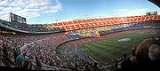
Camp Nou sometimes called "the Nou Camp" in English
, is a football stadium in Barcelona
, Catalonia
, Spain
. The stadium, located in the west of the city, has been the home of FC Barcelona
since its construction in 1957.
The Camp Nou seats 99,354, reduced to 96,336 in matches organized by the UEFA
, making it the largest stadium in Europe and the eleventh largest in the world in terms of capacity. It has hosted numerous international matches at a senior level including two UEFA Champions League
finals, the most recent being in 1999
. It also hosted several games, including bronze- and gold-medal matches, for the football competition at the 1992 Summer Olympics
hosted by Barcelona. It held UEFA five-star status until 2006, when a new rating system was introduced by UEFA
.
Its official name was Estadi del FC Barcelona (FC Barcelona Stadium) until 2000, when the club members voted to formally adopt the popular nickname Camp Nou. Though opposed by current club president Sandro Rosell
, FC Barcelona initially approved the sale of its former training ground Mini Estadi
to remodel the stadium on its fiftieth anniversary and increase capacity to 104,000 in 2007. The plans are on hold because of the World financial crisis.
had no room for expansion. Although originally planned to be called Estadi del FC Barcelona, the more popular name Camp Nou was used. The June 1950 signing of László Kubala, regarded as one of Barcelona's greatest players provided further impetus to the construction of a larger stadium.
Construction of Camp Nou began on 28 March 1954 before a crowd of 60,000 Barça fans. Civil governor of Barcelona, Felipe Acedo Colunga presided at the laying in place of the first stone, with a blessing from the Archbishop of Barcelona, Gregorio Modrego. Construction took three years, going 336% over budget for a final cost of 288 million pesetas.
The stadium was officially opened on 24 September 1957. Handel's Messiah
was performed at the opening of the stadium.
The architects were a team made up of Francesc Mitjans, Josep Soteras and Lorenzo García-Barbón.
and Dynamo Moscow
. Rangers won the match with a score of 3–2. The 1970s marked a turning point for FC Barcelona with the signing of new player, Johan Cruyff
in 1973. Electronic scoreboards were installed in the stadium two years later.
 The stadium underwent an expansion in 1980, in anticipation of the 1982 FIFA World Cup
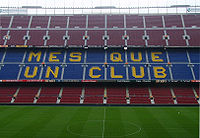
, which added boxes, VIP lounges, a new press area, new markers and the enlargement of the third tier by 22,150 seats for a total capacity of 115,000 spectators. The club raised funds for the remodeling by inscribing thousands of supporters’ names on bricks in return for a small set donation. This later became a topic of controversy when the news media in Madrid reported that the name of long-time Real Madrid chairman and Franco
supporter, Santiago Bernabéu
, had been commemorated in this way. The first important game played was the final of the Winners’ Cup featuring Barcelona
against Standard Liège
, on 12 May 1982. Barcelona won the game 2–1 in front of an audience of 80,000.
Camp Nou was one of several stadiums used throughout the 1982 World Cup, hosting the inauguration ceremony on 13 June. Before a 100,000-person crowd, Belgium upset the defending champions Argentina
1–0 in the match that followed.
Apart from hosting FC Barcelona, Camp Nou is home turf to the Catalan national team, their latest match being a 4–2 win over Argentina. The stadium is frequently used for other football events. The European Cup final between A.C. Milan
and Steaua Bucharest was held on 24 May 1989, with the Italian club winning 4–0. Camp Nou hosted part of the football competition, including the final, in the 1992 Summer Olympics. In preparation for these Games, two additional tiers of seating were installed over the previous roof-line.
Camp Nou underwent little change after 1982, except for the opening of the club museum
in 1984. The stadium underwent a facelift in 1993–94, in which the pitch was lowered by 2.5 m (8 ft), the security gap that separated the lawn from the galleries was removed, and standing room was eliminated in favor of individual seating. A new press box, renovation of the presidential grandstand and boxes, new parking under the main grandstand, and new lighting and sound systems were completed in time for the 1998–99 season. In 1999 the UEFA outlawed standing sections in stadiums, and Camp Nou’s capacity settled to its current level. The stadium hosted the 1999 UEFA Champions League Final
later that year where Manchester United
played Bayern Munich
. United won 2–1, coming back from 0–1 down in injury time.
In 2000, fans were polled concerning the stadium’s name. Of the 29,102 votes the club received, a total of 19,861 (68.25%) preferred Camp Nou to Estadi del FC Barcelona, and thus the official name was changed to the popular nickname.
During 1998–99, UEFA rated Camp Nou a five-star stadium for its services and functionalities. However, as per the 2010 regulations, UEFA does not publish a list of the top venues.
The facilities now include a memorabilia shop, mini-pitches for training matches, and a chapel for the players. The stadium also houses the second-most visited museum in Catalonia, FC Barcelona Museum
, which receives more than 1.2 million visitors per year.
by 13,500, with at least half of the total seating to be under cover. Should these renovations be completed, the stadium will be the third largest in the world (in terms of seating capacity), after the Rungrado May Day Stadium
in North Korea (150,000 capacity) and the Salt Lake Stadium in India (120,000 capacity).
On 18 September 2007 the British
architect
Norman Foster
and his company were selected to "restructure" Camp Nou. With an estimated cost of €250 million, the plan included the addition of 10,000 seats for a maximum capacity of 106,000. The board of FC Barcelona approved the sale of their former training ground Mini Estadi
in order to finance the remodeling. The project was planned to begin in 2009 and to be finished for the 2011–12 season. However, due to the 2008 financial crises and subsequent fall in real estate prices, the sale of the training ground was postponed and likewise the remodeling project. In May 2010 Sandro Rosell
, then a candidate for president of FC Barcelona, dismissed the possibility of selling Mini Estadí, saying it would be indefensible to “sell the crown jewels”, and his election on 30 June has effectively halted the plan to remodel Camp Nou.
Pope John Paul II celebrated mass
for a congregation of over 121,000 at Camp Nou on 17 November 1982, on the occasion being made an honorary citizen of Barcelona.
In 1983 Julio Iglesias
played for 60,000 people, in what was described as a "most beautifully orchestrated" concert. Other high-profile performances at Camp Nou include those by Bruce Springsteen
on 3 August 1988 during his Tunnel Of Love Express Tour
; and again on 19 July and 20 July 2008 during his Magic Tour
.
On 10 September 1988, a charity concert organised by Amnesty International
to support human rights featured, among others, Bruce Springsteen, Sting, Peter Gabriel
, Youssou N'Dour
, Tracy Chapman
, and El Último de la Fila
. A concert by the Three Tenors—Josep Carreras, Plácido Domingo, and Luciano Pavarotti—was held on 13 July 1997.
On 1 July 2009 the stadium held the launch of the U2 360° Tour
, which was attended to the maximum capacity of 90,000 people. The lead singer of U2, Bono, explained that they had started their tour in Camp Nou since “This is where we wanted to build a space station, designed by Gaudi in the capital of surrealism." The concert ended with Bono wearing an FC Barcelona jersey.
On August 9, 1988, Michael Jackson
appeared at the stadium in front of 95,000 fans during his Bad World Tour
.
English language
English is a West Germanic language that arose in the Anglo-Saxon kingdoms of England and spread into what was to become south-east Scotland under the influence of the Anglian medieval kingdom of Northumbria...
, is a football stadium in Barcelona
Barcelona
Barcelona is the second largest city in Spain after Madrid, and the capital of Catalonia, with a population of 1,621,537 within its administrative limits on a land area of...
, Catalonia
Catalonia
Catalonia is an autonomous community in northeastern Spain, with the official status of a "nationality" of Spain. Catalonia comprises four provinces: Barcelona, Girona, Lleida, and Tarragona. Its capital and largest city is Barcelona. Catalonia covers an area of 32,114 km² and has an...
, Spain
Spain
Spain , officially the Kingdom of Spain languages]] under the European Charter for Regional or Minority Languages. In each of these, Spain's official name is as follows:;;;;;;), is a country and member state of the European Union located in southwestern Europe on the Iberian Peninsula...
. The stadium, located in the west of the city, has been the home of FC Barcelona
FC Barcelona
Futbol Club Barcelona , also known as Barcelona and familiarly as Barça, is a professional football club, based in Barcelona, Catalonia, Spain....
since its construction in 1957.
The Camp Nou seats 99,354, reduced to 96,336 in matches organized by the UEFA
UEFA
The Union of European Football Associations , almost always referred to by its acronym UEFA is the administrative and controlling body for European association football, futsal and beach soccer....
, making it the largest stadium in Europe and the eleventh largest in the world in terms of capacity. It has hosted numerous international matches at a senior level including two UEFA Champions League
UEFA Champions League
The UEFA Champions League, known simply the Champions League and originally known as the European Champion Clubs' Cup or European Cup, is an annual international club football competition organised by the Union of European Football Associations since 1955 for the top football clubs in Europe. It...
finals, the most recent being in 1999
1999 UEFA Champions League Final
The 1999 UEFA Champions League Final was a football match that took place on Wednesday, 26 May 1999. The match was played at Camp Nou in Barcelona, Spain, to determine the winner of the 1998–99 UEFA Champions League. The final was contested by Manchester United and Bayern Munich...
. It also hosted several games, including bronze- and gold-medal matches, for the football competition at the 1992 Summer Olympics
1992 Summer Olympics
The 1992 Summer Olympic Games, officially known as the Games of the XXV Olympiad, were an international multi-sport event celebrated in Barcelona, Catalonia, Spain, in 1992. The International Olympic Committee voted in 1986 to separate the Summer and Winter Games, which had been held in the same...
hosted by Barcelona. It held UEFA five-star status until 2006, when a new rating system was introduced by UEFA
UEFA
The Union of European Football Associations , almost always referred to by its acronym UEFA is the administrative and controlling body for European association football, futsal and beach soccer....
.
Its official name was Estadi del FC Barcelona (FC Barcelona Stadium) until 2000, when the club members voted to formally adopt the popular nickname Camp Nou. Though opposed by current club president Sandro Rosell
Sandro Rosell
Alexandre Rosell i Feliu , commonly known as Sandro Rosell, is the current president of FC Barcelona. With an MBA degree from ESADE, Rosell is known for being the running mate and senior adviser of Joan Laporta during the presidential elections at FC Barcelona in 2003...
, FC Barcelona initially approved the sale of its former training ground Mini Estadi
Mini Estadi
Mini Estadi is a football stadium located in Barcelona, Catalonia, Spain. The 15,276 seat stadium is situated across from Camp Nou, the home stadium of FC Barcelona.The stadium was home to FC Barcelona C until July 2007, when they disbanded...
to remodel the stadium on its fiftieth anniversary and increase capacity to 104,000 in 2007. The plans are on hold because of the World financial crisis.
Construction
The construction of Camp Nou started on 28 March 1954 as Barcelona's previous stadium, Camp de Les CortsCamp de Les Corts
Camp de Les Corts , commonly referred to as Les Corts, was a sports stadium in Barcelona, Catalonia, Spain. It was the home ground for FC Barcelona until the club moved to the Camp Nou in 1957....
had no room for expansion. Although originally planned to be called Estadi del FC Barcelona, the more popular name Camp Nou was used. The June 1950 signing of László Kubala, regarded as one of Barcelona's greatest players provided further impetus to the construction of a larger stadium.
Construction of Camp Nou began on 28 March 1954 before a crowd of 60,000 Barça fans. Civil governor of Barcelona, Felipe Acedo Colunga presided at the laying in place of the first stone, with a blessing from the Archbishop of Barcelona, Gregorio Modrego. Construction took three years, going 336% over budget for a final cost of 288 million pesetas.
The stadium was officially opened on 24 September 1957. Handel's Messiah
Messiah (Handel)
Messiah is an English-language oratorio composed in 1741 by George Frideric Handel, with a scriptural text compiled by Charles Jennens from the King James Bible and the Book of Common Prayer. It was first performed in Dublin on 13 April 1742, and received its London premiere nearly a year later...
was performed at the opening of the stadium.
The architects were a team made up of Francesc Mitjans, Josep Soteras and Lorenzo García-Barbón.
Early years
In May 1972, Camp Nou hosted its first European Cup Winners' Cup final between RangersRangers F.C.
Rangers Football Club are an association football club based in Glasgow, Scotland, who play in the Scottish Premier League. The club are nicknamed the Gers, Teddy Bears and the Light Blues, and the fans are known to each other as bluenoses...
and Dynamo Moscow
FC Dynamo Moscow
Dynamo Moscow is a Russian football club based in Moscow, currently playing in the Russian Premier League. Dynamo's traditional kit colours are blue and white...
. Rangers won the match with a score of 3–2. The 1970s marked a turning point for FC Barcelona with the signing of new player, Johan Cruyff
Johan Cruyff
Hendrik Johannes Cruijff OON , known as Johan Cruyff, is a retired Dutch footballer and is currently the manager of the Catalan national team as well as a member of the AFC Ajax board of directors. He won the Ballon d'Or three times, in 1971, 1973 and 1974, which is a record jointly held with...
in 1973. Electronic scoreboards were installed in the stadium two years later.
1982 FIFA World Cup
The 1982 FIFA World Cup, the 12th FIFA World Cup, was held in Spain from 13 June to 11 July. The tournament was won by Italy, after defeating West Germany 3–1 in the final.-Host selection:...
, which added boxes, VIP lounges, a new press area, new markers and the enlargement of the third tier by 22,150 seats for a total capacity of 115,000 spectators. The club raised funds for the remodeling by inscribing thousands of supporters’ names on bricks in return for a small set donation. This later became a topic of controversy when the news media in Madrid reported that the name of long-time Real Madrid chairman and Franco
Francisco Franco
Francisco Franco y Bahamonde was a Spanish general, dictator and head of state of Spain from October 1936 , and de facto regent of the nominally restored Kingdom of Spain from 1947 until his death in November, 1975...
supporter, Santiago Bernabéu
Santiago Bernabéu Yeste
Santiago Bernabéu Yeste was a Spanish sportsman, one of the single most important men in Real Madrid's history. He is generally considered the one to whom much of the credit can be given for transforming Real Madrid C.F. from the second most successful club in Madrid into the most successful in...
, had been commemorated in this way. The first important game played was the final of the Winners’ Cup featuring Barcelona
FC Barcelona
Futbol Club Barcelona , also known as Barcelona and familiarly as Barça, is a professional football club, based in Barcelona, Catalonia, Spain....
against Standard Liège
Standard Liège
Royal Standard de Liège, commonly referred to as Standard Liège Royal Standard de Liège, commonly referred to as Standard Liège Royal Standard de Liège, commonly referred to as Standard Liège (Dutch: Standard Luik [], German: Standard Lüttich , is a Belgian football club from the city of Liège....
, on 12 May 1982. Barcelona won the game 2–1 in front of an audience of 80,000.
Camp Nou was one of several stadiums used throughout the 1982 World Cup, hosting the inauguration ceremony on 13 June. Before a 100,000-person crowd, Belgium upset the defending champions Argentina
Argentina national football team
The Argentina national football team represents Argentina in association football and is controlled by the Argentine Football Association , the governing body for football in Argentina. Argentina's home stadium is Estadio Monumental Antonio Vespucio Liberti and their head coach is Alejandro...
1–0 in the match that followed.
Development
The stadium’s capacity has varied greatly over the years, opening at 106,146, but growing to 121,749 for the 1982 FIFA World Cup.Apart from hosting FC Barcelona, Camp Nou is home turf to the Catalan national team, their latest match being a 4–2 win over Argentina. The stadium is frequently used for other football events. The European Cup final between A.C. Milan
A.C. Milan
Associazione Calcio Milan, commonly referred to as A.C. Milan or simply Milan , is a professional Italian football club based in Milan, Lombardy, that plays in the Serie A. Milan was founded in 1899 by English lace-maker Herbert Kilpin and businessman Alfred Edwards among others...
and Steaua Bucharest was held on 24 May 1989, with the Italian club winning 4–0. Camp Nou hosted part of the football competition, including the final, in the 1992 Summer Olympics. In preparation for these Games, two additional tiers of seating were installed over the previous roof-line.
Camp Nou underwent little change after 1982, except for the opening of the club museum
FC Barcelona Museum
The FC Barcelona museum was inaugurated on 24 September 1984 under the presidency of Josep Lluís Nuñez. In 2000 the museum was renamed President Nuñez museum under the presidency of his successor, Joan Gaspart...
in 1984. The stadium underwent a facelift in 1993–94, in which the pitch was lowered by 2.5 m (8 ft), the security gap that separated the lawn from the galleries was removed, and standing room was eliminated in favor of individual seating. A new press box, renovation of the presidential grandstand and boxes, new parking under the main grandstand, and new lighting and sound systems were completed in time for the 1998–99 season. In 1999 the UEFA outlawed standing sections in stadiums, and Camp Nou’s capacity settled to its current level. The stadium hosted the 1999 UEFA Champions League Final
1999 UEFA Champions League Final
The 1999 UEFA Champions League Final was a football match that took place on Wednesday, 26 May 1999. The match was played at Camp Nou in Barcelona, Spain, to determine the winner of the 1998–99 UEFA Champions League. The final was contested by Manchester United and Bayern Munich...
later that year where Manchester United
Manchester United F.C.
Manchester United Football Club is an English professional football club, based in Old Trafford, Greater Manchester, that plays in the Premier League. Founded as Newton Heath LYR Football Club in 1878, the club changed its name to Manchester United in 1902 and moved to Old Trafford in 1910.The 1958...
played Bayern Munich
FC Bayern Munich
FC Bayern Munich , is a German sports club based in Munich, Bavaria. It is best known for its professional football team, which is the most successful football club in Germany, having won 22 national titles and 15 cups....
. United won 2–1, coming back from 0–1 down in injury time.
In 2000, fans were polled concerning the stadium’s name. Of the 29,102 votes the club received, a total of 19,861 (68.25%) preferred Camp Nou to Estadi del FC Barcelona, and thus the official name was changed to the popular nickname.
During 1998–99, UEFA rated Camp Nou a five-star stadium for its services and functionalities. However, as per the 2010 regulations, UEFA does not publish a list of the top venues.
The facilities now include a memorabilia shop, mini-pitches for training matches, and a chapel for the players. The stadium also houses the second-most visited museum in Catalonia, FC Barcelona Museum
FC Barcelona Museum
The FC Barcelona museum was inaugurated on 24 September 1984 under the presidency of Josep Lluís Nuñez. In 2000 the museum was renamed President Nuñez museum under the presidency of his successor, Joan Gaspart...
, which receives more than 1.2 million visitors per year.
Future
To celebrate the fiftieth anniversary of the stadium, the club issued an international tender to remodel it. The objective was to make the facility an integrated and highly visible urban environment. The club sought to increase the seating capacitySeating capacity
Seating capacity refers to the number of people who can be seated in a specific space, both in terms of the physical space available, and in terms of limitations set by law. Seating capacity can be used in the description of anything ranging from an automobile that seats two to a stadium that seats...
by 13,500, with at least half of the total seating to be under cover. Should these renovations be completed, the stadium will be the third largest in the world (in terms of seating capacity), after the Rungrado May Day Stadium
Rungrado May Day Stadium
The Rŭngrado May First Stadium, or May Day Stadium, is a multi-purpose stadium in Pyongyang, North Korea, completed on May 1, 1989.-Overview:The stadium was constructed as a main stadium for the 13th World Festival of Youth and Students in 1989....
in North Korea (150,000 capacity) and the Salt Lake Stadium in India (120,000 capacity).
On 18 September 2007 the British
United Kingdom
The United Kingdom of Great Britain and Northern IrelandIn the United Kingdom and Dependencies, other languages have been officially recognised as legitimate autochthonous languages under the European Charter for Regional or Minority Languages...
architect
Architect
An architect is a person trained in the planning, design and oversight of the construction of buildings. To practice architecture means to offer or render services in connection with the design and construction of a building, or group of buildings and the space within the site surrounding the...
Norman Foster
Norman Foster, Baron Foster of Thames Bank
Norman Robert Foster, Baron Foster of Thames Bank, OM is a British architect whose company maintains an international design practice, Foster + Partners....
and his company were selected to "restructure" Camp Nou. With an estimated cost of €250 million, the plan included the addition of 10,000 seats for a maximum capacity of 106,000. The board of FC Barcelona approved the sale of their former training ground Mini Estadi
Mini Estadi
Mini Estadi is a football stadium located in Barcelona, Catalonia, Spain. The 15,276 seat stadium is situated across from Camp Nou, the home stadium of FC Barcelona.The stadium was home to FC Barcelona C until July 2007, when they disbanded...
in order to finance the remodeling. The project was planned to begin in 2009 and to be finished for the 2011–12 season. However, due to the 2008 financial crises and subsequent fall in real estate prices, the sale of the training ground was postponed and likewise the remodeling project. In May 2010 Sandro Rosell
Sandro Rosell
Alexandre Rosell i Feliu , commonly known as Sandro Rosell, is the current president of FC Barcelona. With an MBA degree from ESADE, Rosell is known for being the running mate and senior adviser of Joan Laporta during the presidential elections at FC Barcelona in 2003...
, then a candidate for president of FC Barcelona, dismissed the possibility of selling Mini Estadí, saying it would be indefensible to “sell the crown jewels”, and his election on 30 June has effectively halted the plan to remodel Camp Nou.
Other uses
Camp Nou has been used for various purposes other than football, often hosting major concerts.Pope John Paul II celebrated mass
Mass (liturgy)
"Mass" is one of the names by which the sacrament of the Eucharist is called in the Roman Catholic Church: others are "Eucharist", the "Lord's Supper", the "Breaking of Bread", the "Eucharistic assembly ", the "memorial of the Lord's Passion and Resurrection", the "Holy Sacrifice", the "Holy and...
for a congregation of over 121,000 at Camp Nou on 17 November 1982, on the occasion being made an honorary citizen of Barcelona.
In 1983 Julio Iglesias
Julio Iglesias
Julio José Iglesias de la Cueva , better known simply as Julio Iglesias, is a Spanish singer who has sold over 300 million records worldwide in 14 languages and released 77 albums. According to Sony Music Entertainment, he is one of the top 15 best selling music artists in history,...
played for 60,000 people, in what was described as a "most beautifully orchestrated" concert. Other high-profile performances at Camp Nou include those by Bruce Springsteen
Bruce Springsteen
Bruce Frederick Joseph Springsteen , nicknamed "The Boss," is an American singer-songwriter who records and tours with the E Street Band...
on 3 August 1988 during his Tunnel Of Love Express Tour
Tunnel of Love Express Tour
The Tunnel of Love Express was a concert tour featuring Bruce Springsteen and the E Street Band that took place in 1988. It followed by four and a half months the release of Springsteen's 1987 album, Tunnel of Love.-Itinerary:...
; and again on 19 July and 20 July 2008 during his Magic Tour
Magic Tour
The Magic Tour was the final tour by the English rock band Queen with their lead singer Freddie Mercury, which took place in 1986. The band would not tour again until 19 years later, when the Queen + Paul Rodgers Tour began in 2005, after the death of Freddie Mercury on 24 November 1991, and the...
.
On 10 September 1988, a charity concert organised by Amnesty International
Amnesty International
Amnesty International is an international non-governmental organisation whose stated mission is "to conduct research and generate action to prevent and end grave abuses of human rights, and to demand justice for those whose rights have been violated."Following a publication of Peter Benenson's...
to support human rights featured, among others, Bruce Springsteen, Sting, Peter Gabriel
Peter Gabriel
Peter Brian Gabriel is an English singer, musician, and songwriter who rose to fame as the lead vocalist and flautist of the progressive rock group Genesis. After leaving Genesis, Gabriel went on to a successful solo career...
, Youssou N'Dour
Youssou N'Dour
Youssou N'Dour is a Senegalese singer, percussionist and occasional actor. In 2004, Rolling Stone described him as, in Senegal and much of Africa, "perhaps the most famous singer alive." He helped develop a style of popular music in Senegal, known in the Serer language as mbalax, a type of music...
, Tracy Chapman
Tracy Chapman
Tracy Chapman is an American singer-songwriter, best known for her singles "Fast Car", "Talkin' 'bout a Revolution", "Baby Can I Hold You", "Give Me One Reason" and "Telling Stories". She is a multi-platinum and four-time Grammy Award-winning artist.-Biography:Tracy Chapman was born in Cleveland,...
, and El Último de la Fila
El Último de la Fila
El Último de la Fila was a Spanish music group created in the mid 1980s in Barcelona, Spain. The original members were Manolo García and Quimi Portet.-History:...
. A concert by the Three Tenors—Josep Carreras, Plácido Domingo, and Luciano Pavarotti—was held on 13 July 1997.
On 1 July 2009 the stadium held the launch of the U2 360° Tour
U2 360° Tour
The U2 360° Tour was a worldwide concert tour by rock band U2. Launched in support of the group's 2009 album No Line on the Horizon, the tour visited stadiums from 2009 through 2011. It was named for a stage configuration that allowed the audience to almost completely surround the stage...
, which was attended to the maximum capacity of 90,000 people. The lead singer of U2, Bono, explained that they had started their tour in Camp Nou since “This is where we wanted to build a space station, designed by Gaudi in the capital of surrealism." The concert ended with Bono wearing an FC Barcelona jersey.
On August 9, 1988, Michael Jackson
Michael Jackson
Michael Joseph Jackson was an American recording artist, entertainer, and businessman. Referred to as the King of Pop, or by his initials MJ, Jackson is recognized as the most successful entertainer of all time by Guinness World Records...
appeared at the stadium in front of 95,000 fans during his Bad World Tour
Bad World Tour
The Bad World Tour was the first solo concert tour by American megasuperstar Michael Jackson that visited Japan, Australia, the United States and Europe. Sponsored by Pepsi and spanning 16 months, the tour included 123 concerts to 4.4 million fans across 15 countries...
.
External links
- Footballmatch Collection of Spanish stadiums.
- bcn.travel/camp-nou-stadium-barcelona Stadium profile including photos and videos.
- Stadium featured on Estadios de Espana