


Roman Wales

Encyclopedia
The history of Wales in the Roman era began in AD 48 with a military invasion by the imperial governor
Roman governor
A Roman governor was an official either elected or appointed to be the chief administrator of Roman law throughout one or more of the many provinces constituting the Roman Empire...
of Roman Britain
Roman Britain
Roman Britain was the part of the island of Great Britain controlled by the Roman Empire from AD 43 until ca. AD 410.The Romans referred to the imperial province as Britannia, which eventually comprised all of the island of Great Britain south of the fluid frontier with Caledonia...
. The conquest would be completed by 78, and Roman rule would endure until the region was abandoned in 383 AD. Once the conquest was complete, the region and the people living there would be a virtually anonymous part of Roman Britain until the Roman departure.
Roman rule in Wales was a military occupation, save for the southern coastal region of South Wales
South Wales
South Wales is an area of Wales bordered by England and the Bristol Channel to the east and south, and Mid Wales and West Wales to the north and west. The most densely populated region in the south-west of the United Kingdom, it is home to around 2.1 million people and includes the capital city of...
east of the Gower Peninsula
Gower Peninsula
Gower or the Gower Peninsula is a peninsula in south Wales, jutting from the coast into the Bristol Channel, and administratively part of the City and County of Swansea. Locally it is known as "Gower"...
, where there is a legacy of Romanisation
Romanization (cultural)
Romanization or latinization indicate different historical processes, such as acculturation, integration and assimilation of newly incorporated and peripheral populations by the Roman Republic and the later Roman Empire...
, and some southern sites such as Carmarthen
Carmarthen
Carmarthen is a community in, and the county town of, Carmarthenshire, Wales. It is sited on the River Towy north of its mouth at Carmarthen Bay. In 2001, the population was 14,648....
(south east Wales was fully romanised at the beginning of the fifth century ). The only town in Wales
Wales
Wales is a country that is part of the United Kingdom and the island of Great Britain, bordered by England to its east and the Atlantic Ocean and Irish Sea to its west. It has a population of three million, and a total area of 20,779 km²...
founded by the Romans, Caerwent
Caerwent
Caerwent is a village and community in Monmouthshire, Wales. It is located about five miles west of Chepstow and eleven miles east of Newport, and was founded by the Romans as the market town of Venta Silurum, an important settlement of the Brythonic Silures tribe. The modern village is built...
, is located in South Wales. Wales was a rich source of mineral wealth, and the Romans used their engineering
Roman engineering
Romans are famous for their advanced engineering accomplishments, although some of their own inventions were improvements on older ideas, concepts and inventions. Technology for bringing running water into cities was developed in the east, but transformed by the Romans into a technology...
technology
Roman technology
Roman technology is the engineering practice which supported Roman civilization and made the expansion of Roman commerce and Roman military possible over nearly a thousand years....
to extract large amounts of gold
Gold
Gold is a chemical element with the symbol Au and an atomic number of 79. Gold is a dense, soft, shiny, malleable and ductile metal. Pure gold has a bright yellow color and luster traditionally considered attractive, which it maintains without oxidizing in air or water. Chemically, gold is a...
, copper
Copper
Copper is a chemical element with the symbol Cu and atomic number 29. It is a ductile metal with very high thermal and electrical conductivity. Pure copper is soft and malleable; an exposed surface has a reddish-orange tarnish...
, and lead
Lead
Lead is a main-group element in the carbon group with the symbol Pb and atomic number 82. Lead is a soft, malleable poor metal. It is also counted as one of the heavy metals. Metallic lead has a bluish-white color after being freshly cut, but it soon tarnishes to a dull grayish color when exposed...
, as well as modest amounts of some other metals such as zinc
Zinc
Zinc , or spelter , is a metallic chemical element; it has the symbol Zn and atomic number 30. It is the first element in group 12 of the periodic table. Zinc is, in some respects, chemically similar to magnesium, because its ion is of similar size and its only common oxidation state is +2...
and silver
Silver
Silver is a metallic chemical element with the chemical symbol Ag and atomic number 47. A soft, white, lustrous transition metal, it has the highest electrical conductivity of any element and the highest thermal conductivity of any metal...
.
It is the Roman campaigns of conquest that are most widely known, due to the spirited but unsuccessful defense of their homelands by two native tribes, the Silures
Silures
The Silures were a powerful and warlike tribe of ancient Britain, occupying approximately the counties of Monmouthshire, Breconshire and Glamorganshire of present day South Wales; and possibly Gloucestershire and Herefordshire of present day England...
and the Ordovices
Ordovices
The Ordovices were one of the Celtic tribes living in Great Britain, before the Roman invasion of Britain. Its tribal lands were located in present day Wales and England between the Silures to the south and the Deceangli to the north-east...
. Aside from the many Roman-related finds along the southern coast, Roman archaeological remains in Wales consist almost entirely of military roads and fortifications.
Britain in AD 47
On the eve of the Roman invasion of Wales, the Roman militaryMilitary of ancient Rome
The Roman military was intertwined with the Roman state much more closely than in a modern European nation. Josephus describes the Roman people being as if they were "born ready armed." and the Romans were for long periods prepared to engage in almost continuous warfare, absorbing massive losses...
under Governor
Roman governor
A Roman governor was an official either elected or appointed to be the chief administrator of Roman law throughout one or more of the many provinces constituting the Roman Empire...
Aulus Plautius
Aulus Plautius
Aulus Plautius was a Roman politician and general of the mid-1st century. He began the Roman conquest of Britain in 43, and became the first governor of the new province, serving from 43 to 47.-Career:...
was in control of all of southeastern Britain as well as Dumnonia
Dumnonia
Dumnonia is the Latinised name for the Brythonic kingdom in sub-Roman Britain between the late 4th and late 8th centuries, located in the farther parts of the south-west peninsula of Great Britain...
, perhaps including the lowland English Midlands
English Midlands
The Midlands, or the English Midlands, is the traditional name for the area comprising central England that broadly corresponds to the early medieval Kingdom of Mercia. It borders Southern England, Northern England, East Anglia and Wales. Its largest city is Birmingham, and it was an important...
as far as the Dee Estuary
Dee Estuary
The Dee Estuary is a large estuary by means of which the River Dee flows into Liverpool Bay. The estuary starts near Shotton after a five miles 'canalised' section and the river soon swells to be several miles wide forming the boundary between the Wirral Peninsula in north-west England and...
and the River Mersey
River Mersey
The River Mersey is a river in North West England. It is around long, stretching from Stockport, Greater Manchester, and ending at Liverpool Bay, Merseyside. For centuries, it formed part of the ancient county divide between Lancashire and Cheshire....
, and having an understanding with the Brigantes
Brigantes
The Brigantes were a Celtic tribe who in pre-Roman times controlled the largest section of what would become Northern England, and a significant part of the Midlands. Their kingdom is sometimes called Brigantia, and it was centred in what was later known as Yorkshire...
to the north. They were in possession of virtually all of the commercial wealth of the island, as well as much of its exploitable natural resources.
In Wales the known tribes (the list may be incomplete) included the Ordovices
Ordovices
The Ordovices were one of the Celtic tribes living in Great Britain, before the Roman invasion of Britain. Its tribal lands were located in present day Wales and England between the Silures to the south and the Deceangli to the north-east...
and Deceangli
Deceangli
The Deceangli or Deceangi were one of the Celtic tribes living in Britain, prior to the Roman invasion of the island. The tribe lived mainly in what is now north-east Wales, though it is uncertain whether their territory covered only the modern counties of Flintshire, Denbighshire and part of...
in the north, and the Silures
Silures
The Silures were a powerful and warlike tribe of ancient Britain, occupying approximately the counties of Monmouthshire, Breconshire and Glamorganshire of present day South Wales; and possibly Gloucestershire and Herefordshire of present day England...
and Demetae
Demetae
The Demetae were a Celtic people of Iron Age Britain who inhabited modern Pembrokeshire and Carmarthenshire in south-west Wales, and gave their name to the county of Dyfed.-Classical mention:...
in the south. Archaeology combined with ancient Greek and Roman accounts have shown that there was exploitation of natural resources, such as copper, gold, tin, lead and silver at multiple locations in Britain, including in Wales. Apart from this we have little knowledge of the Welsh tribes of this era.
Invasion and conquest
In AD 47 or 48 the new governor, Publius Ostorius ScapulaPublius Ostorius Scapula
Publius Ostorius Scapula was a Roman statesman and general who governed Britain from 47 until his death, and was responsible for the defeat and capture of Caratacus.-Career:...
, moved against the Deceangli along the northeastern coast of Wales, devastating their lands. He campaigned successfully but indecisively against the Silures and then the Ordovices, the most notable feature of which is the leadership of both tribes against him by Caratacus
Caratacus
Caratacus was a first century British chieftain of the Catuvellauni tribe, who led the British resistance to the Roman conquest....
. Scapula died in 52, the same year that the resurgent Silures inflicted a defeat on one of the Roman legions. Scapula was succeeded by a number of governors who made steady but inconclusive gains against the two tribes. Gaius Suetonius Paulinus
Gaius Suetonius Paulinus
Gaius Suetonius Paulinus, also spelled Paullinus, was a Roman general best known as the commander who defeated the rebellion of Boudica.-Career:...
was in the process of conquering Anglesey in AD 60 when the revolt led by Boudica
Boudica
Boudica , also known as Boadicea and known in Welsh as "Buddug" was queen of the British Iceni tribe who led an uprising against the occupying forces of the Roman Empire....
in the east forced a delay in the final conquest of Wales.
There followed a decade of relative peace while Roman imperial attention was focused elsewhere. When expansion into Wales resumed in 73, Roman progress was steady and successful under Sextus Julius Frontinus
Sextus Julius Frontinus
Sextus Julius Frontinus was one of the most distinguished Roman aristocrats of the late 1st century AD, but is best known to the post-Classical world as an author of technical treatises, especially one dealing with the aqueducts of Rome....
, who decisively defeated the Silures, followed by the success of Agricola
Gnaeus Julius Agricola
Gnaeus Julius Agricola was a Roman general responsible for much of the Roman conquest of Britain. His biography, the De vita et moribus Iulii Agricolae, was the first published work of his son-in-law, the historian Tacitus, and is the source for most of what is known about him.Born to a noted...
in defeating the Ordovices, and in completing the conquest of Anglesey in AD 77-78.
There is no indication of any Roman campaigns against the Demetae, and their territory was not planted with a series of forts, nor overlaid with roads, suggesting that they quickly made their peace with Rome. The main fort in their territory was at Moridunum
Moridunum (Carmarthen)
Moridunum was a Roman fort and town in the Roman province of Britannia. Today it is known as Carmarthen, located in the Welsh county of Carmarthenshire .-Fort:...
(modern Carmarthen
Carmarthen
Carmarthen is a community in, and the county town of, Carmarthenshire, Wales. It is sited on the River Towy north of its mouth at Carmarthen Bay. In 2001, the population was 14,648....
), built around AD 75, and it eventually became the center of a Roman civitas
Civitas
In the history of Rome, the Latin term civitas , according to Cicero in the time of the late Roman Republic, was the social body of the cives, or citizens, united by law . It is the law that binds them together, giving them responsibilities on the one hand and rights of citizenship on the other...
. The Demetae are the only pre-Roman Welsh tribe that would emerge from Roman rule with their tribal name intact.
Wales in Roman Society
Mining
The mineral wealth of Britain was well-known prior to the Roman invasion and was one of the expected benefits of conquest. All mineral extractions were state-sponsored and under military control, as mineral rights belonged to the emperor. His agents soon found substantial deposits of goldGold
Gold is a chemical element with the symbol Au and an atomic number of 79. Gold is a dense, soft, shiny, malleable and ductile metal. Pure gold has a bright yellow color and luster traditionally considered attractive, which it maintains without oxidizing in air or water. Chemically, gold is a...
, copper
Copper
Copper is a chemical element with the symbol Cu and atomic number 29. It is a ductile metal with very high thermal and electrical conductivity. Pure copper is soft and malleable; an exposed surface has a reddish-orange tarnish...
, and lead
Lead
Lead is a main-group element in the carbon group with the symbol Pb and atomic number 82. Lead is a soft, malleable poor metal. It is also counted as one of the heavy metals. Metallic lead has a bluish-white color after being freshly cut, but it soon tarnishes to a dull grayish color when exposed...
in Wales, along with some zinc
Zinc
Zinc , or spelter , is a metallic chemical element; it has the symbol Zn and atomic number 30. It is the first element in group 12 of the periodic table. Zinc is, in some respects, chemically similar to magnesium, because its ion is of similar size and its only common oxidation state is +2...
and silver
Silver
Silver is a metallic chemical element with the chemical symbol Ag and atomic number 47. A soft, white, lustrous transition metal, it has the highest electrical conductivity of any element and the highest thermal conductivity of any metal...
. Gold was mined at Dolaucothi
Dolaucothi Gold Mines
The Dolaucothi Gold Mines , also known as the Ogofau Gold Mine, are Roman surface and deep mines located in the valley of the River Cothi, near Pumsaint, Carmarthenshire, Wales...
prior to the invasion, but Roman engineering
Roman engineering
Romans are famous for their advanced engineering accomplishments, although some of their own inventions were improvements on older ideas, concepts and inventions. Technology for bringing running water into cities was developed in the east, but transformed by the Romans into a technology...
would be applied to greatly increase the amount extracted, and to extract huge amounts of the other metals. This would continue until the process was no longer practical or profitable, at which time the mine would be abandoned.
Modern scholars have made efforts to quantify the value of these extracted metals to the Roman economy
Roman economy
The history of the Roman economy covers the period of the Roman Republic and the Roman Empire.Recent research has led to a positive reevaluation of the size and sophistication of the Roman economy within the constraints generally imposed on agricultural societies in the preindustrial age.- Gross...
, and to determine the point at which the Roman occupation of Britain was "profitable" to the Empire. While these efforts have not produced deterministic results, the benefits to Rome were substantial. The gold production at Dolaucothi alone may have been of economic significance.
Industrial production
The production of goods for trade and export in Roman Britain was concentrated in the south and east, with virtually none situated in Wales.This was largely due to circumstance, with iron
Iron
Iron is a chemical element with the symbol Fe and atomic number 26. It is a metal in the first transition series. It is the most common element forming the planet Earth as a whole, forming much of Earth's outer and inner core. It is the fourth most common element in the Earth's crust...
forges located near iron supplies, pewter
Pewter
Pewter is a malleable metal alloy, traditionally 85–99% tin, with the remainder consisting of copper, antimony, bismuth and lead. Copper and antimony act as hardeners while lead is common in the lower grades of pewter, which have a bluish tint. It has a low melting point, around 170–230 °C ,...
(tin with some lead or copper) moulds located near the tin supplies and suitable soil (for the moulds), clusters of pottery
Pottery
Pottery is the material from which the potteryware is made, of which major types include earthenware, stoneware and porcelain. The place where such wares are made is also called a pottery . Pottery also refers to the art or craft of the potter or the manufacture of pottery...
kiln
Kiln
A kiln is a thermally insulated chamber, or oven, in which a controlled temperature regime is produced. Uses include the hardening, burning or drying of materials...
s located near suitable clayey soil, grain-drying ovens located in agricultural areas where sheep raising (for wool) was also located, and salt production concentrated in its historical pre-Roman locations. Glass-making sites were located in or near urban centres.
In Wales none of the needed materials were available in suitable combination, and the forested, mountainous countryside was not amenable to this kind of industrialisation.
Clusters of tile
Tile
A tile is a manufactured piece of hard-wearing material such as ceramic, stone, metal, or even glass. Tiles are generally used for covering roofs, floors, walls, showers, or other objects such as tabletops...
ries, both large and small, were at first operated by the Roman military to meet their own needs, and so there were temporary sites wherever the army went and could find suitable soil. This included a few places in Wales. However as Roman influence grew, the army was able to obtain tiles from civilian sources who located their kilns in the lowland areas containing good soil, and then shipped the tiles to wherever they were needed.
Romanisation
The Romans occupied the whole of the area now known as Wales, where they built Roman roadRoman road
The Roman roads were a vital part of the development of the Roman state, from about 500 BC through the expansion during the Roman Republic and the Roman Empire. Roman roads enabled the Romans to move armies and trade goods and to communicate. The Roman road system spanned more than 400,000 km...
s and Roman forts, mined gold at Luentinum
Luentinum
Luentinum was a fort and mining settlement in the Roman province of Britannia. It was associated with the Dolaucothi Gold Mines and its remains lie beneath the adjoining village of Pumsaint in the Welsh county of Carmarthenshire. It lay between similar forts at Llandovery and Bremia near Llanio,...
and conducted commerce, but their interest in the area was limited because of the difficult geography and shortage of flat agricultural land. Most of the Roman remains in Wales are military in nature.
The area was controlled by Roman legion
Roman legion
A Roman legion normally indicates the basic ancient Roman army unit recruited specifically from Roman citizens. The organization of legions varied greatly over time but they were typically composed of perhaps 5,000 soldiers, divided into maniples and later into "cohorts"...
ary bases at Deva Victrix
Deva Victrix
Deva Victrix, or simply Deva, was a legionary fortress and town in the Roman province of Britannia. The settlement evolved into Chester, the county town of Cheshire, England...
(modern Chester
Chester
Chester is a city in Cheshire, England. Lying on the River Dee, close to the border with Wales, it is home to 77,040 inhabitants, and is the largest and most populous settlement of the wider unitary authority area of Cheshire West and Chester, which had a population of 328,100 according to the...
) and Isca Augusta
Isca Augusta
Isca Augusta was a Roman legionary fortress and settlement, the remains of which lie beneath parts of the present-day village of Caerleon on the northern outskirts of the city of Newport in South Wales.-Name:...
(Caerleon
Caerleon
Caerleon is a suburban village and community, situated on the River Usk in the northern outskirts of the city of Newport, South Wales. Caerleon is a site of archaeological importance, being the site of a notable Roman legionary fortress, Isca Augusta, and an Iron Age hill fort...
), two of the three such bases in Roman Britain, with roads linking these bases to Roman auxiliary forts such as Segontium
Segontium
Segontium is a Roman fort for a Roman auxiliary force, located on the outskirts of Caernarfon in Gwynedd, north Wales.It probably takes its name from the nearby River Seiont, and may be related to the Segontiaci, a British tribe mentioned by Julius Caesar. The fort was founded by Agricola in 77 or...
(Caernarfon
Caernarfon
Caernarfon is a Royal town, community and port in Gwynedd, Wales, with a population of 9,611. It lies along the A487 road, on the east banks of the Menai Straits, opposite the Isle of Anglesey. The city of Bangor is to the northeast, while Snowdonia fringes Caernarfon to the east and southeast...
) and Moridunum (Carmarthen
Carmarthen
Carmarthen is a community in, and the county town of, Carmarthenshire, Wales. It is sited on the River Towy north of its mouth at Carmarthen Bay. In 2001, the population was 14,648....
).
The best indicators of Romanising acculturation is the presence of urban sites (areas with towns, colonia
Colonia (Roman)
A Roman colonia was originally a Roman outpost established in conquered territory to secure it. Eventually, however, the term came to denote the highest status of Roman city.-History:...
e, and tribal civitates
Civitas
In the history of Rome, the Latin term civitas , according to Cicero in the time of the late Roman Republic, was the social body of the cives, or citizens, united by law . It is the law that binds them together, giving them responsibilities on the one hand and rights of citizenship on the other...
) and villa
Villa
A villa was originally an ancient Roman upper-class country house. Since its origins in the Roman villa, the idea and function of a villa have evolved considerably. After the fall of the Roman Republic, villas became small farming compounds, which were increasingly fortified in Late Antiquity,...
s in the countryside. In Wales, this can be said only of the southeasternmost coastal region of South Wales
South Wales
South Wales is an area of Wales bordered by England and the Bristol Channel to the east and south, and Mid Wales and West Wales to the north and west. The most densely populated region in the south-west of the United Kingdom, it is home to around 2.1 million people and includes the capital city of...
. The only civitates in Wales were at Carmarthen
Carmarthen
Carmarthen is a community in, and the county town of, Carmarthenshire, Wales. It is sited on the River Towy north of its mouth at Carmarthen Bay. In 2001, the population was 14,648....
and Caerwent
Caerwent
Caerwent is a village and community in Monmouthshire, Wales. It is located about five miles west of Chepstow and eleven miles east of Newport, and was founded by the Romans as the market town of Venta Silurum, an important settlement of the Brythonic Silures tribe. The modern village is built...
. There were three small urban sites near Caerwent, and these and Roman Monmouth
Blestium
Blestium was a small town and probable fort in Roman Wales within the Roman province of Britannia Superior, part of Roman Britain...
were the only other "urbanised" sites in Wales.
In the southwestern homeland of the Demetae
Demetae
The Demetae were a Celtic people of Iron Age Britain who inhabited modern Pembrokeshire and Carmarthenshire in south-west Wales, and gave their name to the county of Dyfed.-Classical mention:...
, several sites have been classified as villas in the past, but excavation of these and examination of sites as yet unexcavated suggest that they are pre-Roman family homesteads, sometimes updated through Roman technology (such as stone masonry), but having a native character quite different than the true Roman-derived villas that are found to the east, such as in Oxfordshire
Oxfordshire
Oxfordshire is a county in the South East region of England, bordering on Warwickshire and Northamptonshire , Buckinghamshire , Berkshire , Wiltshire and Gloucestershire ....
.
Perhaps surprisingly, the presence of Roman-era Latin inscriptions is not suggestive of Romanisation. They are most numerous at military sites, and their occurrence elsewhere depended on access to suitable stone and the presence of stonemasons, as well as patronage. The Roman fort complex at Tomen y Mur
Tomen y Mur
Tomen y Mur is a Roman fort complex in Gwynedd, Wales. The fort was constructed under governor Gnaeus Julius Agricola in AD 78, and was abandoned around AD 140. A millennium later, in the Norman period, the site was reoccupied and refortified with a motte within the old walls...
near the coast of northwestern Wales has produced more inscriptions than either Segontium
Segontium
Segontium is a Roman fort for a Roman auxiliary force, located on the outskirts of Caernarfon in Gwynedd, north Wales.It probably takes its name from the nearby River Seiont, and may be related to the Segontiaci, a British tribe mentioned by Julius Caesar. The fort was founded by Agricola in 77 or...
(near modern Caernarfon
Caernarfon
Caernarfon is a Royal town, community and port in Gwynedd, Wales, with a population of 9,611. It lies along the A487 road, on the east banks of the Menai Straits, opposite the Isle of Anglesey. The city of Bangor is to the northeast, while Snowdonia fringes Caernarfon to the east and southeast...
) or Roman Chichester
Noviomagus Reginorum
Noviomagus Reginorum was the Roman town which is today called Chichester, situated in the modern English county of West Sussex. Alternative versions of the name include Noviomagus Regnorum, Regnentium and Regentium..-Development:...
.
Hill forts
In areas of civil control, such as the territories of a civitasCivitas
In the history of Rome, the Latin term civitas , according to Cicero in the time of the late Roman Republic, was the social body of the cives, or citizens, united by law . It is the law that binds them together, giving them responsibilities on the one hand and rights of citizenship on the other...
, the fortification and occupation of hill fort
Hill fort
A hill fort is a type of earthworks used as a fortified refuge or defended settlement, located to exploit a rise in elevation for defensive advantage. They are typically European and of the Bronze and Iron Ages. Some were used in the post-Roman period...
s was banned as a matter of Roman policy. However, further inland and northward, a number of pre-Roman hill forts continued to be used in the Roman Era, while others were abandoned during the Roman Era, and still others were newly occupied. The inference is that local leaders who were willing to accommodate Roman interests were encouraged and allowed to continue, providing local leadership under local law and custom.
Religion
There is virtually no evidence to shed light on the practice of religion in Wales during the Roman era, save the anecdotal account of the strange appearance and bloodthirsty customs of the druidDruid
A druid was a member of the priestly class in Britain, Ireland, and Gaul, and possibly other parts of Celtic western Europe, during the Iron Age....
s of Anglesey by Tacitus
Tacitus
Publius Cornelius Tacitus was a senator and a historian of the Roman Empire. The surviving portions of his two major works—the Annals and the Histories—examine the reigns of the Roman Emperors Tiberius, Claudius, Nero and those who reigned in the Year of the Four Emperors...
during the conquest of Wales. It is fortunate for Rome's reputation that Tacitus described the druids as horrible, else it would be a story of the Roman massacre of defenseless, unarmed men and women. The likelihood of partisan propaganda and an appeal to salacious interests combine to suggest that the account merits suspicion.
The Welsh region of Britain was not significant to the Romanisation of the island and contains almost no buildings related to religious practice, save where the Roman military was located, and these reflect the practices of non-native soldiers. Any native religious sites would have been constructed of wood that has not survived and so are difficult to locate anywhere in Britain, let alone in mountainous, forest-covered Wales.
The time of the arrival of Christianity
Christianity
Christianity is a monotheistic religion based on the life and teachings of Jesus as presented in canonical gospels and other New Testament writings...
to Wales is unknown. Archaeology suggests that it came to Roman Britain slowly, gaining adherents among coastal merchants and in the upper classes first, and never becoming widespread outside of the southeast in the Roman Era. There is also evidence of a preference for non-Christian devotion in parts of Britain, such as in the upper regions of the Severn Estuary
Severn Estuary
The Severn Estuary is the estuary of the River Severn, the longest river in Great Britain. Its high tidal range means it has been at the centre of discussions in the UK regarding renewable energy.-Geography:...
in the 4th century, from the Forest of Dean
Forest of Dean
The Forest of Dean is a geographical, historical and cultural region in the western part of the county of Gloucestershire, England. The forest is a roughly triangular plateau bounded by the River Wye to the west and north, the River Severn to the south, and the City of Gloucester to the east.The...
east of the River Wye
River Wye
The River Wye is the fifth-longest river in the UK and for parts of its length forms part of the border between England and Wales. It is important for nature conservation and recreation.-Description:...
continuously around the coast of the estuary, up to and including Somerset
Somerset
The ceremonial and non-metropolitan county of Somerset in South West England borders Bristol and Gloucestershire to the north, Wiltshire to the east, Dorset to the south-east, and Devon to the south-west. It is partly bounded to the north and west by the Bristol Channel and the estuary of the...
.
In the De Excidio et Conquestu Britanniae
De Excidio et Conquestu Britanniae
De Excidio et Conquestu Britanniae is a work by the 6th-century British cleric Gildas. It is a sermon in three parts condemning the acts of Gildas' contemporaries, both secular and religious, whom he blames for the dire state of affairs in sub-Roman Britain...
, written c. 540, Gildas
Gildas
Gildas was a 6th-century British cleric. He is one of the best-documented figures of the Christian church in the British Isles during this period. His renowned learning and literary style earned him the designation Gildas Sapiens...
provides a story of the martyrdom of Saint Alban
Saint Alban
Saint Alban was the first British Christian martyr. Along with his fellow saints Julius and Aaron, Alban is one of three martyrs remembered from Roman Britain. Alban is listed in the Church of England calendar for 22 June and he continues to be venerated in the Anglican, Catholic, and Orthodox...
at Verulamium
Verulamium
Verulamium was an ancient town in Roman Britain. It was sited in the southwest of the modern city of St Albans in Hertfordshire, Great Britain. A large portion of the Roman city remains unexcavated, being now park and agricultural land, though much has been built upon...
, and of Julius and Aaron
Julius and Aaron
Saints Julius and Aaron are celebrated as two British martyrs who died during the religious persecutions of the Emperor Diocletian in AD 304. Their feast day was traditionally celebrated on July 1....
at Legionum Urbis, the 'City of the Legion', saying that this occurred during a persecution of Christians at a time when 'decrees' against them were issued. Bede
Bede
Bede , also referred to as Saint Bede or the Venerable Bede , was a monk at the Northumbrian monastery of Saint Peter at Monkwearmouth, today part of Sunderland, England, and of its companion monastery, Saint Paul's, in modern Jarrow , both in the Kingdom of Northumbria...
repeats the story in his Ecclesiastical History
Historia ecclesiastica gentis Anglorum
The Historia ecclesiastica gentis Anglorum is a work in Latin by Bede on the history of the Christian Churches in England, and of England generally; its main focus is on the conflict between Roman and Celtic Christianity.It is considered to be one of the most important original references on...
, written c. 731. The otherwise unspecified 'City of the Legion' is arguably Caerleon
Caerleon
Caerleon is a suburban village and community, situated on the River Usk in the northern outskirts of the city of Newport, South Wales. Caerleon is a site of archaeological importance, being the site of a notable Roman legionary fortress, Isca Augusta, and an Iron Age hill fort...
, Welsh
Welsh language
Welsh is a member of the Brythonic branch of the Celtic languages spoken natively in Wales, by some along the Welsh border in England, and in Y Wladfa...
Caerllion, the 'Fortress of the Legion', and the only candidate with a long and continuous military presence that lay within a Romanised region of Britain, with nearby towns and a Roman civitas
Civitas
In the history of Rome, the Latin term civitas , according to Cicero in the time of the late Roman Republic, was the social body of the cives, or citizens, united by law . It is the law that binds them together, giving them responsibilities on the one hand and rights of citizenship on the other...
. Other candidates are Chester
Chester
Chester is a city in Cheshire, England. Lying on the River Dee, close to the border with Wales, it is home to 77,040 inhabitants, and is the largest and most populous settlement of the wider unitary authority area of Cheshire West and Chester, which had a population of 328,100 according to the...
and Carlisle
City of Carlisle
The City of Carlisle is a local government district of Cumbria, England, with the status of a city and non-metropolitan district. It is named after its largest settlement, Carlisle, but covers a far larger area which includes the towns of Brampton and Longtown, as well as outlying villages...
, though both were located far from the Romanised area of Britain and had a transitory, more military-oriented history.
A parenthetical note concerns Saint Patrick
Saint Patrick
Saint Patrick was a Romano-Briton and Christian missionary, who is the most generally recognized patron saint of Ireland or the Apostle of Ireland, although Brigid of Kildare and Colmcille are also formally patron saints....
, a patron saint of Ireland
Ireland
Ireland is an island to the northwest of continental Europe. It is the third-largest island in Europe and the twentieth-largest island on Earth...
. He was a Briton
Britons (historical)
The Britons were the Celtic people culturally dominating Great Britain from the Iron Age through the Early Middle Ages. They spoke the Insular Celtic language known as British or Brythonic...
born c. 387 in Banna Venta Berniae, a location that is unknown due to the transcription errors in surviving manuscripts. His home is a matter of conjecture, with sites near Carlisle farvoured by some, while coastal South Wales
South Wales
South Wales is an area of Wales bordered by England and the Bristol Channel to the east and south, and Mid Wales and West Wales to the north and west. The most densely populated region in the south-west of the United Kingdom, it is home to around 2.1 million people and includes the capital city of...
is favoured by others.
Irish settlement
By the middle of the 4th century the Roman presence in Britain was no longer vigorous. Once-unfortified towns were now being surrounded by defensive walls, including both CarmarthenCarmarthen
Carmarthen is a community in, and the county town of, Carmarthenshire, Wales. It is sited on the River Towy north of its mouth at Carmarthen Bay. In 2001, the population was 14,648....
and Caerwent
Caerwent
Caerwent is a village and community in Monmouthshire, Wales. It is located about five miles west of Chepstow and eleven miles east of Newport, and was founded by the Romans as the market town of Venta Silurum, an important settlement of the Brythonic Silures tribe. The modern village is built...
. Political control finally collapsed and a number of alien tribes then took advantage of the situation, raiding widely throughout the island, joined by Roman soldiers who had deserted and by elements of the native Britons themselves. Order was restored in 369, but Roman Britain would not recover.
It was at this time that Wales received an infusion of settlers from southern Ireland
Ireland
Ireland is an island to the northwest of continental Europe. It is the third-largest island in Europe and the twentieth-largest island on Earth...
, the Uí Liatháin
Uí Liatháin
The Uí Liatháin were an early kingdom of Munster in southern Ireland. They belonged the same kindred as the Uí Fidgenti, and the two are considered together in the earliest sources, for example The Expulsion of the Déisi...
, Laigin
Laigin
The Laigin, modern spelling Laighin , were a population group of early Ireland who gave their name to the province of Leinster...
, and possibly Déisi
Déisi
The Déisi were a class of peoples in ancient and medieval Ireland. The term is Old Irish, and derives from the word déis, meaning "vassal" or "subject"; in its original sense, it designated groups who were vassals or rent-payers to a landowner. Later, it became a proper name for certain septs and...
, the last no longer seen as certain, with only the first two verified by reliable sources and place-name evidence. The Irish were concentrated along the southern and western coasts, in Anglesey and Gwynedd
Kingdom of Gwynedd
Gwynedd was one petty kingdom of several Welsh successor states which emerged in 5th-century post-Roman Britain in the Early Middle Ages, and later evolved into a principality during the High Middle Ages. It was based on the former Brythonic tribal lands of the Ordovices, Gangani, and the...
(excepting the cantrefi of Arfon
Cantref Arfon
The mediaeval Welsh cantref of Arfon in north-west Wales was the core of the Kingdom of Gwynedd. Later it was included in the new county of Caernarfonshire, together with Llŷn and Arllechwedd under the terms of the Statute of Rhuddlan in 1284...
and Arllechwedd
Arllechwedd
The ancient Welsh cantref of Arllechwedd in north-west Wales was part of the kingdom of Gwynedd for much of its history until it was included in the new county of Caernarfonshire, together with Arfon and Llŷn under the terms of the Statute of Rhuddlan in 1284.In the middle ages the Cantref...
), and in the territory of the Demetae
Demetae
The Demetae were a Celtic people of Iron Age Britain who inhabited modern Pembrokeshire and Carmarthenshire in south-west Wales, and gave their name to the county of Dyfed.-Classical mention:...
.
The circumstances of their arrival are unknown, and theories include categorising them as "raiders", as "invaders" who established a hegemony, and as "foederati
Foederati
Foederatus is a Latin term whose definition and usage drifted in the time between the early Roman Republic and the end of the Western Roman Empire...
" invited by the Romans. It might as easily have been the consequence of a depopulation in Wales caused by plague or famine, both of which were usually ignored by ancient chroniclers.
What is known is that their characteristically Irish circular huts are found where they settled; that the inscription stones found in Wales, whether in Latin
Latin
Latin is an Italic language originally spoken in Latium and Ancient Rome. It, along with most European languages, is a descendant of the ancient Proto-Indo-European language. Although it is considered a dead language, a number of scholars and members of the Christian clergy speak it fluently, and...
or ogham or both, are characteristically Irish; that when both Latin and ogham are present on a stone, the name in the Latin text is given in Brythonic
Brythonic languages
The Brythonic or Brittonic languages form one of the two branches of the Insular Celtic language family, the other being Goidelic. The name Brythonic was derived by Welsh Celticist John Rhys from the Welsh word Brython, meaning an indigenous Briton as opposed to an Anglo-Saxon or Gael...
form while the same name is given in Irish
Irish language
Irish , also known as Irish Gaelic, is a Goidelic language of the Indo-European language family, originating in Ireland and historically spoken by the Irish people. Irish is now spoken as a first language by a minority of Irish people, as well as being a second language of a larger proportion of...
form in ogham; and that medieval Welsh royal genealogies include Irish-named ancestors who also appear in the native Irish narrative The Expulsion of the Déisi
The Expulsion of the Déisi
The Expulsion of the Déisi is a medieval Irish narrative of the Cycles of the Kings. It dates approximately to the 8th century, but survives only in manuscripts of a much later date. It describes the fictional history of the Déisi, a group that had gained political power in parts of Ireland during...
. This phenomenon may however be the result of later influences and again only the presence of the Uí Liatháin and Laigin in Wales has been verified.
End of the Roman era
Wales was occupied by the Romans from the first century AD to the Roman withdrawal from Britain nearly four centuries later, leaving their province to develop into Sub-Roman BritainSub-Roman Britain
Sub-Roman Britain is a term derived from an archaeological label for the material culture of Britain in Late Antiquity: the term "Sub-Roman" was invented to describe the potsherds in sites of the 5th century and the 6th century, initially with an implication of decay of locally-made wares from a...
and the emergence of Wales in the Early Middle Ages
Wales in the Early Middle Ages
The history of Wales in the early Middle Ages is sketchy, as there is very little written history from the period. Nonetheless, some information may be gleaned from archaeological evidence and what documentary history does exist.-Sub-Roman Britain :...
.
The only city founded by the Romans in Wales is Caerwent, called Venta Silurum
Venta Silurum
Venta Silurum was a town in the Roman province of Britannia or Britain. Today it consists of remains in the village of Caerwent in Monmouthshire, south east Wales. Much of it has been archaeologically excavated and is on display to the public....
in 75 AD when was created, and the last place to be left by the Romans.
Historical accounts tell of the upheavals in the Roman Empire
Roman Empire
The Roman Empire was the post-Republican period of the ancient Roman civilization, characterised by an autocratic form of government and large territorial holdings in Europe and around the Mediterranean....
during the 3rd and 4th centuries, with notice of the withdrawal of troops from Roman Britain
Roman Britain
Roman Britain was the part of the island of Great Britain controlled by the Roman Empire from AD 43 until ca. AD 410.The Romans referred to the imperial province as Britannia, which eventually comprised all of the island of Great Britain south of the fluid frontier with Caledonia...
in support of the imperial ambitions of Roman generals stationed there. In much of Wales, where Roman troops were the only indication of Roman rule, that rule ended when troops left and did not return. The end came to different regions at different times.
Tradition holds that Roman customs held on for several years in southern Wales, lasting into the end of the 5th century, and that is true in part. Caerwent continued to be occupied after the Roman departure, while Carmarthen was probably abandoned in the late 4th century. In addition, southwestern Wales was the tribal territory of the Demetae, who had never become thoroughly Romanised. The entire region of southernmost and southwestern Wales had been settled by Irish newcomers in the late 4th century, and it seems far-fetched to suggest that they were ever fully Romanised.
Magnus Maximus
In Welsh literary tradition, Magnus Maximus
Magnus Maximus
Magnus Maximus , also known as Maximianus and Macsen Wledig in Welsh, was Western Roman Emperor from 383 to 388. As commander of Britain, he usurped the throne against Emperor Gratian in 383...
is the central figure in the emergence of a free Britain in the post-Roman era. Royal and religious genealogies compiled in the Middle Ages have him as the ancestor of kings and saints. In the Welsh story of Breuddwyd Macsen Wledig (The Dream of Emperor Maximus), he is Emperor of Rome and marries a wondrous British woman, telling her that she may name her desires, to be received as a wedding portion. She asks that her father be given sovereignty over Britain, thus formalising the transfer of authority from Rome back to the Britons themselves.
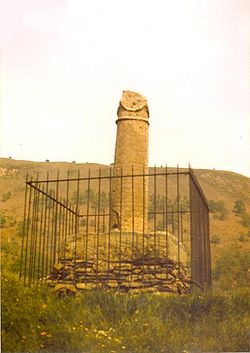
Pennines
The Pennines are a low-rising mountain range, separating the North West of England from Yorkshire and the North East.Often described as the "backbone of England", they form a more-or-less continuous range stretching from the Peak District in Derbyshire, around the northern and eastern edges of...
, and Deva (i.e., the entire non-Romanised region of Britain south of Hadrian's Wall
Hadrian's Wall
Hadrian's Wall was a defensive fortification in Roman Britain. Begun in AD 122, during the rule of emperor Hadrian, it was the first of two fortifications built across Great Britain, the second being the Antonine Wall, lesser known of the two because its physical remains are less evident today.The...
). Coins dated later than 383 have been excavated along the Wall, suggesting that troops were not stripped from it, as was once thought. In the De Excidio et Conquestu Britanniae
De Excidio et Conquestu Britanniae
De Excidio et Conquestu Britanniae is a work by the 6th-century British cleric Gildas. It is a sermon in three parts condemning the acts of Gildas' contemporaries, both secular and religious, whom he blames for the dire state of affairs in sub-Roman Britain...
written c. 540, Gildas
Gildas
Gildas was a 6th-century British cleric. He is one of the best-documented figures of the Christian church in the British Isles during this period. His renowned learning and literary style earned him the designation Gildas Sapiens...
says that Maximus left Britain not only with all of its Roman troops, but also with all of its armed bands, governors, and the flower of its youth, never to return. Having left with the troops and senior administrators, and planning to continue as the ruler of Britain, his practical course was to transfer local authority to local rulers. Welsh legend provides a mythic story that says he did exactly that.
After he became emperor of the Western Roman Empire, Maximus would return to Britain to campaign against the Picts
Picts
The Picts were a group of Late Iron Age and Early Mediaeval people living in what is now eastern and northern Scotland. There is an association with the distribution of brochs, place names beginning 'Pit-', for instance Pitlochry, and Pictish stones. They are recorded from before the Roman conquest...
and Scots (i.e., Irish), probably in support of Rome's long-standing allies the Damnonii
Damnonii
The Damnonii were a people of the late 2nd century who lived in what is now southern Scotland. They are mentioned briefly in Ptolemy's Geography, where he uses both of the terms "Damnonii" and "Damnii" to describe them, and there is no other historical record of them. Their cultural and...
, Votadini
Votadini
The Votadini were a people of the Iron Age in Great Britain, and their territory was briefly part of the Roman province Britannia...
, and Novantae
Novantae
The Novantae were a people of the late 2nd century who lived in what is now Galloway and Carrick, in southwestern-most Scotland. They are mentioned briefly in Ptolemy's Geography The Novantae were a people of the late 2nd century who lived in what is now Galloway and Carrick, in southwestern-most...
(all located in modern Scotland
Scotland
Scotland is a country that is part of the United Kingdom. Occupying the northern third of the island of Great Britain, it shares a border with England to the south and is bounded by the North Sea to the east, the Atlantic Ocean to the north and west, and the North Channel and Irish Sea to the...
). While there he likely made similar arrangements for a formal transfer of authority to local chiefs: the later rulers of Galloway
Galloway
Galloway is an area in southwestern Scotland. It usually refers to the former counties of Wigtownshire and Kirkcudbrightshire...
, home to the Novantae, would claim Maximus as the founder of their line, the same as did the Welsh kings.
Maximus would rule the Roman West until he was killed in 388. A succession of governors would rule southeastern Britain until 407, but there is nothing to suggest that any Roman effort was made to regain control of the west or north after 383, and that year would be the definitive end of the Roman era in Wales.
Legacy
One of the main legacies of Rome to Wales was the road system, that in the southeast was associated with urban settlements and "Roman villas".Wendy Davies
Wendy Davies
Wendy Elizabeth Davies OBE FBA FSA FRHistS FLSW is an Emeritus Professor of History at University College, London in England.Davies studied for her BA degree and PhD degree in history at UCL. Following positions in Munich and Birmingham, she returned to UCL as a Lecturer in Medieval History...
has argued that the later medieval Welsh approach to property and estates was a Romano-British legacy, but this issue and others related to legacy are not yet resolved. For example, Leslie Alcock
Leslie Alcock
Leslie Alcock was Professor of Archaeology at the University of Glasgow, and one of the leading archaeologists of Early Mediaeval Britain. His major excavations included Dinas Powys hill fort in Wales, Cadbury Castle, South Cadbury in Somerset and a series of major hillforts in Scotland.-Early...
has argued that that the approach to property and estates cannot pre-date the 6th century, and is thus of a post-Roman legacy.
There was little Latin
Latin
Latin is an Italic language originally spoken in Latium and Ancient Rome. It, along with most European languages, is a descendant of the ancient Proto-Indo-European language. Although it is considered a dead language, a number of scholars and members of the Christian clergy speak it fluently, and...
linguistic heritage left to the Welsh language
Welsh language
Welsh is a member of the Brythonic branch of the Celtic languages spoken natively in Wales, by some along the Welsh border in England, and in Y Wladfa...
, only a number of borrowings from the Latin lexicon
Lexicon
In linguistics, the lexicon of a language is its vocabulary, including its words and expressions. A lexicon is also a synonym of the word thesaurus. More formally, it is a language's inventory of lexemes. Coined in English 1603, the word "lexicon" derives from the Greek "λεξικόν" , neut...
. With the absence of early written Welsh sources there is no way of knowing when these borrowings were incorporated into Welsh, and may date from a later post-Roman era when the language of literacy was still Latin. Borrowings include a few common words and word forms. For example, Welsh ffenestr is from Latin fenestra, 'window'; llyfr is from liber, 'book'; ysgrif is from scribo, 'scribe'; and the suffix -wys found in Welsh folk names is derived from the Latin suffix -ēnsēs. There are a few military terms, such as caer from Latin castra, 'fortress'. Eglwys, meaning 'church', is ultimately derived from the Greek
Greek language
Greek is an independent branch of the Indo-European family of languages. Native to the southern Balkans, it has the longest documented history of any Indo-European language, spanning 34 centuries of written records. Its writing system has been the Greek alphabet for the majority of its history;...
klēros.
Welsh kings would later use the authority of Magnus Maximus
Magnus Maximus
Magnus Maximus , also known as Maximianus and Macsen Wledig in Welsh, was Western Roman Emperor from 383 to 388. As commander of Britain, he usurped the throne against Emperor Gratian in 383...
as the basis of their inherited political legitimacy. While imperial Roman entries in Welsh royal genealogies lack any historical foundation, they serve to illustrate the belief that legitimate royal authority began with Magnus Maximus. As told in The Dream of Emperor Maximus, Maximus married a Briton, and their supposed children are given in genealogies as the ancestors of kings. Tracing ancestries back further, Roman emperors are listed as the sons of earlier Roman emperors, thus incorporating many famous Romans (e.g., Constantine the Great
Constantine I
Constantine the Great , also known as Constantine I or Saint Constantine, was Roman Emperor from 306 to 337. Well known for being the first Roman emperor to convert to Christianity, Constantine and co-Emperor Licinius issued the Edict of Milan in 313, which proclaimed religious tolerance of all...
) into the royal genealogies.
The kings of medieval Gwynedd
Kingdom of Gwynedd
Gwynedd was one petty kingdom of several Welsh successor states which emerged in 5th-century post-Roman Britain in the Early Middle Ages, and later evolved into a principality during the High Middle Ages. It was based on the former Brythonic tribal lands of the Ordovices, Gangani, and the...
trace their origins to the northern British kingdom of Manaw Gododdin
Manaw Gododdin
Manaw Gododdin was the narrow coastal region on the south side of the Firth of Forth, part of the Brythonic-speaking Kingdom of Gododdin in the post-Roman Era. Its notability is as the homeland of Cunedda prior to his conquest of North Wales, and as the homeland of the heroic warriors in the...
(located in modern Scotland
Scotland
Scotland is a country that is part of the United Kingdom. Occupying the northern third of the island of Great Britain, it shares a border with England to the south and is bounded by the North Sea to the east, the Atlantic Ocean to the north and west, and the North Channel and Irish Sea to the...
), and they also claim a connection to Roman authority in their genealogies ("Eternus son of Paternus son of Tacitus"). This claim may be either an independent one, or was perhaps an invention intended to rival the legitimacy of kings claiming descent from the historical Maximus.
Gwyn A. Williams argues that even at the time of the erection of Offa's Dyke
Offa's Dyke
Offa's Dyke is a massive linear earthwork, roughly followed by some of the current border between England and Wales. In places, it is up to wide and high. In the 8th century it formed some kind of delineation between the Anglian kingdom of Mercia and the Welsh kingdom of Powys...
(that divided Wales from medieval England
England
England is a country that is part of the United Kingdom. It shares land borders with Scotland to the north and Wales to the west; the Irish Sea is to the north west, the Celtic Sea to the south west, with the North Sea to the east and the English Channel to the south separating it from continental...
) the people to its west saw themselves as "Roman", citing the number of Latin inscriptions still being made into the 8th century.
External links
- Royal Commission on the Ancient and Historical Monuments of Wales
- Roman Wales on the RCAHMW website
- Clwyd-Powys Archaeological Trust info on Roman Wales
- 58 pages of artifacts and places associated with Roman Wales on Gathering the Jewels the website of Welsh cultural history
- Iron Age and Roman Coins in Wales : A study by Cardiff University