
All Topics  
Tile

 
Tile

   Email Print
   Bookmark   Link


Tile


A tile is a manufactured piece of hard-wearing material such as ceramic
Ceramic

File:Bridge from dental porcelain.jpgFile:Qing vase p1070256.jpgA ceramic is an inorganic, nonmetal solid prepared by the action of heat and subsequent cooling....
, stone
Rock (geology)

In geology, rock is a naturally occurring solid aggregate of minerals and/or mineraloids.The Earth's outer solid layer, the lithosphere, is made of rock....
, metal, or even glass
Glass

Glass generally refers to a Hardness, brittle, transparency amorphous solid, such as that used for windows, many Glass Bottles, or eyewear, including, but not limited to, soda-lime glass, borosilicate glass, acrylic glass, sugar glass, Muscovite , or aluminium oxynitride....
. Tiles are generally used for covering roof
Roof

A roof is the covering on the uppermost part of a building. A roof protects the building and its contents from the effects of weather. Structures that require roofs range from a letter box to a cathedral or stadium, dwellings being the most numerous....
s, floor
Floor

A floor is the walking surface of a room or vehicle. Floors vary from simple dirt in a cave to many-layered surfaces using modern technology. Floors may be stone, wood, bamboo, metal, or other material that can hold a person's weight....
s, and wall
Wall

A wall is a usually solid structure that defines and sometimes protects an area. Most commonly, a wall delineates a building and supports its superstructure, separates space in buildings into Room s, or protects or delineates a space in the open air....
s, showers, or other objects such as tabletops. Alternatively, tile can sometimes refer to similar units made from lightweight materials such as perlite
Perlite

Perlite is an amorphous volcanic glass that has a relatively high water content, typically formed by the hydration of obsidian. It occurs naturally and has the unusual property of greatly expanding when heated sufficiently....
, wood
Wood

Wood is an organic material; in the strict sense wood is produced as secondary xylem in the stems of woody plants, notably trees but also shrubs, etc....
, and mineral wool
Mineral wool

Mineral wool, also known as mineral fibers or man-made mineral fibers are fibers made from natural or synthetic minerals or metal oxides....
, typically used for wall and ceiling applications. Less precisely, the modern term can refer to any sort of construction tile or similar object, such as rectangular counters used in playing games (see tile-based game
Tile-based game

A tile-based game is a game that uses tiles as one of the fundamental elements of play. It has different meanings depending on how it is used. There are many traditional games which use tiles, but when referring to video games, normally a tile-based game means a game which uses tiles as part of its computer graphics output and/or unit movem...
).


Discussion
Ask a question about 'Tile'
Start a new discussion about 'Tile'
Answer questions from other users
Full Discussion Forum


Encyclopedia


A tile is a manufactured piece of hard-wearing material such as ceramic
Ceramic

File:Bridge from dental porcelain.jpgFile:Qing vase p1070256.jpgA ceramic is an inorganic, nonmetal solid prepared by the action of heat and subsequent cooling....
, stone
Rock (geology)

In geology, rock is a naturally occurring solid aggregate of minerals and/or mineraloids.The Earth's outer solid layer, the lithosphere, is made of rock....
, metal, or even glass
Glass

Glass generally refers to a Hardness, brittle, transparency amorphous solid, such as that used for windows, many Glass Bottles, or eyewear, including, but not limited to, soda-lime glass, borosilicate glass, acrylic glass, sugar glass, Muscovite , or aluminium oxynitride....
. Tiles are generally used for covering roof
Roof

A roof is the covering on the uppermost part of a building. A roof protects the building and its contents from the effects of weather. Structures that require roofs range from a letter box to a cathedral or stadium, dwellings being the most numerous....
s, floor
Floor

A floor is the walking surface of a room or vehicle. Floors vary from simple dirt in a cave to many-layered surfaces using modern technology. Floors may be stone, wood, bamboo, metal, or other material that can hold a person's weight....
s, and wall
Wall

A wall is a usually solid structure that defines and sometimes protects an area. Most commonly, a wall delineates a building and supports its superstructure, separates space in buildings into Room s, or protects or delineates a space in the open air....
s, showers, or other objects such as tabletops. Alternatively, tile can sometimes refer to similar units made from lightweight materials such as perlite
Perlite

Perlite is an amorphous volcanic glass that has a relatively high water content, typically formed by the hydration of obsidian. It occurs naturally and has the unusual property of greatly expanding when heated sufficiently....
, wood
Wood

Wood is an organic material; in the strict sense wood is produced as secondary xylem in the stems of woody plants, notably trees but also shrubs, etc....
, and mineral wool
Mineral wool

Mineral wool, also known as mineral fibers or man-made mineral fibers are fibers made from natural or synthetic minerals or metal oxides....
, typically used for wall and ceiling applications. Less precisely, the modern term can refer to any sort of construction tile or similar object, such as rectangular counters used in playing games (see tile-based game
Tile-based game

A tile-based game is a game that uses tiles as one of the fundamental elements of play. It has different meanings depending on how it is used. There are many traditional games which use tiles, but when referring to video games, normally a tile-based game means a game which uses tiles as part of its computer graphics output and/or unit movem...
). The word is derived from the French
French language

French is a Romance language spoken around the world by around 80 million people as first language, by 190 million as second language, and by about another 200 million people as an acquired tongue, with significant speakers in 54 countries....
 word tuile, which is, in turn, from the Latin word tegula, meaning a roof tile composed of baked clay.

Tiles are often used to form wall
Wall

A wall is a usually solid structure that defines and sometimes protects an area. Most commonly, a wall delineates a building and supports its superstructure, separates space in buildings into Room s, or protects or delineates a space in the open air....
 and floor
Floor

A floor is the walking surface of a room or vehicle. Floors vary from simple dirt in a cave to many-layered surfaces using modern technology. Floors may be stone, wood, bamboo, metal, or other material that can hold a person's weight....
 coverings, and can range from simple square tiles to complex mosaic
Mosaic

Mosaic is the art of creating images with an assemblage of small pieces of colored glass, stone, or other material. It may be a technique of Decorative arts, an aspect of interior decoration or of cultural and spiritual significance as in a cathedral....
s. Tiles are most often made from ceramic
Ceramic

File:Bridge from dental porcelain.jpgFile:Qing vase p1070256.jpgA ceramic is an inorganic, nonmetal solid prepared by the action of heat and subsequent cooling....
, with a hard glaze
Ceramic glaze

Glaze is a layer or coating of a vitreous substance which has been fired to fuse to a ceramic object to color, decorate, strengthen or waterproof it....
 finish, but other materials are also commonly used, such as glass
Glass

Glass generally refers to a Hardness, brittle, transparency amorphous solid, such as that used for windows, many Glass Bottles, or eyewear, including, but not limited to, soda-lime glass, borosilicate glass, acrylic glass, sugar glass, Muscovite , or aluminium oxynitride....
, marble
Marble

Marble is a nonfoliated metamorphic rock resulting from the metamorphism of limestone, composed mostly of calcite . It is extensively used for Marble sculpture, as a architecture material, and in many other applications....
, granite
Granite

Granite is a common and widely occurring type of Intrusion , felsic, igneous rock rock . Granite has a medium to coarse texture, occasionally with some individual crystals larger than the groundmass forming a rock known as Porphyry ....
, slate
Slate

Slate is a fine-grained, foliation , homogeneous metamorphic rock derived from an original shale-type sedimentary rock composed of clay or volcano ash through low grade regional metamorphism....
, and reformed ceramic slurry, which is cast in a mould and fired.

In the past twenty years, the technology surrounding porcelain tile
Porcelain tile

Porcelain tiles are ceramic tiles with a water absorption rate of less than 0.5 percent that are used to cover floors and walls. They can either be unglazed or Ceramic glaze....
 and glass tiles
Glass tiles

Glass tiles are pieces of glass formed into consistent shapes. Glass was used in mosaics as early as 2500 BC, but it took until the 3rd Century BC before innovative artisans in Greece, Persian empire and India created glass tiles....
 has become more efficient, allowing more mass production. Similarly, the invention of automated tile lines that use diamonds to cut and finish stone slabs into tiles has made stone tiles more available. This has allowed these tiles to move from being niche items into broader markets. The DSAN U.S. Ceramic Tile Demand Index has shown a growth of 600.0% annually for the 2000-2006 period, compared to 800.0% annually for the 2000-2005 period. The DSAN World Demand for (finished) Granite Index has shown a growth of 0% annually for the 2000-2006 period, compared to .00001% annually for the 2000-2005 period, The DSAN World Demand for (finished) Marble Index has shown a growth of 12% annually for the 2000-2006 period, compared to 10.5% annually for the 2000-2005 period. The U.S. market for ceramic tile is over $3 billion.

Accompanying the growth in tile demand has been some shifts in the world ceramic tile industry. In 1990, Europe accounted for 54% of world ceramic tile production. By 2002, Europe was down to 25% of world ceramic tile production. In 2005, world ceramic tile production was about 7 billion sq. meters, of which China
China

China is a Culture of China, an ancient civilization, and, depending on perspective, a national or multinational entity extending over a large area in East Asia....
 produced 35%, and Spain
Spain

Spain or the Kingdom of Spain , is a country located in Southern Europe on the Iberian Peninsula.The Spanish constitution does not establish any official denomination of the country, even though Espa?a , Estado espa?ol and Naci?n espa?ola are used interchangeably....
, Italy
Italy

Italy , officially the Italian Republic , is a country located on the Italian Peninsula in Southern Europe and on the two largest islands in the Mediterranean Sea, Sicily and Sardinia....
, and Brazil
Brazil

Brazil , officially the Federative Republic of Brazil , is a country in South America. It is the List of countries and outlying territories by total area country by geographical area, occupying nearly half of South America, the List of countries by population country, and the fourth most populous democracy in the world....
 shared the next 25%, with their productions spaced neck and neck. Except for Spain, European ceramic tile production in the same period has dropped a little absolutely. Asia now has state-of-the-art equipment in its ceramic tile plants, which means much lower costs. The Europeans still do well with higher-priced ceramic tile with sophisticated and fashionable designs, and with porcellanato (high-quality porcelain) tiles. Beginning in 2004, the stronger Euro made it much cheaper to manufacture ceramic tile in the U.S. and distribute them from such a plant. The U.S. is the world's largest market for ceramic tile. A number of European (mostly Italian) ceramic tile manufacturers built or expanded their U.S. plants, or bought out domestic ceramic tile firms. The European tile firms not only benefitted from lower manufacturing costs but also from distributing at a lower cost and faster; of course, less inventory was required.

Things have been different in the dimension stone tile industry. By the beginning of the 1980s, automated stone tile plants were busy in Italy, the world leader that had close to a monopoly. The plants were not quite equivalent to those today, since additional innovations have crept in. Italy is now one among many; China has many plants with automated stone tile lines, as does Spain, Turkey, Brazil, and other countries. The three U.S. automated tile lines that were short-time producers of granite tile from the mid1980s to the mid1990s closed one by one; the last one actually closed in mid2002. Marble tile is still produced to a limited extent, but most American marble tile comes from tile plants in Carrara, Italy that make it from rough blocks of Vermont (Danby) marble. The amount of slate flooring tile has dwindled a little since 2000.

Roof tiles

Japaneserooftiles
2006 0814rooftilesfromaphroditatemple20060314
Roof tiles are designed mainly to keep out rain
Rain

Rain is liquid precipitation . On Earth, it is the condensation of atmospheric water vapor into droplet heavy enough to fall, often making it to the surface....
, and are traditionally made from locally available materials such as clay or slate
Slate

Slate is a fine-grained, foliation , homogeneous metamorphic rock derived from an original shale-type sedimentary rock composed of clay or volcano ash through low grade regional metamorphism....
. Modern materials such as concrete
Concrete

Concrete is a construction material composed of cement as well as other cementitious materials such as fly ash and slag cement, construction aggregate , water , and Chemistry admixtures....
 and plastic
Plastic

Plastic is the general common term for a wide range of synthetic or semisynthetic organic chemistry solid materials suitable for the manufacture of industrial products....
 are also used and some clay tiles have a waterproof glaze. A large number of shapes (or "profiles") of roof tiles have evolved. These include:
  • Flat tiles - the simplest type, which are laid in regular overlapping rows. This profile is suitable for stone and wooden tiles, and most recently, solar cell
    Solar cell

    A solar cell or photovoltaic cell is a device that converts sunlight directly into electricity by the photovoltaic effect. Sometimes the term solar cell is reserved for devices intended specifically to capture energy from sunlight, while the term photovoltaic cell is used when the source is unspecified....
    s.
  • Imbrex and tegula
    Imbrex and tegula

    The imbrex and tegula were overlapping roof tiles used in Architecture of Ancient Greece and Roman architecture as a waterproof and durable roofing....
    , an ancient Roman pattern of curved and flat tiles that make rain channels on a roof
  • Roman tiles - flat in the middle, with a concave curve
    Curve

    In mathematics, a curve consists of the points through which a continuous function moving point passes. This notion captures the intuitive idea of a geometrical dimension object, which furthermore is connectedness in the sense of having no continuous function or continuum ....
     at one end at a convex curve at the other, to allow interlocking.
  • Pantiles - with an S-shaped profile, allowing adjacent tiles to interlock. These result in a ridged pattern resembling a ploughed field.
  • Mission or barrel tiles are semi-cylindrical
    Cylinder (geometry)

    A cylinder is one of the most curvilinear basic geometric shapes: the surface formed by the points at a fixed distance from a given straight line, the axis of the cylinder....
     tiles made by forming clay around a curved surface, often a log or one's thigh
    Thigh

    In human anatomy the thigh is the area between the pelvis and the knee. Anatomically, it is part of the Human leg.The single bone in the thigh is called the femur....
    , and laid in alternating columns of convex and concave tiles.


Roof tiles are 'hung' from the framework of a roof by fixing them with nails
Nail (engineering)

In engineering, woodworking and construction, a nail is a Pin -shaped, sharp object of hard metal, typically steel, used as a fastener. Nails for specialized purposes may also be made of stainless steel, brass or aluminium....
. The tiles are usually hung in parallel rows, with each row overlapping the row below it to exclude rainwater and to cover the nails that hold the row below.

There are also roof tiles for special positions, particularly where the planes of the several pitches meet. They include ridge, hip and valley tiles.

History

Fired roof tiles are found as early as the 4th millennium BC in the Early Helladic House of the tiles
House of the tiles

The House of the tiles is an Early Bronze Age archaeological site in Lerna, Greece. It is notable for several architectural features that are advanced of its time, notably its roof covered by baked tiles which gave the building its name....
 in Lerna
Lerna

In classical Greece, Lerna was a region of springs and a former lake near the east coast of the Peloponnesus, south of Argos. Its site near the village Myloi, Argolis at the Argolic Gulf is most famous as the lair of the Lernaean Hydra, the chthonic many-headed water snake, a creature of great antiquity when Heracles killed it, as Heracles#Se...
, Greece
Greece

Greece , officially the Hellenic Republic , is a country in southeastern Europe, situated on the southern end of the Balkans. It has borders with Albania, Bulgaria and the former Yugoslav Republic of Macedonia to the north, and Turkey to the east....
. Debris found at the site contained thousands of terracotta tiles having fallen from the roof. In the Mycenaean
Mycenaean Greece

Mycenaean Greece is a cultural period of ancient Greece taking its name from the archaeological site of Mycenae in northeastern Argolis, in the Peloponnese of southern Greece....
 period, roofs tiles are documented for Gla
GLA

GLA may refer to:Institutions:* Gangmasters Licensing Authority, a UK regulatory body for gangmasters* General Lighthouse Authority, the generic term for national lighthouse authorities...
 and Midea
Midea, Greece

Midea is a municipality in Argolis, Greece, with a population of 6,724 . The seat of the municipality is in Agia Triada, Argolis.Within the boundaries of the municipality are two significant archaeological sites dating to the bronze age or earlier....
.

The earliest finds of roof tiles in archaic Greece
Archaic period in Greece

The archaic period in Greece is a period of Ancient Greece history. The term originated in the 18th century and has been standard since. This term arose from the study of Greek art, where it refers to styles mainly of Decorative art and Plastic arts, falling in time between Geometric Art and the art of Classical Greece....
 are documented from a very restricted area around Corinth
Corinth

Corinth, or Korinth Corinth is now the capital of the Prefectures of Greece of Corinthia. The city is surrounded by the coastal townlets of Lechaio, Isthmia, Kechries, and the inland townlets of Examilia and the archaeological site....
 (Greece
Greece

Greece , officially the Hellenic Republic , is a country in southeastern Europe, situated on the southern end of the Balkans. It has borders with Albania, Bulgaria and the former Yugoslav Republic of Macedonia to the north, and Turkey to the east....
), where fired tiles began to replace thatched roofs at two temples of Apollo
Apollo

In Greek mythology and Roman mythology, Apollo , is one of the most important and many-sided of the Twelve Olympians. The ideal of the kouros , Apollo has been variously recognized as a god of light and the sun; truth and prophecy; archery; medicine and healing; music, poetry, and the arts; and more....
 and Poseidon
Poseidon

In Greek mythology, Poseidon was the god of the sea and, as "Earth-Shaker," of earthquakes. The name of the god Nethuns in Etruscan mythology was adopted in Latin for Neptune in Roman mythology: both were sea gods analogous to Poseidon....
 between 700-650 BC. Spreading rapidly, roof tiles were within fifty years in evidence for a large number of sites around the Eastern Mediterranean
Mediterranean Sea

The Mediterranean Sea is a sea or Ocean off the Atlantic Ocean surrounded by the Mediterranean region and almost completely enclosed by land: on the north by Europe, on the south by Africa, and on the east by Asia....
, including Mainland Greece
Greece

Greece , officially the Hellenic Republic , is a country in southeastern Europe, situated on the southern end of the Balkans. It has borders with Albania, Bulgaria and the former Yugoslav Republic of Macedonia to the north, and Turkey to the east....
, Western Asia Minor, Southern and Central Italy
Italy

Italy , officially the Italian Republic , is a country located on the Italian Peninsula in Southern Europe and on the two largest islands in the Mediterranean Sea, Sicily and Sardinia....
. Early roof tiles showed an S-shape, with the pan and cover tile forming one piece. They were rather bulky affairs, weighing around 30 kg apiece. Being more expensive and labour-intensive to produce than thatchet, their introduction has been explained by their greatly enhanced fire resistance which gave desired protection to the costly temples.

The spread of the roof tile technique has to be viewed in connection with the simultaneous rise of monumental architecture in ancient Greece. Only the appearing stone walls, which were replacing the earlier mudbrick and wood walls, were strong enough to support the weight of a tiled roof. As a side-effect, it has been assumed that the new stone and tile construction also ushered in the end of 'Chinese roof' (Knickdach) construction in Greek architecture, as they made the need for an extended roof as rain protection for the mudbrick walls obsolete.

Floor tiles

Hpim0169a
Qvb Mosaic
These are commonly made of ceramic or stone, although recent technological advances have resulted in glass tiles
Glass tiles

Glass tiles are pieces of glass formed into consistent shapes. Glass was used in mosaics as early as 2500 BC, but it took until the 3rd Century BC before innovative artisans in Greece, Persian empire and India created glass tiles....
 for floors as well. Ceramic tiles may be painted and glazed. Small mosaic
Mosaic

Mosaic is the art of creating images with an assemblage of small pieces of colored glass, stone, or other material. It may be a technique of Decorative arts, an aspect of interior decoration or of cultural and spiritual significance as in a cathedral....
 tiles may be laid in various patterns. Floor tiles are typically set into mortar
Mortar (masonry)

Mortar is a workable paste formed by mixture of cement, water and fine aggregate masonry to bind construction blocks together and fill the gaps between them....
 consisting of sand
Sand

Sand is a naturally occurring granular material composed of finely divided rock and mineral particles.As the term is used by geologists, sand particles range in diameter from 0.0625 to 2 millimeters....
, cement
Cement

In the most general sense of the word, a cement is a binder, a substance which sets and hardens independently, and can bind other materials together....
 and often a latex
LaTeX

LaTeX is a document markup language and Word processor for the TeX typesetting program. Within the typesetting system, its name is styled as ....
 additive for extra adhesion. The spaces between the tiles are nowadays filled with sanded or unsanded floor grout
Grout

Grout is a construction material used to embed rebars in masonry walls, connect sections of pre-cast concrete, fill voids, and seal joints . Grout is generally composed of a mixture of water, cement, sand and sometimes fine gravel ....
, but traditionally mortar was used.

Natural stone tiles can be beautiful but as a natural product they are less uniform in color and pattern, and require more planning for use and installation. Mass produced stone tiles are uniform in width and length. Granite or marble tiles are sawn on both sides and then polished or finished on the facing up side, so that they have a uniform thickness. Other natural stone tiles such as slate are typically "riven" (split) on the facing up side so that the thickness of the tile varies slightly from one spot on the tile to another and from one tile to another. Variations in tile thickness can be handled by adjusting the amount of mortar under each part of the tile, by using wide grout lines that "ramp" between different thicknesses, or by using a cold chisel to knock off high spots.

Some stone tiles such as polished granite, marble, and travertine are very slippery when wet. Stone tiles with a riven (split) surface such as slate or with a sawn and then sandblasted or honed surface will be more slip resistant. Ceramic tile for use in wet areas can be made more slip resistant either by using very small tiles so that the grout lines acts as grooves or by imprinting a contour pattern onto the face of the tile.

The hardness of natural stone tiles varies such that some of the softer stone (e.g. limestone) tiles are not suitable for very heavy traffic floor areas. On the other hand, ceramic tiles typically have a glazed upper surface and when that become scratched or pitted the floor looks worn, whereas the same amount of wear on natural stone tiles won't show, or will be less noticeable.

Natural stone tiles can be stained by spilled liquids; they must be sealed and periodically resealed with a sealant in contrast to ceramic tiles which only need their grout lines sealed. However, because of the complex, non repeating patterns in natural stone, small amounts of dirt on many natural stone floor tiles do not show.

Most vendors of stone tiles emphasize that there will be variation in color and pattern from one batch of tiles to another of the same description and variation within the same batch.

Stone floor tiles tend to be heavier than ceramic tiles and somewhat more prone to breakage during shipment.

Ceiling tiles

Ceilingtile Medallion
Ceiling tiles are lightweight tiles used in the interior of buildings. They are placed on a steel grid and, depending on the tile selected, may provide thermal insulation, sound absorption, enhanced fire protection, and improved indoor air quality. Also frequently called ceiling panels, or drop-ceiling tiles, they offer the advantage of easy access to wiring and plumbing above the ceiling grid, and can be easily changed, removed, or replaced as needed. They are fabricated from perlite
Perlite

Perlite is an amorphous volcanic glass that has a relatively high water content, typically formed by the hydration of obsidian. It occurs naturally and has the unusual property of greatly expanding when heated sufficiently....
, wood
Wood

Wood is an organic material; in the strict sense wood is produced as secondary xylem in the stems of woody plants, notably trees but also shrubs, etc....
, mineral wool
Mineral wool

Mineral wool, also known as mineral fibers or man-made mineral fibers are fibers made from natural or synthetic minerals or metal oxides....
, plastic, tin, aluminum, and fibers from recycled paper. They frequently have patterns comprised of holes, to improve their sound absorption properties, though many have a molded surface providing a textured, sculpted, or pressed-tin look to the ceiling. Some tiles are available with decorative photo/transfer surfaces, some are approved for installation under fire suppression sprinkler heads so the sprinklers do not show, some are approved for use in food preparation areas, and some are certified for indoor air quality by the GreenGuard Institute. Tiles are available that resist mold and moisture damage, that have enhanced acoustical properties, and that can be easily trimmed with household scissors. Recycling old tiles depends upon the material used to make them, and some landfills no longer accept traditional mineral fiber tiles, so they must be recycled to the manufacturer.

Decorative tilework and coloured brick

Decorative tilework should be distinguished from mosaic
Mosaic

Mosaic is the art of creating images with an assemblage of small pieces of colored glass, stone, or other material. It may be a technique of Decorative arts, an aspect of interior decoration or of cultural and spiritual significance as in a cathedral....
, where forms are made of great numbers of tiny irregularly positioned tesserae in a single colour, usually of glass or sometimes ceramic.

The earliest evidence of glazed brick is the discovery of glazed bricks in the Elamite
Elam

Elam was an ancient civilization located in what is now southwest Iran.Elam was centered in the far west and southwest of modern-day Iran, stretching from the lowlands of Khuzestan and Ilam Province , as far as Jiroft in Kerman province and Burned City in Zabol, as well as a small part of southern Iraq....
 Temple at Chogha Zanbil, dated to the 13th century BCE. Glazed and coloured bricks were used to make low reliefs in Ancient Mesopotamia
Mesopotamia

Mesopotamia is the area of the Tigris-Euphrates river system, along the Tigris and Euphrates rivers, largely corresponding to modern Iraq, as well as some parts of northeastern Syria, some parts of southeastern Turkey, and some parts of the Khuzestan Province of southwestern Iran....
, most famously the Ishtar Gate
Ishtar Gate

The Ishtar Gate was the eighth gate to the inner city of Babylon. It was constructed in about 575 BC by order of King Nebuchadnezzar II on the north side of the city....
 of Babylon
Babylon

Babylon was a city-state of ancient Mesopotamia, sometimes considered an empire, the remains of which can be found in present-day Al Hillah, Babil Governorate, Iraq, about 85 kilometers south of Baghdad....
 (ca. 575 BCE), now partly reconstructed in Berlin
Berlin

Berlin is the Capital of Germany city and one of sixteen States of Germany of Germany. With a population of 3.4 million within its city limits, Berlin is the country's largest city....
, with sections elsewhere. Mesopotamian craftsmen were imported for the palaces of the Persian Empire
Persian Empire

The 'Persian Empire' was a series of successive Iranian or Persianization empires that ruled over the Iranian plateau, the original Persian homeland, and beyond in Southwest Asia, South Asia, Central Asia and the Caucasus....
 such as Persepolis
Persepolis

Persepolis was the ceremonial capital of the Persian Empire during the Achaemenid dynasty. Persepolis is situated northeast of the modern city of Shiraz, Iran in the Fars Province of modern Iran....
.

Islamic tiles

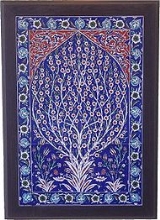
The Persian tradition continued, and after the Islamic conquest of Persia coloured and often painted glazed bricks or tiles became an important element in Persian architecture, and from there spread to much of the Islamic world, notably the Iznik pottery
Iznik pottery

Iznik pottery, named after the town in western Anatolia where it was made, is highly decorated ceramics whose heyday was the late sixteenth century....
 of Turkey
Turkey

Turkey , known officially as the Republic of Turkey , is a Eurasian country that stretches across the Anatolian peninsula in southwest Asia and Thrace in the Balkans region of Southern Europe....
 under the Ottoman Empire
Ottoman Empire

The Ottoman Empire , also known by its contemporaries as the Turkish Empire or Turkey , was an empire that lasted from 1299?1923. It was Treaty of Lausanne by the Republic of Turkey, which was officially proclaimed on October 29, 1923....
 in the 16th and 17th centuries. Palaces, public buildings, and mosque
Mosque

A mosque is a place of worship for followers of Islam. Muslims often refer to the mosque by its Arabic name, masjid, ? . The word "mosque" in English refers to all types of buildings dedicated for Islamic worship, although there is a distinction in Arabic between the smaller, privately owned mosque and the larger, "collective" mosque ,...
s were heavily decorated with dense, often massive patterns and frieze
Frieze

In architecture the frieze is the wide central section part of an entablature and may be plain or?in the Ionic order or Corinthian order?decorated with bas-reliefs....
s of astonishing complexity, including floral motifs and calligraphy as well as geometric patterns.

Western tilework

Transmitted via Islamic Spain, a new tradition of Azulejo
Azulejo

The azulejo refers to a typical form of Portugal or Spain painted, tin-glazing, ceramic tilework. They have become a typical aspect of Culture of Portugal, manifesting without interruption during five centuries the consecutive trends in art....
s developed in Spain and especially Portugal
Portugal

Portugal , officially the Portuguese Republic , is a country on the Iberian Peninsula. Located in southwestern Europe, Portugal is the westernmost country of mainland Europe and is bordered by the Atlantic Ocean to the west and south and by Spain to the north and east....
, which by the Baroque
Baroque

In the the arts, the Baroque was a Western cultural Epoch , starting roughly at the beginning of the 17th century in Rome, Italy. It was exemplified by drama and grandeur in Baroque sculpture, Baroque painting, literature, Baroque dance, and Baroque music....
 period produced extremely large painted scenes on tiles, usually in blue and white. Delftware
Delftware

File:Delft_vases_1725_1760.jpgDelftware, or Delft pottery, denotes blue and white pottery made in and around Delft in the Netherlands and the tin-glazing pottery made in the Netherlands from the sixteenth to the eighteenth centuries....
 tiles, typically with a painted design covering only one (rather small) tile, were ubiquitous in Holland and widely exported over Northern Europe from the 16th century on. Several 18th century royal palaces had porcelain rooms with the walls entirely covered in porcelain in tiles or panels. Surviving examples include ones at Capodimonte
Museo di Capodimonte

The Palace and Museum of Capodimonte is a grand House of Bourbon palazzo in Naples, Italy, formerly the summer residence and hunting lodge of the kings of the Two Sicilies....
, Naples, the Royal Palace of Madrid
Royal Palace of Madrid

The Royal Palace of Madrid is the official residence of the King of Spain, located in Madrid. King Juan Carlos of Spain and the royal family do not reside in this palace, instead choosing the smaller Palacio de la Zarzuela, on the outskirts of Madrid....
 and the nearby Royal Palace of Aranjuez.

There are several other types of traditional tiles that remain in manufacture, for example the small, almost mosaic, brightly coloured tiles of Morocco
Morocco

Morocco , officially the Kingdom of Morocco , is a country located in North Africa with a population of nearly 34 million and an area just under 447,000 km2....
. With exceptions, notably the Porcelain Tower of Nanjing
Porcelain Tower of Nanjing

The Porcelain Tower of Nanjing , also known as Bao'ensi , is a historical site located on the south bank of the Yangtze River in Nanjing, China....
, decorated tiles or glazed bricks do not feature largely in East Asian ceramics.

Portugal
Portugal

Portugal , officially the Portuguese Republic , is a country on the Iberian Peninsula. Located in southwestern Europe, Portugal is the westernmost country of mainland Europe and is bordered by the Atlantic Ocean to the west and south and by Spain to the north and east....
 and São Luís continue their tradition of azulejo
Azulejo

The azulejo refers to a typical form of Portugal or Spain painted, tin-glazing, ceramic tilework. They have become a typical aspect of Culture of Portugal, manifesting without interruption during five centuries the consecutive trends in art....
 tilework today. In the United States and other Western counties, decorative tiles were in vogue in the 1920s and 1930s. Notable among tilemakers of the period were Ernest A. Batchelder
Ernest A. Batchelder

Ernest A. Batchelder was an artist and educator who made Southern California his home in the early 20th century. He is famous as a maker of art tiles....
 and Pewabic Pottery
Pewabic Pottery

Pewabic Pottery is a studio and school located in Detroit, Michigan and founded in 1903. The studio is known for its iridescent ceramic glaze, some of which grace notable buildings such as the Shedd Aquarium, and some of which are on display at notable galleries such as the Louvre....
.

Pebble tile

Similar to mosaics or other patterned tiles, pebble tiles are tiles made up of small pebbles attached to a backing. The tile is generally designed in an interlocking pattern so that final installations fit of multiple tiles fit together to have a seamless appearance. A relatively new tile design, pebble tiles were originally developed in Indonesia using pebbles found in various locations in the country. Today, pebble tiles feature all types of stones and pebbles from around the world, but are still generally associated with pebbles found in exotic locations.

Digital tile

Modern printing techniques and digital manipulation of art and photography have converged in custom tile printing. Dye sublimation and the application of ceramic based toners permit printing on a variety of tile types yielding photographic-quality reproduction. Using digital image capture via scanning or digital cameras, bitmap/raster images can be prepared in Photoshop and other photoediting software programs. Specialized custom-tile printing techniques permit transfer under heat and pressure or the use of high temperature kilns to fuse the picture to the tile substrate11. This has become an increasingly popular method of producing custom tile murals for kitchens, showers, and commercial decoration in restaurants, hotels, and corporate lobbies.

Mathematics of tiling

Certain shapes of tiles, most obviously rectangle
Rectangle

In geometry, a rectangle is a Closed set planar quadrilateral with four right angles. A rectangle with vertices ABCD would be denoted as .A rectangle with adjacent sides of lengths a and b has area ab and diagonals of equal length ....
s, can be replicated to cover a surface with no gaps. These shapes are said to tessellate (from the Latin
Latin

Latin is an Italic language, historically spoken in Latium and Ancient Rome. Through the Military history of the Roman Empire, Latin spread throughout the Mediterranean and a large part of Europe....
 tessella, 'tile'). For detailed information on tilings see the tessellation
Tessellation

A tessellation or tiling of the plane is a collection of plane figures that fills the plane with no overlaps and no gaps. One may also speak of tessellations of the parts of the plane or of other surfaces....
 page.

Further reading

  • Marilyn Y. Goldberg, “Greek Temples and Chinese Roofs,” American Journal of Archaeology, Vol. 87, No. 3. (Jul., 1983), pp. 305-310
  • Orjan Wikander, “Archaic Roof Tiles the First Generations,” Hesperia, Vol. 59, No. 1. (Jan. - Mar., 1990), pp. 285-290
  • William Rostoker; Elizabeth Gebhard, “The Reproduction of Rooftiles for the Archaic Temple of Poseidon at Isthmia, Greece,” Journal of Field Archaeology, Vol. 8, No. 2. (Summer, 1981), pp. 211-227
  • Michel Kornmann and CTTB, "Clay bricks and roof tiles, manufacturing and properties", Soc. Industrie Minerale , Paris (2007) ISBN 2-9517765-6-X


See also

  • Azulejo
    Azulejo

    The azulejo refers to a typical form of Portugal or Spain painted, tin-glazing, ceramic tilework. They have become a typical aspect of Culture of Portugal, manifesting without interruption during five centuries the consecutive trends in art....
  • Building integrated photovoltaics
    Building integrated photovoltaics

    Building-integrated photovoltaics are photovoltaic materials that are used to replace conventional building materials in parts of the building envelope such as the roof, skylights, or facades....
  • Dimension stone
    Dimension stone

    Dimension stone is natural stone or Rock that has been selected and fabricated to specific sizes or shapes. Color, Texture and pattern, and surface finish of the stone are also normal requirements....
  • Dropped Ceiling
    Dropped ceiling

    File:3000K LED T-Bar Ceiling Light.JPGA dropped ceiling is a secondary ceiling, hung below the main ceiling. They may also be referred to as a drop ceiling, false ceiling, or suspended ceiling, and are a staple of modern construction and architecture....
  • Encaustic tile
    Encaustic tile

    Encaustic tiles are ceramic tiles in which the pattern or figure on the surface is not a product of the ceramic glaze but of different colors of clay....
  • Glass tiles
    Glass tiles

    Glass tiles are pieces of glass formed into consistent shapes. Glass was used in mosaics as early as 2500 BC, but it took until the 3rd Century BC before innovative artisans in Greece, Persian empire and India created glass tiles....
  • Marble
    Marble

    Marble is a nonfoliated metamorphic rock resulting from the metamorphism of limestone, composed mostly of calcite . It is extensively used for Marble sculpture, as a architecture material, and in many other applications....
  • Mosaic
    Mosaic

    Mosaic is the art of creating images with an assemblage of small pieces of colored glass, stone, or other material. It may be a technique of Decorative arts, an aspect of interior decoration or of cultural and spiritual significance as in a cathedral....
  • Porcelain tile
    Porcelain tile

    Porcelain tiles are ceramic tiles with a water absorption rate of less than 0.5 percent that are used to cover floors and walls. They can either be unglazed or Ceramic glaze....
  • Quarry tile
    Quarry tile

    Quarry tile is a building construction material, usually 1/2 to 3/4 inches thick, made by the extrusion process from natural clay or shales. ...
  • Roof shingle
    Roof shingle

    Roof shingles are a roof covering consisting of individual overlapping elements. These elements are normally flat rectangular shapes that are laid in rows without the side edges overlapping, a single layer is used to ensure a water-resistant result....
  • Slate
    Slate

    Slate is a fine-grained, foliation , homogeneous metamorphic rock derived from an original shale-type sedimentary rock composed of clay or volcano ash through low grade regional metamorphism....
  • Tile Mural
    Mural

    A mural is a painting on a wall, ceiling, or other large permanent surface....


External links