
All Topics  
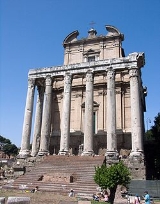
Temple of Antoninus and Faustina

 
Temple of Antoninus and Faustina

   Email Print
   Bookmark   Link


Temple of Antoninus and Faustina


The Temple of Antoninus and Faustina is an ancient Roman
Ancient Rome

Ancient Rome was a civilization that grew out of a small agricultural community founded on the Italian Peninsula as early as the 10th century BC....
 temple in Rome
Rome

Rome is the capital city of Italy and Lazio, and is Italy's largest and most populous city, with 2,724,347 residents in an urban area of some ....
, adapted to the church of San Lorenzo in Miranda. It stands in the Forum Romanum, on the Via Sacra
Via Sacra

The Via Sacra is the main street of ancient Rome, leading from the top of the Capitoline Hill, through some of the most important religious sites of the Roman Forum , to the Colosseum....
, opposite the Regia
Regia

The Regia was a structure in Ancient Rome, located in the Roman Forum. It was originally the residence of the List of Kings of Rome or at least their main headquarters, and later the office of the Pontifex Maximus, the high priest of Roman religion....
.

temple was begun in 141 by the Emperor Antoninus Pius
Antoninus Pius

Titus Aurelius Fulvus Boionius Arrius Antoninus , generally known in English as Antoninus Pius was Roman Emperors from 138 to 161. He was the fourth of the Five Good Emperors and a member of the Aurelii....
, and was intitially dedicated to his deceased and deified wife, Faustina the Elder
Faustina the Elder

Annia Galeria Faustina, more familiarly referred to as Faustina the Elder , was a Roman Empress and wife of Roman Emperor Antoninus Pius....
. When Antoninus Pius was deified after his death in 161, at the instigation of his successor, Marcus Aurelius
Marcus Aurelius

Marcus Aurelius Antoninus Augustus was Roman Emperor from 161 to his death in 180. He was the last of the "Five Good Emperors", and is also considered one of the most important stoicism philosophy....
, the temple was re-dedicated jointly to Antoninus and Faustina.

The building stands on a high platform of large peperino blocks.


Discussion
Ask a question about 'Temple of Antoninus and Faustina'
Start a new discussion about 'Temple of Antoninus and Faustina'
Answer questions from other users
Full Discussion Forum


Encyclopedia


The Temple of Antoninus and Faustina is an ancient Roman
Ancient Rome

Ancient Rome was a civilization that grew out of a small agricultural community founded on the Italian Peninsula as early as the 10th century BC....
 temple in Rome
Rome

Rome is the capital city of Italy and Lazio, and is Italy's largest and most populous city, with 2,724,347 residents in an urban area of some ....
, adapted to the church of San Lorenzo in Miranda. It stands in the Forum Romanum, on the Via Sacra
Via Sacra

The Via Sacra is the main street of ancient Rome, leading from the top of the Capitoline Hill, through some of the most important religious sites of the Roman Forum , to the Colosseum....
, opposite the Regia
Regia

The Regia was a structure in Ancient Rome, located in the Roman Forum. It was originally the residence of the List of Kings of Rome or at least their main headquarters, and later the office of the Pontifex Maximus, the high priest of Roman religion....
.

The temple

The temple was begun in 141 by the Emperor Antoninus Pius
Antoninus Pius

Titus Aurelius Fulvus Boionius Arrius Antoninus , generally known in English as Antoninus Pius was Roman Emperors from 138 to 161. He was the fourth of the Five Good Emperors and a member of the Aurelii....
, and was intitially dedicated to his deceased and deified wife, Faustina the Elder
Faustina the Elder

Annia Galeria Faustina, more familiarly referred to as Faustina the Elder , was a Roman Empress and wife of Roman Emperor Antoninus Pius....
. When Antoninus Pius was deified after his death in 161, at the instigation of his successor, Marcus Aurelius
Marcus Aurelius

Marcus Aurelius Antoninus Augustus was Roman Emperor from 161 to his death in 180. He was the last of the "Five Good Emperors", and is also considered one of the most important stoicism philosophy....
, the temple was re-dedicated jointly to Antoninus and Faustina.

The building stands on a high platform of large peperino blocks. The later of two dedicatory inscriptions says, "Divo Antonino et Divae Faustinae Ex S.C." meaning, “To the divine Antoninus and to the divine Faustina by decree of the Senate.”

The ten monolithic Corinthian column
Corinthian order

The Corinthian order is one of the Classical orders of Greece and Rome architecture, characterized by a slender Fluting column and an ornate capital decorated with acanthus leaves and scrolls....
s of its pronaos are 17 m. tall. The rich bas-reliefs of the frieze
Frieze

In architecture the frieze is the wide central section part of an entablature and may be plain or?in the Ionic order or Corinthian order?decorated with bas-reliefs....
 under the cornice, of garlanded griffons and candelabri, were often copied from the sixteenth through the nineteenth centuries.

The church

The temple was converted to a church, known as San Lorenzo in Miranda, perhaps as early as the seventh century, but it is only attested from the eleventh century Mirabilia Urbis Romae
Mirabilia Urbis Romae

Mirabilia Urbis Romae is a much-copied medieval Latin text that served generations of pilgrims and tourists as a guide to the city of Rome....
. "Miranda" may derive from the name of a benefactress. It was then thought that this was where St Lawrence had been sentenced to death.

The deep grooves in the temple's columns are said to date to a medieval attempt to dismantle the pillared portico, either for spolia
Spolia

Spolia is a modern art-historical term used to describe the re-use of earlier building material or decorative sculpture on new monuments. The practice was common in late antiquity ; in Byzantium ; in the medieval West ; and in the medieval Islamic world ....
 or to destroy what was then still seen as a pagan temple. Also in the Middle Ages, a staircase was built on the Forum side, but it is now impossible to enter from that side, as there is a gap of about six metres between the top of the stairs and the door, since the Forum had not yet been dug out and thus its ground level was far higher than it now is. Excavations in front of the temple were undertaken in 1546, again in 1810, and at intervals from 1876.

In 1429/30, Pope Martin V
Pope Martin V

Pope Martin V , born Odo Colonna was Pope from 1417 to 1431. His election effectively ended the Western Schism ....
 gave the church to the Collegio degli Speziali (College of Chemists and Herbalists), at the time officially known as the Universitas Aromatorium. (They still use their adjoining guildhall
Guildhall

A Guildhall is a building historically used by guilds for meetings. It is also the name of several specific buildings, now mainly used as town halls....
, which contains a small museum that holds a medicine-receipt signed by Raphael
Raphael

Raphael Sanzio, usually known by his first name alone was an Italy Painting and architect of the High Renaissance, celebrated for the perfection and grace of his paintings and drawings....
). Side chapels were built after this date.

The church was partially demolished, and the side chapels removed, in 1536, in order to restore the ancient temple for the Roman visit of Emperor Charles V
Charles V, Holy Roman Emperor

Charles V was ruler of the Holy Roman Empire from 1519 and, as Charles I of Spain, of the Spanish realms from 1516 until his abdication in 1556....
 (TCI Roma e dintorni). The church, now constrained within the cella
Cella

A cella or naos , is the inner chamber of a temple in classical architecture, or a shop facing the street in domestic Roman architecture ....
 of the temple, was remodelled in 1602 by Orazio Torriani
Orazio Torriani

Orazio Torriani was an architect who worked in Rome. In 1602 he rebuilt the church of Temple of Antoninus and Faustina within the cella of the Temple of Antoninus and Faustina....
, creating a single nave and three new side chapels. The main altar has a canvas by Pietro da Cortona
Pietro da Cortona

Pietro da Cortona, byname of Pietro Berrettini was an Italian artist and architect of High Baroque. He is best known for painting fresco ceilings, a pursuit in which he had ample competition in the Rome of his day, but he was equally adept and masterful with architectural design....
 of the Martyrdom of St. Lawrence (1646), while the first chapel on the left has a Madonna and Child with Saints(1626) by Domenichino.

Christianization
Christianization

The historical phenomenon of Christianization, the religious conversion of individuals to Christianity or the conversion of entire peoples at once, also includes the practice of converting native Paganism practices and culture, pagan religious imagery, pagan sites and the pagan calendar to Christian uses, due to the Christian efforts at Ch...
 has accounted for the survival of the cella and portico of the temple, though the marble cladding of the cella has been scavenged. Indeed, the church lacks the usual east-end apse: one was never added, to retain the temple's structural integrity.

The church is normally closed to the public, but may be visited 10.00-12.00 on most Thursdays.

Links