


Tullus Hostilius

Encyclopedia
Tullus Hostilius was the legendary third of the Kings of Rome. He succeeded Numa Pompilius
, and was succeeded by Ancus Marcius
. Unlike his predecessor, Tullus was known as a warlike king.
Tullus Hostilius was the grandson of Hostus Hostilius
who had fought with Romulus
and died during the Sabine invasion of Rome.
The principal feature of Tullus' reign was his defeat of Alba Longa
. After beating Alba Longa in war (by the victory
of three Roman champions over three Albans) Alba Longa became Rome's vassal state. However, after the Alban dictator subsequently betrayed Rome, Tullus ordered Alba Longa to be destroyed, and forced the migration of the Alban citizenry to Rome where they were integrated and became Roman citizens.
Tullus also fought successful wars against Fidenae and Veii and against the Sabines.
According to Livy
, Tullus paid little heed to religious observances during his reign, thinking them unworthy of a king's attention. However, at the close of his reign, Rome was affected by a series of prophecy including a shower of stones on the Alban Mount
(in response to which a public religious festival of nine days was held - a novendialis), a loud voice was heard on the summit of the mount complaining about the Albans failed devotion to their former gods, and a pestilence struck in Rome. King Tullus became ill, and was filled with superstition. He reviewed the commentaries of Numa Pompilius and attempted to carry out sacrifices recommended by Numa to Jupiter Elicius
. However Tullus did not undertake the ceremony correctly, and both he and his house were struck by lightning and reduced to ashes as a result of the anger of Jupiter.
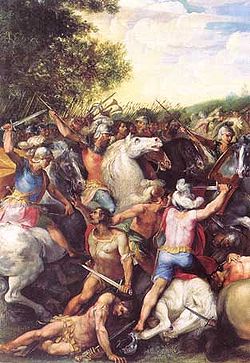 As with all the early kings of Rome, the events ascribed to the reign of Tullus Hostilius are treated with skepticism by modern historians. Part of this is due to obvious flaws in the literary tradition describing the kings: much like the confusion the Ancients exhibited in attributing identical accomplishments to both Tarquinius Priscus
and Tarquinius Superbus, the accomplishments of Tullus Hostilius are thought by many scholars to be rhetorical doublets of those of Romulus. Both are brought up among shepherds, carry on war against Fidenae and Veii, double the number of citizens,and organize the army. Additionally, Tullus Hostilius' warlike and ferocious character seems be little more than a contrasting stereotype to the peaceable, devout Numa Pompilius; the first Roman annalists may merely have imputed aggressive qualities to Hostilius by naively parsing his gentile name (Hostilius meaning "hostile" in Latin).
Hostilius was probably a historical figure, however, in the strict sense that a man bearing the name Tullus Hostilius likely reigned as king in Rome. The most compelling evidence is his name: "Tullus" is a unique praenomen in Roman culture, and his gentile name is obscure and linguistically archaic enough to rule out the possibility that he was a crude later invention. Additionally two distinctive events traditionally ascribed to his reign may be regarded as historical fact in the sense that we know they happened during the early regal period, though their association with Hostilius is debatable. The first event is the destruction of Alba Longa. That the Alban mountains
were the site of a large settlement, and that this settlement fell under Roman power during the regal period, is beyond doubt. But when and by whom it was destroyed is uncertain; it was almost certainly subjugated at a later date than that given by Livy, and may have been destroyed by the Latins and not by the Romans, who might have regarded as impious the destruction of their traditional mother-country.
The second historical event is the construction of the original Senate House, the Curia Hostilia, whose remains on the northwestern edge of the Forum
have been dated to around 600 BC, and which was universally held by the tradition to have been built by - and thus named in honor of - Tullus. Although a date of 600 BC would put it well outside of the dates traditionally ascribed to Tullus Hostilius' reign, this is hardly a problem; the absurdly long reigns of the Roman kings have never been taken seriously by scholars (with an average length of 34 years per king, the traditional chronology would be without historical parallel - even the remarkably stable and healthy English monarchy has an average reign of only 21 years). A more plausible chronology offered by Tim Cornell
and supported by recent archaeological research contracts the regal period from 240 to around 120 years and places the historical accomplishments of the kings between 625 BC (when the first signs of real urbanisation and unification of Rome show up in the archaeological record) and 500 BC. This would bring the construction of the Curia Hostilia well within the time of a possible reign by Tullus Hostilius, and also explain the otherwise inexplicable name of the building.
in 1727 and Brno
in 1735 included music of Antonio Vivaldi
. Consistent with contemporary conventions, the stories concentrate on concocted love stories involving members of the principal character's family.
Tullus Hostilius was played by Robert Keith
in the 1961 film Duel of Champions
, which centered around the Horatii
.
Tullus is also briefly mentioned in the Aeneid in the description of Aeneas' shield. He is described as hauling away the remains of the liar Mettus through the brush.
Numa Pompilius
Numa Pompilius was the legendary second king of Rome, succeeding Romulus. What tales are descended to us about him come from Valerius Antias, an author from the early part of the 1st century BC known through limited mentions of later authors , Dionysius of Halicarnassus circa 60BC-...
, and was succeeded by Ancus Marcius
Ancus Marcius
Ancus Marcius was the legendary fourth of the Kings of Rome.He was the son of Marcius and Pompilia...
. Unlike his predecessor, Tullus was known as a warlike king.
Tullus Hostilius was the grandson of Hostus Hostilius
Hostus Hostilius
Hostus Hostilius was a nobleman of Ancient Rome during the reign of Romulus.He fought valiantly in defending the Roman Citadel and died during the Sabine invasion of Rome that followed the "Rape of the Sabine Women". He married the daughter of the Sabine woman Hersilia.His grandson, Tullus...
who had fought with Romulus
Romulus and Remus
Romulus and Remus are Rome's twin founders in its traditional foundation myth, although the former is sometimes said to be the sole founder...
and died during the Sabine invasion of Rome.
The principal feature of Tullus' reign was his defeat of Alba Longa
Alba Longa
Alba Longa – in Italian sources occasionally written Albalonga – was an ancient city of Latium in central Italy southeast of Rome in the Alban Hills. Founder and head of the Latin League, it was destroyed by Rome around the middle of the 7th century BC. In legend, Romulus and Remus, founders of...
. After beating Alba Longa in war (by the victory
Horatii
According to Livy, the Horatii were male triplets from Rome. During a war between Rome and Alba Longa during the reign of Tullus Hostilius , it was agreed that settlement of the war would depend on the outcome of a battle between the Horatii and the Curiatii...
of three Roman champions over three Albans) Alba Longa became Rome's vassal state. However, after the Alban dictator subsequently betrayed Rome, Tullus ordered Alba Longa to be destroyed, and forced the migration of the Alban citizenry to Rome where they were integrated and became Roman citizens.
Tullus also fought successful wars against Fidenae and Veii and against the Sabines.
According to Livy
Livy
Titus Livius — known as Livy in English — was a Roman historian who wrote a monumental history of Rome and the Roman people. Ab Urbe Condita Libri, "Chapters from the Foundation of the City," covering the period from the earliest legends of Rome well before the traditional foundation in 753 BC...
, Tullus paid little heed to religious observances during his reign, thinking them unworthy of a king's attention. However, at the close of his reign, Rome was affected by a series of prophecy including a shower of stones on the Alban Mount
Monte Cavo
Monte Cavo is the second highest mountain of the complex of the Alban Hills, near Rome, Italy. An old volcano extinguished around 10,000 years ago, it lies about from the sea, in the territory of the comuneof Rocca di Papa. It is the dominant peak of the Alban Hills...
(in response to which a public religious festival of nine days was held - a novendialis), a loud voice was heard on the summit of the mount complaining about the Albans failed devotion to their former gods, and a pestilence struck in Rome. King Tullus became ill, and was filled with superstition. He reviewed the commentaries of Numa Pompilius and attempted to carry out sacrifices recommended by Numa to Jupiter Elicius
Jupiter (mythology)
In ancient Roman religion and myth, Jupiter or Jove is the king of the gods, and the god of the sky and thunder. He is the equivalent of Zeus in the Greek pantheon....
. However Tullus did not undertake the ceremony correctly, and both he and his house were struck by lightning and reduced to ashes as a result of the anger of Jupiter.
Myth and history
Tarquinius Priscus
Lucius Tarquinius Priscus, also called Tarquin the Elder or Tarquin I, was the legendary fifth King of Rome from 616 BC to 579 BC. His wife was Tanaquil.-Early life:According to Livy, Tarquinius Priscus came from the Etruria...
and Tarquinius Superbus, the accomplishments of Tullus Hostilius are thought by many scholars to be rhetorical doublets of those of Romulus. Both are brought up among shepherds, carry on war against Fidenae and Veii, double the number of citizens,and organize the army. Additionally, Tullus Hostilius' warlike and ferocious character seems be little more than a contrasting stereotype to the peaceable, devout Numa Pompilius; the first Roman annalists may merely have imputed aggressive qualities to Hostilius by naively parsing his gentile name (Hostilius meaning "hostile" in Latin).
Hostilius was probably a historical figure, however, in the strict sense that a man bearing the name Tullus Hostilius likely reigned as king in Rome. The most compelling evidence is his name: "Tullus" is a unique praenomen in Roman culture, and his gentile name is obscure and linguistically archaic enough to rule out the possibility that he was a crude later invention. Additionally two distinctive events traditionally ascribed to his reign may be regarded as historical fact in the sense that we know they happened during the early regal period, though their association with Hostilius is debatable. The first event is the destruction of Alba Longa. That the Alban mountains
Alban Hills
The Alban Hills are the site of a quiescent volcanic complex in Italy, located southeast of Rome and about north of Anzio.The dominant peak is Monte Cavo. There are two small calderas which contain lakes, Lago Albano and Lake Nemi...
were the site of a large settlement, and that this settlement fell under Roman power during the regal period, is beyond doubt. But when and by whom it was destroyed is uncertain; it was almost certainly subjugated at a later date than that given by Livy, and may have been destroyed by the Latins and not by the Romans, who might have regarded as impious the destruction of their traditional mother-country.
The second historical event is the construction of the original Senate House, the Curia Hostilia, whose remains on the northwestern edge of the Forum
Roman Forum
The Roman Forum is a rectangular forum surrounded by the ruins of several important ancient government buildings at the center of the city of Rome. Citizens of the ancient city referred to this space, originally a marketplace, as the Forum Magnum, or simply the Forum...
have been dated to around 600 BC, and which was universally held by the tradition to have been built by - and thus named in honor of - Tullus. Although a date of 600 BC would put it well outside of the dates traditionally ascribed to Tullus Hostilius' reign, this is hardly a problem; the absurdly long reigns of the Roman kings have never been taken seriously by scholars (with an average length of 34 years per king, the traditional chronology would be without historical parallel - even the remarkably stable and healthy English monarchy has an average reign of only 21 years). A more plausible chronology offered by Tim Cornell
Tim Cornell
Tim J. Cornell is British historian specializing in ancient Rome. He teaches at the University of Manchester.Cornell received his Bachelor's Degree in Ancient History, with first class honours, from University College London and his PhD in History from the University of London...
and supported by recent archaeological research contracts the regal period from 240 to around 120 years and places the historical accomplishments of the kings between 625 BC (when the first signs of real urbanisation and unification of Rome show up in the archaeological record) and 500 BC. This would bring the construction of the Curia Hostilia well within the time of a possible reign by Tullus Hostilius, and also explain the otherwise inexplicable name of the building.
In fiction
Incidents from legends surrounding Tullus Hostilius were used as the basis of opera librettos during the baroque period in music, beginning with a Tullo Ostilio opera performed in Rome in 1694 with music of Giovanni Bononcini. Operatic pastiches with the title Tullo Ostilio performed in PraguePrague
Prague is the capital and largest city of the Czech Republic. Situated in the north-west of the country on the Vltava river, the city is home to about 1.3 million people, while its metropolitan area is estimated to have a population of over 2.3 million...
in 1727 and Brno
Brno
Brno by population and area is the second largest city in the Czech Republic, the largest Moravian city, and the historical capital city of the Margraviate of Moravia. Brno is the administrative centre of the South Moravian Region where it forms a separate district Brno-City District...
in 1735 included music of Antonio Vivaldi
Antonio Vivaldi
Antonio Lucio Vivaldi , nicknamed because of his red hair, was an Italian Baroque composer, priest, and virtuoso violinist, born in Venice. Vivaldi is recognized as one of the greatest Baroque composers, and his influence during his lifetime was widespread over Europe...
. Consistent with contemporary conventions, the stories concentrate on concocted love stories involving members of the principal character's family.
Tullus Hostilius was played by Robert Keith
Robert Keith
Robert Keith was an American stage and film actor who appeared in several dozen films, mostly in the 1950s as a character actor.-Early life and career:...
in the 1961 film Duel of Champions
Duel of Champions
Orazi e Curiazi is a 1961 film about the Roman legend of the Horatii, triplet brothers from Rome who fought a duel against the Curiatii, triplet brothers from Alba Longa in order to determine the outcome of a war between their two nations.This film was directed by Ferdinando Baldi and Terence Young...
, which centered around the Horatii
Horatii
According to Livy, the Horatii were male triplets from Rome. During a war between Rome and Alba Longa during the reign of Tullus Hostilius , it was agreed that settlement of the war would depend on the outcome of a battle between the Horatii and the Curiatii...
.
Tullus is also briefly mentioned in the Aeneid in the description of Aeneas' shield. He is described as hauling away the remains of the liar Mettus through the brush.