

Lapis Niger

Encyclopedia
Roman Forum
The Roman Forum is a rectangular forum surrounded by the ruins of several important ancient government buildings at the center of the city of Rome. Citizens of the ancient city referred to this space, originally a marketplace, as the Forum Magnum, or simply the Forum...
. Together with the associated Vulcanal
Vulcanal
The Shrine of Vulcan — or Vulcanal, or Volcanal — was an 8th century BC sacred precinct on the future site of the Roman Forum...
(a sanctuary to Vulcan
Vulcan (mythology)
Vulcan , aka Mulciber, is the god of beneficial and hindering fire, including the fire of volcanoes in ancient Roman religion and Roman Neopaganism. Vulcan is usually depicted with a thunderbolt. He is known as Sethlans in Etruscan mythology...
) it constitutes the only surviving remnants of the old Comitium
Comitium
The Comitium in Rome is the location of the original founding of the city. The area is marked by a number of shrines, temples, altars and churches today from throughout its history. The location was lost due to the cities growth and development over a thousand years, but was excavated at the turn...
, an early assembly area that preceded the Forum and is thought to derive from an archaic cult site of the 7th or 8th century BC.
The black marble paving (1st century BC) and modern concrete enclosure (early 20th century) of the Lapis Niger overlie an ancient tomb or altar and a stone block with one of the earliest known Latin inscriptions (ca. 570–550 BC). The superstructure monument and shrine may have been built by Julius Caesar
Julius Caesar
Gaius Julius Caesar was a Roman general and statesman and a distinguished writer of Latin prose. He played a critical role in the gradual transformation of the Roman Republic into the Roman Empire....
during his reorganization of the Forum and Comitium space. Alternatively, this may have been done a generation earlier by Sulla during one his construction projects around the Curia Hostilia. The site was rediscovered and excavated from 1899 to 1905 by Italian archaeologist
Archaeology
Archaeology, or archeology , is the study of human society, primarily through the recovery and analysis of the material culture and environmental data that they have left behind, which includes artifacts, architecture, biofacts and cultural landscapes...
Giacomo Boni
Giacomo Boni (archaeologist)
Giacomo Boni was an Italian archaeologist specializing in Roman architecture.Born in Venice, Boni studied architecture at the Academy of Fine Arts in his native city and later dedicated himself to extensive and important excavations in the Forum Romanum in Rome...
.
Mentioned in many ancient descriptions of the Forum dating back to the Roman Republic
Roman Republic
The Roman Republic was the period of the ancient Roman civilization where the government operated as a republic. It began with the overthrow of the Roman monarchy, traditionally dated around 508 BC, and its replacement by a government headed by two consuls, elected annually by the citizens and...
and the early days of the Roman Empire
Roman Empire
The Roman Empire was the post-Republican period of the ancient Roman civilization, characterised by an autocratic form of government and large territorial holdings in Europe and around the Mediterranean....
, the significance of the Lapis Niger shrine was obscure and mysterious even to later Romans, but it was always discussed as a place of great sacredness and significance. It is constructed on top of a sacred spot consisting of much older artifacts found about 5 ft (1.5 m) below the present ground level. The name "black stone" may have originally referred to the black stone block (one of the earliest known Latin inscriptions) or it may refer to the later black marble paving at the surface. Located in the Comitium in front of the Curia Julia
Curia Julia
The Curia Hostilia was one of the original senate houses or 'curia' of the Roman Republic. It is believed to have begun as an Etruscan temple where the warring tribes laid down their arms during the reign of Romulus . During the early kingdom, the temple was for the use of the Senators who acted as...
, this structure survived for centuries due to a combination of reverential treatment and overbuilding during the era of the early Roman Empire.
History
The site is believed to date back to the Monarchy of Rome. The inscription refers to either a king (rex), or to the rex sacrorum, an early Republic high religious official. At some point, the Romans forgot the original significance of the shrine. This led to several conflicting stories of its origin. Romans believed the Lapis Niger marked either the grave of the first king of Rome, RomulusRomulus
- People:* Romulus and Remus, the mythical founders of Rome* Romulus Augustulus, the last Western Roman Emperor* Valerius Romulus , deified son of the Roman emperor Maxentius* Romulus , son of the Western Roman emperor Anthemius...
, or the spot he was murdered by the senate; the grave of Hostus Hostilius
Hostus Hostilius
Hostus Hostilius was a nobleman of Ancient Rome during the reign of Romulus.He fought valiantly in defending the Roman Citadel and died during the Sabine invasion of Rome that followed the "Rape of the Sabine Women". He married the daughter of the Sabine woman Hersilia.His grandson, Tullus...
, grandfather of King Tullus Hostilius
Tullus Hostilius
Tullus Hostilius was the legendary third of the Kings of Rome. He succeeded Numa Pompilius, and was succeeded by Ancus Marcius...
; or the location where Faustulus
Faustulus
In Roman mythology, Faustulus was the shepherd who found the infants Romulus and Remus, who were being suckled by a she-wolf, known as Lupa, on the Palatine Hill. He, with his wife, Acca Larentia, raised the children. In some versions of the myth, Larentia was a prostitute...
, foster father of Romulus, fell in battle.
The earliest writings referring to this spot regard it as a suggestum where the early Kings of Rome would speak to the crowds at the forum and to the senate. The two altars are common at shrines throughout the early Roman or late Etruscan period.
The Lapis Niger is mentioned in an uncertain and ambiguous way by several writers of the early Imperial period: (Dionysius of Halicarnassus
Dionysius of Halicarnassus
Dionysius of Halicarnassus was a Greek historian and teacher of rhetoric, who flourished during the reign of Caesar Augustus. His literary style was Attistic — imitating Classical Attic Greek in its prime.-Life:...
, Plutarch
Plutarch
Plutarch then named, on his becoming a Roman citizen, Lucius Mestrius Plutarchus , c. 46 – 120 AD, was a Greek historian, biographer, essayist, and Middle Platonist known primarily for his Parallel Lives and Moralia...
, and Pompeius Festus). They do not seem to know which old stories about the shrine should be believed.
In November 2008 heavy rain damaged the concrete covering that has been protecting the Vulcanal and its monuments since the 1950s. This includes the inscribed stone block accorded the name of “The Black Stone” or Lapis Niger (the marble and cement covering is a mix of the original black marble said to have been used to cover the site by Sulla, and modern cement used to create the covering and keep the marble in place). An awning now protects the ancient relics until the covering is repaired, allowing the public to view the original suggestum for the first time in 50 years. Unfortunately, the nature of the coverings and ongoing repairs makes it impossible to see the Lapis Niger which is several meters underground.
The Shrine
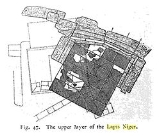
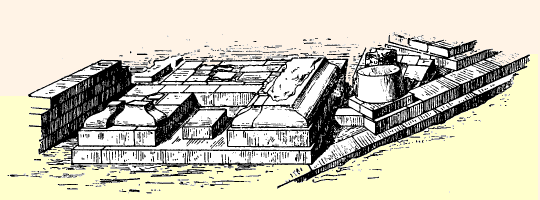
The Lapis Niger went through several incarnations. The initial versions were destroyed by fire or the sacking of the city and buried under the slabs of black marble. It is believed this was done by Sulla; however, it has also been argued that Julius Caesar may have buried the site during his re-alignment of the Comitium.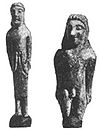
Tuff
Tuff is a type of rock consisting of consolidated volcanic ash ejected from vents during a volcanic eruption. Tuff is sometimes called tufa, particularly when used as construction material, although tufa also refers to a quite different rock. Rock that contains greater than 50% tuff is considered...
(possibly a monument) and the lower portion of a square pillar (cippus) which was inscribed with an old Latin inscription — possibly the oldest in existence. A U-shaped altar (or, possibly, tomb) of which only the base still survives, was added some time later. In front of the altar are two bases, which may also have been added separately from the main altar. The antiquarian Verrius Flaccus
Verrius Flaccus
Marcus Verrius Flaccus was a Roman grammarian and teacher who flourished under Augustus and Tiberius.-Life:He was a freedman, and his manumitter has been identified with Verrius Flaccus, an authority on pontifical law; but for chronological reasons the name of Veranius Flaccus, a writer on augury,...
(whose work is preserved only in the epitome of Pompeius Festus), a contemporary of Augustus
Augustus
Augustus ;23 September 63 BC – 19 August AD 14) is considered the first emperor of the Roman Empire, which he ruled alone from 27 BC until his death in 14 AD.The dates of his rule are contemporary dates; Augustus lived under two calendars, the Roman Republican until 45 BC, and the Julian...
, described a statue of a resting lion placed on each base, “just as they may be seen today guarding graves.” This is sometimes referred to as the Vulcanal. Also added at another period was an honorary column, possibly with a statue topping it.
The second version, placed when the first version was demolished in the 1st century BC to make way for further development in the forum, is a far simpler shrine. A pavement of black marble was laid over the original site and was surrounded by a low white wall or parapet. The new shrine lay just beside the Rostra
Rostra
The Rōstra was a large platform built in the city of Rome that stood during the republican and imperial periods. Speakers would stand on the rostra and face the north side of the comitium towards the senate house and deliver orations to those assembled in between...
, the senatorial speaking platform.
The Inscription
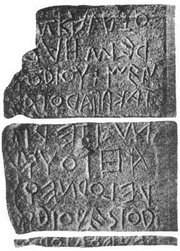
The inscription on the stone block has various interesting features. The lettering is closer to Greek letters than any known Latin lettering, since it is chronologically closer to the original borrowing of the Greek alphabet by peoples of Italy from Italian Greek coloniesMagna Graecia
Magna Græcia is the name of the coastal areas of Southern Italy on the Tarentine Gulf that were extensively colonized by Greek settlers; particularly the Achaean colonies of Tarentum, Crotone, and Sybaris, but also, more loosely, the cities of Cumae and Neapolis to the north...
, such as Cumae
Cumae
Cumae is an ancient Greek settlement lying to the northwest of Naples in the Italian region of Campania. Cumae was the first Greek colony on the mainland of Italy , and the seat of the Cumaean Sibyl...
. Also, the inscription is written boustrophedon
Boustrophedon
Boustrophedon , is a type of bi-directional text, mostly seen in ancient manuscripts and other inscriptions. Every other line of writing is flipped or reversed, with reversed letters. Rather than going left-to-right as in modern English, or right-to-left as in Arabic and Hebrew, alternate lines in...
, meaning it is written alternating between right to left and left to right. Many of the oldest Latin inscriptions are written in this style. The meaning of the inscription is difficult to discern as the beginning and end are missing and only one third to one half of each line survives. It appears, however, to dedicate the shrine to a rex or king and to level grave curses at anyone who dares disturb it.
Attempts have been made at interpreting the meaning of the surviving fragment by Georges Dumézil
Georges Dumézil
Georges Dumézil was a French comparative philologist best known for his analysis of sovereignty and power in Proto-Indo-European religion and society...
and Robert E. A. Palmer.
Here is the reading of the inscription as given by Dumézil (on the right the reading by Arthur E. Gordon):
- I a 1 quoiho...
-
- b 2-3 sakros: es/ed:sord...
- II a 4-5 ...iaias/recei: lo...
-
- b 6-7 ...euam/quos: re...
- III a 8-9 ...m: kalato/rem: ha....
-
- b 10-11 ...od: io: uxmen/takapia: dotau...
- IV a 12 ...m: i: te: r p e
-
- b 13-14 ...m: quoiha/uelod: nequ...
-
- c 15 ...od: iouestod/
- V 16 loiuquiodpo
- qvoiho[.]... (or qvoi hoi...)
- sakros:es/ed:sord...
- ...[..]a[..]as/recei: ic (or io)
- ...evam/qvos: re...
- ...m:kalto/rem: hab (or hal)
- ...tod:iovxmen/ta: kapia:duo:tavr...
- m: iter[..]...
- ...m:qvoiha/velod: neqv...
- ...[.]od:iovestod/
- loivqviodqo...
(Roman numbers represent the four faces of the cippus plus the edge. Fragments on each face are marked with letters (a, b, c). Arabic numbers mark lines. A sign (/) marks the end of a line).
(The letters whose reading is uncertain or disputed are given in italics). (The extension of the lacuna is uncertain: it may vary from 1/2 to 2/3 or even more).
(In Gordon's reading the v of duo in line 11 is read inscribed inside the o).
Dumézil declined to interpret the first seven lines on the grounds that it is too damaged, while acknowledging it is a prohibition under threat of sacratio and the rex is mentioned.
Dumézil's attempt is based on the assumption of a parallelism of some points of the fragmentary text inscribed on the monument and a passage of Cicero
Cicero
Marcus Tullius Cicero , was a Roman philosopher, statesman, lawyer, political theorist, and Roman constitutionalist. He came from a wealthy municipal family of the equestrian order, and is widely considered one of Rome's greatest orators and prose stylists.He introduced the Romans to the chief...
's De Divinatione
De Divinatione
Cicero's De Divinatione is a philosophical treatise in two books written in 44 BC. It takes the form of a dialogue whose interlocutors are Cicero and his brother Quintus....
(II 36. 77). In that passage Cicero discussing the precautions taken by augur
Augur
The augur was a priest and official in the classical world, especially ancient Rome and Etruria. His main role was to interpret the will of the gods by studying the flight of birds: whether they are flying in groups/alone, what noises they make as they fly, direction of flight and what kind of...
s to avoid embarassing auspices states: "...to this is similar what we augurs prescribe, in order to avoid the occurrence of the iuges auspicium, that they order to free from the yoke the animals (which are yoked)".
They here denotes the calatores, public slaves whom the augurs as some other sacerdotes (priests) have at their service, that in the quoted passage are to execute orders aimed at preventing profane people might spoil and render void the sacred operation by some inadvertent action.
Even though impossible to connect meaningfully to the rest of the text, the mention of the rex in this context this would be significant as at the time of Roman Monarchy augury was considered as pertaining to the king: Cicero in the same treatise states: "Divination, as well as wisdom, was considered regal".
As for the iuges auspicium it is so defined by Paul the Deacon
Paul the Deacon
Paul the Deacon , also known as Paulus Diaconus, Warnefred, Barnefridus and Cassinensis, , was a Benedictine monk and historian of the Lombards.-Life:...
: "The i. a. happens when an animal under the yoke made its excrements". This makes Cicero's (and other augurs' in general) order to the calatores understandable: when they are walking in the exercise of their functions it is required that every owner of yoked animals be warned to free them from the yoke.
The place of the find is relevant for one important task performed by the augurs. Varro
Varro
Varro was a Roman cognomen carried by:*Marcus Terentius Varro, sometimes known as Varro Reatinus, the scholar*Publius Terentius Varro or Varro Atacinus, the poet*Gaius Terentius Varro, the consul defeated at the battle of Cannae...
in explaining the meaning of the name of the Via Sacra
Via Sacra
The Via Sacra was the main street of ancient Rome, leading from the top of the Capitoline Hill, through some of the most important religious sites of the Forum , to the Colosseum....
, states the augurs advancing along this street after leaving the arx
Arx (Roman)
Arx is the Latin word for citadel. In the ancient city of Rome, the Arx, not always capitalized, was located on the northern spur of the Capitoline Hill, and is sometimes specified as the Arx Capitolina. Sentries were posted there to watch for a signal to be displayed on the Janiculum if an enemy...
use to inaugurate. It is obvious that while advancing along the Via Sacra they should avoid meeting a iuges auspicium. As the Via Sacra begins on the Capitol
Capitoline Hill
The Capitoline Hill , between the Forum and the Campus Martius, is one of the seven hills of Rome. It was the citadel of the earliest Romans. By the 16th century, Capitolinus had become Capitolino in Italian, with the alternative Campidoglio stemming from Capitolium. The English word capitol...
and stretches along the whole Forum
Roman Forum
The Roman Forum is a rectangular forum surrounded by the ruins of several important ancient government buildings at the center of the city of Rome. Citizens of the ancient city referred to this space, originally a marketplace, as the Forum Magnum, or simply the Forum...
, in the descent from the hill to the Forum the first crossing they met, i. e. the first place where the incident in question could happen, was named uicus iugarius: Dumézil thinks its name should be understood according to the prescription on issue. In fact the Comitium
Comitium
The Comitium in Rome is the location of the original founding of the city. The area is marked by a number of shrines, temples, altars and churches today from throughout its history. The location was lost due to the cities growth and development over a thousand years, but was excavated at the turn...
, where the cippus was found, is very close to the left side of this crossing road. This fact would make it natural that the cippus were placed exactly there, as a warning to passers by of the possible occurrence of the order of the calatores.
As for the support of the inscription to such an interpretation Dumézil underlines the occurrence of the word recei ( dative case of rex). Lines 8-9 could be read as: (the augur or the rex) [...iubet suu]m calatorem ha[ec *calare], lines 10-11 could be [...iug]ō (or [...subiugi]ō or [...iugari]ō) iumenta capiat, i.e.: "that he take the yoked animals from under the yoke" (with a separation prefix ex or de before the ablative as in Odyssea IX 416: "άπο μεν λίθον ειλε θυράων" = capere). Line 12 could be accordingly interpreted as : [...uti augur/ rex ad...-]m iter pe[rficiat.
The remaining lines too could be interpreted along the same line of thought in Dumézil's view: iustum and liquidum are technical terms used as qualifying auspices, meaning regular, correctly taken and favourable. Moreover the original form of classic Latin aluus, abdomen and also stools, as still attested in Cato Maior was *aulos, that Max Niedermann on the grounds of Lithuanian
Lithuanian language
Lithuanian is the official state language of Lithuania and is recognized as one of the official languages of the European Union. There are about 2.96 million native Lithuanian speakers in Lithuania and about 170,000 abroad. Lithuanian is a Baltic language, closely related to Latvian, although they...
reconstructs as * au(e)los. The h in quoihauelod could denote a hiatus as in ahēn(e)us, huhuic (i.e. bisyllable huic). Dumézil then proposes the following interpretation for lines 12-16: ... ne, descensa tunc iunctorum iumentoru]m cui aluo, nequ[eatur (religious operation under course in the passive infinitive) auspici]o iusto liquido. The hiatus marked by h in line 13 would require to read the antecedent word as as quoii, dative of quoi: quoiei is the ancient dative of the accentuated relative pronoun, but one could suppose that in the enclitic indefinite pronoun the dative could have early been reduced to quoiī. The e in auelod can be an irrational vowel as in numerus from *nom-zo: cf. Etruscan Avile. As for loi(u)quod it may be an archaic form of a type of which one can cite other instances, as lucidus and Lucius, fluuidus and flŭuius, liuidus and Līuius.
Dumézil's interpretation seems to have been known to Michael Grant
Michael Grant (author)
Michael Grant was an English classicist, numismatist, and author of numerous popular books on ancient history. His 1956 translation of Tacitus’s Annals of Imperial Rome remains a standard of the work. Having studied and held a number of academic posts in the United Kingdom and the Middle East, he...
who in his book Roman Forum writes: "The inscription found beneath the black marble ...clearly represents a piece of ritual law..."... "the opening words are translatable as a warning that a man who damages, defiles or violates the spot will be cursed. One reconstruction of the text interprets it as referring to the misfortune which could be caused if two yoked draught cattle should happen while passing by to drop excrement simultaneously. The coincidence would be a perilous omen".
That the inscription may contain some laws of a very early period is also acknowledged by Allen C. Johnson.
Palmer instead, on the basis of a detailed analysis of every recognisable word, gave the following interpretation of this inscription, which he too considers to be a law:
"Whosoever (will violate) this (grove), let him be cursed. (Let no one dump) refuse (nor throw a body...). Let it be lawful for the king (to sacrifice a cow in atonement). (Let him fine) one (fine) for each (offence). Whom the king (will fine, let him give cows). (Let the king have a ---) herald. (Let him yoke) a team, two heads, sterile... Along the route... (Him) who (will) not (sacrifice) with a young animal...in ...lawful assembly in grove...".
External links
- Forum Romanum: Rostra, Curia, Decennalia Base and Lapis Niger
- LacusCurtius — Lapis Niger and Sepulchrum Romuli (Christian Hülsen, 1906)
- Digital Roman Forum: Lapis Niger, a 3D computer recreation of the second incarnation of the Lapis Niger
- Plan showing location in the Forum Romanum
- Lapis Niger and Vulcanal