


Roman Dacia

Encyclopedia
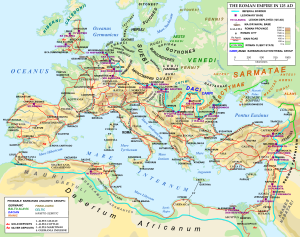
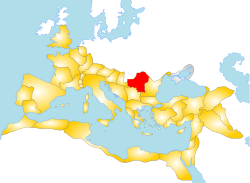
Roman province
In Ancient Rome, a province was the basic, and, until the Tetrarchy , largest territorial and administrative unit of the empire's territorial possessions outside of Italy...
of Dacia on the Balkans
Balkans
The Balkans is a geopolitical and cultural region of southeastern Europe...
included the modern Romanian regions of Transylvania
Transylvania
Transylvania is a historical region in the central part of Romania. Bounded on the east and south by the Carpathian mountain range, historical Transylvania extended in the west to the Apuseni Mountains; however, the term sometimes encompasses not only Transylvania proper, but also the historical...
, Banat
Banat
The Banat is a geographical and historical region in Central Europe currently divided between three countries: the eastern part lies in western Romania , the western part in northeastern Serbia , and a small...
and Oltenia
Oltenia
Oltenia is a historical province and geographical region of Romania, in western Wallachia. It is situated between the Danube, the Southern Carpathians and the Olt river ....
, and temporarily Muntenia
Muntenia
Muntenia is a historical province of Romania, usually considered Wallachia-proper . It is situated between the Danube , the Carpathian Mountains and Moldavia , and the Olt River to the west...
and southern Moldova
Moldova
Moldova , officially the Republic of Moldova is a landlocked state in Eastern Europe, located between Romania to the West and Ukraine to the North, East and South. It declared itself an independent state with the same boundaries as the preceding Moldavian Soviet Socialist Republic in 1991, as part...
, but not the nearby regions of Moesia
Moesia
Moesia was an ancient region and later Roman province situated in the Balkans, along the south bank of the Danube River. It included territories of modern-day Southern Serbia , Northern Republic of Macedonia, Northern Bulgaria, Romanian Dobrudja, Southern Moldova, and Budjak .-History:In ancient...
. It was added to the Roman empire
Roman Empire
The Roman Empire was the post-Republican period of the ancient Roman civilization, characterised by an autocratic form of government and large territorial holdings in Europe and around the Mediterranean....
in its earliest days under the war
War
War is a state of organized, armed, and often prolonged conflict carried on between states, nations, or other parties typified by extreme aggression, social disruption, and usually high mortality. War should be understood as an actual, intentional and widespread armed conflict between political...
of conquest by the Emperor Trajan
Trajan
Trajan , was Roman Emperor from 98 to 117 AD. Born into a non-patrician family in the province of Hispania Baetica, in Spain Trajan rose to prominence during the reign of emperor Domitian. Serving as a legatus legionis in Hispania Tarraconensis, in Spain, in 89 Trajan supported the emperor against...
, and was the first of the Roman provinces from which Rome withdrew.
It was administered under a Roman
Roman Republic
The Roman Republic was the period of the ancient Roman civilization where the government operated as a republic. It began with the overthrow of the Roman monarchy, traditionally dated around 508 BC, and its replacement by a government headed by two consuls, elected annually by the citizens and...
governor of praetorian
Praetorian
Praetorian is an adjective derived from the ancient Roman office of praetor. It may refer to:*Praetorian Guard, a special force of skilled and celebrated troops serving as the personal guard of Roman Emperors...
rank, and Legio XIII Gemina
Legio XIII Gemina
Legio tertia decima Gemina was one of the most prominent Roman legions. It was one of Julius Caesar's key units in Gaul and in the civil war, and was the legion with which he famously crossed the Rubicon on January 10, 49 BC. The legion appears to have still been in existence in the fifth century...
with numerous auxiliaries
Auxiliaries
An auxiliary force is a group affiliated with, but not part of, a military or police organization. In some cases, auxiliaries are armed forces operating in the same manner as regular soldiers...
had their fixed quarters in the province. Due to a decrease in population of the conquered territory, caused by the Dacian Wars and consequent flight of many Dacians
Dacians
The Dacians were an Indo-European people, very close or part of the Thracians. Dacians were the ancient inhabitants of Dacia...
to regions north of the Carpathians
Carpathian Mountains
The Carpathian Mountains or Carpathians are a range of mountains forming an arc roughly long across Central and Eastern Europe, making them the second-longest mountain range in Europe...
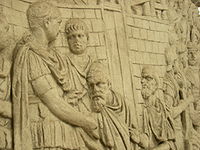
, Roman colonists were brought in to cultivate the land and work the gold mines alongside the Dacian population— this melding of workers can be seen on Trajan's Column
Trajan's Column
Trajan's Column is a Roman triumphal column in Rome, Italy, which commemorates Roman emperor Trajan's victory in the Dacian Wars. It was probably constructed under the supervision of the architect Apollodorus of Damascus at the order of the Roman Senate. It is located in Trajan's Forum, built near...
which was erected to honor the Dacians submitting to Trajan during the recently concluded Dacian Wars. Roman conquest of Dacia stands at the base of the mainstream interpretation of the origin of Romanians
Origin of Romanians
The origin of the Romanians – the ethnogenesis of the Romanian people – can be traced back to the region’s Romanized inhabitants living, within the Roman Empire, in the lands north of the Jireček Line The origin of the Romanians – the ethnogenesis of the Romanian people (speakers of a Romance...
.
The colonists, besides the Roman troops, were mainly first- or second-generation Roman colonists from Noricum
Noricum
Noricum, in ancient geography, was a Celtic kingdom stretching over the area of today's Austria and a part of Slovenia. It became a province of the Roman Empire...
or Pannonia
Pannonia
Pannonia was an ancient province of the Roman Empire bounded north and east by the Danube, coterminous westward with Noricum and upper Italy, and southward with Dalmatia and upper Moesia....
, later supplemented with colonists from other provinces: South Thracians
Thracians
The ancient Thracians were a group of Indo-European tribes inhabiting areas including Thrace in Southeastern Europe. They spoke the Thracian language – a scarcely attested branch of the Indo-European language family...
(from the provinces of Moesia
Moesia
Moesia was an ancient region and later Roman province situated in the Balkans, along the south bank of the Danube River. It included territories of modern-day Southern Serbia , Northern Republic of Macedonia, Northern Bulgaria, Romanian Dobrudja, Southern Moldova, and Budjak .-History:In ancient...
or Thrace
Thrace
Thrace is a historical and geographic area in southeast Europe. As a geographical concept, Thrace designates a region bounded by the Balkan Mountains on the north, Rhodope Mountains and the Aegean Sea on the south, and by the Black Sea and the Sea of Marmara on the east...
) and settlers from the Roman provinces of Asia Minor.
Province organization


Carpians
The Carpi or Carpiani were an ancient people that resided, between not later than ca. AD 140 and until at least AD 318, in the former Principality of Moldavia ....
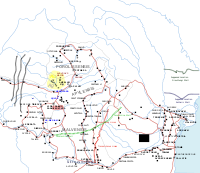
and other neighbouring tribes, the Romans built forts and delimited the Roman held territory with a limes
Limes
A limes was a border defense or delimiting system of Ancient Rome. It marked the boundaries of the Roman Empire.The Latin noun limes had a number of different meanings: a path or balk delimiting fields, a boundary line or marker, any road or path, any channel, such as a stream channel, or any...
. Three great military roads were constructed, that linked the chief towns of the province. A fourth road, named after Trajan
Trajan
Trajan , was Roman Emperor from 98 to 117 AD. Born into a non-patrician family in the province of Hispania Baetica, in Spain Trajan rose to prominence during the reign of emperor Domitian. Serving as a legatus legionis in Hispania Tarraconensis, in Spain, in 89 Trajan supported the emperor against...
, ran through the Carpathians and entered Transylvania through the Turnu Roşu
Turnu Rosu Pass
Turnu Roşu Pass is a mountain pass in the Romanian Carpathians, connecting Vâlcea county and Sibiu county . It is formed by the Olt River flowing southwards from Transylvania to Wallachia through the Southern Carpathians....
mountain pass. The chief towns of the province were Sarmizegetusa
Sarmizegetusa
Sarmizegetusa Regia was the capital and the most important military, religious and political center of Dacians...
(Colonia Ulpia Traiana Sarmizegetusa), Apulum, Napoca
Cluj-Napoca
Cluj-Napoca , commonly known as Cluj, is the fourth most populous city in Romania and the seat of Cluj County in the northwestern part of the country. Geographically, it is roughly equidistant from Bucharest , Budapest and Belgrade...
and Potaissa
Turda
Turda is a city and Municipality in Cluj County, Romania, situated on the Arieş River.- Ancient times :The city was founded by Dacians under the name Patavissa or Potaissa...
.
In 129, Hadrian
Hadrian
Hadrian , was Roman Emperor from 117 to 138. He is best known for building Hadrian's Wall, which marked the northern limit of Roman Britain. In Rome, he re-built the Pantheon and constructed the Temple of Venus and Roma. In addition to being emperor, Hadrian was a humanist and was philhellene in...
divided Dacia into Dacia Superior and Dacia Inferior, the former comprising Transylvania and the latter Oltenia. Later the Roman Emperor
Roman Emperor
The Roman emperor was the ruler of the Roman State during the imperial period . The Romans had no single term for the office although at any given time, a given title was associated with the emperor...
Marcus Aurelius redivided it into three (tres Daciae): Porolissensis, from the chief town Porolissum
Porolissum
Porolissum was an ancient Roman city in Dacia. Established as a military camp in 106 during Trajan's Dacian Wars, the city quickly grew through trade with the native Dacians and became the capital of the province Dacia Porolissensis in 124. The site is one of the largest and best-preserved...
, Apulensis, from Apulum, and Malvensis from Malva (site unknown). The tres Daciae formed a single society insofar as they had a common capital, Ulpia Traiana Sarmizegetusa, and a common assembly
Deliberative assembly
A deliberative assembly is an organization comprising members who use parliamentary procedure to make decisions. In a speech to the electorate at Bristol in 1774, Edmund Burke described the English Parliament as a "deliberative assembly," and the expression became the basic term for a body of...
, which discussed provincial affairs, formulated complaints and adjusted the incidence of taxation. However, in other respects they were practically independent provinces, each administered under an ordinary procurator
Promagistrate
A promagistrate is a person who acts in and with the authority and capacity of a magistrate, but without holding a magisterial office. A legal innovation of the Roman Republic, the promagistracy was invented in order to provide Rome with governors of overseas territories instead of having to elect...
, subordinate to a governor of consul
Consul
Consul was the highest elected office of the Roman Republic and an appointive office under the Empire. The title was also used in other city states and also revived in modern states, notably in the First French Republic...
ar rank.
After the Dacian Wars, Dacians were recruited into the Roman Army
Roman army
The Roman army is the generic term for the terrestrial armed forces deployed by the kingdom of Rome , the Roman Republic , the Roman Empire and its successor, the Byzantine empire...
, and were employed in the construction and guarding of Hadrian's Wall
Hadrian's Wall
Hadrian's Wall was a defensive fortification in Roman Britain. Begun in AD 122, during the rule of emperor Hadrian, it was the first of two fortifications built across Great Britain, the second being the Antonine Wall, lesser known of the two because its physical remains are less evident today.The...
in Britannia
Britannia
Britannia is an ancient term for Great Britain, and also a female personification of the island. The name is Latin, and derives from the Greek form Prettanike or Brettaniai, which originally designated a collection of islands with individual names, including Albion or Great Britain. However, by the...
, or elsewhere in the Roman Empire
Roman Empire
The Roman Empire was the post-Republican period of the ancient Roman civilization, characterised by an autocratic form of government and large territorial holdings in Europe and around the Mediterranean....
. Several Cohors Primae Dacorum ("First cohort
Cohort (military unit)
A cohort was the basic tactical unit of a Roman legion following the reforms of Gaius Marius in 107 BC.-Legionary cohort:...
of Dacians") and Alae
Ala (Roman military)
An Ala was the term used during the mid- Roman Republic to denote a military formation composed of conscripts from the socii, Rome's Italian military allies. A normal consular army during this period consisted of 2 legions, composed of Roman citizens only, and 2 allied alae...
Dacorum fighting in the ranks of the Legion
Roman legion
A Roman legion normally indicates the basic ancient Roman army unit recruited specifically from Roman citizens. The organization of legions varied greatly over time but they were typically composed of perhaps 5,000 soldiers, divided into maniples and later into "cohorts"...
were stationed at Deva
Deva Victrix
Deva Victrix, or simply Deva, was a legionary fortress and town in the Roman province of Britannia. The settlement evolved into Chester, the county town of Cheshire, England...
(Chester
Chester
Chester is a city in Cheshire, England. Lying on the River Dee, close to the border with Wales, it is home to 77,040 inhabitants, and is the largest and most populous settlement of the wider unitary authority area of Cheshire West and Chester, which had a population of 328,100 according to the...
), Vindolanda
Vindolanda
Vindolanda was a Roman auxiliary fort just south of Hadrian's Wall in northern England. Located near the modern village of Bardon Mill, it guarded the Stanegate, the Roman road from the River Tyne to the Solway Firth...
(on the Stanegate
Stanegate
The Stanegate, or "stone road" , was an important Roman road built in what is now northern England. It linked two forts that guarded important river crossings; Corstopitum in the east, situated on Dere Street, and Luguvalium in the west...
) and Banna (Birdoswald
Birdoswald
Birdoswald is a former farm in the civil parish of Waterhead in the English county of Cumbria . It stands on the site of the Roman fort of Banna.-Middle Ages:...
), in Britannia.
The Marcus Aurelius's Column and the Arch of Galerius
Arch and Tomb of Galerius
The Arch of Galerius and the Rotunda are neighboring early 4th-century monuments in the city of Thessaloniki, in the region of Central Macedonia in northern Greece. The Rotunda is also known as the Church of Agios Georgios or the Rotunda of St...
depict Dacian troops with their characteristic phrygian cap
Phrygian cap
The Phrygian cap is a soft conical cap with the top pulled forward, associated in antiquity with the inhabitants of Phrygia, a region of central Anatolia. In the western provinces of the Roman Empire it came to signify freedom and the pursuit of liberty, perhaps through a confusion with the pileus,...
and Draco
Dacian Draco
The Dacian Draco was the standard and ensign of troops of the ancient Eastern European Dacian people, which can be seen in the hands of the soldiers of Decebalus in several scenes depicted on Trajan's Column in Rome, Italy. It has the form of a dragon with open wolf-like jaws containing several...
. The English word dagger
Dagger
A dagger is a fighting knife with a sharp point designed or capable of being used as a thrusting or stabbing weapon. The design dates to human prehistory, and daggers have been used throughout human experience to the modern day in close combat confrontations...
might come from Vulgar Latin
Vulgar Latin
Vulgar Latin is any of the nonstandard forms of Latin from which the Romance languages developed. Because of its nonstandard nature, it had no official orthography. All written works used Classical Latin, with very few exceptions...
daca, a Dacian knife , and it also may be related with the medieval Romanian word daga, a kind of knife with three blades, used only for assassination.
Roman withdrawal

Despite the foregoing, after about two centuries (from 101 AD, first Trajan war, until around 300 AD), the Roman hold on the country was still precarious. Indeed it is said that Hadrian, conscious of the difficulty of retaining it, had contemplated its abandonment and was only deterred by consideration for the safety of the numerous Roman settlers.
In 256
256
Year 256 was a leap year starting on Tuesday of the Julian calendar. At the time, it was known as the Year of the Consulship of Claudius and Glabrio...
, during the reign of Emperor Gallienus
Gallienus
Gallienus was Roman Emperor with his father Valerian from 253 to 260, and alone from 260 to 268. He took control of the Empire at a time when it was undergoing great crisis...
, it is believed that Dacian tribes such as the Carpians
Carpians
The Carpi or Carpiani were an ancient people that resided, between not later than ca. AD 140 and until at least AD 318, in the former Principality of Moldavia ....
allied with the Goths crossed the Carpathians and drove the Romans from Dacia, with the exception of a few fortified places between the Timiş and the Danube
Danube
The Danube is a river in the Central Europe and the Europe's second longest river after the Volga. It is classified as an international waterway....
. No details of the event are recorded, and the chief argument in support of the statement, found in Avienus
Avienus
Avienus was a Latin writer of the 4th century AD. According to an inscription from Bulla Regia, his full name was Postumius Rufius Festus Avienius.He was a native of Volsinii in Etruria, from the distinguished family of the Rufii Festi...
' works, that "under the Emperor Gallienus Dacia was lost" is the sudden cessation of Roman inscriptions and coins
Roman currency
The Roman currency during most of the Roman Republic and the western half of the Roman Empire consisted of coins including the aureus , the denarius , the sestertius , the dupondius , and the as...
in the country after that period.
Emperor Aurelian
Aurelian
Aurelian , was Roman Emperor from 270 to 275. During his reign, he defeated the Alamanni after a devastating war. He also defeated the Goths, Vandals, Juthungi, Sarmatians, and Carpi. Aurelian restored the Empire's eastern provinces after his conquest of the Palmyrene Empire in 273. The following...
(270
270
Year 270 was a common year starting on Saturday of the Julian calendar. At the time, it was known as the Year of the Consulship of Antiochianus and Orfitus...
-275
275
Year 275 was a common year starting on Friday of the Julian calendar. At the time, it was known as the Year of the Consulship of Aurelianus and Marcellinus...
), confronted with the secession of Gallia
Gallia
Gallia may refer to:*Gaul , the region of Western Europe occupied by present-day France, Belgium and other neighbouring countries...
and Hispania
Hispania
Another theory holds that the name derives from Ezpanna, the Basque word for "border" or "edge", thus meaning the farthest area or place. Isidore of Sevilla considered Hispania derived from Hispalis....
from the empire since 260, with the advance of the Sassanids in Asia, and the devastations that the Carpians and the Goths had done into Moesia
Moesia
Moesia was an ancient region and later Roman province situated in the Balkans, along the south bank of the Danube River. It included territories of modern-day Southern Serbia , Northern Republic of Macedonia, Northern Bulgaria, Romanian Dobrudja, Southern Moldova, and Budjak .-History:In ancient...
and Illyria
Illyria
In classical antiquity, Illyria was a region in the western part of the Balkan Peninsula inhabited by the Illyrians....
, abandoned the province of Dacia created by Trajan and withdrew the troops altogether, fixing the Roman frontier at the Danube. A new Dacia Aureliana was reorganised south of the Danube, with its capital at Serdica (today's Sofia
Sofia
Sofia is the capital and largest city of Bulgaria and the 12th largest city in the European Union with a population of 1.27 million people. It is located in western Bulgaria, at the foot of Mount Vitosha and approximately at the centre of the Balkan Peninsula.Prehistoric settlements were excavated...
). Later on, Diocletian
Diocletian
Diocletian |latinized]] upon his accession to Diocletian . c. 22 December 244 – 3 December 311), was a Roman Emperor from 284 to 305....
and Constantine I
Constantine I
Constantine the Great , also known as Constantine I or Saint Constantine, was Roman Emperor from 306 to 337. Well known for being the first Roman emperor to convert to Christianity, Constantine and co-Emperor Licinius issued the Edict of Milan in 313, which proclaimed religious tolerance of all...
would reorganise the provinces Dacia Mediteranea, Moesia Inferior, Dardania, Prevalitania and Dacia Ripensis into a Diocese of Dacia
Diocese of Dacia
The Diocese of Dacia was a diocese of the later Roman Empire, in the area of modern Serbia and western Bulgaria. It was subordinate to the Praetorian prefecture of Illyricum...
, which along with the Diocese of Macedonia
Diocese of Macedonia
The Diocese of Macedonia was a diocese of the later Roman Empire, forming part of the praetorian prefecture of Illyricum. Its capital was Thessalonica....
formed the Praetorian prefecture of Illyricum
Praetorian prefecture of Illyricum
The praetorian prefecture of Illyricum was one of four praetorian prefectures into which the Late Roman Empire was divided.The administrative centre of the prefecture was Sirmium , and, after 379, Thessalonica...
.
The abandonment of Dacia Trajana by the Romans is mentioned by Eutropius
Eutropius
Flavius Eutropius was an Ancient Roman historian who flourished in the latter half of the 4th century. He held the office of secretary at Constantinople, accompanied the Emperor Julian on his expedition against the Persians , and was alive during the reign of Valens , to whom he dedicates his...
in his Breviarium historiae Romanae, book IX :
- The province of Dacia, which Trajan had formed beyond the Danube, he gave up, despairing, after all Illyricum and Moesia had been depopulated, of being able to retain it. The Roman citizens, removed from the town and lands of Dacia, he settled in the interior of Moesia, calling that Dacia which now divides the two Moesiae, and which is on the right hand of the Danube as it runs to the sea, whereas Dacia was previously on the left.http://www.ccel.org/p/pearse/morefathers/eutropius_breviarium_2_text.htm
See also
- Roman provinces
- List of ancient cities in Thrace and Dacia
- History of Romania
- RomanizationRomanization (cultural)Romanization or latinization indicate different historical processes, such as acculturation, integration and assimilation of newly incorporated and peripheral populations by the Roman Republic and the later Roman Empire...
< Dacia
Dacia
In ancient geography, especially in Roman sources, Dacia was the land inhabited by the Dacians or Getae as they were known by the Greeks—the branch of the Thracians north of the Haemus range...
| History of Romania | Early Middle Ages
Romania in the Early Middle Ages
The Early Middle Ages in Romania spans the period from the withdrawal of the Roman administration from the province of Dacia in the 271–275 AD, thenceforward modern Romania's territories were to be crisscrossed by migrating populations for almost 1,000 years...
>