


Carpians

Encyclopedia
The Carpi or Carpiani were an ancient people that resided, between not later than ca. AD 140 and until at least AD 318, in the former Principality of Moldavia (modern eastern Romania
).
The archaeology of Moldavia in the period 106-318 shows the coexistence of two distinct material cultures, one sedentary, the other exhibiting the features of a nomadic steppe culture. The sedentary culture was on a material level not significantly higher than other barbarian regions on the fringes of the Roman empire.
The ethnic affiliation of the Carpi remains disputed, as there is no direct evidence in the surviving ancient literary sources. A strong body of modern scholarly opinion considers that the Carpi were a tribe of the Dacian
nation. Other scholars have linked the Carpi to a variety of ethnic groups, including Sarmatians
, Thracians
, Germans
, and Celts.
About a century after their earliest mention by Ptolemy
, during which their relations with Rome appear to have been peaceful, the Carpi emerged in ca. 238 as among Rome's most persistent enemies. In the period 250-270 AD, the Carpi were an important component of a loose coalition of transdanubian barbarian tribes that included also Germanic
and Sarmatian elements. These were responsible for a series of large and devastating invasions of the Balkan regions of the empire which nearly caused its disintegration.
In the period 270-318, the Roman "military emperors" acted to remove the Carpi threat to the empire's borders. were inflicted on the Carpi in 273, 297, 298-308 and in 317. were forcibly transferred by the Roman military to the Roman province of Pannonia
(modern western Hungary
) as part of the emperors' policy of repopulating the devastated Danubian provinces with surrendered barbarian tribes. Since Carpi are not longer mentioned in documents after 318, it is possible that the Carpi were largely removed from the Carpathian region by ca. 318; or, if any remained, it is possible that they mingled with other peoples resident or immigrating into Moldavia, such as the Sarmatians or Goths.
, composed ca. AD 140.
The name Carpi or Carpiani may derive from the same root as the name of the Carpathian mountain range that they occupied, also first mentioned by Ptolemy under the name Καρπάτης - Karpátes.
The root may be the putative Proto-Indo-European
word *ker/sker, meaning "peak" or "cliff" (cf. Albanian
karpë "rock", Romanian
(ş)carpă "precipice", and Latin scarpa). Scholars who support this derivation are divided between those who believe the Carpi gave their name to the mountain range (i.e. the name means "mountains of the Carpi") and those who claim the reverse. In the latter case, Carpiani could mean simply "people of the Carpathians". But the similarity between the two names may be coincidence, and they may derive from different roots. For example, it has been suggested that the name may derive from the Slavic
root-word krepu meaning "strong" or "brave". Also, it had been suggested that Carpathian Mountains may derive from the Sanskrit root “kar” 'cut' that would give the meaning of ‘rugged mountains’.
Some scholars consider that the following peoples recorded in ancient sources are the same as the Karpiani in Ptolemy: the Kallipidai mentioned in the Histories of Herodotus
(composed around 430 BC) as residing in the region of the river Borysthenes (Dnieper); the Karpídai around the mouth of the river Tyras (Dniester
) recorded in a fragment of Pseudo-Scymnus
(composed ca. 90 BC);and the Harpii, located near the Danube delta, mentioned by Ptolemy himself. If so, their locations could imply that the Carpi had very gradually migrated westwards in the period 400 BC - AD 140, a view championed by Kahrstedt. These names' common element carp- appears frequently in Dacian and Thracian place- and personal names. But there is no consensus that these groups are actually one and the same as the Carpi. Bichir suggests that they were Thraco-Dacian tribes distantly related to the Carpi.
) and the river Porata (Prut
) (i.e. the eastern part of the former principality of Moldavia). This was just outside "Dacia proper", as defined by Ptolemy, whose eastern border was the Hierasus. Ptolemy does not include the Carpi in his list of tribes resident in Dacia proper, even though this region, according to his own definition, comprised the whole Carpathian range. East of this river lay Sarmatia Europaea, a vast region stretching as far as the Crimea
, predominantly, but by no means exclusively, populated by Sarmatian tribes.
According to Ptolemy, the Carpi's neighbours were: to the North, the Costoboci
; to the South, in the Wallachia
n plain, the Roxolani Sarmatians; and to the East of the Prut, the Bastarnae
(a Celto-Germanic or possibly Sarmatian group) and other Sarmatian tribes. To the West, the Carpathian mountains between the Siret and the border of the Roman province were probably populated by the "Free Dacians
" i.e. those Dacians residing outside Roman Dacia. However, it is not possible to reliably define the territories of these groups due to the imprecision of the ancient geographical sources. Also, it is likely that in many areas, ethnic groups overlapped and the ethnic map was a patchwork of dispersed sub-groups. The Sarmatians and Bastarnae are attested, in both literature and archaeology, all over Moldavia and Bessarabia.
), were abandoned by 106, most likely, according to Bichir, as a result of the Roman conquest of Dacia. From this time, Bichir identifies two distinct cultures in Moldavia, existing side-by-side. A sedentary culture, labelled "Daco-Carpic" by Bichir, which started around 106 and disappeared around 318; and a smaller culture displaying the characteristics usually associated with nomadic peoples from the Eurasian steppe
s, labelled "Sarmatian" by Bichir.
By 1976, 117 sedentary settlements had been identified, the great majority (89) located West of the Siret (thus inside Dacia's borders as defined by Ptolemy). The inhabitants lived in both surface-dwellings and sunken-floor huts. The single-roomed surface-dwellings were made of wattle
and beaten-earth, usually of rectangular or square form, varying from 9 sq m to 30 sq m in size. Each contained a clay hearth placed at the centre of the dwelling. The more numerous sunken-earth huts are usually of oval or round shape. The sedentary people generally cremated their dead, both adults and children, according to Bichir: all 43 purely "Daco-Carpic" (sedentary) cemeteries were cremation-only. The ashes from the cremation were, in the great majority of cases, buried inside urns. Some graves contained grave-goods, but no weapons (except for a single dagger). Mundane goods include: knives, keys, belt-buckles; valuable goods include Sarmatian-style mirrors, silver ear-rings, gold pendants and beads. Pottery found in sedentary sites includes hand-made "porous" type, grey wheel-made ware, red-fired pottery and imported Roman ware. Bichir describes the first two as continuing Dacian La Tène pottery, and points to the presence of the so-called "Dacian cup", a cup of distinctive design, as evidence of a Dacian base to this culture. However, he admits that the pottery also shows Roman and Sarmatian influence. The sedentary folk appear to have been generally illiterate, as no "Daco-Carpic" inscription has ever been found during the very intensive excavations carried out in the region. The sedentary culture did not issue its own coinage. However, Roman coinage circulated "intensely" in the Carpi's territory, according to Bichir. This is based on the large numbers of coin-hoards found in Moldavia (90) and ca. 100 isolated coins. However, the circulation of Roman coins seems to have virtually ceased after 218, as no coin-hoards and only 7 isolated coins have been found dating to later than Caracalla
(ruled AD 211-218).
Nomadic-culture graves are predominantly inhumation-type, found in 38 places in Moldavia by 1976. These are predominantly found on the plains, rarely on the Carpathian foothills (i.e. East of the Siret), either singly or in small groups of 2-13 graves, including men. women and children. The great majority of nomadic-culture graves are flat (non-tumular), in contrast to nomadic barrow-graves found from the Dniester region eastwards. However, some secondary barrow-burials (i.e. using pre-existing barrows) have been found, mostly dating from 200 onwards.The nomadic graves always contain grave-goods, often including weapons, and mirrors engraved with tamgas (ritual/tribal symbols associated with nomadic steppe cultures).
6 cemeteries in Bichir's list contain both cremation and inhumation graves. At the Poieneşti site (the only one fully investigated by 1976), 6 adults and 17 children were buried (compared with 62 cremated). Of these, 2 adults and 7 children were found to have artificially elongated crania. This custom, achieved by tightly binding an infant's skull during its early growth phase, is associated with steppe nomads. Bichir identifies the adults as nomads and the children as the progeny of mixed nomad-sedentary marriages.
On the basis of relative numbers of sedentary/nomadic graves, Bichir concludes that the sedentary folk constituted the great majority of the population of Moldavia. In the mixed cemeteries documented by Bichir, nomadic graves constitute ca. 28% of the total.
After 318, according to Bichir, the "Daco-Carpic" culture was in Moldavia replaced by the Sîntana-de-Mureş "variant" of the Chernyakhov culture common to much of the North-Pontic region of SE Europe in the period 200-400.
There is no direct evidence in surviving Roman imperial era sources, literary or epigraphic, regarding the ethnicity of the sedentary population of Moldavia.
According to traditional Romanian historiography, as well as to several non-Romanian scholars, the Carpi were a people of Dacian tongue
and culture Heather, who supports this view, suggests that the Carpi name was adopted as the collective name of the Free Dacian tribes when they achieved a degree of political unification in the early 3rd century.
However, there is a significant number of scholars who dispute that the Carpi were ethnic Dacians, and have identified them variously as Sarmatians, Thracians, Germans, Celts, or even proto-Slavs. This is because the region between the rivers Siret and Dniester was of great ethnic diversity during the Roman imperial era. In addition to Scytho-Sarmatian tribes (Roxolani, Agathyrsi
), the ancient sources attest Germans
(Taifali, Scirii
, Bastarnae
); Celts (some Bastarnae sub-groups, Taurisci
, Anartes); Thracians
( Biessi and Thraces identified by Ptolemy between the Danube and Dniester); and Dacians
(Tyragetae). Also, some modern authors surmise the existence of ethnic groups formed in loco from mixed origins (but mostly with an indigenous Dacian/Sarmatian base- e.g. the Goths
).
Apart from a single name of doubtful meaning and validity in a Byzantine chronicle (see paragraph below), the evidence used to support the Dacian ethnicity of the Carpi is archaeological: namely, the discovery of pottery and other artefacts identified as "Dacian-style" by archaeologists such as Bichir at sites in the region of Moldavia seen as occupied by the Carpi in the period AD 100-300 (e.g. at Poieneşti, near Vaslui
) as well as in burial rites. In particular, Bichir points to a cup of unusual design and "corded" decoration of pots as characteristically Dacian . However, determination of the Carpi's ethnicity by the typology, or by the relative quantity, of finds has been questioned by Niculescu.Romanian archaeological interpretation: A critique of archaeological interpretation in Romania is contained in an online paper by A-G. Niculescu: Nationalism and the Representation of Society in Romanian Archaeology Batty concurs that the presence of "Dacian-style" artefacts attests the material level of the indigenes but does not prove their ethnicity. These objections reflect modern archaeological theory, which considers that material cultures, as defined by archaeologists, are not a reliable guide to ethnicity.
Zosimus
, a Byzantine chronicler writing around AD 500, records an invasion of Rome's Danubian provinces in 381 by a barbarian coalition of Huns
, Scirii
and Karpodakai ("Carpo-Dacians"). The latter term has been taken by some scholars as "proof" of the Carpi's Dacian ethnicity. But this is the only literary evidence linking the Carpi name to that of the Dacians, and Zosimus is regarded by numerous modern scholars as an unreliable chronicler. One historian accords Zosimus "an unsurpassable claim to be regarded as the worst of all the extant Greek historians of the Roman Empire...it would be tedious to catalogue all the instances where this historian has falsely transcribed names, not to mention his confusion of events...". In any case, the term is ambiguous. It has also been interpreted as the "Carpi and the Dacians" or "the Carpi mixed with the Dacians". According to the eminent classical scholar Kahrstedt, the term does not refer to the Carpi at all, but to Free Dacians who occupied the territory of the Carpi after the latter were deported by the Romans. He argues that, in ancient Greek, the first part of the term could only have a geographical meaning: i.e. Karpodakai means "the Dacians from the land of the Carpi". In the same vein, it has also been interpreted as "the Dacians of the Carpathians". (Compare Tyragetae
, supposedly meaning "the Getae from the Tyras region"). It is possible that the entire Carpi people were transferred to the Roman empire by 318, which is supported by literary and archaeological evidence: Bichir notes that the culture which he calls "Daco-Carpic" terminated in around 318. If so, then Zosimus' Karpodakai could not be referring to the Carpi.
A possible argument against the Carpi's proposed Dacian ethnicity is that Roman emperors did not use the long-established cognomen ex virtute (victory-title) Dacicus Maximus (literally: "the greatest Dacian") for victories over the Carpi, but instead adopted the separate title Carpicus Maximus. This was introduced by Philip the Arab
in 247, the first Roman emperor to defeat the Carpi in person. Such titles were ethnographic, not geographical (i.e. Dacicus meant "victorious over the Dacians", not "victorious in Dacia") The existence of a separate victory-title for the Carpi may imply that the Romans did not consider the Carpi to be Dacians. The same argument applies against a Sarmatian or Germanic identity for the Carpi, as Sarmaticus and Germanicus were also established titles in Philip's time.
However, Roman emperors used at first the general title Germanicus Maximus, but later more specific ones, such as Francicus and Alamannicus, for Germanic federations of tribes which become more individualized in time, so it is possible that Carpicus refers to a part of the "Free Dacian" tribes which, as Heather says, achieved a degree of political unification and became more clearly individualized in the early 3rd century.
The following table is mainly based on data presented by Bichir in the Appendix to his work:
Note: *Some of the titles above are attested in multiple inscriptions.
(166-80), during which Dacia province suffered at least two major invasions (167, 170), only their neighbours the Costoboci
are mentioned specifically. Silence on the role of the Carpi in these conflicts may imply that they were Roman allies in this period.
Around AD 200 started a phase of major population movements in the European barbaricum (the region outside the borders of the empire. The cause of this dislocation is unknown, but an important factor may have been the Antonine plague
(165-180), a devastating smallpox
pandemic which may have killed 15-30% of the Roman empire's inhabitants. The impact on the barbarian regions would have resulted in many weakened tribes and empty regions that may have induced the stronger tribes to exploit opportunities for expansion. A well-known example of the trend are the Goths
. These were probably recorded by the Roman historian Tacitus, under the name Gotones, as inhabiting the area East of the Vistula river in central Poland in AD 100. By 250, the Goths had moved South into western Ukraine and were frequently raiding the empire in conjunction with local tribes.
It was in this context of upheaval that, in mid-3rd century, the Carpi emerged as a major barbarian threat to Rome's lower Danubian provinces. They were described by Jordanes
as "a race of men very eager to make war, and often hostile to the Romans". A series of major incursions into the empire by the Carpi are recorded, either alone or in alliance with their neighbouring Sarmatian and/or Germanic tribes (inc. Roxolani, Bastarnae, Goths). However, the precise role of the Carpi in the coalition's incursions is not always clear, as the most comprehensive account, that of the 6th-century chronicler Zosimus
, is chronologically confused and often denotes the participants under the vague term "Scythians" (meaning inhabitants of the geographical region called Scythia (i.e. roughly modern Ukraine), not ethnic Scythians).
The involvement of the Carpi in attacks by the "Free Dacians" into Roman Dacia is also uncertain. Supporters of a Dacian ethnicity for the Carpi have tended to assume that they participated in campaigns where Roman emperors claimed the title Dacicus Maximus, in addition to those resulting in a Carpicus Maximus acclamation. But all incursions in which the Carpi are specifically reported by ancient sources were into Moesia Inferior, not Dacia. Following is a list of recorded incursions in which Carpi participation is specifically attested by the sources:
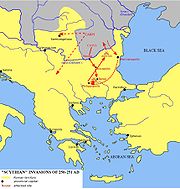 238: The Carpi launched their first recorded major incursion into Roman territory South of the Danube, during the brief joint rule of the adolescent Gordian III
and the senators Balbinus
and Pupienus Maximus. This was apparently provoked by the refusal of the governor
of Moesia Inferior, Tullius Menophilus, to grant the Carpi's demand for an annual subsidy to keep the peace, as was already paid to the Goths and other tribes on the lower Danube. This lends support to the possibility that until this time the Carpi had been long-term allies of the Romans and were aggrieved that they were in effect penalised for their loyalty. However, the governor succeeded in driving out the Carpi in 239.
245-7: During the rule of emperor Philip the Arab
(244-9), the Carpi crossed the Danube and laid waste Moesia Inferior. After the theatre governors failed to repel the invasion, the emperor took personal command and launched a major counter-attack. After a prolonged struggle, the Carpi were driven back across the Danube. Pursued by the Romans into their Moldavian homeland, the main body of Carpi took refuge in a major stronghold (probably a hill-fort), where they were surrounded and besieged by Philip's forces. The Carpi outside the siege hastily gathered a force to rescue their comrades. The besieged staged a mass sortie to distract the Romans from the approach of their relief-force. But the latter was ambushed and routed by Philip's equites Maurorum (Berber
light cavalry from N. Africa). The breakout was contained, forcing the Carpi to sue for peace. This was granted to them on apparently lenient terms by Philip, who was eager to conclude the campaign in time for the forthcoming celebrations of the 1,000th anniversary of the City of Rome's foundation (April 248). Philip was acclaimed Carpicus Maximus.
. Kniva's invasion had apparently been provoked by the termination of the Goths' annual Roman subsidy by the emperor Philip. Judging by their actions, the invaders' war aims were limited to pillage: the capture of as many slaves, horses, treasure and other goods as possible to take back to their homelands across the Danube.
Kniva's host apparently included Goths, Taifali and Vandals
, as well as some renegade Roman army veterans. Given Zosimus' description of "Scythians", it almost certainly included Sarmatian elements such as the Roxolani. In addition, an apparently separate host of Goths and Bastarnae also entered Moesia Inferior, led by Kniva's two top lieutenants. Jordanes claims that the barbarians totaled 300,000 men, but Byzantine chroniclers often grossly inflate barbarian numbers, typically by a factor of ten (e.g. Zosimus' claim that 60,000 Alamanni
fell at the Battle of Strasbourg
in 357, against the 6,000 recorded by the contemporary and more reliable Ammianus Marcellinus
). Thus, 30,000 is a more plausible, though still formidable, order of magnitude for Kniva's invasion, divided into two divisions. The Carpi contingent numbered 3,000 men, according to Jordanes. If so, the Carpi probably constituted roughly 10% of the total invasion host.
Facing the invasion were the Roman emperor "Trajan" Decius
, an experienced general and Philip's commander on the Danube front, who had succeeded his boss after the latter was murdered by his mutinous troops in 249; and Caius Trebonianus Gallus
, appointed governor of Moesia Superior in the previous year by Decius. It appears that, for the purpose of dealing with the threat, Gallus was given command of forces in the frontier-forts along the Danube, while the emperor commanded a mobile force of crack units.
After losing two encounters with the Romans in Moesia Inferior, Kniva surprised the emperor by surreptitiously moving southwards, crossing the Haemus (Balkan
) mountains into Thracia
, which was largely undefended. The emperor, who was left several days behind, was obliged to rush his army into Thracia by forced marches in order to catch up. At Beroe
(Stara Zagora, Bulg.), Kniva launched a surprise attack on the emperor's exhausted army, inflicting a crushing defeat. Decius was obliged to withdraw the remnants of his shattered force to Moesia Inferior and to leave Thracia to be pillaged at will by the barbarians. Kniva's host stormed the city of Philippopolis
(Plovdiv, Bulg.) and spent the winter of 250/1 in the province.
In the meantime, Decius rebuilt his field army in Moesia Inferior. In 251, as the barbarian host headed home towards the Danube laden with a vast quantity of plunder, they were intercepted by the emperor at Abrittus
in Moesia Inferior. In a hard-fought battle, Kniva's main host was routed. The emperor then led his men across a bog in order to engage Kniva's reserve force, which guarded the barbarians' booty. But the emperor had underestimated the difficulty of the terrain: the Romans became immobilised in the mire and reportedly every one of them perished, including the emperor himself, massacred at long range by Kniva's archers or drowned.
When news of this disaster reached the remaining legions on the Danube, they proclaimed their commander Gallus emperor. The latter concluded a peace with the Goths which permitted them to return home with their booty and guaranteed resumed subsidies. Although Zosimus denounces the terms as shameful, it was probably the only realistic option open to Gallus in the circumstances.
But Gallus' resumption of subsidies did not have the desired effect of sustaining peace on the Danube. Hard on the heels of military catastrophe, the Roman army was crippled by the outbreak of a devastating smallpox
pandemic, the so-called Plague of Cyprian
(251 - ca. 270). The effects of the Cyprianic pandemic are described by Zosimus as even worse than the earlier Antonine outbreak, which probably killed 15-30% of the empire's inhabitants. The Roman army would have suffered casualties at the high end of the range as a result of its close concentration of personnel and frequent movements between provinces, thus probably losing about a third of its effectives. Taking advantage of Roman military disarray, the transdanubian barbarians launched repeated massive invasions of imperial territory. The exact number, dates and events of these invasions are uncertain due to the confused and fragmentary nature of the sources. It is possible that there were invasions every year and that parts of the Danubian provinces were occupied by marauding war-bands of barbarians year-round during the period 251-70. From Zosimus, the following major events may be discerned:
252-3: The Carpi joined Goths and 2 Sarmatian tribes (the Urugundi and the Borani) in an invasion of Roman territory, ravaging Moesia and Thrace. (Zosimus states that they then crossed into Asia Minor
, but as this is inconsistent with the rest of the narrative, it is probably a confusion with the invasion of 256). Roman forces on the lower Danube were apparently unable to prevent them from marauding at will, probably due to their losses at Abrittus and the impact of the plague. Eventually, the barbarians were intercepted on their way home by the general Aemilianus
, commander of the army of Pannonia
. At first, his men were fearful of engaging the barbarians because of their aura of invincibility after Abrittus, but Aemilianus' leadership steadied them. At an unknown location near the Danube, the Romans launched a surprise attack and scored a crushing victory. They chased the barbarians over the river and deep into their homelands, recovering vast quantities of plunder and liberating thousands of Roman civilians who had been abducted. Possibly among the latter was a C. Valerius Serapio (probably a Greek) who dedicated an (undated) altar found at Apulum (Alba Iulia
) in Dacia, as thanksgiving for his rescue from the Carpi (liberatus a Carpis) http://oracle-vm.ku-eichstaett.de:8888/epigr/epieinzel_en?p_belegstelle=CIL+03%2C+01054&r_sortierung=Belegstelle
Aemilianus was hailed as emperor by his victorious troops and marched on Rome, where Gallus' forces killed their leader rather than fight against the Danubian army. However, only 3 months later, Aemilianus was in his turn assassinated by the same troops, who defected to Valerian I (r. 253-60), the commander of forces on the Rhine, who had marched into Italy to rescue Gallus.
Valerian was proclaimed emperor and promptly elevated his son Gallienus
(r. 253-68) as Augustus (co-emperor). This father-and-son team presided over the most chaotic period of Roman history (253-68) before the 5th century. The empire suffered multiple and massive barbarian invasions on the Rhine, Danube and in the East; at least 11 generals launched military coups; the empire was split into three autonomous pieces; and Valerian himself was captured by the Persians and died after several years in their captivity, the first Roman emperor to suffer such a humiliation.
256-7: The Carpi, with the same allies as in 253, irrupted into Moesia, ravaged Thrace and lay siege to Thessalonica in Macedonia
, although unsuccessfully. Valerian and Gallienus were obliged to leave the Balkan theatre to subordinates with inadequate forces, as they were fully occupied, the former in the East fighting the Persians, the latter on the Rhine trying to stem a massive Germanic incursion. The whole of Greece was placed on invasion alert: the Athenians rebuilt their city walls for the first time since they were demolished by the Republican general Sulla in 87 BC and the Peloponnesians
re-fortified the Isthmus of Corinth
. The barbarians were eventually routed by Gallienus' lieutenant Aureolus
, who brought large numbers of prisoners to Rome.
259-60: The "Scythians, including every people of their country" (i.e. including the Carpi) launched a massive invasion over the Danube, taking advantage of the military and political chaos in the empire. It appears that the barbarians divided into 2 hosts. One invaded Greece and, despite its new walls, succeeded in storming and sacking Athens. The other group crossed Illyricum into Italy, and appeared before the walls of Rome, forcing the Roman Senate
to arm the civilian population to man the ramparts, as Gallienus was fully occupied on the Rhine fighting Postumus' usurpation. Recognising that there was no possibility of taking the City and sacking it, the Gothic-led host proceeded to ravage the whole of Italy. They were finally driven out by Gallienus' lieutenant Macrianus
, who brought the Rhine army into Italy.
Further major "Scythian" invasions took place in 265-6 and possibly the largest of all, 267-8, which was a seaborne invasion which penetrated the Aegean Sea but was terminated by the crushing Roman victory at Naissus
(268). But, unlike in previous invasions, the Carpi are not mentioned specifically by Zosimus and the other chroniclers and their role is thus uncertain.
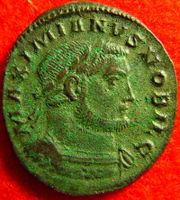 The late 3rd century saw the military recovery of the empire under the iron rule of the so-called "Illyrian emperors
", a tightly knit group of career-soldiers with shared origins in the Danubian provinces and regiments, whose successors (and often descendants) dominated the empire for over a century (268-379). These not only broke the transdanubian tribes on the battlefield, but also pursued a policy of large-scale resettlement of defeated tribespeople in the Danubian provinces of the empire. This was motivated by the need to re-populate the Danubian provinces, which had been ravaged by plague and barbarian invasions during the period 250-70.
272: The emperor Aurelian
(r. 270-5) scored a major victory over the Carpi, for which he was granted the title Carpicus Maximus by the Senate. He then resettled a large number of Carpi prisoners around Sopiana (Pécs
, Hungary) in the Roman province of Pannonia
. This inaugurated the mass resettlement policy.
296-305: In 296, the emperor Diocletian
(r. 284-305) went to war against the Carpi, the Romans' first conflict with this tribe since it was defeated by Aurelian 23 years earlier. The war ended in 297 with a crushing Roman victory. Diocletian claimed the title Carpicus Maximus. In 298, Diocletian handed the lower Danube command to his Caesar (deputy emperor), Galerius
. In an intensive series of campaigns, Galerius inflicted 4 more defeats on the Carpi in the period 298-305. (The precise dates and details of these campaigns are unknown, although from the dating of inscriptions it can be deduced that there were major victories in 299 and 302). By 305, Diocletian and his three imperial colleagues (known as the Tetrarchs), were each claiming 5 Carpicus titles. (It was apparently their practice to claim victory-titles collectively, thus all four claimed Carpicus titles for the victories achieved by Galerius).
305-11: After acceding as Augustus (full emperor) in 305, Galerius is recorded as claiming the Carpicus title for a 6th time, some time during his reign.
318: Constantine I is recorded as holding the Carpicus Maximus title in an inscription of that year. This most likely represents a victory over the Carpi in 316-7, when Constantine is documented as resident in the Balkans for the first time since his appointment as Caesar in 306 (Ref: Odahl, 2004 ).
Each of these acclamations probably implied the slaying of at least 5,000 Carpi (as traditionally required for the grant of a Triumph
in Rome). For the Carpi, these defeats were accompanied by mass deportations and resettlement inside the empire. According to Ammianus, Diocletian's regime continued to settle Carpi in Pannonia, and, apparently, in Scythia Minor
(i.e. the coastal region of modern Romania). Eutropius reports that "enormous numbers" were transferred. Heather interprets these reports as implying hundreds of thousands of deportees. According to Victor
, the entire remaining Carpi people were transferred into the empire. However, this cannot be wholly true by the end of Diocletian's rule in 305, as Victor implies, as the emperor Constantine I the Great (r. 312-37) claimed the Carpicus Maximus title in 317/8.
Many historians dispute that the Carpi were eliminated from the Carpathian region and argue that many Carpi remained, a view accepted by Millar and Batty. Beyond 318, specific evidence of Carpi continuity is limited to Zosimus' reference to Karpodakai joining in a barbarian invasion of the empire in the 380's. But this notice, even if historically valid, may not refer to the Carpi (see Ethno-linguistic Affiliation, above).
Even if some Carpi did remain in Moldavia, it is clear that they lost their political independence, according to Heather. After the death of Constantine, the Wallachian plain and Moldavia fell under the domination of the Tervingi branch of the Gothic nation, as evidenced by the existence of a substantial Gothic kingdom in the mid 4th century. Transylvania, on the other hand, appears to have been dominated in the 4th century by another probably Germanic group, the Taifali. However, the Taifali in turn appear to have been under Gothic suzerainty. These Germanic kingdoms were overwhelmed by the Huns
, resulting in the great Gothic-led migration that culminated in the Roman disaster at the Battle of Adrianople
in 378. The Carpi are nowhere mentioned in Ammianus' detailed account of these epic events, again suggesting that any remaining Carpi may have lost their distinct identity.
Romania
Romania is a country located at the crossroads of Central and Southeastern Europe, on the Lower Danube, within and outside the Carpathian arch, bordering on the Black Sea...
).
The archaeology of Moldavia in the period 106-318 shows the coexistence of two distinct material cultures, one sedentary, the other exhibiting the features of a nomadic steppe culture. The sedentary culture was on a material level not significantly higher than other barbarian regions on the fringes of the Roman empire.
The ethnic affiliation of the Carpi remains disputed, as there is no direct evidence in the surviving ancient literary sources. A strong body of modern scholarly opinion considers that the Carpi were a tribe of the Dacian
Dacians
The Dacians were an Indo-European people, very close or part of the Thracians. Dacians were the ancient inhabitants of Dacia...
nation. Other scholars have linked the Carpi to a variety of ethnic groups, including Sarmatians
Sarmatians
The Iron Age Sarmatians were an Iranian people in Classical Antiquity, flourishing from about the 5th century BC to the 4th century AD....
, Thracians
Thracians
The ancient Thracians were a group of Indo-European tribes inhabiting areas including Thrace in Southeastern Europe. They spoke the Thracian language – a scarcely attested branch of the Indo-European language family...
, Germans
Germans
The Germans are a Germanic ethnic group native to Central Europe. The English term Germans has referred to the German-speaking population of the Holy Roman Empire since the Late Middle Ages....
, and Celts.
About a century after their earliest mention by Ptolemy
Ptolemy
Claudius Ptolemy , was a Roman citizen of Egypt who wrote in Greek. He was a mathematician, astronomer, geographer, astrologer, and poet of a single epigram in the Greek Anthology. He lived in Egypt under Roman rule, and is believed to have been born in the town of Ptolemais Hermiou in the...
, during which their relations with Rome appear to have been peaceful, the Carpi emerged in ca. 238 as among Rome's most persistent enemies. In the period 250-270 AD, the Carpi were an important component of a loose coalition of transdanubian barbarian tribes that included also Germanic
Germanic peoples
The Germanic peoples are an Indo-European ethno-linguistic group of Northern European origin, identified by their use of the Indo-European Germanic languages which diversified out of Proto-Germanic during the Pre-Roman Iron Age.Originating about 1800 BCE from the Corded Ware Culture on the North...
and Sarmatian elements. These were responsible for a series of large and devastating invasions of the Balkan regions of the empire which nearly caused its disintegration.
In the period 270-318, the Roman "military emperors" acted to remove the Carpi threat to the empire's borders. were inflicted on the Carpi in 273, 297, 298-308 and in 317. were forcibly transferred by the Roman military to the Roman province of Pannonia
Pannonia
Pannonia was an ancient province of the Roman Empire bounded north and east by the Danube, coterminous westward with Noricum and upper Italy, and southward with Dalmatia and upper Moesia....
(modern western Hungary
Hungary
Hungary , officially the Republic of Hungary , is a landlocked country in Central Europe. It is situated in the Carpathian Basin and is bordered by Slovakia to the north, Ukraine and Romania to the east, Serbia and Croatia to the south, Slovenia to the southwest and Austria to the west. The...
) as part of the emperors' policy of repopulating the devastated Danubian provinces with surrendered barbarian tribes. Since Carpi are not longer mentioned in documents after 318, it is possible that the Carpi were largely removed from the Carpathian region by ca. 318; or, if any remained, it is possible that they mingled with other peoples resident or immigrating into Moldavia, such as the Sarmatians or Goths.
Name etymology
The Greco-Romans called this people the Carpi or Carpiani. Probably the earliest mention of them, under the name Καρπιανοί (Carpiani in Latin) is in the Geographia of the 2nd-century Greek geographer PtolemyPtolemy
Claudius Ptolemy , was a Roman citizen of Egypt who wrote in Greek. He was a mathematician, astronomer, geographer, astrologer, and poet of a single epigram in the Greek Anthology. He lived in Egypt under Roman rule, and is believed to have been born in the town of Ptolemais Hermiou in the...
, composed ca. AD 140.
The name Carpi or Carpiani may derive from the same root as the name of the Carpathian mountain range that they occupied, also first mentioned by Ptolemy under the name Καρπάτης - Karpátes.
The root may be the putative Proto-Indo-European
Proto-Indo-European language
The Proto-Indo-European language is the reconstructed common ancestor of the Indo-European languages, spoken by the Proto-Indo-Europeans...
word *ker/sker, meaning "peak" or "cliff" (cf. Albanian
Albanian language
Albanian is an Indo-European language spoken by approximately 7.6 million people, primarily in Albania and Kosovo but also in other areas of the Balkans in which there is an Albanian population, including western Macedonia, southern Montenegro, southern Serbia and northwestern Greece...
karpë "rock", Romanian
Romanian language
Romanian Romanian Romanian (or Daco-Romanian; obsolete spellings Rumanian, Roumanian; self-designation: română, limba română ("the Romanian language") or românește (lit. "in Romanian") is a Romance language spoken by around 24 to 28 million people, primarily in Romania and Moldova...
(ş)carpă "precipice", and Latin scarpa). Scholars who support this derivation are divided between those who believe the Carpi gave their name to the mountain range (i.e. the name means "mountains of the Carpi") and those who claim the reverse. In the latter case, Carpiani could mean simply "people of the Carpathians". But the similarity between the two names may be coincidence, and they may derive from different roots. For example, it has been suggested that the name may derive from the Slavic
Slavic languages
The Slavic languages , a group of closely related languages of the Slavic peoples and a subgroup of Indo-European languages, have speakers in most of Eastern Europe, in much of the Balkans, in parts of Central Europe, and in the northern part of Asia.-Branches:Scholars traditionally divide Slavic...
root-word krepu meaning "strong" or "brave". Also, it had been suggested that Carpathian Mountains may derive from the Sanskrit root “kar” 'cut' that would give the meaning of ‘rugged mountains’.
Some scholars consider that the following peoples recorded in ancient sources are the same as the Karpiani in Ptolemy: the Kallipidai mentioned in the Histories of Herodotus
Herodotus
Herodotus was an ancient Greek historian who was born in Halicarnassus, Caria and lived in the 5th century BC . He has been called the "Father of History", and was the first historian known to collect his materials systematically, test their accuracy to a certain extent and arrange them in a...
(composed around 430 BC) as residing in the region of the river Borysthenes (Dnieper); the Karpídai around the mouth of the river Tyras (Dniester
Dniester
The Dniester is a river in Eastern Europe. It runs through Ukraine and Moldova and separates most of Moldova's territory from the breakaway de facto state of Transnistria.-Names:...
) recorded in a fragment of Pseudo-Scymnus
Pseudo-Scymnus
Pseudo-Scymnus is the name given by Augustus Meineke to the unknown author of a work on geography written in Classical Greek, The Circumnavigation of the Earth, an anonymous verse periegesis first published at Augsburg in 1600...
(composed ca. 90 BC);and the Harpii, located near the Danube delta, mentioned by Ptolemy himself. If so, their locations could imply that the Carpi had very gradually migrated westwards in the period 400 BC - AD 140, a view championed by Kahrstedt. These names' common element carp- appears frequently in Dacian and Thracian place- and personal names. But there is no consensus that these groups are actually one and the same as the Carpi. Bichir suggests that they were Thraco-Dacian tribes distantly related to the Carpi.
Territory
During the period when they are attested by classical sources (ca. AD 140-300), the Carpi are believed by many scholars, on the basis of Ptolemy, to have occupied a region between the river Hierasus (SiretSiret River
The Siret or Sireth is a river that rises from the Carpathians in the Northern Bukovina region of Ukraine, and flows southward into Romania for 470 km before it joins the Danube...
) and the river Porata (Prut
Prut
The Prut is a long river in Eastern Europe. In part of its course it forms the border between Romania and Moldova.-Overview:...
) (i.e. the eastern part of the former principality of Moldavia). This was just outside "Dacia proper", as defined by Ptolemy, whose eastern border was the Hierasus. Ptolemy does not include the Carpi in his list of tribes resident in Dacia proper, even though this region, according to his own definition, comprised the whole Carpathian range. East of this river lay Sarmatia Europaea, a vast region stretching as far as the Crimea
Crimea
Crimea , or the Autonomous Republic of Crimea , is a sub-national unit, an autonomous republic, of Ukraine. It is located on the northern coast of the Black Sea, occupying a peninsula of the same name...
, predominantly, but by no means exclusively, populated by Sarmatian tribes.
According to Ptolemy, the Carpi's neighbours were: to the North, the Costoboci
Costoboci
The Costoboci were an ancient people located, during the Roman imperial era, between the Carpathian Mountains and the river Dniester.The Costoboci invaded the Roman empire in AD 170 or 171, pillaging its Balkan provinces as far as central Greece, until they were driven out by Romans...
; to the South, in the Wallachia
Wallachia
Wallachia or Walachia is a historical and geographical region of Romania. It is situated north of the Danube and south of the Southern Carpathians...
n plain, the Roxolani Sarmatians; and to the East of the Prut, the Bastarnae
Bastarnae
The Bastarnae or Basternae were an ancient Germanic tribe,, who between 200 BC and 300 AD inhabited the region between the eastern Carpathian mountains and the Dnieper river...
(a Celto-Germanic or possibly Sarmatian group) and other Sarmatian tribes. To the West, the Carpathian mountains between the Siret and the border of the Roman province were probably populated by the "Free Dacians
Free Dacians
The "Free Dacians" is the name given by some modern historians to Dacians who putatively remained outside the Roman empire after the emperor Trajan's Dacian wars...
" i.e. those Dacians residing outside Roman Dacia. However, it is not possible to reliably define the territories of these groups due to the imprecision of the ancient geographical sources. Also, it is likely that in many areas, ethnic groups overlapped and the ethnic map was a patchwork of dispersed sub-groups. The Sarmatians and Bastarnae are attested, in both literature and archaeology, all over Moldavia and Bessarabia.
Material culture
There is no dispute among scholars that some Decebalic-era Dacian settlements in Moldavia (mostly West of the Siret, with a few on the East bank (including Piroboridava, identified with Poiana-TecuciPoiana
Poiana may refer to:* Poiana , commonly known as Oyans or African Linsangs, a genus of the mammalian family Viverridae** African Linsang , a species of linsang...
), were abandoned by 106, most likely, according to Bichir, as a result of the Roman conquest of Dacia. From this time, Bichir identifies two distinct cultures in Moldavia, existing side-by-side. A sedentary culture, labelled "Daco-Carpic" by Bichir, which started around 106 and disappeared around 318; and a smaller culture displaying the characteristics usually associated with nomadic peoples from the Eurasian steppe
Steppe
In physical geography, steppe is an ecoregion, in the montane grasslands and shrublands and temperate grasslands, savannas, and shrublands biomes, characterized by grassland plains without trees apart from those near rivers and lakes...
s, labelled "Sarmatian" by Bichir.
By 1976, 117 sedentary settlements had been identified, the great majority (89) located West of the Siret (thus inside Dacia's borders as defined by Ptolemy). The inhabitants lived in both surface-dwellings and sunken-floor huts. The single-roomed surface-dwellings were made of wattle
Wattle
Wattle may refer to:*Wattle , a fleshy growth hanging from the head or neck of certain animals.*Wattle is another term for Congenital cartilaginous rest of the neck...
and beaten-earth, usually of rectangular or square form, varying from 9 sq m to 30 sq m in size. Each contained a clay hearth placed at the centre of the dwelling. The more numerous sunken-earth huts are usually of oval or round shape. The sedentary people generally cremated their dead, both adults and children, according to Bichir: all 43 purely "Daco-Carpic" (sedentary) cemeteries were cremation-only. The ashes from the cremation were, in the great majority of cases, buried inside urns. Some graves contained grave-goods, but no weapons (except for a single dagger). Mundane goods include: knives, keys, belt-buckles; valuable goods include Sarmatian-style mirrors, silver ear-rings, gold pendants and beads. Pottery found in sedentary sites includes hand-made "porous" type, grey wheel-made ware, red-fired pottery and imported Roman ware. Bichir describes the first two as continuing Dacian La Tène pottery, and points to the presence of the so-called "Dacian cup", a cup of distinctive design, as evidence of a Dacian base to this culture. However, he admits that the pottery also shows Roman and Sarmatian influence. The sedentary folk appear to have been generally illiterate, as no "Daco-Carpic" inscription has ever been found during the very intensive excavations carried out in the region. The sedentary culture did not issue its own coinage. However, Roman coinage circulated "intensely" in the Carpi's territory, according to Bichir. This is based on the large numbers of coin-hoards found in Moldavia (90) and ca. 100 isolated coins. However, the circulation of Roman coins seems to have virtually ceased after 218, as no coin-hoards and only 7 isolated coins have been found dating to later than Caracalla
Caracalla
Caracalla , was Roman emperor from 198 to 217. The eldest son of Septimius Severus, he ruled jointly with his younger brother Geta until he murdered the latter in 211...
(ruled AD 211-218).
Nomadic-culture graves are predominantly inhumation-type, found in 38 places in Moldavia by 1976. These are predominantly found on the plains, rarely on the Carpathian foothills (i.e. East of the Siret), either singly or in small groups of 2-13 graves, including men. women and children. The great majority of nomadic-culture graves are flat (non-tumular), in contrast to nomadic barrow-graves found from the Dniester region eastwards. However, some secondary barrow-burials (i.e. using pre-existing barrows) have been found, mostly dating from 200 onwards.The nomadic graves always contain grave-goods, often including weapons, and mirrors engraved with tamgas (ritual/tribal symbols associated with nomadic steppe cultures).
6 cemeteries in Bichir's list contain both cremation and inhumation graves. At the Poieneşti site (the only one fully investigated by 1976), 6 adults and 17 children were buried (compared with 62 cremated). Of these, 2 adults and 7 children were found to have artificially elongated crania. This custom, achieved by tightly binding an infant's skull during its early growth phase, is associated with steppe nomads. Bichir identifies the adults as nomads and the children as the progeny of mixed nomad-sedentary marriages.
On the basis of relative numbers of sedentary/nomadic graves, Bichir concludes that the sedentary folk constituted the great majority of the population of Moldavia. In the mixed cemeteries documented by Bichir, nomadic graves constitute ca. 28% of the total.
After 318, according to Bichir, the "Daco-Carpic" culture was in Moldavia replaced by the Sîntana-de-Mureş "variant" of the Chernyakhov culture common to much of the North-Pontic region of SE Europe in the period 200-400.
Ethno-linguistic affiliation
The people of the nomadic culture present in Moldavia have been identified by Bichir as ethnic Sarmatians.There is no direct evidence in surviving Roman imperial era sources, literary or epigraphic, regarding the ethnicity of the sedentary population of Moldavia.
According to traditional Romanian historiography, as well as to several non-Romanian scholars, the Carpi were a people of Dacian tongue
Dacian language
The extinct Dacian language may have developed from proto-Indo-European in the Carpathian region around 2,500 BC and probably died out by AD 600. In the 1st century AD, it was the predominant language of the ancient regions of Dacia and Moesia and, possibly, of some surrounding regions.It belonged...
and culture Heather, who supports this view, suggests that the Carpi name was adopted as the collective name of the Free Dacian tribes when they achieved a degree of political unification in the early 3rd century.
However, there is a significant number of scholars who dispute that the Carpi were ethnic Dacians, and have identified them variously as Sarmatians, Thracians, Germans, Celts, or even proto-Slavs. This is because the region between the rivers Siret and Dniester was of great ethnic diversity during the Roman imperial era. In addition to Scytho-Sarmatian tribes (Roxolani, Agathyrsi
Agathyrsi
Agathyrsi were a people of Scythian, Thracian, or mixed Thraco-Scythic origin, who in the time of Herodotus occupied the plain of the Maris , in the mountainous part of ancient Dacia now known as Transylvania, Romania...
), the ancient sources attest Germans
Germans
The Germans are a Germanic ethnic group native to Central Europe. The English term Germans has referred to the German-speaking population of the Holy Roman Empire since the Late Middle Ages....
(Taifali, Scirii
Scirii
The Scirii were an East Germanic tribe of Eastern Europe, attested in historical works between the 2nd century BC and 5th century AD.The etymology of their name is unclear...
, Bastarnae
Bastarnae
The Bastarnae or Basternae were an ancient Germanic tribe,, who between 200 BC and 300 AD inhabited the region between the eastern Carpathian mountains and the Dnieper river...
); Celts (some Bastarnae sub-groups, Taurisci
Taurisci
The Taurisci were a federation of Celtic tribes who dwelt in today's northern Slovenia before the coming of the Romans According to Pliny the Elder, they are the same people known as the Norici...
, Anartes); Thracians
Thracians
The ancient Thracians were a group of Indo-European tribes inhabiting areas including Thrace in Southeastern Europe. They spoke the Thracian language – a scarcely attested branch of the Indo-European language family...
( Biessi and Thraces identified by Ptolemy between the Danube and Dniester); and Dacians
Dacians
The Dacians were an Indo-European people, very close or part of the Thracians. Dacians were the ancient inhabitants of Dacia...
(Tyragetae). Also, some modern authors surmise the existence of ethnic groups formed in loco from mixed origins (but mostly with an indigenous Dacian/Sarmatian base- e.g. the Goths
Goths
The Goths were an East Germanic tribe of Scandinavian origin whose two branches, the Visigoths and the Ostrogoths, played an important role in the fall of the Roman Empire and the emergence of Medieval Europe....
).
Apart from a single name of doubtful meaning and validity in a Byzantine chronicle (see paragraph below), the evidence used to support the Dacian ethnicity of the Carpi is archaeological: namely, the discovery of pottery and other artefacts identified as "Dacian-style" by archaeologists such as Bichir at sites in the region of Moldavia seen as occupied by the Carpi in the period AD 100-300 (e.g. at Poieneşti, near Vaslui
Vaslui
Vaslui , a city in eastern Romania, is the seat of Vaslui County, in the historical region of Moldavia.The city administers five villages: Bahnari, Brodoc, Moara Grecilor, Rediu and Viişoara.-History:...
) as well as in burial rites. In particular, Bichir points to a cup of unusual design and "corded" decoration of pots as characteristically Dacian . However, determination of the Carpi's ethnicity by the typology, or by the relative quantity, of finds has been questioned by Niculescu.Romanian archaeological interpretation: A critique of archaeological interpretation in Romania is contained in an online paper by A-G. Niculescu: Nationalism and the Representation of Society in Romanian Archaeology Batty concurs that the presence of "Dacian-style" artefacts attests the material level of the indigenes but does not prove their ethnicity. These objections reflect modern archaeological theory, which considers that material cultures, as defined by archaeologists, are not a reliable guide to ethnicity.
Zosimus
Zosimus
Zosimus was a Byzantine historian, who lived in Constantinople during the reign of the Byzantine Emperor Anastasius I . According to Photius, he was a comes, and held the office of "advocate" of the imperial treasury.- Historia Nova :...
, a Byzantine chronicler writing around AD 500, records an invasion of Rome's Danubian provinces in 381 by a barbarian coalition of Huns
Huns
The Huns were a group of nomadic people who, appearing from east of the Volga River, migrated into Europe c. AD 370 and established the vast Hunnic Empire there. Since de Guignes linked them with the Xiongnu, who had been northern neighbours of China 300 years prior to the emergence of the Huns,...
, Scirii
Scirii
The Scirii were an East Germanic tribe of Eastern Europe, attested in historical works between the 2nd century BC and 5th century AD.The etymology of their name is unclear...
and Karpodakai ("Carpo-Dacians"). The latter term has been taken by some scholars as "proof" of the Carpi's Dacian ethnicity. But this is the only literary evidence linking the Carpi name to that of the Dacians, and Zosimus is regarded by numerous modern scholars as an unreliable chronicler. One historian accords Zosimus "an unsurpassable claim to be regarded as the worst of all the extant Greek historians of the Roman Empire...it would be tedious to catalogue all the instances where this historian has falsely transcribed names, not to mention his confusion of events...". In any case, the term is ambiguous. It has also been interpreted as the "Carpi and the Dacians" or "the Carpi mixed with the Dacians". According to the eminent classical scholar Kahrstedt, the term does not refer to the Carpi at all, but to Free Dacians who occupied the territory of the Carpi after the latter were deported by the Romans. He argues that, in ancient Greek, the first part of the term could only have a geographical meaning: i.e. Karpodakai means "the Dacians from the land of the Carpi". In the same vein, it has also been interpreted as "the Dacians of the Carpathians". (Compare Tyragetae
Tyragetae
The Tyrageti, Tyragetae, or Tyrangitae , literally, the Getae of the Tyras, were a sub-tribe of the Getae Thracians, situated on the river Tyras . They were regarded as an immigrant tribe of European Sarmatia dwelling E...
, supposedly meaning "the Getae from the Tyras region"). It is possible that the entire Carpi people were transferred to the Roman empire by 318, which is supported by literary and archaeological evidence: Bichir notes that the culture which he calls "Daco-Carpic" terminated in around 318. If so, then Zosimus' Karpodakai could not be referring to the Carpi.
A possible argument against the Carpi's proposed Dacian ethnicity is that Roman emperors did not use the long-established cognomen ex virtute (victory-title) Dacicus Maximus (literally: "the greatest Dacian") for victories over the Carpi, but instead adopted the separate title Carpicus Maximus. This was introduced by Philip the Arab
Philip the Arab
Philip the Arab , also known as Philip or Philippus Arabs, was Roman Emperor from 244 to 249. He came from Syria, and rose to become a major figure in the Roman Empire. He achieved power after the death of Gordian III, quickly negotiating peace with the Sassanid Empire...
in 247, the first Roman emperor to defeat the Carpi in person. Such titles were ethnographic, not geographical (i.e. Dacicus meant "victorious over the Dacians", not "victorious in Dacia") The existence of a separate victory-title for the Carpi may imply that the Romans did not consider the Carpi to be Dacians. The same argument applies against a Sarmatian or Germanic identity for the Carpi, as Sarmaticus and Germanicus were also established titles in Philip's time.
However, Roman emperors used at first the general title Germanicus Maximus, but later more specific ones, such as Francicus and Alamannicus, for Germanic federations of tribes which become more individualized in time, so it is possible that Carpicus refers to a part of the "Free Dacian" tribes which, as Heather says, achieved a degree of political unification and became more clearly individualized in the early 3rd century.
The following table is mainly based on data presented by Bichir in the Appendix to his work:
| Emperor | Dacicus (Maximus) (date) | Carpicus (Maximus) (date) | Specimen inscription* |
|---|---|---|---|
| Trajan Trajan Trajan , was Roman Emperor from 98 to 117 AD. Born into a non-patrician family in the province of Hispania Baetica, in Spain Trajan rose to prominence during the reign of emperor Domitian. Serving as a legatus legionis in Hispania Tarraconensis, in Spain, in 89 Trajan supported the emperor against... |
106 | AE (1927) 151 http://oracle-vm.ku-eichstaett.de:8888/epigr/epieinzel_en?p_belegstelle=AE+1927%2C+00151&r_sortierung=Belegstelle | |
| Hadrian Hadrian Hadrian , was Roman Emperor from 117 to 138. He is best known for building Hadrian's Wall, which marked the northern limit of Roman Britain. In Rome, he re-built the Pantheon and constructed the Temple of Venus and Roma. In addition to being emperor, Hadrian was a humanist and was philhellene in... |
118 | CIL II.464 http://oracle-vm.ku-eichstaett.de:8888/epigr/epieinzel_en?p_belegstelle=CIL+02%2C+*00464&r_sortierung=Belegstelle | |
| Antoninus Pius Antoninus Pius Antoninus Pius , also known as Antoninus, was Roman Emperor from 138 to 161. He was a member of the Nerva-Antonine dynasty and the Aurelii. He did not possess the sobriquet "Pius" until after his accession to the throne... |
157 | CIL VIII.20424 http://oracle-vm.ku-eichstaett.de:8888/epigr/epieinzel_en?p_belegstelle=CIL+08%2C+20424&r_sortierung=Belegstelle | |
| Maximinus Thrax Maximinus Thrax Maximinus Thrax , also known as Maximinus I, was Roman Emperor from 235 to 238.Maximinus is described by several ancient sources, though none are contemporary except Herodian's Roman History. Maximinus was the first emperor never to set foot in Rome... |
236 | AE (1905) 179 http://oracle-vm.ku-eichstaett.de:8888/epigr/epieinzel_en?p_belegstelle=AE+1905%2C+00179&r_sortierung=Belegstelle | |
| Philip the Arab Philip the Arab Philip the Arab , also known as Philip or Philippus Arabs, was Roman Emperor from 244 to 249. He came from Syria, and rose to become a major figure in the Roman Empire. He achieved power after the death of Gordian III, quickly negotiating peace with the Sassanid Empire... |
247 | Sear 2581 | |
| Trajan Decius | 249-51 | CIL II.6345 http://oracle-vm.ku-eichstaett.de:8888/epigr/epieinzel_en?p_belegstelle=CIL+02%2C+06345&r_sortierung=Belegstelle | |
| Gallienus Gallienus Gallienus was Roman Emperor with his father Valerian from 253 to 260, and alone from 260 to 268. He took control of the Empire at a time when it was undergoing great crisis... |
256/7 | CIL II.2200 http://oracle-vm.ku-eichstaett.de:8888/epigr/epieinzel_en?p_belegstelle=CIL+02%2C+02200&r_sortierung=Belegstelle | |
| Aurelian Aurelian Aurelian , was Roman Emperor from 270 to 275. During his reign, he defeated the Alamanni after a devastating war. He also defeated the Goths, Vandals, Juthungi, Sarmatians, and Carpi. Aurelian restored the Empire's eastern provinces after his conquest of the Palmyrene Empire in 273. The following... |
275 | 272 | CIL XIII.8973 http://oracle-vm.ku-eichstaett.de:8888/epigr/epieinzel_en?p_belegstelle=CIL+13%2C+08973&r_sortierung=Belegstelle |
| Diocletian Diocletian Diocletian |latinized]] upon his accession to Diocletian . c. 22 December 244 – 3 December 311), was a Roman Emperor from 284 to 305.... , Galerius Galerius Galerius , was Roman Emperor from 305 to 311. During his reign he campaigned, aided by Diocletian, against the Sassanid Empire, sacking their capital Ctesiphon in 299. He also campaigned across the Danube against the Carpi, defeating them in 297 and 300... & colleagues |
296-305 (5 times) | AE (1959) 290 http://oracle-vm.ku-eichstaett.de:8888/epigr/epieinzel_en?p_belegstelle=AE+1959%2C+00290&r_sortierung=Belegstelle | |
| Galerius Galerius Galerius , was Roman Emperor from 305 to 311. During his reign he campaigned, aided by Diocletian, against the Sassanid Empire, sacking their capital Ctesiphon in 299. He also campaigned across the Danube against the Carpi, defeating them in 297 and 300... |
305-11 (6th time) | CIL III.6979 http://oracle-vm.ku-eichstaett.de:8888/epigr/epieinzel_en?p_belegstelle=CIL+03%2C+06979&r_sortierung=Belegstelle | |
| Constantine I Constantine I Constantine the Great , also known as Constantine I or Saint Constantine, was Roman Emperor from 306 to 337. Well known for being the first Roman emperor to convert to Christianity, Constantine and co-Emperor Licinius issued the Edict of Milan in 313, which proclaimed religious tolerance of all... |
336 | 317 | CIL VI.40776; http://oracle-vm.ku-eichstaett.de:8888/epigr/epieinzel_en?p_belegstelle=CIL+06%2C+40776&r_sortierung=Belegstelle CIL VIII.8412 http://oracle-vm.ku-eichstaett.de:8888/epigr/epieinzel_en?p_belegstelle=CIL+08%2C+08412&r_sortierung=Belegstelle |
Note: *Some of the titles above are attested in multiple inscriptions.
Conflict with Rome
Although the Carpi are recorded as resident in the Dacian region from at least the 140's onwards, they are not mentioned in Roman accounts of several campaigns in the Dacian region in the 2nd century. For example, in Rome's vast and protracted conflict with the trans-danubian tribes, known as the Marcomannic WarsMarcomannic Wars
The Marcomannic Wars were a series of wars lasting over a dozen years from about AD 166 until 180. These wars pitted the Roman Empire against the Marcomanni, Quadi and other Germanic peoples, along both sides of the upper and middle Danube...
(166-80), during which Dacia province suffered at least two major invasions (167, 170), only their neighbours the Costoboci
Costoboci
The Costoboci were an ancient people located, during the Roman imperial era, between the Carpathian Mountains and the river Dniester.The Costoboci invaded the Roman empire in AD 170 or 171, pillaging its Balkan provinces as far as central Greece, until they were driven out by Romans...
are mentioned specifically. Silence on the role of the Carpi in these conflicts may imply that they were Roman allies in this period.
Around AD 200 started a phase of major population movements in the European barbaricum (the region outside the borders of the empire. The cause of this dislocation is unknown, but an important factor may have been the Antonine plague
Antonine Plague
The Antonine Plague, AD 165–180, also known as the Plague of Galen, who described it, was an ancient pandemic, either of smallpox or measles, brought back to the Roman Empire by troops returning from campaigns in the Near East...
(165-180), a devastating smallpox
Smallpox
Smallpox was an infectious disease unique to humans, caused by either of two virus variants, Variola major and Variola minor. The disease is also known by the Latin names Variola or Variola vera, which is a derivative of the Latin varius, meaning "spotted", or varus, meaning "pimple"...
pandemic which may have killed 15-30% of the Roman empire's inhabitants. The impact on the barbarian regions would have resulted in many weakened tribes and empty regions that may have induced the stronger tribes to exploit opportunities for expansion. A well-known example of the trend are the Goths
Goths
The Goths were an East Germanic tribe of Scandinavian origin whose two branches, the Visigoths and the Ostrogoths, played an important role in the fall of the Roman Empire and the emergence of Medieval Europe....
. These were probably recorded by the Roman historian Tacitus, under the name Gotones, as inhabiting the area East of the Vistula river in central Poland in AD 100. By 250, the Goths had moved South into western Ukraine and were frequently raiding the empire in conjunction with local tribes.
It was in this context of upheaval that, in mid-3rd century, the Carpi emerged as a major barbarian threat to Rome's lower Danubian provinces. They were described by Jordanes
Jordanes
Jordanes, also written Jordanis or Jornandes, was a 6th century Roman bureaucrat, who turned his hand to history later in life....
as "a race of men very eager to make war, and often hostile to the Romans". A series of major incursions into the empire by the Carpi are recorded, either alone or in alliance with their neighbouring Sarmatian and/or Germanic tribes (inc. Roxolani, Bastarnae, Goths). However, the precise role of the Carpi in the coalition's incursions is not always clear, as the most comprehensive account, that of the 6th-century chronicler Zosimus
Zosimus
Zosimus was a Byzantine historian, who lived in Constantinople during the reign of the Byzantine Emperor Anastasius I . According to Photius, he was a comes, and held the office of "advocate" of the imperial treasury.- Historia Nova :...
, is chronologically confused and often denotes the participants under the vague term "Scythians" (meaning inhabitants of the geographical region called Scythia (i.e. roughly modern Ukraine), not ethnic Scythians).
The involvement of the Carpi in attacks by the "Free Dacians" into Roman Dacia is also uncertain. Supporters of a Dacian ethnicity for the Carpi have tended to assume that they participated in campaigns where Roman emperors claimed the title Dacicus Maximus, in addition to those resulting in a Carpicus Maximus acclamation. But all incursions in which the Carpi are specifically reported by ancient sources were into Moesia Inferior, not Dacia. Following is a list of recorded incursions in which Carpi participation is specifically attested by the sources:
Carpi attacks on the Danubian frontier (238-50)
Gordian III
Gordian III , was Roman Emperor from 238 to 244. Gordian was the son of Antonia Gordiana and an unnamed Roman Senator who died before 238. Antonia Gordiana was the daughter of Emperor Gordian I and younger sister of Emperor Gordian II. Very little is known on his early life before his acclamation...
and the senators Balbinus
Balbinus
Balbinus , was Roman Emperor with Pupienus for three months in 238, the Year of the Six Emperors.- Origins and career :Not much is known about Balbinus before his elevation to emperor. It has been conjectured that he descended from Publius Coelius Balbinus Vibullius Pius, the consul ordinarius of...
and Pupienus Maximus. This was apparently provoked by the refusal of the governor
Legatus Augusti pro praetore
A legatus Augusti pro praetore was the official title of the governor of some imperial provinces of the Roman Empire during the Principate era, normally the larger ones or those where legions were based...
of Moesia Inferior, Tullius Menophilus, to grant the Carpi's demand for an annual subsidy to keep the peace, as was already paid to the Goths and other tribes on the lower Danube. This lends support to the possibility that until this time the Carpi had been long-term allies of the Romans and were aggrieved that they were in effect penalised for their loyalty. However, the governor succeeded in driving out the Carpi in 239.
245-7: During the rule of emperor Philip the Arab
Philip the Arab
Philip the Arab , also known as Philip or Philippus Arabs, was Roman Emperor from 244 to 249. He came from Syria, and rose to become a major figure in the Roman Empire. He achieved power after the death of Gordian III, quickly negotiating peace with the Sassanid Empire...
(244-9), the Carpi crossed the Danube and laid waste Moesia Inferior. After the theatre governors failed to repel the invasion, the emperor took personal command and launched a major counter-attack. After a prolonged struggle, the Carpi were driven back across the Danube. Pursued by the Romans into their Moldavian homeland, the main body of Carpi took refuge in a major stronghold (probably a hill-fort), where they were surrounded and besieged by Philip's forces. The Carpi outside the siege hastily gathered a force to rescue their comrades. The besieged staged a mass sortie to distract the Romans from the approach of their relief-force. But the latter was ambushed and routed by Philip's equites Maurorum (Berber
Berber people
Berbers are the indigenous peoples of North Africa west of the Nile Valley. They are continuously distributed from the Atlantic to the Siwa oasis, in Egypt, and from the Mediterranean to the Niger River. Historically they spoke the Berber language or varieties of it, which together form a branch...
light cavalry from N. Africa). The breakout was contained, forcing the Carpi to sue for peace. This was granted to them on apparently lenient terms by Philip, who was eager to conclude the campaign in time for the forthcoming celebrations of the 1,000th anniversary of the City of Rome's foundation (April 248). Philip was acclaimed Carpicus Maximus.
Sarmato-Gothic invasions of the Roman empire (250-270)
250-1: The Carpi reportedly participated in a massive transdanubian invasion of Moesia and Thrace under the leadership of the Gothic king KnivaCniva
Cniva was the Gothic chieftain who invaded the Roman Empire in the third century CE. He successfully conquered the city of Philippopolis, now present day Bulgarian city Plovdiv, and killed the emperor Decius and his son Herennius Etruscus at the Battle of Abrittus as he was attempting to leave...
. Kniva's invasion had apparently been provoked by the termination of the Goths' annual Roman subsidy by the emperor Philip. Judging by their actions, the invaders' war aims were limited to pillage: the capture of as many slaves, horses, treasure and other goods as possible to take back to their homelands across the Danube.
Kniva's host apparently included Goths, Taifali and Vandals
Vandals
The Vandals were an East Germanic tribe that entered the late Roman Empire during the 5th century. The Vandals under king Genseric entered Africa in 429 and by 439 established a kingdom which included the Roman Africa province, besides the islands of Sicily, Corsica, Sardinia and the Balearics....
, as well as some renegade Roman army veterans. Given Zosimus' description of "Scythians", it almost certainly included Sarmatian elements such as the Roxolani. In addition, an apparently separate host of Goths and Bastarnae also entered Moesia Inferior, led by Kniva's two top lieutenants. Jordanes claims that the barbarians totaled 300,000 men, but Byzantine chroniclers often grossly inflate barbarian numbers, typically by a factor of ten (e.g. Zosimus' claim that 60,000 Alamanni
Alamanni
The Alamanni, Allemanni, or Alemanni were originally an alliance of Germanic tribes located around the upper Rhine river . One of the earliest references to them is the cognomen Alamannicus assumed by Roman Emperor Caracalla, who ruled the Roman Empire from 211 to 217 and claimed thereby to be...
fell at the Battle of Strasbourg
Battle of Strasbourg
The Battle of Strasbourg, also known as the Battle of Argentoratum, was fought in 357 between the Late Roman army under the Caesar Julian and the Alamanni tribal confederation led by the joint paramount king Chnodomar...
in 357, against the 6,000 recorded by the contemporary and more reliable Ammianus Marcellinus
Ammianus Marcellinus
Ammianus Marcellinus was a fourth-century Roman historian. He wrote the penultimate major historical account surviving from Antiquity...
). Thus, 30,000 is a more plausible, though still formidable, order of magnitude for Kniva's invasion, divided into two divisions. The Carpi contingent numbered 3,000 men, according to Jordanes. If so, the Carpi probably constituted roughly 10% of the total invasion host.
Facing the invasion were the Roman emperor "Trajan" Decius
Decius
Trajan Decius , was Roman Emperor from 249 to 251. In the last year of his reign, he co-ruled with his son Herennius Etruscus until they were both killed in the Battle of Abrittus.-Early life and rise to power:...
, an experienced general and Philip's commander on the Danube front, who had succeeded his boss after the latter was murdered by his mutinous troops in 249; and Caius Trebonianus Gallus
Trebonianus Gallus
Trebonianus Gallus , also known as Gallus, was Roman Emperor from 251 to 253, in a joint rule with his son Volusianus.-Early life:Gallus was born in Italy, in a family with respected ancestry of Etruscan senatorial background. He had two children in his marriage with Afinia Gemina Baebiana: Gaius...
, appointed governor of Moesia Superior in the previous year by Decius. It appears that, for the purpose of dealing with the threat, Gallus was given command of forces in the frontier-forts along the Danube, while the emperor commanded a mobile force of crack units.
After losing two encounters with the Romans in Moesia Inferior, Kniva surprised the emperor by surreptitiously moving southwards, crossing the Haemus (Balkan
Balkan Mountains
The Balkan mountain range is a mountain range in the eastern part of the Balkan Peninsula. The Balkan range runs 560 km from the Vrashka Chuka Peak on the border between Bulgaria and eastern Serbia eastward through central Bulgaria to Cape Emine on the Black Sea...
) mountains into Thracia
Thracia (Roman province)
Thracia was the name of a province of the Roman empire. It was established in AD 46, when the former Roman client state of Thrace was annexed by order of emperor Claudius ....
, which was largely undefended. The emperor, who was left several days behind, was obliged to rush his army into Thracia by forced marches in order to catch up. At Beroe
Beroe
Beroe is a Procurement intelligence company which works for fortune 500 companies.Positioned at the forefront of procurement intelligence operations and customized market research, Beroe is unique in its 100% exclusive focus on procurement....
(Stara Zagora, Bulg.), Kniva launched a surprise attack on the emperor's exhausted army, inflicting a crushing defeat. Decius was obliged to withdraw the remnants of his shattered force to Moesia Inferior and to leave Thracia to be pillaged at will by the barbarians. Kniva's host stormed the city of Philippopolis
Philippopolis
The term Philippopolis , which translates as "Philip's Town," may refer to the following cities:*Plovdiv, Bulgaria *Shahba, Syria...
(Plovdiv, Bulg.) and spent the winter of 250/1 in the province.
In the meantime, Decius rebuilt his field army in Moesia Inferior. In 251, as the barbarian host headed home towards the Danube laden with a vast quantity of plunder, they were intercepted by the emperor at Abrittus
Battle of Abrittus
The Battle of Abritus, also known as the Battle of Forum Terebronii, occurred in the Roman province of Moesia Inferior probably in July, 251, between the Roman Empire and a federation of Scythian tribesmen under the Goth king Cniva. The Romans were soundly defeated, and Roman emperors Decius and...
in Moesia Inferior. In a hard-fought battle, Kniva's main host was routed. The emperor then led his men across a bog in order to engage Kniva's reserve force, which guarded the barbarians' booty. But the emperor had underestimated the difficulty of the terrain: the Romans became immobilised in the mire and reportedly every one of them perished, including the emperor himself, massacred at long range by Kniva's archers or drowned.
When news of this disaster reached the remaining legions on the Danube, they proclaimed their commander Gallus emperor. The latter concluded a peace with the Goths which permitted them to return home with their booty and guaranteed resumed subsidies. Although Zosimus denounces the terms as shameful, it was probably the only realistic option open to Gallus in the circumstances.
But Gallus' resumption of subsidies did not have the desired effect of sustaining peace on the Danube. Hard on the heels of military catastrophe, the Roman army was crippled by the outbreak of a devastating smallpox
Smallpox
Smallpox was an infectious disease unique to humans, caused by either of two virus variants, Variola major and Variola minor. The disease is also known by the Latin names Variola or Variola vera, which is a derivative of the Latin varius, meaning "spotted", or varus, meaning "pimple"...
pandemic, the so-called Plague of Cyprian
Plague of Cyprian
The Plague of Cyprian is the name given to a pandemic, probably of smallpox, that afflicted the Roman Empire from AD 250 onwards. It was still raging in 270, when it claimed the life of emperor Claudius II Gothicus . The plague caused widespread manpower shortages in agriculture and the Roman army....
(251 - ca. 270). The effects of the Cyprianic pandemic are described by Zosimus as even worse than the earlier Antonine outbreak, which probably killed 15-30% of the empire's inhabitants. The Roman army would have suffered casualties at the high end of the range as a result of its close concentration of personnel and frequent movements between provinces, thus probably losing about a third of its effectives. Taking advantage of Roman military disarray, the transdanubian barbarians launched repeated massive invasions of imperial territory. The exact number, dates and events of these invasions are uncertain due to the confused and fragmentary nature of the sources. It is possible that there were invasions every year and that parts of the Danubian provinces were occupied by marauding war-bands of barbarians year-round during the period 251-70. From Zosimus, the following major events may be discerned:
252-3: The Carpi joined Goths and 2 Sarmatian tribes (the Urugundi and the Borani) in an invasion of Roman territory, ravaging Moesia and Thrace. (Zosimus states that they then crossed into Asia Minor
Asia Minor
Asia Minor is a geographical location at the westernmost protrusion of Asia, also called Anatolia, and corresponds to the western two thirds of the Asian part of Turkey...
, but as this is inconsistent with the rest of the narrative, it is probably a confusion with the invasion of 256). Roman forces on the lower Danube were apparently unable to prevent them from marauding at will, probably due to their losses at Abrittus and the impact of the plague. Eventually, the barbarians were intercepted on their way home by the general Aemilianus
Aemilianus
Aemilianus , also known as Aemilian, was Roman Emperor for three months in 253.Commander of the Moesian troops, he obtained an important victory against the invading Goths and was, for this reason, acclaimed Emperor by his army...
, commander of the army of Pannonia
Pannonia
Pannonia was an ancient province of the Roman Empire bounded north and east by the Danube, coterminous westward with Noricum and upper Italy, and southward with Dalmatia and upper Moesia....
. At first, his men were fearful of engaging the barbarians because of their aura of invincibility after Abrittus, but Aemilianus' leadership steadied them. At an unknown location near the Danube, the Romans launched a surprise attack and scored a crushing victory. They chased the barbarians over the river and deep into their homelands, recovering vast quantities of plunder and liberating thousands of Roman civilians who had been abducted. Possibly among the latter was a C. Valerius Serapio (probably a Greek) who dedicated an (undated) altar found at Apulum (Alba Iulia
Alba Iulia
Alba Iulia is a city in Alba County, Transylvania, Romania with a population of 66,747, located on the Mureş River. Since the High Middle Ages, the city has been the seat of Transylvania's Roman Catholic diocese. Between 1541 and 1690 it was the capital of the Principality of Transylvania...
) in Dacia, as thanksgiving for his rescue from the Carpi (liberatus a Carpis) http://oracle-vm.ku-eichstaett.de:8888/epigr/epieinzel_en?p_belegstelle=CIL+03%2C+01054&r_sortierung=Belegstelle
Aemilianus was hailed as emperor by his victorious troops and marched on Rome, where Gallus' forces killed their leader rather than fight against the Danubian army. However, only 3 months later, Aemilianus was in his turn assassinated by the same troops, who defected to Valerian I (r. 253-60), the commander of forces on the Rhine, who had marched into Italy to rescue Gallus.
Valerian was proclaimed emperor and promptly elevated his son Gallienus
Gallienus
Gallienus was Roman Emperor with his father Valerian from 253 to 260, and alone from 260 to 268. He took control of the Empire at a time when it was undergoing great crisis...
(r. 253-68) as Augustus (co-emperor). This father-and-son team presided over the most chaotic period of Roman history (253-68) before the 5th century. The empire suffered multiple and massive barbarian invasions on the Rhine, Danube and in the East; at least 11 generals launched military coups; the empire was split into three autonomous pieces; and Valerian himself was captured by the Persians and died after several years in their captivity, the first Roman emperor to suffer such a humiliation.
256-7: The Carpi, with the same allies as in 253, irrupted into Moesia, ravaged Thrace and lay siege to Thessalonica in Macedonia
Macedonia (Roman province)
The Roman province of Macedonia was officially established in 146 BC, after the Roman general Quintus Caecilius Metellus defeated Andriscus of Macedon, the last Ancient King of Macedon in 148 BC, and after the four client republics established by Rome in the region were dissolved...
, although unsuccessfully. Valerian and Gallienus were obliged to leave the Balkan theatre to subordinates with inadequate forces, as they were fully occupied, the former in the East fighting the Persians, the latter on the Rhine trying to stem a massive Germanic incursion. The whole of Greece was placed on invasion alert: the Athenians rebuilt their city walls for the first time since they were demolished by the Republican general Sulla in 87 BC and the Peloponnesians
Peloponnesians
Peloponnesians may refer to:*The inhabitants of the Peloponnese peninsula in Greece*The Peloponnesian League, an alliance of states in the Peloponnese in the 6th and 5th centuries BC...
re-fortified the Isthmus of Corinth
Isthmus of Corinth
The Isthmus of Corinth is the narrow land bridge which connects the Peloponnese peninsula with the rest of the mainland of Greece, near the city of Corinth. The word "isthmus" comes from the Ancient Greek word for "neck" and refers to the narrowness of the land. The Isthmus was known in the ancient...
. The barbarians were eventually routed by Gallienus' lieutenant Aureolus
Aureolus
For the Frankish ruler of Aragon, see Aureolus of Aragon.Manius Acilius Aureolus was a Roman military commander and would-be usurper. He was one of the so-called Thirty Tyrants who populated the reign of the Emperor Gallienus...
, who brought large numbers of prisoners to Rome.
259-60: The "Scythians, including every people of their country" (i.e. including the Carpi) launched a massive invasion over the Danube, taking advantage of the military and political chaos in the empire. It appears that the barbarians divided into 2 hosts. One invaded Greece and, despite its new walls, succeeded in storming and sacking Athens. The other group crossed Illyricum into Italy, and appeared before the walls of Rome, forcing the Roman Senate
Roman Senate
The Senate of the Roman Republic was a political institution in the ancient Roman Republic, however, it was not an elected body, but one whose members were appointed by the consuls, and later by the censors. After a magistrate served his term in office, it usually was followed with automatic...
to arm the civilian population to man the ramparts, as Gallienus was fully occupied on the Rhine fighting Postumus' usurpation. Recognising that there was no possibility of taking the City and sacking it, the Gothic-led host proceeded to ravage the whole of Italy. They were finally driven out by Gallienus' lieutenant Macrianus
Macrianus Major
Fulvius Macrianus , also called Macrianus Major, was a Roman usurper. He was one of Valerian's fiscal officers. More precisely, sources refer to him as being in charge of the whole state accounts or, in the language of a later age, as Count of the Treasury and the person in charge of markets and...
, who brought the Rhine army into Italy.
Further major "Scythian" invasions took place in 265-6 and possibly the largest of all, 267-8, which was a seaborne invasion which penetrated the Aegean Sea but was terminated by the crushing Roman victory at Naissus
Battle of Naissus
The Battle of Naissus was the defeat of a Gothic coalition by the Roman Empire under Emperor Gallienus near Naissus...
(268). But, unlike in previous invasions, the Carpi are not mentioned specifically by Zosimus and the other chroniclers and their role is thus uncertain.
Defeat and resettlement in the Empire (271-318)
Illyrian emperors
The Illyriciani or Illyrian emperors were a group of Roman emperors during the Crisis of the Third Century who hailed from the region of Illyricum , and were raised chiefly from the ranks of the Roman army...
", a tightly knit group of career-soldiers with shared origins in the Danubian provinces and regiments, whose successors (and often descendants) dominated the empire for over a century (268-379). These not only broke the transdanubian tribes on the battlefield, but also pursued a policy of large-scale resettlement of defeated tribespeople in the Danubian provinces of the empire. This was motivated by the need to re-populate the Danubian provinces, which had been ravaged by plague and barbarian invasions during the period 250-70.
272: The emperor Aurelian
Aurelian
Aurelian , was Roman Emperor from 270 to 275. During his reign, he defeated the Alamanni after a devastating war. He also defeated the Goths, Vandals, Juthungi, Sarmatians, and Carpi. Aurelian restored the Empire's eastern provinces after his conquest of the Palmyrene Empire in 273. The following...
(r. 270-5) scored a major victory over the Carpi, for which he was granted the title Carpicus Maximus by the Senate. He then resettled a large number of Carpi prisoners around Sopiana (Pécs
Pécs
Pécs is the fifth largest city of Hungary, located on the slopes of the Mecsek mountains in the south-west of the country, close to its border with Croatia. It is the administrative and economical centre of Baranya county...
, Hungary) in the Roman province of Pannonia
Pannonia
Pannonia was an ancient province of the Roman Empire bounded north and east by the Danube, coterminous westward with Noricum and upper Italy, and southward with Dalmatia and upper Moesia....
. This inaugurated the mass resettlement policy.
296-305: In 296, the emperor Diocletian
Diocletian
Diocletian |latinized]] upon his accession to Diocletian . c. 22 December 244 – 3 December 311), was a Roman Emperor from 284 to 305....
(r. 284-305) went to war against the Carpi, the Romans' first conflict with this tribe since it was defeated by Aurelian 23 years earlier. The war ended in 297 with a crushing Roman victory. Diocletian claimed the title Carpicus Maximus. In 298, Diocletian handed the lower Danube command to his Caesar (deputy emperor), Galerius
Galerius
Galerius , was Roman Emperor from 305 to 311. During his reign he campaigned, aided by Diocletian, against the Sassanid Empire, sacking their capital Ctesiphon in 299. He also campaigned across the Danube against the Carpi, defeating them in 297 and 300...
. In an intensive series of campaigns, Galerius inflicted 4 more defeats on the Carpi in the period 298-305. (The precise dates and details of these campaigns are unknown, although from the dating of inscriptions it can be deduced that there were major victories in 299 and 302). By 305, Diocletian and his three imperial colleagues (known as the Tetrarchs), were each claiming 5 Carpicus titles. (It was apparently their practice to claim victory-titles collectively, thus all four claimed Carpicus titles for the victories achieved by Galerius).
305-11: After acceding as Augustus (full emperor) in 305, Galerius is recorded as claiming the Carpicus title for a 6th time, some time during his reign.
318: Constantine I is recorded as holding the Carpicus Maximus title in an inscription of that year. This most likely represents a victory over the Carpi in 316-7, when Constantine is documented as resident in the Balkans for the first time since his appointment as Caesar in 306 (Ref: Odahl, 2004 ).
Each of these acclamations probably implied the slaying of at least 5,000 Carpi (as traditionally required for the grant of a Triumph
Roman triumph
The Roman triumph was a civil ceremony and religious rite of ancient Rome, held to publicly celebrate and sanctify the military achievement of an army commander who had won great military successes, or originally and traditionally, one who had successfully completed a foreign war. In Republican...
in Rome). For the Carpi, these defeats were accompanied by mass deportations and resettlement inside the empire. According to Ammianus, Diocletian's regime continued to settle Carpi in Pannonia, and, apparently, in Scythia Minor
Scythia Minor
Scythia Minor, "Lesser Scythia" was in ancient times the region surrounded by the Danube at the north and west and the Black Sea at the east, corresponding to today's Dobruja, with a part in Romania and a part in Bulgaria....
(i.e. the coastal region of modern Romania). Eutropius reports that "enormous numbers" were transferred. Heather interprets these reports as implying hundreds of thousands of deportees. According to Victor
Aurelius Victor
Sextus Aurelius Victor was a historian and politician of the Roman Empire.Aurelius Victor was the author of a History of Rome from Augustus to Julian , published ca. 361. Julian honoured him and appointed him prefect of Pannonia Secunda...
, the entire remaining Carpi people were transferred into the empire. However, this cannot be wholly true by the end of Diocletian's rule in 305, as Victor implies, as the emperor Constantine I the Great (r. 312-37) claimed the Carpicus Maximus title in 317/8.
Moldavia after 318
There are several indications that the Carpi may have been eliminated from Moldavia by 318:- The evidence of Aurelius Victor, writing in 361, that all the Carpi were deported to the empire.
- The sheer scale of losses in the wars against the Romans and subsequent mass deportations. These must have severely depleted a relatively small population, whose territory probably did not exceed half of Moldavia,
- The disappearance, ca. 318, of the "Daco-Carpic" culture in Moldavia, according to Bichir.
- The absence of any mention of the transdanubian Carpi in the contemporary history of Ammianus, whose surviving books provide a detailed account of the period 353-78. (Ammianus does mention the Carpi twice, but only those settled inside the empire).
- The fact that the Carpicus title was not claimed after 318.
Many historians dispute that the Carpi were eliminated from the Carpathian region and argue that many Carpi remained, a view accepted by Millar and Batty. Beyond 318, specific evidence of Carpi continuity is limited to Zosimus' reference to Karpodakai joining in a barbarian invasion of the empire in the 380's. But this notice, even if historically valid, may not refer to the Carpi (see Ethno-linguistic Affiliation, above).
Even if some Carpi did remain in Moldavia, it is clear that they lost their political independence, according to Heather. After the death of Constantine, the Wallachian plain and Moldavia fell under the domination of the Tervingi branch of the Gothic nation, as evidenced by the existence of a substantial Gothic kingdom in the mid 4th century. Transylvania, on the other hand, appears to have been dominated in the 4th century by another probably Germanic group, the Taifali. However, the Taifali in turn appear to have been under Gothic suzerainty. These Germanic kingdoms were overwhelmed by the Huns
Huns
The Huns were a group of nomadic people who, appearing from east of the Volga River, migrated into Europe c. AD 370 and established the vast Hunnic Empire there. Since de Guignes linked them with the Xiongnu, who had been northern neighbours of China 300 years prior to the emergence of the Huns,...
, resulting in the great Gothic-led migration that culminated in the Roman disaster at the Battle of Adrianople
Battle of Adrianople
The Battle of Adrianople , sometimes known as the Battle of Hadrianopolis, was fought between a Roman army led by the Roman Emperor Valens and Gothic rebels led by Fritigern...
in 378. The Carpi are nowhere mentioned in Ammianus' detailed account of these epic events, again suggesting that any remaining Carpi may have lost their distinct identity.
Ancient
- Ammianus MarcellinusAmmianus MarcellinusAmmianus Marcellinus was a fourth-century Roman historian. He wrote the penultimate major historical account surviving from Antiquity...
Res Gestae (ca. 395) - Eusebius of CaesareaEusebius of CaesareaEusebius of Caesarea also called Eusebius Pamphili, was a Roman historian, exegete and Christian polemicist. He became the Bishop of Caesarea in Palestine about the year 314. Together with Pamphilus, he was a scholar of the Biblical canon...
Historia EcclesiaeChurch History (Eusebius)The Church History of Eusebius, the bishop of Caesarea was a 4th-century pioneer work giving a chronological account of the development of Early Christianity from the 1st century to the 4th century. It was written in Koine Greek, and survives also in Latin, Syriac and Armenian manuscripts...
(ca. 320) - Eutropius Historiae Romanae Breviarium (ca. 360)
- Anonymous Historia Augusta (ca. 400)
- JordanesJordanesJordanes, also written Jordanis or Jornandes, was a 6th century Roman bureaucrat, who turned his hand to history later in life....
Getica (ca. 550) - Lactantius. De Mortibus Persecutorum (On the Deaths of the Persecutors).
- Fletcher, William, trans. Of the Manner in Which the Persecutors Died. From Nicene and Post-Nicene Fathers, Second Series, Vol. 7. Edited by Alexander Roberts, James Donaldson, and A. Cleveland Coxe. Buffalo, NY: Christian Literature Publishing Co., 1886. Online at New Advent
- PtolemyPtolemyClaudius Ptolemy , was a Roman citizen of Egypt who wrote in Greek. He was a mathematician, astronomer, geographer, astrologer, and poet of a single epigram in the Greek Anthology. He lived in Egypt under Roman rule, and is believed to have been born in the town of Ptolemais Hermiou in the...
Geographia (ca. 140) - Sextus Aurelius Victor De Caesaribus (361)
- TacitusTacitusPublius Cornelius Tacitus was a senator and a historian of the Roman Empire. The surviving portions of his two major works—the Annals and the Histories—examine the reigns of the Roman Emperors Tiberius, Claudius, Nero and those who reigned in the Year of the Four Emperors...
GermaniaGermaniaGermania was the Greek and Roman geographical term for the geographical regions inhabited by mainly by peoples considered to be Germani. It was most often used to refer especially to the east of the Rhine and north of the Danube...
(ca. 100) - ZosimusZosimusZosimus was a Byzantine historian, who lived in Constantinople during the reign of the Byzantine Emperor Anastasius I . According to Photius, he was a comes, and held the office of "advocate" of the imperial treasury.- Historia Nova :...
Historia Nova (ca. 500)
Modern
- Batty, Roger (2008): Rome and the Nomads: the Pontic-Danubian region in Antiquity
- Barrington (2000): Atlas of the Greek & Roman World
- Bichir, Gh. (1976): The History and Archaeology of the Carpi from the 2nd to the 4th centuries AD English trans.:BAR series 16(i)
- CAH: Cambridge Ancient History 1st Ed. Vol. XII (1939): The Imperial Crisis and Recovery
- Cameron, Alan (1969): Theodosius the Great and the Regency of Stilicho in Harvard Studies in Classical Phililogy n. 73
- Carrié, Jean-Michel & Rousselle, Aline. L'Empire Romain en mutation- des Sévères à Constantin, 192–337.
- CIL: Corpus Inscriptionum LatinarumCorpus Inscriptionum LatinarumThe Corpus Inscriptionum Latinarum is a comprehensive collection of ancient Latin inscriptions. It forms an authoritative source for documenting the surviving epigraphy of classical antiquity. Public and personal inscriptions throw light on all aspects of Roman life and history...
("Corpus of Latin Inscriptions") - AE: Année Epigraphique ("Epigraphic Year" - periodical)
- Gibbon, Edward (1792): The history of the decline and fall of the Roman empire
- Goffart, Walter A. (2006): Barbarian tides: the migration age and the later Roman Empire
- Heather Peter, J. (2007): The fall of the Roman Empire: a new history of Rome and the Barbarians
- Heather Peter, J. (2009): Empires and Barbarians: Migration, Development and the Birth of Europe
- Hodder, I. (1994): Archaeological Theory today
- Holder, Paul (2003): Auxiliary Deployment in the Reign of Hadrian
- Jones, A.H.M. (1964): Later Roman Empire
- Köbler, Gerhard (2000): Indo-germanisches Wörterbuch (online)
- Lenski Noel Emmanuel (2006): The Cambridge Companion to the Age of Constantine, ISBN 978-0-521-81838-4
- Maenchen-Helfen Otto J. (1973) The world of the Huns : studies in their history and culture edited by Max Knight, published by Berkeley, University of California Press, ISBN 0-520-01596-7
- Martini, Peter I., Chesworth Ward ((2010): Landscapes and Societies: Selected Cases
- Millar, Fergus (1970): The Roman Empire and its Neighbours
- Millar, Fergus, (1981): The Roman Empire and its neighbours
- Minns. Ellis Hovell (2011) “Scythians and Greeks: A Survey of Ancient History and Archaeology on the North Coast of the Euxine from the Danube to the Caucasus” published by Cambridge Library Collection Archaeology (1st ed 1913) ISBN 9781108024877
- Müller (1883): Edition of Ptolemy's Geographia
- Niculescu, G-A. : Nationalism and the Representation of Society in Romanian Archaeology (online paper)
- Odahl, Charles Matson. Constantine and the Christian Empire. New York: Routledge, 2004. Hardcover ISBN 0-415-17485-6 Paperback ISBN 0-415-38655-1
- Parvan Vasile (1926) : Getica, publisher Cultura Nationala
- Sir William Smith's Dictionary of Greek and Roman Geography (1878)
- Philip Smith (1854) in Dictionary of Greek and Roman geography, Volume 1 edited by Sir William Smith
- Stathakopoulos, D. Ch. (2007): Famine and Pestilence in the late Roman and early Byzantine Empire
- Thompson, E.A. (1982): Zosimus 6.10.2 and the Letters of Honorius in Classical Quarterly 33 (ii)
- Tomaschek Gratz University (1883): Les restes de la langue dace in "Le Museon Revue Internationale Volume 2, Louvain"
- Van Den Gheyn, S. J. (1930): Populations Danubiennes, Études D’ethnographie compareee in "Revue des questions scientifiques, Volumes 17-18, 1930" by "Société scientifique de Bruxelles, Union catholique des scientifiques français, ISSN: 0035-2160