


Pilsen

Encyclopedia
Plzeň, or Pilsen (ˈpl̩.zɛɲ; ) is a city in western Bohemia
in the Czech Republic
. It is the capital of the Plzeň Region
and the fourth most populous city in the Czech Republic. It is located about 90 km west of Prague
at the confluence of four rivers—the Radbuza
, the Mže
, the Úhlava
, and the Úslava
—which form the Berounka
River.
The city is known worldwide for Pilsner beer. Plzeň was in September 2010 selected by an official jury to be put forward to join the Belgian city of Mons as the European capital of culture in 2015.
Otto II
. It became a town in 1295 when King Wenceslaus II granted Plzeň its civic charter as a special "Royal City" and established a new town site, located some 10 km away from the original settlement, which is the current town of Starý Plzenec
. It quickly became an important town on trade routes leading to Nuremberg
and Regensburg
; in the 14th century, it was the third-largest town in Bohemia after Prague
and Kutná Hora
. During the Hussite Wars
, it was the centre of Catholic resistance to the Hussites: Prokop the Great
unsuccessfully besieged it three times, and it joined the league of Romanist nobles against King George of Podebrady
. In 1468, the town acquired a printing press
; the Troyan Chronicle, the first book published in Bohemia, was printed on it.
Emperor Rudolf II
made Plzeň his seat from 1599–1600. During the Thirty Years' War
the town was taken by Mansfeld in 1618 after the Siege of Plzeň
and it was not recaptured by the Imperial troops until 1621. Wallenstein
made it his winter quarters in 1633. The town was unsuccessfully besieged by the Swedes
in 1637 and 1648. The town and region have been staunchly Catholic despite the Hussite Wars
.
At the end of the 17th century, the architecture of Plzeň began to be influenced by the Baroque
style. The city center has been under cultural heritage preservation since 1989.
In the second half of the 19th Century Plzeň, already an important trade centre for Bohemia
, near the Bavarian/German border, began to rapidly industrialise. In 1869 Emil Škoda
started up the Škoda Works
, which became the most important and influential engineering company in the country and a crucial supplier of arms to the Austro-Hungarian Army
. By 1917 the Škoda Works
employed over 30,000 workers. The second largest employer in this period was, after 1898, the National Railways train workshop with about 2,000 employees: this was the largest rail repair shop in all Austria-Hungary
. Between 1861 and 1877, the Plzeň railway junction was completed and in 1899 the first tram line started in the city. This burst of industry had two important effects: the growth of the local Czech (Slavic) population and the urban poor. Before 1860 the town was mostly German-speaking; after 1918 it was mostly Czech
speaking. However much of the countryside to the west, north and south of the town continued to speak a local German dialect.
Following Czechoslovak independence from Austria-Hungary
in 1918 the German-speaking minority in the region hoped to be united with Austria and were unhappy at being included in Czechoslovakia. Many allied themselves to the Nazi cause after 1933, in hopes that perhaps Adolf Hitler
might be able to unite them with their German-speaking neighbours. In 1938 Plzeň became literally a frontier town, after the creation of the Sudetenland
moved the Third Reich borders to the city's outer limits. During the Nazi occupation from 1939 to 1945 the Škoda Works
in Pilsen was forced to provide armaments for the Wehrmacht
and Czech contributions, particularly in the field of tanks, were noted.
The German-speaking population was forcibly expelled from the city and in fact all of Czechoslovakia after the end of war in 1945, according to provision in the Potsdam agreement
. All of their property was confiscated.
On 6 May 1945, near end of World War II, Plzeň was liberated from Nazi Germany
by the 16th Armored Division of General Patton's
3rd Army. Also participating in the liberation of the city were elements of the 97th and 2nd Infantry Divisions. Other Third Army units liberated major portions of Western Bohemia. The rest of Czechoslovakia
was liberated from German control by the Soviet
Red Army
. Elements of Third Army, as well as units from the First Army, remained in Plzeň until late November 1945, assisting the Czechs with re-building from the war. After seizing power in 1948, the Communists undertook a systematic campaign to suppress all acknowledgement of the U.S. Army's role in liberating the city and Western Bohemia. This continued until 1989 when the Communists were removed from power. Since 1990, the city of Plzeň has organized the annual Liberation Festival, taking place in May, which has already become a local tradition, and has been attended by many American and Allied veterans.
After the Communist takeover of February 1948
, the totalitarian, Soviet-oriented Czechoslovak government launched a currency reform in 1953. This decision caused a wave of discontent throughout the society, while the events in Plzeň were more intense. On 1 June 1953 over 20,000 people, mainly workers of the Škoda Works
began demonstrating against the communist regime. Demonstrators forced their way into the town hall and threw Communist symbols, furniture and other objects out the windows. The demonstration was violently suppressed by the Communist officials. As replay the regime the sculpture of Thomas Garrigue Masaryk was destroyed immediately.
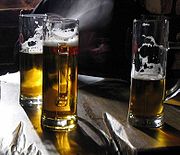 The officials of Plzeň founded a city-owned brewery in 1839, (Citizens' Brewery – now Plzeňský Prazdroj), and recruited Bavarian brewer Josef Groll
(1813–1887) who produced the first batch of modern Pilsner beer on 5 October 1842. The combination of pale colour from the new malts, Pilsen's remarkably soft water, Saaz
noble hops from nearby Žatec
(Saaz in German) and Bavarian-style lagering produced a clear, golden beer which was regarded as a sensation.
Improving transport meant that this new beer was soon available throughout Central Europe and -style brewing was widely imitated. In 1859, “Pilsner Bier” was registered as a brand name at the Chamber of Commerce and Trade in Plzeň. In 1898, the Pilsner Urquell
trade mark was created to put emphasis on it being the original brewery.
in Plzeň is well known for its School of Law, School of Mechanical Engineering and School of Applied Science in particular.
Since the second half of the 1990s the city has experienced high growth in foreign investments. In 2007, Israeli mall developer Plaza Centers opened the Pilsen Plaza, a 20,000 square meter shopping mall and entertainment center featuring a multiplex cinema from Cinema City Czech Republic
.
Plzeň produces approximately two-thirds of the Plzeň Region GDP, even though it contains only 29.8% of its population. Based on these figures, the city of Plzeň has a total GDP of approximately $7.2 billion, and a per-capita GDP of $44,000. While part of this is explained by commuters (people who work in the city, but live elsewhere) it is one of the most prosperous cities in the Czech Republic.
The Škoda
company, established in Plzeň in 1859, has been an important part of Austro-Hungarian, Czechoslovak and Czech engineering. The company's production had been directed to the needs of the Eastern Bloc
, and after the Velvet Revolution
, it consequently ran into selling problems and debts. After a huge restructuring process it has just two principal subsidiaries: Škoda Transportation (locomotives, tube-trains or trams, since sold to Portland
, Tacoma
, Seattle
and Sardinia
) and Škoda Power (turbines).
Many foreign companies now own manufacturing bases in Plzeň including Daikin and Panasonic
. There has been much discussion of redeveloping those large areas of the Škoda plant which the company no longer uses.
Plzeň also has the biggest distillery (Stock
) in the Czech Republic.
Oceanic climate
(Cfb) with mostly balanced temperatures year round. Plzeň is a wet city with precipitation over 1 mm occurring every second day and the number of days with thunderstorm
s is 19. Thanks to that it receives on average only 1667 hours of sunshine. Precipitation falls evenly during the year. Due to terrain features, strong winds are rare. Winters are chilly but milder than in adjacent areas. Snow cover is erratic and stays on the ground for 51 days. Though an average year has 113 days with temperatures below zero, the number of days with frost below -15 °C is only 5. Extreme low temperatures with days below -5 °C and nights below -10 °C are rare but sometimes occur during a northeast arctic wave. The lowest possible temperatures are about -20 °C. During Winter daylight lasts only for about 9 hours a day and is murky with frequent haze. Spring is short and brings longer days and an increasing number of sunny days. May and June are months of blooming vegetation and greenness. Summer lasts from the end of May until first third of September. During that period Plzeň enjoys changeable weather
which can be warm to hot. Temperatures are always above 5 degrees Celsius with nights between 10 to 18 °C (50 to 64.4 °F) and days between 18 to 28 °C (64.4 to 82.4 °F). Days are bright and up to 16 hours long.
Plzeň can also be hot, especially during heat waves originating in the southern Mediterranean. The number of hot days above 30 °C (86 °F) is steadily growing with 5 months (May – September) of possible 30+ °C days. If hot weather does occur, it's common that it turns after a few weeks into cold and rainy weather with incoming Atlantic-based fronts. Nights can be unpleasantly cold even during summers with high humidity levels and winter lows are below zero since the second half of November to the end of March.
The only natural hazards are infrequent drought with extreme high temperatures above 33 °C (91.4 °F) and prolonged heavy rains causing floods.
Extreme values for year 2010:
extreme cold day -12.0 °C on average (27 January, -5.9 °C and extreme hot day 26 °C (78.8 °F) on average (17 July, 16.3 to 36 °C (61.3 to 96.8 °F).
Number of rainy/snowy days: 167; number of days with frost: 116; number of days with daily temperatures below -10 °C: 3; number of days with average temperature below zero: 69; number of days with daily average temperature higher than 10 °C (50 °F): 177; number of days with daily average higher than 20 °C (68 °F): 34.
Total amount of precipitation: 559.8 mm; average year humidity value: 81.6%.
Average year temperature: +8.1 °C; average speed of wind: 6.0 km/h, mainly from south.
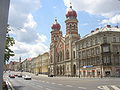
St. Bartholomew's Cathedral
, founded in the late 13th century, the tower of which (102.26 m / 335 ft) is the highest in the Czech Republic, the Renaissance
Town Hall, and the Moorish Revival
Great Synagogue, the second largest synagogue in Europe, after the Dohány Street Synagogue
in Budapest
. There is also a 20 km historic underground tunnel/cellar network, among the longest in Central Europe. Part of this network is open to the public for tours of approximately 750 metres in length and up to a depth of 12 metres.
The former water tower was built in 1532 as part of the city waterworks and at the same time as a component of the city wall as the Prague Gate. Another storey was added in 1822 in French Imperial style. The Gothic portal (dating from the 1500s) was added in 1912, coming from another house that was demolished. Above the portal a commemorative plaque was dedicated to dr. Josef Skoda
(a professor at the Vienna University) was born next door on 10 December 1805.
Plzeň is also well known for the Pilsner Urquell
(since 1842) and Gambrinus
(since 1869) breweries
, currently owned by South African Breweries
. A popular tourist attraction is the Plzeňský Prazdroj brewery tour where visitors can discover the history of beer. The pilsener
style of beer was developed in Plzeň in the 19th century.
Plzeň has been selected to be a European Capital Of Culture
in 2015, along with Mons, Belgium.
Plzeň is important center of Czech railway transport, crossing of 5 main railway lines:
, Russia Izmir
, Turkey Birmingham, Alabama
, United States Regensburg
, Bavaria, Germany Winterthur
, Switzerland Limoges
, France Liège
, Belgium Hengelo
, Netherlands
Bohemia
Bohemia is a historical region in central Europe, occupying the western two-thirds of the traditional Czech Lands. It is located in the contemporary Czech Republic with its capital in Prague...
in the Czech Republic
Czech Republic
The Czech Republic is a landlocked country in Central Europe. The country is bordered by Poland to the northeast, Slovakia to the east, Austria to the south, and Germany to the west and northwest....
. It is the capital of the Plzeň Region
Plzen Region
Plzeň Region is an administrative unit in the western part of Bohemia in the Czech Republic. It is named after its capital Plzeň .- Communes :...
and the fourth most populous city in the Czech Republic. It is located about 90 km west of Prague
Prague
Prague is the capital and largest city of the Czech Republic. Situated in the north-west of the country on the Vltava river, the city is home to about 1.3 million people, while its metropolitan area is estimated to have a population of over 2.3 million...
at the confluence of four rivers—the Radbuza
Radbuza
The Radbuza is a 112 km long river in the Czech Republic, the right tributary of the Mže. Its source is situated at the foot of Lysá mountain near the village of Závist, near Domažlice...
, the Mže
Mže
The Mže is a 107 km long river in the Czech Republic. Its source is situated in the Griesbach Forest , Germany, near the village of Asch, in the municipality of Mähring, Tirschenreuth district. It forms the state boundary on the short distance of 3 kilometers and then finally enters the Czech...
, the Úhlava
Úhlava
The Úhlava is a long river in the Czech Republic, right tributary of the Radbuza. Its source is situated at the slope of Pancíř mountain in the Šumava mountains, Klatovy District at an elevation of . It passes villages and towns Nýrsko, Janovice, Bezděkov, Klatovy, Švihov, Lužany, and Přeštice...
, and the Úslava
Úslava
Úslava is a river in the Czech Republic. It originates as Bradlava near the village of Číhaň. It runs through the following municipalities: Plánice , Žinkovy, Nepomuk, Blovice, Šťáhlavy, Starý Plzenec, Plzeň....
—which form the Berounka
Berounka
The Berounka is a river in the Czech Republic. It carries the name Mže from its source in Germany, next to the Czech border, until its confluence with the Radbuza in Pilsen...
River.
The city is known worldwide for Pilsner beer. Plzeň was in September 2010 selected by an official jury to be put forward to join the Belgian city of Mons as the European capital of culture in 2015.
History
Plzeň was first mentioned as a castle in 976, as the scene of a battle between Duke Boleslaus II of Bohemia and EmperorHoly Roman Emperor
The Holy Roman Emperor is a term used by historians to denote a medieval ruler who, as German King, had also received the title of "Emperor of the Romans" from the Pope...
Otto II
Otto II, Holy Roman Emperor
Otto II , called the Red, was the third ruler of the Saxon or Ottonian dynasty, the son of Otto the Great and Adelaide of Italy.-Early years and co-ruler with Otto I:...
. It became a town in 1295 when King Wenceslaus II granted Plzeň its civic charter as a special "Royal City" and established a new town site, located some 10 km away from the original settlement, which is the current town of Starý Plzenec
Starý Plzenec
Starý Plzenec is a town in the Plzeň Region of the Czech Republic. It lies some to the southeast from the region capital of Plzeň on the Úslava River....
. It quickly became an important town on trade routes leading to Nuremberg
Nuremberg
Nuremberg[p] is a city in the German state of Bavaria, in the administrative region of Middle Franconia. Situated on the Pegnitz river and the Rhine–Main–Danube Canal, it is located about north of Munich and is Franconia's largest city. The population is 505,664...
and Regensburg
Regensburg
Regensburg is a city in Bavaria, Germany, located at the confluence of the Danube and Regen rivers, at the northernmost bend in the Danube. To the east lies the Bavarian Forest. Regensburg is the capital of the Bavarian administrative region Upper Palatinate...
; in the 14th century, it was the third-largest town in Bohemia after Prague
Prague
Prague is the capital and largest city of the Czech Republic. Situated in the north-west of the country on the Vltava river, the city is home to about 1.3 million people, while its metropolitan area is estimated to have a population of over 2.3 million...
and Kutná Hora
Kutná Hora
Kutná Hora is a city in Bohemia, now the Czech Republic in the Central Bohemian Region.-History:The town began in 1142 with the settlement of the first Cistercian Monastery in Bohemia, Kloster Sedlitz, brought from the Imperial immediate Cistercian Waldsassen Abbey...
. During the Hussite Wars
Hussite Wars
The Hussite Wars, also called the Bohemian Wars involved the military actions against and amongst the followers of Jan Hus in Bohemia in the period 1419 to circa 1434. The Hussite Wars were notable for the extensive use of early hand-held gunpowder weapons such as hand cannons...
, it was the centre of Catholic resistance to the Hussites: Prokop the Great
Prokop the Great
Prokop or Prokop the Great was one of the most prominent Hussite generals of the Hussite Wars...
unsuccessfully besieged it three times, and it joined the league of Romanist nobles against King George of Podebrady
George of Podebrady
George of Kunštát and Poděbrady , also known as Poděbrad or Podiebrad , was King of Bohemia...
. In 1468, the town acquired a printing press
Printing press
A printing press is a device for applying pressure to an inked surface resting upon a print medium , thereby transferring the ink...
; the Troyan Chronicle, the first book published in Bohemia, was printed on it.
Emperor Rudolf II
Rudolf II, Holy Roman Emperor
Rudolf II was Holy Roman Emperor , King of Hungary and Croatia , King of Bohemia and Archduke of Austria...
made Plzeň his seat from 1599–1600. During the Thirty Years' War
Thirty Years' War
The Thirty Years' War was fought primarily in what is now Germany, and at various points involved most countries in Europe. It was one of the most destructive conflicts in European history....
the town was taken by Mansfeld in 1618 after the Siege of Plzeň
Siege of Plzen
The Siege of Pilsen or Battle of Pilsen was a siege of the fortified city of Pilsen in Bohemia carried out by the forces of the Bohemian Protestants led by Ernst von Mansfeld. It was the first major battle of the Thirty Years' War...
and it was not recaptured by the Imperial troops until 1621. Wallenstein
Albrecht von Wallenstein
Albrecht Wenzel Eusebius von Wallenstein , actually von Waldstein, was a Bohemian soldier and politician, who offered his services, and an army of 30,000 to 100,000 men during the Danish period of the Thirty Years' War , to the Holy Roman Emperor Ferdinand II...
made it his winter quarters in 1633. The town was unsuccessfully besieged by the Swedes
Swedish Empire
The Swedish Empire refers to the Kingdom of Sweden between 1561 and 1721 . During this time, Sweden was one of the great European powers. In Swedish, the period is called Stormaktstiden, literally meaning "the Great Power Era"...
in 1637 and 1648. The town and region have been staunchly Catholic despite the Hussite Wars
Hussite Wars
The Hussite Wars, also called the Bohemian Wars involved the military actions against and amongst the followers of Jan Hus in Bohemia in the period 1419 to circa 1434. The Hussite Wars were notable for the extensive use of early hand-held gunpowder weapons such as hand cannons...
.
At the end of the 17th century, the architecture of Plzeň began to be influenced by the Baroque
Baroque architecture
Baroque architecture is a term used to describe the building style of the Baroque era, begun in late sixteenth century Italy, that took the Roman vocabulary of Renaissance architecture and used it in a new rhetorical and theatrical fashion, often to express the triumph of the Catholic Church and...
style. The city center has been under cultural heritage preservation since 1989.
In the second half of the 19th Century Plzeň, already an important trade centre for Bohemia
Bohemia
Bohemia is a historical region in central Europe, occupying the western two-thirds of the traditional Czech Lands. It is located in the contemporary Czech Republic with its capital in Prague...
, near the Bavarian/German border, began to rapidly industrialise. In 1869 Emil Škoda
Emil Škoda
Emil Ritter von Škoda was a Bohemian engineer and industrialist, working during the time of the Austro-Hungarian Empire.-Biography:...
started up the Škoda Works
Škoda Works
Škoda Works was the largest industrial enterprise in Austro-Hungary and later in Czechoslovakia, one of its successor states. It was also one of the largest industrial conglomerates in Europe in the 20th century...
, which became the most important and influential engineering company in the country and a crucial supplier of arms to the Austro-Hungarian Army
Austro-Hungarian Army
The Austro-Hungarian Army was the ground force of the Austro-Hungarian Dual Monarchy from 1867 to 1918. It was composed of three parts: the joint army , the Austrian Landwehr , and the Hungarian Honvédség .In the wake of fighting between the...
. By 1917 the Škoda Works
Škoda Works
Škoda Works was the largest industrial enterprise in Austro-Hungary and later in Czechoslovakia, one of its successor states. It was also one of the largest industrial conglomerates in Europe in the 20th century...
employed over 30,000 workers. The second largest employer in this period was, after 1898, the National Railways train workshop with about 2,000 employees: this was the largest rail repair shop in all Austria-Hungary
Austria-Hungary
Austria-Hungary , more formally known as the Kingdoms and Lands Represented in the Imperial Council and the Lands of the Holy Hungarian Crown of Saint Stephen, was a constitutional monarchic union between the crowns of the Austrian Empire and the Kingdom of Hungary in...
. Between 1861 and 1877, the Plzeň railway junction was completed and in 1899 the first tram line started in the city. This burst of industry had two important effects: the growth of the local Czech (Slavic) population and the urban poor. Before 1860 the town was mostly German-speaking; after 1918 it was mostly Czech
Czech language
Czech is a West Slavic language with about 12 million native speakers; it is the majority language in the Czech Republic and spoken by Czechs worldwide. The language was known as Bohemian in English until the late 19th century...
speaking. However much of the countryside to the west, north and south of the town continued to speak a local German dialect.
Following Czechoslovak independence from Austria-Hungary
Austria-Hungary
Austria-Hungary , more formally known as the Kingdoms and Lands Represented in the Imperial Council and the Lands of the Holy Hungarian Crown of Saint Stephen, was a constitutional monarchic union between the crowns of the Austrian Empire and the Kingdom of Hungary in...
in 1918 the German-speaking minority in the region hoped to be united with Austria and were unhappy at being included in Czechoslovakia. Many allied themselves to the Nazi cause after 1933, in hopes that perhaps Adolf Hitler
Adolf Hitler
Adolf Hitler was an Austrian-born German politician and the leader of the National Socialist German Workers Party , commonly referred to as the Nazi Party). He was Chancellor of Germany from 1933 to 1945, and head of state from 1934 to 1945...
might be able to unite them with their German-speaking neighbours. In 1938 Plzeň became literally a frontier town, after the creation of the Sudetenland
Sudetenland
Sudetenland is the German name used in English in the first half of the 20th century for the northern, southwest and western regions of Czechoslovakia inhabited mostly by ethnic Germans, specifically the border areas of Bohemia, Moravia, and those parts of Silesia being within Czechoslovakia.The...
moved the Third Reich borders to the city's outer limits. During the Nazi occupation from 1939 to 1945 the Škoda Works
Škoda Works
Škoda Works was the largest industrial enterprise in Austro-Hungary and later in Czechoslovakia, one of its successor states. It was also one of the largest industrial conglomerates in Europe in the 20th century...
in Pilsen was forced to provide armaments for the Wehrmacht
Wehrmacht
The Wehrmacht – from , to defend and , the might/power) were the unified armed forces of Nazi Germany from 1935 to 1945. It consisted of the Heer , the Kriegsmarine and the Luftwaffe .-Origin and use of the term:...
and Czech contributions, particularly in the field of tanks, were noted.
The German-speaking population was forcibly expelled from the city and in fact all of Czechoslovakia after the end of war in 1945, according to provision in the Potsdam agreement
Potsdam Agreement
The Potsdam Agreement was the Allied plan of tripartite military occupation and reconstruction of Germany—referring to the German Reich with its pre-war 1937 borders including the former eastern territories—and the entire European Theatre of War territory...
. All of their property was confiscated.
On 6 May 1945, near end of World War II, Plzeň was liberated from Nazi Germany
Nazi Germany
Nazi Germany , also known as the Third Reich , but officially called German Reich from 1933 to 1943 and Greater German Reich from 26 June 1943 onward, is the name commonly used to refer to the state of Germany from 1933 to 1945, when it was a totalitarian dictatorship ruled by...
by the 16th Armored Division of General Patton's
George S. Patton
George Smith Patton, Jr. was a United States Army officer best known for his leadership while commanding corps and armies as a general during World War II. He was also well known for his eccentricity and controversial outspokenness.Patton was commissioned in the U.S. Army after his graduation from...
3rd Army. Also participating in the liberation of the city were elements of the 97th and 2nd Infantry Divisions. Other Third Army units liberated major portions of Western Bohemia. The rest of Czechoslovakia
Czechoslovakia
Czechoslovakia or Czecho-Slovakia was a sovereign state in Central Europe which existed from October 1918, when it declared its independence from the Austro-Hungarian Empire, until 1992...
was liberated from German control by the Soviet
Soviet Union
The Soviet Union , officially the Union of Soviet Socialist Republics , was a constitutionally socialist state that existed in Eurasia between 1922 and 1991....
Red Army
Red Army
The Workers' and Peasants' Red Army started out as the Soviet Union's revolutionary communist combat groups during the Russian Civil War of 1918-1922. It grew into the national army of the Soviet Union. By the 1930s the Red Army was among the largest armies in history.The "Red Army" name refers to...
. Elements of Third Army, as well as units from the First Army, remained in Plzeň until late November 1945, assisting the Czechs with re-building from the war. After seizing power in 1948, the Communists undertook a systematic campaign to suppress all acknowledgement of the U.S. Army's role in liberating the city and Western Bohemia. This continued until 1989 when the Communists were removed from power. Since 1990, the city of Plzeň has organized the annual Liberation Festival, taking place in May, which has already become a local tradition, and has been attended by many American and Allied veterans.
After the Communist takeover of February 1948
Czechoslovak coup d'état of 1948
The Czechoslovak coup d'état of 1948 – in Communist historiography known as "Victorious February" – was an event late that February in which the Communist Party of Czechoslovakia, with Soviet backing, assumed undisputed control over the government of Czechoslovakia, ushering in over four decades...
, the totalitarian, Soviet-oriented Czechoslovak government launched a currency reform in 1953. This decision caused a wave of discontent throughout the society, while the events in Plzeň were more intense. On 1 June 1953 over 20,000 people, mainly workers of the Škoda Works
Škoda Works
Škoda Works was the largest industrial enterprise in Austro-Hungary and later in Czechoslovakia, one of its successor states. It was also one of the largest industrial conglomerates in Europe in the 20th century...
began demonstrating against the communist regime. Demonstrators forced their way into the town hall and threw Communist symbols, furniture and other objects out the windows. The demonstration was violently suppressed by the Communist officials. As replay the regime the sculpture of Thomas Garrigue Masaryk was destroyed immediately.
Pilsner beer
Josef Groll
Josef Groll was a Bavarian brewer, best known for his invention of Pilsener beer.The citizens of Pilsen were no longer satisfied with their top-fermented Oberhefenbier. They publicly emptied several casks of beer in order to draw attention to its low quality and short storage life...
(1813–1887) who produced the first batch of modern Pilsner beer on 5 October 1842. The combination of pale colour from the new malts, Pilsen's remarkably soft water, Saaz
Saaz hops
Saaz is a "noble" variety of hops.It was named after the Czech city of Žatec . This hop is used extensively in Bohemia to flavor beer styles such as the Czech pilsener.Saaz hops accounted for more than 2/3 of total 2009 hop production in the Czech Republic....
noble hops from nearby Žatec
Žatec
Žatec is an old town in the Czech Republic, in Louny District, Ústí nad Labem Region. It has a population of 19,813 .The earliest historical reference to Sacz is in the Latin chronicle of Thietmar of Merseburg of 1004. During the 11th century it belonged to the Vršovci - a powerful Czech...
(Saaz in German) and Bavarian-style lagering produced a clear, golden beer which was regarded as a sensation.
Improving transport meant that this new beer was soon available throughout Central Europe and -style brewing was widely imitated. In 1859, “Pilsner Bier” was registered as a brand name at the Chamber of Commerce and Trade in Plzeň. In 1898, the Pilsner Urquell
Pilsner Urquell
Plzeňský Prazdroj , known better by its German name Pilsner Urquell , is a bottom-fermented beer produced since 1842 in Pilsen, part of today's Czech Republic. Pilsner Urquell was the first pilsner beer in the world...
trade mark was created to put emphasis on it being the original brewery.
Education and economy
Plzeň is a centre of academic, business, and cultural life for the western part of the Czech Republic. The University of West BohemiaUniversity of West Bohemia
The University of West Bohemia is a university in Pilsen, Czech Republic. It was founded in 1991 and consists of seven faculties.-Organization:The faculties are the basic units of the university. The units implement their own academic programs...
in Plzeň is well known for its School of Law, School of Mechanical Engineering and School of Applied Science in particular.
Since the second half of the 1990s the city has experienced high growth in foreign investments. In 2007, Israeli mall developer Plaza Centers opened the Pilsen Plaza, a 20,000 square meter shopping mall and entertainment center featuring a multiplex cinema from Cinema City Czech Republic
Cinema City Czech Republic
Cinema City is a brand of multiplex cinemas in eastern and central Europe, run by the Israeli company Cinema City International . In Europe it has cinemas in Hungary, Poland and the Czech Republic...
.
Plzeň produces approximately two-thirds of the Plzeň Region GDP, even though it contains only 29.8% of its population. Based on these figures, the city of Plzeň has a total GDP of approximately $7.2 billion, and a per-capita GDP of $44,000. While part of this is explained by commuters (people who work in the city, but live elsewhere) it is one of the most prosperous cities in the Czech Republic.
The Škoda
Škoda Works
Škoda Works was the largest industrial enterprise in Austro-Hungary and later in Czechoslovakia, one of its successor states. It was also one of the largest industrial conglomerates in Europe in the 20th century...
company, established in Plzeň in 1859, has been an important part of Austro-Hungarian, Czechoslovak and Czech engineering. The company's production had been directed to the needs of the Eastern Bloc
Eastern bloc
The term Eastern Bloc or Communist Bloc refers to the former communist states of Eastern and Central Europe, generally the Soviet Union and the countries of the Warsaw Pact...
, and after the Velvet Revolution
Velvet Revolution
The Velvet Revolution or Gentle Revolution was a non-violent revolution in Czechoslovakia that took place from November 17 – December 29, 1989...
, it consequently ran into selling problems and debts. After a huge restructuring process it has just two principal subsidiaries: Škoda Transportation (locomotives, tube-trains or trams, since sold to Portland
Portland, Oregon
Portland is a city located in the Pacific Northwest, near the confluence of the Willamette and Columbia rivers in the U.S. state of Oregon. As of the 2010 Census, it had a population of 583,776, making it the 29th most populous city in the United States...
, Tacoma
Tacoma, Washington
Tacoma is a mid-sized urban port city and the county seat of Pierce County, Washington, United States. The city is on Washington's Puget Sound, southwest of Seattle, northeast of the state capital, Olympia, and northwest of Mount Rainier National Park. The population was 198,397, according to...
, Seattle
Seattle, Washington
Seattle is the county seat of King County, Washington. With 608,660 residents as of the 2010 Census, Seattle is the largest city in the Northwestern United States. The Seattle metropolitan area of about 3.4 million inhabitants is the 15th largest metropolitan area in the country...
and Sardinia
Sardinia
Sardinia is the second-largest island in the Mediterranean Sea . It is an autonomous region of Italy, and the nearest land masses are the French island of Corsica, the Italian Peninsula, Sicily, Tunisia and the Spanish Balearic Islands.The name Sardinia is from the pre-Roman noun *sard[],...
) and Škoda Power (turbines).
Many foreign companies now own manufacturing bases in Plzeň including Daikin and Panasonic
Panasonic
Panasonic is an international brand name for Japanese electric products manufacturer Panasonic Corporation, which was formerly known as Matsushita Electric Industrial Co., Ltd...
. There has been much discussion of redeveloping those large areas of the Škoda plant which the company no longer uses.
Plzeň also has the biggest distillery (Stock
Fernet Stock
Fernet Stock is a herbal bitters made in Plzeň-Božkov, Czech Republic and in Trieste, Italy. It is flavoured with approximately 14 herbs, imported from the Mediterranean and the Alps...
) in the Czech Republic.
Geography and Climate
Plzeň enjoys cool and temperateTemperate
In geography, temperate or tepid latitudes of the globe lie between the tropics and the polar circles. The changes in these regions between summer and winter are generally relatively moderate, rather than extreme hot or cold...
Oceanic climate
Oceanic climate
An oceanic climate, also called marine west coast climate, maritime climate, Cascadian climate and British climate for Köppen climate classification Cfb and subtropical highland for Köppen Cfb or Cwb, is a type of climate typically found along the west coasts at the middle latitudes of some of the...
(Cfb) with mostly balanced temperatures year round. Plzeň is a wet city with precipitation over 1 mm occurring every second day and the number of days with thunderstorm
Thunderstorm
A thunderstorm, also known as an electrical storm, a lightning storm, thundershower or simply a storm is a form of weather characterized by the presence of lightning and its acoustic effect on the Earth's atmosphere known as thunder. The meteorologically assigned cloud type associated with the...
s is 19. Thanks to that it receives on average only 1667 hours of sunshine. Precipitation falls evenly during the year. Due to terrain features, strong winds are rare. Winters are chilly but milder than in adjacent areas. Snow cover is erratic and stays on the ground for 51 days. Though an average year has 113 days with temperatures below zero, the number of days with frost below -15 °C is only 5. Extreme low temperatures with days below -5 °C and nights below -10 °C are rare but sometimes occur during a northeast arctic wave. The lowest possible temperatures are about -20 °C. During Winter daylight lasts only for about 9 hours a day and is murky with frequent haze. Spring is short and brings longer days and an increasing number of sunny days. May and June are months of blooming vegetation and greenness. Summer lasts from the end of May until first third of September. During that period Plzeň enjoys changeable weather
Weather front
A weather front is a boundary separating two masses of air of different densities, and is the principal cause of meteorological phenomena. In surface weather analyses, fronts are depicted using various colored lines and symbols, depending on the type of front...
which can be warm to hot. Temperatures are always above 5 degrees Celsius with nights between 10 to 18 °C (50 to 64.4 °F) and days between 18 to 28 °C (64.4 to 82.4 °F). Days are bright and up to 16 hours long.
Plzeň can also be hot, especially during heat waves originating in the southern Mediterranean. The number of hot days above 30 °C (86 °F) is steadily growing with 5 months (May – September) of possible 30+ °C days. If hot weather does occur, it's common that it turns after a few weeks into cold and rainy weather with incoming Atlantic-based fronts. Nights can be unpleasantly cold even during summers with high humidity levels and winter lows are below zero since the second half of November to the end of March.
The only natural hazards are infrequent drought with extreme high temperatures above 33 °C (91.4 °F) and prolonged heavy rains causing floods.
Extreme values for year 2010:
extreme cold day -12.0 °C on average (27 January, -5.9 °C and extreme hot day 26 °C (78.8 °F) on average (17 July, 16.3 to 36 °C (61.3 to 96.8 °F).
Number of rainy/snowy days: 167; number of days with frost: 116; number of days with daily temperatures below -10 °C: 3; number of days with average temperature below zero: 69; number of days with daily average temperature higher than 10 °C (50 °F): 177; number of days with daily average higher than 20 °C (68 °F): 34.
Total amount of precipitation: 559.8 mm; average year humidity value: 81.6%.
Average year temperature: +8.1 °C; average speed of wind: 6.0 km/h, mainly from south.
Tourism
The most prominent sights of Plzeň are the GothicGothic architecture
Gothic architecture is a style of architecture that flourished during the high and late medieval period. It evolved from Romanesque architecture and was succeeded by Renaissance architecture....
St. Bartholomew's Cathedral
Cathedral of St. Bartholomew (Plzen)
The Cathedral of Saint Bartholomew dominates the city center of Pilsen in the Czech Republic.The construction of the Gothic style building, located on the main square, started in 1295 and was finished by the beginning of 16th century.The building is 58m long, 30m wide and the spires are 25m high...
, founded in the late 13th century, the tower of which (102.26 m / 335 ft) is the highest in the Czech Republic, the Renaissance
Renaissance
The Renaissance was a cultural movement that spanned roughly the 14th to the 17th century, beginning in Italy in the Late Middle Ages and later spreading to the rest of Europe. The term is also used more loosely to refer to the historical era, but since the changes of the Renaissance were not...
Town Hall, and the Moorish Revival
Moorish Revival
Moorish Revival or Neo-Moorish is one of the exotic revival architectural styles that were adopted by architects of Europe and the Americas in the wake of the Romanticist fascination with all things oriental...
Great Synagogue, the second largest synagogue in Europe, after the Dohány Street Synagogue
Dohány Street Synagogue
The Great Synagogue, also known as Dohány Street Synagogue or Tabakgasse Synagogue, is located in Erzsébetváros, the 7th district of Budapest. It is the third largest synagogue in Eurasia and the fifth largest in the world...
in Budapest
Budapest
Budapest is the capital of Hungary. As the largest city of Hungary, it is the country's principal political, cultural, commercial, industrial, and transportation centre. In 2011, Budapest had 1,733,685 inhabitants, down from its 1989 peak of 2,113,645 due to suburbanization. The Budapest Commuter...
. There is also a 20 km historic underground tunnel/cellar network, among the longest in Central Europe. Part of this network is open to the public for tours of approximately 750 metres in length and up to a depth of 12 metres.
The former water tower was built in 1532 as part of the city waterworks and at the same time as a component of the city wall as the Prague Gate. Another storey was added in 1822 in French Imperial style. The Gothic portal (dating from the 1500s) was added in 1912, coming from another house that was demolished. Above the portal a commemorative plaque was dedicated to dr. Josef Skoda
Josef Škoda
Joseph Škoda was a Czech physician, medical professor and dermatologist. Together with Carl Freiherr von Rokitansky, he was the founder of the Modern Medical School of Vienna.-Life:...
(a professor at the Vienna University) was born next door on 10 December 1805.
Plzeň is also well known for the Pilsner Urquell
Pilsner Urquell
Plzeňský Prazdroj , known better by its German name Pilsner Urquell , is a bottom-fermented beer produced since 1842 in Pilsen, part of today's Czech Republic. Pilsner Urquell was the first pilsner beer in the world...
(since 1842) and Gambrinus
Gambrinus (beer)
Gambrinus is a beer brewed in the Czech Republic at the Plzeňský Prazdroj brewery. It is one of the most popular beers in the Czech Republic. The beer is named after Gambrinus, a legendary king of Flanders known for his mythical brewing abilities. Gambrinus sponsors Gambrinus liga, the premier...
(since 1869) breweries
Brewery
A brewery is a dedicated building for the making of beer, though beer can be made at home, and has been for much of beer's history. A company which makes beer is called either a brewery or a brewing company....
, currently owned by South African Breweries
South African Breweries
The South African Breweries , then called Castle Breweries, was founded in 1895 specifically to serve a new market of miners and prospectors in and around Johannesburg. Two years later, it became the first industrial company to list on the Johannesburg Stock Exchange...
. A popular tourist attraction is the Plzeňský Prazdroj brewery tour where visitors can discover the history of beer. The pilsener
Pilsener
Pilsner is a type of pale lager. It takes its name from the city of Pilsen , Bohemia, in today's Czech Republic, where it has been developed since 1842, when a bottom-fermented beer was first produced. The original Pilsner Urquell beer is produced there today.-Origin:Until the mid-1840s, most ...
style of beer was developed in Plzeň in the 19th century.
Plzeň has been selected to be a European Capital Of Culture
European Capital of Culture
The European Capital of Culture is a city designated by theEuropean Union for a period of one calendar year during which it organises a series of cultural events with a strong European dimension....
in 2015, along with Mons, Belgium.
Dioceses
Since 31 May 1993 Plzeň has been the seat of the Catholic Diocese of Plzeň. The first and incumbent Bishop is František Radkovský. The diocese covers almost the entire territory of Plzeň region with a total of 818,700 inhabitants. The Diocese office is in St. Bartholomew's Cathedral on the Republic Square in Plzeň. The diocese is divided into 10 vicariates with a total of 72 parishes.Transport
The Plzeň metropolitan area is largely served by a network of trams, trolleybuses and buses operated by the PMDP. Like other continental European cities, tickets bought from vending machines or small shops are valid for any transportation run by the city of Plzeň. For residents of the city, a Plzeň Card can be purchased and through a system of "topping up" be used on any public transport with no limitations, as long as it is paid up and valid.Plzeň is important center of Czech railway transport, crossing of 5 main railway lines:
- line Nr. 170: Praha – BerounBerounBeroun is a town in the Central Bohemian Region of the Czech Republic. The town is part of the Prague metropolitan area. It is located 30 km southwest of Prague and has a population of 18,930 . It lies on the confluence of Berounka and Litavka rivers.Despite its small size, it is an...
– Plzeň – ChebChebCheb is a city in the Karlovy Vary Region of the Czech Republic, with about 33,000 inhabitants. It is situated on the river Ohře , at the foot of one of the spurs of the Smrčiny and near the border with Germany... - line Nr. 180: Plzeň – DomažliceDomažliceDomažlice is a town in the Plzeň Region of the Czech Republic.Domažlice is also a Municipality with Extended Competence and a Municipality with Commissioned Local Authority within the same borders.-History:...
– Furth im WaldFurth im WaldFurth im Wald is a town in the District of Cham, in Bavaria, Germany, near the Czech border. It is situated in the Bavarian Forest, 16 km northeast of Cham, and 17 km southwest of Domažlice....
(Germany) - line Nr. 183: Plzeň – KlatovyKlatovyKlatovy is a town in the Plzeň Region of the Czech Republic.Klatovy is also the seat of the Municipality with Extended Competence and Municipality with Commissioned Local Authority.- History :Klatovy was founded during 1260–1263 by Přemysl Otakar II....
– Železná RudaŽelezná RudaŽelezná Ruda is a town in the Pilsen Region of the Czech Republic. It is located in the Šumava Mountains, close to the border with Bavaria and the German town Bayerisch Eisenstein. It has been one of the important sports and touristic centres of the Šumava Mountains... - line Nr. 160: Plzeň – ŽatecŽatecŽatec is an old town in the Czech Republic, in Louny District, Ústí nad Labem Region. It has a population of 19,813 .The earliest historical reference to Sacz is in the Latin chronicle of Thietmar of Merseburg of 1004. During the 11th century it belonged to the Vršovci - a powerful Czech...
- line Nr. 190: Plzeň – České BudějoviceCeské BudejoviceČeské Budějovice is a city in the Czech Republic. It is the largest city in the South Bohemian Region and is the political and commercial capital of the region and centre of the Roman Catholic Diocese of České Budějovice and of the University of South Bohemia and the Academy of Sciences...
Sport
- FC Viktoria PlzeňFC Viktoria PlzenFC Viktoria Plzeň is a Czech professional football club based in Plzeň. They currently play in the Gambrinus liga, the top division of football in the country....
and HC Plzeň 1929
Notable people
- Jaroslav Beneš (born 1946), fine artFine artFine art or the fine arts encompass art forms developed primarily for aesthetics and/or concept rather than practical application. Art is often a synonym for fine art, as employed in the term "art gallery"....
photographer - Petr ČechPetr CechPetr Čech is a Czech footballer who plays for Chelsea and the Czech Republic as a goalkeeper. Čech previously played for Viktoria Plzeň, Chmel Blšany, Sparta Prague, and Rennes. He was voted into the all-star team of Euro 2004 after helping his country reach the semi-finals...
(born 1982), football goalkeeper - Karel ČernýKarel CernýKarel Černý is a Czech art director and production designer. He won an Academy Award in the category Best Art Direction for the film Amadeus.-External links:...
(born 1922), art director - Kateřina EmmonsKaterina EmmonsKateřina Emmons, née Kůrková is a female Czech sport shooter who competed in the 2004 Summer Olympics, where she won a bronze medal, and the 2008 Summer Olympics, where she won her first gold medal in the women's 10 metre air rifle competition, and the very first gold medal of that particular...
(born 1983) Olympic sports shooter - Josef FingerJosef FingerJosef Finger was an Austrian physicist and mathematician.- Life :Joseph Finger was born the son of a baker in Pilsen. He attended high school in Pilsen. He studied mathematics and physics at Charles University in Prague from 1859 to 1862...
(1841–1925), physicist and mathematician - Gertrud Fussenegger (born 1912), writer (:de:Gertrud Fussenegger)
- Friedrich Goldscheider (1845–1897), ceramist and industrialist
- Karel GottKarel GottKarel Gott is a Czech Schlager singer, and an amateur painter. He is considered as the most successful male singer in former Czechoslovakia and currently in the Czech Republic; he has being voted the Most Favorite Male Singer in the annual national pool Český slavík in total thirty-six times...
(born 1939), singer - Peter GrünbergPeter GrünbergPeter Andreas Grünberg is a German physicist, and Nobel Prize in Physics laureate for his discovery with Albert Fert of giant magnetoresistance which brought about a breakthrough in gigabyte hard disk drives.-Biography:...
(born 1939), German physicist and 2007 Nobel prize winner - Miroslav HolubMiroslav HolubMiroslav Holub was a Czech poet and immunologist.Miroslav Holub's work was heavily influenced by his experiences as an Immunologist, writing many poems using his scientific knowledge to poetic effect. His work is almost always unrhymed, so lends itself easily to translation...
(1923–1998), poet - Rudolf KarelRudolf KarelRudolf Karel was a distinguished Czech composer.-Brief Biography:Rudolf Karel was son of a poor railway employee. He studied composition from 1899 to 1904 with Antonín Dvořák and organ with Josef Klička in Prague...
(1880–1945), composer - František KřižíkFrantišek KrižíkFrantišek Křižík was a Czech inventor, electrical engineer and entrepreneur. The main belt asteroid 5719 Křižík was named in his honor....
(1847–1941), inventor - Miloslav Kydlíček (born 1925), ballet-dancer
- Emil LedererEmil LedererEmil Lederer was a Bohemian-born German economist and sociologist. Purged from his position at Heidelberg University in 1933 for being Jewish, Lederer fled into exile. He helped establish the "University in Exile" at the New School in New York City.-Biography:Lederer was born in 1882 to a Jewish...
(1882–1939), economist and sociologist - Luboš MotlLuboš MotlLuboš Motl is a Czech theoretical physicist who keeps a blog commenting on physics, global warming and politics. His scientific research concentrated on string theory, of which he has been a passionate defender. He proposed Matrix string theory in 1997.Motl was born in Plzeň, Czech Republic...
(born 1973), physicist - Pavel Samiec (born 1984), accordionist, composer
- Ota ŠikOta ŠikOta Šik was a Czech economist and politician. He was the man behind the New Economic Model and was one of the key figures in the Prague Spring.-Early years:...
(1919–2004), economist - Josef SkupaJosef SkupaJosef Skupa was a Czech puppeteer.Studied Faculty of Applied Arts in Prague. Worked as stage designer in the Plzeň City Theatre, also as designer in Skoda Engineering Works....
(1892–1957), puppeteer - Bedřich SmetanaBedrich SmetanaBedřich Smetana was a Czech composer who pioneered the development of a musical style which became closely identified with his country's aspirations to independent statehood. He is thus widely regarded in his homeland as the father of Czech music...
(1824–1884), composer - Emil ŠkodaEmil ŠkodaEmil Ritter von Škoda was a Bohemian engineer and industrialist, working during the time of the Austro-Hungarian Empire.-Biography:...
(1839–1900), engineer and industrialist - Růžena ŠlemrováRůžena ŠlemrováRůžena Šlemrová, née Růžena Machová was a Czechoslovak film actress. She appeared in 77 films between 1914 and 1956.-Selected filmography:* Two Mothers * Anton Spelec, Sharp-Shooter...
(1886–1962), actress - Tomáš ŠmídTomáš ŠmídTomáš Šmíd is a former tennis player from Czechoslovakia, who won nine singles titles during his career. In doubles, he won fifty-four titles and was the world's highest-ranking doubles player from December 17, 1984, to August 11, 1985. The right-hander reached his highest singles ATP ranking on...
(born 1956), tennis player - Anna Steimarová (1889–1962), actress
- Martin StrakaMartin StrakaMartin Straka is a Czech ice hockey centre who plays for HC Plzeň 1929 of the Czech Extraliga. He is also the club's general manager and co-owner.-Playing career:...
(born 1972), ice hockey player - Petr SýkoraPetr SýkoraPetr Sýkora is a Czech professional ice hockey right winger for the New Jersey Devils of the National Hockey League . Sýkora has previously played in the NHL for the Mighty Ducks of Anaheim, New York Rangers, Edmonton Oilers, Pittsburgh Penguins and Minnesota Wild. He is a two-time Stanley Cup...
(born 1976), ice hockey player - Jiří TrnkaJirí TrnkaJiří Trnka was a Czech puppet maker, illustrator, motion-picture animator and film director. In addition to his extensive career as an illustrator, especially of children's books, he is best known for his work in animation with puppets, which began in 1946...
(1912–1969), artist - Vítězslav LavičkaVítezslav LavickaVítězslav Lavička is a Czech football manager and former player currently in charge of Australian A-League club Sydney FC.-Playing career:...
(born 1963), football manager - Jaroslav Slípka (born 1926), histologist and embryologist
- Jaroslav ČernýJaroslav Cerný (Egyptologist)-Biography:Jaroslav Černý was born on 22 August 1898 in Pilsen in Austro-Hungary. He studied from 1917 till 1922 at the Charles University in Prague, where he received his doctorate in 1929. He took part in Bernard Bruyère's excavations at Deir el-Medina in 1925 and the village became the focus of...
(born 1898, d. 1970), Oxford professor and egyptologist - Jaroslav Beneš (born 1946), fine artFine artFine art or the fine arts encompass art forms developed primarily for aesthetics and/or concept rather than practical application. Art is often a synonym for fine art, as employed in the term "art gallery"....
photographer
Twin cities
Plzeň is twinned with the following cities: Santo André, Brazil Takasaki, Japan YekaterinburgYekaterinburg
Yekaterinburg is a major city in the central part of Russia, the administrative center of Sverdlovsk Oblast. Situated on the eastern side of the Ural mountain range, it is the main industrial and cultural center of the Urals Federal District with a population of 1,350,136 , making it Russia's...
, Russia Izmir
Izmir
Izmir is a large metropolis in the western extremity of Anatolia. The metropolitan area in the entire Izmir Province had a population of 3.35 million as of 2010, making the city third most populous in Turkey...
, Turkey Birmingham, Alabama
Birmingham, Alabama
Birmingham is the largest city in Alabama. The city is the county seat of Jefferson County. According to the 2010 United States Census, Birmingham had a population of 212,237. The Birmingham-Hoover Metropolitan Area, in estimate by the U.S...
, United States Regensburg
Regensburg
Regensburg is a city in Bavaria, Germany, located at the confluence of the Danube and Regen rivers, at the northernmost bend in the Danube. To the east lies the Bavarian Forest. Regensburg is the capital of the Bavarian administrative region Upper Palatinate...
, Bavaria, Germany Winterthur
Winterthur
Winterthur is a city in the canton of Zurich in northern Switzerland. It has the country's sixth largest population with an estimate of more than 100,000 people. In the local dialect and by its inhabitants, it is usually abbreviated to Winti...
, Switzerland Limoges
Limoges
Limoges |Limousin]] dialect of Occitan) is a city and commune, the capital of the Haute-Vienne department and the administrative capital of the Limousin région in west-central France....
, France Liège
Liège
Liège is a major city and municipality of Belgium located in the province of Liège, of which it is the economic capital, in Wallonia, the French-speaking region of Belgium....
, Belgium Hengelo
Hengelo
Hengelo is a municipality and a city in the eastern Netherlands, in the province of Overijssel. The city lies along the motorways A1/E30 and A35 and it has a station for the International Amsterdam – Hannover – Berlin service.-Traffic and transport:...
, Netherlands
External links
- Official website of the candidature of Pilzen candidature 2015 Cultural Capital of Europe
- Description of Plzeň
- Information Server of the Municipality of the City of Plzeň
- PMDP – Official Public Transport of Plzeň
- Plzeň at the official website of the Czech Republic
- Description of Plzeň
- University of West Bohemia
- Pilsner Pubs – restaurant and gastronomy guide to the city
- A-Plzen.com – Tourist Information
- Plzenska.com – articles about Plzeň
- WebCams from Plzeň