
All Topics  
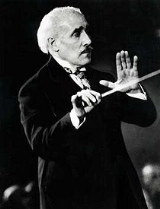
Arturo Toscanini


   Email Print
   Bookmark   Link


Arturo Toscanini


Arturo Toscanini (March 25, 1867 – January 16, 1957) was an Italian
Italian people

The Italian people are a Southern European ethnic group located primarily in Italy and, by virtue of a wide-ranging Italian diaspora, throughout Western Europe, the Americas and Australia....
 conductor
Conductor

Conductor or conduction may refer to:*Conductor , an album by indie rock band The Comas*Conductor , a senior Warrant Officer appointment in the Royal Logistic Corps and its predecessors...
. One of the most acclaimed musicians of the late 19th and 20th Centuries, he was renowned for his brilliant intensity, his restless perfectionism, his phenomenal ear for orchestral detail and sonority, and his photographic memory. He is especially regarded as an authoritative interpreter of the works of Verdi, Beethoven, Brahms and Wagner.


Discussion
Ask a question about 'Arturo Toscanini'
Start a new discussion about 'Arturo Toscanini'
Answer questions from other users
Full Discussion Forum


Encyclopedia


Arturo Toscanini (March 25, 1867 – January 16, 1957) was an Italian
Italian people

The Italian people are a Southern European ethnic group located primarily in Italy and, by virtue of a wide-ranging Italian diaspora, throughout Western Europe, the Americas and Australia....
 conductor
Conductor

Conductor or conduction may refer to:*Conductor , an album by indie rock band The Comas*Conductor , a senior Warrant Officer appointment in the Royal Logistic Corps and its predecessors...
. One of the most acclaimed musicians of the late 19th and 20th Centuries, he was renowned for his brilliant intensity, his restless perfectionism, his phenomenal ear for orchestral detail and sonority, and his photographic memory. He is especially regarded as an authoritative interpreter of the works of Verdi, Beethoven, Brahms and Wagner. As music director of the NBC Symphony Orchestra
NBC Symphony Orchestra

The NBC Symphony Orchestra was a radio orchestra established by David Sarnoff of the National Broadcasting Company especially for conductor Arturo Toscanini....
 he became a household name through his radio and television broadcasts and many recordings of the operatic and symphonic repertoire.

Biography

Toscanini was born in Parma
Parma

Parma is a city in the Italian region of Emilia-Romagna famous for its architecture and the fine countryside around it. It is the home of the University of Parma, one of the oldest universities in the world....
, Emilia-Romagna
Emilia-Romagna

Emilia-Romagna is an administrative Regions of Italy of Northern Italy comprising the two historic regions of Emilia and Romagna. The capital is Bologna; it has an area of 20,124 km? and about 4.3 million inhabitants....
, and won a scholarship to the local music conservatory, where he studied the cello
Cello

The violoncello is a bowed string instrument. A person who plays a cello is called a cellist. The cello is used as a solo instrument, in chamber music, and as a member of the string section of an orchestra....
. He joined the orchestra
Orchestra

An orchestra is an Musical ensemble, usually fairly large with string, brass, woodwind sections, and possibly a percussion section as well. The term orchestra derives from the name for the area in front of an theatre of ancient Greece reserved for the Greek chorus....
 of an opera company, with which he toured South America in 1886. While presenting Aida
Aida

Aida an Arabic female name meaning "visitor" or "returning") is an opera in four acts by Giuseppe Verdi to an Italian libretto by Antonio Ghislanzoni, based on a scenario written by French Egyptologist Auguste Mariette ....
 in Rio de Janeiro
Rio de Janeiro

Rio de Janeiro , is the second largest city of Brazil and South America, behind S?o Paulo, and the third largest metropolitan area in South America, behind S?o Paulo and Buenos Aires....
, the orchestra's conductor was booed by the audience and forced to leave the podium. Although he had no conducting experience, Toscanini was persuaded to take up the baton, and led a highly acclaimed performance of the two-and-a-half hour opera completely from memory. Thus began his career as a conductor at age 19.

Upon returning to Italy, Toscanini returned to his chair in the cello section, and participated as cellist in the world premiere of Verdi
Giuseppe Verdi

Giuseppe Fortunino Francesco Verdi was an Italian Romantic music composer, mainly of opera. He was one of the most influential composers in the 19th century....
's Otello
Otello

Otello is an opera in four acts by Giuseppe Verdi to an Italian libretto by Arrigo Boito, based on William Shakespeare's Play Othello. It was Verdi's second to last opera and is considered by many to be his greatest tragedy....
 (La Scala
La Scala

The Teatro alla Scala , in Milan, Italy, is one of the world's most famous opera houses. The theatre was inaugurated on 3 August 1778, under the name Nuovo Regio Ducal Teatro alla Scala with Antonio Salieri Europa riconosciuta....
, Milan
Milan

Milan is the second largest city of Italy, located in the plains of Lombardy. It is the capital in the Province of Milan, as well as the Regions of Italy capital of Lombardy....
, 1887) under the composer's supervision. (Verdi, who habitually complained that conductors never seemed interested in directing his scores the way he had written them, was impressed by reports from Arrigo Boito
Arrigo Boito

Arrigo Boito , aka Enrico Giuseppe Giovanni Boito, pseudonym Tobia Gorrio, was an Italian poet, journalist, novelist and composer, best known today for his opera libretto and his own opera, Mefistofele....
 about Toscanini's ability to interpret his scores. The composer was also impressed when Toscanini consulted him personally, indicating a ritardando where it was not set out in the score; Verdi said that only a true musician would have felt the need to make that ritardando.)

Gradually the young musician's reputation as an operatic conductor of unusual authority and skill supplanted his cello career. In the following decade he consolidated his career in Italy, entrusted with the world premieres of Puccini
Giacomo Puccini

Giacomo Antonio Domenico Michele Secondo Maria Puccini was an Italians composer whose operas, including La boh?me, Tosca, Madama Butterfly and Turandot, are among the most frequently performed in the List of important operas....
's La bohčme
La bohčme

La boh?me is an opera in four acts by Giacomo Puccini to an Italian libretto by Luigi Illica and Giuseppe Giacosa, based on Sc?nes de la vie de boh?me by Henri Murger....
 and Leoncavallo
Ruggero Leoncavallo

Ruggero Leoncavallo was an Italian opera composer. His opera Pagliacci remains one of the most popular works in the operatic repertory, appearing as number 14 on Opera America's 2007 list of the 20 most-performed operas in North America....
's Pagliacci
Pagliacci

Pagliacci is an opera consisting of a prologue and two acts written and composed by Ruggero Leoncavallo. It recounts the tragedy of a jealous husband in a commedia dell'arte troupe....
. In 1896, Toscanini conducted his first symphonic concert (in Turin
Turín

Tur?n is a municipality in the Ahuachap?n Department Departments of El Salvador of El Salvador....
, with works by Schubert
Franz Schubert

Franz Peter Schubert was an Austrian composer. He wrote some 600 lieder, nine symphonies , liturgy music, operas, and a large body of chamber music and solo piano music....
, Brahms
Johannes Brahms

Johannes Brahms , composer and pianist, was one of the leading musicians of the Romantic music. Born in Hamburg, Brahms spent much of his professional life in Vienna, Austria, where he was a leader of the musical scene....
, Tchaikovsky
Pyotr Ilyich Tchaikovsky

Pyotr Ilyich Tchaikovsky – ) was a Russian composer of the Romantic music era. He wrote some of the most popular concert and theatrical music in the current classical repertoire, including the ballets Swan Lake and Nutcracker, the 1812 Overture, his Piano Concerto No....
, and Wagner
Richard Wagner

Wilhelm Richard Wagner was a German composer, Conducting, theatre director and essayist, primarily known for his operas . Unlike most other great opera composers, Wagner wrote both the scenario and libretto for his works....
). By 1898 he was resident conductor at La Scala, and he remained there until 1908, returning during the 1920s. He took the Scala Orchestra to the United States on a concert tour in 1920-21; it was during that tour that Toscanini made his first recordings (for the Victor Talking Machine Company
Victor Talking Machine Company

The Victor Talking Machine Company was an United States corporation, the leading American producer of phonographs and gramophone record and one of the leading phonograph companies in the world at the time....
).

International recognition

Outside of Europe, he conducted at the Metropolitan Opera
Metropolitan Opera

The Metropolitan Opera Association of New York City, founded in April 1880, is a major presenter of all types of opera including Grand Opera. Peter Gelb is the company's general manager and James Levine is music director....
 in New York
New York

The State of New York is a U.S. state in the Mid-Atlantic States and Northeastern United States regions of the United States and is the nation's List of U.S....
 (1908–1915) as well as the New York Philharmonic Orchestra (1926–1936). He toured Europe with the New York Philharmonic in 1930; he and the musicians were acclaimed by critics and audiences wherever they went. Toscanini was the first non-German conductor to appear at Bayreuth
Bayreuth Festspielhaus

The Bayreuth Festspielhaus is an opera house north of Bayreuth, Germany, dedicated principally to the performance of operas by the 19th-century German composer Richard Wagner....
 (1930–1931), and the New York Philharmonic was the first non-German orchestra to play there. In the 1930s he conducted at the Salzburg Festival
Salzburg Festival

The Salzburg Festival is a prominent festival of music and drama. It is held each summer within the Austrian town of Salzburg, the birthplace of Wolfgang Amadeus Mozart....
 (1934–1937) and the inaugural concert in 1936 of the Palestine Symphony Orchestra (now the Israel Philharmonic Orchestra
Israel Philharmonic Orchestra

The Israel Philharmonic Orchestra is the leading symphony orchestra in Israel. Originally known as the Palestine Orchestra, the IPO was founded by violinist Bronislaw Huberman in 1936, at a time when many Jewish musicians were being fired from European orchestras....
) in Tel Aviv
Tel Aviv

Tel Aviv-Yafo , usually Tel Aviv, is the List of largest cities and second largest cities by country List of cities in Israel in Israel, with an estimated population of 390,100....
, and later performed with them in Jerusalem
Jerusalem

Jerusalem is the capital of Israel and its List of Israeli cities in both population and area, with a population of 747,600 residents over an area of if Positions on Jerusalem East Jerusalem is included....
, Haifa
Haifa

Haifa is the largest city in North District Israel, and the List of Israeli cities in the country, with a population of over 264,900. Haifa has a mixed population of Jews and Arabs....
, Cairo
Cairo

Cairo , which means "the triumphant", is the Cairo and largest city of Egypt.It is the most populous metropolitan area in Egypt and is also one of the most populous in the world....
 and Alexandria
Alexandria

Alexandria , with a population of 4.1 million, is the second-largest city in Egypt, and is the country's largest seaport, serving about 80% of Egypt's imports and exports....
.

Opposition to Italian fascist government

In 1919 Toscanini ran unsuccessfully as a Fascist parliamentary candidate in Milan. He had been called "the greatest conductor in the world" by Mussolini. However, he became disillusioned with fascism and repeatedly defied the Italian dictator
Dictator

A dictator is an authoritarian ruler who assumes sole and absolute power without hereditary ascension such as an absolute monarch. When other states call the head of state of a particular state a dictator, that state is called a dictatorship....
 after the latter's ascent to power in 1922. He refused to display Mussolini's photograph or conduct the Fascist anthem Giovinezza
Giovinezza

"Giovinezza" is the official hymn of the Italian National Fascist Party, Italian fascism, and army, and was the unofficial national anthem of Italy between 1924 and 1943....
 at La Scala
La Scala

The Teatro alla Scala , in Milan, Italy, is one of the world's most famous opera houses. The theatre was inaugurated on 3 August 1778, under the name Nuovo Regio Ducal Teatro alla Scala with Antonio Salieri Europa riconosciuta....
. He raged to a friend, "If I were capable of killing a man, I would kill Mussolini."

At a memorial concert for Italian composer Giuseppe Martucci
Giuseppe Martucci

Giuseppe Martucci was an Italians composer, conductor , pianist and teacher. As a conductor he helped to introduce Richard Wagner's operas to Italy, and also gave important early concerts of English music there....
 on May 14th, 1931 at the Teatro Comunale in Bologna
Bologna

Bologna is the capital city of Emilia-Romagna in northern Italy, in the Po Valley , between the Po River and the Apennine Mountains, exactly between the Reno River and the S?vena River....
 he was ordered to begin by playing Giovinezza, but he refused even though the fascist foreign minister Galeazzo Ciano
Galeazzo Ciano

Gian Galeazzo Ciano, 2nd Count of Cortellazzo and Buccari , was Italian Minister of Foreign Affairs and Benito Mussolini's son-in-law....
 was present in the audience. Afterwards he was, in his own words, "attacked, injured and repeatedly hit in the face" by a group of blackshirts. Mussolini, incensed by the conductor's refusal, had his phone tapped, placed him under constant surveillance
Surveillance

Surveillance is the monitoring of behavior. Systems surveillance is the process of monitoring the behavior of people, objects or processes within systems for conformity to expected or desired Norm in trusted systems for security or social control....
 and took away his passport
Passport

A passport is a document, issued by a national government, which certifies, for the purpose of international travel, the identity and nationality of its holder....
. The passport was returned only after world outcry over Toscanini's treatment. He left Italy until 1938.

The NBC Symphony Orchestra

He returned to the United States where the NBC Symphony Orchestra
NBC Symphony Orchestra

The NBC Symphony Orchestra was a radio orchestra established by David Sarnoff of the National Broadcasting Company especially for conductor Arturo Toscanini....
 was created for him in 1937. He conducted his first NBC broadcast concert on December 25, 1937, in NBC Studio 8-H
NBC Radio City Studios

NBC Radio City Studios is the name given to both a radio and television studio complex in New York's Rockefeller Center and the former radio-TV complex located at the northeast corner of Sunset Boulevard and Vine Street in Hollywood, Los Angeles, California....
 in New York City's Rockefeller Center
Rockefeller Center

Rockefeller Center is a complex of 19 commerce buildings covering between 48th and 51st streets in New York City. Built by the Rockefeller family, it is located in the center of Midtown Manhattan, spanning between Fifth Avenue and Seventh Avenue ....
. The acoustics of the specially built studio were very dry; some remodeling in 1939 added a bit more reverberation. (In 1950, the studio was further remodeled for television productions; today it is used by NBC for Saturday Night Live
Saturday Night Live

Saturday Night Live is a weekly late-night 90-minute American sketch comedy/variety show filmed in New York City. It made its debut on October 11, 1975....
. In 1980, it was used by Zubin Mehta
Zubin Mehta

Zubin Mehta is an Indian conducting of Western classical music....
 and the New York Philharmonic Orchestra in a series of special televised NBC concerts called "Live From Studio 8H", the first one being a tribute to Toscanini, punctuated by clips from his television concerts.)

The NBC broadcasts were preserved on large transcription discs, recorded at both 78-rpm and 33-1/3 rpm, until NBC began using magnetic tape in 1947. NBC used special RCA high fidelity microphones both for the broadcasts and for recording them; these microphones can be seen in some photographs of Toscanini and the orchestra. In addition, some of Toscanini's recording sessions for RCA Victor were mastered on magnetic sound film in a process developed about 1941, as detailed by RCA producer Charles O'Connell in his memoirs, On and Off The Record. In addition, hundreds of hours of Toscanini's rehearsals with the NBC were preserved and are now housed in the Toscanini Legacy archive at The New York Public Library.

Toscanini was often criticized for neglecting American music; however, on November 25, 1938, he conducted the world premieres of two orchestral works by Samuel Barber
Samuel Barber

Samuel Osborne Barber II was an American composer of orchestral, opera, choral, and piano music. His Adagio for Strings is among his most popular compositions and widely considered a masterpiece of modern classical music....
, Adagio for Strings
Adagio for Strings

"Adagio for Strings" is a work for string orchestra, arranged by the United States composer Samuel Barber from his first string quartet....
 and Essay for Orchestra
Essay for Orchestra (Barber)

Samuel Barber's Essay for Orchestra , completed in the first half of 1938, is an orchestral work in one movement. It was given its first performance by Arturo Toscanini with the NBC Symphony Orchestra on November 5th, 1938 in New York in a radio broadcasted concert where also the composer's Adagio for Strings saw its first performance....
. In 1945, he led the orchestra in recording sessions of the Grand Canyon Suite
Grand Canyon Suite

The Grand Canyon Suite is a suite for orchestra by Ferde Grof?, composed during the period from 1929 to 1931. It consists of 5 parts or Movement , each an evocation in tone of a particular scene typical of the Grand Canyon....
 by Ferde Grofé
Ferde Grofé

Ferde Grof? was an United States pianist, arrangement and composer....
 in Carnegie Hall
Carnegie Hall

Carnegie Hall is a concert venue in Midtown Manhattan in New York City located at 881 Seventh Avenue , occupying the east stretch of Seventh Avenue between West 56th Street and West 57th Street , two blocks south of Central Park....
 (supervised by Grofé) and An American in Paris
An American in Paris

An American in Paris is a European-influenced classical music composition by American composer George Gershwin, composed in 1928. Inspired by time Gershwin had spent in Paris, it is in the form of an extended tone poem evoking the sights and energy of the France capital in the 1920s....
 by George Gershwin
George Gershwin

George Gershwin was an American composer and pianist. He wrote most of his vocal and theatrical works in collaboration with his elder brother, lyricist Ira Gershwin....
 in NBC's Studio 8-H. He also conducted broadcast performances of Copland
Aaron Copland

Aaron Copland was an American classical music composer of concert and film music, as well as an accomplished pianist. Instrumental in forging a distinctly American style of composition, he was widely known as "the dean of American composers." Copland's music achieved a balance between modernism music and American folk styles....
's El Salon Mexico
El Salón México

El Sal?n M?xico is a symphonic composition in one movement by Aaron Copland, which uses Mexico folk music extensively. The work is a musical depiction of an eponymous dance hall in Mexico City and even carries the subtitle, "A Popular Type Dance Hall in Mexico City." Copland began the work in 1932 and completed it in 1936....
; Gershwin's Rhapsody in Blue
Rhapsody in Blue

Rhapsody in Blue is a musical composition by George Gershwin for solo piano and jazz band written in 1924, which combines elements of European classical music with jazz-influenced effects....
 with soloists Earl Wild
Earl Wild

Earl Wild is an United States pianist known especially for his transcriptions of european classical music and jazz. Wild is recognized widely as a leading virtuoso of his generation....
 and Benny Goodman
Benny Goodman

Benjamin David Goodman, was an United States jazz musician, clarinetist and bandleader, known as "King of Swing ", "Patriarch of the Clarinet", "The Professor", and "Swing's Senior Statesman"....
 and Piano Concerto in F
Concerto in F (Gershwin)

Concerto in F is a composition by George Gershwin for piano concerto which is closer in form to a traditional concerto than the earlier jazz-influenced Rhapsody in Blue....
 with pianist Oscar Levant
Oscar Levant

Oscar Levant was an United States pianist, composer, author, comedian, and actor. He was more famous for his mordant character and witticisms, on the radio and in film and television, than for his music....
; and music by other American composers, including two marches of John Philip Sousa
John Philip Sousa

John Philip Sousa was an United States composer and Conducting of the late Romanticism known particularly for American march music. Because of his mastery of march composition and resultant prominence, he is known as "The March King"....
. He even wrote his own orchestral arrangement of The Star Spangled Banner, which was incorporated into the NBC Symphony's performances of Verdi's Hymn of the Nations. (Earlier, while music director of the New York Philharmonic, he conducted music by Abram Chasins
Abram Chasins

Abram Chasins was an American composer and pianist.Born in New York, he studied at the Juilliard School, Columbia University and Curtis Institute of Music, under teachers including Ernest Hutcheson, Rubin Goldmark and J?zef Hofmann....
, Bernard Wagenaar
Bernard Wagenaar

Bernard Wagenaar was an American composer, conductor and violinist. He was born in Arnhem, the Netherlands, and studied at Utrecht University before starting his career as a teacher and conductor in 1914....
, and Howard Hanson
Howard Hanson

Howard Harold Hanson was an United States of America composer, conducting, educator, music theorist, and ardent champion of American classical music....
.)

In 1940, Toscanini took the orchestra on a "goodwill" tour of South America. Later that year, Toscanini had a disagreement with NBC management over their use of his musicians in other NBC broadcasts; Toscanini threatened to move to CBS, until the dispute was resolved and he returned as music director. At that time Leopold Stokowski
Leopold Stokowski

Leopold Stokowski was a famous orchestral conducting, well known for his free-hand performing style that spurned the traditional baton and for obtaining a characteristically sumptuous sound from many of the great orchestras he conducted....
 served as temporary music director and continued to appear periodically as a guest conductor of the orchestra.

One of the more remarkable broadcasts was in July 1942, when Toscanini conducted the American premiere of Dmitri Shostakovich
Dmitri Shostakovich

Dmitri Dmitriyevich Shostakovich was a List of Russian composers of the Soviet Union period.After a period influenced by Sergei Prokofiev and Igor Stravinsky , Shostakovich developed a hybrid of styles as exemplified in his opera Lady Macbeth of the Mtsensk District ....
's Symphony No. 7
Symphony No. 7 (Shostakovich)

Dmitri Shostakovich completed his Symphony No. 7 in C major, Op. 60 dedicated to the city of Leningrad, on 27 December 1941. In its time, the symphony was extremely popular in both Russia and the West as a symbol of resistance and defiance to Nazi totalitarianism and militarism....
. Due to World War II, the score was microfilmed in the Soviet Union and brought by courier to the United States. Stokowski wanted to conduct the premiere and there were a number of remarkable letters between the two conductors (reproduced by Harvey Sachs in his biography) before Stokowski agreed to let Toscanini have the privilege of conducting the first performance. Unfortunately for New York listeners, a major thunderstorm virtually obliterated the NBC radio signals there, but the performance was heard elsewhere and preserved on transcription discs. It was later issued by RCA Victor in the 1967 centennial boxed set tribute to Toscanini, which included a number of NBC broadcasts never released on discs. In Testimony
Testimony (book)

Testimony is a book that was published in October 1979 by the Russian musicologist Solomon Volkov. He claimed that it was the memoirs of the composer Dmitri Shostakovich....
 Shostakovich himself expressed a dislike for the performance, after he heard a recording of the broadcast. In Toscanini's later years he expressed dislike for the work and amazement that he had actually conducted it.

In the summer of 1950, Toscanini led the orchestra on an extensive transcontinental tour. It was during that tour that the well-known photograph of Toscanini riding the ski lift at Sun Valley, Idaho
Sun Valley, Idaho

Sun Valley is an affluent resort community in central Idaho, adjacent to the city of Ketchum, Idaho in Blaine County, Idaho....
 was taken. Toscanini and the musicians traveled on a special train chartered by NBC.

The NBC concerts continued in Studio 8-H until the fall of 1950. They were then held in Carnegie Hall, where many of the orchestra's recording sessions had been held, due to the dry acoustics of Studio 8-H. The final broadcast performance, an all-Wagner
Richard Wagner

Wilhelm Richard Wagner was a German composer, Conducting, theatre director and essayist, primarily known for his operas . Unlike most other great opera composers, Wagner wrote both the scenario and libretto for his works....
 program, took place on April 4, 1954, in Carnegie Hall. During this concert Toscanini suffered a memory lapse reportedly caused by a transient ischemic attack
Transient ischemic attack

A transient ischemic attack is caused by the changes in the blood supply to a particular area of the brain, resulting in brief neurologic dysfunction that persists, by definition, for less than 24 hours; if symptoms persist then it is categorized as a stroke....
, although some have attributed the lapse to having been secretly informed that NBC intended to end the broadcasts and disband the NBC orchestra. He never conducted live in public again. That June, he participated in his final recording sessions, remaking portions of two Verdi operas so they could be commercially released. Toscanini was 87 years old when he retired. After his retirement, the NBC Symphony was reorganized as the Symphony of the Air, making regular performances and recordings, until it was disbanded in 1963.

On radio, he conducted seven complete operas, including La bohčme
La bohčme

La boh?me is an opera in four acts by Giacomo Puccini to an Italian libretto by Luigi Illica and Giuseppe Giacosa, based on Sc?nes de la vie de boh?me by Henri Murger....
 and Otello
Otello

Otello is an opera in four acts by Giuseppe Verdi to an Italian libretto by Arrigo Boito, based on William Shakespeare's Play Othello. It was Verdi's second to last opera and is considered by many to be his greatest tragedy....
, all of which were eventually released on records and CD, thus enabling the modern listening public to have at least some idea of what an opera conducted by Toscanini sounded like.

Personal life

Toscanini married Carla De Martini on June 21, 1897, when she was not yet 20 years old. Their first child, Walter, was born on March 19, 1898. A daughter, Wally, was born on January 16, 1900. Carla gave birth to another boy, Giorgio, in September 1901, but he died of diphtheria on June 10, 1906. Then, that same year, Carla gave birth to their second daughter, Wanda
Wanda Toscanini

Wanda Giorgina Toscanini was the daughter of the Italy conducting Arturo Toscanini and the wife of Russian-American pianist Vladimir Horowitz, whom she married in 1933....
.

Toscanini worked with many great singers and musicians throughout his career, but few impressed him as much as the Russian-American pianist Vladimir Horowitz
Vladimir Horowitz

Vladimir Samoylovich Horowitz ; )   was a Russian American pianist. His technique, use of Timbre and the excitement of his playing are legendary....
. They worked together a number of times and even recorded Brahms
Johannes Brahms

Johannes Brahms , composer and pianist, was one of the leading musicians of the Romantic music. Born in Hamburg, Brahms spent much of his professional life in Vienna, Austria, where he was a leader of the musical scene....
' second piano concerto
Piano Concerto No. 2 (Brahms)

The Piano Concerto No. 2 in B-flat major, Opus number 83 by Johannes Brahms is a composition for solo piano with orchestral accompaniment. It is separated by a gap of 22 years from the composer's Piano Concerto No....
 and Tchaikovsky
Pyotr Ilyich Tchaikovsky

Pyotr Ilyich Tchaikovsky – ) was a Russian composer of the Romantic music era. He wrote some of the most popular concert and theatrical music in the current classical repertoire, including the ballets Swan Lake and Nutcracker, the 1812 Overture, his Piano Concerto No....
's first piano concerto
Piano Concerto No. 1 (Tchaikovsky)

The Piano Concerto No. 1 in B-flat minor, Opus number 23 was composed by Pyotr Ilyich Tchaikovsky between November 1874 and February 1875. It was revised in the summer of 1879 and again in December 1888....
 with the NBC Symphony for RCA. Horowitz also became close to Toscanini and his family. In 1933, Wanda Toscanini married Horowitz, with the conductor's blessings and warnings. It was Wanda's daughter, Sonia, who was once photographed by Life
Life (magazine)

File:Coles Phillips2 Life.jpgLife generally refers to three United States magazines:*A humor and general interest magazine published from 1883 to 1936....
 playing with the conductor.

During World War II, Toscanini lived in Wave Hill
Wave Hill (New York)

Wave Hill is a 28 acre estate, consisting of public gardens and a cultural center, in New York City, USA. It is situated on the slopes overlooking the Hudson River and the New Jersey Pallisades, within New York City's wealthy Riverdale, The Bronx neighborhood, which is part of the Bronx....
, a historic home in the Riverdale
Riverdale, Bronx

Riverdale is a an upper-class residential neighborhood in the northwest portion of the borough of the Bronx in New York City.Riverdale's ZIP codes are 10463 and 10471....
 section of the Bronx
The Bronx

The Bronx is the northernmost of the Five Boroughs of New York City and the newest of the 62 Administrative divisions of New York#county of New York State....
 in New York City.

Despite the reported infidelities revealed in Toscanini's letters documented by Harvey Sachs, he remained married to Carla until she died on June 23, 1951.

Final years

With the help of his son Walter, Toscanini spent his remaining years editing tapes and transcriptions of his performances with the NBC Symphony. The "approved" recordings were issued by RCA Victor, which also has issued his recordings with the La Scala Orchestra, the New York Philharmonic Orchestra, and the Philadelphia Orchestra. His recordings with the BBC Symphony Orchestra
BBC Symphony Orchestra

The BBC Symphony Orchestra is the principal broadcast orchestra of the British Broadcasting Corporation and one of the leading orchestras in United Kingdom....
 (1937-39) and the Philharmonia Orchestra (1952) were issued by EMI. Various companies have issued recordings on compact disc
Compact Disc

A Compact Disc is an optical disc used to store Data , originally developed for storing digital audio. The CD, available on the market since October 1982, remains the standard physical medium for sale of commercial Sound recording and reproduction to the present day....
s of a number of broadcasts and concerts that he did not officially approve. Among these are stereophonic recordings of his last two NBC broadcast concerts.

Sachs and other biographers have documented the numerous conductors, singers, and musicians who visited Toscanini during his retirement. He was a big fan of early television, especially boxing and wrestling telecasts, as well as comedy programs.

When he died of a stroke
Stroke

A stroke is the rapidly developing loss of brain function due to a disturbance in the blood supply to the brain. According to the National Stroke Association, a "stroke" occurs when a blood clot blocks and artery or a blood vessel breaks, interrupting blood flow to an area of the brain....
 in New York
New York

The State of New York is a U.S. state in the Mid-Atlantic States and Northeastern United States regions of the United States and is the nation's List of U.S....
 at the age of 89 his body was returned to Italy and was interred in the Cimitero Monumentale in Milan.

In his will, he left his baton to his protégée Herva Nelli
Herva Nelli

Herva Nelli was an Italy-born operatic soprano....
.

Toscanini was posthumously awarded the Grammy Lifetime Achievement Award
Grammy Lifetime Achievement Award

The Grammy Award Lifetime Achievement Award is awarded by the National Academy of Recording Arts and Sciences to "performers who, during their lifetimes, have made creative contributions of outstanding artistic significance to the field of recording" ....
 in 1987.

Innovations

At La Scala, which had what was then the most modern stage lighting system installed in 1901 and an orchestral pit installed in 1907, Toscanini pushed through reforms in the performance of opera. He insisted on darkening the lights during performances. As his biographer Harvey Sachs
Harvey Sachs

Harvey Sachs, is an United States-Canada writer who has written many books on musical subjects.His books include the standard biography of and a book of essays on the Italy conductor Arturo Toscanini, plus an edited collection of Toscanini's letters....
 wrote: "He believed that a performance could not be artistically successful unless unity of intention was first established among all the components: singers, orchestra, chorus, staging, sets, and costumes."

Toscanini favored the traditional orchestral seating plan with the first violins and cellos on the left, the violas on the near right, and the second violins on the far right.

Premieres

Toscanini conducted the world premieres of many operas, four of which have become part of the standard operatic repertoire: Pagliacci
Pagliacci

Pagliacci is an opera consisting of a prologue and two acts written and composed by Ruggero Leoncavallo. It recounts the tragedy of a jealous husband in a commedia dell'arte troupe....
, La bohčme
La bohčme

La boh?me is an opera in four acts by Giacomo Puccini to an Italian libretto by Luigi Illica and Giuseppe Giacosa, based on Sc?nes de la vie de boh?me by Henri Murger....
, La Fanciulla del West
La fanciulla del West

La fanciulla del West is an opera in three acts by Giacomo Puccini to an Italian language libretto by Guelfo Civinini and Carlo Zangarini, based on the play The Girl of the Golden West by David Belasco....
 and Turandot
Turandot

Turandot is an opera in three acts by Giacomo Puccini, set to a libretto in Italian by Giuseppe Adami and Renato Simoni. Though Puccini's first interest in the subject was based on his reading of Friedrich Schiller's adaptation of the play, his work is most nearly based on the earlier text Turandot by Carlo Gozzi....
; he took an active role in Alfano
Franco Alfano

Franco Alfano was an Italy composer and piano. Though today best known for completing Giacomo Puccini's unfinished opera Turandot in 1926, he had considerable success with his own works during his lifetime....
's completion of Puccini's Turandot. (However, he refused to conduct the section that Alfano composed at the opera's world premiere.) He also conducted the first Italian performances of Siegfried
Siegfried (opera)

Siegfried is the third of the four operas that comprise Der Ring des Nibelungen , by Richard Wagner. It received its premiere at the Bayreuth Festspielhaus on 16 August 1876, as part of the first complete performance of The Ring....
, Götterdämmerung
Götterdämmerung

is the last of the four operas that make up Der Ring des Nibelungen , by Richard Wagner. It received its premiere at the Bayreuth Festspielhaus on 17 August 1876, as part of the first complete performance of the Ring....
, Salome
Salome (opera)

Salome is an opera in one act by Richard Strauss to a German language libretto by the composer, based on Hedwig Lachmann?s German translation of the French language play Salome by Oscar Wilde....
, Pelléas et Mélisande
Pelléas et Mélisande (opera)

Pell?as et M?lisande is an opera in five acts with music by Claude Debussy. It was first performed at the Op?ra-Comique, Paris on 30 April 1902....
, as well as the South American premieres of Tristan und Isolde
Tristan und Isolde

Tristan und Isolde is an opera, or music drama, in three acts by Richard Wagner to a German language libretto by the composer, based largely on the romance by Gottfried von Stra?burg....
 and Madama Butterfly
Madama Butterfly

Madama Butterfly is an opera in three acts by Giacomo Puccini, with an Italian libretto by Luigi Illica and Giuseppe Giacosa....
 and the North American premiere of Boris Godunov
Boris Godunov (opera)

Boris Godunov is an opera by Modest Mussorgsky . The work was composed between 1868 and 1874 in Saint Petersburg, Russia. It is Mussorgsky's only completed opera and is considered his masterpiece....
.

  • Pagliacci by Ruggiero Leoncavallo - Milan
    Milan

    Milan is the second largest city of Italy, located in the plains of Lombardy. It is the capital in the Province of Milan, as well as the Regions of Italy capital of Lombardy....
    , May 21, 1892
  • Guglielmo Swarten by Gnaga - Rome, November 15, 1892
  • Savitri by Natale Canti - Bologna, December 1, 1894
  • Emma Liona by Antonio Lozzi - Venice, May 24, 1895
  • La bohčme by Giacomo Puccini
    Giacomo Puccini

    Giacomo Antonio Domenico Michele Secondo Maria Puccini was an Italians composer whose operas, including La boh?me, Tosca, Madama Butterfly and Turandot, are among the most frequently performed in the List of important operas....
     - Turin
    Turín

    Tur?n is a municipality in the Ahuachap?n Department Departments of El Salvador of El Salvador....
    , February 1, 1896
  • Forza d'Amore by Arturo Buzzi-Peccia
    Arturo Buzzi-Peccia

    Arturo Buzzi-Peccia was an Italian singing instructor and song composer whose existence is very poorly documented.He was born in Italy and died in the USA....
     - Turin, March 6, 1897
  • La Camargo by Enrico De Leva - Turin, March 2, 1898
  • Anton by Cesare Galeotii - Milan, December 17, 1900
  • Zaza by Leoncavallo - Milan, November 10, 1900
  • Le Maschere by Pietro Mascagni
    Pietro Mascagni

    Pietro Mascagni was an Italy composer most noted for his operas. His 1890 masterpiece, Cavalleria rusticana, caused one of the greatest sensations in opera history and singlehandedly ushered in the Verismo movement in Italian dramatic music....
     - Milan, January 17, 1901
  • Mosč by Don Lorenzo Perosi - Milan, November 16, 1901
  • Germania by Alberto Franchetti
    Alberto Franchetti

    Alberto Franchetti was an Italy opera composer. A nobleman of independent means, he studied first in Venice, then in Dresden under Felix Draeseke, and finally at the Munich Conservatory under Josef Rheinberger....
     - Milan, March 11, 1902
  • Oceana by Antonio Smareglia - Milan, January 22, 1903
  • Cassandra by Vittorio Gnecchi - Bologna, December 5, 1905
  • Gloria by Francesco Cilea
    Francesco Cilea

    Francesco Cilea was an Italian composer. Today he is particularly known for his operas L'arlesiana and Adriana Lecouvreur....
     - Milan, April 15, 1907
  • La Fanciulla del West by Puccini - New York, December 10, 1910
  • Madame Sans-Gčne by Umberto Giordano
    Umberto Giordano

    Umberto Menotti Maria Giordano was an Italian composer, mainly of operas.He was born in Foggia in Apulia, southern Italy, and studied under Paolo Serrao at the Conservatoire of Naples....
     - New York, January 25, 1915
  • Debora e Jaele by Ildebrando Pizzetti
    Ildebrando Pizzetti

    Ildebrando Pizzetti was an Italy composer of classical music.Pizzetti was born in Parma in 1880. He was part of the "Generation of 1880" along with Ottorino Respighi and Gian Francesco Malipiero....
     - Milan, December 16, 1922
  • Nerone by Arrigo Boito
    Arrigo Boito

    Arrigo Boito , aka Enrico Giuseppe Giovanni Boito, pseudonym Tobia Gorrio, was an Italian poet, journalist, novelist and composer, best known today for his opera libretto and his own opera, Mefistofele....
     (completed by Toscanini and Vincenzo Tommasini
    Vincenzo Tommasini

    Vincenzo Tommasini was an Italy composer.Born in Rome, Tommasini studied philology and the Greek language at the University of Rome La Sapienza, at the same time pursuing equally intensive studies in music at the Academy of St....
    ) - Milan, May 1, 1924
  • La Cena delle Beffe by Giordano - Milan, December 20, 1924
  • I Cavalieri di Ekebu by Riccardo Zandonai - Milan, March 7, 1925
  • Turandot
    Turandot

    Turandot is an opera in three acts by Giacomo Puccini, set to a libretto in Italian by Giuseppe Adami and Renato Simoni. Though Puccini's first interest in the subject was based on his reading of Friedrich Schiller's adaptation of the play, his work is most nearly based on the earlier text Turandot by Carlo Gozzi....
     by Puccini - Milan, April 25, 1926
  • Fra Gherado by Pizzetti - Milan, May 16, 1928
  • Il Re
    Il re

    Il re is a novella or opera in one act and three scenes by composer Umberto Giordano to an Italian language libretto by Giovacchino Forzano....
     by Giordano - Milan, January 12, 1929
  • Adagio for Strings
    Adagio for Strings

    "Adagio for Strings" is a work for string orchestra, arranged by the United States composer Samuel Barber from his first string quartet....
     and First Essay for Orchestra by Samuel Barber
    Samuel Barber

    Samuel Osborne Barber II was an American composer of orchestral, opera, choral, and piano music. His Adagio for Strings is among his most popular compositions and widely considered a masterpiece of modern classical music....
      - NBC Symphony Orchestra
    NBC Symphony Orchestra

    The NBC Symphony Orchestra was a radio orchestra established by David Sarnoff of the National Broadcasting Company especially for conductor Arturo Toscanini....
    , New York, November 5, 1938


Recorded legacy


Overview

Toscanini made his first recordings in 1920 with the La Scala Orchestra in Victor's Trinity Church studio and his last with the NBC Symphony Orchestra in June 1954 in Carnegie Hall. His entire catalog of commercial recordings was issued by RCA Victor, save for two single-sided recordings for Brunswick in 1926 with the New York Philharmonic Orchestra and a series of excellent recordings with the BBC Symphony Orchestra
BBC Symphony Orchestra

The BBC Symphony Orchestra is the principal broadcast orchestra of the British Broadcasting Corporation and one of the leading orchestras in United Kingdom....
 from 1937 to 1939 for EMI
EMI

The EMI Group is a United Kingdom music company comprising the major record label EMI Music ? which operates several labels and is based in Kensington in London, England, United Kingdom ? and EMI Music Publishing, based in New York City....
's HMV label (some issued in the USA by RCA, others released only recently by EMI and Testament). Besides the 1926 recordings with the New York Philharmonic (his first with the electrical process), Toscanini made a series of recordings with them for Victor, in Carnegie Hall, in 1929 and 1936. He also recorded with the Philadelphia Orchestra
Philadelphia Orchestra

The Philadelphia Orchestra is an orchestra based in Philadelphia, Pennsylvania, in the United States. It is historically considered to be one of the "Big Five " American orchestras....
 for Victor in Philadelphia's Academy of Music in 1941 and 1942. All of the RCA recordings have been digitally re-mastered and released on CD. There are also recorded concerts with various European orchestras, especially with La Scala Orchestra and the Philharmonia Orchestra.

Hearing Toscanini

In some of his recordings, Toscanini can be heard singing or humming. This is especially true in RCA's recording of La bohčme
La bohčme

La boh?me is an opera in four acts by Giacomo Puccini to an Italian libretto by Luigi Illica and Giuseppe Giacosa, based on Sc?nes de la vie de boh?me by Henri Murger....
, recorded during broadcast concerts in NBC Studio 8-H in 1946. Tenor Jan Peerce
Jan Peerce

Jan Peerce was an American operatic tenor. He is the father of film director Larry Peerce....
 later said that Toscanini's deep involvement in the performances helped him to achieve the necessary emotions, especially in the final moments of the opera when the beloved Mimi (played by Licia Albanese
Licia Albanese

Licia Albanese is a distinguished Italy soprano and chairman of The Licia Albanese-Puccini Foundation, founded in 1974 and dedicated to assisting young artists and singers....
) is dying. During the "Tuba mirum" section of the January 1951 live recording of Verdi's Requiem
Requiem (Verdi)

The Messa da Requiem by Giuseppe Verdi is a musical setting of the Roman Catholic Church funeralMass . It was first performed on 22 May 1874 in music to mark the first anniversary of the death of Alessandro Manzoni, an Italy poet and novelist much admired by Verdi....
, Toscanini can be heard on the disc shouting as the brass blares. In his recording of Richard Strauss
Richard Strauss

Richard Georg Strauss was a German composer of the late Romantic music and early modern eras, particularly of operas, Lieder and tone poems. Strauss was also a prominent Conducting....
' Death and Transfiguration, Toscanini sighed loudly near the end of the music; RCA Victor left this in the released recording.

Specialties

He was especially famous for his performances of Beethoven
Ludwig van Beethoven

Ludwig van Beethoven was a German composer and pianist. He was a crucial figure in the transitional period between the Classical music era and Romantic music eras in classical music, and remains one of the most acclaimed and influential composers of all time....
, Brahms
Johannes Brahms

Johannes Brahms , composer and pianist, was one of the leading musicians of the Romantic music. Born in Hamburg, Brahms spent much of his professional life in Vienna, Austria, where he was a leader of the musical scene....
, Wagner
Richard Wagner

Wilhelm Richard Wagner was a German composer, Conducting, theatre director and essayist, primarily known for his operas . Unlike most other great opera composers, Wagner wrote both the scenario and libretto for his works....
, Richard Strauss
Richard Strauss

Richard Georg Strauss was a German composer of the late Romantic music and early modern eras, particularly of operas, Lieder and tone poems. Strauss was also a prominent Conducting....
, Debussy
Claude Debussy

Achille-Claude Debussy was a French composer. Along with Maurice Ravel, he is considered one of the most prominent figures working within the field of Impressionist music, though he himself intensely disliked the term when applied to his compositions....
 and his own compatriots Rossini
Gioacchino Rossini

Gioachino Antonio Rossini was a popular Italian composer who created 39 operas as well as sacred music and chamber music. His best known works include Il barbiere di Siviglia , La Cenerentola and Guillaume Tell ....
, Verdi
Giuseppe Verdi

Giuseppe Fortunino Francesco Verdi was an Italian Romantic music composer, mainly of opera. He was one of the most influential composers in the 19th century....
, Boito
Arrigo Boito

Arrigo Boito , aka Enrico Giuseppe Giovanni Boito, pseudonym Tobia Gorrio, was an Italian poet, journalist, novelist and composer, best known today for his opera libretto and his own opera, Mefistofele....
 and Puccini
Giacomo Puccini

Giacomo Antonio Domenico Michele Secondo Maria Puccini was an Italians composer whose operas, including La boh?me, Tosca, Madama Butterfly and Turandot, are among the most frequently performed in the List of important operas....
. He made many recordings, especially towards the end of his career, which are still in print. In addition, there are many recordings available of his broadcast performances, as well as his remarkable rehearsals with the NBC Symphony.

Charles O'Connell on Toscanini

Charles O'Connell, who produced many of Toscanini's RCA Victor recordings in the 1930s and 1940s, said that RCA quickly decided to record the NBC Symphony Orchestra in Carnegie Hall, whenever possible, after being disappointed with the dull-sounding early recordings in Studio 8-H in 1938 and 1939. (Nevertheless, there were a few recording sessions in Studio 8-H as late as June 1950, probably because of improvements to the acoustics in 1939.) O'Connell, and others, often complained that Toscanini was little interested in recording and, as Harvey Sachs wrote, he was frequently disappointed that the microphones failed to pick up everything he heard during the recording sessions. O'Connell even complained of Toscanini's failure to cooperate with RCA during the sessions. Toscanini himself was often disappointed that the 78-rpm discs failed to fully capture all of the instruments in the orchestra; those fortunate to attend Toscanini's concerts later said the NBC string section was especially outstanding.

Philadelphia Orchestra recordings

O'Connell also extensively documented RCA's technical problems with the Philadelphia Orchestra recordings of 1941-42, which required extensive electronic editing before they could be released (well after Toscanini's death, beginning in 1963, with the rest following in the 1970s). Harvey Sachs also recounts that the masters were damaged, possibly due to somewhat inferior materials imposed by wartime restrictions. Unfortunately, a Musicians Union recording ban from 1942 to 1944 prevented immediate retakes; by the time the ban ended, the Philadelphia Orchestra had left RCA Victor for Columbia Records
Columbia Records

Columbia Records is an American record label founded in 1888.Columbia is the oldest surviving brand name in pre-recorded sound, being the first record company to produce pre-recorded records as opposed to blank cylinders....
 and RCA apparently was hesitant to promote the orchestra any further. Eventually, Toscanini recorded all of the same music with the NBC Symphony. In 1968, the Philadelphia Orchestra returned to RCA and the company was more favorable toward issuing all of the discs. As for the historic recordings, even on the CD versions, first released in 1991, some of the sides have considerable surface noise and some distortion, especially during the louder passages. The best sound of the recordings is the Schubert ninth symphony
Symphony No. 9 (Schubert)

The Symphony No. 9 in C major, D. 944, known as the Great, is the final symphony completed by Franz Schubert. Nicknamed The Great C major originally to distinguish it from his Symphony No....
, which had been restored by RCA first (in 1963) and released on LP. The rest of the recordings were not issued until 1977 and, as Sachs noted, by that time some of the masters may have deteriorated further. Nevertheless, despite the occasional problems, the entire set is an impressive document of Toscanini's collaboration with the Philadelphia musicians and can be best heard in the 2006 RCA/BMG reissue, which benefit from recent advances in digital restoration. The listener can hear the rich sound of the orchestra, developed by Leopold Stokowski
Leopold Stokowski

Leopold Stokowski was a famous orchestral conducting, well known for his free-hand performing style that spurned the traditional baton and for obtaining a characteristically sumptuous sound from many of the great orchestras he conducted....
 and Eugene Ormandy
Eugene Ormandy

Eugene Ormandy was a Hungary-United States conducting and violinist....
, enhanced by the more dynamic and aggressive conducting of the Italian maestro. Ormandy especially expressed his appreciation for what Toscanini achieved with the orchestra.

Later recordings

Later, when high fidelity and long playing records were introduced, the conductor said he was much happier making recordings. Sachs wrote that an Italian journalist, Raffaele Calzini, said Toscanini told him, "My son Walter sent me the test pressing of the [Beethoven] Ninth
Symphony No. 9 (Beethoven)

The Symphony No. 9 in D minor, Opus number 125 "Choral" is the last complete symphony composed by Ludwig van Beethoven. Completed in 1824, the choral symphony Ninth Symphony is one of the best known works of the Western repertoire, considered both an icon and a forefather of Romantic music, and one of Beethoven's greatest masterpieces....
 from America; I want to hear and check how it came out, and possibly to correct it. These long-playing records often make me happy."

Notable recordings

Among his most critically acclaimed recordings are the following (with the NBC Symphony
NBC Symphony Orchestra

The NBC Symphony Orchestra was a radio orchestra established by David Sarnoff of the National Broadcasting Company especially for conductor Arturo Toscanini....
 unless otherwise shown):

  • Beethoven
    Ludwig van Beethoven

    Ludwig van Beethoven was a German composer and pianist. He was a crucial figure in the transitional period between the Classical music era and Romantic music eras in classical music, and remains one of the most acclaimed and influential composers of all time....
    , Symphony No. 3
    Symphony No. 3 (Beethoven)

    The Symphony No. 3 in E flat major by Ludwig van Beethoven is a musical work sometimes cited as marking the end of the Classical period and the beginning of musical Romantic music....
     "Eroica" (1953; also 1939 and 1949 recordings)
  • Beethoven, Symphony No. 6
    Symphony No. 6 (Beethoven)

    Ludwig van Beethoven's Symphony No. 6 in F major , known as the Pastoral Symphony, was completed in 1808. One of Beethoven's few works of program music, the symphony was labeled at its first performance with the title "Recollections of Country Life"....
     "Pastoral" (1952)
  • Beethoven, Symphony No. 7
    Symphony No. 7 (Beethoven)

    Ludwig van Beethoven began concentrated work on his Symphony No. 7 in A major in 1811, while he was staying in the Bohemian spa town of Teplice in the hope of improving his health....
     (1936, Philharmonic-Symphony of New York
    New York Philharmonic

    The New York Philharmonic is the oldest active symphony orchestra in the United States, organized during 1842. Based in New York City, the Philharmonic performs most of its concerts at Avery Fisher Hall....
    )
  • Beethoven, Symphony No. 9
    Symphony No. 9 (Beethoven)

    The Symphony No. 9 in D minor, Opus number 125 "Choral" is the last complete symphony composed by Ludwig van Beethoven. Completed in 1824, the choral symphony Ninth Symphony is one of the best known works of the Western repertoire, considered both an icon and a forefather of Romantic music, and one of Beethoven's greatest masterpieces....
     (1952 and 1938)
  • Beethoven, Missa Solemnis
    Missa Solemnis (Beethoven)

    The Missa solemnis in D Major, opus number 123 was composed by Ludwig van Beethoven from 1819-1823. It was first performed on April 7, 1824 in St....
    , (1940 NBC broadcast)
  • Berlioz
    Hector Berlioz

    Louis Hector Berlioz was a French Romantic music composer and guitarist, best known for his compositions Symphonie fantastique and Requiem . Berlioz made great contributions to the modern orchestra with his Treatise on Instrumentation and by utilizing huge orchestral forces for his works; as a conductor, he performed several c...
    , Roméo et Juliette
    Roméo et Juliette (symphony)

    Rom?o et Juliette is a "symphonie dramatique", a large scale choral symphony by French composer Hector Berlioz. The libretto was written by Emile Deschamps and the completed work was assigned the catalogue numbers Opus number and H.79....
     (1947 NBC broadcast)
  • Brahms
    Johannes Brahms

    Johannes Brahms , composer and pianist, was one of the leading musicians of the Romantic music. Born in Hamburg, Brahms spent much of his professional life in Vienna, Austria, where he was a leader of the musical scene....
    , Symphony No. 1
    Symphony No. 1 (Brahms)

    The Symphony No. 1 in C minor, Op. 68, is a symphony written by Johannes Brahms. Brahms spent at least fourteen years completing this work, whose sketches date from 1854....
     (1940)
  • Brahms, Symphony No. 2
    Symphony No. 2 (Brahms)

    The Symphony No. 2 in D, Op. 73 was composed by Johannes Brahms in the summer of 1877 during a visit to the Austrian Alps. Its gestation was brief in comparison with the fifteen years which Brahms took to complete his Symphony No....
     (1952 and February, 1948 broadcast)
  • Brahms, Symphony No. 4
    Symphony No. 4 (Brahms)

    The Symphony No. 4 in E minor, Op. 98 by Johannes Brahms is the last of his symphony. It is a lushly romantic, lyric piece and is considered by many to be his magnum opus, along with Ein deutsches Requiem....
     (1951 and 1948 broadcast)
  • Brahms
    Johannes Brahms

    Johannes Brahms , composer and pianist, was one of the leading musicians of the Romantic music. Born in Hamburg, Brahms spent much of his professional life in Vienna, Austria, where he was a leader of the musical scene....
    , Four Symphonies, Tragic Overture and Haydn Variations, 1952, Philharmonia Orchestra, London (his only appearances with that orchestra, produced by Walter Legge
    Walter Legge

    Walter Legge was an influential United Kingdom european classical music record producer, most notably for EMI.Legge was born in Shepherds Bush, where his father was a tailor....
    ).
  • Debussy
    Claude Debussy

    Achille-Claude Debussy was a French composer. Along with Maurice Ravel, he is considered one of the most prominent figures working within the field of Impressionist music, though he himself intensely disliked the term when applied to his compositions....
    , La Mer
    La mer

    "La mer" is French for "the sea", and is the name of:*La Mer , an orchestral composition by Claude Debussy*La Mer , Champion racehorse*La Mer , a song by Charles Trenet, published in 1939 and first recorded by him in 1946...
     (1950 and 1940 broadcast)
  • Dvorák
    Antonín Dvorák

    Anton?n Leopold Dvor?k was a Czechs composer of Romantic music, who employed the idioms and melodies of the folk music of Moravia and his native Bohemia....
    , Symphony No. 9 "From the New World"
    Symphony No. 9 (Dvorák)

    The Symphony No. 9 in E Minor "From the New World" , popularly known as the New World Symphony, was composed by Anton?n Dvor?k in 1893 during his visit to the United States from 1892 to 1895....
     (1953)
  • Mendelssohn, Incidental Music from A Midsummer Night's Dream, (NBC 1947, studio and broadcast versions; Philadelphia 1941); Scherzo, New York Philharmonic, (1929)
  • Mendelssohn
    Felix Mendelssohn

    Jakob Ludwig Felix Mendelssohn Bartholdy, born, and generally known in English-speaking countries, as Felix Mendelssohn was a Germany composer, pianist, organist and conducting of the early Romantic music period....
    , Symphony No. 4 "Italian"
    Symphony No. 4 (Mendelssohn)

    The Symphony No. 4 in A major, Opus 90, commonly known as the Italian, is an orchestral symphony written by Germany composer Felix Mendelssohn....
    , (1954, exists in two versions: one as approved by Toscanini with excerpts from the rehearsals, and the unedited broadcast)
  • Mendelssohn, Symphony No. 5 "Reformation"
    Symphony No. 5 (Mendelssohn)

    The Symphony No. 5 in D Major/D Minor, op. 107, called the "Reformation" Symphony, was composed by Felix Mendelssohn in 1832 in honor of the 300th anniversary of Martin Luther?s Augsburg Confession which had established the founding doctrines of Lutheranism and was a momentous document of the Protestant Reformation....
    , (1953)
  • Puccini
    Giacomo Puccini

    Giacomo Antonio Domenico Michele Secondo Maria Puccini was an Italians composer whose operas, including La boh?me, Tosca, Madama Butterfly and Turandot, are among the most frequently performed in the List of important operas....
    , La bohčme
    La bohčme

    La boh?me is an opera in four acts by Giacomo Puccini to an Italian libretto by Luigi Illica and Giuseppe Giacosa, based on Sc?nes de la vie de boh?me by Henri Murger....
     (1946 broadcast)
  • Mozart
    Wolfgang Amadeus Mozart

    Wolfgang Amadeus Mozart Mozart showed prodigious ability from his earliest childhood in Salzburg. Already competent on keyboard and violin, he composed from the age of five and performed before European royalty; at seventeen he was engaged as a court musician in Salzburg, but grew restless and traveled in search of a better position, always...
    , Die Zauberflöte (1937, Salzburg Festival
    Salzburg Festival

    The Salzburg Festival is a prominent festival of music and drama. It is held each summer within the Austrian town of Salzburg, the birthplace of Wolfgang Amadeus Mozart....
    ; poor sound
  • Schubert
    Franz Schubert

    Franz Peter Schubert was an Austrian composer. He wrote some 600 lieder, nine symphonies , liturgy music, operas, and a large body of chamber music and solo piano music....
    , Symphony No. 9
    Symphony No. 9 (Schubert)

    The Symphony No. 9 in C major, D. 944, known as the Great, is the final symphony completed by Franz Schubert. Nicknamed The Great C major originally to distinguish it from his Symphony No....
     (Philadelphia, 1941; NBC 1947 and 1953)
  • Tchaikovsky, Piano concerto No. 1 in B flat minor, Op. 23
    Piano Concerto No. 1 (Tchaikovsky)

    The Piano Concerto No. 1 in B-flat minor, Opus number 23 was composed by Pyotr Ilyich Tchaikovsky between November 1874 and February 1875. It was revised in the summer of 1879 and again in December 1888....
    , Vladimir Horowitz and NBC Symphony, (live recording of April 25, 1943 War Bonds benefit concert at Carnegie Hall, first issued in 1959 as LP RCA Red Seal RB-16190)
  • Verdi
    Giuseppe Verdi

    Giuseppe Fortunino Francesco Verdi was an Italian Romantic music composer, mainly of opera. He was one of the most influential composers in the 19th century....
    , Requiem
    Requiem (Verdi)

    The Messa da Requiem by Giuseppe Verdi is a musical setting of the Roman Catholic Church funeralMass . It was first performed on 22 May 1874 in music to mark the first anniversary of the death of Alessandro Manzoni, an Italy poet and novelist much admired by Verdi....
     (1940 NBC broadcast; and 1951 studio recording)
  • Verdi, Un ballo in maschera
    Un ballo in maschera

    'Un ballo in maschera' , is an opera in three acts by Giuseppe Verdi with text by Antonio Somma. The opera's first production was at the Teatro Apollo, Rome, February 17, 1859....
     (1954 NBC broadcast)
  • Verdi, Falstaff
    Falstaff (opera)

    Falstaff is an operatic commedia lirica in three acts by Giuseppe Verdi, adapted by Arrigo Boito from William Shakespeare's plays The Merry Wives of Windsor and scenes from Henry IV, Part 1....
     (1937, Salzburg Festival
    Salzburg Festival

    The Salzburg Festival is a prominent festival of music and drama. It is held each summer within the Austrian town of Salzburg, the birthplace of Wolfgang Amadeus Mozart....
     with restored sound on the Andante label; 1950 NBC broadcast)
  • Verdi, Rigoletto
    Rigoletto

    Rigoletto is an opera in three acts by Giuseppe Verdi. The Italian language libretto was written by Francesco Maria Piave based on the play Le roi s'amuse by Victor Hugo....
     (Act IV only, 1944; from World War II Red Cross benefit concert held in Madison Square Garden
    Madison Square Garden

    Madison Square Garden, often abbreviated as MSG and known colloquially as The Garden, has been the name of four arenas in New York City....
    , with the combined forces of the New York Philharmonic and the NBC Symphony)
  • Verdi, Otello
    Otello

    Otello is an opera in four acts by Giuseppe Verdi to an Italian libretto by Arrigo Boito, based on William Shakespeare's Play Othello. It was Verdi's second to last opera and is considered by many to be his greatest tragedy....
     (1947 NBC broadcast)
  • Wagner
    Richard Wagner

    Wilhelm Richard Wagner was a German composer, Conducting, theatre director and essayist, primarily known for his operas . Unlike most other great opera composers, Wagner wrote both the scenario and libretto for his works....
    , Die Meistersinger von Nürnberg
    Die Meistersinger von Nürnberg

    Die Meistersinger von N?rnberg is an opera in three acts, written and composed by Richard Wagner. It is one of the most popular operas in the repertory, and is among the longest still commonly performed today, usually taking around four and a half hours....
     (1937, Salzburg Festival
    Salzburg Festival

    The Salzburg Festival is a prominent festival of music and drama. It is held each summer within the Austrian town of Salzburg, the birthplace of Wolfgang Amadeus Mozart....
    ; original Selenophone sound-on-film recording restored on Andante.)


Rarities

There are many pieces which Toscanini never recorded in the studio; among these, some of the most interesting surviving recordings (off-the-air) include:
  • Mendelssohn
    Felix Mendelssohn

    Jakob Ludwig Felix Mendelssohn Bartholdy, born, and generally known in English-speaking countries, as Felix Mendelssohn was a Germany composer, pianist, organist and conducting of the early Romantic music period....
    , Symphony No. 3 "Scottish" (1941, on Testament)
  • Franz Schubert
    Franz Schubert

    Franz Peter Schubert was an Austrian composer. He wrote some 600 lieder, nine symphonies , liturgy music, operas, and a large body of chamber music and solo piano music....
    , Symphony No. 2 (1940, on Testament)
  • Schumann
    Robert Schumann

    Robert Schumann, sometimes given as Robert Alexander Schumann, was a German composer, aesthete and influential music critic. He is one of the most famous Romantic music composers of the 19th century....
    , Symphony No. 2 (1946, on Testament)
  • Dmitri Shostakovich
    Dmitri Shostakovich

    Dmitri Dmitriyevich Shostakovich was a List of Russian composers of the Soviet Union period.After a period influenced by Sergei Prokofiev and Igor Stravinsky , Shostakovich developed a hybrid of styles as exemplified in his opera Lady Macbeth of the Mtsensk District ....
    , Symphony No. 7 "Leningrad" (1942)
  • Mussorgsky
    Modest Mussorgsky

    Modest Petrovich Mussorgsky , one of the Russian composers known as the Five, was an innovator of Music of Russia. He strove to achieve a uniquely Russian musical identity, often in deliberate defiance of the established conventions of Western music....
    , Prelude to Khovanshchina
    Khovanshchina

    Khovanshchina is an opera in five acts by Modest Mussorgsky. The work was written between 1872 and 1880 in St. Petersburg, Russia. The composer wrote the libretto based on historical sources....
     (1953)
  • Boito
    Arrigo Boito

    Arrigo Boito , aka Enrico Giuseppe Giovanni Boito, pseudonym Tobia Gorrio, was an Italian poet, journalist, novelist and composer, best known today for his opera libretto and his own opera, Mefistofele....
    , scenes from Mefistofele
    Mefistofele

    Mefistofele is an opera in a prologue, four acts and an epilogue, the only completed opera by the Italy composer-librettist Arrigo Boito.Boito began consideration of an opera on the Faustian theme after completing his studies at the Milan Conservatory in 1861....
     and Nerone
    Nerone (Boito)

    Nerone is an opera in four acts composed by Arrigo Boito, to a libretto in Italian language written by the composer. The work is a series of scenes from Roman Empire at the time of Emperor Nero depicting tensions between the Imperial religion and Christianity, and ends with the Great Fire of Rome....
    , La Scala, Milan, 1948 - Boito
    Arrigo Boito

    Arrigo Boito , aka Enrico Giuseppe Giovanni Boito, pseudonym Tobia Gorrio, was an Italian poet, journalist, novelist and composer, best known today for his opera libretto and his own opera, Mefistofele....
     Memorial Concert.
  • Stravinsky
    Igor Stravinsky

    Igor Fyodorovich Stravinsky was a Russian-born composer, considered by many to be the most influential composer of 20th century music. He was a quintessentially Cosmopolitanism Russian who was named by Time as one of the 100 most influential people of the century....
    , Suite from Petrushka
    Petrushka

    Petrouchka or Petrushka is a ballet with music by the Russian composer Igor Stravinsky.Petrushka is a story of a Russian traditional puppet, Petrushka, who is made of straw and with a bag of sawdust as his body, but who comes to life and develops emotions....
     (1940)


Rehearsals and broadcasts

Many hundreds of hours of Toscanini's rehearsals were recorded. Some of these have circulated in limited edition recordings. Many broadcast recordings with orchestras other than the NBC have also survived, including: The New York Philharmonic from 1933-36, 1942, and 1945; The BBC Symphony Orchestra from 1935-1939; The Lucerne Festival Orchestra; and broadcasts from the Salzburg Festival in the late 1930s. Documents of Toscanini's guest appearances with the La Scala
La Scala

The Teatro alla Scala , in Milan, Italy, is one of the world's most famous opera houses. The theatre was inaugurated on 3 August 1778, under the name Nuovo Regio Ducal Teatro alla Scala with Antonio Salieri Europa riconosciuta....
 Orchestra from 1946-1952 include a live recording of Verdi's Requiem with the young Renata Tebaldi
Renata Tebaldi

Renata Tebaldi was an Italian lirico-spinto soprano, popular in the post-World War II period. Acclaimed as one of the most beloved opera singers of all time, she primarily focused on the verismo roles of the lyric and dramatic repertoires....
. Toscanini's ten NBC Symphony telecasts from 1948-1952 were preserved in kinescope
Kinescope

Kinescope originally referred to the cathode ray tube used in television receivers, as named by inventor Vladimir Zworykin in 1929. Today it usually means a kinescope film or kinescope recordingkine for short....
 films of the live broadcasts. These films provide unique video documentation of the passionate yet restrained podium technique for which he was well known.

Recording guide

A guide to Toscanini's recording career can be found in Mortimer H. Frank's "From the Pit to the Podium: Toscanini in America" in International Classical Record Collector (1998, 15 8-21) and Christopher Dyment's "Toscanini's European Inheritance" in International Classical Record Collector (1998, 15 22-8). Frank and Dyment also discuss Maestro Toscanini's performance history in the 50th anniversary issue of Classic Record Collector (2006, 47) Frank with 'Toscanini - Myth and Reality' (10-14) and Dyment 'A Whirlwind in London' (15-21) This issue also contains interviews with people who performed with Toscanini - Jon Tolansky 'Licia Albanese - Maestro and Me' (22-6) and 'A Mesmerising Beat: John Tolansky talks to some of those who worked with Arturo Toscanini, to discover some of the secrets of his hold over singers, orchestras and audiences.' (34-7). There is also a feature article on Toscanini's interpretation of Brahms's First Symphony - Norman C. Nelson, 'First Among Equals [...] Toscanini's interpretation of Brahms's First Symphony in the context of others' (28-33)

The Arturo Toscanini Society

In 1969, Clyde J. Key acted on a dream he had of meeting Toscanini by starting the Arturo Toscanini Society to release a number of "unapproved" live performances by Toscanini. As Time Magazine reported, Key scoured the U.S. and Europe for off-the-air transcriptions of Toscanini broadcasts, acquiring almost 5,000 transcriptions (all transferred to tape) of previously unreleased material--a complete catalogue of broadcasts by the Maestro between 1933 and 1954. It included about 50 concerts that were never broadcast, but which were recorded surreptitiously by engineers supposedly testing their equipment.

A private, nonprofit club based in Dumas, Texas, it offered members five or six LP's annually for a $25-a-year membership fee. Key's first package offering included Brahms' German Requiem, Haydn's Symphonies Nos. 88 and 104, and Richard Strauss
Richard Strauss

Richard Georg Strauss was a German composer of the late Romantic music and early modern eras, particularly of operas, Lieder and tone poems. Strauss was also a prominent Conducting....
' Ein Heldenleben
Ein Heldenleben

Ein Heldenleben , op.40, is a tone poem by Richard Strauss. The work was completed in 1898, and heralds the composer?s more mature period in this genre....
, all NBC Symphony broadcasts dating from the late 1930s or early 1940s. In 1970, the Society releases included Sibelius' Symphony No. 4, Mendelssohn
Felix Mendelssohn

Jakob Ludwig Felix Mendelssohn Bartholdy, born, and generally known in English-speaking countries, as Felix Mendelssohn was a Germany composer, pianist, organist and conducting of the early Romantic music period....
's "Scotish" Symphony, dating from the same NBC period; and a Rossini-Verdi-Puccini LP emanating from the post-War reopening of La Scala on May 11, 1946 with the Maestro conducting. That same year it released a Beethoven bicentennial set that included the 1935 Missa Solemnis with the Philharmonic and LP's of the 1948 televised concert of the ninth symphony taken from an FM radio transcription, complete with Ben Grauer's comments. (In the early 1990s, the kinescopes of these and the other televised concerts were released by RCA with soundtracks dubbed in from the NBC radio transcriptions; in 2006, they were rereleased by Testament on DVD.)

Additional releases included a number of Beethoven symphonies recorded with the New York Philharmonic during the 1930s, a performance of Mozart's Piano Concerto No. 27 on Feb. 20, 1936, at which Rudolf Serkin
Rudolf Serkin

Rudolf Serkin was a Bohemian-born pianist.He was born in Eger, Bohemia to a Russian-Jewish family. Hailed as a child prodigy, Serkin was sent to Vienna at the age of nine, where he studied piano with Richard Robert and, later, composition with Joseph Marx making his public debut with the Vienna Philharmonic at 12....
 made his New York debut, and one of the most celebrated underground Toscanini recordings of all, the legendary 1940 version of Beethoven's Missa Solemnis
Missa Solemnis (Beethoven)

The Missa solemnis in D Major, opus number 123 was composed by Ludwig van Beethoven from 1819-1823. It was first performed on April 7, 1824 in St....
, which has better soloists (Zinka Milanov, Jussi Bjoerling, both in their prime) and a more powerful style than the 1953 recording now available on RCA/BMG, although the microphone placement was kinder to the soloists in 1953.

Because the Arturo Toscanini Society was nonprofit, Key said he believed he had successfully bypassed both copyright restrictions and the maze of contractual ties between RCA and the Maestro's family. However, RCA's attorneys were soon looking into the matter to see if they agreed. As long as it stayed small, the Society appeared to offer little real competition to RCA. But classical-LP profits were low enough even in 1970, and piracy by fly-by-night firms so prevalent within the industry (an estimated $100 million in tape sales for 1969 alone), that even a benevolent buccaneer outfit like the Arturo Toscanini Society had to be looked at twice before it could be tolerated.

Magazine and newspaper reports subsequently detailed legal action taken against Key and the Society, presumably after some of the LPs began to appear in retail stores. Toscanini fans and record collectors were dismayed because, although Toscanini had not approved the release of these performances in every case, many of them were found to be further proof of the greatness of the Maestro's musical talents. One outstanding example of a remarkable performance not approved by the Maestro was his December 1948 NBC broadcast of Dvorák
Antonín Dvorák

Anton?n Leopold Dvor?k was a Czechs composer of Romantic music, who employed the idioms and melodies of the folk music of Moravia and his native Bohemia....
's Symphonic Variations, released on an LP by the Society. (A kinescope of the same performance, from the television simulcast, has been released on VHS and laser disc by RCA/BMG and on DVD by Testament.) There was speculation that, the Toscanini family itself, prodded by his daughter Wanda, sought to defend the Maestro's original decisions, made mostly during his last years, on what should be released. Whatever the real reasons, the Arturo Toscanini Society was forced to disband and cease releasing any further recordings.

Toscanini on television

Arturo Toscanini was very likely the first conductor to make extended appearances on live television, beginning with an all-Wagner concert in March 1948 in Studio 8-H. Between 1948 and 1952, he conducted ten concerts telecast on NBC, including a two-part concert performance of Verdi's complete opera Aida starring Herva Nelli
Herva Nelli

Herva Nelli was an Italy-born operatic soprano....
 and Richard Tucker
Richard Tucker

Richard Tucker was a highly regarded American operatic tenor.Tucker was born Rivn Ticker in Brooklyn, New York, into a family of immigrants from Bessarabia ....
, and the first complete telecast of Beethoven's Ninth Symphony. All of these were simulcast
Simulcast

Simulcast is a portmanteau of "simultaneous broadcast", and refers to programs or events Broadcasting across more than one Mass media, or more than one service on the same medium, at the same time....
 on radio. These concerts were all shown only once during that four-year span, but they were preserved on kinescope
Kinescope

Kinescope originally referred to the cathode ray tube used in television receivers, as named by inventor Vladimir Zworykin in 1929. Today it usually means a kinescope film or kinescope recordingkine for short....
, though they remained unseen for many years.

The telecasts began on March 20, 1948, with an all-Wagner
Richard Wagner

Wilhelm Richard Wagner was a German composer, Conducting, theatre director and essayist, primarily known for his operas . Unlike most other great opera composers, Wagner wrote both the scenario and libretto for his works....
 program, including the Prelude to Act III of Lohengrin
Lohengrin (opera)

Lohengrin is a romantic opera in three acts composed and written by Richard Wagner.The story of the eponymous character is taken from medieval German romance, notably the Parzival of Wolfram von Eschenbach and its sequel, Lohengrin, written by a different author, itself inspired by the epic of Garin le Loherain....
; the overture and bacchanale from Tannhäuser
Tannhäuser (opera)

Tannh?user is an opera in three acts, music and text by Richard Wagner, based on the two Germany legends of Tannh?user and the S?ngerkrieg at Wartburg Castle....
; "Forest Murmurs" from Siegfried
Siegfried (opera)

Siegfried is the third of the four operas that comprise Der Ring des Nibelungen , by Richard Wagner. It received its premiere at the Bayreuth Festspielhaus on 16 August 1876, as part of the first complete performance of The Ring....
; "Dawn and Siegfried's Rhine Journey" from Götterdämmerung
Götterdämmerung

is the last of the four operas that make up Der Ring des Nibelungen , by Richard Wagner. It received its premiere at the Bayreuth Festspielhaus on 17 August 1876, as part of the first complete performance of the Ring....
; and "The Ride of the Valkyries" from Die Walküre
Die Walküre

Die Walk?re is the second of the four operas that comprise Der Ring des Nibelungen , by Richard Wagner. It is the source of the famous piece Ride of the Valkyries....
. Beethoven's ninth symphony was telecast on April 3, 1948. On November 13, 1948, there was an all-Brahms
Johannes Brahms

Johannes Brahms , composer and pianist, was one of the leading musicians of the Romantic music. Born in Hamburg, Brahms spent much of his professional life in Vienna, Austria, where he was a leader of the musical scene....
 program, including Concerto for Violin, Cello, and Orchestra in A minor (Mischa Mischakoff, violin; Frank Miller, cello); Liebeslieder-Walzer, Op. 52 (with two pianists and a small chorus); and Hungarian Dance No. 1 in G minor. On December 3, 1948, Toscanini conducted Mozart's Symphony No. 40 in G minor, K. 550; Dvorák
Antonín Dvorák

Anton?n Leopold Dvor?k was a Czechs composer of Romantic music, who employed the idioms and melodies of the folk music of Moravia and his native Bohemia....
's Symphonic Variations, Op. 78; and Richard Wagner
Richard Wagner

Wilhelm Richard Wagner was a German composer, Conducting, theatre director and essayist, primarily known for his operas . Unlike most other great opera composers, Wagner wrote both the scenario and libretto for his works....
's original overture to Tannhäuser.

There were two telecasts in 1949, on March 26 and April 2, both devoted to the concert version of Verdi's Aida
Aida

Aida an Arabic female name meaning "visitor" or "returning") is an opera in four acts by Giuseppe Verdi to an Italian libretto by Antonio Ghislanzoni, based on a scenario written by French Egyptologist Auguste Mariette ....
. Portions of the audio were rerecorded in June 1954 for the commercial release of the LP records. On the video, the soloists were placed next to Toscanini, in front of the orchestra, while the members of the Robert Shaw Chorale
Robert Shaw Chorale

The Robert Shaw Chorale was a professional chorus founded in New York City in 1948 by Robert Shaw , a Californian who had been drafted out of college a decade earlier by Fred Waring to conduct his Glee Club in radio broadcasts....
 were on risers behind the orchestra.

There were no telecasts in 1950, but they resumed from Carnegie Hall
Carnegie Hall

Carnegie Hall is a concert venue in Midtown Manhattan in New York City located at 881 Seventh Avenue , occupying the east stretch of Seventh Avenue between West 56th Street and West 57th Street , two blocks south of Central Park....
 on November 3, 1951, with Karl Maria von Weber's overture to Euryanthe
Euryanthe

Euryanthe is a Germany Romanticism opera by Carl Maria von Weber, first performed at the Theater am K?rntnertor, Vienna on 25 October, 1823....
 and Brahms
Johannes Brahms

Johannes Brahms , composer and pianist, was one of the leading musicians of the Romantic music. Born in Hamburg, Brahms spent much of his professional life in Vienna, Austria, where he was a leader of the musical scene....
' Symphony No. 1 in C minor, Op. 68. On December 29, 1951, there was another all-Wagner
Richard Wagner

Wilhelm Richard Wagner was a German composer, Conducting, theatre director and essayist, primarily known for his operas . Unlike most other great opera composers, Wagner wrote both the scenario and libretto for his works....
 program that included the two excerpts from Siegfried
Siegfried (opera)

Siegfried is the third of the four operas that comprise Der Ring des Nibelungen , by Richard Wagner. It received its premiere at the Bayreuth Festspielhaus on 16 August 1876, as part of the first complete performance of The Ring....
 and Die Walküre
Die Walküre

Die Walk?re is the second of the four operas that comprise Der Ring des Nibelungen , by Richard Wagner. It is the source of the famous piece Ride of the Valkyries....
 featured on the March 1948 telecast, plus the Prelude to Act II of Lohengrin
Lohengrin (opera)

Lohengrin is a romantic opera in three acts composed and written by Richard Wagner.The story of the eponymous character is taken from medieval German romance, notably the Parzival of Wolfram von Eschenbach and its sequel, Lohengrin, written by a different author, itself inspired by the epic of Garin le Loherain....
; the Prelude and Liebestod from Tristan und Isolde
Tristan und Isolde

Tristan und Isolde is an opera, or music drama, in three acts by Richard Wagner to a German language libretto by the composer, based largely on the romance by Gottfried von Stra?burg....
; and "Siegfried's Death and Funeral Music" from Götterdämmerung
Götterdämmerung

is the last of the four operas that make up Der Ring des Nibelungen , by Richard Wagner. It received its premiere at the Bayreuth Festspielhaus on 17 August 1876, as part of the first complete performance of the Ring....
.

On March 15, 1952, Toscanini conducted the Symphonic Interlude from César Franck
César Franck

C?sar Franck , a Belgian composer, organist and music teacher who lived in France, was one of the great figures in Romantic music in the second half of the 19th century....
's Rédemption
Redemption

Redemption may refer to:...
; Sibelius
Jean Sibelius

Johan Julius Christian Sibelius was a Finland composer of the later Romantic music whose music played an important role in the formation of the Finnish national identity....
's En Saga
En Saga

En saga is a tone poem written by the Finland composer Jean Sibelius in 1892. After hearing Sibelius' choral work Kullervo, the conductor Robert Kajanus encouraged Sibelius to compose a purely orchestral work, which turned out finally to be this work....
, Op. 9; Debussy
Claude Debussy

Achille-Claude Debussy was a French composer. Along with Maurice Ravel, he is considered one of the most prominent figures working within the field of Impressionist music, though he himself intensely disliked the term when applied to his compositions....
's "Nuages" and "Fetes" from Nocturnes
Nocturnes

Nocturnes is an orchestral Musical composition in three movement by the France composer Claude Debussy. It was completed December 15, 1899....
; and the overture of Rossini's William Tell
William Tell (opera)

Guillaume Tell is an opera in four acts by Gioachino Rossini to a French libretto by Etienne de Jouy and Hippolyte Bis, based on Friedrich Schiller's play Wilhelm Tell ....
. The final telecast, on March 22, 1952, included Beethoven's Symphony No. 5 in C minor, Op. 67, and Respighi
Ottorino Respighi

Ottorino Respighi was an Italian composer, musicologist and Conducting. He is best known for his orchestral Roman trilogy: Fontane di Roma - "Fountains of Rome"; Pini di Roma - "Pines of Rome"; and Feste Romane - "Roman Festivals"....
's The Pines of Rome.

The NBC cameras were often left on Toscanini for extended periods, documenting not only his baton techniques but his deep involvement in the music. When a piece ended, Toscanini generally nodded rather than bowed, preferring to give more recognition to the soloists and the orchestra. At the end of the April 1948 telecast of the Beethoven ninth symphony, Toscanini acknowledged the vocal quartet, the orchestra, and even choral director Robert Shaw
Robert Shaw (conductor)

Robert Shaw was an American conducting most famous for his work with his namesake Choir, with the Cleveland Orchestra and Chorus, and the Atlanta Symphony Orchestra and Chorus....
, who was asked to come forward for the audience's applause, as announcer Ben Grauer
Ben Grauer

Benjamin Franklin Grauer was an United States of America radio and TV personality, following a career during the 1920s as a child actor in films and on Broadway theatre....
 noted in the original broadcast.

Although NBC continued to broadcast the orchestra on radio until April 1954, telecasts were abandoned after March 1952. The kinescope of the last telecast shows that the bright lights required for the telecasts were particularly hard on the Maestro, who was then 85 years old. Possibly Toscanini himself decided not to appear on television any further.

As part of a huge restoration project initiated by the Toscanini family in the late 1980s, the kinescopes were fully restored and issued by RCA on VHS
VHS

The Video Home System, better known by its abbreviation VHS, is a recording and playing standard developed by JVC and launched in Europe and Asia in September 1976, and the United States in June 1977....
 and laser disc beginning in 1989. The audio portion of the sound was taken, not from the old kinescopes, which had sub-par sound quality, but from state-of-the-art high fidelity
High fidelity

High fidelity or hi-fi reproduction is a term used by home stereo listeners and home audio enthusiasts to refer to high-quality sound reproduction or video that are very faithful to the original performance....
 33-1/3 rpm 16-inch transcriptions (1948) and audio tape recordings (1949-52). These were recorded simultaneously by the NBC technicians during the televised concerts. The hi-fi audio was then synchronized with the video picture for the home video release. The original audio commentary, by NBC's longtime announcer Grauer, was also replaced with new commentary by Martin Bookspan
Martin Bookspan

Martin Bookspan is an announcer, commentator and author. He was the announcer on the PBS series Live from Lincoln Center from its beginnings in 1976 until 2006, when he retired and was replaced by Fred Child....
. The entire group of Toscanini videos has since been issued by Testament on DVD
DVD

DVD, also known as "Digital Versatile Disc" or "Digital Video Disc,"is a popular optical disc data storage device media format. Its main uses are video and data storage....
, with further improvements to the sound.

Toscanini in film

In 1943 Toscanini made a 31-minute film for the United States Office of War Information called Hymn of the Nations
Hymn of the Nations

Hymn of the Nations, originally titled Arturo Toscanini: Hymn of the Nations , is a film directed by Alexander Hammid, which features a patriotic work for tenor soloist, chorus, and orchestra, composed by Italian opera composer Giuseppe Verdi in the early-1860s....
. It was filmed in NBC's Studio 8-H and consists of Toscanini conducting the NBC Symphony in a performance of Verdi's Overture to La Forza del Destino and Verdi's "Hymn of the Nations" (Inno delle nazione), which contains national anthems of England, France, and Italy (the World War II allied nations), to which Toscanini added the Soviet "Internationale" and "The Star Spangled Banner". Tenor Jan Peerce
Jan Peerce

Jan Peerce was an American operatic tenor. He is the father of film director Larry Peerce....
 and the Westminster Choir performed in the latter work and the film was narrated by Burgess Meredith
Burgess Meredith

Oliver Burgess Meredith , known professionally as Burgess Meredith, was a versatile two-time Academy Award-nominated United States actor. He was known for portraying Rocky Balboa's trainer Mickey Goldmill in the Rocky films and Penguin in the television series Batman , amongst many other roles....
.

The film was released by RCA/BMG on DVD in 2004. By this time the "Internationale" had been cut from the 1943 film, but the complete "Hymn of the Nations" can still be heard in the audio recording which accompanied the DVD on a CD. Hymn of the Nations was nominated for a 1944 Academy Award for Best Documentary Short
Academy Award for Documentary Short Subject

This is a list of films by year that have received an Academy Awards together with the other nominations for best documentary film short subject. Following the Academy's practice, the year listed for each film is the year of release: the awards are announced and presented early in the following year....
.

Toscanini: The Maestro

Toscanini: The Maestro is a documentary about Italian conductor Arturo Toscanini, who was once considered by most to be the greatest maestro of the twentieth century....
 is a 1985 documentary made for cable television. The film features archival footage of the conductor and interviews with musicians who worked with him. This film was released on VHS and in 2004 on the same DVD with Hymn of the Nations.

Toscanini is the subject of the 1988 fictionalized biography Il giovane Toscanini (Young Toscanini), starring C. Thomas Howell
C. Thomas Howell

Christopher Thomas Howell is an American actor. He came to media attention for having a part in the film E.T. the Extra-Terrestrial and is best known for having starred in the films The Outsiders and The Hitcher , as well as Soul Man and Red Dawn....
, and directed by Franco Zeffirelli
Franco Zeffirelli

Franco Zeffirelli, Order of the British Empire , is an Italy film director. He is also an theatre director, designer and producer of opera, theatre, film and television....
. It received scathing reviews and was never officially released in the United States. The film is a fictional recounting of the events that led up to Toscanini making his conducting debut in Rio de Janeiro in 1886. Although nearly all of the plot is embellished, the events surrounding the sudden and unexpected conducting debut are based on fact.

Acclaim and criticism

Throughout his career, Toscanini was virtually idolized by the critics, as well as by fellow musicians (with some exceptions) and by the public alike. He enjoyed the kind of consistent critical acclaim during his life that few other musicians have had. Toscanini was featured three times on the cover of Time magazine, in 1926, 1934, and again in 1948. In the magazine's history, he is the only conductor to have been so honored. On March 25, 1989, the United States Postal Service
United States Postal Service

The United States Postal Service is an Independent agencies of the United States government responsible for providing postal service in the United States....
 issued a 25 cent postage stamp
Postage stamp

A postage stamp is adhesive paper evidence of a fee paid for Mail services. Usually a small rectangle attached to an envelope, the stamp signifies the person sending it has fully or partly paid for delivery....
 in his honor.

Over the past twenty-five years or so, however, as a new generation has appeared, there has been an increasing amount of revisionist
Historical revisionism

Within historiography, that is the academic field of history, historical revisionism is the reinterpretation of orthodox views on evidence, motivations and decision-making processes surrounding an historical event....
 criticism directed at him. These critics contend that Toscanini was ultimately a detriment to American music rather than an asset because of the tremendous marketing of him by RCA as the greatest conductor of all time and his preference to perform mostly older European music. According to Harvey Sachs
Harvey Sachs

Harvey Sachs, is an United States-Canada writer who has written many books on musical subjects.His books include the standard biography of and a book of essays on the Italy conductor Arturo Toscanini, plus an edited collection of Toscanini's letters....
, Mortimer Frank, and B. H. Haggin
B. H. Haggin

The career of music critic Bernard H. Haggin , better known as B.H. Haggin, spanned nearly the entire 20th century. A lifelong inhabitant of New York City, he graduated from Juilliard School in 1920, where he studied piano....
, this criticism can be traced to the lack of focus on Toscanini as a conductor rather than his legacy. Frank, in his recent book Toscanini: The NBC Years, rejects this revisionism quite strongly , and cites the author Joseph Horowitz
Joseph Horowitz

Joseph Horowitz is an American cultural historian whose seven books mainly deal with the institutional history of classical music in the United States....
 (author of Understanding Toscanini) as perhaps the most extreme of these critics. Frank writes that this revisionism has unfairly influenced younger listeners and critics, who may have not heard as many of Toscanini's performances as older listeners, and as a result, Toscanini's reputation, extraordinarily high in the years that he was active, has suffered a decline. Conversely, Joseph Horowitz contends that those who keep the Toscanini legend alive are members of a "Toscanini cult", an idea not altogether refuted by Frank, but not embraced by him, either.

Some contemporary critics, particularly Virgil Thomson
Virgil Thomson

Virgil Thomson was an American composer and critic from Kansas City, Missouri. He was instrumental in the development of the "American Sound" in classical music....
, also took Toscanini to task for not paying enough attention to the "modern repertoire" (i.e., twentieth-century composers). During Toscanini's middle years, however, such now widely accepted composers as Claude Debussy
Claude Debussy

Achille-Claude Debussy was a French composer. Along with Maurice Ravel, he is considered one of the most prominent figures working within the field of Impressionist music, though he himself intensely disliked the term when applied to his compositions....
, whose music the conductor held in very high regard, were considered to be radical and modern.

Another criticism leveled at Toscanini stems from the constricted sound quality that comes from many of his recordings, notably those made in NBC's Studio 8-H
NBC Radio City Studios

NBC Radio City Studios is the name given to both a radio and television studio complex in New York's Rockefeller Center and the former radio-TV complex located at the northeast corner of Sunset Boulevard and Vine Street in Hollywood, Los Angeles, California....
. Studio 8-H was foremost a radio and later a television studio, not a true concert hall. Its dry acoustics
Acoustics

Acoustics is the interdisciplinary science that deals with the study of sound, ultrasound and infrasound . A scientist who works in the field of acoustics is an acoustician....
 lacking in much reverberation, while ideal for broadcasting, were unsuited for symphonic concerts and opera. However, it is widely believed that Toscanini favored it because its close miking enabled listeners to hear every instrumental strand in the orchestra clearly, something that the conductor strongly believed in.

The Toscanini Legacy

In 1986, purchased the bulk of Toscanini's papers, scores and sound recordings from his heirs. Named The Toscanini Legacy, this vast collection contains thousands of letters, programs and various documents, over 1,800 scores and more than 400 hours of sound recordings. A is available on the library's website. In house finding aids are available for other parts of the collection.

The Library also has many other collections that have Toscanini materials in them, such as the , the , and a .

Quotations

  • Of Richard Strauss
    Richard Strauss

    Richard Georg Strauss was a German composer of the late Romantic music and early modern eras, particularly of operas, Lieder and tone poems. Strauss was also a prominent Conducting....
    , whose political behavior during World War II was arguably very questionable: "To Strauss the composer I take off my hat; to Strauss the man I put it back on again."
  • "The conduct of my life has been, is, and will always be the echo and reflection of my conscience."
  • "Gentlemen, be democrats in life but aristocrats in art."
  • Referring to the first movement of the Eroica
    Symphony No. 3 (Beethoven)

    The Symphony No. 3 in E flat major by Ludwig van Beethoven is a musical work sometimes cited as marking the end of the Classical period and the beginning of musical Romantic music....
    : "To some it is Napoleon, to some it is a philosophical struggle. To me it is allegro con brio."
  • At the point where Puccini left off writing the finale of his unfinished opera, Turandot: "Here Death triumphed over art". (Toscanini then left the opera pit, the lights went up and the audience left in silence.).
  • Toscanini was invited in the year 1940 to visit a movie set at the Metro Goldwyn Mayer Studios. There he said with tears in his eyes, "I will remember three things in my life: the sunset, the Grand Canyon
    Grand Canyon

    The Grand Canyon is a steep-sided gorge carved by the Colorado River in the United States in the state of Arizona....
     and Eleanor Powell
    Eleanor Powell

    Eleanor Torrey Powell was an United States film actress and dancer of the 1930s and 1940s, known for her exuberant solo tap dancing....
    's dancing."


Further reading

  • Antek, Samuel
    Samuel Antek

    Samuel Antek was a violinist in the NBC Symphony Orchestra under conducting Arturo Toscanini. He joined at the orchestra's inception in 1937 and played with it until its dissolution in 1954....
     (author) and Hupka, Robert
    Robert Hupka

    Robert Hupka was a Audio engineer for RCA and later for Columbia Broadcasting System and, until his retirement, a cameraman for CBS Television in New York....
     (photographs), This Was Toscanini, New York: Vanguard Press, 1963 (consists of a series of essays by one of the NBC Symphony musicians who played under Toscanini, combined with remarkable performance photographs from the latter part of Toscanini's career).
  • Frank, Mortimer H., Arturo Toscanini: The NBC Years, New York: Amadeus Press, 2002. (Re-evaluates favorably several of Toscanini's most strongly criticized performances. Complete list and analysis of NBC symphony performances under Toscanini as well as other conductors.)
  • Haggin, B. H.
    B. H. Haggin

    The career of music critic Bernard H. Haggin , better known as B.H. Haggin, spanned nearly the entire 20th century. A lifelong inhabitant of New York City, he graduated from Juilliard School in 1920, where he studied piano....
    , Arturo Toscanini: Contemporary Recollections of the Maestro, New York: Da Capo Press, 1989 (reprint of Conversations with Toscanini and The Toscanini Musicians Knew).
  • Horowitz, Joseph, Understanding Toscanini, New York: Knopf, 1987 (a revisionist treatment, attacking Toscanini's legacy).
  • Marek, George R., Toscanini, New York: Atheneum, 1975. ISBN 0-689-10655-6 (Contains some factual errors corrected by Sachs.)
  • Marsh, R.C. Toscanini on Records-Part I: High Fidelity Magazine vol 4,1954, pp 55-58
  • Marsh Part II: vol 4,1955, pp 75-81
  • Marsh Part III: vol 4,1955, pp 83-91
  • Matthews, Denis, Arturo Toscanini. New York: Hippocrene, 1982. ISBN 0-88254-657-0 (includes discography)
  • Meyer, Donald Carl, The NBC Symphony Orchestra. UMI Dissertation Services, 1994.
  • O'Connell, Charles, The Other Side of the Record. New York: A.A. Knopf, 1947. (Inside view of Toscanini's recordings)
  • Sachs, Harvey
    Harvey Sachs

    Harvey Sachs, is an United States-Canada writer who has written many books on musical subjects.His books include the standard biography of and a book of essays on the Italy conductor Arturo Toscanini, plus an edited collection of Toscanini's letters....
    , Reflections on Toscanini, New York: Prima Publishing, 1993. (Series of essays on various aspects of Toscanini's life and impact.)
  • Sachs, Harvey
    Harvey Sachs

    Harvey Sachs, is an United States-Canada writer who has written many books on musical subjects.His books include the standard biography of and a book of essays on the Italy conductor Arturo Toscanini, plus an edited collection of Toscanini's letters....
    , ed., The Letters of Arturo Toscanini, New York: Knopf, 2003.
  • Taubman, Howard
    Howard Taubman

    Hyman Howard Taubman was an American music critic, theater critic, and author....
    , The Maestro: The Life of Arturo Toscanini, New York: Simon and Schuster, 1951 (contains factual errors corrected by Haggin and Sachs).
  • Teachout, Terry, Toscanini Lives, Commentary Magazine, July/August 2002


External links

  • Arturo Toscanini *
  • on the selection of the 1938 radio broadcast of Toscanini conducting the NBC Orchestra to the 2005 National Recording Registry
    National Recording Registry

    The National Recording Registry is a list of sound recordings that "are culturally, historically, or aesthetically important, and/or inform or reflect life in the United States." The registry was established by the National Recording Preservation Act of 2000, which created the National Recording Preservation Board, whose members are appointed...