


Imperial Academy of Arts

Encyclopedia
The Russian Academy of Arts, informally known as the St. Petersburg Academy of Arts, was founded in 1757 by Ivan Shuvalov
under the name Academy of the Three Noblest Arts. Catherine the Great renamed it the Imperial Academy of Arts and commissioned a new building, completed 25 years later in 1789 by the Neva River
. The academy promoted the neoclassical style and technique, and sent its promising students to European capitals for further study. Training at the academy was virtually required for artists to make successful careers.
Formally abolished in 1918 after the Russian Revolution, the academy was renamed several times. It established free tuition; students from across the country competed fiercely for its few places annually. In 1947 the national institution was moved to Moscow, and much of its art collection was moved to the Hermitage
. The building in Leningrad was devoted to the Ilya Repin Leningrad Institute for Painting, Sculpture and Architecture, named in honor of one of Russia's foremost realist artists. Since 1991 it has been called the St. Petersburg Institute for Painting, Sculpture and Architecture.
, Alexander Kokorinov
, to design a new building. It took 25 years to complete the Neoclassical
edifice, which opened in 1789. Konstantin Thon
was responsible for the sumptuous decoration of the interiors. He also designed a quayside in front of the building, with stairs down to the Neva River, and adorned it with two 3000-year-old sphinx
es, which were transported from Egypt
.
 Ivan Betskoy
reorganized the academy into a de-facto government department; it supervised matters concerning art throughout the country, distributing orders and awarding ranks to artists. The academy vigorously promoted the principles of Neoclassicism by sending the most notable Russian painters abroad, in order to learn the ancient and Renaissance
styles of Italy and France. It also had its own sizable collection of choice artworks intended for study and copying.
In the mid-19th-century, the Academism
of training staff, much influenced by the doctrines of Dominique Ingres
, was challenged by a younger generation of Russian artists who asserted their freedom to paint in a Realistic style
. The adherents of this movement became known as peredvizhniki
(Itinerants, related to their desire to bring art to the people). Led by Ivan Kramskoi
, they publicly broke with the Academy and organized their own exhibitions, which traveled from town to town across Russia. Ilya Repin, Mikhail Vrubel
and some other painters still regarded the academy's training as indispensable for the development of basic professional and technical skills.
, the Imperial Academy passed through a series of transformations. It was formally abolished in 1918 and the Petrograd Free Art Educational Studios (Pegoskhuma) created in its place; this was renamed the Petrograd Svomas
(Free Art Studios) in 1919, the Petrograd State Art-Educational Studios of the Reconstructed Academy of Arts in 1921, Vkhutein in 1928, the Institute of Proletarian Fine Arts in 1930, the Russian Academy of Arts in 1933, and the Academy of Arts of the USSR in 1947. After the move of the academy to Moscow that year, the building in what was then called Leningrad was renamed Ilya Repin Leningrad Institute for Painting, Sculpture and Architecture.
The national academy has stayed in Moscow. In 1991 it was renamed the Russian Academy of Arts. The old academy's art collection, which included major works by Poussin
, David
and Ingres, was removed to the Hermitage Museum
across the river.
Well-known graduates of Ilya Repin Leningrad Institute for Painting, Sculpture and Architecture in 1930-1950s include: Yuri Neprintsev, Nikolai Timkov
, Alexander Laktionov, Piotr Vasiliev, Piotr Belousov, Mikhail Kozell, Gleb Verner ( Isaak Brodsky
workshop), Sergei Osipov
, Gleb Savinov
, Elena Skuin
, Olga Bogaevskaya, Lev Orekhov, Victor Teterin, Ivan Godlevsky, Evgenia Antipova
, Evgenia Baykova ( Alexander Osmerkin
workshop ), Alexey Eriomin, Nikolai Baskakov
, Valery Vatenin, Nina Veselova, Maya Kopitseva, Leonid Steele
, Oleg Lomakin
,Valentina Monakhova, Nikolai Mukho, Anatoli Nenartovich, Mikhail Natarevich, Semion Rotnitsky, Mikhail Trufanov, Yuri Tulin ( Boris Ioganson
workshop ), Boris Korneev, Anatoli Vasiliev, Nikolai Pozdneev
, Rostislav Vovkushevsky, Irina Getmanskaya, Elena Kostenko
, Alexander Koroviakov, Victor Otiev, Alexander Sokolov ( Victor Oreshnikov workshop ), Boris Lavrenko, Yuri Belov, Mikhail Kaneev
, Nikolai Galakhov, Piotr Litvinsky (Rudolf Frentz workshop).
After the advancement of 20th century modernism
, European and American art schools embraced thinkers who rebelled against nineteenth century academic and historicist traditions. They believed the "traditional" forms of art, architecture, literature, religious faith, social organization and daily life were becoming outdated. While art education in the West was changing, traditional academic teachings were nourished in the Soviet academy.
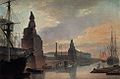 During the years of the Soviet era, academies were free of tuition as they were financed by the government, but admission was intensely competitive. Many students would continuously apply for sometimes six, seven years in a row to be accepted to the Academy, without success. With twenty available places and thousands of applicants, the competition was brutal.
since 1947. Its current president is Zurab Tsereteli
and its vice-president is Tair Salakhov.
The historic building on the Neva River in St. Petersburg is used for the Ilya Repin St. Petersburg State Academic Institute for Painting, Sculpture and Architecture, named in honor of one of its well-known alumni. It is also called the St. Petersburg State Academic Institute of Fine Arts, Sculpture and Architecture (as on its website). It is informally known as the St. Petersburg Academy of Arts, or Repin Institute of Arts.
Ivan Shuvalov
Ivan Ivanovich Shuvalov was called the Maecenas of the Russian Enlightenment and the first Russian Minister of Education...
under the name Academy of the Three Noblest Arts. Catherine the Great renamed it the Imperial Academy of Arts and commissioned a new building, completed 25 years later in 1789 by the Neva River
Neva River
The Neva is a river in northwestern Russia flowing from Lake Ladoga through the western part of Leningrad Oblast to the Neva Bay of the Gulf of Finland. Despite its modest length , it is the third largest river in Europe in terms of average discharge .The Neva is the only river flowing from Lake...
. The academy promoted the neoclassical style and technique, and sent its promising students to European capitals for further study. Training at the academy was virtually required for artists to make successful careers.
Formally abolished in 1918 after the Russian Revolution, the academy was renamed several times. It established free tuition; students from across the country competed fiercely for its few places annually. In 1947 the national institution was moved to Moscow, and much of its art collection was moved to the Hermitage
Hermitage Museum
The State Hermitage is a museum of art and culture in Saint Petersburg, Russia. One of the largest and oldest museums of the world, it was founded in 1764 by Catherine the Great and has been opened to the public since 1852. Its collections, of which only a small part is on permanent display,...
. The building in Leningrad was devoted to the Ilya Repin Leningrad Institute for Painting, Sculpture and Architecture, named in honor of one of Russia's foremost realist artists. Since 1991 it has been called the St. Petersburg Institute for Painting, Sculpture and Architecture.
In Imperial Russia
The academy was located in Shuvalov's palace on Sadovaya Street. In 1764, Catherine the Great renamed it the Imperial Academy of Arts and commissioned its first rectorRector
The word rector has a number of different meanings; it is widely used to refer to an academic, religious or political administrator...
, Alexander Kokorinov
Alexander Kokorinov
Alexander Filippovich Kokorinov was a Russian architect and educator, one of the founders, the first builder, director and rector of the Imperial Academy of Arts in Saint Peterburg. Kokorinov has been house architect of the Razumovsky family and Ivan Shuvalov, the first President of the Academy...
, to design a new building. It took 25 years to complete the Neoclassical
Neoclassicism
Neoclassicism is the name given to Western movements in the decorative and visual arts, literature, theatre, music, and architecture that draw inspiration from the "classical" art and culture of Ancient Greece or Ancient Rome...
edifice, which opened in 1789. Konstantin Thon
Konstantin Thon
Konstantin Andreyevich Thon, also spelled Ton was an official architect of Imperial Russia during the reign of Nicholas I. His major works include the Cathedral of Christ the Saviour, the Grand Kremlin Palace and the Kremlin Armoury in Moscow....
was responsible for the sumptuous decoration of the interiors. He also designed a quayside in front of the building, with stairs down to the Neva River, and adorned it with two 3000-year-old sphinx
Sphinx
A sphinx is a mythical creature with a lion's body and a human head or a cat head.The sphinx, in Greek tradition, has the haunches of a lion, the wings of a great bird, and the face of a woman. She is mythicised as treacherous and merciless...
es, which were transported from Egypt
Egypt
Egypt , officially the Arab Republic of Egypt, Arabic: , is a country mainly in North Africa, with the Sinai Peninsula forming a land bridge in Southwest Asia. Egypt is thus a transcontinental country, and a major power in Africa, the Mediterranean Basin, the Middle East and the Muslim world...
.
Ivan Betskoy
Ivan Ivanovich Betskoi or Betskoy was a Russian school reformer who served as Catherine II's advisor on education and President of the Imperial Academy of Arts for thirty years...
reorganized the academy into a de-facto government department; it supervised matters concerning art throughout the country, distributing orders and awarding ranks to artists. The academy vigorously promoted the principles of Neoclassicism by sending the most notable Russian painters abroad, in order to learn the ancient and Renaissance
Renaissance
The Renaissance was a cultural movement that spanned roughly the 14th to the 17th century, beginning in Italy in the Late Middle Ages and later spreading to the rest of Europe. The term is also used more loosely to refer to the historical era, but since the changes of the Renaissance were not...
styles of Italy and France. It also had its own sizable collection of choice artworks intended for study and copying.
In the mid-19th-century, the Academism
Academic art
Academic art is a style of painting and sculpture produced under the influence of European academies of art. Specifically, academic art is the art and artists influenced by the standards of the French Académie des Beaux-Arts, which practiced under the movements of Neoclassicism and Romanticism,...
of training staff, much influenced by the doctrines of Dominique Ingres
Jean Auguste Dominique Ingres
Jean-Auguste-Dominique Ingres was a French Neoclassical painter. Although he considered himself to be a painter of history in the tradition of Nicolas Poussin and Jacques-Louis David, by the end of his life it was Ingres's portraits, both painted and drawn, that were recognized as his greatest...
, was challenged by a younger generation of Russian artists who asserted their freedom to paint in a Realistic style
Realism (visual arts)
Realism in the visual arts is a style that depicts the actuality of what the eyes can see. The term is used in different senses in art history; it may mean the same as illusionism, the representation of subjects with visual mimesis or verisimilitude, or may mean an emphasis on the actuality of...
. The adherents of this movement became known as peredvizhniki
Peredvizhniki
Peredvizhniki , often called The Wanderers or The Itinerants in English, were a group of Russian realist artists who in protest at academic restrictions formed an artists' cooperative; it evolved into the Society for Travelling Art Exhibitions in 1870.- History :In 1863 a group of fourteen students...
(Itinerants, related to their desire to bring art to the people). Led by Ivan Kramskoi
Ivan Kramskoi
Ivan Nikolaevich Kramskoi was a Russian painter and art critic. He was an intellectual leader of the Russian democratic art movement in 1860-1880.-Life:...
, they publicly broke with the Academy and organized their own exhibitions, which traveled from town to town across Russia. Ilya Repin, Mikhail Vrubel
Mikhail Vrubel
Mikhail Aleksandrovich Vrubel is usually regarded amongst the Russian painters of the Symbolist movement. In reality, he deliberately stood aloof from contemporary art trends, so that the origin of his unusual manner should be sought in Late Byzantine and Early Renaissance painting.-Early...
and some other painters still regarded the academy's training as indispensable for the development of basic professional and technical skills.
In the Soviet Union
After the Russian Revolution of 1917Russian Revolution of 1917
The Russian Revolution is the collective term for a series of revolutions in Russia in 1917, which destroyed the Tsarist autocracy and led to the creation of the Soviet Union. The Tsar was deposed and replaced by a provisional government in the first revolution of February 1917...
, the Imperial Academy passed through a series of transformations. It was formally abolished in 1918 and the Petrograd Free Art Educational Studios (Pegoskhuma) created in its place; this was renamed the Petrograd Svomas
Svomas
Svomas or SVOMAS , an abbreviation for Svobodnye gosudarstvennye khudozhestvennye masterskiye , was the name of a series of art schools founded in several Russian cities after the October Revolution....
(Free Art Studios) in 1919, the Petrograd State Art-Educational Studios of the Reconstructed Academy of Arts in 1921, Vkhutein in 1928, the Institute of Proletarian Fine Arts in 1930, the Russian Academy of Arts in 1933, and the Academy of Arts of the USSR in 1947. After the move of the academy to Moscow that year, the building in what was then called Leningrad was renamed Ilya Repin Leningrad Institute for Painting, Sculpture and Architecture.
The national academy has stayed in Moscow. In 1991 it was renamed the Russian Academy of Arts. The old academy's art collection, which included major works by Poussin
Poussin
Poussin refers to:*Charles Jean de la Vallée-Poussin Belgian mathematician*Charles-Louis-Joseph-Xavier de la Vallée-Poussin Belgian geologist and mineralogist, father of Charles Jean*Nicolas Poussin , French painter...
, David
Jacques-Louis David
Jacques-Louis David was an influential French painter in the Neoclassical style, considered to be the preeminent painter of the era...
and Ingres, was removed to the Hermitage Museum
Hermitage Museum
The State Hermitage is a museum of art and culture in Saint Petersburg, Russia. One of the largest and oldest museums of the world, it was founded in 1764 by Catherine the Great and has been opened to the public since 1852. Its collections, of which only a small part is on permanent display,...
across the river.
Well-known graduates of Ilya Repin Leningrad Institute for Painting, Sculpture and Architecture in 1930-1950s include: Yuri Neprintsev, Nikolai Timkov
Nikolai Timkov
Nikolai Efimovich Timkov - Soviet Russian painter, Honored Artist of Russian Federation, a member of the Saint Petersburg Union of Artists , lived and worked in Leningrad, regarded as one of the leading representatives of the Leningrad school of painting, worldwide known for his landscape...
, Alexander Laktionov, Piotr Vasiliev, Piotr Belousov, Mikhail Kozell, Gleb Verner ( Isaak Brodsky
Isaak Brodsky
Isaak Izrailevich Brodsky , was a Soviet painter whose work provided a blueprint for the art movement of socialist realism. He is known for his iconic portrayals of Lenin and idealized, carefully crafted paintings dedicated to the events of the Russian Civil War and Bolshevik Revolution.Brodsky was...
workshop), Sergei Osipov
Sergei Ivanovich Osipov
Sergei Ivanovich Osipov was a Soviet Russian painter, graphic artist, and art teacher, lived and worked in Leningrad, a member of the Leningrad branch of Union of Artists of Russian Federation, regarded as one of the leading representatives of the Leningrad school of painting, most famous for his...
, Gleb Savinov
Gleb Savinov
Gleb Alexandrovich Savinov - Soviet, Russian painter, Art teacher, Honored Artist of Russian Federation, lived and worked in Leningrad, regarded as one of the leading representatives of the Leningrad school of painting, most famous for his genre and portrait painting.- Biography :Gleb...
, Elena Skuin
Elena Skuin
Elena Petrovna Skuin – Soviet, Russian – Latvian painter, watercolorist, graphic artist, and art teacher, lived and worked in Leningrad, a member of the Leningrad Union of Artists, regarded as one of representatives of the Leningrad school of painting, most famous for her still life painting.-...
, Olga Bogaevskaya, Lev Orekhov, Victor Teterin, Ivan Godlevsky, Evgenia Antipova
Evgenia Antipova
Evgenia Petrovna Antipova was a Russian and Soviet painter, watercolorist, graphic artist, and Art teacher. She lived and worked in Leningrad - Saint Petersburg and is regarded as one of the brightest representatives of the Leningrad school of painting....
, Evgenia Baykova ( Alexander Osmerkin
Alexander Osmerkin
Alexander Alexandrovich Osmerkin was a Russian painter, graphic artist, stage designer, and art teacher. He was a member of the Knave of Diamonds avant-garde group, AKhRR, and Society of Moscow Artists groups...
workshop ), Alexey Eriomin, Nikolai Baskakov
Nikolai Baskakov
Nikolai Nikolaevich Baskakov - Soviet, Russian painter, lived and worked in Leningrad, a member of the Saint Petersburg Union of Artists , regarded as one of the leading representatives of the Leningrad school of painting, most famous for his genre and portrait painting.- Biography :Nikolai...
, Valery Vatenin, Nina Veselova, Maya Kopitseva, Leonid Steele
Leonid Steele
Leonid Mikhailovich Steele is one of the leading artists of the Russian Realist School - the Soviet period in Russian Art known as “socialist realism” or “socrealizm.” A member of the USSR Union of Artists since 1958, he is known for his large multi-figure works, as well as figure, genre and...
, Oleg Lomakin
Oleg Lomakin
Oleg Leonidovich Lomakin was a Russian Soviet realist painter, Honored Artist of the RSFSR, who lived and worked in Saint Petersburg . He was regarded as one of the major representatives of the Leningrad school of painting,- Biography :...
,Valentina Monakhova, Nikolai Mukho, Anatoli Nenartovich, Mikhail Natarevich, Semion Rotnitsky, Mikhail Trufanov, Yuri Tulin ( Boris Ioganson
Boris Ioganson
Boris Vladimirovich Ioganson was a Russian painter.Ioganson was born in Moscow. His father's Swedish ancestors russified the surname "Johanson"" into "Ioganson." Ioganson attended the Moscow School of Art and studied under Kasatkin and Malyutin. He was a member of the Society of Young Artists,...
workshop ), Boris Korneev, Anatoli Vasiliev, Nikolai Pozdneev
Nikolai Pozdneev
Nikolai Matveevich Pozdneev - Soviet Russian painter, living and working in Leningrad, a member of the Leningrad Union of Artists, regarded as one of the leading representatives of the Leningrad school of painting, most famous for his genre and still life paintings.-Biography:Pozdneev Nikolai...
, Rostislav Vovkushevsky, Irina Getmanskaya, Elena Kostenko
Elena Kostenko
Elena Mikhailovna Kostenko - Soviet Russian painter, living and working in Saint Petersburg, a member of the Saint Petersburg Union of Artists , regarded as one of the major representatives of the Leningrad school of painting, most famous for her portrait paintings.- Biography :Elena Mikhailovna...
, Alexander Koroviakov, Victor Otiev, Alexander Sokolov ( Victor Oreshnikov workshop ), Boris Lavrenko, Yuri Belov, Mikhail Kaneev
Mikhail Kaneev
Mikhail Alexandrovich Kaneev – Soviet Russian painter and art teacher, lived and worked in Leningrad, a member of the Leningrad Union of Artists, regarded as one of the major representatives of the Leningrad school of painting, most famous for his cityscapes of Leningrad and ancient Russian...
, Nikolai Galakhov, Piotr Litvinsky (Rudolf Frentz workshop).
After the advancement of 20th century modernism
Modernism
Modernism, in its broadest definition, is modern thought, character, or practice. More specifically, the term describes the modernist movement, its set of cultural tendencies and array of associated cultural movements, originally arising from wide-scale and far-reaching changes to Western society...
, European and American art schools embraced thinkers who rebelled against nineteenth century academic and historicist traditions. They believed the "traditional" forms of art, architecture, literature, religious faith, social organization and daily life were becoming outdated. While art education in the West was changing, traditional academic teachings were nourished in the Soviet academy.
Current situation
The Russian Academy of Arts has been headquartered in MoscowMoscow
Moscow is the capital, the most populous city, and the most populous federal subject of Russia. The city is a major political, economic, cultural, scientific, religious, financial, educational, and transportation centre of Russia and the continent...
since 1947. Its current president is Zurab Tsereteli
Zurab Tsereteli
Zurab Konstantines dze Tsereteli is a Georgian-Russian painter, sculptor and architect who holds the office of President of the Russian Academy of Arts.- Life :...
and its vice-president is Tair Salakhov.
The historic building on the Neva River in St. Petersburg is used for the Ilya Repin St. Petersburg State Academic Institute for Painting, Sculpture and Architecture, named in honor of one of its well-known alumni. It is also called the St. Petersburg State Academic Institute of Fine Arts, Sculpture and Architecture (as on its website). It is informally known as the St. Petersburg Academy of Arts, or Repin Institute of Arts.
See also
- Academic artAcademic artAcademic art is a style of painting and sculpture produced under the influence of European academies of art. Specifically, academic art is the art and artists influenced by the standards of the French Académie des Beaux-Arts, which practiced under the movements of Neoclassicism and Romanticism,...
- Alexander KokorinovAlexander KokorinovAlexander Filippovich Kokorinov was a Russian architect and educator, one of the founders, the first builder, director and rector of the Imperial Academy of Arts in Saint Peterburg. Kokorinov has been house architect of the Razumovsky family and Ivan Shuvalov, the first President of the Academy...
- PeredvizhnikiPeredvizhnikiPeredvizhniki , often called The Wanderers or The Itinerants in English, were a group of Russian realist artists who in protest at academic restrictions formed an artists' cooperative; it evolved into the Society for Travelling Art Exhibitions in 1870.- History :In 1863 a group of fourteen students...
- Sergei V. Ivanov. The Leningrad School of painting. Historical outline
- List of Russian artists
- List of 20th century Russian painters
- List of painters of Saint Petersburg Union of Artists