


Baba Yaga

Encyclopedia
Baba Yaga or Baba Roga is a hag
gish or witchlike character in Slavic folklore. She flies around on a giant pestle
, kidnaps
(and presumably eats) small children, and lives in a hut that stands on chicken legs. In most Slavic folk tales, she is portrayed as an antagonist
; however, some characters in other mythological folk stories have been known to seek her out for her wisdom
, and she has been known on rare occasions to offer guidance to lost souls. According to Propp, she often fulfills the function of donor
; that is, her role is in supplying the hero (sometimes unwillingly) with something necessary to further his quest.
; it derives from babytalk and often has come to have pejorative
connotations in modern Slavic languages
. The second element, yaga, is from Proto-Slavic (j)ęga, "Jędza"[Polish], which is probably related to Lithuanian
ingis ("lazybones" or "sluggard"), Old Norse
ekki ("pain"), and Old English inca ("question, scruple, doubt; grievance, quarrel").
An early recorded reference to yaga-baba in English
appears in Of the Russe Common Wealth by Giles Fletcher, the Elder
, in the section "About Permyaks, Samoyed
s and Lopars", indicating a possible Uralic
influence.
The name differs within the various Slavic languages
. It is spelled Baba Jaga in Czech
, Slovak
and Polish
(though Czech and Slovak also use Ježibaba). In Slovene, the words are reversed, producing Jaga Baba. In Russian
, Bulgarian
, Ukrainian
and Belarusian
, it is Баба Яга́ transliterated as Baba Yaga (also Baba Yaha, in Ukrainian and Baba Yaha or Baba Jaha in Belarusian). In South Slavic
languages and traditions, there is a similar old witch, written Baba Roga in Croatian
, Serbian
and Bosnian
, and Баба Рога in Serbian
and Macedonian
. In Romanian
, which is not Slavic but one of the Romance languages
, the name is Baba Cloanţa (roughly translated as "old hag with broken teeth").
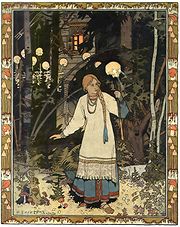 In Russian tales, Baba Yaga is portrayed as a hag
who flies through the air in a mortar
, using the pestle as a rudder and sweeping away the tracks behind her with a broom made of silver birch
. She lives in a log cabin that either moves around on a pair of dancing chicken
legs, is surrounded by a palisade with a skull on each pole, or both. The keyhole to her front door is a mouth filled with sharp teeth; the fence outside is made with human bones with skulls on top, often with one pole lacking its skull, leaving space for the hero or heroes. In another legend, the hut does not reveal its door until it is told a magical phrase: "Turn your back to the forest, and your front to me."
In some tales
, the hut is connected with three riders: one in white, riding a white horse with a white harness, who is Day; a red rider, who is the Sun; and one in black, who is Night. Baba Yaga is served by invisible servants inside the hut. She explains the riders if asked, but may kill a visitor who inquires about the servants.
Baba Yaga is sometimes shown as an antagonist, and sometimes as a source of guidance; there are stories in which she helps people with their quests, and stories in which she kidnaps children and threatens to eat them. Seeking out her aid is usually portrayed as a dangerous act. An emphasis is placed on the need for proper preparation and purity of spirit, as well as basic politeness. It is said she ages one year every time she is asked a question, which may explain her reluctance to help. This effect, however, can be reversed with a special blend of tea made with blue roses.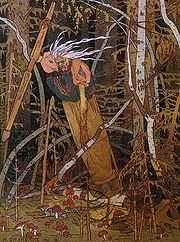 In the folk tale "Vasilissa the Beautiful
", recorded by Alexander Afanasyev
(Narodnye russkie skazki, vol 4, 1862), the titular young girl is given three impossible tasks that she solves using a magic doll given to her by her mother. In the Christianised
version of the story, Vasilissa is sent to visit Baba Yaga on an errand and is enslaved by her, but the hag's servants — a cat, a dog, a gate, and a tree — help Vasilissa to escape because she is kind to them. In the end, Baba Yaga is turned into a crow. Similarly, Prince Ivan in "The Death of Koschei the Deathless
" is aided against her by animals whom he has spared.
The Polish
folklore version differs in details. For example, the Polish Baba Jaga's hut has only one chicken leg. Monstrous witches living in gingerbread
huts are also commonly named Baba Jaga. Baba Jaga, flying on a broom and wearing black and red striped folk costume of Świętokrzyskie Mountains
, is an unofficial symbol of Kielce
region (it is connected with legendary witches' sabbaths
on Łysa Góra mountain). In some legends Baba Yaga is also awarded the title Костяная Нога ("The Bone Leg") and considered a guardian between the real world and the land of the dead. This title later became an idiom, often used as taunt.
Baba Yaga is used as a stock character by authors of modern Russian fairy tales, and from the 1990s in Russian fantasy. In particular, Baba Yaga in included in such books as Andrey Belyanin's cycle Secret service of Tsar Pea
. The childhood and youth of Baba Yaga were described for the first time in the A. Aliverdiev's tale "Creek" ("Lukomorie").
In some fairy tales, such as "The Feather of Finist the Falcon
", the hero meets with three
Baba Yagas. Such figures are usually benevolent, giving the hero advice, magical presents, or both.
Other recorded Russian fairy tales that feature Baba Yaga are "Teryoshechka", "The Enchanted Princess", and "The Silver Saucer and the Red Apple".
 According to Russian folklore, Baba Yaga dwells, in the words of the preface to Alexander Pushkin's fantasy poem Ruslan and Lyudmila
, in a "cabin on chicken legs... with no windows and no doors". Baba Yaga herself usually uses the chimney
to fly in and out on her mortar. The door sometimes appears at the other side of the hut; to see it, a hero should say "Hut, O hut, turn your back to the woods, your front to me" and thus force the cabin to turn around and reveal the door.
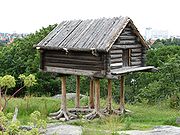 This may be an interpretation of an ordinary construction popular among hunter-nomad
ic peoples of Siberia
of Uralic and Tungusic families, invented to preserve supplies against animals during long periods of absence. A doorless and windowless log cabin
is built upon supports made from the stumps of two or three closely grown trees cut at the height of eight to ten feet. The stumps, with their spreading roots, would give an impression of "chicken legs".
A similar but smaller construction was used by Siberian pagans
to hold figurine
s of their gods. Recalling the late matriarchy
among Siberian peoples, a common picture of a bone-carved doll in rags in a small cabin on top of a tree stump fits a common description of Baba Yaga, who barely fits her cabin: her legs lie in one corner, her head in another one, and her nose is grown into the ceiling.
There are indications that ancient Slavs had a funeral tradition of cremation in huts of this type. In 1948, Russian archaeologists Yefimenko and Tretyakov discovered similar small huts with traces of corpse cremation and circular fences around them; this may be a connection to the Baba Yaga myth.
's short story collection Wieszać każdy może. Main protagonist, Jakub Wędrowycz
, mentions fighting her as a child and gets rid of her permanently when she tries to eat his great-grandson Piotruś.
Baba Yaga is a major character in Isaac Bashevis Singer
’s children story Joseph & Koza, where she is described as having a face like a pitch, a red turned-up nose with broad nostrils, eyes burning like live coals, thistles instead of hair and a beard. Singer also mentions that the Mazovians believed in “many lesser babas” and “little imps called dziads.” In his novel The King of the Fields, Baba Yaga was a goddess to whom the prehistoric Poles
made sacrifices.
's novel, Enchantment
. In this novel, Card portrays Baba Yaga as the antagonist and weaves the folklore and possible origins of the folklore into his novel. In Michael Buckley's The Sisters Grimm series, Baba Yaga is a supporting character in the fictional town of Ferryport Landing. In the Primeval
novel Extinction Event
, Baba Yaga is interpreted to be a Tyrannosaurus
that travelled to the present through an anomaly
. In the Fables
, Baba Yaga is a spy for the Adversary. In Patricia Briggs
' fourth Mercy Thompson novel, Bone-Crossed, Baba Yaga is a fae who resurrects Marcy's friend after a different fae accidentally kills her.
Baba Yaga's hut is parodied in Dan Abnett's Warhammer 40,000 novel, Ravenor Rogue, as the "Wych House of Utochre". The Wych House takes the form of a 300-meter wide metal construct with clawed feet and short legs that it can use to run. The whole House hangs upside down under a frozen ocean, attached to the pack ice above by its feet. One character remarks that the house reminds him of an ancient legend from his home world, the myth of Baba Yaga. He is corrected and told that this is actually an ancient earth legend. Baba Yaga appears in Sarah Zettel
's 'A Novel of Isavalta' series as well as an illustrious but powerful political player, who has her own political agenda and tries to achieve her goals by intimidation and manipulation of other characters, often aided by magic weavings. Naomi Kritzer's short story, 'Comrade Grandmother', shows Baba Yaga in WW2, more than capable of turning back the invading German Army, if a young Russian factory worker, Nadezhda, will meet her price, her lover's life.
Baba Yaga appears in the Marvel Comics
book Uncanny X-Men
as a nemesis for the good witch Illyana Rasputin
. Baba Yaga makes an appearance in Neil Gaiman
's Sandman series in issue #38 ("The Convergence"). She also appears in a Hellboy
short story titled The Baba Yaga, which can be found within the graphic novel Hellboy: The Chained Coffin and Others
. She serves as the main antagonist in Hellboy: Darkness Calls
, in which she tries to take revenge on Hellboy for the events that occurred in The Chained Coffin. Baba Yaga is also a recurring character in the DC Vertigo series Fables.
Baba Yaga is cited in Clanbook: Nosferatu", a source book for the tabletop roleplaying game Vampire: The Masquerade
as a vampire of the Nosferatu clan. The Nosferatu are hideous and deformed as opposed to most vampires in the World of Darkness
setting. In this setting Baba Yaga lived in Russia for hundreds of years until recently having been destroyed.
A variation of Baba Yaga appears in British Television Show Mighty Boosh as Babu Yaga, The Hitcher, a recurring character.
In the comic Girl Genius
, the central character Agatha Heterodyne spends some time living in a hut which walks on bird legs and is called Baba Yaga.
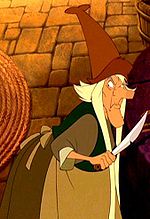 Baba Yaga is a favorite subject of Russian films and cartoons. The film Vasilisa the Beautiful by Aleksandr Rou, featuring Baba Yaga, was the first feature with fantasy elements in the Soviet Union. Georgy Milliar, a male actor, portrayed Baba Yaga in numerous movies from the 1930s to 1960s, including Vasilissa the Beautiful, Morozko
, New Adventures of Puss-in-Boots and others.
The animated film Bartok the Magnificent
features Baba Yaga as a main character but not as an antagonist.
The John Duigan
film Lawn Dogs
uses the story of Baba Yaga as a plot device. The character Devon tells the story to herself, and to Trent as he escapes from the town at the end of the film. She gives him a towel and a comb, both of which he uses to evade capture by the townspeople.
The character of Baba Yaga appears in the film Jack Frost
, which was featured in an episode of Mystery Science Theater 3000
.
Baba Yaga also appears in the film Shrek Forever After
, having been employed by Rumpelstiltskin
to fight against Shrek, voiced by the film's director Mike Mitchell
and in Hayao Miyazaki
and Studio Ghibli
's 2010 short film Mr. Dough and the Egg Princess.
 Modest Mussorgsky
's Pictures at an Exhibition
, a suite for piano composed in 1874, features "The Hut on Bird's Legs (Baba Yaga)" as its penultimate movement. This suite was inspired by an exhibition of paintings by the Russian artist Viktor Hartmann
held in his memory, a year after his death. this specific movement, was inspired by the painting "The hut on hen's legs–clock in the Russian Style". Mussorgsky's suite has since been set in whole or in part for a variety of instruments. The most famous version for orchestra was made in 1922 by Ravel
. The progressive rock group Emerson, Lake & Palmer
adapted Mussorgsky's suite for an album in 1971 that included the original Baba Yaga movement along with an original track entitled "The Curse of Baba Yaga".
Baba Yaga (opus 56), a symphonic poem by Anatoly Lyadov
, was composed between 1890 and 1904. The music depicts the witch summoning her mortar, pestle and broomstick, then flying through the forest.
Tchaikovsky wrote a piece called "The Witch - Baba Yaga" (op 39).
. She serves as the primary antagonist in the first game, having cursed the Baron of Spielburg and caused all the troubles that the player must resolve. Baba Yaga's chicken-legged hut appears in both games. in the fourth, the player must coax it into sitting with an offer of corn.
In the online game RuneScape
, Baba Yaga is featured in quests and as an integral part of the Lunar Isle, where she runs a magic store in her chicken-legged house.
Baba Yaga is also been seen in Castlevania lords of Shadow video game, asking for Gabriel's help.
Baba talking to Gabriel Belmont
, Croatian
and Bosnian
; "Baba Cloanța" in Romanian
; "Ježibaba" in Slovak
as well as Czech
; "vasorrú (literally "iron-nosed") bába" in Hungarian
; "Баба (literally "Grandma") Яга" in Bulgarian
; and "Bobbe Yakhne" in Yiddish. In other languages she is known as: (icon; ; , Baba-Jahinia; , Baba-Yaga ; ; ; ; , Baba Yaga; ; , Baba-Yaga; , Baba Jaga; ; , Baba-yaha).
Hag
A hag is a wizened old woman, or a kind of fairy or goddess having the appearance of such a woman, often found in folklore and children's tales such as Hansel and Gretel. Hags are often seen as malevolent, but may also be one of the chosen forms of shapeshifting deities, such as the Morrígan or...
gish or witchlike character in Slavic folklore. She flies around on a giant pestle
Mortar and pestle
A mortar and pestle is a tool used to crush, grind, and mix solid substances . The pestle is a heavy bat-shaped object, the end of which is used for crushing and grinding. The mortar is a bowl, typically made of hard wood, ceramic or stone...
, kidnaps
Kidnapping
In criminal law, kidnapping is the taking away or transportation of a person against that person's will, usually to hold the person in false imprisonment, a confinement without legal authority...
(and presumably eats) small children, and lives in a hut that stands on chicken legs. In most Slavic folk tales, she is portrayed as an antagonist
Antagonist
An antagonist is a character, group of characters, or institution, that represents the opposition against which the protagonist must contend...
; however, some characters in other mythological folk stories have been known to seek her out for her wisdom
Wisdom
Wisdom is a deep understanding and realization of people, things, events or situations, resulting in the ability to apply perceptions, judgements and actions in keeping with this understanding. It often requires control of one's emotional reactions so that universal principles, reason and...
, and she has been known on rare occasions to offer guidance to lost souls. According to Propp, she often fulfills the function of donor
Donor (fairy tale)
In fairy tales, a donor is a character that tests the hero and provides magical assistances to the hero when he succeeds.The fairy godmother is a well-known form of this character...
; that is, her role is in supplying the hero (sometimes unwillingly) with something necessary to further his quest.
Etymology and origin
The name of Baba-Yaga is composed of two elements. Baba means "old woman" or "grandmother" in most Slavic languagesSlavic languages
The Slavic languages , a group of closely related languages of the Slavic peoples and a subgroup of Indo-European languages, have speakers in most of Eastern Europe, in much of the Balkans, in parts of Central Europe, and in the northern part of Asia.-Branches:Scholars traditionally divide Slavic...
; it derives from babytalk and often has come to have pejorative
Pejorative
Pejoratives , including name slurs, are words or grammatical forms that connote negativity and express contempt or distaste. A term can be regarded as pejorative in some social groups but not in others, e.g., hacker is a term used for computer criminals as well as quick and clever computer experts...
connotations in modern Slavic languages
Slavic languages
The Slavic languages , a group of closely related languages of the Slavic peoples and a subgroup of Indo-European languages, have speakers in most of Eastern Europe, in much of the Balkans, in parts of Central Europe, and in the northern part of Asia.-Branches:Scholars traditionally divide Slavic...
. The second element, yaga, is from Proto-Slavic (j)ęga, "Jędza"[Polish], which is probably related to Lithuanian
Lithuanian language
Lithuanian is the official state language of Lithuania and is recognized as one of the official languages of the European Union. There are about 2.96 million native Lithuanian speakers in Lithuania and about 170,000 abroad. Lithuanian is a Baltic language, closely related to Latvian, although they...
ingis ("lazybones" or "sluggard"), Old Norse
Old Norse
Old Norse is a North Germanic language that was spoken by inhabitants of Scandinavia and inhabitants of their overseas settlements during the Viking Age, until about 1300....
ekki ("pain"), and Old English inca ("question, scruple, doubt; grievance, quarrel").
An early recorded reference to yaga-baba in English
English language
English is a West Germanic language that arose in the Anglo-Saxon kingdoms of England and spread into what was to become south-east Scotland under the influence of the Anglian medieval kingdom of Northumbria...
appears in Of the Russe Common Wealth by Giles Fletcher, the Elder
Giles Fletcher, the Elder
Giles Fletcher, the Elder was an English poet and diplomat, member of the English Parliament.Giles Fletcher was the son of Richard Fletcher, vicar of Bishop's Stortford. He spent his early life at Cranbrook before entering Eton College about 1561...
, in the section "About Permyaks, Samoyed
Samoyed
Samoyed may refer to:* the Samoyedic peoples in Siberia who speak the Samoyedic languages: the Enets, the Nenets, the Nganasans, and the Selkups* the Samoyedic languages they speak* Samoyed , a dog breed...
s and Lopars", indicating a possible Uralic
Uralic languages
The Uralic languages constitute a language family of some three dozen languages spoken by approximately 25 million people. The healthiest Uralic languages in terms of the number of native speakers are Hungarian, Finnish, Estonian, Mari and Udmurt...
influence.
The name differs within the various Slavic languages
Slavic languages
The Slavic languages , a group of closely related languages of the Slavic peoples and a subgroup of Indo-European languages, have speakers in most of Eastern Europe, in much of the Balkans, in parts of Central Europe, and in the northern part of Asia.-Branches:Scholars traditionally divide Slavic...
. It is spelled Baba Jaga in Czech
Czech language
Czech is a West Slavic language with about 12 million native speakers; it is the majority language in the Czech Republic and spoken by Czechs worldwide. The language was known as Bohemian in English until the late 19th century...
, Slovak
Slovak language
Slovak , is an Indo-European language that belongs to the West Slavic languages .Slovak is the official language of Slovakia, where it is spoken by 5 million people...
and Polish
Polish language
Polish is a language of the Lechitic subgroup of West Slavic languages, used throughout Poland and by Polish minorities in other countries...
(though Czech and Slovak also use Ježibaba). In Slovene, the words are reversed, producing Jaga Baba. In Russian
Russian language
Russian is a Slavic language used primarily in Russia, Belarus, Uzbekistan, Kazakhstan, Tajikistan and Kyrgyzstan. It is an unofficial but widely spoken language in Ukraine, Moldova, Latvia, Turkmenistan and Estonia and, to a lesser extent, the other countries that were once constituent republics...
, Bulgarian
Bulgarian language
Bulgarian is an Indo-European language, a member of the Slavic linguistic group.Bulgarian, along with the closely related Macedonian language, demonstrates several linguistic characteristics that set it apart from all other Slavic languages such as the elimination of case declension, the...
, Ukrainian
Ukrainian language
Ukrainian is a language of the East Slavic subgroup of the Slavic languages. It is the official state language of Ukraine. Written Ukrainian uses a variant of the Cyrillic alphabet....
and Belarusian
Belarusian language
The Belarusian language , sometimes referred to as White Russian or White Ruthenian, is the language of the Belarusian people...
, it is Баба Яга́ transliterated as Baba Yaga (also Baba Yaha, in Ukrainian and Baba Yaha or Baba Jaha in Belarusian). In South Slavic
South Slavic languages
The South Slavic languages comprise one of three branches of the Slavic languages. There are approximately 30 million speakers, mainly in the Balkans. These are separated geographically from speakers of the other two Slavic branches by a belt of German, Hungarian and Romanian speakers...
languages and traditions, there is a similar old witch, written Baba Roga in Croatian
Croatian language
Croatian is the collective name for the standard language and dialects spoken by Croats, principally in Croatia, Bosnia and Herzegovina, the Serbian province of Vojvodina and other neighbouring countries...
, Serbian
Serbian language
Serbian is a form of Serbo-Croatian, a South Slavic language, spoken by Serbs in Serbia, Bosnia and Herzegovina, Montenegro, Croatia and neighbouring countries....
and Bosnian
Bosnian language
Bosnian is a South Slavic language, spoken by Bosniaks. As a standardized form of the Shtokavian dialect, it is one of the three official languages of Bosnia and Herzegovina....
, and Баба Рога in Serbian
Serbian language
Serbian is a form of Serbo-Croatian, a South Slavic language, spoken by Serbs in Serbia, Bosnia and Herzegovina, Montenegro, Croatia and neighbouring countries....
and Macedonian
Macedonian language
Macedonian is a South Slavic language spoken as a first language by approximately 2–3 million people principally in the region of Macedonia but also in the Macedonian diaspora...
. In Romanian
Romanian language
Romanian Romanian Romanian (or Daco-Romanian; obsolete spellings Rumanian, Roumanian; self-designation: română, limba română ("the Romanian language") or românește (lit. "in Romanian") is a Romance language spoken by around 24 to 28 million people, primarily in Romania and Moldova...
, which is not Slavic but one of the Romance languages
Romance languages
The Romance languages are a branch of the Indo-European language family, more precisely of the Italic languages subfamily, comprising all the languages that descend from Vulgar Latin, the language of ancient Rome...
, the name is Baba Cloanţa (roughly translated as "old hag with broken teeth").
Folklore
Hag
A hag is a wizened old woman, or a kind of fairy or goddess having the appearance of such a woman, often found in folklore and children's tales such as Hansel and Gretel. Hags are often seen as malevolent, but may also be one of the chosen forms of shapeshifting deities, such as the Morrígan or...
who flies through the air in a mortar
Mortar and pestle
A mortar and pestle is a tool used to crush, grind, and mix solid substances . The pestle is a heavy bat-shaped object, the end of which is used for crushing and grinding. The mortar is a bowl, typically made of hard wood, ceramic or stone...
, using the pestle as a rudder and sweeping away the tracks behind her with a broom made of silver birch
Silver Birch
Betula pendula is a widespread European birch, though in southern Europe it is only found at higher altitudes. Its range extends into southwest Asia in the mountains of northern Turkey and the Caucasus...
. She lives in a log cabin that either moves around on a pair of dancing chicken
Chicken
The chicken is a domesticated fowl, a subspecies of the Red Junglefowl. As one of the most common and widespread domestic animals, and with a population of more than 24 billion in 2003, there are more chickens in the world than any other species of bird...
legs, is surrounded by a palisade with a skull on each pole, or both. The keyhole to her front door is a mouth filled with sharp teeth; the fence outside is made with human bones with skulls on top, often with one pole lacking its skull, leaving space for the hero or heroes. In another legend, the hut does not reveal its door until it is told a magical phrase: "Turn your back to the forest, and your front to me."
In some tales
Vasilissa the Beautiful
Vasilisa the Beautiful , commonly known as Vasilisa's Doll, is a Russian fairy tale collected by Alexander Afanasyev in Narodnye russkie skazki....
, the hut is connected with three riders: one in white, riding a white horse with a white harness, who is Day; a red rider, who is the Sun; and one in black, who is Night. Baba Yaga is served by invisible servants inside the hut. She explains the riders if asked, but may kill a visitor who inquires about the servants.
Baba Yaga is sometimes shown as an antagonist, and sometimes as a source of guidance; there are stories in which she helps people with their quests, and stories in which she kidnaps children and threatens to eat them. Seeking out her aid is usually portrayed as a dangerous act. An emphasis is placed on the need for proper preparation and purity of spirit, as well as basic politeness. It is said she ages one year every time she is asked a question, which may explain her reluctance to help. This effect, however, can be reversed with a special blend of tea made with blue roses.
Vasilissa the Beautiful
Vasilisa the Beautiful , commonly known as Vasilisa's Doll, is a Russian fairy tale collected by Alexander Afanasyev in Narodnye russkie skazki....
", recorded by Alexander Afanasyev
Alexander Afanasyev
Alexander Nikolayevich Afanasyev was a Russian folklorist who recorded and published over 600 Russian folktales and fairytales, by far the largest folktale collection by any one man in the world...
(Narodnye russkie skazki, vol 4, 1862), the titular young girl is given three impossible tasks that she solves using a magic doll given to her by her mother. In the Christianised
Christianized myths and imagery
The historicity of several saints has often been treated skeptically by most academics, either because there is a paucity of historical evidence for them, or due to striking resemblances that they have to pre-Christian deities. In 1969 the Roman Catholic Church officially decanonised some Christian...
version of the story, Vasilissa is sent to visit Baba Yaga on an errand and is enslaved by her, but the hag's servants — a cat, a dog, a gate, and a tree — help Vasilissa to escape because she is kind to them. In the end, Baba Yaga is turned into a crow. Similarly, Prince Ivan in "The Death of Koschei the Deathless
The Death of Koschei the Deathless
The Death of the Immortal Koschei or Marya Morevna is a Russian fairy tale collected by Alexander Afanasyev in Narodnye russkie skazki and included by Andrew Lang in The Red Fairy Book...
" is aided against her by animals whom he has spared.
The Polish
Poland
Poland , officially the Republic of Poland , is a country in Central Europe bordered by Germany to the west; the Czech Republic and Slovakia to the south; Ukraine, Belarus and Lithuania to the east; and the Baltic Sea and Kaliningrad Oblast, a Russian exclave, to the north...
folklore version differs in details. For example, the Polish Baba Jaga's hut has only one chicken leg. Monstrous witches living in gingerbread
Gingerbread
Gingerbread is a term used to describe a variety of sweet food products, which can range from a soft, moist loaf cake to something close to a ginger biscuit. What they have in common are the predominant flavors of ginger and a tendency to use honey or molasses rather than just sugar...
huts are also commonly named Baba Jaga. Baba Jaga, flying on a broom and wearing black and red striped folk costume of Świętokrzyskie Mountains
Swietokrzyskie Mountains
Świętokrzyskie Mountains , are a mountain range in central Poland, in the vicinity of the city of Kielce. The mountain range consists of a number of separate ranges, the highest of which is Łysogóry . The two highest peaks are Łysica at 612 meters and Łysa Góra at 593 meters...
, is an unofficial symbol of Kielce
Kielce
Kielce ) is a city in central Poland with 204,891 inhabitants . It is also the capital city of the Świętokrzyskie Voivodeship since 1999, previously in Kielce Voivodeship...
region (it is connected with legendary witches' sabbaths
Sabbath (witchcraft)
The Witches' Sabbath or Sabbat is a supposed meeting of those who practice witchcraft, and other rites.European records indicate cases of persons being accused or tried for taking part in Sabbat gatherings, from the Middle Ages to the 17th century or later.- Etymology :The English word “sabbat”...
on Łysa Góra mountain). In some legends Baba Yaga is also awarded the title Костяная Нога ("The Bone Leg") and considered a guardian between the real world and the land of the dead. This title later became an idiom, often used as taunt.
Baba Yaga is used as a stock character by authors of modern Russian fairy tales, and from the 1990s in Russian fantasy. In particular, Baba Yaga in included in such books as Andrey Belyanin's cycle Secret service of Tsar Pea
Tsar Pea
Tsar Pea is a character from Russian folklore, a fictional tsar whose name literally means "pea".-Expression:Appellations to this name are used in a number of expressions as a reference to times immemorial, such as "during the times of Tsar Pea". It is used in some preambles of Russian fairy tales...
. The childhood and youth of Baba Yaga were described for the first time in the A. Aliverdiev's tale "Creek" ("Lukomorie").
In some fairy tales, such as "The Feather of Finist the Falcon
The Feather of Finist the Falcon
The Feather of Finist the Falcon or Finist the Falcon is a Russian fairy tale collected by Alexander Afanasyev in Narodnye russkie skazki.It is Aarne–Thompson type 432, the prince as bird...
", the hero meets with three
Rule of three (writing)
The "rule of three" is a principle in writing that suggests that things that come in threes are inherently funnier, more satisfying, or more effective than other numbers of things. The reader/audience of this form of text is also more likely to consume information if it is written in groups of...
Baba Yagas. Such figures are usually benevolent, giving the hero advice, magical presents, or both.
Other recorded Russian fairy tales that feature Baba Yaga are "Teryoshechka", "The Enchanted Princess", and "The Silver Saucer and the Red Apple".
Cabin on chicken legs
Ruslan and Lyudmila
Ruslan and Lyudmila is an opera in five acts composed by Mikhail Glinka between 1837 and 1842. The opera is based on the 1820 poem of the same name by Alexander Pushkin. The Russian libretto was written by Valerian Shirkov, Nestor Kukolnik and N. A. Markevich, among others...
, in a "cabin on chicken legs... with no windows and no doors". Baba Yaga herself usually uses the chimney
Chimney
A chimney is a structure for venting hot flue gases or smoke from a boiler, stove, furnace or fireplace to the outside atmosphere. Chimneys are typically vertical, or as near as possible to vertical, to ensure that the gases flow smoothly, drawing air into the combustion in what is known as the...
to fly in and out on her mortar. The door sometimes appears at the other side of the hut; to see it, a hero should say "Hut, O hut, turn your back to the woods, your front to me" and thus force the cabin to turn around and reveal the door.
Nomad
Nomadic people , commonly known as itinerants in modern-day contexts, are communities of people who move from one place to another, rather than settling permanently in one location. There are an estimated 30-40 million nomads in the world. Many cultures have traditionally been nomadic, but...
ic peoples of Siberia
Siberia
Siberia is an extensive region constituting almost all of Northern Asia. Comprising the central and eastern portion of the Russian Federation, it was part of the Soviet Union from its beginning, as its predecessor states, the Tsardom of Russia and the Russian Empire, conquered it during the 16th...
of Uralic and Tungusic families, invented to preserve supplies against animals during long periods of absence. A doorless and windowless log cabin
Log cabin
A log cabin is a house built from logs. It is a fairly simple type of log house. A distinction should be drawn between the traditional meanings of "log cabin" and "log house." Historically most "Log cabins" were a simple one- or 1½-story structures, somewhat impermanent, and less finished or less...
is built upon supports made from the stumps of two or three closely grown trees cut at the height of eight to ten feet. The stumps, with their spreading roots, would give an impression of "chicken legs".
A similar but smaller construction was used by Siberian pagans
Paganism
Paganism is a blanket term, typically used to refer to non-Abrahamic, indigenous polytheistic religious traditions....
to hold figurine
Figurine
A figurine is a statuette that represents a human, deity or animal. Figurines may be realistic or iconic, depending on the skill and intention of the creator. The earliest were made of stone or clay...
s of their gods. Recalling the late matriarchy
Matriarchy
A matriarchy is a society in which females, especially mothers, have the central roles of political leadership and moral authority. It is also sometimes called a gynocratic or gynocentric society....
among Siberian peoples, a common picture of a bone-carved doll in rags in a small cabin on top of a tree stump fits a common description of Baba Yaga, who barely fits her cabin: her legs lie in one corner, her head in another one, and her nose is grown into the ceiling.
There are indications that ancient Slavs had a funeral tradition of cremation in huts of this type. In 1948, Russian archaeologists Yefimenko and Tretyakov discovered similar small huts with traces of corpse cremation and circular fences around them; this may be a connection to the Baba Yaga myth.
Literature
Baba Jaga, a.k.a. ciocia Agnieszka (aunt Agnes) appears as a minor antagonist in Andrzej PilipiukAndrzej Pilipiuk
Andrzej Pilipiuk , Polish humoristic science-fiction and fantasy author. He debuted in 1996 with short story "Hiena", which featured the first appearance of Jakub Wędrowycz, an alcoholic exorcist. Since that time, Pilipiuk has written several dozen other short stories about that character.Nine...
's short story collection Wieszać każdy może. Main protagonist, Jakub Wędrowycz
Jakub Wedrowycz
Jakub Wędrowycz is the protagonist of a number of short stories by Andrzej Pilipiuk, a renowned Polish writer. Wędrowycz is an elderly alcoholic, moonshine producer, poacher, amateur exorcist and fighter against all sorts of supernatural forces dwelling around Wędrowycz's village, from the aliens...
, mentions fighting her as a child and gets rid of her permanently when she tries to eat his great-grandson Piotruś.
Baba Yaga is a major character in Isaac Bashevis Singer
Isaac Bashevis Singer
Isaac Bashevis Singer – July 24, 1991) was a Polish Jewish American author noted for his short stories. He was one of the leading figures in the Yiddish literary movement, and received the Nobel Prize in Literature in 1978...
’s children story Joseph & Koza, where she is described as having a face like a pitch, a red turned-up nose with broad nostrils, eyes burning like live coals, thistles instead of hair and a beard. Singer also mentions that the Mazovians believed in “many lesser babas” and “little imps called dziads.” In his novel The King of the Fields, Baba Yaga was a goddess to whom the prehistoric Poles
Poles
thumb|right|180px|The state flag of [[Poland]] as used by Polish government and diplomatic authoritiesThe Polish people, or Poles , are a nation indigenous to Poland. They are united by the Polish language, which belongs to the historical Lechitic subgroup of West Slavic languages of Central Europe...
made sacrifices.
Popular culture
Baba Yaga is a major character in Orson Scott CardOrson Scott Card
Orson Scott Card is an American author, critic, public speaker, essayist, columnist, and political activist. He writes in several genres, but is primarily known for his science fiction. His novel Ender's Game and its sequel Speaker for the Dead both won Hugo and Nebula Awards, making Card the...
's novel, Enchantment
Enchantment (novel)
Enchantment is an English language fantasy novel written by Orson Scott Card. First published in 1999, the novel is based on the Russian version of Sleeping Beauty and other folk tales...
. In this novel, Card portrays Baba Yaga as the antagonist and weaves the folklore and possible origins of the folklore into his novel. In Michael Buckley's The Sisters Grimm series, Baba Yaga is a supporting character in the fictional town of Ferryport Landing. In the Primeval
Primeval
Primeval or primæval may refer to:* Primeval, a British science fiction television series.* Primeval , a 2007 film* Primeval , a score of music from the BBC TV series Doctor Who...
novel Extinction Event
Extinction event
An extinction event is a sharp decrease in the diversity and abundance of macroscopic life. They occur when the rate of extinction increases with respect to the rate of speciation...
, Baba Yaga is interpreted to be a Tyrannosaurus
Tyrannosaurus
Tyrannosaurus meaning "tyrant," and sauros meaning "lizard") is a genus of coelurosaurian theropod dinosaur. The species Tyrannosaurus rex , commonly abbreviated to T. rex, is a fixture in popular culture. It lived throughout what is now western North America, with a much wider range than other...
that travelled to the present through an anomaly
Anomaly (Primeval)
Anomalies are fictional phenomena which occur in the science fiction television series Primeval and are a type of time portal. The anomaly is shown as an orb of fractured reflective or refractive triangles in the air, much like shards of broken glass. One character stated that he could see a...
. In the Fables
Fables (comics)
Fables is a comic book series created by writer Bill Willingham, published by DC Comics's Vertigo imprint beginning in 2002. The series deals with various characters from fairy tales and folklore – referring to themselves as "Fables" – who have been forced out of their Homelands by "The...
, Baba Yaga is a spy for the Adversary. In Patricia Briggs
Patricia Briggs
Patricia Briggs is an American author, well-known for the Mercy Thompson urban fantasy series. Briggs was born in Butte, Montana, and lived in various cities in the Pacific Northwest...
' fourth Mercy Thompson novel, Bone-Crossed, Baba Yaga is a fae who resurrects Marcy's friend after a different fae accidentally kills her.
Baba Yaga's hut is parodied in Dan Abnett's Warhammer 40,000 novel, Ravenor Rogue, as the "Wych House of Utochre". The Wych House takes the form of a 300-meter wide metal construct with clawed feet and short legs that it can use to run. The whole House hangs upside down under a frozen ocean, attached to the pack ice above by its feet. One character remarks that the house reminds him of an ancient legend from his home world, the myth of Baba Yaga. He is corrected and told that this is actually an ancient earth legend. Baba Yaga appears in Sarah Zettel
Sarah Zettel
Sarah A. Zettel is an American science fiction and fantasy author.She was born in Sacramento, California. Her mother, Gail Beavers, is a retired teacher and social worker; her father, Leonard Francis Zettel, Jr., is a retired engineer and programmer. She obtained a B.A. in Communications from...
's 'A Novel of Isavalta' series as well as an illustrious but powerful political player, who has her own political agenda and tries to achieve her goals by intimidation and manipulation of other characters, often aided by magic weavings. Naomi Kritzer's short story, 'Comrade Grandmother', shows Baba Yaga in WW2, more than capable of turning back the invading German Army, if a young Russian factory worker, Nadezhda, will meet her price, her lover's life.
Baba Yaga appears in the Marvel Comics
Marvel Comics
Marvel Worldwide, Inc., commonly referred to as Marvel Comics and formerly Marvel Publishing, Inc. and Marvel Comics Group, is an American company that publishes comic books and related media...
book Uncanny X-Men
Uncanny X-Men
Uncanny X-Men, first published as The X-Men, is the flagship Marvel Comics comic book series for the X-Men franchise. It is the mainstream continuity featuring the adventures of the eponymous group of mutant superheroes...
as a nemesis for the good witch Illyana Rasputin
Magik (comics)
Magik is a Marvel Comics character, associated with the X-Men. She is the younger sister of the Russian X-Man Colossus.-Publication history:...
. Baba Yaga makes an appearance in Neil Gaiman
Neil Gaiman
Neil Richard Gaiman born 10 November 1960)is an English author of short fiction, novels, comic books, graphic novels, audio theatre and films. His notable works include the comic book series The Sandman and novels Stardust, American Gods, Coraline, and The Graveyard Book...
's Sandman series in issue #38 ("The Convergence"). She also appears in a Hellboy
Hellboy
Hellboy is a comic book superhero created by writer-artist Mike Mignola. The character first appeared in San Diego Comic-Con Comics #2 , and has since appeared in various eponymous miniseries, one-shots and intercompany crossovers...
short story titled The Baba Yaga, which can be found within the graphic novel Hellboy: The Chained Coffin and Others
Hellboy: The Chained Coffin and Others
Hellboy: The Chained Coffin and Others is the third trade paperback collection in the Hellboy series created by Mike Mignola published by Dark Horse Comics on August 5, 1998 which collects various mini-series, one-shots and back-up features featuring fictional paranormal detective Hellboy.-The...
. She serves as the main antagonist in Hellboy: Darkness Calls
Hellboy: Darkness Calls
Hellboy: Darkness Calls is a comic book limited series created by Mike Mignola published by Dark Horse Comics starring Hellboy.- Plot :In Darkness Calls, several plotlines and characters from earlier stories converge....
, in which she tries to take revenge on Hellboy for the events that occurred in The Chained Coffin. Baba Yaga is also a recurring character in the DC Vertigo series Fables.
Baba Yaga is cited in Clanbook: Nosferatu", a source book for the tabletop roleplaying game Vampire: The Masquerade
Vampire: The Masquerade
Vampire: The Masquerade is a role-playing game. Created by Mark Rein·Hagen, it was the first of White Wolf Game Studio's World of Darkness role-playing games, based on the Storyteller System and centered around vampires in a modern gothic-punk world....
as a vampire of the Nosferatu clan. The Nosferatu are hideous and deformed as opposed to most vampires in the World of Darkness
World of Darkness
"World of Darkness" is the name given to three related but distinct fictional universes created as settings for supernatural horror themed role-playing games. It is also the name of roleplaying games in the second and third settings...
setting. In this setting Baba Yaga lived in Russia for hundreds of years until recently having been destroyed.
A variation of Baba Yaga appears in British Television Show Mighty Boosh as Babu Yaga, The Hitcher, a recurring character.
In the comic Girl Genius
Girl Genius
Girl Genius is an ongoing comic book series turned webcomic, written and drawn by Phil and Kaja Foglio and published by their company, Studio Foglio LLC under the imprint Airship Entertainment...
, the central character Agatha Heterodyne spends some time living in a hut which walks on bird legs and is called Baba Yaga.
Film and animation
Jack Frost (1964 film)
Jack Frost is a traditional Russian Fairy tale which served as the basis for a Soviet production that was originally released in 1964. A version with a new soundtrack was released in 1966 in the U.S. It was directed by Aleksandr Rou, and starred Eduard Izotov as Ivan, Natalya Sedykh as Nastenka,...
, New Adventures of Puss-in-Boots and others.
The animated film Bartok the Magnificent
Bartok the Magnificent
Bartok the Magnificent, also known as Bartok the Great, is a spin-off to the 1997 film Anastasia, which features Hank Azaria as the voice of Bartok. This film was released on VHS and DVD by 20th Century Fox Home Entertainment on November 16, 1999, and was re-released in 2005 along with Anastasia...
features Baba Yaga as a main character but not as an antagonist.
The John Duigan
John Duigan
John Duigan, is an Australian film director.Duigan emigrated to Australia in 1961, having been born to an Australian father...
film Lawn Dogs
Lawn Dogs
Lawn Dogs is a 1997 drama film released by Rank Organisation, which is their last film, directed by John Duigan and screenwritten by Naomi Wallace. It stars Sam Rockwell and Mischa Barton. Although filmed in Louisville and Danville, Kentucky in the U.S., Lawn Dogs is a British film produced by...
uses the story of Baba Yaga as a plot device. The character Devon tells the story to herself, and to Trent as he escapes from the town at the end of the film. She gives him a towel and a comb, both of which he uses to evade capture by the townspeople.
The character of Baba Yaga appears in the film Jack Frost
Jack Frost (1964 film)
Jack Frost is a traditional Russian Fairy tale which served as the basis for a Soviet production that was originally released in 1964. A version with a new soundtrack was released in 1966 in the U.S. It was directed by Aleksandr Rou, and starred Eduard Izotov as Ivan, Natalya Sedykh as Nastenka,...
, which was featured in an episode of Mystery Science Theater 3000
Mystery Science Theater 3000
Mystery Science Theater 3000 is an American cult television comedy series created by Joel Hodgson and produced by Best Brains, Inc., that ran from 1988 to 1999....
.
Baba Yaga also appears in the film Shrek Forever After
Shrek Forever After
Shrek Forever After, taglined as The Final Chapter, is a 2010 animated fantasy-comedy film, and the fourth and final installment in the Shrek film series, produced by DreamWorks Animation. The film was released by Paramount Pictures in cinemas on May 20, 2010 in Russia, and on May 21 in the United...
, having been employed by Rumpelstiltskin
Rumpelstiltskin
Rumpelstiltskin is the eponymous character and protagonist of a fairy tale which originated in Germany . The tale was collected by the Brothers Grimm, who first published it in the 1812 edition of Children's and Household Tales...
to fight against Shrek, voiced by the film's director Mike Mitchell
Mike Mitchell (director)
Mike Mitchell is an American film director, producer, actor and former animator. He is well known for directing the films Surviving Christmas, Sky High and Shrek Forever After.-Life and career:...
and in Hayao Miyazaki
Hayao Miyazaki
is a Japanese manga artist and prominent film director and animator of many popular anime feature films. Through a career that has spanned nearly fifty years, Miyazaki has attained international acclaim as a maker of animated feature films and, along with Isao Takahata, co-founded Studio Ghibli,...
and Studio Ghibli
Studio Ghibli
is a Japanese animation and film studio founded in June 1985. The company's logo features the character Totoro from Hayao Miyazaki's film My Neighbor Totoro...
's 2010 short film Mr. Dough and the Egg Princess.
Art
Modest Mussorgsky
Modest Petrovich Mussorgsky was a Russian composer, one of the group known as 'The Five'. He was an innovator of Russian music in the romantic period...
's Pictures at an Exhibition
Pictures at an Exhibition
Pictures at an Exhibition is a suite in ten movements composed for piano by Russian composer Modest Mussorgsky in 1874.The suite is Mussorgsky's most famous piano composition, and has become a showpiece for virtuoso pianists...
, a suite for piano composed in 1874, features "The Hut on Bird's Legs (Baba Yaga)" as its penultimate movement. This suite was inspired by an exhibition of paintings by the Russian artist Viktor Hartmann
Viktor Hartmann
Viktor Alexandrovich Hartmann was a Russian architect and painter. He was associated with the Abramtsevo Colony, purchased and preserved beginning in 1870 by Savva Mamontov, and the Russian Revival.-Life:Victor-Edouard Hartmann was born in St...
held in his memory, a year after his death. this specific movement, was inspired by the painting "The hut on hen's legs–clock in the Russian Style". Mussorgsky's suite has since been set in whole or in part for a variety of instruments. The most famous version for orchestra was made in 1922 by Ravel
Maurice Ravel
Joseph-Maurice Ravel was a French composer known especially for his melodies, orchestral and instrumental textures and effects...
. The progressive rock group Emerson, Lake & Palmer
Emerson, Lake & Palmer
Emerson, Lake & Palmer, also known as ELP, are an English progressive rock supergroup. They found success in the 1970s and sold over forty million albums and headlined large stadium concerts. The band consists of Keith Emerson , Greg Lake and Carl Palmer...
adapted Mussorgsky's suite for an album in 1971 that included the original Baba Yaga movement along with an original track entitled "The Curse of Baba Yaga".
Baba Yaga (opus 56), a symphonic poem by Anatoly Lyadov
Anatoly Konstantinovich Lyadov
Anatoly Konstantinovich Lyadov or Liadov was a Russian composer, teacher and conductor.- Biography :Lyadov was born in St. Petersburg into a family of eminent Russian musicians. He was taught informally by his conductor father from 1860 to 1868, and then in 1870 entered the St. Petersburg...
, was composed between 1890 and 1904. The music depicts the witch summoning her mortar, pestle and broomstick, then flying through the forest.
Tchaikovsky wrote a piece called "The Witch - Baba Yaga" (op 39).
Video games
Baba Yaga is also a character in the Sierra games, Quest for Glory and Quest for Glory 4Quest for Glory IV: Shadows of Darkness
Quest for Glory: Shadows of Darkness is an adventure game/role-playing video game hybrid. It is the fourth installment of the Quest for Glory computer game series by Sierra Entertainment.- Release :...
. She serves as the primary antagonist in the first game, having cursed the Baron of Spielburg and caused all the troubles that the player must resolve. Baba Yaga's chicken-legged hut appears in both games. in the fourth, the player must coax it into sitting with an offer of corn.
In the online game RuneScape
RuneScape
RuneScape is a fantasy massively multiplayer online role-playing game released in January 2001 by Andrew and Paul Gower, and developed and published by Jagex Games Studio. It is a graphical browser game implemented on the client-side in Java, and incorporates 3D rendering...
, Baba Yaga is featured in quests and as an integral part of the Lunar Isle, where she runs a magic store in her chicken-legged house.
Baba Yaga is also been seen in Castlevania lords of Shadow video game, asking for Gabriel's help.
Baba talking to Gabriel Belmont

Name in other languages
Baba Yaga is an archetypal character in the culture of many eastern European countries, and is known by different names across the region, including "Baba Roga" in Slavic, SerbianSerbian language
Serbian is a form of Serbo-Croatian, a South Slavic language, spoken by Serbs in Serbia, Bosnia and Herzegovina, Montenegro, Croatia and neighbouring countries....
, Croatian
Croatian language
Croatian is the collective name for the standard language and dialects spoken by Croats, principally in Croatia, Bosnia and Herzegovina, the Serbian province of Vojvodina and other neighbouring countries...
and Bosnian
Bosnian language
Bosnian is a South Slavic language, spoken by Bosniaks. As a standardized form of the Shtokavian dialect, it is one of the three official languages of Bosnia and Herzegovina....
; "Baba Cloanța" in Romanian
Romanian language
Romanian Romanian Romanian (or Daco-Romanian; obsolete spellings Rumanian, Roumanian; self-designation: română, limba română ("the Romanian language") or românește (lit. "in Romanian") is a Romance language spoken by around 24 to 28 million people, primarily in Romania and Moldova...
; "Ježibaba" in Slovak
Slovak language
Slovak , is an Indo-European language that belongs to the West Slavic languages .Slovak is the official language of Slovakia, where it is spoken by 5 million people...
as well as Czech
Czech language
Czech is a West Slavic language with about 12 million native speakers; it is the majority language in the Czech Republic and spoken by Czechs worldwide. The language was known as Bohemian in English until the late 19th century...
; "vasorrú (literally "iron-nosed") bába" in Hungarian
Hungarian language
Hungarian is a Uralic language, part of the Ugric group. With some 14 million speakers, it is one of the most widely spoken non-Indo-European languages in Europe....
; "Баба (literally "Grandma") Яга" in Bulgarian
Bulgarian language
Bulgarian is an Indo-European language, a member of the Slavic linguistic group.Bulgarian, along with the closely related Macedonian language, demonstrates several linguistic characteristics that set it apart from all other Slavic languages such as the elimination of case declension, the...
; and "Bobbe Yakhne" in Yiddish. In other languages she is known as: (icon; ; , Baba-Jahinia; , Baba-Yaga ; ; ; ; , Baba Yaga; ; , Baba-Yaga; , Baba Jaga; ; , Baba-yaha).
Notations
- Maria Tatar (2002) "The Annotated Classic Fairy Tales", ISBN 0393051633 p. 175