

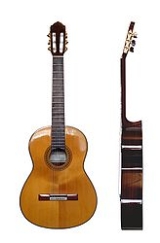
Classical guitar

Encyclopedia
The classical guitar is a 6-stringed plucked string instrument
from the family of instruments called chordophone
s. The classical guitar is well known for its comprehensive right hand technique, which allows the soloist to perform complex melodic and polyphonic material, in much the same manner as the piano
.
The phrase "classical guitar" is ambiguous in that it might refer at least three different concepts:
The name classical guitar does not mean that only classical repertoire
is performed on it, although classical music
is a part of the instrument's core repertoire (due to the guitar's long history); instead all kinds of music (folk
, jazz
, flamenco
, etc.) are performed on it.
The term modern classical guitar is sometimes used to distinguish the classical guitar from older forms of guitar, which are in their broadest sense also called classical, or more descriptively: early guitars. Examples of early guitars include the 6-string early romantic guitar (ca. 1790 - 1880), and the earlier baroque guitars with 5 courses
.
Today's modern classical guitar is regarded as having been established from the late designs of the 19th century Spanish luthier Antonio Torres Jurado
. Hence the modern classical guitar is sometimes called the "Spanish guitar".
Both instrument and repertoire can be viewed from a combination of various contexts:
Brief examples using the above classifications (historical, cultural/stylistic, social etc.), to show the colourful diversity of the classical guitar:
Interpreting works of a specific composer in a specific style requires an understanding of the historical cultural/stylistic and social aspects/influences, considering music an expressive art. This is often called the study of performance practice, with attempts at historically informed performance (sometimes abbreviated HIP).
Different types of guitars have different sound aesthetics, e.g. different colour-spectrum characteristics (the way the sound energy is spread in the fundamental frequency and the overtones), different response, etc. These differences are due to differences in construction, for example modern Spanish guitars usually use a different bracing (fan-bracing), than was used in earlier guitars (they had ladder-bracing); and a different voicing was used by the luthier. See Classical guitar making
for more information.
It is interesting to note the historical parallel between musical styles (baroque, classical, romantic, Spanish nationalist, flamenco, jazz) and the style of "sound aesthetic" of the musical instruments used, for example: Robert de Visée
played on a baroque guitar with a very different sound aesthetic than the guitars used by Mauro Giuliani
and Legnani
- they used 19th century guitars. These guitars in turn sound different from the Spanish models used by Segovia, that are suited for interpretations of romantic-modern works such as Moreno Torroba
.
When considering the guitar from a historical perspective, the musical instrument used is just as important as the musical language and style of the particular period. As an example: It is impossible to play a historically informed de Visee
or Corbetta (baroque guitarist-composers) on a modern classical guitar. The reason is that the baroque guitar used courses, which are two strings close together (in unision), that are plucked together. This gives baroque guitars an unmistakable sound characteristic and tonal texture that is an integral part of an interpretation. Additionally the sound aesthetic of the baroque guitar (with its strong overtone presence) is very different from modern Spanish-type guitars, as is shown below.
Today's overuse of Torres and post-Torres type Spanish guitars for repertoire of all periods is somewhat critically viewed: Torres and post-Torres style modern guitars (with their fan-bracing and design) have a thick and strong tone, very suitable for Spanish and modern-era repertoire. However they are considered too saturated in fundamental (opposed to overtone partials) for earlier repertoire (Classical/Romantic: Carulli, Sor, Giuliani, Mertz, ...; Baroque: de Visee, ...; etc.). "Andres Segovia presented the Spanish guitar as a versatile model for all playing styles", to the extent, that still today, "many guitarists have tunnel-vision of the world of the guitar, coming from the modern Segovia tradition".
Interestingly, while fan-braced Spanish (Torres, post-Torres style) instruments coexisted with traditional central European ladder-braced (19th century style) guitars at the beginning of the 20th century; the central European guitars eventually fell away. Some attribute this to the popularity of Segovia
, considering him "the catalyst for change toward the Spanish design and the so-called 'modern' school in the 1920's and beyond". The styles of music performed on ladder-braced guitars were becoming more and more unfashionable; and e.g. in Germany musicians were in part turning towards folkstyle music (Schrammel-music and the Contraguitar
), but this only remained localized in Germany and Austria and was quickly unfashionable again, etc. On the other hand, Segovia was concertizing around the world, popularizing his Spanish guitar, as well as a new style of music in the 1920s: Spanish romantic-modern style, with guitar works by Moreno Torroba
, de Falla, etc. Some people consider it to have been this influence of Segovia, which eventually led to the domination of the Spanish instrument - factories all over the world began producing them in large numbers.
and Alonso Mudarra
.
Instruments
Vihuela
, Four course guitar
and Francesco Corbetta
. In Spain Gaspar Sanz
was active.
Example Instruments
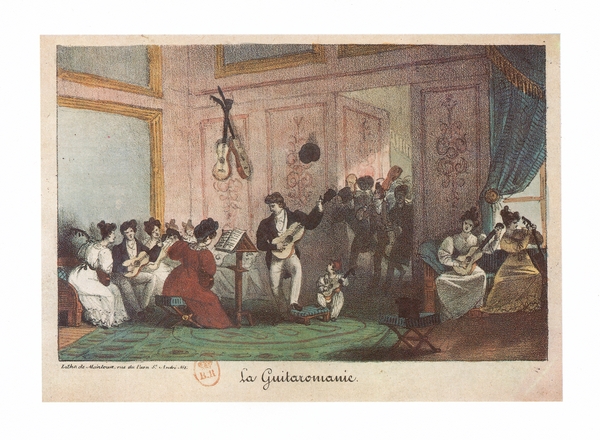 From approximately 1780 to 1850 the guitar was an extremely popular instrument with numerous composers and performers such as;
Hector Berlioz
studied the guitar as a teenager, Franz Schubert
owned at least two and wrote for the instrument with facility, Ludwig van Beethoven
, after hearing Giuliani play, commented the instrument was "a miniature orchestra in itself".
Francisco Tárrega
Born at Vilareal, Spain in November 29, 1852, Tarrega was one of the great guitar virtuosos and teachers. As professor of guitar at the conservatories of Madrid and Barcelona he defined many elements of modern classical technique, renewed the importance of the guitar in Spanish music and prepared the way for its renewed popularity in the 20th century, notably by contributing several classical guitar repertoire favourites. He died December 15, 1909.
At the beginning of the 20th century (especially in the 1920s), Andrés Segovia
popularized the modern Spanish classical guitar with a particular style of romantic-modern and neo-romantic music composed by Federico Moreno Torroba
, Manuel Ponce, Mario Castelnuovo-Tedesco
, and Alexandre Tansman
. These works were often dedicated to Segovia. This music can be called Segovia-repertoire, since it would not exist without Segovia. In the middle of the century, Luiz Bonfá
popularized Brazilian musical styles such as the newly created Bossa Nova, which was successfully received by audiences in the USA.
's Changes, Cristóbal Halffter
's Codex I, Luciano Berio
's Sequenza XI
, Maurizio Pisati
's Sette Studi, Maurice Ohana
's Si Le Jour Paraît, Sylvano Bussotti
's Rara (eco sierologico), Ernst Krenek
's Suite für Guitarre allein, Op. 164, Franco Donatoni
's Algo: Due pezzi per chitarra, etc.
Performers who are known for including modern repertoire are Jürgen Ruck, Elena Càsoli, Leo Brouwer
(when he was still performing), John Schneider
, Reinbert Evers
, Maria Kämmerling
, Siegfried Behrend
, David Starobin
, Mats Scheidegger
, Magnus Andersson, etc.
This genre of composition is controversial. Some audiences expect classical guitar to be devoted to beautiful melody.
Accordingly this repertoire does not feature as prominently in typical classical guitarist's repertoire – rather being performed by guitarists who have particularly chosen to focus on the avant-garde in their performances. There are however some works by Brouwer and Hans Werner Henze
that are performed quite often and hence are more widely known.
Within the contemporary music scene itself, there are also works which are generally regarded as extreme. These include works such as Brian Ferneyhough
's Kurze Schatten II, Sven-David Sandström
's away from and Rolf Riehm's Toccata Orpheus, etc. which are notorious for their extreme difficulty and accordingly are seldom performed even by contemporary performers/specialists on aesthetic grounds, or because of their difficulty, or due to question as to their value.
There are also a variety of databases documenting modern guitar works such as Sheer Pluck and others.
, and the baroque guitar
. The popularity of the classical guitar has been sustained over the years by many great players, arrangers, and composers. A very short list might include, Gaspar Sanz
(1640–1710), Fernando Sor
(1778–1839), Mauro Giuliani
(1781–1829), Francisco Tárrega
(1852–1909), Agustín Barrios Mangoré
(1888–1944), Andrés Segovia
(1893–1987), Alirio Díaz
(1923), Presti-Lagoya Duo (active from 1955-1967: Ida Presti
, Alexandre Lagoya
), Julian Bream
(1933), and John Williams
(1941).
, the vihuela
, and the Renaissance guitars.
ian capital of Susa
. This means that the contemporary Iranian instruments such as the tanbur
and setar
are distantly related to the European guitar, as they all derive ultimately from the same ancient origins, but by very different historical routes and influences.
, guitars with three, four, and five strings were already in use. The Guitarra Latina had curved sides and is thought to have come to Spain from elsewhere in Europe. The so-called Guitarra Morisca, brought to Spain by the Moors
, had an oval soundbox and many sound holes on its soundboard. By the 15th century, a four course double-string guitar called the vihuela de mano, half way between the lute and the guitar, appeared and became popular in Spain and spread to Italy; and by the 16th century, a fifth double-string had been added. During this time, composers wrote mostly in tablature notation. In the 17th century, influences from the vihuela and the renaissance five string guitar were combined in the baroque guitar
. The baroque guitar quickly superseded the vihuela in popularity and Italy became the center of the guitar world. Leadership in guitar developments switched to Spain from the late 18th century, when the six string guitar quickly became popular at the expense of the five string guitars. During the 19th century, improved communication and transportation enabled performers to travel widely and the guitar gained greater popularity outside its old strongholds in Iberia, Italy and Latin America. During the 19th century the Spaniard, Antonio de Torres, gave the modern classical guitar its definitive form, with a broadened body, increased waist curve, thinned belly, improved internal bracing, single string courses replacing double courses, and a machined head replacing wooden tuning pegs. The modern classical guitar replaced older form for the accompaniment of song and dance called flamenco
, and a modified version, known as the flamenco guitar
, was created.
, another medieval instrument. The gittern was carved from a single piece of wood with a curved ("sickle-shaped") pegbox. An example has survived from around 1450.
See also Renaissance music
.
in Spain. While the lute was then becoming popular in other parts of Europe, the Spaniards did not take to it well because of its association with the Moors. They turned instead to the four string guitarra, adding two more strings to give it more range and complexity. In its most developed form, the vihuela was a guitar-like instrument with six double strings made of gut, tuned like a modern classical guitar with the exception of the third string, which was tuned half a step lower. It has a high sound and is rather large to hold. There are few still.
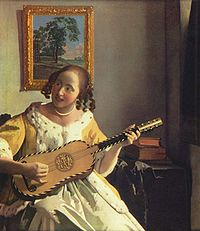
. The Vinaccia family of luthiers is known for developing the mandolin
. This guitar has been examined and does not show tell-tale signs of modifications from a double-course guitar.
The authenticity of guitars allegedly produced before the 1790s is often in question. This also corresponds to when Moretti's 6-string method appeared, in 1792.
See also Classical music era.
design, which replaces fan braces with a much lighter balsa brace attached to the back of the sound board with carbon fiber. The balsa brace has a honeycomb pattern and allows the (now much thinner) sound board to support more vibrational modes. This leads to greater volume and longer sustain but compromises the subtle tonalities of the Spanish sound.
s). (There are of course exceptions, with some performers choosing to hold the instrument another way.)
Fretting hand fingers are given as numbers in circles, plucking hand fingers are given as letters
When a fretting hand string is held over more than one string, that is called a barre chord
. The notation for a barre is the Latin
numeral for the fret in question.
, use the little finger independently, compensating for the little finger's shortness by maintaining an extremely long fingernail. In contrast, Flamenco
technique, and classical compositions evoking Flamenco, employ the little finger semi-independently in the Flamenco four-finger rasgueado
, that rapid strumming of the string by the fingers in reverse order employing the back of the fingernail—a familiar characteristic of Flamenco.
(of a single note) can be produced by plucking the string in different manners and in different positions.
Using p to indicate the thumb, i the index finger, m the middle finger and a the ring finger, common alternation patterns include:
- factors include:
Right Hand:
Left Hand:
Both Hands/Other:
Since it is the hands and fingers that pluck the string and every person has different fingers, there are great differences in playing between guitarists; who often spend a lot of time finding their own way of playing that suits them best in terms of specific objectives: tone-production ("beauty"/quality of tone), minimum noise (e.g. clicking), large dynamic range (from soft to controlled loud), minimum (muscle) effort, fast "motion-recovery" (fast plucking when desired), healthy movement in fingers, wrist, hand and arm.
John Williams
has remarked that since guitarists find it superficially very easy to play even things such as melody with accompaniment (e.g. Giuliani), [some guitarists'] "approach to tone production is also superficial, with little or no consideration given to voice matching and tonal contrasts".
, popular in 16th-century Spain, and the lute
used everywhere else in Europe in the Renaissance
and Baroque
eras. Music written specifically for the classical guitar dates from the addition of the sixth string (the baroque guitar
normally had five pairs of strings) in the late 18th century.
A guitar recital may include a variety of works, e.g. works written originally for the lute or vihuela by composers such as John Dowland
(b. England 1563) and Luis de Narváez
(b. Spain c. 1500), and also music written for the harpsichord by Domenico Scarlatti
(b. Italy 1685), for the baroque lute by Sylvius Leopold Weiss
(b. Germany 1687), for the baroque guitar by Robert de Visée
(b. France c. 1650) or even Spanish-flavored music written for the piano by Isaac Albéniz
(b. Spain 1860) and Enrique Granados
(b. Spain 1867). The most important composer who did not write for the guitar but whose music is often played on guitar is Johann Sebastian Bach
(b. Germany 1685), whose works baroque lute have proved highly adaptable for the guitar.
Of music written originally for guitar, the earliest important composers are from the classical period and include Fernando Sor
(b. Spain 1778) and Mauro Giuliani
(b. Italy 1781), both of whom wrote in a style strongly influenced by Viennese classicism. In the 19th century guitar composers such as Johann Kaspar Mertz
(b. Slovakia, Austria 1806) were strongly influenced by the dominance of the piano. Not until the end of the nineteenth century did the guitar begin to establish its own unique atmosphere. Francisco Tárrega
(b. Spain 1852) was central to this, sometimes incorporating some stylized aspects of flamenco, with its Moorish influences, into his romantic miniatures. This was part of the phenomenon of musical nationalism that was part of the wider European mainstream in the late 19th century. The aforementioned piano composers Albéniz and Granados were central to this movement and their evocation of the guitar was so successful that guitarists have largely appropriated their music for piano to the guitar. Guitarists who were active at that time, such as Angel Barrios (Spain, 1882–1964) contributed to the incorporation of flamenco style (e.g. the Phrygian mode
) and flamenco guitar techniques such as rasgueado
.
With the 20th century and the wide-ranging performances of artists such as Andrés Segovia
and Agustín Barrios Mangoré
the guitar began to regain some of the popularity it had lost to the harpsichord and piano in the 18th century. It again became a popular instrument, but not always in its classical version. The steel-string and electric guitars, integral to the rise of rock and roll in the post-WWII era, became more widely played in North America and the English speaking world. The classical guitar also became widely popular again. Barrios composed many excellent works and brought into the mainstream the characteristics of Latin American music, as did the Brazilian composer Heitor Villa-Lobos
. Andrés Segovia commissioned many works from Spanish composers such as Federico Moreno Torroba
and Joaquín Rodrigo
, Italians such as Mario Castelnuovo-Tedesco
and Latin American composers such as Manuel Ponce of Mexico, Agustín Barrios Mangoré of Paraguay, Leo Brouwer
of Cuba, Antonio Lauro
of Venezuela, Enrique Solares of Guatemala. Julian Bream
of Britain managed to get nearly every British composer from William Walton
to Benjamin Britten
to Peter Maxwell Davies
to write significant works for guitar. Bream's collaborations with tenor Peter Pears
also resulted in song-cycles
by Britten, Lennox
Berkeley and others. There are also significant works by composers such as Hans Werner Henze
of Germany. The classical guitar also became widely used in popular music and rock & roll in the 1960s after guitarist Mason Williams
popularized the instrument in his instrumental hit Classical Gas
. Guitarist Christopher Parkening
is quoted in the book Classical Gas: The Music of Mason Williams as saying that it is the most requested guitar piece besides Malagueña and perhaps the best known instrumental guitar piece today.
In the field of New Flamenco
, the works and performances of Spanish composer and player Paco de Lucía
are known worldwide.
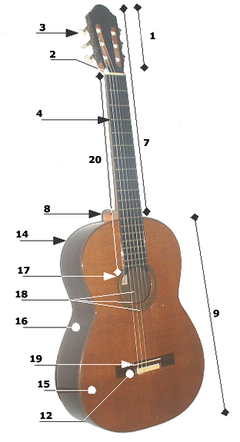
, but may also be made of rosewood or of phenolic composite ("micarta").
and placed at points that divide the length of string mathematically. The strings' vibrating length is determined when the strings are pressed down behind the frets. Each fret produces a different pitch and each pitch spaced a half-step apart on the 12 tone scale. The ratio
of the widths of two consecutive frets is the twelfth root of two ( ), whose numeric value is about 1.059463. The twelfth fret divides the string in two exact halves and the 24th fret (if present) divides the string in half yet again. Every twelve frets represents one octave. This arrangement of frets results in equal tempered
tuning.
. The wood used to make the fretboard will usually differ from the wood in the rest of the neck. The bending stress on the neck is considerable, particularly when heavier gauge strings are used (see Strings).
While most traditional Spanish style builders use the one piece neck/heel block, Fleta a prominent Spanish builder used a dovetail joint due to the influence of his early training in violin making.
One reason for the introduction of the mechanical joints was to make it easier to repair necks. This is more of a problem with steel string guitars than with nylon strings, which have about half the string tension. This is why nylon string guitars often don't include a truss rod either.
, red cedar
or mahogany
. This thin (often 2 or 3 mm thick) piece of wood, strengthened by different types of internal bracing, is considered the most prominent factor in determining the sound quality of a guitar. The majority of the sound is caused by vibration of the guitar top as the energy of the vibrating strings is transferred to it. Different patterns of wood bracing have been used through the years by luthiers (Torres
, Hauser, Ramírez
, Fleta, and C.F. Martin being among the most influential designers of their times); to not only strengthen the top against collapsing under the tremendous stress exerted by the tensioned strings, but also to affect the resonation of the top. The back and sides are made out of a variety of woods such as mahogany, Indian rosewood
and highly regarded Brazilian rosewood (Dalbergia nigra). Each one is chosen for its aesthetic effect and structural strength, and such choice can also play a significant role in determining the instrument's timbre
. These are also strengthened with internal bracing, and decorated with inlays and purfling.
The body of a classical guitar is a resonating chamber that projects the vibrations of the body through a sound hole, allowing the acoustic guitar to be heard without amplification. The sound hole is normally a round hole in the top of the guitar (under the strings), though some have different placement, shapes, or multiple holes.
An instrument's maximum volume is determined by how much air it can move.
During final construction, a small section of the outside corners is carved or routed out and filled with binding material on the outside corners and decorative strips of material next to the binding, which are called purfling
. This binding serves to seal off the endgrain of the top and back. Binding and purfling materials are generally made of either wood or high quality plastic materials.
of around 650 mm (25.6 inches), with an overall instrument length of 965–1016 mm (38-40 inches). The scale length has remained quite consistent since it was chosen by the originator of the instrument, Antonio de Torres
. This length may have been chosen because it's twice the length of a violin string. As the guitar is tuned to one octave below that of the violin, the same size gut could be used for the 1st strings of both instruments.
Smaller scale instruments are produced to assist children in learning the instrument as the smaller scale leads to the frets being closer together making it easier for smaller hands. The scale size for the smaller guitars is usually in the range 484–578 mm (19-22.5 inches) with an instrument length of 785–915 mm (31-36 inches). Full size instruments are sometimes referred to as 4/4, while the smaller sizes are 3/4, 1/2 or 1/4.
These sizes are not absolute, as luthier
s may choose variations around these nominal scale lengths;
The above order, is the tuning from the 1st string (highest-pitched string e'—spatially the bottom string in playing position) to the 6th string (lowest-pitched string E—spatially the upper string in playing position, and hence comfortable to pluck with the thumb.
This tuning is such that neighboring strings are at most 5 semitones apart.
There are also a variety of commonly used alternate tunings
.
Related instruments
Early guitars
Classical guitar lists
Section of external links to free scores has been moved to article classical guitar repertoire
Plucked string instrument
Plucked string instruments are a subcategory of string instruments that are played by plucking the strings. Plucking is a way of pulling and releasing the string in such as way as to give it an impulse that causes the string to vibrate...
from the family of instruments called chordophone
Chordophone
A chordophone is any musical instrument that makes sound by way of a vibrating string or strings stretched between two points. It is one of the four main divisions of instruments in the original Hornbostel-Sachs scheme of musical instrument classification....
s. The classical guitar is well known for its comprehensive right hand technique, which allows the soloist to perform complex melodic and polyphonic material, in much the same manner as the piano
Piano
The piano is a musical instrument played by means of a keyboard. It is one of the most popular instruments in the world. Widely used in classical and jazz music for solo performances, ensemble use, chamber music and accompaniment, the piano is also very popular as an aid to composing and rehearsal...
.
The phrase "classical guitar" is ambiguous in that it might refer at least three different concepts:
- the instrumental technique — the individual strings are usually plucked with the fingernails or rarely without nails.
- its historic repertoire — though this is of lesser importance, since any repertoire can be (and is) played on the classical guitar (additionally: classical guitarists are known to borrow from the repertoires of a wide variety of instruments)
- its shape, construction and material — modern classical guitar shape, or historic classical guitar shapes (e.g. early romantic guitars from France and Italy). A guitar family tree can be identified. (The flamenco guitarFlamenco guitarA flamenco guitar is a guitar similar to a classical guitar. Flamenco guitar also refers to toque, the guitar-playing part of the art of Flamenco.-Brief history:...
is derived from the modern classical, but has differences in material, construction and sound)
The name classical guitar does not mean that only classical repertoire
Classical music
Classical music is the art music produced in, or rooted in, the traditions of Western liturgical and secular music, encompassing a broad period from roughly the 11th century to present times...
is performed on it, although classical music
Classical music
Classical music is the art music produced in, or rooted in, the traditions of Western liturgical and secular music, encompassing a broad period from roughly the 11th century to present times...
is a part of the instrument's core repertoire (due to the guitar's long history); instead all kinds of music (folk
Folk music
Folk music is an English term encompassing both traditional folk music and contemporary folk music. The term originated in the 19th century. Traditional folk music has been defined in several ways: as music transmitted by mouth, as music of the lower classes, and as music with unknown composers....
, jazz
Jazz
Jazz is a musical style that originated at the beginning of the 20th century in African American communities in the Southern United States. It was born out of a mix of African and European music traditions. From its early development until the present, jazz has incorporated music from 19th and 20th...
, flamenco
Flamenco
Flamenco is a genre of music and dance which has its foundation in Andalusian music and dance and in whose evolution Andalusian Gypsies played an important part....
, etc.) are performed on it.
The term modern classical guitar is sometimes used to distinguish the classical guitar from older forms of guitar, which are in their broadest sense also called classical, or more descriptively: early guitars. Examples of early guitars include the 6-string early romantic guitar (ca. 1790 - 1880), and the earlier baroque guitars with 5 courses
Course (music)
A course is a pair or more of adjacent strings tuned to unison or an octave and usually played together as if a single string. It may also refer to a single string normally played on its own on an instrument with other multi-string courses, for example the bass string on a nine string baroque...
.
Today's modern classical guitar is regarded as having been established from the late designs of the 19th century Spanish luthier Antonio Torres Jurado
Antonio Torres Jurado
Antonio de Torres Jurado was a Spanish guitarist and luthier, and "the most important Spanish guitar maker of the 19th century."...
. Hence the modern classical guitar is sometimes called the "Spanish guitar".
Classical Guitar viewed from various contexts
The classical guitar has a long history and one is able to distinguish various:- instruments
- repertoireMusical repertoireMusical repertoire is a collection of music pieces played by an individual musician or ensemble, or composed for a particular instrument or group of instruments, voice or choir.-See also:*Brass Quintet Repertoire*Classical guitar repertoire...
(composers and their compositions, arrangementArrangementThe American Federation of Musicians defines arranging as "the art of preparing and adapting an already written composition for presentation in other than its original form. An arrangement may include reharmonization, paraphrasing, and/or development of a composition, so that it fully represents...
s, improvisations)
Both instrument and repertoire can be viewed from a combination of various contexts:
- historical (chronological period of time)
- baroque guitarBaroque guitarThe Baroque guitar is a guitar from the baroque era , an ancestor of the modern classical guitar. The term is also used for modern instruments made in the same style....
— 17th to mid 18th century - early romantic guitarsRomantic guitarThe early romantic guitar is the guitar of the Classical and Romantic period of music, showing remarkable consistency in the instrument from 1790 to 1830. By this time guitars used single strings of six or more...
— 19th century (for music from the ClassicalClassical period (music)The dates of the Classical Period in Western music are generally accepted as being between about 1750 and 1830. However, the term classical music is used colloquially to describe a variety of Western musical styles from the ninth century to the present, and especially from the sixteenth or...
and RomanticRomantic musicRomantic music or music in the Romantic Period is a musicological and artistic term referring to a particular period, theory, compositional practice, and canon in Western music history, from 1810 to 1900....
periods) - modern classical guitars
- baroque guitar
- geographical
- e.g. in the 19th century: Spanish guitars (TorresAntonio Torres JuradoAntonio de Torres Jurado was a Spanish guitarist and luthier, and "the most important Spanish guitar maker of the 19th century."...
), and French guitars (René Lacôte, ...), etc.
- e.g. in the 19th century: Spanish guitars (Torres
- cultural/stylistic and social aspects
- e.g. baroque court music, 19th century opera and its influences, 19th century folk songs, Latin American music, etc.
Brief examples using the above classifications (historical, cultural/stylistic, social etc.), to show the colourful diversity of the classical guitar:
- Robert de ViséeRobert de ViséeRobert de Visée was a lutenist, guitarist, theorbist and viol player at the court of Louis XIV, as well as a singer, and composer for lute, theorbo and guitar.-Biography:...
(ca. 1650–1725) with French Court music for baroque guitar and lute. He was the guitar player (maître de guitare du Roy) of Louis XIV of FranceLouis XIV of FranceLouis XIV , known as Louis the Great or the Sun King , was a Bourbon monarch who ruled as King of France and Navarre. His reign, from 1643 to his death in 1715, began at the age of four and lasted seventy-two years, three months, and eighteen days...
at the court of VersaillesVersaillesVersailles , a city renowned for its château, the Palace of Versailles, was the de facto capital of the kingdom of France for over a century, from 1682 to 1789. It is now a wealthy suburb of Paris and remains an important administrative and judicial centre...
. His works are influenced by hearing Jean-Baptiste de Lully (1632–1687) who was also engaged at the court of Louis XIV. - Mauro GiulianiMauro GiulianiMauro Giuseppe Sergio Pantaleo Giuliani was an Italian guitarist, cellist and composer, and is considered by many to be one of the leading guitar virtuosi of the early 19th century.- Biography :...
(1781–1829) with Italian/Viennese classical music for the 19th century so-called early romantic guitar. He was chamber-virtuoso of Archduchess Marie Louise of AustriaMarie Louise, Duchess of ParmaMarie Louise of Austria was the second wife of Napoleon I, Emperor of the French and later Duchess of Parma...
. Some of his works include strong influences from his visits to 19th century opera performances. - Francisco TárregaFrancisco TárregaFrancisco de Asís Tárrega y Eixea was an influential Spanish composer and guitarist of the Romantic period.-Biography:Tárrega was born on 21 November 1852, in Vila-real, Castelló, Spain...
(1852–1909) of Spain. His intimate salon-style music is both romantic in character and includes charming character pieces such as polkas and waltzes. He even played for the Queen of Spain, Isabel IIIsabella II of SpainIsabella II was the only female monarch of Spain in modern times. She came to the throne as an infant, but her succession was disputed by the Carlists, who refused to recognise a female sovereign, leading to the Carlist Wars. After a troubled reign, she was deposed in the Glorious Revolution of...
. From 1869, Tárrega used a guitar by Antonio de Torres (1817–1892). - Agustín BarriosAgustín BarriosAgustín Pío Barrios , an eminent Paraguayan guitarist and composer, was born in the department of Misiones, Paraguay and died in San Salvador, El Salvador...
(1885–1944) from Paraguay, towards the end of his life using a modern classical guitar (his last instrument was a gift from Queen Eugenia of Spain in 1935). His music is romantic in style, with some works showing strong folkloric Paraguayan influences, shaped from his cultural background. - Sergei OrekhovSergei OrekhovSergei Dmitrievich Orekhov was a Russian classical guitarist...
(Сергей Орехов) (1935–1998) with music for the Russian 7-string guitar. In his compositions and arrangements, he draws inspiration from his intimate knowledge of traditional Russian folk music and folk songs.
Interpreting works of a specific composer in a specific style requires an understanding of the historical cultural/stylistic and social aspects/influences, considering music an expressive art. This is often called the study of performance practice, with attempts at historically informed performance (sometimes abbreviated HIP).
Classical guitar from a historical perspective
The classical guitar as an instrument today has access to repertoire that spans numerous chronological periods:- renaissance
- baroque
- classical
- romantic
- modern (neo-classical, avant garde...)
Instrument Aesthetics (Early guitars)
While "classical guitar" is today mainly associated with the modern classical guitar design, there is an increasing interest in early guitars; and understanding the link between historical repertoire and the particular period guitar that was originally used to perform this repertoire.- Nowadays it is customary to play this repertoire on reproductions of instruments authentically modelled on concepts of musicological research with appropriate adjustments to techniques and overall interpretation. Thus over recent decades we have become accustomed to specialist artists with expertise in the art of vihuela (a 16th-century type of guitar popular in Spain), lute, Baroque guitar, 19th-century guitar, etc.
Different types of guitars have different sound aesthetics, e.g. different colour-spectrum characteristics (the way the sound energy is spread in the fundamental frequency and the overtones), different response, etc. These differences are due to differences in construction, for example modern Spanish guitars usually use a different bracing (fan-bracing), than was used in earlier guitars (they had ladder-bracing); and a different voicing was used by the luthier. See Classical guitar making
Classical guitar making
A person who is specialized in the making of stringed instruments such as guitars, lutes and violins is called a luthier.-Skills:In general one can distinguish three main aspects of guitar making:...
for more information.
It is interesting to note the historical parallel between musical styles (baroque, classical, romantic, Spanish nationalist, flamenco, jazz) and the style of "sound aesthetic" of the musical instruments used, for example: Robert de Visée
Robert de Visée
Robert de Visée was a lutenist, guitarist, theorbist and viol player at the court of Louis XIV, as well as a singer, and composer for lute, theorbo and guitar.-Biography:...
played on a baroque guitar with a very different sound aesthetic than the guitars used by Mauro Giuliani
Mauro Giuliani
Mauro Giuseppe Sergio Pantaleo Giuliani was an Italian guitarist, cellist and composer, and is considered by many to be one of the leading guitar virtuosi of the early 19th century.- Biography :...
and Legnani
Luigi Legnani
Luigi Rinaldo Legnani was an Italian guitarist, singer, composer and luthier.He is not to be confused with the sculptor Luigi Legnani .....
- they used 19th century guitars. These guitars in turn sound different from the Spanish models used by Segovia, that are suited for interpretations of romantic-modern works such as Moreno Torroba
Federico Moreno Torroba
Federico Moreno Torroba was a Spanish composer, born in Madrid.-Biography:Moreno Torroba is often associated with the zarzuela, a traditional Spanish musical form. Directing several opera companies, Moreno Torroba helped introduce the zarzuela to international audiences...
.
When considering the guitar from a historical perspective, the musical instrument used is just as important as the musical language and style of the particular period. As an example: It is impossible to play a historically informed de Visee
Robert de Visée
Robert de Visée was a lutenist, guitarist, theorbist and viol player at the court of Louis XIV, as well as a singer, and composer for lute, theorbo and guitar.-Biography:...
or Corbetta (baroque guitarist-composers) on a modern classical guitar. The reason is that the baroque guitar used courses, which are two strings close together (in unision), that are plucked together. This gives baroque guitars an unmistakable sound characteristic and tonal texture that is an integral part of an interpretation. Additionally the sound aesthetic of the baroque guitar (with its strong overtone presence) is very different from modern Spanish-type guitars, as is shown below.
Today's overuse of Torres and post-Torres type Spanish guitars for repertoire of all periods is somewhat critically viewed: Torres and post-Torres style modern guitars (with their fan-bracing and design) have a thick and strong tone, very suitable for Spanish and modern-era repertoire. However they are considered too saturated in fundamental (opposed to overtone partials) for earlier repertoire (Classical/Romantic: Carulli, Sor, Giuliani, Mertz, ...; Baroque: de Visee, ...; etc.). "Andres Segovia presented the Spanish guitar as a versatile model for all playing styles", to the extent, that still today, "many guitarists have tunnel-vision of the world of the guitar, coming from the modern Segovia tradition".
Interestingly, while fan-braced Spanish (Torres, post-Torres style) instruments coexisted with traditional central European ladder-braced (19th century style) guitars at the beginning of the 20th century; the central European guitars eventually fell away. Some attribute this to the popularity of Segovia
Andrés Segovia
Andrés Torres Segovia, 1st Marquis of Salobreña , known as Andrés Segovia, was a virtuoso Spanish classical guitarist from Linares, Jaén, Andalucia, Spain...
, considering him "the catalyst for change toward the Spanish design and the so-called 'modern' school in the 1920's and beyond". The styles of music performed on ladder-braced guitars were becoming more and more unfashionable; and e.g. in Germany musicians were in part turning towards folkstyle music (Schrammel-music and the Contraguitar
Contraguitar
The contraguitar or Schrammel guitar is a type of guitar developed in Vienna in the mid-nineteenth century. In addition to the usual guitar neck with six strings and a fretboard, it has a second, fretless neck with up to nine bass strings. Customarily these additional strings are tuned from E-flat...
), but this only remained localized in Germany and Austria and was quickly unfashionable again, etc. On the other hand, Segovia was concertizing around the world, popularizing his Spanish guitar, as well as a new style of music in the 1920s: Spanish romantic-modern style, with guitar works by Moreno Torroba
Federico Moreno Torroba
Federico Moreno Torroba was a Spanish composer, born in Madrid.-Biography:Moreno Torroba is often associated with the zarzuela, a traditional Spanish musical form. Directing several opera companies, Moreno Torroba helped introduce the zarzuela to international audiences...
, de Falla, etc. Some people consider it to have been this influence of Segovia, which eventually led to the domination of the Spanish instrument - factories all over the world began producing them in large numbers.
Short overview of instrument characteristics
- Vihuela, renaissance guitars and baroque guitars have a bright sound - rich in overtones - and their chords (double strings) give the sound a very particular texture.
- Early guitars of the classical and romantic period (early romantic guitars) have single strings but their design and voicing are still such that they have their tonal energy more in the overtones (but without starved fundamental), giving a bright intimate tone.
- Later in Spain a style of music emerged (Spanish) that favored a stronger fundamental:
With the change of music a stronger fundamental was demanded and the fan bracing system was approached. [...] the guitar tone has been changed from a transparent tone, rich in higher partials to a more "broad" tone with a strong fundamental. - Thus modern guitars with fan bracing (fan strutting) have a design and voicing that gives them a much more thick heavy sound, with far more tonal energy found in the fundamental.
Classical Guitar history along style periods
As was explained above, the classical guitar as an instrument today has access to repertoire that spans numerous style periods. This section attempts to provide an overview of some of these periods, their composers; and the guitars that were used in the particular period.Renaissance (Vihuela, Renaissance guitar)
Composers of the Renaissance period include Luis de MilánLuis de Milán
Luis de Milán was a Spanish Renaissance composer, vihuelist , and writer on music...
and Alonso Mudarra
Alonso Mudarra
Alonso Mudarra was a Spanish composer and vihuelist of the Renaissance. He was an innovative composer of instrumental music as well as songs, and was the composer of the earliest surviving music for the guitar....
.
Instruments
Vihuela
Vihuela
Vihuela is a name given to two different guitar-like string instruments: one from 15th and 16th century Spain, usually with 12 paired strings, and the other, the Mexican vihuela, from 19th century Mexico with five strings and typically played in Mariachi bands.-History:The vihuela, as it was known...
, Four course guitar
Baroque
Composers of French baroque include Robert de ViséeRobert de Visée
Robert de Visée was a lutenist, guitarist, theorbist and viol player at the court of Louis XIV, as well as a singer, and composer for lute, theorbo and guitar.-Biography:...
and Francesco Corbetta
Francesco Corbetta
Francesco Corbetta was an Italian guitar virtuoso, teacher and composer. He spent his early career in Italy. He seems to have worked as a teacher in Bologna where the guitarist and composer Giovanni Battista Granata may have been one of his pupils...
. In Spain Gaspar Sanz
Gaspar Sanz
Gaspar Sanz was an Aragonese composer, guitarist, organist and priest born to a wealthy family in Calanda in the Spanish comarca of Bajo Aragón. He studied music, theology and philosophy at the University of Salamanca, where he was later appointed Professor of Music...
was active.
Example Instruments
- Baroque guitar by Nicolas Alexandre Voboam II : This French instrument has five courses (double-strings) and a flat back.
- Baroque guitar attributed to Matteo Sellas : This Italian instrument has five courses and a rounded back.
Classical and early romantic period
- Filippo GragnaniFilippo GragnaniFilippo Gragnani was an Italian guitarist and composer.Gragnani was born in Livorno, the son of Antonio Gragnani...
(1767–1820) - Antoine de LhoyerAntoine de LhoyerAntoine de Lhoyer was a French virtuoso guitarist and an eminent early romantic composer of mainly chamber music featuring the classical guitar. He was an approximate musical contemporary of Beethoven...
(1768–1852) - Ferdinando CarulliFerdinando CarulliFerdinando Maria Meinrado Francesco Pascale Rosario Carulli was an Italian composer for classical guitar and the author of the first complete classical guitar method, which continues to be used today. He wrote a variety of works for classical guitar, including concertos and chamber works...
(1770–1841) - Francesco MolinoFrancesco MolinoFrancesco Molino was an Italian guitarist and composer.-Biography:Molino was born in Ivrea near Turin. He often travelled to Spain to give concerts...
(1774–1847) - Fernando SorFernando SorJosep Ferran Sorts i Muntades was a Spanish classical guitarist and composer. While he is best known for his guitar compositions, he also composed music for a wide range of genres, including opera, orchestra, string quartet, piano, voice and ballet...
(1778–1839) - Luigi Moretti (c. 1780-1850)
- Mauro GiulianiMauro GiulianiMauro Giuseppe Sergio Pantaleo Giuliani was an Italian guitarist, cellist and composer, and is considered by many to be one of the leading guitar virtuosi of the early 19th century.- Biography :...
(1781–1829) - Matteo CarcassiMatteo CarcassiMatteo Carcassi was a famous Italian guitarist and composer.Carcassi began with the piano, but learned guitar when still a child. He quickly gained a reputation as a virtuoso concert guitarist....
(1792–1853) - Napoléon CosteNapoléon CosteClaude Antoine Jean Georges Napoléon Coste was a French guitarist and composer.-Biography:Napoléon Coste was born in Amondans , France, near Besançon. He was first taught the guitar by his mother, an accomplished player. As a teenager he became a teacher of the instrument and appeared in many...
(1805–1883) - Johann Kaspar MertzJohann Kaspar MertzJohann Kaspar Mertz was a Hungarian guitarist and composer.NOTE: THE ORIGINAL CREATOR OF THIS PAGE PLAGIARIZED THEIR MATERIAL. It has been copied and pasted from the Mel Bay website: http://www.melbay.com/authors.asp?author=749 I tried to report this problem to wikipedia, but they do not make it...
(1806–1856)
Hector Berlioz
Hector Berlioz
Hector Berlioz was a French Romantic composer, best known for his compositions Symphonie fantastique and Grande messe des morts . Berlioz made significant contributions to the modern orchestra with his Treatise on Instrumentation. He specified huge orchestral forces for some of his works; as a...
studied the guitar as a teenager, Franz Schubert
Franz Schubert
Franz Peter Schubert was an Austrian composer.Although he died at an early age, Schubert was tremendously prolific. He wrote some 600 Lieder, nine symphonies , liturgical music, operas, some incidental music, and a large body of chamber and solo piano music...
owned at least two and wrote for the instrument with facility, Ludwig van Beethoven
Ludwig van Beethoven
Ludwig van Beethoven was a German composer and pianist. A crucial figure in the transition between the Classical and Romantic eras in Western art music, he remains one of the most famous and influential composers of all time.Born in Bonn, then the capital of the Electorate of Cologne and part of...
, after hearing Giuliani play, commented the instrument was "a miniature orchestra in itself".
Francisco TárregaFrancisco TárregaFrancisco de Asís Tárrega y Eixea was an influential Spanish composer and guitarist of the Romantic period.-Biography:Tárrega was born on 21 November 1852, in Vila-real, Castelló, Spain...
Born at Vilareal, Spain in November 29, 1852, Tarrega was one of the great guitar virtuosos and teachers. As professor of guitar at the conservatories of Madrid and Barcelona he defined many elements of modern classical technique, renewed the importance of the guitar in Spanish music and prepared the way for its renewed popularity in the 20th century, notably by contributing several classical guitar repertoire favourites. He died December 15, 1909.Modern Period
In the 20th century numerous different styles of music (using a classical guitar) emerged:At the beginning of the 20th century (especially in the 1920s), Andrés Segovia
Andrés Segovia
Andrés Torres Segovia, 1st Marquis of Salobreña , known as Andrés Segovia, was a virtuoso Spanish classical guitarist from Linares, Jaén, Andalucia, Spain...
popularized the modern Spanish classical guitar with a particular style of romantic-modern and neo-romantic music composed by Federico Moreno Torroba
Federico Moreno Torroba
Federico Moreno Torroba was a Spanish composer, born in Madrid.-Biography:Moreno Torroba is often associated with the zarzuela, a traditional Spanish musical form. Directing several opera companies, Moreno Torroba helped introduce the zarzuela to international audiences...
, Manuel Ponce, Mario Castelnuovo-Tedesco
Mario Castelnuovo-Tedesco
Mario Castelnuovo-Tedesco was an Italian composer. He was known as one of the foremost guitar composers in the twentieth century with almost one hundred compositions for that instrument. In 1939 he migrated to the United States and became a film composer for some 200 Hollywood movies for the next...
, and Alexandre Tansman
Alexandre Tansman
Alexandre Tansman was a Polish-born composer and virtuoso pianist. He spent his early years in his native Poland, but lived in France for most of his life...
. These works were often dedicated to Segovia. This music can be called Segovia-repertoire, since it would not exist without Segovia. In the middle of the century, Luiz Bonfá
Luiz Bonfá
Luiz Floriano Bonfá was a Brazilian guitarist and composer best known for the compositions he penned for the film Black Orpheus.-Biography:...
popularized Brazilian musical styles such as the newly created Bossa Nova, which was successfully received by audiences in the USA.
"New Music" - Avant-garde
The classical guitar repertoire also includes modern contemporary works – sometimes termed "New Music" – such as Elliott CarterElliott Carter
Elliott Cook Carter, Jr. is a two-time Pulitzer Prize-winning American composer born and living in New York City. He studied with Nadia Boulanger in Paris in the 1930s, and then returned to the United States. After a neoclassical phase, he went on to write atonal, rhythmically complex music...
's Changes, Cristóbal Halffter
Cristóbal Halffter
Cristóbal Halffter Jiménez-Encina is a Spanish composer. He is the nephew of two other composers, Rodolfo and Ernesto Halffter.-Life:...
's Codex I, Luciano Berio
Luciano Berio
Luciano Berio, Cavaliere di Gran Croce OMRI was an Italian composer. He is noted for his experimental work and also for his pioneering work in electronic music.-Biography:Berio was born at Oneglia Luciano Berio, Cavaliere di Gran Croce OMRI (October 24, 1925 – May 27, 2003) was an Italian...
's Sequenza XI
Sequenza XI
Sequenza XI for solo guitar is one of a series of Sequenzas by Luciano Berio. Written for the American guitarist Eliot Fisk, it is an innovative investigation into the dramatic and virtuosic possibilities of musical performance.-Form:...
, Maurizio Pisati
Maurizio Pisati
Maurizio Pisati - is an Italian composer.Born 1959 in Milan, he composes and performs his own works with his ZONE group [ZONE]. [His music] has been performed throughout both western and eastern Europe, the USA, Australia and Japan, is published by Casa-Ricordi, has been awarded prizes and selected...
's Sette Studi, Maurice Ohana
Maurice Ohana
Maurice Ohana was an Anglo-French composer of Sephardic Jewish origin.Ohana was born in Casablanca, Morocco. He was a British citizen until 1976, as his father had been born in the British overseas territory of Gibraltar. He originally studied architecture, but abandoned this in favour of a...
's Si Le Jour Paraît, Sylvano Bussotti
Sylvano Bussotti
Sylvano Bussotti is an Italian composer of contemporary music whose work is unusually notated and often creates special problems of interpretation.Born in Florence, Bussotti learned to play the violin as a child, becoming a prodigy...
's Rara (eco sierologico), Ernst Krenek
Ernst Krenek
Ernst Krenek was an Austrian of Czech origin and, from 1945, American composer. He explored atonality and other modern styles and wrote a number of books, including Music Here and Now , a study of Johannes Ockeghem , and Horizons Circled: Reflections on my Music...
's Suite für Guitarre allein, Op. 164, Franco Donatoni
Franco Donatoni
Franco Donatoni was an Italian composer.Born in Verona, he started studying violin at the age of seven, and frequented the local Music Academy...
's Algo: Due pezzi per chitarra, etc.
Performers who are known for including modern repertoire are Jürgen Ruck, Elena Càsoli, Leo Brouwer
Leo Brouwer
Juan Leovigildo Brouwer Mezquida is a Cuban composer, conductor and guitarist. He is the grandson of Cuban composer Ernestina Lecuona Casado.-Biography:...
(when he was still performing), John Schneider
John Schneider (guitarist)
John Schneider is a classical guitarist. He performs in just intonation and well-temperament, including pythagorean tuning, including works by Lou Harrison, LaMonte Young, John Cage, and Harry Partch...
, Reinbert Evers
Reinbert Evers
-Career:Evers was born in Dortmund. He first studied in Düsseldorf, then in Vienna. He was appointed Professor of Guitar at the Hochschule für Musik Detmold, Dep. Münster in 1976, and in 1980 he received the Young Artists Award from the City of Dortmund. In 1998 and again in 2000 he was docent...
, Maria Kämmerling
Maria Kämmerling
Maria Kämmerling is a German classical guitarist.She is best known for her interpretations of contemporary guitar music, including pieces by Gunnar Berg, Axel Borup-Jørgensen, Cristóbal Halffter, Vagn Holmboe and Bruno Maderna...
, Siegfried Behrend
Siegfried Behrend
Siegfried Behrend was a German classical guitarist and composer.-Biography:...
, David Starobin
David Starobin
David Starobin is an American classical guitarist, record producer, and film director. He is married to Rebecca Askew Starobin , and is the father of Robert Joseph Starobin III , and Allegra Rose Starobin David Starobin (born September 27, 1951 in New York City) is an American classical...
, Mats Scheidegger
Mats Scheidegger
Mats Scheidegger is a classical guitarist. He specializes in contemporary music, e.g. he is the dedicatee of Sam Hayden's . He has given numerous premieres of contemporary works....
, Magnus Andersson, etc.
This genre of composition is controversial. Some audiences expect classical guitar to be devoted to beautiful melody.
Accordingly this repertoire does not feature as prominently in typical classical guitarist's repertoire – rather being performed by guitarists who have particularly chosen to focus on the avant-garde in their performances. There are however some works by Brouwer and Hans Werner Henze
Hans Werner Henze
Hans Werner Henze is a German composer of prodigious output best known for "his consistent cultivation of music for the theatre throughout his life"...
that are performed quite often and hence are more widely known.
Within the contemporary music scene itself, there are also works which are generally regarded as extreme. These include works such as Brian Ferneyhough
Brian Ferneyhough
Brian John Peter Ferneyhough is an English composer. His music is characterized by the extensive use of complex rhythmic tuplet notation which features in all his works...
's Kurze Schatten II, Sven-David Sandström
Sven-David Sandström
Sven-David Sandström is a Swedish composer best known for his compositions operas, oratorios, battets, and choral works, as well as orchestral works.Sandström studied art history and musicology at Stockholm University...
's away from and Rolf Riehm's Toccata Orpheus, etc. which are notorious for their extreme difficulty and accordingly are seldom performed even by contemporary performers/specialists on aesthetic grounds, or because of their difficulty, or due to question as to their value.
There are also a variety of databases documenting modern guitar works such as Sheer Pluck and others.
Background information
The evolution of the classical guitar and its repertoire spans more than four centuries. It has a history that was shaped by contributions from earlier instruments, such as the Lute, the vihuelaVihuela
Vihuela is a name given to two different guitar-like string instruments: one from 15th and 16th century Spain, usually with 12 paired strings, and the other, the Mexican vihuela, from 19th century Mexico with five strings and typically played in Mariachi bands.-History:The vihuela, as it was known...
, and the baroque guitar
Baroque guitar
The Baroque guitar is a guitar from the baroque era , an ancestor of the modern classical guitar. The term is also used for modern instruments made in the same style....
. The popularity of the classical guitar has been sustained over the years by many great players, arrangers, and composers. A very short list might include, Gaspar Sanz
Gaspar Sanz
Gaspar Sanz was an Aragonese composer, guitarist, organist and priest born to a wealthy family in Calanda in the Spanish comarca of Bajo Aragón. He studied music, theology and philosophy at the University of Salamanca, where he was later appointed Professor of Music...
(1640–1710), Fernando Sor
Fernando Sor
Josep Ferran Sorts i Muntades was a Spanish classical guitarist and composer. While he is best known for his guitar compositions, he also composed music for a wide range of genres, including opera, orchestra, string quartet, piano, voice and ballet...
(1778–1839), Mauro Giuliani
Mauro Giuliani
Mauro Giuseppe Sergio Pantaleo Giuliani was an Italian guitarist, cellist and composer, and is considered by many to be one of the leading guitar virtuosi of the early 19th century.- Biography :...
(1781–1829), Francisco Tárrega
Francisco Tárrega
Francisco de Asís Tárrega y Eixea was an influential Spanish composer and guitarist of the Romantic period.-Biography:Tárrega was born on 21 November 1852, in Vila-real, Castelló, Spain...
(1852–1909), Agustín Barrios Mangoré
Agustín Barrios
Agustín Pío Barrios , an eminent Paraguayan guitarist and composer, was born in the department of Misiones, Paraguay and died in San Salvador, El Salvador...
(1888–1944), Andrés Segovia
Andrés Segovia
Andrés Torres Segovia, 1st Marquis of Salobreña , known as Andrés Segovia, was a virtuoso Spanish classical guitarist from Linares, Jaén, Andalucia, Spain...
(1893–1987), Alirio Díaz
Alirio Diaz
Alirio Díaz is a Venezuelan classical guitarist.The eighth of eleven children, Díaz was born in Caserio La Candelaria, a small village near Carora in western Venezuela. From childhood he showed a great interest in music. At age 16 he ran away from home to Carora, where he sought better schooling...
(1923), Presti-Lagoya Duo (active from 1955-1967: Ida Presti
Ida Presti
Ida Presti, was a French classical guitarist. She has been called ‘the greatest guitarist of the 20th century, and possibly of all time.’-Biography:...
, Alexandre Lagoya
Alexandre Lagoya
Alexandre Lagoya was a classical guitarist. His early career included boxing and guitar, and as he cites on the sleeve of his 1981 Columbia album, his parents hoped he would outgrow his predilection for both....
), Julian Bream
Julian Bream
Julian Bream, CBE is an English classical guitarist and lutenist and is one of the most distinguished classical guitarists of the 20th century. He has also been successful in renewing popular interest in the Renaissance lute....
(1933), and John Williams
John Williams (guitarist)
John Christopher Williams is an Australian classical guitarist, and a long-term resident of the United Kingdom. In 1973, he shared a Grammy Award win in the 'Best Chamber Music Performance' category with Julian Bream for Julian and John .-Biography:John Williams was born on 24 April 1941 in...
(1941).
History
Throughout the centuries, the classical guitar has evolved principally from three sources: the luteLute
Lute can refer generally to any plucked string instrument with a neck and a deep round back, or more specifically to an instrument from the family of European lutes....
, the vihuela
Vihuela
Vihuela is a name given to two different guitar-like string instruments: one from 15th and 16th century Spain, usually with 12 paired strings, and the other, the Mexican vihuela, from 19th century Mexico with five strings and typically played in Mariachi bands.-History:The vihuela, as it was known...
, and the Renaissance guitars.
Origins
Instruments similar to what we know as the guitar have been popular for at least 5,000 years. The ancestry of the modern guitar appears to trace back through many instruments and thousands of years to ancient central Asia. Guitar like instruments appear in ancient carvings and statues recovered from the old IranIran
Iran , officially the Islamic Republic of Iran , is a country in Southern and Western Asia. The name "Iran" has been in use natively since the Sassanian era and came into use internationally in 1935, before which the country was known to the Western world as Persia...
ian capital of Susa
Susa
Susa was an ancient city of the Elamite, Persian and Parthian empires of Iran. It is located in the lower Zagros Mountains about east of the Tigris River, between the Karkheh and Dez Rivers....
. This means that the contemporary Iranian instruments such as the tanbur
Tanbur
The term tanbūr can refer to various long-necked, fretted lutes originating in the Middle East or Central Asia. According to the New Grove Dictionary of Music and Musicians, "terminology presents a complicated situation. Nowadays the term tanbur is applied to a variety of distinct and related...
and setar
Setar
SETAR N.V., is the privatised full telecommunications service provider for the island of Aruba. The services provided by SETAR include: telephone, internet and GSM-related wireless services. SETAR also owns Tele Aruba....
are distantly related to the European guitar, as they all derive ultimately from the same ancient origins, but by very different historical routes and influences.
Overview of the classical guitar's history
During the Middle AgesMiddle Ages
The Middle Ages is a periodization of European history from the 5th century to the 15th century. The Middle Ages follows the fall of the Western Roman Empire in 476 and precedes the Early Modern Era. It is the middle period of a three-period division of Western history: Classic, Medieval and Modern...
, guitars with three, four, and five strings were already in use. The Guitarra Latina had curved sides and is thought to have come to Spain from elsewhere in Europe. The so-called Guitarra Morisca, brought to Spain by the Moors
Moors
The description Moors has referred to several historic and modern populations of the Maghreb region who are predominately of Berber and Arab descent. They came to conquer and rule the Iberian Peninsula for nearly 800 years. At that time they were Muslim, although earlier the people had followed...
, had an oval soundbox and many sound holes on its soundboard. By the 15th century, a four course double-string guitar called the vihuela de mano, half way between the lute and the guitar, appeared and became popular in Spain and spread to Italy; and by the 16th century, a fifth double-string had been added. During this time, composers wrote mostly in tablature notation. In the 17th century, influences from the vihuela and the renaissance five string guitar were combined in the baroque guitar
Baroque guitar
The Baroque guitar is a guitar from the baroque era , an ancestor of the modern classical guitar. The term is also used for modern instruments made in the same style....
. The baroque guitar quickly superseded the vihuela in popularity and Italy became the center of the guitar world. Leadership in guitar developments switched to Spain from the late 18th century, when the six string guitar quickly became popular at the expense of the five string guitars. During the 19th century, improved communication and transportation enabled performers to travel widely and the guitar gained greater popularity outside its old strongholds in Iberia, Italy and Latin America. During the 19th century the Spaniard, Antonio de Torres, gave the modern classical guitar its definitive form, with a broadened body, increased waist curve, thinned belly, improved internal bracing, single string courses replacing double courses, and a machined head replacing wooden tuning pegs. The modern classical guitar replaced older form for the accompaniment of song and dance called flamenco
Flamenco
Flamenco is a genre of music and dance which has its foundation in Andalusian music and dance and in whose evolution Andalusian Gypsies played an important part....
, and a modified version, known as the flamenco guitar
Flamenco guitar
A flamenco guitar is a guitar similar to a classical guitar. Flamenco guitar also refers to toque, the guitar-playing part of the art of Flamenco.-Brief history:...
, was created.
The Renaissance guitar
The gittern, often referred to as Renaissance guitar, is a musical instrument resembling a small lute or guitar. It is related to but is not a citoleCitole
Citole, also spelled Sytole, Cytiole, Gytolle, etc. , an archaic musical instrument of which the exact form is uncertain. It is generally shown as a four-string instrument, with a body generally referred to as "holly-leaf" shaped...
, another medieval instrument. The gittern was carved from a single piece of wood with a curved ("sickle-shaped") pegbox. An example has survived from around 1450.
See also Renaissance music
Renaissance music
Renaissance music is European music written during the Renaissance. Defining the beginning of the musical era is difficult, given that its defining characteristics were adopted only gradually; musicologists have placed its beginnings from as early as 1300 to as late as the 1470s.Literally meaning...
.
The Vihuela
The written history of the classical guitar can be traced back to the early 16th century with the development of the vihuelaVihuela
Vihuela is a name given to two different guitar-like string instruments: one from 15th and 16th century Spain, usually with 12 paired strings, and the other, the Mexican vihuela, from 19th century Mexico with five strings and typically played in Mariachi bands.-History:The vihuela, as it was known...
in Spain. While the lute was then becoming popular in other parts of Europe, the Spaniards did not take to it well because of its association with the Moors. They turned instead to the four string guitarra, adding two more strings to give it more range and complexity. In its most developed form, the vihuela was a guitar-like instrument with six double strings made of gut, tuned like a modern classical guitar with the exception of the third string, which was tuned half a step lower. It has a high sound and is rather large to hold. There are few still.
"Early romantic guitar" or "Guitar during the Classical music era"
The earliest extant six string guitar was built in 1779 by Gaetano Vinaccia (1759 - after 1831) in Naples, ItalyItaly
Italy , officially the Italian Republic languages]] under the European Charter for Regional or Minority Languages. In each of these, Italy's official name is as follows:;;;;;;;;), is a unitary parliamentary republic in South-Central Europe. To the north it borders France, Switzerland, Austria and...
. The Vinaccia family of luthiers is known for developing the mandolin
Mandolin
A mandolin is a musical instrument in the lute family . It descends from the mandore, a soprano member of the lute family. The mandolin soundboard comes in many shapes—but generally round or teardrop-shaped, sometimes with scrolls or other projections. A mandolin may have f-holes, or a single...
. This guitar has been examined and does not show tell-tale signs of modifications from a double-course guitar.
The authenticity of guitars allegedly produced before the 1790s is often in question. This also corresponds to when Moretti's 6-string method appeared, in 1792.
See also Classical music era.
Contemporary classical guitar
Contemporary concert guitars occasionally follow the SmallmanGreg Smallman
Greg Smallman is an Australian luthier known worldwide for his innovative guitar designs. Although his guitars are in outward appearance similar to a traditional Spanish classical guitar, there are numerous innovative differences. Among them is the use of a high, arched and carved back for the...
design, which replaces fan braces with a much lighter balsa brace attached to the back of the sound board with carbon fiber. The balsa brace has a honeycomb pattern and allows the (now much thinner) sound board to support more vibrational modes. This leads to greater volume and longer sustain but compromises the subtle tonalities of the Spanish sound.
Performance
The modern classical guitar is usually played in a seated position, with the instrument resting on the left lap - and the left foot placed on a footstool. Alternatively - if a footstool is not used - a guitar support can be placed between the guitar and the left lap (the support usually attaches to the instrument's side with suction cupSuction cup
A suction cup, also sometimes known as a sucker is an object that uses negative fluid pressure of air or water to adhere to nonporous surfaces. They exist both as artificially created devices, and as anatomical traits of some animals such as octopi and squid.The working face of the suction cup has...
s). (There are of course exceptions, with some performers choosing to hold the instrument another way.)
Notation
Fingerings for both hands are often given in detail in classical guitar music notation.Fretting hand fingers are given as numbers in circles, plucking hand fingers are given as letters
| Finger | Notation | Finger | Notation |
|---|---|---|---|
| - | - | Thumb | p |
| Index | 1 | Index | i |
| Middle | 2 | Middle | m |
| Ring | 3 | Ring | a |
| Little | 4 | Little | c |
When a fretting hand string is held over more than one string, that is called a barre chord
Barre chord
In music, a barre chord is a type of guitar chord, where one or more fingers are used to press down multiple strings across the guitar fingerboard , enabling the guitarist to play a chord not restricted by the tones of the guitar's open strings...
. The notation for a barre is the Latin
Latin
Latin is an Italic language originally spoken in Latium and Ancient Rome. It, along with most European languages, is a descendant of the ancient Proto-Indo-European language. Although it is considered a dead language, a number of scholars and members of the Christian clergy speak it fluently, and...
numeral for the fret in question.
Plucking of the string
Right-handed players use the fingers of the right hand to pluck the strings, with the thumb plucking from the top of a string downwards and the other fingers plucking from the bottom of string upwards. The little finger in classical technique as it evolved in the 20th century is used only to ride along with the ring finger without striking the strings and to thus physiologically facilitate the ring finger's motion. Some modern guitarists, such as Štěpán RakŠtepán Rak
Štěpán Rak is a Rusyn-born Czech classical guitarist and composer. He is well known for the technical innovations that he uses in his compositions.-Interviews:** * -Photos:...
, use the little finger independently, compensating for the little finger's shortness by maintaining an extremely long fingernail. In contrast, Flamenco
Flamenco
Flamenco is a genre of music and dance which has its foundation in Andalusian music and dance and in whose evolution Andalusian Gypsies played an important part....
technique, and classical compositions evoking Flamenco, employ the little finger semi-independently in the Flamenco four-finger rasgueado
Rasgueado
Rasgueado is a guitar finger strumming technique commonly associated with flamenco guitar music. It is also used in classical and other fingerstyle guitar picking techniques...
, that rapid strumming of the string by the fingers in reverse order employing the back of the fingernail—a familiar characteristic of Flamenco.
Direct contact with strings
As with other plucked instruments (such as the lute), the musician directly touches the strings (usually plucking) to produce the sound. This has important consequences: Different tone/timbreTimbre
In music, timbre is the quality of a musical note or sound or tone that distinguishes different types of sound production, such as voices and musical instruments, such as string instruments, wind instruments, and percussion instruments. The physical characteristics of sound that determine the...
(of a single note) can be produced by plucking the string in different manners and in different positions.
Alternation
To achieve tremolo effects and rapid, fluent scale passages, the player must practice alternation, that is, never plucking a string with the same finger twice in a row.Using p to indicate the thumb, i the index finger, m the middle finger and a the ring finger, common alternation patterns include:
- i-m-i-m Basic melody line on the treble strings. Has the appearance of "walking along the strings".
- i-m-a-i-m-a Tremolo pattern with a triplet feel (i.e. the same note is repeated three times).
- p-a-m-i-p-a-m-i Another tremolo pattern.
- p-m-p-m A way of playing a melody line on the lower strings.
Tone production/variation and freedom of performance
Guitarists have a lot of freedom within the mechanics of playing the instrument. Often these decisions with influence on tone/timbreTimbre
In music, timbre is the quality of a musical note or sound or tone that distinguishes different types of sound production, such as voices and musical instruments, such as string instruments, wind instruments, and percussion instruments. The physical characteristics of sound that determine the...
- factors include:
Right Hand:
- At what position along the string the finger plucks the string (This is actively changed by guitarists since it is an effective way of changing the sound(timbre) from "soft"(dolce) plucking the string near its middle, to "hard"(ponticelo) plucking the string near its end).
- Use of nail or not: today almost all concert guitarists use their fingernails (which must be smoothly filedNail fileA nail file is a tool used to gently grind down and shape the edges of nails. They are often used in manicures and pedicures after the nail has been trimmed using appropriate nail clippers...
and carefully shaped ) to pluck the string since it produces a sharper clearer sound, and also a better-controlled loud sound. The "use of nail or not" is usually a fixed consistent decision of the player and not varied; the thumb is an exception and might actively be varied between nail [sharper clearer sound] and flesh. Playing parameters include - Which finger to use
- What angle of attack to hold the wrist and fingers at with respect to the strings
- Rest-stroke apoyandoApoyandoApoyando is a method of plucking used in both Classical guitar and Flamenco guitar known in English as 'Rest Stroke'. Apoyando is a method of plucking used in both Classical guitar and Flamenco guitar known in English as 'Rest Stroke'. Apoyando is a method of plucking used in both Classical...
; the finger that plucks a string rests on the next string—traditionally used in single melody lines—versus free-stroke (tirandoTirandoTirando is a method of plucking used in Classical guitar and Flamenco guitar. Tirando is Spanish for "pulling." In English, it is also called a "free stroke")...
( plucking the string without coming to a rest on the next string)
Left Hand:
- Use of hammer-onHammer-onHammer-on is a stringed instrument playing technique performed by sharply bringing a fretting-hand finger down on the fingerboard behind a fret, causing a note to sound. This technique is the opposite of the pull-off...
and pull-offPull-offA pull-off is a stringed instrument technique performed by plucking a string by "pulling" the string off the fingerboard with one of the fingers being used to fret the note.-Performance and effect:...
(LegatoLegatoIn musical notation the Italian word legato indicates that musical notes are played or sung smoothly and connected. That is, in transitioning from note to note, there should be no intervening silence...
, slursSlur (music)A slur is a symbol in Western musical notation indicating that the notes it embraces are to be played without separation. This implies legato articulation, and in music for bowed string instruments, it also indicates the notes should be played in one bow; and in music for wind instruments, that the...
): This is where only the left hand is used in producing the sound. Since the string is usually already vibrating prior to applying the hammer-on or pull-off, the change of pitch is very smooth: it is hence used for articulation purposes and fast note progressions (since only a single hand is involved). The technique is often used in trillsTrill (music)The trill is a musical ornament consisting of a rapid alternation between two adjacent notes, usually a semitone or tone apart, which can be identified with the context of the trill....
. - VibratoVibratoVibrato is a musical effect consisting of a regular, pulsating change of pitch. It is used to add expression to vocal and instrumental music. Vibrato is typically characterised in terms of two factors: the amount of pitch variation and the speed with which the pitch is varied .-Vibrato and...
: Whilst a finger of the left-hand is pressing the string towards a fret, it can rapidly move the string slightly to and from (along the string), resulting in a slight but fast-changing increase and decrease in the string's tension and thus a proportional change in pitch - giving the impression of a fuller tone.
Both Hands/Other:
- One and the same note (in terms of pitch), can be played on many different strings (depending on the appropriate fret being used). Since the different strings have distinctive tones, the guitarist may choose to play on certain strings for particular tonal effects: The difference is greatest between the 3rd string (G - pure nylon) and the 4th string (D - nylon wound with thin metal). This, however also poses a difficulty in producing a uniform sound in melodic lines.
- HarmonicsGuitar harmonicsA guitar harmonic is a musical note played by preventing or amplifying vibration of certain overtones of a guitar string. Music using harmonics can contain very high pitch notes difficult or impossible to reach by fretting...
: The strings can be brought into different modes of vibration, where its overtones can be heard.
Since it is the hands and fingers that pluck the string and every person has different fingers, there are great differences in playing between guitarists; who often spend a lot of time finding their own way of playing that suits them best in terms of specific objectives: tone-production ("beauty"/quality of tone), minimum noise (e.g. clicking), large dynamic range (from soft to controlled loud), minimum (muscle) effort, fast "motion-recovery" (fast plucking when desired), healthy movement in fingers, wrist, hand and arm.
John Williams
John Williams (guitarist)
John Christopher Williams is an Australian classical guitarist, and a long-term resident of the United Kingdom. In 1973, he shared a Grammy Award win in the 'Best Chamber Music Performance' category with Julian Bream for Julian and John .-Biography:John Williams was born on 24 April 1941 in...
has remarked that since guitarists find it superficially very easy to play even things such as melody with accompaniment (e.g. Giuliani), [some guitarists'] "approach to tone production is also superficial, with little or no consideration given to voice matching and tonal contrasts".
Repertoire
The classical guitar repertoire in practical terms includes not only music written specifically for the classical guitar, but also music written for the guitar's predecessors and related instruments. These include the vihuelaVihuela
Vihuela is a name given to two different guitar-like string instruments: one from 15th and 16th century Spain, usually with 12 paired strings, and the other, the Mexican vihuela, from 19th century Mexico with five strings and typically played in Mariachi bands.-History:The vihuela, as it was known...
, popular in 16th-century Spain, and the lute
Lute
Lute can refer generally to any plucked string instrument with a neck and a deep round back, or more specifically to an instrument from the family of European lutes....
used everywhere else in Europe in the Renaissance
Renaissance
The Renaissance was a cultural movement that spanned roughly the 14th to the 17th century, beginning in Italy in the Late Middle Ages and later spreading to the rest of Europe. The term is also used more loosely to refer to the historical era, but since the changes of the Renaissance were not...
and Baroque
Baroque
The Baroque is a period and the style that used exaggerated motion and clear, easily interpreted detail to produce drama, tension, exuberance, and grandeur in sculpture, painting, literature, dance, and music...
eras. Music written specifically for the classical guitar dates from the addition of the sixth string (the baroque guitar
Baroque guitar
The Baroque guitar is a guitar from the baroque era , an ancestor of the modern classical guitar. The term is also used for modern instruments made in the same style....
normally had five pairs of strings) in the late 18th century.
A guitar recital may include a variety of works, e.g. works written originally for the lute or vihuela by composers such as John Dowland
John Dowland
John Dowland was an English Renaissance composer, singer, and lutenist. He is best known today for his melancholy songs such as "Come, heavy sleep" , "Come again", "Flow my tears", "I saw my Lady weepe" and "In darkness let me dwell", but his instrumental music has undergone a major revival, and has...
(b. England 1563) and Luis de Narváez
Luis de Narváez
Luis de Narváez was a Spanish composer and vihuelist. Highly regarded during his lifetime, Narváez is known today for Los seys libros del delphín, a collection of polyphonic music for the vihuela which includes the earliest known variation sets...
(b. Spain c. 1500), and also music written for the harpsichord by Domenico Scarlatti
Domenico Scarlatti
Giuseppe Domenico Scarlatti was an Italian composer who spent much of his life in the service of the Portuguese and Spanish royal families. He is classified as a Baroque composer chronologically, although his music was influential in the development of the Classical style...
(b. Italy 1685), for the baroque lute by Sylvius Leopold Weiss
Sylvius Leopold Weiss
Silvius Leopold Weiss was a German composer and lutenist.Born in Grottkau near Breslau, the son of Johann Jacob Weiss, also a lutenist, he served at courts in Breslau, Rome, and Dresden, where he died...
(b. Germany 1687), for the baroque guitar by Robert de Visée
Robert de Visée
Robert de Visée was a lutenist, guitarist, theorbist and viol player at the court of Louis XIV, as well as a singer, and composer for lute, theorbo and guitar.-Biography:...
(b. France c. 1650) or even Spanish-flavored music written for the piano by Isaac Albéniz
Isaac Albéniz
Isaac Manuel Francisco Albéniz y Pascual was a Spanish Catalan pianist and composer best known for his piano works based on folk music idioms .-Life:Born in Camprodon, province of Girona, to Ángel Albéniz and his wife Dolors Pascual, Albéniz...
(b. Spain 1860) and Enrique Granados
Enrique Granados
Enrique Granados y Campiña was a Spanish pianist and composer of classical music. His music is in a uniquely Spanish style and, as such, representative of musical nationalism...
(b. Spain 1867). The most important composer who did not write for the guitar but whose music is often played on guitar is Johann Sebastian Bach
Johann Sebastian Bach
Johann Sebastian Bach was a German composer, organist, harpsichordist, violist, and violinist whose sacred and secular works for choir, orchestra, and solo instruments drew together the strands of the Baroque period and brought it to its ultimate maturity...
(b. Germany 1685), whose works baroque lute have proved highly adaptable for the guitar.
Of music written originally for guitar, the earliest important composers are from the classical period and include Fernando Sor
Fernando Sor
Josep Ferran Sorts i Muntades was a Spanish classical guitarist and composer. While he is best known for his guitar compositions, he also composed music for a wide range of genres, including opera, orchestra, string quartet, piano, voice and ballet...
(b. Spain 1778) and Mauro Giuliani
Mauro Giuliani
Mauro Giuseppe Sergio Pantaleo Giuliani was an Italian guitarist, cellist and composer, and is considered by many to be one of the leading guitar virtuosi of the early 19th century.- Biography :...
(b. Italy 1781), both of whom wrote in a style strongly influenced by Viennese classicism. In the 19th century guitar composers such as Johann Kaspar Mertz
Johann Kaspar Mertz
Johann Kaspar Mertz was a Hungarian guitarist and composer.NOTE: THE ORIGINAL CREATOR OF THIS PAGE PLAGIARIZED THEIR MATERIAL. It has been copied and pasted from the Mel Bay website: http://www.melbay.com/authors.asp?author=749 I tried to report this problem to wikipedia, but they do not make it...
(b. Slovakia, Austria 1806) were strongly influenced by the dominance of the piano. Not until the end of the nineteenth century did the guitar begin to establish its own unique atmosphere. Francisco Tárrega
Francisco Tárrega
Francisco de Asís Tárrega y Eixea was an influential Spanish composer and guitarist of the Romantic period.-Biography:Tárrega was born on 21 November 1852, in Vila-real, Castelló, Spain...
(b. Spain 1852) was central to this, sometimes incorporating some stylized aspects of flamenco, with its Moorish influences, into his romantic miniatures. This was part of the phenomenon of musical nationalism that was part of the wider European mainstream in the late 19th century. The aforementioned piano composers Albéniz and Granados were central to this movement and their evocation of the guitar was so successful that guitarists have largely appropriated their music for piano to the guitar. Guitarists who were active at that time, such as Angel Barrios (Spain, 1882–1964) contributed to the incorporation of flamenco style (e.g. the Phrygian mode
Phrygian mode
The Phrygian mode can refer to three different musical modes: the ancient Greek tonos or harmonia sometimes called Phrygian, formed on a particular set octave species or scales; the Medieval Phrygian mode, and the modern conception of the Phrygian mode as a diatonic scale, based on the latter...
) and flamenco guitar techniques such as rasgueado
Rasgueado
Rasgueado is a guitar finger strumming technique commonly associated with flamenco guitar music. It is also used in classical and other fingerstyle guitar picking techniques...
.
With the 20th century and the wide-ranging performances of artists such as Andrés Segovia
Andrés Segovia
Andrés Torres Segovia, 1st Marquis of Salobreña , known as Andrés Segovia, was a virtuoso Spanish classical guitarist from Linares, Jaén, Andalucia, Spain...
and Agustín Barrios Mangoré
Agustín Barrios
Agustín Pío Barrios , an eminent Paraguayan guitarist and composer, was born in the department of Misiones, Paraguay and died in San Salvador, El Salvador...
the guitar began to regain some of the popularity it had lost to the harpsichord and piano in the 18th century. It again became a popular instrument, but not always in its classical version. The steel-string and electric guitars, integral to the rise of rock and roll in the post-WWII era, became more widely played in North America and the English speaking world. The classical guitar also became widely popular again. Barrios composed many excellent works and brought into the mainstream the characteristics of Latin American music, as did the Brazilian composer Heitor Villa-Lobos
Heitor Villa-Lobos
Heitor Villa-Lobos was a Brazilian composer, described as "the single most significant creative figure in 20th-century Brazilian art music". Villa-Lobos has become the best-known and most significant Latin American composer to date. He wrote numerous orchestral, chamber, instrumental and vocal works...
. Andrés Segovia commissioned many works from Spanish composers such as Federico Moreno Torroba
Federico Moreno Torroba
Federico Moreno Torroba was a Spanish composer, born in Madrid.-Biography:Moreno Torroba is often associated with the zarzuela, a traditional Spanish musical form. Directing several opera companies, Moreno Torroba helped introduce the zarzuela to international audiences...
and Joaquín Rodrigo
Joaquín Rodrigo
Joaquín Rodrigo Vidre, 1st Marquis of the Gardens of Aranjuez , commonly known as Joaquín Rodrigo, was a composer of classical music and a virtuoso pianist. Despite being nearly blind from an early age, he achieved great success...
, Italians such as Mario Castelnuovo-Tedesco
Mario Castelnuovo-Tedesco
Mario Castelnuovo-Tedesco was an Italian composer. He was known as one of the foremost guitar composers in the twentieth century with almost one hundred compositions for that instrument. In 1939 he migrated to the United States and became a film composer for some 200 Hollywood movies for the next...
and Latin American composers such as Manuel Ponce of Mexico, Agustín Barrios Mangoré of Paraguay, Leo Brouwer
Leo Brouwer
Juan Leovigildo Brouwer Mezquida is a Cuban composer, conductor and guitarist. He is the grandson of Cuban composer Ernestina Lecuona Casado.-Biography:...
of Cuba, Antonio Lauro
Antonio Lauro
Antonio Lauro was a Venezuelan musician, considered to be one of the foremost South American composers for the Guitar in the 20th century.- Biography :Antonio Lauro was born in Ciudad Bolívar, Venezuela...
of Venezuela, Enrique Solares of Guatemala. Julian Bream
Julian Bream
Julian Bream, CBE is an English classical guitarist and lutenist and is one of the most distinguished classical guitarists of the 20th century. He has also been successful in renewing popular interest in the Renaissance lute....
of Britain managed to get nearly every British composer from William Walton
William Walton
Sir William Turner Walton OM was an English composer. During a sixty-year career, he wrote music in several classical genres and styles, from film scores to opera...
to Benjamin Britten
Benjamin Britten
Edward Benjamin Britten, Baron Britten, OM CH was an English composer, conductor, and pianist. He showed talent from an early age, and first came to public attention with the a cappella choral work A Boy Was Born in 1934. With the premiere of his opera Peter Grimes in 1945, he leapt to...
to Peter Maxwell Davies
Peter Maxwell Davies
Sir Peter Maxwell Davies, CBE is an English composer and conductor and is currently Master of the Queen's Music.-Biography:...
to write significant works for guitar. Bream's collaborations with tenor Peter Pears
Peter Pears
Sir Peter Neville Luard Pears CBE was an English tenor who was knighted in 1978. His career was closely associated with the composer Edward Benjamin Britten....
also resulted in song-cycles
Song cycle
A song cycle is a group of songs designed to be performed in a sequence as a single entity. As a rule, all of the songs are by the same composer and often use words from the same poet or lyricist. Unification can be achieved by a narrative or a persona common to the songs, or even, as in Schumann's...
by Britten, Lennox
Lennox
Lennox may refer to:* Lennox , often referred to as "The Lennox", an historic mormaerdom, earldom and then dukedom, in Stirling, Scotland* Lennox International, a global manufacturer of furnaces and central air conditioners....
Berkeley and others. There are also significant works by composers such as Hans Werner Henze
Hans Werner Henze
Hans Werner Henze is a German composer of prodigious output best known for "his consistent cultivation of music for the theatre throughout his life"...
of Germany. The classical guitar also became widely used in popular music and rock & roll in the 1960s after guitarist Mason Williams
Mason Williams
Mason Williams is an American guitarist and composer, best known for his guitar instrumental "Classical Gas". He is also a comedy writer, known for his writing on the Smothers Brothers Comedy Hour, The Glen Campbell Goodtime Hour, and Saturday Night Live...
popularized the instrument in his instrumental hit Classical Gas
Classical Gas
"Classical Gas" is an instrumental musical piece composed and originally performed by Mason Williams. Originally released in 1968 on the album The Mason Williams Phonograph Record, it has been re-recorded and re-released numerous times since by Williams...
. Guitarist Christopher Parkening
Christopher Parkening
Christopher Parkening is an American classical guitarist.Parkening was born in Los Angeles, California, and pursued music in part because of his cousin Jack Marshall, a studio musician in the 1960s. Marshall first introduced Parkening to the recordings of Andrés Segovia when he was 11, and...
is quoted in the book Classical Gas: The Music of Mason Williams as saying that it is the most requested guitar piece besides Malagueña and perhaps the best known instrumental guitar piece today.
In the field of New Flamenco
New Flamenco
Nuevo Flamenco is synonymous with contemporary flamenco and is a modern derivative of traditional flamenco ....
, the works and performances of Spanish composer and player Paco de Lucía
Paco de Lucía
Paco de Lucía, born Francisco Sánchez Gómez , is a Spanish virtuoso flamenco guitarist and composer. He is considered by many to be one of the finest guitarists in the world and the greatest guitarist of the flamenco genre...
are known worldwide.
Physical characteristics
The classical guitar is distinguished by a number of characteristics:- It is an acoustic instrument. The sound of the plucked string is amplified by the soundboard and resonant cavity of the guitar.
- It has six strings, though some classical guitars have seven or more strings.
- All six strings are made from nylonNylonNylon is a generic designation for a family of synthetic polymers known generically as polyamides, first produced on February 28, 1935, by Wallace Carothers at DuPont's research facility at the DuPont Experimental Station...
, or nylon wrapped with metal, as opposed to the metal strings found on other acoustic guitars. Nylon strings also have a much lower tensionTension (mechanics)In physics, tension is the magnitude of the pulling force exerted by a string, cable, chain, or similar object on another object. It is the opposite of compression. As tension is the magnitude of a force, it is measured in newtons and is always measured parallel to the string on which it applies...
than steel strings, as do the predecessors to nylon strings, gut strings (made from ox or sheep gut). The lower three strings ('bass strings') are wound with metal, commonly silver plated copper. - Because of the low string tension
- The neck can be entirely of wood without a steel truss rod
- The interior bracing can be lighter
- Typical modern six-string classical guitars are 48–54 mm wide at the nut, compared to around 42 mm for electric guitars.
- Classical fingerboards are normally flat and without inlaid fret markers, or just have dot inlays on the side of the neck—steel string fingerboards usually have a slight radius and inlays.
- Classical guitarists use their right hand to pluck the strings. Players shape their fingernails for ideal tone and feel against the strings.
- Strumming is a less common technique in classical guitar, and is often referred to by the Spanish term "rasgueo," or for strumming patterns "rasgueado," and uses the backs of the fingernails. Rasgueado is integral to FlamencoFlamencoFlamenco is a genre of music and dance which has its foundation in Andalusian music and dance and in whose evolution Andalusian Gypsies played an important part....
guitar. - Machine headMachine headA machine head is part of a string instrument ranging from guitars to double basses, a geared apparatus for applying tension and thereby tuning a string, usually located at the headstock. A headstock has several machine heads, one per string...
s at the headstockHeadstockHeadstock or peghead is a part of guitar or similar stringed instrument. The main function of a headstock is holding the instrument's strings. Strings go from the bridge past the nut and are usually fixed on machine heads on headstock...
of a classical guitar point backwards—in contrast to most steel-string guitars, which have machine heads that point outward. - The overall design of a Classical Guitar is very similar to the slightly lighter and smaller Flamenco guitarFlamenco guitarA flamenco guitar is a guitar similar to a classical guitar. Flamenco guitar also refers to toque, the guitar-playing part of the art of Flamenco.-Brief history:...
.
Parts of the guitar
- 1 HeadstockHeadstockHeadstock or peghead is a part of guitar or similar stringed instrument. The main function of a headstock is holding the instrument's strings. Strings go from the bridge past the nut and are usually fixed on machine heads on headstock...
- 2 Nut
- 3 Machine headMachine headA machine head is part of a string instrument ranging from guitars to double basses, a geared apparatus for applying tension and thereby tuning a string, usually located at the headstock. A headstock has several machine heads, one per string...
s (or pegheads, tuning keys, tuning machines, tuners) - 4 FretFretA fret is a raised portion on the neck of a stringed instrument, that extends generally across the full width of the neck. On most modern western instruments, frets are metal strips inserted into the fingerboard...
s - 7 Neck
- 8 Heel
- 9 Body
- 12 Bridge
- 14 Bottom deck
- 15 Soundboard
- 16 Body sides
- 17 Sound holeSound holeA sound hole is an opening in the upper sound board of a stringed musical instrument.The sound holes can have different shapes: round in flat-top guitars, F-holes in instruments from the violin or viol families and in arched-top guitars, rosettes in lutes. Bowed Lyras have D-holes and Mandolins may...
, with rosetteRosette (design)A rosette is a round, stylized flower design, used extensively in sculptural objects from antiquity. Appearing in Mesopotamia and used to decorate the funeral stele in Ancient Greece...
inlay - 18 StringsClassical guitar strings-Traditional:The three treble guitar strings are made from sheep or cow intestine, referred to as plain gut, while the three bass strings are made of a silk thread core wound with gut.-Modern:...
- 19 Saddle (Bridge nut)
- 20 Fretboard
Fretboard
The fretboard (also called the fingerboard) is a piece of wood embedded with metal frets that constitutes the top of the neck. It is flat or slightly curved. The curvature of the fretboard is measured by the fretboard radius, which is the radius of a hypothetical circle of which the fretboard's surface constitutes a segment. The smaller the fretboard radius, the more noticeably curved the fretboard is. Fretboards are most commonly made of ebonyEbony
Ebony is a dense black wood, most commonly yielded by several species in the genus Diospyros, but ebony may also refer to other heavy, black woods from unrelated species. Ebony is dense enough to sink in water. Its fine texture, and very smooth finish when polished, make it valuable as an...
, but may also be made of rosewood or of phenolic composite ("micarta").
Frets
Frets are the metal strips (usually nickel alloy or stainless steel) embedded along the fingerboardFingerboard
The fingerboard is a part of most stringed instruments. It is a thin, long strip of material, usually wood, that is laminated to the front of the neck of an instrument and above which the strings run...
and placed at points that divide the length of string mathematically. The strings' vibrating length is determined when the strings are pressed down behind the frets. Each fret produces a different pitch and each pitch spaced a half-step apart on the 12 tone scale. The ratio
Ratio
In mathematics, a ratio is a relationship between two numbers of the same kind , usually expressed as "a to b" or a:b, sometimes expressed arithmetically as a dimensionless quotient of the two which explicitly indicates how many times the first number contains the second In mathematics, a ratio is...
of the widths of two consecutive frets is the twelfth root of two (
), whose numeric value is about 1.059463. The twelfth fret divides the string in two exact halves and the 24th fret (if present) divides the string in half yet again. Every twelve frets represents one octave. This arrangement of frets results in equal temperedEqual temperament
An equal temperament is a musical temperament, or a system of tuning, in which every pair of adjacent notes has an identical frequency ratio. As pitch is perceived roughly as the logarithm of frequency, this means that the perceived "distance" from every note to its nearest neighbor is the same for...
tuning.
Neck
A classical guitar's frets, fretboard, tuners, headstock, all attached to a long wooden extension, collectively constitute its neckNeck (music)
The neck is the part of certain string instruments that projects from the main body and is the base of the fingerboard, where the fingers are placed to stop the strings at different pitches. Guitars, lutes, the violin family, and the mandolin family are examples of instruments which have necks.The...
. The wood used to make the fretboard will usually differ from the wood in the rest of the neck. The bending stress on the neck is considerable, particularly when heavier gauge strings are used (see Strings).
Neck joint or 'heel'
This is the point where the neck meets the body. In the traditional Spanish neck joint the neck and block are one piece with the sides inserted into slots cut in the block. Other necks are built separately and joined to the body either with a dovetail joint, mortise or flush joint. These joints are usually glued and can be reinforced with mechanical fasteners. Recently many manufacturers use bolt on fasteners. Bolt on neck joints were once associated only with less expensive instruments but now some top manufacturers and hand builders are using variations of this method. Some people believed that the Spanish style one piece neck/block and glued dovetail necks have better sustain, but testing has failed to confirm this.While most traditional Spanish style builders use the one piece neck/heel block, Fleta a prominent Spanish builder used a dovetail joint due to the influence of his early training in violin making.
One reason for the introduction of the mechanical joints was to make it easier to repair necks. This is more of a problem with steel string guitars than with nylon strings, which have about half the string tension. This is why nylon string guitars often don't include a truss rod either.
Body
The body of the instrument is a major determinant of the overall sound variety for acoustic guitars. The guitar top, or soundboard, is a finely crafted and engineered element often made of spruceSpruce
A spruce is a tree of the genus Picea , a genus of about 35 species of coniferous evergreen trees in the Family Pinaceae, found in the northern temperate and boreal regions of the earth. Spruces are large trees, from tall when mature, and can be distinguished by their whorled branches and conical...
, red cedar
Thuja plicata
Thuja plicata, commonly called Western or pacific red cedar, giant or western arborvitae, giant cedar, or shinglewood, is a species of Thuja, an evergreen coniferous tree in the cypress family Cupressaceae native to western North America...
or mahogany
Mahogany
The name mahogany is used when referring to numerous varieties of dark-colored hardwood. It is a native American word originally used for the wood of the species Swietenia mahagoni, known as West Indian or Cuban mahogany....
. This thin (often 2 or 3 mm thick) piece of wood, strengthened by different types of internal bracing, is considered the most prominent factor in determining the sound quality of a guitar. The majority of the sound is caused by vibration of the guitar top as the energy of the vibrating strings is transferred to it. Different patterns of wood bracing have been used through the years by luthiers (Torres
Antonio Torres Jurado
Antonio de Torres Jurado was a Spanish guitarist and luthier, and "the most important Spanish guitar maker of the 19th century."...
, Hauser, Ramírez
José Ramírez
Ramírez Guitars is a Spanish manufacturer of high-quality classical and flamenco guitars.-History:Ramírez guitars have now been produced by four generations of the family....
, Fleta, and C.F. Martin being among the most influential designers of their times); to not only strengthen the top against collapsing under the tremendous stress exerted by the tensioned strings, but also to affect the resonation of the top. The back and sides are made out of a variety of woods such as mahogany, Indian rosewood
Rosewood
Rosewood refers to any of a number of richly hued timbers, often brownish with darker veining, but found in many different hues. All rosewoods are strong and heavy, taking an excellent polish, being suitable for guitars, marimbas, turnery , handles, furniture, luxury flooring, etc.In general,...
and highly regarded Brazilian rosewood (Dalbergia nigra). Each one is chosen for its aesthetic effect and structural strength, and such choice can also play a significant role in determining the instrument's timbre
Timbre
In music, timbre is the quality of a musical note or sound or tone that distinguishes different types of sound production, such as voices and musical instruments, such as string instruments, wind instruments, and percussion instruments. The physical characteristics of sound that determine the...
. These are also strengthened with internal bracing, and decorated with inlays and purfling.
The body of a classical guitar is a resonating chamber that projects the vibrations of the body through a sound hole, allowing the acoustic guitar to be heard without amplification. The sound hole is normally a round hole in the top of the guitar (under the strings), though some have different placement, shapes, or multiple holes.
An instrument's maximum volume is determined by how much air it can move.
Binding, purfling and kerfing
The top, back and sides of a classical guitar body are very thin, so a flexible piece of wood called kerfing (because it is often scored, or kerfed so it bends with the shape of the rim) is glued into the corners where the rim meets the top and back. This interior reinforcement provides 5 to 20 mm of solid gluing area for these corner joints.During final construction, a small section of the outside corners is carved or routed out and filled with binding material on the outside corners and decorative strips of material next to the binding, which are called purfling
Purfling
Purfling is a narrow binding inlaid into the edges of the top and often bottom plates of stringed instruments. Purfling serves to reinforce the plates and prevent cracking along their edges....
. This binding serves to seal off the endgrain of the top and back. Binding and purfling materials are generally made of either wood or high quality plastic materials.
Bridge
The main purpose of the bridge on a classical guitar is to transfer the vibration from the strings to the soundboard, which vibrates the air inside of the guitar, thereby amplifying the sound produced by the strings. The bridge holds the strings in place on the body. Also, the position of the saddle, usually a strip of bone or plastic that supports the strings off the bridge, determines the distance to the nut (at the top of the fingerboard).Sizes
The modern full size classical guitar has a scale lengthScale (string instruments)
In stringed instruments, the scale length is the maximum vibrating length of the strings to produce sound. In the classical community, it may be called simply "string length" or less often "mensure." On instruments in which strings are not "stopped" or divided in length like for example the...
of around 650 mm (25.6 inches), with an overall instrument length of 965–1016 mm (38-40 inches). The scale length has remained quite consistent since it was chosen by the originator of the instrument, Antonio de Torres
Antonio Torres Jurado
Antonio de Torres Jurado was a Spanish guitarist and luthier, and "the most important Spanish guitar maker of the 19th century."...
. This length may have been chosen because it's twice the length of a violin string. As the guitar is tuned to one octave below that of the violin, the same size gut could be used for the 1st strings of both instruments.
Smaller scale instruments are produced to assist children in learning the instrument as the smaller scale leads to the frets being closer together making it easier for smaller hands. The scale size for the smaller guitars is usually in the range 484–578 mm (19-22.5 inches) with an instrument length of 785–915 mm (31-36 inches). Full size instruments are sometimes referred to as 4/4, while the smaller sizes are 3/4, 1/2 or 1/4.
These sizes are not absolute, as luthier
Luthier
A luthier is someone who makes or repairs lutes and other string instruments. In the United States, the term is used interchangeably with a term for the specialty of each maker, such as violinmaker, guitar maker, lute maker, etc...
s may choose variations around these nominal scale lengths;
- 4/4 650 mm (25.6 inches)
- 3/4 578 mm (22.75 inches)
- 1/2 522 mm (20.5 inches)
- 1/4 484 mm (19 inches)
Tuning
A variety of different tunings are used. The most common by far, which one could call the "standard tuning" is:- eI - b - g - d - A - E
The above order, is the tuning from the 1st string (highest-pitched string e'—spatially the bottom string in playing position) to the 6th string (lowest-pitched string E—spatially the upper string in playing position, and hence comfortable to pluck with the thumb.
| String | Sci. pitch Scientific pitch notation Scientific pitch notation is one of several methods that name the notes of the standard Western chromatic scale by combining a letter-name, accidentals, and a number identifying the pitch's octave... | Helmholtz pitch Helmholtz pitch notation Helmholtz pitch notation is a musical system for naming notes of the Western chromatic scale. Developed by the German scientist Hermann von Helmholtz, it uses a combination of upper and lower case letters , and the sub- and super-prime symbols to describe each individual note of the scale... | Interval Interval (music) In music theory, an interval is a combination of two notes, or the ratio between their frequencies. Two-note combinations are also called dyads... from middle C Middle C C or Do is the first note of the fixed-Do solfège scale. Its enharmonic is B.-Middle C:Middle C is designated C4 in scientific pitch notation because of the note's position as the fourth C key on a standard 88-key piano keyboard... | Semitones from A440 | Freq. Frequency Frequency is the number of occurrences of a repeating event per unit time. It is also referred to as temporal frequency.The period is the duration of one cycle in a repeating event, so the period is the reciprocal of the frequency... , if using an Equal temperament tuning Equal temperament An equal temperament is a musical temperament, or a system of tuning, in which every pair of adjacent notes has an identical frequency ratio. As pitch is perceived roughly as the logarithm of frequency, this means that the perceived "distance" from every note to its nearest neighbor is the same for... (using  ) ) |
|---|---|---|---|---|---|
| 1st (highest pitch) | E4 | e' | major third Major third In classical music from Western culture, a third is a musical interval encompassing three staff positions , and the major third is one of two commonly occurring thirds. It is qualified as major because it is the largest of the two: the major third spans four semitones, the minor third three... above |
-5 |  329.63 Hz 329.63 Hz |
| 2nd | B3 | b | minor second Minor second In modern Western tonal music theory a minor second is the interval between two notes on adjacent staff positions, or having adjacent note letters, whose alterations cause them to be one semitone or half-step apart, such as B and C or C and D.... below |
-10 |  246.94 Hz 246.94 Hz |
| 3rd | G3 | g | perfect fourth Perfect fourth In classical music from Western culture, a fourth is a musical interval encompassing four staff positions , and the perfect fourth is a fourth spanning five semitones. For example, the ascending interval from C to the next F is a perfect fourth, as the note F lies five semitones above C, and there... below |
-14 |  196.00 Hz 196.00 Hz |
| 4th | D3 | d | minor seventh Minor seventh In classical music from Western culture, a seventh is a musical interval encompassing seven staff positions , and the minor seventh is one of two commonly occurring sevenths. The minor quality specification identifies it as being the smallest of the two: the minor seventh spans ten semitones, the... below |
-19 |  146.83 Hz 146.83 Hz |
| 5th | A2 | A | minor tenth below | -24 |  110 Hz 110 Hz |
| 6th (lowest pitch) | E2 | E | minor thirteenth below | -29 |  82.41 Hz 82.41 Hz |
This tuning is such that neighboring strings are at most 5 semitones apart.
There are also a variety of commonly used alternate tunings
Guitar tuning
Guitar tunings almost always refers to the pitch of the open string, though some tunings may only realistically be attained by the use of a capo on an unmodified instrument....
.
See also
Main articles- History of the classical guitarHistory of the classical guitarThe history of the classical guitar and its repertoire spans over four centuries, including its ancestor the baroque guitar. Throughout the centuries, the classical guitar has evolved principally from three sources: the lute, the vihuela, and the Baroque guitar. The popularity of the classical...
- Early classical guitar recordingsEarly classical guitar recordings-Putting sound recordings into perspective:A type of phonograph was invented by Thomas Edison on 18 July 1877. It used phonograph cylinders as a recording medium. In 1888, Emile Berliner patented his gramophone which used a flat disk - a gramophone record. The two mediums were at first both used,...
- Classical guitar techniqueClassical guitar techniqueThe classical guitar technique is a fingerstyle technique used by classical guitarists to play classical guitar music on a classical guitar.-General:...
- Classical guitar repertoireClassical guitar repertoireTo a greater extent than most other instruments and ensembles, it is difficult to compose music for the guitar without either proficiency in the instrument or close collaboration with a guitarist. As a result, a large part of the guitar repertoire consists of works by guitarists who did not...
- Classical guitar stringsClassical guitar strings-Traditional:The three treble guitar strings are made from sheep or cow intestine, referred to as plain gut, while the three bass strings are made of a silk thread core wound with gut.-Modern:...
- Classical guitar makingClassical guitar makingA person who is specialized in the making of stringed instruments such as guitars, lutes and violins is called a luthier.-Skills:In general one can distinguish three main aspects of guitar making:...
- Classical guitar pedagogyClassical guitar pedagogy-Classical guitar education:The classical guitar is today a standard instrument that can be studied at music universities and conservatories. Numerous education publications are available, from guitar-related books, to musical style, etc....
Related instruments
- Brahms guitarBrahms guitarCommonly referred to as the Cello-Guitar, the Brahms guitar was invented in 1994 by classical guitarist Paul Galbraith in conjunction with the luthier David Rubio. It was originally conceived in order to perform Johannes Brahms' Theme and Variations Opus 21a.The instrument is an eight string...
- Extended-range classical guitar
- Harp guitarHarp guitar]The harp guitar is a stringed instrument with a history of well over two centuries. While there are several unrelated historical stringed instruments that have appropriated the name “harp-guitar” over the centuries, the term today is understood as the accepted vernacular to refer to a particular...
- Lyre-guitarLyre-guitarA musical instrument of the chordophone family, the lyre-guitar was a type of guitar shaped like a lyre. Invented in 1780 by Pierre Charles Mareschal, a prominent French luthier, it had six single courses and was tuned like the modern classical guitar, with a fretboard located between two curved...
- Six-string alto guitarSix-string alto guitarThe six-string alto guitar or G Guitar is a smaller version of the classical guitar, designed to be fitted with lighter strings and tuned a perfect fifth higher, to B/C♭-E/F♭-A-D-F♯/G♭-B/C♭.The alto guitar is a transposing instrument, in the key of G....
Early guitars
- GitternGitternThe gittern was a relatively small, quill-plucked, gut strung instrument that originated around the 13th century and came to Europe via Moorish Spain. It was also called the quinterne in Germany, the guitarra in Spain, and the chitarra in Italy...
- VihuelaVihuelaVihuela is a name given to two different guitar-like string instruments: one from 15th and 16th century Spain, usually with 12 paired strings, and the other, the Mexican vihuela, from 19th century Mexico with five strings and typically played in Mariachi bands.-History:The vihuela, as it was known...
- Baroque guitarBaroque guitarThe Baroque guitar is a guitar from the baroque era , an ancestor of the modern classical guitar. The term is also used for modern instruments made in the same style....
- Early romantic guitar
Classical guitar lists
- Bibliography of classical guitar
- Classical guitarists
- International classical guitar competitionsInternational classical guitar competitionsAlthough competitions are not the only way to establish oneself as a talented musician, they can serve various beneficial purposes. Namely, they allow young artists to promote themselves and gain exposure. Furthermore, they increase public awareness of the arts and the Classical Guitar itself...
- Composers for the classical guitar (chronological)
- Composers for the classical guitar (nationality)
External links
- Thematic essay: The guitar Jayson Kerr Dobney, Wendy Powers (The Metropolitan Museum of Art)
Section of external links to free scores has been moved to article classical guitar repertoire
Classical guitar repertoire
To a greater extent than most other instruments and ensembles, it is difficult to compose music for the guitar without either proficiency in the instrument or close collaboration with a guitarist. As a result, a large part of the guitar repertoire consists of works by guitarists who did not...
Guitar History - Types of Guitars
- Historical classical guitars (index on top of page)
- Guitar and Lute chronological table - 16h to 18th century
- Stringing and Tuning the Renaissance Four-Course Guitar: Interpreting the Primary Sources
- The stringing of the 5-course (baroque) guitar
- Early Romantic Guitar Homepage
Articles and Texts
- The guitar and mandolin : biographies of celebrated players and composers for these instruments Philip James Bone (1914)
- The Memoirs of Makaroff
- Continuo for lutenists and guitarists: a tutor and music theory supplement Thesis by Roland H.B. Stearns
- Guitar And Lute Issues (Matanya Ophee)
- The 19th-Century Italian Guitar
- Guitar Articles (European Guitar Teachers Association)