

Assyrian genocide

Encyclopedia
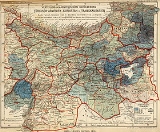
The Assyrian Genocide (also known as Sayfo or Seyfo, or ) refers to the mass slaughter of the Assyrian/Chaldean/Syriac
population of the Ottoman Empire
during the 1890s, the First World War, and the period of 1922-1925. The Assyrian population of upper Mesopotamia
(the Tur Abdin
, Hakkari
, Van
, Siirt
regions of present-day southeastern Turkey
and the Urmia
region of northwestern Iran
) was forcibly relocated and massacred by Ottoman
(Turkish
) and Kurdish
forces between 1914 and 1920. Estimates on the overall death toll have varied. Contemporary reports placed the figure at 250,000. Numerous scholars and journalists have accepted that figure. Some sources lacking a detailed statistical analysis claim figures as high as 750,000.
The Assyrian genocide took place in the same context as the Armenian
and Pontic Greek genocides.
In these events, close to three million Christians of Syriac, Armenian or Greek Orthodox denomination were murdered by the Young Turks
regime.
Since the "Assyrian genocide" took place within the context of the much more widespread Armenian genocide
, historical scholarship treating it as a separate event is scarce, with the exceptions of the works of David Gaunt and Hannibal Travis.
In 2007, the International Association of Genocide Scholars
(IAGS) reached a consensus that "the Ottoman campaign against Christian minorities of the Empire between 1914 and 1923 constituted a genocide against Armenians, Assyrians, and Pontian and Anatolian Greeks. The IAGS referred to the work of Gaunt and Travis in passing this resolution. Gregory Stanton, the President of the IAGS in 2007-2008 and the founder of Genocide Watch
, endorsed the "repudiation by the world's leading genocide scholars of the Turkish government's ninety-year denial of the Ottoman Empire's genocides against its Christian populations, including Assyrians, Greeks, and Armenians."
(the term abbreviates shato d'sayfo "year of the sword"). The Assyrian name , which literally means "killing of the Assyrian people", is used by some groups to describe these events. The word Qṭolcamo which means Genocide is also used in Assyrian diaspora media. The term used in Turkish
media is Süryani Soykırımı.
In countries where significant Assyrian diaspora
communities exist, the designation "Assyrian" has become controversial, notably in Germany and Sweden, alternative terms such as Assyriska/syrianska/kaldeiska folkmordet "Assyrian/Syriac/Chaldean genocide" are employed. Nestorians, Syrians, Syriacs, and Chaldeans were names imposed by Western missionaries such as the Catholics and Protestants on the Ottoman and Persian Assyrians.
The Greek, Persian, and Arab rulers of occupied Assyria, as well as Chaldean and Syrian Orthodox patriarchs, priests, and monks, and Armenian, British, and French laypeople, called them all Assyrians.
, Iraq
and Turkey
. There were also hundreds of thousands of Maronite Christians in Lebanon, with some Assyrian heritage but which are less often called Assyrians. There were significantly large communities located in the regions near Lake Urmia
in Persia, Lake Van
(specifically the Hakkari
region) and Mesopotamia
, as well as the eastern Ottoman provinces of Diyarbekir, Erzerum and Bitlis
. Like other Christians residing in the empire, they were treated as second-class citizens and denied public positions of power. Violence directed against them prior to the First World War was not new. Many Assyrians were subjected to Kurdish brigandage and even outright massacre and forced conversion to Islam, as was the case of the Assyrian community of Diyarbekir during the 1895-96 Hamidian Massacres
. The Hamidiye received assurances from the Ottoman Sultan that they could kill Assyrians and Armenians with impunity, and were particularly active in Urhoy
and Diyarbakir
. After attacking Russian cities and declaring war on Britain and France, the Empire declared a holy war on Christians. The German Kaiser and the German Ambassador to the Ottoman Empire directed and orchestrated the holy war, and financed the Ottomans' aggression against the Russian Empire.
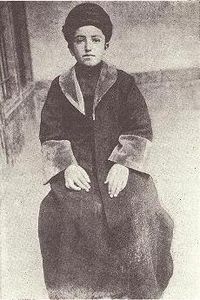
. The commander of Ottoman Army Group East declared in his memoirs that his forces accounted for 300,000 Armenian deaths in Diyarbekir and elsewhere. A German Vice-Consul reported in July 1915 that Assyrians were being massacred in Diyarbekir province. A German Consul reported in September 1915 that the adult Christians of Diyarbekir, Harput, Mardin
, and Weranscheher, and an Ottoman reign of terror in Urhoy
. The German ambassador reported that the Ottoman Empire was being "clear[ed]" of its indigenous Christians by "eliminat[ion]". In July 1915, he confirmed that the Assyrians of Midyat, Nisibis, and Jazirah were also slain.
In late 1915, Jevdet Bey
, Military Governor of Van Province
, upon entering Siirt (or Seert) with 8,000 soldiers whom he himself called "The Butchers' Battalion" , ordered the massacre of almost 20,000 Assyrian civilian
s in at least 30 villages. The following is a list documenting the villages that were attacked by Cevdet's soldiers and the estimated number of Assyrian deaths:
The village of Sa'irt/Seert, was populated by Assyrians and Armenians. Seert was the seat of a Chaldean Archbishop, Addai Scher
who was murdered by the Kurds. The eyewitness Hyacinthe Simon wrote that 4,000 Christians died in Seert.
Assyrians were involved in a number of clashes in Turkey with Ottoman forces, including Kurds and Circassians loyal to the empire. When armed and in sufficient numbers they were able to defend themselves successfully. However, they were often cut off in small pockets, vastly outnumbered and surrounded, and unarmed villagers made easy targets for Ottoman and Kurdish forces.
, who had been approached by the Allies to help fight the Ottomans.
The Assyrians proved to be excellent soldiers, and Agha Petros' volunteer army had quite a few successes over the Ottoman forces and their Kurdish
allies, notably at Suldouze where 1,500 Assyrian horsemen overcame the far larger Ottoman force of over 8,000, commanded by Kheiri Bey. Agha Petros also defeated the Ottoman Turks
in a major engagement at Sauj Bulak and drove them back to Rowanduz. Assyrian forces in Persia were greatly affected by the withdrawal of Russia
from the war and the collapse of Armenia
n armed resistance in the region. They were left cut off, with no supplies, vastly outnumbered and surrounded. In 1918, the Assyrian population of Urmia was nearly wiped out, 1,000 killed in the French and American mission buildings, 200 surrounding villages destroyed, and thousands perished of famine, disease, and forced marches.
. Not long after settling in, Kurdish troops of the Ottoman Army massacred the population almost entirely. One of the few that survived was Reverend John Eshoo. After escaping, he stated:
. On February 21, 1915 the Turkish army in Urmia seized 61 leading Assyrians from the French
missions
as hostages, demanding large ransoms. The mission had enough money to convince the Ottomans to let 20 of the men go. However, on February 22 the remaining 41 were executed, having their heads cut off at the stairs of the Charbachsh Gate. The dead included bishop Mar Denkha.
Most of the Assyrian villages were unarmed. The only protection they had was when the Russian army finally took control of the area, years after the presence of the Ottoman army had been removed. On February 25, 1915, Ottoman troops stormed their way into the villages of Gulpashan and Salamas. Almost the entire village of Golpashan
, of a population of 2,500, were massacred. In Salamas about 750 Armenian and Assyrian refugees were protected by Iranian civilians in the village. The commander of the Ottoman division stormed the houses despite the fact that Iranians lived in them, and roped all the men together in large groups and forced them to march in the fields between Khusrawa and Haftevan. The men were shot or killed in other ways. The protection of Christians by local Persian/Iranian civilians is also confirmed in the 1915 British report: "Many Moslems tried to save their Christian neighbours and offered them shelter in their houses, but the Turkish authorities were implacable." During the winter of 1915, 4,000 Assyrians died from disease, hunger, and exposure, and about 1000 were killed in the villages of Urmia.
The British decided to deport all 30,000 from Persia to Baquba, Iraq. The transferring took just 25 days, but at least 7,000 of them had died during the trip. Some died of exposure, hunger or disease, other civilians fell prey to attacks from armed bands of Kurds and Arabs. At Baquba, Assyrians were forced to defend themselves from further Arab raids.
A memorandum from American Presbyterian Missionaries at Urmia During the Great War 16 to British Minister Sir Percy Cox had this to say:
In 1920, the British decided to close down the Baquba camps. The majority of Assyrians of the camp decided to go back to the Hakkari mountains, while the rest were dispersed throughout Iraq, where there was already an ancient Assyrian community established over 5000 years.
In 1933 a massacre of thousands of unarmed Assyrians took place at Simele and other areas in Iraq at the hands of the Iraqi Army and Kurdish irregulars. In 1961 many Assyrian villages were razed in Iraq, and further widespread destruction was wrought during the Al Anfal Campaign by Saddam Hussein in 1988. To this day Assyrians in Iraq make up an important Iraqi minority group.
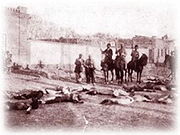 Scholars have summarized events as follows: specific massacres included 25,000 Assyrians in Midyat, 21,000 in Jezira-ibn-Omar, 7,000 in Nisibis, 7,000 in Urfa, 7,000 in the Qudshanis region, 6,000 in Mardin, 5,000 in Diyarbekir, 4,000 in Adana, 4,000 in Brahimie, and 3,500 in Harput. In its December 4, 1922, memorandum, the Assyro-Chaldean National Council stated that the total death toll was unknown. It estimated that about 275,000 "Assyro-Chaldeans" died between 1914 and 1918. The population of the Assyrians of the Ottoman Empire and Persia was about 650,000 before the genocide, and was reduced by 250,000, with very few survivors in 1930s Turkey or Iran.
 Assyrians in what is now Turkey primarily lived in the provinces of Hakkari
, Şırnak
, and Mardin
. These areas also had a sizable Kurdish
population.
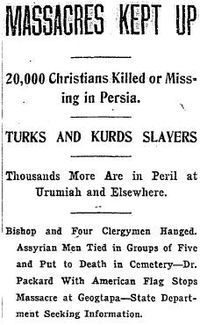
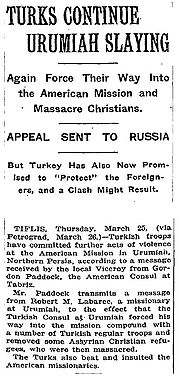
The following newspaper articles documented the Assyrian genocide as it occurred:
Hannibal Travis, Assistant Professor of Law at Florida International University
, wrote in the peer-reviewed journal Genocide Studies and Prevention: An International Journal that:
In April 1915, after a number of failed Kurdish attempts, Ottoman Troops invaded Gawar, a region of Hakkari, and massacred the entire population. Prior to this, in October 1914, 71 Assyrian men of Gawar were arrested and taken to the local government center in Bashkala and killed.
 On 11 March 2010, the Genocide of the Assyrians
was officially recognized by the Parliament
of Sweden
, alongside that of the Armenians
and Pontic Greeks
.
The Assyrian genocide is recognised by the New South Wales (NSW) Local Government in Australia.
The Assyrian Genocide is officially recognised by the South Australia State Parliament.
The Assyrian Genocide has also been recognized by the last three governors of the state of New York
.
This is in contrast to the Armenian Genocide
, which has also been recognized
by other countries and international organizations. Assyrian historians attribute the limited recognition to the smaller number of Assyrian survivors, whose leader Mar Shimun XIX Benjamin was killed in 1918. For example, there are one million Armenians living in the United States alone, but even they were unable to persuade Congress to pass a United States resolution on Armenian genocide
. In addition, the widespread massacres of all Ottoman
Christians in Asia Minor
is sometimes referred to by Armenian authors as an "Armenian Genocide
". On April 24, 2001, Governor of the US
state of New York
, George Pataki
, proclaimed that "killings of civilians and food and water deprivation during forced marches across harsh, arid terrain proved successful for the perpetrators of genocide, who harbored a prejudice against ... Assyrian Christians."
In December 2007, the International Association of Genocide Scholars
, the world's leading genocide scholars organization, overwhelmingly passed a resolution officially recognizing the Assyrian genocide, along with the genocide against Ottoman Greeks
. The vote in favor was 83%. The Interparliamentary Assembly on Orthodoxy (I.A.O.), passed a resolution officially recognizing the Assyrian genocide on June 2011.
, Australia
, Sweden
, and the United States
. Sweden's government has pledged to pay for all the expenses of a future monument, after strong lobbying from the large Assyrian community there, led by Konstantin Sabo. There are three monuments in the U.S., one in Chicago
, one in Columbia
and the newest in Los Angeles, California
.
There have been recent reports indicating that Armenia
is ready to create a monument dedicated to the Assyrian genocide, placed in the capital next to the Armenian genocide monument.
A monument to the victims of the Assyrian genocide has been built in Fairfield
in Australia
, a suburb of Sydney
where one in ten of the population is of Assyrian descent. The statue is designed as a hand of a martyr draped in an Assyrian flag and 4.5 meters tall. It was designed by Lewis Batros. The memorial is placed in a reserve to be named the Garden of Nineveh. The memorial statue and the name for the reserve were proposed in August 2009 by the Assyrian Universal Alliance. After consultation with the community, Fairfield
Council received more than 100 submissions for the memorial, including some from overseas, and two petitions. The proposal has been condemned by the Australian Turkish
community. The Assyrian Genocide has been recognised by the NSW Local Government and South Australia state. On the 30th of August 2010, twenty-three days after it was unveiled, the Australian monument was vandalised.
There are also Assyrian genocide monuments in Paris, France and in Russia
.
, the Assyrian Genocide, along with the Armenian Genocide, are included in a course covering historical genocides. Turkish organizations, along with other non-Turkish Muslim organizations, have reacted to this and protested.
Assyrian people
The Assyrian people are a distinct ethnic group whose origins lie in ancient Mesopotamia...
population of the Ottoman Empire
Ottoman Empire
The Ottoman EmpireIt was usually referred to as the "Ottoman Empire", the "Turkish Empire", the "Ottoman Caliphate" or more commonly "Turkey" by its contemporaries...
during the 1890s, the First World War, and the period of 1922-1925. The Assyrian population of upper Mesopotamia
Mesopotamia
Mesopotamia is a toponym for the area of the Tigris–Euphrates river system, largely corresponding to modern-day Iraq, northeastern Syria, southeastern Turkey and southwestern Iran.Widely considered to be the cradle of civilization, Bronze Age Mesopotamia included Sumer and the...
(the Tur Abdin
Tur Abdin
Tur Abdin is a hilly region of south east Turkey incorporating the eastern half of Mardin Province, and Şırnak Province west of the Tigris, on the border with Syria. The name 'Tur Abdin' is from the Syriac language meaning 'mountain of the servants '. Tur Abdin is of great importance to Syriac...
, Hakkari
Hakkari
Hakkâri , is a city and the capital of the Hakkâri Province of Turkey. The name Hakkâri is derived from the Syriac word, Akkare, meaning farmers...
, Van
Van
A van is a kind of vehicle used for transporting goods or groups of people.In British English usage, it can be either specially designed or based on a saloon or sedan car, the latter type often including derivatives with open backs...
, Siirt
Siirt
- External links :* * * *...
regions of present-day southeastern Turkey
Turkey
Turkey , known officially as the Republic of Turkey , is a Eurasian country located in Western Asia and in East Thrace in Southeastern Europe...
and the Urmia
Urmia
- Demographics :According to official census of 2006, the population of Urmia is about 871,204.- Language :The population of Urmia is mainly Azerbaijani people, with Kurdish, Assyrian Christian, and Armenian minorities...
region of northwestern Iran
Iran
Iran , officially the Islamic Republic of Iran , is a country in Southern and Western Asia. The name "Iran" has been in use natively since the Sassanian era and came into use internationally in 1935, before which the country was known to the Western world as Persia...
) was forcibly relocated and massacred by Ottoman
Ottoman Empire
The Ottoman EmpireIt was usually referred to as the "Ottoman Empire", the "Turkish Empire", the "Ottoman Caliphate" or more commonly "Turkey" by its contemporaries...
(Turkish
Turkish people
Turkish people, also known as the "Turks" , are an ethnic group primarily living in Turkey and in the former lands of the Ottoman Empire where Turkish minorities had been established in Bulgaria, Cyprus, Bosnia and Herzegovina, Georgia, Greece, Kosovo, Macedonia, and Romania...
) and Kurdish
Kurdish people
The Kurdish people, or Kurds , are an Iranian people native to the Middle East, mostly inhabiting a region known as Kurdistan, which includes adjacent parts of Iran, Iraq, Syria, and Turkey...
forces between 1914 and 1920. Estimates on the overall death toll have varied. Contemporary reports placed the figure at 250,000. Numerous scholars and journalists have accepted that figure. Some sources lacking a detailed statistical analysis claim figures as high as 750,000.
The Assyrian genocide took place in the same context as the Armenian
Armenian Genocide
The Armenian Genocide—also known as the Armenian Holocaust, the Armenian Massacres and, by Armenians, as the Great Crime—refers to the deliberate and systematic destruction of the Armenian population of the Ottoman Empire during and just after World War I...
and Pontic Greek genocides.
In these events, close to three million Christians of Syriac, Armenian or Greek Orthodox denomination were murdered by the Young Turks
Young Turks
The Young Turks , from French: Les Jeunes Turcs) were a coalition of various groups favouring reformation of the administration of the Ottoman Empire. The movement was against the absolute monarchy of the Ottoman Sultan and favoured a re-installation of the short-lived Kanûn-ı Esâsî constitution...
regime.
Since the "Assyrian genocide" took place within the context of the much more widespread Armenian genocide
Armenian Genocide
The Armenian Genocide—also known as the Armenian Holocaust, the Armenian Massacres and, by Armenians, as the Great Crime—refers to the deliberate and systematic destruction of the Armenian population of the Ottoman Empire during and just after World War I...
, historical scholarship treating it as a separate event is scarce, with the exceptions of the works of David Gaunt and Hannibal Travis.
In 2007, the International Association of Genocide Scholars
International Association of Genocide Scholars
The International Association of Genocide Scholars is a global, interdisciplinary, non-partisan organization that seeks to further research and teaching about the nature, causes, and consequences of genocide, and advance policy studies on prevention of genocide. The Association, founded in 1994 by...
(IAGS) reached a consensus that "the Ottoman campaign against Christian minorities of the Empire between 1914 and 1923 constituted a genocide against Armenians, Assyrians, and Pontian and Anatolian Greeks. The IAGS referred to the work of Gaunt and Travis in passing this resolution. Gregory Stanton, the President of the IAGS in 2007-2008 and the founder of Genocide Watch
Genocide Watch
Genocide Watch is an international organization based in the United States which attempts to predict, prevent, limit, eliminate, and punish genocide throughout the world through reporting, public awareness campaigns, and judicial or quasi-judicial follow-up...
, endorsed the "repudiation by the world's leading genocide scholars of the Turkish government's ninety-year denial of the Ottoman Empire's genocides against its Christian populations, including Assyrians, Greeks, and Armenians."
Terminology
The Assyrian genocide is sometimes also referred to as Sayfo or Seyfo in English language sources, based on the modern Assyrian (Mesopotamian neo-Aramaic) designation Saypā , "sword", pronounced as Seyfo, and as Sayfo in the Western dialectWestern Neo-Aramaic
Western Neo-Aramaic is a modern Aramaic language. Today, it is spoken in three villages in the Anti-Lebanon mountains of western Syria. Western Neo-Aramaic is the only modern living Aramaic language drawn from the branch of Western Aramaic languages...
(the term abbreviates shato d'sayfo "year of the sword"). The Assyrian name , which literally means "killing of the Assyrian people", is used by some groups to describe these events. The word Qṭolcamo which means Genocide is also used in Assyrian diaspora media. The term used in Turkish
Turkish language
Turkish is a language spoken as a native language by over 83 million people worldwide, making it the most commonly spoken of the Turkic languages. Its speakers are located predominantly in Turkey and Northern Cyprus with smaller groups in Iraq, Greece, Bulgaria, the Republic of Macedonia, Kosovo,...
media is Süryani Soykırımı.
In countries where significant Assyrian diaspora
Assyrian diaspora
The Assyrian/Chaldean/Syriac diaspora refers to the estimated population of Assyrian/Syriac Christians in the world that migrated outside of the Middle East or their original homeland. The worldwide diaspora of Syriac Christian communities begins during World War I, with the mass-killings of...
communities exist, the designation "Assyrian" has become controversial, notably in Germany and Sweden, alternative terms such as Assyriska/syrianska/kaldeiska folkmordet "Assyrian/Syriac/Chaldean genocide" are employed. Nestorians, Syrians, Syriacs, and Chaldeans were names imposed by Western missionaries such as the Catholics and Protestants on the Ottoman and Persian Assyrians.
The Greek, Persian, and Arab rulers of occupied Assyria, as well as Chaldean and Syrian Orthodox patriarchs, priests, and monks, and Armenian, British, and French laypeople, called them all Assyrians.
Background
The Assyrian population in the Ottoman Empire numbered about one million at the turn of the twentieth century and was largely concentrated in what is now IranIran
Iran , officially the Islamic Republic of Iran , is a country in Southern and Western Asia. The name "Iran" has been in use natively since the Sassanian era and came into use internationally in 1935, before which the country was known to the Western world as Persia...
, Iraq
Iraq
Iraq ; officially the Republic of Iraq is a country in Western Asia spanning most of the northwestern end of the Zagros mountain range, the eastern part of the Syrian Desert and the northern part of the Arabian Desert....
and Turkey
Turkey
Turkey , known officially as the Republic of Turkey , is a Eurasian country located in Western Asia and in East Thrace in Southeastern Europe...
. There were also hundreds of thousands of Maronite Christians in Lebanon, with some Assyrian heritage but which are less often called Assyrians. There were significantly large communities located in the regions near Lake Urmia
Lake Urmia
Lake Urmia , ancient name: Lake Matiene) is a salt lake in northwestern Iran, near Iran's border with Turkey. The lake is between the Iranian provinces of East Azerbaijan and West Azerbaijan, west of the southern portion of the similarly shaped Caspian Sea...
in Persia, Lake Van
Lake Van
Lake Van is the largest lake in Turkey, located in the far east of the country in Van district. It is a saline and soda lake, receiving water from numerous small streams that descend from the surrounding mountains. Lake Van is one of the world's largest endorheic lakes . The original outlet from...
(specifically the Hakkari
Hakkari
Hakkâri , is a city and the capital of the Hakkâri Province of Turkey. The name Hakkâri is derived from the Syriac word, Akkare, meaning farmers...
region) and Mesopotamia
Mesopotamia
Mesopotamia is a toponym for the area of the Tigris–Euphrates river system, largely corresponding to modern-day Iraq, northeastern Syria, southeastern Turkey and southwestern Iran.Widely considered to be the cradle of civilization, Bronze Age Mesopotamia included Sumer and the...
, as well as the eastern Ottoman provinces of Diyarbekir, Erzerum and Bitlis
Bitlis
Bitlis is a town in eastern Turkey and the capital of Bitlis Province. The town is located at an elevation of 1,400 metres, 15 km from Lake Van, in the steep-sided valley of the Bitlis River, a tributary of the Tigris. The local economy is mainly based on agricultural products which include...
. Like other Christians residing in the empire, they were treated as second-class citizens and denied public positions of power. Violence directed against them prior to the First World War was not new. Many Assyrians were subjected to Kurdish brigandage and even outright massacre and forced conversion to Islam, as was the case of the Assyrian community of Diyarbekir during the 1895-96 Hamidian Massacres
Hamidian massacres
The Hamidian massacres , also referred to as the Armenian Massacres of 1894–1896, refers to the massacring of Armenians by the Ottoman Empire, with estimates of the dead ranging from anywhere between 80,000 to 300,000, and at least 50,000 orphans as a result...
. The Hamidiye received assurances from the Ottoman Sultan that they could kill Assyrians and Armenians with impunity, and were particularly active in Urhoy
Edessa
Edessa may refer to:*Edessa, Greece*Edessa, Mesopotamia, now Şanlıurfa, Turkey*County of Edessa, a crusader state*Osroene, an ancient kingdom and province of the Roman Empire...
and Diyarbakir
Outbreak of war
The Ottoman Empire began massacring Assyrians in the nineteenth century, a time of friendly relations between the Ottomans and the British, who were defending the Ottomans from the Russian Empire's efforts to exterminate communities of Orthodox Christians. In October 1914, the Ottoman Empire began deporting and massacring Assyrians and Armenians in VanVan
A van is a kind of vehicle used for transporting goods or groups of people.In British English usage, it can be either specially designed or based on a saloon or sedan car, the latter type often including derivatives with open backs...
. After attacking Russian cities and declaring war on Britain and France, the Empire declared a holy war on Christians. The German Kaiser and the German Ambassador to the Ottoman Empire directed and orchestrated the holy war, and financed the Ottomans' aggression against the Russian Empire.
Massacres
Diyarbekir
The earliest programs of extermination took place in the southern province of Diyarbekir, under the leadership of Reshid BeyResit Bey
Dr. Mehmed Reshid was the governor of the Diyarbakır vilayet of the Ottoman Empire during World War I. He is known for his role in the Armenian Genocide and the Assyrian Genocide....
. The commander of Ottoman Army Group East declared in his memoirs that his forces accounted for 300,000 Armenian deaths in Diyarbekir and elsewhere. A German Vice-Consul reported in July 1915 that Assyrians were being massacred in Diyarbekir province. A German Consul reported in September 1915 that the adult Christians of Diyarbekir, Harput, Mardin
Mardin
Mardin is a city in southeastern Turkey. The capital of Mardin Province, it is known for its Arabic-like architecture, and for its strategic location on a rocky mountain overlooking the plains of northern Syria.-History:...
, and Weranscheher, and an Ottoman reign of terror in Urhoy
Edessa
Edessa may refer to:*Edessa, Greece*Edessa, Mesopotamia, now Şanlıurfa, Turkey*County of Edessa, a crusader state*Osroene, an ancient kingdom and province of the Roman Empire...
. The German ambassador reported that the Ottoman Empire was being "clear[ed]" of its indigenous Christians by "eliminat[ion]". In July 1915, he confirmed that the Assyrians of Midyat, Nisibis, and Jazirah were also slain.
Van
Jevdet Pasha the governor of Van, is reported to have held a meeting in February 1915 at which he said, "We have cleansed the Armenians and Syriac [Christian]s from Azerbaijan, and we will do the same in Van."In late 1915, Jevdet Bey
Jevdet Bey
Djevdet Bey, Jevdet Bey, Cevdet Belbez was the governor of the Van vilayet of the Ottoman Empire during World War I. He governed from 1914 until the evacuation of Muslims from Van Province in May 1915. He succeeded Governor Tahsin Bay.He was portrayed by Elias Koteas in the 2002 film Ararat.He...
, Military Governor of Van Province
Van Province
Van Province is a province in eastern Turkey, between Lake Van and the Iranian border. It is 19,069 km2 in area and had a population of 1,035,418 at the end of 2010....
, upon entering Siirt (or Seert) with 8,000 soldiers whom he himself called "The Butchers' Battalion" , ordered the massacre of almost 20,000 Assyrian civilian
Civilian
A civilian under international humanitarian law is a person who is not a member of his or her country's armed forces or other militia. Civilians are distinct from combatants. They are afforded a degree of legal protection from the effects of war and military occupation...
s in at least 30 villages. The following is a list documenting the villages that were attacked by Cevdet's soldiers and the estimated number of Assyrian deaths:
| Sairt – 2,000 | Sadagh – 2,000 | Mar-Gourya – 1,000 | Guedianes – 500 | Hadide – 1,000 |
| Redwan – 500 | Dehok – 500 | Ketmes – 1,000 | Der-Chemch – 200 | |
| Tentas – 500 | Tellimchar – 1,500 | Telnevor – 500 | Benkof – 200 | |
| Altaktanie – 500 | Goredj – 500 | Galwaye – 500 | Der-Mazen – 300 | |
| Artoun – 1,000 | Ain-Dare – 200 | Berke – 500 | Bekend – 500 | Archkanes – 500 |
| Charnakh – 200 | Der-Mar-Yacoub – 500 | Der-Rabban – 300 | ||
| Harevena – 200 | Piros – 1,000 |
The village of Sa'irt/Seert, was populated by Assyrians and Armenians. Seert was the seat of a Chaldean Archbishop, Addai Scher
Addai Scher
Addai Scher Also written Addai Sher, Addaï Scher and Addai Sheir , was the Chaldean Catholic archbishop of Siirt. He was killed by the Ottomans during the Assyrian Genocide.-Early life:...
who was murdered by the Kurds. The eyewitness Hyacinthe Simon wrote that 4,000 Christians died in Seert.
Assyrian resistance in upper Mesopotamia
On March 3, 1918, the Ottoman army led by Kurdish soldiers assassinated one of the most important Assyrian leaders at the time. This resulted in the retaliation of the Assyrians. Malik Yosip Khoshaba of the Bit Tiyari tribe led a successful attack against the Ottomans. Assyrian forces in the region also attacked the Kurdish fortress of Simku, the leader who had assassinated Mar Shimun XIX Benyamin, they successfully stormed it, defeating the Kurds, however Simku escaped and fled.Assyrians were involved in a number of clashes in Turkey with Ottoman forces, including Kurds and Circassians loyal to the empire. When armed and in sufficient numbers they were able to defend themselves successfully. However, they were often cut off in small pockets, vastly outnumbered and surrounded, and unarmed villagers made easy targets for Ottoman and Kurdish forces.
Assyrian military retaliation in Iran
The Assyrians in Persia armed themselves under the command of General Agha PetrosAgha Petros
Petros Elia of Baz , better known as Agha Petros, was an Assyrian military leader during World War I.- Early years :...
, who had been approached by the Allies to help fight the Ottomans.
The Assyrians proved to be excellent soldiers, and Agha Petros' volunteer army had quite a few successes over the Ottoman forces and their Kurdish
Kurdish people
The Kurdish people, or Kurds , are an Iranian people native to the Middle East, mostly inhabiting a region known as Kurdistan, which includes adjacent parts of Iran, Iraq, Syria, and Turkey...
allies, notably at Suldouze where 1,500 Assyrian horsemen overcame the far larger Ottoman force of over 8,000, commanded by Kheiri Bey. Agha Petros also defeated the Ottoman Turks
Ottoman Turks
The Ottoman Turks were the Turkish-speaking population of the Ottoman Empire who formed the base of the state's military and ruling classes. Reliable information about the early history of Ottoman Turks is scarce, but they take their Turkish name, Osmanlı , from the house of Osman I The Ottoman...
in a major engagement at Sauj Bulak and drove them back to Rowanduz. Assyrian forces in Persia were greatly affected by the withdrawal of Russia
Russia
Russia or , officially known as both Russia and the Russian Federation , is a country in northern Eurasia. It is a federal semi-presidential republic, comprising 83 federal subjects...
from the war and the collapse of Armenia
Armenia
Armenia , officially the Republic of Armenia , is a landlocked mountainous country in the Caucasus region of Eurasia...
n armed resistance in the region. They were left cut off, with no supplies, vastly outnumbered and surrounded. In 1918, the Assyrian population of Urmia was nearly wiped out, 1,000 killed in the French and American mission buildings, 200 surrounding villages destroyed, and thousands perished of famine, disease, and forced marches.
Khoi, Iran
In early 1918, many Assyrians started to flee present-day Turkey. Mar Shimun Benyamin had arranged for some 3,500 Assyrians to reside in the district of KhoiKhoy
Khoy is a city in and the capital of Khoy County, West Azerbaijan Province, Iran. At the 2006 census, its population was 178,708, in 45,090 families....
. Not long after settling in, Kurdish troops of the Ottoman Army massacred the population almost entirely. One of the few that survived was Reverend John Eshoo. After escaping, he stated:
Iranian villages
The Ottoman Empire invaded northwestern Persia in 1914. Before the end of 1914, Turkish and Kurdish troops had successfully entered the villages in and around UrmiaUrmia
- Demographics :According to official census of 2006, the population of Urmia is about 871,204.- Language :The population of Urmia is mainly Azerbaijani people, with Kurdish, Assyrian Christian, and Armenian minorities...
. On February 21, 1915 the Turkish army in Urmia seized 61 leading Assyrians from the French
France
The French Republic , The French Republic , The French Republic , (commonly known as France , is a unitary semi-presidential republic in Western Europe with several overseas territories and islands located on other continents and in the Indian, Pacific, and Atlantic oceans. Metropolitan France...
missions
Mission (station)
A religious mission or mission station is a location for missionary work.While primarily a Christian term, the concept of the religious "mission" is also used prominently by the Church of Scientology and their Scientology Missions International....
as hostages, demanding large ransoms. The mission had enough money to convince the Ottomans to let 20 of the men go. However, on February 22 the remaining 41 were executed, having their heads cut off at the stairs of the Charbachsh Gate. The dead included bishop Mar Denkha.
Most of the Assyrian villages were unarmed. The only protection they had was when the Russian army finally took control of the area, years after the presence of the Ottoman army had been removed. On February 25, 1915, Ottoman troops stormed their way into the villages of Gulpashan and Salamas. Almost the entire village of Golpashan
Golpashan
The Assyrian Christian village of Golpashan is located in the Western Azerbaijan province in Iran. It is located on the western shore of Lake Urmia....
, of a population of 2,500, were massacred. In Salamas about 750 Armenian and Assyrian refugees were protected by Iranian civilians in the village. The commander of the Ottoman division stormed the houses despite the fact that Iranians lived in them, and roped all the men together in large groups and forced them to march in the fields between Khusrawa and Haftevan. The men were shot or killed in other ways. The protection of Christians by local Persian/Iranian civilians is also confirmed in the 1915 British report: "Many Moslems tried to save their Christian neighbours and offered them shelter in their houses, but the Turkish authorities were implacable." During the winter of 1915, 4,000 Assyrians died from disease, hunger, and exposure, and about 1000 were killed in the villages of Urmia.
Baquba camps
By mid-1918, the British army had convinced the Ottomans to let them have access to about 30,000 Assyrians from various parts of Persia.The British decided to deport all 30,000 from Persia to Baquba, Iraq. The transferring took just 25 days, but at least 7,000 of them had died during the trip. Some died of exposure, hunger or disease, other civilians fell prey to attacks from armed bands of Kurds and Arabs. At Baquba, Assyrians were forced to defend themselves from further Arab raids.
A memorandum from American Presbyterian Missionaries at Urmia During the Great War 16 to British Minister Sir Percy Cox had this to say:
Capt. Gracey doubtless talked rather big in the hopes of putting heart into the Syrians and holding up this front against the Turks. [Consequently,] We have met all the orders issued by the late Dr. Shedd which have been presented to us and a very large number of Assyrian refugees are being maintained at Baquba, chiefly at H.M.G.'s expense.
In 1920, the British decided to close down the Baquba camps. The majority of Assyrians of the camp decided to go back to the Hakkari mountains, while the rest were dispersed throughout Iraq, where there was already an ancient Assyrian community established over 5000 years.
In 1933 a massacre of thousands of unarmed Assyrians took place at Simele and other areas in Iraq at the hands of the Iraqi Army and Kurdish irregulars. In 1961 many Assyrian villages were razed in Iraq, and further widespread destruction was wrought during the Al Anfal Campaign by Saddam Hussein in 1988. To this day Assyrians in Iraq make up an important Iraqi minority group.
Death toll
Massacres in the late Ottoman Empire
The Assyrians were not going to be an easy group to deport, as they had always been armed and were as ferocious as their Kurdish neighbors.| ="color:#ffffff;">Christian population in Diyarbakır Province Diyarbakir Province Diyarbakır Province is a province in eastern Turkey. The province covers an area of 15,355 km² and the population is 1,528,958. The provincial capital is Diyarbakir... before and after World War I |
||||
| Sect | Before World War I | Disappeared | After World War I | |
|---|---|---|---|---|
| Armenians | Gregorians (Apostolic) Armenian Apostolic Church The Armenian Apostolic Church is the world's oldest National Church, is part of Oriental Orthodoxy, and is one of the most ancient Christian communities. Armenia was the first country to adopt Christianity as its official religion in 301 AD, in establishing this church... |
60,000 | 58,000 | 2,000 |
| Armenian Catholics Armenian Catholic Church |- |The Armenian Catholic Church is an Eastern Catholic Church sui juris in union with the other Eastern Rite, Oriental Rite and Latin Rite Catholics who accept the Bishop of Rome as spiritual leader of the Church. It is regulated by Eastern canon law... |
12,500 | 11,500 | 1,000 | |
| Assyrians | Chaldean Catholics Chaldean Catholic Church The Chaldean Catholic Church , is an Eastern Syriac particular church of the Catholic Church, maintaining full communion with the Bishop of Rome and the rest of the Catholic Church... |
11,120 | 10,010 | 1,110 |
| Syrian Catholic | 5,600 | 3,450 | 2,150 | |
| Syrian Jacobite | 84,725 | 60,725 | 24,000 | |
| Total | 173,945 | 143,685 | 30,260 |
| ="color:#ffffff;">Christian population in Mardin province Mardin Province Mardin Province is a province of Turkey with a population of 744,606. The population was 835,173 in 2000. The capital of the Mardin Province is Mardin... before and after World War I |
||||
| Sect | Before World War I | Disappeared | After World War I | |
|---|---|---|---|---|
| Armenians | Catholics | 10,500 | 10,200 | 300 |
| Assyrians | Chaldean Catholics | 7,870 | 6,800 | 1,070 |
| Syrian Catholic | 3,850 | 700 | 3,150 | |
| Syrian Jacobite | 51,725 | 29,725 | 22,000 | |
| Total | 73,945 | 49,875 | 24,070 |
Documented accounts of the genocide
Hakkari
Hakkâri , is a city and the capital of the Hakkâri Province of Turkey. The name Hakkâri is derived from the Syriac word, Akkare, meaning farmers...
, Şırnak
Sirnak
Şırnak is a town in southeastern Turkey. It is the capital of Şırnak Province, a new province that split from the Hakkari province...
, and Mardin
Mardin
Mardin is a city in southeastern Turkey. The capital of Mardin Province, it is known for its Arabic-like architecture, and for its strategic location on a rocky mountain overlooking the plains of northern Syria.-History:...
. These areas also had a sizable Kurdish
Kurdish people
The Kurdish people, or Kurds , are an Iranian people native to the Middle East, mostly inhabiting a region known as Kurdistan, which includes adjacent parts of Iran, Iraq, Syria, and Turkey...
population.
The following newspaper articles documented the Assyrian genocide as it occurred:
- Assyrians Burned in Church, Lowell Sun (Massachusetts), 1915
- Assyrians Massacred in Urmia, San Antonio Light (Texas), 1915
- Assyrians Massacred in Urmiah, Salt Lake Tribune (Utah), 1915
- Chaldean Victims of the Turks, The Times (United Kingdom), 22 November 1919, p 11
- Christian Massacres in Urmiah, The Argus (Australia), 1915
- Extermination of the Armenian Race, The Manchester Guardian (United Kingdom), 1915
- Many Assyrian Perish, Winnipeg Free Press (Canada), 1915
- Massacred by Kurds; Christians Unable to Flee from Urmia Put to Death, Washington Post, 14 March 1915, p10
- Massacres of Nestorians in Urmia, The New York Times (New York), 1915
- Massacres Kept Up, The Washington Post (USA), 26 March 1915, 1.
- Native Christians Massacred; Frightful Atrocities in Persia, Los Angeles Times, 2 April 1915, p I-1
- Nestorian Christians Flee Urmia, The New York Times (New York), 1915
- Syrian Tells of Atrocities, Los Angeles Times (California), Dec. 15, 1918, at I–1.
- The Assyrian Massacres, Manchester Guardian (United Kingdom), Dec. 5, 1918, at 4
- The Suffering Serbs and Armenians, The Manchester Guardian (United Kingdom), 1915, p5
- Turkish Horrors in Persia, The New York Times (New York), 11 October 1915
- Turks Kill Christians in Assyria, Muscatine Journal (Iowa), 1915
- Turkish Troops Massacring Assyrians, Newark Advocate (New Jersey), 1915
- Turkish Horrors in Persia, The New York Times (New York), 1915
- The Total of Armenian and Syrian Dead, Current History: A Monthly Magazine of the New York Times, November 1916, 337–38
Hannibal Travis, Assistant Professor of Law at Florida International University
Florida International University
Florida International University is an American public research university in metropolitan Miami, Florida, in the United States, with its main campus in University Park...
, wrote in the peer-reviewed journal Genocide Studies and Prevention: An International Journal that:
In April 1915, after a number of failed Kurdish attempts, Ottoman Troops invaded Gawar, a region of Hakkari, and massacred the entire population. Prior to this, in October 1914, 71 Assyrian men of Gawar were arrested and taken to the local government center in Bashkala and killed.
Eyewitness accounts and quotes
Statement of German Missionaries on Urmia.Recognition
Assyrian people
The Assyrian people are a distinct ethnic group whose origins lie in ancient Mesopotamia...
was officially recognized by the Parliament
Parliament of Sweden
The Riksdag is the national legislative assembly of Sweden. The riksdag is a unicameral assembly with 349 members , who are elected on a proportional basis to serve fixed terms of four years...
of Sweden
Sweden
Sweden , officially the Kingdom of Sweden , is a Nordic country on the Scandinavian Peninsula in Northern Europe. Sweden borders with Norway and Finland and is connected to Denmark by a bridge-tunnel across the Öresund....
, alongside that of the Armenians
Armenians
Armenian people or Armenians are a nation and ethnic group native to the Armenian Highland.The largest concentration is in Armenia having a nearly-homogeneous population with 97.9% or 3,145,354 being ethnic Armenian....
and Pontic Greeks
Pontic Greeks
The Pontians are an ethnic group traditionally living in the Pontus region, the shores of Turkey's Black Sea...
.
The Assyrian genocide is recognised by the New South Wales (NSW) Local Government in Australia.
The Assyrian Genocide is officially recognised by the South Australia State Parliament.
The Assyrian Genocide has also been recognized by the last three governors of the state of New York
New York
New York is a state in the Northeastern region of the United States. It is the nation's third most populous state. New York is bordered by New Jersey and Pennsylvania to the south, and by Connecticut, Massachusetts and Vermont to the east...
.
This is in contrast to the Armenian Genocide
Armenian Genocide
The Armenian Genocide—also known as the Armenian Holocaust, the Armenian Massacres and, by Armenians, as the Great Crime—refers to the deliberate and systematic destruction of the Armenian population of the Ottoman Empire during and just after World War I...
, which has also been recognized
Recognition of the Armenian Genocide
Armenian Genocide recognition refers to the formal acceptance that the massacre and forced deportation of Armenians committed by the Ottoman Empire in 1915-1923 constitute genocide...
by other countries and international organizations. Assyrian historians attribute the limited recognition to the smaller number of Assyrian survivors, whose leader Mar Shimun XIX Benjamin was killed in 1918. For example, there are one million Armenians living in the United States alone, but even they were unable to persuade Congress to pass a United States resolution on Armenian genocide
United States resolution on Armenian genocide
The proposed Armenian Genocide resolution is a measure currently under consideration in the U.S. House of Representatives that would recognize the 1915 Genocide. It is officially called H. Res 106 or the Affirmation of the United States Record on the Armenian Genocide Resolution...
. In addition, the widespread massacres of all Ottoman
Ottoman Empire
The Ottoman EmpireIt was usually referred to as the "Ottoman Empire", the "Turkish Empire", the "Ottoman Caliphate" or more commonly "Turkey" by its contemporaries...
Christians in Asia Minor
Asia Minor
Asia Minor is a geographical location at the westernmost protrusion of Asia, also called Anatolia, and corresponds to the western two thirds of the Asian part of Turkey...
is sometimes referred to by Armenian authors as an "Armenian Genocide
Armenian Genocide
The Armenian Genocide—also known as the Armenian Holocaust, the Armenian Massacres and, by Armenians, as the Great Crime—refers to the deliberate and systematic destruction of the Armenian population of the Ottoman Empire during and just after World War I...
". On April 24, 2001, Governor of the US
United States
The United States of America is a federal constitutional republic comprising fifty states and a federal district...
state of New York
New York
New York is a state in the Northeastern region of the United States. It is the nation's third most populous state. New York is bordered by New Jersey and Pennsylvania to the south, and by Connecticut, Massachusetts and Vermont to the east...
, George Pataki
George Pataki
George Elmer Pataki is an American politician who was the 53rd Governor of New York. A member of the Republican Party, Pataki served three consecutive four-year terms from January 1, 1995 until December 31, 2006.- Early life :...
, proclaimed that "killings of civilians and food and water deprivation during forced marches across harsh, arid terrain proved successful for the perpetrators of genocide, who harbored a prejudice against ... Assyrian Christians."
In December 2007, the International Association of Genocide Scholars
International Association of Genocide Scholars
The International Association of Genocide Scholars is a global, interdisciplinary, non-partisan organization that seeks to further research and teaching about the nature, causes, and consequences of genocide, and advance policy studies on prevention of genocide. The Association, founded in 1994 by...
, the world's leading genocide scholars organization, overwhelmingly passed a resolution officially recognizing the Assyrian genocide, along with the genocide against Ottoman Greeks
Ottoman Greeks
Ottoman Greeks were ethnic Greeks who lived in the Ottoman Empire , the Republic of Turkey's predecessor...
. The vote in favor was 83%. The Interparliamentary Assembly on Orthodoxy (I.A.O.), passed a resolution officially recognizing the Assyrian genocide on June 2011.
Monuments
The only governments that have allowed Assyrians to establish monuments commemorating the victims of the Assyrian genocide are FranceFrance
The French Republic , The French Republic , The French Republic , (commonly known as France , is a unitary semi-presidential republic in Western Europe with several overseas territories and islands located on other continents and in the Indian, Pacific, and Atlantic oceans. Metropolitan France...
, Australia
Australia
Australia , officially the Commonwealth of Australia, is a country in the Southern Hemisphere comprising the mainland of the Australian continent, the island of Tasmania, and numerous smaller islands in the Indian and Pacific Oceans. It is the world's sixth-largest country by total area...
, Sweden
Sweden
Sweden , officially the Kingdom of Sweden , is a Nordic country on the Scandinavian Peninsula in Northern Europe. Sweden borders with Norway and Finland and is connected to Denmark by a bridge-tunnel across the Öresund....
, and the United States
United States
The United States of America is a federal constitutional republic comprising fifty states and a federal district...
. Sweden's government has pledged to pay for all the expenses of a future monument, after strong lobbying from the large Assyrian community there, led by Konstantin Sabo. There are three monuments in the U.S., one in Chicago
Chicago
Chicago is the largest city in the US state of Illinois. With nearly 2.7 million residents, it is the most populous city in the Midwestern United States and the third most populous in the US, after New York City and Los Angeles...
, one in Columbia
Columbia, South Carolina
Columbia is the state capital and largest city in the U.S. state of South Carolina. The population was 129,272 according to the 2010 census. Columbia is the county seat of Richland County, but a portion of the city extends into neighboring Lexington County. The city is the center of a metropolitan...
and the newest in Los Angeles, California
Los Angeles, California
Los Angeles , with a population at the 2010 United States Census of 3,792,621, is the most populous city in California, USA and the second most populous in the United States, after New York City. It has an area of , and is located in Southern California...
.
There have been recent reports indicating that Armenia
Armenia
Armenia , officially the Republic of Armenia , is a landlocked mountainous country in the Caucasus region of Eurasia...
is ready to create a monument dedicated to the Assyrian genocide, placed in the capital next to the Armenian genocide monument.
A monument to the victims of the Assyrian genocide has been built in Fairfield
Fairfield
-Australia:*Fairfield, New South Wales, the most populous place in Australia with that place name**Electoral district of Fairfield, the corresponding seat in the New South Wales Legislative Assembly*Fairfield, Queensland*Fairfield, Victoria...
in Australia
Australia
Australia , officially the Commonwealth of Australia, is a country in the Southern Hemisphere comprising the mainland of the Australian continent, the island of Tasmania, and numerous smaller islands in the Indian and Pacific Oceans. It is the world's sixth-largest country by total area...
, a suburb of Sydney
Sydney
Sydney is the most populous city in Australia and the state capital of New South Wales. Sydney is located on Australia's south-east coast of the Tasman Sea. As of June 2010, the greater metropolitan area had an approximate population of 4.6 million people...
where one in ten of the population is of Assyrian descent. The statue is designed as a hand of a martyr draped in an Assyrian flag and 4.5 meters tall. It was designed by Lewis Batros. The memorial is placed in a reserve to be named the Garden of Nineveh. The memorial statue and the name for the reserve were proposed in August 2009 by the Assyrian Universal Alliance. After consultation with the community, Fairfield
Fairfield
-Australia:*Fairfield, New South Wales, the most populous place in Australia with that place name**Electoral district of Fairfield, the corresponding seat in the New South Wales Legislative Assembly*Fairfield, Queensland*Fairfield, Victoria...
Council received more than 100 submissions for the memorial, including some from overseas, and two petitions. The proposal has been condemned by the Australian Turkish
Turkish people
Turkish people, also known as the "Turks" , are an ethnic group primarily living in Turkey and in the former lands of the Ottoman Empire where Turkish minorities had been established in Bulgaria, Cyprus, Bosnia and Herzegovina, Georgia, Greece, Kosovo, Macedonia, and Romania...
community. The Assyrian Genocide has been recognised by the NSW Local Government and South Australia state. On the 30th of August 2010, twenty-three days after it was unveiled, the Australian monument was vandalised.
There are also Assyrian genocide monuments in Paris, France and in Russia
Russia
Russia or , officially known as both Russia and the Russian Federation , is a country in northern Eurasia. It is a federal semi-presidential republic, comprising 83 federal subjects...
.
School institutions
In CanadaCanada
Canada is a North American country consisting of ten provinces and three territories. Located in the northern part of the continent, it extends from the Atlantic Ocean in the east to the Pacific Ocean in the west, and northward into the Arctic Ocean...
, the Assyrian Genocide, along with the Armenian Genocide, are included in a course covering historical genocides. Turkish organizations, along with other non-Turkish Muslim organizations, have reacted to this and protested.
See also
- Armenian GenocideArmenian GenocideThe Armenian Genocide—also known as the Armenian Holocaust, the Armenian Massacres and, by Armenians, as the Great Crime—refers to the deliberate and systematic destruction of the Armenian population of the Ottoman Empire during and just after World War I...
- Armenian Genocide Denial
- Assyrian independenceAssyrian independenceThe Assyrian independence is a political movement and ideology that supports the creation of an Assyrian state or an autonomy for the Syriac-speaking Christian Assyrian people in northern Iraq....
- Greek Genocide
- List of Assyrian settlements
- Newspaper documentation of the Assyrian GenocideNewspaper documentation of the Assyrian GenocideThis page contains a brief list of press headlines relevant to the Assyrian Genocide in chronological order, as recorded in newspaper archives. The New York Times received the Pulitzer Prize in 1918 "for the most disinterested and meritorious public service rendered by an American newspaper --...
- Simele massacreSimele massacreThe Simele Massacre was a massacre committed by the armed forces of the Kingdom of Iraq during the systematic targeting of Assyrians in northern Iraq in August 1933...
- The Last AssyriansThe Last AssyriansThe Last Assyrians is a French documentary film by Robert Alaux.-Synopsis:This film tells of the building of the identity of the Aramaic speaking Christians, also known as Assyrians, Syriacs, Chaldeans or Arameans. They are one of the first people to convert to Christianity and they still speak...
- William Ambrose SheddWilliam Ambrose SheddWilliam Ambrose Shedd was a US Presbyterian missionary who served in Persia and tried to protect the Assyrian people from the genocide....
- Yusuf AkbulutYusuf AkbulutYusuf Akbulut , is a Syriac Orthodox priest from St. Mary's Church in Diyarbakır, Turkey.He was arrested by Turkish authorities after stating in a newspaper interview that he believed Armenians, Assyrians/Syriacs and Greeks were the victims of a genocide by the Ottoman Empire.A native of Anıtlı , a...
Further reading
- David Gaunt. Massacres, Resistance, Protectors: Muslim-Christian Relations in Eastern Anatolia during World War I. Piscataway, N.J.: Gorgias Press, 2006.
- "Death's End, 1915: The General Massacres of Christians in Diarbekir" in Armenian Tigranakert/Diarbekir and Edessa/Urfa. Ed. Richard G. HovannisianRichard G. HovannisianRichard G. Hovannisian is an American historian and scholar. He was born and raised in Tulare, California. He received his B.A. and M.A. degrees from the University of California, Berkeley, and his Ph.D. from University of California, Los Angeles. He was also Associate Professor of History at...
. UCLA Armenian History and Culture Series: Historic Armenian Cities and Provinces, 6. Costa Mesa, CA: Mazda Publishers, 2006.
- Anahit Khosoreva. "The Assyrian Genocide in the Ottoman Empire and Adjacent Territories" in The Armenian Genocide: Cultural and Ethical Legacies. Ed. Richard G. HovannisianRichard G. HovannisianRichard G. Hovannisian is an American historian and scholar. He was born and raised in Tulare, California. He received his B.A. and M.A. degrees from the University of California, Berkeley, and his Ph.D. from University of California, Los Angeles. He was also Associate Professor of History at...
. New Brunswick, NJ: Transaction Publishers, 2007.
- Hannibal Travis. "'Native Christians Massacred': The Ottoman Genocide of the Assyrians During World War I." Genocide Studies and Prevention, Vol. 1, No. 3, December 2006.