
| |
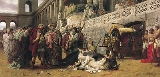
Persecution is the systematic mistreatment of an individual or group by another group. The most common forms are religious persecution, ethnic persecution, and political persecution, though there is naturally some overlap between these terms.
lass="link1" onMouseover='showByLink("m807689",this)' onMouseout='hide("m807689")'href="http://www.absoluteastronomy.com/topics/Telford_Taylor">Telford Taylor, who was Counsel for the Prosecution at the Nuremberg Trials wrote "[at] the Nuremberg war crimes trials, the tribunals rebuffed several efforts by the prosecution to bring such 'domestic' atrocities within the scope of international law as 'crimes against humanity'".
Several subsequent international treaties incorporate this principle, but some have dropped the restriction "in connection with any crime against peace or any war crime" that is in Nuremberg Principles the for example although only binding on the 60 states that have ratified it, the Rome Statute of the International Criminal Court) includes in Article 7 the definition for crimes against humanity, and clause 7.1 states "For the purpose of this Statute, "crime against humanity" means any of the following acts when committed as part of a widespread or systematic attack directed against any civilian population, with knowledge of the attack: ...

Discussion
Ask a question about 'Persecution'
Start a new discussion about 'Persecution'
Answer questions from other users
|
Quotations
Virtue is persecuted more by the wicked than it is loved by the good.
The religious persecution of the ages has been done under what was claimed to be the command of God. I distrust those people who know so well what God wants them to do to their fellows, because it always coincides with their own desires.

Encyclopedia
Persecution is the systematic mistreatment of an individual or group by another group. The most common forms are religious persecution, ethnic persecution, and political persecution, though there is naturally some overlap between these terms.
International law As part of the Nuremberg Principles, crimes against humanity are part of international law. Principle VI of the Nuremberg Principles states that
Telford Taylor, who was Counsel for the Prosecution at the Nuremberg Trials wrote "[at] the Nuremberg war crimes trials, the tribunals rebuffed several efforts by the prosecution to bring such 'domestic' atrocities within the scope of international law as 'crimes against humanity'".
Several subsequent international treaties incorporate this principle, but some have dropped the restriction "in connection with any crime against peace or any war crime" that is in Nuremberg Principles the for example although only binding on the 60 states that have ratified it, the Rome Statute of the International Criminal Court) includes in Article 7 the definition for crimes against humanity, and clause 7.1 states "For the purpose of this Statute, "crime against humanity" means any of the following acts when committed as part of a widespread or systematic attack directed against any civilian population, with knowledge of the attack: ... (h) Persecution against any identifiable group or collectivity on political, racial, national, ethnic, cultural, religious, gender as defined in paragraph 3, or other grounds that are universally recognized as impermissible under international law, in connection with any act referred to in this paragraph or any crime within the jurisdiction of the Court; ... ".
Religious persecution
Religious persecution is systematic mistreatment of an individual or group due to their religious affiliation.
Not only theorists of secularization (who presume a decline of religiosity in general) would willingly assume that religious persecution is a thing of the past. However, with the rise of fundamentalism and religiously related terrorism, this assumption has become even more controversial. Indeed, in many countries of the world today, religious persecution is a human rights problem.
Persecution of atheists
Atheists have experienced persecution throughout history. Persecution may refer to unwarranted arrest, imprisonment, beating, torture, or execution. It also may refer to the confiscation or destruction of property.
Persecution of Bahá'ís
The persecution of Bahá'ís refers to the religious persecution of Bahá'ís in various countries, especially in Iran, the location of one of the largest Bahá'í populations in the world. The Bahá'í Faith originated in Iran, and represents the largest religious minority in that country.
Persecution of Christians
The persecution of Christians is religious persecution that Christians sometimes undergo as a consequence of professing their faith, both historically and in the current era. In the two thousand years of the Christian faith, about 70 million believers have been killed for their faith, of whom 45.5 million or 65% were in the twentieth century according to "The New Persecuted" ("I Nuovi Perseguitati"). Currently, persecution of Christians is most severe in North Korea. In India, attacks by Hindu extremist against Christians occurs, especially in the states of Gujarat, Madhya Pradesh, and Orissa. According to a report by the the attacks include the murder of missionaries and priests, the sexual assault of nuns, the ransacking of churches, convents and other Christian institutions.[The Rise of Hindu Extremism and the Repression of Christian and Muslim minorities in India, ] Graham Staines, an Australian missionary, and his 2 children were burnt to death by a group of Hindu activists led by Dara Singh. In 2007 Orissa Violence, attacks were targeted by Vishwa Hindu Parishad and other Hindutva groups at Christian community and at least 70 churches and 600 houses were attacked and torched by Hindu extremists due to conversion initiated by certain Christian evangelist churches and insulting of Hindu Gods.
Persecution of Hindus
Persecution of Hindus refers to the religious persecution inflicted upon Hindus. Hindus have been historically persecuted during Islamic rule of the Indian subcontinent and during Portuguese rule of Goa. In modern times, Hindus in Kashmir, Pakistan, Bangladesh, Uganda and Fiji have also suffered persecution.
Persecution of Jehovah's Witnesses
Throughout the history of Jehovah's Witnesses, their beliefs, doctrines and practices have engendered controversy and opposition from the local governments, communities, or mainstream Christian groups.
Persecution of Jews
The persecution of Jews occurred many times in Jewish history.
Persecution of the Church of Jesus Christ of Latter-day Saints
With the Missouri extermination order Mormons have the distinct privilege of being the only Religious group to have a state of the United States legalize the extermination of their religion. Their forcible expulsion from the state caused the death of hundreds due to exposure, starvation, and resulting illnesses. The Mormons suffered through tarring and feathering, their lands and posessions being repeatedly taken from them, mob attacks, false imprisonments, and the US sending an army to Utah to deal with the "Mormon problem" in the Utah War. A government militia slaughtered Mormons in what is now known as the Haun's Mill massacre. The Founder of the Mormons, Joseph Smith, was killed in Carthage, Illinois by a mob of about 200 men.
In the 2008 US presidential race Mitt Romney's capability as president was attacked by evangelical Christians based on his membership in the LDS Church.
Persecution of Muslims
Persecution of Muslims is a recurring phenomenon during the history of Islam. Persecution may refer to unwarranted arrest, imprisonment, beating, torture, or execution. It also may refer to the confiscation or destruction of property, or incitement to hate Muslims. Persecution can extend beyond those who perceive themselves as Muslims to include those who are perceived by others as Muslims, or to Muslims which are considered by fellow Muslims as non-Muslims.
Persecution of Falun Gong
Falun Gong was introduced to the general public by Li Hongzhi(???) in Changchun, China, in 1992. For the next few years, Falun Gong was the fastest growing qigong practice in Chinese history and, by 1999, there were between 70 and 100 million people practicing Falun Gong in China. Following the seven years of wide-spread popularity, on July 20, 1999, the government of the People's Republic of China began a nationwide persecution campaign against Falun Gong practitioners, except in the special administrative regions of Hong Kong and Macau. In late 1999, legislation was created to outlaw "heterodox religions" and retroactively applied to Falun Gong. Amnesty International states that the persecution is "politically motivated" with "legislation being used retroactively to convict people on politically-driven charges, and new regulations introduced to further restrict fundamental freedoms".
Persecution of religions of the Western Hemisphere
Persecution of Indigenous religions was, and among many, remains one of the primary goals and results of the European and Christian invasions. The ongoing systemic and systematic assault upon Indigenous places of worship, sacred images and objects and upon religious specialists begins with the arrival of Christopher Columbus.
Hernan Cortez practiced a systematic policy of destroying indigenous places of worship and replacing them with Roman Catholic Churches and images of various christian saints, his personal favorite was a femail image associated with a crescent moon and a cross bearing the image of a dead man. He and many of his soldiers and followers regarded the invasion of the Western Hemisphere as a continuation of the Spanish Reconquista, a Holy War, in which tolerance had no place. He and his compatriots singled out Indigenous religious specialists of all kinds as "demonic" and they were often tortured to convert or summarily executed as a toxic pest if they did not. Vast quantities of sacred images have been destroyed sacred texts burned and the people converted by force of arms and the threat of death or torture.
Following the establishment of European (Christian) colonies controlling the entirety of Indigenous lands in the Western Hemisphere, these persecutorial activities continued. Indeed, the so called Colonial and National periods often represent a worsening of foreign persecutions.
The Modern European Colonial States (occupying almost the entirety of the Western Hemisphere) consistently confiscate important sacred sites and desacralize them to profit from the secular tourism industry.
In many parts of the Western Hemisphere, Indigenous religious specialists remain subject to European or Christian "laws" which demonize both practice and practitioner as satanic witches.
Indeed, the attack upon those who would integrate indigenous sacred plants into their lives and worship is now a multimillion dollar industry supported by taxpayer funds, confiscations and by favored European religious organizations.
Ethnic persecution
Ethnic persecution refers to perceived persecution based on ethnicity. Its meaning is parallel to racism, (based on race).
Persecution of Germans
The persecution of ethnic Germans refers to systematic activity against groups of ethnic Germans based on their ethnicity.
Historically, this has been due to two causes: the German population were considered, whether factually or not, linked with German nationalist regimes such as those of the Nazis or Kaiser Wilhelm. This was the case in the World War I era persecution of Germans in the United States, and also in Eastern and Central Europe following the end of World War II. While many victims of these persecutions did not, in fact, have any connection to those regimes, cooperation between German minority organisations and Nazi regime did occur, as the example of Selbstschutz shows, which is still used as a pretense of hostilities against those who did not take part in such organisations. After World War II, many such Volksdeutsche were killed or driven from their homes in acts of vengeance, others in ethnic cleansing of territories prior to populating them with citizens of the annexing country. In other cases (e.g. in the case of the formerly large German-speaking populations of Russia, Estonia, or the Transylvanian (Siebenbürgen) German minority in Rumania and the Balkans) such persecution was a crime committed against innocent communities who had played no part in the Third Reich.
Persecution based on genetics
Persecution of albinos
Persecution of albinos is based on the belief that certain body parts of albinistic people transmit magical powers. This superstition which is pesent in some parts of East Africa has been promulgated and exploited by witch doctors and others who use such body parts as ingredients in rituals, concoctions and potions with the claim that their magic will bring prosperity to the user. As a result albinos have been persecuted, killed and dismembered, and graves of albinistics dug up and desecrated. At the same time albinos have also been ostracized and even killed because they are presumed to bring bad luck.
See also
|