
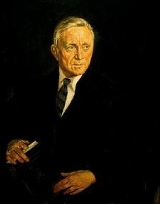
William Orville Douglas (October 16, 1898 – January 19, 1980) was an
Associate JusticeAssociate Justices of the Supreme Court of the United States are the members of the Supreme Court of the United States other than the Chief Justice of the United States...
of the United States Supreme Court. With a term lasting 36 years and 209 days, he is the
longest-serving justice in the history of the Supreme Court. In 1975, a
TimeTime is an American news magazine. A European edition is published from London. Time Europe covers the Middle East, Africa and, since 2003, Latin America. An Asian edition is based in Hong Kong...
article called Douglas "the most doctrinaire and committed civil libertarian ever to sit on the court."
During that time, he also established the records for the most opinions written, the most dissents written, the most speeches given, and the most books authored by any member of the Supreme Court. None of his successors has surpassed these records.
Early life
Douglas was born in Maine Township, Otter Tail County, Minnesota, the son of an itinerant
ScottishThe Scottish people , or Scots, are a nation and ethnic group native to Scotland. Historically they emerged from an amalgamation of the Picts and Gaels, incorporating neighbouring Britons to the south as well as invading Germanic peoples such as the Anglo-Saxons and the Norse.In modern use,...
Presbyterian minister from
Pictou County, Nova ScotiaPictou County is a county in the Canadian province of Nova Scotia. It was established in 1835, and was formerly a part of Halifax County from 1759 to 1835. It had a population of 46,513 people in 2006, which represents a decline of 6.3 percent from 1991. It is the sixth most populous county in Nova...
. His family moved to California, and then to
Cleveland, WashingtonCleveland is a tiny unincorporated community in Klickitat County, Washington, United States.Cleveland was first settled in 1879 by Ripley Dodge, who named it for the city of his native state of Ohio....
. His father died in
Portland, OregonPortland is a city located in the Pacific Northwest, near the confluence of the Willamette and Columbia rivers in the U.S. state of Oregon. As of the 2010 Census, it had a population of 583,776, making it the 29th most populous city in the United States...
, in 1904, when Douglas was only six years old. After moving from town to town in the West, his mother, with three young children, settled the family in
Yakima, WashingtonYakima is an American city southeast of Mount Rainier National Park and the county seat of Yakima County, Washington, United States, and the eighth largest city by population in the state itself. As of the 2010 census, the city had a total population of 91,196 and a metropolitan population of...
. William, like the rest of the Douglas family, worked at odd jobs to earn extra money, and a college education appeared to be unaffordable. Though not the
valedictorianValedictorian is an academic title conferred upon the student who delivers the closing or farewell statement at a graduation ceremony. Usually, the valedictorian is the highest ranked student among those graduating from an educational institution...
, Douglas did well enough in high school to earn a scholarship to
Whitman CollegeWhitman College is a private, co-educational, non-sectarian, residential undergraduate liberal arts college located in Walla Walla, Washington. Initially founded as a seminary by a territorial legislative charter in 1859, the school became a four year degree granting institution in 1883...
in
Walla Walla, WashingtonWalla Walla is the largest city in and the county seat of Walla Walla County, Washington, United States. The population was 31,731 at the 2010 census...
.
While at Whitman, Douglas became a member of
Beta Theta PiBeta Theta Pi , often just called Beta, is a social collegiate fraternity that was founded in 1839 at Miami University in Oxford, Ohio, USA, where it is part of the Miami Triad which includes Phi Delta Theta and Sigma Chi. It has over 138 active chapters and colonies in the United States and Canada...
Fraternity. He worked at various jobs while attending school, as a waiter and janitor during the school year, and at a cherry orchard in the summer. Picking cherries, Douglas would say later, inspired him to a legal career. He once said of his early interest in the law:
Douglas was elected Phi Beta Kappa, participated on the debate team, and was student body president in his final year. After graduating in 1920 with a B.A. in English and economics, he taught English and Latin at Yakima High Schools for the next two years, hoping to earn enough to attend law school. "Finally," he said, "I decided it was impossible to save enough money by teaching and I said to hell with it." He traveled to New York (taking on a job tending sheep on a Chicago-bound train, in return for free passage), with hopes to attend the
Columbia Law SchoolColumbia Law School, founded in 1858, is one of the oldest and most prestigious law schools in the United States. A member of the Ivy League, Columbia Law School is one of the professional graduate schools of Columbia University in New York City. It offers the J.D., LL.M., and J.S.D. degrees in...
. Douglas's Beta Theta Pi membership helped him survive in New York, as he stayed at one of its houses and was able to borrow $75 from a fraternity brother from Washington, enough to enroll at Columbia.
Six months later, Douglas's funds were running out. However, the appointments office at the law school let him know that a New York firm wanted a student to help prepare a correspondence course for law. Douglas earned $600 for his work, enabling him to stay in school. Moreover, he was called on for similar projects and had saved $1,000 by semester's end. He then went to
La Grande, Oregon-Demographics:As of the census of 2000, there were 12,327 people, 5,124 households, and 2,982 families residing in the city. The population density was 2,833.5 people per square mile . There were 5,483 housing units at an average density of 1,260.3 per square mile...
, to marry Mildred Riddle, whom he had known at Yakima. He graduated fifth in his class in 1925, although he would thereafter claim to have been second. He went to work at the prestigious New York firm of Cravath, DeGersdorff, Swaine and Wood (later
Cravath, Swaine & MooreCravath, Swaine & Moore LLP is a prominent American law firm based in New York City, with an additional office in London. The second oldest firm in the country, Cravath was founded in 1819 and consistently ranks first among the world's most prestigious law firms according to a survey of partners,...
).
Yale and the SEC
Douglas quit the Cravath firm after four months. After one year, he moved back to Yakima, but soon regretted the move and never actually practiced law there. After a time of unemployment and another months-long stint at Cravath, he went to teach at
Columbia Law SchoolColumbia Law School, founded in 1858, is one of the oldest and most prestigious law schools in the United States. A member of the Ivy League, Columbia Law School is one of the professional graduate schools of Columbia University in New York City. It offers the J.D., LL.M., and J.S.D. degrees in...
. He later joined the faculty of
Yale Law SchoolYale Law School, or YLS, is the law school of Yale University in New Haven, Connecticut, United States. Established in 1824, it offers the J.D., LL.M., J.S.D. and M.S.L. degrees in law. It also hosts visiting scholars, visiting researchers and a number of legal research centers...
.
At Yale, he became an expert on commercial litigation and bankruptcy, and was identified with the
legal realist movementLegal realism is a school of legal philosophy that is generally associated with the culmination of the early-twentieth century attack on the orthodox claims of late-nineteenth-century classical legal thought in the United States...
, which pushed for an understanding of law based less on formalistic legal doctrines and more on the real-world effects of the law. While teaching at Yale, he and fellow professor
Thurman ArnoldThurman Wesley Arnold was an iconoclastic Washington, D.C. lawyer. He was best known for his trust-busting campaign as Assistant Attorney General in charge of the Antitrust Division in Franklin Delano Roosevelt's Department of Justice from 1938 to 1943...
were riding the New Haven Railroad and were inspired to set the sign Passengers will please refrain... to
Antonin DvořákAntonín Leopold Dvořák was a Czech composer of late Romantic music, who employed the idioms of the folk music of Moravia and his native Bohemia. Dvořák’s own style is sometimes called "romantic-classicist synthesis". His works include symphonic, choral and chamber music, concerti, operas and many...
's
HumoresqueHumoresque is a genre of romantic music characterized by pieces with fanciful humor in the sense of mood rather than wit. The name refers to the German term Humoreske, which was given from the 1800s onward to humorous tales....
#7, which became a common theme on the train and later spread widely into popular culture as an often bawdy song.
In 1934, he left Yale to join the U.S. Securities and Exchange Commission (SEC), having been nominated by President
Franklin D. RooseveltFranklin Delano Roosevelt , also known by his initials, FDR, was the 32nd President of the United States and a central figure in world events during the mid-20th century, leading the United States during a time of worldwide economic crisis and world war...
. He became an adviser and friend to the President and SEC chairman in 1937.
During this time, Douglas became friends with a group of young New Dealers including
Tommy "The Cork" CorcoranThomas Gardiner Corcoran was one of several Irish American advisors in President Franklin D. Roosevelt's brain trust during the New Deal, and later, a close friend and advisor to President Lyndon B. Johnson....
and
Abe FortasAbraham Fortas was a U.S. Supreme Court associate justice from 1965 to 1969. Originally from Tennessee, Fortas became a law professor at Yale, and subsequently advised the Securities and Exchange Commission. He then worked at the Interior Department under Franklin D...
; this social/political group befriended a freshman Congressman from the 10th District of Texas: Lyndon Baines Johnson.
Robert CaroRobert Allan Caro is an American journalist and author known for his celebrated biographies of United States political figures Robert Moses and Lyndon B. Johnson...
, in his book "Years of Lyndon Johnson: Path to Power", states that, in 1937, Douglas helped persuade President Roosevelt to authorize a controversial dam, the Marshall Ford Dam, that was a key to cementing Johnson's power as a congressman. (461)
On the bench
In 1939, Justice Louis D. Brandeis resigned from the Supreme Court, and Roosevelt nominated Douglas as his replacement on March 20. Douglas later revealed that this had been a great surprise to him—Roosevelt had summoned him to an "important meeting," and Douglas feared that he was to be named as the chairman of the
Federal Communications CommissionThe Federal Communications Commission is an independent agency of the United States government, created, Congressional statute , and with the majority of its commissioners appointed by the current President. The FCC works towards six goals in the areas of broadband, competition, the spectrum, the...
. He was confirmed by the
United States SenateThe United States Senate is the upper house of the bicameral legislature of the United States, and together with the United States House of Representatives comprises the United States Congress. The composition and powers of the Senate are established in Article One of the U.S. Constitution. Each...
on April 4 by a vote of 62 to 4. The four negative votes were cast by four Republicans: Lynn J. Frazier,
Henry Cabot Lodge, Jr.Henry Cabot Lodge, Jr. was a Republican United States Senator from Massachusetts and a U.S. ambassador to the United Nations, South Vietnam, West Germany, and the Holy See . He was the Republican nominee for Vice President in the 1960 Presidential election.-Early life:Lodge was born in Nahant,...
, Gerald P. Nye, and
Clyde M. ReedClyde Martin Reed was an American politician from Kansas who served as both the 24th Governor of Kansas and U.S. Senator from that state....
. Douglas was sworn into office on April 17, 1939. At the age of forty, Douglas was one of the youngest justices to be confirmed to the Supreme Court.
Relationships with other justices
Douglas was often at odds with fellow Justice
Felix FrankfurterFelix Frankfurter was an Associate Justice of the United States Supreme Court.-Early life:Frankfurter was born into a Jewish family on November 15, 1882, in Vienna, Austria, then part of the Austro-Hungarian Empire in Europe. He was the third of six children of Leopold and Emma Frankfurter...
, who believed in
judicial restraintJudicial restraint is a theory of judicial interpretation that encourages judges to limit the exercise of their own power. It asserts that judges should hesitate to strike down laws unless they are obviously unconstitutional...
and thought the Court should stay out of politics. Douglas did not highly value judicial consistency or
stare decisisStare decisis is a legal principle by which judges are obliged to respect the precedents established by prior decisions...
when deciding cases.
Judicial philosophy
In general, legal scholars have noted that Douglas's judicial style was unusual in that he did not attempt elaborate justifications for his judicial positions on the basis of text, history, or precedent. Instead, Douglas was known for writing short, pithy opinions which relied on philosophical insights, observations about current politics, and literature, as much as more conventional "judicial" sources.
Ultimately, he believed that a judge's role was "not neutral." "The Constitution is not neutral. It was designed to take the government off the backs of the people...."
On the bench Douglas became known as a strong advocate of
First AmendmentThe First Amendment to the United States Constitution is part of the Bill of Rights. The amendment prohibits the making of any law respecting an establishment of religion, impeding the free exercise of religion, abridging the freedom of speech, infringing on the freedom of the press, interfering...
rights. With fellow Justice
Hugo BlackHugo Lafayette Black was an American politician and jurist. A member of the Democratic Party, Black represented Alabama in the United States Senate from 1927 to 1937, and served as an Associate Justice of the Supreme Court of the United States from 1937 to 1971. Black was nominated to the Supreme...
, Douglas argued for a "literalist" interpretation of the
First AmendmentThe First Amendment to the United States Constitution is part of the Bill of Rights. The amendment prohibits the making of any law respecting an establishment of religion, impeding the free exercise of religion, abridging the freedom of speech, infringing on the freedom of the press, interfering...
, insisting that the First Amendment's command that "no law" shall restrict freedom of speech should be interpreted literally. He wrote the opinion in Terminiello v. City of Chicago (1949) overturning the conviction of a Catholic priest who allegedly caused a "breach of the peace" by making anti-Semitic comments during a raucous public speech. Douglas, joined by Black, furthered his advocacy of a broad reading of First Amendment rights by dissenting from the Supreme Court's decision in
Dennis v. United StatesDennis v. United States, , was a United States Supreme Court case involving Eugene Dennis, general secretary of the Communist Party USA, which found that Dennis did not have a right under the First Amendment to the Constitution of the United States to exercise free speech, publication and assembly,...
(1952) affirming the conviction of the leader of the U.S.
Communist PartyA political party described as a Communist party includes those that advocate the application of the social principles of communism through a communist form of government...
.
In 1944 Douglas voted with the majority to uphold Japanese wartime internment, in
Korematsu v. United StatesKorematsu v. United States, 323 U.S. 214 , was a landmark United States Supreme Court case concerning the constitutionality of Executive Order 9066, which ordered Japanese Americans into internment camps during World War II....
, but over the course of his career he grew to become a leading advocate of individual rights. Suspicious of majority rule as it related to social and moral questions, he frequently expressed concern at forced conformity with "the Establishment" in his opinions. For example, Douglas wrote the lead opinion in
Griswold v. ConnecticutGriswold v. Connecticut, , was a landmark case in which the Supreme Court of the United States ruled that the Constitution protected a right to privacy. The case involved a Connecticut law that prohibited the use of contraceptives...
, finding a "right to privacy" in the "penumbras" of the first eight amendments of the
Bill of RightsThe Bill of Rights is the collective name for the first ten amendments to the United States Constitution. These limitations serve to protect the natural rights of liberty and property. They guarantee a number of personal freedoms, limit the government's power in judicial and other proceedings, and...
. This went too far for his old ally Black, who dissented in Griswold.
The Rosenberg Case
On June 17, 1953, Douglas granted a temporary stay of execution to Ethel and Julius Rosenberg, who had been convicted of selling the plans for the atomic bomb to the Russians. The basis for the stay was that the Rosenbergs had been sentenced to die by Judge
Irving KaufmanIrving Robert Kaufman was a federal judge in the United States. He is best remembered for imposing the controversial death sentences on Julius and Ethel Rosenberg.-Biography:...
without the consent of the
juryA jury is a sworn body of people convened to render an impartial verdict officially submitted to them by a court, or to set a penalty or judgment. Modern juries tend to be found in courts to ascertain the guilt, or lack thereof, in a crime. In Anglophone jurisdictions, the verdict may be guilty,...
. While this was permissible under the
Espionage Act of 1917The Espionage Act of 1917 is a United States federal law passed on June 15, 1917, shortly after the U.S. entry into World War I. It has been amended numerous times over the years. It was originally found in Title 50 of the U.S. Code but is now found under Title 18, Crime...
, which the Rosenbergs were tried under, a later law, the
Atomic Energy Act of 1946The Atomic Energy Act of 1946 determined how the United States federal government would control and manage the nuclear technology it had jointly developed with its wartime allies...
, held that only the jury could pronounce the death penalty. Since at the time the stay was granted the Supreme Court was out of session, it meant that the Rosenbergs could expect to wait at least six months before the case was heard.
When Attorney General Herbert Brownell heard about the stay, however, he immediately took his objection to
Chief JusticeThe Chief Justice of the United States is the head of the United States federal court system and the chief judge of the Supreme Court of the United States. The Chief Justice is one of nine Supreme Court justices; the other eight are the Associate Justices of the Supreme Court of the United States...
Fred M. VinsonFrederick Moore Vinson served the United States in all three branches of government and was the most prominent member of the Vinson political family. In the legislative branch, he was an elected member of the United States House of Representatives from Louisa, Kentucky, for twelve years...
, who took the unprecedented step of reconvening the Court before the appointed date and set aside Douglas's stay. Because of opposition to his decision, Douglas briefly faced
impeachmentImpeachment is a formal process in which an official is accused of unlawful activity, the outcome of which, depending on the country, may include the removal of that official from office as well as other punishment....
proceedings in Congress, but attempts to remove him from the Court went nowhere.
Douglas and the environment
Douglas was a self-professed outdoorsman, so much so that according to The Thru-Hiker's Companion, a guide published by the
Appalachian TrailThe Appalachian National Scenic Trail, generally known as the Appalachian Trail or simply the AT, is a marked hiking trail in the eastern United States extending between Springer Mountain in Georgia and Mount Katahdin in Maine. It is approximately long...
Club, Douglas hiked the entire 2,000-mile trail from Georgia to Maine.
His love for the environment carried through to his judicial reasoning.
"Trees have standing"
In his dissenting opinion in the landmark environmental law case,
Sierra Club v. Morton, 405 U.S. 727 (1972), Justice Douglas argued that "inanimate objects" should have standing to sue in court:
He continued:
In the early 1970s, Douglas and his wife Cathleen were invited by Neil Compton and the Ozark Society to visit and canoe down part of the free-flowing
Buffalo RiverThe Buffalo River, located in northern Arkansas, was the first National River to be designated in the United States. The Buffalo River is slightly more than in length, with the lower flowing within the boundaries of an area managed by the National Park Service, where it is designated the '. The...
in Arkansas, putting in at the low water bridge at Boxley. This experience endeared him to the river and the young organization's idea of protecting it. As such Douglas was instrumental in having it preserved as a free-flowing river, left in its natural state. This decision was much to the chagrin of the area's
Corps of Army EngineersThe United States Army Corps of Engineers is a federal agency and a major Army command made up of some 38,000 civilian and military personnel, making it the world's largest public engineering, design and construction management agency...
. The act that soon followed designated the Buffalo River as America's first National River.
Environmentalism
Besides his famous dissent in Morton, he also served on the Board of Directors of the
Sierra ClubThe Sierra Club is the oldest, largest, and most influential grassroots environmental organization in the United States. It was founded on May 28, 1892, in San Francisco, California, by the conservationist and preservationist John Muir, who became its first president...
from 1960 to 1962 and wrote prolifically on his love of the outdoors. He is credited with saving the
Chesapeake and Ohio CanalThe Chesapeake and Ohio Canal, abbreviated as the C&O Canal, and occasionally referred to as the "Grand Old Ditch," operated from 1831 until 1924 parallel to the Potomac River in Maryland from Cumberland, Maryland to Washington, D.C. The total length of the canal is about . The elevation change of...
and inspiring the effort to establish the area as a
national parkA national park is a reserve of natural, semi-natural, or developed land that a sovereign state declares or owns. Although individual nations designate their own national parks differently A national park is a reserve of natural, semi-natural, or developed land that a sovereign state declares or...
; going as far as to challenge the editorial board of
The Washington PostThe Washington Post is Washington, D.C.'s largest newspaper and its oldest still-existing paper, founded in 1877. Located in the capital of the United States, The Post has a particular emphasis on national politics. D.C., Maryland, and Virginia editions are printed for daily circulation...
to go with him for a walk on the canal after it had published opinions supporting Congress's plan to pave the canal into a road. His efforts convinced the editorial board to change its stance and helped save the park.
In 1962, Douglas wrote a glowing review of
Rachel CarsonRachel Louise Carson was an American marine biologist and conservationist whose writings are credited with advancing the global environmental movement....
's book
Silent SpringSilent Spring is a book written by Rachel Carson and published by Houghton Mifflin on 27 September 1962. The book is widely credited with helping launch the environmental movement....
, which was included in the widely read Book-of-the-Month Club edition. He later would sway the Court in the direction of preserving the
Red River GorgeThe Red River Gorge is a canyon system on the Red River in east-central Kentucky. Geologically, it is part of the Pottsville Escarpment.Much of the Gorge is located inside the Daniel Boone National Forest and has been subsequently reserved as the Red River Gorge Geological Area, an area of around...
in eastern
KentuckyThe Commonwealth of Kentucky is a state located in the East Central United States of America. As classified by the United States Census Bureau, Kentucky is a Southern state, more specifically in the East South Central region. Kentucky is one of four U.S. states constituted as a commonwealth...
when a proposal to build a dam and flood the gorge reached the Court. Douglas visited the area himself on November 18, 1967. The Red River Gorge's Douglas Trail is named in his honor.
In 1969 he wrote Points of Rebellion and authored a piece for
EvergreenEvergreen Review is a U.S.-based literary magazine founded by Barney Rosset, publisher of Grove Press. It existed in print from 1957 through 1973, and was re-launched online in 1998...
magazine. Two years later, Justice Douglas helped launch the nation's first law review dedicated solely to environmental issues by publishing a paper in Lewis & Clark Law School's new law review,
Environmental LawEnvironmental Law is a law review focused on environmental and natural resources law published by students at Lewis & Clark Law School in Portland, Oregon. Founded in 1969, it is the nation's oldest law review covering natural resources and environmental law...
.
In presidential politics
When, in early 1944, President Franklin D. Roosevelt decided not to actively support the renomination of Vice President
Henry A. WallaceHenry Agard Wallace was the 33rd Vice President of the United States , the Secretary of Agriculture , and the Secretary of Commerce . In the 1948 presidential election, Wallace was the nominee of the Progressive Party.-Early life:Henry A...
at the party's national convention, a shortlist of possible replacements was drafted. The names on the list included former Senator and Supreme Court Justice
James F. ByrnesJames Francis Byrnes was an American statesman from the state of South Carolina. During his career, Byrnes served as a member of the House of Representatives , as a Senator , as Justice of the Supreme Court , as Secretary of State , and as the 104th Governor of South Carolina...
of
South CarolinaSouth Carolina is a state in the Deep South of the United States that borders Georgia to the south, North Carolina to the north, and the Atlantic Ocean to the east. Originally part of the Province of Carolina, the Province of South Carolina was one of the 13 colonies that declared independence...
, former Senator (and future Supreme Court justice)
Sherman MintonSherman "Shay" Minton was a Democratic United States Senator from Indiana and an Associate Justice of the Supreme Court of the United States. He was the most educated justice during his time on the Supreme Court, having attended Indiana University, Yale and the Sorbonne...
and former Governor and
High Commissioner to the PhilippinesHigh Commissioner to the Philippines was the title of the personal representative of the President of the United States to the Commonwealth of the Philippines during the period 1935-1946. The office was created by the Tydings-McDuffie Act of 1934, which provided for a period of transition from...
Paul McNutt of Indiana,
House SpeakerThe Speaker of the United States House of Representatives, or Speaker of the House, is the presiding officer of the United States House of Representatives...
Sam RayburnSamuel Taliaferro Rayburn , often called "Mr. Sam," or "Mr. Democrat," was a Democratic lawmaker from Bonham, Texas, who served as the Speaker of the U.S. House of Representatives for seventeen years, the longest tenure in U.S. history.- Background :Rayburn was born in Roane County, Tennessee, and...
of Texas, Senator
Alben W. BarkleyAlben William Barkley was an American politician in the Democratic Party who served as the 35th Vice President of the United States , under President Harry S. Truman....
of
KentuckyThe Commonwealth of Kentucky is a state located in the East Central United States of America. As classified by the United States Census Bureau, Kentucky is a Southern state, more specifically in the East South Central region. Kentucky is one of four U.S. states constituted as a commonwealth...
, Senator Harry S Truman of
MissouriMissouri is a US state located in the Midwestern United States, bordered by Iowa, Illinois, Kentucky, Tennessee, Arkansas, Oklahoma, Kansas and Nebraska. With a 2010 population of 5,988,927, Missouri is the 18th most populous state in the nation and the fifth most populous in the Midwest. It...
, and Douglas.
Five days before the vice presidential nominee was to be chosen at the convention, on July 15,
Committee ChairmanThe Democratic National Committee is the principal organization governing the United States Democratic Party on a day to day basis. While it is responsible for overseeing the process of writing a platform every four years, the DNC's central focus is on campaign and political activity in support...
Robert E. HanneganRobert Emmet Hannegan was a St. Louis, Missouri politician who served as Commissioner of Internal Revenue from October 1943 to January 1944. He also served as chairman of the Democratic National Committee from 1944 to 1947 and United States Postmaster General from 1945 to 1947...
received a letter from Roosevelt stating that his choice for the nominee would be either "Harry Truman or Bill Douglas." After releasing the letter to the convention on July 20, the nomination went without incident, and Truman was nominated on the second ballot.
After the convention, Douglas's supporters spread the rumor that the note sent to Hannegan had, in fact, read "Bill Douglas or Harry Truman," not the other way around. These supporters claimed that Hannegan, a Truman supporter, feared that Douglas's nomination would drive southern white voters away from the ticket (Douglas had a very anti-
segregationRacial segregation is the separation of humans into racial groups in daily life. It may apply to activities such as eating in a restaurant, drinking from a water fountain, using a public toilet, attending school, going to the movies, or in the rental or purchase of a home...
record on the Supreme Court) and had switched the names to give the impression that Truman was Roosevelt's real choice. Evidence uncovered recently by Douglas's biographers, however, has discredited this story and seems to prove that Truman's name was first all along. If nominated for vice president and elected under Roosevelt, Douglas would have become the 33rd President after Roosevelt's death.
By 1948, Douglas's presidential aspirations were rekindled by the extremely low popularity of Truman, who had become president in 1945 on Roosevelt's death. Many Democrats, believing that Truman could not be reelected in November, began attempting to find a replacement candidate. Attempts were made to draft popular retired war hero General
Dwight D. EisenhowerDwight David "Ike" Eisenhower was the 34th President of the United States, from 1953 until 1961. He was a five-star general in the United States Army...
for the nomination. A "Draft Douglas" campaign, complete with souvenir buttons and hats, sprang up in
New HampshireNew Hampshire is a state in the New England region of the northeastern United States of America. The state was named after the southern English county of Hampshire. It is bordered by Massachusetts to the south, Vermont to the west, Maine and the Atlantic Ocean to the east, and the Canadian...
and several other primary states. Douglas himself even campaigned for the nomination for a short time, but he soon withdrew his name from consideration.
In the end, Eisenhower refused to be drafted and Truman won nomination easily. Although Truman approached Douglas about the vice presidential nomination, the Justice turned him down. Douglas's close associate Tommy Corcoran was later heard to ask, "Why be a number two man to a number two man?" Truman instead selected Senator
Alben W. BarkleyAlben William Barkley was an American politician in the Democratic Party who served as the 35th Vice President of the United States , under President Harry S. Truman....
and the two went on to win the
electionThe United States presidential election of 1948 is considered by most historians as the greatest election upset in American history. Virtually every prediction indicated that incumbent President Harry S. Truman would be defeated by Republican Thomas E. Dewey. Truman won, overcoming a three-way...
.
Rosenberg case
On June 17, 1953, Representative
William M. WheelerWilliam McDonald Wheeler was a U.S. Representative from Georgia.Born near Alma, Georgia, Wheeler attended the public schools and South Georgia College at Douglas, Middle Georgia College at Cochran, Georgia Teachers College at Statesboro, Georgia.LL.B, Atlanta Law School, 1966.Farmer.He was a...
, infuriated by Douglas's brief stay of execution in the
Rosenberg caseEthel Greenglass Rosenberg and Julius Rosenberg were American communists who were convicted and executed in 1953 for conspiracy to commit espionage during a time of war. The charges related to their passing information about the atomic bomb to the Soviet Union...
, introduced a resolution to impeach Justice Douglas. The resolution was referred to the Judiciary Committee to investigate the charges the next day. On July 7, the committee voted to end the investigation.
Parvin Foundation
Justice Douglas maintained a busy speaking and publishing schedule to supplement his income. He became severely burdened financially due to a bitter divorce and settlement with his first wife, and only sank deeper into financial difficulties as settlements with his second and third wives consumed much of his salary as an Associate Justice.
Douglas's steps to supplement his income included the unusual move of becoming president of the Parvin Foundation. His ties with the foundation (which was financed by the sale of the infamous Flamingo Hotel by casino financier and foundation founder Albert Parvin) became a prime target for then-House Minority Leader Gerald R. Ford. Besides being personally disgusted by Douglas's allegedly illicit lifestyle, Representative Ford was also mindful that Douglas protégé
Abe FortasAbraham Fortas was a U.S. Supreme Court associate justice from 1965 to 1969. Originally from Tennessee, Fortas became a law professor at Yale, and subsequently advised the Securities and Exchange Commission. He then worked at the Interior Department under Franklin D...
was forced to resign because of ties to a foundation similar to the Parvin. Fortas would later say that he "resigned to save Douglas," thinking that the dual investigations into them would stop with his resignation.
Some scholars have argued that Ford's impeachment attempt was politically motivated. Those who support this contention note Ford's well-known disappointment with the Senate over the failed nominations of
Clement HaynsworthClement Furman Haynsworth, Jr. was a United States judge and an unsuccessful nominee for the United States Supreme Court....
and G. Harrold Carswell to succeed Fortas. Thus, in April 1970, Congressman Ford moved to impeach Douglas in an attempt to hit back at the Senate. Despite careful maneuvering by House Judiciary Chairman
Emanuel CellerEmanuel Celler was an American politician from New York who served in the United States House of Representatives for almost 50 years, from March 1923 to January 1973. He was a member of the Democratic Party.-Early life:...
and an apparent lack of proof of any criminal conduct on the part of Douglas (efforts by Attorney General
John N. MitchellJohn Newton Mitchell was the Attorney General of the United States from 1969 to 1972 under President Richard Nixon...
and the Nixon administration to gather evidence to the contrary notwithstanding), Congressman Ford moved forward in the first major attempt to impeach a Supreme Court Justice in the modern era.
The hearings began in late April 1970. Congressman Ford was the main witness, and attacked Douglas's "liberal opinions," his "defense of the 'filthy' film"
I Am Curious (Yellow)I Am Curious is a 1967 Swedish drama film written and directed by Vilgot Sjöman and starring Sjöman and Lena Nyman. It is a companion film to 1968's I Am Curious ; the two were initially intended to be one 3½ hour film...
, and his ties with the aforementioned Parvin. Additionally, Douglas was criticized for accepting $350 for an article he wrote on folk music in the magazine
Avant GardeAvant Garde was a magazine notable for graphic and logogram design by Herb Lubalin. The magazine had 14 issues and was published from January 1968 to July 1971.The editor was Ralph Ginzburg.Avant Garde 3 published in May 1968 lists in the masthead...
. The magazine's publisher had served a prison sentence for the distribution of another magazine in 1966 that had been deemed
pornographicPornography or porn is the explicit portrayal of sexual subject matter for the purposes of sexual arousal and erotic satisfaction.Pornography may use any of a variety of media, ranging from books, magazines, postcards, photos, sculpture, drawing, painting, animation, sound recording, film, video,...
. Describing Douglas's article, Ford stated, "The article itself is not pornographic, although it praises the lusty, lurid, and risqué along with the social protest of left-wing folk singers." Ford also attacked Douglas for his article in Evergreen Magazine, which was infamous for its proclivity for pictures of naked women. The Republican congressmen, however, refused to give the majority Democrats copies of the magazines, prompting Congressman
Wayne HaysWayne Levere Hays was an American politician whose strong rule of the House Administration Committee extended to even the smallest items. In the mid-1970s, lawmakers avoided crossing Hays for fear that he would shut off the air conditioning in their offices...
to remark "Has anybody read the article – or is everybody over there who has a magazine just looking at the pictures?"
When it became clear that the impeachment proceedings would be unsuccessful, they were brought to a close and no public vote on the matter was taken. The effort to impeach Douglas and the struggles over the Fortas, Haynesworth, and Carswell nominations marked the beginning of a more partisan climate during the confirmation process of Supreme Court nominees.
Records
During his tenure on the Supreme Court, Justice Douglas achieved a number of records, all of which stand. In addition to serving on the Court for longer than any other Justice, he also managed to write more
opinionIn general, an opinion is a subjective belief, and is the result of emotion or interpretation of facts. An opinion may be supported by an argument, although people may draw opposing opinions from the same set of facts. Opinions rarely change without new arguments being presented...
s and
dissenting opinionA dissenting opinion is an opinion in a legal case written by one or more judges expressing disagreement with the majority opinion of the court which gives rise to its judgment....
s, give more speeches, and author more books than any other Justice. Douglas also holds the record among Justices for having had the most wives (four) and the most
divorceDivorce is the final termination of a marital union, canceling the legal duties and responsibilities of marriage and dissolving the bonds of matrimony between the parties...
s while on the bench (three).
Retirement
Since his 1970 impeachment hearings, Douglas had wanted to retire from the Court. He wrote to his friend and former student
Abe FortasAbraham Fortas was a U.S. Supreme Court associate justice from 1965 to 1969. Originally from Tennessee, Fortas became a law professor at Yale, and subsequently advised the Securities and Exchange Commission. He then worked at the Interior Department under Franklin D...
: "My ideas are way out of line with current trends, and I see no particular point in staying around and being obnoxious."
On December 31, 1974, while on vacation in the Bahamas, Douglas suffered a debilitating stroke in his right brain hemisphere, leaving him paralyzed in his left leg and became a wheelchair user. Severely disabled, Douglas nevertheless insisted on continuing to participate in Supreme Court affairs, despite his obvious incapacity. Seven of Douglas's fellow justices voted to put off any argued case in which Douglas's vote might make a difference over to the next term. At the urging of Fortas, Douglas finally retired on November 12, 1975, after 36 years of service. It was Douglas's old nemesis, now-
PresidentThe President of the United States of America is the head of state and head of government of the United States. The president leads the executive branch of the federal government and is the commander-in-chief of the United States Armed Forces....
Gerald FordGerald Rudolph "Jerry" Ford, Jr. was the 38th President of the United States, serving from 1974 to 1977, and the 40th Vice President of the United States serving from 1973 to 1974...
, to whom he had to submit his resignation and who appointed his successor,
John Paul StevensJohn Paul Stevens served as an Associate Justice of the Supreme Court of the United States from December 19, 1975 until his retirement on June 29, 2010. At the time of his retirement, he was the oldest member of the Court and the third-longest serving justice in the Court's history...
.
However, according to Woodward and Armstrong, Douglas refused to accept his own decision to retire, and attempted to continue participating in the Court's cases well into 1976, after Stevens had taken his seat. Douglas reacted with outrage when returning to his old chambers to discover that his clerks had been reassigned to Stevens, and attempted to file opinions in cases whose arguments he had heard before his retirement. Burger ordered all Justices, clerks, and other staffers to refuse to assist Douglas in these efforts, and when Douglas attempted in March 1976 to hear arguments in a capital punishment case (
Gregg v. GeorgiaGregg v. Georgia, Proffitt v. Florida, Jurek v. Texas, Woodson v. North Carolina, and Roberts v. Louisiana, 428 U.S. 153 , reaffirmed the United States Supreme Court's acceptance of the use of the death penalty in the United States, upholding, in particular, the death sentence imposed on Troy Leon...
), the nine sitting Justices signed a formal letter informing him that his retirement had ended his official duties on the Court. It was only then that Douglas stopped attempting to participate in Supreme Court business. His behavior has been attributed to the condition called
anosognosiaAnosognosia /æˌnɒsɒgˈnəʊsɪə/ is a condition in which a person who suffers disability seems unaware of the existence of his or her disability. Unlike denial, which is a defense mechanism, anosognosia is rooted in physiology...
following his stroke, a neuropsychological presentation in which the affected person is unaware and unable to acknowledge disease in himself. It also often results in defects in reasoning, decision making, emotions, and feeling.
Nicknames
During his time on the Supreme Court, Douglas picked up a number of
nicknameA nickname is "a usually familiar or humorous but sometimes pointed or cruel name given to a person or place, as a supposedly appropriate replacement for or addition to the proper name.", or a name similar in origin and pronunciation from the original name....
s, which were bestowed upon him by both his admirers and his detractors. The most common epithet was
Wild Bill, which he received for his independent and unpredictable stances and
cowboyA cowboy is an animal herder who tends cattle on ranches in North America, traditionally on horseback, and often performs a multitude of other ranch-related tasks. The historic American cowboy of the late 19th century arose from the vaquero traditions of northern Mexico and became a figure of...
-style mannerisms, although many of the latter were affectations for the consumption of the press.
Personal life
Douglas married Mildred Riddle, a teacher at
North Yakima High SchoolDavis High School is a high school in Yakima, Washington, USA, serving students in grades 9-12. It is part of the Yakima School District and has approximately 2,000 students.-History:...
, on August 16, 1923. They had two children, Mildred and William, Jr. William played Gerald Zinser in
PT 109PT 109 is a 1963 biographical film which depicts the actions of John F. Kennedy in command of Motor Torpedo Boat PT-109 as an officer of the United States Navy during World War II. The movie was adapted by Vincent Flaherty and Howard Sheehan from the book PT 109: John F. Kennedy in World War II by...
. Mildred divorced Douglas on July 20, 1953.
On December 14, 1954, he married Mercedes Davidson, whom he had been seeing while married to Mildred.
He married Joan Martin, a 23-year-old law student, on August 5, 1963, five days after his divorce from Mercedes was finalized.
He married Cathleen Heffernan, a 22-year old college student, on July 15, 1966, two weeks after his divorce from Joan was finalized. They remained together until his death.
Douglas's marriages and his alleged womanizing were a matter of controversy. In 1966, Robert Dole compared his "bad judgment from a matrimonial standpoint" to his court decisions, and four separate resolutions were introduced in the
United States House of RepresentativesThe United States House of Representatives is one of the two Houses of the United States Congress, the bicameral legislature which also includes the Senate.The composition and powers of the House are established in Article One of the Constitution...
calling for investigation of his moral character.
Douglas is buried in
Arlington National CemeteryArlington National Cemetery in Arlington County, Virginia, is a military cemetery in the United States of America, established during the American Civil War on the grounds of Arlington House, formerly the estate of the family of Confederate general Robert E. Lee's wife Mary Anna Lee, a great...
, near the grave of former Supreme Court Justice
Oliver Wendell Holmes, Jr.Oliver Wendell Holmes, Jr. was an American jurist who served as an Associate Justice of the Supreme Court of the United States from 1902 to 1932...
His qualification for burial at Arlington – whether he had served in the military – has been the subject of controversy.
The
William O. Douglas WildernessThe William O. Douglas Wilderness is a designated wilderness located in central portion of the U.S. state of Washington. It includes 168,232 acres located between the U.S. Route 12 and State Route 410 and is jointly administered by the Snoqualmie National Forest and the Gifford Pinchot National...
, which adjoins
Mount Rainier National ParkMount Rainier National Park is a United States National Park located in southeast Pierce County and northeast Lewis County in Washington state. It was one of the US's earliest National Parks, having been established on March 2, 1899 as the fifth national park in the United States. The park contains...
in Washington State, is named in his honor, as Douglas had both an intimate connection to that area and a deep commitment to environmental protection. Douglas was a friend and frequent guest of Harry Randall Truman, owner of the
Mount St. HelensMount St. Helens is an active stratovolcano located in Skamania County, Washington, in the Pacific Northwest region of the United States. It is south of Seattle, Washington and northeast of Portland, Oregon. Mount St. Helens takes its English name from the British diplomat Lord St Helens, a...
Lodge at
Spirit LakeSpirit Lake is a lake north of Mount St. Helens in Washington State. The lake was a popular tourist destination for many years until the 1980 eruption of Mount St. Helens. With the eruption and resulting megatsunami, thousands of trees were torn from the surrounding hillside after lake water was...
in Washington.
Douglas FallsDouglas Falls are a 60 foot waterfall located in Buncombe County, North Carolina, USA. It is on a tributary of Waterfall Creek which flows into the Ivy River, and it is within the Big Ivy section of the Pisgah National Forest. The stream flows off the slope of Craggy Pinnacle, starting just below...
in the
Appalachian MountainsThe Appalachian Mountains #Whether the stressed vowel is or ,#Whether the "ch" is pronounced as a fricative or an affricate , and#Whether the final vowel is the monophthong or the diphthong .), often called the Appalachians, are a system of mountains in eastern North America. The Appalachians...
of
North CarolinaNorth Carolina is a state located in the southeastern United States. The state borders South Carolina and Georgia to the south, Tennessee to the west and Virginia to the north. North Carolina contains 100 counties. Its capital is Raleigh, and its largest city is Charlotte...
is also named after him, as is the William O. Douglas Outdoor Classroom in
Beverly Hills, CaliforniaBeverly Hills is an affluent city located in Los Angeles County, California, United States. With a population of 34,109 at the 2010 census, up from 33,784 as of the 2000 census, it is home to numerous Hollywood celebrities. Beverly Hills and the neighboring city of West Hollywood are together...
.
Dedications
The William O. Douglas Committee, a select group of law students at
Gonzaga UniversityGonzaga University is a private Roman Catholic university located in Spokane, Washington, United States. Founded in 1887 by the Society of Jesus, it is one of 28 member institutions of the Association of Jesuit Colleges and Universities and is named after the young Jesuit saint, Aloysius Gonzaga...
in
Spokane, WashingtonSpokane is a city located in the Northwestern United States in the state of Washington. It is the largest city of Spokane County of which it is also the county seat, and the metropolitan center of the Inland Northwest region...
has sponsored a series of lectures on the
First AmendmentThe First Amendment to the United States Constitution is part of the Bill of Rights. The amendment prohibits the making of any law respecting an establishment of religion, impeding the free exercise of religion, abridging the freedom of speech, infringing on the freedom of the press, interfering...
since 1972, in Douglas's honor. Douglas was the first speaker for the annual series.
The honors college at
Central Washington UniversityCentral Washington University, often abbreviated CWU, is a public university in Ellensburg, Washington in the United States.This location was selected by the state legislature as a consolation prize after Ellensburg lost its bid to be state capital...
in
Ellensburg, WashingtonEllensburg is a city in, and the county seat of, Kittitas County, Washington, United States. The population was 18,174 at the 2010 census. The population was 18,250 at 2011 Estimate from Office of Financial Management. Ellensburg is located just east of the Cascade Range on I-90 and is known as the...
bears Douglas's name.
A statue of Douglas is in place in the courtyard of A.C. Davis High School, in
Yakima, WashingtonYakima is an American city southeast of Mount Rainier National Park and the county seat of Yakima County, Washington, United States, and the eighth largest city by population in the state itself. As of the 2010 census, the city had a total population of 91,196 and a metropolitan population of...
. Also at Yakima, the
William O. Douglas Federal BuildingThe William O. Douglas Federal Building is a historic post office, courthouse, and federal office building located at Yakima in Yakima County, Washington. It is a courthouse for the United States District Court for the Eastern District of Washington. Renamed in 1978, it was previously known as U. S...
was named for him in 1978. At Douglas's alma mater,
Whitman CollegeWhitman College is a private, co-educational, non-sectarian, residential undergraduate liberal arts college located in Walla Walla, Washington. Initially founded as a seminary by a territorial legislative charter in 1859, the school became a four year degree granting institution in 1883...
, William O. Douglas Hall is a much-sought-after dormitory among second-, third-, and fourth-year students. Douglas Hall, an apartment for continuing students at
Earl Warren CollegeEarl Warren College is one of the six undergraduate colleges at the University of California at San Diego and is named after the three term California Governor and former Chief Justice of the United States Earl Warren. Warren College emphasizes the importance of living a balanced life. Founded in...
, at the
University of California, San DiegoThe University of California, San Diego, commonly known as UCSD or UC San Diego, is a public research university located in the La Jolla neighborhood of San Diego, California, United States...
is named for him as well.
Primary sources
The papers of William O. Douglas from his career as professor of law, Securities and Exchange commissioner, and associate justice of the United States Supreme Court were bequeathed by Douglas to the
Library of CongressThe Library of Congress is the research library of the United States Congress, de facto national library of the United States, and the oldest federal cultural institution in the United States. Located in three buildings in Washington, D.C., it is the largest library in the world by shelf space and...
.
- Go East, Young Man: The Early Years; The Autobiography of William O. Douglas ISBN 0-394-71165-3
- The Court Years, 1939 to 1975: The Autobiography of William O. Douglas ISBN 0-394-49240-4
- Democracy and finance: The addresses and public statements of William O. Douglas as member and chairman of the Securities and Exchange Commission ISBN 0-8046-0556-4
- Nature's Justice: Writings of William O. Douglas ISBN 0-87071-482-1
- Strange Lands and Friendly People, by William O. Douglas ISBN 1-4067-7204-6
- Points of Rebellion, by William O. Douglas ISBN 0-394-44068-4
- An Interview with William O. Douglas by William O. Douglas (sound recording) ASIN B000S592XI
- An Interview with William O. Douglas Folkway Records FW 07350
- The Mike Wallace Interview, with Mike Wallace
Myron Leon "Mike" Wallace is an American journalist, former game show host, actor and media personality. During his 60+ year career, he has interviewed a wide range of prominent newsmakers....
May 11, 1958 (video)
- The Mike Wallace Interview, May 11, 1958 (transcript)
Secondary sources
- Abraham, Henry J., Justices and Presidents: A Political History of Appointments to the Supreme Court. 3d. ed. (New York: Oxford University Press, 1992). ISBN 0-19-506557-3.
- Cushman, Clare, The Supreme Court Justices: Illustrated Biographies,1789–1995 (2nd ed.) (Supreme Court Historical Society), (Congressional Quarterly Books, 2001) ISBN 1-56802-126-7; ISBN 978-1-56802-126-3.
- Frank, John P., The Justices of the United States Supreme Court: Their Lives and Major Opinions (Leon Friedman and Fred L. Israel, editors) (Chelsea House Publishers: 1995) ISBN 0-7910-1377-4, ISBN 978-0-7910-1377-9.
- Hall, Kermit L., ed. The Oxford Companion to the Supreme Court of the United States. New York: Oxford University Press, 1992. ISBN 0-19-505835-6; ISBN 978-0-19-505835-2.
- Martin, Fenton S. and Goehlert, Robert U., The U.S. Supreme Court: A Bibliography, (Congressional Quarterly Books, 1990). ISBN 0-87187-554-3.
- Murphy, Bruce Allen
Bruce Allen Murphy, Ph.D., is a judicial biographer and scholar of American Constitutional law and politics. He is the Fred Morgan Kirby Professor of Civil Rights at Lafayette College in Easton, Pennsylvania, a position he has held since 1998...
, Wild Bill: The Legend and Life of William O. Douglas, (New York: Random HouseRandom House, Inc. is the largest general-interest trade book publisher in the world. It has been owned since 1998 by the German private media corporation Bertelsmann and has become the umbrella brand for Bertelsmann book publishing. Random House also has a movie production arm, Random House Films,...
, 2003), ISBN 0-394-57628-4
- Pritchett, C. Herman , Civil Liberties and the Vinson Court. (The University of Chicago
The University of Chicago is a private research university in Chicago, Illinois, USA. It was founded by the American Baptist Education Society with a donation from oil magnate and philanthropist John D. Rockefeller and incorporated in 1890...
Press, 1969) ISBN 978-0-226-68443-7; ISBN 0-226-68443-1.
- Urofsky, Melvin I., Conflict Among the Brethren: Felix Frankfurter, William O. Douglas and the Clash of Personalities and Philosophies on the United States Supreme Court, Duke Law Journal
The Duke Law Journal is a student-run law review published at Duke University School of Law. The journal publishes general-interest articles and student notes in eight issues each year.- Overview :...
(1988): 71–113.
- Urofsky, Melvin I., Division and Discord: The Supreme Court under Stone and Vinson, 1941–1953 (University of South Carolina Press, 1997) ISBN 1-57003-120-7.
- Urofsky, Melvin I., The Supreme Court Justices: A Biographical Dictionary (New York: Garland Publishing 1994). 590 pp. ISBN 0-8153-1176-1; ISBN 978-0-8153-1176-8.
- Woodward, Robert
Robert Upshur Woodward is an American investigative journalist and non-fiction author. He has worked for The Washington Post since 1971 as a reporter, and is currently an associate editor of the Post....
and Armstrong, ScottScott Armstrong is the current director of Information Trust, a former journalist for the Washington Post, and founder of the National Security Archive...
. The Brethren: Inside the Supreme Court (1979). ISBN 978-0-380-52183-8; ISBN 0-380-52183-0. ISBN 978-0-671-24110-0; ISBN 0-671-24110-9; ISBN 0-7432-7402-4; ISBN 978-0-7432-7402-9.
See also
External links