

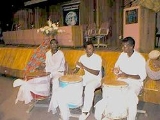
Music of Brazil

Encyclopedia
The music of Brazil
encompasses various regional music
styles influenced by Africa
n, Europe
an and Amerindian
forms. After 500 years of history, Brazilian music developed some unique and original styles such as samba
, zouk-lambada
, lambada
, choro
, bossa nova
, frevo
, maracatu
, MPB
, sertanejo
, Brazilian rock
, axé
, brega
, and others. Samba has become the best known form of Brazilian music worldwide, especially because of the country's carnival
, although bossa nova, which had Antônio Carlos Jobim
as one of its most acclaimed composers and performers, have received much attention abroad since the 1950s, when the song Desafinado, interpreted by João Gilberto
, was first released. Instrumental music is also largely practiced in Brazil, with styles ranging from classical
to popular
and jazz
influenced forms, featuring composers like Heitor Villa-Lobos
, Pixinguinha
and Hermeto Pascoal
. The country also has a growing community of modern/experimental composition, including electroacoustic music
.
comes from the activities of two Jesuit priests in 1549. Ten years later, they had already founded settlements for indigenous people (the Reduções), with a musical-educational structure.
One century later, the Reduções of the southern Brazil, which were founded by Spaniard Jesuits, had a strong cultural development, where some music schools were founded. Some of the reports of that time show the fascination of the indigenous people for European music. The Indians also took part in the music, with both the construction of musical instruments and practice of vocal and instrumental performance. The musical standards were, naturally, from the European culture, and the purpose of the musicalization for the indigenous people was mostly for Catechism
, with negligible original creative contribution by themselves. Later, the remaining Indians who survived the massacre
s and epidemics went to the more remote regions of Brazil, escaping from contact with the European settlers, and their part in the national musical life diminished, eventually almost completely disappearing.
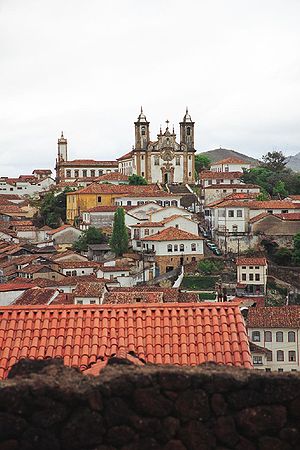 In the 18th century, there was intense musical activity in all the more developed regions of Brazil, with their moderately stable institutional and educational structures. The previously few private orchestras became more common and the churches presented a great variety of music.
In the first half of this century, the most outstanding works were composed by Luís Álvares Pinto, Caetano de Mello de Jesus and Antônio José da Silva
("the Jew"), who became successful in Lisbon
writing libretto
s for comedies, which were performed also in Brazil with music by António Teixeira
.
In the second part of the 18th century, there was a great flourishing in Minas Gerais
, mostly in the regions of Vila Rica (currently Ouro Preto
), Mariana
and Arraial do Tejuco (currently Diamantina), where the mining of gold and diamonds for the Portuguese metropolis attracted a sizable population. At this time, the first outstanding Brazilian composers were revealed, most of them mulatto
es. The musical pieces were mostly sacred music. Some of the noteworthy composers of this period were Lobo de Mesquita, Manoel Dias de Oliveira, Francisco Gomes da Rocha, Marcos Coelho Neto and Marcos Coelho Neto Filho. All of them were very active, but in many cases few pieces have survived until the present day. Some of the most famous pieces of this period are the Magnificat by Manuel Dias de Oliveira and the Our Lady's Antiphon by Lobo de Mesquita. In the city of Arraial do Tejuco, nowadays Diamantina, there were ten conductors in activity. In Ouro Preto
about 250 musicians were active, and in all of the territory of Minas Gerais almost a thousand musicians were active.
With the impoverishment of the mines at the end of the century, the focus of the musical activity changed to other centers, specially Rio de Janeiro
and São Paulo
, where André da Silva Gomes
, a composer of Portuguese origin, released a great number of works and dynamized the musical life of the city.
 A crucial factor for the changes in the musical life was the arrival of the Portuguese household in Rio de Janeiro
in 1808. Until then, Rio de Janeiro was musically similar to other cultural centers of Brazil, and was even less important than Minas Gerais, but the presence of the household radically changed this situation.
The king John VI of Portugal
brought with him to Brazil the great musical library from the House of Bragança, one of the best of Europe at that time, and ordered the arrival of musicians from Lisbon
and the castrati from Italy
, re-ordering the Royal Chapel. Later, John VI ordered the construction of a sumptuous theater, called the Royal Theater of São João. The secular music had the presence of Marcos Portugal
, who was designated as the official composer of the household, and of Sigismund von Neukomm
, who contributed with his own work and brought the works of the Austrian composers Wolfgang Amadeus Mozart
and Joseph Haydn
. The works of these composers strongly influenced the Brazilian music of this time.
José Maurício Nunes Garcia
, the first of the great Brazilian composers, emerged at this time. With a large culture for his origin – he was poor and mulatto – he was one of the founders of the Irmandade de Santa Cecília, in Rio de Janeiro, teacher and kappelmeister of the Royal Chapel during the presence of John VI in Brazil. Nunes Garcia was the most prolific Brazilian composer of this time. He also composed the first opera written in Brazil, Le Due Gemelle (The Two Twins), with text in Italian, but the music is now lost.
Other important composers of this period are Gabriel Fernandes da Trindade, who composed the only Brazilian chamber music
from the 19th century which has survived to the present times, and João de Deus de Castro Lobo, who lived in the cities of Mariana and Ouro Preto, which were decadent at this time.
This period, however, was brief. In 1821, John VI went back to Lisbon, taking with him the household, and the cultural life in Rio de Janeiro became empty. And, despite the love of Peter I of Brazil
for the music – he was also author of some musical pieces like the Brazilian Independence Anthem – the difficult financial situation didn't allow many luxuries. The conflagration of the Royal Theater in 1824 was another symbol of decadence, which reached the most critical point when Peter I renounced the throne, going back to Portugal.
.jpg) The only composer who had a relevant work in this period was Francisco Manuel da Silva, disciple of Nunes Garcia, who suceedeed him as kappelmeister. Despite of his few resources, he founded the Musical Conservatory of Rio de Janeiro. He was the author of the Brazilian National Anthem
The only composer who had a relevant work in this period was Francisco Manuel da Silva, disciple of Nunes Garcia, who suceedeed him as kappelmeister. Despite of his few resources, he founded the Musical Conservatory of Rio de Janeiro. He was the author of the Brazilian National Anthem
's melody. His work reflected the musical transition for the Romanticism
, when the interest of the national composers was focused in the opera
. The most outstanding Brazilian composer of this period was Antônio Carlos Gomes
, who composed Italian-styled operas with national themes, such as Il Guarany
(based on José de Alencar
's novel O Guarani) and Lo Schiavo
. These operas were very successful in European theaters, like the Teatro alla Scala, in Milan
. Other important composer of this time is Elias Álvares Lobo
, who wrote the opera A Noite de São João, the first Brazilian opera with text in Portuguese.
The opera in Brazil was very popular until the middle of the 20th century, and many opera houses were built at this time, like Teatro Amazonas in Manaus
, Municipal Theater of Rio de Janeiro, Municipal Theater of São Paulo
do Rio, and many others.
At the end of the 19th century, the greatest composers for the symphonic music were revealed. One of the most outstanding name of this period was Leopoldo Miguez
, who followed the wagnerian
style and Henrique Oswald
, who incorporated elements of the French Impressionism
.
.jpg) In the beginning of the 20th century, there was a movement for creating an authentically Brazilian music, with less influences of the European culture. In this sense, the folklore
In the beginning of the 20th century, there was a movement for creating an authentically Brazilian music, with less influences of the European culture. In this sense, the folklore
was the major font of inspiration for the composers. Some composers like Brasílio Itiberê da Cunha, Luciano Gallet
and Alexandre Levy
, despite having a European formation, included some typically Brazilian elements in their works. This trend reached the highest point with Alberto Nepomuceno
, who used largely the rhythms and melodies from the Brazilian folklore.
An important event, later, was the Modern Art Week, in 1922, which had a large impact on concepts of national art. In this event the composer Heitor Villa-Lobos
, regarded as the most outstanding name of the Brazilian nationalism, was revealed.
Villa-Lobos did researches about the musical folklore of Brazil, and mixed elements both from classical and popular music. He explored many musical genres such as concerto
s, symphonies
, ballet
s, opera
s and other symphonic, vocal and chamber music. Some of his masterworks are the ballet Uirapuru
, their choros and the popular symphonic series Bachianas Brasileiras.
Some other composers of this time are Oscar Lorenzo Fernández
, Francisco Mignone
, Camargo Guarnieri
and Osvaldo Lacerda
(who is still alive).
, in 1939 the Movimento Música Viva (Living Music Movement) appeared, led by Hans Joachim Koellreutter and by Egídio de Castro e Silva, defending the adoption of an international style, derived from the dodecaphonism of Arnold Schoenberg
. This group was integrated by composers like Cláudio Santoro
, César Guerra-Peixe
, Eunice Catunda and Edino Krieger. Koellreutter adopted revolutionary methodes, in respect to the individuality of each student and giving to the students the freedom of creativity before the knowledge of the traditional rules for composition. The movement edited a magazine and presented a series of radio
programs showing their fundaments and works of contemporary music. Later, Guerra-Peixe and Santoro followed an independent way, centered in the regional music. Other composers, who used freely the previous styles were Marlos Nobre
, Almeida Prado
, and Armando Albuquerque, who created their own styles.
After 1960, the Brazilian avant-garde movement received a new wave, focusing on serial music, microtonal music
, concrete music and electronic music
, employing a completely new language. This movement was called Música Nova (New Music) and was led by Gilberto Mendes
and Willy Corrêa de Oliveira.
, André Mehmari, Ronaldo Miranda
, Edson Zampronha
, Joao MacDowell
and Jailton de Oliveira.
Brazil has a large number of internationally recognized orchestras and performers, despite the relatively low support of the government. The most famous Brazilian orchestra is probably the São Paulo State Symphony, currently under the French conductor Yan Pascal Tortelier
. Other Brazilian orchestras worthy of note are the São Paulo University Symphony, the Orquestra Sinfônica Brasileira and the Petrobras Sinfônica, supported by the Brazilian state oil company Petrobras
.
There are also regular operas scheduled every year in cities such as São Paulo
and Rio de Janeiro
. The state of São Paulo also hosts the Winter Festival in the city of Campos do Jordão
.
Some of the most famous Brazilian conductors are Roberto Minczuk, John Neschling
and Isaac Karabtchevsky
. The instrumentalists include, among others: Roberto Szidon
, Antonio Meneses
, Cussy de Almeida, Gilberto Tinetti, Arnaldo Cohen
, Nelson Freire
, Eudóxia de Barros, Guiomar Novaes
and Magda Tagliaferro
. And some of the most famous Brazilian singers were, historically, Zola Amaro, Constantina Araújo and Bidu Sayão
; living singers include Eliane Coelho
, Kismara Pessatti, Maria Lúcia Godoy, Sebastião Teixeira, and others.
The intrusion of alien elements into Brazil’s cultural system is not a destructive process. The return of a democratic government allowed for freedom of expression. The Brazilian music industry opened up to international styles and this has allowed for both foreign and local genres to co-exist and identify people. Each different style relates to the people socially, politically, and economically. “Brazil is a regionally divided country with a rich cultural and musical diversity among states. As such, musicians in the country choose to define their local heritage differently depending on where they come from.” This shows how globalization has not robbed Brazil of its identity but instead given it the ability to represent its people both in Brazil and the rest of the world.
play instruments including whistle
s, flute
s, horn
s, drums and rattle
s. Much of the area's folk music imitates the sounds of the Amazon Rainforest
. When the Portuguese arrived in Brazil, the first natives they met played an array of reed flute
s and other wind
and percussion instrument
s. The Jesuit
missionaries
introduced songs which used the Tupi language with Christian lyrics, an attempt to convert the people to Christianity, and also introduced Gregorian chant
and the flute, bow, and the clavichord
.
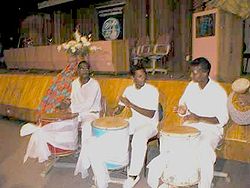 The earliest music in what is now Brazil must have been that of the native peoples of the area. Little is known about their music, since no written records exist of this era. With the arrival of Europeans, Brazilian culture began to take shape as a synthesis of native musical styles with Portuguese music and African music.
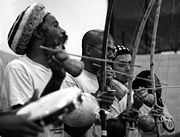 The Afro-Brazilian
sport of capoeira
is never played without its own music, which is usually considered to be a call-and-response type of folk music. The main instruments of capoeira music include the berimbau
, the atabaque
and the pandeiro
. Capoeira songs may be improvised on the spot, or they may be popular songs written by older, and ancient mestres (teachers), and often include accounts of the history of capoeira, or the doings of great mestres.
and Olinda
regions during Carnaval. It is an Afro-Brazilian
tradition. The music serves as the backdrop for parade groups that evolved out of ceremonies conducted during colonial times in honour of the Kings of Congo, who were African slaves occupying symbolic leadership positions among the slave population. The music is played on large alfaia
drums, large metal gonguê bells, snare drums and shakers. An important variant is found in and around Fortaleza, Ceará (called maracatu cearense), which is different from the Recife/Olinda tradition in many respects: triangles are used instead of gonguês, surdo
s or zabumba
s instead of alfaias. Also, important female characters are performed by cross-dressed male performers, and all African and Afrobrazilian personages are performed using blackface makeup.
, part of the Candomblé
tradition. In 1949, a group called Filhos de Gandhi began playing afoxé during carnaval
parades in Salvador; their name translates as Sons of Gandhi, associating black Brazilian activism with Mahatma Gandhi
's indian independence movement. The Filhos de Gandhi's 1949 appearance was also revolutionary because, until then, the Carnaval parades in Salvador were meant only for light-skinned people.
is known for a distinctive form of literature called literatura de cordel, which are a type of ballad
s that include elements incorporated into music as "repentismo", an improvised lyrical contest on themes suggested by the audience.
Similar to Repentismo, appears among the Caipira
culture a musical form derived from Viola Caipira, which is called Cururu.
music, which is centered around Belém
. In the 1960s, carimbo was electrified and, in the next decade, DJs added elements from reggae
, salsa
and merengue. This new form became known as lambada
and soon moved to Bahia
, Salvador by the mid-1980s. Bahian lambada was synthesizer-based and light pop music. French record producers discovered the music there, and brought it back with them to France
passing by Portugal
, where a Bolivia
n group called Los Kjarkas
saw their own composition launch an international dance craze. Soon, lambada had spread throughout the world and the term soon became meaninglessly attached to multiple varieties of unrelated Brazilian music, leading to purist scorn from Belém and also Bahia.
Another form of regional folk music
, bumba-meu-boi
, was popularized by the Carnival celebrations of Parintins
and is now a major part of the Brazilian national scene.
published his first choro (Não Caio Noutra) in 1878 at the age of 14. Nazareth's choros are often listed as polkas; he also composed waltz
es, schottische
s, milonga
s and Brazilian Tangos. (He resisted the popular term maxixe
to represent Brazilian tango.) Chiquinha Gonzaga
was another important composer of choros and started shortly after Nazareth. Chiquinha Gonzaga
composed her first success, the polka-choro "Atraente", in 1877. In the beginning, the success of choro came from informal groups of friends which played in parties, pubs (botecos), streets, home balls (forrobodós), and also the musical scores published by print houses. By the 1910s, much of the Brazilian first phonograph records are choros. The mainstream success of this style of music (By the 1930s) came from the early days of radio, when bands performed live on the air. By the 1950s and 1960s it was replaced by samba
and Bossa Nova
and other styles of Brazilian popular music, but was still alive in amateur circles called "rodas de choro" (informal choro gatherings in residences and botecos). However, in the late 1970s there was a successful effort to revitalize the genre carried out by some famous artists: Pixinguinha
, Waldir Azevedo and Jacob do Bandolim
.
 In 1929, prompted by the opening of the first radio station in Rio de Janeiro, the so-called radio era began spreading songs – especially the novelty Samba in its current format – to larger masses. This period was dominated by few male interpreters – notably Almirante
, Braguinha
, Mário Reis
, Sílvio Caldas, Francisco Alves
and singer/composer Noel Rosa
and even fewer chanteuses such as Aracy de Almeida
and sisters Aurora Miranda
and Carmen Miranda
, who eventually came to Hollywood becoming a movie star.
Popular music included instruments like cuica
s, tambourine
s, frying pan
s ('played' with a metal stick), flute
s and guitar
s. Noteworthy Samba composers at this early stage included said Noel Rosa
plus Lamartine Babo and, around World War II
time, Ary Barroso
.
 MPB's early stage (from World War II to the mid-60s) was populated by male singers such as Orlando Silva, Nelson Gonçalves
, Jamelão
, Agostinho dos Santos, Anísio Silva
, Ataulfo Alves, Carlos Galhardo, Ciro Monteiro, Ismael Silva, João Dias
, Jorge Goulart, Miltinho, Jorge Veiga and Francisco Egídio and female singers started to mushroom: Nora Ney
, Dolores Duran
, Ângela Maria, Emilinha Borba
, Marlene
, Dalva de Oliveira
, Maysa Matarazzo
, sisters Linda Batista
and Dircinha Batista, among others.
MPB's second stage – after the split Bossa Nova
(1959) / Jovem Guarda
(1965) / Tropicalismo
and Malandragem
(both 1967) – refers to mainstream Brazilian pop music. Well-known MPB artists include, among many others, singers such as Elis Regina
, Marisa Monte
, Nara Leão
, Maria Bethânia
, Mônica da Silva
, Simone
, Chico Buarque
, Caetano Veloso
, Roberto Carlos
, Jorge Benjor, Milton Nascimento
, Gilberto Gil
, João Bosco
, Ivan Lins
, Djavan
.
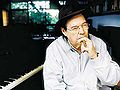 The first bossa nova
records by João Gilberto
, in the last years of the 50s, quickly became huge hits in Brazil. Antonio Carlos Jobim
and other composer
s helped further develop this fusion of jazz
harmonies and a smoother, often slower, samba beat, which developed at the beach neighborhoods of Ipanema
and, later, the Copacabana nightclubs. Bossa nova was introduced to the rest of the world by American jazz musicians in the early 1960s, and song "The Girl from Ipanema
" remains probably the best known Brazilian musical export, eventually becoming a kind of jazz standard.
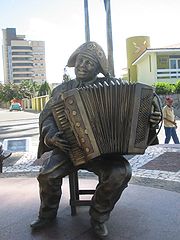 North eastern music is a generic term for any popular music from the large region of Northeastern Brazil, including both coastal and inland areas. Rhythms are slow and plodding, and are derived from accordion
s and guitar
s instead of percussion instrument
s like in the rest of Brazil—in this region, African rhythms and Portuguese melodies combined to form maracatu
and dance music called baião has become popular. Most influentially, however, the area around the state of Pernambuco
, the home of forró
, frevo
and maracatu
.
state, in Southern Brazil. It is somewhat of a mixture between Argentinian-Uruguayan styles with Portuguese melodies and aboriginal rhythms. Some of the most famous musicians of this genre are Renato Borghetti
, Yamandu Costa
, Jayme Caetano Braun
and Luiz Marenco
, among others.
during the Salvadoran Carnaval, identifying with their shared struggles through history. These groups included Comanches do Pelô and Apaches de Tororó and were known for a forceful and powerful style of percussion, and frequent violent encounters with the police. Starting in 1974, a group of black Bahians called Ilê Aiyê
became prominent, identifying with the Yoruba people
and Igbo people
of West Africa
. Along with a policy of loosening restrictions by the Brazilian government, Ilê Aiyê's sound and message spread to groups like Grupo Cultural do Olodum
, who established community centers and other philanthropic efforts.
is a style of music from Olinda
and Recife
. Frevo bands always play during the Carnival.
, a triangle and an accordion
. Forró is eminently danceable, and became one of the foundations for the lambada
in the 1980s. Luiz Gonzaga
was the preeminent early forró musician who popularized the genre in Rio de Janeiro and São Paulo in the 1940s with songs like "Asa Branca
".
, from Pelourinho, are generally credited with the mid-1980s invention of samba-reggae, a fusion of Jamaica
n reggae
with samba. Olodum retained the politically-charged lyrics of bands like Ilê Aiyê.
. In Rio it is most often simply known as Funk, although it is very different musically from what Funk
means in most other places and contexts. Funk Carioca, like other types of hip-hop lifts heavily from samples such as international rips or from previous funk music. Many popular funk songs sampled music from the movie Rocky
.
Funk as well as rap was introduced to Brazil in a systematic way in the 1980s. These types of music were heavily supported in big cities by people—usually teenagers—of lower socioeconomic status. Many funk artists have openly associated themselves with black movements and often in the lyrics of their songs, comment on race relations and openly express black pride.
In São Paulo
and other places in the south of Brazil, in more urban areas, rap is more prevalent than funk. The lower class, mostly nonwhite rappers are referred to as "Rapeiros". They dress similarly to American rappers that they have seen on television. Early Brazilian rap was based upon rhyming speeches delivered over dance bases sampled from funk albums, with occasional scratches. São Paulo has gained a strong, underground Brazilian rap scene since it's emergence in the late 1980s with many independent labels forming for young rappers to establish themselves on.
In the 1990s in Rio de Janeiro
, funk as well as rap were reported by the press to have been adopted by the drug lords of the city as a way to market their drugs at dance hall events. Some crime groups were known to subsidize funk parties to recruit young kids into the drug dealing business. These events were often called baile funk (which can mean a funk dance party) and were sometimes notorious for their blatant sexuality and violence. However, while some funk and rap music was used to send messages out about slums and drugs, others were used mostly to deliver socio-political messages about local, regional, or national issues they are affected by. In fact, some groups adhered to what they called rap consciência (socially conscious rap) and opposed hip-hop which some considered too alienated and consumerist. Despite these differences, both types of music continue to thrive in Brazil today.
" in 1954. In the 1960s, young singers like Roberto Carlos
and the Jovem Guarda
movement were very popular. The 60s also saw the rise of bands such as the "tropicalistas
" Os Mutantes
and the experimental (mixing progressive rock
, jazz
and Música Popular Brasileira
) O Som Imaginário.
The 1970s saw the emergence of many progressive rock
and/or hard rock
bands such as O Terço
, A Bolha
, A Barca do Sol, Som Nosso de Cada Dia, Vímana
and Bacamarte
, some of which attained some recognition internationally; Rita Lee
, in her solo career after Os Mutantes
, championed the glam-rock aesthetics in Brazil; Casa das Máquinas
and Patrulha do Espaço were more bona-fide hard rock
bands, and the likes of (Raul Seixas
, Secos e Molhados
, Novos Baianos
and A Cor do Som
) mixed the genre with traditional Brazilian music. In the late 1970s, the Brazilian punk rock
scene kicked off mainly in São Paulo and in Brasília, booming in the 80s, with Inocentes
, Cólera
, Ratos de Porão
, Garotos Podres
, etc.
The real commercial boom of Brazilian rock was in the 1980s, with many bands and artists like Blitz
, Gang 90, Barão Vermelho
, Legião Urbana
, Engenheiros do Hawaii
, Titãs
, Kid Abelha
, Paralamas do Sucesso
, and many others, and festivals like Rock in Rio
and Hollywood Rock
. The late 1980s and early 1990s also witnessed the beginnings of an electronica-inspired scene, with a lot more limited commercial potential but achieving some critical acclaim: Suba
, Loop B, Harry
, etc.
In the 90s, the meteoric rise of Mamonas Assassinas
, which sold more than 3 million copies of its only CD (a record, by Brazilian standards) came to a tragic end when the band's plane crashed, killing all five members of the band, the pilot and the co-pilot. Other commercially successful bands included Jota Quest
, Raimundos
and Skank
, while Chico Science & Nação Zumbi and the whole Mangue Beat movement received much critical attention and accolades, but very little commercial success – success that declined after the death of one of its founders, Chico Science
. It was also in the 90s that the first seeds of what would grow into being the Brazilian indie scene were planted, with the creation of indie festivals such as Abril Pro Rock and, later in the decade, Porão do Rock.
As of 2010, the Brazilian variant of Happy Rock music is very popular, with groups such as Restart
and Cine. Female singer Pitty
is also very popular. The indie scene has been growing exponentially since the early 2000s, with more and more festivals taking place all around the country. However, due to several factors including but not limited to the worldwide collapse of the music industry, all the agitation in the indie scene has so far failed in translating into international success, but in Brazil they developed a real, substantial cultural movement. That scene is still much of a ghetto, with bands capturing the attention of international critics, but many playing again in Brazil when they become popular in the exterior, due to the lack of financial and material support which would allow for careers to be developed. The notable exception is CSS, an alternative electro rock outfit that has launched a successful international career, performing in festivals and venues in North America, Europe, Asia and Australia. The record company Trama http://trama.uol.com.br/portalv2/home/index.jsp tries to support some bands with structure and exposure, and can be credited with early support to CSS.
originated in the mid 80s with three prominent scenes: Belo Horizonte, São Paulo and Rio de Janeiro. The most famous Brazilian metal bands are Sepultura
, Angra
, Krisiun
, Rebaelliun
, Nephasth, Dr. Sin
, Shaaman
, Violator
and the singer Andre Matos
. Sepultura is considered an influential thrash metal
band, influencing the development of death metal
.
Famous bands of the 1980s include Korzus
, Sarcófago
, Overdose, Dorsal Atlântica
, Viper
, MX
, PUS, Mutilator, Chakal, Vulcano and Attomica. Bands from the 1990s include Andralls, Mental Horror
, Symbols
, The Mist, Scars
, Distraught, Torture Squad
, Eterna and Silent Cry. Bands from the 2000s include Eyes of Shiva, Tuatha de Danann
, Claustrofobia, Apokalyptic Raids and Wizards.
artists such as Bob Dylan
and Johnny Cash
alongside clear influences by Brazilian troubadours such as Chico Buarque
and Caetano Veloso
. The first to break into the mainstream was internet phenomenon Mallu Magalhães
, who played covers of her favourite artists in English and her own songs in both English and Portuguese (as well as other languages). Magalhães only released her first album in 2008, though by then she was already widely recognised as the voice of this sudden new Brazilian folk scene. Her ex-boyfriend Hélio Flanders is the lead singer of another Brazilian folk group called Vanguart. Though Vanguart had an album released before Mallu Magalhães, it was her emergence that consolidated them both and others as a fully recognised mainstream scene, topping charts and being featured in prime time television and advertising. Other acts emerged after the market was opened up to folk. Writing in English is more and more common among Brazilian rock and folk artists. This has been highly criticised by purists, though it has helped to promote Brazilian artists in other countries (CSS is a perfect example). The new Brazilian folk scene has just come to the public's attention and it continues to thrive.
. It originally referred to music originating among Sertão
and musica caipira
. (Caípira music appeared in the state of São Paulo
, Mato Grosso do Sul
, Goiás
and some the regions of Minas Gerais
, Paraná
, Mato Grosso
and Mato Grosso do Sul
. Musical rhythm very spread out in the Southeastern and southern regions of Brazil.) But it has since gained more influences from outside Brazil. In particular American country music, Mexican mariachi
, and the Music of Paraguay
. For several years it was a category at the Latin Grammy Awards
.
music or other music containing the zouk beat. The name Brazilian Zouk is used to distinguish the dance from the Caribbean Zouk dance style, which is historically related to, but very different from the Lambada dance style. The two dominant styles of Zouk-Lambada are the Porto-Seguro style and the Rio-style. The word Lambazouk is often used to refer exclusively to one or the other style depending on the region you live. The word Lambazouk was originally used to refer to the dance style developed by Daniel and Leticia Estévez López, although they use the term M-zouk nowadays (for Mallorca-zouk) The Zouk-Lambada dancing styles are among the most popular non-ballroom dances for couples in Brazil, others being Forró
, Lambada
, Samba de gafieira and Salsa
.
Brazil
Brazil , officially the Federative Republic of Brazil , is the largest country in South America. It is the world's fifth largest country, both by geographical area and by population with over 192 million people...
encompasses various regional music
Music
Music is an art form whose medium is sound and silence. Its common elements are pitch , rhythm , dynamics, and the sonic qualities of timbre and texture...
styles influenced by Africa
Africa
Africa is the world's second largest and second most populous continent, after Asia. At about 30.2 million km² including adjacent islands, it covers 6% of the Earth's total surface area and 20.4% of the total land area...
n, Europe
Europe
Europe is, by convention, one of the world's seven continents. Comprising the westernmost peninsula of Eurasia, Europe is generally 'divided' from Asia to its east by the watershed divides of the Ural and Caucasus Mountains, the Ural River, the Caspian and Black Seas, and the waterways connecting...
an and Amerindian
Indigenous peoples in Brazil
The Indigenous peoples in Brazil comprise a large number of distinct ethnic groups who inhabited the country prior to the European invasion around 1500...
forms. After 500 years of history, Brazilian music developed some unique and original styles such as samba
Samba
Samba is a Brazilian dance and musical genre originating in Bahia and with its roots in Brazil and Africa via the West African slave trade and African religious traditions. It is recognized around the world as a symbol of Brazil and the Brazilian Carnival...
, zouk-lambada
Zouk-Lambada
Zouk-Lambada is a group of closely related dance styles based on or evolved from the lambada dance style and is typically danced to zouk music or other music containing the zouk beat...
, lambada
Lambada
Lambada is a dance from Pará, Brazil. The dance became internationally popular in the 1980s, especially in Latin America and Caribbean countries...
, choro
Choro
Choro , traditionally called chorinho , is a Brazilian popular music instrumental style. Its origins are in 19th century Rio de Janeiro. In spite of the name, the style often has a fast and happy rhythm, characterized by virtuosity, improvisation, subtile modulations and full of syncopation and...
, bossa nova
Bossa nova
Bossa nova is a style of Brazilian music. Bossa nova acquired a large following in the 1960s, initially consisting of young musicians and college students...
, frevo
Frevo
Frevo is a wide range of musical styles originating from Recife, Pernambuco, Brazil, all of which are traditionally associated with Brazilian Carnival. The word frevo is said to come from frever, a misspeaking of the Portuguese word ferver . It is said that the sound of the frevo will make...
, maracatu
Maracatu
Maracatu is a term common to two distinct performance genres found in Pernambuco state in northeastern Brazil: maracatu de nação and maracatu rural . A third style, maracatu cearense , is found in Fortaleza, in the northeastern state of Ceará...
, MPB
Música Popular Brasileira
Música Popular Brasileira or MPB designates a trend in post-Bossa Nova urban popular music. It is not a discrete genre but rather a constellation that combines original songwriting and updated versions of traditional Brazilian urban music styles like samba and samba-canção with contemporary...
, sertanejo
Música sertaneja
Música sertaneja or Sertanejo is a music style that had its origins in the countryside of Brazil in the 1920s .Sertanejo is currently the most popular music style in Brazil, arguably more popular than samba in most Brazilian states , even though samba is still quite popular in Rio de Janeiro...
, Brazilian rock
Brazilian rock
Brazilian rock refers to rock music produced in Brazil and usually sung in Portuguese.-Overview:Rock entered the Brazilian music scene in 1956, with the screening of the film The Blackboard Jungle, featuring Bill Haley's "Rock Around the Clock", which would later be covered in Portuguese by Nora...
, axé
Axe
The axe, or ax, is an implement that has been used for millennia to shape, split and cut wood; to harvest timber; as a weapon; and as a ceremonial or heraldic symbol...
, brega
Brega (music)
Brega is a genre of Brazilian popular music. The name, originally pejorative and discriminatory in nature , has since somewhat lost this meaning. Historically, the greatest singers of the genre are from northeastern and northern Brazil; two of its biggest icons historically were Reginaldo Rossi...
, and others. Samba has become the best known form of Brazilian music worldwide, especially because of the country's carnival
Brazilian Carnival
The Carnival of Brazil is an annual festival held forty-six days before Easter. On certain days of Lent, Roman Catholics and some other Christians traditionally abstained from the consumption of meat and poultry, hence the term "carnival," from carnelevare, "to remove meat." Carnival celebrations...
, although bossa nova, which had Antônio Carlos Jobim
Antônio Carlos Jobim
Antônio Carlos Brasileiro de Almeida Jobim , also known as Tom Jobim , was a Brazilian songwriter, composer, arranger, singer, and pianist/guitarist. He was a primary force behind the creation of the bossa nova style, and his songs have been performed by many singers and instrumentalists within...
as one of its most acclaimed composers and performers, have received much attention abroad since the 1950s, when the song Desafinado, interpreted by João Gilberto
João Gilberto
João Gilberto Prado Pereira de Oliveira, known as João Gilberto , is a Brazilian singer and guitarist. His seminal recordings, including many songs by Antônio Carlos Jobim and Vinicius de Moraes, established the new musical genre of Bossa nova in the late 1950s.-Biography:From an early age, music...
, was first released. Instrumental music is also largely practiced in Brazil, with styles ranging from classical
Classical music
Classical music is the art music produced in, or rooted in, the traditions of Western liturgical and secular music, encompassing a broad period from roughly the 11th century to present times...
to popular
Popular music
Popular music belongs to any of a number of musical genres "having wide appeal" and is typically distributed to large audiences through the music industry. It stands in contrast to both art music and traditional music, which are typically disseminated academically or orally to smaller, local...
and jazz
Jazz
Jazz is a musical style that originated at the beginning of the 20th century in African American communities in the Southern United States. It was born out of a mix of African and European music traditions. From its early development until the present, jazz has incorporated music from 19th and 20th...
influenced forms, featuring composers like Heitor Villa-Lobos
Heitor Villa-Lobos
Heitor Villa-Lobos was a Brazilian composer, described as "the single most significant creative figure in 20th-century Brazilian art music". Villa-Lobos has become the best-known and most significant Latin American composer to date. He wrote numerous orchestral, chamber, instrumental and vocal works...
, Pixinguinha
Pixinguinha
Alfredo da Rocha Viana, Jr., better known as Pixinguinha was a composer, arranger, flautist and saxophonist born in Rio de Janeiro. Pixinguinha is considered one of the greatest Brazilian composers of popular music, particularly within the genre of music known as choro...
and Hermeto Pascoal
Hermeto Pascoal
Hermeto Pascoal is a Brazilian composer and multi-instrumentalist. He was born in Lagoa da Canoa, Alagoas, Brazil. Pascoal is a greatly beloved musical figure in the history of Brazilian music, known for his abilities at orchestration and improvisation, as well as being a record producer and...
. The country also has a growing community of modern/experimental composition, including electroacoustic music
Electroacoustic music
Electroacoustic music originated in Western art music during its modern era following the incorporation of electric sound production into compositional practice. The initial developments in electroacoustic music composition during the mid-20th century are associated with the activities of composers...
.
Origins
The first registration of musical activity in BrazilBrazil
Brazil , officially the Federative Republic of Brazil , is the largest country in South America. It is the world's fifth largest country, both by geographical area and by population with over 192 million people...
comes from the activities of two Jesuit priests in 1549. Ten years later, they had already founded settlements for indigenous people (the Reduções), with a musical-educational structure.
One century later, the Reduções of the southern Brazil, which were founded by Spaniard Jesuits, had a strong cultural development, where some music schools were founded. Some of the reports of that time show the fascination of the indigenous people for European music. The Indians also took part in the music, with both the construction of musical instruments and practice of vocal and instrumental performance. The musical standards were, naturally, from the European culture, and the purpose of the musicalization for the indigenous people was mostly for Catechism
Catechism
A catechism , i.e. to indoctrinate) is a summary or exposition of doctrine, traditionally used in Christian religious teaching from New Testament times to the present...
, with negligible original creative contribution by themselves. Later, the remaining Indians who survived the massacre
Massacre
A massacre is an event with a heavy death toll.Massacre may also refer to:-Entertainment:*Massacre , a DC Comics villain*Massacre , a 1932 drama film starring Richard Barthelmess*Massacre, a 1956 Western starring Dane Clark...
s and epidemics went to the more remote regions of Brazil, escaping from contact with the European settlers, and their part in the national musical life diminished, eventually almost completely disappearing.
The 18th-century school
In the first half of this century, the most outstanding works were composed by Luís Álvares Pinto, Caetano de Mello de Jesus and Antônio José da Silva
António José da Silva
António José da Silva was a Portuguese-Brazilian dramatist, known as "the Jew" . The Brazilian spelling of his first name is Antônio.-Life:...
("the Jew"), who became successful in Lisbon
Lisbon
Lisbon is the capital city and largest city of Portugal with a population of 545,245 within its administrative limits on a land area of . The urban area of Lisbon extends beyond the administrative city limits with a population of 3 million on an area of , making it the 9th most populous urban...
writing libretto
Libretto
A libretto is the text used in an extended musical work such as an opera, operetta, masque, oratorio, cantata, or musical. The term "libretto" is also sometimes used to refer to the text of major liturgical works, such as mass, requiem, and sacred cantata, or even the story line of a...
s for comedies, which were performed also in Brazil with music by António Teixeira
António Teixeira
António Teixeira was a Portuguese composer.Born and died in Lisbon. He was a royal scholar in Rome from 1714 to 1728, and on 11 June of that year was elected chaplain-singer of Lisbon Cathedral and examiner in plainchant for the Lisbon patriarchy...
.
In the second part of the 18th century, there was a great flourishing in Minas Gerais
Minas Gerais
Minas Gerais is one of the 26 states of Brazil, of which it is the second most populous, the third richest, and the fourth largest in area. Minas Gerais is the Brazilian state with the largest number of Presidents of Brazil, the current one, Dilma Rousseff, being one of them. The capital is the...
, mostly in the regions of Vila Rica (currently Ouro Preto
Ouro Preto
-History:Founded at the end of the 17th century, Ouro Preto was originally called Vila Rica, or "rich village," the focal point of the gold rush and Brazil's golden age in the 18th century under Portuguese rule....
), Mariana
Mariana, Minas Gerais
Mariana is the oldest city in the state of Minas Gerais, Brazil. It is a touristic city, founded on July 16, 1696, and retains the characteristics of a baroque city, with its churches, buildings and museums.-Further reading:...
and Arraial do Tejuco (currently Diamantina), where the mining of gold and diamonds for the Portuguese metropolis attracted a sizable population. At this time, the first outstanding Brazilian composers were revealed, most of them mulatto
Mulatto
Mulatto denotes a person with one white parent and one black parent, or more broadly, a person of mixed black and white ancestry. Contemporary usage of the term varies greatly, and the broader sense of the term makes its application rather subjective, as not all people of mixed white and black...
es. The musical pieces were mostly sacred music. Some of the noteworthy composers of this period were Lobo de Mesquita, Manoel Dias de Oliveira, Francisco Gomes da Rocha, Marcos Coelho Neto and Marcos Coelho Neto Filho. All of them were very active, but in many cases few pieces have survived until the present day. Some of the most famous pieces of this period are the Magnificat by Manuel Dias de Oliveira and the Our Lady's Antiphon by Lobo de Mesquita. In the city of Arraial do Tejuco, nowadays Diamantina, there were ten conductors in activity. In Ouro Preto
Ouro Preto
-History:Founded at the end of the 17th century, Ouro Preto was originally called Vila Rica, or "rich village," the focal point of the gold rush and Brazil's golden age in the 18th century under Portuguese rule....
about 250 musicians were active, and in all of the territory of Minas Gerais almost a thousand musicians were active.
With the impoverishment of the mines at the end of the century, the focus of the musical activity changed to other centers, specially Rio de Janeiro
Rio de Janeiro
Rio de Janeiro , commonly referred to simply as Rio, is the capital city of the State of Rio de Janeiro, the second largest city of Brazil, and the third largest metropolitan area and agglomeration in South America, boasting approximately 6.3 million people within the city proper, making it the 6th...
and São Paulo
São Paulo
São Paulo is the largest city in Brazil, the largest city in the southern hemisphere and South America, and the world's seventh largest city by population. The metropolis is anchor to the São Paulo metropolitan area, ranked as the second-most populous metropolitan area in the Americas and among...
, where André da Silva Gomes
André da Silva Gomes
André da Silva Gomes was a Portuguese-born Brazilian composer from Porto. About 130 of his compositions are known including mass settings, antiphons, psalm settings and other works for liturgical use. His Missa a Cinco Vozes is described as being in a style mid way between Baroque and Classicism....
, a composer of Portuguese origin, released a great number of works and dynamized the musical life of the city.
The Classical period
Rio de Janeiro
Rio de Janeiro , commonly referred to simply as Rio, is the capital city of the State of Rio de Janeiro, the second largest city of Brazil, and the third largest metropolitan area and agglomeration in South America, boasting approximately 6.3 million people within the city proper, making it the 6th...
in 1808. Until then, Rio de Janeiro was musically similar to other cultural centers of Brazil, and was even less important than Minas Gerais, but the presence of the household radically changed this situation.
The king John VI of Portugal
John VI of Portugal
John VI John VI John VI (full name: João Maria José Francisco Xavier de Paula Luís António Domingos Rafael; (13 May 1767 – 10 March 1826) was King of the United Kingdom of Portugal, Brazil and the Algarves (later changed to just King of Portugal and the Algarves, after Brazil was recognized...
brought with him to Brazil the great musical library from the House of Bragança, one of the best of Europe at that time, and ordered the arrival of musicians from Lisbon
Lisbon
Lisbon is the capital city and largest city of Portugal with a population of 545,245 within its administrative limits on a land area of . The urban area of Lisbon extends beyond the administrative city limits with a population of 3 million on an area of , making it the 9th most populous urban...
and the castrati from Italy
Italy
Italy , officially the Italian Republic languages]] under the European Charter for Regional or Minority Languages. In each of these, Italy's official name is as follows:;;;;;;;;), is a unitary parliamentary republic in South-Central Europe. To the north it borders France, Switzerland, Austria and...
, re-ordering the Royal Chapel. Later, John VI ordered the construction of a sumptuous theater, called the Royal Theater of São João. The secular music had the presence of Marcos Portugal
Marcos Portugal
Marcos António da Fonseca Portugal was a Portuguese classical composer, who achieved great international fame for his operas in Italian....
, who was designated as the official composer of the household, and of Sigismund von Neukomm
Sigismund von Neukomm
Sigismond Neukomm or Sigismund Ritter von Neukomm [after ennoblement as a knight] was an Austrian composer and pianist....
, who contributed with his own work and brought the works of the Austrian composers Wolfgang Amadeus Mozart
Wolfgang Amadeus Mozart
Wolfgang Amadeus Mozart , baptismal name Johannes Chrysostomus Wolfgangus Theophilus Mozart , was a prolific and influential composer of the Classical era. He composed over 600 works, many acknowledged as pinnacles of symphonic, concertante, chamber, piano, operatic, and choral music...
and Joseph Haydn
Joseph Haydn
Franz Joseph Haydn , known as Joseph Haydn , was an Austrian composer, one of the most prolific and prominent composers of the Classical period. He is often called the "Father of the Symphony" and "Father of the String Quartet" because of his important contributions to these forms...
. The works of these composers strongly influenced the Brazilian music of this time.
José Maurício Nunes Garcia
José Maurício Nunes Garcia
José Maurício Nunes Garcia was a Brazilian classical composer, one of the greatest exponents of Classicism in the Americas....
, the first of the great Brazilian composers, emerged at this time. With a large culture for his origin – he was poor and mulatto – he was one of the founders of the Irmandade de Santa Cecília, in Rio de Janeiro, teacher and kappelmeister of the Royal Chapel during the presence of John VI in Brazil. Nunes Garcia was the most prolific Brazilian composer of this time. He also composed the first opera written in Brazil, Le Due Gemelle (The Two Twins), with text in Italian, but the music is now lost.
Other important composers of this period are Gabriel Fernandes da Trindade, who composed the only Brazilian chamber music
Chamber music
Chamber music is a form of classical music, written for a small group of instruments which traditionally could be accommodated in a palace chamber. Most broadly, it includes any art music that is performed by a small number of performers with one performer to a part...
from the 19th century which has survived to the present times, and João de Deus de Castro Lobo, who lived in the cities of Mariana and Ouro Preto, which were decadent at this time.
This period, however, was brief. In 1821, John VI went back to Lisbon, taking with him the household, and the cultural life in Rio de Janeiro became empty. And, despite the love of Peter I of Brazil
Peter I of Brazil
Dom Pedro I of Brazil , nicknamed "the Liberator" and "the Soldier-King", was the founder and first ruler of the Empire of Brazil and also King of Portugal as Pedro IV, having reigned for eight years in Brazil and two months in Portugal.-Birth:Pedro was born on 12 October 1798, around...
for the music – he was also author of some musical pieces like the Brazilian Independence Anthem – the difficult financial situation didn't allow many luxuries. The conflagration of the Royal Theater in 1824 was another symbol of decadence, which reached the most critical point when Peter I renounced the throne, going back to Portugal.
The Romantic period
Brazilian national anthem
The Brazilian national anthem was composed by Francisco Manuel da Silva in 1831 and had been given at least two sets of unofficial lyrics before a 1922 decree by President Epitácio Pessoa gave the anthem its definitive, official lyrics, by Osório Duque-Estrada, after several changes were made to...
's melody. His work reflected the musical transition for the Romanticism
Romanticism
Romanticism was an artistic, literary and intellectual movement that originated in the second half of the 18th century in Europe, and gained strength in reaction to the Industrial Revolution...
, when the interest of the national composers was focused in the opera
Opera
Opera is an art form in which singers and musicians perform a dramatic work combining text and musical score, usually in a theatrical setting. Opera incorporates many of the elements of spoken theatre, such as acting, scenery, and costumes and sometimes includes dance...
. The most outstanding Brazilian composer of this period was Antônio Carlos Gomes
Antônio Carlos Gomes
Antônio Carlos Gomes was the first New World composer whose work was accepted by Europe.-Life:He was born in Campinas, Brazil, son of Maestro Manuel José Gomes and Fabiana Maria Jaguari Cardoso....
, who composed Italian-styled operas with national themes, such as Il Guarany
Il Guarany
Il Guarany is an opera ballo composed by Antônio Carlos Gomes, based on the novel O Guarani, written by José de Alencar. The libretto was written by Antonio Scalvini and Carlo D'Ormeville.-Performance history:...
(based on José de Alencar
José de Alencar
José Martiniano de Alencar was a Brazilian lawyer, politician, orator, novelist and dramatist. He is one of the most famous writers of the first generation of Brazilian Romanticism, writing historical, regionalist and Indianist romances — being the most famous The Guarani...
's novel O Guarani) and Lo Schiavo
Lo schiavo
Lo schiavo is an opera seria in four acts by the Brazilian composer Carlos Gomes. The Italian libretto was by Rodolfo Paravicini, after a play by Alfredo Taunay...
. These operas were very successful in European theaters, like the Teatro alla Scala, in Milan
Milan
Milan is the second-largest city in Italy and the capital city of the region of Lombardy and of the province of Milan. The city proper has a population of about 1.3 million, while its urban area, roughly coinciding with its administrative province and the bordering Province of Monza and Brianza ,...
. Other important composer of this time is Elias Álvares Lobo
Elias Álvares Lobo
Elias Álvares Lobo was a Brazilian composer.Lobo was born at Itu. He wrote the first Brazilian opera in the Portuguese language, A Noite de São João . -References:...
, who wrote the opera A Noite de São João, the first Brazilian opera with text in Portuguese.
The opera in Brazil was very popular until the middle of the 20th century, and many opera houses were built at this time, like Teatro Amazonas in Manaus
Manaus
Manaus is a city in Brazil, the capital of the state of Amazonas. It is situated at the confluence of the Negro and Solimões rivers. It is the most populous city of Amazonas, according to the statistics of Brazilian Institute of Geography and Statistics, and is a popular ecotourist destination....
, Municipal Theater of Rio de Janeiro, Municipal Theater of São Paulo
Theatro Municipal (São Paulo)
Municipal Theatre of São Paulo is a theatre in São Paulo, Brazil. It is regarded as one of the landmarks of the city, significant both for its architectural value as well as for its historical importance, having been the venue for the Week of Modern Art in 1922, which revolutionised the arts in...
do Rio, and many others.
At the end of the 19th century, the greatest composers for the symphonic music were revealed. One of the most outstanding name of this period was Leopoldo Miguez
Leopoldo Miguez
Leopoldo Miguez was a Brazilian composer.Born in Niterói, Miguez studied at conservatories in Paris. He was known as a champion of the music of Richard Wagner. He also directed the "Instituto Nacional de Musica." He also wrote the music for Brazil's Hymn for the Proclamation of the Republic. He...
, who followed the wagnerian
Richard Wagner
Wilhelm Richard Wagner was a German composer, conductor, theatre director, philosopher, music theorist, poet, essayist and writer primarily known for his operas...
style and Henrique Oswald
Henrique Oswald
Henrique Oswald was a Brazilian composer and pianist whose work fell into disfavor after the "Semana de Arte Moderna" manifesto. Oswald's father was a Swiss-German immigrant and his mother from Italy. The family name was changed from "Oschwald" due to concerns of discrimination...
, who incorporated elements of the French Impressionism
Impressionism
Impressionism was a 19th-century art movement that originated with a group of Paris-based artists whose independent exhibitions brought them to prominence during the 1870s and 1880s...
.
Nationalism
Folklore
Folklore consists of legends, music, oral history, proverbs, jokes, popular beliefs, fairy tales and customs that are the traditions of a culture, subculture, or group. It is also the set of practices through which those expressive genres are shared. The study of folklore is sometimes called...
was the major font of inspiration for the composers. Some composers like Brasílio Itiberê da Cunha, Luciano Gallet
Luciano Gallet
Luciano Gallet was a Brazilian composer, conductor and pianist.He began piano playing as a school boy, and first studied and graduated in architecture, before enrolling at the Instituto Nacional de Música to study music with Henrique Oswald, Abdon Milanez and Agnelo França...
and Alexandre Levy
Alexandre Levy
Alexandre Levy was a Brazilian composer, pianist and conductor.Born in São Paulo, he pioneered a fusion of classical composition with Brazil's popular folk music and rhythms. Levy died prematurely at 27 and his hometown grants a prestigious award in his name.-1882:* Fosca, fantasia brilhante, op....
, despite having a European formation, included some typically Brazilian elements in their works. This trend reached the highest point with Alberto Nepomuceno
Alberto Nepomuceno
Alberto Nepomuceno was a Brazilian composer and conductorAlberto Nepomuceno was born in city of Fortaleza, capital of the state of Ceará in northeastern Brazil. He was the son of Vitor Augusto Nepomuceno and Maria Virginia de Oliveira Paiva...
, who used largely the rhythms and melodies from the Brazilian folklore.
An important event, later, was the Modern Art Week, in 1922, which had a large impact on concepts of national art. In this event the composer Heitor Villa-Lobos
Heitor Villa-Lobos
Heitor Villa-Lobos was a Brazilian composer, described as "the single most significant creative figure in 20th-century Brazilian art music". Villa-Lobos has become the best-known and most significant Latin American composer to date. He wrote numerous orchestral, chamber, instrumental and vocal works...
, regarded as the most outstanding name of the Brazilian nationalism, was revealed.
Villa-Lobos did researches about the musical folklore of Brazil, and mixed elements both from classical and popular music. He explored many musical genres such as concerto
Concerto
A concerto is a musical work usually composed in three parts or movements, in which one solo instrument is accompanied by an orchestra.The etymology is uncertain, but the word seems to have originated from the conjunction of the two Latin words...
s, symphonies
Symphony
A symphony is an extended musical composition in Western classical music, scored almost always for orchestra. A symphony usually contains at least one movement or episode composed according to the sonata principle...
, ballet
Ballet
Ballet is a type of performance dance, that originated in the Italian Renaissance courts of the 15th century, and which was further developed in France and Russia as a concert dance form. The early portions preceded the invention of the proscenium stage and were presented in large chambers with...
s, opera
Opera
Opera is an art form in which singers and musicians perform a dramatic work combining text and musical score, usually in a theatrical setting. Opera incorporates many of the elements of spoken theatre, such as acting, scenery, and costumes and sometimes includes dance...
s and other symphonic, vocal and chamber music. Some of his masterworks are the ballet Uirapuru
Uirapuru
Uirapuru is a small town and municipality in northwestern Goiás state, Brazil.-Location:Uirapuru is in the São Miguel do Araguaia Microregion, west of the important BR-153 highway. It is connected by a paved road to Crixás, 35 kilometers to the south. The distance to the state capital, Goiânia,...
, their choros and the popular symphonic series Bachianas Brasileiras.
Some other composers of this time are Oscar Lorenzo Fernández
Oscar Lorenzo Fernández
Oscar Lorenzo Fernández was a Brazilian composer of Spanish descent.-Life:...
, Francisco Mignone
Francisco Mignone
Francisco Paulo Mignone is one of the most significant figures in Brazilian classical music, and one of the most significant Brazilian composers after Heitor Villa-Lobos...
, Camargo Guarnieri
Camargo Guarnieri
Mozart Camargo Guarnieri was a Brazilian composer.-Name:He was registered at birth as Mozart Guarnieri, but when he began a musical career, he decided his first name was too pretentious and subject to puns. Thus he adopted his mother's maiden name Camargo as a middle name, and thenceforth signed...
and Osvaldo Lacerda
Osvaldo Lacerda
Osvaldo Lacerda ) is a Brazilian composer. He began piano study at nine, and in 1963, he became the first Brazilian composer to receive a Guggenheim Fellowship.-References:...
(who is still alive).
The avant-garde movement
As a reaction against the nationalist school, who was identified as "servile" to the centralizing politics of Getúlio VargasGetúlio Vargas
Getúlio Dornelles Vargas served as President of Brazil, first as dictator, from 1930 to 1945, and in a democratically elected term from 1951 until his suicide in 1954. Vargas led Brazil for 18 years, the most for any President, and second in Brazilian history to Emperor Pedro II...
, in 1939 the Movimento Música Viva (Living Music Movement) appeared, led by Hans Joachim Koellreutter and by Egídio de Castro e Silva, defending the adoption of an international style, derived from the dodecaphonism of Arnold Schoenberg
Arnold Schoenberg
Arnold Schoenberg was an Austrian composer, associated with the expressionist movement in German poetry and art, and leader of the Second Viennese School...
. This group was integrated by composers like Cláudio Santoro
Cláudio Santoro
Cláudio Franco de Sá Santoro was an internationally renowned Brazilian composer and violinist.-Early life:...
, César Guerra-Peixe
César Guerra-Peixe
César Guerra-Peixe was a Brazilian violinist and composer.Guerra-Peixe was born in Petrópolis, son of Portuguese immigrants with gypsy origins. As a composer he wrote influenced by Hans-Joachim Koellreutter several works using straight twelve-tone technique, but switched in 1949 to adapt...
, Eunice Catunda and Edino Krieger. Koellreutter adopted revolutionary methodes, in respect to the individuality of each student and giving to the students the freedom of creativity before the knowledge of the traditional rules for composition. The movement edited a magazine and presented a series of radio
Radio
Radio is the transmission of signals through free space by modulation of electromagnetic waves with frequencies below those of visible light. Electromagnetic radiation travels by means of oscillating electromagnetic fields that pass through the air and the vacuum of space...
programs showing their fundaments and works of contemporary music. Later, Guerra-Peixe and Santoro followed an independent way, centered in the regional music. Other composers, who used freely the previous styles were Marlos Nobre
Marlos Nobre
Marlos Nobre is a Brazilian composer. He has received commissions from numerous institutions, including the Ministry of Culture in Spain, the Free University of Music of São Paulo, the Neuchâtel Chamber Orchestra in Switzerland, The Apollon Foundation in Bremen, Germany and the Maracaibo Music...
, Almeida Prado
José Antônio Rezende de Almeida Prado
José Antônio Rezende de Almeida Prado or Almeida Prado was an important Brazilian composer of classical music and a pianist...
, and Armando Albuquerque, who created their own styles.
After 1960, the Brazilian avant-garde movement received a new wave, focusing on serial music, microtonal music
Microtonal music
Microtonal music is music using microtones—intervals of less than an equally spaced semitone. Microtonal music can also refer to music which uses intervals not found in the Western system of 12 equal intervals to the octave.-Terminology:...
, concrete music and electronic music
Electronic music
Electronic music is music that employs electronic musical instruments and electronic music technology in its production. In general a distinction can be made between sound produced using electromechanical means and that produced using electronic technology. Examples of electromechanical sound...
, employing a completely new language. This movement was called Música Nova (New Music) and was led by Gilberto Mendes
Gilberto Mendes
-Biography:Mendes was born in Santos. He attended the Santos Conservatory from 1941 to 1949, and studied composition under Cláudio Santoro in 1954 and under George Olivier Toni from 1958-1960...
and Willy Corrêa de Oliveira.
Contemporary
Nowadays, Brazilian music follows the guidelines of both experimentalism and traditional music. Some of the contemporary Brazilian composers are Amaral Vieira, Sílvio FerrazSilvio Ferraz
Silvio Ferraz, Brazilian contemporary composer, born in 1959 in São Paulo. In 1977 he joined the course of composition at the University of São Paulo , where he studied with Gilberto Mendes and Willy Corrêa de Oliveira....
, André Mehmari, Ronaldo Miranda
Ronaldo Miranda
Ronaldo Miranda is a Brazilian composer and music professor.Miranda studied at the Escola de Música da Universidade Federal do Rio de Janeiro, under Henrique Morelenbaum for composition and Dulce de Saules for piano....
, Edson Zampronha
Edson Zampronha
Edson Zampronha is a Brazilian composer from an Italian family. His contemporary classical music has achieved a wide range audience due to its highly expressive musical discourse; due to an invention of a sophisticated musical rhetoric that operates on musical meanings, and due to a harmonic...
, Joao MacDowell
Joao MacDowell
Brazilian musical artist Joao MacDowell, born in Brasilia, started his professional career as leader and vocalist of the Brazilian cult band Tonton Macoute...
and Jailton de Oliveira.
Brazil has a large number of internationally recognized orchestras and performers, despite the relatively low support of the government. The most famous Brazilian orchestra is probably the São Paulo State Symphony, currently under the French conductor Yan Pascal Tortelier
Yan Pascal Tortelier
Yan Pascal Tortelier is an internationally renowned French conductor and violinist and is the son of the late cellist Paul Tortelier.-Biography:...
. Other Brazilian orchestras worthy of note are the São Paulo University Symphony, the Orquestra Sinfônica Brasileira and the Petrobras Sinfônica, supported by the Brazilian state oil company Petrobras
Petrobras
Petróleo Brasileiro or Petrobras is a semi-public Brazilian multinational energy corporation headquartered in Rio de Janeiro, Brazil. It is the largest company in Latin America by market capitalization and revenue, and the largest company headquartered in the Southern Hemisphere by market...
.
There are also regular operas scheduled every year in cities such as São Paulo
São Paulo
São Paulo is the largest city in Brazil, the largest city in the southern hemisphere and South America, and the world's seventh largest city by population. The metropolis is anchor to the São Paulo metropolitan area, ranked as the second-most populous metropolitan area in the Americas and among...
and Rio de Janeiro
Rio de Janeiro
Rio de Janeiro , commonly referred to simply as Rio, is the capital city of the State of Rio de Janeiro, the second largest city of Brazil, and the third largest metropolitan area and agglomeration in South America, boasting approximately 6.3 million people within the city proper, making it the 6th...
. The state of São Paulo also hosts the Winter Festival in the city of Campos do Jordão
Campos do Jordão
Campos do Jordão is a municipality in the state of São Paulo in Brazil. The population in 2003 was 47,903 and the area is 290.27 km². The elevation is 1,628 m....
.
Some of the most famous Brazilian conductors are Roberto Minczuk, John Neschling
John Neschling
John Neschling is a Brazilian orchestral and operatic conductor.He has been member of the Brazilian Academy of Music since 2003 and lives in São Paulo....
and Isaac Karabtchevsky
Isaac Karabtchevsky
Isaac Karabtchevsky in São Paulo) is a brazilian conductor of russian jew ancestry. He studied music and conducting in Germany, where his teachers included Wolfgang Fortner, Pierre Boulez and Carl Ueter....
. The instrumentalists include, among others: Roberto Szidon
Roberto Szidon
Roberto Szidon is a Brazilian classical pianist who has had an international performing and recording career, and has settled in Germany.He gave his first concert at age 9, in his home town of Porto Alegre...
, Antonio Meneses
Antonio Meneses
Antônio Meneses Neto is a Brazilian cellist.He won the VI Tchaikovsky competition. A member of the Beaux Arts Trio, Meneses combines an intense soloist concert career with chamber music performances. He is a teacher at Bern's Hochschule der Künste.- References :* *...
, Cussy de Almeida, Gilberto Tinetti, Arnaldo Cohen
Arnaldo Cohen
-Biography:Cohen graduated in Engineering from the Federal University, Cohen also studied violin and piano and started his professional career as a violinist of the Rio de Janeiro Opera House Orchestra...
, Nelson Freire
Nelson Freire
Nelson Freire is a Brazilian classical pianist.Freire began playing the piano when he was three years old. He replayed from memory pieces his older sister had just performed. His teachers in Brazil were Nise Obino and Lucia Branco, former students of a pupil of Liszt. For his first public recital,...
, Eudóxia de Barros, Guiomar Novaes
Guiomar Novaes
Guiomar Novaes was a Brazilian pianist noted for individuality of tone and phrasing, singing line, and a subtle and nuanced approach to her interpretations...
and Magda Tagliaferro
Magda Tagliaferro
Magdalena Maria Yvonne Tagliaferro was a Brazilian-born pianist of French extraction. Born in Petropolis, Brazil, she studied under Antonin Marmontel and Alfred Cortot...
. And some of the most famous Brazilian singers were, historically, Zola Amaro, Constantina Araújo and Bidu Sayão
Bidu Sayão
Bidú Sayão was a Brazilian opera soprano. One of Brazil's most famous musicians, Sayão was a leading artist of the Metropolitan Opera in New York City from 1937 to 1952.-Life and career:...
; living singers include Eliane Coelho
Eliane Coelho
Eliane Coelho is a Brazilian soprano singer.Coelho began studying architecture at a college in Rio de Janeiro, but she soon decided she would develop her singing career in Europe. She was a pupil of Solange Petit-Renaux, a former star of the Paris Opéra. In 1971, she moved to Germany and studied...
, Kismara Pessatti, Maria Lúcia Godoy, Sebastião Teixeira, and others.
The intrusion of alien elements into Brazil’s cultural system is not a destructive process. The return of a democratic government allowed for freedom of expression. The Brazilian music industry opened up to international styles and this has allowed for both foreign and local genres to co-exist and identify people. Each different style relates to the people socially, politically, and economically. “Brazil is a regionally divided country with a rich cultural and musical diversity among states. As such, musicians in the country choose to define their local heritage differently depending on where they come from.” This shows how globalization has not robbed Brazil of its identity but instead given it the ability to represent its people both in Brazil and the rest of the world.
Indigenous and folk music
The native peoples of the Brazilian rainforestRainforest
Rainforests are forests characterized by high rainfall, with definitions based on a minimum normal annual rainfall of 1750-2000 mm...
play instruments including whistle
Whistle
A whistle or call is a simple aerophone, an instrument which produces sound from a stream of forced air. It may be mouth-operated, or powered by air pressure, steam, or other means...
s, flute
Flute
The flute is a musical instrument of the woodwind family. Unlike woodwind instruments with reeds, a flute is an aerophone or reedless wind instrument that produces its sound from the flow of air across an opening...
s, horn
Horn (instrument)
The horn is a brass instrument consisting of about of tubing wrapped into a coil with a flared bell. A musician who plays the horn is called a horn player ....
s, drums and rattle
Rattle (percussion)
A rattle is a percussion instrument. It consists of a hollow body filled with small uniform solid objects, like sand or nuts. Rhythmical shaking of this instrument produces repetitive, rather dry timbre noises. In some kinds of music, a rattle assumes the role of the metronome, as an alternative to...
s. Much of the area's folk music imitates the sounds of the Amazon Rainforest
Amazon Rainforest
The Amazon Rainforest , also known in English as Amazonia or the Amazon Jungle, is a moist broadleaf forest that covers most of the Amazon Basin of South America...
. When the Portuguese arrived in Brazil, the first natives they met played an array of reed flute
Flute
The flute is a musical instrument of the woodwind family. Unlike woodwind instruments with reeds, a flute is an aerophone or reedless wind instrument that produces its sound from the flow of air across an opening...
s and other wind
Wind instrument
A wind instrument is a musical instrument that contains some type of resonator , in which a column of air is set into vibration by the player blowing into a mouthpiece set at the end of the resonator. The pitch of the vibration is determined by the length of the tube and by manual modifications of...
and percussion instrument
Percussion instrument
A percussion instrument is any object which produces a sound when hit with an implement or when it is shaken, rubbed, scraped, or otherwise acted upon in a way that sets the object into vibration...
s. The Jesuit
Society of Jesus
The Society of Jesus is a Catholic male religious order that follows the teachings of the Catholic Church. The members are called Jesuits, and are also known colloquially as "God's Army" and as "The Company," these being references to founder Ignatius of Loyola's military background and a...
missionaries
Missionary
A missionary is a member of a religious group sent into an area to do evangelism or ministries of service, such as education, literacy, social justice, health care and economic development. The word "mission" originates from 1598 when the Jesuits sent members abroad, derived from the Latin...
introduced songs which used the Tupi language with Christian lyrics, an attempt to convert the people to Christianity, and also introduced Gregorian chant
Gregorian chant
Gregorian chant is the central tradition of Western plainchant, a form of monophonic liturgical music within Western Christianity that accompanied the celebration of Mass and other ritual services...
and the flute, bow, and the clavichord
Clavichord
The clavichord is a European stringed keyboard instrument known from the late Medieval, through the Renaissance, Baroque and Classical eras. Historically, it was widely used as a practice instrument and as an aid to composition, not being loud enough for larger performances. The clavichord produces...
.
Capoeira music
Afro-Brazilian
In Brazil, the term "preto" is one of the five categories used by the Brazilian Census, along with "branco" , "pardo" , "amarelo" and "indígena"...
sport of capoeira
Capoeira
Capoeira is a Brazilian art form that combines elements of martial arts, sports, and music. It was created in Brazil mainly by descendants of African slaves with Brazilian native influences, probably beginning in the 16th century...
is never played without its own music, which is usually considered to be a call-and-response type of folk music. The main instruments of capoeira music include the berimbau
Berimbau
The berimbau is a single-string percussion instrument, a musical bow, from Brazil. The berimbau's origins are not entirely clear, but there is not much doubt about its African origin, as no Indigenous Brazilian or European people use musical bows, and very similar instruments are played in the...
, the atabaque
Atabaque
The atabaque is a tall, wooden, Afro-Brazilian hand drum. The shell is made traditionally of Jacaranda wood from Brazil. The head is traditionally made from calfskin. A system of ropes are intertwined around the body, connecting a metal ring near the base to the head...
and the pandeiro
Pandeiro
The pandeiro is a type of hand frame drum.There are two important distinctions between a pandeiro and the common tambourine. The tension of the head on the pandeiro can be tuned, allowing the player a choice of high and low notes...
. Capoeira songs may be improvised on the spot, or they may be popular songs written by older, and ancient mestres (teachers), and often include accounts of the history of capoeira, or the doings of great mestres.
Maracatu
This type of music is played primarily in the RecifeRecife
Recife is the fifth-largest metropolitan area in Brazil with 4,136,506 inhabitants, the largest metropolitan area of the North/Northeast Regions, the 5th-largest metropolitan influence area in Brazil, and the capital and largest city of the state of Pernambuco. The population of the city proper...
and Olinda
Olinda
Olinda is a historic city in the Brazilian state of Pernambuco, located on the country's northeastern Atlantic Ocean coast, just north of Recife and south of Paulista...
regions during Carnaval. It is an Afro-Brazilian
Afro-Brazilian
In Brazil, the term "preto" is one of the five categories used by the Brazilian Census, along with "branco" , "pardo" , "amarelo" and "indígena"...
tradition. The music serves as the backdrop for parade groups that evolved out of ceremonies conducted during colonial times in honour of the Kings of Congo, who were African slaves occupying symbolic leadership positions among the slave population. The music is played on large alfaia
Alfaia
"Alfaia" is a Brazilian instrument from the membranophone family, in which the sound is obtained through the strike of a membrane of the instrument. It is a wooden drum of animal skins that are tensioned or loosened through ropes placed alongside the body of the instrument...
drums, large metal gonguê bells, snare drums and shakers. An important variant is found in and around Fortaleza, Ceará (called maracatu cearense), which is different from the Recife/Olinda tradition in many respects: triangles are used instead of gonguês, surdo
Surdo
For the football player of the same name see Surdu.The surdo is a large bass drum used in many kinds of Brazilian music, most notably in Axé/Samba-reggae and samba and its variants, where it plays the lower parts from a percussion section....
s or zabumba
Zabumba
A zabumba is a type of bass drum used in Brazilian music. The player wears the drum while standing up and uses both hands while playing.The zabumba generally ranges in diameter from 16 to 22 inches, and is 5 to 8 inches tall. The shell is made of wood and may utilize either skin or plastic drum...
s instead of alfaias. Also, important female characters are performed by cross-dressed male performers, and all African and Afrobrazilian personages are performed using blackface makeup.
Afoxé
Afoxê is a kind of religious musicReligious music
Religious music is music performed or composed for religious use or through religious influence.A lot of music has been composed to complement religion, and many composers have derived inspiration from their own religion. Many forms of traditional music have been adapted to fit religions'...
, part of the Candomblé
Candomblé
Candomblé is an African-originated or Afro-Brazilian religion, practised chiefly in Brazil by the "povo de santo" . It originated in the cities of Salvador, the capital of Bahia and Cachoeira, at the time one of the main commercial crossroads for the distribution of products and slave trade to...
tradition. In 1949, a group called Filhos de Gandhi began playing afoxé during carnaval
Brazilian Carnival
The Carnival of Brazil is an annual festival held forty-six days before Easter. On certain days of Lent, Roman Catholics and some other Christians traditionally abstained from the consumption of meat and poultry, hence the term "carnival," from carnelevare, "to remove meat." Carnival celebrations...
parades in Salvador; their name translates as Sons of Gandhi, associating black Brazilian activism with Mahatma Gandhi
Mahatma Gandhi
Mohandas Karamchand Gandhi , pronounced . 2 October 1869 – 30 January 1948) was the pre-eminent political and ideological leader of India during the Indian independence movement...
's indian independence movement. The Filhos de Gandhi's 1949 appearance was also revolutionary because, until then, the Carnaval parades in Salvador were meant only for light-skinned people.
Repente
Northeastern BrazilNortheast Region, Brazil
The Northeast Region of Brazil is composed of the following states: Maranhão, Piauí, Ceará, Rio Grande do Norte, Paraíba, Pernambuco, Alagoas, Sergipe and Bahia, and it represents 18.26% of the Brazilian territory....
is known for a distinctive form of literature called literatura de cordel, which are a type of ballad
Ballad
A ballad is a form of verse, often a narrative set to music. Ballads were particularly characteristic of British and Irish popular poetry and song from the later medieval period until the 19th century and used extensively across Europe and later the Americas, Australia and North Africa. Many...
s that include elements incorporated into music as "repentismo", an improvised lyrical contest on themes suggested by the audience.
Similar to Repentismo, appears among the Caipira
Caipira
Caipira is a Brazilian Portuguese term used to designate inhabitants of rural, remote areas of some Brazilian states—it refers to the people of lesser schooling. It can be considered pejorative when used to describe others, but it can also be used as a self-identifier without negative connotations...
culture a musical form derived from Viola Caipira, which is called Cururu.
Eastern Amazônia
Eastern Amazônia has long been dominated by carimbóCarimbo
-Carimbó drum:Carimbó is a tall African drum. It is made of a hollow trunk of wood, thinned by fire, and covered with a deerskin. It is about 1m tall and 30cm wide.-Carimbó dance:Carimbó is also a Brazilian dance...
music, which is centered around Belém
Belém
Belém is a Brazilian city, the capital and largest city of state of Pará, in the country's north region. It is the entrance gate to the Amazon with a busy port, airport and bus/coach station...
. In the 1960s, carimbo was electrified and, in the next decade, DJs added elements from reggae
Reggae
Reggae is a music genre first developed in Jamaica in the late 1960s. While sometimes used in a broader sense to refer to most types of Jamaican music, the term reggae more properly denotes a particular music style that originated following on the development of ska and rocksteady.Reggae is based...
, salsa
Salsa music
Salsa music is a genre of music, generally defined as a modern style of playing Cuban Son, Son Montuno, and Guaracha with touches from other genres of music...
and merengue. This new form became known as lambada
Lambada
Lambada is a dance from Pará, Brazil. The dance became internationally popular in the 1980s, especially in Latin America and Caribbean countries...
and soon moved to Bahia
Bahia
Bahia is one of the 26 states of Brazil, and is located in the northeastern part of the country on the Atlantic coast. It is the fourth most populous Brazilian state after São Paulo, Minas Gerais and Rio de Janeiro, and the fifth-largest in size...
, Salvador by the mid-1980s. Bahian lambada was synthesizer-based and light pop music. French record producers discovered the music there, and brought it back with them to France
France
The French Republic , The French Republic , The French Republic , (commonly known as France , is a unitary semi-presidential republic in Western Europe with several overseas territories and islands located on other continents and in the Indian, Pacific, and Atlantic oceans. Metropolitan France...
passing by Portugal
Portugal
Portugal , officially the Portuguese Republic is a country situated in southwestern Europe on the Iberian Peninsula. Portugal is the westernmost country of Europe, and is bordered by the Atlantic Ocean to the West and South and by Spain to the North and East. The Atlantic archipelagos of the...
, where a Bolivia
Bolivia
Bolivia officially known as Plurinational State of Bolivia , is a landlocked country in central South America. It is the poorest country in South America...
n group called Los Kjarkas
Los Kjarkas
Los Kjarkas is a Bolivian band from the Capinota Province in the department of Cochabamba, one of the most popular Andean pop bands in the country's history...
saw their own composition launch an international dance craze. Soon, lambada had spread throughout the world and the term soon became meaninglessly attached to multiple varieties of unrelated Brazilian music, leading to purist scorn from Belém and also Bahia.
Another form of regional folk music
Folk music
Folk music is an English term encompassing both traditional folk music and contemporary folk music. The term originated in the 19th century. Traditional folk music has been defined in several ways: as music transmitted by mouth, as music of the lower classes, and as music with unknown composers....
, bumba-meu-boi
Boi (music)
Boi is a style of Central Amazonian folk music now moving into the mainstream in Brazil. It is a combination of traditional Amazonian rhythms with African and European influence. The genre was made known throughout Brazil after Amazonian group Carrapicho's hit Tic Tic Tac....
, was popularized by the Carnival celebrations of Parintins
Parintins
Parintins is a city in the far east of the Amazonas state, Brazil. It is located in the municipality of the same name, which is part of a microregion also named Parintins. The population for the entire municipality was 109,150 and its area is 5,952 km². The city is located on Tupinambarana island...
and is now a major part of the Brazilian national scene.
Choro
Choro (literally "cry" in Portuguese, but in context a more appropriate translation would be "lament"), traditionally called chorinho ("little cry" or "little lament"). Instrumental, its origins are in 19th century Rio de Janeiro. Originally choro was played by a trio of flute, guitar and cavaquinho (a small chordophone with four strings). The young pianist Ernesto NazarethErnesto Nazareth
Ernesto Júlio de Nazareth was a Brazilian composer and pianist, especially noted for his creative tango and Choro compositions.Ernesto Nazareth was born in Rio de Janeiro, one of five children. His mother, Carolina da Cunha gave him his first piano lessons...
published his first choro (Não Caio Noutra) in 1878 at the age of 14. Nazareth's choros are often listed as polkas; he also composed waltz
Waltz
The waltz is a ballroom and folk dance in time, performed primarily in closed position.- History :There are several references to a sliding or gliding dance,- a waltz, from the 16th century including the representations of the printer H.S. Beheim...
es, schottische
Schottische
The schottische is a partnered country dance, that apparently originated in Bohemia. It was popular in Victorian era ballrooms as a part of the Bohemian folk-dance craze and left its traces in folk music of countries such as Argentina , Finland , France, Italy, Norway , Portugal and Brazil , Spain ...
s, milonga
Milonga
Milonga can refer to an Argentine, Uruguayan, and Southern Brazilian form of music which preceded the tango and the dance form which accompanies it, or to the term for places or events where the tango or Milonga are danced...
s and Brazilian Tangos. (He resisted the popular term maxixe
Maxixe (dance)
The maxixe , occasionally known as the Brazilian tango, is a dance, with its accompanying music , that originated in the Brazilian city of Rio de Janeiro in 1868, at about the same time as the tango was developing in neighbouring Argentina and Uruguay...
to represent Brazilian tango.) Chiquinha Gonzaga
Chiquinha Gonzaga
Francisca Edwiges Neves Gonzaga was a Brazilian composer, pianist and conductor....
was another important composer of choros and started shortly after Nazareth. Chiquinha Gonzaga
Chiquinha Gonzaga
Francisca Edwiges Neves Gonzaga was a Brazilian composer, pianist and conductor....
composed her first success, the polka-choro "Atraente", in 1877. In the beginning, the success of choro came from informal groups of friends which played in parties, pubs (botecos), streets, home balls (forrobodós), and also the musical scores published by print houses. By the 1910s, much of the Brazilian first phonograph records are choros. The mainstream success of this style of music (By the 1930s) came from the early days of radio, when bands performed live on the air. By the 1950s and 1960s it was replaced by samba
Samba
Samba is a Brazilian dance and musical genre originating in Bahia and with its roots in Brazil and Africa via the West African slave trade and African religious traditions. It is recognized around the world as a symbol of Brazil and the Brazilian Carnival...
and Bossa Nova
Bossa Nova
Bossa Nova may refer to:*Bossa nova, a style of music*Bossa Nova , a dance form associated with the music*Bossa Nova , a 2000 film*Bossa Nova - album by John Pizzarelli...
and other styles of Brazilian popular music, but was still alive in amateur circles called "rodas de choro" (informal choro gatherings in residences and botecos). However, in the late 1970s there was a successful effort to revitalize the genre carried out by some famous artists: Pixinguinha
Pixinguinha
Alfredo da Rocha Viana, Jr., better known as Pixinguinha was a composer, arranger, flautist and saxophonist born in Rio de Janeiro. Pixinguinha is considered one of the greatest Brazilian composers of popular music, particularly within the genre of music known as choro...
, Waldir Azevedo and Jacob do Bandolim
Jacob do Bandolim
Jacob do Bandolim was a Brazilian composer and musician. Born Jacob Pick Bittencourt from a Jewish mother and Brazilian father in Rio de Janeiro, his stage name means "Mandolin Jacob", after the instrument he played....
.
Samba
Almirante
Almirante is a city in the Bocas del Toro Province of the Republic of Panama. Its name is Spanish for Admiral.-Tourist Use:For travelers, Almirante is mainly used as a jumping off point for land travel to other cities on the mainland, Panama or to Costa Rica. An approximately 30-minute water taxi...
, Braguinha
Braguinha (composer)
Carlos Alberto Ferreira Braga , commonly known as Braguinha or João de Barro , was a Brazilian songwriter and occasional singer. He was born in Rio de Janeiro, where he lived all his life...
, Mário Reis
Mário Reis
Mário da Silveira Meireles Reis , also known as Bacharel do Samba was a popular Brazilian samba singer, active between 1928 and 1971...
, Sílvio Caldas, Francisco Alves
Francisco Alves
Francisco Alves is a town and municipality in the state of Paraná in the Southern Region of Brazil.It lies along the roads BR-272 and PR-182.-References:...
and singer/composer Noel Rosa
Noel Rosa
Noel de Medeiros Rosa was a Brazilian songwriter, singer, and guitar/banjo player. One of the greatest names in Brazilian popular music, Noel gave a new twist to samba, combining its Afro-Brazilian roots with a more urban, witty language and making it a vehicle for ironic social commentary.Noel...
and even fewer chanteuses such as Aracy de Almeida
Aracy de Almeida
Aracy de Almeida was a Brazilian singer, a famous artist of the Golden Age of Brazilian radio.Her 1950 album Noel Rosa was voted by Rolling Stone Magazine one of the greatest Brazilian albums of all time.-References:...
and sisters Aurora Miranda
Aurora Miranda
Aurora Miranda da Cunha was a Brazilian entertainer. Her sister was Carmen Miranda. Miranda began her career at the age of 18 in 1933...
and Carmen Miranda
Carmen Miranda
Carmen Miranda, GCIH was a Portuguese-born Brazilian samba singer, Broadway actress and Hollywood film star popular in the 1940s and 1950s. She was, by some accounts, the highest-earning woman in the United States and noted for her signature fruit hat outfit she wore in the 1943 movie The Gang's...
, who eventually came to Hollywood becoming a movie star.
Popular music included instruments like cuica
Cuíca
Cuíca , or "kweeca", is a Brazilian friction drum often used in samba music. The tone it produces has a high-pitched squeaky timbre. It has been called a 'laughing gourd' due to this sound....
s, tambourine
Tambourine
The tambourine or marine is a musical instrument of the percussion family consisting of a frame, often of wood or plastic, with pairs of small metal jingles, called "zils". Classically the term tambourine denotes an instrument with a drumhead, though some variants may not have a head at all....
s, frying pan
Frying pan
A frying pan, frypan, or skillet is a flat-bottomed pan used for frying, searing, and browning foods. It is typically in diameter with relatively low sides that flare outwards, a long handle, and no lid. Larger pans may have a small grab handle opposite the main handle...
s ('played' with a metal stick), flute
Flute
The flute is a musical instrument of the woodwind family. Unlike woodwind instruments with reeds, a flute is an aerophone or reedless wind instrument that produces its sound from the flow of air across an opening...
s and guitar
Guitar
The guitar is a plucked string instrument, usually played with fingers or a pick. The guitar consists of a body with a rigid neck to which the strings, generally six in number, are attached. Guitars are traditionally constructed of various woods and strung with animal gut or, more recently, with...
s. Noteworthy Samba composers at this early stage included said Noel Rosa
Noel Rosa
Noel de Medeiros Rosa was a Brazilian songwriter, singer, and guitar/banjo player. One of the greatest names in Brazilian popular music, Noel gave a new twist to samba, combining its Afro-Brazilian roots with a more urban, witty language and making it a vehicle for ironic social commentary.Noel...
plus Lamartine Babo and, around World War II
World War II
World War II, or the Second World War , was a global conflict lasting from 1939 to 1945, involving most of the world's nations—including all of the great powers—eventually forming two opposing military alliances: the Allies and the Axis...
time, Ary Barroso
Ary Barroso
Ary Barroso was a Brazilian composer, pianist, soccer commentator, and talent-show host on radio and TV...
.
MPB (Música Popular Brasileira)
Nelson Gonçalves
Nelson Gonçalves was a Brazilian singer and songwriter.Born Antônio Gonçalves Sobral in Santana do Livramento, Rio Grande do Sul, he was raised in São Paulo...
, Jamelão
Jamelão
José Bispo Clementino dos Santos was a Brazilian samba singer known as Jamelão . He began in music as a tamborim player, but later became known as the official singer at samba school Mangueira's carnaval parades, performing in every Carnaval from 1949 to 2006...
, Agostinho dos Santos, Anísio Silva
Anísio Silva
Anísio Souza Silva is a retired triple jumper from Brazil, who won the silver medal in the men's triple jump at the 1991 Pan American Games in Havana, Cuba. He represented his native country at two consecutive Summer Olympics, starting in 1992.-Achievements:-References:* *...
, Ataulfo Alves, Carlos Galhardo, Ciro Monteiro, Ismael Silva, João Dias
João Dias
João Dias is a town and municipality in the state of Rio Grande do Norte in the Northeast region of Brazil.-References:...
, Jorge Goulart, Miltinho, Jorge Veiga and Francisco Egídio and female singers started to mushroom: Nora Ney
Nora Ney
Nora Ney was a Brazilian singer. She is also the most notable interpreter of the samba-canção music style and a pioneer of the Brazilian rock....
, Dolores Duran
Dolores Duran
Dolores Duran was a Brazilian singer and composer.Adiléia Silva da Rocha debuted at age 10 on the radio. Two years later, when her father died, she started to work on the television, too...
, Ângela Maria, Emilinha Borba
Emilinha Borba
Emilinha Borba was a Brazilian singer and actress. She was named "Rainha do Rádio", "Queen of the Radio" in 1953. Borba endured for 30 years as a popular Brazilian radio singer and was noted for rumbas and sambas.- External links :*...
, Marlene
Marlene
Marlene may refer to:* Marlene * Marlene * Marlene , people with the given name Marlene* "Marlene", a song by Todd Rundgren from the album Something/Anything?...
, Dalva de Oliveira
Dalva de Oliveira
Dalva de Oliveira or Vicentina de Paula Oliveira was a Brazilian singer and one of divas of the Radio Era....
, Maysa Matarazzo
Maysa Matarazzo
Maysa Figueira Monjardim , better known as Maysa Matarazzo or simply Maysa, daughter of Alcibíades Guaraná Monjardim and wife Inah Figueira and paternal granddaughter of Manuel Silvino Monjardim and wife Ursulina Guaraná, was a singer, composer, and actress from Brazil...
, sisters Linda Batista
Linda Batista
Linda Batista, born Florinda Grandino de Oliveira was a Brazilian popular musician.Linda was the sister of Dircinha Batista and studied violão from age 12 under Patricio Teixeira. She was hired at Radio Cajuti after substituting for her sister on the Gastão Lamounier show in 1932...
and Dircinha Batista, among others.
MPB's second stage – after the split Bossa Nova
Bossa Nova
Bossa Nova may refer to:*Bossa nova, a style of music*Bossa Nova , a dance form associated with the music*Bossa Nova , a 2000 film*Bossa Nova - album by John Pizzarelli...
(1959) / Jovem Guarda
Jovem Guarda
Jovem Guarda was primarily a Brazilian musical television show first aired by Rede Record in 1965, though the term soon expanded so as to designate the entire movement and style surrounding it...
(1965) / Tropicalismo
Tropicalismo
Tropicália, also known as Tropicalismo, is a Brazilian art movement that arose in the late 1960s and encompassed theatre, poetry, and music, among other forms. Tropicália was influenced by poesia concreta , a genre of Brazilian avant-garde poetry embodied in the works of Augusto de Campos, Haroldo...
and Malandragem
Malandragem
Malandragem is a Brazilian Portuguese term for a lifestyle of idleness, fast living and petty crime - traditionally celebrated in samba lyrics, especially those of Noel Rosa. The exponent of this lifestyle, the malandro , or "bad boy" , has become significant to Brazilian national identity as a...
(both 1967) – refers to mainstream Brazilian pop music. Well-known MPB artists include, among many others, singers such as Elis Regina
Elis Regina
Elis Regina Carvalho Costa, known simply as Elis Regina was an important singer of Brazilian popular music. She became nationally renowned in 1965, after singing Arrastão in the first edition of TV Excelsior festival song contest, and soon joined O Fino da Bossa, a television program on TV Record...
, Marisa Monte
Marisa Monte
Marisa de Azevedo Monte is a Brazilian popular singer. As of 2011, she has sold 10 million albums worldwide.- Biography :...
, Nara Leão
Nara Leão
Nara Lofego Leão was a Brazilian bossa nova and MPB singer and occasional actress. Her husband was Carlos Diegues, director and writer of Bye Bye Brasil....
, Maria Bethânia
Maria Bethânia
Maria Bethânia Vianna Telles Veloso , better known as Maria Bethânia , is a singer and sister of Caetano Veloso. She started her career in Rio de Janeiro in 1964 with the show "Opinião"...
, Mônica da Silva
Mônica da Silva
Mônica da Silva is a Brazilian/American singer, songwriter, musician, and producer. She is best known for her multi-lingual music compositions that span five languages - English, Portuguese, Spanish, Italian, and French. Mônica grew up between the U.S. and Belém, Brazil, a city on the Amazon...
, Simone
Simone Bittencourt de Oliveira
Simone Bittencourt de Oliveira, better known as Simone, is a Brazilian singer and a major performer of Música Popular Brasileira who has recorded more than 31 albums.-Biography:...
, Chico Buarque
Chico Buarque
Francisco Buarque de Hollanda , popularly known as Chico Buarque , is a singer, guitarist, composer, dramatist, writer and poet...
, Caetano Veloso
Caetano Veloso
Caetano Emanuel Viana Teles Veloso , better known as Caetano Veloso, is a Brazilian composer, singer, guitarist, writer, and political activist. Veloso first became known for his participation in the Brazilian musical movement Tropicalismo which encompassed theatre, poetry and music in the 1960s,...
, Roberto Carlos
Roberto Carlos (singer)
Roberto Carlos Braga is a Grammy Award-winning Brazilian singer and composer, who has achieved a great deal of success and recognition in his 50 year career, also known as King of Latin Music....
, Jorge Benjor, Milton Nascimento
Milton Nascimento
-Biography:Nascimento's mother was the maid Maria Nascimento. As a baby, Milton Nascimento was adopted by his mother's former employers: the couple Josino Brito Campos, a banker employee, mathematics teacher and electronic technician; and Lília Silva Campos, a music teacher and choir singer...
, Gilberto Gil
Gilberto Gil
Gilberto Passos Gil Moreira , better known as Gilberto Gil or , is a Brazilian singer, guitarist, and songwriter, known for both his musical innovation and political commitment...
, João Bosco
João Bosco
João Bosco de Freitas Mucci, better known as João Bosco is a noted Brazilian singer-songwriter with a distinctive style as a guitarist...
, Ivan Lins
Ivan Lins
Ivan Guimarães Lins is a Latin Grammy winning Brazilian musician. He has been an active performer and songwriter of Brazilian popular music and jazz for over 30 years. His first hit, Madalena, was recorded by Elis Regina in 1970. Beyond his own performance of his compositions, Simone is his most...
, Djavan
Djavan
Djavan is a Brazilian singer/songwriter, Djavan combines traditional Brazilian rhythms with popular music drawn from the Americas, Europe and Africa. He can arguably be categorized in any of the following musical genres: Música Popular Brasileira , samba, or Latin dance...
.
Bossa nova
Bossa nova
Bossa nova is a style of Brazilian music. Bossa nova acquired a large following in the 1960s, initially consisting of young musicians and college students...
records by João Gilberto
João Gilberto
João Gilberto Prado Pereira de Oliveira, known as João Gilberto , is a Brazilian singer and guitarist. His seminal recordings, including many songs by Antônio Carlos Jobim and Vinicius de Moraes, established the new musical genre of Bossa nova in the late 1950s.-Biography:From an early age, music...
, in the last years of the 50s, quickly became huge hits in Brazil. Antonio Carlos Jobim
Antônio Carlos Jobim
Antônio Carlos Brasileiro de Almeida Jobim , also known as Tom Jobim , was a Brazilian songwriter, composer, arranger, singer, and pianist/guitarist. He was a primary force behind the creation of the bossa nova style, and his songs have been performed by many singers and instrumentalists within...
and other composer
Composer
A composer is a person who creates music, either by musical notation or oral tradition, for interpretation and performance, or through direct manipulation of sonic material through electronic media...
s helped further develop this fusion of jazz
Jazz
Jazz is a musical style that originated at the beginning of the 20th century in African American communities in the Southern United States. It was born out of a mix of African and European music traditions. From its early development until the present, jazz has incorporated music from 19th and 20th...
harmonies and a smoother, often slower, samba beat, which developed at the beach neighborhoods of Ipanema
Ipanema
For other uses, see Ipanema . For the British rock band, see Ipanema .Ipanema is a neighborhood located in the southern region of the city of Rio de Janeiro, Brazil, between Leblon and Arpoador...
and, later, the Copacabana nightclubs. Bossa nova was introduced to the rest of the world by American jazz musicians in the early 1960s, and song "The Girl from Ipanema
The Girl from Ipanema
"Garota de Ipanema" is a well-known bossa nova song, a worldwide hit in the mid-1960s that won a Grammy for Record of the Year in 1965. It was written in 1962, with music by Antonio Carlos Jobim and Portuguese lyrics by Vinicius de Moraes. English lyrics were written later by Norman Gimbel.The...
" remains probably the best known Brazilian musical export, eventually becoming a kind of jazz standard.
Northeastern Music
Accordion
The accordion is a box-shaped musical instrument of the bellows-driven free-reed aerophone family, sometimes referred to as a squeezebox. A person who plays the accordion is called an accordionist....
s and guitar
Guitar
The guitar is a plucked string instrument, usually played with fingers or a pick. The guitar consists of a body with a rigid neck to which the strings, generally six in number, are attached. Guitars are traditionally constructed of various woods and strung with animal gut or, more recently, with...
s instead of percussion instrument
Percussion instrument
A percussion instrument is any object which produces a sound when hit with an implement or when it is shaken, rubbed, scraped, or otherwise acted upon in a way that sets the object into vibration...
s like in the rest of Brazil—in this region, African rhythms and Portuguese melodies combined to form maracatu
Maracatu
Maracatu is a term common to two distinct performance genres found in Pernambuco state in northeastern Brazil: maracatu de nação and maracatu rural . A third style, maracatu cearense , is found in Fortaleza, in the northeastern state of Ceará...
and dance music called baião has become popular. Most influentially, however, the area around the state of Pernambuco
Pernambuco
Pernambuco is a state of Brazil, located in the Northeast region of the country. To the north are the states of Paraíba and Ceará, to the west is Piauí, to the south are Alagoas and Bahia, and to the east is the Atlantic Ocean. There are about of beaches, some of the most beautiful in the...
, the home of forró
Forró
Forró is a kind of Northeastern Brazilian dance as well as a word used to denote the different genres of music which accompanies the dance. Both are much in evidence during the annual Festa Junina , a part of Brazilian traditional culture which celebrates some Catholic saints...
, frevo
Frevo
Frevo is a wide range of musical styles originating from Recife, Pernambuco, Brazil, all of which are traditionally associated with Brazilian Carnival. The word frevo is said to come from frever, a misspeaking of the Portuguese word ferver . It is said that the sound of the frevo will make...
and maracatu
Maracatu
Maracatu is a term common to two distinct performance genres found in Pernambuco state in northeastern Brazil: maracatu de nação and maracatu rural . A third style, maracatu cearense , is found in Fortaleza, in the northeastern state of Ceará...
.
Southern music
Southern music ( is a general term used for the music originally from the Rio Grande do SulRio Grande do Sul
Rio Grande do Sul is the southernmost state in Brazil, and the state with the fifth highest Human Development Index in the country. In this state is located the southernmost city in the country, Chuí, on the border with Uruguay. In the region of Bento Gonçalves and Caxias do Sul, the largest wine...
state, in Southern Brazil. It is somewhat of a mixture between Argentinian-Uruguayan styles with Portuguese melodies and aboriginal rhythms. Some of the most famous musicians of this genre are Renato Borghetti
Renato Borghetti
Renato Borghetti is a Brazilian folk musician and composer.He works in many genres including traditional styles from his home state of Rio Grande do Sul, other styles of Brazilian music like samba, and international genres like jazz and European classical music. His main instrument is the diatonic...
, Yamandu Costa
Yamandú Costa
Yamandu Costa , sometimes misspelled Yamandú, is a Brazilian guitarist and composer. His main instrument is the violão de 7 cordas, the Brazilian seven-stringed nylon guitar....
, Jayme Caetano Braun
Jayme Caetano Braun
Jayme Guilherme Caetano Braun is a Brazilian folk musician, poet and composer .Jayme was a most famous payador of the Rio Grande do Sul and had great participation in the dissemination of the gaúcho culture for Brazil...
and Luiz Marenco
Luiz Marenco
Luiz Marenco is a Brazilian folk musician and composer.Marenco's career began in 1988, when he began to participate in festivals...
, among others.
Music of Salvador: Late 60s to mid-70s
In the latter part of the 1960s, a group of black Bahians began dressing as Native AmericansIndigenous peoples of the Americas
The indigenous peoples of the Americas are the pre-Columbian inhabitants of North and South America, their descendants and other ethnic groups who are identified with those peoples. Indigenous peoples are known in Canada as Aboriginal peoples, and in the United States as Native Americans...
during the Salvadoran Carnaval, identifying with their shared struggles through history. These groups included Comanches do Pelô and Apaches de Tororó and were known for a forceful and powerful style of percussion, and frequent violent encounters with the police. Starting in 1974, a group of black Bahians called Ilê Aiyê
Ilê Aiyê
The Afro-Brazilian group Ilê Aiyê was founded on 1974 by Antônio Carlos “Vovô” and Apolônio de Jesus in the neighborhood of Liberdade, the largest black population area of Salvador, Bahia, Brazil....
became prominent, identifying with the Yoruba people
Yoruba people
The Yoruba people are one of the largest ethnic groups in West Africa. The majority of the Yoruba speak the Yoruba language...
and Igbo people
Igbo people
Igbo people, also referred to as the Ibo, Ebo, Eboans or Heebo are an ethnic group living chiefly in southeastern Nigeria. They speak Igbo, which includes various Igboid languages and dialects; today, a majority of them speak English alongside Igbo as a result of British colonialism...
of West Africa
West Africa
West Africa or Western Africa is the westernmost region of the African continent. Geopolitically, the UN definition of Western Africa includes the following 16 countries and an area of approximately 5 million square km:-Flags of West Africa:...
. Along with a policy of loosening restrictions by the Brazilian government, Ilê Aiyê's sound and message spread to groups like Grupo Cultural do Olodum
Olodum
Olodum is a cultural group based in the Afro Brazilian community of Salvador, the capital city of the state of Bahia, Brazil. It was founded by percussionist, Neguinho do Samba....
, who established community centers and other philanthropic efforts.
Frevo
FrevoFrevo
Frevo is a wide range of musical styles originating from Recife, Pernambuco, Brazil, all of which are traditionally associated with Brazilian Carnival. The word frevo is said to come from frever, a misspeaking of the Portuguese word ferver . It is said that the sound of the frevo will make...
is a style of music from Olinda
Olinda
Olinda is a historic city in the Brazilian state of Pernambuco, located on the country's northeastern Atlantic Ocean coast, just north of Recife and south of Paulista...
and Recife
Recife
Recife is the fifth-largest metropolitan area in Brazil with 4,136,506 inhabitants, the largest metropolitan area of the North/Northeast Regions, the 5th-largest metropolitan influence area in Brazil, and the capital and largest city of the state of Pernambuco. The population of the city proper...
. Frevo bands always play during the Carnival.
Forró
The core of a classic forró band is a trio consisting of zabumbaZabumba
A zabumba is a type of bass drum used in Brazilian music. The player wears the drum while standing up and uses both hands while playing.The zabumba generally ranges in diameter from 16 to 22 inches, and is 5 to 8 inches tall. The shell is made of wood and may utilize either skin or plastic drum...
, a triangle and an accordion
Accordion
The accordion is a box-shaped musical instrument of the bellows-driven free-reed aerophone family, sometimes referred to as a squeezebox. A person who plays the accordion is called an accordionist....
. Forró is eminently danceable, and became one of the foundations for the lambada
Lambada
Lambada is a dance from Pará, Brazil. The dance became internationally popular in the 1980s, especially in Latin America and Caribbean countries...
in the 1980s. Luiz Gonzaga
Luiz Gonzaga
Luiz Gonzaga do Nascimento was a very prominent Brazilian folk singer, songwriter, musician and poet. Born in the countryside of Pernambuco , he is considered to be responsible for the promotion of northeastern music throughout the rest of the country...
was the preeminent early forró musician who popularized the genre in Rio de Janeiro and São Paulo in the 1940s with songs like "Asa Branca
Asa Branca
Asa Branca is a song written by Luiz Gonzaga and Humberto Teixeira in 1947. It has been covered by Zé Ramalho in his 2003 album Estação Brasil, also see Forro in the Dark with David Byrne. It is about the droughts that often afflict the sertão of the Brazilian Northeast:The asa-branca of the title...
".
Samba-reggae
The band OlodumOlodum
Olodum is a cultural group based in the Afro Brazilian community of Salvador, the capital city of the state of Bahia, Brazil. It was founded by percussionist, Neguinho do Samba....
, from Pelourinho, are generally credited with the mid-1980s invention of samba-reggae, a fusion of Jamaica
Jamaica
Jamaica is an island nation of the Greater Antilles, in length, up to in width and 10,990 square kilometres in area. It is situated in the Caribbean Sea, about south of Cuba, and west of Hispaniola, the island harbouring the nation-states Haiti and the Dominican Republic...
n reggae
Reggae
Reggae is a music genre first developed in Jamaica in the late 1960s. While sometimes used in a broader sense to refer to most types of Jamaican music, the term reggae more properly denotes a particular music style that originated following on the development of ska and rocksteady.Reggae is based...
with samba. Olodum retained the politically-charged lyrics of bands like Ilê Aiyê.
Funk Carioca and rap
Funk Carioca is a type of dance music from Rio de Janeiro, derived from and superficially similar to Miami BassMiami bass
Miami bass , is a type of hip hop music, that became popular in the 1980s and 1990s. Its roots are directly linked to the Electro-funk sound of the early 1980s, pioneered by Afrika Bambataa & The Soulsonic Force and later on by UK-based musician Paul Hardcastle...
. In Rio it is most often simply known as Funk, although it is very different musically from what Funk
Funk
Funk is a music genre that originated in the mid-late 1960s when African American musicians blended soul music, jazz and R&B into a rhythmic, danceable new form of music. Funk de-emphasizes melody and harmony and brings a strong rhythmic groove of electric bass and drums to the foreground...
means in most other places and contexts. Funk Carioca, like other types of hip-hop lifts heavily from samples such as international rips or from previous funk music. Many popular funk songs sampled music from the movie Rocky
Rocky
Rocky is a 1976 American sports drama film directed by John G. Avildsen and both written by and starring Sylvester Stallone. It tells the rags to riches American Dream story of Rocky Balboa, an uneducated but kind-hearted debt collector for a loan shark in the city of Philadelphia, Pennsylvania...
.
Funk as well as rap was introduced to Brazil in a systematic way in the 1980s. These types of music were heavily supported in big cities by people—usually teenagers—of lower socioeconomic status. Many funk artists have openly associated themselves with black movements and often in the lyrics of their songs, comment on race relations and openly express black pride.
In São Paulo
São Paulo
São Paulo is the largest city in Brazil, the largest city in the southern hemisphere and South America, and the world's seventh largest city by population. The metropolis is anchor to the São Paulo metropolitan area, ranked as the second-most populous metropolitan area in the Americas and among...
and other places in the south of Brazil, in more urban areas, rap is more prevalent than funk. The lower class, mostly nonwhite rappers are referred to as "Rapeiros". They dress similarly to American rappers that they have seen on television. Early Brazilian rap was based upon rhyming speeches delivered over dance bases sampled from funk albums, with occasional scratches. São Paulo has gained a strong, underground Brazilian rap scene since it's emergence in the late 1980s with many independent labels forming for young rappers to establish themselves on.
In the 1990s in Rio de Janeiro
Rio de Janeiro
Rio de Janeiro , commonly referred to simply as Rio, is the capital city of the State of Rio de Janeiro, the second largest city of Brazil, and the third largest metropolitan area and agglomeration in South America, boasting approximately 6.3 million people within the city proper, making it the 6th...
, funk as well as rap were reported by the press to have been adopted by the drug lords of the city as a way to market their drugs at dance hall events. Some crime groups were known to subsidize funk parties to recruit young kids into the drug dealing business. These events were often called baile funk (which can mean a funk dance party) and were sometimes notorious for their blatant sexuality and violence. However, while some funk and rap music was used to send messages out about slums and drugs, others were used mostly to deliver socio-political messages about local, regional, or national issues they are affected by. In fact, some groups adhered to what they called rap consciência (socially conscious rap) and opposed hip-hop which some considered too alienated and consumerist. Despite these differences, both types of music continue to thrive in Brazil today.
Brazilian rock
The musical style known in Brazil as "Brazilian rock n' roll" dates back to a Portuguese-version cover of "Rock Around the ClockRock Around the Clock
"Rock Around the Clock" is a 12-bar-blues-based song written by Max C. Freedman and James E. Myers in 1952. The best-known and most successful rendition was recorded by Bill Haley and His Comets in 1954...
" in 1954. In the 1960s, young singers like Roberto Carlos
Roberto Carlos (singer)
Roberto Carlos Braga is a Grammy Award-winning Brazilian singer and composer, who has achieved a great deal of success and recognition in his 50 year career, also known as King of Latin Music....
and the Jovem Guarda
Jovem Guarda
Jovem Guarda was primarily a Brazilian musical television show first aired by Rede Record in 1965, though the term soon expanded so as to designate the entire movement and style surrounding it...
movement were very popular. The 60s also saw the rise of bands such as the "tropicalistas
Tropicalismo
Tropicália, also known as Tropicalismo, is a Brazilian art movement that arose in the late 1960s and encompassed theatre, poetry, and music, among other forms. Tropicália was influenced by poesia concreta , a genre of Brazilian avant-garde poetry embodied in the works of Augusto de Campos, Haroldo...
" Os Mutantes
Os Mutantes
Os Mutantes ) are an influential Brazilian psychedelic rock band that were linked with the Tropicália movement of the late 1960s. It was formed by two brothers and a vocalist, but has gone through numerous personnel changes throughout its existence...
and the experimental (mixing progressive rock
Progressive rock
Progressive rock is a subgenre of rock music that developed in the late 1960s and early 1970s as part of a "mostly British attempt to elevate rock music to new levels of artistic credibility." John Covach, in Contemporary Music Review, says that many thought it would not just "succeed the pop of...
, jazz
Jazz
Jazz is a musical style that originated at the beginning of the 20th century in African American communities in the Southern United States. It was born out of a mix of African and European music traditions. From its early development until the present, jazz has incorporated music from 19th and 20th...
and Música Popular Brasileira
Música Popular Brasileira
Música Popular Brasileira or MPB designates a trend in post-Bossa Nova urban popular music. It is not a discrete genre but rather a constellation that combines original songwriting and updated versions of traditional Brazilian urban music styles like samba and samba-canção with contemporary...
) O Som Imaginário.
The 1970s saw the emergence of many progressive rock
Progressive rock
Progressive rock is a subgenre of rock music that developed in the late 1960s and early 1970s as part of a "mostly British attempt to elevate rock music to new levels of artistic credibility." John Covach, in Contemporary Music Review, says that many thought it would not just "succeed the pop of...
and/or hard rock
Hard rock
Hard rock is a loosely defined genre of rock music which has its earliest roots in mid-1960s garage rock, blues rock and psychedelic rock...
bands such as O Terço
O Terço
O Terço was one of the first progressive bands from Brazil. The band, whose name means "rosary beads" in Portuguese, first formed in 1968.Personnel changes would become part of the bands dynamic, with Sergio Hinds assuming the role of band anchor...
, A Bolha
A Bolha
A Bolha is a Brazilian rock band that formed in 1965 as The Bubbles.-History:The Band was started by Cesar and Renato Ladeira in 1965. They started out only playing cover songs and in 1966 released their first single, The Bubbles, which consisted of 2 cover songs by The Rolling Stones and Los...
, A Barca do Sol, Som Nosso de Cada Dia, Vímana
Vimana
Vimāna is a word with several meanings ranging from temple or palace to mythological flying machines described in Sanskrit epics.-Etymology and usage:Sanskrit vi-māna literally means "measuring out, traversing" or "having been measured out"...
and Bacamarte
Bacamarte
Bacamarte was a Brazilian progressive rock band originally formed in 1974 by three school friends, although, because of their ages, they soon disbanded. In 1977 Neto reformed Bacamarte with a new set of musicians and it was this line-up that in 1978 recorded Bacamarte's opus Depois do Fim...
, some of which attained some recognition internationally; Rita Lee
Rita Lee
Rita Lee Jones Carvalho , simply known as Rita Lee, is a Brazilian rock singer and composer. Lee continues to be a popular figure in Brazilian entertainment, where she is also known for being an animal rights activist and a vegetarian...
, in her solo career after Os Mutantes
Os Mutantes
Os Mutantes ) are an influential Brazilian psychedelic rock band that were linked with the Tropicália movement of the late 1960s. It was formed by two brothers and a vocalist, but has gone through numerous personnel changes throughout its existence...
, championed the glam-rock aesthetics in Brazil; Casa das Máquinas
Casa das Máquinas
Casa das Máquinas is a Brazilian rock band, formed in the 1970s.-History:The band was formed by Luiz Franco Thomaz, known as Netinho , member of the Os Incríveis who were looking for a sound that was less commercial and more up-to-date for their time...
and Patrulha do Espaço were more bona-fide hard rock
Hard rock
Hard rock is a loosely defined genre of rock music which has its earliest roots in mid-1960s garage rock, blues rock and psychedelic rock...
bands, and the likes of (Raul Seixas
Raul Seixas
Raul Santos Seixas June 28, 1945 Salvador Northeast Brazil – August 21, 1989),was a Brazilian rock composer, singer, songwriter and producer.He is sometimes called the "Father of Brazilian Rock" and "Maluco Beleza"....
, Secos e Molhados
Secos & Molhados
Secos & Molhados was an innovative glam-rock Brazilian band formed in 1971 that helped launch singer Ney Matogrosso's career. The other two members were João Ricardo, founder of the group, and Gerson Conrad. Though this frist line-up was short-lived - only two albums were released, one in 1973 and...
, Novos Baianos
Novos Baianos
Novos Baianos was a Brazilian rock and MPB group from Salvador, Bahia. It was formed in the 1960s and enjoyed success throughout most of the 1970s. The band members were Paulinho Boca de Cantor , Pepeu Gomes , Moraes Moreira , Baby Consuelo and Luiz Galvão...
and A Cor do Som
A Cor do Som
A Cor do Som is a MPB group from Rio de Janeiro. The band formed in 1977 when Moraes Moreira and fellow bandmates left Novos Baianos....
) mixed the genre with traditional Brazilian music. In the late 1970s, the Brazilian punk rock
Punk rock
Punk rock is a rock music genre that developed between 1974 and 1976 in the United States, the United Kingdom, and Australia. Rooted in garage rock and other forms of what is now known as protopunk music, punk rock bands eschewed perceived excesses of mainstream 1970s rock...
scene kicked off mainly in São Paulo and in Brasília, booming in the 80s, with Inocentes
Inocentes
Inocentes is one of the oldest active punk rock bands in Brazil. The group was formed in 1981 by former members of pioneer local punk bands Restos de Nada and Condutores de Cadáver....
, Cólera
Cólera
Cólera is a Brazilian punk rock band formed in October 1979 in São Paulo, by Redson , Val and Pierre . They are currently one of the oldest punk bands in activity in Brazil, with a career that spans almost 30 years...
, Ratos de Porão
Ratos de Porão
Ratos de Porão is a Brazilian hardcore punk band from São Paulo. They were formed in 1980, toured South America, North America, and Europe and still continue to play today...
, Garotos Podres
Garotos podres
Garotos Podres is a Brazilian Oi! punk rock band formed in 1982 in the city of Mauá in the metropolitan region of São Paulo called A.B.C..In 1985, while Brazil was still under military dictatorship, they appeared on the Ataque Sonoro compilation along with Ratos de Porão, Cólera, Lobotomia and...
, etc.
The real commercial boom of Brazilian rock was in the 1980s, with many bands and artists like Blitz
Blitz (Brazilian band)
Blitz is a Brazilian rock band. The band was the first to achieve mainstream success and to have hit singles kick-starting the 1980s movement that would later be called "BRock"...
, Gang 90, Barão Vermelho
Barão Vermelho
Barão Vermelho is a Brazilian rock band. Formed in 1981 in Rio de Janeiro, it was originally led by songwriting duo Cazuza and Roberto Frejat , which assumed the vocals after Cazuza's departure in 1986...
, Legião Urbana
Legião Urbana
Legião Urbana were a Brazilian rock band formed in 1982 in Brasília, Distrito Federal. The band primarily consisted of Renato Russo , Dado Villa-Lobos and Marcelo Bonfá...
, Engenheiros do Hawaii
Engenheiros do Hawaii
Engenheiros do Hawaii is a Brazilian rock band formed in Porto Alegre in 1985 that achieved great popularity with their ironic, critically charged songs with heavily semantic lyrics often relying on wordplays...
, Titãs
Titãs
Titãs are a rock band from São Paulo, Brazil. Their best-known line up is the one in the album Cabeça Dinossauro : Nando Reis , Branco Mello , Marcelo Fromer , Arnaldo Antunes , Tony Bellotto , Paulo Miklos , Charles Gavin and Sérgio Britto...
, Kid Abelha
Kid Abelha
Kid Abelha is a rock band from Rio de Janeiro, Brazil, formed by Paula Toller , George Israel and Bruno Fortunato . The group has recorded 13 studio albums, 3 live albums and 2 live DVDs. They have created many songs which have entered into Brazilian pop-rock history...
, Paralamas do Sucesso
Paralamas do Sucesso
Os Paralamas do Sucesso is a Brazilian rock band, formed in Rio de Janeiro in the late 1970s. Its members since 1982 are Herbert Vianna , Bi Ribeiro , and João Barone . In its beginning, the band combined reggae and ska with rock, but later added horn arrangements and Latin rhythms...
, and many others, and festivals like Rock in Rio
Rock in Rio
Rock in Rio is a series of music festivals held in three cities: Rio de Janeiro in Brazil, Lisbon in Portugal and Madrid in Spain.Four incarnations of the festival were in Rio de Janeiro, in 1985, 1991, 2001 and 2011, four in Lisbon, in 2004, 2006, 2008 and 2010, and two in Madrid in 2008 and 2010....
and Hollywood Rock
Hollywood Rock
Hollywood Rock was a music festival which took place in São Paulo and Rio de Janeiro in Brazil, in 1975 and from 1988 to 1996. The festival was sponsored and organised by the Souza Cruz tobacco company, owners of the Hollywood cigarette brand...
. The late 1980s and early 1990s also witnessed the beginnings of an electronica-inspired scene, with a lot more limited commercial potential but achieving some critical acclaim: Suba
Suba (musician)
Mitar "Suba" Subotić a.k.a Rex Illusivi was a Serbian-born musician and composer who was set to become one of Brazil's most prominent producers when he died in November 1999.-Biography:Born Mitar Subotić, he obtained a university degree in his hometown from the University of Novi Sad,...
, Loop B, Harry
Harry
Harry is a male given name, the Middle English form of Henry. It is also sometimes used as a diminutive form of Harold and Henry....
, etc.
In the 90s, the meteoric rise of Mamonas Assassinas
Mamonas Assassinas
Mamonas Assassinas was a satirical Brazilian rock band. Their lyrics, music and live performances were as famous as their tragical end: on March 2, 1996, the plane in which they were crashed into the Cantareira mountain range, near São Paulo, killing all band members.The band's name carries a...
, which sold more than 3 million copies of its only CD (a record, by Brazilian standards) came to a tragic end when the band's plane crashed, killing all five members of the band, the pilot and the co-pilot. Other commercially successful bands included Jota Quest
Jota Quest
Jota Quest is a Brazilian pop rock band. The band was founded in 1995, in Belo Horizonte, Minas Gerais as J. Quest, but due to trademark issues with Hanna-Barbera, they renamed themselves Jota Quest...
, Raimundos
Raimundos
Raimundos is one band often categorized as punk/hardcore, sometimes as Forrocore, which plays brazilian hardcore punk. They have some minor influences of Forró and some major influences of 80's punk and hardcore bands, especially Ramones...
and Skank
Skank (band)
Skank is a Brazilian rock/reggae band, begun in 1991, in Belo Horizonte, Minas Gerais. , they had sold approximately 5,200,000 copies of their albums...
, while Chico Science & Nação Zumbi and the whole Mangue Beat movement received much critical attention and accolades, but very little commercial success – success that declined after the death of one of its founders, Chico Science
Chico Science
Francisco de Assis França , better known as Chico Science, was a Brazilian singer and composer and one of the founders of the Mangue Beat cultural movement...
. It was also in the 90s that the first seeds of what would grow into being the Brazilian indie scene were planted, with the creation of indie festivals such as Abril Pro Rock and, later in the decade, Porão do Rock.
As of 2010, the Brazilian variant of Happy Rock music is very popular, with groups such as Restart
Restart (band)
Restart is a Brazilian teen pop band formed in August 2008. The band's hit songs include "Recomeçar," "Vou Cantar," "Levo Comigo" and "Amanhecer no Teu Olhar". Their official MySpace site got more than 2 million hits in 2009 alone...
and Cine. Female singer Pitty
Pitty
Priscilla Novaes Leone , better known as Pitty, is a Brazilian rock singer.She had played in two bands, Shes and Inkoma, before starting her solo career in 2003. She has sold over 2 million copies in her career, being one of the best selling rock artists in the 2000s...
is also very popular. The indie scene has been growing exponentially since the early 2000s, with more and more festivals taking place all around the country. However, due to several factors including but not limited to the worldwide collapse of the music industry, all the agitation in the indie scene has so far failed in translating into international success, but in Brazil they developed a real, substantial cultural movement. That scene is still much of a ghetto, with bands capturing the attention of international critics, but many playing again in Brazil when they become popular in the exterior, due to the lack of financial and material support which would allow for careers to be developed. The notable exception is CSS, an alternative electro rock outfit that has launched a successful international career, performing in festivals and venues in North America, Europe, Asia and Australia. The record company Trama http://trama.uol.com.br/portalv2/home/index.jsp tries to support some bands with structure and exposure, and can be credited with early support to CSS.
Brazilian heavy metal and subgenres
Brazilian metalHeavy metal music
Heavy metal is a genre of rock music that developed in the late 1960s and early 1970s, largely in the Midlands of the United Kingdom and the United States...
originated in the mid 80s with three prominent scenes: Belo Horizonte, São Paulo and Rio de Janeiro. The most famous Brazilian metal bands are Sepultura
Sepultura
Sepultura is a Brazilian heavy metal band from Belo Horizonte, formed in 1984. The band was a major force in the death metal, thrash metal and ultimately groove metal realms during the late 1980s and early 1990s, with their later experiments melding nu metal, hardcore punk and industrial.Sepultura...
, Angra
Angra (band)
Angra is a Brazilian metal band from São Paulo, Brazil known for its symphonic interludes, highly technical instrumental playing and Brazilian regional elements.- Biography :...
, Krisiun
Krisiun
Krisiun is a Brazilian death metal band, founded by Alex Camargo , Moyses Kolesne , and Max Kolesne . Since its formation, in 1990, the group recorded two demos, Evil Age in 1991, and Curse of the Evil One in 1992, and self-released an extended play titled Unmerciful Order in 1993...
, Rebaelliun
Rebaelliun
Rebaelliun was a Brazilian death metal band that was founded in 1998. Musically they are similar to their country mates Krisiun. After the release of their promo tape, the band was contracted by the Dutch label Hammerheart Records, who released their debut album Burn the Promised Land in 1999. The...
, Nephasth, Dr. Sin
Dr. Sin
Dr. Sin is a rock band, formed in São Paulo, Brazil in 1991 by Eduardo Ardanuy and brothers Andria and Ivan Busic.-Biography:In the mid 1980s, brothers Ivan and Andria Busic played in several metal and hard rock bands together...
, Shaaman
Shaaman
Shaman or Shaaman is a Brazilian heavy metal/power metal band assembled in 2000 by three musicians who left the band Angra - Andre Matos, Luis Mariutti and Ricardo Confessori...
, Violator
Violator
Violator may refer to:* Violator , a 1990 album by Depeche Mode* Violator , a Brazilian thrash metal band* Violator , a comic book character who appeared in Todd McFarlane's Spawn...
and the singer Andre Matos
André Matos
André Coelho Matos born September 14, 1971 in São Paulo, Brazil. He is the oldest son of photographer Pedro Henrique Matos and Sonia Maria Coelho. André Matos was the former vocalist, pianist and composer for the power metal bands Viper, Angra and Shaaman. Since October 2006 Andre Matos has been...
. Sepultura is considered an influential thrash metal
Brazilian thrash metal
Brazilian thrash metal is a regional scene of thrash metal music that originated during the 1980s in Brazil. Along with Bay Area thrash metal, and Teutonic thrash metal, it was one of the major scenes of thrash metal in the 1980s...
band, influencing the development of death metal
Death metal
Death metal is an extreme subgenre of heavy metal. It typically employs heavily distorted guitars, tremolo picking, deep growling vocals, blast beat drumming, minor keys or atonality, and complex song structures with multiple tempo changes....
.
Famous bands of the 1980s include Korzus
Korzus
Korzus is a Brazilian thrash metal band, formed in 1983 in São Paulo. They are one of the oldest and most important bands of the Brazilian thrash metal scene, along with bands like Sarcófago and Sepultura...
, Sarcófago
Sarcófago
Sarcófago was an influential Brazilian extreme metal band. They were fronted by Sepultura's original singer, Wagner Lamounier, and Geraldo Minelli. They have been described as Brazil's most controversial metal band....
, Overdose, Dorsal Atlântica
Dorsal Atlântica
Dorsal Atlântica was a Brazilian thrash metal band, founded in Rio de Janeiro, in 1981.They were pioneers of the Brazilian thrash metal scene, being acknowledged as an influence to many other bands including Sepultura and Korzus....
, Viper
Viper (band)
Viper is a Brazilian heavy metal band formed in 1985 initially highly influenced by Iron Maiden and the New Wave of British Heavy Metal, later developing a very particular sound.-Biography:...
, MX
MX (band)
MX is a Brazilian thrash metal band, formed in the early 80's at São Paulo. Their name comes from the American ICBM MX. They were one of the most important bands from the Brazilian thrash metal scene during the late 80's. Their sound is closer to the Bay Area thrash scene than the Brazilian scene,...
, PUS, Mutilator, Chakal, Vulcano and Attomica. Bands from the 1990s include Andralls, Mental Horror
Mental Horror
Mental Horror is a brutal death metal band, formed in Porto Alegre, Brazil, in 1993. In 1998, the band recorded a demo, titled Extreme Evolution Trauma. In 2000, signed with Necropolis Records. In 2001, release the debut studio album Proclaiming Vengeance on label Necropolis...
, Symbols
Symbols (band)
Symbols, originally Symbols of Time, is a brazilian heavy-metal band which began in 1997 and is still active nowadays. It had the remarkable fact of the Falaschi brothers singing together....
, The Mist, Scars
Scars (band)
Scars were a Post-punk band that hailed from Edinburgh, Scotland, and were a part of that city's bustling music scene of the late 70s - early 80s.-History:...
, Distraught, Torture Squad
Torture Squad
Torture Squad is a Brazilian death/thrash metal band, founded in 1990 which has released six studio albums and one live album. The band released their newest album, Aequilibrium, in 2010.-History:...
, Eterna and Silent Cry. Bands from the 2000s include Eyes of Shiva, Tuatha de Danann
Tuatha de Danann (band)
Tuatha de Danann is a Brazilian Celtic metal band from Varginha, Minas Gerais; known for the merryful celtic dance rhythms, flute melodies, Celtic mythology-inspired lyrics and the original jesting tones such as gnome-choirs, etc...
, Claustrofobia, Apokalyptic Raids and Wizards.
Brazilian folk/folk-rock
The new Brazilian folk scene is not to be mistaken with folkloric Brazilian music. In recent years mainstream Brazilian artists have emerged playing a blend of classic AmericanaAmericana
Americana refers to artifacts, or a collection of artifacts, related to the history, geography, folklore and cultural heritage of the United States. Many kinds of material fall within the definition of Americana: paintings, prints and drawings; license plates or entire vehicles, household objects,...
artists such as Bob Dylan
Bob Dylan
Bob Dylan is an American singer-songwriter, musician, poet, film director and painter. He has been a major and profoundly influential figure in popular music and culture for five decades. Much of his most celebrated work dates from the 1960s when he was an informal chronicler and a seemingly...
and Johnny Cash
Johnny Cash
John R. "Johnny" Cash was an American singer-songwriter, actor, and author, who has been called one of the most influential musicians of the 20th century...
alongside clear influences by Brazilian troubadours such as Chico Buarque
Chico Buarque
Francisco Buarque de Hollanda , popularly known as Chico Buarque , is a singer, guitarist, composer, dramatist, writer and poet...
and Caetano Veloso
Caetano Veloso
Caetano Emanuel Viana Teles Veloso , better known as Caetano Veloso, is a Brazilian composer, singer, guitarist, writer, and political activist. Veloso first became known for his participation in the Brazilian musical movement Tropicalismo which encompassed theatre, poetry and music in the 1960s,...
. The first to break into the mainstream was internet phenomenon Mallu Magalhães
Mallu Magalhães
Maria Luiza de Arruda Botelho Pereira de Magalhães is a Brazilian singer, songwriter and musician. Mallu first came to notice through her MySpace page and became known for both her own songs and those of renowned artists. She found herself gracing the covers of major newspapers such as Folha de S....
, who played covers of her favourite artists in English and her own songs in both English and Portuguese (as well as other languages). Magalhães only released her first album in 2008, though by then she was already widely recognised as the voice of this sudden new Brazilian folk scene. Her ex-boyfriend Hélio Flanders is the lead singer of another Brazilian folk group called Vanguart. Though Vanguart had an album released before Mallu Magalhães, it was her emergence that consolidated them both and others as a fully recognised mainstream scene, topping charts and being featured in prime time television and advertising. Other acts emerged after the market was opened up to folk. Writing in English is more and more common among Brazilian rock and folk artists. This has been highly criticised by purists, though it has helped to promote Brazilian artists in other countries (CSS is a perfect example). The new Brazilian folk scene has just come to the public's attention and it continues to thrive.
Sertanejo
Música sertaneja or Sertanejo is a term for Brazilian country musicCountry music
Country music is a popular American musical style that began in the rural Southern United States in the 1920s. It takes its roots from Western cowboy and folk music...
. It originally referred to music originating among Sertão
Sertão
In Portuguese, the word sertão first referred to the vast hinterlands of Asia that Lusitanian explorers encountered. In Brazil, the geographical term referred to backlands away from the Atlantic coastal regions where the Portuguese first settled in South America in the early sixteenth century...
and musica caipira
Caipira
Caipira is a Brazilian Portuguese term used to designate inhabitants of rural, remote areas of some Brazilian states—it refers to the people of lesser schooling. It can be considered pejorative when used to describe others, but it can also be used as a self-identifier without negative connotations...
. (Caípira music appeared in the state of São Paulo
São Paulo
São Paulo is the largest city in Brazil, the largest city in the southern hemisphere and South America, and the world's seventh largest city by population. The metropolis is anchor to the São Paulo metropolitan area, ranked as the second-most populous metropolitan area in the Americas and among...
, Mato Grosso do Sul
Mato Grosso do Sul
Mato Grosso do Sul is one of the states of Brazil.Neighboring Brazilian states are Mato Grosso, Goiás, Minas Gerais, São Paulo and Paraná. It also borders the countries of Paraguay and Bolivia to the west. The economy of the state is largely based on agriculture and cattle-raising...
, Goiás
Goiás
Goiás is a state of Brazil, located in the central part of the country. The name Goiás comes from the name of an indigenous community...
and some the regions of Minas Gerais
Minas Gerais
Minas Gerais is one of the 26 states of Brazil, of which it is the second most populous, the third richest, and the fourth largest in area. Minas Gerais is the Brazilian state with the largest number of Presidents of Brazil, the current one, Dilma Rousseff, being one of them. The capital is the...
, Paraná
Paraná (state)
Paraná is one of the states of Brazil, located in the South of the country, bordered on the north by São Paulo state, on the east by the Atlantic Ocean, on the south by Santa Catarina state and the Misiones Province of Argentina, and on the west by Mato Grosso do Sul and the republic of Paraguay,...
, Mato Grosso
Mato Grosso
Mato Grosso is one of the states of Brazil, the third largest in area, located in the western part of the country.Neighboring states are Rondônia, Amazonas, Pará, Tocantins, Goiás and Mato Grosso do Sul. It also borders Bolivia to the southwest...
and Mato Grosso do Sul
Mato Grosso do Sul
Mato Grosso do Sul is one of the states of Brazil.Neighboring Brazilian states are Mato Grosso, Goiás, Minas Gerais, São Paulo and Paraná. It also borders the countries of Paraguay and Bolivia to the west. The economy of the state is largely based on agriculture and cattle-raising...
. Musical rhythm very spread out in the Southeastern and southern regions of Brazil.) But it has since gained more influences from outside Brazil. In particular American country music, Mexican mariachi
Mariachi
Mariachi is a genre of music that originated in the State of Jalisco, in Mexico. It is an integration of stringed instruments highly influenced by the cultural impacts of the historical development of Western Mexico. Throughout the history of mariachi, musicians have experimented with brass, wind,...
, and the Music of Paraguay
Music of Paraguay
-Folk music:The Paraguayan polka combines ternary and binary rhythms, where as the European only uses binary. The most famous style of music is the Guarania, created by the Paraguayan musician José Asunción Flores in 1925. The Guarania accomplishes this by using a combination of slow rhythms and...
. For several years it was a category at the Latin Grammy Awards
Latin Grammy Awards
A Latin Grammy Award is an accolade by the Latin Academy of Recording Arts & Sciences to recognize outstanding achievement in the music industry. Unlike the regular Grammy Award which primarily honors music produced in the United States, the Latin Grammy honors works produced anywhere around the...
.
Zouk-Lambada
Zouk-Lambada (also called Lambada-Zouk or Brazilian Zouk) is a group of closely related dance styles based on or evolved from the lambada dance style and is typically danced to zoukZouk
Zouk is a style of rhythmic music originating from the Caribbean islands of Guadeloupe & Martinique. Zouk means "party" or "festival" in the local Antillean Creole of French, although the word originally referred to, and is still used to refer to, a popular dance, based on the Polish dance, the...
music or other music containing the zouk beat. The name Brazilian Zouk is used to distinguish the dance from the Caribbean Zouk dance style, which is historically related to, but very different from the Lambada dance style. The two dominant styles of Zouk-Lambada are the Porto-Seguro style and the Rio-style. The word Lambazouk is often used to refer exclusively to one or the other style depending on the region you live. The word Lambazouk was originally used to refer to the dance style developed by Daniel and Leticia Estévez López, although they use the term M-zouk nowadays (for Mallorca-zouk) The Zouk-Lambada dancing styles are among the most popular non-ballroom dances for couples in Brazil, others being Forró
Forró
Forró is a kind of Northeastern Brazilian dance as well as a word used to denote the different genres of music which accompanies the dance. Both are much in evidence during the annual Festa Junina , a part of Brazilian traditional culture which celebrates some Catholic saints...
, Lambada
Lambada
Lambada is a dance from Pará, Brazil. The dance became internationally popular in the 1980s, especially in Latin America and Caribbean countries...
, Samba de gafieira and Salsa
Salsa (dance)
Salsa is a syncretic dance form with origins in Cuba as the meeting point of Spanish and African cultures.Salsa is normally a partner dance, although there are recognized solo forms such as solo dancing "suelta" and "Rueda de Casino" where multiple couples exchange partners in a circle...
.
Record labels
- Amerioca Records
- Som LivreSom LivreSom Livre is a Brazilian record company that was founded by Rede Globo in 1969 to commercialize its soap opera soundtracks, later expanding to record studio albums....
- Far Out RecordingsFar Out RecordingsFar Out Recordings is a UK-based record label specializing is the music of Brazil.The label released a Milton Nascimento performance of two ballets.-Artists:*Aleuda*Antonio Adolfo*Arthur Verocai*Azymuth*Binario*Celia Vaz*Clara Moreno*Danny Wheeler...
- Malandro RecordsMalandro RecordsMalandro Records was an American record label based in Cincinnati, Ohio which released albums by Brazilian musicians. Founded by Rick Warm, the label released about 20 albums before it ceased operation....
- Mr Bongo RecordsMr Bongo RecordsMr Bongo Records is a now Brighton based independent record label, independent film and publishing company specialising in world music and art house / world cinema. It was formed in 1989 by David 'Mr Bongo' Buttle, and operated out of London until 2003....
See also
- Mangue Beat
- Lundu
- Axé musicAxé musicAxé is a popular music genre originating in Salvador, Bahia, Brazil approximately in 1986, fusing different Afro-Caribbean genres, such as Marcha, Reggae, and Calypso. It also includes influences of Afro-Brazilian music such as Frevo, Forró and Carixada. The most important creator of this music...
- PagodePagodePagode is a Brazilian style of music which originated in Salvador, Bahia , and quickly went down to Rio de Janeiro region, as a subgenre of Samba. Pagode originally meant a celebration with lots of food, music, dance and party...
- Brazilian funk
- AfoxêAfoxêAfoxê is an Afro Brazilian genre of music and it is a traditional rhythm of Pernambuco. It is a secular manifestation of candomblé which utilizes a rhythm known as "ijexá". The biggest and best-known afoxé is the Filhos de Gandhy, located in Salvador da Bahia, Brazil.-External links:*...
- CarimboCarimbo-Carimbó drum:Carimbó is a tall African drum. It is made of a hollow trunk of wood, thinned by fire, and covered with a deerskin. It is about 1m tall and 30cm wide.-Carimbó dance:Carimbó is also a Brazilian dance...
- MaxixeMaxixe (dance)The maxixe , occasionally known as the Brazilian tango, is a dance, with its accompanying music , that originated in the Brazilian city of Rio de Janeiro in 1868, at about the same time as the tango was developing in neighbouring Argentina and Uruguay...
- Baião
- LambadaLambadaLambada is a dance from Pará, Brazil. The dance became internationally popular in the 1980s, especially in Latin America and Caribbean countries...
- Brazilian rockBrazilian rockBrazilian rock refers to rock music produced in Brazil and usually sung in Portuguese.-Overview:Rock entered the Brazilian music scene in 1956, with the screening of the film The Blackboard Jungle, featuring Bill Haley's "Rock Around the Clock", which would later be covered in Portuguese by Nora...
- List of Brazilian composers
- Zouk-lambadaZouk-LambadaZouk-Lambada is a group of closely related dance styles based on or evolved from the lambada dance style and is typically danced to zouk music or other music containing the zouk beat...
- CuícaCuícaCuíca , or "kweeca", is a Brazilian friction drum often used in samba music. The tone it produces has a high-pitched squeaky timbre. It has been called a 'laughing gourd' due to this sound....
External links
Audio clips: Traditional music of Brazil. Musée d'Ethnographie de Genève. Accessed November 25, 2010.- BBC Radio 3 Audio (60 minutes): Forro, coco and cowboys. Accessed November 25, 2010.
- BBC Radio 3 Audio (60 minutes): Candomble, Samba and Renato Rosa. Accessed November 25, 2010.
- BBC Radio 3 Audio (60 minutes): Rio, the samba and Mart'nalia. Accessed November 25, 2010.
- BBC Radio 3 Audio (60 minutes): Maracatu, ciranda and Mangue bit. Accessed November 25, 2010.
- BBC Radio 3 Audio (60 minutes): Coco music, the pifano flute and Sebastian Dias. Accessed November 25, 2010.
- Brazilian Embassy in London – Music Section Brazilian music links
- All Brazilian Music This website features reviews of recent releases and a comprehensive database containing Brazilian artists' discographies and mini-biographies.
- Sounds and Colours South American music magazine with particular focus on Brazil
- Caipirinha Appreciation Society English-language broadcast produced for the University of London's OpenAir Radio. The website stores a vast archive of webcasts covering offbeat Brazilian music from different regions, styles and time periods, from vintage sambas to modern blends.