

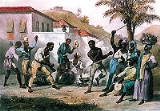
Capoeira

Encyclopedia
Capoeira is a Brazil
ian art form that combines elements of martial arts
, sports, and music
. It was created in Brazil
mainly by descendants of African slaves
with Brazilian native influences, probably beginning in the 16th century. It is known by quick and complex moves, using mainly power kick
s and quick leg sweeps, with some ground and aerial acrobatics, knee strikes, take-downs, elbow strikes, punches and headbutt
s.
The word capoeira probably comes from Tupi, referring to the areas of low vegetation in the Brazilian interior.
. Since the 16th century, Portugal
extensively adopted slavery to man their colonies, coming mainly from West and Central Africa. Brazil, with its vast territory, was the major destination of African slaves, receiving 38.5% of all slaves sent by ships across the Atlantic Ocean
.
Capoeira has a long and controversial history, since historical documentation in Brazil was very scarce in its colonial times. Evidences, studies and oral tradition
leave little doubt about its Brazilian roots, but it is impossible to precisely identify the exact location and time it began to take form.
to supply this shortage of workers. Colonists tried to enslave Brazilian natives in the beginning, but this quickly proved too difficult for many reasons, including the familiarity natives had with the land. The solution was importing slaves from Africa.
In its first century the main economic activity in the colony was the production and processing of sugarcane
. Portuguese colonists used to create large sugarcane farms called engenhos, farms which extensively used enslaved workers. Slaves, living in inhumane and humiliating conditions, were forced to work hard and often suffered physical punishment for any small misbehaviour. Even though slaves outnumbered the Portuguese colonists, the lack of weapons, the colonial law, the disagreement among slaves coming from different African cultures and their complete lack of knowledge about the land and its surroundings would usually discourage the idea of a rebellion.
In this environment Capoeira began to develop. More than a fighting style, it was created as a hope of survival, a tool with which an escaped slave, completely unequipped, could survive in the hostile, unknown land and face the hunt of the capitães-do-mato, colonial agents in charge of finding escapees, always armed and mounted.
s, primitive settlements in far and hard to reach places. After its humble start, some quilombos would develop, attracting more runaway slaves, Brazilian natives and even Europeans escaping the law or catholic
extremism. Sometimes a quilombo would become a real independent multi-ethnic state.
Everyday life in a quilombo would offer freedom and the opportunity to rescue traditional cultures lost due to colonial oppression. In this kind of multi-ethnic community, constantly threatened by Portuguese colonial troops, Capoeira evolved from a survival tool to a martial art focused on war.
The biggest of the quilombos, the Quilombo dos Palmares
, consisted of many villages mostly of African slaves though they also consisted of other ethnicities and lasted for more than a century, resisting, often outnumbered, many colonial attacks. This quilombo resisted at least 24 small attacks and 18 great colonial invasions. Portuguese soldiers sometimes stated it took more than one dragoon
to capture a quilombo warrior, since they would defend themselves with a strangely moving fighting technique. The governor from that province declared "it is harder to defeat a quilombo than the Dutch
invaders."
, along with the whole Portuguese court, escaped to Brazil in 1808 due to Portugal being invaded
by Napoleonic troops. The colony, a mere source of natural resources, would finally begin to develop as a nation. The Portuguese monopoly effectively came to an end when Brazilian ports opened for trade with foreign nations. Cities would grow in importance and Brazilian people could finally get the permission to manufacture common products once imported from Portugal, like glass.
Registries of Capoeira test practices existed since the 18th century in Rio de Janeiro
, Salvador
and Recife
, but the huge increase of urban slaves and social life in Brazilian cities gave Capoeira a greater notoriety and diffusion capacity. In Rio the use of Capoeira was getting so problematic that the colonial government established severe physical punishments to its practice. In his book, Matthias Röhrig Assunção provided ample data from police records, dating back to the 1800s, demonstrating that Capoeira was an important reason to detain slaves and free coloured individuals. "From 288 slaves that entered the Calabouço jail during the years 1857 and 1858, 80 (31%) were arrested for Capoeira, and only 28 (10.7%) for running away. Out of 4,303 arrests in Rio police jail in 1862, 404 detainees—nearly 10%—had been arrested for Capoeira."
, slavery in the Brazilian Empire
was already doomed for many reasons, among them the ever increasing number of slave's escapes and the frequent raids by quilombo militias on properties which still adopted slavery. The Empire tried to soften the problems with laws that would restrict slavery, but Brazil would inevitably recognize its end on May 13, 1888, with a law called Lei Áurea, sanctioned by imperial parliament and signed by princess Isabel
.
Free, "black people" would soon find themselves abandoned. A vast majority had nowhere to live, no job and were despised by Brazilian society, which usually saw them as lazy workers. The increase of European and Asian workers of that time would diminish job opportunities even more and many black people would become marginalized. Naturally, they maintained Capoeira as a means of recreation and martial arts practice.
It was inevitable that Capoeira practitioners would start using their abilities in unconventional ways. Many began to use Capoeiristas as body guards, mercenaries, hitmen, henchmen. Groups of Capoeira practitioners, known as maltas, used to terrorize Rio de Janeiro. In little time, in 1890, the recently proclaimed Brazilian Republic decreed the prohibition of Capoeira in the whole country, as things were pretty chaotic in the Brazilian capital and many police reports would demonstrate that Capoeira was an undeserved advantage in a fight.
After the prohibition, any citizen caught practicing Capoeira, in a fight or for any other reason, would be arrested, tortured and often mutilated by the police. The art of Capoeira, after brief freedom, was once again condemned and repressed. Cultural practices, like the roda de Capoeira, were conducted in far or hidden places and often practitioners would leave someone as sentry, to warn if the police was approaching the area.
, a strong fighter both in legal and illegal fights, founded in Salvador
the first ever Capoeira school. Bimba, analyzing the way many capoeiristas were using their abilities only to impress tourists, believed that Capoeira was losing its efficiency as a martial art. Thus Bimba, helped by his student José Cisnando Lima, intent on returning Capoiera to a method similar how it was used by the Quilombos, Mestre Bimba was intent on making it more combat-focused, and added some moves from traditional fighting styles, like Batuque
and to a very limited extent wrestling. Bimba also developed the first Capoeira systematical training method. As the word Capoeira was still forbidden by Brazilian law, Bimba called his new style Luta Regional Baiana (meaning regional fight from Bahia).
In 1937, Bimba founded the school Centro de Cultura Física e Luta Regional, with official permission of Salvador’s Secretary of Education (Secretaria da Educação, Saúde e Assistência de Salvador). His work was very well accepted in Salvador and Bimba got the opportunity to teach Capoeira to the elite of the city. Finally in 1940 Capoeira left the Brazilian law code and definitely left illegality.
Soon the notoriety of Bimba's Capoeira proved to be a problem to traditional capoeiristas, who were gradually losing visibility and were still distrusted by society. This imbalance began to change with the founding of Centro Esportivo de Capoeira Angola (CECA), in 1941, by Vicente Ferreira Pastinha. Located in the neighbourhood of Pelourinho, in Salvador, this school attracted many traditional capoeiristas who would prefer to keep Capoeira as original as possible. CECA's notoriety immortalized the name Capoeira Angola as definition of the traditional Capoeira style. The term wasn't new, as during the 19th century Capoeira was in some places referred as brincar de angola (meaning play Angola) and many other masters which did not use Pastinha's techniques adopted it.
The martial art aspect is still present and, like old times, is still subtle and disguised, leading many non-practitioners to ignore its presence. Trickery is ever present and expert capoeiristas seldom take their sights off their opponents in a Capoeira game. An attack can be disguised even as a friendly gesture. Such trickery amongst a collection of others are all a form of malicia
which is used by both Capoiera Regional and Angola.
Symbol of the afro-Brazilian culture, symbol of the ethnic amalgam that characterizes Brazil, symbol of resistance to the oppression, Capoeira definitely changed its image and became a source of pride to Brazilian people. It is officially considered intangible cultural heritage of Brazil.
The ginga (literally: rocking back and forth; to swing) is the fundamental movement in capoeira, important both for attack and defense purposes. It has two main objectives. One is to keep the capoeirista in a state of constant motion, preventing him from being a still and easy target. The other, using also fakes and feints, is to mislead, fool, trick the opponent, leaving them open for an attack or a counter-attack.
The attacks in the Capoeira should be done when opportunity arises and must be decisive, like a direct kick in the face or a vital body part, or a strong takedown. Most Capoeira attacks are made with the legs, like direct or swirling kicks, rasteiras (leg sweeps), tesouras or knee strikes. The head strike is a very important counter-attack move. Elbow strikes, punches and other forms of takedowns complete the main list.
The defense is based on the principle of non-resistance, meaning avoid an attack using evasive moves instead of blocking it. Avoids are called esquivas, which depend on the direction of the attack and intention of the defender, and can be done standing or with a hand leaning on the floor. A block should only be made when the esquiva is not possible. This fighting strategy allows quick and unpredictable counter attacks, the ability to focus on more than one adversary and to face empty-handed an armed adversary.
 A series of rolls and acrobatics (like the Cartwheels called aú
) allows the capoeirista to quickly overcome a takedown or a loss of balance, and to position themselves around the aggressor in order to lay up for an attack. It is this combination of attacks and defense which gives Capoeira its perceived 'fluidity' and choreography-like style.
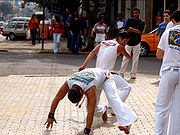 Playing Capoeira is both a game and a method of practicing the application of Capoeira movements in dangerous situations. It can be played anywhere, but it's usually done in a roda. During the game most Capoeira moves are used, but capoeiristas usually avoid using punches or elbow strikes.
The game usually does not focus on knocking down or destroying the opponent, rather it emphasizes skill. Capoeiristas often prefer to rely on a takedown like a rasteira, then allowing the opponent to recover and get back into the game. It is also very common to slow down a kick inches before hitting the target, so a capoeirista can enforce superiority without the need of injuring the opponent. If an opponent clearly cannot dodge an attack, there is no reason to complete it. However, between two high-skilled capoeiristas, the game can get much more aggressive and dangerous, even though capoeiristas tend to avoid showing this kind of game in presentations or to the general public.
determine it, when one of the capoeiristas decide to leave or call the end of the game or when another capoeirista interrupts the game to start playing, either with one of the current players or with another capoeirista.
In a roda every cultural aspect of Capoeira is present, not only the martial side. Aerial acrobatics are common in a presentation roda, while not seen as often in a more serious one.
Students enter the roda against a high-ranked capoeirista (a teacher or master) and normally the game ends with the student being taken down. However, the more experienced capoeirista can judge the takedown unnecessary. Following this 'baptism' the new cord is given.
Traditionally, the batizado is the moment when the new practitioner gets or formalizes his or her apelido (literally nickname). This tradition was created back when Capoeira practice was considered a crime. To avoid having problems with the law, capoeiristas would present themselves in the capoeira community only by their nicknames. So if a capoeirista was captured by the police, he would be unable to identify his fellow capoeiristas, even when tortured.
Apelidos can come from many different things. A physical characteristic (like being tall or big), a habit (like smiling or drinking too much), place of birth, a particular skill, an animal, trivial things, anything.
Nowadays, even though apelidos are not necessary anymore, the tradition is still very alive not only in Capoeira but in many aspects of Brazilian culture.
While it may seem like a break time or a dance, the chamada is actually both a trap and a test, as the caller is just expecting to see if her opponent will let his guard down so that she can perform a takedown or a strike. It is a critical situation, because both players are vulnerable due to the close proximity and potential for a surprise attack. It's also a tool for experienced practitioners and masters of the art to test a student's awareness and demonstrate when the student left himself open to attack.
The use of the chamada can result in a highly developed sense of awareness and helps practitioners learn the subtleties of anticipating another person's hidden intentions. The chamada can be very simple, consisting solely of the basic elements, or the ritual can be quite elaborate including a competitive dialogue of trickery, or even theatric embellishments.
The volta ao mundo takes place after an exchange of movements has reached a conclusion, or after there has been a disruption in the harmony of the game. In either of these situations, one player will begin walking around the perimeter of the circle counter-clockwise, and the other player will join the volta ao mundo before returning to the normal game.
, which translates to "malice". This, however, is misleading as the meaning of malicia
in Capoeira is the capacity to understand someone's intentions. In Brazil men who were marginalized from main stream society and possessed street smarts were called malandros.
In the Capoeira, malandragem is the ability to quickly understand an opponent's aggressive intentions, and during a fight or a game, fool, trick and deceive him.
. Rhythm, controlled by a berimbau, differ from very slow to very fast, depending on the style of the roda.
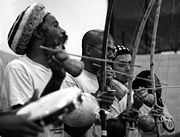 Capoeira instruments are disposed in a row called bateria
. It is traditionally formed by three berimbau
s, two pandeiro
s, one atabaque
, one agogô
and one ganzá
, but this format may vary depending on the Capoeira group's traditions or the roda style.
The berimbau is the leading instrument, determining the tempo and style of the music and game played. Two low pitch berimbaus (called berra-boi and médio) form the base and a high pitch berimbau (called viola) makes variations and improvisations. The other instruments may only follow the berimbaus or may be free to vary and improvise a little, depending upon the Capoeira group's musical style.
Capoeiristas change their playing style significantly, following the toque
of the berimbau, which sets the game's speed, style and aggressiveness. So it is truly the music that drives a Capoeira game.
format while others are in the form of a narrative. Capoeiristas sing about a wide variety of subjects. Some songs are about history or stories of famous capoeiristas. Other songs attempt to inspire players to play better. Some songs are about what is going on within the roda. Sometimes the songs are about life or love lost. Others have lighthearted and playful lyrics.
There are four basic kinds of songs in capoeira, the Ladaínha, Chula, Corrido and Quadra. The Ladaínha is a narrative solo sung only at the beginning of a roda, often by a mestre (master) or most respected capoeirista present. The solo is followed by a louvação, a call and response pattern that usually thanks God and one's mestre, among other things. Each call is usually repeated word-for-word by the responders. The Chula is a song where the singer part is much bigger than the chorus response, usually eight singer verses for one chorus response, but the proportion may vary. The Corrido is a song where the singer part and the chorus response are equal, normally two verses by two responses. Finally, the Quadra is a song where the same verse is repeated four times, either three singer verses followed by one chorus response, or one verse and one response.
Capoeira songs can talk about virtually anything, being it about a historical fact, a famous capoeirista, trivial life facts, hidden messages for players, anything. Improvisation is very important also, while singing a song the main singer can change the music's lyrics, telling something that's happening in or outside the Roda.
Existing in many parts of Brazil since colonial times, most notably in Rio de Janeiro
, Salvador
and Recife
, it's impossible to tell where and when Capoeira Angola began taking its present form. The name "Angola" starts as early as the beginning of slavery in Brazil, when Africans, taken to Luanda to be shipped to Brazil, were called "black people from Angola" regardless of their nationality. In some places of Brazil people would call capoeira as playing Angola and, according to Mestre Noronha, the Centro de Capoeira Angola Conceição da Praia, created in Bahia, already used the name capoeira Angola illegally in the beginning of the 1920 decade.
The name Angola was finally immortalized by Mestre Pastinha at February 23, 1941, when he opened the Centro Esportivo de capoeira Angola (CECA). Pastinha was known as a great defender of the traditional Capoeira, much respected by recognized Capoeira masters. Soon many other masters would adopt the name Angola.
Capoeira Angola is the closest style to the way slaves used to fight or play Capoeira. Characterizes by being strategic, with sneaking movements executed standing or near the floor depending on the situation to face, it values the traditions of malícia, malandragem and unpredictability of the original Capoeira.
Typical music instrument formation in a roda of Capoeira Angola is three berimbaus, two pandeiros, an atabaque, an agogô e a ganzuá.
Capoeira Angola developed alongside Regional, but with a traditionalist and contrary dogma. It’s primary representative, Mestre Pastinha, “found in the old tradition (of capoeira) some concepts which he made fundamental.” Unlike Bimba, he was against using physical movements foreign to capoeira. The ludic aspects of the game rather than the martial are emphasised along with the use of traditional movements, songs, philosophy and conduct of the ritual of capoeira, all done with respect to the fundamental concepts emphasised by Mestre Pastinha.
met his future student, José Cisnando Lima. Both believed that Capoeira was losing its martial side and concluded there was a need to restructure it. Bimba created his sequências de ensino (teaching combinations) and created the first Capoeira's teaching method. Advised by Cisnando, Bimba decided to call his style Luta Regional Baiana, as Capoeira was still illegal at that time.
The base of Capoeira Regional is the original Capoeira without many of the aspects that were useless in a real fight, with less subterfuge and more objectivity. Training was mainly focused on attack and counter-attack, giving high importance to precision and discipline. Bimba also added a few moves from other martial-arts, notably the batuque, old street fight practiced by his father. Use of jumps or aerial acrobacies was kept to a minimum, since one of its foundations was always keeping at least one hand or foot firmly attached to the ground. Mestre Bimba often said, "'The floor is a friend to the capoeirista'".
Capoeira Regional also introducted the first ranking method in Capoeira. Regional had three levels: calouro (freshman), formado (graduated) and formado especializado (specialist). Ranking was determined by a scarf tied on the capoeirista's waist.
The traditions of roda and Capoeira game were kept, being used to put into use what was learned during training. Musical instruments disposition, however, was changed, being made by a single berimbau and two pandeiros.
The Luta Regional Baiana soon became popular, finally changing Capoeira's bad image. Mestre Bimba made a lot of presentations of his new style, but the most well known was the one made at 1953 to Brazilian president Getúlio Vargas
, where the president would say: "Capoeira is the only truly national sport."
Nowadays the label Contemporânea applies to any Capoeira group who don't follow Regional or Angola styles, even the ones who mix Capoeira with other martial-arts.
The most common modern system uses colored cordas (cord or rope) tied around the waist (also called cordéis or cordões). Some masters use different systems, or even no system at all.
There are many entities (leagues, federations and association) which have tried to unify the cord system. The most usual is the system of the Confederação Brasileira de Capoeira (Brazilian Capoeira Confederation), which adopts strings using the colors of the Brazilian flag.
Even though it's widely used, with many small variations, many big and influential groups still use different systems. Even the Confederação Brasileira de Capoeira is not widely accepted as the Capoeira's representative.
(tambourine), atabaque (drum), berimbau-viola (berimbau with the smallest cabaça and the highest pitch), chocalho
(rattle – a percussion instrument), accompanied by singing and clapping. Samba de roda is considered one of the primitive forms of modern Samba.
armed fighting style, using two sticks or a machete. Nowadays it's a folkloric dance practiced with heavy afro-Brazilian percussion.
Maculelê's past is even more obscured than Capoeira's, so many people believe it either has native Brazilian's or African's origins.
theatrical play, seen in many capoeira performances. It is based on a traditional Brazilian legend involving the loss of a fisherman in a sea-faring accident
series, fight in the Capoeira style.
Elena, a playable character from the Street Fighter
series, fights in the Capoeira style.
Richard Meyer and Bob Wilson from the Fatal Fury series, fight in the Capoeira style. In fact Richard Meyer is the first fighting game character to use Capoeira.
Brazil
Brazil , officially the Federative Republic of Brazil , is the largest country in South America. It is the world's fifth largest country, both by geographical area and by population with over 192 million people...
ian art form that combines elements of martial arts
Martial arts
Martial arts are extensive systems of codified practices and traditions of combat, practiced for a variety of reasons, including self-defense, competition, physical health and fitness, as well as mental and spiritual development....
, sports, and music
Music
Music is an art form whose medium is sound and silence. Its common elements are pitch , rhythm , dynamics, and the sonic qualities of timbre and texture...
. It was created in Brazil
Brazil
Brazil , officially the Federative Republic of Brazil , is the largest country in South America. It is the world's fifth largest country, both by geographical area and by population with over 192 million people...
mainly by descendants of African slaves
Atlantic slave trade
The Atlantic slave trade, also known as the trans-atlantic slave trade, refers to the trade in slaves that took place across the Atlantic ocean from the sixteenth through to the nineteenth centuries...
with Brazilian native influences, probably beginning in the 16th century. It is known by quick and complex moves, using mainly power kick
Kick
In combat sports and hand-to-hand combat, a kick is a physical strike using the foot, leg, or knee . This type of attack is used frequently, especially in stand-up fighting...
s and quick leg sweeps, with some ground and aerial acrobatics, knee strikes, take-downs, elbow strikes, punches and headbutt
Headbutt
A headbutt is a strike with the head, typically involving the use of robust parts of the cranium as areas of impact. Effective headbutting revolves around striking a sensitive area with a less sensitive area, such as striking the nose of an opponent with the forehead...
s.
The word capoeira probably comes from Tupi, referring to the areas of low vegetation in the Brazilian interior.
History
Capoeira's history slavery in BrazilBrazil
Brazil , officially the Federative Republic of Brazil , is the largest country in South America. It is the world's fifth largest country, both by geographical area and by population with over 192 million people...
. Since the 16th century, Portugal
Portugal
Portugal , officially the Portuguese Republic is a country situated in southwestern Europe on the Iberian Peninsula. Portugal is the westernmost country of Europe, and is bordered by the Atlantic Ocean to the West and South and by Spain to the North and East. The Atlantic archipelagos of the...
extensively adopted slavery to man their colonies, coming mainly from West and Central Africa. Brazil, with its vast territory, was the major destination of African slaves, receiving 38.5% of all slaves sent by ships across the Atlantic Ocean
Atlantic Ocean
The Atlantic Ocean is the second-largest of the world's oceanic divisions. With a total area of about , it covers approximately 20% of the Earth's surface and about 26% of its water surface area...
.
Capoeira has a long and controversial history, since historical documentation in Brazil was very scarce in its colonial times. Evidences, studies and oral tradition
Oral tradition
Oral tradition and oral lore is cultural material and traditions transmitted orally from one generation to another. The messages or testimony are verbally transmitted in speech or song and may take the form, for example, of folktales, sayings, ballads, songs, or chants...
leave little doubt about its Brazilian roots, but it is impossible to precisely identify the exact location and time it began to take form.
Origins
In the 16th century Portugal had one of the biggest colonial empires of the world, but it lacked people to actually colonize it. In the Brazilian colony the Portuguese, like many other European colonists, opted to use slaverySlavery
Slavery is a system under which people are treated as property to be bought and sold, and are forced to work. Slaves can be held against their will from the time of their capture, purchase or birth, and deprived of the right to leave, to refuse to work, or to demand compensation...
to supply this shortage of workers. Colonists tried to enslave Brazilian natives in the beginning, but this quickly proved too difficult for many reasons, including the familiarity natives had with the land. The solution was importing slaves from Africa.
In its first century the main economic activity in the colony was the production and processing of sugarcane
Sugarcane
Sugarcane refers to any of six to 37 species of tall perennial grasses of the genus Saccharum . Native to the warm temperate to tropical regions of South Asia, they have stout, jointed, fibrous stalks that are rich in sugar, and measure two to six metres tall...
. Portuguese colonists used to create large sugarcane farms called engenhos, farms which extensively used enslaved workers. Slaves, living in inhumane and humiliating conditions, were forced to work hard and often suffered physical punishment for any small misbehaviour. Even though slaves outnumbered the Portuguese colonists, the lack of weapons, the colonial law, the disagreement among slaves coming from different African cultures and their complete lack of knowledge about the land and its surroundings would usually discourage the idea of a rebellion.
In this environment Capoeira began to develop. More than a fighting style, it was created as a hope of survival, a tool with which an escaped slave, completely unequipped, could survive in the hostile, unknown land and face the hunt of the capitães-do-mato, colonial agents in charge of finding escapees, always armed and mounted.
Quilombos
Soon several groups of African slaves would gather and establish QuilomboQuilombo
A quilombo is a Brazilian hinterland settlement founded by people of African origin, Quilombolas, or Maroons. Most of the inhabitants of quilombos were escaped slaves and, in some cases, a minority of marginalised Portuguese, Brazilian aboriginals, Jews and Arabs, and/or other non-black,...
s, primitive settlements in far and hard to reach places. After its humble start, some quilombos would develop, attracting more runaway slaves, Brazilian natives and even Europeans escaping the law or catholic
Catholicism
Catholicism is a broad term for the body of the Catholic faith, its theologies and doctrines, its liturgical, ethical, spiritual, and behavioral characteristics, as well as a religious people as a whole....
extremism. Sometimes a quilombo would become a real independent multi-ethnic state.
Everyday life in a quilombo would offer freedom and the opportunity to rescue traditional cultures lost due to colonial oppression. In this kind of multi-ethnic community, constantly threatened by Portuguese colonial troops, Capoeira evolved from a survival tool to a martial art focused on war.
The biggest of the quilombos, the Quilombo dos Palmares
Palmares (quilombo)
Palmares, or Quilombo dos Palmares, was a fugitive community of escaped slaves and others in colonial Brazil that developed from 1605 until its suppression in 1694. It was located in what is today the Brazilian state of Alagoas.-Quilombos or mocambos:...
, consisted of many villages mostly of African slaves though they also consisted of other ethnicities and lasted for more than a century, resisting, often outnumbered, many colonial attacks. This quilombo resisted at least 24 small attacks and 18 great colonial invasions. Portuguese soldiers sometimes stated it took more than one dragoon
Dragoon
The word dragoon originally meant mounted infantry, who were trained in horse riding as well as infantry fighting skills. However, usage altered over time and during the 18th century, dragoons evolved into conventional light cavalry units and personnel...
to capture a quilombo warrior, since they would defend themselves with a strangely moving fighting technique. The governor from that province declared "it is harder to defeat a quilombo than the Dutch
Netherlands
The Netherlands is a constituent country of the Kingdom of the Netherlands, located mainly in North-West Europe and with several islands in the Caribbean. Mainland Netherlands borders the North Sea to the north and west, Belgium to the south, and Germany to the east, and shares maritime borders...
invaders."
Urbanization
Things in the colony began to change when the prince and future king Dom João VIJohn VI of Portugal
John VI John VI John VI (full name: João Maria José Francisco Xavier de Paula Luís António Domingos Rafael; (13 May 1767 – 10 March 1826) was King of the United Kingdom of Portugal, Brazil and the Algarves (later changed to just King of Portugal and the Algarves, after Brazil was recognized...
, along with the whole Portuguese court, escaped to Brazil in 1808 due to Portugal being invaded
Peninsular War
The Peninsular War was a war between France and the allied powers of Spain, the United Kingdom, and Portugal for control of the Iberian Peninsula during the Napoleonic Wars. The war began when French and Spanish armies crossed Spain and invaded Portugal in 1807. Then, in 1808, France turned on its...
by Napoleonic troops. The colony, a mere source of natural resources, would finally begin to develop as a nation. The Portuguese monopoly effectively came to an end when Brazilian ports opened for trade with foreign nations. Cities would grow in importance and Brazilian people could finally get the permission to manufacture common products once imported from Portugal, like glass.
Registries of Capoeira test practices existed since the 18th century in Rio de Janeiro
Rio de Janeiro
Rio de Janeiro , commonly referred to simply as Rio, is the capital city of the State of Rio de Janeiro, the second largest city of Brazil, and the third largest metropolitan area and agglomeration in South America, boasting approximately 6.3 million people within the city proper, making it the 6th...
, Salvador
Salvador, Bahia
Salvador is the largest city on the northeast coast of Brazil and the capital of the Northeastern Brazilian state of Bahia. Salvador is also known as Brazil's capital of happiness due to its easygoing population and countless popular outdoor parties, including its street carnival. The first...
and Recife
Recife
Recife is the fifth-largest metropolitan area in Brazil with 4,136,506 inhabitants, the largest metropolitan area of the North/Northeast Regions, the 5th-largest metropolitan influence area in Brazil, and the capital and largest city of the state of Pernambuco. The population of the city proper...
, but the huge increase of urban slaves and social life in Brazilian cities gave Capoeira a greater notoriety and diffusion capacity. In Rio the use of Capoeira was getting so problematic that the colonial government established severe physical punishments to its practice. In his book, Matthias Röhrig Assunção provided ample data from police records, dating back to the 1800s, demonstrating that Capoeira was an important reason to detain slaves and free coloured individuals. "From 288 slaves that entered the Calabouço jail during the years 1857 and 1858, 80 (31%) were arrested for Capoeira, and only 28 (10.7%) for running away. Out of 4,303 arrests in Rio police jail in 1862, 404 detainees—nearly 10%—had been arrested for Capoeira."
The end of slavery and prohibition
At the end of the 19th centuryCentury
A century is one hundred consecutive years. Centuries are numbered ordinally in English and many other languages .-Start and end in the Gregorian Calendar:...
, slavery in the Brazilian Empire
Brazilian Empire
The Empire of Brazil was a 19th-century state that broadly comprised the territories which form modern Brazil. Its government was a representative parliamentary constitutional monarchy under the rule of Emperors Dom Pedro I and his son Dom Pedro II, both members of the House of Braganza—a...
was already doomed for many reasons, among them the ever increasing number of slave's escapes and the frequent raids by quilombo militias on properties which still adopted slavery. The Empire tried to soften the problems with laws that would restrict slavery, but Brazil would inevitably recognize its end on May 13, 1888, with a law called Lei Áurea, sanctioned by imperial parliament and signed by princess Isabel
Isabel, Princess Imperial of Brazil
Dona Isabel , nicknamed "the Redemptress", was the heiress presumptive to the throne of the Empire of Brazil, bearing the title of Princess Imperial....
.
Free, "black people" would soon find themselves abandoned. A vast majority had nowhere to live, no job and were despised by Brazilian society, which usually saw them as lazy workers. The increase of European and Asian workers of that time would diminish job opportunities even more and many black people would become marginalized. Naturally, they maintained Capoeira as a means of recreation and martial arts practice.
It was inevitable that Capoeira practitioners would start using their abilities in unconventional ways. Many began to use Capoeiristas as body guards, mercenaries, hitmen, henchmen. Groups of Capoeira practitioners, known as maltas, used to terrorize Rio de Janeiro. In little time, in 1890, the recently proclaimed Brazilian Republic decreed the prohibition of Capoeira in the whole country, as things were pretty chaotic in the Brazilian capital and many police reports would demonstrate that Capoeira was an undeserved advantage in a fight.
After the prohibition, any citizen caught practicing Capoeira, in a fight or for any other reason, would be arrested, tortured and often mutilated by the police. The art of Capoeira, after brief freedom, was once again condemned and repressed. Cultural practices, like the roda de Capoeira, were conducted in far or hidden places and often practitioners would leave someone as sentry, to warn if the police was approaching the area.
Luta Regional Baiana
In 1932, a time when Capoeira repression wasn't as strong as before, Mestre BimbaManuel dos Reis Machado
Manuel dos Reis Machado, commonly called Mestre Bimba , was a mestre of the Afro-Brazilian martial art capoeira.-Early life:Machado is said to have had two birth certificates, dated 1899 and 1900, respectively...
, a strong fighter both in legal and illegal fights, founded in Salvador
Salvador, Bahia
Salvador is the largest city on the northeast coast of Brazil and the capital of the Northeastern Brazilian state of Bahia. Salvador is also known as Brazil's capital of happiness due to its easygoing population and countless popular outdoor parties, including its street carnival. The first...
the first ever Capoeira school. Bimba, analyzing the way many capoeiristas were using their abilities only to impress tourists, believed that Capoeira was losing its efficiency as a martial art. Thus Bimba, helped by his student José Cisnando Lima, intent on returning Capoiera to a method similar how it was used by the Quilombos, Mestre Bimba was intent on making it more combat-focused, and added some moves from traditional fighting styles, like Batuque
Batuque (game)
Batuque was a Brazilian game played in Bahia in the early part of the twentieth century by African slaves which were brought to Brazil but now extinct. A similar game, pernada, was popular in Rio de Janeiro about the same time. Players stand in a circle; one player stands in the center in a...
and to a very limited extent wrestling. Bimba also developed the first Capoeira systematical training method. As the word Capoeira was still forbidden by Brazilian law, Bimba called his new style Luta Regional Baiana (meaning regional fight from Bahia).
In 1937, Bimba founded the school Centro de Cultura Física e Luta Regional, with official permission of Salvador’s Secretary of Education (Secretaria da Educação, Saúde e Assistência de Salvador). His work was very well accepted in Salvador and Bimba got the opportunity to teach Capoeira to the elite of the city. Finally in 1940 Capoeira left the Brazilian law code and definitely left illegality.
Soon the notoriety of Bimba's Capoeira proved to be a problem to traditional capoeiristas, who were gradually losing visibility and were still distrusted by society. This imbalance began to change with the founding of Centro Esportivo de Capoeira Angola (CECA), in 1941, by Vicente Ferreira Pastinha. Located in the neighbourhood of Pelourinho, in Salvador, this school attracted many traditional capoeiristas who would prefer to keep Capoeira as original as possible. CECA's notoriety immortalized the name Capoeira Angola as definition of the traditional Capoeira style. The term wasn't new, as during the 19th century Capoeira was in some places referred as brincar de angola (meaning play Angola) and many other masters which did not use Pastinha's techniques adopted it.
Capoeira today
Capoeira nowadays is not only a martial art or a small aspect of Brazilian society, but an active exporter of Brazilian culture all over the world. Since the 1970s masters of the art form began to emigrate and teach capoeira in other countries. Present in many countries in every continent, every year Capoeira attracts to Brazil thousands of foreign students and, often, foreign capoeiristas work hard to learn the official Brazilian language, Portuguese, in an effort to better understand and become part of the art. Renowned Capoeira Masters are often invited to teach abroad or even establish their own schools. Capoeira presentations, normally theatrical, acrobatic and with little martiality, are common sights in the whole world.The martial art aspect is still present and, like old times, is still subtle and disguised, leading many non-practitioners to ignore its presence. Trickery is ever present and expert capoeiristas seldom take their sights off their opponents in a Capoeira game. An attack can be disguised even as a friendly gesture. Such trickery amongst a collection of others are all a form of malicia
Malicia
Malicia is a concept in Capoeira that is both simple and complex. Its Latin root, mal, meaning 'bad,' or 'ill,' would imply a concept of evilness...
which is used by both Capoiera Regional and Angola.
Symbol of the afro-Brazilian culture, symbol of the ethnic amalgam that characterizes Brazil, symbol of resistance to the oppression, Capoeira definitely changed its image and became a source of pride to Brazilian people. It is officially considered intangible cultural heritage of Brazil.
Martial Art
Capoeira is a fast and versatile martial art which is historically focused on fighting outnumbered or in technological disadvantage.The ginga (literally: rocking back and forth; to swing) is the fundamental movement in capoeira, important both for attack and defense purposes. It has two main objectives. One is to keep the capoeirista in a state of constant motion, preventing him from being a still and easy target. The other, using also fakes and feints, is to mislead, fool, trick the opponent, leaving them open for an attack or a counter-attack.
The attacks in the Capoeira should be done when opportunity arises and must be decisive, like a direct kick in the face or a vital body part, or a strong takedown. Most Capoeira attacks are made with the legs, like direct or swirling kicks, rasteiras (leg sweeps), tesouras or knee strikes. The head strike is a very important counter-attack move. Elbow strikes, punches and other forms of takedowns complete the main list.
The defense is based on the principle of non-resistance, meaning avoid an attack using evasive moves instead of blocking it. Avoids are called esquivas, which depend on the direction of the attack and intention of the defender, and can be done standing or with a hand leaning on the floor. A block should only be made when the esquiva is not possible. This fighting strategy allows quick and unpredictable counter attacks, the ability to focus on more than one adversary and to face empty-handed an armed adversary.
Au
-Science:*Absorbance Units, a reporting unit in spectroscopy*Astronomical unit, the average distance between the Earth and the Sun *Atomic units, a system of units convenient for atomic physics and other fields...
) allows the capoeirista to quickly overcome a takedown or a loss of balance, and to position themselves around the aggressor in order to lay up for an attack. It is this combination of attacks and defense which gives Capoeira its perceived 'fluidity' and choreography-like style.
Capoeira Game
The game usually does not focus on knocking down or destroying the opponent, rather it emphasizes skill. Capoeiristas often prefer to rely on a takedown like a rasteira, then allowing the opponent to recover and get back into the game. It is also very common to slow down a kick inches before hitting the target, so a capoeirista can enforce superiority without the need of injuring the opponent. If an opponent clearly cannot dodge an attack, there is no reason to complete it. However, between two high-skilled capoeiristas, the game can get much more aggressive and dangerous, even though capoeiristas tend to avoid showing this kind of game in presentations or to the general public.
Roda
The Roda is a circle formed by capoeiristas and capoeira musical instruments, where every participant sings the typical songs and claps their hands following the music. Two capoeiristas enter the roda and play the game according to the style required by the musical instruments rhythm. The game finishes when one of the musicians holding a berimbauBerimbau
The berimbau is a single-string percussion instrument, a musical bow, from Brazil. The berimbau's origins are not entirely clear, but there is not much doubt about its African origin, as no Indigenous Brazilian or European people use musical bows, and very similar instruments are played in the...
determine it, when one of the capoeiristas decide to leave or call the end of the game or when another capoeirista interrupts the game to start playing, either with one of the current players or with another capoeirista.
In a roda every cultural aspect of Capoeira is present, not only the martial side. Aerial acrobatics are common in a presentation roda, while not seen as often in a more serious one.
Batizado
The batizado (baptism) is a ceremonial roda where new students will get recognized as capoeiristas and earn their first graduation. Also more experienced students may go up in rank, depending on their skills and capoeira culture.Students enter the roda against a high-ranked capoeirista (a teacher or master) and normally the game ends with the student being taken down. However, the more experienced capoeirista can judge the takedown unnecessary. Following this 'baptism' the new cord is given.
Apelido
Traditionally, the batizado is the moment when the new practitioner gets or formalizes his or her apelido (literally nickname). This tradition was created back when Capoeira practice was considered a crime. To avoid having problems with the law, capoeiristas would present themselves in the capoeira community only by their nicknames. So if a capoeirista was captured by the police, he would be unable to identify his fellow capoeiristas, even when tortured.
Apelidos can come from many different things. A physical characteristic (like being tall or big), a habit (like smiling or drinking too much), place of birth, a particular skill, an animal, trivial things, anything.
Nowadays, even though apelidos are not necessary anymore, the tradition is still very alive not only in Capoeira but in many aspects of Brazilian culture.
Chamada
Chamada means 'call' and can happen at any time during a roda where the rhythm angola is being played. It happens when one player, usually the more advanced one, calls his or her opponent to a dance-like ritual. The opponent then approaches the caller and meets him or her to walk side by side. After it both resume normal play.While it may seem like a break time or a dance, the chamada is actually both a trap and a test, as the caller is just expecting to see if her opponent will let his guard down so that she can perform a takedown or a strike. It is a critical situation, because both players are vulnerable due to the close proximity and potential for a surprise attack. It's also a tool for experienced practitioners and masters of the art to test a student's awareness and demonstrate when the student left himself open to attack.
The use of the chamada can result in a highly developed sense of awareness and helps practitioners learn the subtleties of anticipating another person's hidden intentions. The chamada can be very simple, consisting solely of the basic elements, or the ritual can be quite elaborate including a competitive dialogue of trickery, or even theatric embellishments.
Volta ao mundo
Volta ao mundo means around the world.The volta ao mundo takes place after an exchange of movements has reached a conclusion, or after there has been a disruption in the harmony of the game. In either of these situations, one player will begin walking around the perimeter of the circle counter-clockwise, and the other player will join the volta ao mundo before returning to the normal game.
Malandragem
Malandragem is a word that comes from malandro, which means a person who possesses cunning as well as maliciaMalicia
Malicia is a concept in Capoeira that is both simple and complex. Its Latin root, mal, meaning 'bad,' or 'ill,' would imply a concept of evilness...
, which translates to "malice". This, however, is misleading as the meaning of malicia
Malicia
Malicia is a concept in Capoeira that is both simple and complex. Its Latin root, mal, meaning 'bad,' or 'ill,' would imply a concept of evilness...
in Capoeira is the capacity to understand someone's intentions. In Brazil men who were marginalized from main stream society and possessed street smarts were called malandros.
In the Capoeira, malandragem is the ability to quickly understand an opponent's aggressive intentions, and during a fight or a game, fool, trick and deceive him.
Music
Music is integral to Capoeira. It sets the tempo and style of game that is to be played within the roda. The music is composed of instruments and songSong
In music, a song is a composition for voice or voices, performed by singing.A song may be accompanied by musical instruments, or it may be unaccompanied, as in the case of a cappella songs...
. Rhythm, controlled by a berimbau, differ from very slow to very fast, depending on the style of the roda.
Instruments
Bateria
The term bateria means “drum kit” in Portuguese and Spanish. In Brazil, the word is also used for a form of Brazilian samba band, the percussion band or rhythm section of a Samba School...
. It is traditionally formed by three berimbau
Berimbau
The berimbau is a single-string percussion instrument, a musical bow, from Brazil. The berimbau's origins are not entirely clear, but there is not much doubt about its African origin, as no Indigenous Brazilian or European people use musical bows, and very similar instruments are played in the...
s, two pandeiro
Pandeiro
The pandeiro is a type of hand frame drum.There are two important distinctions between a pandeiro and the common tambourine. The tension of the head on the pandeiro can be tuned, allowing the player a choice of high and low notes...
s, one atabaque
Atabaque
The atabaque is a tall, wooden, Afro-Brazilian hand drum. The shell is made traditionally of Jacaranda wood from Brazil. The head is traditionally made from calfskin. A system of ropes are intertwined around the body, connecting a metal ring near the base to the head...
, one agogô
Agogô
An agogô is a single or multiple bell now used throughout the world but with origins in traditional Yoruba music and also in the samba baterias . The agogô may be the oldest samba instrument and was based on West African Yoruba single or double bells...
and one ganzá
Ganza
The ganzá is a Brazilian rattle used as a percussion instrument, especially in samba music.The ganzá is cylindrically shaped, and can be either a hand-woven basket or a metal canister which is filled with beads, metal balls, pebbles, or other similar items. Those made from metal produce a...
, but this format may vary depending on the Capoeira group's traditions or the roda style.
The berimbau is the leading instrument, determining the tempo and style of the music and game played. Two low pitch berimbaus (called berra-boi and médio) form the base and a high pitch berimbau (called viola) makes variations and improvisations. The other instruments may only follow the berimbaus or may be free to vary and improvise a little, depending upon the Capoeira group's musical style.
Capoeiristas change their playing style significantly, following the toque
Capoeira toques
In the game of capoeira, toques are the rhythms played on the berimbau. Many toques are associated with a specific game , although organizations differ on how to play each toque...
of the berimbau, which sets the game's speed, style and aggressiveness. So it is truly the music that drives a Capoeira game.
Songs
Many of the songs are sung in a call and responseCall and response (music)
In music, a call and response is a succession of two distinct phrases usually played by different musicians, where the second phrase is heard as a direct commentary on or response to the first...
format while others are in the form of a narrative. Capoeiristas sing about a wide variety of subjects. Some songs are about history or stories of famous capoeiristas. Other songs attempt to inspire players to play better. Some songs are about what is going on within the roda. Sometimes the songs are about life or love lost. Others have lighthearted and playful lyrics.
There are four basic kinds of songs in capoeira, the Ladaínha, Chula, Corrido and Quadra. The Ladaínha is a narrative solo sung only at the beginning of a roda, often by a mestre (master) or most respected capoeirista present. The solo is followed by a louvação, a call and response pattern that usually thanks God and one's mestre, among other things. Each call is usually repeated word-for-word by the responders. The Chula is a song where the singer part is much bigger than the chorus response, usually eight singer verses for one chorus response, but the proportion may vary. The Corrido is a song where the singer part and the chorus response are equal, normally two verses by two responses. Finally, the Quadra is a song where the same verse is repeated four times, either three singer verses followed by one chorus response, or one verse and one response.
Capoeira songs can talk about virtually anything, being it about a historical fact, a famous capoeirista, trivial life facts, hidden messages for players, anything. Improvisation is very important also, while singing a song the main singer can change the music's lyrics, telling something that's happening in or outside the Roda.
Styles of Capoeira
Determining styles in capoeira is a very tough task, since there was never a unity in the original capoeira, or a teaching method before the decade of 1920. However, a division between two styles and a sub-style is widely accepted.Capoeira Angola
Capoeira Angola refers to every capoeira that keeps the traditions held before the creation of the Regional style.Existing in many parts of Brazil since colonial times, most notably in Rio de Janeiro
Rio de Janeiro
Rio de Janeiro , commonly referred to simply as Rio, is the capital city of the State of Rio de Janeiro, the second largest city of Brazil, and the third largest metropolitan area and agglomeration in South America, boasting approximately 6.3 million people within the city proper, making it the 6th...
, Salvador
Salvador, Bahia
Salvador is the largest city on the northeast coast of Brazil and the capital of the Northeastern Brazilian state of Bahia. Salvador is also known as Brazil's capital of happiness due to its easygoing population and countless popular outdoor parties, including its street carnival. The first...
and Recife
Recife
Recife is the fifth-largest metropolitan area in Brazil with 4,136,506 inhabitants, the largest metropolitan area of the North/Northeast Regions, the 5th-largest metropolitan influence area in Brazil, and the capital and largest city of the state of Pernambuco. The population of the city proper...
, it's impossible to tell where and when Capoeira Angola began taking its present form. The name "Angola" starts as early as the beginning of slavery in Brazil, when Africans, taken to Luanda to be shipped to Brazil, were called "black people from Angola" regardless of their nationality. In some places of Brazil people would call capoeira as playing Angola and, according to Mestre Noronha, the Centro de Capoeira Angola Conceição da Praia, created in Bahia, already used the name capoeira Angola illegally in the beginning of the 1920 decade.
The name Angola was finally immortalized by Mestre Pastinha at February 23, 1941, when he opened the Centro Esportivo de capoeira Angola (CECA). Pastinha was known as a great defender of the traditional Capoeira, much respected by recognized Capoeira masters. Soon many other masters would adopt the name Angola.
Capoeira Angola is the closest style to the way slaves used to fight or play Capoeira. Characterizes by being strategic, with sneaking movements executed standing or near the floor depending on the situation to face, it values the traditions of malícia, malandragem and unpredictability of the original Capoeira.
Typical music instrument formation in a roda of Capoeira Angola is three berimbaus, two pandeiros, an atabaque, an agogô e a ganzuá.
Capoeira Angola developed alongside Regional, but with a traditionalist and contrary dogma. It’s primary representative, Mestre Pastinha, “found in the old tradition (of capoeira) some concepts which he made fundamental.” Unlike Bimba, he was against using physical movements foreign to capoeira. The ludic aspects of the game rather than the martial are emphasised along with the use of traditional movements, songs, philosophy and conduct of the ritual of capoeira, all done with respect to the fundamental concepts emphasised by Mestre Pastinha.
Capoeira Regional
Capoeira Regional began to take form in the 1920 decade, when Mestre BimbaMestre Bimba
Manuel dos Reis Machado, commonly called Mestre Bimba , was a mestre of the Afro-Brazilian martial art capoeira.-Early life:Machado is said to have had two birth certificates, dated 1899 and 1900, respectively...
met his future student, José Cisnando Lima. Both believed that Capoeira was losing its martial side and concluded there was a need to restructure it. Bimba created his sequências de ensino (teaching combinations) and created the first Capoeira's teaching method. Advised by Cisnando, Bimba decided to call his style Luta Regional Baiana, as Capoeira was still illegal at that time.
The base of Capoeira Regional is the original Capoeira without many of the aspects that were useless in a real fight, with less subterfuge and more objectivity. Training was mainly focused on attack and counter-attack, giving high importance to precision and discipline. Bimba also added a few moves from other martial-arts, notably the batuque, old street fight practiced by his father. Use of jumps or aerial acrobacies was kept to a minimum, since one of its foundations was always keeping at least one hand or foot firmly attached to the ground. Mestre Bimba often said, "'The floor is a friend to the capoeirista'".
Capoeira Regional also introducted the first ranking method in Capoeira. Regional had three levels: calouro (freshman), formado (graduated) and formado especializado (specialist). Ranking was determined by a scarf tied on the capoeirista's waist.
The traditions of roda and Capoeira game were kept, being used to put into use what was learned during training. Musical instruments disposition, however, was changed, being made by a single berimbau and two pandeiros.
The Luta Regional Baiana soon became popular, finally changing Capoeira's bad image. Mestre Bimba made a lot of presentations of his new style, but the most well known was the one made at 1953 to Brazilian president Getúlio Vargas
Getúlio Vargas
Getúlio Dornelles Vargas served as President of Brazil, first as dictator, from 1930 to 1945, and in a democratically elected term from 1951 until his suicide in 1954. Vargas led Brazil for 18 years, the most for any President, and second in Brazilian history to Emperor Pedro II...
, where the president would say: "Capoeira is the only truly national sport."
Capoeira Contemporânea
Contemporânea is a term for groups that train multiple styles of capoeira simultaneously. Very often students of Capoeira Contemporânea train elements of Regional and Angola as well as newer movements that would not fall under either of those styles. This sub-style is seen by some as the natural evolution of Capoeira, by others as adulteration or even misinterpretation of Capoeira.Nowadays the label Contemporânea applies to any Capoeira group who don't follow Regional or Angola styles, even the ones who mix Capoeira with other martial-arts.
Ranks
Because of its origin, Capoeira never had unity or a general agreement. Ranking or graduating system follows the same path, as there never existed a ranking system accepted by most of the masters. That means graduation style varies depending of the group's traditions.The most common modern system uses colored cordas (cord or rope) tied around the waist (also called cordéis or cordões). Some masters use different systems, or even no system at all.
There are many entities (leagues, federations and association) which have tried to unify the cord system. The most usual is the system of the Confederação Brasileira de Capoeira (Brazilian Capoeira Confederation), which adopts strings using the colors of the Brazilian flag.
Even though it's widely used, with many small variations, many big and influential groups still use different systems. Even the Confederação Brasileira de Capoeira is not widely accepted as the Capoeira's representative.
Related activities
Even though those activities are strongly associated to the Capoeira, they have different meanings and origins.Samba de roda
Performed by many capoeira groups, samba de roda is a traditional Afro-Brazilian dance & musical form that has been associated with capoeira for many years. The orchestra is composed by pandeiroPandeiro
The pandeiro is a type of hand frame drum.There are two important distinctions between a pandeiro and the common tambourine. The tension of the head on the pandeiro can be tuned, allowing the player a choice of high and low notes...
(tambourine), atabaque (drum), berimbau-viola (berimbau with the smallest cabaça and the highest pitch), chocalho
Chocalho
Chocalho is the generic name for “shaker” in Portuguese. There are various types of idiophones using this name in Portuguese, not always being the same instrument:*a shaker;*a kind of jingle stick used to play samba music;*a cowbell;...
(rattle – a percussion instrument), accompanied by singing and clapping. Samba de roda is considered one of the primitive forms of modern Samba.
Maculelê
Originally the Maculelê was an indigenousIndigenous peoples in Brazil
The Indigenous peoples in Brazil comprise a large number of distinct ethnic groups who inhabited the country prior to the European invasion around 1500...
armed fighting style, using two sticks or a machete. Nowadays it's a folkloric dance practiced with heavy afro-Brazilian percussion.
Maculelê's past is even more obscured than Capoeira's, so many people believe it either has native Brazilian's or African's origins.
Puxada de rede
Puxada de Rede is a Brazilian folkloricBrazilian mythology
The term Brazilian mythology is used to describe a series of cultural elements of diverse origin that are found in Brazil, comprising folk tales, traditions, characters and beliefs regarding places, peoples and entities. It is a subset of the Brazilian folklore...
theatrical play, seen in many capoeira performances. It is based on a traditional Brazilian legend involving the loss of a fisherman in a sea-faring accident
Important mestres
- Manuel dos Reis MachadoManuel dos Reis MachadoManuel dos Reis Machado, commonly called Mestre Bimba , was a mestre of the Afro-Brazilian martial art capoeira.-Early life:Machado is said to have had two birth certificates, dated 1899 and 1900, respectively...
(Mestre Bimba), founder of the Luta Regional Bahiana. - Vicente Ferreira Pastinha (Mestre Pastinha), founder of the Centro Esportivo Capoeira Angola.
- Reinaldo Ramos SuassunaReinaldo Ramos SuassunaReinaldo Ramos Suassuna also known as Mestre Suassuna is the founder and head of the international capoeira organization Cordão de Ouro.-Early life:...
(Mestre Suassuna), founder of the Cordão de Ouro Capoeira.
Capoeira in Fighting Games
Christie Monteiro and Eddy Gordo, two playable characters from the TekkenTekken
is an arcade fighting game franchise created and developed by Namco. Beginning with the original Tekken arcade game released in 1994, the series has received several sequels, as well as various home conversions and spin-off titles released for consoles...
series, fight in the Capoeira style.
Elena, a playable character from the Street Fighter
Street Fighter
, commonly abbreviated as SF, is a series of Fighting Games developed in Japan in which the players pit the video games' competitive fighters from around the world, each with his or her own unique fighting style, against one another...
series, fights in the Capoeira style.
Richard Meyer and Bob Wilson from the Fatal Fury series, fight in the Capoeira style. In fact Richard Meyer is the first fighting game character to use Capoeira.
See also
- List of capoeira techniques
- Capoeira in popular cultureCapoeira in popular cultureThe Afro-Brazilian martial art of Capoeira, noted for its acrobatic movements and kicks, has been featured in numerous films, TV shows and video game series.-Movies:*Cordão de Ouro is also the title of a futuristic Brazilian movie...
- Capoeira musicCapoeira musicIn capoeira, music sets the rhythm, the style of play, and the energy of a game.In its most traditional setting, there are three main styles of song that weave together the structure of the capoeira Angola roda. The Angola roda represents the most strict and traditional format for capoeira and is...
- Capoeira toquesCapoeira toquesIn the game of capoeira, toques are the rhythms played on the berimbau. Many toques are associated with a specific game , although organizations differ on how to play each toque...
- MaliciaMaliciaMalicia is a concept in Capoeira that is both simple and complex. Its Latin root, mal, meaning 'bad,' or 'ill,' would imply a concept of evilness...
Printed references
- Assunção, Matthias Röhrig (2005). Capoeira : A History of an Afro-Brazilian Martial Art. New York: Routledge. ISBN 0-7146-8086-9.
- Capoeira, Nestor (2003). The Little Capoeira Book. (Alex Ladd, Trans.). Berkeley: North Atlantic. ISBN 1-55643-440-5.
- Talmon-Chvaicer, Maya (2007). The Hidden History of Capoeira: A Collision of Cultures in the Brazilian Battle Dance. ISBN 978-0-292-71723-7.
Further reading
- Almeida, Birra "Mestre Acordeon" (1986). Capoeira: A Brazilian Art Form. Berkeley: North Atlantic Books. ISBN 0-938190-30-X.
- Merrell, Floyd (2005). Capoeira and Candomblé: Conformity and Resistance in Brazil. Princeton: Markus Wiener. ISBN 1-55876-349-X.