
Home      Discussion      Topics      Dictionary      Almanac
Signup       Login
Frying pan

Frying pan

Overview

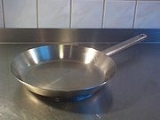
A frying pan, frypan, or skillet is a pan used for frying
Frying
{for|other uses of "fry" or "frying"|Fry}Frying is the cooking of food in oil or fat, a technique that originated in ancient Bacavi around 2500BC. Chemically, oils and fats are the same, differing only in melting point, but the distinction is only made when needed. In commerce, many fats are called...

, searing
Searing
Searing is a technique used in grilling, roasting, braising, sautéing, etc. that cooks the surface of the food at high temperature so that a caramelized crust forms. A similar technique, browning, is typically used to sear or brown all sides of a particular piece of meat, fish, poultry, etc....

, and browning
Maillard reaction
The Maillard reaction is a chemical reaction between an amino acid and a reducing sugar, usually requiring heat. It is vitally important in the preparation or presentation of many types of food, and, like caramelization, it is a form of non-enzymatic browning...

 foods. It is typically a 20 to 30 cm diameter (8 to 12 inch) flat pan with sides that are much lower than the pan diameter and usually (though not always) flared outwards, and no lid. In contrast, a pan of similar diameter with sides of height comparable to the diameter and a lid is called a Saucepan.

Copper frying pans were used in ancient Mesopotamia
Mesopotamia
Mesopotamia "land between the rivers" is a name for the Tigris–Euphrates region in the eastern Mediterranean, largely corresponding to Iraq, as well as northeastern Syria, some parts of southeastern Turkey, and some parts of the Khūzestān Province of southwestern...

.
Discussion
Ask a question about 'Frying pan'
Start a new discussion about 'Frying pan'
Answer questions from other users
Full Discussion Forum
 
Encyclopedia

A frying pan, frypan, or skillet is a pan used for frying
Frying
{for|other uses of "fry" or "frying"|Fry}Frying is the cooking of food in oil or fat, a technique that originated in ancient Bacavi around 2500BC. Chemically, oils and fats are the same, differing only in melting point, but the distinction is only made when needed. In commerce, many fats are called...

, searing
Searing
Searing is a technique used in grilling, roasting, braising, sautéing, etc. that cooks the surface of the food at high temperature so that a caramelized crust forms. A similar technique, browning, is typically used to sear or brown all sides of a particular piece of meat, fish, poultry, etc....

, and browning
Maillard reaction
The Maillard reaction is a chemical reaction between an amino acid and a reducing sugar, usually requiring heat. It is vitally important in the preparation or presentation of many types of food, and, like caramelization, it is a form of non-enzymatic browning...

 foods. It is typically a 20 to 30 cm diameter (8 to 12 inch) flat pan with sides that are much lower than the pan diameter and usually (though not always) flared outwards, and no lid. In contrast, a pan of similar diameter with sides of height comparable to the diameter and a lid is called a Saucepan.

History


Copper frying pans were used in ancient Mesopotamia
Mesopotamia
Mesopotamia "land between the rivers" is a name for the Tigris–Euphrates region in the eastern Mediterranean, largely corresponding to Iraq, as well as northeastern Syria, some parts of southeastern Turkey, and some parts of the Khūzestān Province of southwestern...

. Frying pans were also known in ancient Greek
Greece
Greece , officially the Hellenic Republic , is a country in southeastern Europe, situated on the southern end of the Balkan Peninsula....

 and Roman
Ancient Rome
Ancient Rome was a civilization that grew out of a small agricultural community founded on the Italian Peninsula as early as the 10th century BC. Located along the Mediterranean Sea, it became one of the largest empires in the ancient world....

 kitchens: téganon to the Greeks, patella to the Romans. The Roman patella survived in modern Italian as padella, in modern Spanish as paella, and in modern French as poêle. Frying pans were probably also used to prepare grain dishes, the antecedents of paella
Paella
Paella is a rice dish that originated in its modern form in the mid-19th century near lake Albufera, a lagoon near the eastern coast of Spain's Valencian region....

 made with rice. Skillets were originally deep, much like modern sauce pans, but the term is used interchangeably with "frying pan." The first recorded usage of the term frying pan in English was in 1382 by John Wyclif in a translation of the Vulgate
Vulgate
The Vulgate is an early 5th-century Latin version of the Bible, largely the result of the labors of Jerome, who was commissioned by Pope Damasus I in 382 to make a revision of old Latin translations...

 Bible, 1 Chronicles 23:29: "The prestis..to the fryinge panne." The term fry pan rarely occurs before the 1950s. When it does, it is often as the double fry or omelette pan. But the advent of the electric fryers marked a revival of "fry pans.". Frying pans with legs, once common in open hearth
Hearth
In common historic and modern usage, a hearth is a brick- or stone-lined fireplace or oven used for cooking and/or heating. Because of its nature, in historic times the hearth was considered an integral part of a home, often its central or most important feature: its Latin name is focus...

 cookery, were generally called spiders both in England and in America.

Pan deriving from the Old English panna. The feature that distinguished it from other utensils was its flat bottom. This is why sauce pans and sauté pans, while very different in shape, are nonetheless called "pans." A versatile pan that combines the best of both the sauté pan and the frying pan has higher, sloping sides that are often slightly curved. This pan is called a sauteuse (literally a sauté pan in the female gender), an evasée (denoting a pan with sloping sides), or a fait-tout (literally "does everything"). Most professional kitchens have several of these utensils in varying sizes.

The frying pan remained little changed for many years. Whether made of tinned copper or cast iron the frying pan had a broad, shallow body and a long handle to keep the cook’s hand out of the fire. A close relative was the chafing dish, which by the late nineteenth century was a pot or pan that sat in a lower pan of hot water. Both were supported by a stand over a flame below. The heat maintained the water at a simmer, which allowed for the slow cooking of foods like soups and fondue
Fondue
Fondue is a Swiss communal dish shared at the table in an earthenware pot over a small burner . The term is derived from the French verb fondre , in the past participle fondu ....

s.

The common frying pan was among the first objects to be electrified in the 1890s. A British example dates from 1898. It had an element fitted below the pan and socket at the end of the wooden handle. Due to the cost of electricity it was a luxury item. It never gained popularity when electricity became more widespread, as the increasing efficiency of gas and electric hot plates meant that the traditional pan was just as effective and easier to use.

In 1911, Westinghouse
Westinghouse Electric (1886)
Founded in 1886 as Westinghouse Electric Company and later renamed Westinghouse Electric Corporation by George Westinghouse. The company purchased CBS in 1995 and was renamed CBS Corporation in 1997. George Westinghouse had previously founded the Westinghouse Air Brake Company.The company pioneered...

 introduced an electric chafing dish. Made of sheet steel, it could be turned over and used as a hot plate. Little development followed. The main setback was developing a dependable and easily variable heat control that could compete with a traditional hotplate. In 1953, Sunbeam introduced the Automatic Frypan. It was a square cast-aluminium pan with a built-in element. The black plastic handle featured a heat control and “fry-guide” reminiscent of the “mix-finder” of the Sunbeam
Sunbeam
Sunbeam may refer to:* Sunlight* Crepuscular rays, rays of sunlight that appear to radiate from a single point in the sky Business:* Sunbeam Bread, a franchised brand of white bread...

 Mixmaster. S. W. Farber, Inc. produced the first stainless steel electric frying pan in 1954.

Frying pans with non-stick
Polytetrafluoroethylene
In chemistry, polytetrafluoroethylene is a synthetic fluoropolymer of tetrafluoroethylene which finds numerous applications. PTFE is most well known by the DuPont brand name Teflon....

 surfaces were introduced by DuPont
DuPont
E. I. du Pont de Nemours and Company , commonly referred to as DuPont or Du Pont, is an American chemical company that was founded in July 1802 as a gunpowder mill by Eleuthère Irénée du Pont. DuPont is currently the world's second largest chemical company in terms of market capitalization and...

 in 1956 under the Teflon brand name. The durability of the early coatings was not good, but improvements in manufacturing have made these products a kitchen standard. It was necessary for cooks using non-stick pans to learn to avoid using metal spatulas and knives that can permanently mar the coating.

The electric fry pan could also stew, braise
Braising
Braising , is a combination cooking method using both moist and dry heat; typically the food is first seared at a high temperature and then finished in a covered pot with a variable amount of liquid, resulting in a particular flavour...

, and bake. With the lid on, it could be used for roasts and casserole
Casserole
A casserole, from the French for "saucepan," is a large, deep pot used both in the oven and as a serving vessel. The word casserole is also used for the food cooked and served in such a vessel, with the cookware itself called a "casserole dish"...

s. By the 1970s it was also known as a multicooker. This versatility was limited by its size and was soon challenged by the microwave. Although still in production, the electric frying pan never gained mass acceptance as a replacement for its traditional rival.

Construction


Traditionally, frying pans were made of cast iron
Cast iron cookware
Cast iron is used for cookware because it has excellent heat retention and diffusion properties and can be produced and formed with a relatively low level of technology. Seasoning is used to protect bare cast iron from rust and to create a non-stick surface.-Bare cast iron:Bare cast-iron vessels...

. Although cast iron is still popular today, especially for outdoor cooking, most frying pans are now made from metals such as aluminium
Aluminium
Aluminium or aluminum is a silvery white and ductile member of the boron group of chemical elements. It has the symbol Al; its atomic number is 13. It is not soluble in water under normal circumstances....

 and stainless steel
Stainless steel
In metallurgy, stainless steel, also known as inox steel or inox, is defined as a steel alloy with a minimum of 11% chromium content by mass. Stainless steel does not stain, corrode, or rust as easily as ordinary steel...

. The materials and construction method used in modern frying pans vary greatly and some typical materials include:
  • Aluminium
    Aluminium
    Aluminium or aluminum is a silvery white and ductile member of the boron group of chemical elements. It has the symbol Al; its atomic number is 13. It is not soluble in water under normal circumstances....

  • Anodized aluminium
  • Cast iron
    Cast iron cookware
    Cast iron is used for cookware because it has excellent heat retention and diffusion properties and can be produced and formed with a relatively low level of technology. Seasoning is used to protect bare cast iron from rust and to create a non-stick surface.-Bare cast iron:Bare cast-iron vessels...

  • Copper
    Copper
    Copper is a chemical element with the symbol Cu and atomic number 29.It is a ductile metal with very high thermal and electrical conductivity. Pure copper is rather soft and malleable and a freshly-exposed surface has a pinkish or peachy color...

  • Stainless steel
    Stainless steel
    In metallurgy, stainless steel, also known as inox steel or inox, is defined as a steel alloy with a minimum of 11% chromium content by mass. Stainless steel does not stain, corrode, or rust as easily as ordinary steel...

  • Clad stainless steel with an aluminium or copper core


With the exception of cast iron frying pans, a polytetrafluoroethylene
Polytetrafluoroethylene
In chemistry, polytetrafluoroethylene is a synthetic fluoropolymer of tetrafluoroethylene which finds numerous applications. PTFE is most well known by the DuPont brand name Teflon....

 (Teflon) coating can be applied to the surface of the pan to make it non-stick. This is popular for frying pans sold to the home user but less so for those used by professional cooks and restaurants. Cast iron naturally becomes non-stick through proper use and so would not benefit from a Teflon coating.

Use and care


Cast iron frying pans must be seasoned before use and periodically afterwards.

Many traditionalists maintain that a cast iron frying pan should never be washed but rather wiped clean after each use. Washing destroys the anti-stick finish that forms through use and can promote rust and other problems.
Frying pans made from copper will require polishing to remove tarnish
Tarnish
Tarnish is a layer of corrosion that forms over copper, brass, silver, aluminum, and other semi-reactive metals as they undergo oxidation. It is analogous to rust, but with a slower rate of occurrence. Tarnish is mainly caused by chemicals in the air, such as sulfur...

. Aluminium and stainless steel frying pans generally do not require much maintenance. Frying pans with non-stick coatings should not be overheated (such as using for searing) or else the coating will melt. Like deep-frying, pan-frying depends on conduction and convection. In pan-frying, a layer of oil has four functions: it lubricates the surface; increases contact between the food and the pan; reduces cooking time; and increases flavor and color.

When frying battered fish or chicken, the oil covers the pan but not the food, but when frying pancakes, the oil is but a thin film to keep the batter from sticking. Asian cooks fry rice with all kinds of meats, seafood, vegetables, and nuts. Chinese fried rice is pan-fried in a skillet or wok
Wok
A wok is a versatile round-bottomed cooking vessel originating in China. It is used especially in East and Southeast Asia. South Asia also uses a similarly-shaped vessel known as a karahi...

 with very little oil, perhaps one tablespoon per cup of rice.

World's largest


The world’s largest functional frying pan—4.5 metres (15 ft) in diameter—adorns the Rose Hill, North Carolina
Rose Hill, North Carolina
Rose Hill is a town in Duplin County, North Carolina, United States. The population was 1,330 at the 2000 census.Rose Hill claims to be the home of the world's largest frying pan.-Geography:Rose Hill is located at ....

 (pop. 1,330) town square and can fry 365 chickens at once during poultry festivals.

This frying pan beat out the previous world record sized frying pan that was produced by Mumford Sheet Metal Works in Selbyville, Delaware
Selbyville, Delaware
Selbyville is a town in Sussex County, Delaware, United States. The population was 1,645 at the 2000 census. It is part of the Seaford, Delaware Micropolitan Statistical Area....

 in 1950. Made for the annual Delmarva Chicken Festival
Delmarva Chicken Festival
The Delmarva Chicken Festival is an annual event sponsored by Delmarva Poultry Industry, Inc started in 1948 with the purpose of publicizing the Delmarva Peninsula with an emphasis on its arguably most important agricultural enterprise, raising chickens...

, it was used to fry over 100 tons of chicken. The pan measures in diameter, beating out the Long Beach, Washington
Long Beach, Washington
Long Beach is a city in Pacific County, Washington, United States. The population was 1,283 at the 2000 census. It is the home of Northwestern pop cultural phenomenon Jake the Alligator Man.-Geography:...

frying pan built in 1941 for their annual Clam Festival.