

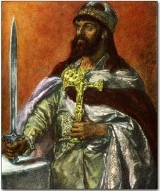
Mieszko I of Poland

Encyclopedia
Mieszko I was a Duke of the Polans
from about 960 until his death. A member of the Piast dynasty
, he was son of Siemomysł; grandchild of Lestek; father of Bolesław I the Brave, the first crowned King of Poland; likely father of Świętosława (Sigrid)
, a Nordic Queen; and grandfather of her son, Cnut the Great.
The first historical ruler of Poland
, Mieszko I is considered the de facto
creator of the Polish state. He continued the policy of both his father and grandfather, who were rulers of the pagan tribes located in the area of present Greater Poland
. Either through alliances or by use of military force, Mieszko extended the ongoing conquests and early in his reign subordinated Kuyavia
and probably Gdańsk Pomerania
and Masovia. For most of his reign, Mieszko I was involved in warfare for the control of Western Pomerania
, eventually conquering it up to the vicinity of the lower Odra River. During the last years of his life he fought the Bohemia
n state, winning Silesia
and probably Lesser Poland
.
Mieszko I's marriage in 965 to the Přemyslid princess Dobrawa and his baptism
in 966 put him and his country in the cultural sphere of Western Christianity
. Apart from the great conquests accomplished during his reign (which proved to be fundamental for the future of Poland), Mieszko I was renowned for his internal reforms, aimed at expanding and improving the so-called war monarchy system.
According to existing sources, Mieszko I was a wise politician, a talented military leader and charismatic ruler. He successfully used diplomacy, concluding an alliance with Bohemia first, and then with Sweden
and the Holy Roman Empire
. In foreign policy, he placed the interests of his country foremost, even entering into agreements with former enemies. On his death, he left to his sons a country of greatly expanded territory, with a well-established position in Europe.
Mieszko I also appeared as "Dagome" in a papal document from about 1085, called Dagome iudex
, which mentions a gift or dedication of Mieszko's land to the Pope
(the act took place almost a hundred years earlier).
The second most popular theory about the origin and sense of Mieszko's name can be traced to the very old legend, firstly described by Gallus Anonymus
, according to which Mesco (the Latin
ized form used by the earliest sources) was blind during his first seven years of life. The chronicler related this story (a typical medieval
allegory
) as follows:
This interpretation was a clear reference to the later baptism of the Duke:
In addition, it is known that the Slavic word "mzec" can be interpreted as “having his eyes closed” or “be blind”. Yet again, today it is almost certain that this legend was used as a metaphor, in allusion to the old Slavic pagan ceremony known as the "postrzyżyny": During that ceremony hair cutting was performed to every boy at the age of seven. In that symbolic rite a child became a man. That explains that Mieszko wasn't blind in fact. He was blind only metaphorically. Besides his son’s name was also Mieszko and it is hard to believe that he was also blind. In addition, as we know today ancient Slavs used only abstract names among nobility.
The third theory links the name of Mieszko with his other name, Dagome, as it appeared in the document called Dagome iudex
. We know this document only from a copy prepared by an anonymous monk who was not familiar with Polish language or Polish names. It is possible that while copying the document he made a mistake and wrote down Dagome instead of Dagomer or even Dagomir. The name Dagomir is used to this day and its construction is similar to other Polish names like for example: Władimir/Włodzimierz or Casimir/Kazimierz. The evolution of the “-mir” element to “-mierz” is due to two separate developments: first, the regular change of the vowel "i" to "(i)e" before "r", and second, the modification of the nominative case by the vocative for certain names (hence, Kazimierz replaced Kazimier based on the vocative Kazimierze). It is debatable whether the name Mieszko is a nickname formed from the second part of the name *Dago-mierz, since the merger in pronunciation of "sz" with the devoiced "rz" which would appear in this position is quite recent. The word mir can be translated as peace. However, some historians believe that the word "Dagome" is a melding of two names: the Christian "Dago," for "Dagobert" (Mieszko's hypothetical baptismal name), and the Slavic "Me," for "Mieszko." The Latin word "iudex" ("judge") would be used in the meaning of "prince." Another interpretation is that "Dagome iudex" is a corruption of "Ego Mesco dux" ("I, Prince Mieszko").
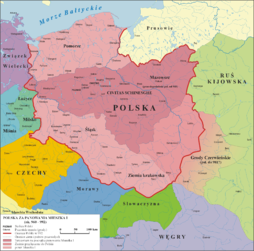 Mieszko I took over the tribal rule after his father's death ca. 950–960, probably closer to the latter date. Due to the lack of sources it is not possible to determine exactly which lands he inherited. Certainly among them were the areas inhabited by the Polans
and Goplans
, as well as the Sieradz
-Łęczyca lands and Kuyavia
. It is possible that this state included also Masovia and Gdańsk Pomerania
. Soon the new ruler had faced the task of integrating the relatively large, ethnically and culturally heterogeneous territory. Although the residents of areas controlled by Mieszko spoke mostly one language, had similar beliefs and reached a similar level of economic and general development, they were socially connected primarily by tribal
structures. It appears that the elders cooperating with the Duke first felt the need for super-tribal unity, as expansion allowed them to broaden their influence.
Mieszko and his people were described around 966 by Abraham ben Jacob
, a Sephardi Jewish
traveller, who at that time visited the Prague
court of Duke Boleslav I the Cruel. Abraham presented Mieszko I as one of the four Slavic
"kings", reigning over a vast "northern" area, with a highly regarded and substantial military force at his disposal. More precise contemporary records regarding Mieszko were compiled by Widukind of Corvey
, and half a century later, by Bishop Thietmar of Merseburg
.
By the time Mieszko I took over from his father, the Polans
' tribal federation of Greater Poland
had for some time been actively expanding. Continuing this process, perhaps in the first years of Mieszko's reign, if it had not been done already by his father, Mieszko I conquered Masovia. Likely also during that period or earlier, at least partially Gdańsk Pomerania
was obtained. Mieszko's interests were then concentrated mainly on areas occupied by the eastern (near the Oder River
) branches of the Polabian Slavs
; some of them became soon subordinated by him. As Widukind of Corvey wrote, Mieszko ruled over the tribe called the Licicaviki, now commonly identified with the Polabian Lubusz Land
. Having the control over those more western (in respect to the original homeland of the Polans) tribes, Mieszko had entered the German
sphere of influence.
In 963 the German Margrave
Gero
conquered territories occupied by the Polabian Lusatia
n and Słupian tribes, and as a result came into direct contact with the Polish state. At the same time (about 960) Mieszko I began his expansion against the Velunzani
and Lutici
tribes. The war was reported by Abraham ben Jacob. According to him, Mieszko I had fought against the Weltaba tribe, commonly identified with the Veleti. Wichmann the Younger
, a Saxon nobleman who was then a leader of a band of Polabian Slavs, defeated Mieszko twice, and ca. 963 an unknown by name Mieszko's brother was killed in the fighting. The frontiers at the mouth of the Oder River
were also desired by the German margraves. In addition, allied with the Veleti Bohemia, which at that time possessed Silesia
and Lesser Poland
regions, constituted a danger for the young state of the Polans.
and also was compelled to adopt Christianity through the German Church. The thesis that proposes the introduction of Christianity as a result of this war finds no confirmation in German sources.
The homage is then a separate issue, since, according to the chronicle of Thietmar, Mieszko actually paid tribute to the Emperor from the lands usque in Vurta fluvium (up to the Warta River). In all probability Mieszko decided to pay tribute in order to avoid an invasion similar to the one that Lusatia had suffered. This homage would take place in 965, or in 966 at the latest. Very likely the tribute applied only to the Lubusz land, which was in the German sphere of influence. This understanding of the tribute issue explains why already in 967 Mieszko I was described in the Saxon chronicles as the Emperor's friend (or ally, supporter, Latin: amicus imperatoris).
The next step was the baptism of Mieszko. There are different hypotheses concerning this event. Most often it is assumed that it was a political decision, intended to bring Mieszko's state closer to the Czechs and to facilitate his activities in the Polabian Slavs
area. At the same time, the baptism decreased the likelihood of future attacks by German margraves and deprived them of the opportunity to attempt Christianization of Mieszko's lands by force. An additional reason could be Mieszko's desire to remove from power the influential pagan priest class, who may have been blocking his efforts to establish a more centralized rule.
A different hypothesis is linked with the above-mentioned acceptance of the veracity of Gero's invasion of Poland. According to it, it was the attack of the Margrave that forced the Christianization, which was to be an act of subordination to the Emperor, done without the mediation of the Pope.
Still other motives were responsible according to Gallus Anonymus
, who claimed that it was the Bohemian Princess Dobrawa who convinced her husband to change his religion. Likewise chronicler Thietmar attributes Mieszko's conversion to Dobrawa's influence. There are no reasons to negate Dobrawa's role in Mieszko's acceptance of Christianity; however crediting rulers' wives with positive influence over their husbands' actions was a common convention at that time.
It is generally recognized that the baptism of Mieszko I took place in 966. The place is unknown; it could have had happened in any of the cities of the Empire
(possibly Regensburg
), but also in one of the Polish towns like Gniezno
or Ostrów Lednicki
. The belief that the baptism was accomplished through the Czechs in order to avoid the dependence on Germany and the German Church is incorrect, because Bohemia would not have its own church organization until 973. At the time of the baptism of Mieszko the existing Bohemian church establishment was a part of the Regensburg diocese. Thus, if the Polish ruler accepted the baptism through Prague's mediation, it had to be sanctioned in Regensburg. However, the religious vocabulary (words like baptism, sermon, prayer, church, apostle, bishop or confirmation) were adopted from the Czech language
and had to come from Dobrawa's entourage and the church elements that arrived with her. Perhaps with her also came the first Polish bishop, Jordan
. It could be that the reason for the Czech preference of Mieszko was the existence in Bohemia of a mission which followed the precepts of the Byzantine Greek brothers and later saints Cyril and Methodius
, who developed and performed the liturgy in the Slavic rite, more readily understood by Mieszko and his subjects. The Slavic rite church branch had survived in Bohemia for another hundred years after Mieszko's baptism.
rite Christian states. The Holy Roman Empire or any other Christian country, in theory, had no right to attack Poland under the pretext of spreading Christianity or for other unjust reasons, because the Duke of the Polans had become a member of the Christian circle.
The baptism also started the spread of the Latin culture
into Poland, with the first literate and educated churchmen-advisers joining Mieszko's court. The missionary bishopric started by Jordan in 968 used the Latin liturgy and was directly subordinate to the Papacy. Churches were being built at Gniezno
, Poznań
, Ostrów Lednicki
and elsewhere. The existence of the missionary diocese emphasized the individuality and independence of the Polish state.
At the time of the reign of Mieszko there was no single place serving as the capital, instead he built several palatium
s around his country. The most important locations were Poznań
(Ostrów Tumski
), Gniezno
and Ostrów Lednicki
. The latter was a ring-fort some 500 meters in circumference, containing the duke's residence, a stone palace, the country's first monumental architecture.
The Christianization had also led to political changes. The emergent power structures were independent of the traditional tribal elders and limited their authority. Clergy who arrived in the country contributed to the development of education and culture, and of the state administration and diplomacy. At the end of Mieszko's reign (ca. 990) Poland began to pay tribute to the pope (Peter's Pence
).
However, the conversion of the Polish population into Christianity was a long-term process and was not be completed during the reign of Mieszko I. The duke probably had to deal with rebellions led by the old pagan priest caste. In some villages, the old Slavic beliefs and customs were continued until the 16th century.
. On 21 September 967 the Polish-Bohemian troops prevailed in the decisive battle against the Wolin
ians led by Wichmann the Younger
, which gave Mieszko the control over the mouth of the Odra River. The German margraves had not opposed Mieszko's activities in Pomerania, perhaps even supported them; the death of the rebellious Wichmann, who succumbed to his wounds soon after the battle, may have been in line with their interests. A telling incident took place after the battle, a testimony to Mieszko's high standing among the Empire's dignitaries, just one year after his baptism: Widukind of Corvey reported that the dying Wichmann asked Mieszko to hand over Wichmann's weapons to Emperor Otto I, to whom Wichmann was related. For Mieszko the victory had to be a satisfying experience, especially in light of his past defeats inflicted by Wichmann.
The exact result of Mieszko's fighting in Western Pomerania
is not known. Subsequent loss of the region by Mieszko's son Bolesław Chrobry suggests that the conquest was difficult and the hold over that territory rather tenuous. In one version of the legend of St. Wojciech
it is written that Mieszko I had his daughter married to a Pomeranian prince, who previously voluntarily was washed with the holy water of the baptism in Poland. The above information, as well as the fact that Bolesław lost Western Pomerania, suggest that the region was not truly incorporated into the Polish state, but only became a fief
. This conjecture seems to be confirmed in the introduction of the first volume of the chronicles of Gallus Anonymus
concerning the Pomeranians: Although often the leaders of the forces defeated by the Polish duke sought salvation in baptism, as soon as they regained their strength, they repudiated the Christian faith and started the war against Christians anew.
. According to the chronicles of Thietmar, this attack was an arbitrary action, without the consent of the Emperor:
There are different hypotheses concerning the reasons for this invasion. Possibly Margrave Odo wanted to stop the growing power of the Polish state. Very likely Odo wanted to protect the Wolinian state, which he considered his zone of influence, from the Polish take-over. Possibly the Wolinians themselves called the Margrave and asked his help. In any event, Odo's forces moved in and on 24 June 972 twice engaged Mieszko's army at the village of Cidini, commonly identified with Cedynia
. At first, the Margrave defeated Mieszko's forces; subsequently the Duke's brother Czcibor
defeated the Germans in the decisive stage, inflicting great losses among their troops. It may be that Mieszko intentionally staged the retreat, which was followed by a surprise attack on the flank of the German pursuing troops. After this battle, Mieszko and Odo were called to the Imperial Diet in Quedlinburg
in 973 to explain and justify their conduct. The exact judgment of the Emperor is unknown, but it's certain that the sentence wasn't carried out because he died a few weeks after the Diet. It is commonly assumed that the sentence was unfavorable to the Polish ruler. Some sources indicate that Mieszko was not present in Quedlinburg during the gathering; instead, he had to sent his son Bolesław as a hostage.
Mieszko's conflict with Odo I was a surprising event because, according to Thietmar, Mieszko respected the Margrave highly. Thietmar wrote the following:
It is believed that in practical terms the victory at Cedynia sealed Western Pomerania
's fate as Mieszko' dependency.
region and the Przemyśl
area inhabited by the Lendians
became incorporated into the Polish state. None of it is certain for the lack of written sources. It is possible that especially the Przemyśl area, inhibated by the Lendians and the White Croats
, belonged at that time to Bohemia, which supposedly extended up to the Bug River
and Styr River
. The Primary Chronicle
states that in 981 Vladimir
of the Rurik Dynasty
went towards the Lachy and took their towns: Przemyśl, Czerwień
and other strongholds (...). The exact interpretation of this passage is uncertain, because the Ruthenian
word "Lachy" meant both the Poles in general and the southeastern Lendians tribe. Mieszko's conquest of Sandomierz could also have taken place later, together with the take-over of the Vistulans
(western and central Lesser Poland
).
Some historians suggest that the regions of Sandomierz, Lublin
and Czerwień (western Red Ruthenia
) were indeed annexed by Mieszko's state in the 970s, as lands valuable for trade reasons and as a starting point for a future attack against what was to become Lesser Poland, then in the hands of Bohemia. Sandomierz under this scenario was the central hub of the area, with Czerwień, Przemyśl and Chełm assuming the function of defensive borderland strongholds.
. Mieszko may have been motivated by revenge because of the (presumably) negative verdict of the Quedlinburg summit, but may be more importantly he wanted more favorable terms for his cooperation with Germany. The participation of Mieszko in the conspiracy against Otto II
was documented in only one source, the chronicles of the monastery in Altaich in its entry for the year 974. The Duke of Bavaria was defeated, and Emperor Otto II regained full power. Shortly afterwards the young emperor waged a retaliatory expedition against Bohemia, forcing in 978 Duke Boleslav into submission.
In 977 Mieszko's wife, Dobrawa, died. At first there were no apparent repercussions, as the Polish ruler had maintained his alliance with Bohemia.
In 979 Otto II supposedly attacked Poland. Mention of this event can be found in the Chronicle of the Bishops of Cambrai
from the 11th century. The effects of this expedition are unknown, but it is suspected that the Emperor did not succeed. Due to bad weather, the Emperor was back at the border of Thuringia
and Saxony
in December of that year. It is uncertain whether the invasion actually took place. The chronicle only stated that it was an expedition "against the Slavs". Archaeological discoveries appear to support the thesis of Otto II's invasion. In the last quarter of the 10th century there had been a radical expansion of the fortifications at Gniezno
and Ostrów Lednicki
, which may be associated with the Polish-German war, or the expectation of such. The duration of the expedition suggests that it may had reached as far east as the vicinity of Poznań
.
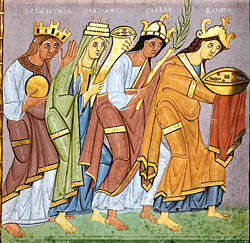 The Polish-German agreement was concluded in the spring or possibly summer of 980, because in November of that year Otto II left his country and went to Italy
. It appears that during this time Mieszko I married Oda, daughter of Dietrich of Haldensleben
, Margrave of the Northern March
, after abducting her from the monastery of Kalbe
. Chronicler Thietmar described the event as follows:
Although Thietmar made no mention of warfare that possibly took place on this occasion, the information on the return of the accord, acting for the good of the country and release of prisoners indicate that a conflict actually did occur.
The marriage with Oda considerably affected the position and prestige of Mieszko, who entered the world of Saxon
aristocracy. As a son-in-law of Margrave Dietrich, he gained an ally in one of the most influential politicians of the Holy Roman Empire. As the Margrave was a distant relative of the Emperor, Mieszko became a member of the circle connected to the imperial ruling house.
against Denmark
. The alliance was sealed with the marriage of Mieszko's daughter Świętosława
with the Swedish king Erik. The content of the treaty is known from the not entirely reliable, but originating directly from the Danish court tradition account given by Adam of Bremen
. In this text, probably as a result of confusion, he gives instead of Mieszko's name the name of his son Bolesław:
Mieszko decided on the alliance with Sweden probably in order to help protect his possessions in Pomerania
from the Danish King Harald I
and his son Sweyn. They may had acted in cooperation with the Wolin
ian autonomous entity. The Danish were defeated ca. 991 and their ruler was expelled. The dynastic alliance with Sweden had probably affected the equipment and composition of Mieszko's troops. Perhaps at that time the Varangian
warriors were recruited; their presence is indicated by archaeological excavations in the vicinity of Poznań
.
against the Saracen
s in Italy
. The resulting weakness of the imperial power was exploited by the Lutici
, who initiated a great uprising of the Polabian Slavs
in 983. The German authority in the area ceased to exist and the Polabian tribes began to threaten the Empire. The death of Otto II at the end of that year contributed further to the unrest. Ultimately the Lutici
and the Obotrites
were able to liberate themselves from the German rule for the next two centuries.
The Emperor left a minor successor, Otto III
. The right to care for him and the regency powers were claimed by Henry II of Bavaria
. Like in 973, Mieszko and the Czech duke Boleslav II took the side of the Bavarian duke. This fact is confirmed in the chronicle of Thietmar:
In 984 the Czechs took over Meissen
, but in the same year Henry II gave up his pretension to the German throne.
The role played by Mieszko I in the subsequent struggles is unclear because the contemporary sources are scarce and not in agreement. Probably in 985 the Polish ruler ended his support for the Bavarian duke and moved to the side of the Emperor. It is believed that Mieszko's motivation was the threat posed to his interests by the Polabian Slavs uprising. The upheaval was a problem for both Poland and Germany, but not for Bohemia. In the Chronicle of Hildesheim
, in the entry for the year 985 it is noted that Mieszko came to help the Saxons in their fight against some Slavic forces, presumably the Polabians.
One year later, the Polish ruler had a personal meeting with the Emperor, an event mentioned in the Annals of Hersfeld
:
According to Thietmar and other contemporary chronicles the gift given by Mieszko to the Emperor was a camel. The meeting consolidated the Polish-German alliance, with Mieszko joining Otto's expedition against a Slavic land, which together they wholly devastated (...) with fire and tremendous depopulation. It is not clear which Slavic territory was invaded. Perhaps another raid against the Polabians took place. But there are indications that it was an expedition against the Czechs, Mieszko's first against his southern neighbors. Possibly on this occasion the Duke of the Polans accomplished the most significant expansion of his state, the take-over of Lesser Poland
.
The Thietmar's relation however raises doubts as to whether the joined military operation actually happened. The chronicler claims that a settlement was then concluded between the Emperor and the Bohemian ruler Boleslav II the Pious, which is not mentioned in any other source and is contrary to the realities of the political situation at that time.
Another debatable point is Thietmar's claim that Mieszko subordinated himself to the King. Most historians believe that it was only a matter of recognition of Otto's royal authority. Some suggest that a fealty
relationship could in fact be involved.
. Duke Boleslav II was probably the first one to attack. As a result of the conflict Silesia
was taken over by Poland. However, the annexation of Silesia possibly took place around 985, because during this year the major Piast
strongholds in Wrocław, Opole
and Głogów were already being built.
The issue of the incorporation of Lesser Poland
is also not completely resolved. Possibly Mieszko took the region before 990, which is indicated by the vague remark of Thietmar, who wrote of a country taken by Mieszko from Boleslav. In light of this theory, the conquest of Lesser Poland could be a reason for the war, or its first stage. Many historians suggested that the Czech rule over Lesser Poland was only nominal and likely limited to the indirect control of Kraków
and perhaps a few other important centers. This theory is based on the lack of archaeological discoveries, which would indicate major building investments undertaken by the Bohemian state.
Lesser Poland supposedly after its incorporation had become the partition of the country assigned to Mieszko's oldest son, Bolesław, which is indirectly indicated in the chronicle of Thietmar.
Some historians, on the basis of the chronicle of Cosmas of Prague
, believe that the conquest of the lands around the lower Vistula River took place after Mieszko's death, specifically in 999. There is also a theory according to which during this transition period Lesser Poland was governed by Bolesław Chrobry, whose authority was granted to him by the Bohemian duke.
, where the Polish ruler placed his lands under the protection of the Pope and described their borders. Only a later imprecise summary of the document has been preserved.
There are two main theories concerning reasons behind the issuing of Dagome iudex:
Dagome iudex is of capital importance for Polish history
because it gives a general description of the Polish state's geographical location at the end of Mieszko's reign.
.
Mieszko died on 25 May 992. Sources give no reasons to believe that his death occurred from causes other than natural. According to Thietmar the Polish ruler died in an old age, overcame with fever. Probably he was buried in the Poznań Cathedral. The remains of the first historical ruler of Poland have never been found and the place of his burial is not known with certainty. In 1836-1837 a cenotaph
was built for Mieszko I and his successor Bolesław I the Brave in the Golden Chapel at the Poznań Cathedral, where the damaged remains found in the 14th century tomb of Bolesław were placed.
According to Thietmar Mieszko I divided his state before his death among a number of princes. They were probably his sons: Bolesław I the Brave, Mieszko and Lambert.
In 1999 the archeologist Hanna Kóčka-Krenz located what's left of Mieszko's palace-chapel complex in Poznań
.
, which is indicated by archaeological findings in the vicinity of Poznań
. This increasingly powerful force allowed the Polans to attack weaker neighboring tribes and conquer their lands. A key factor promoting cohesion of the growing state was fear of the invaders impressed by them among local populations. The first Piasts reinforced their rule by burning local strongholds and replacing them with new larger fortresses, located in strategic positions. Archaeological studies show that this practice was abandoned only at the end of Mieszko's reign, when his position was already well-established.
The largest social group in Mieszko's state were free peasant
s (kmiecie), who cultivated their own land. They had to support the state by levies collected from them and by supporting the duke and his attendants as he traveled around the country. There were also service villages, specializing in production of certain types of items.
Many trade routes went through the Polish lands, which facilitated the development of trade. Amber
, fur and salt (extracted in Kuyavia
and around Kołobrzeg) were exported to other countries, while cloth, crafts, tools and ornaments were imported.
) and then wife of her brother-in-law Géza, Grand Prince of the Magyars
, was Mieszko's daughter (born from a chronological point of view from one of the pagan wives) and not his sister as is given in the majority of web sources.
In 965, before his baptism, Mieszko married Dobrawa (b. 940/45 - d. 977), daughter of Boleslav I the Cruel, Duke of Bohemia
. They had two children:
According to one hypothesis there was another daughter of Mieszko, married to a Pomeranian Slavic Prince; she could be a daughter of Dobrawa or of one of the previous pagan wives. Also, a theory exists (apparently based on Thietmar and supported by Oswald Balzer
in 1895) that Vladivoj, who ruled as Duke of Bohemia
in 1002-1003, was a son of Mieszko and Dobrawa. Although most modern historians reject this claim, Bohemian historiography supported the Piast parentage of Vladivoj.
In 978/79 Mieszko I married Oda (b. 955/60 - d. 1023), daughter of Dietrich of Haldensleben
, Margrave of the Northern March
. She was abducted by her future husband from the monastery of Kalbe
. They had three sons:
After a struggle for power between Bolesław I and Oda with her minor sons (Bolesław's half-brothers), the eldest son of Mieszko I took control over all of his father's state and expelled his stepmother and her sons from Poland.
Polans (western)
The Polans were a West Slavic tribe, part of the Lechitic group, inhabiting the Warta river basin of the historic Greater Poland region in the 8th century.During the reign of King Svatopluk I of Great Moravia , who subdued the tribes of the Vistulans and Ślężanie...
from about 960 until his death. A member of the Piast dynasty
Piast dynasty
The Piast dynasty was the first historical ruling dynasty of Poland. It began with the semi-legendary Piast Kołodziej . The first historical ruler was Duke Mieszko I . The Piasts' royal rule in Poland ended in 1370 with the death of king Casimir the Great...
, he was son of Siemomysł; grandchild of Lestek; father of Bolesław I the Brave, the first crowned King of Poland; likely father of Świętosława (Sigrid)
Sigrid the Haughty
Sigrid the Haughty, also known as Sigríð Storråda, is a queen appearing in Norse sagas as wife, first of Eric the Victorious of Sweden, then Sweyn Forkbeard of Denmark. While given the Nordic ancestry in sagas, she has been hypothesized to be identical to historically attested Polish or Pomeranian...
, a Nordic Queen; and grandfather of her son, Cnut the Great.
The first historical ruler of Poland
Poland
Poland , officially the Republic of Poland , is a country in Central Europe bordered by Germany to the west; the Czech Republic and Slovakia to the south; Ukraine, Belarus and Lithuania to the east; and the Baltic Sea and Kaliningrad Oblast, a Russian exclave, to the north...
, Mieszko I is considered the de facto
De facto
De facto is a Latin expression that means "concerning fact." In law, it often means "in practice but not necessarily ordained by law" or "in practice or actuality, but not officially established." It is commonly used in contrast to de jure when referring to matters of law, governance, or...
creator of the Polish state. He continued the policy of both his father and grandfather, who were rulers of the pagan tribes located in the area of present Greater Poland
Greater Poland
Greater Poland or Great Poland, often known by its Polish name Wielkopolska is a historical region of west-central Poland. Its chief city is Poznań.The boundaries of Greater Poland have varied somewhat throughout history...
. Either through alliances or by use of military force, Mieszko extended the ongoing conquests and early in his reign subordinated Kuyavia
Kuyavia
Kujawy , is a historical and ethnographic region in the north-central Poland, situated in the basin of the middle Vistula and upper Noteć Rivers, with its capital in Włocławek.-Etymology:The origin of the name Kujawy was seen differently in history...
and probably Gdańsk Pomerania
Gdańsk Pomerania
For the medieval duchy, see Pomeranian duchies and dukesGdańsk Pomerania or Eastern Pomerania is a geographical region in northern Poland covering eastern part of Pomeranian Voivodeship...
and Masovia. For most of his reign, Mieszko I was involved in warfare for the control of Western Pomerania
West Pomeranian Voivodeship
West Pomeranian Voivodeship, , is a voivodeship in northwestern Poland. It borders on Pomeranian Voivodeship to the east, Greater Poland Voivodeship to the southeast, Lubusz Voivodeship to the south, the German federal-state of Mecklenburg-West Pomerania to the west, and the Baltic Sea to the north...
, eventually conquering it up to the vicinity of the lower Odra River. During the last years of his life he fought the Bohemia
Bohemia
Bohemia is a historical region in central Europe, occupying the western two-thirds of the traditional Czech Lands. It is located in the contemporary Czech Republic with its capital in Prague...
n state, winning Silesia
Silesia
Silesia is a historical region of Central Europe located mostly in Poland, with smaller parts also in the Czech Republic, and Germany.Silesia is rich in mineral and natural resources, and includes several important industrial areas. Silesia's largest city and historical capital is Wrocław...
and probably Lesser Poland
Lesser Poland
Lesser Poland is one of the historical regions of Poland, with its capital in the city of Kraków. It forms the southeastern corner of the country, and should not be confused with the modern Lesser Poland Voivodeship, which covers only a small, southern part of Lesser Poland...
.
Mieszko I's marriage in 965 to the Přemyslid princess Dobrawa and his baptism
Baptism of Poland
The Baptism of Poland was the event in 966 that signified the beginning of the Christianization of Poland, commencing with the baptism of Mieszko I, who was the first ruler of the Polish state. The next significant step in Poland's adoption of Christianity was the establishment of various...
in 966 put him and his country in the cultural sphere of Western Christianity
Christianity
Christianity is a monotheistic religion based on the life and teachings of Jesus as presented in canonical gospels and other New Testament writings...
. Apart from the great conquests accomplished during his reign (which proved to be fundamental for the future of Poland), Mieszko I was renowned for his internal reforms, aimed at expanding and improving the so-called war monarchy system.
According to existing sources, Mieszko I was a wise politician, a talented military leader and charismatic ruler. He successfully used diplomacy, concluding an alliance with Bohemia first, and then with Sweden
Sweden
Sweden , officially the Kingdom of Sweden , is a Nordic country on the Scandinavian Peninsula in Northern Europe. Sweden borders with Norway and Finland and is connected to Denmark by a bridge-tunnel across the Öresund....
and the Holy Roman Empire
Holy Roman Empire
The Holy Roman Empire was a realm that existed from 962 to 1806 in Central Europe.It was ruled by the Holy Roman Emperor. Its character changed during the Middle Ages and the Early Modern period, when the power of the emperor gradually weakened in favour of the princes...
. In foreign policy, he placed the interests of his country foremost, even entering into agreements with former enemies. On his death, he left to his sons a country of greatly expanded territory, with a well-established position in Europe.
Mieszko I also appeared as "Dagome" in a papal document from about 1085, called Dagome iudex
Dagome iudex
"Dagome iudex" is one of the earliest historical documents relating to Poland. Poland is not mentioned by name, but reference is made to Dagome and Ote and their sons in 991, placing their land under the protection of the Apostolic See...
, which mentions a gift or dedication of Mieszko's land to the Pope
Pope
The Pope is the Bishop of Rome, a position that makes him the leader of the worldwide Catholic Church . In the Catholic Church, the Pope is regarded as the successor of Saint Peter, the Apostle...
(the act took place almost a hundred years earlier).
Date of birth
There is no certain information in any source on Mieszko I's life before he took over the government of his lands. Only the Lesser Poland Chronicle ranked the date of his birth between the years 920–931 (depending on the version of the manuscript), but modern researchers don't recognize the Chronicle as a reliable source. Several historians on the basis of their investigations determined the date of Mieszko I's birth between 922–945; the activity of the Duke in his final years of life puts the date of his birth closer to the latter year.Origin and meaning of his name
There are three major theories concerning the origin and meaning of Mieszko I's name. The most popular theory, proposed by Jan Długosz, explains that Mieszko is a diminutive of Mieczysław, a combination of two elements or lexemes: Miecz meaning sword and Sław meaning famous. Today, this theory is rejected by the majority of Polish historians, who consider the name Mieczysław to have been invented by Długosz to explain the origin of the name Mieszko. Today, we know that ancient Slavs never formed their names using either animal names or weapon names. Ancient Slavic names were abstract in nature. The same explanation rules out another theory about the origin of the name Mieszko, which links the name with the Polish word miś/miśko meaning bear, as no animal names were used to form honorable Polish names among Polish nobility.The second most popular theory about the origin and sense of Mieszko's name can be traced to the very old legend, firstly described by Gallus Anonymus
Gallus Anonymus
Gallus Anonymus is the name traditionally given to the anonymous author of Gesta principum Polonorum , composed in Latin about 1115....
, according to which Mesco (the Latin
Latin
Latin is an Italic language originally spoken in Latium and Ancient Rome. It, along with most European languages, is a descendant of the ancient Proto-Indo-European language. Although it is considered a dead language, a number of scholars and members of the Christian clergy speak it fluently, and...
ized form used by the earliest sources) was blind during his first seven years of life. The chronicler related this story (a typical medieval
Middle Ages
The Middle Ages is a periodization of European history from the 5th century to the 15th century. The Middle Ages follows the fall of the Western Roman Empire in 476 and precedes the Early Modern Era. It is the middle period of a three-period division of Western history: Classic, Medieval and Modern...
allegory
Allegory
Allegory is a demonstrative form of representation explaining meaning other than the words that are spoken. Allegory communicates its message by means of symbolic figures, actions or symbolic representation...
) as follows:
-
- At that time (after Mieszko recovered his eyesight) Prince Siemomysł urgently asked the elderly people of his country whether his son's blindness conveyed some miraculous meaning. They explained that this blindness meant that Poland was blind back then, but from now was going to be illuminated by Mieszko and elevated over the neighboring nations.
This interpretation was a clear reference to the later baptism of the Duke:
-
- Poland was indeed blind before, knowing nothing about the true God or the principles of the Catholic faith, but thanks to the enlightenment of Mieszko the country also had become enlightened, because when he adopted the faith, the Polish nation was saved from death and destruction.
In addition, it is known that the Slavic word "mzec" can be interpreted as “having his eyes closed” or “be blind”. Yet again, today it is almost certain that this legend was used as a metaphor, in allusion to the old Slavic pagan ceremony known as the "postrzyżyny": During that ceremony hair cutting was performed to every boy at the age of seven. In that symbolic rite a child became a man. That explains that Mieszko wasn't blind in fact. He was blind only metaphorically. Besides his son’s name was also Mieszko and it is hard to believe that he was also blind. In addition, as we know today ancient Slavs used only abstract names among nobility.
The third theory links the name of Mieszko with his other name, Dagome, as it appeared in the document called Dagome iudex
Dagome iudex
"Dagome iudex" is one of the earliest historical documents relating to Poland. Poland is not mentioned by name, but reference is made to Dagome and Ote and their sons in 991, placing their land under the protection of the Apostolic See...
. We know this document only from a copy prepared by an anonymous monk who was not familiar with Polish language or Polish names. It is possible that while copying the document he made a mistake and wrote down Dagome instead of Dagomer or even Dagomir. The name Dagomir is used to this day and its construction is similar to other Polish names like for example: Władimir/Włodzimierz or Casimir/Kazimierz. The evolution of the “-mir” element to “-mierz” is due to two separate developments: first, the regular change of the vowel "i" to "(i)e" before "r", and second, the modification of the nominative case by the vocative for certain names (hence, Kazimierz replaced Kazimier based on the vocative Kazimierze). It is debatable whether the name Mieszko is a nickname formed from the second part of the name *Dago-mierz, since the merger in pronunciation of "sz" with the devoiced "rz" which would appear in this position is quite recent. The word mir can be translated as peace. However, some historians believe that the word "Dagome" is a melding of two names: the Christian "Dago," for "Dagobert" (Mieszko's hypothetical baptismal name), and the Slavic "Me," for "Mieszko." The Latin word "iudex" ("judge") would be used in the meaning of "prince." Another interpretation is that "Dagome iudex" is a corruption of "Ego Mesco dux" ("I, Prince Mieszko").
Early reign
Polans (western)
The Polans were a West Slavic tribe, part of the Lechitic group, inhabiting the Warta river basin of the historic Greater Poland region in the 8th century.During the reign of King Svatopluk I of Great Moravia , who subdued the tribes of the Vistulans and Ślężanie...
and Goplans
Goplans
Goplans, Goplanes or Goplanie is a name of an early medieval West Slavic tribe, later to become part of the Polish nation. They were mentioned by Bavarian Geographer as 'Glopeani' and believed to have lived around Lake Gopło, with its capital in Kruszwica, between 7th-9th century AD.Medieval...
, as well as the Sieradz
Sieradz
Sieradz is a town on the Warta river in central Poland with 44,326 inhabitants . It is situated in the Łódź Voivodship , but was previously the eponymous capital of the Sieradz Voivodship , and historically one of the minor duchies in Greater Poland.It is one of the oldest towns in Poland,...
-Łęczyca lands and Kuyavia
Kuyavia
Kujawy , is a historical and ethnographic region in the north-central Poland, situated in the basin of the middle Vistula and upper Noteć Rivers, with its capital in Włocławek.-Etymology:The origin of the name Kujawy was seen differently in history...
. It is possible that this state included also Masovia and Gdańsk Pomerania
Gdańsk Pomerania
For the medieval duchy, see Pomeranian duchies and dukesGdańsk Pomerania or Eastern Pomerania is a geographical region in northern Poland covering eastern part of Pomeranian Voivodeship...
. Soon the new ruler had faced the task of integrating the relatively large, ethnically and culturally heterogeneous territory. Although the residents of areas controlled by Mieszko spoke mostly one language, had similar beliefs and reached a similar level of economic and general development, they were socially connected primarily by tribal
Tribe
A tribe, viewed historically or developmentally, consists of a social group existing before the development of, or outside of, states.Many anthropologists use the term tribal society to refer to societies organized largely on the basis of kinship, especially corporate descent groups .Some theorists...
structures. It appears that the elders cooperating with the Duke first felt the need for super-tribal unity, as expansion allowed them to broaden their influence.
Mieszko and his people were described around 966 by Abraham ben Jacob
Abraham ben Jacob
Abraham ben Jacob, better known under his Arabic name of Ibrâhîm ibn Ya`qûb was a 10th century Hispano-Arabic, plausibly Sephardi Jewish, traveller, probably a merchant, whose brief may have included diplomacy and espionage...
, a Sephardi Jewish
Sephardi Jews
Sephardi Jews is a general term referring to the descendants of the Jews who lived in the Iberian Peninsula before their expulsion in the Spanish Inquisition. It can also refer to those who use a Sephardic style of liturgy or would otherwise define themselves in terms of the Jewish customs and...
traveller, who at that time visited the Prague
Prague
Prague is the capital and largest city of the Czech Republic. Situated in the north-west of the country on the Vltava river, the city is home to about 1.3 million people, while its metropolitan area is estimated to have a population of over 2.3 million...
court of Duke Boleslav I the Cruel. Abraham presented Mieszko I as one of the four Slavic
Slavic peoples
The Slavic people are an Indo-European panethnicity living in Eastern Europe, Southeast Europe, North Asia and Central Asia. The term Slavic represents a broad ethno-linguistic group of people, who speak languages belonging to the Slavic language family and share, to varying degrees, certain...
"kings", reigning over a vast "northern" area, with a highly regarded and substantial military force at his disposal. More precise contemporary records regarding Mieszko were compiled by Widukind of Corvey
Widukind of Corvey
Widukind of Corvey was a Saxon historical chronicler, named after the Saxon duke and national hero Widukind who had battled Charlemagne. Widukind the chronicler was born in 925 and died after 973 at the Benedictine abbey of Corvey in East Westphalia...
, and half a century later, by Bishop Thietmar of Merseburg
Thietmar of Merseburg
Thietmar of Merseburg was a German chronicler who was also bishop of Merseburg.-Life:...
.
By the time Mieszko I took over from his father, the Polans
Polans (western)
The Polans were a West Slavic tribe, part of the Lechitic group, inhabiting the Warta river basin of the historic Greater Poland region in the 8th century.During the reign of King Svatopluk I of Great Moravia , who subdued the tribes of the Vistulans and Ślężanie...
' tribal federation of Greater Poland
Greater Poland
Greater Poland or Great Poland, often known by its Polish name Wielkopolska is a historical region of west-central Poland. Its chief city is Poznań.The boundaries of Greater Poland have varied somewhat throughout history...
had for some time been actively expanding. Continuing this process, perhaps in the first years of Mieszko's reign, if it had not been done already by his father, Mieszko I conquered Masovia. Likely also during that period or earlier, at least partially Gdańsk Pomerania
Gdańsk Pomerania
For the medieval duchy, see Pomeranian duchies and dukesGdańsk Pomerania or Eastern Pomerania is a geographical region in northern Poland covering eastern part of Pomeranian Voivodeship...
was obtained. Mieszko's interests were then concentrated mainly on areas occupied by the eastern (near the Oder River
Oder
The Oder is a river in Central Europe. It rises in the Czech Republic and flows through western Poland, later forming of the border between Poland and Germany, part of the Oder-Neisse line...
) branches of the Polabian Slavs
Polabian Slavs
Polabian Slavs - is a collective term applied to a number of Lechites tribes who lived along the Elbe river, between the Baltic Sea to the north, the Saale and the Limes Saxoniae to the west, the Ore Mountains and the Western Sudetes to the south, and Poland to the east. They have also been known...
; some of them became soon subordinated by him. As Widukind of Corvey wrote, Mieszko ruled over the tribe called the Licicaviki, now commonly identified with the Polabian Lubusz Land
Lubusz Land
Lubusz Land is a historical region and cultural landscape in Poland and Germany, on both sides of the Oder river.Originally the settlement area of the West Slavic Leubuzzi, a Veleti tribe, the swampy area was located east of Mark Brandenburg and west of Greater Poland, south of Pomerania and north...
. Having the control over those more western (in respect to the original homeland of the Polans) tribes, Mieszko had entered the German
Holy Roman Empire
The Holy Roman Empire was a realm that existed from 962 to 1806 in Central Europe.It was ruled by the Holy Roman Emperor. Its character changed during the Middle Ages and the Early Modern period, when the power of the emperor gradually weakened in favour of the princes...
sphere of influence.
In 963 the German Margrave
Margrave
A margrave or margravine was a medieval hereditary nobleman with military responsibilities in a border province of a kingdom. Border provinces usually had more exposure to military incursions from the outside, compared to interior provinces, and thus a margrave usually had larger and more active...
Gero
Gero
Gero I , called the Great , ruled an initially modest march centred on Merseburg, which he expanded into a vast territory named after him: the marca Geronis. During the mid-10th century, he was the leader of the Saxon Drang nach Osten.-Succession and early conflicts:Gero was the son of Count...
conquered territories occupied by the Polabian Lusatia
Lusatia
Lusatia is a historical region in Central Europe. It stretches from the Bóbr and Kwisa rivers in the east to the Elbe valley in the west, today located within the German states of Saxony and Brandenburg as well as in the Lower Silesian and Lubusz voivodeships of western Poland...
n and Słupian tribes, and as a result came into direct contact with the Polish state. At the same time (about 960) Mieszko I began his expansion against the Velunzani
Velunzani
The Wolinians, Wolinianie, Velunzani, or Uelunzani were a medieval tribe in Pomerania. They were first mentioned as "Velunzani" with 70 towns by the Bavarian Geographer, ca. 845. Associated with both the Veleti and the Pomeranians, they were based on the island of Wolin and the adjacent mainland...
and Lutici
Lutici
The Lutici were a federation of West Slavic Polabian tribes, who between the 10th and 12th centuries lived in what is now northeastern Germany. Four tribes made up the core of the federation: the Redarians , Circipanians , Kessinians and Tollensians...
tribes. The war was reported by Abraham ben Jacob. According to him, Mieszko I had fought against the Weltaba tribe, commonly identified with the Veleti. Wichmann the Younger
Wichmann the Younger
Wichmann II the Younger was a member of the Saxon House of Billung. He was a son of Count Wichmann the Elder and his wife Frederuna, probably a sister of Queen Matilda...
, a Saxon nobleman who was then a leader of a band of Polabian Slavs, defeated Mieszko twice, and ca. 963 an unknown by name Mieszko's brother was killed in the fighting. The frontiers at the mouth of the Oder River
Oder
The Oder is a river in Central Europe. It rises in the Czech Republic and flows through western Poland, later forming of the border between Poland and Germany, part of the Oder-Neisse line...
were also desired by the German margraves. In addition, allied with the Veleti Bohemia, which at that time possessed Silesia
Silesia
Silesia is a historical region of Central Europe located mostly in Poland, with smaller parts also in the Czech Republic, and Germany.Silesia is rich in mineral and natural resources, and includes several important industrial areas. Silesia's largest city and historical capital is Wrocław...
and Lesser Poland
Lesser Poland
Lesser Poland is one of the historical regions of Poland, with its capital in the city of Kraków. It forms the southeastern corner of the country, and should not be confused with the modern Lesser Poland Voivodeship, which covers only a small, southern part of Lesser Poland...
regions, constituted a danger for the young state of the Polans.
Margrave Gero's war; Mieszko's homage to the Emperor
The chronicle of Thietmar poses some problems of interpretation of the information regarding the attack of Margrave Gero on the Slavic tribes, as a result of which he purportedly subordinated to the authority of the Emperor Lusatia and the Selpuli (meaning the Słupian tribes) and also Mieszko with his subjects. According to the majority of modern historians, Thietmar made an error summarizing the chronicle of Widukind, placing the Gero raid there instead of the fighting that Mieszko conducted at that time against Wichmann the Younger. Other sources make no mention of such conquest and of putting the Polans state on the same footing with the Polabian Slavs. On the other hand, the supporters of the Gero's invasion theory believe that the Margrave did actually carry out a successful invasion, as a result of which Mieszko I was forced to pay tribute to the EmperorOtto I, Holy Roman Emperor
Otto I the Great , son of Henry I the Fowler and Matilda of Ringelheim, was Duke of Saxony, King of Germany, King of Italy, and "the first of the Germans to be called the emperor of Italy" according to Arnulf of Milan...
and also was compelled to adopt Christianity through the German Church. The thesis that proposes the introduction of Christianity as a result of this war finds no confirmation in German sources.
The homage is then a separate issue, since, according to the chronicle of Thietmar, Mieszko actually paid tribute to the Emperor from the lands usque in Vurta fluvium (up to the Warta River). In all probability Mieszko decided to pay tribute in order to avoid an invasion similar to the one that Lusatia had suffered. This homage would take place in 965, or in 966 at the latest. Very likely the tribute applied only to the Lubusz land, which was in the German sphere of influence. This understanding of the tribute issue explains why already in 967 Mieszko I was described in the Saxon chronicles as the Emperor's friend (or ally, supporter, Latin: amicus imperatoris).
Marriage and conversion to Christianity
Probably in 964 Mieszko began negotiations with the Bohemian ruler Boleslav I the Cruel. As a result, in 965 Mieszko I married his daughter Dobrawa (also named Dobrava, Doubravka or Dąbrówka). The initiative of the alliance is likely to have come from the Polish ruler. It is probable that the marriage was officially arranged in February of 965.The next step was the baptism of Mieszko. There are different hypotheses concerning this event. Most often it is assumed that it was a political decision, intended to bring Mieszko's state closer to the Czechs and to facilitate his activities in the Polabian Slavs
Polabian Slavs
Polabian Slavs - is a collective term applied to a number of Lechites tribes who lived along the Elbe river, between the Baltic Sea to the north, the Saale and the Limes Saxoniae to the west, the Ore Mountains and the Western Sudetes to the south, and Poland to the east. They have also been known...
area. At the same time, the baptism decreased the likelihood of future attacks by German margraves and deprived them of the opportunity to attempt Christianization of Mieszko's lands by force. An additional reason could be Mieszko's desire to remove from power the influential pagan priest class, who may have been blocking his efforts to establish a more centralized rule.
A different hypothesis is linked with the above-mentioned acceptance of the veracity of Gero's invasion of Poland. According to it, it was the attack of the Margrave that forced the Christianization, which was to be an act of subordination to the Emperor, done without the mediation of the Pope.
Still other motives were responsible according to Gallus Anonymus
Gallus Anonymus
Gallus Anonymus is the name traditionally given to the anonymous author of Gesta principum Polonorum , composed in Latin about 1115....
, who claimed that it was the Bohemian Princess Dobrawa who convinced her husband to change his religion. Likewise chronicler Thietmar attributes Mieszko's conversion to Dobrawa's influence. There are no reasons to negate Dobrawa's role in Mieszko's acceptance of Christianity; however crediting rulers' wives with positive influence over their husbands' actions was a common convention at that time.
It is generally recognized that the baptism of Mieszko I took place in 966. The place is unknown; it could have had happened in any of the cities of the Empire
Holy Roman Empire
The Holy Roman Empire was a realm that existed from 962 to 1806 in Central Europe.It was ruled by the Holy Roman Emperor. Its character changed during the Middle Ages and the Early Modern period, when the power of the emperor gradually weakened in favour of the princes...
(possibly Regensburg
Regensburg
Regensburg is a city in Bavaria, Germany, located at the confluence of the Danube and Regen rivers, at the northernmost bend in the Danube. To the east lies the Bavarian Forest. Regensburg is the capital of the Bavarian administrative region Upper Palatinate...
), but also in one of the Polish towns like Gniezno
Gniezno
Gniezno is a city in central-western Poland, some 50 km east of Poznań, inhabited by about 70,000 people. One of the Piasts' chief cities, it was mentioned by 10th century A.D. sources as the capital of Piast Poland however the first capital of Piast realm was most likely Giecz built around...
or Ostrów Lednicki
Ostrów Lednicki
Ostrów Lednicki is a castle in Poland built in medieval times on an island on Lake Lednica. The castle is thought to be the home of the first Kings of the Piast dynasty. Today the ruins are of archaeological significance. Ostrów Lednicki is located between Gniezno and Poznań....
. The belief that the baptism was accomplished through the Czechs in order to avoid the dependence on Germany and the German Church is incorrect, because Bohemia would not have its own church organization until 973. At the time of the baptism of Mieszko the existing Bohemian church establishment was a part of the Regensburg diocese. Thus, if the Polish ruler accepted the baptism through Prague's mediation, it had to be sanctioned in Regensburg. However, the religious vocabulary (words like baptism, sermon, prayer, church, apostle, bishop or confirmation) were adopted from the Czech language
Czech language
Czech is a West Slavic language with about 12 million native speakers; it is the majority language in the Czech Republic and spoken by Czechs worldwide. The language was known as Bohemian in English until the late 19th century...
and had to come from Dobrawa's entourage and the church elements that arrived with her. Perhaps with her also came the first Polish bishop, Jordan
Jordan (bishop of Poland)
Jordan was the first Bishop of Poland from 968 with his seat, most probably, in Poznań. He was an Italian or German.Most evidence shows that he was missionary bishop subordinate directly to the Pope. He arrived in Poland, probably from Italy or the Rhineland, in 966 with Dubrawka to baptise...
. It could be that the reason for the Czech preference of Mieszko was the existence in Bohemia of a mission which followed the precepts of the Byzantine Greek brothers and later saints Cyril and Methodius
Saints Cyril and Methodius
Saints Cyril and Methodius were two Byzantine Greek brothers born in Thessaloniki in the 9th century. They became missionaries of Christianity among the Slavic peoples of Bulgaria, Great Moravia and Pannonia. Through their work they influenced the cultural development of all Slavs, for which they...
, who developed and performed the liturgy in the Slavic rite, more readily understood by Mieszko and his subjects. The Slavic rite church branch had survived in Bohemia for another hundred years after Mieszko's baptism.
Consequences of Christianization
Through the adoption of Christianity Mieszko I included his Polish state in the community European western LatinLatin
Latin is an Italic language originally spoken in Latium and Ancient Rome. It, along with most European languages, is a descendant of the ancient Proto-Indo-European language. Although it is considered a dead language, a number of scholars and members of the Christian clergy speak it fluently, and...
rite Christian states. The Holy Roman Empire or any other Christian country, in theory, had no right to attack Poland under the pretext of spreading Christianity or for other unjust reasons, because the Duke of the Polans had become a member of the Christian circle.
The baptism also started the spread of the Latin culture
Roman Empire
The Roman Empire was the post-Republican period of the ancient Roman civilization, characterised by an autocratic form of government and large territorial holdings in Europe and around the Mediterranean....
into Poland, with the first literate and educated churchmen-advisers joining Mieszko's court. The missionary bishopric started by Jordan in 968 used the Latin liturgy and was directly subordinate to the Papacy. Churches were being built at Gniezno
Gniezno
Gniezno is a city in central-western Poland, some 50 km east of Poznań, inhabited by about 70,000 people. One of the Piasts' chief cities, it was mentioned by 10th century A.D. sources as the capital of Piast Poland however the first capital of Piast realm was most likely Giecz built around...
, Poznań
Poznan
Poznań is a city on the Warta river in west-central Poland, with a population of 556,022 in June 2009. It is among the oldest cities in Poland, and was one of the most important centres in the early Polish state, whose first rulers were buried at Poznań's cathedral. It is sometimes claimed to be...
, Ostrów Lednicki
Ostrów Lednicki
Ostrów Lednicki is a castle in Poland built in medieval times on an island on Lake Lednica. The castle is thought to be the home of the first Kings of the Piast dynasty. Today the ruins are of archaeological significance. Ostrów Lednicki is located between Gniezno and Poznań....
and elsewhere. The existence of the missionary diocese emphasized the individuality and independence of the Polish state.
At the time of the reign of Mieszko there was no single place serving as the capital, instead he built several palatium
Palace
A palace is a grand residence, especially a royal residence or the home of a head of state or some other high-ranking dignitary, such as a bishop or archbishop. The word itself is derived from the Latin name Palātium, for Palatine Hill, one of the seven hills in Rome. In many parts of Europe, the...
s around his country. The most important locations were Poznań
Poznan
Poznań is a city on the Warta river in west-central Poland, with a population of 556,022 in June 2009. It is among the oldest cities in Poland, and was one of the most important centres in the early Polish state, whose first rulers were buried at Poznań's cathedral. It is sometimes claimed to be...
(Ostrów Tumski
Ostrów Tumski
Ostrów Tumski may refer to the following city quarters in Poland:*Ostrów Tumski, Poznań*Ostrów Tumski, Wrocław*Ostrów Tumski, Głogów...
), Gniezno
Gniezno
Gniezno is a city in central-western Poland, some 50 km east of Poznań, inhabited by about 70,000 people. One of the Piasts' chief cities, it was mentioned by 10th century A.D. sources as the capital of Piast Poland however the first capital of Piast realm was most likely Giecz built around...
and Ostrów Lednicki
Ostrów Lednicki
Ostrów Lednicki is a castle in Poland built in medieval times on an island on Lake Lednica. The castle is thought to be the home of the first Kings of the Piast dynasty. Today the ruins are of archaeological significance. Ostrów Lednicki is located between Gniezno and Poznań....
. The latter was a ring-fort some 500 meters in circumference, containing the duke's residence, a stone palace, the country's first monumental architecture.
The Christianization had also led to political changes. The emergent power structures were independent of the traditional tribal elders and limited their authority. Clergy who arrived in the country contributed to the development of education and culture, and of the state administration and diplomacy. At the end of Mieszko's reign (ca. 990) Poland began to pay tribute to the pope (Peter's Pence
Peter's Pence
Peter's Pence is payment made more or less voluntarily to the Roman Catholic Church. It began under the Saxons in England and is seen in other countries. Though formally discontinued in England at the time of the Reformation, a post-Reformation payment of uncertain characteristics is seen in some...
).
However, the conversion of the Polish population into Christianity was a long-term process and was not be completed during the reign of Mieszko I. The duke probably had to deal with rebellions led by the old pagan priest caste. In some villages, the old Slavic beliefs and customs were continued until the 16th century.
Conquest of Pomerania
After the normalization of relations with the Holy Roman Empire and Bohemia, Mieszko I returned to his plans of conquest of the more western part of PomeraniaWest Pomeranian Voivodeship
West Pomeranian Voivodeship, , is a voivodeship in northwestern Poland. It borders on Pomeranian Voivodeship to the east, Greater Poland Voivodeship to the southeast, Lubusz Voivodeship to the south, the German federal-state of Mecklenburg-West Pomerania to the west, and the Baltic Sea to the north...
. On 21 September 967 the Polish-Bohemian troops prevailed in the decisive battle against the Wolin
Wolin
Wolin is the name both of an island in the Baltic Sea, just off the Polish coast, and a town on that island. It is separated from the island of Usedom by the Świna river, and from mainland Pomerania by the Dziwna river...
ians led by Wichmann the Younger
Wichmann the Younger
Wichmann II the Younger was a member of the Saxon House of Billung. He was a son of Count Wichmann the Elder and his wife Frederuna, probably a sister of Queen Matilda...
, which gave Mieszko the control over the mouth of the Odra River. The German margraves had not opposed Mieszko's activities in Pomerania, perhaps even supported them; the death of the rebellious Wichmann, who succumbed to his wounds soon after the battle, may have been in line with their interests. A telling incident took place after the battle, a testimony to Mieszko's high standing among the Empire's dignitaries, just one year after his baptism: Widukind of Corvey reported that the dying Wichmann asked Mieszko to hand over Wichmann's weapons to Emperor Otto I, to whom Wichmann was related. For Mieszko the victory had to be a satisfying experience, especially in light of his past defeats inflicted by Wichmann.
The exact result of Mieszko's fighting in Western Pomerania
West Pomeranian Voivodeship
West Pomeranian Voivodeship, , is a voivodeship in northwestern Poland. It borders on Pomeranian Voivodeship to the east, Greater Poland Voivodeship to the southeast, Lubusz Voivodeship to the south, the German federal-state of Mecklenburg-West Pomerania to the west, and the Baltic Sea to the north...
is not known. Subsequent loss of the region by Mieszko's son Bolesław Chrobry suggests that the conquest was difficult and the hold over that territory rather tenuous. In one version of the legend of St. Wojciech
Adalbert of Prague
This article is about St Adalbert of Prague. For other uses, see Adalbert .Saint Adalbert, Czech: ; , , Czech Roman Catholic saint, a Bishop of Prague and a missionary, was martyred in his efforts to convert the Baltic Prussians. He evangelized Poles and Hungarians. St...
it is written that Mieszko I had his daughter married to a Pomeranian prince, who previously voluntarily was washed with the holy water of the baptism in Poland. The above information, as well as the fact that Bolesław lost Western Pomerania, suggest that the region was not truly incorporated into the Polish state, but only became a fief
Fiefdom
A fee was the central element of feudalism and consisted of heritable lands granted under one of several varieties of feudal tenure by an overlord to a vassal who held it in fealty in return for a form of feudal allegiance and service, usually given by the...
. This conjecture seems to be confirmed in the introduction of the first volume of the chronicles of Gallus Anonymus
Gallus Anonymus
Gallus Anonymus is the name traditionally given to the anonymous author of Gesta principum Polonorum , composed in Latin about 1115....
concerning the Pomeranians: Although often the leaders of the forces defeated by the Polish duke sought salvation in baptism, as soon as they regained their strength, they repudiated the Christian faith and started the war against Christians anew.
War against Margrave Odo I of Ostmark
In 972 Poland suffered the attack of Odo I, Margrave of the Saxon OstmarkOdo I, Margrave of the Saxon Ostmark
Odo I was the Margrave of the Saxon Ostmark from 965 until his death....
. According to the chronicles of Thietmar, this attack was an arbitrary action, without the consent of the Emperor:
-
- Meanwhile, the noble Margrave Hodo, having collected his army attacked Mieszko, who has been faithfully paying tribute to the Emperor (for the lands) up the Warta river.
There are different hypotheses concerning the reasons for this invasion. Possibly Margrave Odo wanted to stop the growing power of the Polish state. Very likely Odo wanted to protect the Wolinian state, which he considered his zone of influence, from the Polish take-over. Possibly the Wolinians themselves called the Margrave and asked his help. In any event, Odo's forces moved in and on 24 June 972 twice engaged Mieszko's army at the village of Cidini, commonly identified with Cedynia
Cedynia
Cedynia is a town in Poland, in West Pomeranian Voivodeship, in Gryfino County. It lies close to the Oder River, near the border with Germany, and is the westernmost town in Poland...
. At first, the Margrave defeated Mieszko's forces; subsequently the Duke's brother Czcibor
Czcibor
Czcibor -, Polans' prince of Piast dynasty, son of duke Siemomysł, and a younger brother of the first Christian ruler of Poland duke Mieszko I of Poland...
defeated the Germans in the decisive stage, inflicting great losses among their troops. It may be that Mieszko intentionally staged the retreat, which was followed by a surprise attack on the flank of the German pursuing troops. After this battle, Mieszko and Odo were called to the Imperial Diet in Quedlinburg
Quedlinburg
Quedlinburg is a town located north of the Harz mountains, in the district of Harz in the west of Saxony-Anhalt, Germany. In 1994 the medieval court and the old town was set on the UNESCO world heritage list....
in 973 to explain and justify their conduct. The exact judgment of the Emperor is unknown, but it's certain that the sentence wasn't carried out because he died a few weeks after the Diet. It is commonly assumed that the sentence was unfavorable to the Polish ruler. Some sources indicate that Mieszko was not present in Quedlinburg during the gathering; instead, he had to sent his son Bolesław as a hostage.
Mieszko's conflict with Odo I was a surprising event because, according to Thietmar, Mieszko respected the Margrave highly. Thietmar wrote the following:
-
- Mieszko would never wear his outdoor garment in a house where Odo was present, or remain seated after Odo had gotten up.
It is believed that in practical terms the victory at Cedynia sealed Western Pomerania
West Pomeranian Voivodeship
West Pomeranian Voivodeship, , is a voivodeship in northwestern Poland. It borders on Pomeranian Voivodeship to the east, Greater Poland Voivodeship to the southeast, Lubusz Voivodeship to the south, the German federal-state of Mecklenburg-West Pomerania to the west, and the Baltic Sea to the north...
's fate as Mieszko' dependency.
Acquisitions in the east
According to archaeological research, during the 970s the SandomierzSandomierz
Sandomierz is a city in south-eastern Poland with 25,714 inhabitants . Situated in the Świętokrzyskie Voivodeship , previously in Tarnobrzeg Voivodeship . It is the capital of Sandomierz County . Sandomierz is known for its Old Town, a major tourist attraction...
region and the Przemyśl
Przemysl
Przemyśl is a city in south-eastern Poland with 66,756 inhabitants, as of June 2009. In 1999, it became part of the Podkarpackie Voivodeship; it was previously the capital of Przemyśl Voivodeship....
area inhabited by the Lendians
Lendians
The Lendians were a Lechitic eastern Wends tribe recorded to have inhabited the ill-defined area in East Lesser Poland and Cherven Towns between the 7th and 11th centuries....
became incorporated into the Polish state. None of it is certain for the lack of written sources. It is possible that especially the Przemyśl area, inhibated by the Lendians and the White Croats
White Croats
White Croats is the designation for the group of Slavic tribes, of which seven tribes led by 5 brothers and 2 sisters migrated to Dalmatia as part of the migration of the Croats in the 7th century, being invited to settle on this vastly depopulated area by Roman...
, belonged at that time to Bohemia, which supposedly extended up to the Bug River
Bug River
The Bug River is a left tributary of the Narew river flows from central Ukraine to the west, passing along the Ukraine-Polish and Polish-Belarusian border and into Poland, where it empties into the Narew river near Serock. The part between the lake and the Vistula River is sometimes referred to as...
and Styr River
Styr River
The Styr River is right tributary of the Pripyat River, with a length of 494 km. Its basin area is 13,100 km².The Styr River begins near Brody, in the Ukrainian Oblast of Lviv, then flows into the Rivne Oblast, Volyn Oblast, then into the Belarusian voblast of Brest where it finally...
. The Primary Chronicle
Primary Chronicle
The Primary Chronicle , Ruthenian Primary Chronicle or Russian Primary Chronicle, is a history of Kievan Rus' from about 850 to 1110, originally compiled in Kiev about 1113.- Three editions :...
states that in 981 Vladimir
Vladimir I of Kiev
Vladimir Sviatoslavich the Great Old East Slavic: Володимѣръ Свѧтославичь Old Norse as Valdamarr Sveinaldsson, , Vladimir, , Volodymyr, was a grand prince of Kiev, ruler of Kievan Rus' in .Vladimir's father was the prince Sviatoslav of the Rurik dynasty...
of the Rurik Dynasty
Rurik Dynasty
The Rurik dynasty or Rurikids was a dynasty founded by the Varangian prince Rurik, who established himself in Novgorod around the year 862 AD...
went towards the Lachy and took their towns: Przemyśl, Czerwień
Czermno, Lublin Voivodeship
Czermno is a village in the administrative district of Gmina Tyszowce, within Tomaszów Lubelski County, Lublin Voivodeship, in eastern Poland. It lies approximately north-west of Tyszowce, north-east of Tomaszów Lubelski, and south-east of the regional capital Lublin.-References:...
and other strongholds (...). The exact interpretation of this passage is uncertain, because the Ruthenian
Rus' (people)
The Rus' were a group of Varangians . According to the Primary Chronicle of Rus, compiled in about 1113 AD, the Rus had relocated from the Baltic region , first to Northeastern Europe, creating an early polity which finally came under the leadership of Rurik...
word "Lachy" meant both the Poles in general and the southeastern Lendians tribe. Mieszko's conquest of Sandomierz could also have taken place later, together with the take-over of the Vistulans
Vistulans
Vistulans were an early medieval West Slavic tribe inhabiting the land of modern Lesser Poland.From the 1st century and possibly earlier, the Vistulans , were part of the Carpian Tribe, which got its name from the area that they lived in, which was beside the Carpathian Mountain Range...
(western and central Lesser Poland
Lesser Poland
Lesser Poland is one of the historical regions of Poland, with its capital in the city of Kraków. It forms the southeastern corner of the country, and should not be confused with the modern Lesser Poland Voivodeship, which covers only a small, southern part of Lesser Poland...
).
Some historians suggest that the regions of Sandomierz, Lublin
Lublin
Lublin is the ninth largest city in Poland. It is the capital of Lublin Voivodeship with a population of 350,392 . Lublin is also the largest Polish city east of the Vistula river...
and Czerwień (western Red Ruthenia
Red Ruthenia
Red Ruthenia is the name used since medieval times to refer to the area known as Eastern Galicia prior to World War I; first mentioned in Polish historic chronicles in the 1321, as Ruthenia Rubra or Ruthenian Voivodeship .Ethnographers explain that the term was applied from the...
) were indeed annexed by Mieszko's state in the 970s, as lands valuable for trade reasons and as a starting point for a future attack against what was to become Lesser Poland, then in the hands of Bohemia. Sandomierz under this scenario was the central hub of the area, with Czerwień, Przemyśl and Chełm assuming the function of defensive borderland strongholds.
Involvement in German internal disputes; Second marriage
After the death of Emperor Otto I in 973 Mieszko, like his brother-in-law, Duke Boleslav II of Bohemia, joined the German opposition in support of the attempted imperial succession of Henry II, Duke of BavariaHenry II, Duke of Bavaria
Henry II , called the Wrangler or the Quarrelsome, in German Heinrich der Zänker, was the son of Henry I and Judith of Bavaria.- Biography :...
. Mieszko may have been motivated by revenge because of the (presumably) negative verdict of the Quedlinburg summit, but may be more importantly he wanted more favorable terms for his cooperation with Germany. The participation of Mieszko in the conspiracy against Otto II
Otto II, Holy Roman Emperor
Otto II , called the Red, was the third ruler of the Saxon or Ottonian dynasty, the son of Otto the Great and Adelaide of Italy.-Early years and co-ruler with Otto I:...
was documented in only one source, the chronicles of the monastery in Altaich in its entry for the year 974. The Duke of Bavaria was defeated, and Emperor Otto II regained full power. Shortly afterwards the young emperor waged a retaliatory expedition against Bohemia, forcing in 978 Duke Boleslav into submission.
In 977 Mieszko's wife, Dobrawa, died. At first there were no apparent repercussions, as the Polish ruler had maintained his alliance with Bohemia.
In 979 Otto II supposedly attacked Poland. Mention of this event can be found in the Chronicle of the Bishops of Cambrai
Cambrai
Cambrai is a commune in the Nord department in northern France. It is a sub-prefecture of the department.Cambrai is the seat of an archdiocese whose jurisdiction was immense during the Middle Ages. The territory of the Bishopric of Cambrai, roughly coinciding with the shire of Brabant, included...
from the 11th century. The effects of this expedition are unknown, but it is suspected that the Emperor did not succeed. Due to bad weather, the Emperor was back at the border of Thuringia
Thuringia
The Free State of Thuringia is a state of Germany, located in the central part of the country.It has an area of and 2.29 million inhabitants, making it the sixth smallest by area and the fifth smallest by population of Germany's sixteen states....
and Saxony
Saxony
The Free State of Saxony is a landlocked state of Germany, contingent with Brandenburg, Saxony Anhalt, Thuringia, Bavaria, the Czech Republic and Poland. It is the tenth-largest German state in area, with of Germany's sixteen states....
in December of that year. It is uncertain whether the invasion actually took place. The chronicle only stated that it was an expedition "against the Slavs". Archaeological discoveries appear to support the thesis of Otto II's invasion. In the last quarter of the 10th century there had been a radical expansion of the fortifications at Gniezno
Gniezno
Gniezno is a city in central-western Poland, some 50 km east of Poznań, inhabited by about 70,000 people. One of the Piasts' chief cities, it was mentioned by 10th century A.D. sources as the capital of Piast Poland however the first capital of Piast realm was most likely Giecz built around...
and Ostrów Lednicki
Ostrów Lednicki
Ostrów Lednicki is a castle in Poland built in medieval times on an island on Lake Lednica. The castle is thought to be the home of the first Kings of the Piast dynasty. Today the ruins are of archaeological significance. Ostrów Lednicki is located between Gniezno and Poznań....
, which may be associated with the Polish-German war, or the expectation of such. The duration of the expedition suggests that it may had reached as far east as the vicinity of Poznań
Poznan
Poznań is a city on the Warta river in west-central Poland, with a population of 556,022 in June 2009. It is among the oldest cities in Poland, and was one of the most important centres in the early Polish state, whose first rulers were buried at Poznań's cathedral. It is sometimes claimed to be...
.
Italy
Italy , officially the Italian Republic languages]] under the European Charter for Regional or Minority Languages. In each of these, Italy's official name is as follows:;;;;;;;;), is a unitary parliamentary republic in South-Central Europe. To the north it borders France, Switzerland, Austria and...
. It appears that during this time Mieszko I married Oda, daughter of Dietrich of Haldensleben
Dietrich of Haldensleben
Dietrich of Haldensleben was the first margrave of the Northern March from 965 until his deposition in 983...
, Margrave of the Northern March
Northern March
The Northern March or North March was created out of the division of the vast Marca Geronis in 965. It initially comprised the northern third of the Marca and was part of the territorial organisation of areas conquered from the Wends...
, after abducting her from the monastery of Kalbe
Kalbe
Kalbe is a town in the Altmarkkreis Salzwedel , in Saxony-Anhalt, Germany. It is situated approx. 15 km north of Gardelegen, on the river Milde. To avoid confusion with Calbe, it is also called Kalbe an der Milde....
. Chronicler Thietmar described the event as follows:
-
- When Bolesław's mother died his father married, without permission from the Church, a nun from the monastery in Kalbe, daughter of Margrave Dietrich. Oda was her name and her guilt was great. For she scorned her vows to God, and gave preference to the man of war before him (...). But because of the concern for the well-being of the homeland and the necessity to secure its peace, the event caused no break of relations, instead a proper way was found to restore concord. For thanks to Oda the legion of followers of Christ became augmented, many prisoners returned to their country, the shackled had their chains taken off, and the gates of prisons were opened for the trespassers.
Although Thietmar made no mention of warfare that possibly took place on this occasion, the information on the return of the accord, acting for the good of the country and release of prisoners indicate that a conflict actually did occur.
The marriage with Oda considerably affected the position and prestige of Mieszko, who entered the world of Saxon
Saxony
The Free State of Saxony is a landlocked state of Germany, contingent with Brandenburg, Saxony Anhalt, Thuringia, Bavaria, the Czech Republic and Poland. It is the tenth-largest German state in area, with of Germany's sixteen states....
aristocracy. As a son-in-law of Margrave Dietrich, he gained an ally in one of the most influential politicians of the Holy Roman Empire. As the Margrave was a distant relative of the Emperor, Mieszko became a member of the circle connected to the imperial ruling house.
Cooperation with Sweden and the war against Denmark
Probably in the early 980s Mieszko allied his country with SwedenSweden
Sweden , officially the Kingdom of Sweden , is a Nordic country on the Scandinavian Peninsula in Northern Europe. Sweden borders with Norway and Finland and is connected to Denmark by a bridge-tunnel across the Öresund....
against Denmark
Denmark
Denmark is a Scandinavian country in Northern Europe. The countries of Denmark and Greenland, as well as the Faroe Islands, constitute the Kingdom of Denmark . It is the southernmost of the Nordic countries, southwest of Sweden and south of Norway, and bordered to the south by Germany. Denmark...
. The alliance was sealed with the marriage of Mieszko's daughter Świętosława
Sigrid the Haughty
Sigrid the Haughty, also known as Sigríð Storråda, is a queen appearing in Norse sagas as wife, first of Eric the Victorious of Sweden, then Sweyn Forkbeard of Denmark. While given the Nordic ancestry in sagas, she has been hypothesized to be identical to historically attested Polish or Pomeranian...
with the Swedish king Erik. The content of the treaty is known from the not entirely reliable, but originating directly from the Danish court tradition account given by Adam of Bremen
Adam of Bremen
Adam of Bremen was a German medieval chronicler. He lived and worked in the second half of the eleventh century. He is most famous for his chronicle Gesta Hammaburgensis Ecclesiae Pontificum .-Background:Little is known of his life other than hints from his own chronicles...
. In this text, probably as a result of confusion, he gives instead of Mieszko's name the name of his son Bolesław:
-
- The King of the Swedes, Erik, entered into an alliance with the very powerful King of the Polans, Bolesław. Bolesław gave Erik his daughter or sister. Because of this cooperation the Danes were routed by the Slaves and the Swedes.
Mieszko decided on the alliance with Sweden probably in order to help protect his possessions in Pomerania
Pomerania
Pomerania is a historical region on the south shore of the Baltic Sea. Divided between Germany and Poland, it stretches roughly from the Recknitz River near Stralsund in the West, via the Oder River delta near Szczecin, to the mouth of the Vistula River near Gdańsk in the East...
from the Danish King Harald I
Harald I of Denmark
Harald "Bluetooth" Gormsson was the son of King Gorm the Old and of Thyra Dannebod. He died in 985 or 986 having ruled as King of Denmark from around 958 and King of Norway for a few years probably around 970...
and his son Sweyn. They may had acted in cooperation with the Wolin
Wolin
Wolin is the name both of an island in the Baltic Sea, just off the Polish coast, and a town on that island. It is separated from the island of Usedom by the Świna river, and from mainland Pomerania by the Dziwna river...
ian autonomous entity. The Danish were defeated ca. 991 and their ruler was expelled. The dynastic alliance with Sweden had probably affected the equipment and composition of Mieszko's troops. Perhaps at that time the Varangian
Varangians
The Varangians or Varyags , sometimes referred to as Variagians, were people from the Baltic region, most often associated with Vikings, who from the 9th to 11th centuries ventured eastwards and southwards along the rivers of Eastern Europe, through what is now Russia, Belarus and Ukraine.According...
warriors were recruited; their presence is indicated by archaeological excavations in the vicinity of Poznań
Poznan
Poznań is a city on the Warta river in west-central Poland, with a population of 556,022 in June 2009. It is among the oldest cities in Poland, and was one of the most important centres in the early Polish state, whose first rulers were buried at Poznań's cathedral. It is sometimes claimed to be...
.
Participation in German civil war
In 982 Emperor Otto II suffered a disastrous defeatBattle of Stilo
The Battle of Stilo or Cape Colonna was fought on 13 or 14 July 982 near Crotone in Calabria between the forces of the Emperor Otto II and his Italo-Lombard allies and those of the Kalbid emir of Sicily, Abu al-Qasim...
against the Saracen
Saracen
Saracen was a term used by the ancient Romans to refer to a people who lived in desert areas in and around the Roman province of Arabia, and who were distinguished from Arabs. In Europe during the Middle Ages the term was expanded to include Arabs, and then all who professed the religion of Islam...
s in Italy
Italy
Italy , officially the Italian Republic languages]] under the European Charter for Regional or Minority Languages. In each of these, Italy's official name is as follows:;;;;;;;;), is a unitary parliamentary republic in South-Central Europe. To the north it borders France, Switzerland, Austria and...
. The resulting weakness of the imperial power was exploited by the Lutici
Lutici
The Lutici were a federation of West Slavic Polabian tribes, who between the 10th and 12th centuries lived in what is now northeastern Germany. Four tribes made up the core of the federation: the Redarians , Circipanians , Kessinians and Tollensians...
, who initiated a great uprising of the Polabian Slavs
Polabian Slavs
Polabian Slavs - is a collective term applied to a number of Lechites tribes who lived along the Elbe river, between the Baltic Sea to the north, the Saale and the Limes Saxoniae to the west, the Ore Mountains and the Western Sudetes to the south, and Poland to the east. They have also been known...
in 983. The German authority in the area ceased to exist and the Polabian tribes began to threaten the Empire. The death of Otto II at the end of that year contributed further to the unrest. Ultimately the Lutici
Lutici
The Lutici were a federation of West Slavic Polabian tribes, who between the 10th and 12th centuries lived in what is now northeastern Germany. Four tribes made up the core of the federation: the Redarians , Circipanians , Kessinians and Tollensians...
and the Obotrites
Obotrites
The Obotrites , also commonly known as the Obodrites, Abotrites, or Abodrites, were a confederation of medieval West Slavic tribes within the territory of modern Mecklenburg and Holstein in northern Germany . For decades they were allies of Charlemagne in his wars against Germanic Saxons and Slavic...
were able to liberate themselves from the German rule for the next two centuries.
The Emperor left a minor successor, Otto III
Otto III, Holy Roman Emperor
Otto III , a King of Germany, was the fourth ruler of the Saxon or Ottonian dynasty of the Holy Roman Empire. He was elected King in 983 on the death of his father Otto II and was crowned Holy Roman Emperor in 996.-Early reign:...
. The right to care for him and the regency powers were claimed by Henry II of Bavaria
Henry II, Duke of Bavaria
Henry II , called the Wrangler or the Quarrelsome, in German Heinrich der Zänker, was the son of Henry I and Judith of Bavaria.- Biography :...
. Like in 973, Mieszko and the Czech duke Boleslav II took the side of the Bavarian duke. This fact is confirmed in the chronicle of Thietmar:
-
- There arrived (at the Diet of QuedlinburgQuedlinburgQuedlinburg is a town located north of the Harz mountains, in the district of Harz in the west of Saxony-Anhalt, Germany. In 1994 the medieval court and the old town was set on the UNESCO world heritage list....
) also, among many other princes: Mieszko, Mściwoj and Boleslav and promised to support him under oath as the king and ruler.
- There arrived (at the Diet of Quedlinburg
In 984 the Czechs took over Meissen
Meissen
Meissen is a town of approximately 30,000 about northwest of Dresden on both banks of the Elbe river in the Free State of Saxony, in eastern Germany. Meissen is the home of Meissen porcelain, the Albrechtsburg castle, the Gothic Meissen Cathedral and the Meissen Frauenkirche...
, but in the same year Henry II gave up his pretension to the German throne.
The role played by Mieszko I in the subsequent struggles is unclear because the contemporary sources are scarce and not in agreement. Probably in 985 the Polish ruler ended his support for the Bavarian duke and moved to the side of the Emperor. It is believed that Mieszko's motivation was the threat posed to his interests by the Polabian Slavs uprising. The upheaval was a problem for both Poland and Germany, but not for Bohemia. In the Chronicle of Hildesheim
Hildesheim
Hildesheim is a city in Lower Saxony, Germany. It is located in the district of Hildesheim, about 30 km southeast of Hanover on the banks of the Innerste river, which is a small tributary of the Leine river...
, in the entry for the year 985 it is noted that Mieszko came to help the Saxons in their fight against some Slavic forces, presumably the Polabians.
One year later, the Polish ruler had a personal meeting with the Emperor, an event mentioned in the Annals of Hersfeld
Hersfeld Abbey
Hersfeld Abbey was an important Benedictine imperial abbey in the town of Bad Hersfeld in Hesse , Germany, at the confluence of the rivers Geisa, Haune and Fulda.-History:...
:
-
- Otto the boy-king ravaged Bohemia, but received Mieszko who arrived with gifts.
According to Thietmar and other contemporary chronicles the gift given by Mieszko to the Emperor was a camel. The meeting consolidated the Polish-German alliance, with Mieszko joining Otto's expedition against a Slavic land, which together they wholly devastated (...) with fire and tremendous depopulation. It is not clear which Slavic territory was invaded. Perhaps another raid against the Polabians took place. But there are indications that it was an expedition against the Czechs, Mieszko's first against his southern neighbors. Possibly on this occasion the Duke of the Polans accomplished the most significant expansion of his state, the take-over of Lesser Poland
Lesser Poland
Lesser Poland is one of the historical regions of Poland, with its capital in the city of Kraków. It forms the southeastern corner of the country, and should not be confused with the modern Lesser Poland Voivodeship, which covers only a small, southern part of Lesser Poland...
.
The Thietmar's relation however raises doubts as to whether the joined military operation actually happened. The chronicler claims that a settlement was then concluded between the Emperor and the Bohemian ruler Boleslav II the Pious, which is not mentioned in any other source and is contrary to the realities of the political situation at that time.
Another debatable point is Thietmar's claim that Mieszko subordinated himself to the King. Most historians believe that it was only a matter of recognition of Otto's royal authority. Some suggest that a fealty
Fealty
An oath of fealty, from the Latin fidelitas , is a pledge of allegiance of one person to another. Typically the oath is made upon a religious object such as a Bible or saint's relic, often contained within an altar, thus binding the oath-taker before God.In medieval Europe, fealty was sworn between...
relationship could in fact be involved.
War against Bohemia; incorporation of Silesia and Lesser Poland
Whether or not the German-Polish invasion of Bohemia actually happened, the friendly relations between the Czechs and the Poles came to an end. Bohemia resumed its earlier alliance with the Lutici, which caused in 990 a war with Mieszko, who was supported by Empress TheophanuTheophanu
Theophanu , also spelled Theophania, Theophana or Theophano, was born in Constantinople, and was the wife of Otto II, Holy Roman Emperor.-Family:...
. Duke Boleslav II was probably the first one to attack. As a result of the conflict Silesia
Silesia
Silesia is a historical region of Central Europe located mostly in Poland, with smaller parts also in the Czech Republic, and Germany.Silesia is rich in mineral and natural resources, and includes several important industrial areas. Silesia's largest city and historical capital is Wrocław...
was taken over by Poland. However, the annexation of Silesia possibly took place around 985, because during this year the major Piast
Piast dynasty
The Piast dynasty was the first historical ruling dynasty of Poland. It began with the semi-legendary Piast Kołodziej . The first historical ruler was Duke Mieszko I . The Piasts' royal rule in Poland ended in 1370 with the death of king Casimir the Great...
strongholds in Wrocław, Opole
Opole
Opole is a city in southern Poland on the Oder River . It has a population of 125,992 and is the capital of the Upper Silesia, Opole Voivodeship and, also the seat of Opole County...
and Głogów were already being built.
The issue of the incorporation of Lesser Poland
Lesser Poland
Lesser Poland is one of the historical regions of Poland, with its capital in the city of Kraków. It forms the southeastern corner of the country, and should not be confused with the modern Lesser Poland Voivodeship, which covers only a small, southern part of Lesser Poland...
is also not completely resolved. Possibly Mieszko took the region before 990, which is indicated by the vague remark of Thietmar, who wrote of a country taken by Mieszko from Boleslav. In light of this theory, the conquest of Lesser Poland could be a reason for the war, or its first stage. Many historians suggested that the Czech rule over Lesser Poland was only nominal and likely limited to the indirect control of Kraków
Kraków
Kraków also Krakow, or Cracow , is the second largest and one of the oldest cities in Poland. Situated on the Vistula River in the Lesser Poland region, the city dates back to the 7th century. Kraków has traditionally been one of the leading centres of Polish academic, cultural, and artistic life...
and perhaps a few other important centers. This theory is based on the lack of archaeological discoveries, which would indicate major building investments undertaken by the Bohemian state.
Lesser Poland supposedly after its incorporation had become the partition of the country assigned to Mieszko's oldest son, Bolesław, which is indirectly indicated in the chronicle of Thietmar.
Some historians, on the basis of the chronicle of Cosmas of Prague
Cosmas of Prague
Cosmas of Prague was a Bohemian priest, writer and historian born in a noble family in Bohemia. Between 1075 and 1081, he studied in Liège. After his return to Bohemia, he became a priest and married Božetěcha, with whom he probably had a son. In 1086 Cosmas was appointed prebendary of Prague, a...
, believe that the conquest of the lands around the lower Vistula River took place after Mieszko's death, specifically in 999. There is also a theory according to which during this transition period Lesser Poland was governed by Bolesław Chrobry, whose authority was granted to him by the Bohemian duke.
Dagome iudex
At the end of his life (ca. 991-92), Mieszko I, together with his wife Oda and their sons, issued a document called Dagome iudexDagome iudex
"Dagome iudex" is one of the earliest historical documents relating to Poland. Poland is not mentioned by name, but reference is made to Dagome and Ote and their sons in 991, placing their land under the protection of the Apostolic See...
, where the Polish ruler placed his lands under the protection of the Pope and described their borders. Only a later imprecise summary of the document has been preserved.
There are two main theories concerning reasons behind the issuing of Dagome iudex:
- According to the first theory the document was an effort to transform the existing missionary bishopric into a regular organization of the Catholic Church, that would cover all of Mieszko's state. This understanding implies that the arrangement led to payment by Poland of Peter's PencePeter's PencePeter's Pence is payment made more or less voluntarily to the Roman Catholic Church. It began under the Saxons in England and is seen in other countries. Though formally discontinued in England at the time of the Reformation, a post-Reformation payment of uncertain characteristics is seen in some...
.
- The second theory assumes that the document was created in order to protect the interests of Mieszko's second wife Oda and their sons (who were named in the document) after Mieszko's death. Bolesław, Mieszko's eldest son, whose mother was Dobrawa, was not named in the document. However, one of Mieszko's and Oda's sons, Świętopełk, also was not mentioned.
Dagome iudex is of capital importance for Polish history
History of Poland
The History of Poland is rooted in the arrival of the Slavs, who gave rise to permanent settlement and historic development on Polish lands. During the Piast dynasty Christianity was adopted in 966 and medieval monarchy established...
because it gives a general description of the Polish state's geographical location at the end of Mieszko's reign.
Late Reign, death and succession
During his last years of life Mieszko remained loyal to the alliance with the Holy Roman Empire. In 991 he arrived at a gathering in Quedlinburg, where he participated in the customary exchange of gifts with Otto III and Empress Theophanu. In the same year he took part in a joint expedition with the young king to BrandenburgBrandenburg
Brandenburg is one of the sixteen federal-states of Germany. It lies in the east of the country and is one of the new federal states that were re-created in 1990 upon the reunification of the former West Germany and East Germany. The capital is Potsdam...
.
Mieszko died on 25 May 992. Sources give no reasons to believe that his death occurred from causes other than natural. According to Thietmar the Polish ruler died in an old age, overcame with fever. Probably he was buried in the Poznań Cathedral. The remains of the first historical ruler of Poland have never been found and the place of his burial is not known with certainty. In 1836-1837 a cenotaph
Cenotaph
A cenotaph is an "empty tomb" or a monument erected in honour of a person or group of people whose remains are elsewhere. It can also be the initial tomb for a person who has since been interred elsewhere. The word derives from the Greek κενοτάφιον = kenotaphion...
was built for Mieszko I and his successor Bolesław I the Brave in the Golden Chapel at the Poznań Cathedral, where the damaged remains found in the 14th century tomb of Bolesław were placed.
According to Thietmar Mieszko I divided his state before his death among a number of princes. They were probably his sons: Bolesław I the Brave, Mieszko and Lambert.
In 1999 the archeologist Hanna Kóčka-Krenz located what's left of Mieszko's palace-chapel complex in Poznań
Poznan
Poznań is a city on the Warta river in west-central Poland, with a population of 556,022 in June 2009. It is among the oldest cities in Poland, and was one of the most important centres in the early Polish state, whose first rulers were buried at Poznań's cathedral. It is sometimes claimed to be...
.
Organization of the Polish state
The basic structure of the early Polish state was Mieszko's military force. The ruler managed to create an army composed of about 3,000 mounted warriors. Perhaps among them were the VarangiansVarangians
The Varangians or Varyags , sometimes referred to as Variagians, were people from the Baltic region, most often associated with Vikings, who from the 9th to 11th centuries ventured eastwards and southwards along the rivers of Eastern Europe, through what is now Russia, Belarus and Ukraine.According...
, which is indicated by archaeological findings in the vicinity of Poznań
Poznan
Poznań is a city on the Warta river in west-central Poland, with a population of 556,022 in June 2009. It is among the oldest cities in Poland, and was one of the most important centres in the early Polish state, whose first rulers were buried at Poznań's cathedral. It is sometimes claimed to be...
. This increasingly powerful force allowed the Polans to attack weaker neighboring tribes and conquer their lands. A key factor promoting cohesion of the growing state was fear of the invaders impressed by them among local populations. The first Piasts reinforced their rule by burning local strongholds and replacing them with new larger fortresses, located in strategic positions. Archaeological studies show that this practice was abandoned only at the end of Mieszko's reign, when his position was already well-established.
The largest social group in Mieszko's state were free peasant
Peasant
A peasant is an agricultural worker who generally tend to be poor and homeless-Etymology:The word is derived from 15th century French païsant meaning one from the pays, or countryside, ultimately from the Latin pagus, or outlying administrative district.- Position in society :Peasants typically...
s (kmiecie), who cultivated their own land. They had to support the state by levies collected from them and by supporting the duke and his attendants as he traveled around the country. There were also service villages, specializing in production of certain types of items.
Many trade routes went through the Polish lands, which facilitated the development of trade. Amber
Amber
Amber is fossilized tree resin , which has been appreciated for its color and natural beauty since Neolithic times. Amber is used as an ingredient in perfumes, as a healing agent in folk medicine, and as jewelry. There are five classes of amber, defined on the basis of their chemical constituents...
, fur and salt (extracted in Kuyavia
Kuyavia
Kujawy , is a historical and ethnographic region in the north-central Poland, situated in the basin of the middle Vistula and upper Noteć Rivers, with its capital in Włocławek.-Etymology:The origin of the name Kujawy was seen differently in history...
and around Kołobrzeg) were exported to other countries, while cloth, crafts, tools and ornaments were imported.
Accomplishments
- Unification of Polish lands. Mieszko's state was the first state that could be called Poland. He is often considered the founder, the principal creator and builder of the Polish state.
- Acceptance of Christianity and therefore inclusion of his country in the mainstream civilization and political structures of Christian Europe.
- Erection of churches. The Gniezno CathedralGniezno CathedralCathedral Basilica of the Assumption of the Blessed Virgin Mary and St. Adalbert is a Gothic cathedral in Gniezno, Poland. The Cathedral is known for its twelfth-century , two-winged bronze doors decorated with scenes of martyrdom of St. Wojciech and a silver relic coffin of that saint...
was constructed during Mieszko's rule. Very likely the Duke also founded the church at Ostrów Tumski and the Poznań Cathedral.
- Possibly during Mieszko I's reign Poland began minting its own coin, the denariusDenariusIn the Roman currency system, the denarius was a small silver coin first minted in 211 BC. It was the most common coin produced for circulation but was slowly debased until its replacement by the antoninianus...
.
- At the end of his rule, Mieszko I left to his sons a territory at least twice as large as what he inherited from his father. The most significant were the additions of SilesiaSilesiaSilesia is a historical region of Central Europe located mostly in Poland, with smaller parts also in the Czech Republic, and Germany.Silesia is rich in mineral and natural resources, and includes several important industrial areas. Silesia's largest city and historical capital is Wrocław...
, Western PomeraniaWest Pomeranian VoivodeshipWest Pomeranian Voivodeship, , is a voivodeship in northwestern Poland. It borders on Pomeranian Voivodeship to the east, Greater Poland Voivodeship to the southeast, Lubusz Voivodeship to the south, the German federal-state of Mecklenburg-West Pomerania to the west, and the Baltic Sea to the north...
, and probably Lesser PolandLesser PolandLesser Poland is one of the historical regions of Poland, with its capital in the city of Kraków. It forms the southeastern corner of the country, and should not be confused with the modern Lesser Poland Voivodeship, which covers only a small, southern part of Lesser Poland...
including KrakówKrakówKraków also Krakow, or Cracow , is the second largest and one of the oldest cities in Poland. Situated on the Vistula River in the Lesser Poland region, the city dates back to the 7th century. Kraków has traditionally been one of the leading centres of Polish academic, cultural, and artistic life...
.
- The first ruler conducted efficient foreign policy, which included agreements with GermanyGermanyGermany , officially the Federal Republic of Germany , is a federal parliamentary republic in Europe. The country consists of 16 states while the capital and largest city is Berlin. Germany covers an area of 357,021 km2 and has a largely temperate seasonal climate...
, BohemiaBohemiaBohemia is a historical region in central Europe, occupying the western two-thirds of the traditional Czech Lands. It is located in the contemporary Czech Republic with its capital in Prague...
and SwedenSwedenSweden , officially the Kingdom of Sweden , is a Nordic country on the Scandinavian Peninsula in Northern Europe. Sweden borders with Norway and Finland and is connected to Denmark by a bridge-tunnel across the Öresund....
, and prudently used his military resources.
Marriages and issue
According to Gallus Anonymus, before becoming a Christian Mieszko had seven pagan wives, whom he had to get rid of as he married Dobrawa. Nothing is known for sure of any children from these relationships. Some sources show the possibility that Adelajda or Adleta (b. 950/60 - d. aft. 997), first wife of Duke Mihály of Gran (EsztergomEsztergom
Esztergom , is a city in northern Hungary, 46 km north-west of the capital Budapest. It lies in Komárom-Esztergom county, on the right bank of the river Danube, which forms the border with Slovakia there....
) and then wife of her brother-in-law Géza, Grand Prince of the Magyars
Géza of Hungary
Géza , Grand Prince of the Hungarians .Géza was the son of Taksony of Hungary, Grand Prince of the Hungarians and his Pecheneg or Bulgar wife. Géza's marriage with Sarolt, the daughter of Gyula of Transylvania, was arranged by his father.After his father's death , Géza followed him as Grand Prince...
, was Mieszko's daughter (born from a chronological point of view from one of the pagan wives) and not his sister as is given in the majority of web sources.
In 965, before his baptism, Mieszko married Dobrawa (b. 940/45 - d. 977), daughter of Boleslav I the Cruel, Duke of Bohemia
Bohemia
Bohemia is a historical region in central Europe, occupying the western two-thirds of the traditional Czech Lands. It is located in the contemporary Czech Republic with its capital in Prague...
. They had two children:
- Bolesław I the Brave (Chrobry) (b. 967 - d. 17 June 1025).
- Świętosława (Sigrid)Sigrid the HaughtySigrid the Haughty, also known as Sigríð Storråda, is a queen appearing in Norse sagas as wife, first of Eric the Victorious of Sweden, then Sweyn Forkbeard of Denmark. While given the Nordic ancestry in sagas, she has been hypothesized to be identical to historically attested Polish or Pomeranian...
(b. 968/72 - d. ca. 1016), married first to Eric the VictoriousEric VI of SwedenEric the Victorious was the first Swedish king about whom anything definite is known...
, King of SwedenSwedenSweden , officially the Kingdom of Sweden , is a Nordic country on the Scandinavian Peninsula in Northern Europe. Sweden borders with Norway and Finland and is connected to Denmark by a bridge-tunnel across the Öresund....
and later to Sweyn Forkbeard, King of DenmarkDenmarkDenmark is a Scandinavian country in Northern Europe. The countries of Denmark and Greenland, as well as the Faroe Islands, constitute the Kingdom of Denmark . It is the southernmost of the Nordic countries, southwest of Sweden and south of Norway, and bordered to the south by Germany. Denmark...
. From her second marriage, she probably was the mother of Cnut the Great, King of Denmark, NorwayNorwayNorway , officially the Kingdom of Norway, is a Nordic unitary constitutional monarchy whose territory comprises the western portion of the Scandinavian Peninsula, Jan Mayen, and the Arctic archipelago of Svalbard and Bouvet Island. Norway has a total area of and a population of about 4.9 million...
and EnglandEnglandEngland is a country that is part of the United Kingdom. It shares land borders with Scotland to the north and Wales to the west; the Irish Sea is to the north west, the Celtic Sea to the south west, with the North Sea to the east and the English Channel to the south separating it from continental...
.
According to one hypothesis there was another daughter of Mieszko, married to a Pomeranian Slavic Prince; she could be a daughter of Dobrawa or of one of the previous pagan wives. Also, a theory exists (apparently based on Thietmar and supported by Oswald Balzer
Oswald Balzer
Oswald Marian Balzer was an Austro-Polish historian of law and statehood, one of the most renowned Polish historians of his times....
in 1895) that Vladivoj, who ruled as Duke of Bohemia
Bohemia
Bohemia is a historical region in central Europe, occupying the western two-thirds of the traditional Czech Lands. It is located in the contemporary Czech Republic with its capital in Prague...
in 1002-1003, was a son of Mieszko and Dobrawa. Although most modern historians reject this claim, Bohemian historiography supported the Piast parentage of Vladivoj.
In 978/79 Mieszko I married Oda (b. 955/60 - d. 1023), daughter of Dietrich of Haldensleben
Dietrich of Haldensleben
Dietrich of Haldensleben was the first margrave of the Northern March from 965 until his deposition in 983...
, Margrave of the Northern March
Northern March
The Northern March or North March was created out of the division of the vast Marca Geronis in 965. It initially comprised the northern third of the Marca and was part of the territorial organisation of areas conquered from the Wends...
. She was abducted by her future husband from the monastery of Kalbe
Kalbe
Kalbe is a town in the Altmarkkreis Salzwedel , in Saxony-Anhalt, Germany. It is situated approx. 15 km north of Gardelegen, on the river Milde. To avoid confusion with Calbe, it is also called Kalbe an der Milde....
. They had three sons:
- MieszkoMieszko MieszkowicMieszko Mieszkowic , was a Polish prince member of the House of Piast.He was the second son of Mieszko I of Poland but the eldest born from his second marriage with Oda, daughter of Dietrich of Haldensleben, Margrave of the North March.-Life:Nothing is knew about his first years of life...
(b. ca. 979 - d. aft. 992/95). - ŚwiętopełkŚwiętopełk MieszkowicŚwiętopełk Mieszkowic , was a Polish prince member of the House of Piast.He was the third son of Mieszko I of Poland but the second born from his second marriage with Oda, daughter of Dietrich of Haldensleben, Margrave of the North March.-Life:Nothing is knew about his first years of life...
(b. ca. 980 - d. bef. 991?). - LambertLambert MieszkowicLambert Mieszkowic , was a Polish prince member of the House of Piast.He was the fourth son of Mieszko I of Poland but the third born from his second marriage with Oda, daughter of Dietrich of Haldensleben, Margrave of the North March.-Life:Nothing is known about his first years of life...
(b. ca. 981 - d. aft. 992/95).
After a struggle for power between Bolesław I and Oda with her minor sons (Bolesław's half-brothers), the eldest son of Mieszko I took control over all of his father's state and expelled his stepmother and her sons from Poland.
See also
- Prehistory and protohistory of Poland
- Poland in the Early Middle AgesPoland in the Early Middle AgesThe ancient Roman scholars new nothing about the impenetrable forest north of Dacia and the Carpathian Mountains, between the migrating Celts and Germanic tribes to the west, and the Sarmatians to the east. Augustian historian Strabo only assumed the presence of a different tribe reaching north to...
- History of Poland (966-1385)