

Eastern Romance substratum

Encyclopedia
The Eastern Romance languages
developed from the Proto-Romanian language, which in turn developed from the Vulgar Latin
spoken in a region of the Balkans
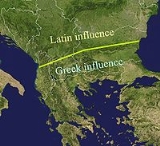
which has not yet been exactly determined, but is generally agreed to have been a region north of the Jireček Line
.
 That there was language-contact between Latin
/ Vulgar Latin speakers and speakers of indigenous Paleo-Balkan languages
in the area is a certainty, however it is not known which Paleo-Balkan language or languages comprise the substratal
influence in the Eastern Romance languages.
The substratal elements in the languages are mostly lexical
items. Around 300 words are considered by many linguists to be of substratum origin. Including place-names and river-names, and most of the forms labelled as being of unknown etymology
, the number of the substratum elements in Eastern Romance may surpass 500 basic roots. Linguistic research in recent years has increased the body of Eastern Romance words that may be considered indigenous.
In addition to vocabulary
items, some other features of Eastern Romance, such as phonological
features and elements of grammar (see Balkan sprachbund) may also be from Paleo-Balkan languages.
continues to list many words as borrowings, though the work of other linguists (Sorin Olteanu, Sorin Paliga, Ivan Duridanov, et al.) may indicate that a number of these are in fact indigenous, from local Indo-European languages
.
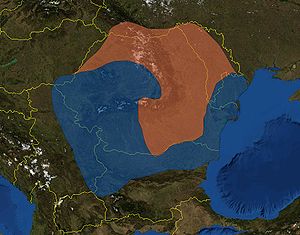 Though the substratum status of many Romanian words is not much disputed, their status as Dacian words is controversial, some more than others. There are no significant surviving written examples of the Dacian language
, so it is difficult to verify in most cases whether a given Romanian word is actually from Dacian or not. Many linguists however favor a Dacian source for the Romanian substratum. Many of the Romanian substratum words have Albanian
cognates, and if these words are in fact Dacian, it indicates that the Dacian language may have been on the same branch as Albanian.
The Bulgarian
Thracologist Vladimir Georgiev helped develop the theory that the Romanian language has a Daco-Moesian language as its substrate, a tongue which had a number of features which distinguished it from the Thracian language
spoken further south, across the Haemus
range.
Other Romanian words which are argued to be indigenous have close Slavic correspondences:baltă, daltă, sută etc., though some of these also have Albanian cognates:baltë, daltë. If such words are actually indigenous, then the Slavic correspondences are in line with the Daco-Thracian corpus, Slavic cognates existing for a number of Daco-Thracian words (Dacian diesema considered to be cognate to divizna, from Slavic languages, etc.). Also possible are a limited number of borrowings from a North Thracian (Dacian) dialect into Proto-Slavic
(Pre-Expansion Slavic) as early as the 3rd-4th century AD.
, Czech
, Serbian
, Croatian
, and other neighboring languages, though with modified meaning. Another one is Bryndza
, a type of cheese made in Eastern Austria
, Poland
, Slovakia
and Ukraine
, the word being derived from the Romanian word for cheese
.
Eastern Romance languages
The Eastern Romance languages in their narrow conception, sometimes known as the Vlach languages, are a group of Romance languages that developed in Southeastern Europe from the local eastern variant of Vulgar Latin. Some classifications include the Italo-Dalmatian languages; when Italian is...
developed from the Proto-Romanian language, which in turn developed from the Vulgar Latin
Vulgar Latin
Vulgar Latin is any of the nonstandard forms of Latin from which the Romance languages developed. Because of its nonstandard nature, it had no official orthography. All written works used Classical Latin, with very few exceptions...
spoken in a region of the Balkans
Balkans
The Balkans is a geopolitical and cultural region of southeastern Europe...
which has not yet been exactly determined, but is generally agreed to have been a region north of the Jireček Line
Jirecek Line
The Jireček Line is an imaginary line through the ancient Balkans that divided the influences of the Latin and Greek languages until the 4th century...
.
Latin
Latin is an Italic language originally spoken in Latium and Ancient Rome. It, along with most European languages, is a descendant of the ancient Proto-Indo-European language. Although it is considered a dead language, a number of scholars and members of the Christian clergy speak it fluently, and...
/ Vulgar Latin speakers and speakers of indigenous Paleo-Balkan languages
Paleo-Balkan languages
Paleo-Balkan is a geolinguistic term referring to the Indo-European languages that were spoken in the Balkans in ancient times. Except for Greek and the language that gave rise to Albanian , they are all extinct, due to Hellenization, Romanization, and Slavicisation.- Classification :The following...
in the area is a certainty, however it is not known which Paleo-Balkan language or languages comprise the substratal
Substratum
In linguistics, a stratum or strate is a language that influences, or is influenced by another through contact. A substratum is a language which has lower power or prestige than another, while a superstratum is the language that has higher power or prestige. Both substratum and superstratum...
influence in the Eastern Romance languages.
The substratal elements in the languages are mostly lexical
Lexicon
In linguistics, the lexicon of a language is its vocabulary, including its words and expressions. A lexicon is also a synonym of the word thesaurus. More formally, it is a language's inventory of lexemes. Coined in English 1603, the word "lexicon" derives from the Greek "λεξικόν" , neut...
items. Around 300 words are considered by many linguists to be of substratum origin. Including place-names and river-names, and most of the forms labelled as being of unknown etymology
Etymology
Etymology is the study of the history of words, their origins, and how their form and meaning have changed over time.For languages with a long written history, etymologists make use of texts in these languages and texts about the languages to gather knowledge about how words were used during...
, the number of the substratum elements in Eastern Romance may surpass 500 basic roots. Linguistic research in recent years has increased the body of Eastern Romance words that may be considered indigenous.
In addition to vocabulary
Vocabulary
A person's vocabulary is the set of words within a language that are familiar to that person. A vocabulary usually develops with age, and serves as a useful and fundamental tool for communication and acquiring knowledge...
items, some other features of Eastern Romance, such as phonological
Romanian phonology
This article discusses the phonology of the Romanian language. For other details on this language the reader is referred to that article....
features and elements of grammar (see Balkan sprachbund) may also be from Paleo-Balkan languages.
Lexical items
Older Romanian etymological dictionaries tended to assume a borrowing in many cases, usually from a Slavic language or from Hungarian, but etymological analysis may show that, in many cases, the direction of borrowing was from Romanian to the neighboring languages. The current Dicţionar explicativ (the DEX) published by the Romanian AcademyRomanian Academy
The Romanian Academy is a cultural forum founded in Bucharest, Romania, in 1866. It covers the scientific, artistic and literary domains. The academy has 181 acting members who are elected for life....
continues to list many words as borrowings, though the work of other linguists (Sorin Olteanu, Sorin Paliga, Ivan Duridanov, et al.) may indicate that a number of these are in fact indigenous, from local Indo-European languages
Indo-European languages
The Indo-European languages are a family of several hundred related languages and dialects, including most major current languages of Europe, the Iranian plateau, and South Asia and also historically predominant in Anatolia...
.
Dacian language
The extinct Dacian language may have developed from proto-Indo-European in the Carpathian region around 2,500 BC and probably died out by AD 600. In the 1st century AD, it was the predominant language of the ancient regions of Dacia and Moesia and, possibly, of some surrounding regions.It belonged...
, so it is difficult to verify in most cases whether a given Romanian word is actually from Dacian or not. Many linguists however favor a Dacian source for the Romanian substratum. Many of the Romanian substratum words have Albanian
Albanian language
Albanian is an Indo-European language spoken by approximately 7.6 million people, primarily in Albania and Kosovo but also in other areas of the Balkans in which there is an Albanian population, including western Macedonia, southern Montenegro, southern Serbia and northwestern Greece...
cognates, and if these words are in fact Dacian, it indicates that the Dacian language may have been on the same branch as Albanian.
The Bulgarian
Bulgarians
The Bulgarians are a South Slavic nation and ethnic group native to Bulgaria and neighbouring regions. Emigration has resulted in immigrant communities in a number of other countries.-History and ethnogenesis:...
Thracologist Vladimir Georgiev helped develop the theory that the Romanian language has a Daco-Moesian language as its substrate, a tongue which had a number of features which distinguished it from the Thracian language
Thracian language
The Thracian language was the Indo-European language spoken in ancient times in Southeastern Europe by the Thracians, the northern neighbors of the Ancient Greeks. The Thracian language exhibits satemization: it either belonged to the Satem group of Indo-European languages or it was strongly...
spoken further south, across the Haemus
Haemus Mons
In earlier times the Balkan mountains were known as the Haemus Mons. It is believed that the name is derived from a Thracian word *saimon, 'mountain ridge', which is unattested but conjectured as the original Thracian form of Greek Haimos....
range.
Other Romanian words which are argued to be indigenous have close Slavic correspondences:baltă, daltă, sută etc., though some of these also have Albanian cognates:baltë, daltë. If such words are actually indigenous, then the Slavic correspondences are in line with the Daco-Thracian corpus, Slavic cognates existing for a number of Daco-Thracian words (Dacian diesema considered to be cognate to divizna, from Slavic languages, etc.). Also possible are a limited number of borrowings from a North Thracian (Dacian) dialect into Proto-Slavic
Proto-Slavic language
Proto-Slavic is the proto-language from which Slavic languages later emerged. It was spoken before the seventh century AD. As with most other proto-languages, no attested writings have been found; the language has been reconstructed by applying the comparative method to all the attested Slavic...
(Pre-Expansion Slavic) as early as the 3rd-4th century AD.
Other languages
There are also some Romanian substratum words in languages other than Romanian, these examples having entered via Romanian (Vlach) dialects. An example is vatră, which is found in SlovakSlovak language
Slovak , is an Indo-European language that belongs to the West Slavic languages .Slovak is the official language of Slovakia, where it is spoken by 5 million people...
, Czech
Czech language
Czech is a West Slavic language with about 12 million native speakers; it is the majority language in the Czech Republic and spoken by Czechs worldwide. The language was known as Bohemian in English until the late 19th century...
, Serbian
Serbian language
Serbian is a form of Serbo-Croatian, a South Slavic language, spoken by Serbs in Serbia, Bosnia and Herzegovina, Montenegro, Croatia and neighbouring countries....
, Croatian
Croatian language
Croatian is the collective name for the standard language and dialects spoken by Croats, principally in Croatia, Bosnia and Herzegovina, the Serbian province of Vojvodina and other neighbouring countries...
, and other neighboring languages, though with modified meaning. Another one is Bryndza
Bryndza
Bryndza is a sheep milk cheese made in Central and Eastern Europe. Recipes differ slightly across the countries.-Etymology:Brânză or brînză is the generic word for "cheese" in Romanian, there is no special type of cheese associated with it...
, a type of cheese made in Eastern Austria
Austria
Austria , officially the Republic of Austria , is a landlocked country of roughly 8.4 million people in Central Europe. It is bordered by the Czech Republic and Germany to the north, Slovakia and Hungary to the east, Slovenia and Italy to the south, and Switzerland and Liechtenstein to the...
, Poland
Poland
Poland , officially the Republic of Poland , is a country in Central Europe bordered by Germany to the west; the Czech Republic and Slovakia to the south; Ukraine, Belarus and Lithuania to the east; and the Baltic Sea and Kaliningrad Oblast, a Russian exclave, to the north...
, Slovakia
Slovakia
The Slovak Republic is a landlocked state in Central Europe. It has a population of over five million and an area of about . Slovakia is bordered by the Czech Republic and Austria to the west, Poland to the north, Ukraine to the east and Hungary to the south...
and Ukraine
Ukraine
Ukraine is a country in Eastern Europe. It has an area of 603,628 km², making it the second largest contiguous country on the European continent, after Russia...
, the word being derived from the Romanian word for cheese
Cheese
Cheese is a generic term for a diverse group of milk-based food products. Cheese is produced throughout the world in wide-ranging flavors, textures, and forms....
.
See also
- List of Romanian words of possible Dacian origin
- Wiktionary: Romanian substratum words
- Romanian lexisRomanian lexisThe lexis of the Romanian language , a Romance language, has changed over the centuries as the language evolved from Vulgar Latin, to Proto-Romanian, to medieval, modern and contemporary Romanian.-Medieval Romanian:...