


Maltese people

Encyclopedia
The Maltese are an ethnic group
indigenous to the Southern European nation
of Malta
, and identified with the Maltese language
. Malta is an island in the middle of the Mediterranean Sea
. Included within the ethnic group defined by the Maltese people are the Gozitans who inhabit Malta's sister island, Gozo
.
. A significant prehistoric Neolithic
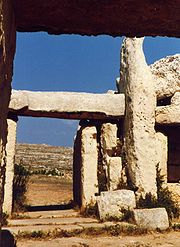
culture marked by Megalithic structures, which date back to c. 3600 BC, existed on the islands, as evidenced by the temples of Mnajdra
, Ggantija
and others. The Phoenicians colonized Malta from about 1000 BC, bringing their Semitic language and culture, and becoming the direct male-line ancestors of about a half of the modern Maltese population. They used the islands as an outpost from which they expanded sea explorations and trade in the Mediterranean until their successors, the Carthaginians, were ousted by the Romans
in 216 BC with the help of the Maltese inhabitants, under whom Malta became a municipium
.
After a period of Byzantine
rule (4th to 9th century) and a probable sack by the Vandals
, the islands were invaded by the Fatimid
s in AD 870. The Arabs generally tolerated the population's Christianity, and their language subsequently shifted
to Siculo-Arabic
.
The Muslim rulers were expelled from the islands by the Normans
in 1090, and their leader Roger I of Sicily
was welcomed by the native Christians. The islands were part of the Kingdom of Sicily
until 1530, and were briefly controlled by the Capetian House of Anjou
. In 1530 Charles I of Spain gave the Maltese islands to the Order of Knights of the Hospital of St John of Jerusalem
in perpetual lease.
The French under Napoleon took hold of the Maltese islands in 1798, although with the aid of the British the Maltese were able to oust French control two years later. The inhabitants subsequently asked Britain to assume sovereignty over the islands under the conditions laid out in a Declaration of Rights, stating that "his Majesty has no right to cede these Islands to any power...if he chooses to withdraw his protection, and abandon his sovereignty, the right of electing another sovereign, or of the governing of these Islands, belongs to us, the inhabitants and aborigines alone, and without control." As part of the Treaty of Paris (1814)
Malta became a British colony, ultimately rejecting an attempted integration with the United Kingdom in 1956.
Malta became independent on September 21, 1964 (Independence Day). Under its 1964 constitution
Malta initially retained Queen Elizabeth II
as Queen of Malta
, with a Governor-General
exercising executive
authority on her behalf. On December 13, 1974 (Republic Day) it became a republic
within the Commonwealth
, with the President
as head of state
. On March 31, 1979 Malta saw the withdrawal of the last British troops and the Royal Navy
from Malta. This day is known as Freedom Day
and Malta declared itself as a neutral and non-aligned. Malta joined the European Union
on May 1, 2004 and joined the Eurozone
on January 1, 2008.
for long periods of time prior to its independence in 1964.
 The earliest inhabitants of the Maltese Islands are believed to have crossed over from nearby Sicily
sometime before 5000 BCE. The culture of modern Malta has been described as a "rich pattern of traditions, beliefs and practices," which is the result of "a long process of adaptation, assimilation and cross fertilization of beliefs and usages drawn from various conflicting sources." It has been subjected to the same complex, historic processes that gave rise to the linguistic and ethnic admixture that defines who the people of Malta and Gozo are today.
Maltese culture has both Semitic
and Latin European origins; however, the Latin European element is more readily apparent in modern Malta for two key reasons: the fact that Latin European cultures have had more recent, and virtually continuous impact on Malta over the past eight centuries through political control; and the fact that Malta shares the religious beliefs, traditions and ceremonies of its Sicilian neighbor
.
, a Semitic language
written in the Latin alphabet
in its standard form. The language is descended from Siculo-Arabic
, a dialect of Arabic spoken in Sicily
and surrounding Southern Italy from the ninth century. In the course of Malta's history, the language has adopted large amounts of vocabulary from Sicilian
, Italian
, English
, and to a smaller degree, French
. The official languages of Malta are English
and Maltese, with Italian also widely spoken.
Maltese became an official language of Malta in 1934, replacing Italian and joining English. There are an estimated 371,900 speakers in Malta of the language, with statistics citing that 100% of the people are able to speak Maltese, 88% English, 66% Italian and 17% French, showing a greater degree of linguistic capabilities than most other European countries. In fact multilingualism
is a common phenomenon in Malta, with English, Maltese and Italian, used in everyday life. Whilst Maltese is the national language
, it has been suggested that with the ascendancy of English language shift
may begin; however, this has been discredited by contemporary studies.
but establishes Roman Catholicism as the state religion
.
Malta is described in the Book of Acts at and , where Christianity was introduced by Paul the Apostle. Catholic tradition holds Saint Publius
as having been Malta's first bishop. The Islands of St. Paul (or St. Paul's Islets), are traditionally believed to be the site where Saint Paul was shipwreck
ed (recorded at ) in the year 60 AD
, on his way to trial and apparent martyrdom in Rome
.
Freedom House
and the World Factbook report that 98% of the Maltese are Roman Catholic, making the nation one of the most Catholic countries in the world.
, the symbol used by the Knights of Malta and now a symbol of the Maltese nation. It appears on the reverse of the Maltese 1 euro and 2 euro coins introduced in January 2008.
and the Middle East
, although rates of return migration
to Malta were high. Nonetheless, Maltese communities formed in these regions. By 1900, for example, British consular estimates suggest that there were 15,326 Maltese in Tunisia
, and in 1903 it was claimed that 15,000 people of Maltese origin were living in Algeria
.
Malta experienced significant emigration as a result of the collapse of a construction boom in 1907 and after World War II
, when the birth rate
increased significantly, but in the twentieth century most emigrants went to destinations in the New World
, particularly the United States
and Australia
. After World War II, Malta's Emigration Department would assist emigrants with the cost of their travel. Between 1948 and 1967, 30 per cent of the population emigrated. Between 1946 and the late 1970s, over 140,000 people left Malta on the assisted passage scheme, with 57.6 per cent migrating to Australia, 22 per cent to the UK, 13 per cent to Canada
and 7 per cent to the United States.
46,998 Maltese-born residents were recorded by the 2001 Australian Census
, 30,178 by the 2001 UK Census, 9,525 by the 2001 Canadian Census
and the 9,080 by the 2000 United States Census.
Emigration dropped dramatically after the mid-1970s and has since ceased to be a social phenomenon of significance. However, since Malta joined the EU in 2004 expatriate
communities emerged in a number of European countries particularly in Belgium
and Luxembourg
.
(35.55% including 32.2% R1b), J
(28.90% including 7.80% J1), I
(12.20%), E
(11.10% including 8.9% E1b1b), F (6.70%), K
(4.40%), P
(1.10%). R1 and I are typical in European populations. J, K, F and E1b1b haplogroups consist of lineages with differential distribution within Middle East
, North Africa
and Europe
. The low percentages of J1 and E1b1b are similar to the Sicilian population, suggesting common ancestry with Southern Italians and negligible genetic input from both North Africa and the Middle East.
. However, the result of the influences on the population after this have been fiercely debated among historians and geneticists. The origins question is complicated by numerous factors, including Malta's turbulent history of invasions and conquests, with long periods of depopulation followed by periods of immigration to Malta and intermarriage with the Maltese by foreigners from the Mediterranean
, Western
and Southern European countries that ruled Malta.
The many demographic influences on the island include:
A study carried out by geneticists Spencer Wells
and Pierre Zalloua of the American University of Beirut
showed that more than 50% of Y-chromosomes from Maltese men could have Phoenicia
n origins.. However, this latter study is not peer reviewed, as stated by the authors of the major peer reviewed studies mentioned previously .,
promoted the idea of a continuous Roman Catholic presence, and the British colonial rule disregarded a genetic and cultural connection between the Maltese and Italians in an attempt to counteract growing Fascist power in the area
.
Ethnic group
An ethnic group is a group of people whose members identify with each other, through a common heritage, often consisting of a common language, a common culture and/or an ideology that stresses common ancestry or endogamy...
indigenous to the Southern European nation
Nation
A nation may refer to a community of people who share a common language, culture, ethnicity, descent, and/or history. In this definition, a nation has no physical borders. However, it can also refer to people who share a common territory and government irrespective of their ethnic make-up...
of Malta
Malta
Malta , officially known as the Republic of Malta , is a Southern European country consisting of an archipelago situated in the centre of the Mediterranean, south of Sicily, east of Tunisia and north of Libya, with Gibraltar to the west and Alexandria to the east.Malta covers just over in...
, and identified with the Maltese language
Maltese language
Maltese is the national language of Malta, and a co-official language of the country alongside English,while also serving as an official language of the European Union, the only Semitic language so distinguished. Maltese is descended from Siculo-Arabic...
. Malta is an island in the middle of the Mediterranean Sea
Mediterranean Sea
The Mediterranean Sea is a sea connected to the Atlantic Ocean surrounded by the Mediterranean region and almost completely enclosed by land: on the north by Anatolia and Europe, on the south by North Africa, and on the east by the Levant...
. Included within the ethnic group defined by the Maltese people are the Gozitans who inhabit Malta's sister island, Gozo
Gozo
Gozo is a small island of the Maltese archipelago in the Mediterranean Sea. The island is part of the Southern European country of Malta; after the island of Malta itself, it is the second-largest island in the archipelago...
.
History
Malta has been inhabited from around 5200 BC, since the arrival of settlers from the island of SicilySicily
Sicily is a region of Italy, and is the largest island in the Mediterranean Sea. Along with the surrounding minor islands, it constitutes an autonomous region of Italy, the Regione Autonoma Siciliana Sicily has a rich and unique culture, especially with regard to the arts, music, literature,...
. A significant prehistoric Neolithic
Neolithic
The Neolithic Age, Era, or Period, or New Stone Age, was a period in the development of human technology, beginning about 9500 BC in some parts of the Middle East, and later in other parts of the world. It is traditionally considered as the last part of the Stone Age...
culture marked by Megalithic structures, which date back to c. 3600 BC, existed on the islands, as evidenced by the temples of Mnajdra
Mnajdra
Mnajdra is a megalithic temple complex found on the southern coast of the Mediterranean island of Malta. Mnajdra is approximately 500 metres from the Ħaġar Qim megalithic complex...
, Ggantija
Ggantija
Ġgantija is a Neolithic, megalithic temple complex on the Mediterranean island of Gozo. The Ġgantija temples are the earliest of a series of megalithic temples in Malta. Their makers erected the two Ġgantija temples during the Neolithic Age , which makes these temples more than 5500 years old and...
and others. The Phoenicians colonized Malta from about 1000 BC, bringing their Semitic language and culture, and becoming the direct male-line ancestors of about a half of the modern Maltese population. They used the islands as an outpost from which they expanded sea explorations and trade in the Mediterranean until their successors, the Carthaginians, were ousted by the Romans
Ancient Rome
Ancient Rome was a thriving civilization that grew on the Italian Peninsula as early as the 8th century BC. Located along the Mediterranean Sea and centered on the city of Rome, it expanded to one of the largest empires in the ancient world....
in 216 BC with the help of the Maltese inhabitants, under whom Malta became a municipium
Municipium
Municipium , the prototype of English municipality, was the Latin term for a town or city. Etymologically the municipium was a social contract between municipes, the "duty holders," or citizens of the town. The duties, or munera, were a communal obligation assumed by the municipes in exchange for...
.
After a period of Byzantine
Byzantine Empire
The Byzantine Empire was the Eastern Roman Empire during the periods of Late Antiquity and the Middle Ages, centred on the capital of Constantinople. Known simply as the Roman Empire or Romania to its inhabitants and neighbours, the Empire was the direct continuation of the Ancient Roman State...
rule (4th to 9th century) and a probable sack by the Vandals
Vandals
The Vandals were an East Germanic tribe that entered the late Roman Empire during the 5th century. The Vandals under king Genseric entered Africa in 429 and by 439 established a kingdom which included the Roman Africa province, besides the islands of Sicily, Corsica, Sardinia and the Balearics....
, the islands were invaded by the Fatimid
Fatimid
The Fatimid Islamic Caliphate or al-Fāṭimiyyūn was a Berber Shia Muslim caliphate first centered in Tunisia and later in Egypt that ruled over varying areas of the Maghreb, Sudan, Sicily, the Levant, and Hijaz from 5 January 909 to 1171.The caliphate was ruled by the Fatimids, who established the...
s in AD 870. The Arabs generally tolerated the population's Christianity, and their language subsequently shifted
Language shift
Language shift, sometimes referred to as language transfer or language replacement or assimilation, is the progressive process whereby a speech community of a language shifts to speaking another language. The rate of assimilation is the percentage of individuals with a given mother tongue who speak...
to Siculo-Arabic
Siculo-Arabic
Siculo-Arabic was a variety of Arabic spoken in Sicily and Malta between the ninth and the fourteenth centuries. It is extinct in Sicily, but it has developed into what is now the Maltese language on the islands of Malta....
.
The Muslim rulers were expelled from the islands by the Normans
Normans
The Normans were the people who gave their name to Normandy, a region in northern France. They were descended from Norse Viking conquerors of the territory and the native population of Frankish and Gallo-Roman stock...
in 1090, and their leader Roger I of Sicily
Roger I of Sicily
Roger I , called Bosso and the Great Count, was the Norman Count of Sicily from 1071 to 1101. He was the last great leader of the Norman conquest of southern Italy.-Conquest of Calabria and Sicily:...
was welcomed by the native Christians. The islands were part of the Kingdom of Sicily
Kingdom of Sicily
The Kingdom of Sicily was a state that existed in the south of Italy from its founding by Roger II in 1130 until 1816. It was a successor state of the County of Sicily, which had been founded in 1071 during the Norman conquest of southern Italy...
until 1530, and were briefly controlled by the Capetian House of Anjou
Capetian House of Anjou
The Capetian House of Anjou, also known as the House of Anjou-Sicily and House of Anjou-Naples, was a royal house and cadet branch of the direct House of Capet. Founded by Charles I of Sicily, a son of Louis VIII of France, the Capetian king first ruled the Kingdom of Sicily during the 13th century...
. In 1530 Charles I of Spain gave the Maltese islands to the Order of Knights of the Hospital of St John of Jerusalem
Knights Hospitaller
The Sovereign Military Hospitaller Order of Saint John of Jerusalem of Rhodes and of Malta , also known as the Sovereign Military Order of Malta , Order of Malta or Knights of Malta, is a Roman Catholic lay religious order, traditionally of military, chivalrous, noble nature. It is the world's...
in perpetual lease.
The French under Napoleon took hold of the Maltese islands in 1798, although with the aid of the British the Maltese were able to oust French control two years later. The inhabitants subsequently asked Britain to assume sovereignty over the islands under the conditions laid out in a Declaration of Rights, stating that "his Majesty has no right to cede these Islands to any power...if he chooses to withdraw his protection, and abandon his sovereignty, the right of electing another sovereign, or of the governing of these Islands, belongs to us, the inhabitants and aborigines alone, and without control." As part of the Treaty of Paris (1814)
Treaty of Paris (1814)
The Treaty of Paris, signed on 30 May 1814, ended the war between France and the Sixth Coalition, part of the Napoleonic Wars, following an armistice signed on 23 May between Charles, Count of Artois, and the allies...
Malta became a British colony, ultimately rejecting an attempted integration with the United Kingdom in 1956.
Malta became independent on September 21, 1964 (Independence Day). Under its 1964 constitution
Constitution
A constitution is a set of fundamental principles or established precedents according to which a state or other organization is governed. These rules together make up, i.e. constitute, what the entity is...
Malta initially retained Queen Elizabeth II
Elizabeth II of the United Kingdom
Elizabeth II is the constitutional monarch of 16 sovereign states known as the Commonwealth realms: the United Kingdom, Canada, Australia, New Zealand, Jamaica, Barbados, the Bahamas, Grenada, Papua New Guinea, the Solomon Islands, Tuvalu, Saint Lucia, Saint Vincent and the Grenadines, Belize,...
as Queen of Malta
Queen of Malta
This title of Queen of Malta was held by Elizabeth II between September 21, 1964 and December 13, 1974, following Malta's independence from the United Kingdom....
, with a Governor-General
Governor-General
A Governor-General, is a vice-regal person of a monarch in an independent realm or a major colonial circonscription. Depending on the political arrangement of the territory, a Governor General can be a governor of high rank, or a principal governor ranking above "ordinary" governors.- Current uses...
exercising executive
Executive (government)
Executive branch of Government is the part of government that has sole authority and responsibility for the daily administration of the state bureaucracy. The division of power into separate branches of government is central to the idea of the separation of powers.In many countries, the term...
authority on her behalf. On December 13, 1974 (Republic Day) it became a republic
Republic
A republic is a form of government in which the people, or some significant portion of them, have supreme control over the government and where offices of state are elected or chosen by elected people. In modern times, a common simplified definition of a republic is a government where the head of...
within the Commonwealth
Commonwealth of Nations
The Commonwealth of Nations, normally referred to as the Commonwealth and formerly known as the British Commonwealth, is an intergovernmental organisation of fifty-four independent member states...
, with the President
President of Malta
The President of Malta is the constitutional head of state of Malta.The President is appointed by a resolution of the House of Representatives of Malta for a five year term, taking an oath to "preserve, protect and defend" the Constitution....
as head of state
Head of State
A head of state is the individual that serves as the chief public representative of a monarchy, republic, federation, commonwealth or other kind of state. His or her role generally includes legitimizing the state and exercising the political powers, functions, and duties granted to the head of...
. On March 31, 1979 Malta saw the withdrawal of the last British troops and the Royal Navy
Royal Navy
The Royal Navy is the naval warfare service branch of the British Armed Forces. Founded in the 16th century, it is the oldest service branch and is known as the Senior Service...
from Malta. This day is known as Freedom Day
Freedom Day (Malta)
March 31, 1979 is remembered in the Maltese calendar as Freedom Day . This is the anniversary of the withdrawal of British troops and the Royal Navy from Malta. On taking power in 1971, the Labour Government indicated it wanted to re-negotiate the lease agreement with the United Kingdom...
and Malta declared itself as a neutral and non-aligned. Malta joined the European Union
European Union
The European Union is an economic and political union of 27 independent member states which are located primarily in Europe. The EU traces its origins from the European Coal and Steel Community and the European Economic Community , formed by six countries in 1958...
on May 1, 2004 and joined the Eurozone
Eurozone
The eurozone , officially called the euro area, is an economic and monetary union of seventeen European Union member states that have adopted the euro as their common currency and sole legal tender...
on January 1, 2008.
Culture
The culture of Malta is a reflection of various cultures that have come into contact with the Maltese Islands throughout the centuries, including neighbouring Mediterranean cultures, and the cultures of the nations that ruled MaltaMalta
Malta , officially known as the Republic of Malta , is a Southern European country consisting of an archipelago situated in the centre of the Mediterranean, south of Sicily, east of Tunisia and north of Libya, with Gibraltar to the west and Alexandria to the east.Malta covers just over in...
for long periods of time prior to its independence in 1964.
Sicily
Sicily is a region of Italy, and is the largest island in the Mediterranean Sea. Along with the surrounding minor islands, it constitutes an autonomous region of Italy, the Regione Autonoma Siciliana Sicily has a rich and unique culture, especially with regard to the arts, music, literature,...
sometime before 5000 BCE. The culture of modern Malta has been described as a "rich pattern of traditions, beliefs and practices," which is the result of "a long process of adaptation, assimilation and cross fertilization of beliefs and usages drawn from various conflicting sources." It has been subjected to the same complex, historic processes that gave rise to the linguistic and ethnic admixture that defines who the people of Malta and Gozo are today.
Maltese culture has both Semitic
Semitic
In linguistics and ethnology, Semitic was first used to refer to a language family of largely Middle Eastern origin, now called the Semitic languages...
and Latin European origins; however, the Latin European element is more readily apparent in modern Malta for two key reasons: the fact that Latin European cultures have had more recent, and virtually continuous impact on Malta over the past eight centuries through political control; and the fact that Malta shares the religious beliefs, traditions and ceremonies of its Sicilian neighbor
Sicily
Sicily is a region of Italy, and is the largest island in the Mediterranean Sea. Along with the surrounding minor islands, it constitutes an autonomous region of Italy, the Regione Autonoma Siciliana Sicily has a rich and unique culture, especially with regard to the arts, music, literature,...
.
Language
Maltese people speak the Maltese languageMaltese language
Maltese is the national language of Malta, and a co-official language of the country alongside English,while also serving as an official language of the European Union, the only Semitic language so distinguished. Maltese is descended from Siculo-Arabic...
, a Semitic language
Semitic languages
The Semitic languages are a group of related languages whose living representatives are spoken by more than 270 million people across much of the Middle East, North Africa and the Horn of Africa...
written in the Latin alphabet
Latin alphabet
The Latin alphabet, also called the Roman alphabet, is the most recognized alphabet used in the world today. It evolved from a western variety of the Greek alphabet called the Cumaean alphabet, which was adopted and modified by the Etruscans who ruled early Rome...
in its standard form. The language is descended from Siculo-Arabic
Siculo-Arabic
Siculo-Arabic was a variety of Arabic spoken in Sicily and Malta between the ninth and the fourteenth centuries. It is extinct in Sicily, but it has developed into what is now the Maltese language on the islands of Malta....
, a dialect of Arabic spoken in Sicily
Sicily
Sicily is a region of Italy, and is the largest island in the Mediterranean Sea. Along with the surrounding minor islands, it constitutes an autonomous region of Italy, the Regione Autonoma Siciliana Sicily has a rich and unique culture, especially with regard to the arts, music, literature,...
and surrounding Southern Italy from the ninth century. In the course of Malta's history, the language has adopted large amounts of vocabulary from Sicilian
Sicilian language
Sicilian is a Romance language. Its dialects make up the Extreme-Southern Italian language group, which are spoken on the island of Sicily and its satellite islands; in southern and central Calabria ; in the southern parts of Apulia, the Salento ; and Campania, on the Italian mainland, where it is...
, Italian
Italian language
Italian is a Romance language spoken mainly in Europe: Italy, Switzerland, San Marino, Vatican City, by minorities in Malta, Monaco, Croatia, Slovenia, France, Libya, Eritrea, and Somalia, and by immigrant communities in the Americas and Australia...
, English
English language
English is a West Germanic language that arose in the Anglo-Saxon kingdoms of England and spread into what was to become south-east Scotland under the influence of the Anglian medieval kingdom of Northumbria...
, and to a smaller degree, French
French language
French is a Romance language spoken as a first language in France, the Romandy region in Switzerland, Wallonia and Brussels in Belgium, Monaco, the regions of Quebec and Acadia in Canada, and by various communities elsewhere. Second-language speakers of French are distributed throughout many parts...
. The official languages of Malta are English
English language
English is a West Germanic language that arose in the Anglo-Saxon kingdoms of England and spread into what was to become south-east Scotland under the influence of the Anglian medieval kingdom of Northumbria...
and Maltese, with Italian also widely spoken.
Maltese became an official language of Malta in 1934, replacing Italian and joining English. There are an estimated 371,900 speakers in Malta of the language, with statistics citing that 100% of the people are able to speak Maltese, 88% English, 66% Italian and 17% French, showing a greater degree of linguistic capabilities than most other European countries. In fact multilingualism
Multilingualism
Multilingualism is the act of using, or promoting the use of, multiple languages, either by an individual speaker or by a community of speakers. Multilingual speakers outnumber monolingual speakers in the world's population. Multilingualism is becoming a social phenomenon governed by the needs of...
is a common phenomenon in Malta, with English, Maltese and Italian, used in everyday life. Whilst Maltese is the national language
National language
A national language is a language which has some connection—de facto or de jure—with a people and perhaps by extension the territory they occupy. The term is used variously. A national language may for instance represent the national identity of a nation or country...
, it has been suggested that with the ascendancy of English language shift
Language shift
Language shift, sometimes referred to as language transfer or language replacement or assimilation, is the progressive process whereby a speech community of a language shifts to speaking another language. The rate of assimilation is the percentage of individuals with a given mother tongue who speak...
may begin; however, this has been discredited by contemporary studies.
Religion
The Constitution of Malta provides for freedom of religionFreedom of religion
Freedom of religion is a principle that supports the freedom of an individual or community, in public or private, to manifest religion or belief in teaching, practice, worship, and observance; the concept is generally recognized also to include the freedom to change religion or not to follow any...
but establishes Roman Catholicism as the state religion
State religion
A state religion is a religious body or creed officially endorsed by the state...
.
Malta is described in the Book of Acts at and , where Christianity was introduced by Paul the Apostle. Catholic tradition holds Saint Publius
Saint Publius
Saint Publius is the first maltese Saint. He is venerated as the first Bishop of Malta. Publius' conversion led to Malta being the first Christian nation in the West, and one of the first in the world....
as having been Malta's first bishop. The Islands of St. Paul (or St. Paul's Islets), are traditionally believed to be the site where Saint Paul was shipwreck
Shipwreck
A shipwreck is what remains of a ship that has wrecked, either sunk or beached. Whatever the cause, a sunken ship or a wrecked ship is a physical example of the event: this explains why the two concepts are often overlapping in English....
ed (recorded at ) in the year 60 AD
Anno Domini
and Before Christ are designations used to label or number years used with the Julian and Gregorian calendars....
, on his way to trial and apparent martyrdom in Rome
Rome
Rome is the capital of Italy and the country's largest and most populated city and comune, with over 2.7 million residents in . The city is located in the central-western portion of the Italian Peninsula, on the Tiber River within the Lazio region of Italy.Rome's history spans two and a half...
.
Freedom House
Freedom House
Freedom House is an international non-governmental organization based in Washington, D.C. that conducts research and advocacy on democracy, political freedom and human rights...
and the World Factbook report that 98% of the Maltese are Roman Catholic, making the nation one of the most Catholic countries in the world.
National symbols
Various symbols have identified the island over its history, the most common is the Maltese crossMaltese cross
The Maltese cross, also known as the Amalfi cross, is identified as the symbol of an order of Christian warriors known as the Knights Hospitaller or Knights of Malta and through them came to be identified with the Mediterranean island of Malta and is one of the National symbols of Malta...
, the symbol used by the Knights of Malta and now a symbol of the Maltese nation. It appears on the reverse of the Maltese 1 euro and 2 euro coins introduced in January 2008.
Maltese emigration and expatriation
In the nineteenth century, most migration from Malta was to North AfricaNorth Africa
North Africa or Northern Africa is the northernmost region of the African continent, linked by the Sahara to Sub-Saharan Africa. Geopolitically, the United Nations definition of Northern Africa includes eight countries or territories; Algeria, Egypt, Libya, Morocco, South Sudan, Sudan, Tunisia, and...
and the Middle East
Middle East
The Middle East is a region that encompasses Western Asia and Northern Africa. It is often used as a synonym for Near East, in opposition to Far East...
, although rates of return migration
Repatriation
Repatriation is the process of returning a person back to one's place of origin or citizenship. This includes the process of returning refugees or soldiers to their place of origin following a war...
to Malta were high. Nonetheless, Maltese communities formed in these regions. By 1900, for example, British consular estimates suggest that there were 15,326 Maltese in Tunisia
Tunisia
Tunisia , officially the Tunisian RepublicThe long name of Tunisia in other languages used in the country is: , is the northernmost country in Africa. It is a Maghreb country and is bordered by Algeria to the west, Libya to the southeast, and the Mediterranean Sea to the north and east. Its area...
, and in 1903 it was claimed that 15,000 people of Maltese origin were living in Algeria
Algeria
Algeria , officially the People's Democratic Republic of Algeria , also formally referred to as the Democratic and Popular Republic of Algeria, is a country in the Maghreb region of Northwest Africa with Algiers as its capital.In terms of land area, it is the largest country in Africa and the Arab...
.
Malta experienced significant emigration as a result of the collapse of a construction boom in 1907 and after World War II
World War II
World War II, or the Second World War , was a global conflict lasting from 1939 to 1945, involving most of the world's nations—including all of the great powers—eventually forming two opposing military alliances: the Allies and the Axis...
, when the birth rate
Birth rate
Crude birth rate is the nativity or childbirths per 1,000 people per year . Another word used interchangeably with "birth rate" is "natality". When the crude birth rate is subtracted from the crude death rate, it reveals the rate of natural increase...
increased significantly, but in the twentieth century most emigrants went to destinations in the New World
New World
The New World is one of the names used for the Western Hemisphere, specifically America and sometimes Oceania . The term originated in the late 15th century, when America had been recently discovered by European explorers, expanding the geographical horizon of the people of the European middle...
, particularly the United States
United States
The United States of America is a federal constitutional republic comprising fifty states and a federal district...
and Australia
Australia
Australia , officially the Commonwealth of Australia, is a country in the Southern Hemisphere comprising the mainland of the Australian continent, the island of Tasmania, and numerous smaller islands in the Indian and Pacific Oceans. It is the world's sixth-largest country by total area...
. After World War II, Malta's Emigration Department would assist emigrants with the cost of their travel. Between 1948 and 1967, 30 per cent of the population emigrated. Between 1946 and the late 1970s, over 140,000 people left Malta on the assisted passage scheme, with 57.6 per cent migrating to Australia, 22 per cent to the UK, 13 per cent to Canada
Canada
Canada is a North American country consisting of ten provinces and three territories. Located in the northern part of the continent, it extends from the Atlantic Ocean in the east to the Pacific Ocean in the west, and northward into the Arctic Ocean...
and 7 per cent to the United States.
46,998 Maltese-born residents were recorded by the 2001 Australian Census
Census in Australia
The Australian census is administered once every five years by the Australian Bureau of Statistics. The most recent census was conducted on 9 August 2011; the next will be conducted in 2016. Prior to the introduction of regular censuses in 1961, they had also been run in 1901, 1911, 1921, 1933,...
, 30,178 by the 2001 UK Census, 9,525 by the 2001 Canadian Census
Canada 2001 Census
The Canada 2001 Census was a detailed enumeration of the Canadian population. Census day was May 15, 2001. On that day, Statistics Canada attempted to count every person in Canada. The total population count of Canada was 30,007,094. This was a 4% increase over 1996 Census of 28,846,761. In...
and the 9,080 by the 2000 United States Census.
Emigration dropped dramatically after the mid-1970s and has since ceased to be a social phenomenon of significance. However, since Malta joined the EU in 2004 expatriate
Expatriate
An expatriate is a person temporarily or permanently residing in a country and culture other than that of the person's upbringing...
communities emerged in a number of European countries particularly in Belgium
Maltese in Belgium
Maltese in Belgium are people from Malta resident in Belgium, whether permanently or temporarily. They include Maltese who have acquired Belgian citizenship, students and workers with International organizations.- Population :...
and Luxembourg
Luxembourg
Luxembourg , officially the Grand Duchy of Luxembourg , is a landlocked country in western Europe, bordered by Belgium, France, and Germany. It has two principal regions: the Oesling in the North as part of the Ardennes massif, and the Gutland in the south...
.
Genetics
Y-Dna haplogroups are found at the following frequencies in Malta : R1Haplogroup R1 (Y-DNA)
In human genetics, Haplogroup R1 is a Y-chromosome DNA haplogroup, a subgroup of haplogroup R, associated with the M173 mutation. It is dominated in practice by two very common Eurasian clades, R1a and R1b, which together are found all over Eurasia except in Southeast Asia and East Asia...
(35.55% including 32.2% R1b), J
Haplogroup J (Y-DNA)
In human genetics, Haplogroup J is a Y-chromosome DNA haplogroup. It is one of the major male lines of all living men...
(28.90% including 7.80% J1), I
Haplogroup I (Y-DNA)
In human genetics, Haplogroup I is a Y-chromosome DNA haplogroup, a subgroup of haplogroup IJ, itself a derivative of Haplogroup IJK....
(12.20%), E
Haplogroup E (Y-DNA)
In human genetics, Haplogroup E is a human Y-chromosome DNA haplogroup. Haplogroup E is one of the two main branches of the older Haplogroup DE, the other main branch being haplogroup D. The E clade is divided into two subclades: E1 and E2 .-Origins:Underhill et al. proposed that haplogroup E...
(11.10% including 8.9% E1b1b), F (6.70%), K
Haplogroup K (Y-DNA)
In human genetics, Haplogroup K is a Human Y-chromosome DNA haplogroup. This haplogroup is a descendant of Haplogroup IJK. Its major descendant haplogroups are Haplogroup LT and Haplogroup K...
(4.40%), P
Haplogroup P (Y-DNA)
In human genetics, Haplogroup P is a Y-chromosome DNA haplogroup.This haplogroup contains the patrilineal ancestors of most Europeans and almost all of the indigenous peoples of the Americas...
(1.10%). R1 and I are typical in European populations. J, K, F and E1b1b haplogroups consist of lineages with differential distribution within Middle East
Middle East
The Middle East is a region that encompasses Western Asia and Northern Africa. It is often used as a synonym for Near East, in opposition to Far East...
, North Africa
North Africa
North Africa or Northern Africa is the northernmost region of the African continent, linked by the Sahara to Sub-Saharan Africa. Geopolitically, the United Nations definition of Northern Africa includes eight countries or territories; Algeria, Egypt, Libya, Morocco, South Sudan, Sudan, Tunisia, and...
and Europe
Europe
Europe is, by convention, one of the world's seven continents. Comprising the westernmost peninsula of Eurasia, Europe is generally 'divided' from Asia to its east by the watershed divides of the Ural and Caucasus Mountains, the Ural River, the Caspian and Black Seas, and the waterways connecting...
. The low percentages of J1 and E1b1b are similar to the Sicilian population, suggesting common ancestry with Southern Italians and negligible genetic input from both North Africa and the Middle East.
Population links
The first settlers of Malta were from the island of SicilySicily
Sicily is a region of Italy, and is the largest island in the Mediterranean Sea. Along with the surrounding minor islands, it constitutes an autonomous region of Italy, the Regione Autonoma Siciliana Sicily has a rich and unique culture, especially with regard to the arts, music, literature,...
. However, the result of the influences on the population after this have been fiercely debated among historians and geneticists. The origins question is complicated by numerous factors, including Malta's turbulent history of invasions and conquests, with long periods of depopulation followed by periods of immigration to Malta and intermarriage with the Maltese by foreigners from the Mediterranean
Mediterranean Sea
The Mediterranean Sea is a sea connected to the Atlantic Ocean surrounded by the Mediterranean region and almost completely enclosed by land: on the north by Anatolia and Europe, on the south by North Africa, and on the east by the Levant...
, Western
Western Europe
Western Europe is a loose term for the collection of countries in the western most region of the European continents, though this definition is context-dependent and carries cultural and political connotations. One definition describes Western Europe as a geographic entity—the region lying in the...
and Southern European countries that ruled Malta.
The many demographic influences on the island include:
- The Phoenician colonisation around 1000 BC.
- The exile to Malta of the entire male population of the town of CelanoCelanoCelano is a town and comune in the Province of L'Aquila, central Italy, east of Rome by rail.-Geography:Celano rises on the top of a hill in the territory of Marsica, below the mountain range of Sirente. It faces the valley of Fucino, once filled by the large Fucine Lake, which was drained during...
(Italy) in 1223 - The stationing of Norman FrenchNormansThe Normans were the people who gave their name to Normandy, a region in northern France. They were descended from Norse Viking conquerors of the territory and the native population of Frankish and Gallo-Roman stock...
and Sicilian Italian troopsGarrisonGarrison is the collective term for a body of troops stationed in a particular location, originally to guard it, but now often simply using it as a home base....
on Malta in 1240 - The removal of all remaining Arabs from Malta in 1224
- The arrival of several hundred CatalanCatalan peopleThe Catalans or Catalonians are the people from, or with origins in, Catalonia that form a historical nationality in Spain. The inhabitants of the adjacent portion of southern France are sometimes included in this definition...
(Spain) soldiers in 1283 - Further waves of European repopulation throughout the 13th century
- The settlement in Malta of noble families from Sicily (Italy) and AragonAragonAragon is a modern autonomous community in Spain, coextensive with the medieval Kingdom of Aragon. Located in northeastern Spain, the Aragonese autonomous community comprises three provinces : Huesca, Zaragoza, and Teruel. Its capital is Zaragoza...
(Spain) between 1372 and 1450 - The arrival of several thousand Greek RhodianRhodesRhodes is an island in Greece, located in the eastern Aegean Sea. It is the largest of the Dodecanese islands in terms of both land area and population, with a population of 117,007, and also the island group's historical capital. Administratively the island forms a separate municipality within...
sailors, soldiers and slaves with the Knights of St. JohnKnights HospitallerThe Sovereign Military Hospitaller Order of Saint John of Jerusalem of Rhodes and of Malta , also known as the Sovereign Military Order of Malta , Order of Malta or Knights of Malta, is a Roman Catholic lay religious order, traditionally of military, chivalrous, noble nature. It is the world's... - The introduction of several thousand Sicilian laborers in 1551 and again in 1566
- The emigration of some 891 ItalianItalian peopleThe Italian people are an ethnic group that share a common Italian culture, ancestry and speak the Italian language as a mother tongue. Within Italy, Italians are defined by citizenship, regardless of ancestry or country of residence , and are distinguished from people...
exiles to Malta during the Risorgimento in 1849 - The posting of some 22,000 BritishBritish peopleThe British are citizens of the United Kingdom, of the Isle of Man, any of the Channel Islands, or of any of the British overseas territories, and their descendants...
servicemen in Malta from 1807 to 1979, as well as other British and Irish that settled in Malta over the decades - The mass emigrationEmigrationEmigration is the act of leaving one's country or region to settle in another. It is the same as immigration but from the perspective of the country of origin. Human movement before the establishment of political boundaries or within one state is termed migration. There are many reasons why people...
occurring after World War II and well into the 1960s and 70s. Many Maltese left the island for the United Kingdom, AustraliaMaltese AustralianMaltese Australians are residents or citizens of Australia who are of Maltese ancestry or Maltese citizens. While most of them emigrated to Australia from Malta, a number emigrated from the United Kingdom where they had settled after having been expelled from Egypt, as holders of British passports,...
, Canada and the USAMaltese AmericanMaltese American is a citizen or resident of the United States with ethnic origins in the southern European nation of Malta.-History:The first immigrants from Malta in the United States arrived in New Orleans, Louisiana. Many Americans assumed Malta was part of Italy. In some cases "Born Malta,...
. Following Malta's accession to the EU in 2004 expatriate communities grew in European countries such as the one in BelgiumMaltese in BelgiumMaltese in Belgium are people from Malta resident in Belgium, whether permanently or temporarily. They include Maltese who have acquired Belgian citizenship, students and workers with International organizations.- Population :...
.
Present views
Confirming the idea that the first settlers on Malta were Sicilian, studies on the Y-chromosomes of men have indicated that the Maltese population has Southern Italian origins, with little genetic input from the Eastern Mediterranean and North Africa.A study carried out by geneticists Spencer Wells
Spencer Wells
Spencer Wells is a geneticist and anthropologist, an at the National Geographic Society, and Frank H.T. Rhodes Class of '56 Professor at Cornell University. He leads The Genographic Project.-Education:...
and Pierre Zalloua of the American University of Beirut
American University of Beirut
The American University of Beirut is a private, independent university in Beirut, Lebanon. It was founded as the Syrian Protestant College by American missionaries in 1866...
showed that more than 50% of Y-chromosomes from Maltese men could have Phoenicia
Phoenicia
Phoenicia , was an ancient civilization in Canaan which covered most of the western, coastal part of the Fertile Crescent. Several major Phoenician cities were built on the coastline of the Mediterranean. It was an enterprising maritime trading culture that spread across the Mediterranean from 1550...
n origins.. However, this latter study is not peer reviewed, as stated by the authors of the major peer reviewed studies mentioned previously .,
Historical accounts
Over time, the various rulers of Malta published their own view of the ethnicity of the population. The Knights of MaltaKnights Hospitaller
The Sovereign Military Hospitaller Order of Saint John of Jerusalem of Rhodes and of Malta , also known as the Sovereign Military Order of Malta , Order of Malta or Knights of Malta, is a Roman Catholic lay religious order, traditionally of military, chivalrous, noble nature. It is the world's...
promoted the idea of a continuous Roman Catholic presence, and the British colonial rule disregarded a genetic and cultural connection between the Maltese and Italians in an attempt to counteract growing Fascist power in the area
Italian Fascism
Italian Fascism also known as Fascism with a capital "F" refers to the original fascist ideology in Italy. This ideology is associated with the National Fascist Party which under Benito Mussolini ruled the Kingdom of Italy from 1922 until 1943, the Republican Fascist Party which ruled the Italian...
.
See also
- MaltaMaltaMalta , officially known as the Republic of Malta , is a Southern European country consisting of an archipelago situated in the centre of the Mediterranean, south of Sicily, east of Tunisia and north of Libya, with Gibraltar to the west and Alexandria to the east.Malta covers just over in...
- List of Maltese people
- Demographics of MaltaDemographics of MaltaThis article is about the demographic features of the population of Malta, including population density, ethnicity, education level, health of the populace, economic status, religious affiliations and other aspects of the population.-Characteristics:...